Article

From Job Postings to Vocational Education Standards: Mapping Competency Requirements for NEV Sales and Livestreaming Hosts


1
School of Management, Suzhou Polytechnic University, Suzhou 215104, China
2
School of Electronic Information Engineering, Suzhou Polytechnic University, Suzhou 215104, China
3
Business School, Nanjing University, Nanjing 210093, China
*
Author to whom correspondence should be addressed.
World Electr. Veh. J. 2026, 17(3), 162; https://doi.org/10.3390/wevj17030162
Submission received: 17 February 2026 / Revised: 17 March 2026 / Accepted: 19 March 2026 / Published: 23 March 2026
(This article belongs to the Section Marketing, Promotion and Socio Economics)

Abstract

This study maps competency requirements for two representative frontline marketing roles in China’s new energy vehicle (NEV) sector, NEV sales consultants and livestreaming hosts, and examines their alignment with current vocational education standards. Using a market-oriented, data-driven design, recruitment texts were collected from Zhaopin across more than 20 major Chinese cities. Latent Dirichlet Allocation (LDA) identified competency themes, which were then organized into work-process task domains and visualized as position–task–competency mappings. Mapping these demand-side requirements to national teaching standards reveals relatively strong alignment for sales in market insight and sales strategy, but also gaps in omni-channel lead operations, customer experience management, and operational coordination; livestreaming roles show systematic gaps across the entire work process, particularly in on-air control, customer conversion process design, and data-driven optimization. Building on the identified gaps, the study proposes a position–task–competency-to-curriculum translation pathway to support modular updates in NEV marketing talent development within vocational education and training.

1. Introduction

Against the backdrop of the global energy transition and the rapid development of intelligent connected-vehicle technologies, China’s new energy vehicle (NEV) industry has expanded rapidly and become a major force in the global automotive market. Globally, electric-vehicle sales surged from approximately 0.32 million units in 2014 to 17.29 million units in 2024, and their share of new-vehicle sales increased from 0.4% to around 20% [1,2].
In China, the NEV penetration rate reached 40.9% in 2024 and further increased to 44% in the first half of 2025 [3,4]. Data released by the China Association of Automobile Manufacturers (CAAM) further show that in 2025, NEV production and sales each exceeded 16 million units, and the share of NEVs in domestic new-vehicle sales surpassed 50% [5]. At the same time, the deepening integration of the digital economy and platform media has reshaped automotive marketing. Emerging media platforms such as livestreaming and short-video services are no longer merely channels for information dissemination; they have become integrated marketing spaces that combine product presentation, brand engagement, lead generation, and conversion fulfillment [6]. For NEV products, which are highly technology-intensive and experience-oriented, this shift has accelerated the transition from a primarily offline showroom-based sales pathway to an integrated model that links online content promotion and livestreaming interaction with offline conversion and transaction fulfillment.
In response to this transformation, dealerships and OEMs have increasingly formalized livestreaming-related positions and articulated competency expectations in recruitment texts, particularly in on-camera presentation, real-time customer interaction, and the coordination of online–offline conversion processes. For higher vocational education, which is oriented toward employability, the key question is whether existing vehicle marketing curricula and standards have kept pace with these evolving workplace demands. In practice, firms frequently encounter difficulties in recruiting job-ready candidates, and even successful hires often require substantial post-hire training before they can perform effectively. This situation points to a structural mismatch between rising industry demand and the limited effective supply of job-ready talent. More importantly, this mismatch is not simply a quantitative shortage of personnel; rather, it likely stems from the lack of a clearly defined and systematically articulated competency framework for NEV livestreaming roles, which has not yet been fully translated into curriculum and training design.
From the perspective of the supply side of vocational education, talent cultivation in automotive marketing-related majors is grounded in national-level professional teaching standards. Taking the Teaching Standards for the Automobile Technical Service and Marketing Major in Higher Vocational Schools issued by the Ministry of Education of China as an example (Table 1), its core curriculum system is primarily organized around typical work tasks in the field of traditional automobile marketing and services (e.g., automotive marketing planning, consultative vehicle sales, automobile insurance claims, and used-car inspection, appraisal, and valuation) [7]. Although the course “Automotive Internet and New Media Marketing” has been introduced in response to digitalization trends, its competency focus remains largely confined to content production (e.g., graphic-text posts and short videos). As a result, it does not adequately address the typical task requirements of livestreaming, which involves real-time audience engagement, scenario-based product demonstration and conversion. For instance, there are evident gaps in the cultivation of key competencies such as in-camera in-depth product explanation and scenario-based presentation, real-time interaction and live-session control, and the coordinated handoff of the online-to-offline conversion chain. This raises a critical issue of alignment between vocational education and industry demand: which competency units are explicitly required in livestreaming-oriented NEV marketing, and where do current vocational curricula and standards fall short?
The NEV sector represents a distinctive context rather than a simple extension of traditional automobile retailing. Compared with traditional automobile sales, frontline work in the NEV sector involves more technologically complex products, greater customer uncertainty, and a closer integration of product explanation, user experience, and online-to-offline conversion. Sales personnel are expected not only to explain battery systems accurately and accessibly, but also to enhance test-drive experiences through scenario-based demonstrations of intelligent features such as smart cockpit functions, assisted driving systems, and connected in-vehicle ecosystems. Consequently, the competence profile of NEV positions extends beyond conventional consultative selling to include technology translation, scenario-based demonstration, experience design, and customer uncertainty reduction. This shift is also evident in livestreaming roles, where on-air control and online-to-offline conversion design emerge as competencies combining interactive selling, live presentation management, lead-conversion coordination, and data-driven optimization.
Despite the growing literature on digital marketing and livestreaming commerce, several important gaps remain. Existing studies have mainly discussed digital marketing and livestreaming in broad terms, while paying limited attention to competency identification in the specific context of NEV marketing. Even within the emerging field of NEV marketing, relatively few studies have identified job competencies from large-scale recruitment demand; most existing discussions rely on policy documents or small-scale interviews, while lacking recruitment-text evidence, especially for new frontline roles such as automobile livestreaming hosts. In addition, prior research has rarely extended competency analysis to a systematic mapping onto vocational education standards and curriculum frameworks. Existing studies stop at job analysis or competency listing without establishing a translation pathway from position requirements to curriculum design.
To address these gaps, this study makes three main contributions. First, it combines LDA topic modeling of job postings with curriculum analysis to connect labor-market demand with educational provision. Second, it identifies a set of emerging competencies in NEV frontline marketing, showing how digitalization and NEV-specific product characteristics jointly reshape workforce competency requirements in automotive marketing. Third, it develops a conceptual “position–task–competency–curriculum” mapping framework that links occupational change to curriculum design.
To address this issue, the study advances the following three sequential research questions:
RQ1. What latent competency clusters can be identified from job postings for NEV sales and livestreaming hosts in China?
RQ2. What emerging competency domains characterize the role of NEV sales and livestreaming hosts, that potentially lie outside the conventional scope of automotive marketing education?
RQ3. How can the identified gaps and competency maps inform curriculum design in vehicle marketing-related education?
The structure of this study is organized as follows. Section 2 reviews related work and identifies research gaps. Drawing on prior studies and an analysis of practical challenges in the NEV sector, it clarifies the study’s central focus. Section 3 outlines the research design and methodology, detailing the methods adopted, the procedures for data collection and preprocessing, and the topic-modeling process. Section 4 presents the results by mapping the core competencies required for NEV sales positions and livestream host positions, and by identifying the corresponding competency gaps in current NEV marketing vocational education. Section 5 summarizes the conclusions, discusses their theoretical and practical implications for job training in the NEV industry and for curriculum design in vocational education, and proposes directions for future research.

2. Related Work and Research Gaps

2.1. Competency-Based Perspective in Vocational Education

Competency, as a core concept bridging educational objectives and occupational requirements, has been discussed across both education and human resource management. In education, outcome-oriented thinking (e.g., Bloom’s taxonomy) emphasizes observable and assessable learning performances, which provides an important foundation for expressing vocational learning objectives as demonstrable outcomes [8]. In management literature, competency is further defined as an integrated set of knowledge, skills, abilities, and other personal characteristics that can predict job performance [9,10]. This structure can be enhanced through systematic training and demonstrates significant predictive power for job performance. To analyze this composite structure more clearly, scholars have developed multiple theoretical models. Among them, Lyle M. Spencer and Signe M. Spencer’s (1993) “iceberg model” has been particularly influential [11]. It distinguishes competencies into an easily identifiable and trainable “above-the-waterline” component (e.g., explicit knowledge and skills) and a deeper, more stable “below-the-waterline” component (e.g., motives, traits, and self-concept), thereby revealing both manifest and latent factors that shape job performance. The KSAO model (Knowledge, Skills, Abilities, and other characteristics) offers a more operational analytical framework and provides a practical tool for the systematic identification, assessment, and development of job competencies.
In the field of vocational education, competency theories constitute the central foundation of Competency-Based Education (CBE) [12,13]. A fundamental distinction between vocational education and general higher education lies in their respective starting logics. Vocational education does not begin with an established disciplinary knowledge system; rather, it starts with a systematic analysis of specific occupational positions (or position clusters) and their task requirements. This starting point entails that curriculum design must follow a competency-oriented logic of backward design [14,15]. Specifically, the development process requires a systematic analysis of typical work tasks in the target occupation and the integrated vocational capabilities required (i.e., job competencies). These competency requirements are then precisely translated into teachable, trainable, and assessable learning outcomes and curriculum modules. Accordingly, vocational education organizes content according to work-process logic; its instructional core focuses on practical problem-solving concerning “how to do” tasks, and its evaluation criteria closely center on proficiency in occupational skills, the capacity to address complex real-world problems, and the attainment of comprehensive professional qualities, rather than emphasizing the depth of theoretical knowledge and potential for academic innovation. Within this paradigm, a precise and structured job competency model transcends the conventional scope of human resource management tools and becomes a roadmap guiding vocational curriculum design, instructional implementation, and assessment reform [14,16]. In essence, it serves as a key mechanism connecting dynamic industry talent demands with the relatively stable processes of institutional talent cultivation.
To effectively bridge the “curriculum–skills gap”, competency-model-guided curriculum development must integrate perspectives from industry, educational institutions, and learners. It typically employs methods such as job analysis, expert panels, and behavioral event interviews to accurately identify and define clusters of competency elements required by the occupation [10,16,17]. Educational institutions can then benchmark existing curricula against these requirements to diagnose gaps and implement targeted enhancements in competency development.

2.2. Digital Marketing Role Evolution

With the widespread adoption of digital technologies, marketing functions are undergoing profound transformation. Prior research suggests that digitalization is not merely an increase in marketing tools or online channels; rather, it reshapes job roles by differentiating competency structures, elevating task hierarchies, and reconstituting role value [18,19,20]. First, competency structures exhibit increasing differentiation: whereas traditional roles have emphasized sales communication and interpersonal skills, digital marketing positions are increasingly organized around distinct skill sets centered on technical and analytical competency, such as data analytics and CRM operations, and these differentiated competency profiles are manifested at the market level through job postings [21]. Second, task content is shifting toward the strategic level: digitalization requires practitioners to move beyond fragmented technical execution (e.g., SEO and social media tool operation) to assume responsibilities for cross-channel strategic integration and systematic coordination, which is reflected in the upward shift in task boundaries from the execution level to the strategic planning level [22]. Third, role boundaries are tending toward blurring and restructuring: digitalization also alters the value positioning of sales roles. As information asymmetry diminishes, sales personnel are transforming from product promoters to co-creators of solutions and coordinators of ecosystems [23,24,25]. Their task settings expand from one-way offline interactions to an online, socialized, and traceable interactive network, thereby accelerating the overlap and convergence of marketing and sales functions and giving rise to new front-stage roles centered on real-time interaction and conversion.
Regarding e-commerce live streaming hosts, a novel occupational role emerging from digital interactive contexts, existing studies emphasize real-time interactivity characterized by strong synchronicity and high audience participation, conceptualizing livestream hosts as core nodes bridging brands and consumers. The task form of this role exhibits a multidimensional and composite characteristic that integrates cognitive expertise, nonverbal expression and social interaction [26]. Specifically, hosts are required to possess (a) cognitive and professional competencies (e.g., product knowledge and the ability to translate product value into persuasive explanations) [18,19,27], (b) nonverbal and visual expressive competencies (including body language, facial affinity, and aesthetic design of the livestream setting) [19,20,28], and (c) affective and social-interaction competencies (encompassing immediate responsiveness, atmosphere cultivation, and adaptive modulation of personal style) [18,26]. These dimensions are not isolated but are collectively embedded in the real-time, multimodal interactive sales process: professional competence serves as the foundation for trust building, nonverbal cues enhance the sense of presence and persuasiveness, and social interaction drives audience engagement and conversion. Further research suggests that the relative importance of these competencies varies across contexts (e.g., rational decision-making in B2B versus affective experience in B2C) and product types (especially experiential attributes and technical complexity), underscoring both the complexity and contextual contingency of livestream tasks. Collectively, these dynamics may shape the distinctive task configuration and differentiated competency structure of livestream e-commerce roles relative to traditional sales positions [18,19,20].
In sum, the above literature provides theoretical cues and analytical dimensions to support the extraction of role-specific competency structures from job postings and to inform how vocational curricula should respond to evolving frontline job requirements in the NEV terminal-marketing context, particularly by constructing a position–typical task/domain–competency mapping.

2.3. Competency and Talent Development in the NEV Industry

The rapid expansion of the NEV industry has created persistent pressure on education and training systems to update occupational preparation in a timely manner. Existing studies commonly characterize current training responses as lagging behind technological and market changes, with institutional adjustments often occurring after new technologies and business practices have already diffused into industry routines [29,30]. In response, scholars have proposed educational strategies at different levels. At the university level, the establishment of dedicated NEV-oriented programs is advocated as a way to consolidate advanced knowledge and research capacity development into a coherent training pathway, thereby improving graduates’ preparedness for fast-changing professional contexts [31]. At the pedagogical level, practice-intensive approaches such as project-based learning through EV prototype design and fabrication are emphasized to strengthen learners’ system-level understanding and hands-on problem-solving ability by engaging them with component functions, architecture integration, and iterative optimization processes [32]. Complementary proposals further highlight the importance of systematically translating frontier EV research outputs into teachable content, ensuring that curricula can be updated through structured mechanisms rather than sporadic additions [31].
Alongside education-focused discussions, competency-oriented research has begun to examine how electrification and digitalization reshape skill requirements across the automotive sector. A macro-level stream identifies transformation-driven competency gaps across broad functional areas. For example, studies covering R&D, production, and management highlight emerging requirements such as circular-economy awareness, connectivity-related knowledge, safe handling of high-voltage systems, and stronger digital/IT capabilities [33]. Such work helps reveal the direction of capability shifts under transformation; however, because it is not anchored in clearly delimited job clusters, its outputs can be difficult to translate into position-specific training objectives or course tasks.
A second stream develops competency frameworks for specific technical occupations. For instance, competency models for EV maintenance technicians emphasize high-voltage safety, fault diagnosis, and maintenance procedures, and in some cases incorporate values and attitudes aligned with sustainability and environmental responsibility [34]. Compared with macro gap studies, these occupation-specific frameworks are more actionable for training design, but they focus primarily on technical job families and therefore do not fully address competency changes in customer-facing terminal roles.
Research is also beginning to extend competency analysis to non-technical positions. Using expert-based methods such as Delphi, some studies propose competency indicators for BEV sales personnel, suggesting that beyond product knowledge, a customer-oriented service mindset and soft skills warrant greater attention [35]. This line of work provides an important starting point for understanding transformation pressures on terminal marketing roles. Nevertheless, two limitations remain critical for the NEV terminal-marketing context considered in this study. First, existing sales-related competency discussions often remain close to conventional consultative-selling frameworks and do not foreground platform-mediated interaction, content-based persuasion, or real-time engagement as central competency domains [35]. Second, sales roles and related frontline roles are frequently treated as a relatively homogeneous category, leaving limited analytical attention to emerging intra-occupational differentiation, that is, the coexistence of multiple frontline roles with distinct task logics within the same terminal-marketing ecosystem. Given these limitations and the scarcity of position-specific evidence for emerging terminal roles, it is necessary to draw on demand-side signals that directly reflect firms’ competency requirements.

2.4. Research Gaps and Directions

Drawing on the competency-based perspective, the evolution of digital marketing and NEV-specific discussions of training and competencies, three research gaps remain that frame the present study.
First, existing research has not adequately captured the reconfiguration of frontline roles in NEV terminal marketing, including both the emergence of the automotive livestreaming host and the competency upgrading of conventional sales positions. Current automotive competency studies either identify broad, cross-functional transformation gaps at the industry level [33] or develop frameworks for specific technical occupations (e.g., maintenance technicians) [34]. Although some studies address the competencies of BEV sales personnel [35], they largely remain within conventional consultative-selling frameworks. More importantly, frontline terminal-marketing roles are often treated as a homogeneous category, which leaves the emerging competency domains associated with NEV sales and livestreaming work insufficiently specified.
Second, existing livestreaming commerce research has clarified livestreaming hosts’ multidimensional competencies, yet the evidence base is dominated by surveys, experiments, or small-sample qualitative studies, typically situated in consumer-goods or general e-commerce settings. Consequently, studies leveraging large-scale labor-market signals to capture firms’ competency demands for high-involvement and technically complex products such as NEVs remain limited. It therefore remains unclear what latent competency clusters characterize sales roles and livestreaming roles in NEV terminal-marketing contexts.
Third, vocational curricula lack a bridge from positions to competencies to teachable modules. As noted in the Introduction, current vocational automobile marketing curricula remain centered on traditional sales-and-service tasks (Table 1), while “Internet and new media” courses often emphasize static content production and provide insufficient coverage of livestreaming tasks such as real-time interaction, in-camera product explanation, and online–offline handoff. This misalignment reflects a deeper issue: the absence of evidence-based competency identification and structured mapping for NEV-specific marketing roles.
These substantive gaps also need to be situated in relation to existing job-posting research using NLP and topic-modeling techniques. Prior studies in this stream have generally used NLP or topic-modeling approaches to extract skills, identify or classify competencies across broad occupational domains, thereby demonstrating the value of recruitment texts as large-scale, real-time indicators of labor-market change [36,37,38,39,40]. However, such studies have mainly focused on general-purpose skill identification rather than role-specific competency interpretation within a narrowly bounded industry context or the translation of these findings into educational design [41,42,43]. This study differs in three respects. First, it examines two typical frontline roles in the NEV terminal-marketing context (sales and livestreaming hosts) rather than broad occupational categories. Second, LDA is employed not simply for keyword clustering, but to identify latent competency structures that are interpreted in relation to concrete work-process domains. Third, the analysis extends beyond labor-market description by organizing the identified topics through a position–task–competency–curriculum framework, thereby linking recruitment-based evidence to implications for vocational education.
The three gaps identified above lead directly to the formulation of the study’s three research questions. The first two gaps, concerning the insufficient identification of role reconfiguration and the lack of large-scale demand-side evidence for NEV frontline roles, motivate RQ1 and RQ2, which focus on latent competency clusters and emerging competency domains. The third gap, concerning the absence of a structured bridge from position requirements to teachable curriculum units, motivates RQ3, which examines how the identified competency structures can inform curriculum design in vehicle marketing-related education.

3. Research Design and Methodology

This section elaborates on the research design and methodology of this study. The study adopts a market-oriented perspective and a data-driven approach, using job postings posted on online platforms as indicators of market demand. By applying text mining and topic modeling techniques, it explores the latent competency structures underlying two representative roles in China’s NEV marketing: sales and livestreaming hosts. Specifically, this section covers the research approach, data collection, text preprocessing, and the topic modeling procedures.

3.1. Research Approach: Content Analysis of Online Job Postings

This study adopts a market-oriented perspective grounded in the analysis of online job postings, regarding job postings as labor market signals that reflect the competency requirements of specific occupations. Job postings not only function as screening tools for employers, but also constitute a standardized, real-time, and practice-oriented articulation of organizational expectations regarding role responsibilities, task scopes, and skill demands. Accordingly, they provide a useful basis for competency analysis and competency profiling for specific roles [44,45,46]. Compared with traditional methods such as surveys or expert interviews, job posting data provides a more objective and large-scale means of capturing labor market dynamics, particularly for emerging and rapidly evolving roles. By systematically collecting and analyzing job postings for two representative positions in China’s NEV marketing, this study identifies competency configurations from the perspective of market demand, thereby offering evidence to inform curriculum reform on the education supply side.

3.2. Data Collection

3.2.1. Data Source Selection

This study selected Zhaopin.com (Zhaopin) as the primary data source for three main reasons. First, the platform offers broad coverage and a large volume of job postings, which help enhance the external validity of the research. As one of China’s leading comprehensive recruitment platforms, Zhaopin has a substantial user base and a high volume of postings, with extensive coverage of NEV-related enterprises and cities across China. Such wide coverage mitigates sampling bias attributable to a single firm or region and strengthens the generalizability and representativeness of the findings within the industry. Second, the data are structurally standardized, and the textual quality is relatively high, providing a solid corpus foundation for accurate modeling. Job-posting pages on Zhaopin adopt standardized field designs and clearly present core information such as job responsibilities and qualification requirements, while also supporting multi-dimensional search and filtering. The relatively consistent textual structure and terminology facilitate more precise text mining, reduce noise during preprocessing, and provide a semantically clear corpus for topic modeling. Third, the data are updated in a timely manner and track market dynamics, enabling the study to capture competency demands for emerging roles. Zhaopin updates postings frequently, reflecting changes in the labor market in near real time. Given the rapid iteration of marketing practices in the NEV industry, the platform provides current, mainstream, and practically oriented skill descriptions, thereby reducing reliance on lagged information. This temporal immediacy and forward-looking relevance are particularly important for identifying the competency structure of emerging roles such as NEV livestreaming hosts.

3.2.2. Data Collection Process

The data collection for this study was conducted over a six-month period, from August 2025 to January 2026. In terms of geographic distribution, data were collected across more than twenty major Chinese cities, including Beijing, Shanghai, Guangzhou, Nanjing, Hangzhou, Wuhan, Chengdu, and Harbin, providing broad geographic representativeness. In terms of brand coverage, the dataset includes leading NEV manufacturers such as BYD, NIO, AITO, Xiaomi, Wuling, and Mercedes-Benz, ensuring that the sample reflects hiring demand among major industry players. Overall, data collection was carried out in two stages.
Phase 1: Job Posting Data Extraction
In the initial phase of the study, job posting data were collected from publicly accessible postings on the Zhaopin platform using web scraping techniques. Selenium, an automated browser interaction tool widely used in both academic research and industry practice, was employed. Selenium enables the programmatic simulation of user interactions with web browsers, including page navigation, element selection, and text input, thereby facilitating the extraction of dynamically loaded web content. Based on Selenium, a targeted crawler was developed to systematically retrieve both structured and semi-structured textual information, including job title, company name, job location, and job description. Throughout the data collection and analysis process, the study strictly adhered to academic research ethics. No personally identifiable information was collected or stored. To further protect privacy and confidentiality, all company names were anonymized, and the crawler was restricted to extracting only recruitment-related content that is publicly available. The resulting dataset was used solely for academic analysis. Methodologically, this approach addresses challenges posed by dynamic content loading mechanisms commonly adopted by recruitment websites, thereby improving the completeness and integrity of the collected data. Prior studies have also reported that Selenium-based scraping achieves high efficiency and reliability in contexts such as business analytics, product information extraction, and market intelligence analysis [39,40]. Accordingly, this data acquisition strategy enhances the technical rigor of the study and provides a sound empirical basis for subsequent analyses.
Phase 2: Job Post Screening and Data Filtering
This study initially collected 2486 job postings related to the NEV industry. To ensure the relevance of the dataset, the advertisements were screened using predefined criteria. Specifically, only postings whose titles or descriptions explicitly indicated (1) NEV sales positions (e.g., “NEV sales,” “sales consultant,” and “brand experience officer”) or (2) NEV livestreaming host positions (e.g., “NEV live-stream host,” “live-stream host,” and “short-video host”) were retained. Job postings clearly unrelated to the target roles were excluded, including NEV ride-hailing driver positions, trade and leasing roles, and technical positions (e.g., vehicle maintenance, after-sales service, and research and development). Sales postings associated with the NEV aftermarket, such as automotive insurance, financial services, and derivative product sales, as well as other non-vehicle-related roles, were also removed. In addition, managerial positions (e.g., sales supervisor, sales manager, sales director, and new media operations manager) were excluded because vocational graduates typically enter the workforce in non-managerial roles. Consequently, only frontline NEV sales and livestreaming host positions were included for analysis. After data cleaning and filtering, the final corpus consisted of 1612 valid job descriptions, including 829 NEV sales postings and 783 livestreaming host postings.

3.3. Text Preprocessing

As a critical preliminary stage in text mining research, data preprocessing directly affects the consistency, quality, and interpretability of subsequent topic-modeling results. The preprocessing workflow in this study consisted of three sequential steps: preliminary text cleaning, Chinese word segmentation, and stop-word filtering supported by a domain-specific lexicon. Through these procedures, unstructured job-posting texts were transformed into structured feature representations suitable for latent semantic analysis using the Latent Dirichlet Allocation (LDA) model. Because the corpus was entirely in Chinese, no stemming or lemmatization procedure was applied; instead, semantic normalization was achieved through customized segmentation, vocabulary control, and recruitment-specific stop-word filtering.
Prior to segmentation, preliminary text cleaning was performed using Python 3.13.5’s re.sub () function to remove punctuation marks, special symbols, and other non-informative characters from the raw postings. This step was intended to standardize text format and reduce irrelevant noise before tokenization. After this initial cleaning stage, the corpus was processed using the Jieba Chinese segmentation tool (version 0.42.1), which is widely used in Chinese natural language processing. Jieba constructs a directed acyclic graph (DAG) based on a prefix dictionary and applies dynamic programming to identify the most probable segmentation path, striking a practical balance between processing speed and segmentation accuracy and making it suitable for domain-specific text analysis involving technical and occupational terminology [47,48,49]. In this study, segmentation was conducted using the Jieba.cut () method.
To improve segmentation quality and preserve the semantic integrity of occupational expressions, the default Jieba dictionary was supplemented with a domain-specific lexicon tailored to NEV sales and livestreaming contexts. Frequently occurring fixed expressions in the corpus, such as “user profiling,” “test drive,” “livestream traffic,” and “video editing,” were added to the customized lexicon so that they would be treated as complete semantic units rather than fragmented tokens. This step helped reduce semantic fragmentation and information loss, improved segmentation accuracy, and enhanced the stability of subsequent topic extraction.
Stop-word filtering was then applied to further reduce irrelevant noise and improve analytical efficiency. The stop-word list was developed on the basis of the general Chinese stop-word list provided by the Harbin Institute of Technology and was further refined according to the research objectives and the linguistic characteristics of NEV job postings. In addition to common function words, the customized stop-word list included two types of recruitment-specific expressions. The first comprised high-frequency procedural terms that are common in job advertisements but weakly related to role-specific competencies, such as “job requirements,” “social insurance,” and “salary.” The second included automotive brand names and related identifiers, such as “BYD,” “Wuling,” and “Xiaomi,” which were removed in order to prevent brand-specific information from distorting the identification of generalized competency themes. Through this process, non-informative and redundant tokens were effectively filtered from the segmented texts, allowing the subsequent analysis to focus on the semantic content most relevant to competency requirements and providing a stable basis for later topic extraction.
Unlike English-language corpora, Chinese text preprocessing does not typically rely on lemmatization in the same sense. In the present study, semantic consistency was primarily maintained through Jieba-based tokenization, domain-dictionary adaptation, and recruitment-specific stop-word filtering, which together provided a stable and contextually appropriate basis for topic modeling.

3.4. Topic Modeling Procedure

This study employs the Latent Dirichlet Allocation (LDA) model as the primary method for topic modeling. LDA is a widely used unsupervised probabilistic generative model in natural language processing that identifies latent thematic structures in large-scale unstructured text data without requiring prior manual annotation. By estimating document-topic and topic-word probability distributions, the model provides a structured representation of underlying semantic patterns within textual corpora [50,51]. These characteristics make LDA an appropriate analytical framework for the present study.
The selection of LDA was guided by its alignment with the research objectives, the characteristics of the dataset, and the interpretive requirements of the analysis. First, the purpose of this study is to explore latent competency structures in job-posting texts rather than to assign texts to predefined categories. From this perspective, an unsupervised topic-modeling approach that does not require manually labeled data is methodologically appropriate [50]. Second, this study focuses on identifying competency themes within the corpus rather than capturing subtle contextual semantic differences across texts. LDA is therefore suitable for uncovering latent thematic structures embedded in patterns of word co-occurrence [52]. Third, the dataset comprises relatively standardized recruitment texts, in which job responsibilities and qualification requirements are often articulated through recurring occupational terminology. Given the preprocessing procedures adopted in this study, including word segmentation, domain-specific lexicon construction, and stop-word removal, LDA is well suited to extracting relatively stable competency themes. Finally, given the size of the corpus and practical constraints on computational resources, LDA also offers advantages in terms of computational efficiency and implementation feasibility.
The LDA models were implemented using scikit-learn 1.6.1. The LDA hyperparameters were specified with reference to the number of topics K, and the expected sparsity of the latent distributions. In particular, α controls the sparsity of the document topic distribution, whereas β controls the sparsity of the topic word distribution. Following widely adopted practice in LDA literature, α = 50/K and β = 0.01 were adopted as conventional empirical settings [53]. The number of iterations was not treated as a fixed quantity determined in advance, but as a convergence related control parameter. Accordingly, the initial setting was max_iter = 800, which provided a sufficiently large upper bound for optimization, and the adequacy of training was assessed through convergence diagnostics, as reflected in the stabilization of log likelihood, perplexity, and related training signals.
The selection of an appropriate number of topics is critical to the validity and interpretability of topic-modeling results. To improve the robustness of topic-number selection, this study adopted a combined strategy that integrated quantitative evaluation metrics with semantic validation. Perplexity was first used to assess model fit. As a normalized indicator derived from log-likelihood, lower perplexity indicates that the model assigns a higher probability to the observed words in a given document and therefore provides a better statistical fit to the corpus. However, prior studies have noted that selecting the number of topics solely on the basis of perplexity may sometimes produce results that are statistically acceptable but less meaningful in substantive terms. For this reason, particular attention was also given to topic coherence, because it provides an important indication of the interpretability of the extracted topics. In other words, higher coherence indicates greater semantic consistency within topics and less overlap in the distribution of terms across topics. Candidate models were therefore compared jointly in terms of perplexity and coherence, and their corresponding trends were examined to identify topic-number intervals with relatively favorable quantitative performance.
Topic naming and interpretation represent a critical step in translating quantitative topic-modeling outputs into meaningful insights with practical relevance. To improve the transparency of this step, the labeling procedure was formalized in several stages. For each latent topic identified by the model, the top 15 weighted keywords were first extracted as the primary basis for interpretation. In assigning a topic label, priority was given to capturing the semantic meaning of the highest-ranking core keywords, while the remaining terms were used to verify the broader semantic pattern of the cluster. The preliminary interpretation of each topic was then checked against the contextual meanings of the original job postings, the occupational characteristics and typical work contexts of the NEV industry, and relevant concepts reported in prior studies. To further reduce subjectivity, the final topic labels were determined through discussion within the research team, which included members with expertise in linguistics as well as members with relevant industry experience in NEV sales and livestreaming. This interdisciplinary review helped ensure that the labels were both semantically grounded and contextually appropriate. On this basis, each topic was assigned a precise and concise label, interpreted as a competency unit, and linked to representative work tasks, thereby forming a standardized set of competency categories for subsequent analysis. Although formal intercoder reliability testing was not conducted, the labeling criteria and interpretive procedures are reported explicitly to enhance procedural transparency and mitigate subjective bias.

4. Results

4.1. Latent Competency Clusters in NEV Sales Positions

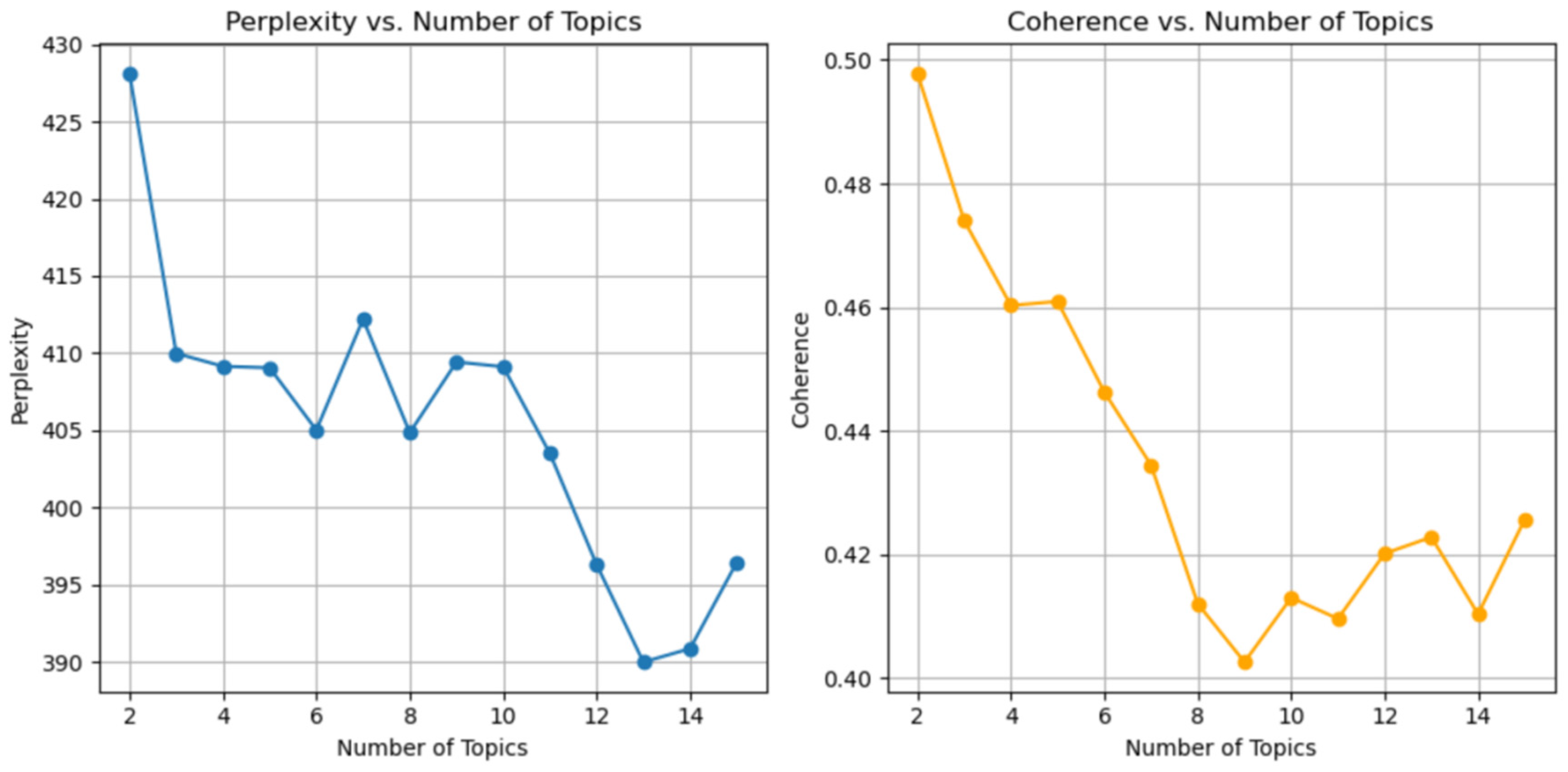
To determine the optimal number of topics for NEV sales positions, we estimated a series of LDA models with different topic numbers and compared their perplexity and coherence scores. Perplexity was first used to assess model fit. As a normalized indicator based on log-likelihood, lower perplexity indicates that the model assigns a higher probability to the observed words in each document and therefore provides a better statistical fit to the corpus. However, previous studies have shown that selecting the number of topics solely on the basis of perplexity may sometimes produce misleading or difficult-to-interpret results. For this reason, particular attention was also given to topic coherence because it provides an important indication of the interpretability of the extracted topics. In other words, models with higher coherence show a lower degree of shared words between topics, meaning that the terms within each topic are more semantically consistent and that there is less confusion as to where each term belongs. As shown in Figure 1, the 14-topic model corresponded to the most appropriate combination of low perplexity and high coherence among the candidate solutions. This suggests that the model not only captured the textual structure of the corpus effectively, but also produced topics that were more representative and semantically interpretable. After manually reviewing the topic keywords and their substantive meanings in the context of NEV sales work, we retained the 14-topic model because it provided the most effective summary of the competency information contained in the job postings. The results of this model are presented in Table 2, and the extracted topics were subsequently organized into higher-order task domains for structured interpretation.
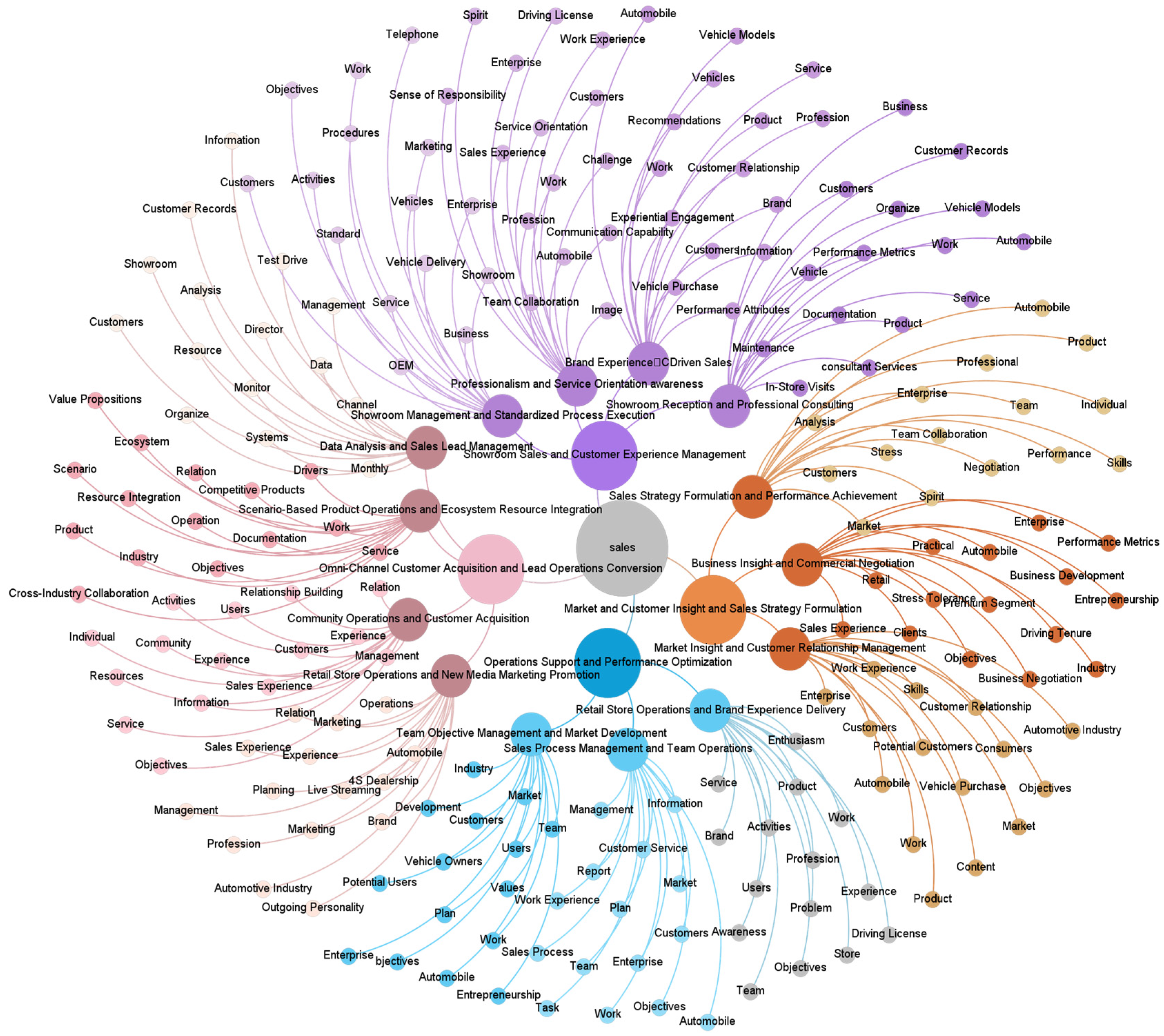
Table 2 reports the LDA topic modeling results for the sales position. Using the top 15 weighted keywords within each topic as the basis for interpretation, topic labeling was conducted and the connotations of the corresponding competencies were specified. During the topic-labeling phase, priority was given to ensuring semantic coverage of the highest-ranking core keywords (e.g., the label was required to capture the meaning of the top 10 keywords), while also considering the clusters suggested by the remaining terms. This procedure ensured that each label reflected the topic’s dominant semantic pattern and prevented drift from the topic center due to overemphasis on individual terms. Drawing on industry context, typical work scenarios, each topic was interpreted as a competency unit and linked to representative tasks. The associations among keywords, competencies, and tasks are visualized in a network graph (Figure 2), revealing the internal semantic structure.
The following paragraphs provide a detailed interpretation of four representative work tasks derived from the key competencies identified through the LDA model. These findings offer critical analytical evidence and theoretical insights into the core functions and competency structure of NEV sales across different stages of related work.

4.1.1. Task 1: Market Insight and Sales Strategy Formulation

This task encompasses three key competencies, namely, business insight and commercial negotiation, market insight and customer relationship management, and sales strategy formulation and performance achievement, highlighting the foundational role of strategic analysis, customer insight, and goal orientation in sales work. Keywords such as “industry,” “premium segment,” and “potential customers” indicate that this function requires a macro-level perspective on industry and market dynamics, beginning with an in-depth understanding of the NEV sector, particularly the premium segment. Terms including “business negotiation,” “entrepreneurship,” “objectives,” and “stress tolerance” point to core competency requirements: sales professionals must not only possess strong commercial negotiation and goal-advancement capabilities, but also demonstrate entrepreneurial spirit and customer development awareness, enabling performance breakthroughs under high-pressure conditions. In addition, keywords such as “team collaboration” and “spirit” emphasize the importance of teamwork and professional conduct to support the effective implementation of sales strategies.

4.1.2. Task 2: Omni-Channel Customer Acquisition and Lead Operations Conversion

This task covers four key competencies, namely, scenario-based product operations and ecosystem resource integration, community operations and customer acquisition, retail store operations and new media marketing promotion, and data analysis and sales lead management, signaling a systematic transformation in NEV sales from traditional channels toward digitalized and ecosystem-based operations. Keywords such as “scenario,” “ecosystem,” and “resource integration” underscore an end-to-end operational mindset centered on user scenarios and cross-ecosystem resource integration. Sales activities are no longer confined to single-point conversion; instead, they are embedded within users’ mobility ecosystems to deliver value. Keywords including “livestreaming,” “marketing,” and “data analysis” reflect two concrete pathways of capability implementation: on the one hand, leveraging livestreaming and new media content formats to enhance brand penetration and user engagement; on the other hand, relying on data tools to enable refined lead management and improve conversion efficiency. Furthermore, terms such as “community” and “relation” emphasize the necessity for cross-boundary collaboration and long-term relationship management, through which differentiated customer acquisition systems can be established in an increasingly competitive market.

4.1.3. Task 3: Showroom Sales and Customer Experience Management

This task includes four competencies, namely, showroom reception and professional consultation, brand experience-driven sales, professionalism and service orientation awareness, and showroom management and standardized process execution, underscoring the irreplaceable role of offline touchpoints in the NEV sales experience. It highlights the importance of customer experience, professional service, and process standardization in offline sales contexts. Keywords such as “showroom,” “brand,” and “experiential engagement” indicate that the showroom is not merely a space for vehicle display, but an experiential arena for communicating brand value and enabling deep user interaction. Core competencies focus on “consultant services,” “service orientation,” and “standardized process,” requiring sales personnel to assume roles as both product and service experts: they must provide professional explanations of technical features of NEV while ensuring consistency in user experience through standardized service processes. Keywords including “vehicle models” and “performance attributes” further suggest that, amid trends toward electrification and intelligentization, professional sales presentations must be deeply integrated with the product’s technological attributes, thereby transforming experience into purchase decisions.

4.1.4. Task 4: Optimization Operations Support and Performance Optimization

This task comprises three competencies, namely, team objective management and market development, sales process management and team operations, and retail store operations and brand experience delivery, reflecting the managerial support and systematic empowerment role of sales functions within organizations. Keywords such as “team,” “objectives,” and “sales process” suggest that this function emphasizes goal decomposition, process control, and team operations to ensure the efficient functioning of the sales system. “Entrepreneurship” and “market development” again echo the importance of proactive market expansion. Moreover, keywords such as “brand,” “experience,” and “service” indicate that operational support ultimately serves brand experience and customer satisfaction, forming a closed-loop optimization system spanning management and execution, process and outcomes, thereby sustaining continuous sales growth in a dynamic market environment.

4.2. Latent Competency Clusters in NEV Livestreaming Host Positions

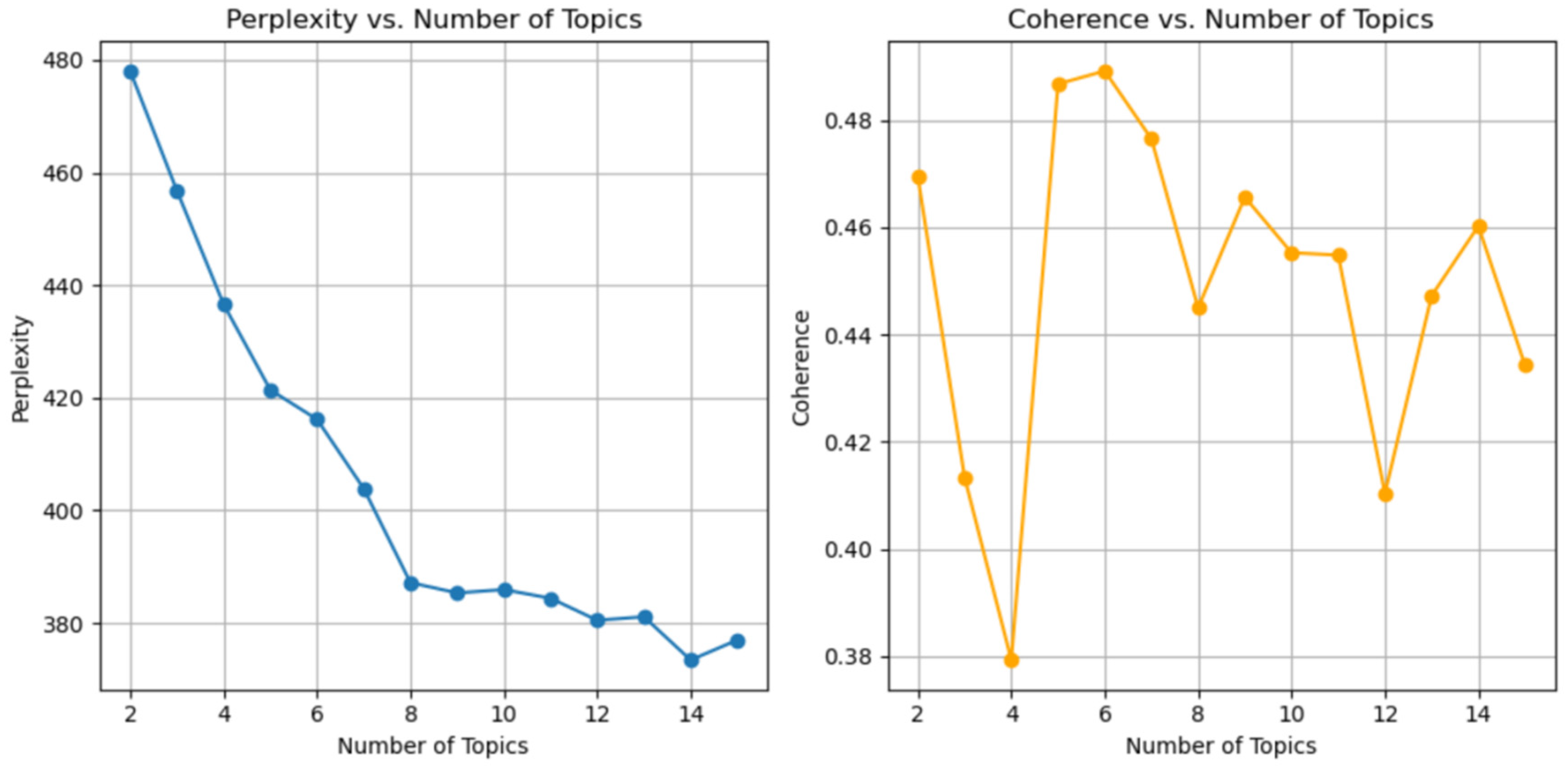
For NEV livestreaming positions, the optimal number of topics was determined using the same procedure by comparing LDA models with different topic numbers in terms of perplexity and coherence. Perplexity was used to assess statistical model fit, while coherence was given particular attention as an indicator of topic interpretability. As shown in Figure 3, the 13-topic model represented the most appropriate combination of low perplexity and high coherence among the candidate solutions. This indicates that the model achieved a good fit to the corpus while yielding semantically clearer and more representative topics. After manually reviewing the topic keywords and their contextual meanings in NEV livestreaming work, we retained the 13-topic model because it provided the most effective summary of the competency information contained in the job postings. The results of the retained model were subsequently grouped into higher-order task domains for structured interpretation.
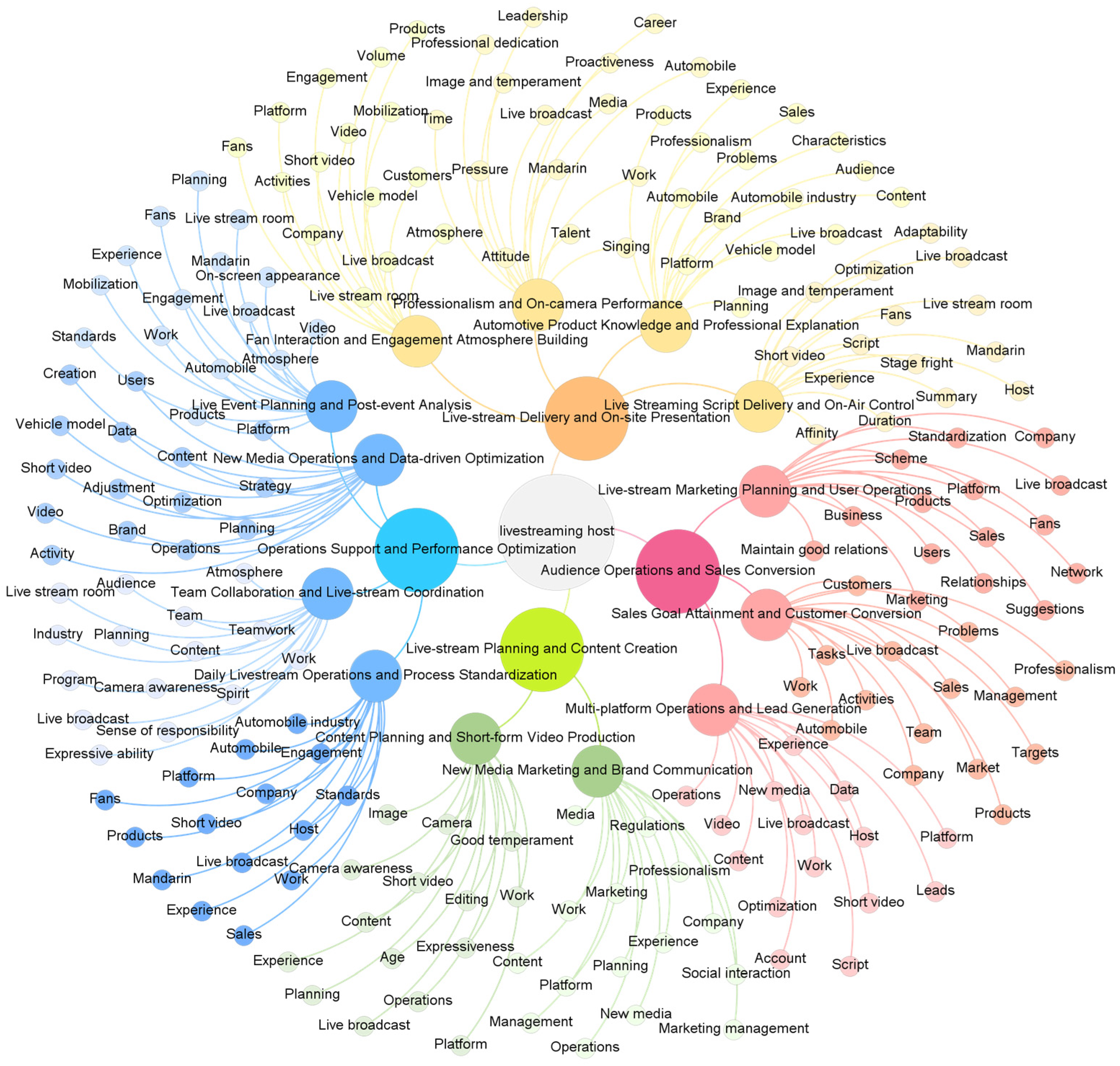
The results of the LDA topic modeling for the NEV livestreaming host position are presented in Table 3. Using the top 15 weighted keywords for each topic as the basis for interpretation, topic labels were assigned by incorporating industry context, typical work scenarios, thereby identifying the key competencies required for the position. Each competency was linked to representative tasks, resulting in a systematic competency framework for the role. The relationships among keywords, competencies, and tasks are visualized in the network graph (Figure 4).
The following part provides a detailed interpretation of four representative work tasks derived from the key competencies identified through the LDA model.

4.2.1. Task 1: Livestream Planning and Content Creation

This task integrates two key competencies: content planning and short-video production and new media marketing and brand communication, which forms the foundation of systematic content construction and brand narrative building in the pre-livestream phase. Keywords such as “planning,” “content,” “editing,” and “image” indicate that livestream hosts are required to possess comprehensive content production capabilities spanning from creative ideation to visual presentation, ensuring that outputs are both informative and highly communicative. Furthermore, keywords including “new media,” “social interaction,” “platform,” and “marketing,” highlight the need for strategic thinking in cross-platform content distribution. Hosts must tailor differentiated content strategies according to platform-specific characteristics in order to effectively convey brand value and establish a professional image within a fragmented media environment. This suggests that NEV livestream hosts have moved beyond the role of mere content executors to become content architects and narrative leaders for brands in digital spaces.

4.2.2. Task 2: Live-Stream Delivery and On-Site Presentation

This task encompasses four key competencies: livestream script delivery and on-air control, professionalism and on-camera performance, automotive product knowledge and professional explanation, fan interaction and engagement atmosphere building. Together, these competencies shape the host’s professional performance and emotional connectivity within real-time communication contexts. Keywords such as “script,” “optimization,” “image and temperament” and “professional dedication” indicate that hosts must fluently translate scripted content into live spoken language while maintaining stable on-camera performance and emotional regulation. Notably, keywords such as “automobile,” “product,” “professionalism,” and “automobile industry” underscore that, in technology-intensive product livestreams, hosts must deeply integrate product expertise to translate complex technical parameters into colloquial and scenario-based explanations. Meanwhile, keywords such as “fans,” “live stream room,” “product,” and “atmosphere” further emphasize the importance of interpersonal engagement skills. Hosts are required to embed interaction within professional explanations, thereby constructing livestream environments characterized by high engagement and strong user participation, and achieving a balance between knowledge dissemination and emotional resonance.

4.2.3. Task 3: Audience Operations and Sales Conversion

This task corresponds to three key competencies: live-stream marketing planning and user operations, sales goal attainment and customer conversion and multi-platform operations and lead generation. It reflects the host’s central role in traffic retention and the formation of a complete commercial loop. Keywords such as “customers,” “sales,” “live broadcast” and “targets” outline a clear pathway from audience activation to transaction completion, requiring hosts not only to maintain user relationships through content and interaction but also to possess strong marketing orientation and sales facilitation capabilities. In combination with keywords such as “platform,” “accounts,” “leads,” “optimization” and “data,” this task highlights the necessity of cross-channel traffic integration and data-driven operational competence. Hosts are expected to systematically track user behavior, optimize traffic acquisition strategies, and realize full-funnel conversion from exposure to lead generation and from interaction to purchase. This evolution indicates that NEV livestream hosts are increasingly assuming the role of “sales growth driver” within automotive marketing systems.

4.2.4. Task 4: Operational Support and Performance Optimization

This task integrates four key competencies: daily livestream operation and process standardization, new media operation and data-driven optimization, live event planning and post-event analysis, team collaboration and live-stream coordination. It emphasizes the host’s role in operational support and continuous improvement within the livestream ecosystem. Keywords such as “standards,” “sales,” and “adjustment” indicate that hosts are required to participate in the development of standardized livestream workflows and to iteratively optimize content, strategies, and execution based on data feedback. Additionally, keywords such as “teamwork spirit,” “sense of responsibility” and “camera awareness” reveal that hosts must possess cross-functional coordination capabilities in large-scale livestream projects, engaging in team-based operations from planning and execution to post-event analysis. This points to the deeper professionalization of NEV livestreaming hosts: they are expected not only to perform as “on-stage presenters” but also to act as “behind-the-scenes operators and collaborators,” driving livestream projects toward greater systematization and professional maturity.

4.3. Gaps Between Industry Requirements and National Standards

This section provides a comparison between industry-defined competency requirements and the national teaching standards to provide context for the subsequent curriculum mapping.

4.3.1. Competency Gaps Across Task Domains in NEV Sales

From the perspective of mapping the sales position competency framework against the national teaching standards, the two demonstrate strong alignment within the task domain of market and customer insight and sales strategy formulation. The nationally prescribed courses, including Automotive Marketing Planning and Consultative Automotive Sales, systematically cover theories and procedural skills such as market research, consumer analysis, marketing strategy formulation, consultative communication, and negotiation. This curricular structure is capable of supporting frontline sales consultants in executing core work processes ranging from needs identification to transaction closure. However, across the other three task domains, the comparison suggests that current industry expectations are not yet fully reflected in the competency of the national teaching standards.
First, in the domain of omni-channel customer acquisition and lead operations conversion, the industry increasingly requires a full operational closed loop capability encompassing multi-channel traffic generation, lead assessment, contact and follow up strategy design, conversion to purchase, and post hoc review for iterative optimization. This domain is particularly dependent on emerging competencies such as private domain community operations, lead data governance and management, scenario-based solution design for new energy vehicles, and the integration of ecosystem resources. By contrast, existing teaching standards remain largely confined to traditional market research and new media content promotion.
Second, in the domain of showroom sales and customer experience management, although the national standards provide explicit coverage of consultative sales processes such as reception, needs analysis, test drive facilitation, and objection handling, thereby meeting baseline requirements for completing the transaction, the industry is upgrading the sales venue from a transaction space to a brand experience space. Accordingly, sales personnel are expected to develop capabilities in brand experience design and experience operations management, yet these competencies are not yet explicitly reflected in current training standards.
Third, in the domain of operations support and performance optimization, competency development on the education side remains positioned primarily at the individual contributor level. In practice, however, the industry has articulated clear expectations for frontline sales roles to develop sales operations and managerial competencies, including team target management, sales process optimization, store level operations management, and market development.

4.3.2. Competency Gaps Across Task Domains in NEV Livestreaming Hosts

For NEV livestreaming hosts, the gap between the derived competency map and the national teaching standards is more salient. The gap extends across most components of the four typical task domains, suggesting relatively limited representation throughout the chain from planning and delivery to operations and optimization. This may reflect the fact that, as a representative occupation shaped by emerging business models, the core competencies required of livestream hosts are not yet fully reflected in the current curriculum system.
First, within the domain of live stream planning and content creation, the national standard course Automotive Online and New Media Marketing addresses basic skills related to the production of graphic content and short videos, as well as platform-based dissemination. However, its instructional objectives remain limited to the ability to produce and publish content, whereas industry practice requires the development of a conversion-oriented content system. Competencies associated with conversion driven content planning, including content strategy formulation, content matrix design, the use of short videos to drive traffic to livestream sessions, and coordinated mechanisms linking livestreaming with secondary distribution of livestream content, are largely absent from current educational provision.
Second, the domain of live stream delivery and on-site presentation represents the most concentrated area of omission within the national teaching standards. Livestream specific delivery skills, including script performance, live session control, on camera expressiveness, real time responsiveness, customer interaction, and atmosphere building, have no corresponding modules in existing courses. It should be emphasized that, although automotive product knowledge is partially covered in traditional sales curricula, the capability to explain products in a livestream context oriented toward audience and characterized by short duration, high frequency, strong attention capture, and real time interaction differs fundamentally from one to one consultative communication in both the organization of knowledge and the logic of expression. To date, these capabilities have not been recognized as an independent set of occupational competencies to be cultivated.
Third, within the domain of audience operations and sales conversion, the teaching standards merely reference attracting customers through new media platforms and do not extend to a conversion-oriented operational logic for user management. Competencies in user operations and sales conversion, including audience segmentation within livestream rooms, private domain accumulation, user lifecycle management, conversion pathway design, cross platform content distribution, and coordinated traffic acquisition through multi account matrix operations, have not been incorporated into training objectives.
Finally, within the domain of operations support and performance optimization, the national teaching standards provide no cultivation of back end operational support competencies for livestreaming. This includes daily livestream operations and process standardization, data monitoring and data-driven optimization decision making, live event planning and post event review and analysis, as well as collaborative workflows and responsibility delineation among roles such as technical directors, floor controllers, and customer service staff within livestream teams. These competencies constitute a highly practiced intensive occupational skill set. The absence of this dimension not only signals discrete skill gaps but also reflects the fact that vocational education has yet to establish a comprehensive competency framework and a clear curricular translation pathway for the emerging occupational cluster of livestream operations.

5. Discussion

5.1. Key Findings and Theoretical Contributions

Based on topic extraction from job postings and work-process logic, this study develops work-process-oriented competency maps for two typical frontline marketing roles in the NEV sector: sales consultants and livestreaming hosts. Rather than taking the form of fragmented skill items, the competencies required for these positions are organized through linked task domains and work processes. In this respect, the study responds to the limited attention that previous research has paid to competency identification in the specific context of NEV marketing. On this basis, the study advances existing competency modeling in two respects. First, prior studies have often represented job competencies as lists of skills or competency items [37,38,41]. While influential frameworks such as the iceberg model and the KSAO model have provided important classification logics, they less clearly explain how competencies are enacted through concrete tasks in specific occupational contexts. Second, from the perspective of competency-based education (CBE) theory, vocational curriculum development should be grounded in the analysis of occupational positions and task requirements. Building on this perspective, the present study advances data-driven competency modeling by locating competencies in specific work situations and task processes rather than in abstract categories alone, and by developing a conceptual position–task–competency–curriculum mapping framework that links occupational change to curriculum design. In this way, it extends the conventional competency-list approach from an attribute-based perspective to a process-embedded perspective that is more directly relevant to curriculum development.
Moreover, these findings extend existing research on livestreaming host competencies in two related ways. First, they provide demand-side evidence for the established three-dimensional competency set of livestreaming hosts in the NEV context. Existing evidence on livestreaming host competencies has largely been generated in the context of general e-commerce, fast-moving consumer goods, and other low-involvement product categories, relying predominantly on surveys, experiments, or small-sample qualitative materials [18,19,20,26]. By contrast, research and demand-side evidence on the competency structure of livestreaming hosts in NEV-related e-commerce settings remain relatively limited [18]. In particular, previous studies have rarely drawn on large-scale recruitment evidence to identify the competencies required for emerging frontline roles such as automobile livestreaming hosts. Addressing this gap, the present study uses job postings as labor-market expectations and identifies competency clusters for NEV livestreaming roles that can still be interpreted through the three established dimensions. It provides supplementary evidence based on the standardized, normative language of corporate recruitment requirements, including nonverbal presentation and real-time on-air control (for example, Professionalism and On-camera Performance and Live Streaming Script Delivery and On-Air Control) [19,20,28], social interaction and atmosphere building (for example, Fan Interaction and Engagement Atmosphere Building) [18,26], and cognitive competence and professional explanation (for example, Automotive Product Knowledge and Professional Explanation) [18,19,27]. Second, on this basis, the study proposes a testable product-category boundary condition for livestreaming host competencies [18]. NEVs are characterized by high involvement, high price, greater technical complexity, and longer decision cycles. In this context, the competency structure of livestreaming hosts appears to extend beyond content delivery and affective interaction to include requirements for professional explanation, lead generation, coordination in customer conversion from online to offline, and data-driven optimization. This suggests that, in high-complexity and high-risk product settings, livestreaming hosts are positioned not only as content performers but also as conversion-oriented actors embedded in the broader digital marketing and sales process. This distinction becomes clearer when compared with traditional marketing and sales skills reported in prior research. The competencies identified here for NEV livestreaming hosts are not merely conventional sales communication, product explanation, and transaction-support abilities transferred to an online setting. Traditional sales competency frameworks have typically emphasized communication and coordination, product and brand knowledge, sales techniques, and transaction support. By contrast, NEV livestreaming competencies reflect a platform mediated reconfiguration of these capabilities under real-time, conversion-oriented conditions. In this context, on-air control requires simultaneous management of presentation rhythm, audience attention, interaction intensity, and affective atmosphere during live delivery. Likewise, conversion-loop design involves integrating traffic attraction, audience segmentation, cross-platform lead handover, and the linkage of online EV product education with offline test-drive experiences through collaboration with sales staff in designing the customer journey.
Finally, the study contributes to the vocational curriculum literature by integrating topic extraction from job postings with curriculum analysis to identify competency structures and curriculum gaps in emerging occupations. It also addresses the limited attention that prior research has given to linking competency analysis with vocational education standards and curriculum frameworks. Using large-scale job postings as observable labor-market demand data, the study combines topic extraction with curriculum analysis to identify competency structures in emerging occupations and to explore their alignment with curriculum competency units. In this respect, the findings suggest that curriculum alignment is not only a matter of matching content to job requirements, but also of establishing a structured linkage between occupational positions, task domains, competencies, and curriculum units. Sales positions appear to be relatively aligned with existing educational standards in areas such as market & customer insight and sales strategy, although gaps remain in lead conversion, customer experience management, and performance optimization. By contrast, livestreaming host roles show broader competency gaps, particularly in on-air presentation and interactive control, customer conversion process design, and data-driven optimization. These patterns indicate that curriculum gaps vary across emerging occupations according to differences in work processes and competency structures. On this basis, the study offers a work-process-oriented perspective on how occupational change can be translated into curriculum adjustment and competency gap identification in emerging digital occupations.

5.2. Practical Contributions: From Position–Task–Competency Map to Curriculum Design

For NEV sales positions, national standards and industry needs are largely aligned in the task domain of market and customer insight and sales strategy formulation. Existing courses already cover the basic process from demand identification to transaction completion; therefore, curriculum reform should focus on competency gaps in the remaining three task domains. In omni-channel customer acquisition and lead operations conversion, relevant content currently dispersed across modules such as market research and content promotion should be integrated into a coherent, core course. A dedicated module on omni-channel lead operations and CRM should be added, adopting work-process-oriented, project-based training. This module should implement process-oriented evaluation across the full cycle of tasks, including lead development, tiered lead management, follow-up strategies, and conversion analytics. In showroom sales and customer experience management, curriculum design should respond to the trend of showrooms evolving from transaction-oriented spaces into brand experience spaces, thereby shifting sales practice from consultative selling to experiential selling. A module on brand experience design and showroom experience operations should be introduced, with an emphasis on cultivating students’ ability to translate technological attributes into scenario-based value in the context of intelligent NEVs. Focusing on key experience touchpoints such as test drives, vehicle delivery, and events, the module should employ case-based instruction and situational practice to develop competencies in customer journey design and test-drive experience proposal presentations, ensuring that experience delivery becomes designable, manageable, and assessable.
Meanwhile, to address emerging industry demands for cross-ecosystem collaboration, a work-integrated learning (WIL) project entitled “NEV ecosystem resource integration and conversion solution design” should be introduced. The project simulates cross-industry partnership scenarios and employs pitch-based presentations with dual assessment by industry partners and university faculty, with the aim of strengthening students’ competencies in resource integration and the development of integrated proposals for complex business scenarios. Regarding operations support and performance optimization, to compensate for gaps in composite competencies such as team goal management and store operations management, a module on sales operations and performance optimization should be added. Through team-based projects, students should be trained in goal decomposition, process indicators, workflow optimization, and post-action review and continuous improvement, thereby expanding competency development from individual deal-closing to team-level operational management.
For NEV livestreaming host positions, competency gaps extend across the entire work process, including live-stream content planning, live-stream delivery, audience operations and sales conversion, and performance optimization. This suggests that the competency set required by this emerging role remains, to a large extent, outside the framework of the existing curriculum system. Curriculum updating should adopt a work-process-oriented approach to construct a livestreaming competency framework oriented toward sales closing and conversion outcomes. In the domain of live-stream planning and content creation, a conversion-oriented content planning module should be incorporated into Automotive Internet and New Media Marketing. The training objectives should be elevated from content production to the design of conversion pathways. Instruction should be organized around project planning as the central thread, and assessment should focus on content strategy, coordination within a content matrix, and the effectiveness of secondary distribution. In the domain of live-stream delivery and on-site presentation, a new course entitled NEV Live-stream Delivery and Session Control should be established. The course should systematically cover live-stream-specific competencies, including script performance, pacing and session control, camera presentation, real-time contingency handling, and interactive atmosphere building. For example, the competency of real-time interaction can be translated into a short vocational module on live audience response practice, in which students handle instant questions, recognize audience emotions, and respond to unexpected situations in simulated NEV livestreaming sessions. Assessment can be based on timed product presentation, immediacy of response, and appropriateness of interaction. Feedback-enabled training approaches should be adopted, including practical drills, recorded session review and reflection, and online vehicle presentation competitions.
In the domain of audience operations and sales conversion, a module for live-stream audience operations and conversion pathway design should be added. This module should include audience segmentation within the live-stream session, customer life-cycle management, and conversion pathway design. Through operational simulations or project-based practicums, students should produce actionable lead handoff and conversion plans. In the domain of operations support and performance optimization, an advanced module on live-stream operations and data-driven optimization may be developed as an extension of Automotive Internet and New Media Marketing. Implemented through a comprehensive team project, this module should train students to complete the full process from NEV event planning, solution execution, and role allocation to data monitoring, analysis, diagnosis, and optimization. The accuracy of data reporting, the depth of analysis, and the effectiveness of team collaboration should serve as the core assessment dimensions.

5.3. Limitations and Future Research Directions

This study uses Zhaopin as the primary data source because the platform offers relatively broad employer coverage in China’s recruitment market and features a higher degree of standardization in job posting information and comparatively normative textual descriptions. These characteristics help enhance corpus consistency and better satisfy the text quality requirements of LDA topic modeling. At the same time, job postings have inherent limitations as an indicator of competency requirements. They capture employers’ expressed demand rather than the competencies enacted in day-to-day work, and may therefore reflect aspirational or idealized expectations. In addition, the content of job postings may be shaped by template-based posting practices, firm heterogeneity, and signaling strategies, which may bias the observed competency patterns. From an implementation perspective, multi-platform data collection can introduce cross-channel duplicate postings and highly homogeneous texts, which increases the difficulty of deduplication and maintaining sample independence. Nevertheless, a single-platform design also implies that the findings are more likely to reflect the competency demands of firms that are active on this platform, tend to use more standardized recruitment language, and are concentrated in major urban markets. Therefore, the applicability of these conclusions to other recruitment channels and lower-tier markets remains to be examined in future research.
In addition to data-source limitations, this study is also subject to several methodological limitations inherent in LDA. Although LDA has been successfully applied in prior research, it relies on word co-occurrence patterns rather than contextual meaning. As a result, it does not fully capture word order, syntactic structure, or other subtle semantic dependencies in job postings, which may lead to minor discrepancies in topic boundaries and interpretation. Moreover, although topic-number selection in this study was informed by perplexity, coherence, and manual semantic review, LDA results remain somewhat sensitive to the choice of topic number. Furthermore, while topic labeling followed explicit interpretive criteria and interdisciplinary team review, formal intercoder reliability testing was not conducted. Some degree of subjectivity in theme interpretation therefore cannot be entirely ruled out. Accordingly, the findings should be viewed as an exploratory mapping of market demand rather than a definitive taxonomy of competencies. Future research could strengthen robustness by triangulating LDA findings with embedding-based topic models, supervised text classification, qualitative coding, and multiple independent coders and reporting agreement statistics.
A further limitation concerns the temporal boundary of the dataset. This study models recruitment texts from August 2025 to January 2026 and maps the core competency profiles for NEV sales and livestream host positions during this period. As an exploratory study, this design provides a foundational framework for understanding current competency requirements for frontline marketing roles in the NEV industry. However, artificial intelligence (AI) technologies are rapidly permeating NEV marketing scenarios, including intelligent cockpit interaction, interpretation of automated driving functions, and AI-assisted sales and content production tools. Together with changes in the market environment, these developments are likely to continuously reshape job tasks and competency requirements. Constrained by the temporal boundary of the study, the findings constitute a competency snapshot of a specific period and do not trace the dynamic evolution of competency structures driven by technological penetration and market shifts. For example, the study does not capture emerging capabilities such as tool coordination in human–machine collaboration contexts for sales consultants and livestream hosts, creative development and calibration of AI-generated content, and the novel hybrid competencies derived from these demands. These dynamic processes should be further examined in future research through longitudinal tracking and analysis.
Moreover, based on a competency gap analysis, this study proposes recommendations that map from “position–task–competency” to the restructuring of curriculum modules, thereby providing a theoretical basis and substantive reference for updating talent development programs in new energy vehicle marketing within vocational colleges. However, this article has not yet empirically tested the feasibility of the proposed curriculum recommendations or their learning outcomes in real instructional settings. The effectiveness of the proposed curriculum modules and their contribution to improving students’ job-role alignment require further validation in subsequent research through instructional interventions and outcome evaluations.
Accordingly, future research can extend and validate these findings in the following directions, with particular attention to external validity, methodological robustness, dynamic evolution, and practice-based verification. To enhance external validity, future studies may examine the robustness of the competency map through cross-platform and cross-regional comparisons and identify differences in competency demands across market contexts. Methodological triangulation can also be introduced to strengthen the robustness and interpretive validity of the competency map. On the employer side, semi-structured interviews or Delphi studies with HR professionals, dealership managers, and heads of livestream operations can be conducted to assess whether the LDA-derived topics correspond to the underlying structure of real work tasks. On the employee side, behavioral event interviews or task-diary analysis can be used to uncover tacit and contextual competencies that recruitment texts seldom make explicit, thereby constructing a more comprehensive chain of evidence.
Against the backdrop of the continued penetration of artificial intelligence into frontline marketing processes, future research may also adopt a dynamic evolutionary perspective and deepen inquiry in two respects. First, it should focus on the mechanisms through which technological intervention reshapes competency structures. As AI tools assume part of standardized work content, researchers should investigate how the competency focus of sales staff and livestream hosts shifts toward higher-value activities within human–machine collaboration contexts, and which competencies are strengthened, substituted, or newly generated. Second, future research should explore the temporal rhythm and evolutionary pathways of competency updating. Longitudinal tracking designs can be employed to identify trajectories of competency themes over time, distinguish rapidly changing competencies from relatively stable ones, and provide evidence for the pace and priorities of curriculum renewal.
Future research may also move from gap identification to practice-based validation. First, curriculum intervention studies can be conducted by developing instructional units based on the curriculum modules proposed in this study, such as omni-channel lead management, livestream facilitation and audience interaction for NEV products, and livestream data review and optimization. Quasi-experimental or design-based research in vocational colleges can then test the actual effects of these courses on students’ competency development through pretest–posttest designs and controlled comparisons. Second, benchmarking against enterprise KPIs can be pursued by aligning curriculum evaluation indicators with business performance metrics, such as lead-capture rates, dealership-visit rates, and test-drive conversion rates, thereby validating the effectiveness and transferability of the position–competency–curriculum closed loop.

Author Contributions

Conceptualization, Y.Z. and W.D.; Methodology, Y.Z.; Validation, L.T. and W.D.; Formal analysis, Y.Z.; Investigation, Y.Z. and L.T.; Data curation, Z.X.; Writing—original draft, Y.Z.; writing—review and editing, Y.Z., Z.X. and W.D; Visualization, Z.X.; Supervision, W.D and L.T.; Project administration, W.D.; Funding acquisition, Y.Z. & L.T and W.D. All authors have read and agreed to the published version of the manuscript.

Funding

This research was funded by [Jiangsu Province Higher Education Teaching Reform Research Project] grant number [2025JGYB674] And [National Natural Science Foundation of China General Program] grant number [No. 71972098] And [Jiangsu Province Higher Education Teaching Reform Research Project] grant number [2025JGZZ50] and [Jiangsu Vocational Education Research Project] grant number [XHZDB2025040] and [Special Project of Suzhou Polytechnic University] grant number [GJSZX-260110] and [Jiangsu Provincial Universities Philosophy and Social Sciences Research Project] grant number [2022SJYB1631].

Institutional Review Board Statement

This study was conducted in accordance with the Declaration of Helsinki and approved by the Institutional Review Board (or Ethics Committee) of SUZHOU POLYTECHNIC UNIVERSITY (protocol code SPU20250523 and date of approval: 23 May 2025).

Informed Consent Statement

Informed consent was obtained from all subjects involved in the study.

Data Availability Statement

The original contributions presented in this study are included in the article. Further inquiries can be directed to the corresponding author.

Conflicts of Interest

The authors declare no conflicts of interest.

References

  1. Roland, I. Global EV Sales for 2023. Available online: https://ev-volumes.com/news/ev/global-ev-sales-for-2023/?_gl=1*w96s37*_up*MQ.*_ga*MTUzNDEyMzE2Mi4xNzYwNDkzOTU2*_ga_JVQHCS66Z*czE3NjA0OTM5NTUkbzEkZzEkdDE3NjA0OTM5NjckajQ4JGwwJGgxNzY2NzAzMzgy (accessed on 15 January 2026).
  2. Neil, K. Are Global EV Sales Forecast to Improve by the End of 2024? Available online: https://ev-volumes.com/news/ev/are-global-ev-sales-forecast-to-improve-by-the-end-of-2024/?_gl=1*r9lndg*_up*MQ.*_ga*OTI0NTI5MDg4LjE3NjExMTUwMDM.*_ga_9JVQHCS66Z*czE3NjExMTUwMDIkbzEkZzEkdDE3NjExMTY0OTckajYwJGwwJGgxMjA3NzUzODY1 (accessed on 15 January 2026).
  3. International Energy Agency (IEA). Global EV Outlook 2025. Available online: https://www.iea.org/reports/global-ev-outlook-2025 (accessed on 15 January 2026).
  4. China Center for Information Industry Development (CCID). CCID Released “2023 New Energy Vehicle Industry Talent Development Report”. Available online: https://www.ccidgroup.com/info/1155/39608.htm (accessed on 15 January 2026).
  5. Xinhua News Agency. China’s Production and Sales of New Energy Vehicles Both Exceeded 16 Million Units in 2025. Available online: https://www.gov.cn/yaowen/liebiao/202601/content_7054738.htm (accessed on 15 January 2026).
  6. Dong, H.; Zhao, P.; Ngai, C.S.B. Engaging social media users with corporate social responsibility messages: An integrated theoretical approach in the automotive industry during social media era. PLoS ONE 2025, 20, e0322481. [Google Scholar] [CrossRef] [PubMed]
  7. Ministry of Education of China. Teaching Standards for the Major of Automotive Technology Service and Marketing (Higher Vocational Education). Available online: http://www.moe.gov.cn/s78/A07/zcs_ztzl/2017_zt06/17zt06_bznr/bznr_zyjyzyjxbz/gdzyjy_zk/zk_jtysdl/jtysdl_tlysl/202502/P020250207534169626718.pdf (accessed on 15 January 2026).
  8. Yusop, S.R.M.; Rasul, M.S.; Mohamad Yasin, R.; Hashim, H.U.; Jalaludin, N.A. An assessment approaches and learning outcomes in technical and vocational education: A systematic review using PRISMA. Sustainability 2022, 14, 5225. [Google Scholar] [CrossRef]
  9. Parry, S.B. Just What Is a Competency? (And Why Should You Care?). Training 1996, 35, 58. [Google Scholar]
  10. Campion, M.A.; Fink, A.A.; Ruggeberg, B.J.; Carr, L.; Phillips, G.M.; Odman, R.B. Doing competencies well: Best practices in competency modeling. Pers. Psychol. 2011, 64, 225–262. [Google Scholar] [CrossRef]
  11. Spencer, L.M.; Spencer, P.S.M. Competence at Work Models for Superior Performance; John Wiley & Sons: Hoboken, NJ, USA, 2008. [Google Scholar]
  12. Mulder, M. Foundations of competence-based vocational education and training. In Handbook of Vocational Education and Training; Springer: Berlin/Heidelberg, Germany, 2019; pp. 1–26. [Google Scholar]
  13. Winterton, J. Competence-Based Vocational and Professional Education; Springer: Dordrecht, The Netherlands, 2017. [Google Scholar]
  14. Tūtlys, V.; Spöttl, G. From the analysis of work-processes to designing competence-based occupational standards and vocational curricula. Eur. J. Train. Dev. 2017, 41, 50–66. [Google Scholar] [CrossRef]
  15. Nylund, M.; Rosvall, P.Å.; Ledman, K. The vocational–academic divide in neoliberal upper secondary curricula: The Swedish case. J. Educ. Policy 2017, 32, 788–808. [Google Scholar] [CrossRef]
  16. Gessler, M.; Howe, F. From the reality of work to grounded work-based learning in German vocational education and training: Background, concept and tools. Int. J. Res. Vocat. Educ. Train. (IJRVET) 2015, 2, 214–238. [Google Scholar] [CrossRef]
  17. Pacher, C.; Woschank, M.; Zunk, B.M. The role of competence profiles in industry 5.0-related vocational education and training: Exemplary development of a competence profile for industrial logistics engineering education. Appl. Sci. 2023, 13, 3280. [Google Scholar] [CrossRef]
  18. Liao, M.; Fang, J.; Han, L.; Wen, L.; Zheng, Q.; Xia, G. Boosting eCommerce sales with livestreaming in B2B marketplace: A perspective on live streamers’ competencies. J. Bus. Res. 2023, 167, 114167. [Google Scholar] [CrossRef]
  19. Xian, T.; Fang, Z.; Huang, Z.; Niu, Y.; Liao, C. Benefit appeals in livestreaming E-commerce: The moderating role of influencers’ facial beauty and body motion. J. Advert. Res. 2025, 1–33. [Google Scholar] [CrossRef]
  20. Cui, Y.; Yu, J.; Xie, C.; Fang, X.; Wu, Y. The marketing value of livestreaming in exhibitions and its impact on buyers. J. Bus. Ind. Mark. 2025, 40, 1936–1954. [Google Scholar] [CrossRef]
  21. Bobrytskyy, S.; Stříteský, V. A systematic review of online marketing effects on online and offline sales: A framework and state of research. Market-Tržište 2024, 36, 59–82. [Google Scholar] [CrossRef]
  22. Royle, J.; Laing, A. The digital marketing skills gap: Developing a Digital Marketer Model for the communication industries. Int. J. Inf. Manag. 2014, 34, 65–73. [Google Scholar] [CrossRef]
  23. Peesker, K.M.; Ryals, L.J.; Kerr, P.D. Toward an understanding of the personal traits needed in a digital selling environment. J. Bus. Ind. Mark. 2024, 39, 1687–1703. [Google Scholar] [CrossRef]
  24. Corsaro, D.; Maggioni, I. The transformation of selling for value co-creation: Antecedents and boundary conditions. Mark. Theory 2022, 22, 563–600. [Google Scholar] [CrossRef]
  25. Alamäki, A.; Korpela, P. Digital transformation and value-based selling activities: Seller and buyer perspectives. Balt. J. Manag. 2021, 16, 298–317. [Google Scholar] [CrossRef]
  26. Tao, M.; Alam, F.; Lahuerta-Otero, E.; Mengyuan, C. Get ready to buy with me: The effect of social presence interaction and social commerce intention on s-commerce live streaming. Sage Open 2024, 14, 21582440241232751. [Google Scholar] [CrossRef]
  27. Huang, S.L.; Chen, Y.C. Understanding how best to host livestream shopping shows: The perspectives of persuasion and parasocial phenomena. Cyberpsychol. J. Psychosoc. Res. Cyberspace 2025, 19, 5. [Google Scholar] [CrossRef]
  28. Li, L.; Chen, X.; Zhu, P. How do e-commerce anchors’ characteristics influence consumers’ impulse buying? An emotional contagion perspective. J. Retail. Consum. Serv. 2024, 76, 103587. [Google Scholar] [CrossRef]
  29. Oviawe, J.I.; Uwameiye, R.; Uddin, P.S.O. Bridging skill gap to meet technical, vocational education and training school-workplace collaboration in the 21st century. Int. J. Vocat. Educ. Train. Res. 2017, 3, 7–14. [Google Scholar]
  30. Chau, K.T.; Liu, T.; Liu, W.; Niu, S.; Chan, C.C. Translation of electric vehicle research into education. World Electr. Veh. J. 2025, 16, 327. [Google Scholar] [CrossRef]
  31. Chau, K.T.; Chan, C.C.; Niu, S.; Liu, W.; Liu, T. Graduate degree in electric vehicles—A timely programme for modern society. World Electr. Veh. J. 2025, 16, 31. [Google Scholar] [CrossRef]
  32. Ravi, R.; Belkasmi, M.; Douadi, O.; Faqir, M.; Essadiqi, E.; Gargab, F.Z.; Ezhilchandran, M.; Kasinathan, P. Advancing sustainable transportation education: A comprehensive analysis of electric vehicle prototype design and fabrication. World Electr. Veh. J. 2024, 15, 354. [Google Scholar] [CrossRef]
  33. Dahm, J.; Kauffeld, S. The New Road Ahead: Future Competencies for the Automotive Industry. Available online: https://papers.ssrn.com/sol3/papers.cfm?abstract_id=5353527 (accessed on 15 January 2026).
  34. Yu, H.C.; Hsueh, T.J.; Wu, T.Y.; Liu, C.; Liao, C.-W.; Fu, Y.-K. A competency framework for electric vehicle maintenance technicians: Addressing the environmental, social, and governance (ESG) imperatives of the BEV industry. World Electr. Veh. J. 2025, 16, 314. [Google Scholar] [CrossRef]
  35. Liao, C.W.; Chang, C.P.; Lee, H.C.; Lee, H.-Y.; Liao, Y.-C. Research on Core Competency Indicators for Battery Electric Vehicle Sales Personnel: Aligning with SDG Goals for Sustainable Mobility and Workforce Development. World Electr. Veh. J. 2025, 16, 213. [Google Scholar] [CrossRef]
  36. Culasso, F.; Gavurova, B.; Crocco, E.; Giacosa, E. Empirical identification of the chief digital officer role: A latent Dirichlet allocation approach. J. Bus. Res. 2023, 154, 113301. [Google Scholar] [CrossRef]
  37. Gurcan, F.; Cagiltay, N.E. Big data software engineering: Analysis of knowledge domains and skill sets using LDA-based topic modeling. IEEE Access 2019, 7, 82541–82552. [Google Scholar] [CrossRef]
  38. Djunaidi, K.; Kusuma, D.T.; Ningrum, R.F.; Siswipraptini, P.C.; Murad, D.F. Big Data Analytics of Knowledge and Skill Sets for Web Development Using Latent Dirichlet Allocation and Clustering Analysis. Int. J. Adv. Comput. Sci. Appl. 2025, 16, 233–244. [Google Scholar] [CrossRef]
  39. Kang, P.S.; Enstroem, R.; Bhawna, B.; Bennett, O. A text mining study of competencies in modern supply chain management with skillset mapping. Supply Chain. Anal. 2025, 10, 100117. [Google Scholar] [CrossRef]
  40. Gurcan, F.; Gudek, B.; Menekse Dalveren, G.G.; Derawi, M. Future-Ready Skills Across Big Data Ecosystems: Insights from Machine Learning-Driven Human Resource Analytics. Appl. Sci. 2025, 15, 5841. [Google Scholar] [CrossRef]
  41. Zhou, Y.; Xue, Z.; Dai, W.; Chen, G. Redefining Talent for Smart Mobility: A Data-Driven Competency Framework for NEV Sales and Marketing in the Digital Era. World Electr. Veh. J. 2025, 17, 18. [Google Scholar] [CrossRef]
  42. Fettach, Y.; Ghogho, M.; Benatallah, B. Knowledge graphs in education and employability: A survey on applications and techniques. IEEE Access 2022, 10, 80174–80183. [Google Scholar] [CrossRef]
  43. Lin, L.; Chen, Y. Evolution of Chinese original-innovation talent policies: A topic modelling approach. Technol. Anal. Strateg. Manag. 2024, 36, 4128–4143. [Google Scholar] [CrossRef]
  44. Khaouja, I.; Kassou, I.; Ghogho, M. A survey on skill identification from online job ads. IEEE Access 2021, 9, 118134–118153. [Google Scholar] [CrossRef]
  45. Gavrilescu, M.; Leon, F.; Minea, A.A. Techniques for transversal skill classification and relevant keyword extraction from job advertisements. Information 2025, 16, 167. [Google Scholar] [CrossRef]
  46. Lukauskas, M.; Šarkauskaitė, V.; Pilinkienė, V.; Stundžienė, A.; Grybauskas, A.; Bruneckienė, J. Enhancing skills demand understanding through job ad segmentation using NLP and clustering techniques. Appl. Sci. 2023, 13, 6119. [Google Scholar] [CrossRef]
  47. Han, X.; Li, B.; Wang, Z. An attention-based neural framework for uncertainty identification on social media texts. Tsinghua Sci. Technol. 2019, 25, 117–126. [Google Scholar] [CrossRef]
  48. Zhen, F.; Xi, G.; Zhang, S.; Qin, X. Tomorrow’s Smart Cities: Reflections on the Chinese Practices of Smart Cities and Strategy Development for the Future. Chin. Geogr. Sci. 2025, 35, 929–944. [Google Scholar] [CrossRef]
  49. Xiong, A.; Liu, D.; Tian, H.; Liu, Z.; Yu, P.; Kadoch, M. News keyword extraction algorithm based on semantic clustering and word graph model. Tsinghua Sci. Technol. 2021, 26, 886–893. [Google Scholar] [CrossRef]
  50. Jelodar, H.; Wang, Y.; Yuan, C.; Feng, X. Latent Dirichlet allocation (LDA) and topic modeling: Models, applications, a survey. Multimed. Tools Appl. 2019, 78, 15169–15211. [Google Scholar] [CrossRef]
  51. Goyal, A.; Kashyap, I. Latent Dirichlet Allocation-An approach for topic discovery. In 2022 International Conference on Machine Learning, Big Data, Cloud and Parallel Computing (COM-IT-CON); IEEE: Piscataway, NJ, USA, 2022; Volume 1, pp. 97–102. [Google Scholar]
  52. Chauhan, U.; Shah, A. Topic modeling using latent Dirichlet allocation: A survey. ACM Comput. Surv. (CSUR) 2021, 54, 1–35. [Google Scholar] [CrossRef]
  53. Heinrich, G. Parameter Estimation for Text Analysis; Fraunhofer IGD: Darmstadt, Germany, 2005. [Google Scholar]
Figure 1. Perplexity and Coherence under different numbers of topics (sales).
Wevj 17 00162 g001
Figure 2. Position–Task–Competency Map for NEV Sales. (Different task domains are represented by distinct colors).
Wevj 17 00162 g002
Figure 3. Perplexity and Coherence under different numbers of topics (livestreaming host).
Wevj 17 00162 g003
Figure 4. Position–Task–Competency Map for NEV Livestreaming Host. (Different task domains are represented by distinct colors).
Wevj 17 00162 g004
Table 1. Main Instructional Content and Requirements of Core Courses in the Automobile Technology Service and Marketing Major.
Course DomainDescription of Typical Work Tasks
Automotive Marketing PlanningOn the basis of market research and forecasting results, and through analysis of consumer psychology and behavior in the target market, marketing strategies are systematically proposed, marketing plans are formulated, and implementation activities are organized and executed.
Automotive Online and New Media MarketingThrough analysis of the automotive online and new media marketing environment, and in response to evolving consumer concept trends, promotional content: such as graphic materials, advertorials, and videos, which is developed to attract target customers and implemented via new media platforms for automotive marketing purposes.
Automotive Consultative SalesIn accordance with the automotive sales workflow, consumer behavior analysis methods are applied to conduct consultative vehicle recommendations and to complete vehicle sales transactions.
Automotive Maintenance ServicesFollowing the workflow of automotive after-sales service consulting, service reception activities are conducted for vehicle maintenance, repair, three-guarantee claims, and insurance accident vehicle repairs, as well as post-repair vehicle delivery.
Automotive Insurance and ClaimsIn alignment with automotive insurance operational workflows, insurance application and underwriting tasks are carried out; accident vehicle inspection and damage assessment are conducted; and compensation calculation for insurance claims is completed.
Used Vehicle Inspection, Evaluation, and TradingBased on the operational workflow of used vehicle inspection, evaluation, and trading, and in combination with key technical assessment criteria for vehicle condition, used vehicle inspection, valuation, and transaction activities are completed.
Automotive Shared Mobility ServicesIn accordance with the operational processes and standards of automotive shared mobility enterprises, activities related to business promotion, operational management, vehicle operation, and maintenance management are carried out.
Table 2. Cluster and thematic interpretation for sales positions.
Cluster NumberThematic InterpretationRelevant WordsRate %
1Business Insight and Commercial Negotiation Industry; Automobile; Premium Segment; Sales Experience; Enterprise; Driving Tenure; Stress Tolerance; Business Negotiation; Objectives; Retail; Entrepreneurship; Business Development; Performance Metrics; Practical; Commercial3.3
2Market Insight and Customer Relationship ManagementAutomobile; Customers; Product; Enterprise; Automotive Industry; Customer Relationship; Work Experience; Vehicle Purchase; Potential Customers; Skills; Work; Objectives; Content; Consumers; Market5.7
3Sales Strategy Formulation and Performance AchievementCustomers; Automobile; Product; Performance; Skills; Enterprise; Individual; Team; Professional; Negotiation; Stress; Analysis; Market; Team Collaboration; Spirit20.1
4Scenario-Based Product Operations and Ecosystem Resource IntegrationScenario; Service; Work; Objectives; Product; Industry; Documentation; Cross-Industry Collaboration; Ecosystem; Operation; Resource Integration; Relation; Value Propositions; Drivers; Competitive Products; Customer Resources5.2
5Community Operations and Customer AcquisitionUsers; Objectives; Resources; Individual; Management; Experience; Community; Relationship Building; Customers; Activities; Sales Experience; Experience; Relation; Service; Information10.6
6Retail Store Operations and New Media Marketing Promotion4S Dealership; Management; Experience; Operations; Marketing; Automobile; Livestreaming; Automotive Industry; Relation; Brand; Sales Experience; Outgoing Personality; Profession; Marketing; Planning5.2
7Data Analysis and Sales Lead ManagementAnalysis; Data; Information; Showroom; Management; Customer Records; Systems; Director; Monitor; Organize; Test Drive; Monthly; Channel; Customers; Resource7.1
8Showroom Reception and Professional ConsultingCustomers; Work; Product; Vehicle; Organize; Consultant Services; Documentation; In-Store Visits; Vehicle Models; Automobile; Performance Metrics; Service; Maintenance; Customer Records; Business12.5
9Brand Experience-Driven SalesCustomers; Service; Vehicle Purchase; Brand; Product; Vehicles; Experiential Engagement; Automobile; Profession; Customer Relationship; Information; Vehicle Models; Recommendations; Performance Attributes; Work2.7
10Professionalism and Service Orientation awarenessWork; Customers; Automobile; Sales Experience; Spirit; Service Orientation; Team Collaboration; Work Experience; Communication Capability; Enterprise; Driving License; Sense of Responsibility; Profession; Image; Challenge6.9
11Showroom Management and Standardized Process ExecutionCustomers; Work; Vehicles; Enterprise; Showroom; Activities; Procedures; Standard; Telephone; Marketing; Objectives; Vehicle Delivery; Service; Business; OEM4.7
12Team Objective Management and Market DevelopmentTeams; Objectives; Users; Work; Values; Plan; Customers; Automobile; Potential Users; Enterprise; Entrepreneurship; Market; Vehicle Owners; Industry; Development10.7
13Sales Process Management and Team OperationsCustomers; Work; Plan; Market; Objectives; Enterprise; Task; Automobile; Information; Sales Process; Report; Team; Work Experience; Management; Customer Service3.4
14Retail Store Operations and Brand Experience DeliveryProduct; Users; Brand; Experience; Team; Enthusiasm; Profession; Store; Objectives; Work; Service; Activities; Driving License; Problem; Awareness1.9
Table 3. Cluster and thematic interpretation for livestreaming host position.
Cluster NumberThematic InterpretationRelevant WordsRate %
1Live Streaming Script Delivery and On-Air ControlLive stream room; Experience; Host; Script; Optimization; Fans; Summary; Duration; Stage fright; Live broadcast; Affinity; Short video; Adaptability; Mandarin; Image and temperament6.0
2Live-stream Marketing Planning and User OperationsUsers; Live broadcast; Marketing; Relationships; Fans; Products; Sales; Company; Platform; Scheme; Suggestions; Business; Network; Maintain good relations; Standardization2.0
3Professionalism and On-camera PerformanceWork; Live broadcast; Pressure; Image and temperament; Talent; Proactiveness; Attitude; Professional dedication; Career; Time; Leadership; Media; Automobile; Singing; Mandarin12.8
4Content Planning and Short-form Video ProductionLive broadcast; Operations; Experience; Content; Work; Image; Planning; Good temperament; Short video; Editing; Platform; Age; Camera; Camera awareness; Expressiveness7.4
5Daily Livestream Operations and Process StandardizationLive broadcast; Automobile; Experience; Work; Short video; Fans; Host; Company; Platform; Mandarin; Products; Standards; Sales; Automobile industry; Engagement6.1
6New Media Operations and Data-driven OptimizationContent; Users; Operations; Platform; Video; Data; Strategy; Optimization; Vehicle model; Short video; Creation; Planning; Adjustment; Activity; Brand2.0
7Live Event Planning and Post-event AnalysisLive broadcast; Fans; Video; Work; Automobile; Products; Live stream room; Standards; Mandarin; Atmosphere; Mobilization; On-screen appearance; Planning; Experience; Engagement4.0
8New Media Marketing and Brand CommunicationMedia; Operations; New media; Social interaction; Platform; Marketing; Planning; Professionalism; Management; Content; Marketing management; Company; Work; Experience; Regulations2.7
9Automotive Product Knowledge and Professional ExplanationLive broadcast; Automobile; Audience; Products; Experience; Brand; Planning; Platform; Vehicle model; Professionalism; Content; Automobile industry; Sales; Problems; Characteristics18.0
10Team Collaboration and Live-stream CoordinationLive broadcast; Content; Audience; Teamwork Spirit; Industry; Expressive ability; Work; Sense of responsibility; Atmosphere; Planning; Team; Live stream room; Program; Camera awareness11.0
11Sales Goal Attainment and Customer ConversionCustomers; Sales; Work; Company; Products; Team; Live broadcast; Automobile; Market; Targets; Problems; Tasks; Management; Professionalism; Activities8.3
12Multi-platform Operations and Lead GenerationLive broadcast; New media; Short video; Content; Operations; Platform; Account; Leads; Video; Experience; Work; Optimization; Data; Script; Host5.2
13Fan Interaction and Engagement Atmosphere BuildingFans; Live broadcast; Live stream room; Company; Products; Platform; Customers; Atmosphere; Activities; Mobilization; Short video; Engagement; Volume; Vehicle model; Video14.4
Disclaimer/Publisher’s Note: The statements, opinions and data contained in all publications are solely those of the individual author(s) and contributor(s) and not of MDPI and/or the editor(s). MDPI and/or the editor(s) disclaim responsibility for any injury to people or property resulting from any ideas, methods, instructions or products referred to in the content.