Article

Trajectory Planning for Autonomous Underwater Vehicles in Uneven Environments: A Survey of Coverage and Sensor Data Collection Methods


by
Talal S. Almuzaini
1,2 and
Andrey V. Savkin
1,*
1
School of Electrical Engineering and Telecommunications, University of New South Wales, Sydney 2052, Australia
2
School of Electrical Engineering, Islamic University of Madinah, Madinah 42351, Saudi Arabia
*
Author to whom correspondence should be addressed.
Future Internet 2026, 18(2), 79; https://doi.org/10.3390/fi18020079 (registering DOI)
Submission received: 8 January 2026 / Revised: 29 January 2026 / Accepted: 29 January 2026 / Published: 2 February 2026
(This article belongs to the Special Issue Navigation, Deployment and Control of Intelligent Unmanned Vehicles)

Abstract

Autonomous Underwater Vehicles (AUVs) play a central role in marine observation, inspection, and monitoring missions, where effective trajectory planning is essential for ensuring safe operation, reliable sensing, and efficient data transfer. In realistic underwater environments, uneven seafloor geometry, limited acoustic communication, navigation uncertainty, and sensing visibility constraints significantly influence mission performance and challenge classical planar planning formulations. This survey reviews trajectory planning methods for AUVs operating in uneven environments, with a focus on two major classes of underwater sensing missions: underwater area coverage using onboard sensors and underwater sensor data collection within underwater acoustic sensor networks (UASNs) supporting the Internet of Underwater Things (IoUT). For area coverage, the survey examines the progression from classical planar coverage strategies to terrain-aware, occlusion-aware, multi-AUV, and online planning frameworks designed to address uneven terrain and sensing visibility. For underwater sensor data collection, it reviews mobile sink-based trajectory planning strategies, including energy-aware, channel-aware, and information-based formulations based on metrics such as Age of Information (AoI) and Value of Information (VoI), as well as cooperative architectures involving unmanned surface vehicles (USVs). By synthesizing these two bodies of literature, the survey clarifies current capabilities and limitations of trajectory planning methods for AUVs operating in uneven underwater environments.

1. Introduction

Autonomous Underwater Vehicles (AUVs) have become essential tools for marine observation and monitoring. As autonomous platforms equipped with diverse sensing modalities, AUVs support a wide range of missions, including seafloor mapping, benthic habitat surveys, inspection of subsea infrastructure, mine countermeasure operations, and long-term environmental monitoring [1,2,3]. Many of these tasks require the vehicle to follow carefully designed trajectories that ensure safe operation and effective sensing in the presence of complex seafloor geometry, uncertain navigation, and limited communication capabilities [4].
A substantial body of work has focused on developing trajectory planning and control strategies for AUVs. These methods aim to generate feasible paths that satisfy vehicle kinematic and dynamic constraints while meeting sensing or communication objectives, such as achieving complete coverage of a region, maintaining a desired footprint resolution, or collecting stored data from sensor networks with acceptable delay. Earlier studies concentrated on low level motion control and guidance under simplified assumptions, often treating the underwater environment as flat or weakly varying [4,5,6,7,8]. More recently, attention has shifted towards missions over realistic seafloor topographies, where bathymetric variations, obstacles, and occlusions significantly affect the performance and reliability of AUV operations [9,10].
Two broad categories of AUV sensing tasks are particularly discussed in this survey. In the first category, AUVs operate as mobile sensing platforms that directly observe the seafloor or underwater structures using onboard sensors. Typical examples include bathymetric mapping, ecological and habitat monitoring, and visual inspection of pipelines, wrecks, and other subsea assets [1,3,11,12,13]. In these applications, the trajectory must be planned such that the sensor footprint sweeps the region of interest with sufficient overlap and resolution, while maintaining safe terrain clearance and avoiding collisions [5]. These requirements have motivated the development of underwater coverage path planning methods that extend coverage concepts to incorporate hydrodynamic constraints, localization uncertainty, and the geometric complexity of uneven seafloors [5,8,9,14,15].
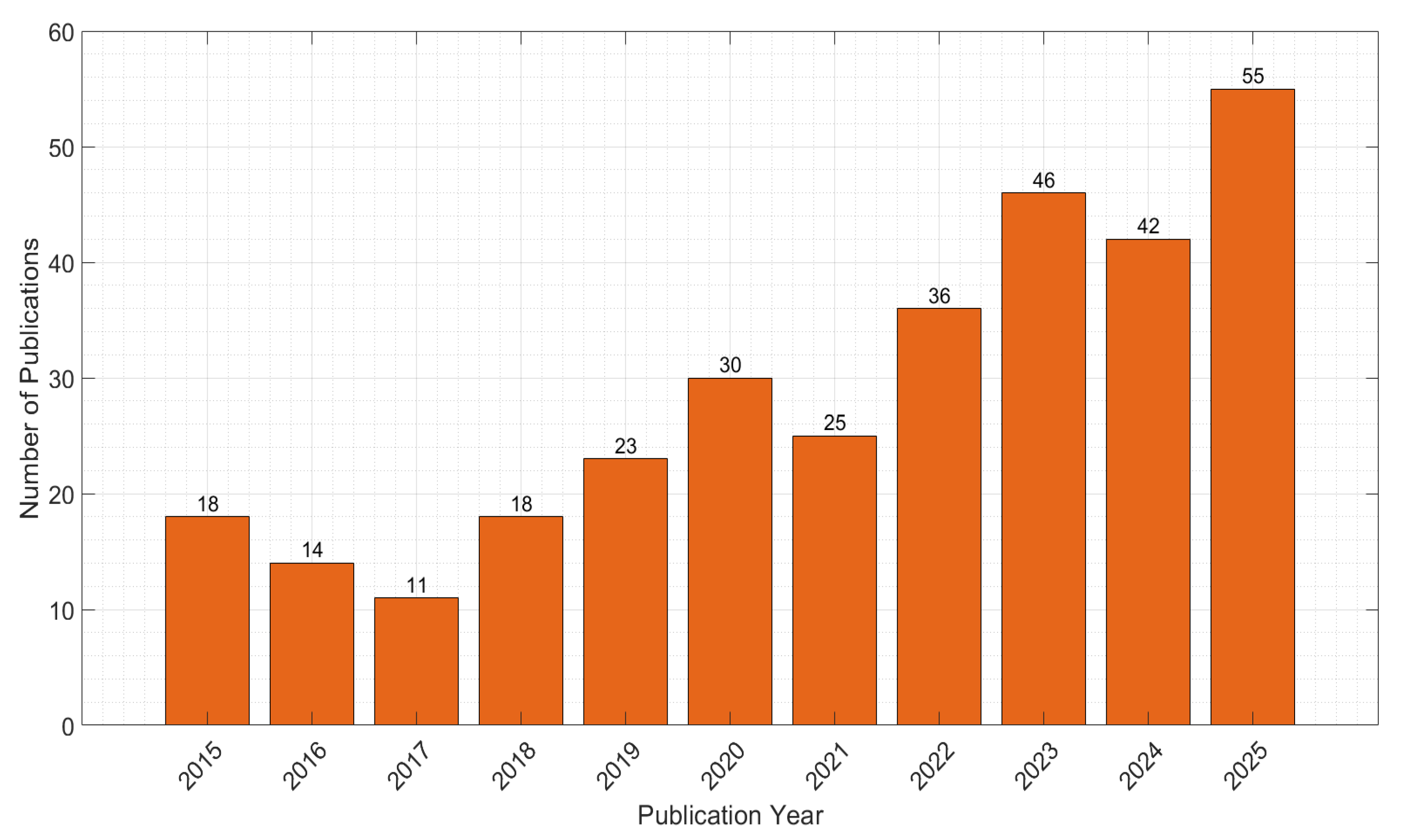
Recent publication trends indicate a growing research interest in this area. When coverage path planning and its underwater variants are considered together, the number of related works has increased steadily over the past decade. This reflects both the continued development of foundational techniques and the rising demand for methods capable of addressing realistic terrain and mission-level challenges. This trend is illustrated by publication statistics from the Web of Science database, which show consistent growth in coverage path planning and underwater coverage path planning from 2015 to 2025, as summarized in Figure 1.
The second category of missions involves AUVs operating as mobile data collectors within underwater acoustic sensor networks (UASNs), forming a central component of the Internet of Underwater Things (IoUT). In these systems, static or slightly drifting seabed nodes record environmental or structural data over extended periods, and the accumulated information must be transferred reliably to a surface station or onshore facility [16,17,18]. Relying solely on multihop acoustic relays is often inefficient due to the uneven energy burden placed on intermediate nodes. Mobility-assisted frameworks mitigate this issue by enabling an AUV to visit sensor nodes or cluster heads, establish short-range acoustic links, and transport stored data to a surface sink [18]. Similar to terrestrial wireless sensor networks (WSNs), where mobile sinks and data mules have been used to alleviate energy imbalance, trajectory planning for AUV-assisted sensor data collection is commonly formulated as an optimization problem over sensor locations and rendezvous points [19,20,21,22]. Research activity in this area has also increased significantly in recent years, as indicated by the annual publication counts from 2015 to 2025 shown in Figure 2.
Across both coverage and sensor data collection missions, trajectory planning must balance several interacting demands. The AUV must operate under constraints on velocity, turning rates, and vertical maneuvers imposed by its kinematic and dynamic limits [23]. The sensing or communication region is limited by the field of view, range, and resolution properties of the onboard sensor, which depend on altitude and orientation relative to the seafloor [10]. Environmental constraints arise from bathymetry and obstacles, which can introduce blind regions, increase travel distances, and create hazardous areas that require appropriate safety margins [9]. Furthermore, uncertainties in navigation and environmental models may cause discrepancies between planned and executed trajectories, potentially resulting in coverage gaps or reduced communication performance. These factors motivate the development of trajectory planning methods that incorporate seafloor geometry, visibility characteristics, and communication constraints rather than relying on planar approximations [4,6,23].
This survey synthesizes trajectory planning methods for AUVs across the two mission categories described above, with emphasis on how these methods account for the underwater environment. For underwater area coverage, the survey discusses classical coverage path planning concepts and how they have been adapted for seafloor mapping, followed by more advanced terrain-aware, occlusion-aware, and multi-AUV approaches. For underwater sensor data collection, it outlines the evolution of mobile sink techniques and their adaptation to AUV-assisted UASNs and IoUT deployments, and reviews information-based methods and cooperative strategies involving unmanned surface vehicles (USVs) designed to improve information freshness and communication robustness. The survey highlights the limited attention given in the current literature to the direct and explicit influence of seafloor irregularities on the quality and performance of sensor data collection missions.
To provide practical context, Section 3 summarizes representative application domains of AUV sensing, including video and sonar-based coverage missions and AUV-assisted sensor data collection in underwater networks. This brief application overview highlights how different tasks emphasize different objectives and constraints, such as visibility, terrain clearance, endurance, and communication reliability.
The remainder of the paper is organized as follows. Section 2 introduces fundamental trajectory planning concepts relevant to AUV missions, focusing on objectives, constraints, and environment representations that are particularly important in underwater settings. Section 3 outlines key application domains of AUV sensing, illustrating how different missions prioritize distinct objectives and constraints. Section 4 reviews AUV-based underwater area coverage methods, beginning with classical coverage path planning and moving towards terrain-aware, occlusion-aware, multi-AUV, and online coverage strategies, with a discussion of key gaps and limitations. Section 5 examines trajectory planning frameworks for AUV-assisted underwater sensor data collection, including mobile sink concepts, energy-aware and channel-aware methods, information-based approaches, and USV-AUV cooperation, and highlights remaining challenges related to terrain integration and realistic deployment. Section 6 concludes the survey.

2. Fundamentals of AUV Sensing and Trajectory Planning

Trajectory planning for AUVs is determined by the sensing objectives of the mission, the capabilities and limitations of the vehicle, and the characteristics of the underwater environment. AUVs operate in an environment where communication is intermittent and low bandwidth, localization errors accumulate rapidly, and seafloor geometry can significantly influence safety, sensing performance, and mission feasibility [8,17,24,25,26]. These factors necessitate a set of operational concepts and constraints that must be understood before examining specific coverage and sensor data collection approaches.
AUV sensing missions can be interpreted broadly as either onboard sensing or sensor data collection tasks. In onboard sensing, the AUV acts as the primary measurement platform. Its sensors, such as multibeam sonars, side scan sonars, or optical cameras, must be positioned and oriented such that the region of interest is captured with sufficient resolution and overlap. This requirement imposes geometric constraints on altitude, viewing angle, and the smoothness of the vehicle’s path [2,25]. In sensor data collection missions, the AUV functions as a mobile sink that retrieves stored measurements from static or slowly drifting underwater sensor nodes. In this setting, the trajectory is shaped by the need to establish short-range acoustic links with selected nodes or cluster heads and to deliver the collected data to a surface station [18,27]. Although the sensing roles differ, both mission types require careful consideration of how environmental geometry, vehicle kinematics, and sensing or communication performance interact.
Trajectory planning must respect the motion constraints of AUVs. These vehicles are typically nonholonomic and operate under bounded turning rates and speed limits. Sharp maneuvers, abrupt depth changes, or trajectories that reduce terrain clearance can compromise safety or degrade sensing performance [28,29,30]. Moreover, energy consumption places limits on the duration and complexity of feasible trajectories. Extended detours and high-speed segments all influence the mission’s endurance, making path efficiency an essential consideration in both coverage and sensor data collection frameworks [31,32].
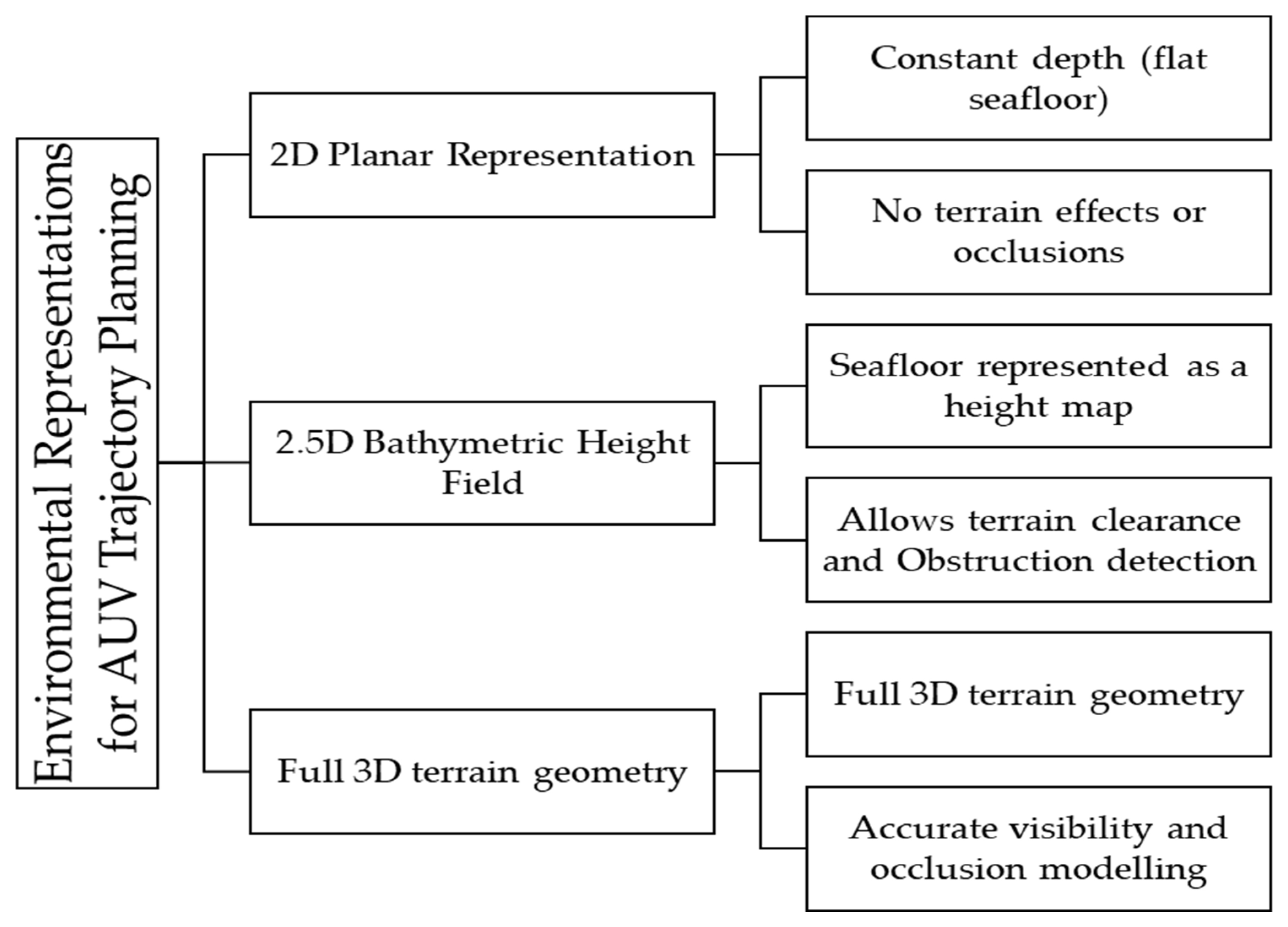
Environmental representation plays a central role in underwater trajectory planning and determines how seafloor complexity, visibility, and terrain clearance constraints are incorporated into the planning process [9,26]. Figure 3 summarizes the three common forms of environmental modelling used in AUV trajectory planning, ranging from simple planar approximations to full 3D representations. The simplest of these is the 2D planar representation, in which the AUV moves at an approximately constant depth over a flat seafloor. Although computationally efficient, this representation neglects terrain variations, occlusions, and changes in sensing performance with depth [24,33]. A more descriptive alternative is the 2.5D bathymetric height field model, where the seafloor is represented as a height map. This formulation enables the planner to evaluate terrain clearance and detect nonvisible regions created by local slopes or terrain features [34,35]. At the highest level of fidelity, full 3D environmental models capture the complete geometry of the seafloor, enabling accurate visibility assessment and occlusion-aware trajectory planning at the cost of substantially higher computational complexity [36,37,38,39]. In missions where bathymetry is not known beforehand, the environment must instead be constructed online using methods such as bathymetric SLAM or incremental mapping [35,40].
The influence of uneven terrain extends beyond collision avoidance. Seafloor geometry can affect the sensing footprint, create blind regions behind ridges, and impose visibility constraints that influence tasks such as optical imaging, acoustic surveying, and structural inspection [35,41,42,43]. Furthermore, it shapes communication performance in data collection missions, where terrain-induced acoustic shadow zones and multipath fading can intermittently disrupt links between the AUV and static sensor nodes [44,45,46,47]. Consequently, trajectory planning increasingly incorporates terrain-aware models that allow the planner to determine which parts of the environment are visible or reachable from a given viewpoint. This shift from planar to terrain-aware formulations distinguishes modern underwater trajectory planning research from earlier work [23,35,48].
In data collection settings, the modelling of the communication layer introduces additional complexity. Acoustic signals are subject to significant attenuation, limited bandwidth, and high propagation delay, which makes communication distance and channel quality critical factors in trajectory design [44,49]. Therefore, metrics such as packet error probability, path loss, and link reliability appear as key elements of the planning model [50,51]. Frameworks that incorporate the Age of Information (AoI) or Value of Information (VoI) extend this perspective by recognizing that the utility of the collected data depends on its timeliness or informational importance rather than on retrieval alone [18,27,52,53,54,55]. In such cases, the trajectory must account for seafloor geometry, node distribution, and the temporal and informational constraints imposed by the sensing application [56,57,58].
Across all AUV missions, uncertainty represents a persistent challenge. Bathymetric maps may contain errors, ocean currents may deviate the vehicle from its intended path, and localization drift can accumulate over long deployments [8,26,59,60]. These sources of uncertainty highlight the need for planning frameworks that remain effective despite mismatches between planned and executed trajectories. Techniques commonly address this by introducing safety margins, applying conservative clearance buffers, or incorporating real-time replanning modules that enable the AUV to adjust its path and maintain sensing or communication performance under changing environmental conditions [8,34,61,62].
Collectively, these operational concepts provide the foundation for AUV trajectory planning methods. They show how sensing objectives, vehicle dynamics, environmental representations, communication constraints, and uncertainty interact to determine both the feasibility and overall performance of underwater missions. Understanding these principles is essential before examining specific planning strategies, since coverage and sensor data collection methods differ largely in how they exploit or adapt to these underlying constraints. With this foundation in place, the next section reviews representative AUV sensing applications, highlighting how varying tasks impose different objectives and constraints for the trajectory planning process.

3. Application Domains of AUV Sensing Missions

AUV trajectory planning is tightly coupled to the sensing mission that the vehicle is intended to support. This section outlines representative application domains where AUVs perform onboard sensing, such as imaging or sonar surveying, and where they act as mobile data collectors in underwater sensor networks. This overview provides practical context for the two mission categories used throughout this survey.

3.1. Underwater Search and Rescue

Underwater search and rescue is a time-critical AUV sensing application in which the vehicle must search a potentially large area to localize and confirm a target, such as missing aircraft or submerged objects, under harsh ocean conditions and limited human reach. The prolonged search for Malaysia Airlines Flight MH370 provides a well-known example of both the practical value of AUV-based seabed search and the operational difficulty of sustaining missions over long durations [63,64,65]. More broadly, early system-level discussions emphasize that search operations are often time-constrained and that effective response requires coordinated sensing, communication, and automated planning to reduce search time and improve mission performance [66]. In practice, many missions rely on complete coverage path planning using side scan sonar, where the trajectory is designed to ensure full area coverage while maintaining reliable sonar imagery and supporting rapid discovery. This makes trajectory smoothness and reduced turning maneuvers practically important [67]. Consequently, many formulations combine coverage requirements with priority-based search guided by prior target likelihood, and increasingly incorporate online updates from onboard sensing to address uncertainty and dynamic conditions during execution [68].
Representative methods show a progression from conceptual frameworks to practical multistage autonomy. In [66], an integrated search and rescue concept is presented that uses multiple vehicles and automated coordination to support rapid response. In [67], a search and rescue A* approach decomposes the area into cells and uses a probabilistic model of target presence to prioritize higher value cells while reducing turns, hence increasing cumulative discovery probability with fewer turning maneuvers. The same line of work extends to multiple AUVs in [69] by formulating multi-robot coverage path planning as area partitioning followed by single AUV coverage, while continuing to use search and rescue A* to limit turns and improve sonar image quality, with validation through simulation and experiments. Moving toward online autonomy, Ref. [68] proposes an environment information-driven online bilevel framework that performs coverage search and triggers replanning using real-time sensor updates, including side scan sonar and an acoustic Doppler current profiler (ADCP), and then computes energy-optimal confirmation paths. Finally, Ref. [70] presents a hybrid algorithm-based emergency search and rescue method that integrates global coverage, energy-aware replanning for target identification, and local obstacle avoidance in uncertain environments, with results reported in both simulation and practical experiments.

3.2. Marine Geology and Geophysics

Marine geology and marine geophysics missions increasingly rely on AUVs as mobile sensing platforms that can acquire high-resolution measurements close to the seabed and in regions that are difficult or costly for conventional vessel-based operations [1]. In marine geophysical surveys, AUVs are used for acoustic mapping and for collecting electric and magnetic field data to support subsea structure inspection and geophysical characterization. These capabilities are particularly valuable in challenging settings such as under Arctic ice, where autonomous platforms enable access and persistent measurements [71]. In geomorphological and seabed survey contexts, AUV payloads commonly include multibeam echosounders and side scan sonar, which support detailed characterization of seafloor topography and features relevant to geological interpretation and hazard assessment [72].
A major driver of these missions is related to resource exploration and monitoring. In this context, AUVs support geological studies of continental shelves and contribute to exploration workflows and, more broadly, to monitoring and escorting extraction activities [73]. From a trajectory planning perspective, survey tasks often benefit from adaptive strategies that respond to observed seafloor structure. For example, online geomorphological survey approaches can select survey patterns based on real-time observations and report measurable gains in survey efficiency over traditional methods, while also demonstrating applicability to rapid characterization of specific seafloor targets and related search tasks [72].

3.3. Underwater Archaeology

Underwater archaeology missions aim to locate, inspect, and document submerged cultural heritage sites such as shipwrecks, while reducing risk to divers and lowering operational costs. In a trajectory planning survey, this application can be framed around the typical campaign phases of wide area search, that is coverage driven, site characterization, that is data driven through sensing and processing, and detailed documentation that requires close range and viewpoint aware mapping [74,75,76]. The ARROWS project in [77] is a strong anchor for this subsection as it starts from archaeologists’ operational requirements and translates them into robotic system specifications. It emphasizes low-cost technologies and a heterogeneous team of cooperating AUVs, including vehicles designed for modular payloads, shipwreck penetration, and easy single-person deployment [77].
From a trajectory planning perspective, underwater archaeology highlights why AUV sensing often requires multisensor payloads and multistage missions. For example, seafloor mapping and object detection commonly combine optical cameras with acoustic sensors such as side scan sonar or multibeam echosounders, leveraging complementary sensing properties [76]. Building on this idea, authors in [74] propose a multi-mission pipeline in which an initial high altitude coverage scan produces a coarse sonar or bathymetry map, followed by low altitude passes that collect images from multiple viewpoints for photogrammetric reconstruction. Their planner uses a modified Rapidly Exploring Random Trees method to account for AUV kinematics and to maximize information gain within a time limit, and it is validated in field trials on wreck sites [74]. At the team level, archaeology also motivates multi-AUV coordination under limited acoustic communication. Authors in [78] study distributed task allocation using greedy assignment, k-means clustering, and multiple traveling salesman problem formulations for a heterogeneous team composed of a search AUV and an inspection AUV operating under lossy, high-latency links. Finally, coastal archaeology provides a practical driver for light, easily deployable AUVs, where payload integration constraints such as magnetometers and sonars, together with simple launch and recovery procedures, strongly shape feasible survey patterns and overall mission performance [75].

3.4. Environmental Monitoring

Marine environmental monitoring is increasingly driven by the need to assess ecosystem health under growing anthropogenic pressures such as pollution, while also supporting broader objectives, including observation and resource management related to climate. AUVs have become a practical tool for these tasks as they can repeatedly acquire in situ measurements with lower operational cost and effort than ship-based campaigns, and as their controllable motion enables targeted sampling using diverse onboard sensors [79]. This application context directly links trajectory planning to sustained sampling performance. Paths must be designed to maximize useful environmental information under limited endurance and challenging underwater navigation and communication conditions [79,80].
Recent work highlights how autonomy enables environmental monitoring across missions, focusing on infrastructure and science. For inspection and monitoring, underwater robots are largely utilized to reduce human exposure risk, and the inspection of critical undersea infrastructure is often constrained by navigation and positioning limitations that affect achievable autonomy and cost savings [81]. For rapid response monitoring, such as subsurface pollution events, cooperative AUV and USV systems can support near continuous sensing with timely operator oversight. The surface vehicle can act as a communication and localization relay, enabling mission updates without frequent surfacing [82]. Environmental monitoring is also increasingly coupled with ocean observing networks, where an AUV is planned to travel efficiently while satisfying communication or collection geometry requirements with distributed instruments. For example, authors in [80] formulate data collection for an ocean observation network by jointly selecting collection positions and planning an AUV route. They report improved solutions using clustering for infrastructure placement and metaheuristic optimization for path planning, validated on the North East Pacific Time series Underwater Networked Experiment.

3.5. Underwater Seismic Data Collection

Underwater seismic surveys are central to offshore oil and gas exploration as they produce subsurface images used to infer reservoir location and size. Traditional acquisition typically relies on surface vessels towing long streamers that carry receivers. This approach is associated with high operating costs, limited maneuverability, and inflexible receiver geometries, particularly in shallow or obstructed areas [83]. Authors in [83] motivate an alternative concept in which a fleet of AUVs acts as distributed seismic receivers. This removes the physical streamer link and enables more flexible 2D and 3D receiver layouts. It also turns acquisition into a multi-vehicle planning and coordination problem, in which trajectories must be controlled accurately under underwater localization and communication constraints [83].
More recent work frames this transition as part of a broader push toward automation and robotization of seabed, or ocean bottom, acquisition. The aim is to retain the data quality advantages of seabed receivers while reducing deployment and retrieval costs [84]. Authors in [84] discuss robotic node systems that use AUVs as seismic sensors and report pilot field tests indicating that seismic coupling and acoustic navigation-based positioning can be reliable, supporting the practical feasibility of autonomous operations. In the same direction, authors in [85] describe a seismic acquisition system based on fully autonomous AUV ocean bottom nodes. They emphasize that successful deployment requires full mission autonomy, including steering, landing, recording, repositioning, and surfacing, together with robust fleet communication and management. They also report trials showing satisfactory seabed coupling and repeatable autonomous acquisition cycles, including landings within about 10 m of planned locations and trajectories that adapt to local currents during execution [85].

3.6. Oil Spill Detection and Cleaning

Oil spills pose serious ecological and economic risks, and the operational priority is often rapid detection followed by efficient mitigation. In coastal regions, the search area can be large, and AUV endurance becomes a binding constraint. As a result, trajectory planning is tightly coupled to search distance and energy use [86]. Authors in [86] address this by formulating oil spill detection as an optimization-based coverage problem and proposing a hybrid Whale Cuckoo Search Optimization Algorithm to reduce search distance, delay, and energy consumption. They report lower energy consumption than boustrophedon style coverage and a whale optimization baseline [86].
In practical spill response, efficiency is not the only objective, as the environment can be hazardous and uncertain, and vehicle loss risk becomes part of the planning problem [87]. Authors in [87] incorporate this aspect by constructing a Bayesian network-based risk model to generate a spatial risk map and then applying an A* search to compute an optimal risk route that balances risk mitigation with mission efficiency. The mitigation stage also motivates multi-vehicle coordination rather than a single platform. Authors in [88] propose a heterogeneous multi-robot concept in which an unmanned aerial vehicle and an autonomous surface vehicle cooperate for detection and for in situ bioremediation actions, supported by a multi-robot mission framework and validated through field testing.

3.7. Fishing and Marine Farming

Fishing and marine farming applications motivate trajectory planning for repeatable inspection and monitoring around farm infrastructure while collecting environmental and fish-based information. A review in [89] emphasizes that aquaculture monitoring and management require collecting data on water quality, pollutants, temperature, fish behavior, and current and wave conditions. It also notes that unmanned systems are attractive as offshore sites can be difficult and risky to monitor continuously [89]. At the control and planning level, authors in [90] propose and experimentally validate a unified framework for fish farms that accounts for complex and dynamically changing environments by integrating estimates of cage structure dynamics and fish behavior with adaptive path planning and path following control [90]. For seaweed farms, authors in [91] outline an inspection system that includes initial localization of the farm from a prior estimate with dead reckoning navigation and then scanning the entire farm, highlighting how limited sensing and lack of GPS shape practical mission planning. Finally, Ref. [92] presents a data-driven fishing workflow in which a FishID AUV predicts potential fishing zones and performs fish species classification, while providing real-time sensing information such as pH and temperature through a user interface, illustrating how onboard analytics can guide subsequent sampling decisions [92].
These examples illustrate that AUV trajectory planning is highly mission dependent. Some tasks can be formulated primarily as coverage problems, whereas others focus on collecting and delivering sensed data from underwater sensor networks. In both cases, uneven terrain, sensing visibility, communication limitations, and uncertainty strongly shape feasible trajectories and achievable performance. Building on this application context, the following sections review trajectory planning methods and strategies for underwater coverage and sensor data collection, focusing on formulations and algorithms designed for uneven environments.

4. AUV-Based Underwater Area Coverage

Underwater area coverage constitutes one of the most widely studied mission classes for AUVs, as many scientific, industrial, and inspection tasks require systematic observation of the seafloor or subsea structures, including seafloor mapping, ecological surveys, infrastructure inspection, and mine countermeasure operations [1,8,93]. The objective in such missions is to plan a trajectory that ensures every point within a predefined region is observed at an acceptable resolution while the vehicle remains within safe operating limits [5]. Underwater coverage must be performed under strict sensing, navigation, and environmental constraints, including limited visibility, acoustic communication delays, localization drift, and highly uneven seafloor topography [6,17,26]. These conditions place strong demands on trajectory planning, requiring the AUV to maintain suitable altitude, footprint overlap, and terrain clearance while ensuring complete coverage of the region of interest [5,94]. As a result, underwater coverage path planning has emerged as a distinct research direction that adapts classical coverage principles to the geometric, hydrodynamic, and sensing characteristics of the underwater domain.

4.1. Classical Coverage Path Planning Foundations

Early contributions in underwater area coverage drew heavily from classical coverage path planning concepts. In these approaches, the environment is typically approximated as planar, and the vehicle is assumed to move at a nearly constant altitude while executing structured motion patterns. Classical coverage path planning methods aim to guarantee complete coverage of a region while minimizing performance metrics such as total travel distance, turning effort, or redundant overlap [5]. These formulations provide the algorithmic foundations upon which many later underwater coverage strategies have been built.
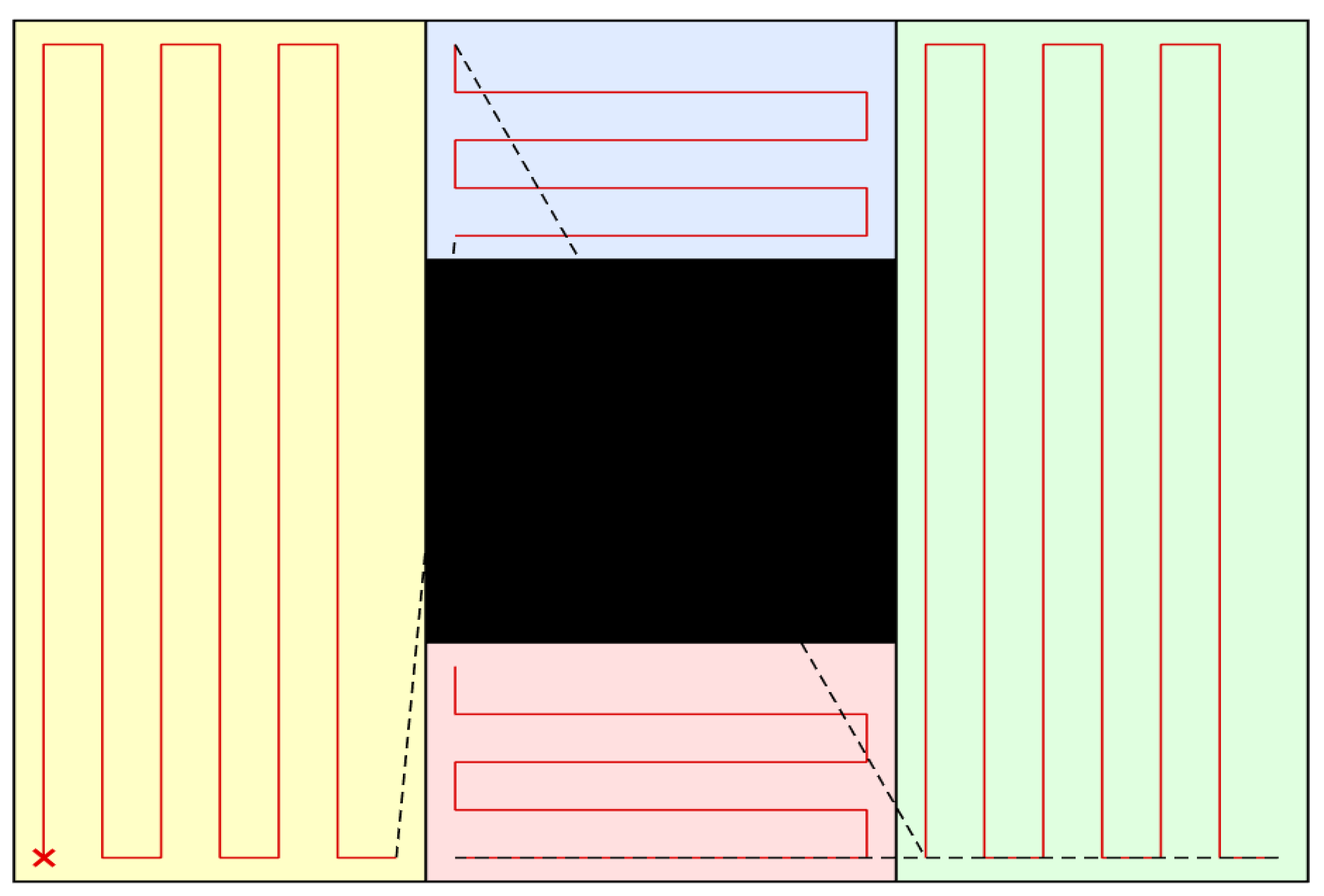
One of the earliest and most widely studied families of classical coverage path planning methods is cell decomposition, in which the workspace is partitioned into simpler subregions that can be covered systematically. Exact cell decomposition techniques divide the free space into a set of nonoverlapping cells that collectively represent the environment [5]. A foundational method in this category is boustrophedon cellular decomposition (BCD), introduced in [95], which employs a sweep line procedure to detect changes in connectivity and divide the environment into monotone cells. Each cell can then be covered using simple back-and-forth motions [refer to Figure 4]. Due to their algorithmic simplicity, completeness guarantees, and suitability for structured environments, BCD and its extensions have been widely adopted across robotics applications [5]. This classical sweep coverage idea is also supported by theoretical analysis, since authors in [96] propose a periodic multi-robot sweep strategy and prove asymptotic optimality in terms of minimizing the maximum revisit time over large flat regions. However, these methods typically assume uniform sensing footprints and unobstructed visibility within each cell, relying on simplified planar environment representations [5,97].
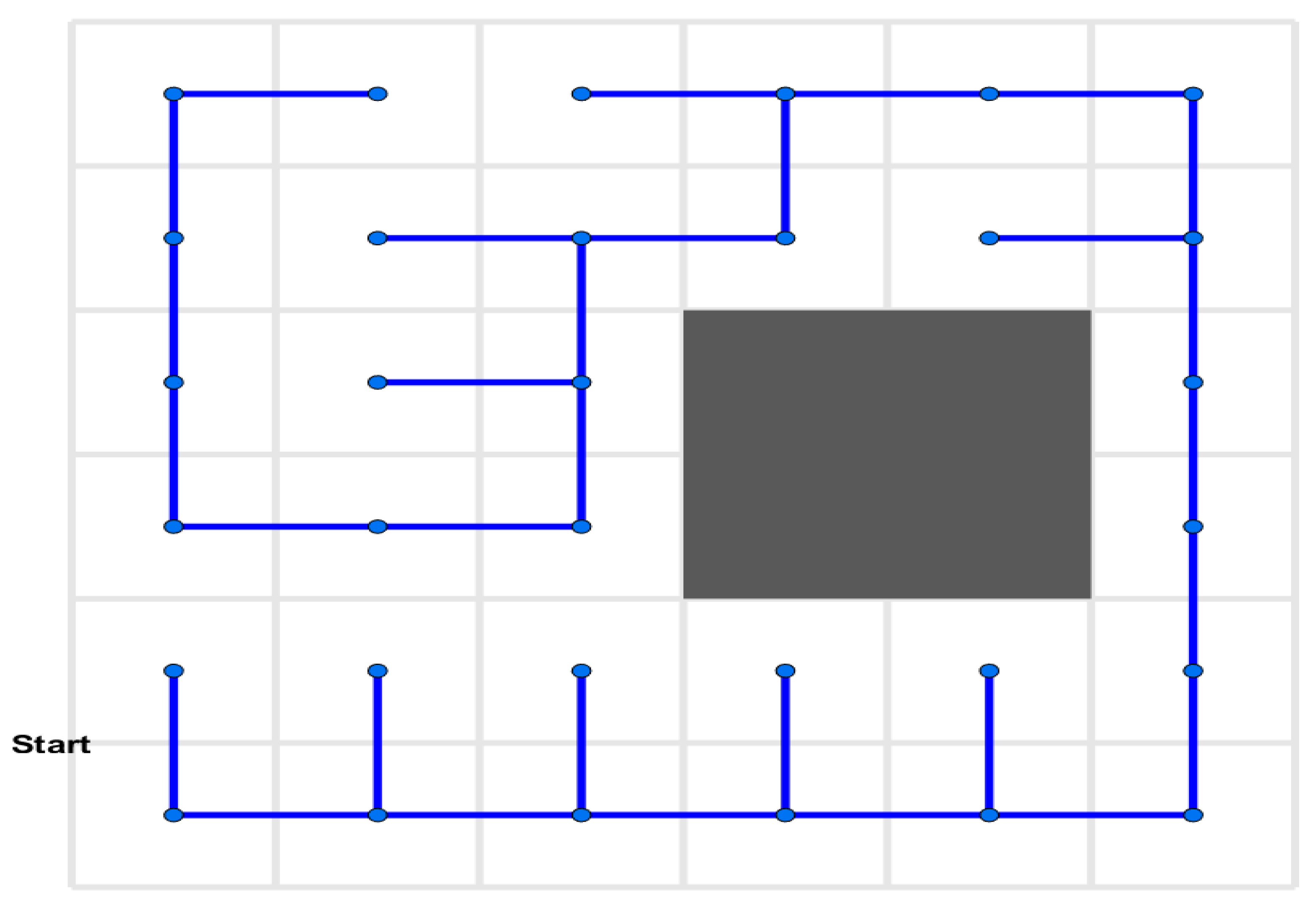
Another classical class of coverage path planning methods is grid-based coverage, in which the workspace is discretized into a uniform grid of cells, and the vehicle follows a trajectory that visits each free cell at least once. These methods are closely associated with occupancy grid representations and have been widely adopted in indoor and other structured environments [94]. Early examples include systematic row-by-row sweeping, depth-first or breadth-first traversal of free cells, and spanning tree coverage, where a spanning tree constructed over the grid is traversed to reduce path redundancy [see Figure 5] [94,98]. Grid-based approaches are flexible, straightforward to implement, and naturally support online map updates. Nevertheless, their reliance on a fixed 2D grid introduces a trade-off between spatial resolution and computational cost, and the underlying flat representation limits their applicability in environments with significant elevation variation [94].
Classical coverage path planning patterns have been successfully applied in early underwater mapping and inspection missions, particularly in large-scale surveys where the seafloor can be approximated as weakly varying. Large AUV geoscience expeditions, such as those in [1], commonly partition the mission area into contiguous linear swaths and execute structured lawnmower trajectories that closely resemble decomposition-based or grid-style coverage [1]. A representative example is provided in [24], where the authors analyze the impact of accumulated navigation errors on the completeness of coverage for standard sweeping patterns. Under the assumption of a flat or weakly varying seafloor and a downward-facing sensing footprint, analytical bounds on sweep spacing and landmark separation are derived to guarantee full coverage despite linearly increasing localization drift [24]. Similar tile-based scanning concepts also underpin many photomosaic and benthic habitat surveys, in which visual mapping frameworks such as those in [99,100] divide the seafloor into imaging tiles and command the vehicle to follow grid-aligned trajectories to maintain consistent spatial resolution.
Despite their practical success, these classical coverage strategies commonly retain the planar abstractions of coverage path planning while overlooking the environmental assumptions under which such formulations remain valid. In realistic underwater environments, the seafloor is rarely flat, and variations in elevation strongly influence sensing performance, collision risk, and coverage completeness. Fixed altitude sweeps neglect depth-dependent changes in sensor footprint size, fail to account for terrain-induced occlusions, and provide limited guarantees on safe clearance in regions of high relief [5,94,97]. These limitations highlight that purely planar coverage path planning methods remain inadequate for achieving reliable coverage over complex seafloor geometries and motivate the development of coverage strategies that explicitly incorporate bathymetry, sensing constraints, and environmental structure.

4.2. Terrain-Aware Coverage Using Bathymetric Information

As the limitations of classical coverage strategies become apparent in realistic underwater environments, a substantial body of research has focused on incorporating explicit bathymetric information into underwater area coverage planning. In terrain-aware coverage approaches, the seafloor is typically modelled as a 2.5D height field, allowing the planner to reason about local elevation changes while retaining computational tractability [62]. This representation enables the AUV to adjust its altitude in response to seafloor variations to maintain sensing quality, enforce terrain clearance constraints, and reduce the risk of collision with prominent features [5,101].
Terrain-aware coverage methods have been widely adopted in practical seafloor mapping, marine geology, and benthic habitat surveys, where high-resolution sensing requires careful regulation of the separation distance between the sensor and the seafloor. As highlighted in the comprehensive survey in [5], bathymetry-guided sweeps and terrain following trajectories form the basis of many operational AUV missions. A representative example is the bathymetry-based coverage planner introduced in [34], which addresses the limitations of constant altitude lawnmower surveys in regions with pronounced relief. To avoid frequent vertical adjustments that increase energy consumption and degrade imaging quality due to variations in sensor separation distance, the method partitions the bathymetric map into high slope and low slope areas and assigns dedicated coverage patterns to each [34]. High slope regions are surveyed using horizontal slicing trajectories that minimize depth variation while maintaining an appropriate viewing angle, whereas flatter regions are covered using a rectilinear decomposition combined with standard lawnmower motions. This hybrid strategy preserves coverage completeness and significantly reduces unnecessary vertical motion [34].
Beyond deterministic terrain following strategies, other terrain-aware coverage approaches explicitly consider the impact of pose uncertainty and localization drift on achieved coverage. The probabilistic area coverage framework proposed in [8] accounts for AUV pose uncertainty during seabed surveys by maintaining a probabilistic coverage map that propagates localization uncertainty through the sensor model. In this formulation, coverage planning is cast as an entropy reduction problem, and trajectories are selected to maximize expected information gain while compensating for drift-induced deviations between planned and executed paths [8]. Such methods are particularly relevant for low-altitude seabed mapping, where dead reckoning errors can accumulate rapidly and lead to missed regions or excessive overlap, even when deterministic coverage plans are used [8].
Collectively, terrain-aware coverage approaches demonstrate that incorporating bathymetric information into trajectory planning significantly improves navigation safety and sensing reliability compared to purely planar strategies. However, these methods remain fundamentally constrained by their reliance on a 2.5D environmental representation. While altitude adaptation can address terrain clearance and footprint consistency, such representations have limited ability to account for visibility and occlusion effects that arise when sensing complex seafloor structures under varied viewing configurations. As a result, regions of the environment may remain unobserved despite satisfying geometric coverage criteria [102]. This limitation has motivated a complementary line of research that explicitly incorporates visibility constraints into underwater coverage planning.

4.3. Occlusion and Visibility-Aware Coverage

In visual and acoustic imaging missions, the ability to observe a point on the seafloor depends on both sensor footprint characteristics and the line of sight between the sensor and the environment. Uneven seafloor features such as ridges, knolls, furrows, and steep slopes can obstruct visibility, creating blind zones that lead to coverage gaps even when classical geometric coverage criteria are satisfied [9,15,103,104]. To address this limitation, a complementary line of research has focused on occlusion-aware coverage planning, which explicitly incorporates sensing visibility by modelling the vehicle’s field of view together with the local geometry of the seafloor to determine which regions are observable from a given viewpoint. By explicitly accounting for visibility rather than relying solely on footprint overlap, occlusion-aware methods aim to identify regions that remain hidden along nominal sweep trajectories and to adapt the vehicle’s path or altitude to recover these areas.
A representative analytical treatment of terrain-induced occlusions is presented in [9], where the authors investigate the impact of uneven seafloor features, such as knolls, furrows, and depressions, on generating occlusions in visual and side scan sonar mosaicking, and derive geometric conditions under which an AUV must deviate from its path to avoid gaps in the mosaic [9]. This analysis demonstrates that coverage completeness in mosaicking cannot be guaranteed without explicitly accounting for visibility constraints. In a related but more operationally focused approach, the work in [15] develops a method for obtaining high coverage 3D images of the rough seafloor using an AUV equipped with a camera. The system evaluates image quality and overlap in real time and inserts additional correction passes when the coverage falls below a threshold, effectively compensating for terrain-induced occlusions and altitude variations [15]. By explicitly incorporating visibility in the coverage assessment and executing an additional planned pass within the same deployment, the approach improves coverage compared with relying on the initial static plan alone [15].
Beyond explicit coverage formulations, several studies have connected occlusion-aware coverage with view planning and active perception, further emphasizing the role of visibility in underwater sensing. In [25], the authors present a randomized model predictive control framework for AUV seabed inspection that selects future viewpoints to maximize an information-driven inspection objective while respecting vehicle dynamics and environmental constraints. Although the method targets inspection rather than full area coverage, it explicitly models the camera field of view and employs visibility-based information metrics to guide viewpoint selection, linking it conceptually to occlusion-aware coverage planning [25]. Similarly, the adaptive sampling strategy proposed in [7] replans the AUV trajectory in real time to reduce uncertainty in a scalar environmental field while enforcing bathymetric and workspace constraints. These approaches highlight a broader shift toward coverage strategies that integrate sensing objectives, such as visibility and information gain, with dynamically feasible motion planning.

4.4. Cooperative and Multi-AUV Coverage Planning

In many underwater coverage applications, the deployment of multiple AUVs provides an effective means of reducing mission duration, enhancing robustness, and improving spatial completeness [93,105]. In this context, cooperative coverage planning concentrates on coordinating the motion of multiple vehicles such that the region of interest is surveyed efficiently while avoiding excessive overlap, redundancy, or collisions [106,107]. Compared with single-AUV coverage, multi-AUV scenarios introduce additional challenges associated with task allocation, inter-vehicle coordination, and limited underwater communication, all of which must be systematically addressed within the trajectory planning framework [108,109,110,111].
A common strategy in multi-AUV coverage planning is task or area decomposition, in which the overall mission is divided into smaller components that are assigned to individual vehicles for local execution. Such approaches aim to reduce redundant coverage and improve overall efficiency while maintaining coverage completeness [5,112]. For example, the authors in [106] propose a multi-AUV full coverage planning framework in which local motion decisions are made using a priority-based strategy that explicitly accounts for inter-vehicle collision risk and energy-related turning costs. By coordinating local coverage actions and reducing repeated paths around obstacles, the method improves multi-AUV coverage efficiency compared to uncoordinated execution [106]. Similarly, the work in [93] formulates a cooperative coverage strategy in which the survey area is explicitly divided into subregions and sampling tasks are distributed among multiple AUVs based on ocean current effects and sonar sensing performance, demonstrating that environmental factors play an important role in effective task allocation and cooperative coverage planning [93].
Distributed planning strategies have been investigated for long-duration or persistent monitoring missions. In [113], a distributed cooperative mission planning system is proposed that performs real-time task allocation and mission replanning while accounting for communication constraints, environmental factors, and potential vehicle failures. During execution, vehicles can redistribute workload by deploying idle AUVs with residual time to assist overloaded vehicles and can replan routes to compensate for a failed vehicle, improving robustness and maintaining mission continuity [113].
Although cooperative coverage strategies consistently demonstrate substantial gains in efficiency and robustness, they introduce additional design challenges. Spatial variability in terrain complexity can lead to unbalanced workloads if subregions are not carefully defined, and collision avoidance constraints become increasingly restrictive as the number of vehicles grows [69,93,114,115]. These challenges highlight the need for multi-AUV coverage frameworks that jointly account for terrain geometry, sensing constraints, communication limitations, and vehicle dynamics.

4.5. Online Coverage in Unknown or Partially Known Environments

Extending the discussion from coverage in prior known environments, a related research effort examines online coverage planning in underwater settings where bathymetric information and obstacles are not available in advance. In such scenarios, the AUV must incrementally build and update its environmental representation during execution and adapt its trajectory accordingly. The authors in [116] propose a sensor-driven online seabed coverage method for mine countermeasure missions, in which an AUV incrementally constructs a hexagonal decomposition, updates a coverage map using side scan sonar measurements, and replans its path to balance coverage completeness with path length and in situ environmental constraints [116].
More recent work in [117] develops an uncertainty-driven, sampling-based online coverage planner that steers an AUV toward frontier regions with high expected information gain while enforcing collision avoidance constraints in partially known environments [117]. At the multi-vehicle level, the authors in [118] formulate cooperative area search in an unknown 3D underwater environment as a decentralized partially observable Markov decision process, and apply multi-agent reinforcement learning to enable multiple AUVs to jointly update an information map and coordinate their motions [118]. Static deployment problems have also been considered, with the work in [119] proposing a static area coverage algorithm for heterogeneous AUV teams that combines centroidal Voronoi tessellation with a biologically inspired competition mechanism to balance coverage load when the task area is initially unknown [119].
To provide a structured overview of the literature discussed in this section, Table 1 summarizes representative AUV-based underwater coverage path planning methods reviewed above. The table classifies each contribution according to key modelling assumptions and design characteristics, including whether prior bathymetric information is available and whether the method considers a single AUV or multiple AUVs. A check mark indicates that the corresponding assumption applies. Presenting the literature in this form clarifies the methodological distinctions among existing approaches and highlights remaining challenges related to environmental knowledge and cooperative coverage.

4.6. Research Gap

Despite the significant advances reviewed above, underwater area coverage over uneven seafloor environments remains challenging. Many existing approaches rely on planar or height field representations that are effective for terrain clearance and footprint regulation, but provide limited support for modelling visibility and terrain-induced occlusions, which can lead to coverage gaps even when geometric criteria are satisfied [9,34,62]. Occlusion-aware and visibility-driven methods improve sensing completeness in complex terrain. Their performance depends strongly on the accuracy of bathymetric models and vehicle localization, which are often uncertain in realistic underwater missions [15,25,26,116]. These limitations are further amplified in multi-AUV scenarios, where uneven terrain complexity can cause unbalanced workload allocation and where limited underwater communication constrains coordination [93,106,113]. Developing coverage frameworks that jointly and robustly account for uneven seafloor geometry, sensing visibility, and uncertainty, while maintaining computational tractability, remains a challenging and active research direction.

5. AUV-Based Underwater Sensor Data Collection

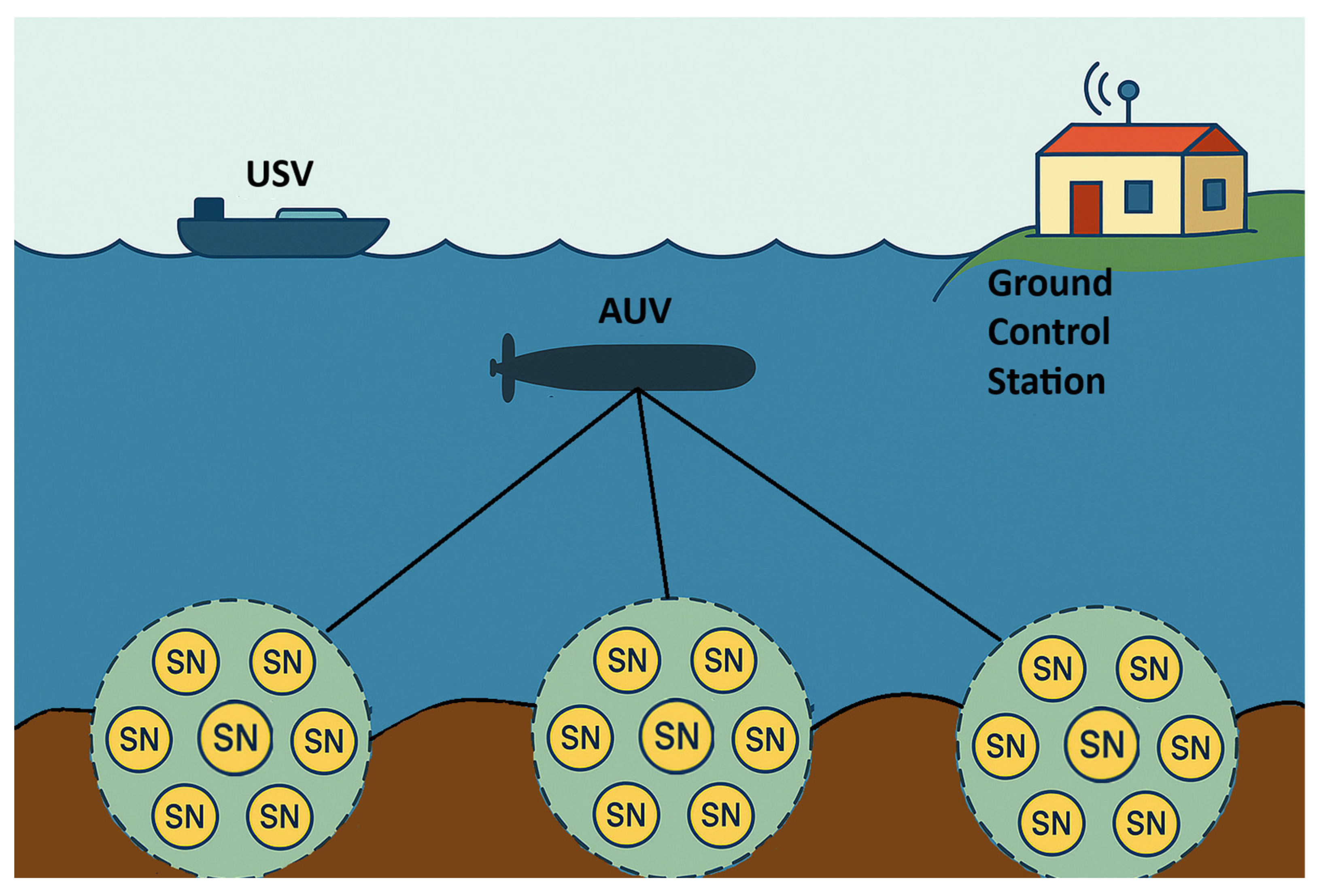
While underwater area coverage focuses on ensuring the geometric completeness of onboard sensing, a complementary class of missions treats the AUV as a mobile data collector operating within a UASN. In these scenarios, sensing is performed primarily by static or slowly drifting seabed nodes, and the role of the AUV is to retrieve stored measurements and deliver them to a surface station or a cooperating surface platform (e.g., a USV), as illustrated in Figure 6. Such mobility-assisted sensor data collection has become a central component of the IoUT, enabling long-term environmental monitoring, infrastructure supervision, and event-driven sensing in environments where continuous acoustic connectivity cannot be guaranteed [16,17,18].
Trajectory planning in AUV-assisted sensor data collection differs fundamentally from coverage planning in both its objectives and constraints. Rather than maximizing spatial sensing completeness, the planner must determine routes that enable reliable and efficient communication with selected sensor nodes or cluster heads. This introduces additional considerations related to acoustic channel quality, energy expenditure, and the temporal relevance of the retrieved data. Consequently, sensor data collection frameworks increasingly incorporate communication and information performance metrics, such as data freshness and utility, alongside traditional motion and energy constraints [18,120].
The conceptual foundation of AUV-assisted collection traces back to mobile sink and data mule architectures in terrestrial wireless sensor networks (WSNs), developed to address the energy hole problem near fixed sinks [20]. The data mules framework in [121] formalizes a three-tier design in which low-power sensors offload data to mobile collectors that physically transport it to access points, hence reducing long-range multihop forwarding at the cost of increased latency. Subsequent WSN studies explored controlled mule trajectories, constrained operating regions, and coordinated touring to reduce delay while preserving energy benefits [122]. Survey works in [19,20,123] systematize these approaches and highlight a recurring theme in which trajectory design couples travel cost, contact scheduling, buffer constraints, and network lifetime. These concepts transfer naturally to UASNs, while underwater communication and vehicle motion constraints introduce additional coupling between route geometry and link performance [16,18].

5.1. Energy-Aware Trajectory Planning

Within UASNs, early mobility-assisted designs often formulate sensor data collection as a joint optimization of which nodes transmit directly, how nodes are clustered, and where cluster heads (CHs) are selected, and the order and locations the AUV visits to retrieve data. A representative example is [21], which introduces an energy-efficient collection framework that integrates a rigid graph-based topology optimization with an AUV path planning strategy to balance sensor energy consumption and improve the reliability of data retrieval. By structuring the routing layer around optimized relay graphs and steering the AUV toward appropriate collection points, the approach reduces communication load on individual sensors and enhances overall collection performance [21]. Similarly, ref. [124] presents a joint optimization that couples CH visiting order, clustering structure, and transmission strategies under acoustic channel constraints, aiming to reduce energy consumption while improving throughput.
Other frameworks combine route design with protocol layer mechanisms, such as residual energy-aware tours with coordinated sleep–wake scheduling to balance network lifetime against collection delay [125]. More recent studies further incorporate residual energy and task heterogeneity into the planning model, for instance, by jointly optimizing energy-aware CH selection and AUV trajectories to improve data freshness while maintaining balanced energy expenditure [22]. Collectively, these works establish a dominant design pattern for UASN data collection, in which clustering and rendezvous selection reduce communication cost at sensor nodes, while path planning determines the tour geometry and retrieval schedule.

5.2. Channel-Aware Trajectory Planning

Beyond formulations centered only on energy consumption, channel-aware collection strategies explicitly account for underwater link variability when guiding AUV positioning and movement during data retrieval. Rather than modelling communication cost purely as a function of distance, these approaches exploit spatial variations in acoustic propagation to favor regions with lower transmission loss [126]. For example, ref. [126] adapts the AUV trajectory according to acoustic channel characteristics, enabling more reliable data transfer while avoiding unnecessary travel. This line of work highlights that trajectory planning plays a central role in shaping the spatiotemporal conditions under which underwater acoustic communication occurs.

5.3. Information-Based Collection (AoI and VoI)

As underwater monitoring applications increasingly involve dynamic or time-sensitive processes, performance objectives have expanded beyond distance, energy, or raw throughput. In particular, AoI and VoI provide systematic ways to model the timeliness and utility of delivered data. AoI-based formulations optimize collection schedules and trajectories to reduce the latency of information at the sink, while VoI-based formulations prioritize retrieval of measurements that are more informative or operationally relevant [52,54,55,120,127]. In underwater settings, these metrics are especially meaningful since propagation delays, intermittent connectivity, and limited vehicle speed amplify the consequences of late or poorly prioritized retrieval [18].
AoI-aware collection is investigated in [58] through a two-stage approach that first clusters nodes and then plans AUV tours to reduce the interval between successive data arrivals at the data center, yielding lower average AoI. VoI-driven collection is addressed in [18], which proposes an AUV-aided hybrid data collection scheme for the IoUT, where the trajectory is guided by a VoI metric to ensure that high-value data is retrieved promptly. A hierarchical VoI-driven collection strategy is introduced in [27], in which an AUV selects energy-balanced sink nodes and subsequently plans a VoI maximizing path using an integer linear programming formulation supported by branch and bound, heuristic ant colony, and genetic algorithm solutions.
Additional refinement is introduced through the VoI-based Packet Scheduling (VBPS) scheme in [128], in which an AUV prioritizes abnormal and high VoI packets and schedules transmissions to mitigate packet collisions with static nodes and other AUVs. By combining VoI-driven prioritization with collision-aware scheduling, the scheme achieves higher cumulative VoI and reduced delay compared with conventional random access and reservation-based methods [128]. More recent work has moved toward adaptive strategies, particularly those based on learning-based techniques. In [129], a deep reinforcement learning framework is proposed for dynamic AUV path planning, enabling the vehicle to adapt its trajectory in response to the spatial distribution of data and the associated VoI. Overall, approaches that account for information shift the emphasis from uniform data retrieval toward timely and utility-driven collection, with trajectory planning serving as the mechanism that links physical visitation schedules to evolving informational objectives.

5.4. Cooperative USV-AUV Architectures

A complementary direction augments underwater sensor data collection with surface support, where USVs serve as adaptive gateways, relays, or supervisory platforms. Several works provide evidence that surface mobility can improve underwater link geometry and communication continuity. For instance, ref. [130] examines how the motion of a surface vehicle influences underwater link reliability, supporting the role of USVs as adaptive communication gateways. In [131], the authors demonstrate that incorporating a USV as an auxiliary relay can significantly improve acoustic connectivity within an AUV network by dynamically repositioning the surface platform.
Building on this idea, the authors in [132] propose a collaborative navigation strategy in which a USV maintains an optimal relative position to a submerged AUV to maximize short-range acoustic data exchange while ensuring collision avoidance. The work in [133] develops a USV-AUV cooperative framework designed to maintain favorable communication geometry and ensure reliable underwater data transfer under extreme sea conditions. Additionally, the kinodynamic MPC framework in [134] shows how USVs can provide supervision and communication support from the surface to enhance the robustness of large-scale deep ocean sensing operations. Similarly, authors in [135] use a consensus graph MPC framework to jointly plan multi-AUV trajectories and maintain localization by enforcing AUV to USV and AUV to AUV acoustic connectivity within sonar range. These studies suggest that multi-platform cooperation can partially compensate for underwater communication constraints, although it introduces additional coordination variables and operational dependencies.

5.5. Research Gap

Despite the substantial progress in AUV-assisted underwater sensor data collection, uneven seafloor geometry remains only weakly coupled with trajectory planning objectives in most existing frameworks. Many techniques that account for energy, channel, and information considerations optimize routes and contact schedules under abstract distance or link quality models, while treating terrain effects implicitly or excluding them from the planning formulation [21,124,126]. In practice, seafloor irregularities can constrain feasible approach paths, impose safety standoff requirements, and degrade acoustic connectivity, thereby influencing both communication reliability and collection efficiency [44,45,46,47]. Some recent studies have begun to incorporate uneven deployment depth into feasibility and safety-aware contact modeling by relating the projected communication region to node depth and terrain standoff requirements, providing an initial step toward terrain-aware planning [136]. However, designing sensor data collection strategies that consistently integrate uneven seafloor geometry with vehicle motion constraints, acoustic communication performance, and information-based objectives remains a challenging and active research direction, particularly for realistic and large-scale IoUT deployments.

6. Conclusions

This survey examined trajectory planning methods for AUVs across two central classes of underwater sensing missions: underwater area coverage and underwater sensor data collection. By organizing the literature around these mission objectives, the paper highlighted trajectory planning as the key mechanism linking vehicle motion with sensing performance, communication constraints, and environmental structure in underwater operations. Classical planning approaches provide useful foundations; however, realistic deployments increasingly require methods that account for uneven seafloor geometry, sensing visibility, navigation uncertainty, and limited acoustic connectivity. Such requirements arise across many real-world deployments, including smart ocean applications that rely on underwater surveillance and persistent monitoring over large, complex, and often only partially known environments.
For underwater area coverage, the survey traced the evolution from planar coverage strategies to terrain-aware, occlusion-aware, multi-AUV, and online planning frameworks. Although substantial progress has been made in improving safety and sensing reliability over complex seafloor topographies, persistent challenges remain in robustly addressing visibility constraints, uncertainty, and coordination under limited communication, particularly in uneven and partially known environments. For underwater sensor data collection, the review showed a parallel progression from energy-driven formulations toward channel-aware and information-based approaches based on metrics such as AoI and VoI, as well as cooperative USV-AUV architectures. Despite these advances, the explicit integration of uneven seafloor effects into sensor data collection planning remains limited, even though terrain geometry can strongly influence feasibility, communication performance, and collection efficiency.
Overall, the surveyed literature indicates a clear shift toward more realistic and mission-aware trajectory planning frameworks, while underscoring the need for tighter integration between environmental modelling, sensing visibility, communication performance, and information-based objectives. Addressing these challenges is essential for enabling robust, scalable, and autonomous underwater operations in the complex environments encountered in real-world IoUT and marine monitoring applications. The insights synthesized in this survey aim to clarify current capabilities and limitations, and to support the development of next-generation AUV trajectory planning methods that better match the demands of realistic underwater missions.

Author Contributions

Conceptualization, T.S.A. and A.V.S.; methodology, T.S.A. and A.V.S.; investigation, T.S.A.; resources, T.S.A.; data curation, T.S.A.; writing—original draft preparation, T.S.A.; writing—review and editing, A.V.S.; visualization, T.S.A.; supervision, A.V.S.; project administration, A.V.S.; funding acquisition, A.V.S. All authors have read and agreed to the published version of the manuscript.

Funding

This work was supported by the Australian Research Council with the grant DP190102501.

Data Availability Statement

The data presented in this study are available upon request from the corresponding author, as they are not publicly accessible due to privacy restrictions.

Conflicts of Interest

The authors declare no conflicts of interest.

Abbreviations

The following abbreviations are used in this manuscript:
AUVsAutonomous Underwater Vehicles
IoUTInternet of Underwater Things
UASNsUnderwater Acoustic Sensor Networks
AoIAge of Information
VoIValue of Information
USVsUnmanned Surface Vehicles
BCDBoustrophedon Cellular Decomposition
SNsSensor Nodes
CHCluster Head
WSNsWireless Sensor Networks
VBPSVoI-based Packet Scheduling
ADCPAcoustic Doppler Current Profiler

References

  1. Wynn, R.B.; Huvenne, V.A.I.; Le Bas, T.P.; Murton, B.J.; Connelly, D.P.; Bett, B.J.; Ruhl, H.A.; Morris, K.J.; Peakall, J.; Parsons, D.R.; et al. Autonomous Underwater Vehicles (AUVs): Their Past, Present and Future Contributions to the Advancement of Marine Geoscience. Mar. Geol. 2014, 352, 451–468. [Google Scholar] [CrossRef]
  2. Wibisono, A.; Piran, M.J.; Song, H.-K.; Lee, B.M. A Survey on Unmanned Underwater Vehicles: Challenges, Enabling Technologies, and Future Research Directions. Sensors 2023, 23, 7321. [Google Scholar] [CrossRef] [PubMed]
  3. Zhang, H.; Zhang, S.; Wang, Y.; Liu, Y.; Yang, Y.; Zhou, T.; Bian, H. Subsea Pipeline Leak Inspection by Autonomous Underwater Vehicle. Appl. Ocean. Res. 2021, 107, 102321. [Google Scholar] [CrossRef]
  4. Li, D.; Du, L. AUV Trajectory Tracking Models and Control Strategies: A Review. J. Mar. Sci. Eng. 2021, 9, 1020. [Google Scholar] [CrossRef]
  5. Galceran, E.; Carreras, M. A Survey on Coverage Path Planning for Robotics. Robot. Auton. Syst. 2013, 61, 1258–1276. [Google Scholar] [CrossRef]
  6. Li, D.; Wang, P.; Du, L. Path Planning Technologies for Autonomous Underwater Vehicles—A Review. IEEE Access 2019, 7, 9745–9768. [Google Scholar] [CrossRef]
  7. Stankiewicz, P.; Tan, Y.T.; Kobilarov, M. Adaptive Sampling with an Autonomous Underwater Vehicle in Static Marine Environments. J. Field Robot. 2021, 38, 572–597. [Google Scholar] [CrossRef]
  8. Paull, L.; Seto, M.; Li, H. Area Coverage Planning That Accounts for Pose Uncertainty with an AUV Seabed Surveying Application. In Proceedings of the 2014 IEEE International Conference on Robotics and Automation (ICRA), Hong Kong, China, 31 May–7 June 2014; pp. 6592–6599. [Google Scholar]
  9. Tiwari, S. Mosaicking of the Ocean Floor in the Presence of Three-Dimensional Occlusions in Visual and Side-Scan Sonar Images. In Proceedings of the Symposium on Autonomous Underwater Vehicle Technology, Monterey, CA, USA, 2–6 June 1996; pp. 308–314. [Google Scholar]
  10. Whitmore, B.M.; Ellen, J.S.; Grier, M.C. Toward Improving Unmanned Underwater Vehicle Sensing Operations through Characterization of the Impacts and Limitations of in Situ Environmental Conditions. In Proceedings of the OCEANS 2022, Hampton Roads, Hampton Roads, VA, USA, 17–20 October 2022; pp. 1–4. [Google Scholar]
  11. Benoist, N.M.A.; Morris, K.J.; Bett, B.J.; Durden, J.M.; Huvenne, V.A.I.; Le Bas, T.P.; Wynn, R.B.; Ware, S.J.; Ruhl, H.A. Monitoring Mosaic Biotopes in a Marine Conservation Zone by Autonomous Underwater Vehicle. Conserv. Biol. 2019, 33, 1174–1186. [Google Scholar] [CrossRef]
  12. Eldred, R.; Lussier, J.; Pollman, A. Design and Testing of a Spherical Autonomous Underwater Vehicle for Shipwreck Interior Exploration. J. Mar. Sci. Eng. 2021, 9, 320. [Google Scholar] [CrossRef]
  13. Zhang, D.; Chang, S.; Zou, G.; Wan, C.; Li, H. A Robust Graph-Based Bathymetric Simultaneous Localization and Mapping Approach for AUVs. IEEE J. Ocean. Eng. 2024, 49, 1350–1370. [Google Scholar] [CrossRef]
  14. Tan, C.S.; Mohd-Mokhtar, R.; Arshad, M.R. A Comprehensive Review of Coverage Path Planning in Robotics Using Classical and Heuristic Algorithms. IEEE Access 2021, 9, 119310–119342. [Google Scholar] [CrossRef]
  15. Kume, A.; Maki, T.; Sakamaki, T.; Ura, T. A Method for Obtaining High-Coverage 3D Images of Rough Seafloor Using AUV—Real-Time Quality Evaluation and Path-Planning. J. Robot. Mechatron. 2013, 25, 364–374. [Google Scholar] [CrossRef]
  16. Coutinho, R.W.L.; Boukerche, A.; Vieira, L.F.M.; Loureiro, A.A.F. Underwater Wireless Sensor Networks: A New Challenge for Topology Control–Based Systems. ACM Comput. Surv. 2018, 51, 1–36. [Google Scholar] [CrossRef]
  17. Domingo, M.C. An Overview of the Internet of Underwater Things. J. Netw. Comput. Appl. 2012, 35, 1879–1890. [Google Scholar] [CrossRef]
  18. Liu, Z.; Meng, X.; Liu, Y.; Yang, Y.; Wang, Y. AUV-Aided Hybrid Data Collection Scheme Based on Value of Information for Internet of Underwater Things. IEEE Internet Things J. 2022, 9, 6944–6955. [Google Scholar] [CrossRef]
  19. Di Francesco, M.; Das, S.K.; Anastasi, G. Data Collection in Wireless Sensor Networks with Mobile Elements: A Survey. ACM Trans. Sens. Netw. 2011, 8, 7. [Google Scholar] [CrossRef]
  20. Khan, A.W.; Abdullah, A.H.; Anisi, M.H.; Bangash, J.I. A Comprehensive Study of Data Collection Schemes Using Mobile Sinks in Wireless Sensor Networks. Sensors 2014, 14, 2510–2548. [Google Scholar] [CrossRef]
  21. Yan, J.; Yang, X.; Luo, X.; Chen, C. Energy-Efficient Data Collection over AUV-Assisted Underwater Acoustic Sensor Network. IEEE Syst. J. 2018, 12, 3519–3530. [Google Scholar] [CrossRef]
  22. Guang, X.; Liu, C.; Qu, W.; Qiu, T. A Joint Optimized Data Collection Algorithm Based on Dynamic Cluster-Head Selection and Value of Information in UWSNs. Veh. Commun. 2022, 38, 100530. [Google Scholar] [CrossRef]
  23. Guo, Y.; Liu, H.; Fan, X.; Lyu, W. Research Progress of Path Planning Methods for Autonomous Underwater Vehicle. Math. Probl. Eng. 2021, 2021, 8847863. [Google Scholar] [CrossRef]
  24. Özkahraman, Ö.; Ögren, P. Efficient Navigation Aware Seabed Coverage Using AUVs. In Proceedings of the 2021 IEEE International Symposium on Safety, Security, and Rescue Robotics (SSRR), New York City, NY, USA, 25–27 October 2021; pp. 63–70. [Google Scholar]
  25. Zacchini, L.; Franchi, M.; Bucci, A.; Secciani, N.; Ridolfi, A. Randomized MPC for View Planning in AUV Seabed Inspections. In Proceedings of the OCEANS 2021, San Diego–Porto, San Diego, CA, USA, 20–23 September 2021; pp. 1–6. [Google Scholar]
  26. Paull, L.; Saeedi, S.; Seto, M.; Li, H. AUV Navigation and Localization: A Review. IEEE J. Ocean. Eng. 2014, 39, 131–149. [Google Scholar] [CrossRef]
  27. Duan, R.; Du, J.; Jiang, C.; Ren, Y. Value-Based Hierarchical Information Collection for AUV-Enabled Internet of Underwater Things. IEEE Internet Things J. 2020, 7, 9870–9883. [Google Scholar] [CrossRef]
  28. Schillai, S.M.; Turnock, S.R.; Rogers, E.; Phillips, A.B. Experimental Analysis of Low-Altitude Terrain Following for Hover-Capable Flight-Style Autonomous Underwater Vehicles. J. Field Robot. 2019, 36, 1399–1421. [Google Scholar] [CrossRef]
  29. Cai, W.; Zhang, M.; Zheng, Y.R. Task Assignment and Path Planning for Multiple Autonomous Underwater Vehicles Using 3D Dubins Curves. Sensors 2017, 17, 1607. [Google Scholar] [CrossRef]
  30. Hadi, B.; Khosravi, A.; Sarhadi, P. A Review of the Path Planning and Formation Control for Multiple Autonomous Underwater Vehicles. J. Intell. Robot. Syst. 2021, 101, 67. [Google Scholar] [CrossRef]
  31. Zeng, Z.; Lian, L.; Sammut, K.; He, F.; Tang, Y.; Lammas, A. A Survey on Path Planning for Persistent Autonomy of Autonomous Underwater Vehicles. Ocean. Eng. 2015, 110, 303–313. [Google Scholar] [CrossRef]
  32. Alam, T.; Al Redwan Newaz, A.; Bobadilla, L.; Alsabban, W.H.; Smith, R.N.; Karimoddini, A. Towards Energy-Aware Feedback Planning for Long-Range Autonomous Underwater Vehicles. Front. Robot. AI 2021, 8, 621820. [Google Scholar] [CrossRef]
  33. Mu, X.; Yue, G.; Zhou, N.; Chen, C. Occupancy Grid-Based AUV SLAM Method with Forward-Looking Sonar. J. Mar. Sci. Eng. 2022, 10, 1056. [Google Scholar] [CrossRef]
  34. Galceran, E.; Carreras, M. Planning Coverage Paths on Bathymetric Maps for In-Detail Inspection of the Ocean Floor. In Proceedings of the 2013 IEEE International Conference on Robotics and Automation, Karlsruhe, Germany, 6–10 May 2013; pp. 4159–4164. [Google Scholar]
  35. Almuzaini, T.S.; Savkin, A.V. Online Multi-AUV Trajectory Planning for Underwater Sweep Video Sensing in Unknown and Uneven Seafloor Environments. Drones 2025, 9, 735. [Google Scholar] [CrossRef]
  36. Cheng, Y.; Xu, M.; Wang, K.; Chen, Z.; Wang, J. Real-Time LiDAR–Inertial Simultaneous Localization and Mesh Reconstruction. World Electr. Veh. J. 2024, 15, 495. [Google Scholar] [CrossRef]
  37. Roldão, L.; de Charette, R.; Verroust-Blondet, A. 3D Surface Reconstruction from Voxel-Based Lidar Data. In Proceedings of the 2019 IEEE Intelligent Transportation Systems Conference (ITSC), Auckland, New Zealand, 27–30 October 2019; pp. 2681–2686. [Google Scholar]
  38. Vega-Torres, M.A.; Braun, A.; Borrmann, A. SLAM2REF: Advancing Long-Term Mapping with 3D LiDAR and Reference Map Integration for Precise 6-DoF Trajectory Estimation and Map Extension. Constr. Robot. 2024, 8, 13. [Google Scholar] [CrossRef]
  39. Palomer, A.; Ridao, P.; Ribas, D. Inspection of an Underwater Structure Using Point-Cloud SLAM with an AUV and a Laser Scanner. J. Field Robot. 2019, 36, 1333–1344. [Google Scholar] [CrossRef]
  40. Ling, Y.; Li, Y.; Ma, T.; Cong, Z.; Xu, S.; Li, Z. Active Bathymetric SLAM for Autonomous Underwater Exploration. Appl. Ocean. Res. 2023, 130, 103439. [Google Scholar] [CrossRef]
  41. Zacchini, L.; Franchi, M.; Ridolfi, A. Sensor-Driven Autonomous Underwater Inspections: A Receding-Horizon RRT-Based View Planning Solution for AUVs. J. Field Robot. 2022, 39, 499–527. [Google Scholar] [CrossRef]
  42. Hernández, J.D.; Istenič, K.; Gracias, N.; Palomeras, N.; Campos, R.; Vidal, E.; García, R.; Carreras, M. Autonomous Underwater Navigation and Optical Mapping in Unknown Natural Environments. Sensors 2016, 16, 1174. [Google Scholar] [CrossRef] [PubMed]
  43. Almuzaini, T.S.; Savkin, A.V. Multi-Auv Path Planning for Underwater Video Surveillance Over an Uneven Seafloor. In Proceedings of the 2025 17th International Conference on Computer and Automation Engineering (ICCAE), Perth, Australia, 20–22 March 2025; pp. 557–561. [Google Scholar]
  44. Akyildiz, I.F.; Pompili, D.; Melodia, T. Underwater Acoustic Sensor Networks: Research Challenges. Ad Hoc Netw. 2005, 3, 257–279. [Google Scholar] [CrossRef]
  45. Morozs, N.; Gorma, W.; Henson, B.T.; Shen, L.; Mitchell, P.D.; Zakharov, Y.V. Channel Modeling for Underwater Acoustic Network Simulation. IEEE Access 2020, 8, 136151–136175. [Google Scholar] [CrossRef]
  46. Hamilton, A.; Holdcroft, S.; Fenucci, D.; Mitchell, P.; Morozs, N.; Munafò, A.; Sitbon, J. Adaptable Underwater Networks: The Relation between Autonomy and Communications. Remote Sens. 2020, 12, 3290. [Google Scholar] [CrossRef]
  47. Domingo, M.C. A Topology Reorganization Scheme for Reliable Communication in Underwater Wireless Sensor Networks Affected by Shadow Zones. Sensors 2009, 9, 8684–8708. [Google Scholar] [CrossRef]
  48. Wang, R.; Wang, J.; Li, Y.; Ma, T.; Zhang, X. Research Advances and Prospects of Underwater Terrain-Aided Navigation. Remote Sens. 2024, 16, 2560. [Google Scholar] [CrossRef]
  49. Stojanovic, M.; Preisig, J. Underwater Acoustic Communication Channels: Propagation Models and Statistical Characterization. IEEE Commun. Mag. 2009, 47, 84–89. [Google Scholar] [CrossRef]
  50. Lucani, D.E.; Medard, M.; Stojanovic, M. Underwater Acoustic Networks: Channel Models and Network Coding Based Lower Bound to Transmission Power for Multicast. IEEE J. Sel. Areas Commun. 2008, 26, 1708–1719. [Google Scholar] [CrossRef]
  51. Wei, X.; Guo, H.; Wang, X.; Wang, X.; Qiu, M. Reliable Data Collection Techniques in Underwater Wireless Sensor Networks: A Survey. IEEE Commun. Surv. Tutor. 2022, 24, 404–431. [Google Scholar] [CrossRef]
  52. Alawad, F.; Kraemer, F.A. Value of Information in Wireless Sensor Network Applications and the IoT: A Review. IEEE Sens. J. 2022, 22, 9228–9245. [Google Scholar] [CrossRef]
  53. Kosta, A.; Pappas, N.; Angelakis, V. Age of Information: A New Concept, Metric, and Tool. Found. Trends® Netw. 2017, 12, 162–259. [Google Scholar] [CrossRef]
  54. Kadota, I.; Sinha, A.; Modiano, E. Optimizing Age of Information in Wireless Networks with Throughput Constraints. In Proceedings of the IEEE INFOCOM 2018—IEEE Conference on Computer Communications, Honolulu, HI, USA, 16–19 April 2018; pp. 1844–1852. [Google Scholar]
  55. Costa, M.; Codreanu, M.; Ephremides, A. On the Age of Information in Status Update Systems with Packet Management. IEEE Trans. Inf. Theory 2016, 62, 1897–1910. [Google Scholar] [CrossRef]
  56. Cruz, N. Autonomous Underwater Vehicles; IntechOpen: London, UK, 2011; ISBN 9789533074320. [Google Scholar]
  57. Han, G.; Li, S.; Zhu, C.; Jiang, J.; Zhang, W. Probabilistic Neighborhood-Based Data Collection Algorithms for 3D Underwater Acoustic Sensor Networks. Sensors 2017, 17, 316. [Google Scholar] [CrossRef]
  58. Cao, W.; Chen, K.; Cheng, E. Joint Optimization of AoI and Energy for AUV-Assisted Data Collection in Underwater Acoustic Sensor Networks. Front. Mar. Sci. 2025, 12, 1580751. [Google Scholar] [CrossRef]
  59. González-García, J.; Gómez-Espinosa, A.; Cuan-Urquizo, E.; García-Valdovinos, L.G.; Salgado-Jiménez, T.; Cabello, J.A.E. Autonomous Underwater Vehicles: Localization, Navigation, and Communication for Collaborative Missions. Appl. Sci. 2020, 10, 1256. [Google Scholar] [CrossRef]
  60. Hollinger, G.A.; Pereira, A.A.; Binney, J.; Somers, T.; Sukhatme, G.S. Learning Uncertainty in Ocean Current Predictions for Safe and Reliable Navigation of Underwater Vehicles. J. Field Robot. 2016, 33, 47–66. [Google Scholar] [CrossRef]
  61. Carreño, S.; Wilson, P.; Ridao, P.; Petillot, Y. A Survey on Terrain Based Navigation for AUVs. In Proceedings of the OCEANS 2010 MTS/IEEE SEATTLE, Seattle, WA, USA, 20–23 September 2010; pp. 1–7. [Google Scholar]
  62. Galceran, E.; Campos, R.; Palomeras, N.; Ribas, D.; Carreras, M.; Ridao, P. Coverage Path Planning with Real-Time Replanning and Surface Reconstruction for Inspection of Three-Dimensional Underwater Structures Using Autonomous Underwater Vehicles. J. Field Robot. 2015, 32, 952–983. [Google Scholar] [CrossRef]
  63. LeHardy, P.K.; Moore, C. Deep Ocean Search for Malaysia Airlines Flight 370. In Proceedings of the 2014 Oceans—St. John’s, St. John’s, NL, Canada, 14–19 September 2014; pp. 1–4. [Google Scholar]
  64. Li, B.; Moridian, B.; Mahmoudian, N. Underwater Multi-Robot Persistent Area Coverage Mission Planning. In Proceedings of the OCEANS 2016 MTS/IEEE Monterey, Monterey, CA, USA, 19–23 September 2016; pp. 1–6. [Google Scholar]
  65. Mujeebu, M.A. The Disappearance of MH370 and the Search Operations—The Role of Technology and Emerging Research Challenges. IEEE Aerosp. Electron. Syst. Mag. 2016, 31, 6–16. [Google Scholar] [CrossRef]
  66. Venkatesan, S. AUV for Search & Rescue at Sea—An Innovative Approach. In Proceedings of the 2016 IEEE/OES Autonomous Underwater Vehicles (AUV), Tokyo, Japan, 6–9 November 2016; pp. 1–9. [Google Scholar]
  67. Cai, C.; Chen, J.; Yan, Q.; Liu, F.; Zhou, R. A Prior Information-Based Coverage Path Planner for Underwater Search and Rescue Using Autonomous Underwater Vehicle (AUV) with Side-Scan Sonar. IET Radar Sonar Navig. 2022, 16, 1225–1239. [Google Scholar] [CrossRef]
  68. Qin, H.; Zhou, N.; Han, S.; Xue, Y. An Environment Information-Driven Online Bi-Level Path Planning Algorithm for Underwater Search and Rescue AUV. Ocean. Eng. 2024, 296, 116949. [Google Scholar] [CrossRef]
  69. Cai, C.; Chen, J.; Yan, Q.; Liu, F. A Multi-Robot Coverage Path Planning Method for Maritime Search and Rescue Using Multiple AUVs. Remote Sens. 2023, 15, 93. [Google Scholar] [CrossRef]
  70. Zhou, N.; Zhu, Z.; Mu, X.; Zhou, L.; Qin, H.; Bai, G. Hybrid-Algorithm-Based Emergency Search and Rescue Method with AUV to Uncertain Environment in Internet of Underwater Things. IEEE Internet Things J. 2025, 12, 29925–29939. [Google Scholar] [CrossRef]
  71. Obembe, E.; Ali, B. Evaluating the Applications and the Growing Importance of Autonomous Underwater Vehicles (AUVs) in Marine Geophysical Survey. J. Sci. Innov. Technol. Res. 2025, 7. [Google Scholar] [CrossRef]
  72. Zhang, Y.; Wang, Q.; Shen, Y.; He, B. An Online Path Planning Algorithm for Autonomous Marine Geomorphological Surveys Based on AUV. Eng. Appl. Artif. Intell. 2023, 118, 105548. [Google Scholar] [CrossRef]
  73. Kotov, D.D.; Pervukhin, D.A.; Davardoost, H.; Afanasyeva, O.V. Prospects for the Use of Autonomous Underwater Vehicles (AUV) to Solve the Problems of the Mineral Resources Complex (MRC) of the Russian Federation. J. Marit. Res. 2024, 21, 309–317. [Google Scholar]
  74. Viswanathan, V.K.; Lobo, Z.; Lupanow, J.; von Fock, S.S.; Wood, Z.; Gambin, T.; Clark, C. AUV Motion-Planning for Photogrammetric Reconstruction of Marine Archaeological Sites. In Proceedings of the 2017 IEEE International Conference on Robotics and Automation (ICRA), Singapore, 29 May–3 June 2017; pp. 5096–5103. [Google Scholar]
  75. Costa, M.; Pinto, J.; Ribeiro, M.; Lima, K.; Monteiro, A.; Kowalczyk, P.; Sousa, J. Underwater Archaeology with Light AUVs. In Proceedings of the OCEANS 2019—Marseille, Marseille, France, 17–20 June 2019. [Google Scholar]
  76. Reggiannini, M.; Salvetti, O. Seafloor Analysis and Understanding for Underwater Archeology. J. Cult. Herit. 2017, 24, 147–156. [Google Scholar] [CrossRef]
  77. Allotta, B.; Costanzi, R.; Ridolfi, A.; Salvetti, O.; Reggiannini, M.; Kruusmaa, M.; Salumae, T.; Lane, D.M.; Frost, G.; Tsiogkas, N.; et al. The ARROWS Project: Robotic Technologies for Underwater Archaeology. In Proceedings of the IOP Conference Series: Materials Science and Engineering, Florence, Italy, 18 June 2018; Institute of Physics Publishing: Bristol, UK, 2018; Volume 364. [Google Scholar]
  78. Tsiogkas, N.; Saigol, Z.; Lane, D. Distributed Multi-AUV Cooperation Methods for Underwater Archaeology. In Proceedings of the OCEANS 2015—Genova, Genova, Italy, 18–21 May 2015; pp. 1–5. [Google Scholar]
  79. Di Ciaccio, F.; Troisi, S. Monitoring Marine Environments with Autonomous Underwater Vehicles: A Bibliometric Analysis. Results Eng. 2021, 9, 100205. [Google Scholar] [CrossRef]
  80. Yan, Z.; Li, Y. Data Collection Optimization of Ocean Observation Network Based on AUV Path Planning and Communication. Ocean. Eng. 2023, 282, 114912. [Google Scholar] [CrossRef]
  81. Ioannou, G.; Forti, N.; Millefiori, L.M.; Carniel, S.; Renga, A.; Tomasicchio, G.; Binda, S.; Braca, P. Underwater Inspection and Monitoring: Technologies for Autonomous Operations. IEEE Aerosp. Electron. Syst. Mag. 2024, 39, 4–16. [Google Scholar] [CrossRef]
  82. Vasilijević, A.; Nađ, Đ.; Mandić, F.; Mišković, N.; Vukić, Z. Coordinated Navigation of Surface and Underwater Marine Robotic Vehicles for Ocean Sampling and Environmental Monitoring. IEEE/ASME Trans. Mechatron. 2017, 22, 1174–1184. [Google Scholar] [CrossRef]
  83. Essaouari, Y.; Turetta, A. Cooperative Underwater Mission: Offshore Seismic Data Acquisition Using Multiple Autonomous Underwater Vehicles. In Proceedings of the 2016 IEEE/OES Autonomous Underwater Vehicles (AUV), Tokyo, Japan, 6–9 November 2016; pp. 435–438. [Google Scholar]
  84. Tsingas, C.; Brizard, T.; Muhaidib, A. Al Seafloor Seismic Acquisition Using Autonomous Underwater Vehicles. Geophys. Prospect. 2019, 67, 1557–1570. [Google Scholar] [CrossRef]
  85. Mancini, F.; Hollings, B.; Manning, T.; Debens, H. Development of a Novel Seismic Acquisition System Based on Fully Autonomous Ocean Bottom Nodes. Aust. Energy Prod. J. 2024, 64, S407–S410. [Google Scholar] [CrossRef]
  86. Vinoth Kumar, S.; Jayaparvathy, R.; Priyanka, B.N. Efficient Path Planning of AUVs for Container Ship Oil Spill Detection in Coastal Areas. Ocean. Eng. 2020, 217, 107932. [Google Scholar] [CrossRef]
  87. Chen, X.; Bose, N.; Brito, M.; Khan, F.; Millar, G.; Bulger, C.; Zou, T. Risk-Based Path Planning for Autonomous Underwater Vehicles in an Oil Spill Environment. Ocean. Eng. 2022, 266, 113077. [Google Scholar] [CrossRef]
  88. Dias, A.; Mucha, A.; Santos, T.; Oliveira, A.; Amaral, G.; Ferreira, H.; Martins, A.; Almeida, J.; Silva, E. Oil Spill Mitigation with a Team of Heterogeneous Autonomous Vehicles. J. Mar. Sci. Eng. 2024, 12, 1281. [Google Scholar] [CrossRef]
  89. Ubina, N.A.; Cheng, S.C. A Review of Unmanned System Technologies with Its Application to Aquaculture Farm Monitoring and Management. Drones 2022, 6, 12. [Google Scholar] [CrossRef]
  90. Kelasidi, E.; Su, B.; Caharija, W.; Føre, M.; Pedersen, M.O.; Frank, K. Autonomous Monitoring and Inspection Operations with UUVs in Fish Farms. IFAC-PapersOnLine 2022, 55, 401–408. [Google Scholar] [CrossRef]
  91. Stenius, I.; Folkesson, J.; Bhat, S.; Sprague, C.I.; Ling, L.; Özkahraman, Ö.; Bore, N.; Cong, Z.; Severholt, J.; Ljung, C.; et al. A System for Autonomous Seaweed Farm Inspection with an Underwater Robot. Sensors 2022, 22, 5064. [Google Scholar] [CrossRef] [PubMed]
  92. Sowmmiya, U.; Roselyn, J.P.; Sundaravadivel, P. Integrating Edge-Intelligence in AUV for Real-Time Fish Hotspot Identification and Fish Species Classification. Information 2024, 15, 324. [Google Scholar] [CrossRef]
  93. Mu, X.; Gao, W. Coverage Path Planning for Multi-AUV Considering Ocean Currents and Sonar Performance. Front. Mar. Sci. 2025, 11, 1483122. [Google Scholar] [CrossRef]
  94. Jayalakshmi, K.P.; Nair, V.G.; Sathish, D. A Comprehensive Survey on Coverage Path Planning for Mobile Robots in Dynamic Environments. IEEE Access 2025, 13, 60158–60185. [Google Scholar] [CrossRef]
  95. Choset, H.; Pignon, P. Coverage Path Planning: The Boustrophedon Cellular Decomposition. In Proceedings of the Field and Service Robotics; Zelinsky, A., Ed.; Springer: London, UK, 1998; pp. 203–209. [Google Scholar]
  96. Savkin, A.V.; Huang, H. Asymptotically Optimal Path Planning for Ground Surveillance by a Team of UAVs. IEEE Syst. J. 2022, 16, 3446–3449. [Google Scholar] [CrossRef]
  97. Choset, H. Coverage for Robotics—A Survey of Recent Results. Ann. Math. Artif. Intell. 2001, 31, 113–126. [Google Scholar] [CrossRef]
  98. Gabriely, Y.; Rimon, E. Spanning-Tree Based Coverage of Continuous Areas by a Mobile Robot. Ann. Math. Artif. Intell. 2001, 31, 77–98. [Google Scholar] [CrossRef]
  99. Singh, H.; Roman, C.; Pizarro, O.; Eustice, R.; Can, A. Towards High-Resolution Imaging from Underwater Vehicles. Int. J. Robot. Res. 2007, 26, 55–74. [Google Scholar] [CrossRef]
  100. Johnson-Roberson, M.; Pizarro, O.; Williams, S.B.; Mahon, I. Generation and Visualization of Large-Scale Three-Dimensional Reconstructions from Underwater Robotic Surveys. J. Field Robot. 2010, 27, 21–51. [Google Scholar] [CrossRef]
  101. Bush, L.A.M.; Blackmore, L.; Williams, B.C. AUV Bathymetric Mapping Depth Planning for Bottom Following Splice Linear Programming Algorithm. In Proceedings of the OCEANS 2016 MTS/IEEE Monterey, Monterey, CA, USA, 19–23 September 2016; pp. 1–8. [Google Scholar]
  102. Englot, B.; Hover, F. Sampling-Based Coverage Path Planning for Inspection of Complex Structures. Proc. Int. Conf. Autom. Plan. Sched. 2012, 22, 29–37. [Google Scholar] [CrossRef]
  103. Ramírez, I.S.; Bernalte Sánchez, P.J.; Papaelias, M.; Márquez, F.P.G. Autonomous Underwater Vehicles and Field of View in Underwater Operations. J. Mar. Sci. Eng. 2021, 9, 277. [Google Scholar] [CrossRef]
  104. Thrampoulidis, C.; Shulkind, G.; Xu, F.; Freeman, W.T.; Shapiro, J.H.; Torralba, A.; Wong, F.N.C.; Wornell, G.W. Exploiting Occlusion in Non-Line-of-Sight Active Imaging. IEEE Trans. Comput. Imaging 2018, 4, 419–431. [Google Scholar] [CrossRef]
  105. Martins, R.; Pinto, J.; Dias, P.S.; Sujit, P.B.; Sousa, J.B. Multiple Underwater Vehicle Coordination for Ocean Exploration. Intl. Joint Conf. Artif. Intell. 2009, 13–16. [Google Scholar]
  106. Zhang, X.; Hao, X.; Zhang, L.; Liu, L.; Zhang, S.; Ren, R. Multi-Autonomous Underwater Vehicle Full-Coverage Path-Planning Algorithm Based on Intuitive Fuzzy Decision-Making. J. Mar. Sci. Eng. 2024, 12, 1276. [Google Scholar] [CrossRef]
  107. Zhu, D.; Tian, C.; Jiang, X.; Luo, C. Multi-AUVs Cooperative Complete Coverage Path Planning Based on GBNN Algorithm. In Proceedings of the 2017 29th Chinese Control and Decision Conference (CCDC), Chongqing, China, 28–30 May 2017; pp. 6761–6766. [Google Scholar]
  108. Li, L.; Li, Y.; Wang, Y.; Xu, G.; Wang, H.; Gao, P.; Feng, X. Multi-AUV Coverage Path Planning Algorithm Using Side-Scan Sonar for Maritime Search. Ocean. Eng. 2024, 300, 117396. [Google Scholar] [CrossRef]
  109. Martorell-Torres, A.; Guerrero-Sastre, J.; Oliver-Codina, G. Coordination of Marine Multi Robot Systems with Communication Constraints. Appl. Ocean. Res. 2024, 142, 103848. [Google Scholar] [CrossRef]
  110. Wang, L.; Zhu, D.; Pang, W.; Zhang, Y. A Survey of Underwater Search for Multi-Target Using Multi-AUV: Task Allocation, Path Planning, and Formation Control. Ocean. Eng. 2023, 278, 114393. [Google Scholar] [CrossRef]
  111. Deng, Y.; Beaujean, P.-P.J.; An, E.; Carlson, E. Task Allocation and Path Planning for Collaborative Autonomous Underwater Vehicles Operating through an Underwater Acoustic Network. J. Robot. 2013, 2013, 483095. [Google Scholar] [CrossRef]
  112. Rekleitis, I.M.; Dudek, G.; Milios, E.E. Multi-Robot Exploration of an Unknown Environment, Efficiently Reducing the Odometry Error. In Proceedings of the International Joint Conference on Artificial Intelligence; Lawrence Erlbaum Associates Ltd.: Mahwah, NJ, USA, 1997; pp. 1340–1345. [Google Scholar]
  113. MahmoudZadeh, S.; Yazdani, A. Distributed Task Allocation and Mission Planning of AUVs for Persistent Underwater Ecological Monitoring and Preservation. Ocean. Eng. 2023, 290, 116216. [Google Scholar] [CrossRef]
  114. Almadhoun, R.; Taha, T.; Seneviratne, L.; Zweiri, Y. A Survey on Multi-Robot Coverage Path Planning for Model Reconstruction and Mapping. SN Appl. Sci. 2019, 1, 847. [Google Scholar] [CrossRef]
  115. Mitra, R.; Saha, I. Scalable Online Coverage Path Planning for Multi-Robot Systems. In Proceedings of the 2022 IEEE/RSJ International Conference on Intelligent Robots and Systems (IROS), Kyoto, Japan, 23–27 October 2022; pp. 10102–10109. [Google Scholar]
  116. Paull, L.; Saeedi, S.; Seto, M.; Li, H. Sensor-Driven Online Coverage Planning for Autonomous Underwater Vehicles. IEEE/ASME Trans. Mechatron. 2013, 18, 1827–1838. [Google Scholar] [CrossRef]
  117. Zhou, M.; Shi, J. An Uncertainty-Driven Sampling-Based Online Coverage Path Planner for Seabed Mapping Using Marine Robots. In Proceedings of the 2022 IEEE/OES Autonomous Underwater Vehicles Symposium (AUV), Singapore, 19–21 September 2022; pp. 1–7. [Google Scholar]
  118. Li, Y.; Ma, M.; Cao, J.; Luo, G.; Wang, D.; Chen, W. A Method for Multi-AUV Cooperative Area Search in Unknown Environment Based on Reinforcement Learning. J. Mar. Sci. Eng. 2024, 12, 1194. [Google Scholar] [CrossRef]
  119. Guo, X.; Chen, Y.; Zhao, D.; Luo, G. A Static Area Coverage Algorithm for Heterogeneous AUV Group Based on Biological Competition Mechanism. Front. Bioeng. Biotechnol. 2022, 10, 845161. [Google Scholar] [CrossRef]
  120. Kaul, S.; Yates, R.; Gruteser, M. Real-Time Status: How Often Should One Update? In Proceedings of the 2012 Proceedings IEEE INFOCOM, Orlando, FL, USA, 25–30 March 2012; pp. 2731–2735. [Google Scholar]
  121. Shah, R.C.; Roy, S.; Jain, S.; Brunette, W. Data MULEs: Modeling and Analysis of a Three-Tier Architecture for Sparse Sensor Networks. Ad Hoc Netw. 2003, 1, 215–233. [Google Scholar] [CrossRef]
  122. Kim, D.; Uma, R.N.; Abay, B.H.; Wu, W.; Wang, W.; Tokuta, A.O. Minimum Latency Multiple Data MULE Trajectory Planning in Wireless Sensor Networks. IEEE Trans. Mob. Comput. 2014, 13, 838–851. [Google Scholar] [CrossRef]
  123. Temene, N.; Sergiou, C.; Georgiou, C.; Vassiliou, V. A Survey on Mobility in Wireless Sensor Networks. Ad Hoc Netw. 2022, 125, 102726. [Google Scholar] [CrossRef]
  124. Zhuo, X.; Liu, M.; Wei, Y.; Yu, G.; Qu, F.; Sun, R. AUV-Aided Energy-Efficient Data Collection in Underwater Acoustic Sensor Networks. IEEE Internet Things J. 2020, 7, 10010–10022. [Google Scholar] [CrossRef]
  125. Khan, M.T.R.; Ahmed, S.H.; Jembre, Y.Z.; Kim, D. An Energy-Efficient Data Collection Protocol with AUV Path Planning in the Internet of Underwater Things. J. Netw. Comput. Appl. 2019, 135, 20–31. [Google Scholar] [CrossRef]
  126. Wei, L.; Sun, M.; Peng, Z.; Guo, J.; Cui, J.; Qin, B.; Cui, J.-H. A Channel-Aware AUV-Aided Data Collection Scheme Based on Deep Reinforcement Learning. J. Mar. Sci. Eng. 2025, 13, 1460. [Google Scholar] [CrossRef]
  127. Howard, R.A. Information Value Theory. IEEE Trans. Syst. Sci. Cybern. 1966, 2, 22–26. [Google Scholar] [CrossRef]
  128. Zhuo, X.; Wu, W.; Tang, L.; Qu, F.; Shen, X. Value of Information-Based Packet Scheduling Scheme for AUV-Assisted UASNs. IEEE Trans. Wirel. Commun. 2024, 23, 7172–7185. [Google Scholar] [CrossRef]
  129. Shi, W.; Tang, Y.; Jin, M.; Jing, L. An AUV-Assisted Data Gathering Scheme Based on Deep Reinforcement Learning for IoUT. J. Mar. Sci. Eng. 2023, 11, 2279. [Google Scholar] [CrossRef]
  130. Lv, Z.; Zhang, J.; Jin, J.; Liu, L. Link Strength for Unmanned Surface Vehicle’s Underwater Acoustic Communication. In Proceedings of the 2016 IEEE/OES China Ocean Acoustics (COA), Harbin, China, 9–11 January 2016; pp. 1–4. [Google Scholar]
  131. Françolin, C.C.; Rao, A.V.; Duarte, C.; Martel, G. Optimal Control of a Surface Vehicle to Improve Underwater Vehicle Network Connectivity. J. Aerosp. Comput. Inf. Commun. 2012, 9, 1–13. [Google Scholar] [CrossRef]
  132. Savkin, A.V.; Verma, S.C.; Anstee, S. Optimal Navigation of an Unmanned Surface Vehicle and an Autonomous Underwater Vehicle Collaborating for Reliable Acoustic Communication with Collision Avoidance. Drones 2022, 6, 27. [Google Scholar] [CrossRef]
  133. Xu, J.; Xie, G.; Wang, X.; Ding, Y.; Zhang, S. USV-AUV Collaboration Framework for Underwater Tasks under Extreme Sea Conditions. In Proceedings of the ICASSP 2025–2025 IEEE International Conference on Acoustics, Speech and Signal Processing (ICASSP), Hyderabad, India, 6–11 April 2025; pp. 1–5. [Google Scholar]
  134. Eskandari, M.; Savkin, A.V. Kinodynamic Motion Model-Based MPC Path Planning and Localization for Autonomous AUV Teams in Deep Ocean Exploration. In Proceedings of the 2025 33rd Mediterranean Conference on Control and Automation (MED), Tangier, Morocco, 10–13 June 2025; pp. 162–167. [Google Scholar]
  135. Eskandari, M.; Savkin, A.V.; Deghat, M. Integrated Path Planning and Localization for an Ocean Exploring Team of Autonomous Underwater Vehicles with Consensus Graph Model Predictive Control. IEEE Trans. Intell. Veh. 2026, 11, 150–162. [Google Scholar] [CrossRef]
  136. Almuzaini, T.S.; Savkin, A.V. AUV Trajectory Planning for Optimized Sensor Data Collection in Internet of Underwater Things. Future Internet 2025, 17, 293. [Google Scholar] [CrossRef]
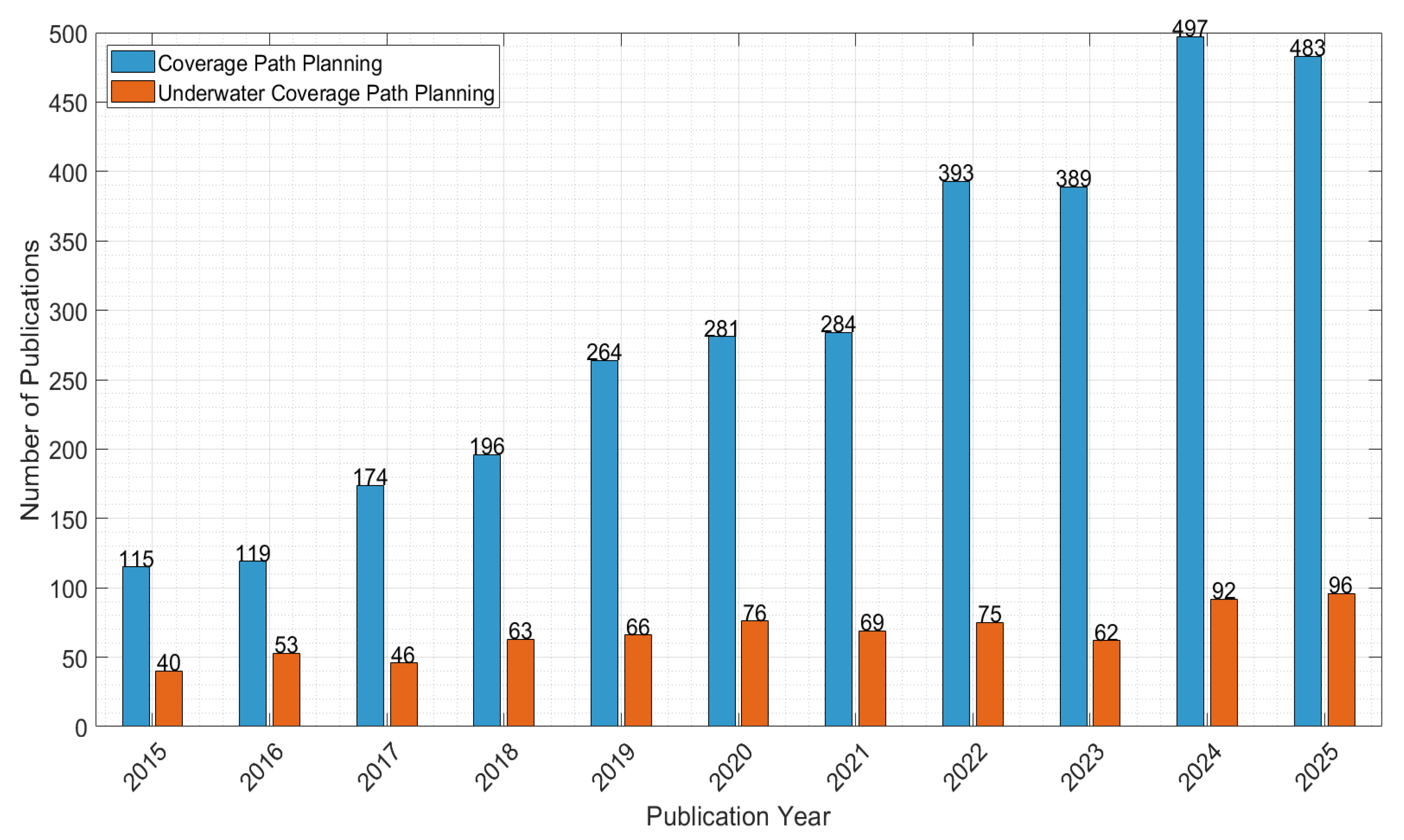
Figure 1. Number of publications related to coverage path planning and underwater coverage path planning from 2015 to 2025, based on the Web of Science database. The data were retrieved in November 2025 using keyword searches related to coverage path planning, underwater coverage, underwater area surveillance, seabed coverage, AUV coverage missions, seafloor inspection coverage, and ocean floor survey patterns.
Futureinternet 18 00079 g001
Figure 2. Annual publication counts from 2015 to 2025 related to AUV-based underwater sensor data collection, based on the Web of Science database. The data were retrieved in November 2025 using keyword searches covering AUV sensor data collection, sensor network retrieval, and information-based underwater sensing.
Futureinternet 18 00079 g002
Figure 3. Common environmental representations used in AUV trajectory planning. The schematic illustrates three representations: 2D planar models, 2.5D bathymetric height field models, and full 3D terrain geometry, highlighting the sensing and visibility capabilities enabled at each level.
Futureinternet 18 00079 g003
Figure 4. Illustrative example of boustrophedon cellular decomposition for coverage path planning in the presence of obstacles. A sweep line divides the workspace into monotone cells, within which back-and-forth paths are generated to achieve complete, collision-free coverage.
Futureinternet 18 00079 g004
Figure 5. Illustrative example of classical grid-based coverage path planning. The workspace is discretized into a uniform grid with one obstacle (grey), and a spanning tree constructed over the free cells defines the resulting coverage path.
Futureinternet 18 00079 g005
Figure 6. Overview of the UASN architecture illustrating sensor nodes (SNs) on the seafloor, with sensor data collection performed by an AUV and relayed to a USV and the ground control station.
Futureinternet 18 00079 g006
Table 1. Summary of representative AUV-based underwater coverage path planning methods based on prior environmental knowledge and the use of single or multiple AUVs.
ReferencesKnown Environment 1Unknown Environment 2Single AUVMultiple AUVs
[7,8,24,34]Futureinternet 18 00079 i001 Futureinternet 18 00079 i001
[9,15,116,117] Futureinternet 18 00079 i001Futureinternet 18 00079 i001
[93,106]Futureinternet 18 00079 i001 Futureinternet 18 00079 i001
[118,119] Futureinternet 18 00079 i001 Futureinternet 18 00079 i001
1,2 Known and unknown refer to the availability of prior bathymetric or obstacle information at mission start.
Disclaimer/Publisher’s Note: The statements, opinions and data contained in all publications are solely those of the individual author(s) and contributor(s) and not of MDPI and/or the editor(s). MDPI and/or the editor(s) disclaim responsibility for any injury to people or property resulting from any ideas, methods, instructions or products referred to in the content.