1. Introduction
Ensuring ubiquitous, high–data-rate connectivity in challenging environments calls for advanced technologies and novel architectures in next-generation wireless networks. Among these, the integration of terrestrial and aerial nodes has emerged as a promising paradigm for achieving flexible and resilient mobile communication infrastructures. In particular, deploying unmanned aerial vehicles (UAVs) as aerial base stations (ABSs) enables the creation of dynamic wireless topologies [
1,
2,
3]. The intrinsic line-of-sight (LoS) capability of ABS links serves as a key enabler of seamless sky-to-ground connectivity, allowing them to handle sudden traffic peaks, extend coverage to remote areas, and ensure reliable communications during emergencies [
4]. On the other hand, the exponentially increasing demand for higher data rates from the myriad of devices connected to 5G networks, together with the expected impact of numerous UAVs joining these networks, makes spectrum scarcity a critical issue. In UAV communication systems, the problem is worsened by the coexistence of multiple wireless protocols within the same frequency bands.
Therefore, the need for more efficient spectrum utilization has become crucial. Toward this end, cognitive radio (CR) represents a promising solution, where the key functionality is spectrum sensing (SS). SS enables secondary users (SUs) to monitor the radio spectrum and determine the occupancy of frequency channels by primary users (PUs). This capability allows SUs to opportunistically access frequency bands temporarily left vacant by PUs while avoiding harmful interference to them [
5]. In particular, cognitive UAV communications have attracted significant attention as a means to dynamically exploit available spectrum and enable UAVs to coexist with terrestrial devices in shared frequency bands [
6]. Several studies have investigated the integration of CR into UAV networks, including spectrum sharing via UAV-based secondary transmitters [
7].
Cooperative spectrum sensing (CSS) naturally extends conventional spectrum sensing and has emerged as a key technique to enhance PU detection reliability by exploiting the spatial diversity of multiple collaborating SUs [
8,
9,
10]. CSS enables a more accurate assessment of spectrum occupancy, particularly in UAV-assisted CR networks subject to multipath fading, shadowing, or the hidden node problem. CSS schemes are generally divided into two categories based on how cooperating CR users share sensing data within the network: centralized and distributed [
11]. In centralized CSS (C-CSS), a fusion center (FC) collects local sensing results from all nodes. Although effective, these approaches can suffer from scalability limitations, vulnerability to single points of failure, and significant communication overhead, thereby motivating the development of more efficient cooperation strategies. For instance, recent work [
8] introduces a cooperative scheme based on multiple mini-slots with a single UAV, which enhances cooperative gain and overall efficiency. In distributed cooperative spectrum sensing (D-CSS), nodes exchange local test statistics and reach a global decision, eliminating the need for a fusion center. Each node iteratively updates its decision based on its own statistic and those received from neighboring nodes until consensus is achieved [
11].
Following this framework, we adopt a distributed consensus-based CSS approach in which each UAV, equipped with a multi-antenna (MIMO) system, employs the sphericity test (ST) as the local detector; consensus is realized via the push–sum protocol [
12,
13].
The ST is selected for its robustness to noise uncertainty, unlike the energy detector commonly used in previous CSS studies [
8,
14]. Moreover, for multiple-antenna receivers and in the most general case with no prior information about the PU signal, the ST is the GLRT-optimal detector [
5]; consequently, it outperforms other eigenvalue-based tests, such as the max-to-min eigenvalue detector used in the UAV context [
15].
Furthermore, we assume that all UAV–CR nodes are equipped with full-duplex (FD) transceivers. FD is a key enabler for next-generation networks: by allowing simultaneous transmission and reception over the same band, it can nearly double spectral efficiency [
16]. When combined with the CR paradigm, FD supports concurrent sensing and transmission—particularly valuable for ABSs—so that continuous sensing during transmission lets SUs promptly detect PU activity and vacate the band to prevent interference, while immediately exploiting newly available spectrum [
5,
16,
17,
18]. However, FD transceivers are subject to self-interference (SI) arising from coupling between transmit and receive antennas. Although analog and digital cancellation techniques can significantly reduce SI, a residual self-interference (RSI) component remains, potentially degrading the reliability of spectrum sensing [
16]. Specifically, in UAV scenarios, the multipath nature of the SI channel introduces temporal correlation in the RSI [
2,
19], which can increase the false-alarm probability and consequently degrade detection performance.
As a result, differences in self-interference suppression across UAVs yield varying RSI correlation levels, creating a heterogeneous scenario that complicates the reliable fusion of local statistics. To address this issue, we extend the weighted average consensus algorithm, originally proposed in [
13] for energy detection, to the ST. The consensus weights are computed to be proportional to the inverse of the variance of the ST values obtained under the null hypothesis.
Finally, we formulate a multiobjective optimization problem to determine the optimal UAV altitude, balancing the interference experienced by users served by the ground base station (GBS) with the coverage requirements of those served by the ABS.
Numerical results for FD-MIMO ABSs in a dense urban scenario show that the proposed distributed weighted-consensus CSS—where UAVs exchange local ST values—outperforms both unweighted average consensus and centralized OR-rule hard fusion in user capacity. Moreover, the few iterations needed for convergence keep the communication overhead negligible, offering a clear advantage over centralized schemes.
Contributions
The contributions of this paper can be summarized as follows:
Adoption of the sphericity test as the local spectrum-sensing algorithm at each UAV, yielding GLRT-optimal detection in multi-antenna settings with no prior PU information.
Extension of weighted-consensus CSS to FD UAV networks by explicitly modeling RSI as a temporally correlated impairment. A model-free, variance-based weighting strategy is proposed, which naturally down-weights UAVs affected by stronger or more correlated RSI, estimated via an offline calibration procedure.
Design of a fully distributed RSI calibration procedure that periodically and autonomously acquires samples at the UAV operating location, without relying on external databases or prior RSI knowledge.
Demonstration that the proposed push–sum distributed CSS efficiently exploits spatial diversity in heterogeneous FD UAV networks, achieving fast convergence and robust performance under both structured (ring) and irregular (random) topologies.
Scalability analysis showing that the proposed scheme exhibits constant per-node computational complexity and sub-linear convergence behavior with respect to the swarm size.
Integration of the proposed sensing framework into a UAV altitude optimization problem that jointly accounts for PU protection and ground-user coverage.
2. System Model
We consider a swarm of K cognitive UAVs acting as ABSs to enhance the 5G coverage provided by a GBS in a dense urban environment. In such scenarios, the LoS links between the GBS and the UEs can be severely degraded or completely obstructed, particularly for UEs located within urban canyons. To overcome these coverage limitations, UAVs are deployed to establish reliable connectivity for UEs located in areas that are otherwise unreachable by conventional terrestrial infrastructure.
Each UAV is equipped with an FD-MIMO transceiver operating at 5.8 GHz. Both the UAVs and the GBS share the same frequency band. In accordance with the CR paradigm, the GBS acts as the PU, while the UAVs (i.e., ABSs) serve as SUs, opportunistically accessing the spectrum allocated to the PU.
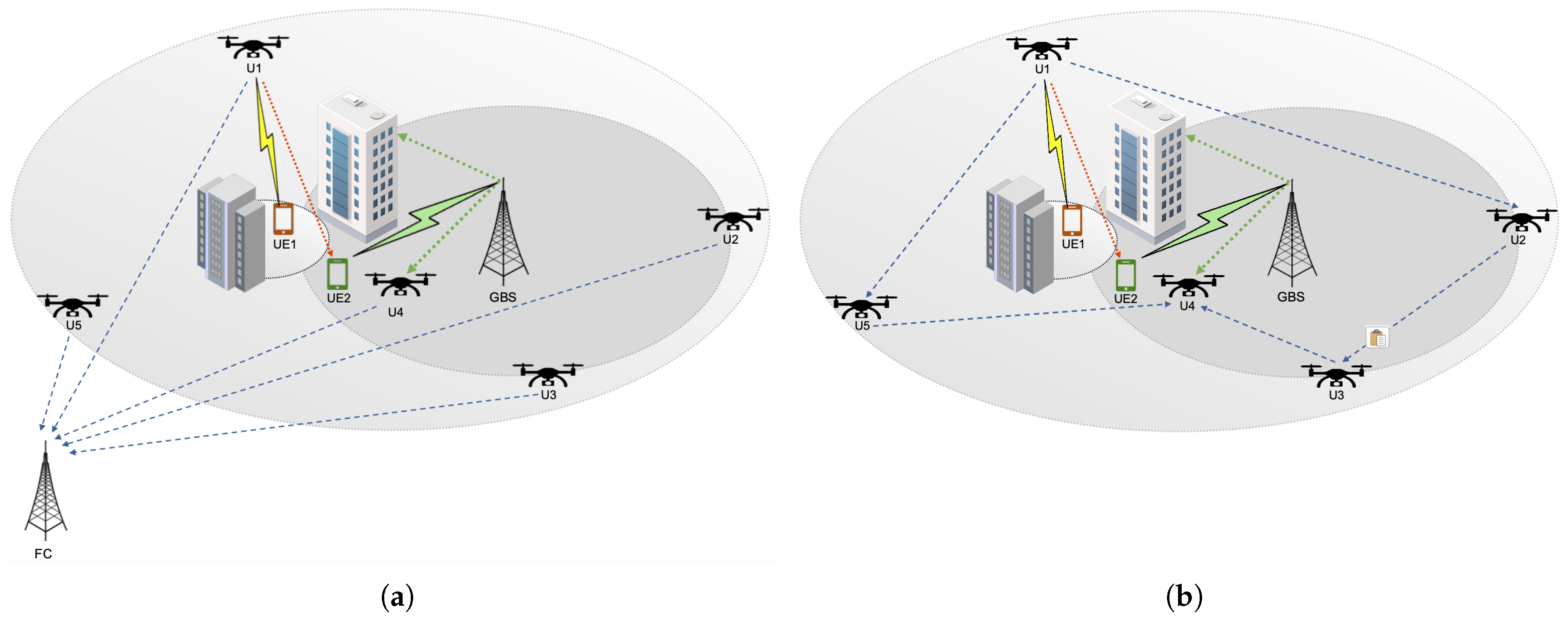
In this context, UAVs may encounter the issue illustrated in
Figure 1, commonly referred to in the literature as the hidden node problem. Specifically,
experiences an obstructed link to the GBS (i.e., the PU) but maintains a LoS connection with
, ensuring its network connectivity. However, the opportunistic link established by
reuses the frequency band allocated to the GBS for downlink transmissions to
, thereby causing harmful interference at
. This occurs because
, operating as a stand-alone decision node, incorrectly identifies the GBS downlink band as idle due to building-induced blockage, which degrades its spectrum-sensing performance. Thus, the GBS behaves as a hidden node for
.
This issue can be mitigated via CSS, wherein a set of K UAVs perform spectrum sensing from spatially diverse locations, thereby making the likelihood that all UAV–GBS links are simultaneously obstructed exceedingly low and leading to more reliable detection outcomes.
For instance, as illustrated in
Figure 1, unlike
, at least
is positioned such that it can successfully detect the GBS signal in the band of interest. To leverage the sensing information collected by spatially distributed UAVs, two cooperative approaches can be adopted. The first, depicted in
Figure 1a, corresponds to the centralized CSS (C-CSS) scheme. In this approach, UAVs transmit their local decisions to a designated BS, which functions as a FC. It is described in detail in
Section 3 and used as the baseline for comparison. The second approach, referred to as distributed CSS (D-CSS) and illustrated in
Figure 1b, is adopted in this paper. In this configuration, the UAVs are represented as the vertices of a connected communication graph, whose edges correspond to LoS links established according to proximity.
In both cases, we assume the set of K UAVs is randomly deployed within a specific range of distances from the GBS. Moreover, the UAVs operate at the same altitude.
2.1. Channel Model
To model both the signal from the GBS to the UAV (spectrum-sensing case) and the signal from the UAV to the ground user (coverage case), we adopt the widely used probabilistic air-to-ground (A2G) channel model [
20]. Although the two links are technically A2G and ground-to-air (G2A), respectively, they are treated identically in the following without loss of generality.
The A2G channel can experience either LoS or NLoS conditions, depending on the UAV altitude and the surrounding environment. In particular, the elevation angle
is a key parameter that affects several propagation characteristics [
20]. The LoS probability between the UAV and the UE/GBS can be approximated by a modified sigmoid (S-curve) [
20]:
where
with
h the UAV altitude and
d the slant distance between the UAV and the UE (or the GBS). The S-curve parameters
and
are environment dependent (e.g., urban, suburban, dense urban); typical dense urban values are
and
[
20].
2.1.1. Large-Scale Fading
Radio signals transmitted by the ABSs or the GBS propagate in free space until reaching the urban environment, where they experience additional attenuation due to blockage and scattering, termed excessive path loss. The excessive path loss for LoS or NLoS conditions is modeled as an additive term to the free-space path loss (FSPL) [
20,
21]. Accordingly, letting
indicate the link state (
for LoS,
for NLoS), the path loss can be written as
where
d is the slant distance,
is the carrier frequency, and
c is the speed of light. Moreover,
and
denote the excessive path loss (in dB) under LoS and NLoS conditions, respectively, and are typically modeled as Gaussian random variables,
and
[
20].
2.1.2. Small-Scale Fading
To model small-scale fading on the A2G link, we adopt a mixed approach: NLoS links are modeled as Rayleigh fading (i.e., Rician with
), whereas LoS links follow a Rician distribution with a
-factor (linear scale) that captures the relative strength of the LoS component with respect to scattered multipath. For consistency with the previous subsection, where the elevation angle was denoted by
(in degrees), we define the radian-valued angle
. The Rician
K-factor is modeled as a non-decreasing function of
[
22]: a larger
implies a stronger LoS component and fewer multipath components, hence a higher
. Accordingly,
is minimal at
and maximal at
. We adopt the exponential model [
23]
where
and
are environment-dependent parameters chosen to match the desired end-point values.
2.1.3. GBS Vertical Lobe Model
The GBS array is down-tilted to serve ground UEs; therefore, a UAV at high elevation primarily receives energy radiated in the near-vertical direction, i.e., from vertical sidelobes. A conservative (worst-case) expression for the transmitted power in the vertical lobe is [
24]
where
is the GBS transmit power (dBm),
is the composite (element × array) boresight gain (dBi), and
is the vertical attenuation (in dB) of the radiated pattern relative to boresight in the near-vertical direction.
We model the vertical attenuation as the sum of the element vertical pattern attenuation and the array-factor sidelobe level:
For a uniform
planar array (16 elements) with
spacing and no taper, the first sidelobe level is approximately
, while typical 3GPP vertical sidelobe attenuation is
[
24]. For a medium-range 5G base station with a uniform
array, typical parameters are
and
[
24,
25]. Hence, the transmitted power in the vertical lobe evaluates to
2.1.4. Residual Self-Interference (RSI)
Since the UAV transceivers operate in FD mode, RSI must be taken into account. Although we assume negligible spatial correlation across the receive antennas—due to spatial whitening during a calibration phase [
26]—the RSI remains temporally correlated because of the multipath SI channel and imperfect SI cancellation [
5,
19,
26].
Time-domain whitening—needed to implement a constant false-alarm rate (CFAR) detector—is often impractical on UAV hardware; therefore, we model the RSI as temporally colored. A standard choice is the exponential-correlation model [
27], which is equivalent to an AR(1) process with coefficient
. Accordingly, denoting by
the RSI sample at one antenna, we have
After spatial whitening, the RSI is spatially white but temporally colored, hence its autocorrelation is
with stationary variance
Stacking the
antenna outputs yields
. Since the process is spatially white (post-whitening), its spatial covariance is
2.2. Multi-Antenna Spectrum Sensing
Consider an FD receiver with
antennas. Let
denote the complex baseband sample at the
i-th antenna and time
n, and stack the antenna outputs as [
28]
Over a sensing interval of
N snapshots and in the presence of FD-induced RSI, the multi-antenna spectrum sensing problem is cast as the binary hypothesis test [
2,
5]
where
and
denote, respectively, the absence and the presence of the PU signal.
We adopt a block-fading model in which the GBS–to–UAV channel vector
is constant over the
N snapshots and captures both large- and small-scale effects (
Section 2.1.1 and
Section 2.1.2). The PU waveform is modeled as
, independent of interference and noise. The RSI
follows the model in
Section 2.1.4 and is spatially white after whitening (but temporally colored), while
denotes additive white Gaussian noise (AWGN).
2.3. Sphericity Test with RSI
Let
denote the spatial covariance of
, and let
denote the spatial covariance of the PU signal component
. Assuming the RSI is spatially white after whitening (
Section 2.1.4), the hypotheses in (
11)–(
12) can be expressed in terms of spatial covariance as [
28]
where
is the aggregate RSI+AWGN variance per antenna. Thus, under
the covariance is spherical. Under
,
i.e.,
lies in the one-dimensional subspace spanned by
, so
departs from sphericity. Collecting
N vectors as in (
10) into the observation matrix
we define the spatial sample covariance matrix (SCM) as [
28]
Without additional assumptions on
beyond positive definiteness, the GLRT for testing
vs.
is the classical sphericity test based on
[
2,
5,
28]:
where
is a threshold,
denotes the determinant, and
the trace.
Remark on RSI temporal correlation. Temporal correlation of induces dependence among the columns of , so is not central Wishart with N degrees of freedom. This effectively reduces the number of independent snapshots to , broadens the eigenvalue spread, and degrades detection performance (relative to temporally white interference).
3. Centralized-Based Sphericity Test
In centralized CSS, depicted in
Figure 1a, each UAV performs local spectrum sensing and reports its result to FC, which aggregates the received information to decide on the presence of the PU. Centralized soft fusion exploits all available sensing information and can approach optimal performance, but it entails higher communication overhead. In contrast, hard-decision reporting minimizes overhead and is widely adopted in practice [
11]. In the following, we introduce the centralized CSS schemes considered as performance baselines.
3.1. OR-Rule Hard Fusion
For comparison, we first consider a centralized scheme with hard-decision OR fusion, hereinafter denoted as OR-C-CSS. Each UAV
k makes a local binary decision based on its sphericity test (ST) statistic:
and the FC applies a logical OR rule,
Assuming possibly different local false-alarm probabilities
, the global false-alarm probability under OR fusion is given by
In the identical-sensors case (
), this reduces to
Due to its simplicity and analytical tractability, the OR rule is used as the main hard-fusion baseline and is evaluated across all performance metrics.
3.2. Majority (K-out-of-N) Hard Fusion
In Majority hard fusion, the FC declares if at least K out of N UAVs report PU presence. Compared to the OR rule, Majority fusion is generally more robust to isolated unreliable sensors and is therefore considered as an additional centralized hard-decision baseline. In this work, its performance is assessed through ROC curves.
3.3. Centralized Soft Fusion
In centralized soft fusion, each UAV forwards its local sphericity test statistic to a FC, which combines the received values to form a global decision. Two soft-fusion strategies are considered.
Equal-weight soft fusion combines the local statistics through simple averaging and represents the centralized counterpart of unweighted distributed consensus.
Weighted soft fusion assigns reliability weights to the local statistics, accounting for heterogeneous sensing quality, and represents an upper-performance benchmark corresponding to centralized access to soft information. By exploiting full soft information, centralized soft fusion can approach optimal performance; however, it requires reliable transmission of all sensing data to the FC and incurs significant communication overhead, scalability limitations, and latency constraints, particularly in UAV networks. For these reasons, centralized soft fusion is used here only as a reference benchmark and is evaluated via ROC curves.
5. Numerical Results
In what follows, we present numerical results obtained via simulations to validate the effectiveness of the proposed weighted distributed scheme (W-D-CSS) against the distributed equal-weight baseline (EQ-D-CSS) and the centralized OR-fusion scheme (OR-C-CSS). In addition to the false-alarm and detection probabilities that typically characterize SS performance, we also consider UAV coverage and UE capacity. Consistent with the RSI model in
Section 2.1.4, the AR(1) correlation parameter
is chosen to reflect realistic temporal correlation levels of RSI. Measurement results show that, after SI cancellation, the SI channel spans a wide range of Rician
K-factors (
), from multipath-dominated to LoS-dominated conditions [
31]. Since stronger multipath components imply higher temporal correlation, we relate
to
through the heuristic relation
. Based on the empirical distribution of
in [
31], the values of
are selected according to representative percentiles of the
distribution. Specifically, for
, we consider
and seven percentile-based values listed in
Table 1; for
and the 5%, 30%, and 60% percentiles; and for
,
and a single intermediate value (the 30% percentile).
Noteworthy, the proposed method does not require explicit estimation of the AR(1) coefficient
. Consensus weights are computed from the empirical variance of the local sphericity test under
, which implicitly captures the effects of RSI power and temporal correlation. As a result, the weighting strategy is model-free and robust to mismatches in the assumed correlation model. The AR(1) process is used only to emulate RSI correlation in simulations. The main simulation parameters are depicted in
Table 2.
5.1. False Alarm Probability
We begin our analysis by determining the
as a function of the detection threshold, varying the number of cooperating UAVs,
K, along with the correlation degree of the RSI of each UAV.
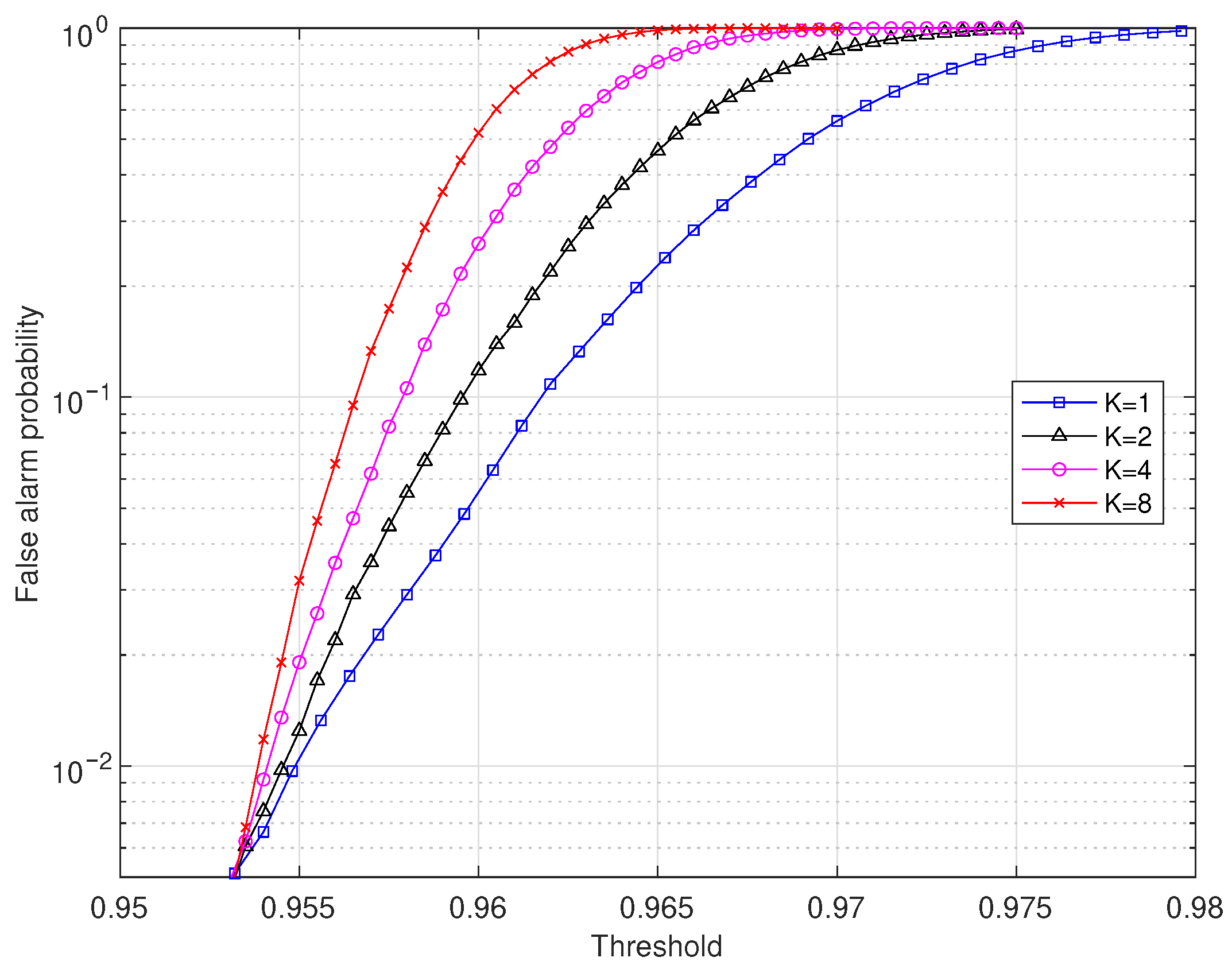
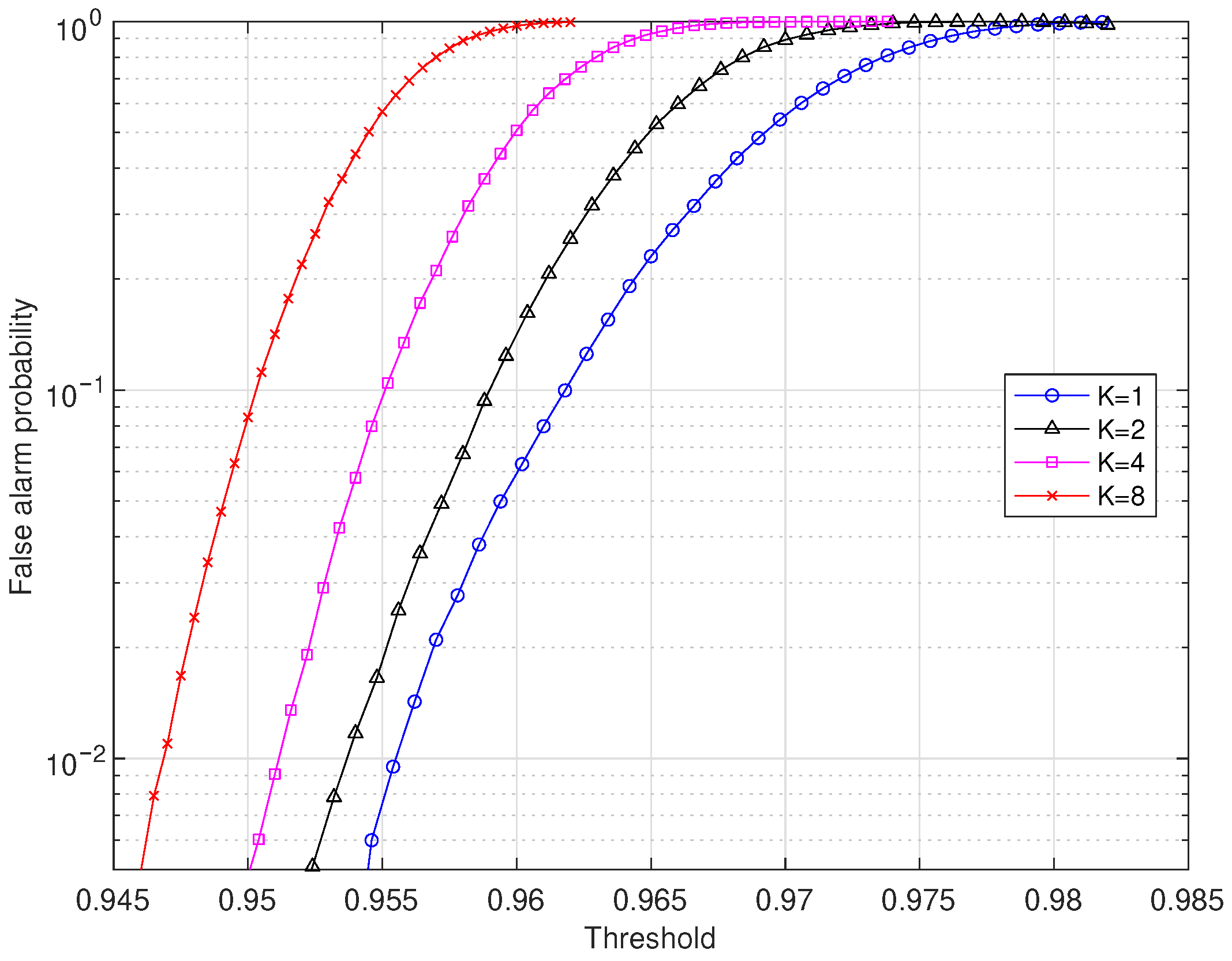
Figure 2 shows the false-alarm probability
versus the detection threshold
for the proposed W-D-CSS scheme, for different numbers of cooperating UAVs
K. From the decision rule in (
15) increasing
naturally increases
. At relatively low thresholds, the weighting scheme emphasizes more reliable UAVs (those with smaller empirical variance of the local statistic under
), so the consensus averaging effect dominates and
remains low. As
increases, the influence of higher-variance nodes becomes more pronounced; although weighting mitigates this, the variance of the fused statistic grows, yielding higher
at larger thresholds.
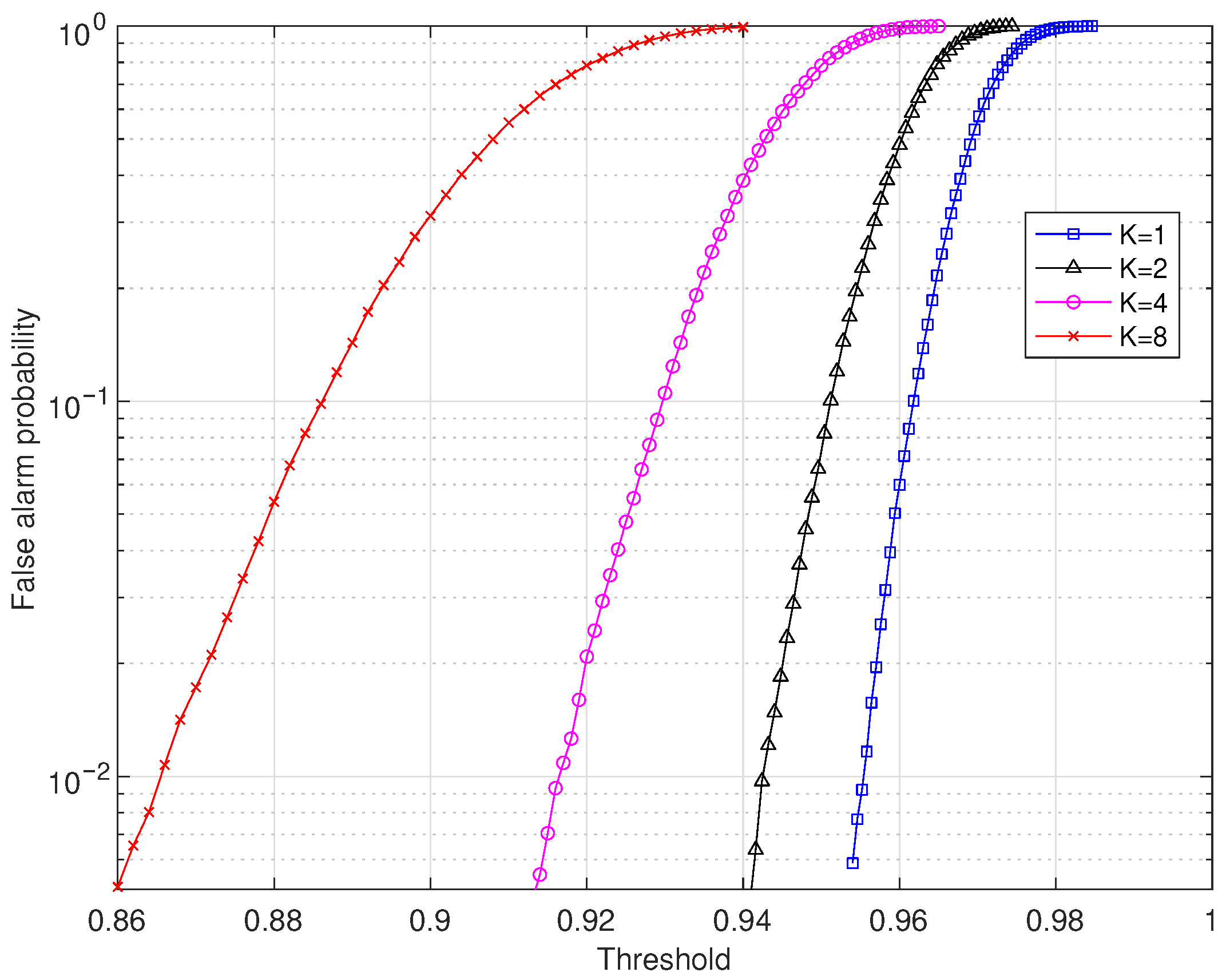
Similarly,
Figure 3 and
Figure 4 show
versus the detection threshold as the number of UAVs
K varies for the benchmark schemes EQ-D-CSS and OR-C-CSS, respectively.
For EQ-D-CSS, consensus averaging partially mitigates the impact of temporal correlation, but, without weighting, high-variance nodes are not down-weighted. Thus, as
K grows and more heterogeneous (more temporally correlated) UAVs are included, the reduction of
with
is less pronounced than with W-D-CSS. By contrast, in OR-C-CSS there is no averaging effect: for a fixed
, the global false-alarm probability increases markedly with
K, as shown in
Figure 4.
5.2. Joint GBS Detection and Ground-User Coverage Optimization over UAV Altitude
We evaluate the ability to detect the GBS signal at a fixed false-alarm probability as a function of the UAV altitude. UAVs are randomly distributed around the GBS at a common altitude h; The horizontal UAV–GBS distance r is obtained from the slant distance d and the altitude h as , and is modeled as . The altitude h is swept as a parameter. Since altitude directly impacts the A2G pathloss and LoS probability, it also affects the detection probability, yielding an altitude that maximizes successful detection.
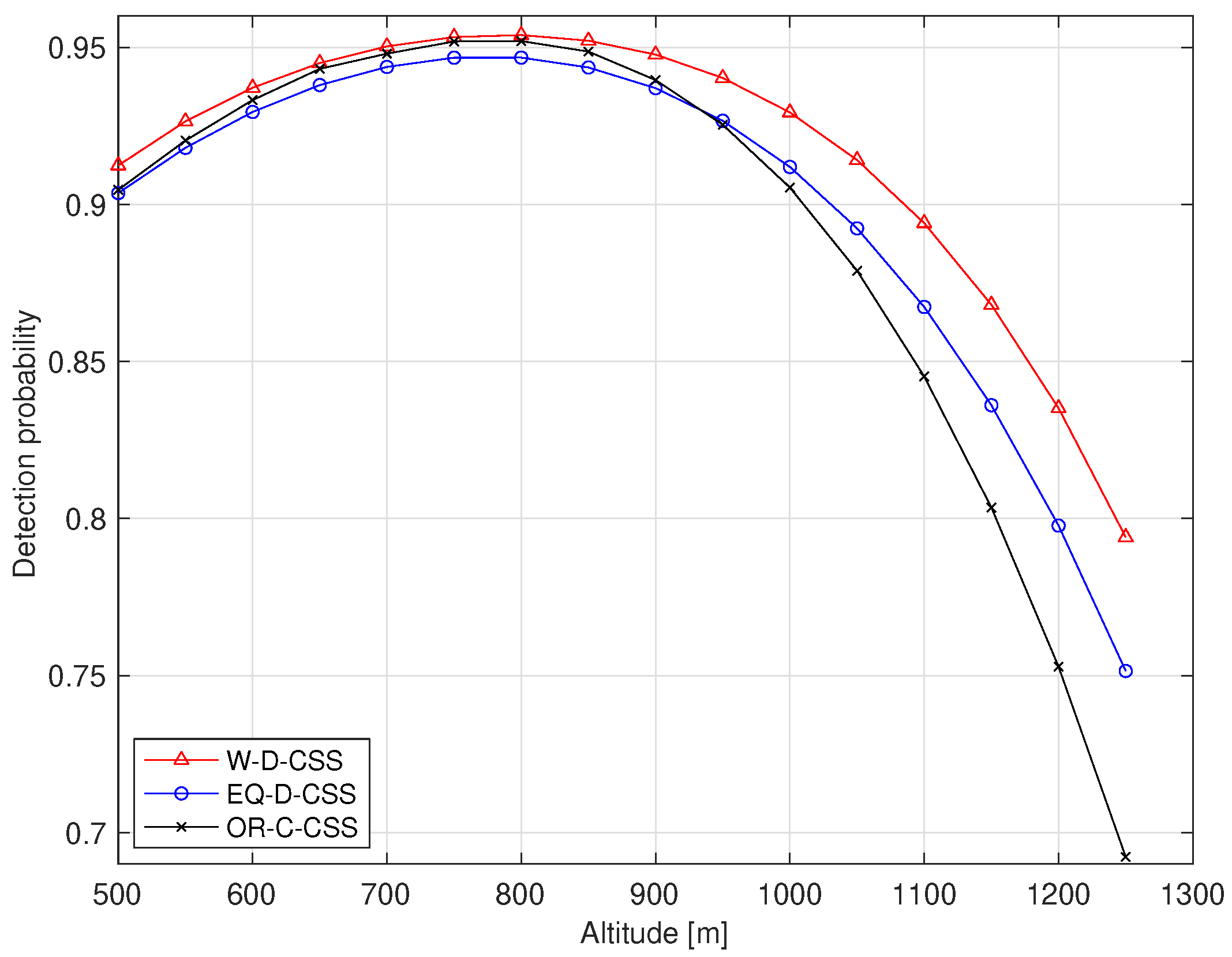
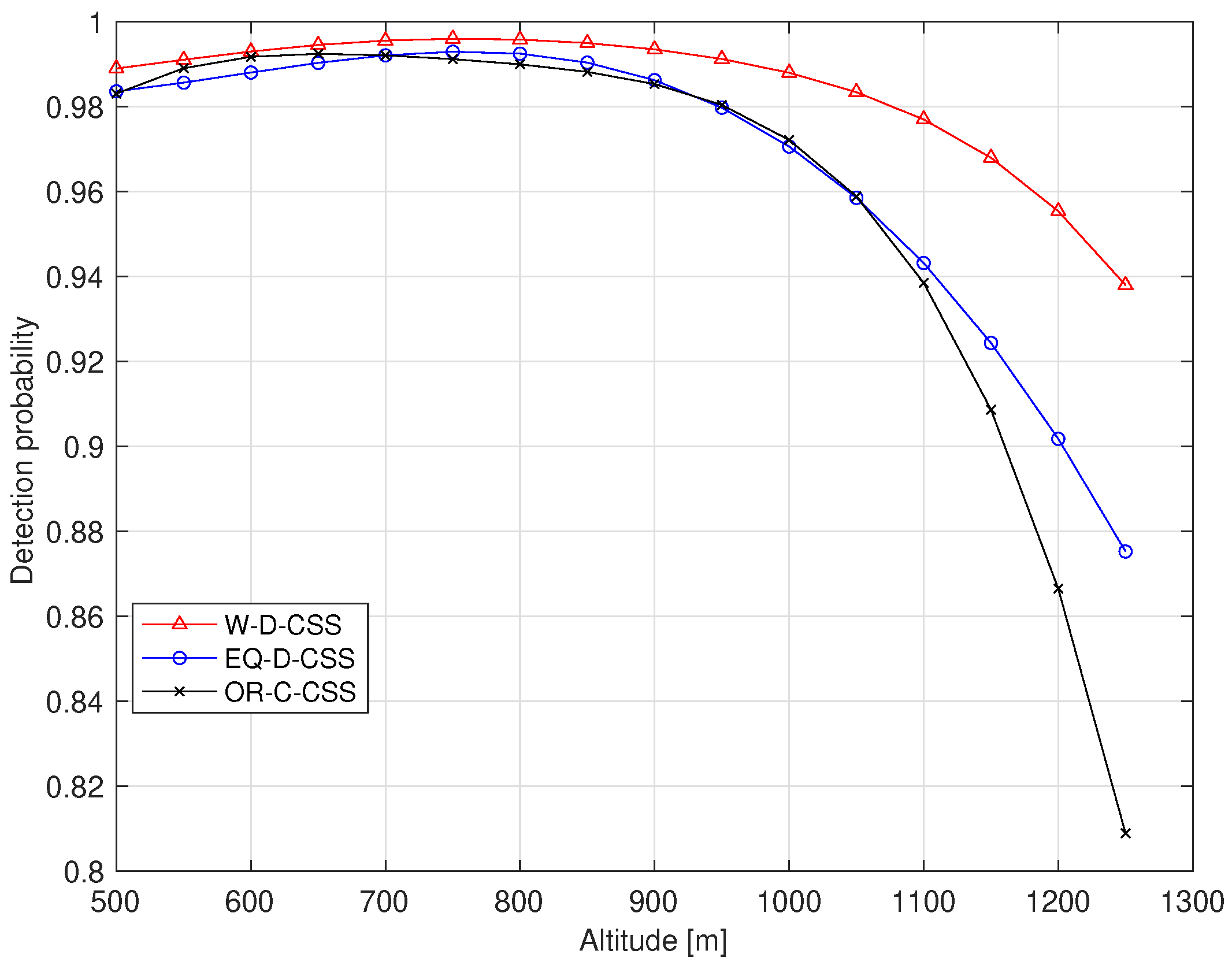
Figure 5 and
Figure 6 show the detection probability versus altitude
h for
and
cooperating UAVs, respectively. In both cases, the detection probability attains a maximum around
, due to the trade-off between increasing pathloss at higher altitudes and increasing LoS probability. Both figures highlight that W-D-CSS consistently outperforms EQ-D-CSS and OR-C-CSS, with the gap widening at higher altitudes (e.g.,
), where OR-C-CSS yields the lowest detection probability. Moreover, as
K increases, all schemes improve, but the relative advantage of W-D-CSS becomes increasingly evident.
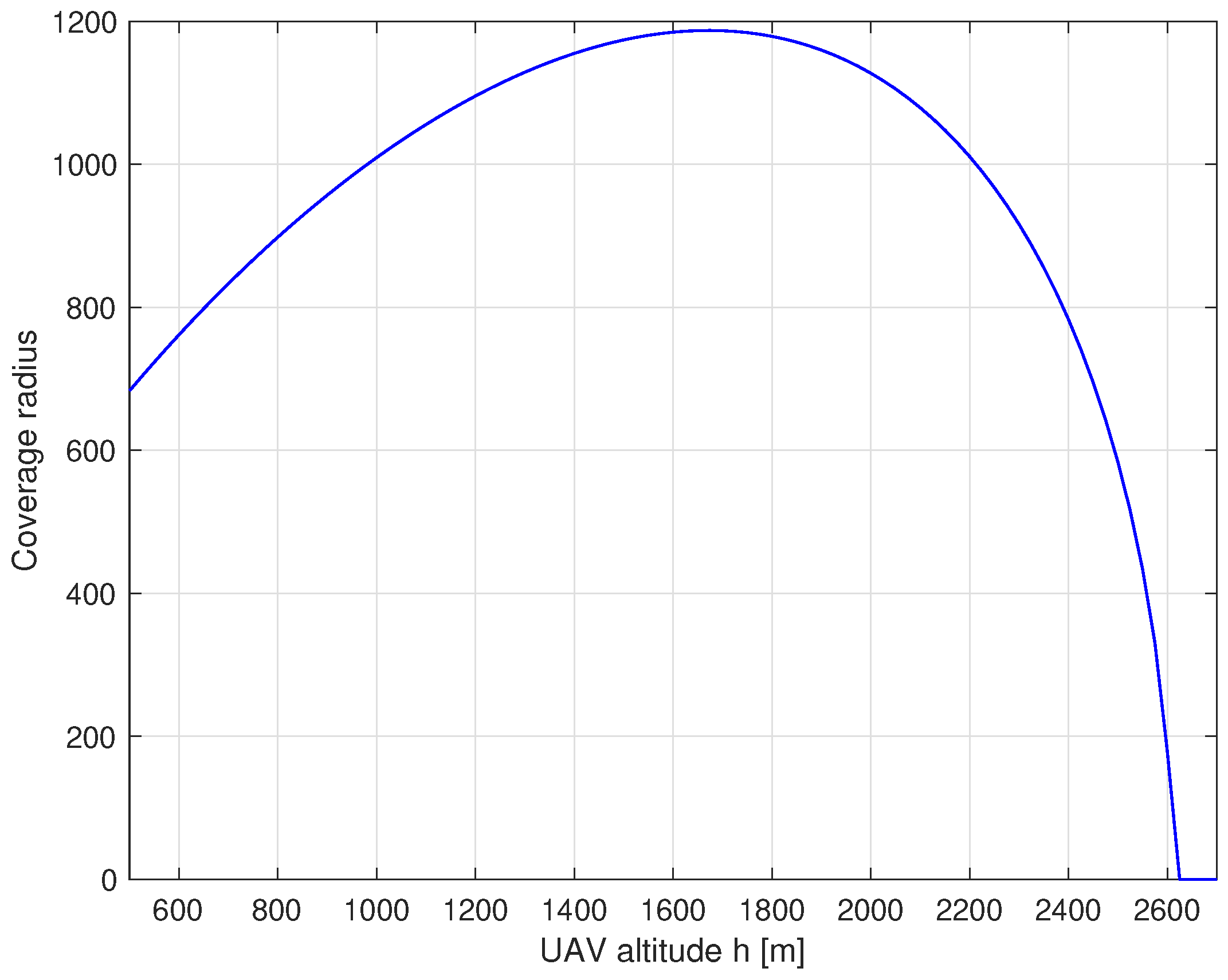
Since the UAVs are deployed to provide connectivity to ground UEs, we extend our analysis to jointly account for both coverage and SS capabilities. The ABS provides reliable service within the region where the received signal-to-noise ratio (SNR) exceeds a target threshold.
Following the approach in [
20], we define the coverage radius as the maximum horizontal distance that ensures
at the ground-user receiver in a dense urban environment. For a fixed SNR requirement and propagation conditions, this radius depends solely on the UAV altitude
h, as illustrated in
Figure 7.
In particular,
Figure 7 shows that the coverage radius attains a maximum at
, due to the trade-off between the LoS probability, which increases with
h and enhances the SNR, and the pathloss—which also increases with
h and reduces the SNR [
20].
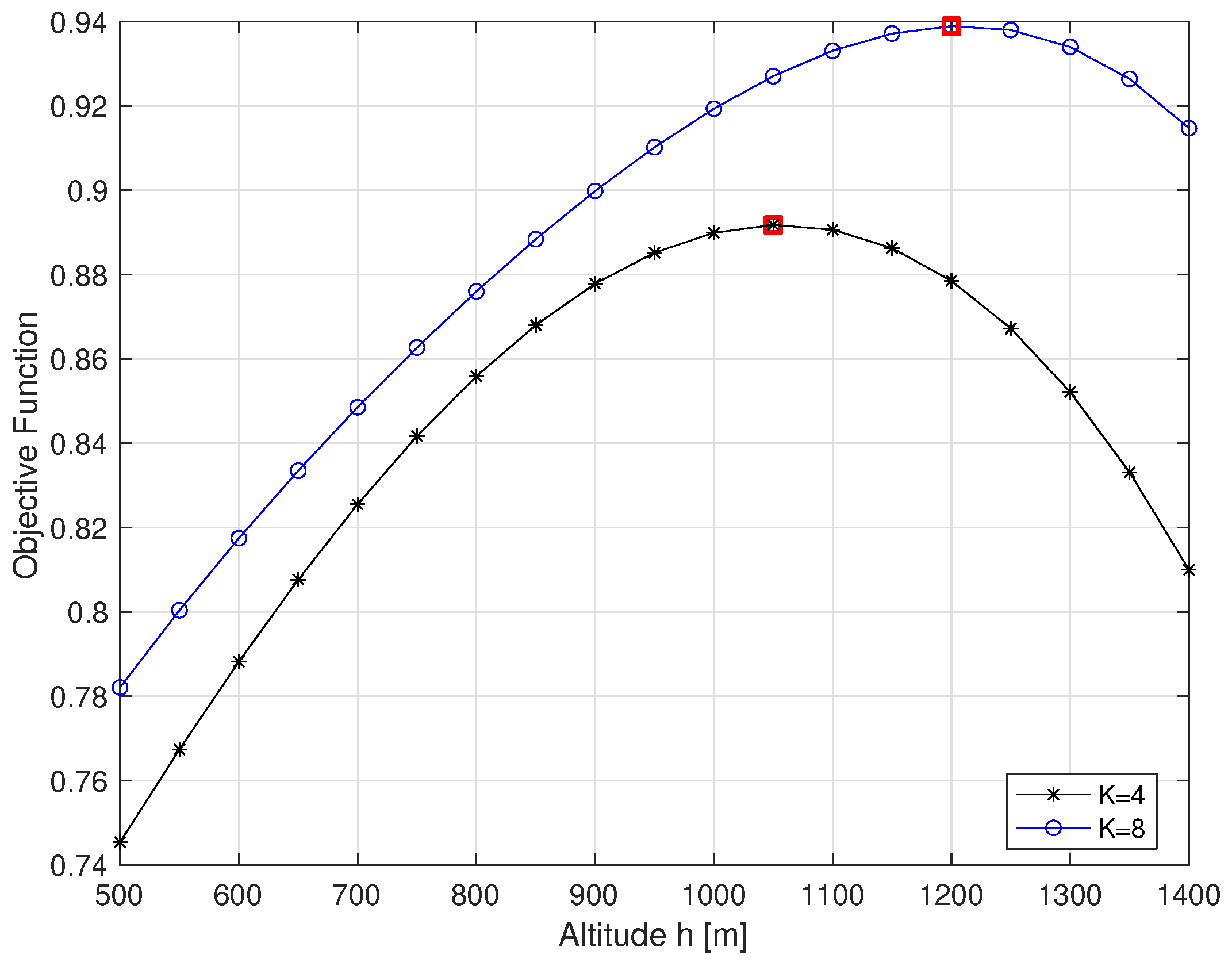
The goal is to balance maximizing UE coverage with minimizing interference to UEs served by the GBS. To this end, we define an objective function as the weighted sum of the detection probability and the (normalized) coverage radius as functions of the UAV altitude:
where
is the detection probability for
K cooperating UAVs,
is the normalized coverage radius, and
balances the relative weight of detection and coverage. The optimal operating altitude of the UAV swarm is obtained via numerical simulation.
Figure 8 shows the optimal altitude for
, corresponding to an equal balance between detection and coverage, with larger
K yielding higher values of the objective function. Overall, the joint optimization shifts the optimum between the detection optimum (around
) and the coverage optimum (around
), depending on
and
K. In particular, for
the optimum is attained at
for
and at
for
.
5.3. Receiver Operating Characteristic Curves
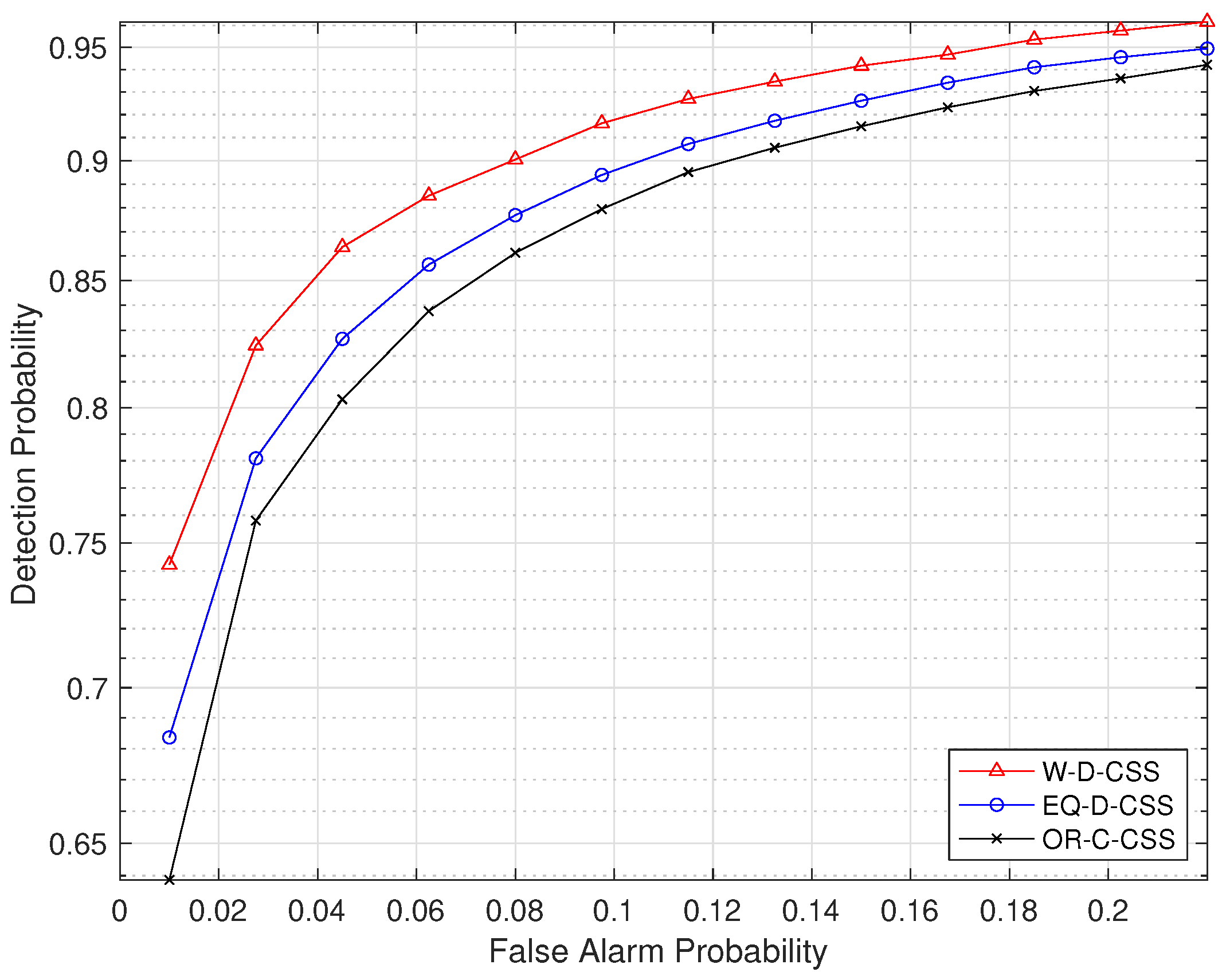
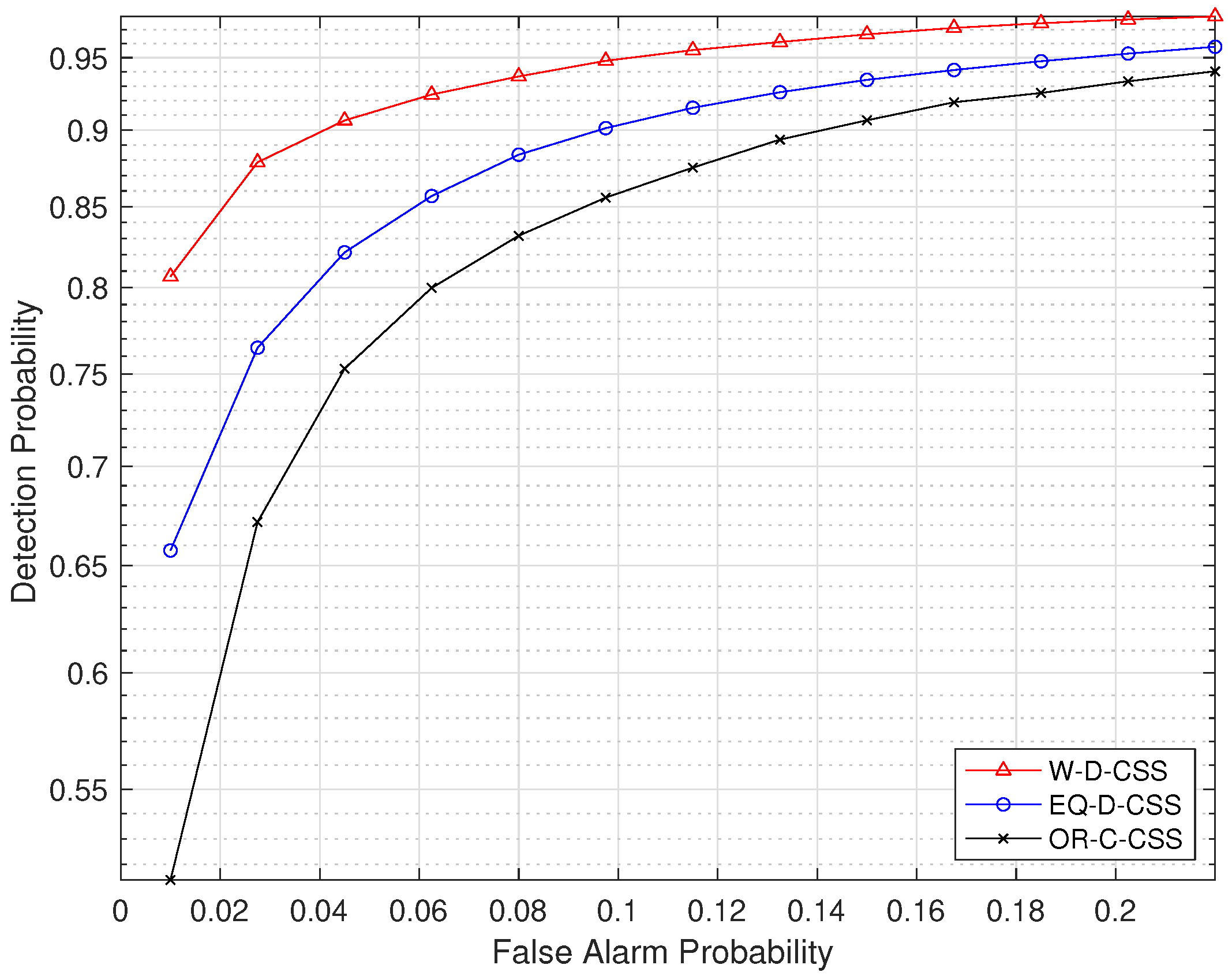
Using the previously obtained optimal altitude, we compute the Receiver Operating Characteristic (ROC) curves. The ROC illustrates the trade-off between detection and false-alarm probabilities: the former reflects protection of UEs served by the GBS, while the latter reflects avoiding missed transmission opportunities when the PU is idle.
Figure 9 and
Figure 10 show
versus
for
and
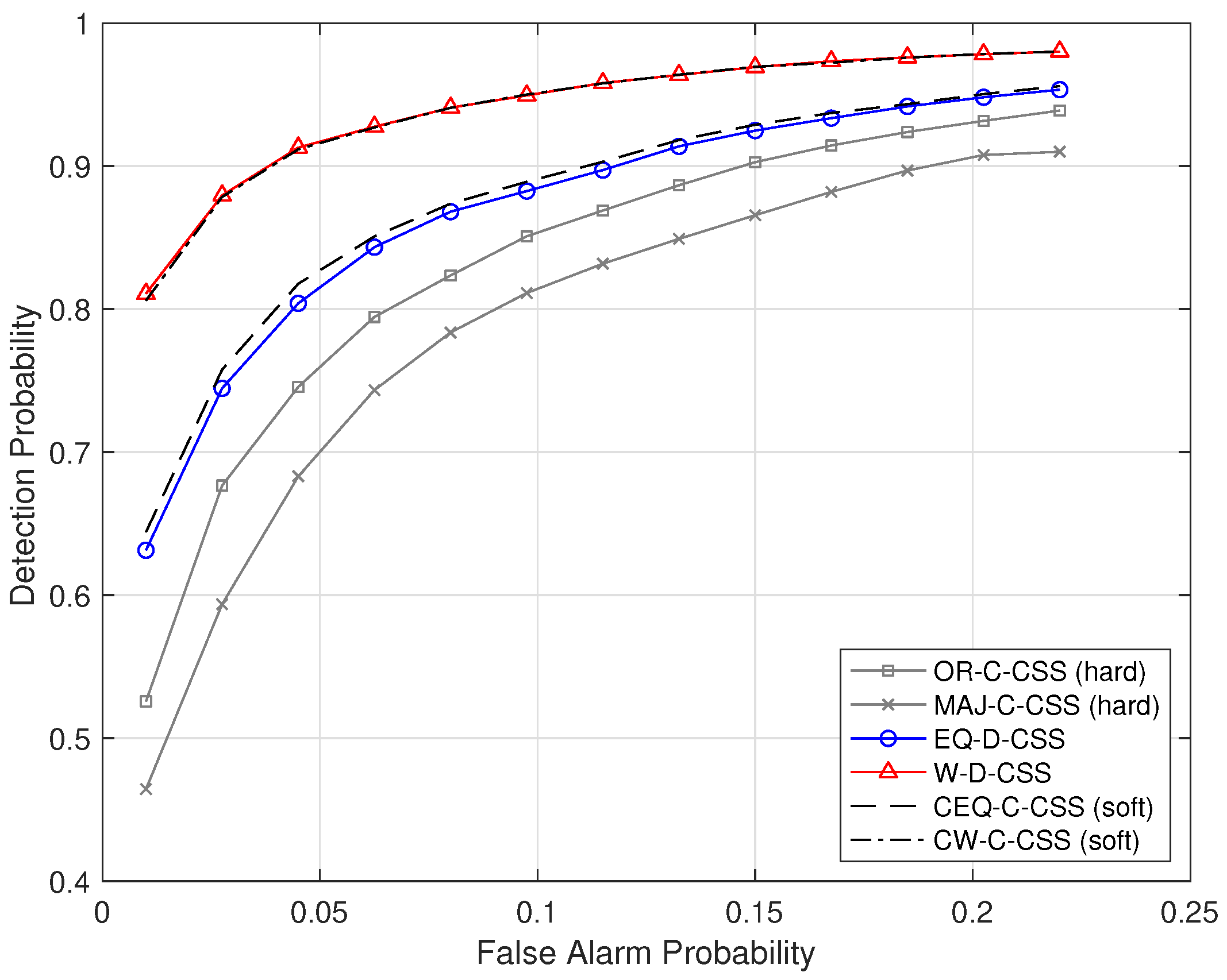
cooperating UAVs, respectively. In both cases, W-D-CSS consistently outperforms EQ-D-CSS and OR-C-CSS across the entire range of
, yielding higher
at a given false-alarm level. EQ-D-CSS attains intermediate performance, whereas the centralized OR-C-CSS scheme yields the lowest detection probability.
Notably,
Figure 10 shows that increasing
K provides a significant performance gain for W-D-CSS due to spatial diversity. By contrast, increasing
K does not yield a comparable gain for EQ-D-CSS or OR-C-CSS, since adding more UAVs also introduces nodes with higher RSI time-correlation coefficients
, whose impact is not adequately mitigated—unlike in W-D-CSS, where smaller weights are assigned to those higher-variance (higher-
) nodes in the fused statistic.
These results confirm that W-D-CSS exploits cooperation diversity more effectively among UAVs affected by RSI with heterogeneous correlation levels. This enables operation at lower
—and thus larger communication capacity (see
Section 5.4)—for a fixed level of protection of the PU receiver (i.e., a given
).
Comprehensive ROC Comparison
To provide a fair and complete performance comparison,
Figure 11 reports the ROC curves of all considered centralized and distributed spectrum sensing schemes. In addition to the OR-rule hard fusion, which is evaluated across all metrics, we include Majority hard fusion and centralized soft fusion (both equal-weight and weighted) as stronger reference baselines. These schemes are shown only through ROC curves, as they primarily serve to benchmark detection performance and do not qualitatively alter the conclusions drawn from the OR-based results.
Indeed, centralized soft fusion represents an upper-performance benchmark, against which the proposed distributed soft-combining schemes can be directly compared.
Figure 11 shows that the proposed W-D-CSS achieves the highest detection probability across the entire false-alarm probability range, closely approaching centralized soft fusion (CW-CSS). Unweighted distributed consensus EQ-D-CSS also significantly outperforms hard-fusion rules, while Majority hard fusion performs worse than the OR rule due to heterogeneous local statistics induced by RSI.
5.4. Capacity of Ground UEs Served by an ABS
From the ROC analysis, we evaluate the performance in terms of the capacity of UEs served by the ABS. Assuming a high level of protection with
, the normalized capacity is
where
is the PU idle probability,
is the SNR at the UE, and
represents the fraction of frame time available for data transmission (i.e., excluding cooperation/reporting overhead).
In centralized CSS, each of the K UAVs transmits its local sensing result to a DC within each sensing frame. Let denote the airtime required to transmit one such report; the total reporting time therefore scales approximately as . In contrast, in distributed CSS, cooperation is achieved through an iterative consensus process, where each iteration consists of a short message exchange among neighboring UAVs. Let denote the duration of one neighbor-exchange iteration and I the number of iterations required for convergence; the resulting cooperation time is then .
Since centralized CSS requires sequential reporting from all UAVs to the FC, whereas distributed consensus relies on a fixed number of short, localized exchanges, it is natural to compare the two approaches in terms of their overall communication time. In practice, the total convergence time of the distributed scheme,
, is expected to be no larger than the aggregate reporting time
required by centralized CSS. To obtain a conservative, worst-case comparison in the simulations, we therefore assume
and adopt a fixed data-time fraction
, following [
32].
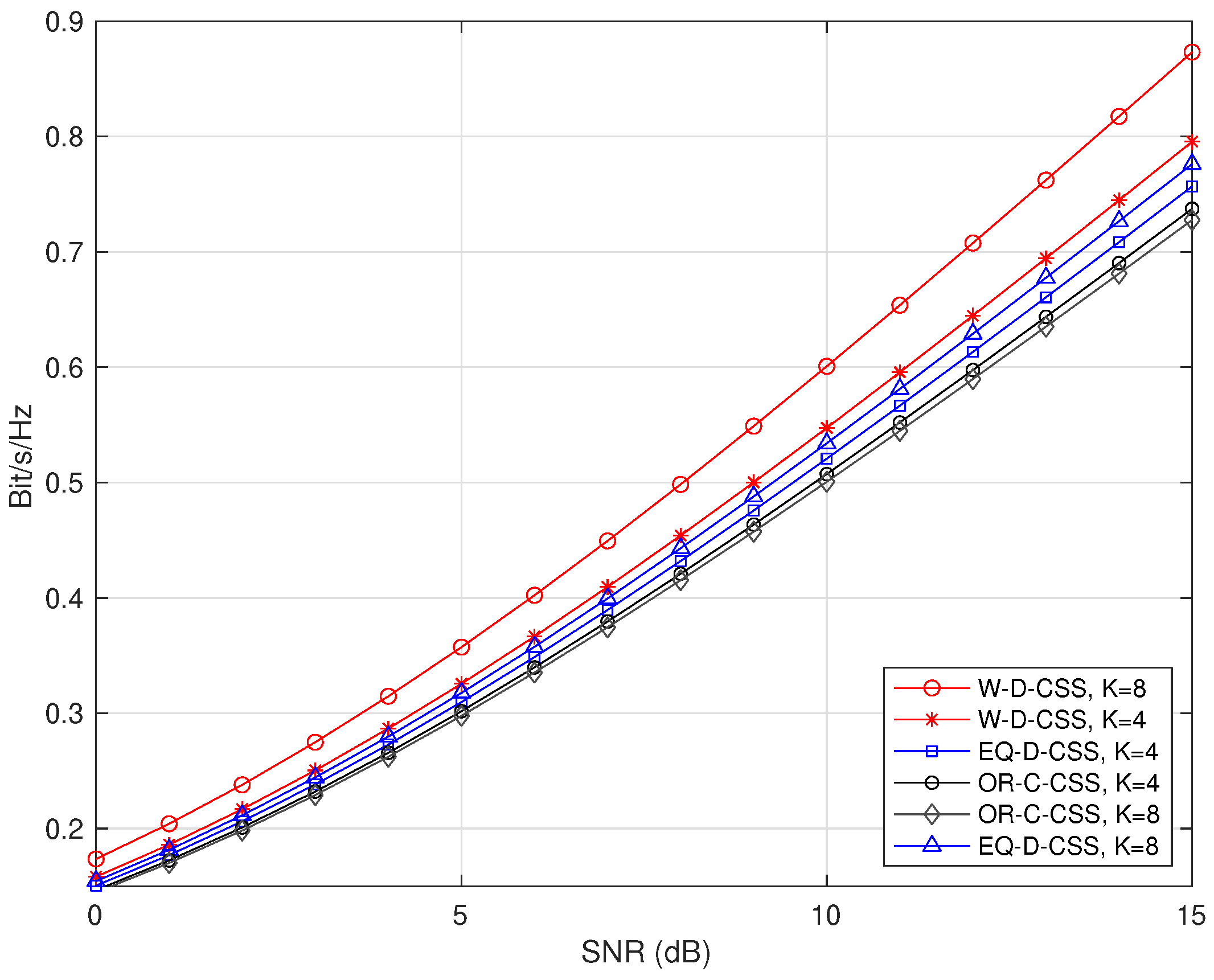
Figure 12 plots the normalized capacity (bits/s/Hz) versus the received SNR for the three schemes of CSS for
cooperating UAVs, assuming
. W-D-CSS attains the highest capacity across all SNR values, with performance further improving as
K increases from 4 to 8. EQ-D-CSS is slightly inferior to W-D-CSS but consistently outperforms OR-C-CSS. The centralized OR-C-CSS yields the lowest capacity, even for larger
K, due to its higher false-alarm probability. Notably, for W-D-CSS, increasing
K from 4 to 8 produces a clear upward shift of the curves (cooperation diversity gain), whereas this gain is limited for EQ-D-CSS and negligible for OR-C-CSS.
5.5. Convergence of the Distributed Algorithms
Finally, to provide further insight into performance, we evaluate the convergence behavior of both distributed schemes as a function of the number of iterations required to achieve consensus among the UAVs.
Specifically,
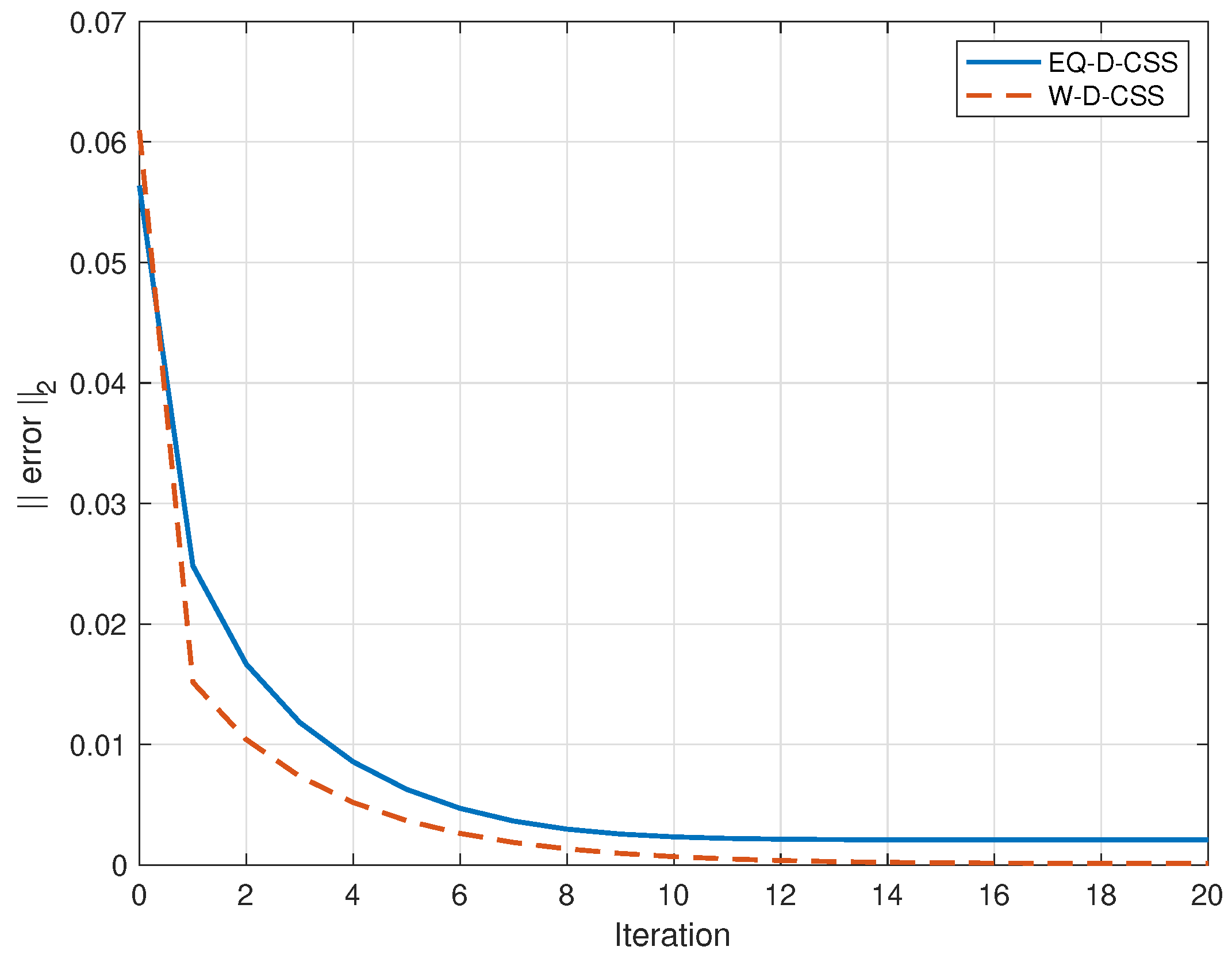
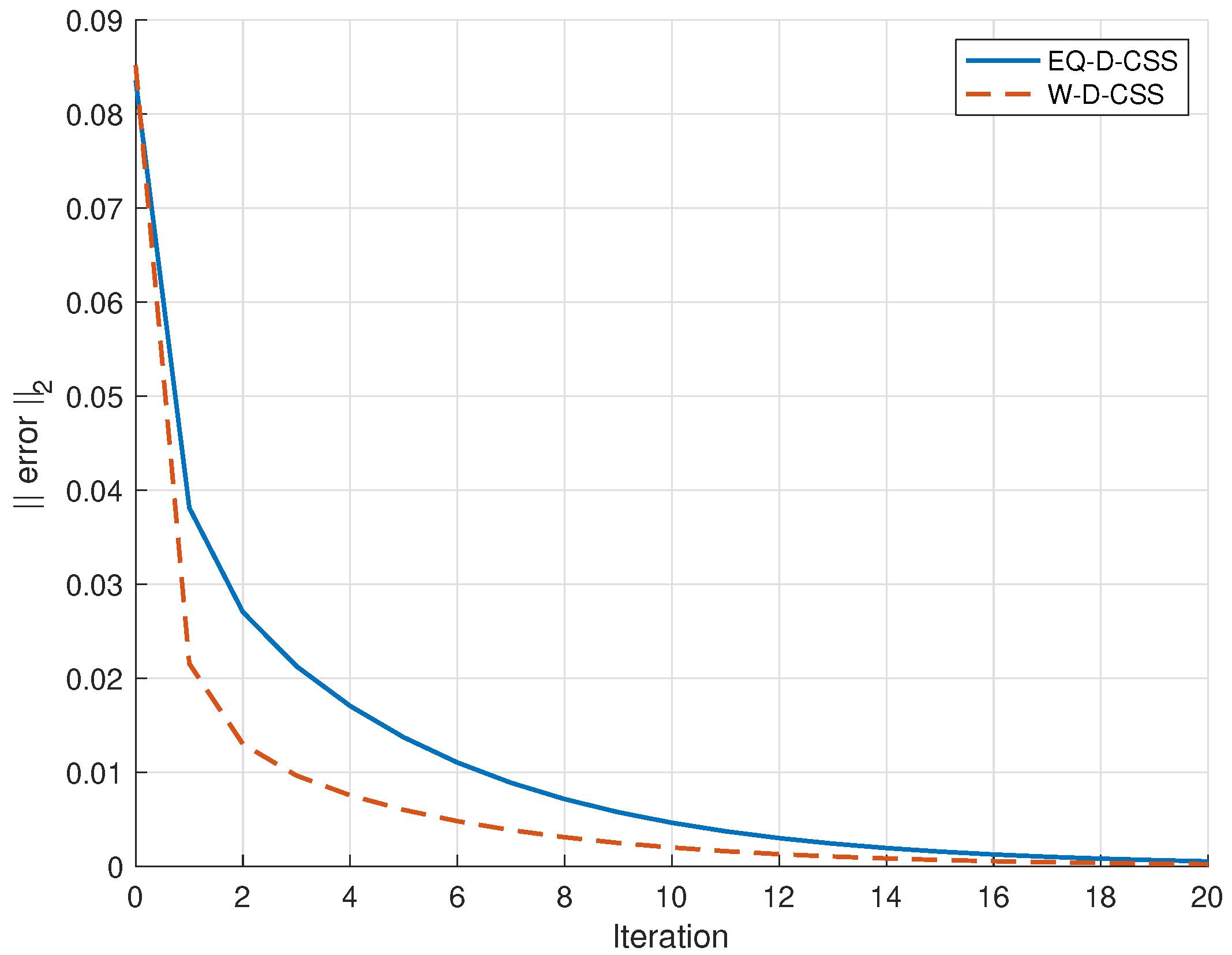
Figure 13 shows the convergence error
, defined as the
-norm of the difference between the consensus value held by each UAV at a given iteration and the final consensus value obtained after convergence of the push–sum algorithm, for
, comparing EQ-D-CSS and W-D-CSS. Both schemes converge within a few iterations; however, W-D-CSS exhibits a faster decrease of the error norm, confirming the benefit of weighting the UAVs’ local ST values according to the inverse of their variances.
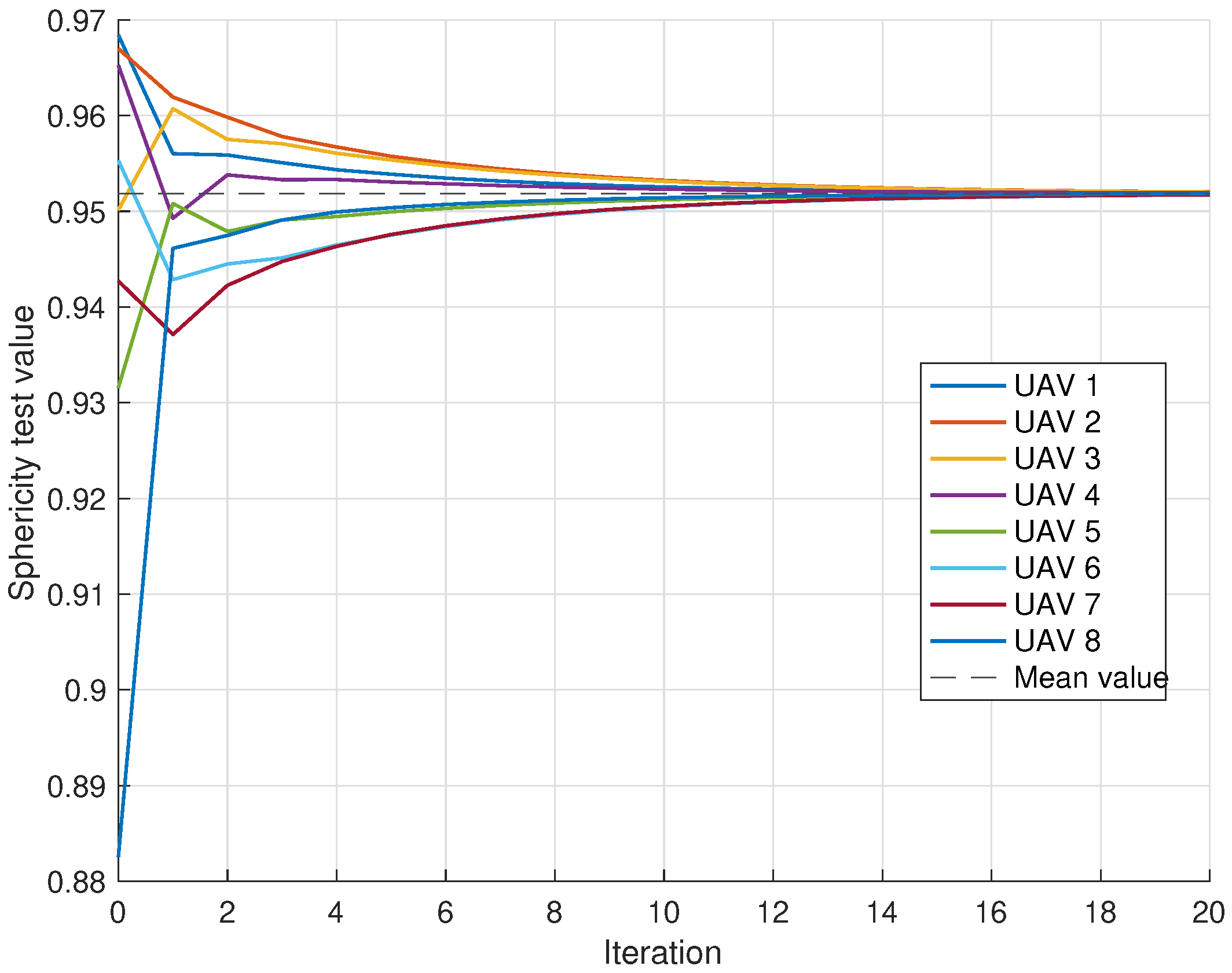
Figure 14 details the convergence steps of W-D-CSS, where the individual UAVs’ local ST values progressively align with the consensus value. After approximately 15 iterations, all nodes converge to a common value, demonstrating the stability and effectiveness of the weighted consensus process.
5.5.1. Communication Overhead
In the proposed distributed CSS, each UAV exchanges only two scalar values per the push–sum iteration. Using 32-bit floating-point representation, this corresponds to an 8-byte payload; including minimal protocol overhead, a packet size of
32–40 bytes is assumed. For the convergence observed in
Figure 13, where approximately
iterations are sufficient, the per-UAV communication overhead per sensing frame is approximately
. At the network level, the total transmitted overhead of the distributed scheme scales as
, yielding approximately
kB per sensing frame for
. In centralized CSS, each UAV transmits a single report per sensing frame; however, both communication traffic and processing are concentrated at the FC. By contrast, distributed CSS spreads the communication load evenly across UAVs, avoiding congestion and scalability bottlenecks at a single node.
5.5.2. Convergence Time
Since the convergence time of the distributed scheme is given by , assuming a realistic air-to-air LoS data rate in the range of 10–50 Mbps, transmitting a 40-byte packet requires approximately – ms. Accounting for medium-access and processing delays, a practical estimate is – ms, leading to a total convergence time of roughly 1.5–4 ms for . This time is well below the 5G NR frame duration of 10 ms, ensuring that distributed sensing is completed within a single sensing frame and allowing reliable identification of PU-free frames during normal UAV operation. Overall, although distributed CSS incurs higher aggregate network traffic than centralized hard-decision fusion, the overhead is evenly distributed and avoids FC congestion.
5.5.3. Convergence Under Irregular Topologies
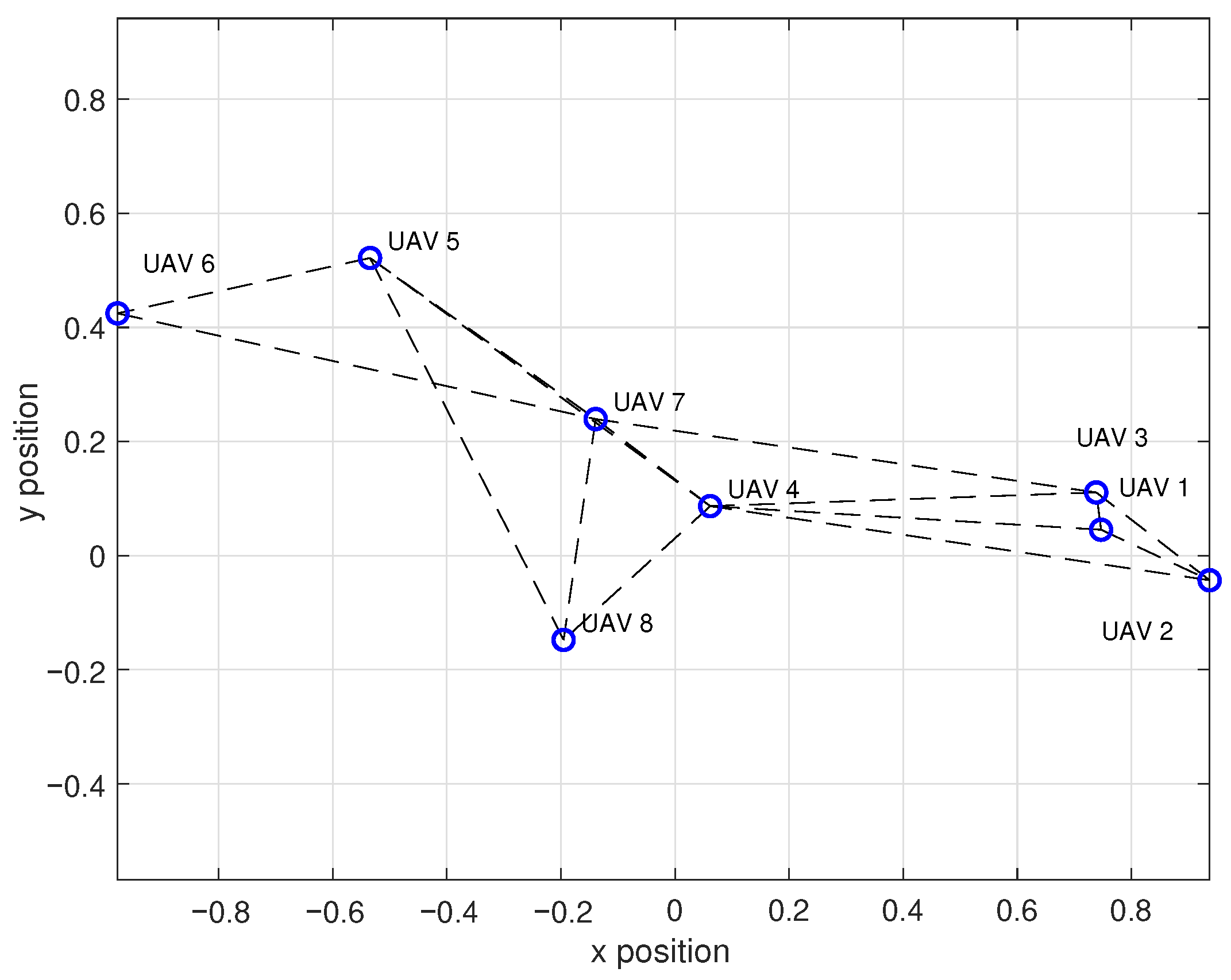
To verify robustness to network topology, we simulate an irregular communication graph with UAVs randomly deployed and links established via a distance-based proximity rule, ensuring strong connectivity, e.g., in
Figure 15. The mixing matrix is constructed using the Metropolis-–Hastings rule, which is row-stochastic and applicable to arbitrary topologies.
Convergence behavior for the proposed W-D-CSS under this irregular topology is shown in
Figure 16. The results confirm that the algorithm converges correctly and at a speed comparable to the ring topology, demonstrating its topology independence.
5.5.4. Scalability with Swarm Size
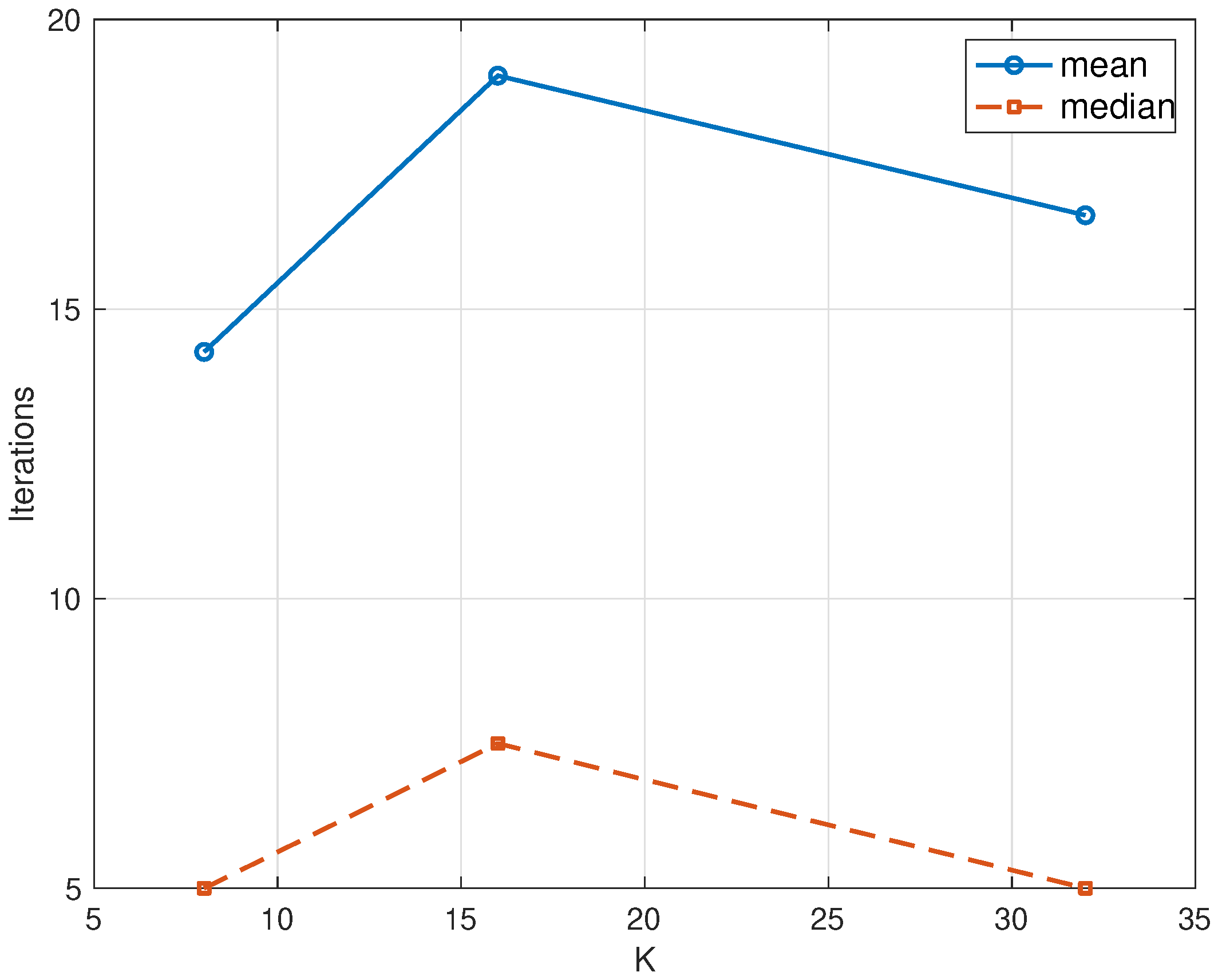
Figure 17 reports the number of push–sum iterations required to satisfy
as a function of the swarm size
K, averaged over 100 random network realizations. The convergence behavior does not scale monotonically with
K, since it is mainly driven by the connectivity of the communication graph—i.e., the average node degree
—rather than by the swarm size itself. In random geometric graphs deployed over a fixed area,
may decrease for intermediate values of
K, leading to slower convergence, whereas higher node densities for larger swarms improve connectivity and reduce the number of required iterations. From a computational perspective, the proposed scheme has constant per-node complexity, ensuring scalability, in contrast to centralized CSS schemes that incur
processing at the fusion center.
5.6. Discussion and Sensitivity Analysis
We conclude this section with a brief discussion on the sensitivity of the proposed framework to key system parameters. We show that the number of cooperating UAVs mainly affects the convergence speed of the push–sum algorithm, while the final consensus value is preserved under graph connectivity. Heterogeneous RSI temporal correlation across UAVs [0–0.9] increases the variance of local statistics but is effectively mitigated by the proposed variance-based weighting. The altitude optimization objective is smooth with respect to UAV height, indicating robustness to small deviations. Convergence is further validated under stochastic A2G propagation with LoS/NLoS transitions, random UAV topologies, and swarm sizes up to 32 nodes. Finally, we discuss that asynchrony primarily impacts convergence speed rather than correctness, and that assuming near-ideal A2A links is reasonable in LoS-dominated UAV scenarios.