


Abstract
Big players in information and communication technologies are investing in the metaverse for their businesses. Meta, as the main player in social media worldwide, is massively developing its “social” metaverse as a new paradigm by depicting it with nice and endless features and by expecting current social media to become engrained within it. What is the attitude of users towards this future scenario? Very few studies specifically focusing on this question were found. In this work, a scale for assessing the attitude of people towards the social metaverse was developed. A questionnaire composed of 38 Likert items, inspired by features of the social metaverse, was generated and administered to 184 Italian subjects. The results were analyzed with exploratory factor analysis, and the final scale is composed of 15 items covering four factors that were interpreted. Aspects consistent with both the preliminary work of the authors and with some previous works were found. Considerations are also made in relation to the analysis of the contents of Meta.
1. Introduction
The “metaverse” is described in several ways; thus, there is no convergence on a unique definition of it. In general, the common concept is that the metaverse is a set of virtual worlds, online and shared on the Internet, and users join it, participate in it by means of customizable avatars, interact, and are allowed to do anything, including the creation of new digital content. We cannot avoid citing, as a classic, the novel Snow Crash [1], deemed to be the first publication talking about the metaverse. For many years, the topic of the metaverse has been raised and developed; several studies have been carried out around several facets, such as, security, ethics, privacy, enabling technologies, user interfaces, and intention to use.
Park and Kim [2] developed a taxonomy of types of metaverses and highlighted open issues related to social disparities, legal themes, and limits of available devices. An interesting systematic review performed by Crespo-Pereira and colleagues [3] mentions and describes the components of the metaverse and how social and neurosciences are involved in participation in the metaverse. Bojic [4] debates the power of the influence of “big tech” in the development of the metaverse and its relationship with the behavior of society. Zhao et al. [5] designed a framework for the development of the visual part of the metaverse, including visualization methods, ways of interaction, graphics, and methods for designing scenes. In their research, Zhang and colleagues [6] analyzed and designed a framework of enabling technologies for developing learning and education in the metaverse; this research also offers a history of the metaverse and its main traits. Recent studies also include research about the intention of participating in the metaverse and the factors influencing the behavior of users. With their experiment [7], Bethcle and Weinberger assessed that, using the Unified Theory of Acceptance and Use of Technology model [8], immersive virtual reality (that is, one of the enabling technologies of the metaverse) is generally accepted and positively evaluated in the context of participation in municipal politics. Calderón-Fajardo et al. worked on the topic of acceptance [9], evaluating the constructs that influence the acceptance of metaverse technologies for the tourism industry with a focus on the so-called “Gen Z” [10] and “Millennial” [11] subjects; findings showed that the pricing value, facilitating conditions, social influence and intention to visit are relevant constructs. Shahzad et al. [12] carried out research to identify, by means of a specific theoretical framework, the reasons to adopt the metaverse (new immersion, shopping, and social experience) or not adopt it (perceived lack of control, privacy issues, strain). Raman and colleagues’ research [13] reports a detailed analysis, after a literature review, for screening theoretical models suitable for assessing how metaverse technologies influence the cognitive, affective, and emotional facets of human behavior in social life.
In a preliminary work [14], Mottura analyzed the contents of main big-tech companies (Microsoft, Apple, IBM, Siemens, and Meta—formerly Facebook) and found that the metaverse is mainly considered to be a tool or a platform for business purposes or for entertainment, while on the other hand Meta places itself as the realization of the metaverse as a new virtual social world (from now on, “social metaverse”). Meta is fully aimed at realizing it by expecting 1 billion users in about ten or so years [15]. In the vision of Meta, the main player in social media worldwide, the social metaverse will involve people of society, starting from the users of existing social media platforms. Such a metaverse is described and advertised as a new online virtual space where everyone can meet and share experiences with anyone, and where people are allowed to feel good. In the context of the development of immersive social media for the future, it is reasonable to raise the question: would people like such a “social” metaverse with such features, immersed in virtual reality and with huge potential?
Beyond Meta’s specific objectives, understanding people’s attitudes toward a social metaverse is relevant for broader societal reasons. First, a socially oriented metaverse can become an extension of everyday interpersonal interactions: meeting friends, attending events, or participating in communities in immersive formats. Measuring attitudes toward the metaverse would help predict people’s willingness to adopt these new forms of social connection. Further research could investigate the relationship between attitudes toward the metaverse and characteristics of identity, embodiment, privacy, and social relationships.
Second, in education, assessing young people’s expectations and concerns about the metaverse can support digital literacy and awareness-raising initiatives, similar to those addressing cyberbullying, social media use, or artificial intelligence. Finally, even at a more institutional level, policymakers are increasingly monitoring public perceptions of emerging technologies; a metaverse-validated instrument can inform preventive regulation and public communication.
Two literature reviews carried out in the preliminary work showed that there are very few works specifically aimed at assessing the position of people on the question stated above. These works [16,17,18,19] are not properly focused on that question, but they are among the few ones approaching, maybe not in a direct way, the opinion of people; they are described in Section 2.
In summary, works specifically focusing on assessing the agreement of people about the (perspective of a) social metaverse are few. The aim of this work is to develop a scale for assessing the attitude of people towards a social metaverse shaped with the features promoted by Meta. The theoretical justification for this research question lies in the lack of instruments that capture attitudes towards the “social” dimension of the metaverse, specifically, as conceptualized by Meta. As reported in Section 2, existing studies predominantly use technology acceptance models, focusing on intention to use rather than attitude formation or social perception of the metaverse. The practical contribution of the present work is the proposal of an exploratory measurement framework that identifies the key latent dimensions underlying users’ perception of the social metaverse. This framework aims to provide an empirical basis for future validation studies and for researchers and practitioners seeking to understand public readiness and social concerns related to metaverse adoption.
2. Related Works
Some works from the previous literature review [14] were found to be related to the topic of assessing what the opinion of people is regarding a social metaverse; a concise description of such findings follows.
Babu and Mohan carried out a study [16] about the perception of people about the metaverse. A sample of 220 subjects participated in an online questionnaire composed of 18 items, most of them on a Likert scale. The questions ranged from opinions on the metaverse (e.g., the future, economy, evolution of the Internet, evolution of society, improvements in health care and education) to opinions around feelings about the metaverse (being disconnected from the physical world, being ready for it). The results are reported, for each question, with the percentages of subjects selecting a specific answer. The interesting result, for the purposes of this paper, is that around 37% stated themselves to be ready for the metaverse; a detailed description of all the results is reported in the study, as well as the questionnaire. Alvarez-Risco and colleagues carried out research [17] about the intention to participate in the metaverse of Facebook by considering the influence of (a) self-efficacy [20], (b) the support of the institutions in training users in technology, and (c) soft skills in using the tools of office automation and common smart devices. To this aim, 410 subjects from Peru answered an online questionnaire composed of items on a 5-point Likert scale (an internal version of it is shown in the paper). The results showed that factors (a), (b) and (c) positively influence the intention to participate in the metaverse of Facebook.
In their experiment, Bale et al. [18] assessed the impact the metaverse can have on people by administering a 7-item questionnaire (with the answers mainly in the form “Yes”, “No”, or “Maybe”). The questionnaire was developed after a deep consultation with a pool of experts from the health sectors (such as psychology, neurology, therapy). The main results, expressed as percentages of answers to each question, showed that 53% did not know what the metaverse is, and that 57% are excited about the metaverse; percentages regarding concerns about the metaverse imply that many are not in favor of it (for example, 47.4% answered “Yes” to the question “Do you think a Metaverse could create a physical communication gap between humans, and also cause hindrance in physical relationships?”).
The research carried out by Bibri and Allam [19] is twofold. On the one hand, a thorough dissertation, grounded in a literature review, was performed about the ethical implications of the metaverse on everyday life; on the other hand, the study reports the results of interviews (sources in [21,22,23,24,25]) where the answers highlighted the presence of concerns and doubts about the rise of the metaverse (for example, 68% answered “Not that/At all interested” to the question “Based on what you know, how interested are you in using Facebook’s new virtual reality project, metaverse, which would allow users to interact with each other in a computer generated environment?”). Answers to the question “Which of the following best describes how you feel about Metaverse? Select one.” Are as follows: “Curious = 33%”, “Uninterested = 27%”, “Suspicious = 23%, and “Concerned = 19%” [22,23].
In the present work, the literature was screened again to select potential new works on the topic of assessing the attitude of people towards the social metaverse. Two literature searches, S1NEW and S2NEW, were carried out on the Web of Science (WOS) [26] and on Scopus [27]. The same search strings used by Mottura [14] were initially used (see Appendix A); the raw results were filtered by selecting only documents in the English language, journal articles, conference proceedings and definitively published documents.
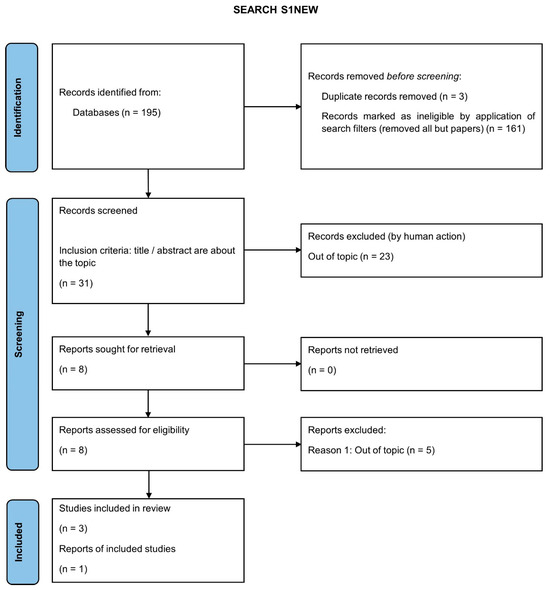
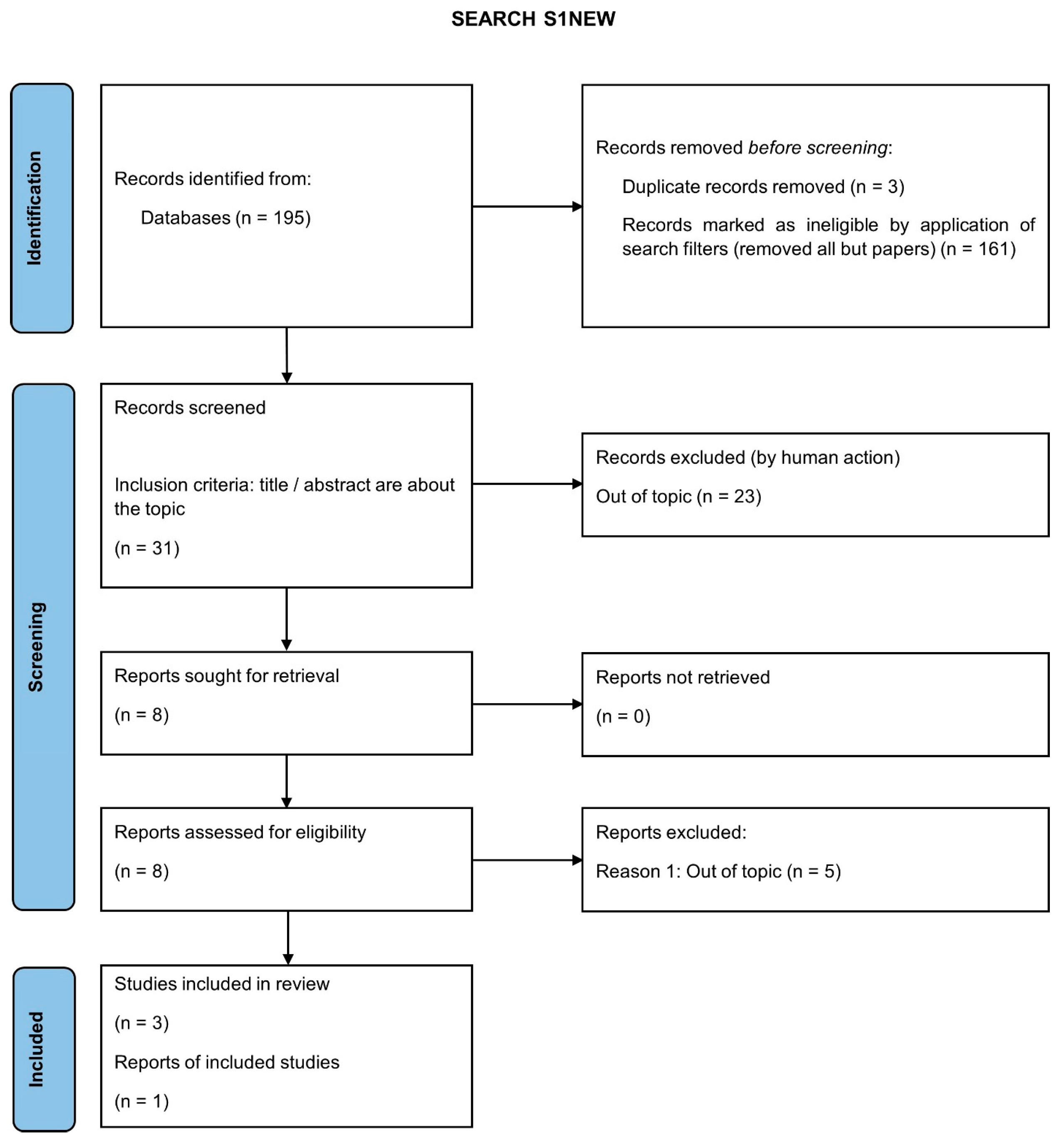
The raw result of S1NEW (in the date range 1 January 2023–1 July 2025) returned 195 documents (70 from WOS and 125 from Scopus). The PRISMA flowchart of the process is shown in Figure 1. After reading the titles and the abstracts to check whether the topic could be interesting, eight papers were selected. After a complete reading (or after a careful reading of the abstract, in cases where a full paper was not accessible), three papers were selected (the full document of two of them was not accessible). Nevertheless, the two papers with abstracts only have still been considered because of a very low number of results.
Figure 1.
The PRISMA flowchart of the literature search S1NEW.
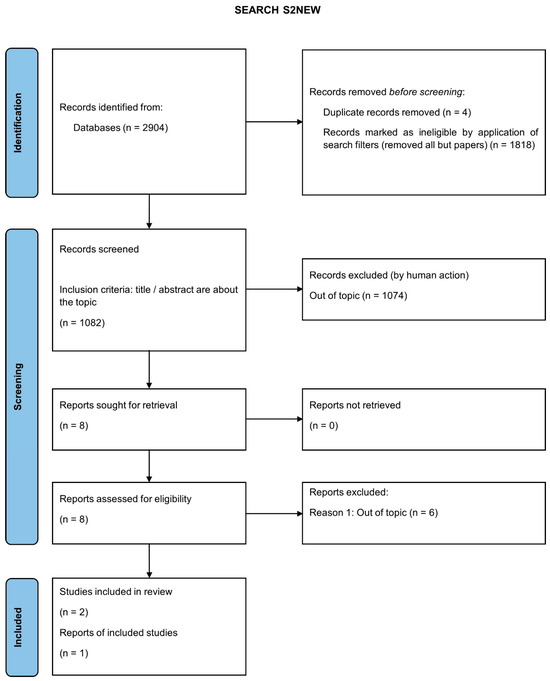
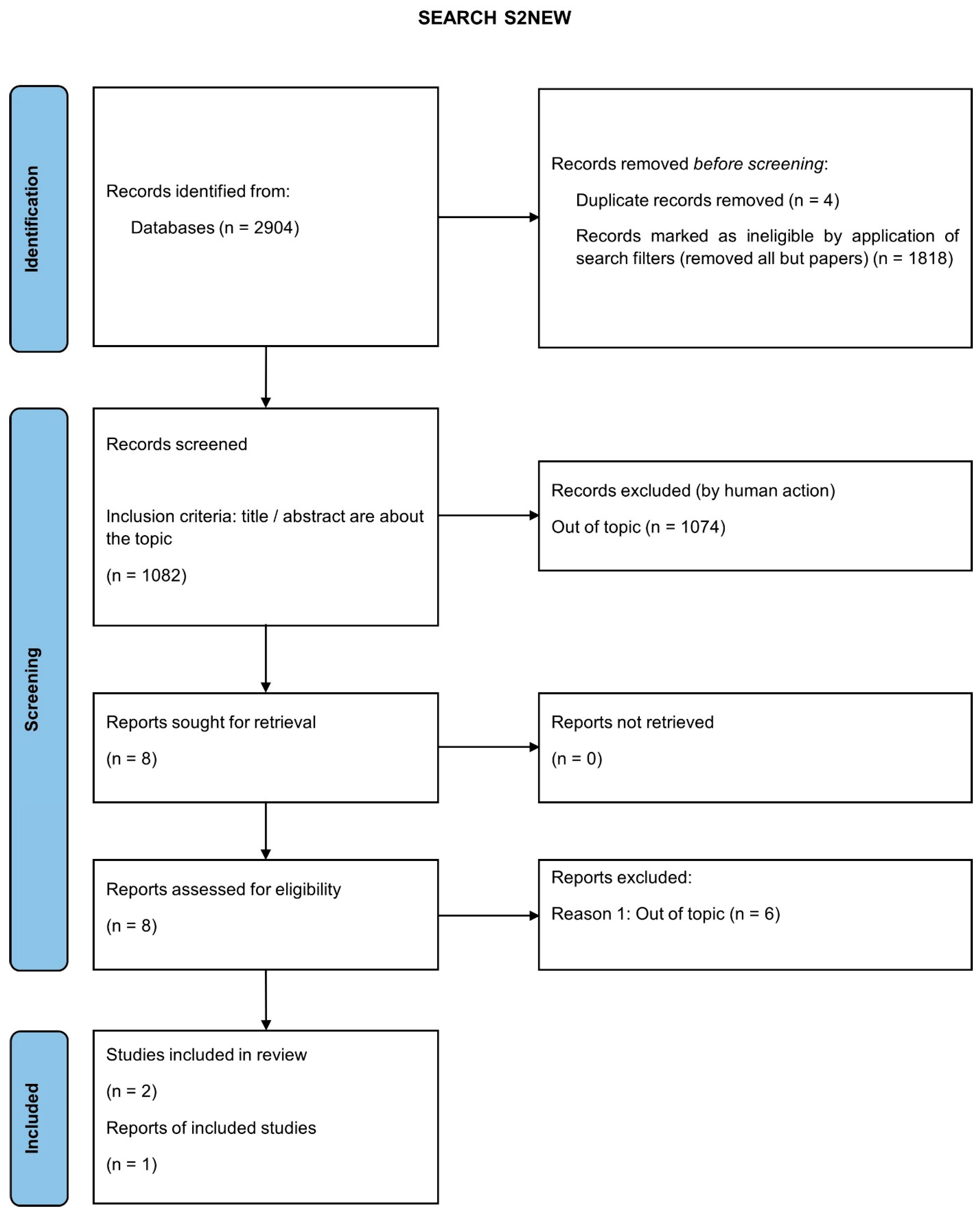
The raw result of S2NEW (in the date range 1 April 2024–1 July 2025) returned 2904 documents (1452 from both WOS and Scopus); the PRISMA flowchart of the process is shown in Figure 2.
Figure 2.
The PRISMA flowchart of the literature search S2NEW.
Further filtering was performed in WOS by excluding databases with titles out of scope, such as MEDLINE, KCI-Korean Journal Database, BIOSIS Citation Index, Science Citation Database, and SciELO Citation Index; it was performed in Scopus by including only the subject areas of “Computer Science”, “Social Sciences” and “Psychology”. Following this, the entry count decreased to 1082. After reading the titles and abstracts to check whether the topics could be interesting, eight papers were selected. After a complete reading (or after a careful reading of the abstract, in cases where full papers were not accessible), two papers were selected (the full document of one of them was not accessible). Nevertheless, the paper with an abstract only has still been considered because of a very low number of results.
In summary, the results of the literature screenings S1NEW and S2NEW are the works [28,29,30,31,32]; a concise description of such findings follows.
In their work, Qiu et al. [28] studied which factors can impact acceptance (or lack thereof) of the metaverse, given that a gap in this topic was found in the literature; the need to debate this matter from the perspective of people is also emphasized as further motivation. Semi-structured interviews were administered to a sample of 16 subjects (both users of social media and people not interested in the metaverse) by inspecting personal perceptions about the metaverse, the reasons of refusing to access it, the risks and the concerns. The results, processed using the Technology Acceptance Model (TAM) [33] and its extensions, showed that the dimensions driving the reluctance in accessing the metaverse were the perceived usefulness, the ease of use, the enjoyment, the connectedness and the risks; the themes involved in each dimension are described.
A similar argument was covered by Pragha et al. [29]; their study analyzes the factors influencing the intention to adopt the metaverse. For identifying such factors, a sample of 420 subjects took part in a study, based on a structured theoretical model, grounded in Unified Theory of Acceptance and Use of Technology v2 (UTAUT2) [34] and in Pleasure–Arousal–Dominance theory (PAD) [35] in the context of the Stimulus–Organism–Response framework. As stated by the authors, the results indicate that the immersive experience and the social influence are the elements most impacting the perceived value (of using the metaverse); in turn, the perceived value is the item impacting the intention to adopt the metaverse. In their turn, the users perceive such value in the presence of fun, enjoyment and security. These elements should be considered by stakeholders, designers and developers of the metaverse to realize such attractive features and to provide good services to users.
Also, the research carried out by Wu and Yu [30] is about the factors influencing the acceptance of the metaverse by potential users. A total of 418 subjects (who are metaverse users) answered an online survey; the analysis of the collected data was grounded in the Technology Acceptance Model, which was expanded by including the constructs of social interaction, presence, conformity, emotional attachment, flow, and perceived enjoyment. The main remarkable results are twofold: on the one hand, the intention of using the metaverse can be positively influenced by the constructs of perceived usefulness, attitudes, flow and social interaction; on the other hand, the attitude toward using the metaverse is positively affected by the constructs of perceived usefulness, perceived ease of use, emotional attachment and social interaction. Also in this study, the authors claim that stakeholders should consider these findings in developing effective and useful metaverse applications.
Korn et al. [31] carried out an explorative study on young people in Germany for analyzing the perceptions about the metaverse. A sample of 115 subjects aged Gen Y [36] and Gen Z answered an online 33-item questionnaire on a 5-point Likert scale (ranging from “Strongly disagree” to “Strongly agree”). The areas covered by the questionnaire were multiple, and a thorough analysis of results was described for each area. In the context of this paper, we would like to mention the most rated answers for some of the covered areas: the top scenarios for the area “preferred used scenarios” are Gaming And Entertainment and Social Connections; the main problems for the area “perceived problems and challenges” are Psychological Harm Or Harassment, Addiction, and Loss Of Relations Of Real World; the top worry for the area “personal worries regarding virtual worlds” is represented by Being Spied On.
In their research, Zhang et al. [32] studied the intention to adopt the devices and the applications of the metaverse by Gen Y users in the Malaysian context and assessed the motivation of consumers to enter the metaverse. A 41-item questionnaire on a 5-point Likert scale (ranging from “Strongly disagree” to “Strongly agree”) was completed by a total of 205 subjects suitable for analysis. The items were taken from sources already existing in the literature (they are referenced in the paper). The raw results were analyzed by using a model extending TAM and by integrating the constructs of “Perceived Enjoyment”, “Personal Innovativeness in Information Technology”, and “Immersion and Sense of Presence” (this last one is the driver of the intention to adopt the devices and the applications of the metaverse). The findings show that the involved constructs exert a positive impact and an influence on the “Immersion and Sense of Presence”, which drives the intention of adoption; moreover, the “Perceived Enjoyment” is the element most influencing the object of the study.
To summarize, studies about the opinions of people/users and their intention to adopt the metaverse are mainly grounded in theoretical models (for example, TAM, UTAUT) aimed at assessing the intention to use/acceptance of systems and technologies. The feature of “social purposes” of the metaverse is, in general, implied; the focus on the type of social metaverse specifically proposed by Meta is generally missing, although Meta is, in actual fact, a (the) potential leading company in this field. Thus, in this work we tried to partially fill this gap by developing a scale for assessing the attitude of people towards the social metaverse with the specific features promoted by Meta. To this end, the present work is composed of four parts: (Section 3) development of an explorative questionnaire about the social metaverse as a base of information on the thoughts of people about the proposed topics; (Section 4) administration of the questionnaire; (Section 5) analysis of the results with exploratory factor analysis (EFA) to identify the principal topics underlying the answers, to reduce the items of the questionnaire (if possible), to form the scale; and (Section 6 and Section 7) considerations and conclusions.
3. Development of the Questionnaire
According to what emerged in the previous work of the authors [14], the main features shaping the metaverse proposed by Meta are summarized by the following tags Ti (they are shortly described in Table 1): T1 = “New social platform”; T2 = “Flooding mobile phones/devices”; T3 = “New internet”; T4 = “Doing activities of daily living”; T5 = “People meet/share experiences”; T6 = “Tearing down the boundaries”; T7 = “Living life in the metaverse”. These are the concepts, latent or explicit, that are promoted by Meta when presenting and showing its vision of the metaverse. The tags T4–T7 were used for this work; T6 and T7 are the most frequent in the contents of Meta. The tags T1, T2 and T3 have not been used because they are more related to the concepts of evolving technology and new functionalities in the expansion of smart devices and apps.
Table 1.
The tags representing the main concepts of the social metaverse promoted by Meta are shown. On the left column: the tag Ti with its “title”; on the right column: a short description of the meaning of Ti. Source: [14].
An explorative 38-item questionnaire was developed; it is inspired by the investigated contents of Meta, and summarized by tags T4–T7. The questions are on a 5-point Likert scale (“Strongly disagree”, “Disagree”, “Neither agree nor disagree”, “Agree”, “Strongly agree”); they are sentences about the concepts developed for tags T4–T7 and strive to elicit positive (or negative) attitudes towards them from the subject. The original versions of the questionnaire in the Italian language and its translation into the English language are shown in Appendix B.
The questionnaire was implemented with Microsoft Forms [37] and was administered online; it is composed of a starting page and three parts.
In the starting page are reported the purpose of the project, the conditions of inclusion, and the personal data treatment statement; informed consent is acquired too. Moreover, further details about the study were made available through a specific link.
In the first part, the following demographic information was collected: age range (predefined age ranges are available for selection, including “Other”), sex (“Male”, “Female”, “No Answer”), daily use of internet (“Yes”, “No”), frequency of social media usage (“Every day”, “Sometimes in the week”, “Sometimes in the month”, “I do not use social media”), familiarity with virtual reality (“Never heard of it!”, “Yes I know a bit”, “Yes I know it”).
In the second part, the participants were shown a brief presentation of the social metaverse to ensure basic knowledge about it. The presentation is a brief sequence of slides introducing the basic concepts of the social metaverse. All the images in the presentation were collected from free online databases and from videos of Meta about the metaverse. In every image, the reference to the original source is given and, when needed, a sentence stating that the image is for demonstration purposes only is shown, as in the original source.
In the third part, the subjects filled out the 38-item questionnaire; the items were randomized at each access. At the end, the subjects were shown a message expressing gratitude for their participation.
4. Questionnaire Administration
According to the analysis of the Italian population, performed in 2024 and reported in [38], 94% people aged 16–64 use the Internet for more than 5 h per day and use social media platforms for more than 1.5 h per day (mean values). People aged 18–54 cover about 76% of users of current Meta social media platforms (Facebook, Facebook Messenger, WhatsApp, Instagram). The inclusion conditions for subjects were being aged 18–54, using the Internet every day and giving consent for personal data treatment. To potentially include as heterogenous a population as possible, no more inclusion conditions were defined.
The subjects were recruited by email, by social media, and by personal contact; the URL of the questionnaire was provided, available for 1.5 months.
Given that the pool is composed of 38 items (the variables), a target of 190 subjects was defined by taking into account the considerations of [39] (the more observations, the better), of [40] (at least twice the number of variables), and of [41,42] (at least 5 cases per variables and not less than 100 cases; at least 100 cases and a 5:1 ratio of variables/cases).
5. Results
In this section, the results are described with the data analysis.
5.1. General Information
The number of subjects that filled in the online questionnaire was 184; 9 subjects were excluded because they were aged >54. The final sample consisted of 175 subjects, a bit less than the target number. In relation to the practical rule of the 5:1 ratio mentioned above, in this case the ratio is 4.6:1. IBM SPSS v29 was used to process the data [43].
The results of the first part, related to demographic information, are described below.
In total, 54.9% of respondents (n = 96) were female, 43.4% were male (n = 76) and 1.7% gave no answer (n = 3).
Overall, 10.9% of respondents (n = 19) were aged 18–22, 21.1% were aged 23–30 (n = 37), 24.0% were aged 31–40 (n = 42), 28.6% were aged 41–50 (n = 50), and 15.4% were aged 51–54 (n = 27).
All respondents use the Internet daily.
The frequency of social media usage is expressed as follows: “I do not use social media”: 4% (n = 7); “Every day”: 89% (n = 156); “Sometimes in the month”: 3.4% (n = 6); “Sometimes in the week”: 3.4% (n = 6). It is interesting to note that in [38], the percentage of people aged 16–64 using social media is 96%; in this sample, 96% of people (aged 18–54) use social media.
Familiarity with virtual reality is represented as follows: “Never heard of it!”: 0.57% (n = 1); “Yes, I know a bit”: 49.71% (n = 87); “Yes, I know it”: 49.71% (n = 87).
5.2. Checks for Feasibility of Exploratory Factor Analysis
Given a high number of variables that have been empirically measured, a “latent factor” (“factor”) can be described as an implicit element that is deemed to be responsible for the covariances between the variables. In this work, the variables are the items of the questionnaire mentioned in Section 4; EFA was used since it allows latent factors to emerge and a reduction in the initial set of variables by revealing the main topics driving the answers [44,45].
Preliminary checks on data were performed to ensure the feasibility of the EFA.
We would like to mention in advance that the EFA was repeated because six items caused failures in the preliminary tests and in the analysis itself. These six items were removed (Item 3, Item 5, Item 12, Item 18, Item 37, Item 38) and the process was repeated. Thus, the complete analysis was performed on 32 items.
Some of the preliminary checks also needed to be performed again and, if this was the case, “re-checked” will be mentioned in parentheses.
We checked the questionnaire results for normal distribution by inspecting the skewness, the kurtosis values, and the detrended quantile–quantile plot values (Q-Q plots); the results were found to be fitting enough for the normal distribution.
Results were checked for potential outliers, and finally no items were selected as outliers. Given the subjective nature of the items, it may be the case that a subject gives answers that are apparently contradictory (which would be a symptom of a potential outlier) but that are actually not. In fact, the boxplots of answers for each item were inspected, and many, let us say, “regular” subjects showed in their answers the same irregularities as those subjects deemed potential outliers.
The correlation matrix R of items was tested (re-checked) for the presence of values ≥ 0.3 (absolute value) to ensure that correlations were not negligible [46]: this was satisfied for more than half of the elements for both Spearman correlations (65.92% of the elements) and Pearson correlations (66.73% of the elements, p < 0.01 for all the values in the matrices, two-tailed) as well as for the Kendall Tau-B (50.60% of the elements).
The Bartlett Sphericity test [47] (re-checked) and the Kaiser–Meyer–Olkin (KMO) test [46] (re-checked) confirmed the sampling adequacy by providing, respectively, p < 0.001 and a score of 0.921 that, according to the classification in [48], are ranked “marvelous”.
Checks on the anti-image correlation and covariance matrices were performed too (re-checked). In the anti-image correlation matrix, about 21% and 11% of elements exceeded the pragmatic thresholds of, respectively, 0.12 and 0.15 (these are slightly relaxed thresholding values instead of the default value of 0.1; absolute values); in the anti-image covariance matrix, about 12% of elements exceeded the threshold of 0.1 [44,49,50]. The above percentages are <25%, according to what was suggested in [51]. Thus, we have deemed the set of 32 items suitable enough for the EFA.
5.3. Extraction of Factors and Processing
We defined the stopping point of factor extraction as when the reproduced correlations matrix has most elements < 0.1 (absolute value), as this means that the actual model has a sufficient fit with the original values [52,53]. The RMSEA (Root Mean Square Error of Approximation) value has also been computed as a further index of goodness of fit; values ≤ 0.05 are acceptable [54,55]. The factors were extracted with Maximum Likelihood method.
The process started by extracting four factors and ended with six factors, since the reproduced correlation matrix related to six factors had 99.39% of elements < 0.1 (absolute value), with an RMSEA index value of 0.031. The goodness of fit of solutions with four, five, and six factors is summarized in Table 2.
Table 2.
The percentages of residuals in the reproduced correlation matrix and the RMSEA index for each extracted factor amount are shown. In the left column: the number of extracted factors for a specific solution; in the central column: the percentage of residuals with value < 0.1 (absolute value) in the reproduced correlations matrix; in the right column: the RMSEA index of the specific solution.
Different types of rotations were applied to factors to have a set of possibilities for comparing results and for selecting the most satisfactory one [56]. The factors were rotated with orthogonal (Varimax method) and oblique rotations (Direct Oblimin method and Promax method with Kaiser normalization) for making the solution closer to the “simple structure” [57] and more interpretable.
In all the rotated solutions, for the interpretation of factors the items were selected according to the following four criteria (Ci):
- C1 (in the end not used): Select the items with a loading cutoff of 0.35. Thus, the items must have a loading ≥ 0.35. This is a simple pragmatic criterion.
- C2: Select the items with a loading cutoff ≥ 0.3 as factor markers AND a factor must have at least three markers [45]. Whenever possible, in practice more severe cutoff values were used (such as, for example, ≥0.4 or more).
- C3: Select items so that the absolute value of {item’s first maximum loading amongst factors—item’s second maximum loading amongst factors} ≥ 0.3 [58].
- C4: First apply C3 and then apply C2 to the items resulting from C3. This criterion helps in letting the factors emerge with at least three markers and featuring both a good enough distance of the highest loading value from other loading values and a sufficient loading cutoff value.
To sum up, 27 solutions were computed: 3 “initial” solutions (with four, five and six extracted factors) × 3 rotations (orthogonal Varimax, oblique Direct Oblimin and Promax methods) × 3 criteria (C2, C3, and C4) for item selection. In some cases, the application of a certain criterion Ci caused the exclusion from the solution of one or more extracted factors because there were not enough items satisfying Ci.
The solutions obtained from the extraction and rotations of six factors were discarded because they presented some values of communalities > 1, one loading value > 1, and inconsistent values of the explained variance (initial and after extraction) of 2twofactors.
The method for selecting the best solution from the 27 solutions was as follows: consider the maximum number of factors kept AND consider the maximum percentage of cumulated variance (computed on factors kept) AND consider the maximum loading cutoff used AND, in cases of very similar solutions, if possible, prefer the solution with C4. This method was applied simply by looking at the values scored in the 27 solutions.
According to this method, the best solution is the one with five extracted factors, with the Promax method for rotation, and with items selected with criterion C4; in short, let us call this solution the “winning solution”. The loadings of the items of the winning solution range from 0.518 to 0.975; according to the classification reported in [46,59], such values are classified from (almost) “good” to “excellent”. The pattern, the structure matrix and the communalities of the winning solution are reported in Appendix C.
The summary of the best solutions with four, five and six extracted factors is shown in Table 3.
Table 3.
The overview of the best solutions only, for each rotation, is shown. From leftmost column to rightmost column are shown the initial number of factors extracted for a specific solution; the type of rotation applied to the extracted factors; the criterion Ci giving the best item selection for the factors; the discarded factors Fi not satisfying the criterion Ci; the number of factors left; the percentage of cumulated explained total variance after rotation (for factors left only) and, in parentheses, the initial percentage (for all extracted factors); the loading cutoff for the selection of items on factors. The last 4 lines show the solutions with 6 extracted factors. Such solutions were discarded from the analysis because some communality values were > 1, the loading value of one item was > 1 (the line in red), and the explained variance values of 2 factors were inconsistent. The percentages of the explained variance of factors Fi of the winning solution are F1 = 36.14%, F2 = 4.79%, F3 = 4.04%, F4 = 3.02%.
As stated in [45], the global efficiency (ge) of a solution is defined as ge = (E1 + E2 + … + Ek)/k, where Ei (i: 1, 2, …, k) is the eigenvalue of the i-th factor and k is the number of extracted factors; ge should be ≥2. The winning solution scored ge = 3.71 (computed with the five factors), which is an acceptable value. Another indicator of the potential usefulness of the solution, proposed by [45,59], is that the structure matrix of the rotated solution is not composed only of values < 0.45 (absolute value). In total, 51% of elements of the structure matrix of the winning solutions have values ≥ 0.45, which is an acceptable percentage.
The winning solution has 4 factors (factor 5 was discarded) and 15 items from the processed set of 32 items, and it is the scale of the attitude of people towards the social metaverse; it is shown in Table 4. Being derived from the original questionnaire, it is a scale composed of 5-point Likert items (“Strongly disagree”, “Disagree”, “Neither agree nor disagree”, “Agree”, “Strongly agree”); the higher the score, the higher the subject’s attitude towards the social metaverse.
Table 4.
The scale of the attitude of people towards the social metaverse. In the first column the 15 items of the scale, numbered from 1 to 15, are shown. Shown in parentheses: the attitude of the item in relation to the social metaverse (“+” = positive, “−“ = negative and score must be reversed), the number of the item in the original questionnaire, and the inspiring tag Ti. The other columns show the loadings of the items on the factors (Fi).
The Cronbach Alpha value of the scale is 0.855, while the Cronbach Alpha values of the items of the factors are, respectively, Alpha of F1 = 0.748, Alpha of F2 = 0.708, Alpha of F3 = 0.805 and Alpha of F4 = 0.832 [60,61]. As also briefly mentioned in Section 5.2, an item (Item 3) was deleted from the set because its Cronbach Alpha value was 0.395, which is a very low value, and the EFA was repeated. Item–total correlations and α-if-deleted analyses, while useful, are typically redundant when the retention of the items has already been driven by the factor loading strength and by the discriminant quality, as in the present work. The EFA-based item discrimination was prioritized over α-if-deleted tables to avoid circular redundancy. The retained items already demonstrated strong factor loadings (>0.5, also shown in Table 4) and conceptual coherence, thus ensuring internal consistency and parsimony.
5.4. Interpretation of Factors
The EFA made the factors emerge as latent components underlying the set of items of the questionnaire; each factor groups the items together. The interpretation of the factors is here described to identify the groups of items and, thus, the arguments expressed by the scale.
Factor 1 can be identified as “Making up for real life (well-being, limitations); Virtual as a resource”. F1 encompasses the aspects related to improving personal well-being by using the metaverse. High scores correspond to considering the metaverse as a resource that allows one to overcome personal limitations and difficulties, and to generally improve one’s life.
Factor 2 can be identified as “Comparison with reality, concern/skepticism; the metaverse as a substitute for reality”. F2 consists of items that assess thoughts of people on using the metaverse in place of reality. Expressions such as “all the time” or “impoverish people” explore fears or expectations that the metaverse could replace the way we experience social interaction. The items of F2 convey a negative attitude; their scores must be reversed. In this case, high scores (disagreement) indicate a positive view of the metaverse as an option for experiencing interaction differently, while low scores (agreement) correspond to a rejection of the metaverse as a substitution of reality.
Factor 3 can be identified as “Entertainment in virtual social worlds”. F3 includes items related to entertainment in various forms (e.g., amusement parks, concerts, general entertainment). High scores correspond to a positive propensity to use the social metaverse for these purposes, while low scores correspond to a rejection of the social metaverse.
Factor 4 can be identified as “Sports and games in virtual social worlds”. F4 includes the items related to playing sports and games while immersed in virtual social worlds, also by sharing these experiences with other people. High scores correspond to a positive propensity to use the social metaverse for these purposes, while low scores correspond to a rejection of them.
5.5. Scoring
The scale should be administered to subjects by randomizing items to prevent potential communication between subjects, to reduce order effects and to minimize systematic response bias. As previously stated, items 5, 6, 7, and 8 represent a negative attitude towards the metaverse; thus, their answers must be reversed before computing the overall score.
The interpretation of the results falls in the topic of scoring Likert scale-based questionnaires. Since the Likert scale is an ordinal scale and it is unknown, by its nature, whether points are equally spaced on the scale or not, there are several approaches for scoring and interpreting results of Likert scales [62,63,64].
In the case of our scale, we can compute some reference values. Let us assign responses a score from 1 to 5, from the most negative to the most positive attitude towards what is sentenced in the specific item: “Strongly disagree” = 1, “Disagree” = 2, “Neither agree nor disagree” = 3, “Agree” = 4, “Strongly agree” = 5 (the scores of the items expressing negative attitudes towards what is described in the specific item must be reversed). The possible score ranges of factors, such as [min_score, max_score] closed intervals, are the following: F1, F2 and F3’s range is (4, 20) while F4’s range is (3, 15). The total score of a subject is the sum of the scores of all the answers on the scale. The minimum total score of the scale is 15; the maximum total score of the scale is 75. These values start from 15: for better readability purposes only, by subtracting the minimum value of 15 from the scores, the score interval (15, 75) is rigidly translated backwards and is transformed into (0, 60), thus starting from 0 as the minimum value. High scores mean that the subject has a considerable positive attitude towards the social metaverse features, while low scores mean that the subject has a considerable negative attitude towards the social metaverse features. With the translated score values, we suggest as a quick reference for score interpretation the following intervals:
- Scores ≤ 15 express just a negative attitude towards the social metaverse;
- Scores in (16, 21) express a slight negative attitude towards the social metaverse;
- Scores in (22, 39) express a neutral position;
- Scores in (40, 45) express a slight positive attitude;
- Scores ≥ 46 express a positive attitude.
6. Considerations
Some considerations can be made about the results and the limitations of this work. The limitation of the subjects to a specific age range should be left out, given that at present time the use of the Internet and social media is widely spread in society; instead, if necessary, filtering could be applied to the raw data.
The factors of the scale are composed of items grounded in tags T4, T6, and T7 (shown in Table 1). More than one half of the contents of the scale is shaped according to the main arguments of Meta, represented by tag T7 (“Living life in the metaverse”) and inspiring nine items of the scale. Tag T7 is present in all factors, as a sort of foundation; this makes sense because, on the one hand, it represents the most frequent concept of the social metaverse of Meta (as mentioned in Section 3) and, on the other hand, because it represents the essence of the social metaverse itself. It seems that the specific characteristic of each factor is shaped by the other tag(s) occurring in the factor itself. At the same time, latent dimensions of the social metaverse may exist that are not captured by our scale, since the items were generated solely from the tags identified from Meta, suggesting that other relevant facets may remain unmeasured.
We guess that the subjects were particularly sensible to the idea of, let us say, transferring various activities into virtual worlds of the social metaverse. In particular, it seems that the concepts related to the metaverse as an opportunity to eliminate barriers and limitations derive from tags T6 (“Tearing down the boundaries”) and T7, and are reflected in F1 (inspired by T6 and T7).
On the other hand, subjects were also prone to worries and skepticism in relation to the essence of the activities of the social metaverse; it seems that this derives from tag T7 and is reflected in F2 (completely inspired by T7).
The opportunity of carrying out activities related to, in general, sports and entertainment emerged as a relevant topic; this can be considered as deriving from tag T4 (“Doing activities of daily living”) and is reflected in F3 and F4 (both inspired by T4 and T7).
In the surveys reported in [16,17,18,19] (described in Section 2), some multiple-choice questions scored relevant percentages in “negative” answers, which are characterized by doubts and worries about the negative impact of the social metaverse on real life. As a qualitative consideration, in the present study this outcome also occurred by manifesting itself in factor F2 (in Table 4), which reflects the “negative” contents. Similarly, in the administered questionnaire, the items of F2 scored relevant percentages in “Agree” and “Strongly agree” answers too, as in [16,17,18,19]. As mentioned above, it seems that factor 2 arises from tag T7: the idea of living in the metaverse and of replacing real experiences with virtual ones emerges in this factor, albeit in a negative light; some examples of this are summarized in Table 5.
Table 5.
On the left column: as examples, some questions from previous works that generally scored a relevant percentage regarding doubts or worries about a social metaverse; on the right column: the text of the items of factor F2 in the scale, where the related percentages of “Agree” and “Strongly agree” answers from administered questionnaire are reported.
The presented work has some limitations.
The scale developed in the present work has not been validated yet: this is the next step of the process. For a more reliable analysis, the sample size could be even larger, given that this just fits with some of the recommendations found in the literature (as mentioned in Section 5.1). The validation roadmap will include testing the scale with a sample of subjects (n = 200–300) recruited from Europe, the USA and, if possible, from China, also by leveraging institutional partners and by identifying proper recruitment tools (for example, specific web services). Confirmatory factor analysis will be performed, for example, with SPSS Amos software [65], for testing the structure of factors emerging from the current exploratory work.
External validation (confirmatory factor analysis, invariance testing, test–retest reliability, convergent/divergent validity) is a necessary next step, as discussed in the methodological literature [44,45,46,51]. However, the current study was explicitly designed as an exploratory phase aimed at developing an initial pool of items and at testing their internal consistency and factor structure through the EFA. The results, particularly the good internal reliability, show that the tool has potential for further validation. The developed tool represents a methodologically sound exploratory contribution.
Some considerations can be made about the type of the sample used in this work. The sample of subjects recruited for the analysis is not intended to represent cultural diversity. This was a deliberate methodological decision since the nature of this work is exploratory, for identifying latent constructs and for testing the structure of the newly generated items under controlled cultural conditions before going further with a cross-cultural validation. In this context, future studies will replicate the analysis with international and demographically balanced samples to assess the invariance and the possibility for generalizing the measurement.
Some items of the questionnaire should be rephrased more properly because maybe they present the topic to be inspected in a way that is too explicit; thus, they could unintentionally influence the response and be something close to a rhetorical question (for example, Item 3, Item 8, and Item 17; see Appendix B). Moreover, the items of the questionnaire were inspired, directly or implicitly, by the features of the social metaverse promoted by Meta: in this context, the common theme of the narrative of Meta is that the social metaverse is a beautiful place where people can do what they want in the way they want; thus, the items risk expressing the same topic, just with different facets. The above aspects can influence the overall results; in fact, the percentage of cumulated explained total variance (of the winning solution) is 54.29% and, after the exclusion of one factor, its value is 48.00% (Section 5.3, Table 3), and it should be higher. Future works should aim to broaden the conceptual base of the scale by including items inspired by alternative sources beyond Meta’s official discourse, such as user-generated content. This would help in capturing a wider range of meanings and experiences related to social interaction in virtual environments.
7. Conclusions
A scale for assessing (positive/negative) attitudes of people towards a social metaverse featuring the properties advertised by Meta was developed; this was essentially motivated by the potential perspective of future social relations in virtual reality worlds and by the lack of investigations specifically tailored to this topic. A questionnaire inspired by such properties was administered to a sample of subjects; then, after the EFA, a scale composed of 15 items grouped into 4 factors was formed. This scale is a tool proposed for assessing the position of people in terms of attitudes towards the social metaverse. While, on the one hand, information and communication technology (ICT) applications and solutions grow at a rapid pace and are pushed into a society continuously updating its ICT skills, on the other hand we propose that the opinions and attitudes of people should be analyzed. The purpose of such an analysis and of the tool developed in the present work is to study and understand the attitudes towards the social metaverse; this also allows us to study and to enhance public awareness and readiness for future digital social relations. This makes the tool relevant not only for researchers, but also for educators, policymakers, and institutions interested in raising digital awareness and preparing the public for future forms of sociality. A good awareness enables responsible use that may help people to properly move in a society that is increasingly digitalized and virtualized.
Author Contributions
Conceptualization, S.M.; methodology, S.M. and M.M.; software, S.M.; validation, S.M. and M.M.; formal analysis, S.M. and M.M.; investigation, S.M.; resources, S.M.; data curation, S.M.; writing—original draft preparation, S.M.; writing—review and editing, S.M. and M.M.; visualization, S.M. and M.M.; supervision, S.M.; project administration, S.M. All authors have read and agreed to the published version of the manuscript.
Funding
This research received no external funding.
Institutional Review Board Statement
The study was conducted in accordance with the Declaration of Helsinki, and the protocol was approved by the Ethics Committee of the National Research Council, Italy, (internal project code: “PMS”) on 18 December 2024, Record Number 0501501.
Informed Consent Statement
Informed consent for participation was obtained from all the subjects involved in the study.
Data Availability Statement
The original contributions presented in the study are included in the article; further inquiries can be directed at the corresponding author.
Conflicts of Interest
The authors declare no conflicts of interest.
Appendix A
The following search string was used for search S1NEW in Web of Science:
TI = ((people OR citizen* OR user* OR “end user” OR “end users” OR society OR mainstream OR compan* OR audience) AND (“virtual reality” OR metaverse OR “meta” OR “immersive technology” OR “immersive technologies” OR “virtual world” OR “virtual worlds” OR “VR world” OR “VR worlds” OR HMD OR “head mounted display”) AND (“don’t want” OR “dont want” OR “do not want” OR “want it” OR want* OR deal* OR apprec* OR curio* OR expectation* OR accept* OR interest* OR enjoy* OR engage* OR involve* OR participat* OR future)) NOT TI = “meta-analysis” NOT TI =“meta-analysis” NOT TI = metaanalysis NOT TI = “meta analyses” NOT TI = “metaanalyses” NOT TI = metaanalyses NOT TI = “meta review” NOT TI = “meta-review” NOT TI = metareview
The following search string was used for search S1NEW in Scopus:
TITLE ((people OR citizen* OR user* OR “end user*” OR society OR mainstream OR compan* OR audience) AND (“virtual reality” OR metaverse OR “meta” OR “immersive technolog*” OR “virtual world*” OR “VR world*” OR hmd OR “head mounted display”) AND (“don’t want” OR “dont want” OR “do not want” OR “want it” OR want* OR apprec* OR curio* OR expectation* OR accept* OR interest* OR enjoy* OR engage* OR involve* OR participat* OR future) AND NOT “meta analys*” AND NOT “meta-analys*” AND NOT metaanalys* AND NOT “meta review” AND NOT “meta-review” AND NOT metareview) AND PUBYEAR > 2022
The following search string was used for search S2NEW in Web of Science:
TI = (metaverse AND (issue* OR problem* OR ethic* OR concern* OR substitut* OR future OR challeng* OR insight* OR alternat* OR roadmap* OR opportunit* OR possibilit* OR “3D virtual world” OR “3D virtual wolds” OR moral* OR achiev* OR dawn OR horizon* OR existence* OR realm* OR realit* OR social* OR societ* OR good OR avatar* OR behaviour* OR behavior* OR extens* OR extend* OR human* OR man OR world* OR health* OR mental* OR mind*))
The following search string was used for search S2NEW in Scopus:
TITLE (metaverse AND (issue* OR problem* OR ethic* OR concern* OR substitut* OR future OR challeng* OR insight* OR alternat* OR roadmap* OR opportunit* OR possibilit* OR “3D virtual world*” OR moral* OR achiev* OR dawn OR horizon* OR existence* OR realm* OR realit* OR social* OR societ* OR good OR avatar* OR behaviour* OR behavior* OR extens* OR extend* OR human* OR man OR world* OR health* OR mental* OR mind*)) AND PUBYEAR > 2023
Appendix B
In this appendix, the administered questionnaire, both in English and in Italian languages, is shown.
The attitude of the item in relation to social metaverse (“+” = positive, “−” = negative) and the inspiring tag Ti are shown in parentheses (the tags are reported in Table 1). The Italian-language version is reported below each item, in parentheses.
- Doing fitness while immersed in virtual scenarios draws me (+) (T7)
(Mi attira l’idea di fare fitness mentre sono immerso in scenari virtuali)
- 2.
- Rather than facing a trip (maybe long and expensive) to meet up with somebody, I would prefer to meet somebody within virtual social worlds without moving from home (+) (T6)
(Piuttosto che affrontare un viaggio (magari lungo e costoso) per incontrarmi con qualcuno, preferirei incontrarlo nei mondi social virtuali senza muovermi da casa)
- 3.
- In my opinion, doing and sharing experiences while immersed in virtual social worlds would not be something better than reality (−) (T6)
(Secondo me, fare e condividere le esperienze immersi nei mondi social virtuali non sarebbe un qualcosa di migliore della realtà)
- 4.
- In my opinion, experiences within virtual social worlds, even in company of other people, could be an alternative to experiences of reality (+) (T4)
(Secondo me, le esperienze all’interno dei mondi social virtuali, anche in compagnia di altre persone, potrebbero essere una alternativa alle esperienze della realtà)
- 5.
- The immersion in virtual social worlds offers many possibilities: in my opinion, it risks making reality “unnecessary” (−) (T7)
(Immergendosi nei mondi social virtuali si hanno moltissime possibilità: secondo me questo rischia di rendere “superflua” la realtà)
- 6.
- I am afraid that social relations made by users interacting in virtual social worlds might impoverish people (−) (T7)
(Temo che una socialità fatta da utenti che interagiscono immersi in mondi social virtuali possa impoverire le persone)
- 7.
- The idea of meeting up with my friends within the virtual social worlds doesn’t mean a thing to me (−) (T5)
(L’idea di trovarmi con i miei amici all’interno di mondi social virtuali non mi dice gran che)
- 8.
- I think that exploring virtual, imaginary and fantasy social worlds makes little sense (−) (T6)
(Penso che abbia poco senso esplorare mondi social virtuali, immaginari e di fantasia)
- 9.
- I think that, in virtual social worlds, doing what I want and sharing my experiences can better my well-being (+) (T6)
(Penso che, nei mondi social virtuali, fare quello che voglio e condividere le mie esperienze possa migliorare il mio star bene)
- 10.
- The thought that situations I desire can be realized within virtual social worlds cheers me up (+) (T6)
(Pensare che nei mondi social virtuali si possano creare le situazioni che io desidero, mi rallegra)
- 11.
- If there were something limiting my life, I think I could overcome it by getting immersed in virtual social worlds and attending experiences that I would select myself (+) (T7)
(Se ci fosse qualcosa che limita la mia vita, credo che potrei superarla immergendomi nei mondi social virtuali e partecipando alle esperienze che sceglierei io)
- 12.
- The idea of having experiences with my friends in virtual social worlds leaves me indifferent (−) (T5)
(L’idea di fare esperienze con i miei amici nei mondi social virtuali mi lascia indifferente)
- 13.
- I think that it is nice to have experiences with my relatives within virtual social worlds, instead of meeting up really (+) (T5)
(Penso che fare esperienze insieme ai miei familiari all’interno di mondi social virtuali invece che incontrarsi realmente sia una cosa bella)
- 14.
- A future where we meet within virtual social worlds worries me (−) (T7)
(Un futuro dove ci si incontra all’interno di mondi social virtuali mi inquieta)
- 15.
- I think that I could spend less time on certain things in real life and, instead, do them while immersed in virtual social worlds (+) (T4)
(Penso che potrei spendere meno tempo per certe cose nella vita reale e invece farle stando immerso nei mondi social virtuali)
- 16.
- I like more meeting up and having experiences with people in reality rather than in virtual social worlds (−) (T5)
(Preferisco incontrare e fare esperienze con le persone nella realtà che nei mondi social virtuali)
- 17.
- I don’t like the idea of “being away” from reality around me while immersed in virtual social worlds (−) (T7)
(L’idea di “essere assente” dalla realtà intorno a me mentre sono immerso nei mondi social virtuali non mi piace)
- 18.
- The students could attend classes by getting immersed in a virtual social world rather than being at school: I don’t like this scenario (−) (T7)
(Gli studenti potrebbero stare immersi a lezione in un mondo social virtuale invece che stare a scuola: è uno scenario che non mi piace)
- 19.
- In my opinion the experiences and sharing in virtual social worlds will not be as satisfying as experiences and sharing in real life (−) (T7)
(Secondo me le esperienze e le condivisioni fatte nei mondi social virtuali non potranno comunque essere soddisfacenti come quelle della realtà)
- 20.
- The idea of meeting up with my relatives in virtual social worlds interests me a great deal (+) (T5)
(Mi interessa l’idea di incontrarmi con i miei familiari nei mondi social virtuali)
- 21.
- In virtual social worlds, I would like to attend public events and situations, such as going to concerts, to cinema, to theater, to club (+) (T4)
(Mi piacerebbe partecipare nei mondi social virtuali ad eventi e situazioni pubbliche, come andare a concerti, al cinema, a teatro, in un locale)
- 22.
- In my opinion it is better to meet up with people within virtual social worlds directly, rather than having to move on purpose to see each other (+) (T6)
(Secondo me è meglio incontrarsi con la gente direttamente all’interno di mondi social virtuali piuttosto che doversi spostare apposta per vedersi)
- 23.
- If I had trouble travelling, being able to meet up anyway with people in virtual social worlds would be consolatory for me (+) (T6)
(Se avessi difficoltà a viaggiare, per me sarebbe una consolazione potermi comunque incontrare con le persone nei mondi social virtuali)
- 24.
- In my opinion, the possibility of working while immersed in a virtual office and of attending meetings with people in customized virtual environments is interesting (+) (T7)
(La possibilità di lavorare stando immerso in un ufficio virtuale e di fare riunioni con altre persone in scenari virtuali personalizzati secondo me è interessante)
- 25.
- In the virtual social worlds there are many occasions of awesome experiences, but I don’t think that this can better the life of people (−) (T7)
(Nei mondi social virtuali ci sono tantissime occasioni di esperienze incredibili, però non credo che questo possa migliorare la vita della gente)
- 26.
- I wouldn’t like to wear all the time on the head a display device for getting immersed in virtual social worlds (−) (T7)
(Indossare in testa tutto il tempo un visore per stare immerso nei mondi social virtuali non mi andrebbe bene)
- 27.
- In my opinion, frequenting virtual social worlds can better life (+) (T6)
(Secondo me frequentare mondi social virtuali può migliorare la vita)
- 28.
- I deem it positive to be able to meet up easily with other people within virtual social worlds for the purpose of activities, meetings or work (+) (T6)
(Ritengo positivo poter incontrare facilmente altre persone in mondi social virtuali per attività, incontri o lavoro)
- 29.
- The possibility of playing sports and games within virtual social worlds with other people “present” in virtual is a nice thing (+) (T4)
(La possibilità di fare sport e giochi nei mondi social virtuali insieme ad altre persone “presenti” in virtuale, è una cosa bella)
- 30.
- I would be fine spending, during the week, 4–10 h immersed in virtual social worlds (+) (T7)
(Mi andrebbe bene, durante la settimana, passare 4–10 ore immerso nei mondi social virtuali)
- 31.
- Frequenting, exploring virtual social places created by users are pointless things (−) (T6)
(Frequentare, esplorare luoghi social virtuali creati dagli utenti è una cosa con poco senso)
- 32.
- Playing sports within virtual social worlds is an interesting thing (+) (T4)
(Fare sport all’interno dei mondi social virtuali è una cosa interessante)
- 33.
- I think that attending public entertainment events within virtual social worlds is a good idea because I can have fun and feel at peace (+) (T4)
(Penso che andare ad eventi pubblici di intrattenimento all’interno dei mondi social virtuali sia una buona idea perchè mi potrei divertire e stare sereno)
- 34.
- Doing things in virtual social worlds rather than in reality can be positive (+) (T7)
(Fare le cose nei mondi social virtuali invece che nella realtà può essere positivo)
- 35.
- I would like to participate in astonishing events within virtual social worlds, as for example attending concerts in between the planets, or going to amusement parks stretching to the horizon, or shopping in ancient Rome (+) (T7)
(Nei mondi social virtuali mi piacerebbe partecipare ad eventi stupefacenti, per esempio come andare a concerti in mezzo ai pianeti o in luna park giganteschi fino all’orizzonte, oppure fare shopping nell’antica Roma)
- 36.
- I think I will use the virtual social worlds (+) (T7)
(Credo che userò i mondi social virtuali)
- 37.
- If there was something of my appearance I did not like, I don’t think that participating in virtual social worlds with a different appearance would make me feel better (−) (T6)
(Se ci fosse qualcosa che non mi va del mio aspetto, non penso che partecipare ai mondi social virtuali apparendo con un altro aspetto mi farebbe sentire meglio)
- 38.
- The possibility of customizing my appearance in virtual social worlds leaves me indifferent (−) (T6)
(La possibilità di personalizzare la mia apparenza all’interno dei mondi social virtuali mi lascia indifferente)
Appendix C
In this appendix, the pattern matrix, the structure matrix and the communalities of the winning solution (reported in Section 5.3) are shown, respectively, in Table A1, Table A2 and Table A3.
Table A1.
The pattern matrix of the winning solution (reported in Section 5.3). In the first column the names of the 32 items of the analysis are shown (“SQRT” and “LOG10” mean that the square root and the logarithm with base 10 of the values were used instead of the original values); in the other columns the loadings of the items for each factor Fi are shown. The values ≥ 0.4 (absolute value) are shown in bold; the values that satisfy criterion C4 (reported in Section 5.3) and that are in the winning solution are in bold, italicized, and underlined; all the other values are in gray color. The cutoff value of the winning solution is 0.518 (see also Table 3).
Table A2.
The structure matrix of the winning solution (reported in Section 5.3). In the first column the names of the 32 items of the analysis are shown (“SQRT” and “LOG10” mean that the square root and the logarithm with base 10 of the values were used instead of the original values); in the other columns the correlations of the items with the factors Fi are shown.
Table A3.
The communalities of factor extraction of the winning solution (reported in Section 5.3). In the first column the names of the 32 items of the analysis are shown (“SQRT” and “LOG10” mean that the square root and the logarithm with base 10 of the values were used instead of the original values); in the other two columns the initial communalities (“Initial”) and those after the extraction of factors (“Extraction”) are shown.
References
- Stephenson, N. Snow Crash, 1st ed.; Bantam Books: New York, NY, USA, 1992. [Google Scholar]
- Park, S.-M.; Kim, Y.-G. A Metaverse: Taxonomy, Components, Applications, and Open Challenges. IEEE Access 2022, 10, 4209–4251. [Google Scholar] [CrossRef] [Scilit]
- Crespo-Pereira, V.; Sánchez-Amboage, E.; Membiela-Pollán, M. Facing the challenges of metaverse: A systematic literature review from Social Sciences and Marketing and Communication. Prof. Inf. 2023, 32, e320102. Available online: https://revista.profesionaldelainformacion.com/index.php/EPI/article/view/87104/63308 (accessed on 23 November 2025). [CrossRef] [Scilit]
- Bojic, L. Metaverse through the prism of power and addiction: What will happen when the virtual world becomes more attractive than reality? Eur. J. Futures Res. 2022, 10, 22. [Google Scholar] [CrossRef] [Scilit]
- Zhao, Y.; Jiang, J.; Chen, Y.; Liu, R.; Yang, Y.; Xue, X.; Chen, S. Metaverse: Perspectives from graphics, interactions and visualization. Vis. Inf. 2022, 6, 56–67. [Google Scholar] [CrossRef] [Scilit]
- Zhang, X.; Chen, Y.; Hu, L.; Wang, Y. The metaverse in education: Definition, framework, features, potential applications, challenges, and future research topics. Front. Psychol. 2022, 13, 1016300. [Google Scholar] [CrossRef] [Scilit]
- Bethcle, N.; Weinberger, M. Applying the Metaverse to Real-world Citizen Participation—First Results from a Field Experiment. In Proceedings of the 58th Hawaii International Conference on System Sciences, Waikoloa, HI, USA, 7–10 January 2025. [Google Scholar] [CrossRef] [Scilit]
- Venkatesh, V.; Morris, M.G.; Davis, G.B.; Davis, F.D. User Acceptance of Information Technology: Toward a Unified View. MIS Q. 2003, 27, 425–478. [Google Scholar] [CrossRef] [Scilit]
- Calderón-Fajardo, V.; Puig-Cabrera, M.; Rodríguez-Rodríguez, I. Beyond the real world: Metaverse adoption patterns in tourism among Gen Z and Millennials. Curr. Issues Tour. 2024, 28, 1261–1281. [Google Scholar] [CrossRef] [Scilit]
- McKinsey & Company. What Is Gen Z? Available online: https://www.mckinsey.com/featured-insights/mckinsey-explainers/what-is-gen-z (accessed on 29 July 2025).
- Zelazko, A. Millenial, Demographic Group. Available online: https://www.britannica.com/topic/millennial (accessed on 30 September 2025).
- Shahzad, K.; Ashfaq, M.; Zafar, A.U.; Basahel, S. Is the future of the metaverse bleak or bright? Role of realism, facilitators, and inhibitors in metaverse adoption. Technol. Forecast. Soc. Change 2024, 209, 123768. [Google Scholar] [CrossRef] [Scilit]
- Raman, R.; Kowalski, R.; Achuthan, K. Metaverse technologies and human behavior: Insights into engagement, adoption, and ethical challenges. Comput. Hum. Behav. Rep. 2025, 19, 100712. [Google Scholar] [CrossRef] [Scilit]
- Mottura, S. Does Anyone Care about the Opinion of People on Participating in a “Social” Metaverse? A Review and a Draft Proposal for a Surveying Tool. Future Internet 2024, 16, 236. [Google Scholar] [CrossRef] [Scilit]
- Zuckerberg, M. The Metaverse and How We Will Build It Together. Connect 2021. Available online: https://www.youtube.com/watch?v=Uvufun6xer8 (accessed on 28 July 2025).
- Babu, A.; Mohan, P. Impact of the Metaverse on the Digital Future: People’s Perspective. In Proceedings of the Seventh International Conference on Communication and Electronics Systems, Coimbatore, India, 22–24 June 2022. [Google Scholar] [CrossRef] [Scilit]
- Alvarez-Risco, A.; Del-Aguila-Arcentales, S.; Rosen, M.A.; Yáñez, J.A. Social Cognitive Theory to Assess the Intention to Participate in the Facebook Metaverse by Citizens in Peru during the COVID-19 Pandemic. J. Open Innov. Technol. Mark. Complex. 2022, 8, 142. [Google Scholar] [CrossRef] [Scilit]
- Bale, A.S.; Ghorpade, N.; Hashim, M.F.; Vaishnav, J.; Almaspoor, Z. A Comprehensive Study on Metaverse and Its Impacts on Humans. Adv. Hum.-Comput. Interact. 2022, 2022, 3247060. [Google Scholar] [CrossRef] [Scilit]
- Bibri, S.E.; Allam, Z. The Metaverse as a virtual form of data-driven smart cities: The ethics of the hyper-connectivity, datafication, algorithmization, and platformization of urban society. Comput. Urban Sci. 2022, 2, 22. [Google Scholar] [CrossRef] [Scilit] [PubMed]
- Bandura, A. Self-efficacy mechanism in psychobiologic functioning. In Self-Efficacy: Thought Control of Action; Hemisphere Publishing Corp.: Washington, DC, USA, 1992; pp. 355–394. [Google Scholar]
- Clement, J. Metaverse-Statistics & Facts. 10 January 2024. Available online: https://www.statista.com/topics/8652/metaverse/ (accessed on 30 July 2025).
- Dixon, S.J. Share of Adults in the United States Who Are Interested in Meta’s New Virtual Reality Project Known as the Metaverse as of November 2021. 21 February 2022. Available online: https://www.statista.com/statistics/1277855/united-statesadults-interested-meta-metaverse/ (accessed on 30 July 2025).
- Petrosyan, A. Feelings Toward the Metaverse According to Adults in the United States as of January 2022. 7 July 2022. Available online: https://www.statista.com/statistics/1290667/united-states-adults-feelings-toward-metaverse/ (accessed on 30 July 2025).
- Petrosyan, A. Views on the Metaverse According to Adults in the United States as of January 2022. 7 July 2022. Available online: https://www.statista.com/statistics/1290435/united-states-adults-views-of-metaverse/ (accessed on 30 July 2025).
- Dixon, S.J. Share of Adults in the United States Joining or Considering Joining the Metaverse for Various Reasons as of December 2021. 7 February 2022. Available online: https://www.statista.com/statistics/1288048/united-states-adults-reasons-forjoining-the-metaverse/ (accessed on 30 July 2025).
- Web of Science. Available online: https://www.webofscience.com (accessed on 30 July 2025).
- Scopus. Available online: https://www.scopus.com (accessed on 30 July 2025).
- Qiu, H.; Hoe-Lian, G.D.; Ong, A.; Jin, S.; Wang, S. Why Social Media Users Are Hesitant to Embrace the Metaverse: Technology Acceptance, Perceived Risks and Mitigations. In Proceedings of the HCI International 2024, Washington, DC, USA, 29 June–4 July 2024. [Google Scholar] [CrossRef] [Scilit]
- Pragha, P.; Dhalmahapatra, K.; Natarajan, T. The future of human experience: The drivers of user adoption of the metaverse. Online Inf. Rev. 2025, 49, 669–706. [Google Scholar] [CrossRef] [Scilit]
- Wu, R.; Yu, Z. Investigating Users’ Acceptance of the Metaverse with an Extended Technology Acceptance Model. Int. J. Hum.-Comput. Interact. 2023, 40, 5810–5826. [Google Scholar] [CrossRef] [Scilit]
- Korn, O.; Zallio, M.; Schnitzer, B. Young skeptics: Exploring the perceptions of virtual worlds and the metaverse in generations Y and Z. Front. Virtual Real. 2024, 5, 1330358. [Google Scholar] [CrossRef] [Scilit]
- Jiale, Z.; Farzana, Q.; Jihad, M. Embracing the new reality: Gen Y’s intention to use metaverse apps and devices. Curr. Psychol. 2025, 44, 398–417. [Google Scholar] [CrossRef] [Scilit]
- Davis, F.D. A Technology Acceptance Model for Empirically Testing New End-User Information Systems: Theory and Results. Ph. D. Thesis, Massachusetts Institute of Technology, Cambridge, MA, USA, 1985. Available online: https://dspace.mit.edu/handle/1721.1/15192 (accessed on 30 September 2025).
- Venkatesh, V.; Thong, J.Y.L.; Xu, X. Consumer Acceptance and Use of Information Technology: Extending the Unified Theory of Acceptance and Use of Technology. MIS Q. 2012, 36, 157–178. [Google Scholar] [CrossRef] [Scilit]
- Mehrabian, A.; Russell, J.A. An Approach to Environment Psychology; MIT Press: Cambridge, MA, USA, 1974. [Google Scholar]
- Krahn, H.J.; Galambos, N.L. Work values and beliefs of ‘Generation X’ and ‘Generation Y’. J. Youth Stud. 2013, 17, 92–112. [Google Scholar] [CrossRef] [Scilit]
- Microsoft Forms. Available online: https://www.microsoft.com/en-us/microsoft-365/online-surveys-polls-quizzes (accessed on 4 August 2025).
- Digital 2024: Italy. Available online: https://datareportal.com/reports/digital-2024-italy (accessed on 5 August 2025).
- Kline, P. An Easy Guide to Factor Analysis, 1st ed.; Routledge, Taylor & Francis Group: New York, NY, USA, 1994. [Google Scholar]
- Harris, C.W. On factors and factors scores. Psichometrika 1967, 32, 363–379. [Google Scholar] [CrossRef] [Scilit]
- Gorsuch, R.L. Factor Analysis, 2nd ed.; Lawrence Erlbaum Associates: Hillsdale, MI, USA; Mahwah, NJ, USA, 1983. [Google Scholar]
- Reio, T.G.; Shuck, B. Exploratory Factor Analysis: Implications for Theory, Research, and Practice. Adv. Dev. Hum. Resour. 2014, 17, 12–25. [Google Scholar] [CrossRef] [Scilit]
- IBM SPSS Statistics. Available online: https://www.ibm.com/products/spss-statistics (accessed on 30 September 2025).
- Backhaus, K.; Erichson, B.; Gensler, S.; Weiber, R.; Weiber, T. Factor Analysis. In Multivariate Analysis, 1st ed.; Roscher, B., Ed.; Springer Gabler: Wiesbaden, Germany, 2021; pp. 381–450. [Google Scholar] [CrossRef] [Scilit]
- Roberto, A.; Molino, D. Factor Analysis for Social Sciences, 1st ed.; Research Notebooks Series, A14-400/12; Social Sciences Dept., University of Turin: Torino, Italy, 2011. (In Italian) [Google Scholar]
- Tabachnick, B.G.; Fidell, L.S. Using Multivariate Statistics, 6th ed.; Pearson Education, Inc.: Upper Saddle River, NJ, USA, 2013. [Google Scholar]
- Hoyle, R.H. Confirmatory Factor Analysis. In Handbook of Applied Multivariate Statistics and Mathematical Modeling; Tinsley, H.E.A., Brown, S.D., Eds.; Academic Press: San Diego, CA, USA, 2000; pp. 465–497. [Google Scholar]
- Bartlett, M.S. The effect of standardization on a Chi-square approximation in factor analysis. Biometrika 1951, 38, 337–344. [Google Scholar]
- Kaiser, H.F.; Rice, J. Little Jiffy, Mark IV. Educ. Psychol. Meas. 1974, 34, 111–117. [Google Scholar] [CrossRef] [Scilit]
- Dziuban, C.D.; Shirkey, E.C. When is a correlation matrix appropriate for factor analysis? Some decision rules. Psychol. Bull. 1974, 81, 358–361. [Google Scholar] [CrossRef] [Scilit]
- Factor Analysis Descriptives. Available online: https://www.ibm.com/docs/en/spss-statistics/30.0.0?topic=analysis-factor-descriptives (accessed on 1 October 2025).
- McDonald, R.P. Factor Analysis and Related Methods, 1st ed.; Psychology Press, Lawrence Erlbaum Associates: Hillsdale, NJ, USA, 1985. [Google Scholar]
- Schermelleh-Engel, K.; Moosbrugger, H.; Müller, H. Evaluating the Fit of Structural Equation Models: Tests of Significance and Descriptive Goodness-of-Fit Measures. Methods Psychol. Res. 2003, 8, 23–74. [Google Scholar] [CrossRef]
- Steiger, J.H. Structural model evaluation and modification: An interval estimation approach. Multivar. Behav. Res. 1990, 25, 173–180. [Google Scholar] [CrossRef] [Scilit] [PubMed]
- Browne, M.W.; Cudeck, R. Alternative ways of assessing model fit. In Testing Structural Equation Models, 1st ed.; Bollen, K.A., Long, J.S., Eds.; Sage: Newbury Park, CA, USA, 1993; pp. 136–162. [Google Scholar]
- Browne, M.W. An Overview of Analytic Rotation in Exploratory Factor Analysis. Multivar. Behav. Res. 2001, 36, 111–150. [Google Scholar] [CrossRef] [Scilit]
- Thurstone, L.L. Multiple Factor Analysis; University of Chicago Press: Chicago, IL, USA, 1945. [Google Scholar]
- Matsunaga, M. How to Factor-Analyze Your Data Right: Do’s, Don’ts, and How-To’s. Int. J. Psychol. Res. 2010, 3, 97–110. [Google Scholar] [CrossRef] [Scilit]
- Comrey, A.L.; Lee, H.B. A First Course in Factor Analysis, 2nd ed.; Lawrence Erlbaum Associates: Hillsdale, NJ, USA, 1992. [Google Scholar]
- Nunnally, J.C.; Bernstein, I.C. Psychometric Theory, 3rd ed.; McGraw-Hill: New York, NY, USA, 1994. [Google Scholar]
- Hays, R.; Revicki, D.A. Reliability and validity (including responsiveness). In Assessing Quality of Life in Clinical Trials: Methods and Practice, 2nd ed.; Fayers, P., Hays, R., Eds.; Oxford University Press: New York, NY, USA, 2005. [Google Scholar]
- Gail, M.S.; Artino, A.R., Jr. Analyzing and Interpreting Data from Likert-Type Scales. J. Grad. Med. Educ. 2013, 5, 541–542. [Google Scholar] [CrossRef] [Scilit]
- Jamieson, S. Likert scales: How to (ab)use them. Med. Educ. 2004, 38, 1217–1218. [Google Scholar] [CrossRef] [Scilit]
- Geoff, N. Likert scales, levels of measurement and the “laws” of statistics. Adv. Health Sci. Educ. 2010, 15, 625–632. [Google Scholar] [CrossRef] [Scilit]
- IBMS SPSS Amos. Available online: https://www.ibm.com/it-it/products/structural-equation-modeling-sem (accessed on 12 November 2025).

Disclaimer/Publisher’s Note: The statements, opinions and data contained in all publications are solely those of the individual author(s) and contributor(s) and not of MDPI and/or the editor(s). MDPI and/or the editor(s) disclaim responsibility for any injury to people or property resulting from any ideas, methods, instructions or products referred to in the content. |
© 2025 by the authors. Licensee MDPI, Basel, Switzerland. This article is an open access article distributed under the terms and conditions of the Creative Commons Attribution (CC BY) license (https://creativecommons.org/licenses/by/4.0/).