



Internet of Things Adoption in Technology Ecosystems Within the Central African Region: The Case of Silicon Mountain
 , , and
Abstract
1. Introduction
- Identifying the key challenges for IoT adoption in the Silicon Mountain technology ecosystem and, by extension, the Central African region.
- Providing empirical data and insights specific to Silicon Mountain, which can serve as a benchmark for similar ecosystems in the region.
- Proposing strategies to overcome the identified barriers and to enhance the adoption of the IoT in the Silicon Mountain technology ecosystem and, by extension, the Central African region.
- Highlighting the role of educational institutions, government policies, and private sector initiatives in promoting IoT adoption.
2. Review of Related Works

| Ref | Geography Focus | Technological Focus | Research Objectives | Methodology | Identified Factors Influencing or Hindering IoT Adoption |
|---|---|---|---|---|---|
| [26] | India | Smart cities | Investigate the impact of IoT barriers for smart city waste management | An analytic approach involving a hybrid multi-attribute decision-making model applied to 15 IoT barriers identified from the literature and expert opinions | Security and privacy issues, lack of regulatory norms and policies, operational costs and extended payback periods, etc. |
| [28] | South Africa | Education | Investigate and identify the determinants of IoT adoption by higher educational institutions (HEIs) within the South African setting | A quantitative (empirical) method involving a survey of 250 respondents selected randomly from some tertiary institutions and the use of exploratory factor analysis (EFA) and regression analysis to determine factors affecting IoT adoption in HEIs | Behavioral intention to use the IoT was positively influenced by performance expectancy, social influence, and effort expectancy. |
| [30] | N.A. | Healthcare | Analyze and statistically classify existing knowledge about the factors that influence medical professionals to adopt IoT applications in the healthcare sector. | Systematic review of relevant IoT adoption studies from 2015 to 2021 carried out on nine major scientific databases and leading to 22 articles being selected as per the inclusion criteria | Social influence, attitude, and personal inattentiveness; perceived usefulness, perceived ease of use, performance expectancy, and effort expectations; perceived privacy risk, perceived severity and perceived health risk; financial cost; and facilitating conditions |
| [31] | Pakistan | E-government | Explore the success factors of IoT service orchestration to create public value in smart government. | A quantitative method for data collection involving a field survey conducted through online and paper-based questionnaires administered to 87 respondents. Partial least squares structural equation modeling was used for data analysis | Decision transparency, government trust, service collaboration, service effectiveness, service transparency, public engagement, perceived ease of use, public trust, and perceived usefulness are valid success measures of e-gov IoT service orchestration |
| [17] | South Africa | Smart Agriculture | Identify factors that may determine the adoption and use of IoT within the agricultural sector in Limpopo province. | A quantitative approach involving data collected via interviews, observations, and document reviews. Thematic analysis was used for data analysis | Organizational support, cost, knowledge gap, security, policy, monitoring and control, and perceived value and risk |
| [32] | China | Construction | Investigate factors influencing the adoption of the IoT by construction companies in China. | Review of the related literature, adoption theories, semi-structured expert interviews, and a survey via questionnaires were used for data collection and regression analysis was used for analyzing the data | External environmental pressure, perceived benefit, top management support, company resource readiness, adoption intention, and perceived compatibility |
| [16] | Rwanda | Construction | Investigate the adoption, application and challenges of IoT technologies in the Rwandan construction industry. | Descriptive survey research method using a questionnaire with closed- and open-ended questions. Data analysis carried out using frequencies, mean scores, and Student’s t-tests | Lack of training centers, lack of IoT awareness, lack of expertise, poor internet connectivity, etc. |
| [27] | Europe | Smart cities, autonomous driving, wearables and smart agriculture | Explore IoT adoption barriers in four large-scale pilots in Europe. | Literature review, workshops, and interviews were used to determine relevant IoT adoption barriers | Trust, cost, perceived value, privacy, and security |
| [33] | US | Agriculture | Explore IoT adoption barriers in precision agriculture practices in the Midwestern (Indiana) region of the US. | Focus group interview sessions conducted with eighteen subject matter experts (SME) in IoT-based precision agriculture practices | Cost, data latency, data scalability, data storage, data interoperability, type of sensors, type of wireless communication, type of precision agriculture application, and power consumption |
| [29] | Nigeria | Education | Investigate the behavioral intentions of students and staff at tertiary institutions in Kaduna metropolis to adopt IoT technology for educational purposes. | A quantitative method for data collection involving a field survey conducted through online questionnaires administered to 300 respondents. Partial least squares structural equation modeling was used for data analysis | Performance expectancy, effort expectancy, and facilitating condition positively influence behavioral intentions to use IoT technology |
| [15] | Nigeria | Education | Review IoT implementation challenges in Nigeria. | Literature review and survey via the use of questionnaires | Fraud, lack of power supply, religion, technical know-how, cost of implementing IoT, government policy, cyber attacks, privacy, security, and fear of loss of jobs |
3. Methodology
3.1. Literature Review
3.2. Survey Design and Development
3.3. Sampling and Data Collection
3.4. Data Validation
3.5. Data Analysis
4. Results and Discussion
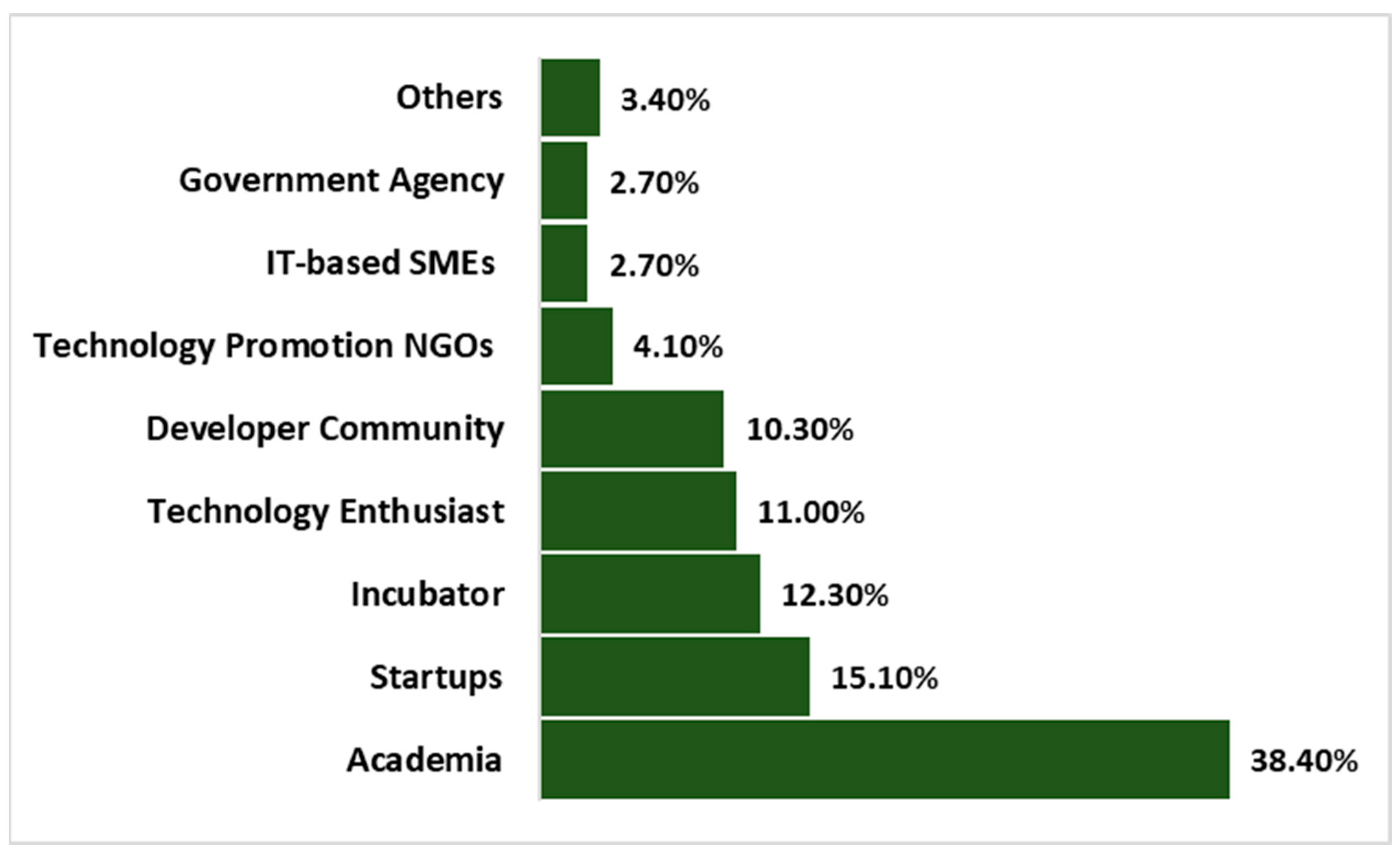
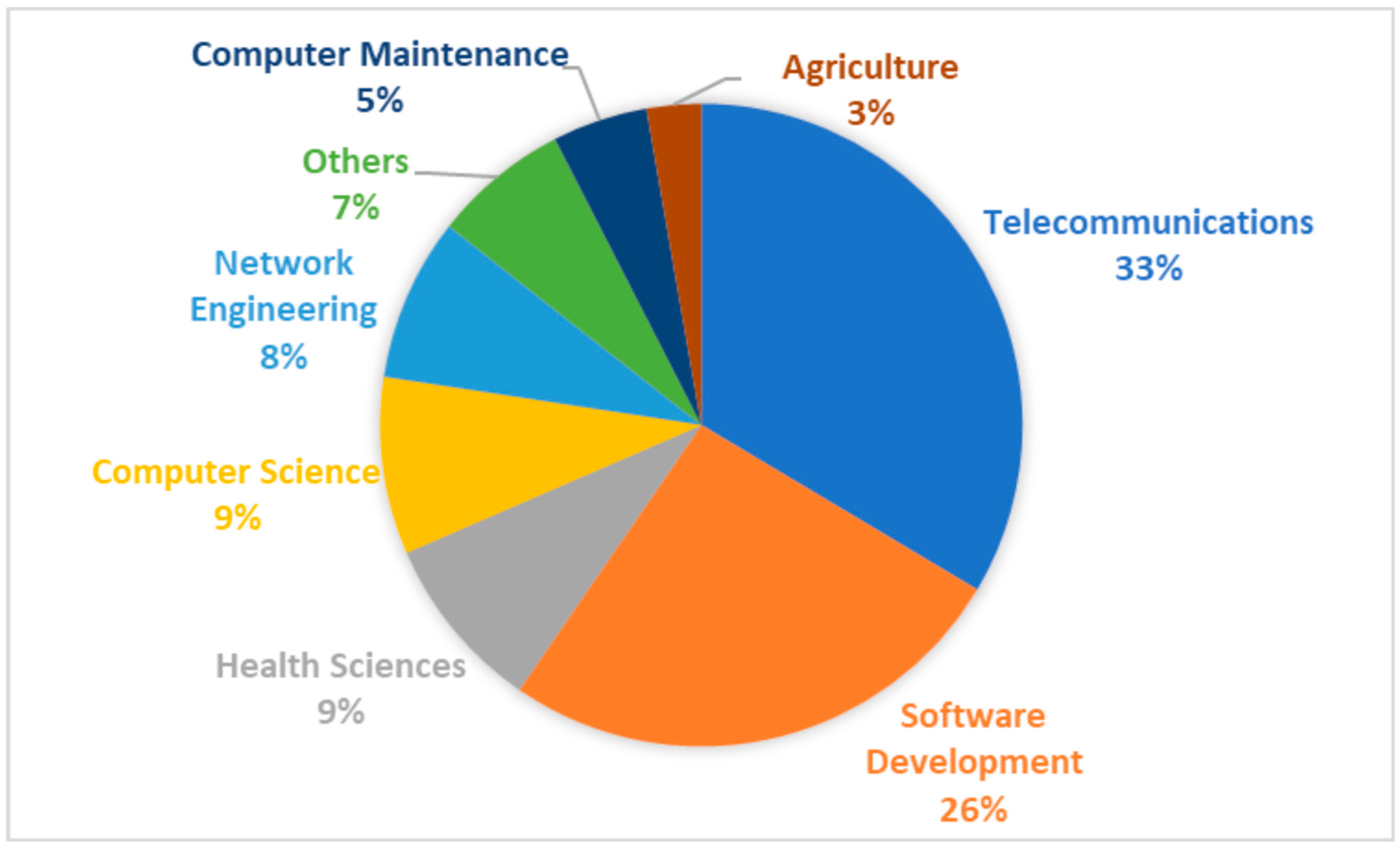
4.1. Respondent’s Demographics
4.2. Reliability Analysis
4.3. Awareness and the Level of Knowledge About IoT in the Silicon Mountain Technology Ecosystem
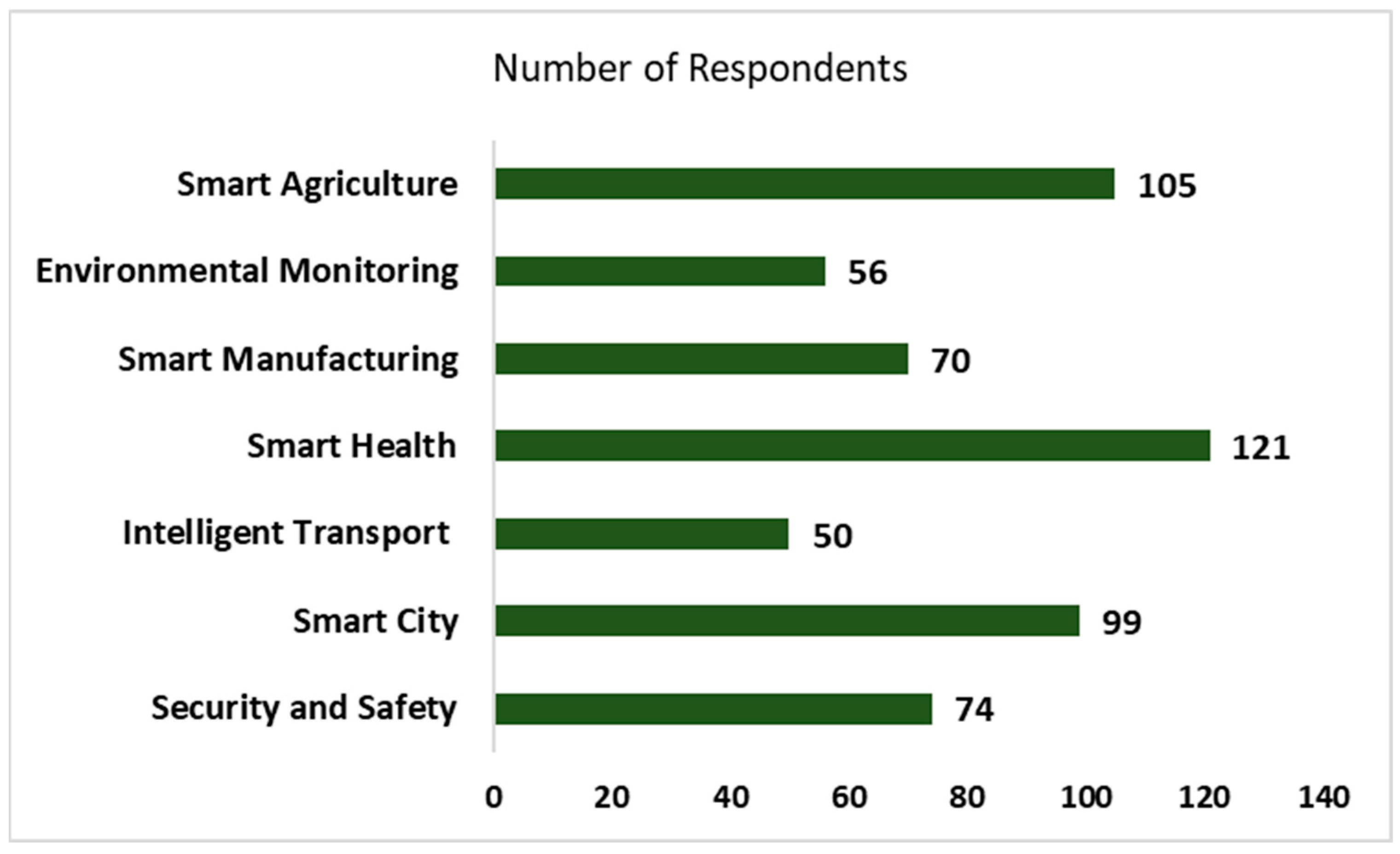
4.4. Potential Areas for the Implementation of Internet of Things of in the Central African Sub-Region
4.5. Challenges Impeding IoT Adoption Within the Silicon Mountain Technology Ecosystem
- Poor Internet Connectivity: This is not considered a serious challenge, with 52.1% of respondents rating it as “Not Serious”.
- Power Supply and High Energy Costs: Similarly, these issues are not seen as significant barriers, with 49.3% of respondents rating them as “Not Serious”.
- Insufficient Skilled Labor: The lack of skilled professionals in technological areas such as data science, cybersecurity, IoT development, agriculture, etc., is considered a significant challenge by 40.4% of respondents who rated it as “Very Serious”.
- Inadequate Financial Resources: Challenges such as difficulty securing loans and limited funding support are rated as “Very Serious” by 32.2% of respondents.
- Lack of Standardization: The absence of uniform standards in IoT hardware, software, and communication protocols makes interoperability difficult. This was rated as “More Serious” by 29.5% of respondents.
- Sub-Standard Curriculum: The outdated educational curricula in most of Silicon Mountain’s academic institutions, which fail to keep up with advancements in technology, were rated as “Very Serious” by 30.8% of respondents.
- Data Security Concerns: Issues related to data confidentiality, integrity, and authentication are considered a challenge, with 30.8% rating these concerns as “Moderate”.
- Risk of IoT Attacks: The potential damage from IoT attacks, such as the 2016 IoT botnet attack, is seen as a significant risk, rated as “More Serious” by 26% of respondents.
- Inadequate Security Mechanisms: The perception of the IoT as the “Internet of Threats” due to insufficient security measures is also considered a barrier.
- Lack of Legal Recognition and Policy Framework: The absence of a clear legal and policy framework is rated as “More Serious” by 51.2% of respondents.
- Government Interference and Bureaucracy: Overlapping and conflicting policies, increased tax burdens, and corruption are significant deterrents, with 52.7% rating tax policy changes as “More Serious” and 58.9% identifying favoritism and corruption as barriers.
- Reluctance to Adopt IoT: Potential client reluctance to invest in IoT due to the need for infrastructure upgrades and new business models was rated as “More Serious” by 64.4% of respondents.
- Lack of Understanding of Market Practices: Poor understanding of commercial practices and market regulations was also a notable challenge, rated as “More Serious” by 58.9% of respondents.
- IoT Costs and Payback Period: The high costs associated with IoT implementation and the difficulty in establishing local distribution networks were rated as significant barriers by 51.4% of respondents.
- Tax Policy Reforms: Rated as highly influential by 87 respondents (59.6%), improving tax policies is seen as a significant factor in enhancing IoT adoption among businesses in the Silicon Mountain.
- Network Connectivity and Internet Data Costs: Improving network connectivity and reducing internet data costs were also deemed crucial, with 43.8% of respondents highlighting their importance.
- Reduction in IoT Device Prices: Lowering the costs of IoT devices was rated as a highly influential factor by 95 respondents (65.1%), which could significantly boost IoT adoption.
- Enhanced Energy Availability: Improving the availability of energy to businesses was similarly recognized as an important factor.
- Enhanced IoT Security Mechanisms: Strengthening security measures for IoT systems is considered essential for fostering adoption.
- Educational Initiatives: Organizing IoT workshops, seminars, and meetups, as well as integrating IoT-related courses into academic curricula, is expected to address the skills gap and increase labor proficiency.
- Access to Funding: Providing access to funding, loans, and IoT research grants for academic institutions and incubators is identified as a key strategy to support IoT development and adoption.
4.6. Verification of the Hypothesis of the Study
4.6.1. Factor Analysis
- Lack of Understanding and Motivation: organizations typically do not grasp the benefits of the IoT and are often unwilling to invest in it, with a mean score of 3.8973.
- Socio-economic Crises: the ongoing socio-economic crises in the country pose a significant barrier, scoring 3.8151.
- Inadequate Financial Resources: the inability to secure loans and the lack of funding support from the government and other sponsors are major issues, with a mean score of 3.8014.
- Loose Policies: the loose nature of policies is a critical challenge, reflected in a mean score of 3.7877.
- Insufficient Skilled Labor: there is a shortage of skilled labor in the IoT, data science, and agriculture, scoring 3.7603.
- Client Reluctance: potential clients are hesitant to adopt the IoT due to the need for infrastructure upgrades and new business models, scoring 3.7534.
- High Marketing Costs: the cost of marketing IoT solutions is high, making it unaffordable for startups, with a mean score of 3.7534.
- Lack of Commercial Understanding: there is a lack of understanding of commercial practices and market regulation, scoring 3.7397.
- Brain Drain: the mass movement of graduates from Science, Technology, Engineering, and Mathematics (STEM) fields seeking better opportunities is a significant barrier, scoring 3.7260.
- Conflicting Policies: overlapping and conflicting policies also pose a challenge, with a mean score of 3.7192.
- Outdated Educational Curricula: many academic institutions lack dynamic curricula to equip students with the latest developments in IoT technologies, scoring 3.6781.
- Favoritism and Corruption: these issues also constitute serious barriers, with a mean score of 3.6507.
- Lack of Standardization: the lack of standardization in the IoT, where each vendor develops their hardware, software, and communication protocols independently, is a hindrance, scoring 3.6370.
4.6.2. Principal Component Analysis of IoT Adoption Challenges in the Silicon Mountain Technology Ecosystem
4.7. Discussion
- Standardization and Financial Resources: issues related to the lack of standardized protocols and financial constraints.
- Labor Shortage in the Industry: the shortage of skilled labor in the field.
- Educational and Knowledge Challenges: inadequate educational curricula and knowledge gaps.
- Market Challenges: difficulties related to market adoption and commercial practices.
- Government Policies: issues arising from governmental policies and regulatory frameworks.
- Security and Data Privacy Challenges: concerns about data security and privacy.
- Labor and Power Supply: challenges related to the availability of reliable power and labor.
- Enhancing Tax Policies: revising tax regulations to better support IoT businesses.
- Improving Network Connectivity: expanding network infrastructure and reducing internet data costs.
- Reducing IoT Device Prices: making IoT devices more affordable.
- Increasing Energy Availability: ensuring a more reliable energy supply for IoT operations.
- Strengthening IoT Security: enhancing security mechanisms to protect IoT systems.
- Organizing IoT Workshops and Seminars: hosting events to raise awareness and build expertise in IoT.
- Updating Educational Curricula: integrating IoT-related courses into academic programs to address labor shortages and improve skill levels.
4.8. Future Trends in IoT Adoption in Silicon Mountain and Central Africa
4.9. Limitations and Recommendations for Future Work
5. Conclusions
Author Contributions
Funding
Data Availability Statement
Conflicts of Interest
Appendix A
| 1 | 2 | 3 | 4 | 5 |
|---|---|---|---|---|
| Not serious | Less serious | Moderate | More serious | Very serious |
| Not at all | Lesser extent | Moderate | Great Extent | Greater Extent |
| Operating Barriers | 1 | 2 | 3 | 4 | 5 | |
|---|---|---|---|---|---|---|
| 1 | The implementation of THE IoT requires organizations to upgrade and adopt new business models. | |||||
| 2 | IoT applications need a higher infrastructure to support them, which most business cannot afford. | |||||
| 3 | Fragmentation of standards with new ones evolving every day makes it difficult for IoT practitioners. | |||||
| 4 | Increase in businesses’ operating costs. | |||||
| 5 | IoT adoption because most of the services are delivered to mobile users. | |||||
| 6 | Limited skilled workforce in Cameroon as compared to developed countries. | |||||
| 7 | Poor internet connectivity. | |||||
| 8 | Varying accessibility of internet connection across the nation. | |||||
| Information/Security Barriers | 1 | 2 | 3 | 4 | 5 | |
| 9 | Personal privacy issue (data ownership) is a major concern in employing IoT networks as the connected objects and devices can be easily traced and hacked. | |||||
| 10 | Billions of devices are connected through the IoT which necessitates efficient security mechanisms that not only help in protecting the information but also enable data sharing over IoT-based smart city networks. | |||||
| 11 | Lack of knowledge on production costs of IoT systems. | |||||
| 12 | Unsecure provenance data may result in the exposition of sensitive Information. | |||||
| Legal/Bureaucracy Barriers | 1 | 2 | 3 | 4 | 5 | |
| 13 | Lack of legal recognition and policy framework. | |||||
| 14 | Cameroon government interference and bureaucracy. | |||||
| 15 | Overlapping and conflicting policies. | |||||
| 16 | Increase in tax burden due to changes in tax policy. | |||||
| 17 | Loose nature of policies. | |||||
| 18 | Favoritism and corruption. | |||||
| Market challenges | ||||||
| 19 | IoT applications employ a huge number of sensing and actuating devices. | |||||
| 20 | Lack of understanding of commercial practice. | |||||
| 21 | IoT costs and its payback period are a hindrance for adoption. | |||||
| 22 | Difficult to establish cooperation with local distribution network. | |||||
| 23 | Difficulty in locating supply lines for local raw materials. | |||||
| 24 | Ongoing economic crises in the country. | |||||
| 25 | Global misinformation systems. | |||||
| Impact of challenges on IoT adoption | 1 | 2 | 3 | 4 | 5 | |
| 26 | Improvement in tax policies for adoption of IoT businesses. | |||||
| 27 | Increase in network connectivity. | |||||
| 28 | Regularizing prices for materials. | |||||
| 29 | Improvement in information flow and communication systems. | |||||
| 30 | Improvement in the security of information systems. |
References
- Kopetz, H.; Steiner, W. Internet of Things. In Real-Time Systems: Design Principles for Distributed Embedded Applications; Kopetz, H., Steiner, W., Eds.; Springer International Publishing: Cham, Switzerland, 2022; pp. 325–341. [Google Scholar] [CrossRef]
- Rejeb, A.; Rejeb, K.; Treiblmaier, H.; Appolloni, A.; Alghamdi, S.; Alhasawi, Y.; Iranmanesh, M. The Internet of Things (IoT) in healthcare: Taking stock and moving forward. Internet Things 2023, 22, 100721. [Google Scholar] [CrossRef]
- Rajak, P.; Ganguly, A.; Adhikary, S.; Bhattacharya, S. Internet of Things and smart sensors in agriculture: Scopes and challenges. J. Agric. Food Res. 2023, 14, 100776. [Google Scholar] [CrossRef]
- Musa, A.A.; Malami, S.I.; Alanazi, F.; Ounaies, W.; Alshammari, M.; Haruna, S.I. Sustainable Traffic Management for Smart Cities Using Internet-of-Things-Oriented Intelligent Transportation Systems (ITS): Challenges and Recommendations. Sustainability 2023, 15, 9859. [Google Scholar] [CrossRef]
- Babayigit, B.; Abubaker, M. Industrial Internet of Things: A Review of Improvements Over Traditional SCADA Systems for Industrial Automation. IEEE Syst. J. 2024, 18, 120–133. [Google Scholar] [CrossRef]
- Orfanos, V.A.; Kaminaris, S.D.; Papageorgas, P.; Piromalis, D.; Kandris, D. A Comprehensive Review of IoT Networking Technologies for Smart Home Automation Applications. J. Sens. Actuator Netw. 2023, 12, 30. [Google Scholar] [CrossRef]
- Edquist, H.; Goodridge, P.; Haskel, J. The Internet of Things and economic growth in a panel of countries. Econ. Innov. New Technol. 2021, 30, 262–283. [Google Scholar] [CrossRef]
- Alasmary, H. ScalableDigitalHealth (SDH): An IoT-Based Scalable Framework for Remote Patient Monitoring. Sensors 2024, 24, 1346. [Google Scholar] [CrossRef]
- Zhong, Y.; Xu, Z.; Cao, L. Intelligent IoT-based telemedicine systems implement for smart medical treatment. Pers. Ubiquitous Comput. 2023, 27, 1429–1439. [Google Scholar] [CrossRef]
- Ali, A.; Hussain, T.; Tantashutikun, N.; Hussain, N.; Cocetta, G. Application of Smart Techniques, Internet of Things and Data Mining for Resource Use Efficient and Sustainable Crop Production. Agriculture 2023, 13, 397. [Google Scholar] [CrossRef]
- Kuaban, G.S.; Czekalski, P.; Molua, E.L.; Grochla, K. An Architectural Framework Proposal for IoT Driven Agriculture. In Computer Networks; Gaj, P., Sawicki, M., Kwiecień, A., Eds.; Springer International Publishing: Cham, Switzerland, 2019; pp. 18–33. [Google Scholar] [CrossRef]
- Hassebo, A.; Tealab, M. Global Models of Smart Cities and Potential IoT Applications: A Review. IoT 2023, 4, 366–411. [Google Scholar] [CrossRef]
- Szpilko, D.; de la Torre Gallegos, F.A.; Naharro, F.J.; Rzepka, A.; Remiszewska, A. Waste Management in the Smart City: Current Practices and Future Directions. Resources 2023, 12, 115. [Google Scholar] [CrossRef]
- Mishra, P.; Singh, G. Energy Management Systems in Sustainable Smart Cities Based on the Internet of Energy: A Technical Review. Energies 2023, 16, 6903. [Google Scholar] [CrossRef]
- Iwayemi, A. Internet of things: Implementation challenges in Nigeria. Am. J. Eng. Res. 2018, 7, 105–115. [Google Scholar]
- Dosumu, O.S.; Mahame, C.; Niyitegeka, S.; Hahiirwuwambaza, J.A. Applications and Challenges of Adopting the Internet of Things (loT) in the Rwandan Construction Industry. J. Constr. Dev. Ctries. 2023, 28, 81–100. [Google Scholar]
- Moeti, M.N.; Mokwena, S.N.; Selape, M. Factors influencing the adoption of Internet of Things in the agricultural sector in Limpopo province. S. Afr. J. Inf. Manag. 2024, 26, 1–8. [Google Scholar] [CrossRef]
- Ofori-Amoah, B. The Economic Community of Central African States. In The African Continental Free Trade Area: Prospects, Problems and Challenges; Ofori-Amoah, B., Ed.; Springer International Publishing: Cham, Switzerland, 2024; pp. 93–107. [Google Scholar] [CrossRef]
- Kewir, K.J. Rethinking Regional Security in Central Africa: The Case of the Central African Republic. Int. J. Afr. Renaiss. Stud. Multi-, Inter- Transdiscipl. 2020, 15, 115–133. [Google Scholar] [CrossRef]
- Rex, E.; Njie, M.J. Explaining the Absence of a Regional Hegemon in the Central African Sub-region. Cent. Eur. J. Int. Secur. Stud. 2021, 15, 32–47. [Google Scholar] [CrossRef]
- Obasa, S.O. Africa’s Political Environment and the Challenge of Underdevelopment. Soc. Sci. 2020, 9, 241. [Google Scholar] [CrossRef]
- Fabrice, N.; Bertrand, N.A.S.; Adamou, N. Effects of Information and Communication Technologies on Structural Change in Sub-Saharan Africa. J. Knowl. Econ. 2024, 15, 2271–2293. [Google Scholar] [CrossRef]
- Briter Bridges. 618 Active Tech Hubs in Africa. Briter. Available online: https://briterbridges.com/618-active-tech-hubs (accessed on 23 September 2024).
- AfriLabs. African Innovation Ecosystem Roundtables: Exploring and Understanding the African Innovation Ecosystem and Its Needs. 2021. Available online: https://www.afrilabs.com/ecosystem-insights/ (accessed on 26 September 2024).
- Ajadi, S.; Acland, S. Navigating the Tech Ecosystem in Cameroon. Mobile for Development. Available online: https://www.gsma.com/solutions-and-impact/connectivity-for-good/mobile-for-development/gsma_resources/navigating-the-tech-ecosystem-in-cameroon/ (accessed on 1 August 2024).
- Mishra, A.R.; Rani, P.; Saha, A.; Hezam, I.M.; Pamucar, D.; Marinovic, M.; Pandey, K. Assessing the Adaptation of Internet of Things (IoT) Barriers for Smart Cities’ Waste Management Using Fermatean Fuzzy Combined Compromise Solution Approach. IEEE Access 2022, 10, 37109–37130. [Google Scholar] [CrossRef]
- Padyab, A.; Habibipour, A.; Rizk, A.; Ståhlbröst, A. Adoption Barriers of IoT in Large Scale Pilots. Information 2019, 11, 23. [Google Scholar] [CrossRef]
- Ajigini, O.A. Adoption of Internet of Things in the Higher Educational Institutions: Perspectives from South Africa. Int. J. Emerg. Technol. Learn. (IJET) 2023, 18, 165–181. [Google Scholar] [CrossRef]
- Evwiekpaefe, A.E.; Amrevuawho, O.F. Acceptance of IoT Technology among Students and Staff of Tertiary Institutions in Kaduna State, Nigeria. Dutse J. Pure Appl. Sci. 2023, 9, 117–126. [Google Scholar] [CrossRef]
- Al-rawashdeh, M.; Keikhosrokiani, P.; Belaton, B.; Alawida, M.; Zwiri, A. IoT Adoption and Application for Smart Healthcare: A Systematic Review. Sensors 2022, 22, 5377. [Google Scholar] [CrossRef]
- Chohan, S.R.; Hu, G. Success Factors Influencing Citizens’ Adoption of IoT Service Orchestration for Public Value Creation in Smart Government. IEEE Access 2020, 8, 208427–208448. [Google Scholar] [CrossRef]
- Zhao, Y.; Hao, S.; Chen, Z.; Zhou, X.; Zhang, L.; Guo, Z. Critical factors influencing the internet of things technology adoption behavior of construction companies: Evidence from China. Eng. Constr. Archit. Manag. 2023; ahead of print. [Google Scholar] [CrossRef]
- Hundal, G.S.; Laux, C.M.; Buckmaster, D.; Sutton, M.J.; Langemeier, M. Exploring Barriers to the Adoption of Internet of Things-Based Precision Agriculture Practices. Agriculture 2023, 13, 163. [Google Scholar] [CrossRef]
- Das, L.; Mangalam, S.; Rasit, M.; Claus, S.; Martin, L. Internet of Things: The New Government to Business Platform—A Review of Opportunities, Practices, and Challenges. World Bank. Available online: https://documents.worldbank.org/en/publication/documents-reports/documentdetail/610081509689089303/Internet-of-things-the-new-government-to-business-platform-a-review-of-opportunities-practices-and-challenges (accessed on 7 October 2024).
- Garrity, J. Harnessing the Internet of Things for Global Development; SSRN: Rochester, NY, USA, 2015. [Google Scholar] [CrossRef]
- Akamanzi, C.; Deutscher, P.; Guerich, B.; Lobelle, A.; Ooko-Ombaka, A. Silicon Savannah: The Kenya ICT Services Cluster. Microecon. Compet. 2016, 7, 36–49. [Google Scholar]
- Cheah, J.-H.; Sarstedt, M.; Ringle, C.M.; Ramayah, T.; Ting, H. Convergent validity assessment of formatively measured constructs in PLS-SEM: On using single-item versus multi-item measures in redundancy analyses. Int. J. Contemp. Hosp. Manag. 2018, 30, 3192–3210. [Google Scholar] [CrossRef]
- Hajjar, S.T.E. Statistical Analysis: Internal-Consistency Reliability and Construct Validity. Int. J. Quant. Qual. Res. Methods 2018, 6, 27–38. [Google Scholar]
- Shrestha, N. Factor analysis as a tool for survey analysis. Am. J. Appl. Math. Stat. 2021, 9, 4–11. [Google Scholar] [CrossRef]
- Schreiber, J.B. Issues and recommendations for exploratory factor analysis and principal component analysis. Res. Soc. Adm. Pharm. 2021, 17, 1004–1011. [Google Scholar] [CrossRef]
- Boateng, G.O.; Neilands, T.B.; Frongillo, E.A.; Melgar-Quiñonez, H.R.; Young, S.L. Best Practices for Developing and Validating Scales for Health, Social, and Behavioral Research: A Primer. Front. Public Health 2018, 6, 149. [Google Scholar] [CrossRef] [PubMed]
- Siwale, K.; Mwalemba, G. Societal influences on career decision making: Perspectives of African women pursuing technology-related professions. Electron. J. Inf. Syst. Dev. Ctries. 2023, 89, e12259. [Google Scholar] [CrossRef]
- Hailu, M.F.; Gaete, I.P. Sub-Saharan women in engineering higher education: A literature-informed research tool. Policy Futures Educ. 2024, 147821032412265274. [Google Scholar] [CrossRef]
- Wrycza, S.; Marcinkowski, B.; Gajda, D. The Enriched UTAUT Model for the Acceptance of Software Engineering Tools in Academic Education. Inf. Syst. Manag. 2017, 34, 38–49. [Google Scholar] [CrossRef]
- Taber, K.S. The Use of Cronbach’s Alpha When Developing and Reporting Research Instruments in Science Education. Res. Sci. Educ. 2018, 48, 1273–1296. [Google Scholar] [CrossRef]
- Lavrakas, P.J. Encyclopedia of Survey Research Methods; Sage Publications, Inc.: Thousand Oaks, CA, USA, 2008. [Google Scholar] [CrossRef]
- Alnahdi, G.H.; Goldan, J.; Schwab, S. Psychometric Properties and Rasch Validation of the Teachers’ Version of the Perception of Resources Questionnaire. Front. Psychol. 2021, 12, 633801. [Google Scholar] [CrossRef]
- Park, C.; Kim, Y. Identifying key factors affecting consumer purchase behavior in an online shopping context. Int. J. Retail Distrib. Manag. 2003, 31, 16–29. [Google Scholar] [CrossRef]
- IoT Analytics. New Research on 1600 Enterprise IoT Projects: Upsurge in Smart City and Connected Building Related IoT Projects. Available online: https://iot-analytics.com/global-overview-1600-enterprise-iot-projects/ (accessed on 6 September 2024).
- Nižetić, S.; Šolić, P.; González-de-Artaza, D.L.-D.-I.; Patrono, L. Internet of Things (IoT): Opportunities, issues and challenges towards a smart and sustainable future. J. Clean. Prod. 2020, 274, 122877. [Google Scholar] [CrossRef]
- Kautsarina; Kusumawati, D. The Potential Adoption of the Internet of Things in Rural Areas. In Proceedings of the 2018 International Conference on ICT for Rural Development (IC-ICTRuDev), Badung, Indonesia, 17–18 October 2018; pp. 124–130. [Google Scholar] [CrossRef]
- López-Vargas, A.; Fuentes, M.; Vivar, M. Challenges and Opportunities of the Internet of Things for Global Development to Achieve the United Nations Sustainable Development Goals. IEEE Access 2020, 8, 37202–37213. [Google Scholar] [CrossRef]
- TFernández-Caramés, M.; Fraga-Lamas, P. Towards Next Generation Teaching, Learning, and Context-Aware Applications for Higher Education: A Review on Blockchain, IoT, Fog and Edge Computing Enabled Smart Campuses and Universities. Appl. Sci. 2019, 9, 4479. [Google Scholar] [CrossRef]
- Tran-Dang, H.; Krommenacker, N.; Charpentier, P.; Kim, D.-S. The Internet of Things for Logistics: Perspectives, Application Review, and Challenges. IETE Tech. Rev. 2022, 39, 93–121. [Google Scholar] [CrossRef]
- Kalsoom, T.; Ahmed, S.; Rafi-Ul-Shan, P.M.; Azmat, M.; Akhtar, P.; Pervez, Z.; Imran, M.A.; Ur-Rehman, M. Impact of IoT on Manufacturing Industry 4.0: A New Triangular Systematic Review. Sustainability 2021, 13, 12506. [Google Scholar] [CrossRef]
- Kaiser, H.F. A second generation little jiffy. Psychometrika 1970, 35, 401–415. [Google Scholar] [CrossRef]
- Chanal, P.M.; Kakkasageri, M.S. Security and Privacy in IoT: A Survey. Wirel. Pers. Commun. 2020, 115, 1667–1693. [Google Scholar] [CrossRef]
- Abdulghani, H.A.; Nijdam, N.A.; Collen, A.; Konstantas, D. A Study on Security and Privacy Guidelines, Countermeasures, Threats: IoT Data at Rest Perspective. Symmetry 2019, 11, 774. [Google Scholar] [CrossRef]
- Albouq, S.S.; Sen, A.A.A.; Almashf, N.; Yamin, M.; Alshanqiti, A.; Bahbouh, N.M. A Survey of Interoperability Challenges and Solutions for Dealing With Them in IoT Environment. IEEE Access 2022, 10, 36416–36428. [Google Scholar] [CrossRef]
- Lee, E.; Seo, Y.-D.; Oh, S.-R.; Kim, Y.-G. A Survey on Standards for Interoperability and Security in the Internet of Things. IEEE Commun. Surv. Tutor. 2021, 23, 1020–1047. [Google Scholar] [CrossRef]
- Okafor, K.C.; Achumba, I.E.; Chukwudebe, G.A.; Ononiwu, G.C. Leveraging Fog Computing for Scalable IoT Datacenter Using Spine-Leaf Network Topology. J. Electr. Comput. Eng. 2017, 2017, 2363240. [Google Scholar] [CrossRef]
- Madni, S.H.H.; Ali, J.; Husnain, H.A.; Masum, M.H.; Mustafa, S.; Shuja, J.; Maray, M.; Hosseini, S. Factors Influencing the Adoption of IoT for E-Learning in Higher Educational Institutes in Developing Countries. Front. Psychol. 2022, 13, 915596. [Google Scholar] [CrossRef]
- Kuaban, G.S.; Nowak, M.; Czekalski, P.; Tokarz, K.; Tangka, J.K.; Siggursson, K.; Nikitenko, A.; Berkolds, K.; Sell, R. An IoT Course Program to Foster the Adoption of IoT Driven Food and Agriculture in Sub-Saharan Africa (SSA). In Proceedings of the 2022 International Conference on Electrical, Computer and Energy Technologies (ICECET), Prague, Czech Republic, 20–22 July 2022; pp. 1–7. [Google Scholar] [CrossRef]
- Morrissey, J. The Energy Challenge in Sub-Saharan Africa: A Guide for Advocates and Policy Makers, Part 2: Addressing Energy Poverty. Oxfam America, 2017. Available online: https://www.oxfamamerica.org/explore/research-publications/the-energy-challenge-in-sub-saharan-africa/ (accessed on 6 September 2024).
- Cetindamar, D.; Abedin, B.; Shirahada, K. The Role of Employees in Digital Transformation: A Preliminary Study on How Employees’ Digital Literacy Impacts Use of Digital Technologies. IEEE Trans. Eng. Manag. 2024, 71, 7837–7848. [Google Scholar] [CrossRef]
- Pal, D.; Zhang, X.; Siyal, S. Prohibitive factors to the acceptance of Internet of Things (IoT) technology in society: A smart-home context using a resistive modelling approach. Technol. Soc. 2021, 66, 101683. [Google Scholar] [CrossRef]
- Almugari, F.; Bajaj, P.; Tabash, M.I.; Khan, A.; Ali, M.A. An examination of consumers’ adoption of internet of things (IoT) in Indian banks. Cogent Bus. Manag. 2020, 7, 1809071. [Google Scholar] [CrossRef]
- Cole, K.; Chetty, M.; LaRosa, C.; Rietta, F.; Schmitt, D.K.; Goodman, S.E. Cybersecurity in Africa: An Assessment; Sam Nunn School of International Affairs, Georgia Institute of Technology: Atlanta, GA, USA, 2008; Available online: https://www.academia.edu/57022945/Cybersecurity_in_Africa_An_Assessment (accessed on 6 September 2024).
| Items | VS | MS | M | LS | NS |
|---|---|---|---|---|---|
| Poor internet connectivity and high cost of internet data | 28 19.2% | 5 3.4% | 9 6.2% | 28 19.2% | 76 52.1% |
| Insufficient power supply and high energy costs | 30 20.5% | 12 8.25 | 5 3.4% | 27 18.5% | 72 49.3% |
| Lack of skilled labor in the field of IoT | 56 40.4% | 28 19.2% | 36 24.7% | 11 7.5% | 12 8.2% |
| Adoption of new technologies requires an updated educational curriculum | 45 30.8% | 43 29.5% | 33 22.3% | 16 11.0% | 9 6.2% |
| Insufficient financial resources | 48 32.2% | 41 28.1% | 37 25.3% | 13 8.9% | 6 4.1% |
| Lack of standardization in IoT | 39 26.7% | 43 29.5% | 40 27.4% | 20 13.7% | 4 2.7% |
| Concerns regarding data confidentiality, integrity, authentication, and ownership | 33 22.6% | 37 25.3% | 36 24.7% | 29 19.9% | 11 7.5% |
| Potential damage resulting from a successful IoT attack | 29 19.9% | 38 26.0% | 46 31.5% | 25 17.1% | 8 5.5% |
| Inadequate security mechanisms within IoT systems | 24 16.4% | 44 30.1% | 45 30.8% | 25 17.1% | 8 5.5% |
| Lack of legal recognition and a comprehensive policy framework for IoT | 38 26.0% | 37 25.3% | 40 27.4% | 24 16.4% | 7 4.8% |
| Government interference and bureaucratic obstacles in Cameroon | 25 17.1% | 48 32.9% | 35 24.0% | 25 17.1% | 13 8.9% |
| Conflicting and overlapping policies | 46 31.5% | 42 28.6% | 33 22.6% | 21 14.4% | 4 2.7% |
| Increased tax burden resulting from changes in tax policy | 37 25.3% | 40 27.4% | 44 30.1% | 14 9.6% | 11 7.5% |
| Ambiguity and lack of rigor in existing policies | 47 32.2% | 52 35.6% | 24 16.4% | 15 10.3% | 8 5.5% |
| Prevalence of favoritism and corruption in policy implementation | 47 32.2% | 39 26.7% | 33 22.6% | 16 11.0% | 11 7.5% |
| Potential clients are hesitant to adopt the IoT due to the need for significant infrastructure setup and upgrades | 52 36.6% | 42 28.8% | 27 18.5% | 14 9.6% | 11 7.5% |
| Lack of understanding of commercial practices and market regulations | 41 28.1% | 45 30.8% | 45 30.8% | 11 7.5% | 4 2.7% |
| The cost of IoT solutions and the associated payback period hinder adoption | 35 24.0% | 40 27.4% | 42 28.8% | 18 12.3% | 0 00% |
| Difficulty in establishing cooperation with local distribution networks | 25 17.1% | 49 33.6% | 41 28.1% | 24 16.4% | 7 4.8% |
| The high cost of marketing IoT solutions makes it difficult for startups to afford | 45 30.8% | 49 33.6% | 31 21.2% | 13 8.9% | 8 5.5% |
| Ongoing economic crises in the country | 40 27.4% | 58 39.7% | 33 22.6% | 11 7.5% | 4 2.7% |
| Organizations often lack understanding of the benefits of the IoT and are generally not motivated to invest in it | 58 39.7% | 43 29.5% | 23 15.8% | 16 11.0% | 6 4.1% |
| Improvement Strategies | GTE | GE | M | LE | NE |
|---|---|---|---|---|---|
| Improvement in tax policies to encourage the adoption of IoT businesses | 60 41.1% | 27 18.5% | 33 22.6% | 14 9.6% | 12 8.2% |
| Enhance network connectivity and reduce internet data costs | 38 26.0% | 26 17.8% | 20 13.7% | 39 26.7% | 23 15.8% |
| Reduction in the prices of IoT devices | 64 43.8% | 31 21.2% | 26 17.8% | 14 9.6% | 11 7.5% |
| Enhance the availability and reliability of energy supply | 65 44.5% | 46 31.5% | 19 13.0% | 11 7.5% | 5 3.4% |
| Enhance the security mechanisms for IoT systems | 61 41.8% | 52 35.6% | 27 18.5% | 6 4.1% | 0 00% |
| Organize IoT workshops, seminars, and meet-ups and incorporate IoT-related courses into the curriculum to enhance skilled labor in the IoT | 62 42.5% | 47 32.2% | 26 17.8% | 9 6.2% | 2 1.4% |
| Provide access to funding, loans, and IoT research grants for academic institutions and incubators | 57 39.0% | 37 25.3% | 40 27.4% | 12 8.2% | 0 0.0% |
| Kaiser–Meyer–Olkin Measure of Sampling Adequacy | 0.706 | |
| Bartlett’s Test of Sphericity | Approx. Chi-Square | 785.296 |
| df | 231 | |
| Sig. | 0.000 | |
| Major Factors that Affect the Adoption of Internet of Things | Mean |
|---|---|
| Organizations often lack an understanding of the benefits of IoT and are generally not motivated to invest in it | 3.8973 |
| Ongoing socio-economic crises in the country | 3.8151 |
| Inadequate financial resources, difficulty in securing loans, and limited funding support from the government and other sponsors | 3.8014 |
| The loose nature of policies | 3.7877 |
| Insufficient skilled labor in the IoT, data science, and agriculture | 3.7603 |
| Potential clients are hesitant to adopt IoT due to the necessity of setting up or upgrading infrastructure and adopting new business models, which may result in a limited market | 3.7534 |
| The high cost of marketing IoT solutions poses a significant challenge, as many startups are unable to afford these expenses | 3.7534 |
| Lack of understanding of commercial practices and market regulations related to the IoT | 3.7397 |
| The mass movements of graduates from STEM (Science, Technology, Engineering and Mathematics) fields for greener pastures | 3.7260 |
| Overlapping and conflicting policies | 3.7192 |
| Lack of updated educational curricula with many academic institutions lacking dynamic curricula that integrate the latest advancements in hardware, software, and communication technologies | 3.6781 |
| Favoritism and corruption | 3.6507 |
| Lack of standardization in IoT as each vendor develops its own hardware, software, and communication protocols without adhering to common standards, making it challenging to integrate devices from different manufacturers into a cohesive IoT application | 3.6370 |
| Total Variance Explained | |||||||||
|---|---|---|---|---|---|---|---|---|---|
| Component | Initial Eigenvalues | Extraction Sums of Squared Loadings | Rotation Sums of Squared Loadings | ||||||
| Total | % of Variance | Cumulative % | Total | % of Variance | Cumulative % | Total | % of Variance | Cumulative % | |
| 1 | 4.789 | 21.770 | 21.770 | 4.789 | 21.770 | 21.770 | 2.981 | 13.548 | 13.548 |
| 2 | 1.788 | 8.127 | 29.897 | 1.788 | 8.127 | 29.897 | 2.173 | 9.878 | 23.426 |
| 3 | 1.716 | 7.799 | 37.696 | 1.716 | 7.799 | 37.696 | 1.754 | 7.975 | 31.401 |
| 4 | 1.396 | 6.344 | 44.040 | 1.396 | 6.344 | 44.040 | 1.752 | 7.963 | 39.364 |
| 5 | 1.353 | 6.148 | 50.188 | 1.353 | 6.148 | 50.188 | 1.608 | 7.311 | 46.674 |
| 6 | 1.176 | 5.345 | 55.533 | 1.176 | 5.345 | 55.533 | 1.520 | 6.910 | 53.585 |
| 7 | 1.081 | 4.916 | 60.449 | 1.081 | 4.916 | 60.449 | 1.510 | 6.864 | 60.449 |
| 8 | 0.948 | 4.310 | 64.759 | ||||||
| 9 | 0.889 | 4.040 | 68.799 | ||||||
| 10 | 0.824 | 3.747 | 72.546 | ||||||
| 11 | 0.719 | 3.267 | 75.813 | ||||||
| 12 | 0.711 | 3.232 | 79.044 | ||||||
| 13 | 0.681 | 3.094 | 82.138 | ||||||
| 14 | 0.633 | 2.878 | 85.016 | ||||||
| 15 | 0.564 | 2.565 | 87.581 | ||||||
| 16 | 0.543 | 2.467 | 90.048 | ||||||
| 17 | 0.463 | 2.106 | 92.154 | ||||||
| 18 | 0.448 | 2.035 | 94.189 | ||||||
| 19 | 0.402 | 1.828 | 96.016 | ||||||
| 20 | 0.352 | 1.599 | 97.615 | ||||||
| 21 | 0.312 | 1.417 | 99.032 | ||||||
| 22 | 0.213 | 0.968 | 100.000 | ||||||
| Rotated Component Matrix a | |||||||
|---|---|---|---|---|---|---|---|
| Component | |||||||
| 1 | 2 | 3 | 4 | 5 | 6 | 7 | |
| Loose nature of policies | 0.798 | ||||||
| Overlapping and conflicting policies | 0.654 | ||||||
| Favoritism and corruption | 0.651 | ||||||
| Cameroon government interference and bureaucracy | 0.631 | ||||||
| Increase in tax burden due to changes in tax policy | 0.604 | ||||||
| Potential clients are reluctant adopt the IoT | 0.500 | ||||||
| The damage that can result from a successful IoT attack | 0.770 | ||||||
| Inadequate security mechanisms for IoT systems means that the IoT is viewed as the “Internet of Threats” despite its potential benefits | 0.720 | ||||||
| Data confidentiality, integrity, authentication, data ownership, etc., are major concerns | 0.545 | ||||||
| Lack of legal recognition and policy framework | 0.496 | ||||||
| Inadequate financial resources, inability to secure loans, and little or no funding support from government and other sponsors | 0.092 | 0.769 | |||||
| Organizations do not usually understand the benefits of the IoT and are often not motivated to pay for it | 0.652 | ||||||
| Lack of standardization in the IoT as each and every vendor is developing its hardware, software, and communication protocol without any standardization | 0.526 | ||||||
| Ongoing economic crises in the country | 0.784 | ||||||
| Difficult to establish cooperation with local distribution network | 0.625 | ||||||
| The cost of marketing IoT solutions is high and startups are not able to afford this | 0.578 | ||||||
| Technological adoption requires an updated educational curriculum but most academic institutions do not have dynamic educational curricula to equip the students with | 0.102 | 0.844 | |||||
| Could be a result of mass movements of graduates from STEM (Science, Technology, Engineering and Mathematics) fields for greener pastures. | 0.524 | ||||||
| Lack of understanding of commercial practice and market regulation | 0.828 | ||||||
| Insufficient power supply and the high cost of energy is one of the challenges to the adoption of IoT | −0.546 | ||||||
| The cost of the IoT and its payback period are a hindrance for adoption | 0.444 | ||||||
| Insufficient skilled labor in the area of the IoT, data science, and agriculture | 0.792 | ||||||
| Main Factors | Challenges to the Adoption of Internet of Things (IoT) | Mean | Global Mean |
|---|---|---|---|
| Government policies | Loose nature of policies | 3.788 | 3.628 |
| Overlapping and conflicting policies | 3.719 | ||
| Favoritism and corruption | 3.651 | ||
| Cameroon government interference and bureaucracy | 3.322 | ||
| Increase in tax burden due to changes in tax policy | 3.534 | ||
| Potential clients are reluctant adopt the IoT | 3.753 | ||
| Security and data privacy challenges | The damage that can result from a successful IoT attack | 3.377 | 3.399 |
| Inadequate security mechanisms for IoT systems means that the IoT is viewed as the “Internet of Threats” despite its potential benefits | 3.349 | ||
| Data confidentiality, integrity, authentication, data ownership, etc., are major concerns | 3.356 | ||
| Lack of legal recognition and policy framework | 3.514 | ||
| Standardization and Financial Resources | Inadequate financial resources, inability to secure loans, and little or no funding support from government and other sponsors | 3.801 | 3.779 |
| Organizations do not usually understand the benefits of the IoT and are often not motivated to pay for it | 3.897 | ||
| Lack of standardization in the IoT as each and every vendor is developing its hardware, software, and communication protocol with any standardization | 3.637 | ||
| Market Challenges | Ongoing economic crises in the country | 3.815 | 3.662 |
| Difficult to establish cooperation with local distribution network | 3.418 | ||
| The cost of marketing IoT solutions is high and startups are not able to afford this | 3.753 | ||
| Educational and knowledge challenges | Technological adoption requires an updated educational curriculum but most academic institutions do not have dynamic educational curricula to equip the students with | 3.678 | 3.702 |
| The mass movements of graduates from STEM (Science, Technology, Engineering and Mathematics) fields for greener pastures | 3.726 | ||
| Labor and power supply | Lack of understanding of commercial practice and market regulation | 3.740 | 3.274 |
| Insufficient power supply and the high cost of energy is one of the challenges to the adoption of the IoT | 2.322 | ||
| The cost of the IoT and its payback period are a hindrance for adoption | 3.760 | ||
| Labor Shortage in the industry | Insufficient skilled labor in the area of the IoT, data science, and agriculture | 3.760 | 3.76 |
| Main Challenges to IoT Adoption | Mean | Rank |
|---|---|---|
| Standardization and financial resources | 3.779 | 1st |
| Labor shortage in the industry | 3.760 | 2nd |
| Educational and knowledge challenges | 3.702 | 3rd |
| Market challenges | 3.662 | 4th |
| Government policies | 3.628 | 5th |
| Security and data privacy challenges | 3.399 | 6th |
| Labor and power supply | 3.274 | 7th |
Disclaimer/Publisher’s Note: The statements, opinions and data contained in all publications are solely those of the individual author(s) and contributor(s) and not of MDPI and/or the editor(s). MDPI and/or the editor(s) disclaim responsibility for any injury to people or property resulting from any ideas, methods, instructions or products referred to in the content. |
© 2024 by the authors. Licensee MDPI, Basel, Switzerland. This article is an open access article distributed under the terms and conditions of the Creative Commons Attribution (CC BY) license (https://creativecommons.org/licenses/by/4.0/).
Share and Cite
Kuaban, G.S.; Nkemeni, V.; Nwobodo, O.J.; Czekalski, P.; Mieyeville, F. Internet of Things Adoption in Technology Ecosystems Within the Central African Region: The Case of Silicon Mountain. Future Internet 2024, 16, 376. https://doi.org/10.3390/fi16100376
Kuaban GS, Nkemeni V, Nwobodo OJ, Czekalski P, Mieyeville F. Internet of Things Adoption in Technology Ecosystems Within the Central African Region: The Case of Silicon Mountain. Future Internet. 2024; 16(10):376. https://doi.org/10.3390/fi16100376
Chicago/Turabian StyleKuaban, Godlove Suila, Valery Nkemeni, Onyeka J. Nwobodo, Piotr Czekalski, and Fabien Mieyeville. 2024. "Internet of Things Adoption in Technology Ecosystems Within the Central African Region: The Case of Silicon Mountain" Future Internet 16, no. 10: 376. https://doi.org/10.3390/fi16100376
APA StyleKuaban, G. S., Nkemeni, V., Nwobodo, O. J., Czekalski, P., & Mieyeville, F. (2024). Internet of Things Adoption in Technology Ecosystems Within the Central African Region: The Case of Silicon Mountain. Future Internet, 16(10), 376. https://doi.org/10.3390/fi16100376

