
You are currently viewing a new version of our website. To view the old version click .
Future Internet
  • Article
  • Open Access

19 May 2022

A Versatile MANET Experimentation Platform and Its Evaluation through Experiments on the Performance of Routing Protocols under Diverse Conditions

,
and
1
Institute of Informatics & Telecommunications, National Center for Scientific Research “Demokritos”, 15310 Athens, Greece
2
Department of Natural Resources Management and Agricultural Engineering, Agricultural University of Athens, 75 Iera Odos Street, Botanikos, 11855 Athens, Greece
*
Author to whom correspondence should be addressed.
This article belongs to the Section Internet of Things

Abstract

Mobile Ad hoc Networks (MANETs) are characterized by highly dynamic phenomena and volatility. These features have a significant impact on network performance and should be present in the scenarios of experiments for the assessment of MANET-related technologies. However, the currently available experimentation approaches suffer from limitations, either employing overly abstract simulation-based models that cannot capture real-world imperfections or drawing upon “monolithic” testbeds suited only to a narrow set of predetermined technologies, operational scenarios, or environmental conditions. Toward addressing these limitations, this work proposes a versatile platform that can accommodate many of the complexities present in real-world scenarios while still remaining highly flexible and customizable to enable a wide variety of MANET-related experiments. The platform is characterized by a modular architecture with clearly defined modules for the signaling between peer mobile nodes, the tracking of each node’s location and motion, the routing protocol functionality, and the management of communication messages at each node. The relevant software runs on inexpensive Raspberry Pi-based commodity hardware, which can be readily attached to robotic devices for moving the network nodes in accordance with controlled mobility patterns. Moreover, through an appropriate tuning of certain modules, a number of important operational conditions can be precisely controlled through software, e.g., restricting the communications range (thus reducing the network density) or for emulating the mobility patterns of nodes. The effectiveness and versatility of the proposed platform are demonstrated through the realization of a series of experiments on the performance comparison of selected routing protocols under diverse network density conditions.

1. Introduction

1.1. Background and Motivation

Mobile Ad hoc Networks (MANETs) [1,2] provide a versatile form of networking that enables the spontaneous formation of communication networks for data exchanges between peer mobile nodes without a need for dedicated infrastructure support. This versatility, apart from being valuable on its own sake, also blends well with the concept of the Internet of Things (IoT), which targets the aggregation of any networking-capable device under the assumption of common networking protocols [3]. IoT allows the connection of various physical things, called smart objects, to each other and to the Internet, through the use of heterogeneous communication technologies. The combination of the MANET and IoT concepts gives rise to the Future Internet paradigm of MANETs (named global MANET-IoT system [4]) that aims at the interoperability and interaction between heterogeneous networks (e.g., various types of MANETs and/or sensor networks [5]) and becomes attractive for developing a wide range of novel applications [6].
A more specialized but highly relevant example aligning with the general principles of MANET is the Vehicle Ad hoc Network (VANET) paradigm [7]. This networking concept underlies Intelligent Transportation Systems [8] and is used to provide communication between nearby vehicles (i.e., vehicle to vehicle communication), and between vehicles and fixed infrastructure on the roadside (i.e., vehicle to infrastructure communication). In the special case where the vehicles are unmanned devices, the unmanned vehicle networks (UxVs) emerge [9,10,11,12]. This type of network can be harnessed for military and civil applications, embracing a multitude of different environments. With respect to deployment, UxVs may target roads and ground terrains in general (UGVs), aerial applications (UAVs/Drones), the surface of maritime environments (USVs), and underwater applications (UUVs).
The aforementioned scenarios present additional challenges when the involved MANETs are characterized by sparse topologies, i.e., when the mobile nodes encounter, on average, very few neighbor nodes within the communication range. In such networks, called Delay Tolerant Networks (DTNs) [13], mobile nodes may become temporarily disconnected and thus unable to immediately forward their messages to suitable next-hop nodes. To overcome this obstacle, the nodes must leverage their mobility and keep carrying the messages until they encounter forwarding opportunities (i.e., contacts with other suitable next-hop nodes). Accordingly, routing protocols for DTNs become more effective when the evaluation of the candidate next-hop nodes considers not only the current status of the nodes at the time of contact (i.e., their current position, possibly in conjunction with further attributes pertaining to the delay/disruption-tolerant application in hand), collectively called their “forward effect/action”, but also their mobility pattern, determining their “carry effect/action”, i.e., their suitability for effectively carrying the received message until encountering a better next-hop node.
In view of the dynamic character and the volatility of the environments just described, there is a clear need for comprehensive methodologies to evaluate MANET-related technologies, applications, and protocols and to assess their effectiveness under diverse operational and environmental conditions. To this end, the most commonly employed techniques draw upon network simulation, network emulation, or testbed-based experimentation. (The terms “testbed” and “platform” are used interchangeably in the following.)

1.2. Related Work and Limitations

With network simulation [14], a software program is used to represent the behavior of a network by imitating the interaction between different network entities (e.g., gateways, nodes, mobility attributes) in accordance with the underlying models. The networking protocols, the applications, and services, as well as the various environmental conditions and nodal attributes that the simulator supports, can be adjusted in a controlled manner to assess how the network and the protocols would behave under different conditions [15,16]. In that way, the network simulation provides a repeatable and controlled environment for rapid prototyping and experimental evaluation [17]. However, simulation models are inherently limited in their potential for accurately capturing finer details of network functions, nodal mobility behavior, and wireless medium characteristics [18].
Network emulation [19,20,21] comes a step closer to the real system by combining actual elements of a deployed network implementation with other simulated components. A fundamental difference between simulation and emulation is that while the former runs in virtual simulated time (advanced either through triggers by discrete events or by fixed increments), the latter must run in real-time. This real-time nature of emulation, often in combination with a physically distributed computation infrastructure, hinders the repeatability of a sequence of events, contrary to simulation [22]. Moreover, while emulation comes closer to the real world than a plain simulation model, it still suffers from inaccuracies in the modeling of the abstracted elements. Generally, the potential and limitations of the emulation methods have been discussed in the literature (see, e.g., [23,24]).
By employing a full-blown set of real components, testbed-based methods provide the most realistic alternative for testing networking scenarios [25]. In particular, testbeds can represent, in realistic terms, the mobile nodes’ motion, which critically affects the operation of real MANETs. This is in contrast to emulationor simulation-based methods, which represent motion through idealized models that cannot accurately capture the effect of real-world limitations and/or other interactions of the nodes with the environment. This is the key reason why most of the current MANET testbeds put an emphasis on mechanisms for controlling and tracking the motion of the employed mobile devices. For the localization (also called positioning) process, used for tracking and monitoring the positions and movements of the mobile devices over time, several centralized and distributed techniques exist, targeting indoor and/or outdoor experimentation terrains. These techniques employ visual-based methods [26], Global Positioning Systems (GPS) [27,28], Inertial Measurements Units [27], or beacon-based methods (e.g., RSSI techniques and Bluetooth low energy beacons [29]). Additionally, the realization and control of the mobile nodes’ motion involve facilities responsible for the navigation of the mobile devices [30,31], including components and mechanisms for obstacles and collision avoidance [32]. For a comprehensive survey of selected MANET testbeds, see [33,34].
Currently existing MANET testbeds, however, although certainly useful for experimentation in the field, are monolithic “black box” designs, targeting a narrow set of predetermined technologies, operational scenarios, or environmental conditions. As such, they cannot be easily employed for the investigation of protocols or operational scenarios of a greater scope.

1.3. Contributions

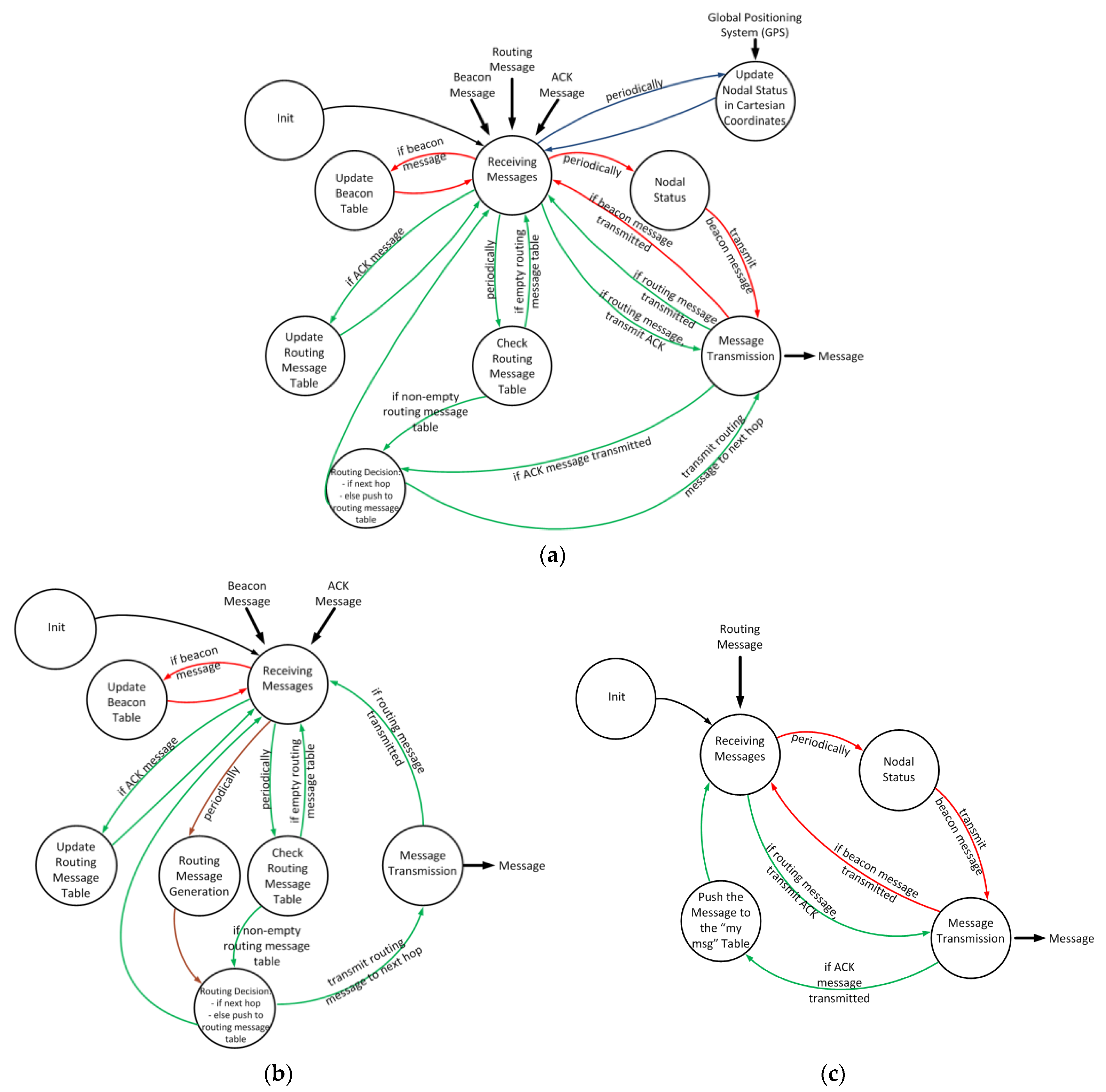
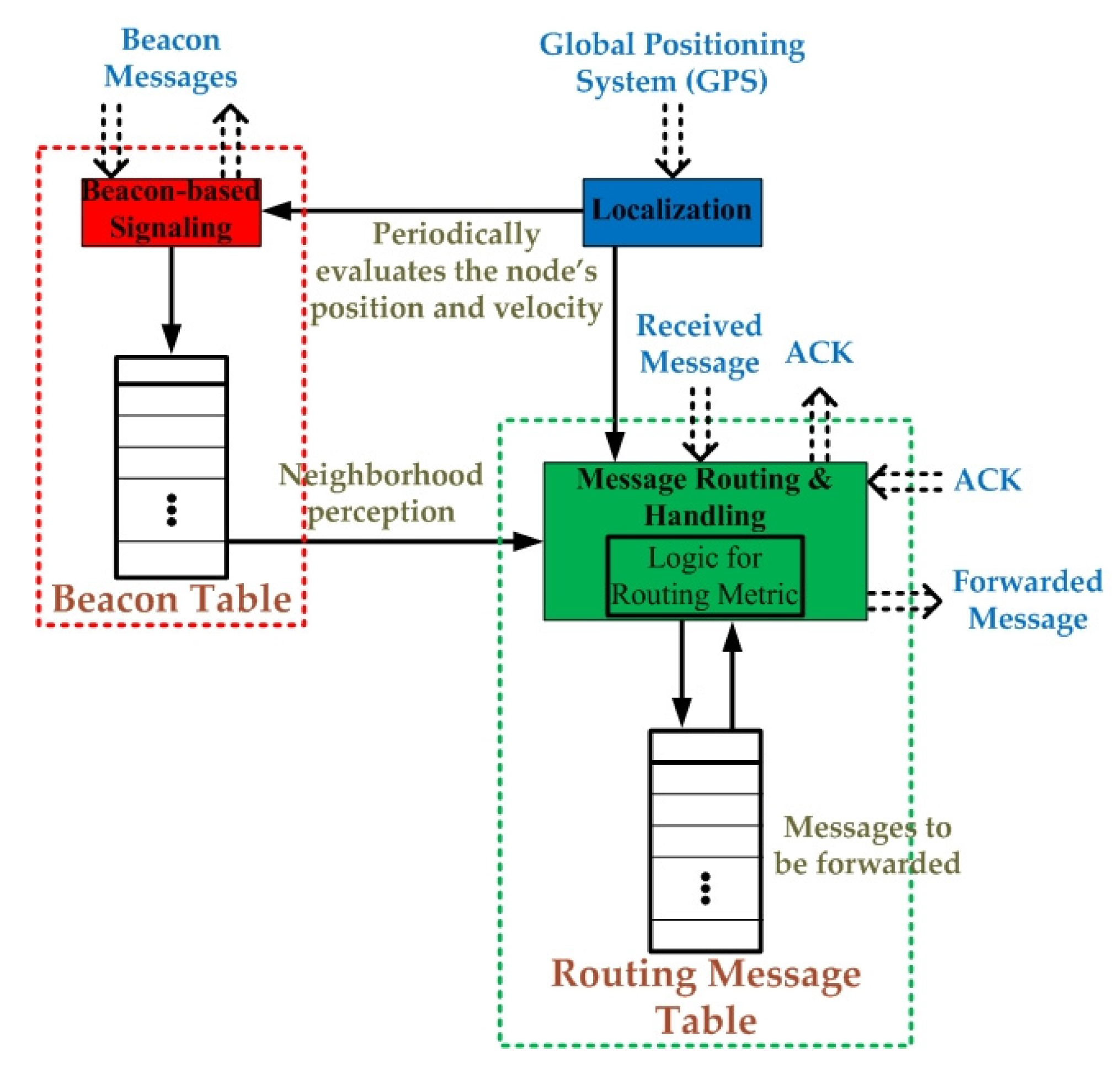
In an attempt to address these limitations, this paper proposes a versatile MANET experimentation platform, which is characterized by a modular architecture and can be flexibly employed in a wide range of experimentation scenarios, as demonstrated by its use in the scope of the ATLAS research project [35], on UxV-based mobile networks. The platform includes clearly defined modules for: the signaling between peer mobile nodes within communication range, according to a beacon-based mechanism; the localization/tracking of each mobile node’s location and motion over time; the routing protocol functionality, including the evaluation and selection of next-hop nodes; and the management of communication messages at each node, including message reception, storage, and next-hop forwarding. All signaling and data exchanges occur at the application layer, decoupling the operation of the platform from the intricacies of the actual wireless technologies employed.
The software of the MANET platform has been implemented in Python and runs on standard Raspberry Pi-based commodity hardware, using one board computer per network node. It is straightforward to mount the boards on robotic devices, which are used for moving the network nodes in accordance with controlled mobility patterns. With this arrangement, it becomes possible to completely decouple the operation of the attached boards from the intricacies of the robotic devices realizing mobility, thus maximizing the compatibility between the two sets of entities. Nevertheless, a controllable degree of coupling is still possible, if so desired. For example, the localization module of the MANET platform may take input from GPS facilities on the robotic devicesor, alternatively, disregard these facilities and perform the localization through other independent means.
The modular structure of the platform facilitates the adaptation of the software to enable experiments involving a variety of different routing protocols. Moreover, through an appropriate tuning of certain modules, it becomes possible to precisely control a number of important operational and environmental conditions through the software. In particular, by jointly exploiting input from the beacon-based signaling module and from the localization module, a reduced communication range between peer nodes can be emulated. This feature enables experiments that can address a wider range of network densities. In another direction, instead of mounting the MANET boards on actual robotic devices, it is possible to interface the localization module of some or all of the boards with another software module, providing input according to simulated mobility patterns. By leveraging these features, the operation of the proposed platform can span the range between emulated and real-world experiments, trading repeatability and control for realism, as required.
All these aspects are highlighted through the presentation and analysis of results from a comprehensive set of experiments on the performance of selected routing protocols under diverse conditions. These results not only demonstrate the effectiveness and versatility of the platformbut also yield additional insight into the performance impact of real-world imperfections, such as inaccurate location information or restricted mobility patterns.
In summary, the paper makes the following contributions:
  • It proposes a MANET experimentation platform with a modular architecture that includes clearly defined modules for the functions associated with localization, nodal interactions, and ad hoc networking. The architecture can accommodate a variety of different routing protocols and supports mechanisms for controlling, through software, a number of operational and environmental conditions.
  • It discusses a lightweight implementation of the design on inexpensive Raspberry Pi-based commodity hardware, using one board computer per network node. The implementation is compatible with a wide range of wireless communications technologies and any type of robotic device undertaking nodal mobility.
  • It presents and analyses results from a comprehensive set of experiments, demonstrating the platform’s potential and highlighting the impact of real-world imperfections.
The rest of the paper is organized as follows: Section 2 elaborates further on the scope of the proposed MANET platform and on associated use-case scenarios. Then, Section 3 presents the platform’s modular architecture and provides all necessary details about the software design, as well as about implementation aspects and the hardware components involved. Subsequently, Section 4 discusses robotic devices that may be employed for the physical motion of the mobile nodes. Section 5 presents results from experiments using the platform. Finally, Section 6 provides concluding remarks.

2. Scope of Applicability and Use-Case Scenario

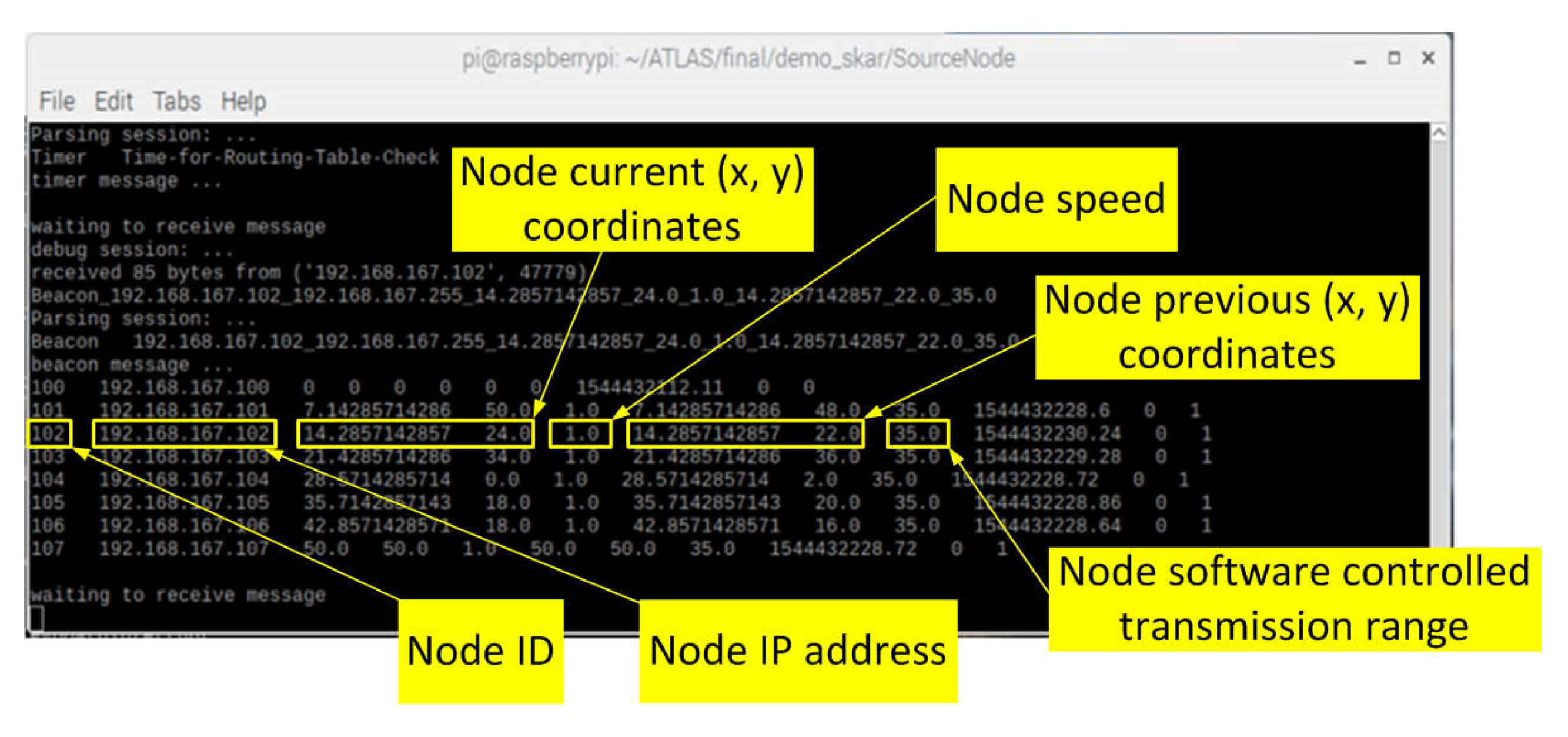
The platform addresses a mobile ad hoc setting, where each mobile node can communicate directly with all other nodes within its communication range. The associated coverage area around each node is called the node’s neighborhood, and the platform provides all the necessary mechanisms for an effective neighborhood perception. Specifically, as discussed in the introduction, the position and motion of all nodes in the neighborhood are particularly important attributes of the neighborhood’s status. Accordingly, the platform provides means so that each mobile node may obtain quasi-real-time updates of the position and motion of itself and all its neighbors. More precisely, each node obtains updates about its own position and motion through a GPS-based localization process and advertises this updated information to its neighborhood by means of periodically broadcast beacons.
By leveraging the updated status of its neighborhood, a mobile node holding messages that must be routed to their destination can evaluate the appropriateness of its neighbor nodes as next hops for each such message, according to an employed routing protocol (whose metric differentiates between neighbor nodes on the basis of their suitability). When the application of the routing protocol indicates that there exist neighbor nodes more suitable than the current node, the latter forwards the message to the most suitable such neighbor. The modular design of the platform facilitates the implementation of appropriate routing protocols, ensuring the proper interaction between the routing module and the modules responsible for the neighborhood perception.
Another worthwhile feature of the platform is the absence of requirements for a tight coupling between the core processes of the platform (which undertake the neighborhood perception and ad hoc networking functions) and the robotic devices employed for implementing the physical motion of the MANET nodes. This characteristic proved valuable during the initial deployment of the platform for realizing MANET-related experiments in the context of the ATLAS research project, implemented as part of the second Open Call from the RAWFIE European project (in the Horizon 2020 Framework Programme, under the FIRE+ initiative) [35]. RAWFIE developed and made available a wide variety of different UxV devices, together with a comprehensive (and complex) infrastructure for the coordination and control of these devices. Avoiding the need for tight integration with this infrastructure enabled a flexible and rapid deployment of the MANET platform for the realization of the ATLAS experiments. Moreover, due to the lack of integration requirements, it became straight-forward to apply the MANET platform in further experiments beyond the scope of ATLAS/RAWFIE.
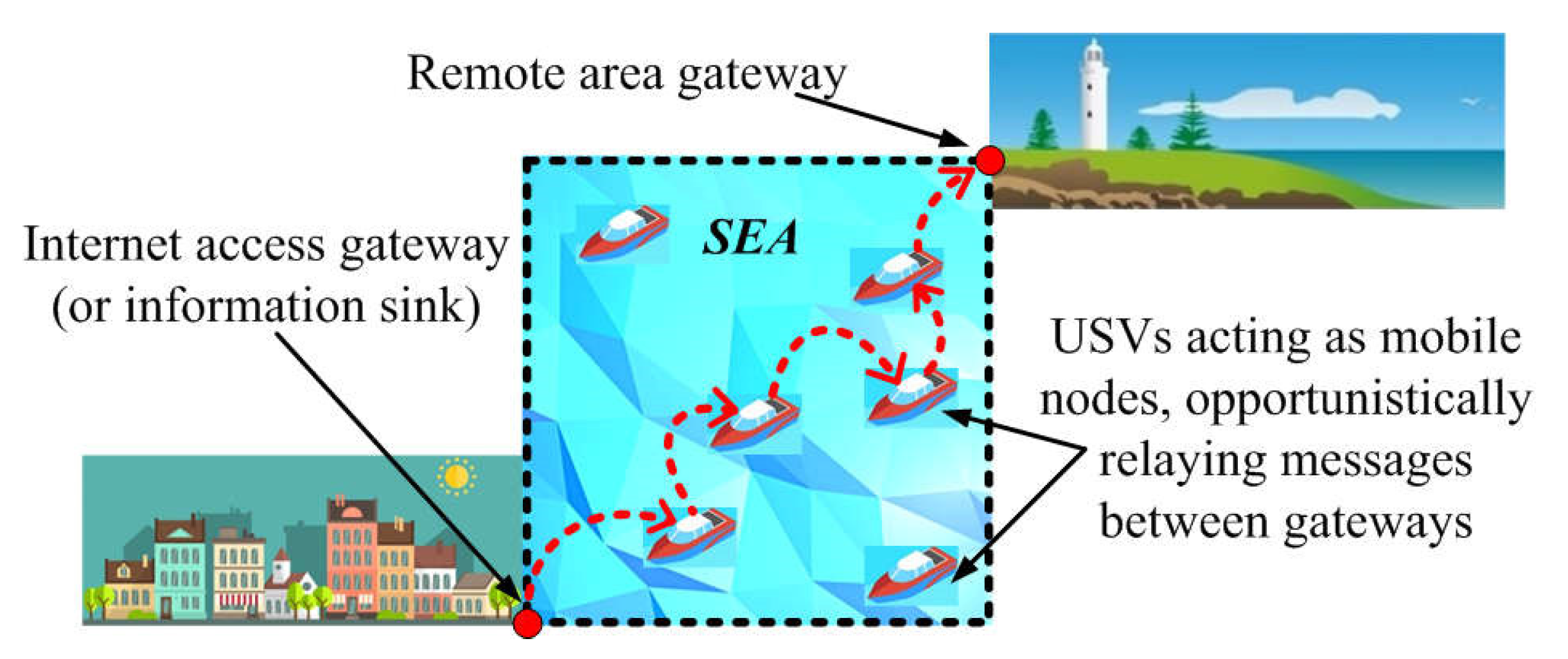
The ATLAS experiments aimed at assessing the performance of various routing protocols (detailed further in Section 3.2.4) suitable for use in UxV-based opportunistic networks under a variety of real-world conditions referring to the concrete use-case of providing connectivity to remote maritime areas, as depicted in Figure 1. According to this scenario, a remote island without networking infrastructure obtains opportunistic network connectivity via another area already equipped with network access. The network gateways at the two areas are connected by means of an opportunistic network of USVs acting as mobile nodes.
Figure 1. Use-case for the ATLAS experiments.
The evaluation results presented in Section 5 also refer to message exchanges between two fixed endpoints, but this time across stretches of land rather than water. In connection with this point, it is noted that the platform can readily accommodate additional scenarios beyond the case of Figure 1, involving further types of terrain or different traffic endpoints.

4. Devices Enabling Mobility in the MANET Platform

As mentioned in the introduction and Section 2, the mechanisms of the MANET platform are completely decoupled from the details of the devices realizing mobility. To demonstrate this flexibility, in this section, we briefly describe a number of different devices that have been employed so far for realizing the physical motion of the platform’s mobile nodes in experiments.

4.1. UxV Devices Enabling Mobility in the ATLAS/RAWFIE Experiments

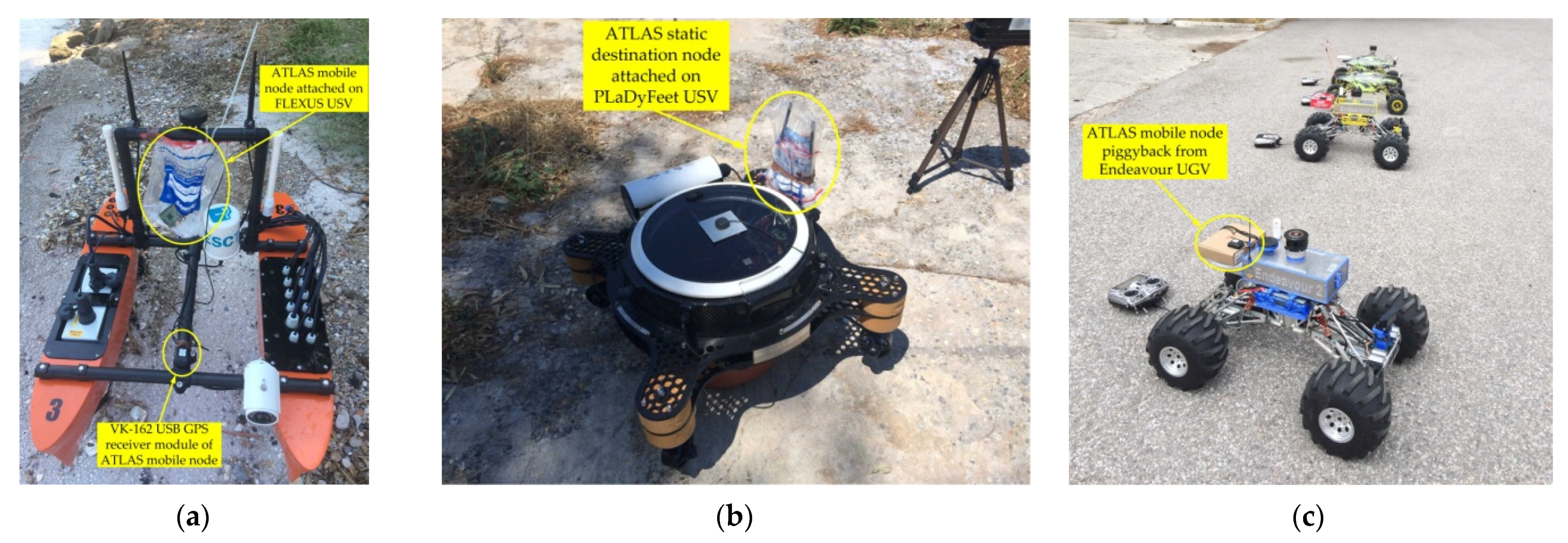
Given the orientation of the ATLAS-related experiments towards the use-case scenario of Figure 1, USVs were used for carrying the boards for the MANET nodes. (These experimentation activities took place in a naval base located in Skaramagkas, near Athens, Greece.) Among the choices available in the RAWFIE infrastructure, the platform was tested on board specific types of USVs with desirable characteristics. Specifically, the FLEXUS USV devices (Figure 9a) [50] were capable of maintaining a steady trajectory, and this characteristic matched well with the requirements of the mobile nodes. The PLaDyFeet USV devices (Figure 9b) [51] could maintain a stationary location at sea, fitting better to the needs of the static source and destination nodes. Moreover, besides the USVs just mentioned, RAWFIE was made available to other types of UxVs as well, such as the Endeavour All-Terrain UGVs (Figure 9c) [52]. These were exploited for conducting further experiments, this time on a ground terrain.
Figure 9. (a) An ATLAS mobile node attached to a “FLEXUS” USV; (b) ATLAS static destination node attached to a “PLaDyFeet” USV; (c) ATLAS mobile node attached to Endeavour UGV.
The mobility model for all types of UxVs was implemented using a series of specific waypoints that had been calculated before the experiment. It is noted that the RAWFIE infrastructure employed a dedicated IEEE 802.11 network (operating in a channel different from those used by the MANET platform) to interconnect the UxVs with the RAWFIE control and navigation facilities. The lack of requirements for a tight integration of the MANET platform with the RAWFIE infrastructure enabled a flexible and rapid deployment of the platform for the realization of the experiments.

4.2. Enabling Mobility through Simple Arduino-Based Mobile Robots

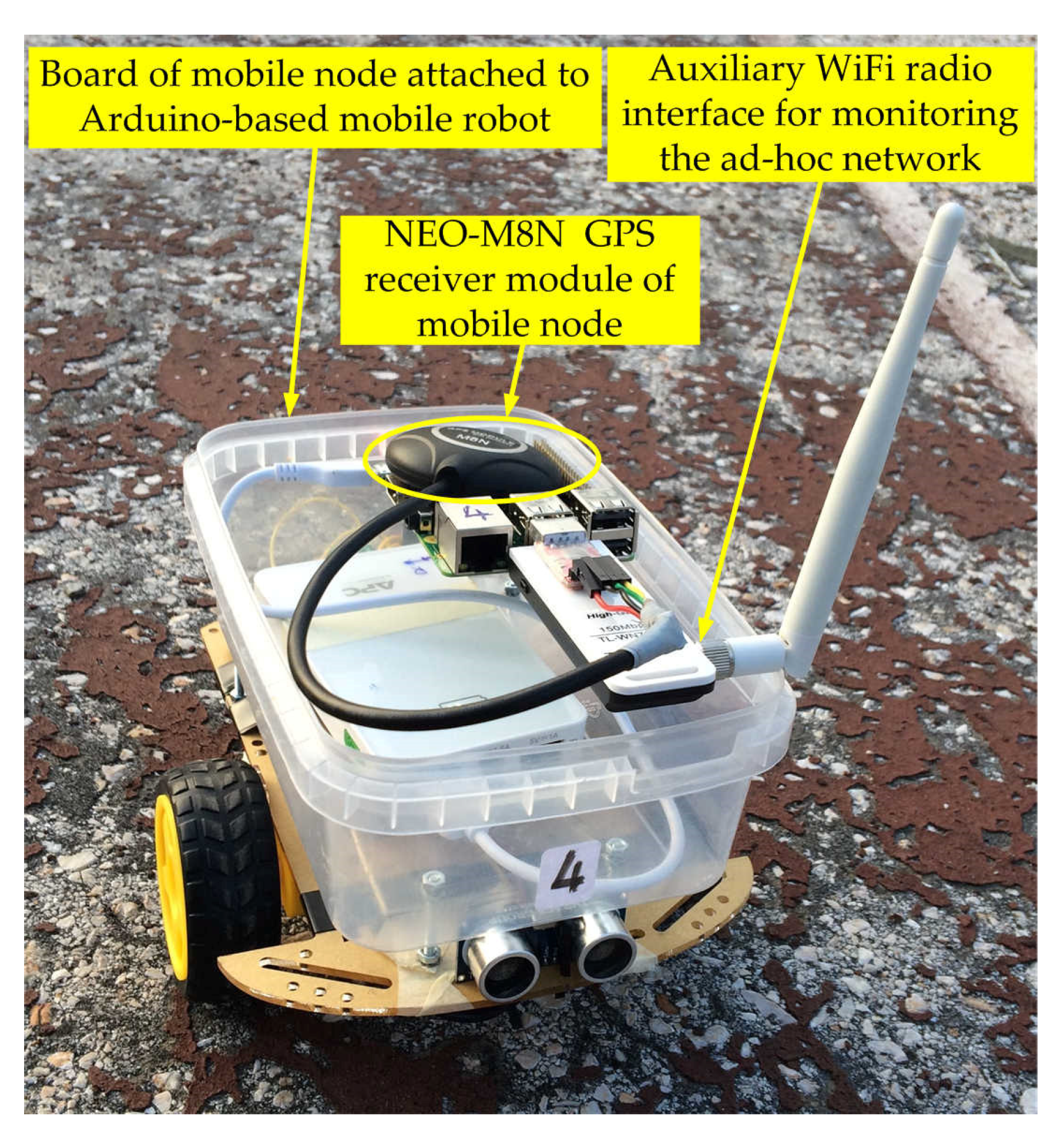
The experiments reported in the next section relied on simpler, inexpensive mobile robots. The said devices have a three-wheeled configuration, with two driving wheels at the front sides of the chassis, each powered by a continuous rotation servomotor, and a third rear caster/free-wheel (see Figure 10). This configuration is simple but effective, making the vehicles flexible and capable of changing their direction through differential steering techniques with minimum friction. The driving side wheels are equipped with photo interrupters for speed and direction stabilization purposes.
Figure 10. Board of a mobile node attached to an Arduino-based mobile robot.
Each mobile robot is controlled by a dedicated Arduino Uno unit and uses a 2-cell lithium-polymer battery for energy supply. Moreover, the chassis of each robot is equipped with an ultrasound distance sensor on its front, which can sense the robot’s approach to an obstacle, e.g., whenever the borders of the testing area are reached. By programming the control unit to respond to triggers from the distance sensor with appropriate changes in the robot’s direction, several typical mobility models can be supported (including the Random Direction mobility employed in the experiments of Section 5).
For more details on the design, the control principles and the implementation of these robotic vehicles, the reader may consult [53,54].

5. Results from Experiments Using the Platform

We now turn to the use of the platform and present results from an extensive set of experiments targeting the performance comparison of all implemented routing protocols, namely: the forward action-oriented MFR, the carry action-oriented MoVe, and the two versions of MAD (original and improved, the latter using a more refined estimation of the retaining time; see Section 3.2.4).

5.1. Setup and Methodology

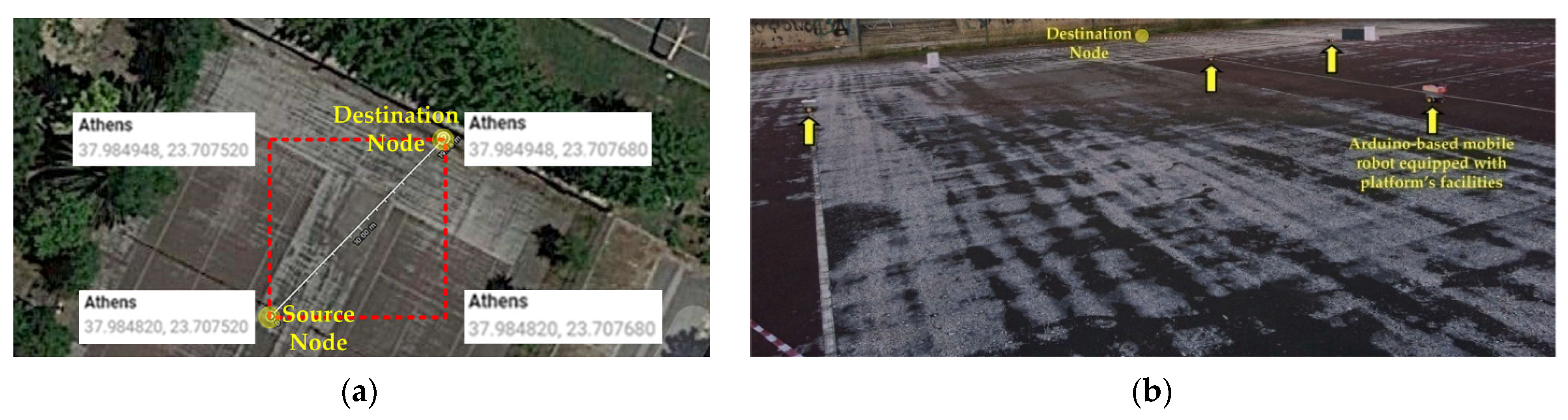
All experiments addressed the same scenario, according to which mobile nodes relayed messages exchanged between a pair of static source and destination nodes. The mobile nodes moved within a square area of size 14 × 14 m, and the source and destination nodes were placed at diagonally opposite vertices of the square. Four mobile nodes were employed, all of which moved according to the Random Direction mobility model [55] with zero pause time and a constant speed of magnitude V = 0.54   m / s (approx. 2 km/h). The experimentation activities took place in an outdoor area within the campus of the Agricultural University of Athens, Greece. Figure 11a provides relevant coordinates (based on the Google Maps information), while Figure 11b captures a snapshot of activity on the terrain.
Figure 11. (a) Coordinates of the experimentation terrain; (b) snapshot of activity in the terrain.
Given the moderate size of the experimentation terrain, if the full range of wireless communications had been enabled, it would have been impossible to explore the impact of the network density on the performance, as all MANET nodes would have been in range of one another, and every node would have perceived all others as (topological) neighbors. Even worse, the destination node would have been directly reachable from the source node, negating the need for any intermediate message relays. To mitigate such effects, the experiments leveraged the platform’s capability of controlling through software the communication range of the MANET nodes (see Section 3.1.2). Using this mechanism, different experiments were conducted, setting the communication range r of the MANET nodes to 3, 5, 6, and 7 m in turn. Higher values of the range yield greater network densities. Indeed, the regularity of the Random Direction mobility model implies that, at steady-state, a mobile node may occupy any point in the mobility terrain equally likely. Thus, given a mobility terrain of overall area A , a mobile node with communication range r has each of the other N 1 mobile nodes in range with probability π r 2 / A , so the node has on average N 1 π r 2 / A neighbors. In the experiment scenarios, A = 14 2   m 2 and N = 4 , so the four aforementioned range values correspond toan average number of 0.43, 1.20, 1.73, and 2.36 neighbors per node, respectively, spanning a range from low to higher network densities.
Experiments addressing all four network densities were repeated three times, each time employing a different configuration of the platform. In the first configuration, the motion of the mobile nodes was emulatedby interfacing the localization module of the nodes with software simulating mobility, as explained in Section 3.1.1. Both of the other two configurations involved actual mobility (realized by attaching the hardware for the mobile nodes to mobile robots with characteristics as in Section 4.2), differing in the type of the GPS devices used for localization. Specifically, the MANET nodes in the second configuration were equipped with NEO-M8N GPS receivers, while the third configuration employed the lessprecise VK-162 USB devices instead (see Section 3.2.3). By comparing results across all three configurations, it became possible to explore the impact of varying degrees of localization accuracy on the performance of the routing protocols.
For all protocols, network densities, and platform configurations, the performance was quantified through the average delay for message delivery from source to destination and the average number of hops required for this delivery. The platform provides facilities for calculating both of these metrics, as discussed in Section 3.1.4. The values reported here were obtained by averaging samples over 20 message deliveries using each routing protocol. In order to avoid correlations in the sampling process, the time between message generation events was chosen to be sufficiently large to ensure that the arrangement of MANET nodes on the terrain, as “seen” by any two consecutively generated messages, were completely different. It is noted that, in the interest of representing the end-to-end delays in a speed-invariant form, their values in the following results are expressed in a normalized way as multiples of the time constant r / V that determines the time required for refreshing a node’s neighborhood (For a node with range r moving at constant speed V on a straight line, time equal to 2 r / V must elapse before the neighborhood areas spanned by the node at the beginning and end of this time become non-overlapping).

5.2. Results

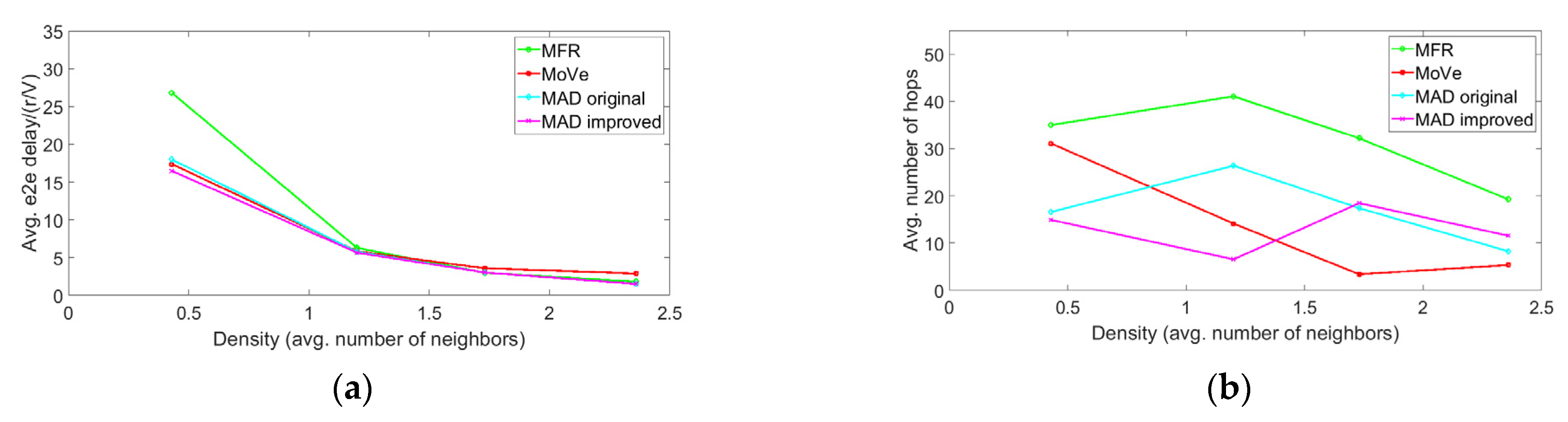
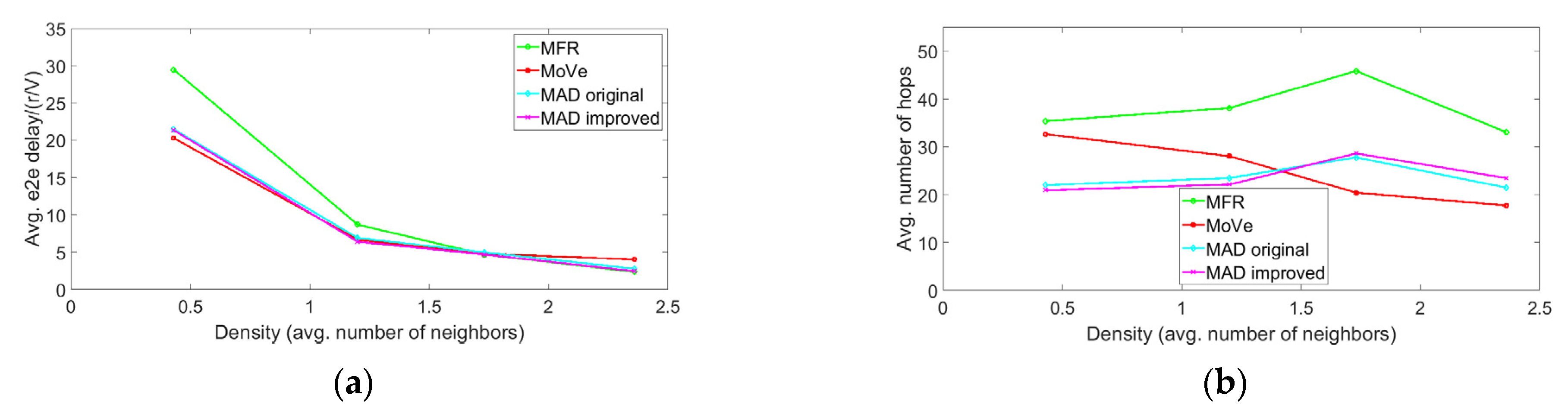
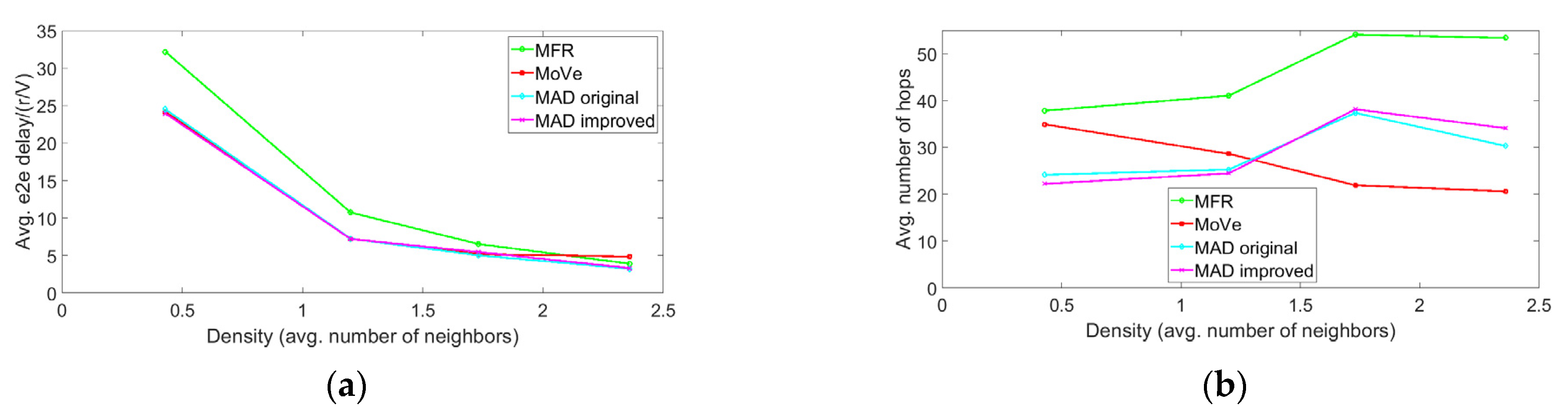
The results from the experiments appear in Figure 12, Figure 13 and Figure 14. All the main trends exhibited therein are in accordance with intuition, as we now discuss. In particular, for all considered routing protocols and platform configurations, the average end-to-end delay decreases as the network density increases. This happens because in denser topologies, a message-carrying node is in contact with more neighbors and thus experiences an increased number of potential message-forwarding opportunities per unit of time, with beneficial impacts on the delay-related performance.
Figure 12. Configuration 1 (emulated mobility): (a) average end-to-end delay and (b) average number of hops vs. network density (V = 0.54 m/s).
Figure 13. Configuration 2 (real mobility, GPS type NEO-M8N): (a) average end-to-end delay and (b) average number of hops vs. network density (V = 0.54 m/s).
Figure 14. Configuration 3 (real mobility, GPS type VK-162): (a) average end-to-end delay and (b) average number of hops vs. network density (V = 0.54 m/s).
The effect and relative importance of the forward and carry actions are also visible in the results. By comparing the end-to-end delays for MFR and MoVe, it is seen that in all configurations, the carry-based MoVe protocol outperforms the forward-based MFR when the network density is low, while the opposite is true for high densities. Again, this phenomenon is intuitively appealing: When the network density is low, a message-carrying node makes contact with just a few neighbors, on average, so the node rarely encounters suitable forwarding opportunities. Thus, in such environments, the carry action is more effective. On the other hand, in dense topologies, there are more neighbors, and it is easier for the node to identify suitable next hops, the forward action prevails, and the MFR protocol performs better.
In networks of intermediate densities, both the forward and carry actions have a significant effect, and both should be taken into account for an effective routing. The MAD protocol is inherently capable of exploiting the right combination of the forward and carry actions, behaving more like MoVe in low densities and more like MFR in higher ones. As it can be seen from the delay-related results, both versions of the protocol adjust their operation properly across the entire range of network densities and for all configurations, thus being more flexible and better performing overall than the protocols relying on a single action. Further, the results indicate that the improved version of MAD outperforms the original version of the protocol throughoutbecause the more accurate estimation of the retaining time in the improved version enables a better adjustment of the forward and carry components in the protocol’s next-hop selection metric.
With respect to the number of hops required for message delivery, the results demonstrate that, in all configurations, MoVe uses a smaller number of hops than MFR. Again, this is expectedbecause MoVe determines the suitability of next-hop nodes solely on the basis of the direction of motion. Thus, once a node heading towards the destination receives the message, it will be unlikely to encounter neighbors better directed than itself, and the same node will keep carrying the message until delivery. On the contrary, MFR bases its operation on the forward action, which inherently involves a greater number of hops. It is noted that a smaller number of hops is not necessarily accompanied by better delay-related performance: The results clearly show that in dense environments (where the forward action is most impactful), the fewer hops of MoVe prevent this protocol from attaining the better end-to-end delay exhibited by MFR and the two versions of MAD.
The aforementioned patterns in the results are not only reasonable, as discussed, but also well aligned with analogous patterns in other results, such as the simulation-based results in [47]. This is remarkable, considering that the simulation results addressed idealized settings (perfect communication channels, perfect knowledge of location and motion, etc.) and involved significantly larger terrains and a significantly greater number of mobile nodes (enabling a smoother, more uniform coverage of the mobility terrainand a reduced impact of boundary effects at the terrain’s borders). The fact that experimentation using the platform in a terrain of moderate size, with only a few mobile nodes, was capable of reproducing important trends identified in results from idealized setups provides validation for the platform and a strong indication of its capability to support the realization of meaningful experiments.

5.3. Further Discussion and Real-World Effects

Of course, the main reason for employing an experimentation platform is not to replicate results from simulations but rather to study the impact of real-world effects and imperfections, something not possible with simulations. Here, this aspect is demonstrated by exploring the impact of localization accuracy through a comparison of the performance results across the three configurations. Indeed, the simulated mobility in the first configuration sets a benchmark for perfect localization, while the second and third configurations capture settings of increasingly coarser localization accuracy due to the characteristics of the GPS devices employed in each case. The results indicate clearly that, while all three configurations exhibit the same trends, the performance of all protocols degrades as the localization accuracy becomes coarser. This occurs because message-carrying nodes select next hops on the basis of partially incorrect position information, and this leads to sub-optimalor even inappropriate message forwarding decisions.
It is interesting that, in some respects, the reduced performance due to imprecise localization manifests itself as a smaller network density. Indeed, as remarked earlier, lower network densities are also associated with a degraded performance of all routing protocols because of the reduced number of potential message-forwarding opportunities. However, the connection is stronger, as now explained: By considering the delay-related performance results for each configuration alone, one may determine the value of the density for which the delay curves of MFR and MoVe intersect. Since the carry-based MoVe performs better in sparse topologies and the forward-based MFR in dense ones, the value of the density at the intersection characterizes the transition from sparse to dense topologies, i.e., intermediate regimes for which both the forward and carry actions have a significant impact. In light of this, the results demonstrate that the value of the “transitional” density becomes greater for configurations with more inaccurate localization. In other words, a given network topology will appear to be sparser when the localization becomes less precise.
We point out that the performance impact of the localization inaccuracy has been represented somewhat emphatically in the results just discussed due to particular characteristics of the relevant experiments. Specifically, although the GPS units employed in the second and third configurations are typical devices featuring a modest degree of imprecision (2.5 m for NEO-M8N and 3 m for VK-162, see Section 3.2.3), the effect of this imprecision becomes pronounced in the context of the experiments, due to the comparably small size of the mobility terrain (14 × 14 m, also restricting the magnitude of the distances between nodes) and of the communication ranges employed (3–7 m, also restricting the extent of a node’s neighborhood). If the same GPS devices had been used in setups involving larger terrains and longer communication ranges, the impact of localization inaccuracy would have been milder; the same performance trends would still have been present but to a lesser extent. In the same spirit, it is seen that the small-size experiments discussed here, besides their capability for emphasizing the effect of location inaccuracies, are also useful in demonstrating that the performance of all considered routing protocols degrades gracefully, even when the information on the positions of candidate next-hop nodes becomes highly inaccurate (in relative terms).
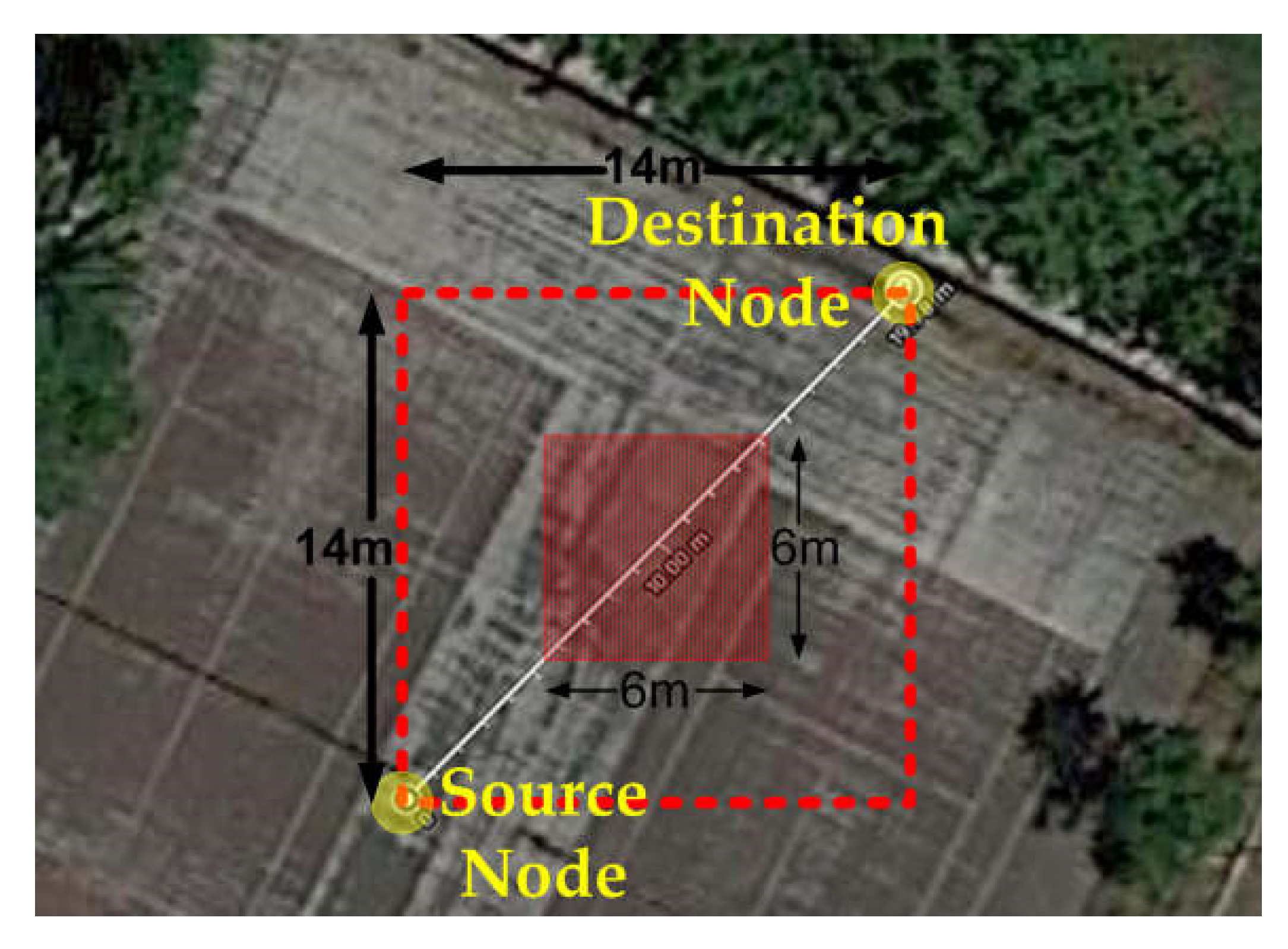
We close by presenting results from one more experiment, again representative of real-world aspects that can be studied with the help of the platform. For this experiment, the central part of the mobility terrain was blocked by means of a square obstacle of size 6 × 6 m placed therein (see Figure 15). The experiment employed the second configuration of the platform (real mobility, nodes equipped with NEO-M8N GPS devices), and the communication range was set to 3 m (for a network density of 0.43 neighbors per node, on average). The mobile nodes could move in the free part of the terrain according to the same mobility model as before (Random Direction mobility with speed V = 0.54   m / s ), but in this case, the nodes changed direction, not only when reaching the borders of the terrain but also when hitting the obstacle.
Figure 15. Modified experimentation terrain with blocked central part.
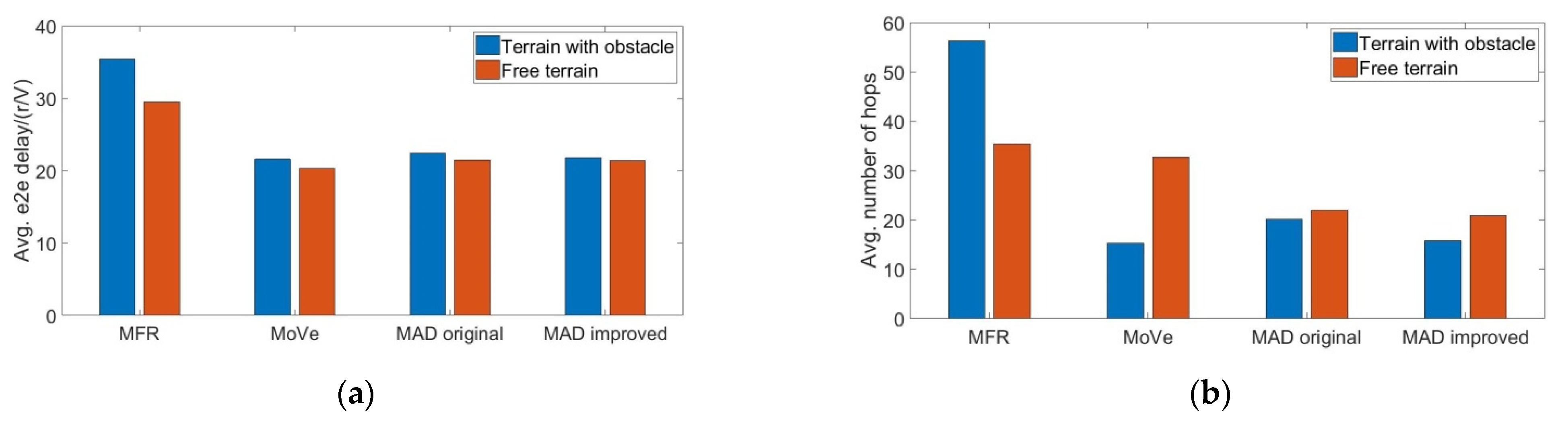
The results are in Figure 16, which also displays the corresponding performance metrics for the free terrain (same values as those depicted in the left parts of Figure 13a,b). Clearly, the delay-related performance of all routing protocols is reduced in the blocked terrain. This is expected because the obstacle occupies the central part of the terrain and prevents mobile nodes from taking positions that would enable them to act as beneficial next-hops for other nearby nodes. Moreover, apart from deteriorating the effectiveness of the forward action, the obstacle has a negative impact on the carry action too, as it prevents mobile nodes from moving along trajectories proximal to the shortest path from source to destination.
Figure 16. Configuration 2 (real mobility, GPS type NEO-M8N): (a) average end-to-end delay and (b) average number of hops in a terrain with and without obstacle (V = 0.54 m/s, r = 3 m).
Between these two effects, the one having an influence on the forward action is the strongest. It can be observed that the MFR protocol, which relies exclusively on this action, suffers the worst degradation in the delay-related performance. The low network density featured in the experiment is also a contributing factor: MFR performs poorly in sparse environments, and the reduced effectiveness due to the obstacle of the rarely encountered forwarding opportunities has an adverse effect. The deterioration of performance is less severe for the other protocols, because they can leverage (exclusively or partly) the carry action, which is more suitable in sparse environments. These trends are also reflected in the hops-related results. In the blocked terrain, MFR uses a significantly greater number of hops in its attempts to circumvent the obstacle and make progress towards the destination. Contrarily, the other protocols use a smaller number of hops because in the blocked terrain, it is more difficult to encounter better-directed nodes that would carry faster the message to the destination. Finally, it may be observed that the two versions of MAD exhibit the smallest performance differences between the free and blocked terrains (with respect to both metrics)because of the protocol’s potential for dynamic adaptation and effective exploitation of both the forward and carry effects, as the local conditions vary.

6. Conclusions

The platform proposed in the paper responds to the need for enabling a more flexible and customizable experimentation on a variety of MANET scenarios. The platform has a modular software architecture, which facilitates adaptations, modifications and/or extensions, and can be operated in conjunction with a variety of wireless communications technologies. Its software runs on inexpensive Raspberry Pi-based commodity hardware, using one board computer per network node, and this hardware can be attached to robotic devices in a straight-forward manner, without tight coupling, for moving the network nodes in accordance with controlled mobility patterns. Moreover, the platform provides facilities for restricting through software the communications range (thus affecting the network density) or for emulating the mobility patterns of nodes. By leveraging these features, the operation of the platform can span the range between emulated and real-world experiments, trading repeatability and control for realism, as required.
The effectiveness and versatility of the platform were demonstrated through results from an extensive set of experiments on the comparative performance evaluation of selected routing protocols under diverse conditions. Although the experiments were conducted on a small area and employed only a few mobile nodes, they were capable of reproducing many important phenomena identified in previous results, derived in connection with idealized simulation-based setups. Moreover, the experiments provided additional insight into real-world aspects, such as the impact of inaccurate location information or of restricted mobility patterns. Overall, the results provide validation and a strong indication of the platform’s potential for supporting the realization of meaningful experiments.

Author Contributions

Conceptualization, I.M.; methodology, I.M.; software, I.M. and D.L.; prototyping, I.M. and D.L.; validation, I.M., D.L. and K.K.; resources, I.M., D.L. and K.K.; writing—original draft preparation, I.M.; writing—review and editing, I.M., D.L. and K.K.; visualization, I.M., D.L. and K.K.; supervision, K.K. All authors have read and agreed to the published version of the manuscript.

Funding

This work and the APC was partially supported by the European Union’s Horizon 2020 Framework Programme for Research and Innovation, under Grant Agreement No. 645220 (project RAWFIE—“Road-, Air- and Water-based Future Internet Experimentation”) and the project SYNTELESIS “Innovative Technologies and Applications based on the Internet of Things (IoT) and the Cloud Computing”, which is funded by the Operational Programme “Competitiveness, Entrepreneurship and Innovation” (NSRF 2014–2020) and co-financed by Greece and the EU (European Regional Development Fund) under Grant MIS 5002521.

Institutional Review Board Statement

Not applicable.

Data Availability Statement

Not applicable.

Conflicts of Interest

The authors declare no conflict of interest.

References

  1. Kurkowski, S.; Camp, T.; Colagrosso, M. MANET simulation studies: The incredible. ACM SIGMOBILE Mob. Comput. Commun. Rev. 2005, 9, 50–61. [Google Scholar] [CrossRef]
  2. Sharma, S.; Kumar, S. Techniques for Real-World Implementation of a Manet. In Proceedings of the 2019 International Conference on Machine Learning, Big Data, Cloud and Parallel Computing (COMITCon), Faridabad, India, 14–16 February 2019; pp. 519–524. [Google Scholar]
  3. Ngu, A.H.; Gutierrez, M.; Metsis, V.; Nepal, S.; Sheng, Q.Z. IoT Middleware: A Survey on Issues and Enabling Technologies. IEEE Internet Things J. 2017, 4, 1–20. [Google Scholar] [CrossRef]
  4. Bruzgiene, R.; Narbutaite, L.; Adomkus, T. MANET Network in Internet of Things System. Ad Hoc Netw. 2017, 3, 89–114. [Google Scholar]
  5. Bellavista, P.; Cardone, G.; Corradi, A.; Foschini, L. Convergence of MANET and WSN in IoT Urban Scenarios. IEEE Sens. J. 2013, 13, 3558–3567. [Google Scholar] [CrossRef]
  6. Chibelushi, C.; Eardley, A.; Arabo, A. Identity Management in the Internet of Things: The Role of MANETs for Healthcare Applications. Comput. Sci. Inf. Technol. 2013, 1, 73–81. [Google Scholar] [CrossRef]
  7. Glass, S.; Mahgoub, I.; Rathod, M. Leveraging MANET-based cooperative cache discovery techniques in VANETs: A survey and analysis. IEEE Commun. Surv. Tutor. 2017, 19, 2640–2661. [Google Scholar] [CrossRef]
  8. Sumalee, A.; Ho, H.W. Smarter and more connected: Future intelligent transportation system. IATSS Res. 2018, 42, 67–71. [Google Scholar] [CrossRef]
  9. Schranz, M.; Umlauft, M.; Sende, M.; Elmenreich, W. Swarm robotic behaviors and current applications. Front. Robot. AI 2020, 7, 36. [Google Scholar] [CrossRef] [Green Version]
  10. Papadopoulou, P.; Kolomvatsos, K.; Hadjiefthymiades, S. Internet of Things Business Models: The RAWFIE Case. In Digital Transformation for a Sustainable Society in the 21st Century; Pappas, I., Mikalef, P., Dwivedi, Y., Jaccheri, L., Krogstie, J., Mäntymäki, M., Eds.; Springer International Publishing: Cham, Switzerland, 2019; Volume 11701. [Google Scholar]
  11. Kalatzis, N.; Avgeris, M.; Dechouniotis, D.; Papadakis-Vlachopapadopoulos, K.; Roussaki, I.; Papavassiliou, S. Edge computing in IoT ecosystems for UAV-enabled early fire detection. In Proceedings of the IEEE International Conference on Smart Computing (SMARTCOMP), Taormina, Italy, 18–20 June 2018; pp. 106–114. [Google Scholar]
  12. Zhang, T.; Liu, G.; Zhang, H.; Kang, W.; Karagiannidis, G.K.; Nallanathan, A. Energy-efficient resource allocation and trajectory design for UAV relaying systems. IEEE Trans. Commun. 2020, 68, 6483–6498. [Google Scholar] [CrossRef]
  13. Benhamida, F.Z.; Bouabdellah, A.; Challal, Y. Using delay tolerant network for the Internet of Things: Opportunities and challenges. In Proceedings of the 8th International Conference on Information and Communication Systems (ICICS), Irbid, Jordan, 4–6 April 2017; pp. 252–257. [Google Scholar]
  14. Hogie, L.; Bouvry, P.; Guinand, F. An Overview of MANETs Simulation. Electron. Notes Theor. Comput. Sci. 2006, 150, 81–101. [Google Scholar] [CrossRef] [Green Version]
  15. Borboruah, G.; Nandi, G. A study on large scale network simulators. Int. J. Comput. Sci. Inf. Technol. 2014, 5, 7318–7322. [Google Scholar]
  16. Boukerche, A.; Bononi, L. Simulation and Modeling of Wireless, Mobile and Ad Hoc Networks. Mob. Ad HocNetw. 2004, 373–409. [Google Scholar] [CrossRef]
  17. Guruprasad, S.; Ricci, R.; Lepreau, J. Integrated Network Experimentation using Simulation and Emulation. In Proceedings of the First International Conference on Testbeds and Research Infrastructures for the Development of Networks and Communities (TRIDENTCOM), Trento, Italy, 23–25 February 2005; pp. 204–212. [Google Scholar]
  18. Krop, T.; Bredel, M.; Hollick, M.; Steinmetz, R. JiST/MobNet: Combined simulation emulation and real-world testbed for ad hoc networks. In Proceedings of the Second ACM International Workshop on Wireless Network Testbeds, Experimental Evaluation and Characterization (WinTECH’07), New York, NY, USA, 10 September 2007; pp. 27–34. [Google Scholar]
  19. Mahadevan, P.; Rodriguez, A.; Becker, D.; Vahdat, A. MobiNet: A Scalable Emulation Infrastructure for Ad-hoc and Wireless Networks. ACM SIGMOBILE Mob. Comput. Commun. Rev. 2006, 10, 26–37. [Google Scholar] [CrossRef]
  20. Sanchez-Aguero, V.; Valera, F.; Nogales, B.; Gonzalez, L.F.; Vidal, I. VENUE: Virtualized environment for multi-UAV network emulation. IEEE Access 2019, 7, 154659–154671. [Google Scholar] [CrossRef]
  21. Ruffieux, S.; Gisler, C.; Wagen, J.; Buntschu, F.; Bovet, G. TAKE-Tactical ad-hoc network emulation. In Proceedings of the 2018 International Conference on Military Communications and Information Systems (ICMCIS), Warsaw, Poland, 22–23 May 2018; pp. 1–8. [Google Scholar]
  22. Poylisher, A.; Serban, C.; Lee, J.; Lu, T.-C.; Chadha, R.; Chiang, C.-Y.; Orlando, R.; Jakubowski, K. A virtual ad hoc network testbed. Int. J. Commun. Netw. Distrib. Syst. 2010, 5, 5–24. [Google Scholar] [CrossRef]
  23. McGregor, I. The relationship between simulation and emulation. In Proceedings of the Winter Simulation Conference, San Diego, CA, USA, 8–11 December 2002; pp. 1683–1688. [Google Scholar]
  24. Göktürk, E. Emulating Ad Hoc Networks: Differences from Simulations and Emulation Specific Problems. In Proceedings of the 20th International Symposium on Computer and Information Sciences (ISCIS 2005), Istanbul, Turkey, 26–28 October 2005; pp. 198–203. [Google Scholar]
  25. Kropff, M.; Krop, T.; Hollick, M.; Mogre, P.; Steinmetz, R. A Survey on Real World and Emulation Testbeds for Mobile Ad hoc Networks. In Proceedings of the 2nd International Conference on Testbeds and Research Infrastructures for the Development of Networks and Communities (TRIDENTCOM 2006), Barcelona, Spain, 1–3 March 2006; pp. 1989–1993. [Google Scholar]
  26. De, P.; Raniwala, A.; Krishnan, R.; Tatavarthi, K.; Modi, J.; Syed, N.; Sharma, S.; Chiueh, T. MiNT-m: An Autonomous Mobile Wireless Experimentation Platform. In Proceedings of the 4th International Conference on Mobile Systems, Applications and Services (MobiSys’06), New York, NY, USA, 19–22 June 2006; pp. 124–137. [Google Scholar]
  27. Martinez-de Dios, J.; Jimenez-Gonzalez, A.; San Bernabe, A.; Ollero, A. CONET integrated testbed architecture. In a Remote Integrated Testbed for Cooperating Objects; Springer International Publishing: Cham, Switzerland, 2014; pp. 23–39. [Google Scholar]
  28. Fok, C.; Petz, A.; Stovall, D.; Paine, N.; Julien, C.; Vishwanath, S. Pharos: A testbed for mobile cyber-physical systems. Univ. Tex. Austin Tech. Rep. 2011. Available online: https://www.yumpu.com/en/document/read/51122653/a-testbed-for-mobile-cyber-physical-systems-the-university-of- (accessed on 18 February 2022).
  29. Pu, Y.-C.; You, P.-C. Indoor positioning system based on BLE location fingerprinting with classification approach. Appl. Math. Model. 2018, 62, 654–663. [Google Scholar] [CrossRef]
  30. Pechlivanidou, K.; Katsalis, K.; Igoumenos, I.; Katsaros, D.; Korakis, T.; Tassiulas, L. NITOS Testbed: A Cloud based Wireless Experimentation Facility. In Proceedings of the 26th International Teletraffic Congress (ITC), Karlskrona, Sweden, 9–11 September 2014; pp. 1–6. [Google Scholar]
  31. Dahlberg, T.A.; Nasipuri, A.; Taylor, C. Explorebots: A Mobile Network Experimentation Testbed. In Proceedings of the 2005 ACM SIGCOMM Workshop Experimental Approaches to Wireless Network Design and Analysis (E-WIND’05), New York, NY, USA, 22 August 2005; pp. 76–81. [Google Scholar]
  32. Acroname Corp. Garcia Robot. Available online: http://www.acroname.com/garcia/garcia.html (accessed on 18 February 2022).
  33. Farkhana, M.; Hanan, A.A. Mobility in mobile ad-hoc network testbed using robot: Technical and critical review. Robot. Auton. Syst. 2018, 108, 153–178. [Google Scholar] [CrossRef]
  34. Kulla, E.; Ikeda, M.; Barolli, L.; Xhafa, F.; Iwashige, J. A Survey on MANET Testbeds and Mobility Models. In Computer Science and Convergence, Lecture Notes in Electrical Engineering; Springer: Dordrecht, The Netherlands, 2012; pp. 651–657. [Google Scholar]
  35. RAWFIE Project (Road-, Air-, and Water-based Future Internet Experimentation); Funded by the European Union’s Horizon 2020 Framework Programme for Research and Innovation—Future Internet Research and Experimentation (FIRE+), under Grant Agreement No 645220. Available online: www.rawfie.eu (accessed on 18 February 2022).
  36. Albers, H.C. Beschreibung einer neuen Kegelprojektion. Zach’s Mon. Corresp. Beford. Erd- Himmels-Kunde 1805, 12, 450–459. [Google Scholar]
  37. Adams, O.S. Tables for Albers Projection: U.S. Coast and Geodetic Survey Special Publication; DC Government Printing Office: Washington, DC, USA, 1927. [Google Scholar]
  38. Snyder, J.P. Map Projections Used by the U.S. Geological Survey; United States Government Printing Office: Washington, DC, USA, 1982. Available online: http://pubs.er.usgs.gov/publication/b1532 (accessed on 18 February 2022).
  39. Killijian, M.-O.; Powell, D.; Roy, M.; Severac, G. Experimental Evaluation, of Ubiquitous Systems: Why and How to Reduce WiFi Communication Range. In Proceedings of the 2nd International Conference on Distributed Event-Based Systems (DEBS 2008), Rome, Italy, 2–4 July 2008. [Google Scholar]
  40. Killijian, M.-O.; Roy, M.; Severac, G. The ARUM experimentation platform: An open tool to evaluate mobile systems applications. In Advances in Autonomous Mini Robots; Rückert, U., Joaquin, S., Felix, W., Eds.; Springer: Berlin/Heidelberg, Germany, 2012; pp. 221–234. [Google Scholar]
  41. The Official Raspberry Pi Site. Available online: https://www.raspberrypi.org/ (accessed on 18 February 2022).
  42. TP-Link TL-WN722N. Available online: https://www.tp-link.com/us/home-networking/usb-adapter/tl-wn722n/#overview (accessed on 18 February 2022).
  43. Description of the u-blox 7 Receiver Description Including Protocol Specification V14. Available online: https://www.u-blox.com/sites/default/files/products/documents/u-blox7-V14_ReceiverDescriptionProtocolSpec_%28GPS.G7-SW-12001%29_Public.pdf (accessed on 18 February 2022).
  44. NEO-M8N GPS. Available online: https://www.u-blox.com/sites/default/files/NEO-M8-FW3_DataSheet_UBX-15031086.pdf (accessed on 18 February 2022).
  45. Takagi, H.; Kleinrock, L. Optimal transmission ranges for randomly distributed packet radio terminals. IEEE Trans. Commun. 1984, 32, 246–257. [Google Scholar] [CrossRef] [Green Version]
  46. Lebrun, J.; Chuah, C.-N.; Ghosal, D.; Zhang, M. Knowledge-based Opportunistic Forwarding in Vehicular Wireless Ad Hoc Networks. In Proceedings of the 2005 IEEE 61st Vehicular Technology Conference, Stockholm, Sweden, 30 May–1 June 2005; pp. 2289–2293. [Google Scholar]
  47. Manolopoulos, I.; Kontovasilis, K.; Stavrakakis, I.; Thomopoulos, S.C.A. Methodologies for calculating decision-related event occurrence times, with applications to effective routing in diverse MANET environments. Ad Hoc Netw. 2020, 99, 102068. [Google Scholar] [CrossRef]
  48. Manolopoulos, I.; Kontovasilis, K.; Stavrakakis, I.; Thomopoulos, S.C.A. MAD: A Dynamically Adjustable Hybrid Location and Motion-based Routing Protocol for VANETs. In Proceedings of the IEEE 7th International Symposium on Wireless Communication Systems (IEEE ISWCS’10), York, UK, 19–22 September 2010. [Google Scholar]
  49. Manolopoulos, I.; Kontovasilis, K.; Stavrakakis, I.; Thomopoulos, S.C.A. Exploiting Topology and Behavioral Attributes for Effective Routing in Mobile Networks. In Proceedings of the IFIP/IEEE 10th International Conference on Wireless On-Demand Network Systems and Services (IFIP/IEEE WONS’13), Banff, AB, Canada, 18–20 March 2013. [Google Scholar]
  50. FLEXUS-Flexible Unmanned Surface Vehicles for the Internet of Moving Things. Available online: https://flexus.inesctec.pt/ (accessed on 18 February 2022).
  51. PlaDyFleet—A Fleet of Unmanned Surface Marine Vehicles. Available online: https://labust.fer.hr/labust/research/pladyfleet (accessed on 18 February 2022).
  52. ALTU: Provision of All-Terrain UGVs, Model Endeavour. Available online: https://vehicularlab.uni.lu/project/fcd4its/ (accessed on 18 February 2022).
  53. Loukatos, D.; Arvanitis, K.G. Extending Smart Phone Based Techniques to Provide AI Flavored Interaction with DIY Robots, over Wi-Fi and LoRa interfaces. Educ. Sci. 2019, 9, 224. [Google Scholar] [CrossRef] [Green Version]
  54. Loukatos, D.; Petrongonas, E.; Manes, K.; Kyrtopoulos, I.-V.; Dimou, V.; Arvanitis, K.G. A Synergy of Innovative Technologies towards Implementing an Autonomous DIY Electric Vehicle for Harvester-Assisting Purposes. Machines 2021, 9, 82. [Google Scholar] [CrossRef]
  55. Camp, T.; Boleng, J.; Davies, V. A survey of mobility models for ad hoc networks research. Wirel. Commun. Mob. Comput. 2002, 2, 483–502. [Google Scholar] [CrossRef]
Publisher’s Note: MDPI stays neutral with regard to jurisdictional claims in published maps and institutional affiliations.

Article Metrics

Citations

Article Access Statistics

Multiple requests from the same IP address are counted as one view.