This is an early access version, the complete PDF, HTML, and XML versions will be available soon.
Review

Cannabinoids for Dermatological Applications: Mechanistic Insights, Clinical Evidence, and Emerging Nanotechnology-Enabled Delivery Strategies


1
Department of Pharmacy, Banasthali Vidyapith, Banasthali 304022, India
2
Department of Bioscience and Biotechnology, Banasthali Vidyapith, Banasthali 304022, India
3
Department of Pharmaceutical Sciences, Jerry H. Hodge School of Pharmacy, Texas Tech University Health Sciences Center, Amarillo, TX 79106, USA
4
Discipline of Medical Biochemistry, School of Medicine, University of KwaZulu-Natal, Durban 4041, South Africa
*
Authors to whom correspondence should be addressed.
Pharmaceutics 2026, 18(4), 469; https://doi.org/10.3390/pharmaceutics18040469 (registering DOI)

Submission received: 16 February 2026 / Revised: 2 April 2026 / Accepted: 9 April 2026 / Published: 12 April 2026
(This article belongs to the Section Nanomedicine and Nanotechnology)

Abstract

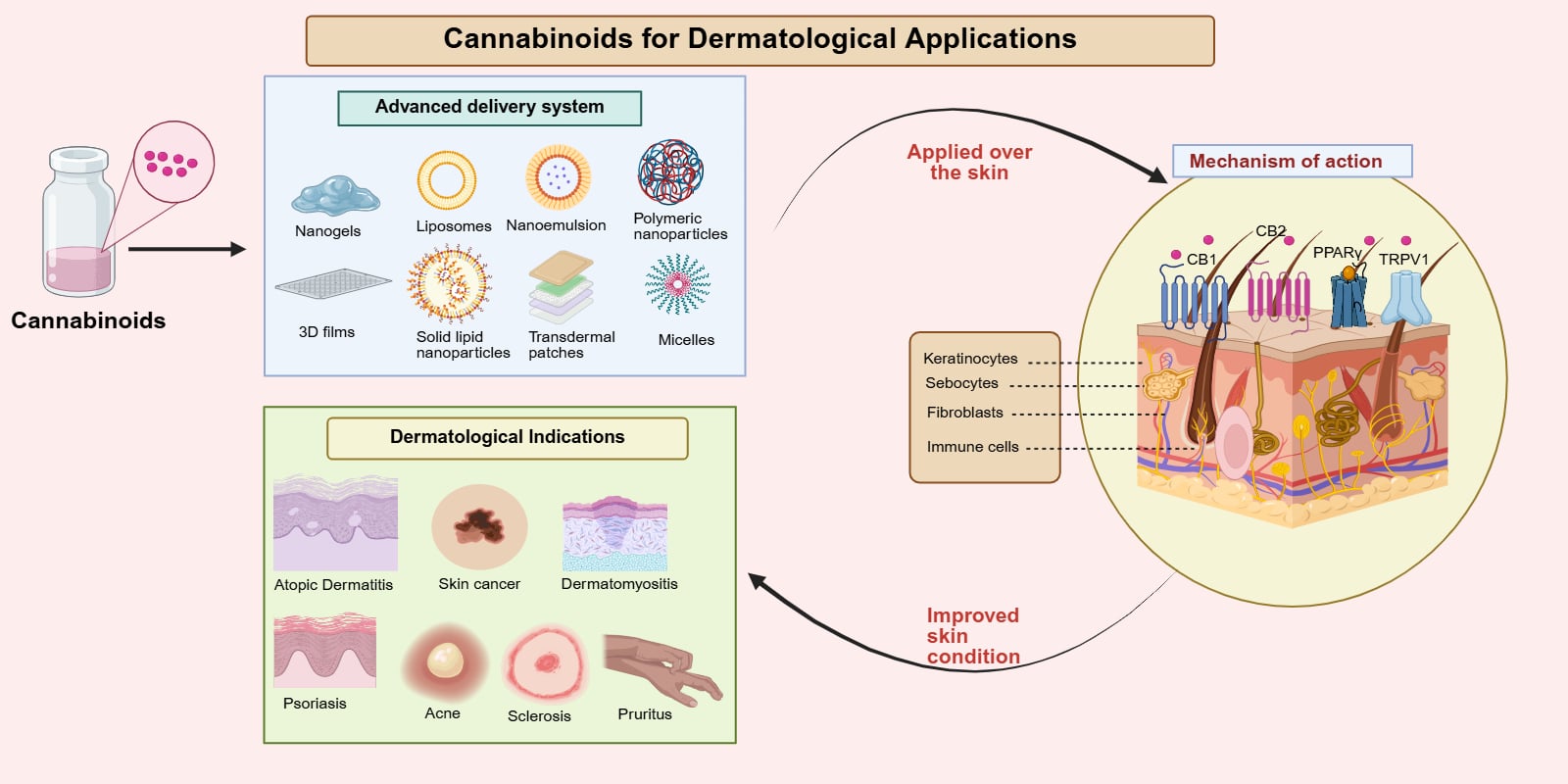
Cannabinoids (CBs) derived from Cannabis sativa have attracted growing interest for dermatological applications due to their anti-inflammatory, antiproliferative, antimicrobial, antifibrotic, and antipruritic properties. However, their clinical translation is significantly limited by physicochemical and pharmacokinetic challenges, including poor aqueous solubility, lipophilicity, instability, variable skin penetration, and inconsistent bioavailability. At the molecular level, CBs modulate keratinocyte proliferation, sebocyte activity, fibroblast function, melanocyte balance, and immune signalling through CB1/CB2 receptors, TRP channels, and PPARγ pathways. Evidence supports their potential in the treatment of psoriasis, atopic dermatitis, acne, allergic contact dermatitis, pruritus, scleroderma, and skin cancers. Clinical evidence remains preliminary: topical and oral formulations have demonstrated anti-inflammatory, antiproliferative, antibacterial, and antifibrotic effects, with improvements in pruritus, lesion severity, and quality of life in early-phase studies. However, most trials are small, uncontrolled, and lack placebo comparators, limiting generalisability. To overcome formulation barriers and enhance dermal delivery, advanced pharmaceutical strategies such as liposomes, nanoemulsions, polymeric nanoparticles, micelles, and transdermal systems have been investigated to improve stability, controlled release, and targeted skin deposition while minimising systemic exposure. This review integrates mechanistic insights, clinical evidence, and emerging nanotechnology-enabled delivery approaches, emphasising rational formulation design and translational considerations necessary for advancing CBs toward standardised and clinically reliable dermatological therapeutics.
Keywords: cannabidiol; dermatology; psoriasis; atopic dermatitis; skin cancer; nanotechnology cannabidiol; dermatology; psoriasis; atopic dermatitis; skin cancer; nanotechnology
Graphical Abstract