Applications of Pharmacometrics in Antibody–Drug Conjugate Development


Abstract
1. Introduction
2. Pharmacokinetics Models for Antibody–Drug Conjugates
2.1. Physiologically Based Pharmacokinetics Models for Antibody–Drug Conjugates
2.1.1. Introduction for Physiologically Based Pharmacokinetics Models
2.1.2. Application of Physiologically Based Pharmacokinetics Models in Antibody–Drug Conjugates Development
2.2. Semi-Mechanistic and Mechanistic Models for Antibody–Drug Conjugates
2.2.1. Introduction to Semi-Mechanistic and Mechanistic Models
2.2.2. Semi-Mechanistic and Mechanistic-Based Models for Antibody–Drug Conjugates
2.3. Population Pharmacokinetics Models for Antibody–Drug Conjugates
2.3.1. Single-Analyte-Based Population Pharmacokinetics Models for Antibody–Drug Conjugates
2.3.2. Two-Analyte-Based Population Pharmacokinetics Models for Antibody–Drug Conjugates
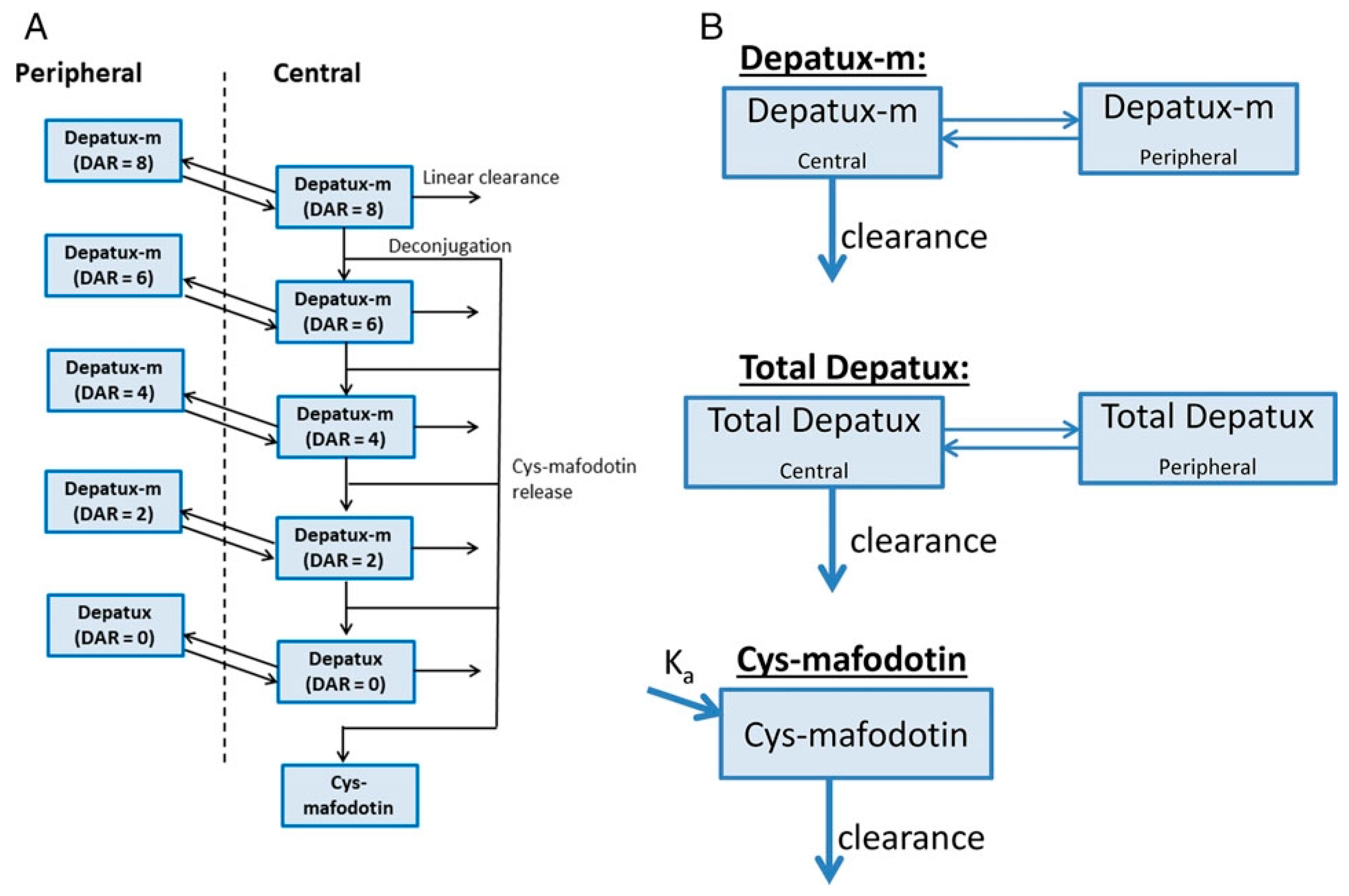
2.3.3. Three-Analyte-Based Population Pharmacokinetics Models for Antibody–Drug Conjugates
3. Exposure-Response Analyses for Antibody–Drug Conjugates
3.1. Exposure Metric Considerations
3.2. Exposure-Response Modeling
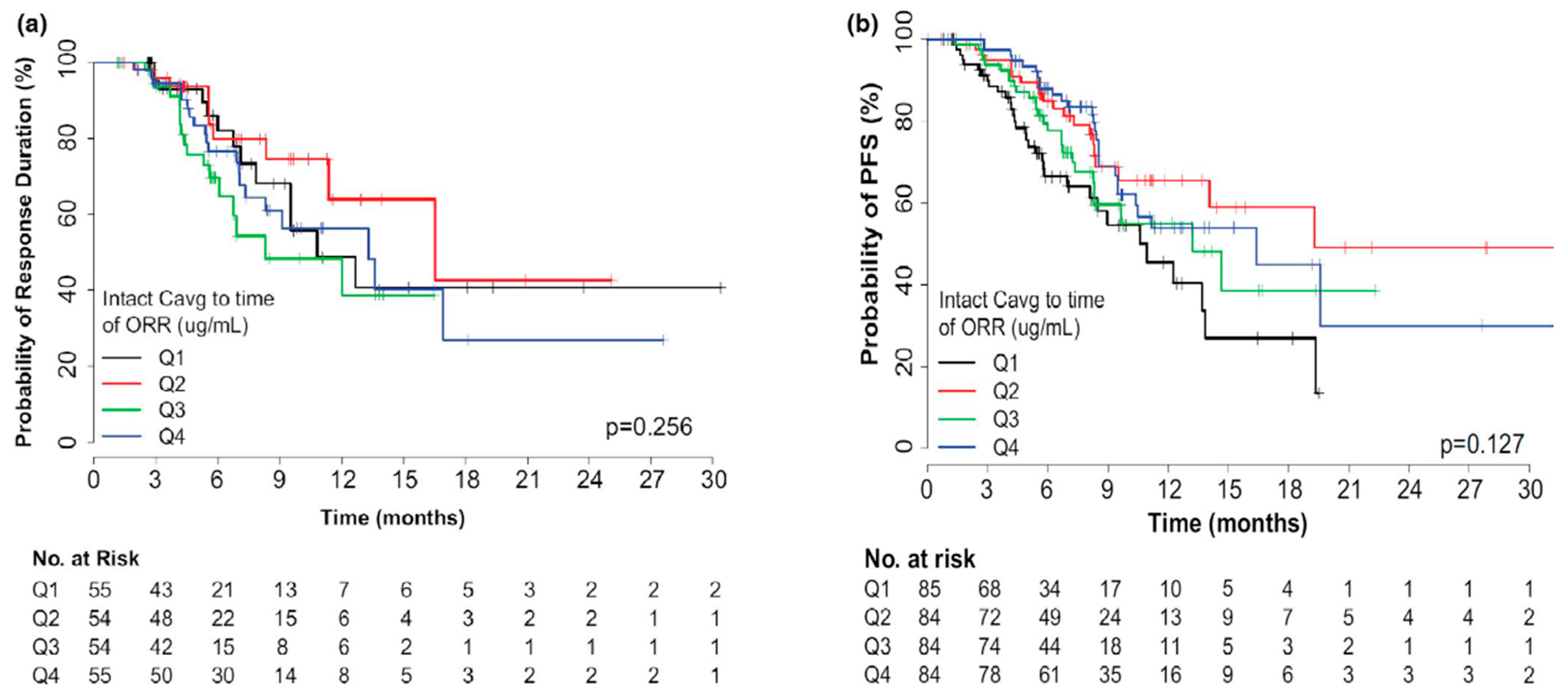
3.2.1. Survival Analyses
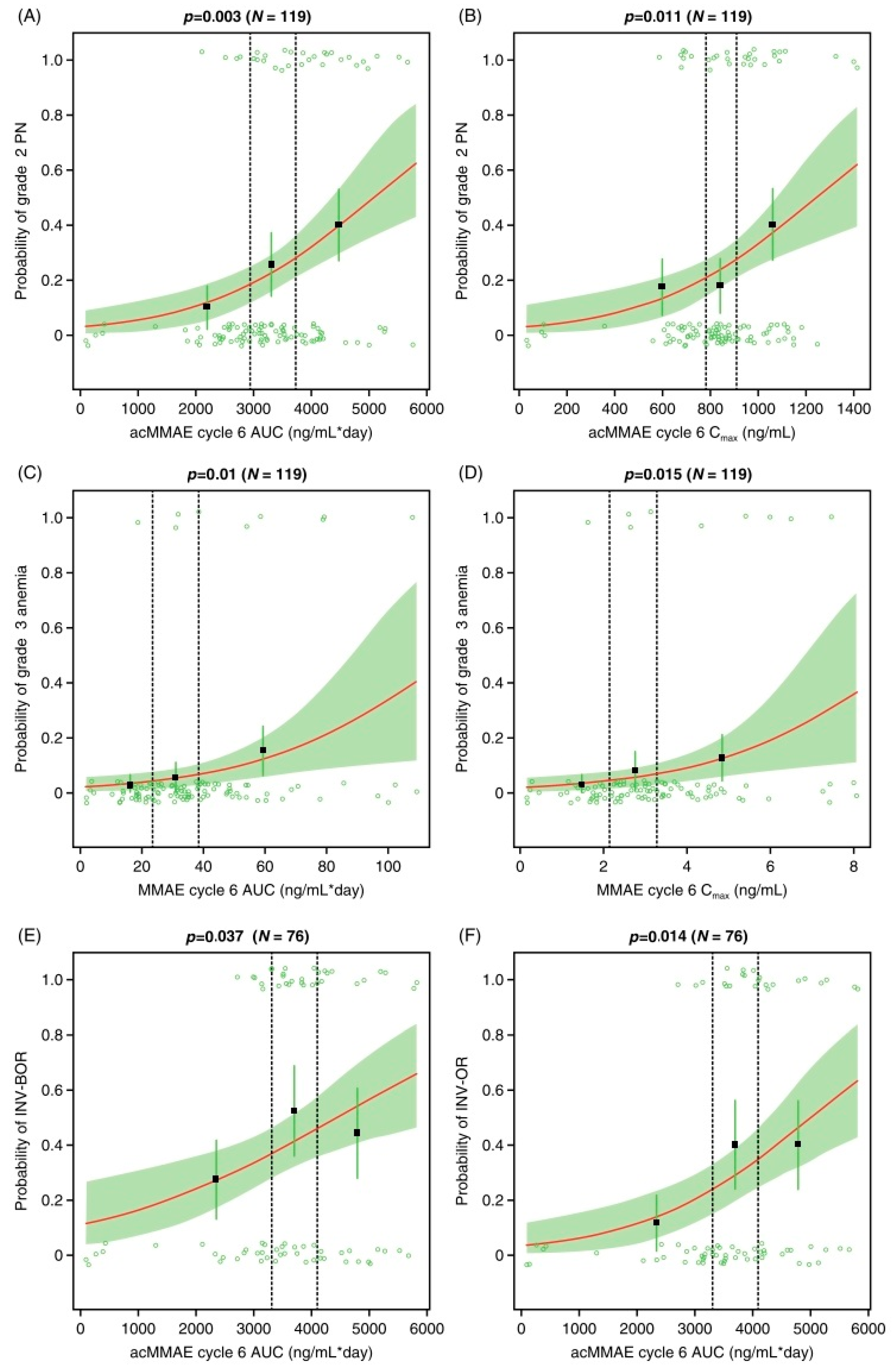
3.2.2. Logistic Regression Models

| Agent | Components | Indication | Approval Year and Regulatory Agencies | Model Type | Key Endpoints | Tested and Revealed * Exposure Metrics | Software | Purpose | Reference |
|---|---|---|---|---|---|---|---|---|---|
| Gemtuzumab ozogamicin | Anti-CD33 mAb, calicheamicin, hydrazone disulfide linker | CD33-positive acute myeloid leukemia | 2000, US FDA and EMA | LR model | Efficacy endpoints: CR/CRp. Safety endpoints: VOD, grade ≥ 3 hepatic adverse events. | Tested: model predicted cycle 1 Cmax, overall Cmax, and overall AUC for total antibody. Revealed: cycle 1 Cmax for total antibody. | R 3.2.2, NONMEM 7.3 and Perl-speaks-NONMEM 4.2.0 | To provide a rationale for new fractionated dosing regimens. | [135] |
| Brentuximab vedotin | Anti-CD30 mAb, MMAE, vc linker | Hodgkin lymphoma, anaplastic large cell lymphoma | 2011, US FDA | K-M plot, CPH and LR model | Efficacy endpoints: ORR. Safety endpoints: grade ≥ 2 peripheral neuropathy, grade ≥ 3 neutropenia and thrombocytopenia. | Tested: model predicted Ctrough,ss and AUCss for ADC and payload. Revealed: AUCss for ADC. | R 3.2.0 | To support the starting dose and dose reduction. | [75] |
| Trastuzumab emtansine | Trastuzumab, DM-1, thioether linker | HER2-positive, metastatic breast cancer | 2013, US FDA | K-M plot, CPH and LR model | Efficacy endpoint: OS, PFS, ORR. Safety endpoints: grade ≥ 3 adverse event/thrombocytopenia/hepatotoxicity. | Tested: model predicted and observed Cmin and AUC at cycle 1 for ADC. Revealed: cycle 1 Cmin for ADC. | Splus 8.2 | To support the dose regimen. | [117] |
| Inotuzumab Ozogamicin | Inotuzumab, N-acetyl-calicheamicin 1, 2-dimethyl hydrazine dichloride, acid-cleavable linker | Relapsed or refractory B-cell precursor acute lymphoblastic leukemia | 2017, US FDA | LR model | Efficacy endpoints: CR/CRi, MRD-negativity. Safety endpoints: hepatic event, VOD/SOS, and grade ≥ 3 AEs. | Tested: model predicted Cmax,event, Cmax,overall, cAUC, Cavg, and cAUCP1 for ADC. Revealed: ADC Cavg and cAUCP1 for ADC. | R 3.0.2 | To support dose modification in clinic. | [139] |
| Polatuzumab vedotin | Anti-CD79b mAb, MMAE, vc linker | Relapsed or refractory diffuse large B-cell lymphoma | 2019, US FDA | K-M plot, CPH and LR model | Efficacy endpoints: DOR, PFS, OS, OR. Safety endpoints: grade ≥ 3 hepatotoxicity/neutropenia/infections and infestations/anemia/thrombocytopenia/peripheral neuropathy, dose modification due to AE. | Tested: model predicted cycle 6 AUC and Cmax for ADC and payload. Revealed: cycle 6 AUC for ADC. | Not reported | To assess the risk/benefit. | [137] |
| Enfortumab vedotin | Anti–Nectin-4 mAb, MMAE, vc linker | Locally advanced/metastatic urothelial carcinoma | 2019, US FDA | K-M plot, CPH and LR model | Efficacy endpoints: OS, BOR. Safety endpoints: grade ≥ 3 TEAE/rash/severe cutaneous AE/hyperglycemia, dose adjustment, grade ≥ 2 peripheral neuropathy. | Tested and revealed: model predicted Cavg,last for ADC and payload. | SAS 9.4 and R 3.6.2 | To support the starting dose regimen. | [98] |
| Trastuzumab deruxtecan | Anti-HER2 mA, DXd, tetrapeptid linker | HER2-positive breast cancer, gastric cancer, and non-small cell lung cancer | 2019, US FDA | K-M plot, CPH and LR model | Efficacy endpoints: ORR, PFS, DOR. Safety endpoints: ILD. | Tested: model predicted Cmax, Cmin, AUC at cycle 1 and steady-state, Cavg during treatment and Cavg,last for ADC and payload. Revealed: Cavg,last for ADC. | Not reported | To characterize E-R relationship and evaluate effect of covariates. | [122] |
| Belantamab mafodotin | Anti-B-cell maturation antigen mAb, MMAF, maleimidocaproyl linker | Elapsed or refractory multiple myeloma | 2020, US FDA | K-M plot, CPH and LR model | Efficacy endpoints: PFS, PoR, TTR, TTBR, and DOR. Safety endpoints: probability of grade ≥ 2 or ≥3 corneal events and time to first event of grade ≥ 2 or ≥3 corneal events. | Tested: model predicted cycle 1 Cmax, Cavg, and Ctau for ADC, cycle 1 Cmax and Cavg for cys-mcMMAF. Revealed: cycle 1 Cavg for ADC. | R | To support dose selection | [140,141] |
| Sacituzumab Govitecan | Antibody against Trop-2, SN-38, hydrolyzable linker | Triple-negative breast cancer, urothelial cancer | 2022, US FDA | LR | Efficacy endpoints: PSF, OS. Safety endpoints: nausea/vomiting and diarrhea of any grade. | Tested: model predicted cycle 1 AUC and Cmax for ADC, total antibody and payload. Revealed: cycle 1 AUC and Cmax for payload. | Postgre SQL 14.4 and R 4.2.0 | To explore the risk factors associated with adverse events. | [146,147] |
| Loncastuximab tesirine | Anti-CD19 antibody, SG3199, valine-alanine linker | Diffuse large B-cell lymphoma | 2021, US FDA | K-M, CPH and LR model | Efficacy endpoints: OS, PFS, and DoR. Safety endpoints: grade ≥ 2 TEAE. | Tested: model predicted Cmax, Cmin, and AUC at first 3 cycles for ADC, total antibody, and payload. Revealed: cycle 1 Cavg for ADC. | R 4.0.1 and SAS 9.4 | To support dose regimen. | [96] |
| Tisotumab vedotin | Tissue factor specific mAb, MMAE, vc linker | Recurrent or metastatic cervical cancer | 2021, US FDA | K-M plot, CPH and LR model | Efficacy endpoints: ORR, PFS, OS, DOR. Safety endpoints: grade ≥ 2 ocular AEs/peripheral neuropathy/bleeding AEs, grade ≥ 3 AEs, treatment-related dose modifications, all SAEs, and treatment-related SAEs. | Tested: model predicted cycle 1 AUC, Cmax, and Ctrough for MMAE; cycle 1 AUC and Cmax for ADC; Cavg,last for MMAE and ADC. Revealed: cycle 1 AUC, Cmax, and Cavg,last for ADC; cycle 1 AUC for MMAE. | R 4.0.2 | To support the dose schedule. | [142] |
| Mirvetuximab soravtansine | Anti-folate receptor α mAb, DM4, sulfo-SPDB linker | Folate receptor α positive, platinum-resistant ovarian cancer | 2022, US FDA | K-M plot, CPH and LR model | Efficacy endpoints: ORR, PFS, OS. Safety endpoints: ocular AEs (as well as the time to onset of ocular AEs) and peripheral neuropathy. | Tested: model predicted Cmax, Ctrough, and AUC at cycle 1 for ADC, DM4, and S-methyl-DM4. Revealed: Ctrough and AUC at cycle 1 for ADC. | Not reported | Justification of therapeutic dose regimen. | [138] |
4. Conclusions and Perspectives
Author Contributions
Funding
Institutional Review Board Statement
Informed Consent Statement
Data Availability Statement
Conflicts of Interest
Abbreviations
| acMMAE | antibody-conjugated monomethyl auristatin E |
| ADCs | antibody–drug conjugates |
| ADME | absorption, distribution, metabolism, and excretion |
| ALL | acute lymphocytic leukemia |
| AUC | area under the concentration–time curve |
| CDE | China Center for Drug Evaluation |
| Cavg,C1 | average concentration in the first cycle |
| Cavg,ss | average steady state concentration |
| Cavg,TE | average concentration up to an event time |
| Cmax | maximum concentration |
| CPH | Cox proportional hazards |
| CR | complete remission |
| CRp | CR without platelet recovery |
| Ctrough,C1 | trough concentration in the first cycle |
| Ctrough,ss | steady state trough concentration |
| CYP | cytochrome P450 |
| DAR | drug-to-antibody ratio |
| EGFR | epithelial growth factor |
| E-R | exposure-response |
| HER-2 | human epidermal growth factor receptor 2 |
| K-M | Kaplan–Meier |
| LBAs | ligand-binding assays |
| LC-MS | liquid chromatography–mass spectrophotometry |
| LR | logistic regression |
| mAbs | monoclonal antibodies |
| MMAE | monomethyl auristatin E |
| MMAF | monomethyl auristatin F |
| NHL | non-Hodgkin’s lymphoma |
| NMPA | National Medicine Products Agency |
| PD | pharmacodynamics |
| PFS | progression-free survival |
| PK | pharmacokinetic |
| PK/PD | pharmacokinetics/pharmacodynamics |
| PWP | Prentice, Williams and Peterson |
| T-DM1 | trastuzumab emtansine |
| TMDD | target-mediated drug disposition |
| vc | valine-citrulline |
| VOD | veno-occlusive disease |
References
- Rubahamya, B.; Dong, S.; Thurber, G.M. Clinical translation of antibody drug conjugate dosing in solid tumors from preclinical mouse data. Sci. Adv. 2024, 10, eadk1894. [Google Scholar] [CrossRef] [Scilit] [PubMed]
- Fu, Z.; Li, S.; Han, S.; Shi, C.; Zhang, Y. Antibody drug conjugate: The “biological missile” for targeted cancer therapy. Signal Transduct. Target. Ther. 2022, 7, 93. [Google Scholar] [CrossRef] [Scilit]
- Kohler, G.; Milstein, C. Continuous cultures of fused cells secreting antibody of predefined specificity. Nature 1975, 256, 495–497. [Google Scholar] [CrossRef] [Scilit] [PubMed]
- Lambert, J.M.; Berkenblit, A. Antibody-Drug Conjugates for Cancer Treatment. Annu. Rev. Med. 2018, 69, 191–207. [Google Scholar] [CrossRef] [Scilit] [PubMed]
- Sobhani, N.; D’Angelo, A.; Pittacolo, M.; Mondani, G.; Generali, D. Future AI Will Most Likely Predict Antibody-Drug Conjugate Response in Oncology: A Review and Expert Opinion. Cancers 2024, 16, 3089. [Google Scholar] [CrossRef] [Scilit]
- Lin, K.; Tibbitts, J.; Shen, B.Q. Pharmacokinetics and ADME characterizations of antibody-drug conjugates. In Antibody-Drug Conjugates; Methods in Molecular Biology; Humana Press: Totowa, NJ, USA, 2013; Volume 1045, pp. 117–131. [Google Scholar] [CrossRef] [Scilit]
- Gerber, H.P.; Koehn, F.E.; Abraham, R.T. The antibody-drug conjugate: An enabling modality for natural product-based cancer therapeutics. Nat. Prod. Rep. 2013, 30, 625–639. [Google Scholar] [CrossRef] [Scilit]
- Riccardi, F.; Dal Bo, M.; Macor, P.; Toffoli, G. A comprehensive overview on antibody-drug conjugates: From the conceptualization to cancer therapy. Front. Pharmacol. 2023, 14, 1274088. [Google Scholar] [CrossRef] [Scilit]
- Staudacher, A.H.; Brown, M.P. Antibody drug conjugates and bystander killing: Is antigen-dependent internalisation required? Br. J. Cancer 2017, 117, 1736–1742. [Google Scholar] [CrossRef] [Scilit]
- Colombo, R.; Rich, J.R. The therapeutic window of antibody drug conjugates: A dogma in need of revision. Cancer Cell 2022, 40, 1255–1263. [Google Scholar] [CrossRef] [Scilit]
- Li, J.H.; Liu, L.; Zhao, X.H. Precision targeting in oncology: The future of conjugated drugs. Biomed. Pharmacother. 2024, 177, 117106. [Google Scholar] [CrossRef] [Scilit]
- Minich, S.S. Brentuximab vedotin: A new age in the treatment of Hodgkin lymphoma and anaplastic large cell lymphoma. Ann. Pharmacother. 2012, 46, 377–383. [Google Scholar] [CrossRef] [Scilit]
- Sassoon, I.; Blanc, V. Antibody-Drug Conjugate (ADC) Clinical Pipeline: A Review. In Antibody-Drug Conjugates; Methods in Molecular Biology; Humana Press: Totowa, NJ, USA, 2013; Volume 1045, pp. 1–27. [Google Scholar] [CrossRef] [Scilit]
- Chau, C.H.; Steeg, P.S.; Figg, W.D. Antibody-drug conjugates for cancer. Lancet 2019, 394, 793–804. [Google Scholar] [CrossRef] [Scilit] [PubMed]
- Geraud, A.; Gougis, P.; Vozy, A.; Anquetil, C.; Allenbach, Y.; Romano, E.; Funck-Brentano, E.; Moslehi, J.J.; Johnson, D.B.; Salem, J.E. Clinical Pharmacology and Interplay of Immune Checkpoint Agents: A Yin-Yang Balance. Annu. Rev. Pharmacol. Toxicol. 2021, 61, 85–112. [Google Scholar] [CrossRef] [Scilit] [PubMed]
- Ryman, J.T.; Meibohm, B. Pharmacokinetics of Monoclonal Antibodies. CPT Pharmacomet. Syst. Pharmacol. 2017, 6, 576–588. [Google Scholar] [CrossRef] [Scilit] [PubMed]
- Cataldi, M.; Vigliotti, C.; Mosca, T.; Cammarota, M.; Capone, D. Emerging Role of the Spleen in the Pharmacokinetics of Monoclonal Antibodies, Nanoparticles and Exosomes. Int. J. Mol. Sci. 2017, 18, 1249. [Google Scholar] [CrossRef] [Scilit]
- Geraud, A.; Gougis, P.; de Nonneville, A.; Beaufils, M.; Bertucci, F.; Billon, E.; Brisou, G.; Gravis, G.; Greillier, L.; Guerin, M.; et al. Pharmacology and pharmacokinetics of antibody-drug conjugates, where do we stand? Cancer Treat. Rev. 2025, 135, 102922. [Google Scholar] [CrossRef] [Scilit]
- Saberi, S.A.; Cheng, D.; Nambudiri, V.E. Antibody-drug conjugates: A review of cutaneous adverse effects. J. Am. Acad. Dermatol. 2024, 91, 922–931. [Google Scholar] [CrossRef] [Scilit]
- Colombo, R.; Tarantino, P.; Rich, J.R.; LoRusso, P.M.; de Vries, E.G.E. The Journey of Antibody-Drug Conjugates: Lessons Learned from 40 Years of Development. Cancer Discov. 2024, 14, 2089–2108. [Google Scholar] [CrossRef] [Scilit]
- Kumar, N.; Dixit, V.; Burt, H.; Gill, K.L.; Jones, H.M.; Keirstead, N.; Su, D.; Toader, D.; Lowinger, T.B. PBPK Modeling to Predict Clinical Drug-Drug Interaction and Impact of Hepatic Impairment for an ADC with the Payload Auristatin F-Hydroxypropylamide. CPT Pharmacomet. Syst. Pharmacol. 2025, 14, 1661–1672. [Google Scholar] [CrossRef] [Scilit]
- Swierczek, A.; Batko, D.; Wyska, E. The Role of Pharmacometrics in Advancing the Therapies for Autoimmune Diseases. Pharmaceutics 2024, 16, 1559. [Google Scholar] [CrossRef] [Scilit]
- Liu, H.; Ibrahim, E.I.K.; Centanni, M.; Sarr, C.; Venkatakrishnan, K.; Friberg, L.E. Integrated modeling of biomarkers, survival and safety in clinical oncology drug development. Adv. Drug Deliv. Rev. 2025, 216, 115476. [Google Scholar] [CrossRef] [Scilit] [PubMed]
- Dunn, A.; Gobburu, J.V.S. The trajectory of pharmacometrics to support drug licensing and labelling. Br. J. Clin. Pharmacol. 2025, 91, 932–937. [Google Scholar] [CrossRef] [Scilit] [PubMed]
- Chang, H.P.; Shah, D.K. A translational physiologically-based pharmacokinetic model for MMAE-based antibody-drug conjugates. J. Pharmacokinet. Pharmacodyn. 2025, 52, 27. [Google Scholar] [CrossRef] [Scilit] [PubMed]
- Haraya, K.; Tsutsui, H.; Komori, Y.; Tachibana, T. Recent Advances in Translational Pharmacokinetics and Pharmacodynamics Prediction of Therapeutic Antibodies Using Modeling and Simulation. Pharmaceuticals 2022, 15, 508. [Google Scholar] [CrossRef] [Scilit]
- Siebinga, H.; de Wit-van der Veen, B.J.; Stokkel, M.D.M.; Huitema, A.D.R.; Hendrikx, J. Current use and future potential of (physiologically based) pharmacokinetic modelling of radiopharmaceuticals: A review. Theranostics 2022, 12, 7804–7820. [Google Scholar] [CrossRef] [Scilit]
- Jones, H.M.; Parrott, N.; Jorga, K.; Lave, T. A novel strategy for physiologically based predictions of human pharmacokinetics. Clin. Pharmacokinet. 2006, 45, 511–542. [Google Scholar] [CrossRef] [Scilit]
- Min, J.S.; Bae, S.K. Prediction of drug-drug interaction potential using physiologically based pharmacokinetic modeling. Arch. Pharm. Res. 2017, 40, 1356–1379. [Google Scholar] [CrossRef] [Scilit]
- Grimstein, M.; Yang, Y.; Zhang, X.; Grillo, J.; Huang, S.M.; Zineh, I.; Wang, Y. Physiologically Based Pharmacokinetic Modeling in Regulatory Science: An Update from the U.S. Food and Drug Administration’s Office of Clinical Pharmacology. J. Pharm. Sci. 2019, 108, 21–25. [Google Scholar] [CrossRef] [Scilit]
- Lin, K.; Tibbitts, J. Pharmacokinetic considerations for antibody drug conjugates. Pharm. Res. 2012, 29, 2354–2366. [Google Scholar] [CrossRef] [Scilit]
- Lu, D.; Sahasranaman, S.; Zhang, Y.; Girish, S. Strategies to address drug interaction potential for antibody-drug conjugates in clinical development. Bioanalysis 2013, 5, 1115–1130. [Google Scholar] [CrossRef] [Scilit]
- Chen, Y.; Samineni, D.; Mukadam, S.; Wong, H.; Shen, B.Q.; Lu, D.; Girish, S.; Hop, C.; Jin, J.Y.; Li, C. Physiologically based pharmacokinetic modeling as a tool to predict drug interactions for antibody-drug conjugates. Clin. Pharmacokinet. 2015, 54, 81–93. [Google Scholar] [CrossRef] [Scilit] [PubMed]
- Choules, M.P.; Zuo, P.; Otsuka, Y.; Garg, A.; Tang, M.; Bonate, P. Physiologically based pharmacokinetic model to predict drug-drug interactions with the antibody-drug conjugate enfortumab vedotin. J. Pharmacokinet. Pharmacodyn. 2024, 51, 417–428. [Google Scholar] [CrossRef] [Scilit] [PubMed]
- Samineni, D.; Ding, H.; Ma, F.; Shi, R.; Lu, D.; Miles, D.; Mao, J.; Li, C.; Jin, J.; Wright, M.; et al. Physiologically Based Pharmacokinetic Model-Informed Drug Development for Polatuzumab Vedotin: Label for Drug-Drug Interactions Without Dedicated Clinical Trials. J. Clin. Pharmacol. 2020, 60, S120–S131. [Google Scholar] [CrossRef] [Scilit] [PubMed]
- Singh, A.P.; Shin, Y.G.; Shah, D.K. Application of Pharmacokinetic-Pharmacodynamic Modeling and Simulation for Antibody-Drug Conjugate Development. Pharm. Res. 2015, 32, 3508–3525. [Google Scholar] [CrossRef] [Scilit]
- Waight, A.B.; Bargsten, K.; Doronina, S.; Steinmetz, M.O.; Sussman, D.; Prota, A.E. Structural Basis of Microtubule Destabilization by Potent Auristatin Anti-Mitotics. PLoS ONE 2016, 11, e0160890. [Google Scholar] [CrossRef] [Scilit]
- Chang, H.P.; Li, Z.; Shah, D.K. Development of a Physiologically-Based Pharmacokinetic Model for Whole-Body Disposition of MMAE Containing Antibody-Drug Conjugate in Mice. Pharm. Res. 2022, 39, 1–24. [Google Scholar] [CrossRef] [Scilit]
- Bender, B.; Leipold, D.D.; Xu, K.; Shen, B.Q.; Tibbitts, J.; Friberg, L.E. A mechanistic pharmacokinetic model elucidating the disposition of trastuzumab emtansine (T-DM1), an antibody-drug conjugate (ADC) for treatment of metastatic breast cancer. AAPS J. 2014, 16, 994–1008. [Google Scholar] [CrossRef] [Scilit]
- Oroudjev, E.; Lopus, M.; Wilson, L.; Audette, C.; Provenzano, C.; Erickson, H.; Kovtun, Y.; Chari, R.; Jordan, M.A. Maytansinoid-antibody conjugates induce mitotic arrest by suppressing microtubule dynamic instability. Mol. Cancer Ther. 2010, 9, 2700–2713. [Google Scholar] [CrossRef] [Scilit]
- Khot, A.; Tibbitts, J.; Rock, D.; Shah, D.K. Development of a Translational Physiologically Based Pharmacokinetic Model for Antibody-Drug Conjugates: A Case Study with T-DM1. AAPS J. 2017, 19, 1715–1734. [Google Scholar] [CrossRef] [Scilit]
- Thurber, G.M.; Weissleder, R. A systems approach for tumor pharmacokinetics. PLoS ONE 2011, 6, e24696. [Google Scholar] [CrossRef] [Scilit]
- Thurber, G.M.; Zajic, S.C.; Wittrup, K.D. Theoretic criteria for antibody penetration into solid tumors and micrometastases. J. Nucl. Med. 2007, 48, 995–999. [Google Scholar] [CrossRef] [Scilit] [PubMed]
- Venkatasubramanian, R.; Arenas, R.B.; Henson, M.A.; Forbes, N.S. Mechanistic modelling of dynamic MRI data predicts that tumour heterogeneity decreases therapeutic response. Br. J. Cancer 2010, 103, 486–497. [Google Scholar] [CrossRef] [Scilit]
- Cilliers, C.; Guo, H.; Liao, J.; Christodolu, N.; Thurber, G.M. Multiscale Modeling of Antibody-Drug Conjugates: Connecting Tissue and Cellular Distribution to Whole Animal Pharmacokinetics and Potential Implications for Efficacy. AAPS J. 2016, 18, 1117–1130. [Google Scholar] [CrossRef] [Scilit] [PubMed]
- Birrer, M.J.; Moore, K.N.; Betella, I.; Bates, R.C. Antibody-Drug Conjugate-Based Therapeutics: State of the Science. J. Natl. Cancer Inst. 2019, 111, 538–549. [Google Scholar] [CrossRef] [Scilit] [PubMed]
- Chang, H.P.; Cheung, Y.K.; Shah, D.K. Whole-Body Pharmacokinetics and Physiologically Based Pharmacokinetic Model for Monomethyl Auristatin E (MMAE). J. Clin. Med. 2021, 10, 1332. [Google Scholar] [CrossRef] [Scilit]
- Masters, J.C.; Nickens, D.J.; Xuan, D.; Shazer, R.L.; Amantea, M. Clinical toxicity of antibody drug conjugates: A meta-analysis of payloads. Investig. New Drugs 2018, 36, 121–135. [Google Scholar] [CrossRef] [Scilit]
- Haddish-Berhane, N.; Shah, D.K.; Ma, D.; Leal, M.; Gerber, H.P.; Sapra, P.; Barton, H.A.; Betts, A.M. On translation of antibody drug conjugates efficacy from mouse experimental tumors to the clinic: A PK/PD approach. J. Pharmacokinet. Pharmacodyn. 2013, 40, 557–571. [Google Scholar] [CrossRef] [Scilit]
- Jumbe, N.L.; Xin, Y.; Leipold, D.D.; Crocker, L.; Dugger, D.; Mai, E.; Sliwkowski, M.X.; Fielder, P.J.; Tibbitts, J. Modeling the efficacy of trastuzumab-DM1, an antibody drug conjugate, in mice. J. Pharmacokinet. Pharmacodyn. 2010, 37, 221–242. [Google Scholar] [CrossRef] [Scilit]
- Agoram, B.M.; Martin, S.W.; van der Graaf, P.H. The role of mechanism-based pharmacokinetic-pharmacodynamic (PK-PD) modelling in translational research of biologics. Drug Discov. Today 2007, 12, 1018–1024. [Google Scholar] [CrossRef] [Scilit]
- Shah, D.K.; Haddish-Berhane, N.; Betts, A. Bench to bedside translation of antibody drug conjugates using a multiscale mechanistic PK/PD model: A case study with brentuximab-vedotin. J. Pharmacokinet. Pharmacodyn. 2012, 39, 643–659. [Google Scholar] [CrossRef] [Scilit]
- Kotapati, S.; Passmore, D.; Yamazoe, S.; Sanku, R.K.K.; Cong, Q.; Poudel, Y.B.; Chowdari, N.S.; Gangwar, S.; Rao, C.; Rangan, V.S.; et al. Universal Affinity Capture Liquid Chromatography-Mass Spectrometry Assay for Evaluation of Biotransformation of Site-Specific Antibody Drug Conjugates in Preclinical Studies. Anal. Chem. 2020, 92, 2065–2073. [Google Scholar] [CrossRef] [Scilit] [PubMed]
- Sukumaran, S.; Zhang, C.; Leipold, D.D.; Saad, O.M.; Xu, K.; Gadkar, K.; Samineni, D.; Wang, B.; Milojic-Blair, M.; Carrasco-Triguero, M.; et al. Development and Translational Application of an Integrated, Mechanistic Model of Antibody-Drug Conjugate Pharmacokinetics. AAPS J. 2017, 19, 130–140. [Google Scholar] [CrossRef] [Scilit] [PubMed]
- Gibiansky, L.; Gibiansky, E. Target-mediated drug disposition model and its approximations for antibody-drug conjugates. J. Pharmacokinet. Pharmacodyn. 2014, 41, 35–47. [Google Scholar] [CrossRef] [Scilit] [PubMed]
- Lu, D.; Jin, J.Y.; Girish, S.; Agarwal, P.; Li, D.; Prabhu, S.; Dere, R.C.; Saad, O.M.; Nazzal, D.; Koppada, N.; et al. Semi-mechanistic Multiple-Analyte Pharmacokinetic Model for an Antibody-Drug-Conjugate in Cynomolgus Monkeys. Pharm. Res. 2015, 32, 1907–1919. [Google Scholar] [CrossRef] [Scilit]
- Younes, A.; Yasothan, U.; Kirkpatrick, P. Brentuximab vedotin. Nat. Rev. Drug Discov. 2012, 11, 19–20. [Google Scholar] [CrossRef] [Scilit]
- Shah, D.K.; King, L.E.; Han, X.; Wentland, J.A.; Zhang, Y.; Lucas, J.; Haddish-Berhane, N.; Betts, A.; Leal, M. A priori prediction of tumor payload concentrations: Preclinical case study with an auristatin-based anti-5T4 antibody-drug conjugate. AAPS J. 2014, 16, 452–463. [Google Scholar] [CrossRef] [Scilit]
- Singh, A.P.; Maass, K.F.; Betts, A.M.; Wittrup, K.D.; Kulkarni, C.; King, L.E.; Khot, A.; Shah, D.K. Evolution of Antibody-Drug Conjugate Tumor Disposition Model to Predict Preclinical Tumor Pharmacokinetics of Trastuzumab-Emtansine (T-DM1). AAPS J. 2016, 18, 861–875. [Google Scholar] [CrossRef] [Scilit]
- Gong, J.; Bordeau, B.M.; Balthasar, J.P. Improving the Therapeutic Selectivity of Trastuzumab Deruxtecan Using 8C2 Fab Fragments. AAPS J. 2025, 27, 106. [Google Scholar] [CrossRef] [Scilit]
- Vasalou, C.; Proia, T.A.; Kazlauskas, L.; Przybyla, A.; Sung, M.; Mamidi, S.; Maratea, K.; Griffin, M.; Sargeant, R.; Urosevic, J.; et al. Quantitative evaluation of trastuzumab deruxtecan pharmacokinetics and pharmacodynamics in mouse models of varying degrees of HER2 expression. CPT Pharmacomet. Syst. Pharmacol. 2024, 13, 994–1005. [Google Scholar] [CrossRef] [Scilit]
- Bussing, D.; Sharma, S.; Li, Z.; Meyer, L.F.; Shah, D.K. Quantitative Evaluation of the Effect of Antigen Expression Level on Antibody-Drug Conjugate Exposure in Solid Tumor. AAPS J. 2021, 23, 56. [Google Scholar] [CrossRef] [Scilit]
- Betts, A.M.; Haddish-Berhane, N.; Tolsma, J.; Jasper, P.; King, L.E.; Sun, Y.; Chakrapani, S.; Shor, B.; Boni, J.; Johnson, T.R. Preclinical to Clinical Translation of Antibody-Drug Conjugates Using PK/PD Modeling: A Retrospective Analysis of Inotuzumab Ozogamicin. AAPS J. 2016, 18, 1101–1116. [Google Scholar] [CrossRef] [Scilit]
- Singh, A.P.; Shah, D.K. Application of a PK-PD Modeling and Simulation-Based Strategy for Clinical Translation of Antibody-Drug Conjugates: A Case Study with Trastuzumab Emtansine (T-DM1). AAPS J. 2017, 19, 1054–1070. [Google Scholar] [CrossRef] [Scilit] [PubMed]
- Singh, R.; Kozhich, A.; Pan, C.; Lee, F.; Cardarelli, P.; Vangipuram, R.; Iyer, R.; Marathe, P. A novel semi-mechanistic tumor growth fraction model for translation of preclinical efficacy of anti-glypican 3 antibody drug conjugate to human. Biopharm. Drug Dispos. 2020, 41, 319–333. [Google Scholar] [CrossRef] [Scilit] [PubMed]
- Khera, E.; Cilliers, C.; Bhatnagar, S.; Thurber, G.M. Computational transport analysis of antibody-drug conjugate bystander effects and payload tumoral distribution: Implications for therapy. Mol. Syst. Des. Eng. 2018, 3, 73–88. [Google Scholar] [CrossRef] [Scilit]
- Betts, A.; Clark, T.; Jasper, P.; Tolsma, J.; van der Graaf, P.H.; Graziani, E.I.; Rosfjord, E.; Sung, M.; Ma, D.; Barletta, F. Use of translational modeling and simulation for quantitative comparison of PF-06804103, a new generation HER2 ADC, with Trastuzumab-DM1. J. Pharmacokinet. Pharmacodyn. 2020, 47, 513–526. [Google Scholar] [CrossRef] [Scilit]
- Wada, R.; Erickson, H.K.; Lewis Phillips, G.D.; Provenzano, C.A.; Leipold, D.D.; Mai, E.; Johnson, H.; Tibbitts, J. Mechanistic pharmacokinetic/pharmacodynamic modeling of in vivo tumor uptake, catabolism, and tumor response of trastuzumab maytansinoid conjugates. Cancer Chemother. Pharmacol. 2014, 74, 969–980. [Google Scholar] [CrossRef] [Scilit]
- Zuo, P. Capturing the Magic Bullet: Pharmacokinetic Principles and Modeling of Antibody-Drug Conjugates. AAPS J. 2020, 22, 105. [Google Scholar] [CrossRef] [Scilit]
- Gupta, M.; Lorusso, P.M.; Wang, B.; Yi, J.H.; Burris, H.A., 3rd; Beeram, M.; Modi, S.; Chu, Y.W.; Agresta, S.; Klencke, B.; et al. Clinical implications of pathophysiological and demographic covariates on the population pharmacokinetics of trastuzumab emtansine, a HER2-targeted antibody-drug conjugate, in patients with HER2-positive metastatic breast cancer. J. Clin. Pharmacol. 2012, 52, 691–703. [Google Scholar] [CrossRef] [Scilit]
- Lu, D.; Girish, S.; Gao, Y.; Wang, B.; Yi, J.H.; Guardino, E.; Samant, M.; Cobleigh, M.; Rimawi, M.; Conte, P.; et al. Population pharmacokinetics of trastuzumab emtansine (T-DM1), a HER2-targeted antibody-drug conjugate, in patients with HER2-positive metastatic breast cancer: Clinical implications of the effect of covariates. Cancer Chemother. Pharmacol. 2014, 74, 399–410. [Google Scholar] [CrossRef] [Scilit]
- Chen, S.C.; Kagedal, M.; Gao, Y.; Wang, B.; Harle-Yge, M.L.; Girish, S.; Jin, J.; Li, C. Population pharmacokinetics of trastuzumab emtansine in previously treated patients with HER2-positive advanced gastric cancer (AGC). Cancer Chemother. Pharmacol. 2017, 80, 1147–1159. [Google Scholar] [CrossRef] [Scilit]
- Garrett, M.; Ruiz-Garcia, A.; Parivar, K.; Hee, B.; Boni, J. Population pharmacokinetics of inotuzumab ozogamicin in relapsed/refractory acute lymphoblastic leukemia and non-Hodgkin lymphoma. J. Pharmacokinet. Pharmacodyn. 2019, 46, 211–222. [Google Scholar] [CrossRef] [Scilit]
- Wu, J.H.; Pennesi, E.; Bautista, F.; Garrett, M.; Fukuhara, K.; Brivio, E.; Ammerlaan, A.C.J.; Locatelli, F.; van der Sluis, I.M.; Rossig, C.; et al. Population Pharmacokinetics of Inotuzumab Ozogamicin in Pediatric Relapsed/Refractory B-Cell Precursor Acute Lymphoblastic Leukemia: Results of Study ITCC-059. Clin. Pharmacokinet. 2024, 63, 981–997. [Google Scholar] [CrossRef] [Scilit] [PubMed]
- Suri, A.; Mould, D.R.; Liu, Y.; Jang, G.; Venkatakrishnan, K. Population PK and Exposure-Response Relationships for the Antibody-Drug Conjugate Brentuximab Vedotin in CTCL Patients in the Phase III ALCANZA Study. Clin. Pharmacol. Ther. 2018, 104, 989–999. [Google Scholar] [CrossRef] [Scilit] [PubMed]
- Suri, A.; Mould, D.R.; Song, G.; Collins, G.P.; Endres, C.J.; Gomez-Navarro, J.; Venkatakrishnan, K. Population Pharmacokinetic Modeling and Exposure-Response Assessment for the Antibody-Drug Conjugate Brentuximab Vedotin in Hodgkin’s Lymphoma in the Phase III ECHELON-1 Study. Clin. Pharmacol. Ther. 2019, 106, 1268–1279. [Google Scholar] [CrossRef] [Scilit] [PubMed]
- Suri, A.; Mould, D.R.; Song, G.; Kinley, J.; Venkatakrishnan, K. Population Pharmacokinetics of Brentuximab Vedotin in Adult and Pediatric Patients with Relapsed/Refractory Hematologic Malignancies: Model-Informed Hypothesis Generation for Pediatric Dosing Regimens. J. Clin. Pharmacol. 2020, 60, 1585–1597. [Google Scholar] [CrossRef] [Scilit]
- Li, H.; Han, T.H.; Hunder, N.N.; Jang, G.; Zhao, B. Population Pharmacokinetics of Brentuximab Vedotin in Patients with CD30-Expressing Hematologic Malignancies. J. Clin. Pharmacol. 2017, 57, 1148–1158. [Google Scholar] [CrossRef] [Scilit]
- Zhang, D.; Zhang, Z.; Lee, A.; Fenton, K.; Jain, S.; Garg, A.; Chia, Y.L. Time-varying brentuximab vedotin pharmacokinetics and weight-based dosing in paediatric patients despite lower exposure in those aged 2 to <6 and 6–11 years. Br. J. Clin. Pharmacol. 2024, 90, 2299–2313. [Google Scholar] [CrossRef] [Scilit]
- Zhou, X.; Mould, D.R.; Gore, L.; Bai, X.; Gupta, N. Optimizing Brentuximab Vedotin Dosing in Pediatric Patients with Advanced Hodgkin Lymphoma: A Population Pharmacokinetic and Exposure-Response Analysis. Clin. Pharmacol. Ther. 2025, 117, 1803–1810. [Google Scholar] [CrossRef] [Scilit]
- Yin, O.; Xiong, Y.; Endo, S.; Yoshihara, K.; Garimella, T.; AbuTarif, M.; Wada, R.; LaCreta, F. Population Pharmacokinetics of Trastuzumab Deruxtecan in Patients with HER2-Positive Breast Cancer and Other Solid Tumors. Clin. Pharmacol. Ther. 2021, 109, 1314–1325. [Google Scholar] [CrossRef] [Scilit]
- Lu, D.; Joshi, A.; Wang, B.; Olsen, S.; Yi, J.H.; Krop, I.E.; Burris, H.A.; Girish, S. An integrated multiple-analyte pharmacokinetic model to characterize trastuzumab emtansine (T-DM1) clearance pathways and to evaluate reduced pharmacokinetic sampling in patients with HER2-positive metastatic breast cancer. Clin. Pharmacokinet. 2013, 52, 657–672. [Google Scholar] [CrossRef] [Scilit]
- Chudasama, V.L.; Schaedeli Stark, F.; Harrold, J.M.; Tibbitts, J.; Girish, S.R.; Gupta, M.; Frey, N.; Mager, D.E. Semi-mechanistic population pharmacokinetic model of multivalent trastuzumab emtansine in patients with metastatic breast cancer. Clin. Pharmacol. Ther. 2012, 92, 520–527. [Google Scholar] [CrossRef] [Scilit] [PubMed]
- Toukam, M.; Wuerthner, J.; Havenith, K.; Hamadani, M.; Caimi, P.F.; Kopotsha, T.; Cruz, H.G.; Boni, J.P. Population pharmacokinetics analysis of camidanlumab tesirine in patients with relapsed or refractory Hodgkin lymphoma and non-Hodgkin lymphoma. Cancer Chemother. Pharmacol. 2023, 91, 13–24. [Google Scholar] [CrossRef] [Scilit] [PubMed]
- Lu, D.; Lu, T.; Gibiansky, L.; Li, X.; Li, C.; Agarwal, P.; Shemesh, C.S.; Shi, R.; Dere, R.C.; Hirata, J.; et al. Integrated Two-Analyte Population Pharmacokinetic Model of Polatuzumab Vedotin in Patients with Non-Hodgkin Lymphoma. CPT Pharmacomet. Syst. Pharmacol. 2020, 9, 48–59. [Google Scholar] [CrossRef] [Scilit] [PubMed]
- Deng, R.; Gibiansky, L.; Lu, T.; Flowers, C.R.; Sehn, L.H.; Liu, Q.; Agarwal, P.; Liao, M.Z.; Dere, R.; Lee, C.; et al. Population pharmacokinetics and exposure-response analyses of polatuzumab vedotin in patients with previously untreated DLBCL from the POLARIX study. CPT Pharmacomet. Syst. Pharmacol. 2024, 13, 1055–1066. [Google Scholar] [CrossRef] [Scilit]
- Bouguerra Zina, B.; Rousseau, F.; Fauquier, S.; Sabatier, R.; Kfoury, M. Practical clinical management of ocular adverse events related to Antibody-Drug Conjugates in gynaecological malignancies. Cancer Treat. Rev. 2025, 134, 102867. [Google Scholar] [CrossRef] [Scilit]
- Li, X.; Liu, D.; Liu, S.; Yu, M.; Wu, X.; Wang, H. Application of Pharmacometrics in Advancing the Clinical Research of Antibody-Drug Conjugates: Principles and Modeling Strategies. Clin. Pharmacokinet. 2024, 63, 1373–1387. [Google Scholar] [CrossRef] [Scilit]
- Gibiansky, L.; Passey, C.; Voellinger, J.; Gunawan, R.; Hanley, W.D.; Gupta, M.; Winter, H. Population pharmacokinetic analysis for tisotumab vedotin in patients with locally advanced and/or metastatic solid tumors. CPT Pharmacomet. Syst. Pharmacol. 2022, 11, 1358–1370. [Google Scholar] [CrossRef] [Scilit]
- Sun, Y.; Li, C.; Wang, X.; Zheng, Y.; Wu, Z.; Hui, A.M.; Diao, L. Model-informed dose selection for an investigational human epidermal growth factor receptor 2 antibody-drug conjugate FS-1502 in patients with human epidermal growth factor receptor 2-expressing advanced malignant solid tumours. Br. J. Clin. Pharmacol. 2024, 90, 1115–1129. [Google Scholar] [CrossRef] [Scilit]
- Lee, V.; Hultcrantz, M.; Petrone, S.; Lewis, E.W.; Banna, H.; Lichtman, E.; Thulasi, P.; Quick, A.A.; Jeng, B.H.; Sunshine, S.B.; et al. Characterization of Belantamab Mafodotin-Induced Corneal Changes in Patients with Multiple Myeloma. JAMA Ophthalmol. 2025, 143, 507–514. [Google Scholar] [CrossRef] [Scilit]
- Rathi, C.; Collins, J.; Struemper, H.; Opalinska, J.; Jewell, R.C.; Ferron-Brady, G. Population pharmacokinetics of belantamab mafodotin, a BCMA-targeting agent in patients with relapsed/refractory multiple myeloma. CPT Pharmacomet. Syst. Pharmacol. 2021, 10, 851–863. [Google Scholar] [CrossRef] [Scilit]
- Ferron-Brady, G.; Taylor, A.; Kaullen, J.; Polireddy, K.; McKeown, A.; Sule, N.; Struemper, H. Population Pharmacokinetics (PopPK) and Exposure-Response (E-R) Analyses for Belantamab Mafodotin Monotherapy in Patients with Relapsed/Refractory Multiple Myeloma (RRMM) Enrolled in DREAMM-2 and DREAMM-3. Blood 2023, 142, 6730. [Google Scholar] [CrossRef] [Scilit]
- Papathanasiou, T.; Kaullen, J.; Polireddy, K.; Chen, X.; Ho, Y.L.; Taylor, A.; Struemper, H.; Carreno, F.; Ferron-Brady, G. Population Pharmacokinetics for Belantamab Mafodotin Monotherapy and Combination Therapies in Patients with Relapsed/Refractory Multiple Myeloma. Clin. Pharmacokinet. 2025, 64, 925–942. [Google Scholar] [CrossRef] [Scilit] [PubMed]
- Lownik, J.; Boiarsky, J.; Birhiray, R.; Merchant, A.; Mead, M. Sequencing of Anti-CD19 Therapies in the Management of Diffuse Large B-Cell Lymphoma. Clin. Cancer Res. 2024, 30, 2895–2904. [Google Scholar] [CrossRef] [Scilit] [PubMed]
- Hess, B.; Townsend, W.; Ai, W.; Stathis, A.; Solh, M.; Alderuccio, J.P.; Ungar, D.; Liao, S.; Liao, L.; Khouri, L.; et al. Efficacy and Safety Exposure-Response Analysis of Loncastuximab Tesirine in Patients with B cell non-Hodgkin Lymphoma. AAPS J. 2021, 24, 11. [Google Scholar] [CrossRef] [Scilit]
- Mittapalli, R.K.; Stodtmann, S.; Friedel, A.; Menon, R.M.; Bain, E.; Mensing, S.; Xiong, H. An Integrated Population Pharmacokinetic Model Versus Individual Models of Depatuxizumab Mafodotin, an Anti-EGFR Antibody Drug Conjugate, in Patients with Solid Tumors Likely to Overexpress EGFR. J. Clin. Pharmacol. 2019, 59, 1225–1235. [Google Scholar] [CrossRef] [Scilit]
- Zuo, P.; Bonate, P.; Garg, A.; Matsangou, M.; Tang, M. Population Pharmacokinetic Modeling and Exposure-Response Analysis for the Antibody-Drug Conjugate Enfortumab Vedotin in Locally Advanced or Metastatic Urothelial Carcinoma. Clin. Pharmacol. Ther. 2024, 116, 1278–1288. [Google Scholar] [CrossRef] [Scilit]
- Hibma, J.; Knight, B. Population Pharmacokinetic Modeling of Gemtuzumab Ozogamicin in Adult Patients with Acute Myeloid Leukemia. Clin. Pharmacokinet. 2019, 58, 335–347. [Google Scholar] [CrossRef] [Scilit]
- Masters, J.C.; Barry, E.; Knight, B. Population Pharmacokinetics of Gemtuzumab Ozogamicin in Pediatric Patients with Relapsed or Refractory Acute Myeloid Leukemia. Clin. Pharmacokinet. 2019, 58, 271–282. [Google Scholar] [CrossRef] [Scilit]
- Van Gorp, T.; Moore, K.N.; Konecny, G.E.; Leary, A.; Garcia-Garcia, Y.; Banerjee, S.; Lorusso, D.; Lee, J.Y.; Moroney, J.W.; Caruso, G.; et al. Patient-reported outcomes from the MIRASOL trial evaluating mirvetuximab soravtansine versus chemotherapy in patients with folate receptor alpha-positive, platinum-resistant ovarian cancer: A randomised, open-label, phase 3 trial. Lancet Oncol. 2025, 26, 503–515. [Google Scholar] [CrossRef] [Scilit]
- Tu, Y.P.; Hanze, E.; Zhu, F.; Lagraauw, H.M.; Sloss, C.M.; Method, M.; Esteves, B.; Westin, E.H.; Berkenblit, A. Population pharmacokinetics of mirvetuximab soravtansine in patients with folate receptor-alpha positive ovarian cancer: The antibody-drug conjugate, payload and metabolite. Br. J. Clin. Pharmacol. 2024, 90, 568–581. [Google Scholar] [CrossRef] [Scilit]
- Preusser, M.; Garde-Noguera, J.; Garcia-Mosquera, J.J.; Gion, M.; Greil, R.; Arumi, M.; Ruiz-Borrego, M.; Llombart-Cussac, A.; Valero, M.; Cortes, J.; et al. Patritumab deruxtecan in leptomeningeal metastatic disease of solid tumors: The phase 2 TUXEDO-3 trial. Nat. Med. 2025, 31, 2797–2805. [Google Scholar] [CrossRef] [Scilit] [PubMed]
- Lu, Y.; Shimizu, S.; Sawamura, R.; Tajima, N.; He, L.; Lee, M.; Abutarif, M.; Shi, R. Population Pharmacokinetics of Patritumab Deruxtecan in Patients with Solid Tumors. J. Clin. Pharmacol. 2023, 63, 77–90. [Google Scholar] [CrossRef] [Scilit]
- Xu, Y.; Lee, M.; Joshi, R.; Wang, X.; Husband, H.; Byrne, R.; Waterhouse, T.; Abutarif, M.; Vaddady, P.; Garimella, T.; et al. Integrated Two-Analyte Population Pharmacokinetics Model of Patritumab Deruxtecan (HER3-DXd) Monotherapy in Patients with Solid Tumors. Clin. Pharmacokinet. 2025, 64, 943–957. [Google Scholar] [CrossRef] [Scilit] [PubMed]
- Hoffman-Censits, J.; Tsiatas, M.; Chang, P.M.; Kim, M.; Antonuzzo, L.; Shin, S.J.; Gakis, G.; Blais, N.; Kim, S.H.; Smith, A.; et al. Avelumab plus sacituzumab govitecan versus avelumab monotherapy as first-line maintenance treatment in patients with advanced urothelial carcinoma: JAVELIN Bladder Medley interim analysis. Ann. Oncol. 2025, 36, 1088–1095. [Google Scholar] [CrossRef] [Scilit] [PubMed]
- Sathe, A.G.; Singh, I.; Singh, P.; Diderichsen, P.M.; Wang, X.; Chang, P.; Taqui, A.; Phan, S.; Girish, S.; Othman, A.A. Population Pharmacokinetics of Sacituzumab Govitecan in Patients with Metastatic Triple-Negative Breast Cancer and Other Solid Tumors. Clin. Pharmacokinet. 2024, 63, 669–681. [Google Scholar] [CrossRef] [Scilit]
- Overgaard, R.V.; Ingwersen, S.H.; Tornoe, C.W. Establishing Good Practices for Exposure-Response Analysis of Clinical Endpoints in Drug Development. CPT Pharmacomet. Syst. Pharmacol. 2015, 4, 565–575. [Google Scholar] [CrossRef] [Scilit]
- FDA. Exposure-Response Relationships—Study Design, Data Analysis, and Regulatory Applications. Available online: https://www.fda.gov/media/71277/download (accessed on 30 April 2003).
- FDA. Clinical Pharmacology Considerations for Antibody-Drug Conjugates Guidance for Industry. Available online: https://www.fda.gov/media/155997/download (accessed on 30 March 2024).
- CDE. Guidance of Clinical Pharmacology Studies for Antibody-Drug Conjugate. Available online: https://www.cde.org.cn/zdyz/domesticinfopage?zdyzIdCODE=c88ae060db1fa705eb1a02c9b73fa82b (accessed on 8 September 2025).
- Callegari, E.; Varma, M.V.S.; Obach, R.S. Prediction of Metabolite-to-Parent Drug Exposure: Derivation and Application of a Mechanistic Static Model. Clin. Transl. Sci. 2020, 13, 520–528. [Google Scholar] [CrossRef] [Scilit]
- Dai, H.I.; Vugmeyster, Y.; Mangal, N. Characterizing Exposure-Response Relationship for Therapeutic Monoclonal Antibodies in Immuno-Oncology and Beyond: Challenges, Perspectives, and Prospects. Clin. Pharmacol. Ther. 2020, 108, 1156–1170. [Google Scholar] [CrossRef] [Scilit]
- FDA. MYLOTARGTM (Gemtuzumab Ozogamicin) Label. Available online: https://www.accessdata.fda.gov/drugsatfda_docs/label/2017/761060lbl.pdf (accessed on 30 September 2017).
- FDA. BESPONSA (Inotuzumab Ozogamicin) Label. Available online: https://www.accessdata.fda.gov/drugsatfda_docs/label/2017/761040s000lbl.pdf (accessed on 30 August 2017).
- Wang, Y.; Booth, B.; Rahman, A.; Kim, G.; Huang, S.M.; Zineh, I. Toward greater insights on pharmacokinetics and exposure-response relationships for therapeutic biologics in oncology drug development. Clin. Pharmacol. Ther. 2017, 101, 582–584. [Google Scholar] [CrossRef] [Scilit]
- Li, C.; Wang, B.; Chen, S.C.; Wada, R.; Lu, D.; Wang, X.; Polhamus, D.; French, J.; Vadhavkar, S.; Strasak, A.; et al. Exposure-response analyses of trastuzumab emtansine in patients with HER2-positive advanced breast cancer previously treated with trastuzumab and a taxane. Cancer Chemother. Pharmacol. 2017, 80, 1079–1090. [Google Scholar] [CrossRef] [Scilit]
- Hu, Q.; Wang, L.; Yang, Y.; Lee, J.B. Review of dose justifications for antibody-drug conjugate approvals from clinical pharmacology perspective: A focus on exposure-response analyses. J. Pharm. Sci. 2024, 113, 3434–3446. [Google Scholar] [CrossRef] [Scilit] [PubMed]
- Modi, S.; Saura, C.; Yamashita, T.; Park, Y.H.; Kim, S.B.; Tamura, K.; Andre, F.; Iwata, H.; Ito, Y.; Tsurutani, J.; et al. Trastuzumab Deruxtecan in Previously Treated HER2-Positive Breast Cancer. N. Engl. J. Med. 2020, 382, 610–621. [Google Scholar] [CrossRef] [Scilit] [PubMed]
- Ruiz-Garcia, A.; Baverel, P.; Bottino, D.; Dolton, M.; Feng, Y.; Gonzalez-Garcia, I.; Kim, J.; Robey, S.; Singh, I.; Turner, D.; et al. A comprehensive regulatory and industry review of modeling and simulation practices in oncology clinical drug development. J. Pharmacokinet. Pharmacodyn. 2023, 50, 147–172. [Google Scholar] [CrossRef] [Scilit] [PubMed]
- Maio, M.; Scherpereel, A.; Calabro, L.; Aerts, J.; Perez, S.C.; Bearz, A.; Nackaerts, K.; Fennell, D.A.; Kowalski, D.; Tsao, A.S.; et al. Tremelimumab as second-line or third-line treatment in relapsed malignant mesothelioma (DETERMINE): A multicentre, international, randomised, double-blind, placebo-controlled phase 2b trial. Lancet Oncol. 2017, 18, 1261–1273. [Google Scholar] [CrossRef] [Scilit]
- Yin, O.; Iwata, H.; Lin, C.C.; Tamura, K.; Watanabe, J.; Wada, R.; Kastrissios, H.; AbuTarif, M.; Garimella, T.; Lee, C.; et al. Exposure-Response Relationships in Patients with HER2-Positive Metastatic Breast Cancer and Other Solid Tumors Treated with Trastuzumab Deruxtecan. Clin. Pharmacol. Ther. 2021, 110, 986–996. [Google Scholar] [CrossRef] [Scilit]
- Dey, T.; Lipsitz, S.R.; Cooper, Z.; Trinh, Q.D.; Krzywinski, M.; Altman, N. Survival analysis-time-to-event data and censoring. Nat. Methods 2022, 19, 906–908. [Google Scholar] [CrossRef] [Scilit]
- Wiens, M.R.; French, J.L.; Rogers, J.A. Confounded exposure metrics. CPT Pharmacomet. Syst. Pharmacol. 2024, 13, 187–191. [Google Scholar] [CrossRef] [Scilit]
- Liu, C.; Yu, J.; Li, H.; Liu, J.; Xu, Y.; Song, P.; Liu, Q.; Zhao, H.; Xu, J.; Maher, V.E.; et al. Association of time-varying clearance of nivolumab with disease dynamics and its implications on exposure response analysis. Clin. Pharmacol. Ther. 2017, 101, 657–666. [Google Scholar] [CrossRef] [Scilit]
- Lin, Y.W.; Largajolli, A.; Edwards, A.Y.; Cheung, S.Y.A.; Patel, K.; Hennig, S. Impact of using time-averaged exposure metrics on binary endpoints in exposure-response analyses. Front. Pharmacol. 2024, 15, 1487062. [Google Scholar] [CrossRef] [Scilit]
- Schober, P.; Vetter, T.R. Survival Analysis and Interpretation of Time-to-Event Data: The Tortoise and the Hare. Anesth. Analg. 2018, 127, 792–798. [Google Scholar] [CrossRef] [Scilit]
- Park, S.Y.; Park, J.E.; Kim, H.; Park, S.H. Review of Statistical Methods for Evaluating the Performance of Survival or Other Time-to-Event Prediction Models (from Conventional to Deep Learning Approaches). Korean J. Radiol. 2021, 22, 1697–1707. [Google Scholar] [CrossRef] [Scilit] [PubMed]
- Deo, S.V.; Deo, V.; Sundaram, V. Survival analysis-part 2: Cox proportional hazards model. Indian. J. Thorac. Cardiovasc. Surg. 2021, 37, 229–233. [Google Scholar] [CrossRef] [Scilit] [PubMed]
- Kuitunen, I.; Ponkilainen, V.T.; Uimonen, M.M.; Eskelinen, A.; Reito, A. Testing the proportional hazards assumption in cox regression and dealing with possible non-proportionality in total joint arthroplasty research: Methodological perspectives and review. BMC Musculoskelet. Disord. 2021, 22, 489. [Google Scholar] [CrossRef] [Scilit]
- Persson, I. A comparison of graphical methods for assessing the proportional hazards assumption in the Cox model. J. Stat. Appl. 2007, 2, 1–32. [Google Scholar]
- Zhang, Z.; Reinikainen, J.; Adeleke, K.A.; Pieterse, M.E.; Groothuis-Oudshoorn, C.G.M. Time-varying covariates and coefficients in Cox regression models. Ann. Transl. Med. 2018, 6, 121. [Google Scholar] [CrossRef] [Scilit]
- Yang, W.; Jepson, C.; Xie, D.; Roy, J.A.; Shou, H.; Hsu, J.Y.; Anderson, A.H.; Landis, J.R.; He, J.; Feldman, H.I.; et al. Statistical Methods for Recurrent Event Analysis in Cohort Studies of CKD. Clin. J. Am. Soc. Nephrol. 2017, 12, 2066–2073. [Google Scholar] [CrossRef] [Scilit]
- Dey, D.; Haque, M.S.; Islam, M.M.; Aishi, U.I.; Shammy, S.S.; Mayen, M.S.A.; Noor, S.T.A.; Uddin, M.J. The proper application of logistic regression model in complex survey data: A systematic review. BMC Med. Res. Methodol. 2025, 25, 15. [Google Scholar] [CrossRef] [Scilit]
- Fostvedt, L.K.; Hibma, J.E.; Masters, J.C.; Vandendries, E.; Ruiz-Garcia, A. Pharmacokinetic/Pharmacodynamic Modeling to Support the Re-approval of Gemtuzumab Ozogamicin. Clin. Pharmacol. Ther. 2019, 106, 1006–1017. [Google Scholar] [CrossRef] [Scilit]
- Jen, E.Y.; Ko, C.W.; Lee, J.E.; Del Valle, P.L.; Aydanian, A.; Jewell, C.; Norsworthy, K.J.; Przepiorka, D.; Nie, L.; Liu, J.; et al. FDA Approval: Gemtuzumab Ozogamicin for the Treatment of Adults with Newly Diagnosed CD33-Positive Acute Myeloid Leukemia. Clin. Cancer Res. 2018, 24, 3242–3246. [Google Scholar] [CrossRef] [Scilit]
- Lu, T.; Gibiansky, L.; Li, X.; Li, C.; Shi, R.; Agarwal, P.; Hirata, J.; Miles, D.; Chanu, P.; Girish, S.; et al. Exposure-safety and exposure-efficacy analyses of polatuzumab vedotin in patients with relapsed or refractory diffuse large B-cell lymphoma. Leuk. Lymphoma 2020, 61, 2905–2914. [Google Scholar] [CrossRef] [Scilit]
- Tu, Y.P.; Lagraauw, H.M.; Method, M.; Wang, Y.; Hanze, E.; Li, L.; Parrott, T.; Sloss, C.M.; Westin, E.H. Exposure-response relationships of mirvetuximab soravtansine in patients with folate receptor-alpha-positive ovarian cancer: Justification of therapeutic dose regimen. Br. J. Clin. Pharmacol. 2025, 91, 220–231. [Google Scholar] [CrossRef] [Scilit] [PubMed]
- Chen, J.; Haughey, M.; Vandendries, E.; DeAngelo, D.J.; Kantarjian, H.M.; Ruiz-Garcia, A. Characterization of the Relationship of Inotuzumab Ozogamicin Exposure with Efficacy and Safety End Points in Adults with Relapsed or Refractory Acute Lymphoblastic Leukemia. Clin. Transl. Sci. 2021, 14, 184–193. [Google Scholar] [CrossRef] [Scilit] [PubMed]
- Hanafin, P.; Ho, Y.L.; Papathanasiou, T.; Fulci, G.; Sule, N.; Kremer, B.E.; Ferron-Brady, G. Belantamab Mafodotin with Pomalidomide and Dexamethasone in Relapsed/Refractory Multiple Myeloma: A Comprehensive Exposure-Response Analysis of the DREAMM-8 Study. Target. Oncol. 2025, 20, 833–845. [Google Scholar] [CrossRef] [Scilit] [PubMed]
- Ferron-Brady, G.; Rathi, C.; Collins, J.; Struemper, H.; Opalinska, J.; Visser, S.; Jewell, R.C. Exposure-Response Analyses for Therapeutic Dose Selection of Belantamab Mafodotin in Patients with Relapsed/Refractory Multiple Myeloma. Clin. Pharmacol. Ther. 2021, 110, 1282–1292. [Google Scholar] [CrossRef] [Scilit]
- Passey, C.; Voellinger, J.; Gibiansky, L.; Gunawan, R.; Nicacio, L.; Soumaoro, I.; Hanley, W.D.; Winter, H.; Gupta, M. Exposure-safety and exposure-efficacy analyses for tisotumab vedotin for patients with locally advanced or metastatic solid tumors. CPT Pharmacomet. Syst. Pharmacol. 2023, 12, 1262–1273. [Google Scholar] [CrossRef] [Scilit]
- Kawakatsu, S.; Bruno, R.; Kagedal, M.; Li, C.; Girish, S.; Joshi, A.; Wu, B. Confounding factors in exposure-response analyses and mitigation strategies for monoclonal antibodies in oncology. Br. J. Clin. Pharmacol. 2021, 87, 2493–2501. [Google Scholar] [CrossRef] [Scilit]
- Baverel, P.; Roskos, L.; Tatipalli, M.; Lee, N.; Stockman, P.; Taboada, M.; Vicini, P.; Horgan, K.; Narwal, R. Exposure-Response Analysis of Overall Survival for Tremelimumab in Unresectable Malignant Mesothelioma: The Confounding Effect of Disease Status. Clin. Transl. Sci. 2019, 12, 450–458. [Google Scholar] [CrossRef] [Scilit]
- Chen, S.; Piatkov, K.; Dong, L.; Sugimoto, H. Detection of antidrug antibodies against antibody-drug conjugates by solid-phase extraction with acid dissociation in cynomolgus monkey serum. Drug Metab. Dispos. 2025, 53, 100039. [Google Scholar] [CrossRef] [Scilit]
- Li, X.; Zhang, L.; Hu, S.; Liu, D.; Hu, B.; Ran, J.; Lin, X.; Mao, W.; Hu, J. Postmarketing Safety of Sacituzumab Govitecan: A Pharmacovigilance Study Based on the FDA Adverse Event Reporting System. Clin. Pharmacol. Ther. 2024, 115, 256–268. [Google Scholar] [CrossRef] [Scilit]
- FDA. TRODELVYTM (Sacituzumab Govitecan-Hziy) Label. 2020. Available online: https://www.accessdata.fda.gov/drugsatfda_docs/label/2025/761115s059lbl.pdf (accessed on 30 March 2025).
- Hejmady, S.; Pradhan, R.; Kumari, S.; Pandey, M.; Dubey, S.K.; Taliyan, R. Pharmacokinetics and toxicity considerations for antibody-drug conjugates: An overview. Bioanalysis 2023, 15, 1193–1202. [Google Scholar] [CrossRef] [Scilit]
- Wang, S.; Wang, F.; Wang, L.; Liu, Z.; Liu, M.; Li, S.; Wang, Y.; Sun, X.; Jiang, J. Detection of antibody-conjugate payload in cynomolgus monkey serum by a high throughput capture LC-MS/MS bioanalysis method. J. Pharm. Biomed. Anal. 2023, 227, 115069. [Google Scholar] [CrossRef] [Scilit]


| Agent | Components | DAR | Indication | Approval Year and Regulatory Agencies | Software | Purpose | Reference |
|---|---|---|---|---|---|---|---|
| Pinatuzumab vedotin | anti-CD22 mAb, MMAE, vc linker | 3.5 | None | Not approved | Simcyp version 12 | Prediction of MMAE-based DDI potential | [33] |
| Enfortumab vedotin | anti-Nectin-4 mAb, MMAE, vc linker | 3.7 | Locally advanced/metastatic urothelial carcinoma | 2019, US FDA | Simcyp version 19 | Prediction of MMAE-based DDI potential | [34] |
| Polatuzumab Vedotin | Anti-CD79b mAb, MMAE, vc linker | 3.7 | relapsed or refractory diffuse large B-cell lymphoma | 2019, US FDA | Simcyp version 12 | Prediction of DDI potential | [35] |
| Trastuzumab-vc-MMAE | Trastuzumab, MMAE, vc linker | 4.5 | None | Not approved | Berkeley Madonna | Quantification of whole-body disposition of MMAE | [38] |
| Trastuzumab emtansine | Trastuzumab, DM-1, thioether linker | 3.5 | HER2-positive, metastatic breast cancer | 2013, US FDA | ADAPT V, Berkeley Madonna, IQMTools | Prediction of whole-body disposition of ADCs, and translation into human. | [41] |
| Trastuzumab emtansine | Trastuzumab, DM-1, thioether linker | 3.5 | HER2-positive, metastatic breast cancer | 2013, US FDA | MATLAB | Modeling both the systemic and tissue-scale distributions of antibodies and ADCs. | [45] |
| Agent | Components | DAR | Indication | Approval Year and Regulatory Agencies | Model Type | Software | Purpose | Reference |
|---|---|---|---|---|---|---|---|---|
| Trastuzumab Emtansine | Trastuzumab, DM-1, thioether linker | 3.5 | HER2-positive, metastatic breast cancer | 2013, US FDA | Mechanistic PK | NONMEM 7.2 | To Elucidate ADC PK and quantify rates of payload deconjugation. | [39] |
| Anti-HER2-vc-MMAF, anti-NaPi2b-vc-MMAE, anti-STEAP1-vc-MMAE | Anti-HER2 mAb, Anti-NaPi2b mAb, Anti-STEAP1 mAb, MMAF, MMAE, vc linker | Not obtained for Anti-HER2-vc-MMAF, 3-4 for anti-NaPi2b-vc-MMAE and anti-STEAP1-vc-MMAE | None | Not approved | Mechanistic PK | SimBiology® | To describe and predict PK of ADCs with VC linker linked to MMAF or MMAE. | [54] |
| Trastuzumab emtansine | Trastuzumab, DM-1, thioether linker | 3.5 | HER2-positive, metastatic breast cancer | 2013, US FDA | Mechanistic PK | Not reported | To characterize ADC PK based on TMDD model. | [55] |
| Anti-CD79b-MMAE | Anti-CD79 mAb, MMAE, vc linker | 3.5 | Diffuse large B cell lymphoma | 2019, US FDA | Semi-mechanistic PK | S-ADAPT II 1.57 | To simultaneously describe PK of multiple analytes. | [56] |
| Brentuximab vedotin | Anti-CD30 mAb, MMAE, vc linker | 4.4 | Hodgkin lymphoma, anaplastic large cell lymphoma | 2011, US FDA | Mechanistic PK | ADAPT-5, Berkeley Madonna | Preclinical to clinical translation of ADC efficacy. | [52] |
| A1mcMMAF | anti-5T4 antibody (A1), MMAF, maleimidocaproyl linker. | 4 | None | Not approved | Mechanistic PK | ADAPT-5, Berkeley Madonna | To better understand the underlying processes responsible for the disposition of ADCs. | [58] |
| Trastuzumab emtansine | Trastuzumab, DM-1, thioether linker | 3.5 | HER2-positive, metastatic breast cancer | 2013, US FDA | Mechanistic PK | Berkeley Madonna, ADAPT-5 | To predict preclinical pumor PK | [59] |
| Trastuzumab deruxtecan | Anti-HER2 mA, DXd, tetrapeptid linker | 8 | HER2-positive breast cancer, gastric cancer and non-small cell lung cancer | 2019, US FDA | Mechanistic PK | Phoenix 8.3.3, NONMEM 7.4 | To understand the relationship between antigen expression and downstream efficacy outcomes. | [61] |
| Trastuzumab-vc-MMAE | Trastuzumab, MMAE, vc linker | 4 | None | Not approved | Semi-mechanistic PK | ADAPT 5, MATLAB | To evaluate the effect of antigen expression level on ADC exposure in solid tumor. | [62] |
| Inotuzumab Ozogamicin | Inotuzumab, N-acetyl-calicheamicin 1, 2-dimethyl hydrazine dichloride, acid-cleavable linker | 3.5 | Relapsed or refractory B-cell precursor acute lymphoblastic leukemia | 2017, US FDA | Mechanistic PK | JACOBIAN Modeling and Optimization Software | Preclinical to clinical translation. | [63] |
| Trastuzumab emtansine | Trastuzumab, DM-1, thioether linker | 3.5 | HER2-positive, metastatic breast cancer | 2013, US FDA | Mechanistic PK | Berkeley Madonna, ADAPT-5 | Clinical translation. | [64] |
| Anti-glypican 3 ADC | Anti-glypican 3 mAb, tubulysin, vc linker | 3 | None | Not approved | Semi-mechanistic PK | Pheonix 6.4 NLME 1.3 | Translation of preclinical efficacy of ADC to human. | [65] |
| PF-06804103 | Anti-HER2 mAb, auristatin 101, vc linker | 4 | None | Not approved | Mechanism-based PK | Not reported | Quantitative comparison of PF- 06804103 and T-DM1 in terms of their PK and efficacy. | [67] |
| T-DM1, T-SPP-DM1 | Trastuzumab, DM-1, thioether or disulfide linker | 4.0 for T-DM1, 3.2 for T-SPP-DM1 | HER2-positive, metastatic breast cancer | 2013, US FDA | Mechanistic PK-PD | R 2.10.0 | To explore the mechanistic processes of ADC PK, tumor uptake, catabolism, and tumor response. | [68] |
| Agent | Components | DAR | Indication | Approval Year and Regulatory Agencies | Model Type | Software | Purpose | Reference |
|---|---|---|---|---|---|---|---|---|
| Trastuzumab Emtansine | Trastuzumab, DM-1, thioether linker | 3.5 | HER2-positive, metastatic breast cancer | 2013, US FDA | Single-analyte-based population PK | NONMEM | To understand clinical factors that might affect exposure. | [70,71,72] |
| Inotuzumab Ozogamicin | Inotuzumab, N-acetyl-calicheamicin 1, 2-dimethyl hydrazine dichloride, acid-cleavable linker | 3.5 | Relapsed or refractory B-cell precursor acute lymphoblastic leukemia | 2017, US FDA | Single-analyte-based population PK | NONMEM | Dose adjustment. | [73,74] |
| Brentuximab vedotin | Anti-CD30 mAb, MMAE, vc linker | 4.4 | Hodgkin lymphoma, anaplastic large cell lymphoma | 2011, US FDA | Two-analyte-based population PK | NONMEM | Identification of covariates influencing PK and PK variability. | [75,76,78,79,80] |
| Trastuzumab deruxtecan | Anti-HER2 mAb, DXd, tetrapeptid linker | 8 | HER2-positive breast cancer, gastric cancer, and non-small cell lung cancer | 2019, US FDA | Two-analyte-based population PK | NONMEM | Identification of covariates influencing PK. | [81] |
| Trastuzumab emtansine | Trastuzumab, DM-1, thioether linker | 3.5 | HER2-positive, metastatic breast cancer | 2013, US FDA | Two-analyte-based population PK | NONMEM | To understand PK profiles and identify influence of patient characteristics on PK. | [82,83] |
| Camidanlumab tesirine | Anti-CD25 mAb, SG3199, cleavable linker | 2.3 | None | Not approved | Two-analyte-based population PK | NONMEM | To characterize PK profile and identify covariates influencing PK | [84] |
| Polatuzumab Vedotin | Anti-CD79b mAb, MMAE, vc linker | 3.7 | Relapsed or refractory diffuse large B-cell lymphoma | 2019, US FDA | Two-analyte-based population PK | NONMEM | Description of antibody-conjugated and free MMAE concentration, and examination dosing decisions. | [85,86] |
| Tisotumab vedotin | Tissue factor specific mAb, MMAE, vc linker | 4 | Recurrent or metastatic cervical cancer | 2021, US FDA | Two-analyte-based population PK | NONMEM | To assess the PK profile of tisotumab vedotin and MMAE. | [89] |
| FS-1502 | Anti-HER2 antibody, MMAF, a β-glucuronidase cleavable linker | 2 | None | Not approved | Two-analyte-based population PK | NONMEM | Dose selection | [90] |
| Belantamab mafodotin | Anti-B-cell maturation antigen mAb, MMAF, maleimidocaproyl linker | 4 | Elapsed or refractory multiple myeloma | 2020, US FDA (withdrawn) | Three-analyte-based population PK | NONMEM | To identify disease factors and patient characteristics impacting PK parameters and exposure. | [92,93,94] |
| Loncastuximab tesirine | Anti-CD19 antibody, SG3199, valine-alanine linker | 2.3 | Diffuse large B-cell lymphoma | 2021, US FDA | Three-analyte-based population PK | NONMEM | To assess the influence of covariates on PK, and to explore E-R relationships. | [96] |
| Depatuxizumab mafodotin | Recombinant IgG1κ antibody, MMAF, maleimido-caproyl linker | 3 and 4 for different manufacture | None | Not approved | Three-analyte-based population PK | NONMEM | Simultaneous description of concentration–time for ADC, total antibody, and payload. | [97] |
| Enfortumab vedotin | Anti–Nectin-4 mAb, MMAE, vc linker | 3.7 | Locally advanced/metastatic urothelial carcinoma | 2019, US FDA | Three-analyte-based population PK | NONMEM | To assess the influence of covariates on PK and exposure, and E-R analysis. | [98] |
| Gemtuzumab ozogamicin | Anti-CD33 mAb, calicheamicin, hydrazone disulfide linker | 2-3 | CD33-positive acute myeloid leukemia | 2000, US FDA | Three-analyte-based population PK | NONMEM | To explore intrinsic and extrinsic factors that may influence exposure. | [99,100] |
| Mirvetuximab soravtansine | Anti-folate receptor α mAb, DM4, sulfo-SPDB linker | 3.4 | Folate receptor α positive, platinum-resistant ovarian cancer | 2022, US FDA | Three-analyte-based population PK | NONMEM | To describe PK profiles, and assess the influence of covariates on PK and exposure. | [102] |
| Patritumab deruxtecan | mAb against HER-3, deruxtecan, and a tetrapeptide-based linker | Not obtained | None | Not approved | Three or two-analyte-based population PK | NONMEM | To assess the influence of covariates on PK and exposure. | [104,105] |
| Sacituzumab govitecan | Antibody against Trop-2, SN-38, hydrolyzable linker. | 8 | Triple-negative breast cancer, urothelial cancer | 2022, US FDA | Three-analyte-based population PK | NONMEM | To assess the influence of covariates on PK and exposure. | [107] |
Disclaimer/Publisher’s Note: The statements, opinions and data contained in all publications are solely those of the individual author(s) and contributor(s) and not of MDPI and/or the editor(s). MDPI and/or the editor(s) disclaim responsibility for any injury to people or property resulting from any ideas, methods, instructions or products referred to in the content. |
© 2026 by the authors. Licensee MDPI, Basel, Switzerland. This article is an open access article distributed under the terms and conditions of the Creative Commons Attribution (CC BY) license.
Share and Cite
Cheng, X.; Ji, S.; Lee, Y.; Dong, H. Applications of Pharmacometrics in Antibody–Drug Conjugate Development. Pharmaceutics 2026, 18, 354. https://doi.org/10.3390/pharmaceutics18030354
Cheng X, Ji S, Lee Y, Dong H. Applications of Pharmacometrics in Antibody–Drug Conjugate Development. Pharmaceutics. 2026; 18(3):354. https://doi.org/10.3390/pharmaceutics18030354
Chicago/Turabian StyleCheng, Xiaoliang, Shuangmin Ji, Yonghyun Lee, and Haiyan Dong. 2026. "Applications of Pharmacometrics in Antibody–Drug Conjugate Development" Pharmaceutics 18, no. 3: 354. https://doi.org/10.3390/pharmaceutics18030354
APA StyleCheng, X., Ji, S., Lee, Y., & Dong, H. (2026). Applications of Pharmacometrics in Antibody–Drug Conjugate Development. Pharmaceutics, 18(3), 354. https://doi.org/10.3390/pharmaceutics18030354