AI-Driven Drug Discovery: Focus on Targets for Solid Tumors
 ,
,  and
and
Abstract
1. Introduction
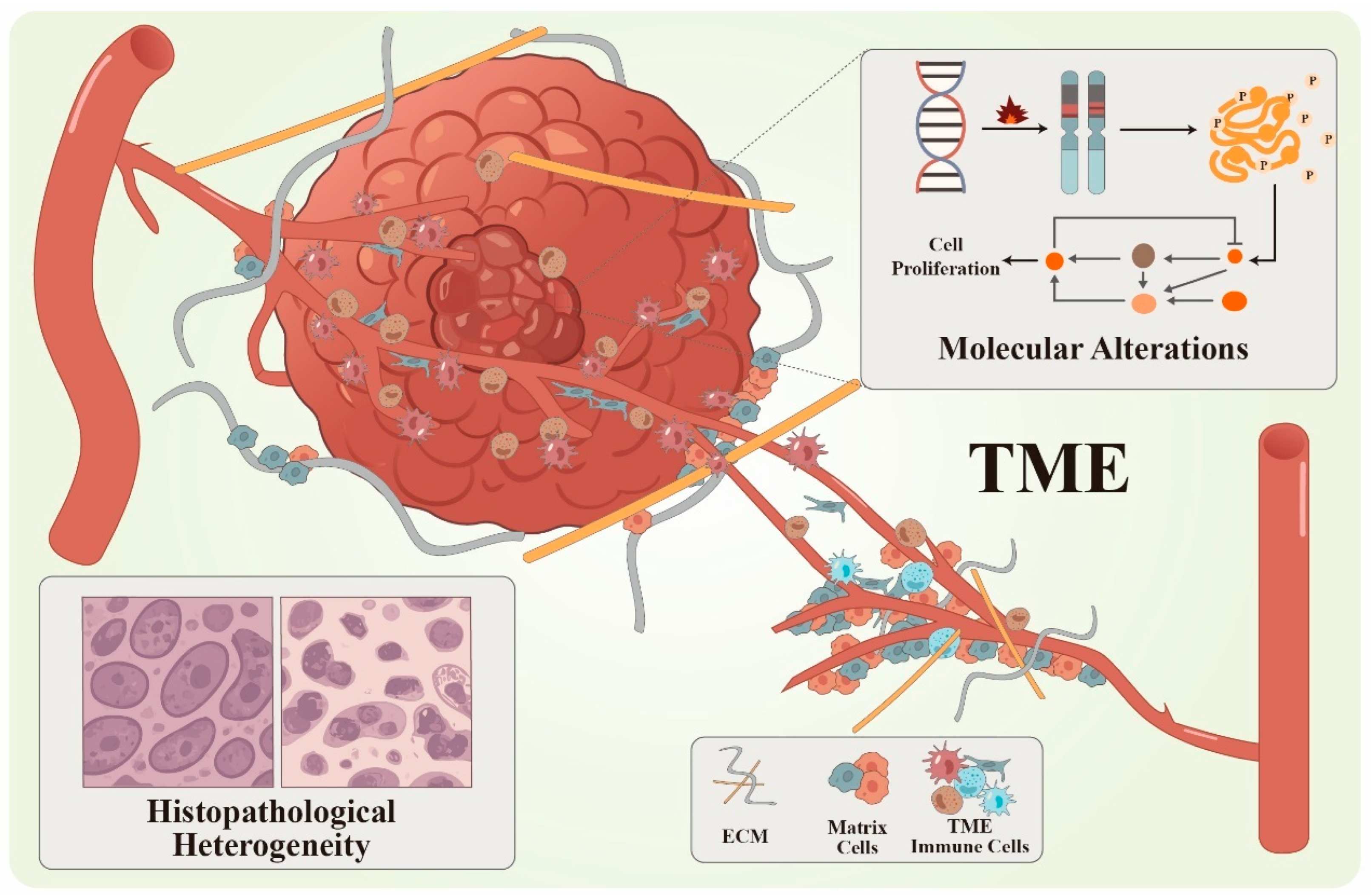
2. Biological Features of Solid Tumors
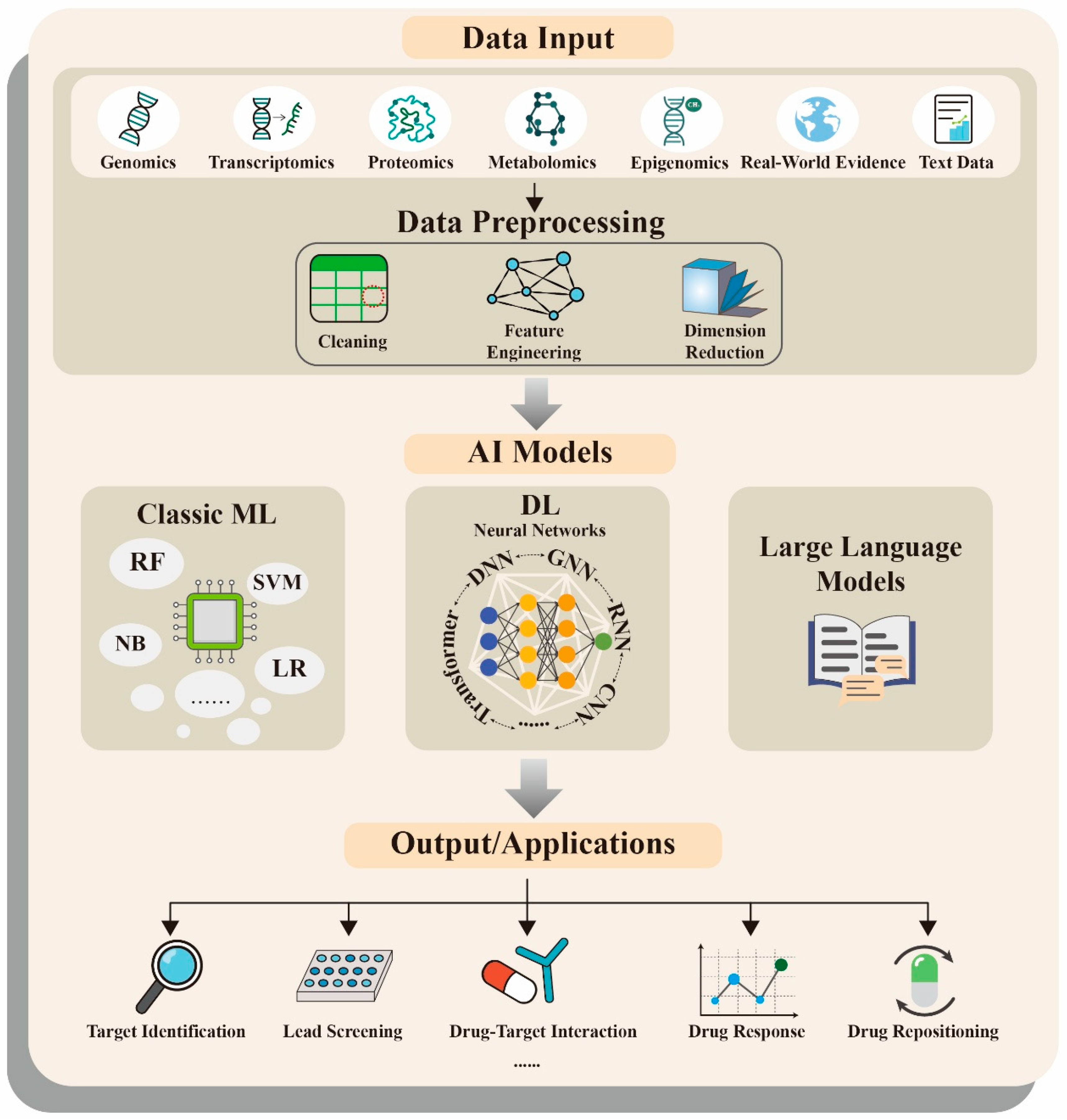
3. Methodologies of AI in Drug Discovery
3.1. Sources of Data
3.2. Classic Machine Learning Methods
3.3. Deep Learning
4. Large Language Models
5. AI-Assisted Target Discovery in Solid Tumors
6. Discussion and Future Outlook
Author Contributions
Funding
Institutional Review Board Statement
Informed Consent Statement
Data Availability Statement
Conflicts of Interest
References
- Siegel, R.L.; Kratzer, T.B.; Giaquinto, A.N.; Sung, H.; Jemal, A. Cancer Statistics, 2025. CA Cancer J. Clin. 2025, 75, 10–45. [Google Scholar] [CrossRef]
- Sun, Q.; Hong, Z.; Zhang, C.; Wang, L.; Han, Z.; Ma, D. Immune Checkpoint Therapy for Solid Tumours: Clinical Dilemmas and Future Trends. Signal Transduct. Target. Ther. 2023, 8, 320. [Google Scholar] [CrossRef] [PubMed]
- Feng, T.; Hu, J.; Wen, J.; Qian, Z.; Che, G.; Zhou, Q.; Zhu, L. Personalized Nanovaccines for Treating Solid Cancer Metastases. J. Hematol. Oncol. 2024, 17, 115. [Google Scholar] [CrossRef]
- Huayamares, S.G.; Loughrey, D.; Kim, H.; Dahlman, J.E.; Sorscher, E.J. Nucleic Acid-Based Drugs for Patients with Solid Tumours. Nat. Rev. Clin. Oncol. 2024, 21, 407–427. [Google Scholar] [CrossRef]
- Alabi, B.R.; Liu, S.; Stoyanova, T. Current and Emerging Therapies for Neuroendocrine Prostate Cancer. Pharmacol. Ther. 2022, 238, 108255. [Google Scholar] [CrossRef]
- Schaff, L.R.; Mellinghoff, I.K. Glioblastoma and Other Primary Brain Malignancies in Adults: A Review. J. Am. Med. Assoc. 2023, 329, 574–587. [Google Scholar] [CrossRef] [PubMed]
- Leon-Ferre, R.A.; Goetz, M.P. Advances in Systemic Therapies for Triple Negative Breast Cancer. Br. Med. J. 2023, 381, e071674. [Google Scholar] [CrossRef] [PubMed]
- Jones, L.H.; Bunnage, M.E. Applications of Chemogenomic Library Screening in Drug Discovery. Nat. Rev. Drug Discov. 2017, 16, 285–296. [Google Scholar] [CrossRef]
- Hanahan, D. Hallmarks of Cancer: New Dimensions. Cancer Discov. 2022, 12, 31–46. [Google Scholar] [CrossRef]
- Maacha, S.; Bhat, A.A.; Jimenez, L.; Raza, A.; Haris, M.; Uddin, S.; Grivel, J.-C. Extracellular Vesicles-Mediated Intercellular Communication: Roles in the Tumor Microenvironment and Anti-Cancer Drug Resistance. Mol. Cancer 2019, 18, 55. [Google Scholar] [CrossRef]
- Pan, X.; Zheng, L. Epigenetics in Modulating Immune Functions of Stromal and Immune Cells in the Tumor Microenvironment. Cell. Mol. Immunol. 2020, 17, 940–953. [Google Scholar] [CrossRef]
- Fan, Y.; Feng, R.; Zhang, X.; Wang, Z.-L.; Xiong, F.; Zhang, S.; Zhong, Z.-F.; Yu, H.; Zhang, Q.-W.; Zhang, Z.; et al. Encoding and Display Technologies for Combinatorial Libraries in Drug Discovery: The Coming of Age from Biology to Therapy. Acta Pharm. Sin. B 2024, 14, 3362–3384. [Google Scholar] [CrossRef] [PubMed]
- Jose, A.; Kulkarni, P.; Thilakan, J.; Munisamy, M.; Malhotra, A.G.; Singh, J.; Kumar, A.; Rangnekar, V.M.; Arya, N.; Rao, M. Integration of Pan-Omics Technologies and Three-Dimensional in Vitro Tumor Models: An Approach toward Drug Discovery and Precision Medicine. Mol. Cancer 2024, 23, 50. [Google Scholar] [CrossRef]
- Rivenson, Y.; Ozcan, A. Deep Learning Accelerates Whole Slide Imaging for Next-Generation Digital Pathology Applications. Light Sci. Appl. 2022, 11, 300. [Google Scholar] [CrossRef]
- Gulati, G.S.; D’Silva, J.P.; Liu, Y.; Wang, L.; Newman, A.M. Profiling Cell Identity and Tissue Architecture with Single-Cell and Spatial Transcriptomics. Nat. Rev. Mol. Cell Biol. 2025, 26, 11–31. [Google Scholar] [CrossRef]
- Müller, M.; Huber, F.; Arnaud, M.; Kraemer, A.I.; Altimiras, E.R.; Michaux, J.; Taillandier-Coindard, M.; Chiffelle, J.; Murgues, B.; Gehret, T.; et al. Machine Learning Methods and Harmonized Datasets Improve Immunogenic Neoantigen Prediction. Immunity 2023, 56, 2650–2663.e6. [Google Scholar] [CrossRef]
- Zhang, K.; Yang, X.; Wang, Y.; Yu, Y.; Huang, N.; Li, G.; Li, X.; Wu, J.C.; Yang, S. Artificial Intelligence in Drug Development. Nat. Med. 2025, 31, 45–59. [Google Scholar] [CrossRef]
- Pal, S.; Bhattacharya, M.; Islam, M.A.; Chakraborty, C. ChatGPT or LLM in Next-Generation Drug Discovery and Development: Pharmaceutical and Biotechnology Companies Can Make Use of the Artificial Intelligence-Based Device for a Faster Way of Drug Discovery and Development. Int. J. Surg. Lond. Engl. 2023, 109, 4382–4384. [Google Scholar] [CrossRef] [PubMed]
- Zhang, S.; Xiao, X.; Yi, Y.; Wang, X.; Zhu, L.; Shen, Y.; Lin, D.; Wu, C. Tumor Initiation and Early Tumorigenesis: Molecular Mechanisms and Interventional Targets. Signal Transduct. Target. Ther. 2024, 9, 149. [Google Scholar] [CrossRef] [PubMed]
- Della Corte, C.M.; Viscardi, G.; Di Liello, R.; Fasano, M.; Martinelli, E.; Troiani, T.; Ciardiello, F.; Morgillo, F. Role and Targeting of Anaplastic Lymphoma Kinase in Cancer. Mol. Cancer 2018, 17, 30. [Google Scholar] [CrossRef]
- Tan, S.; Sun, D.; Pu, W.; Gou, Q.; Guo, C.; Gong, Y.; Li, J.; Wei, Y.-Q.; Liu, L.; Zhao, Y.; et al. Circular RNA F-circEA-2a Derived from EML4-ALK Fusion Gene Promotes Cell Migration and Invasion in Non-Small Cell Lung Cancer. Mol. Cancer 2018, 17, 138. [Google Scholar] [CrossRef]
- Cao, P.H.A.; Dominic, A.; Lujan, F.E.; Senthilkumar, S.; Bhattacharya, P.K.; Frigo, D.E.; Subramani, E. Unlocking Ferroptosis in Prostate Cancer—The Road to Novel Therapies and Imaging Markers. Nat. Rev. Urol. 2024, 21, 615–637. [Google Scholar] [CrossRef] [PubMed]
- Wu, J.; He, J.; Liu, Z.; Zhu, X.; Li, Z.; Chen, A.; Lu, J. Cuproptosis: Mechanism, Role, and Advances in Urological Malignancies. Med. Res. Rev. 2024, 44, 1662–1682. [Google Scholar] [CrossRef] [PubMed]
- Dentro, S.C.; Leshchiner, I.; Haase, K.; Tarabichi, M.; Wintersinger, J.; Deshwar, A.G.; Yu, K.; Rubanova, Y.; Macintyre, G.; Demeulemeester, J.; et al. Characterizing Genetic Intra-Tumor Heterogeneity across 2658 Human Cancer Genomes. Cell 2021, 184, 2239–2254.e39. [Google Scholar] [CrossRef]
- Surintrspanont, J.; Zhou, M. Prostate Pathology: What Is New in the 2022 WHO Classification of Urinary and Male Genital Tumors? Pathologica 2023, 115, 41–56. [Google Scholar] [CrossRef]
- Cai, M.; Song, X.-L.; Li, X.-A.; Chen, M.; Guo, J.; Yang, D.-H.; Chen, Z.; Zhao, S.-C. Current Therapy and Drug Resistance in Metastatic Castration-Resistant Prostate Cancer. Drug Resist. Updat. 2023, 68, 100962. [Google Scholar] [CrossRef]
- Neftel, C.; Laffy, J.; Filbin, M.G.; Hara, T.; Shore, M.E.; Rahme, G.J.; Richman, A.R.; Silverbush, D.; Shaw, M.L.; Hebert, C.M.; et al. An Integrative Model of Cellular States, Plasticity, and Genetics for Glioblastoma. Cell 2019, 178, 835–849.e21. [Google Scholar] [CrossRef]
- Mathur, R.; Wang, Q.; Schupp, P.G.; Nikolic, A.; Hilz, S.; Hong, C.; Grishanina, N.R.; Kwok, D.; Stevers, N.O.; Jin, Q.; et al. Glioblastoma Evolution and Heterogeneity from a 3D Whole-Tumor Perspective. Cell 2024, 187, 446–463.e16. [Google Scholar] [CrossRef] [PubMed]
- Xiao, Y.; Yu, D. Tumor Microenvironment as a Therapeutic Target in Cancer. Pharmacol. Ther. 2021, 221, 107753. [Google Scholar] [CrossRef]
- Ngoi, N.Y.L.; Gallo, D.; Torrado, C.; Nardo, M.; Durocher, D.; Yap, T.A. Synthetic Lethal Strategies for the Development of Cancer Therapeutics. Nat. Rev. Clin. Oncol. 2025, 22, 46–64. [Google Scholar] [CrossRef]
- Fizazi, K.; Piulats, J.M.; Reaume, M.N.; Ostler, P.; McDermott, R.; Gingerich, J.R.; Pintus, E.; Sridhar, S.S.; Bambury, R.M.; Emmenegger, U.; et al. Rucaparib or Physician’s Choice in Metastatic Prostate Cancer. N. Engl. J. Med. 2023, 388, 719–732. [Google Scholar] [CrossRef]
- Moore, K.; Colombo, N.; Scambia, G.; Kim, B.-G.; Oaknin, A.; Friedlander, M.; Lisyanskaya, A.; Floquet, A.; Leary, A.; Sonke, G.S.; et al. Maintenance Olaparib in Patients with Newly Diagnosed Advanced Ovarian Cancer. N. Engl. J. Med. 2018, 379, 2495–2505. [Google Scholar] [CrossRef] [PubMed]
- Tutt, A.N.J.; Garber, J.E.; Kaufman, B.; Viale, G.; Fumagalli, D.; Rastogi, P.; Gelber, R.D.; de Azambuja, E.; Fielding, A.; Balmaña, J.; et al. Adjuvant Olaparib for Patients with BRCA1- or BRCA2-Mutated Breast Cancer. N. Engl. J. Med. 2021, 384, 2394–2405. [Google Scholar] [CrossRef]
- Wimalasena, V.K.; Wang, T.; Sigua, L.H.; Durbin, A.D.; Qi, J. Using Chemical Epigenetics to Target Cancer. Mol. Cell 2020, 78, 1086–1095. [Google Scholar] [CrossRef]
- Trajanoska, K.; Bhérer, C.; Taliun, D.; Zhou, S.; Richards, J.B.; Mooser, V. From Target Discovery to Clinical Drug Development with Human Genetics. Nature 2023, 620, 737–745. [Google Scholar] [CrossRef]
- Haley, B.; Roudnicky, F. Functional Genomics for Cancer Drug Target Discovery. Cancer Cell 2020, 38, 31–43. [Google Scholar] [CrossRef]
- Fort, R.S.; Mathó, C.; Oliveira-Rizzo, C.; Garat, B.; Sotelo-Silveira, J.R.; Duhagon, M.A. An Integrated View of the Role of miR-130b/301b miRNA Cluster in Prostate Cancer. Exp. Hematol. Oncol. 2018, 7, 10. [Google Scholar] [CrossRef]
- Deng, B.; Ke, B.; Tian, Q.; Gao, Y.; Zhai, Q.; Zhang, W. Targeting AURKA with Multifunctional Nanoparticles in CRPC Therapy. J. Nanobiotechnol. 2024, 22, 803. [Google Scholar] [CrossRef]
- Kadeerhan, G.; Xue, B.; Wu, X.; Hu, X.; Tian, J.; Wang, D. Novel Gene Signature for Predicting Biochemical Recurrence-Free Survival of Prostate Cancer and PRAME Modulates Prostate Cancer Progression. Am. J. Cancer Res. 2023, 13, 2861–2877. [Google Scholar] [PubMed]
- Zhang, Y.; Li, J.; Lin, S.; Zhao, J.; Xiong, Y.; Wei, D.-Q. An End-to-End Method for Predicting Compound-Protein Interactions Based on Simplified Homogeneous Graph Convolutional Network and Pre-Trained Language Model. J. Cheminform. 2024, 16, 67. [Google Scholar] [CrossRef] [PubMed]
- Liu, C.; Xiao, K.; Yu, C.; Lei, Y.; Lyu, K.; Tian, T.; Zhao, D.; Zhou, F.; Tang, H.; Zeng, J. A Probabilistic Knowledge Graph for Target Identification. PLoS Comput. Biol. 2024, 20, e1011945. Available online: https://github.com/Dr-Patient/Progeni (accessed on 3 March 2026). [CrossRef]
- Carracedo-Reboredo, P.; Liñares-Blanco, J.; Rodríguez-Fernández, N.; Cedrón, F.; Novoa, F.J.; Carballal, A.; Maojo, V.; Pazos, A.; Fernandez-Lozano, C. A Review on Machine Learning Approaches and Trends in Drug Discovery. Comput. Struct. Biotechnol. J. 2021, 19, 4538–4558. [Google Scholar] [CrossRef]
- Jiang, H.; Liu, M.; Deng, Y.; Zhang, C.; Dai, L.; Zhu, B.; Ou, Y.; Zhu, Y.; Hu, C.; Yang, L.; et al. Identification of Prostate Cancer Bone Metastasis Related Genes and Potential Therapy Targets by Bioinformatics and In Vitro Experiments. J. Cell. Mol. Med. 2024, 28, e18511. [Google Scholar] [CrossRef]
- Liu, J.; Li, J.; Wang, H.; Yan, J. Application of Deep Learning in Genomics. Sci. China Life Sci. 2020, 63, 1860–1878. [Google Scholar] [CrossRef]
- Achreja, A.; Yu, T.; Mittal, A.; Choppara, S.; Animasahun, O.; Nenwani, M.; Wuchu, F.; Meurs, N.; Mohan, A.; Jeon, J.H.; et al. Metabolic Collateral Lethal Target Identification Reveals MTHFD2 Paralogue Dependency in Ovarian Cancer. Nat. Metab. 2022, 4, 1119–1137. [Google Scholar] [CrossRef] [PubMed]
- Lin, E.; Hahn, A.W.; Nussenzveig, R.H.; Wesolowski, S.; Sayegh, N.; Maughan, B.L.; McFarland, T.; Rathi, N.; Sirohi, D.; Sonpavde, G.; et al. Identification of Somatic Gene Signatures in Circulating Cell-Free DNA Associated with Disease Progression in Metastatic Prostate Cancer by a Novel Machine Learning Platform. Oncologist 2021, 26, 751–760. [Google Scholar] [CrossRef]
- Madhukar, N.S.; Khade, P.K.; Huang, L.; Gayvert, K.; Galletti, G.; Stogniew, M.; Allen, J.E.; Giannakakou, P.; Elemento, O. A Bayesian Machine Learning Approach for Drug Target Identification Using Diverse Data Types. Nat. Commun. 2019, 10, 5221. [Google Scholar] [CrossRef] [PubMed]
- Wang, R.; Zhuang, C. Graph Neural Networks Driven Acceleration in Drug Discovery. Acta Pharm. Sin. B 2025, 15, 6163–6177. [Google Scholar] [CrossRef] [PubMed]
- Chen, Y.; Wang, Z.; Wang, L.; Wang, J.; Li, P.; Cao, D.; Zeng, X.; Ye, X.; Sakurai, T. Deep Generative Model for Drug Design from Protein Target Sequence. J. Cheminform. 2023, 15, 38. [Google Scholar] [CrossRef]
- Snow, O.; Lallous, N.; Ester, M.; Cherkasov, A. Deep Learning Modeling of Androgen Receptor Responses to Prostate Cancer Therapies. Int. J. Mol. Sci. 2020, 21, 5847. [Google Scholar] [CrossRef]
- Yu, L.; Xue, L.; Liu, F.; Li, Y.; Jing, R.; Luo, J. The Applications of Deep Learning Algorithms on in Silico Druggable Proteins Identification. J. Adv. Res. 2022, 41, 219–231. [Google Scholar] [CrossRef]
- Li, Y.; Zhang, L.; Wang, Y.; Zou, J.; Yang, R.; Luo, X.; Wu, C.; Yang, W.; Tian, C.; Xu, H.; et al. Generative Deep Learning Enables the Discovery of a Potent and Selective RIPK1 Inhibitor. Nat. Commun. 2022, 13, 6891. [Google Scholar] [CrossRef]
- Naseer, S.; Hussain, W.; Khan, Y.D.; Rasool, N. Optimization of Serine Phosphorylation Prediction in Proteins by Comparing Human Engineered Features and Deep Representations. Anal. Biochem. 2021, 615, 114069. [Google Scholar] [CrossRef]
- Muzio, G.; O’Bray, L.; Borgwardt, K. Biological Network Analysis with Deep Learning. Brief. Bioinform. 2021, 22, 1515–1530. [Google Scholar] [CrossRef]
- Zhang, Z.; Chen, L.; Zhong, F.; Wang, D.; Jiang, J.; Zhang, S.; Jiang, H.; Zheng, M.; Li, X. Graph Neural Network Approaches for Drug-Target Interactions. Curr. Opin. Struct. Biol. 2022, 73, 102327. [Google Scholar] [CrossRef]
- Ye, Q.; Zeng, Y.; Jiang, L.; Kang, Y.; Pan, P.; Chen, J.; Deng, Y.; Zhao, H.; He, S.; Hou, T.; et al. A Knowledge-Guided Graph Learning Approach Bridging Phenotype- and Target-Based Drug Discovery. Adv. Sci. Weinh. Baden-Wurtt. Ger. 2025, 12, e2412402. [Google Scholar] [CrossRef]
- Yang, Z.; Zhong, W.; Zhao, L.; Yu-Chian Chen, C. MGraphDTA: Deep Multiscale Graph Neural Network for Explainable Drug-Target Binding Affinity Prediction. Chem. Sci. 2022, 13, 816–833. [Google Scholar] [CrossRef] [PubMed]
- Li, M.; Cao, Y.; Liu, X.; Ji, H. Structure-Aware Graph Attention Diffusion Network for Protein-Ligand Binding Affinity Prediction. IEEE Trans. Neural Netw. Learn. Syst. 2024, 35, 18370–18380. [Google Scholar] [CrossRef]
- Meller, A.; Ward, M.; Borowsky, J.; Kshirsagar, M.; Lotthammer, J.M.; Oviedo, F.; Ferres, J.L.; Bowman, G.R. Predicting Locations of Cryptic Pockets from Single Protein Structures Using the PocketMiner Graph Neural Network. Nat. Commun. 2023, 14, 1177. [Google Scholar] [CrossRef] [PubMed]
- Xia, X.; Zhu, C.; Zhong, F.; Liu, L. TransCDR: A Deep Learning Model for Enhancing the Generalizability of Drug Activity Prediction through Transfer Learning and Multimodal Data Fusion. BMC Biol. 2024, 22, 227. [Google Scholar] [CrossRef]
- Feng, L.; Fu, X.; Du, Z.; Guo, Y.; Zhuo, L.; Yang, Y.; Cao, D.; Yao, X. MultiCTox: Empowering Accurate Cardiotoxicity Prediction through Adaptive Multimodal Learning. J. Chem. Inf. Model. 2025, 65, 3517–3528. [Google Scholar] [CrossRef]
- Nakamura, S.; Yasuo, N.; Sekijima, M. Molecular Optimization Using a Conditional Transformer for Reaction-Aware Compound Exploration with Reinforcement Learning. Commun. Chem. 2025, 8, 40. [Google Scholar] [CrossRef] [PubMed]
- Monteiro, N.R.C.; Oliveira, J.L.; Arrais, J.P. DTITR: End-to-End Drug-Target Binding Affinity Prediction with Transformers. Comput. Biol. Med. 2022, 147, 105772. [Google Scholar] [CrossRef]
- Sultan, A.; Sieg, J.; Mathea, M.; Volkamer, A. Transformers for Molecular Property Prediction: Lessons Learned from the Past Five Years. J. Chem. Inf. Model. 2024, 64, 6259–6280. [Google Scholar] [CrossRef] [PubMed]
- Zhou, C.; Li, Z.; Song, J.; Xiang, W. TransVAE-DTA: Transformer and Variational Autoencoder Network for Drug-Target Binding Affinity Prediction. Comput. Methods Programs Biomed. 2024, 244, 108003. [Google Scholar] [CrossRef]
- Monteiro, N.R.C.; Pereira, T.O.; Machado, A.C.D.; Oliveira, J.L.; Abbasi, M.; Arrais, J.P. FSM-DDTR: End-to-End Feedback Strategy for Multi-Objective De Novo Drug Design Using Transformers. Comput. Biol. Med. 2023, 164, 107285. [Google Scholar] [CrossRef]
- Wu, H.; Liu, J.; Jiang, T.; Zou, Q.; Qi, S.; Cui, Z.; Tiwari, P.; Ding, Y. AttentionMGT-DTA: A Multi-Modal Drug-Target Affinity Prediction Using Graph Transformer and Attention Mechanism. Neural Netw. Off. J. Int. Neural Netw. Soc. 2024, 169, 623–636. [Google Scholar] [CrossRef] [PubMed]
- Bran, A.M.; Cox, S.; Schilter, O.; Baldassari, C.; White, A.D.; Schwaller, P. Augmenting Large Language Models with Chemistry Tools. Nat. Mach. Intell. 2024, 6, 525–535. Available online: https://github.com/ur-whitelab/chemcrow-public (accessed on 3 March 2026). [CrossRef]
- Zhou, P.; Wang, J.; Li, C.; Wang, Z.; Liu, Y.; Sun, S.; Lin, J.; Wei, L.; Cai, X.; Lai, H.; et al. Instruction Multi-Constraint Molecular Generation Using a Teacher-Student Large Language Model. BMC Biol. 2025, 23, 105. Available online: https://github.com/HHW-zhou/TSMMG/tree/main/EP2 (accessed on 3 March 2026). [CrossRef]
- Fan, Q.; He, Y.; Liu, J.; Liu, Q.; Wu, Y.; Chen, Y.; Dou, Q.; Shi, J.; Kong, Q.; Ou, Y.; et al. Large Language Model-Assisted Genotoxic Metal-Phenolic Nanoplatform for Osteosarcoma Therapy. Small Weinh. Bergstr. Ger. 2025, 21, e2403044. [Google Scholar] [CrossRef]
- Wang, J.; Luo, H.; Qin, R.; Wang, M.; Wan, X.; Fang, M.; Zhang, O.; Gou, Q.; Su, Q.; Shen, C.; et al. 3DSMILES-GPT: 3D Molecular Pocket-Based Generation with Token-Only Large Language Model. Chem. Sci. 2025, 16, 637–648. Available online: https://github.com/ashipiling/GPT_3DSMILES (accessed on 3 March 2026). [CrossRef] [PubMed]
- Yue, J.; Peng, B.; Chen, Y.; Jin, J.; Zhao, X.; Shen, C.; Ji, X.; Hsieh, C.-Y.; Song, J.; Hou, T.; et al. Unlocking Comprehensive Molecular Design across All Scenarios with Large Language Model and Unordered Chemical Language. Chem. Sci. 2024, 15, 13727–13740. Available online: https://github.com/pengbingxin/FragGPT-Interface (accessed on 3 March 2026). [CrossRef]
- Cui, H.; Wang, C.; Maan, H.; Pang, K.; Luo, F.; Duan, N.; Wang, B. scGPT: Toward Building a Foundation Model for Single-Cell Multi-Omics Using Generative AI. Nat. Methods 2024, 21, 1470–1480. [Google Scholar] [CrossRef]
- Cheng, J.; Pan, X.; Fang, Y.; Yang, K.; Xue, Y.; Yan, Q.; Yuan, Y. GexMolGen: Cross-Modal Generation of Hit-like Molecules via Large Language Model Encoding of Gene Expression Signatures. Brief. Bioinform. 2024, 25, bbae525. Available online: https://zenodo.org/records/11092780?token=eyJhbGciOiJIUzUxMiIsImlhdCI6MTcxNDQ4MjYwOCwiZXhwIjoxNzk4Njc1MTk5fQ.eyJpZCI6IjQwMjc0ZTlkLTQ0YjItNDY0Mi1hYmRjLTlkM2VkMjVhNWE5OSIsImRhdGEiOnt9LCJyYW5kb20iOiI5MzhjMjdmZjdmNmRlZmMxZTU0MTNhMGNmZGIzMDNmOCJ9.p3lxB8h_BDhuHm_1yqr4L1ZjRCTXmftMzpNdYaexmvycISDkoUu1cizUFrmcRZ52QovkPeQDjsHBrdScRkVqiw (accessed on 3 March 2026). [CrossRef]
- Wei, J.; Zhuo, L.; Fu, X.; Zeng, X.; Wang, L.; Zou, Q.; Cao, D. DrugReAlign: A Multisource Prompt Framework for Drug Repurposing Based on Large Language Models. BMC Biol. 2024, 22, 226. Available online: https://github.com/kkkayle/DrugReAlign (accessed on 3 March 2026). [CrossRef]
- Bhattacharya, D.; Cassady, H.J.; Hickner, M.A.; Reinhart, W.F. Large Language Models as Molecular Design Engines. J. Chem. Inf. Model. 2024, 64, 7086–7096. Available online: https://zenodo.org/records/11110873 (accessed on 3 March 2026). [CrossRef]
- Ye, G.; Cai, X.; Lai, H.; Wang, X.; Huang, J.; Wang, L.; Liu, W.; Zeng, X. DrugAssist: A Large Language Model for Molecule Optimization. Brief. Bioinform. 2024, 26, bbae693. Available online: https://github.com/blazerye/DrugAssist (accessed on 3 March 2026). [CrossRef]
- Ji, G.-W.; Xu, Z.-G.; Liu, S.-C.; Cao, S.-Y.; Jiao, C.-Y.; Lu, M.; Zhang, B.; Yang, Y.; Xu, Q.; Wu, X.-F.; et al. Radiogenomics of Intrahepatic Cholangiocarcinoma Predicts Immunochemotherapy Response and Identifies Therapeutic Target. Clin. Mol. Hepatol. 2025, 31, 935. [Google Scholar] [CrossRef]
- Puleo, N.; Ram, H.; Dziubinski, M.L.; Carvette, D.; Teitel, J.; Sekhar, S.C.; Bedi, K.; Robida, A.; Nakashima, M.M.; Farsinejad, S.; et al. Identification of a TNIK-CDK9 Axis as a Targetable Strategy for Platinum-Resistant Ovarian Cancer. Mol. Cancer Ther. 2025, 24, 639–656. [Google Scholar] [CrossRef] [PubMed]
- Chen, R.; Zhou, J.; Chen, B. Imputing Abundance of over 2500 Surface Proteins from Single-Cell Transcriptomes with Context-Agnostic Zero-Shot Deep Ensembles. Cell Syst. 2024, 15, 869–884.e6. Available online: https://github.com/Bin-Chen-Lab/spider (accessed on 3 March 2026). [CrossRef] [PubMed]
- Bahcheli, A.T.; Min, H.-K.; Bayati, M.; Zhao, H.; Fortuna, A.; Dong, W.; Dzneladze, I.; Chan, J.; Chen, X.; Guevara-Hoyer, K.; et al. Pan-Cancer Ion Transport Signature Reveals Functional Regulators of Glioblastoma Aggression. EMBO J. 2024, 43, 196–224. [Google Scholar] [CrossRef]
- Liao, H.; Barra, C.; Zhou, Z.; Peng, X.; Woodhouse, I.; Tailor, A.; Parker, R.; Carré, A.; Borrow, P.; Hogan, M.J.; et al. MARS an Improved de Novo Peptide Candidate Selection Method for Non-Canonical Antigen Target Discovery in Cancer. Nat. Commun. 2024, 15, 661. [Google Scholar] [CrossRef] [PubMed]
- Pun, F.W.; Leung, G.H.D.; Leung, H.W.; Rice, J.; Schmauck-Medina, T.; Lautrup, S.; Long, X.; Liu, B.H.M.; Wong, C.W.; Ozerov, I.V.; et al. A Comprehensive AI-Driven Analysis of Large-Scale Omic Datasets Reveals Novel Dual-Purpose Targets for the Treatment of Cancer and Aging. Aging Cell 2023, 22, e14017. [Google Scholar] [CrossRef]
- Ager, C.R.; Zhang, M.; Chaimowitz, M.; Bansal, S.; Tagore, S.; Obradovic, A.; Jugler, C.; Rogava, M.; Melms, J.C.; McCann, P.; et al. KLRG1 Marks Tumor-Infiltrating CD4 T Cell Subsets Associated with Tumor Progression and Immunotherapy Response. J. Immunother. Cancer 2023, 11, e006782. [Google Scholar] [CrossRef]
- Uhlén, M.; Fagerberg, L.; Hallström, B.M.; Lindskog, C.; Oksvold, P.; Mardinoglu, A.; Sivertsson, Å.; Kampf, C.; Sjöstedt, E.; Asplund, A.; et al. Proteomics. Tissue-Based Map of the Human Proteome. Science 2015, 347, 1260419. [Google Scholar] [CrossRef]
- Ajmal, A.; Alkhatabi, H.A.; Alreemi, R.M.; Alamri, M.A.; Khalid, A.; Abdalla, A.N.; Alotaibi, B.S.; Wadood, A. Prospective Virtual Screening Combined with Bio-Molecular Simulation Enabled Identification of New Inhibitors for the KRAS Drug Target. BMC Chem. 2024, 18, 57. [Google Scholar] [CrossRef]
- Zhi, H.-Y.; Zhao, L.; Lee, C.-C.; Chen, C.Y.-C. A Novel Graph Neural Network Methodology to Investigate Dihydroorotate Dehydrogenase Inhibitors in Small Cell Lung Cancer. Biomolecules 2021, 11, 477. [Google Scholar] [CrossRef]
- Lee, S.; Park, J.; Cho, S.; Kim, E.J.; Oh, S.; Lee, Y.; Park, S.; Kang, K.; Shin, D.H.; Ko, S.Y.; et al. Hyaluronan Network Remodeling by ZEB1 and ITIH2 Enhances the Motility and Invasiveness of Cancer Cells. J. Clin. Investig. 2025, 135, e180570. [Google Scholar] [CrossRef] [PubMed]
- He, H.; Chen, G.; Tang, Z.; Chen, C.Y.-C. Dual Modality Feature Fused Neural Network Integrating Binding Site Information for Drug Target Affinity Prediction. NPJ Digit. Med. 2025, 8, 67. [Google Scholar] [CrossRef]
- Yang, J.; Li, Z.; Wu, W.K.K.; Yu, S.; Xu, Z.; Chu, Q.; Zhang, Q. Deep Learning Identifies Explainable Reasoning Paths of Mechanism of Action for Drug Repurposing from Multilayer Biological Network. Brief. Bioinform. 2022, 23, bbac469. [Google Scholar] [CrossRef] [PubMed]
- García, E.G.; Varas, P.; González-Naranjo, P.; Ulzurrun, E.; Marcos-Ayuso, G.; Pérez, C.; Páez, J.A.; Insua, D.R.; Santana, S.R.; Campillo, N.E. AI-Driven De Novo Design and Development of Nontoxic DYRK1A Inhibitors. J. Med. Chem. 2025, 68, 10346–10364. [Google Scholar] [CrossRef] [PubMed]
- Bhinder, B.; Gilvary, C.; Madhukar, N.S.; Elemento, O. Artificial Intelligence in Cancer Research and Precision Medicine. Cancer Discov. 2021, 11, 900–915. [Google Scholar] [CrossRef] [PubMed]
- Wang, T.; Du, Z.; Zhuo, L.; Fu, X.; Zou, Q.; Yao, X. MultiCBlo: Enhancing Predictions of Compound-Induced Inhibition of Cardiac Ion Channels with Advanced Multimodal Learning. Int. J. Biol. Macromol. 2024, 276, 133825. [Google Scholar] [CrossRef] [PubMed]
- Xu, H.; Usuyama, N.; Bagga, J.; Zhang, S.; Rao, R.; Naumann, T.; Wong, C.; Gero, Z.; González, J.; Gu, Y.; et al. A Whole-Slide Foundation Model for Digital Pathology from Real-World Data. Nature 2024, 630, 181–188. Available online: https://github.com/prov-gigapath/prov-gigapath (accessed on 3 March 2026). [CrossRef]
- Elmarakeby, H.A.; Hwang, J.; Arafeh, R.; Crowdis, J.; Gang, S.; Liu, D.; AlDubayan, S.H.; Salari, K.; Kregel, S.; Richter, C.; et al. Biologically Informed Deep Neural Network for Prostate Cancer Discovery. Nature 2021, 598, 348–352. Available online: https://github.com/marakeby/pnet_prostate_paper (accessed on 3 March 2026). [CrossRef]
- Novakovsky, G.; Dexter, N.; Libbrecht, M.W.; Wasserman, W.W.; Mostafavi, S. Obtaining Genetics Insights from Deep Learning via Explainable Artificial Intelligence. Nat. Rev. Genet. 2023, 24, 125–137. [Google Scholar] [CrossRef]
- Medina-Ortiz, D.; Khalifeh, A.; Anvari-Kazemabad, H.; Davari, M.D. Interpretable and Explainable Predictive Machine Learning Models for Data-Driven Protein Engineering. Biotechnol. Adv. 2025, 79, 108495. [Google Scholar] [CrossRef]
- Abdel-Rehim, A.; Zenil, H.; Orhobor, O.; Fisher, M.; Collins, R.J.; Bourne, E.; Fearnley, G.W.; Tate, E.; Smith, H.X.; Soldatova, L.N.; et al. Scientific Hypothesis Generation by Large Language Models: Laboratory Validation in Breast Cancer Treatment. J. R. Soc. Interface 2025, 22, 20240674. [Google Scholar] [CrossRef]
- Ding, X.; Sheng, Z.; Hur, B.; Tauscher, J.; Ben-Zeev, D.; Yetişgen, M.; Pakhomov, S.; Cohen, T. Tailoring Task Arithmetic to Address Bias in Models Trained on Multi-Institutional Datasets. J. Biomed. Inform. 2025, 168, 104858. [Google Scholar] [CrossRef]
- Cen, H.S.; Dandamudi, S.; Lei, X.; Weight, C.; Desai, M.; Gill, I.; Duddalwar, V. Diversity in Renal Mass Data Cohorts: Implications for Urology AI Researchers. Oncology 2024, 102, 574–584. [Google Scholar] [CrossRef]
- Parrondo-Pizarro, R.; Menestrina, L.; Garcia-Serna, R.; Fernández-Torras, A.; Mestres, J. Enhancing Molecular Property Prediction through Data Integration and Consistency Assessment. J. Cheminform. 2025, 17, 163. [Google Scholar] [CrossRef]
- Wang, J.-W.; Meng, M.; Dai, M.-W.; Liang, P.; Hou, J. Correlation Does Not Equal Causation: The Imperative of Causal Inference in Machine Learning Models for Immunotherapy. Front. Immunol. 2025, 16, 1630781. [Google Scholar] [CrossRef]
- Shi, X.; Teng, H.; Shi, L.; Bi, W.; Wei, W.; Mao, F.; Sun, Z. Comprehensive Evaluation of Computational Methods for Predicting Cancer Driver Genes. Brief. Bioinform. 2022, 23, bbab548. [Google Scholar] [CrossRef]
- Qu, J.; Xiao, X.; Wei, X.; Qian, X. A Causality-Inspired Generalized Model for Automated Pancreatic Cancer Diagnosis. Med. Image Anal. 2024, 94, 103154. [Google Scholar] [CrossRef] [PubMed]
- Qadri, Y.A.; Shaikh, S.; Ahmad, K.; Choi, I.; Kim, S.W.; Vasilakos, A.V. Explainable Artificial Intelligence: A Perspective on Drug Discovery. Pharmaceutics 2025, 17, 1119. [Google Scholar] [CrossRef] [PubMed]
- Korkmaz, S. Statistical Rigor and Reproducibility in the AI Era. Balk. Med. J. 2025, 42, 386–387. [Google Scholar] [CrossRef]
- Ball, P. Is AI Leading to a Reproducibility Crisis in Science? Nature 2023, 624, 22–25. [Google Scholar] [CrossRef]
- Shick, A.A.; Webber, C.M.; Kiarashi, N.; Weinberg, J.P.; Deoras, A.; Petrick, N.; Saha, A.; Diamond, M.C. Transparency of Artificial Intelligence/Machine Learning-Enabled Medical Devices. NPJ Digit. Med. 2024, 7, 21. [Google Scholar] [CrossRef]
- Liu, S.; Yu, Z. Explainable AI and Debiased Networks: The ‘Last Mile’ for Precision Medicine Delivery. Br. J. Pharmacol. 2026, 183, 217–218. [Google Scholar] [CrossRef]
- Christiansen, F.; Konuk, E.; Ganeshan, A.R.; Welch, R.; Palés Huix, J.; Czekierdowski, A.; Leone, F.P.G.; Haak, L.A.; Fruscio, R.; Gaurilcikas, A.; et al. International Multicenter Validation of AI-Driven Ultrasound Detection of Ovarian Cancer. Nat. Med. 2025, 31, 189–196. [Google Scholar] [CrossRef]



| Stage | Model | Architecture | Modalities | Tasks | Performance | Year | Ref. |
|---|---|---|---|---|---|---|---|
| Lead discovery | TSMMG | GPT-2 (pre-trained and prompt optimized) | Text (text–molecule pairs) | Acted as a “student” LLM, learning to generate novel molecules from natural language descriptions by distilling knowledge from “teacher” models, satisfying multiple constraints via text prompts | Parameter size: GPT-2 level | 2025 | [69] |
| Lead screening | LLMPN | GPT-4 (task-specific prompt optimization) | Text (chemical descriptors), numerical (IC50), structural (IUPAC) | Used to analyze polyphenol structure–activity relationships, adapted through task-specific prompts and structured molecular descriptor inputs, to identify effective lead compounds for osteosarcoma | Parameter size: GPT-4 level; gossypol predicted as top candidate from 60 polyphenols | 2025 | [70] |
| Lead optimization | ChemCrow | GPT-4 (ReAct/MRKL agent framework with tool augmentation via LangChain) | Text, structured chemical representations (SMILES, CAS) | Adapted GPT-4 into a chemistry-aware agent by integrating 18 chemistry tools to autonomously perform synthesis planning and compound screening | Parameter size: GPT-4 level; successful automated synthesis of 4 compounds | 2024 | [68] |
| Lead screening & optimization | 3DSMILES-GPT | Transformer decoder (8 layers, 12 heads) | 2D SMILES, 3D atomic coordinates, protein pocket surface | Adapting a token-only LLM through pretraining, protein-aware fine-tuning, and reinforcement learning to generate high-affinity, drug-like, and synthesizable 3D molecules | Parameter size: not provided; achieved strong prediction ability and 3 times faster generation speed | 2024 | [71] |
| Lead optimization | FragGPT/FragGPT-ADMET | GPT-2 (fine-tuning with LoRA) | Text-based molecular fragments (FU-SMILES) | Fragment-based molecular generation optimized via LoRA and reinforcement learning, enabling high-quality and controllable molecular generation across multiple drug design tasks | Parameter size: GPT-2 level; pre-trained on 78M molecules | 2024 | [72] |
| Lead screening | GexMolGen | scGPT (integrated first-align-then-generate strategy) | Gene expression (transcriptome), molecular structure (graph) | To generate hit-like molecules from gene expression signatures via a cross-modal framework combining scGPT-based gene encoding, hierVAE-based molecular decoding, and contrastive alignment for modality bridging | Parameter size: scGPT level [73]; achieved 100% validity in molecule generation | 2024 | [74] |
| Drug repurposing | DrugReAlign | GTP-4, GPT-3.5, New Bing, medllama3-v20 | Text (natural language, structures, spatial interaction, etc.) | Analyzing target sites, generating drug repositioning suggestions, and providing explanations; adapted by multi-source prompts; identified two unrecognized drug–target interactions for cancer therapy | Parameter size: GPT-4 level (best performance of all) | 2024 | [75] |
| Lead screening & optimization | Claude 3 Opus LLM | Claude 3 Opus (task-specific prompt optimization) | Text (natural language prompts) and molecular representations (SMILES) | Acted as a molecular design engine for reading, writing, modifying and generating valid and unique molecules; adapted by prompt engineering | Parameter size: Claude 3 Opus level | 2024 | [76] |
| Lead optimization | DrugAssist | LlaMA2-7B-Chat (fine-tuned with LoRA) | Text (SMILES strings, natural language instructions) | Fine-tuned with a custom instruction dataset and LoRA to perform molecule optimization, achieving multi-property control, transferability, and expert-guided refinement | Parameter size: 7B; achieved 0.62 multi-property optimization success rate (vs. 0.59 for Transformer) | 2023 | [77] |
| Tumor Type | AI Methodology | Sample Size | Data Type | Data Source | Validation Method | Predicted Target | Performance | Interpretability | Year | Ref. |
|---|---|---|---|---|---|---|---|---|---|---|
| ICC | ML (logistic regression with RFE) | Discovery/Training Sets: 401 pts (Bulk RNA-seq). Single-cell Data: 51,642 cells (from 16 ICC pts and 6 normal controls). Spatial Transcriptomics: 120 samples from 40 pts (3 anatomical regions each). Validation Cohorts (n = 331): Molecular (52 pts, 156 specimens), resection (243 pts), and immunochemotherapy cohort (36 pts). | Contrast-enhanced CT (Radiomics), Bulk/Single-cell/Spatial RNA-seq (Multi-omics). | Public (TCGA, GEO, CPTAC) + Institutional Dataset | Internal CV (5-fold) + Independent External Set + In vitro & In vivo validation | uPAR (identified through IRS level) | Internal: AUC 0.95 (IRS prediction). External: Prognosis: C-index = 0.67 (OS) & 0.64 (recurrence-free survival). Immunotherapy response: AUC = 0.84 | High (used interpretable algorithms; selected features show spatial correlation with immune gene expression, confirming biological relevance) | 2025 | [78] |
| Ovarian cancer | Integrated AI platform (Benevolent) combining relational inference and causal reasoning algorithm | N_train: >35 million scientific articles & databases (Knowledge Graph) + GSE71340 cohort. N_val: 13 patient-derived organoids, multiple patient-derived cell lines, and TCGA cohort (n = 201 to 307 patients). | Text, structured data (kinase activity profiles, drug compounds, etc.), genomics, clinical and phenotypic data. | Benevolent Knowledge Graph (ChEMBL, Reaxys), GEO, TCGA | Independent External Set + In vitro validation | TNIK, CDK9 | Model metrics not reported; prioritized 74 targets from 500 candidates, with 6 hit compounds identified, showing ≥50% cell viability reduction ex vivo. | High (leveraged knowledge graph for transparent relational inference; biological validation via co-expression & pathway analysis) | 2025 | [79] |
| PCa | ML (LASSO and SVM-RFE) | N_train: 42 samples (GSE77930: 22 PCa, 20 PCa with bone metastasis). N_val: 51 samples (GSE32269: 22 PCa, 29 PCa with bone metastasis). Single-cell data: 16 pts (9 bone metastasis, 7 normal). Institutional clinical validation: 16 pts. | Bulk RNA-seq, scRNA-seq, clinical dataset, and in vitro experimental data. | Public (TCGA, GEO) + Institutional Dataset | Independent External Set (GSE32269) + Wet lab validation (Immunohistochemistry, RT-PCR, Transwell, etc.) | Bone metastasis-related markers (APOC1, etc.) | Internal: AUC = 0.727–0.926. External: AUC maintained >0.7. | High (relatively interpretable ML models; validated via pathology, functional assays, and GSEA) | 2024 | [43] |
| CRC, melanoma | GNN on a prob-KG | Graph Data (Nodes/Edges): Dataset 1 (Baseline): 12,015 entities and 1,596,745 associations. Dataset 2 (Wet lab): 27,467 entities and 77,429 associations. Patient Data (TCGA): Melanoma: n = 176 (metastatic), n = 173 (metastatic), n = 50 (primary). Colorectal Cancer: n = 264. | Heterogeneous biological networks (interactions between proteins, drugs, etc.), unstructured text data, and sequence/structural similarity matrices. | Public (HRPD, DrugBank, PubMed, TCGA, etc.) | Internal CV (5-fold) + Independent External Set (TCGA) + In vitro validation | Novel protein targets in melanoma and CRC | Internal: entry-wise AUROC ≈ 0.98 and AUPR ≈ 0.95; cluster-wise AUROC ≈ 0.81 and AUPR ≈ 0.51 External: Significant tumor proliferation inhibition; correlated with TCGA patient survival outcomes. | Moderate to High (while GNN-based embeddings remain complex, predicted targets were validated by wet lab experiments) | 2024 | [41] |
| HCC, CRC | DNN + ensemble learning | N_train: 120,461 cells (6 datasets covering 289 proteins, 5 tissues, 4 diseases, 17 cell types) via 10-fold CV. N_val: 4 CITE-seq datasets. Application Data: HCC cohort and CRC liver metastasis cohort (125,150 cells). | Single-cell multimodal data (scRNA-seq, cell-type/tissue/disease metadata, surface protein abundance). | Public CITE-seq (GEO and Figshare) | Internal CV (10-fold) + Independent External Set validation (4 distinct cross-context CITE-seq datasets). | Abundance of >2500 cell surface proteins at single-cell resolution | Internal: Pearson correlation 0.80 for seen proteins. External: Median correlation 0.81 for unseen proteins; superior to baseline models. | Moderate to High (while the ensemble DNN architecture reduced interpretability, the predicted protein abundances were biologically coherent) | 2024 | [80] |
| GBM | ML (Elastic net-regularized CoxPH) | N_train: 9352 cancer samples across 33 cancer types (150 GBM samples via 1000 iterations of 80% splits). N_val (External/Lab): 136 GLASS samples, 55 GEO samples. 3 patient-derived cell lines & mouse cohorts. | Transcriptomic data (bulk RNA-seq), clinical metadata (overall survival, tumor grade/stage, etc.). | Public (TCGA, GLASS, GTEx, GEO, etc.) | Internal CV (Bootstrapping) + Independent External Sets + In vitro & In vivo validation. | GJB2 and SCN9A | Model metrics not reported. Internal: High selection frequency with significant OS association. External: HR > 1.5 in independent cohorts. Target knockdown significantly prolonged xenograft mouse survival. | High (linear model with interpretable coefficients and Elastic Net enabled sparse feature selection) | 2024 | [81] |
| Pan-cancer | Supervised affine-weighted model | N_Train: 118,177 spectra (5-fold CV). N_Val: ~169 k synthetic peptides; 2424 cancer cell line spectra; 10 primary cervical tumor samples. | Immunopeptidomics (mass spectrometry [MS/MS] spectra of HLA-bound peptides) | Public (PRIDE) + In-house primary tissue data | Internal CV (5-fold) + Independent External Sets (Synthetic & Public) + In vitro validation | Non-canonical MHC-I-associated peptide sequences on tumor cells | Internal: FSR improved to 0.782 vs. 0.731 (Baseline). External: 90.7% FSR on benchmark; 1.6-fold improvement in recall; FDR < 14.3% at high confidence score. | High (used transparent model with biologically meaningful features; predictions aligned with known immunopeptidomics patterns) | 2024 | [82] |
| Pan-cancer | Integrated AI platform (PandaOmics) | Analysis/Input Set: 139 cancer datasets (11,303 cases and 4431 controls) + GTEx healthy dataset (16,740 samples from 980 individuals). Validation Set (In vivo): 540 C. elegans worms (270 in the RNAi treatment group, 270 in the control group). | Transcriptomics, proteomics, pathway activity scores, literature-derived text, expert and funding metrics. | Public (TCGA, GEO, COSMIC, GTEx, etc.). | In vivo validation (Lifespan experiments in C. elegans via RNAi knockdown). | 22 validated dual-purpose therapeutic targets for aging and cancer | Model metrics not reported/applicable; identified 22 dual-purpose targets (e.g., KDM1A) across cancers validated by in vivo experiment. | High (PandaOmics scores integrated biological evidence; predictions were biologically validated) | 2023 | [83] |
| ccRCC | unsupervised ML (RF regression, UMAP) | N_train (Discovery): Preclinical in vivo models (n = 10–25 mice/group). N_val (Validation): 2 human ccRCC scRNA-seq cohorts. | 34-parameter spectral flow cytometry (protein) & scRNA-seq | Public (GEO) + literature data (previous study) | Independent External Sets + In vivo validation | KLRG1 protein activity in CD4+ T cells | Model metrics not reported/applicable; predicted KLRG1 signature showed strong correlation with tumor stage (p = 0.0282 for localized vs. normal; p = 1.124 × 10−158 for metastatic vs. normal) | High (RF provided feature importance scores; predicted KLRG1 activity aligned with tumor progression and known immune phenotypes) | 2023 | [84] |
Disclaimer/Publisher’s Note: The statements, opinions and data contained in all publications are solely those of the individual author(s) and contributor(s) and not of MDPI and/or the editor(s). MDPI and/or the editor(s) disclaim responsibility for any injury to people or property resulting from any ideas, methods, instructions or products referred to in the content. |
© 2026 by the authors. Licensee MDPI, Basel, Switzerland. This article is an open access article distributed under the terms and conditions of the Creative Commons Attribution (CC BY) license.
Share and Cite
Wu, J.; He, J.; Ni, Q.; Li, Z.; Lin, X.; Zhao, Z.; Qiu, L.; Wang, H.; Li, S.; Shi, C.; et al. AI-Driven Drug Discovery: Focus on Targets for Solid Tumors. Pharmaceutics 2026, 18, 329. https://doi.org/10.3390/pharmaceutics18030329
Wu J, He J, Ni Q, Li Z, Lin X, Zhao Z, Qiu L, Wang H, Li S, Shi C, et al. AI-Driven Drug Discovery: Focus on Targets for Solid Tumors. Pharmaceutics. 2026; 18(3):329. https://doi.org/10.3390/pharmaceutics18030329
Chicago/Turabian StyleWu, Jialong, Jide He, Qianyang Ni, Zi’ang Li, Xiushi Lin, Zhenkun Zhao, Lei Qiu, Hongyin Wang, Sijie Li, Chengdong Shi, and et al. 2026. "AI-Driven Drug Discovery: Focus on Targets for Solid Tumors" Pharmaceutics 18, no. 3: 329. https://doi.org/10.3390/pharmaceutics18030329
APA StyleWu, J., He, J., Ni, Q., Li, Z., Lin, X., Zhao, Z., Qiu, L., Wang, H., Li, S., Shi, C., Zhang, Y., Gao, H., & Lu, J. (2026). AI-Driven Drug Discovery: Focus on Targets for Solid Tumors. Pharmaceutics, 18(3), 329. https://doi.org/10.3390/pharmaceutics18030329