Microbiome-Responsive Hydrogels: From Biological Cues to Smart Biomaterials

 , ,
, , 
Abstract
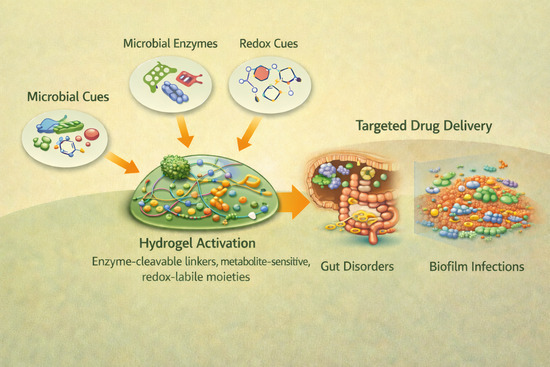
1. Introduction
1.1. Stimuli-Responsive Hydrogels: Design Strategies, Clinical Translation, and Biological Limitations
1.2. Translational Challenges of SRHs
1.2.1. Biocompatibility and Safety
1.2.2. Physiological Complexity
1.2.3. Mechanical Stability
1.2.4. Drug Loading and Release Kinetics
1.2.5. Manufacturing, Scale-Up, and Regulatory Considerations
1.3. The Rationale for MRHS
1.4. Endogenous Biological Triggers Beyond Abiotic Stimuli
1.5. Evolution of Microbiome as a Source of Biologically Relevant Stimuli
2. The Microbiome as a Source of Biologically Relevant Stimuli
2.1. Microbial Metabolites as Hydrogel Triggers
2.1.1. Short-Chain Fatty Acids (SCFAs) and Organic Acids
2.1.2. Gasotransmitters and Reductive Metabolites (e.g., H2S, NO, Sulfides)
2.1.3. Bile Acid-Derived and Other Microbial Catabolites
2.1.4. Nitrogenous Waste and Ammonia Production
2.2. Microbial Enzymes and Enzyme-Triggered Hydrogels
2.3. Microbial Communication Molecules and Biofilm-Derived Signals
2.3.1. QS Molecules as Potential Hydrogel Triggers
2.3.2. Biofilm-Responsive Hydrogels via EPS and Microenvironment Sensing
2.4. Microbiome-Induced Physicochemical Shifts: pH, Redox, Osmotic, and Ionic Changes
2.5. Summary
3. Design Strategies and Material Architecture for MRHs
3.1. Polymer Based on Origin and Source
3.2. Polymer Based on Crosslinking Type
3.3. Molecular and Network-Level Design Principles for Microbiome Responsiveness
4. Biomedical Applications of MRHs
4.1. Infection-Responsive Antimicrobial Delivery and Wound Healing
4.2. Microbiome Modulation and Tissue Regeneration
4.3. Targeted Delivery in Complex Microenvironments (Gut, Oral, Mucosal, Biofilm-Rich Tissues)
4.4. Biosensing, Diagnostics, and Smart Implants
5. Critical Challenges and Translational Barriers
5.1. Heterogeneity and Complexity of Microbial Environments
5.2. Lack of Standardization and Quantitative Characterization
5.3. Biocompatibility, Safety, and Degradation Products
5.4. Scaling, Manufacturing, and Regulatory Hurdles
5.5. Limited Mechanistic Understanding and Predictive Design Frameworks
6. Future Directions and Opportunities
7. Conclusions
Author Contributions
Funding
Data Availability Statement
Acknowledgments
Conflicts of Interest
Abbreviations
| AHL | N-acyl homoserine lactones |
| AIP | Autoinducing peptides |
| ATMP | Advanced therapy medicinal products |
| DSF | Diffusible signal factors |
| EPS | Extracellular polymeric substances |
| ERH | Enzyme-responsive hydrogels |
| GelMA | Gelatin meth acryloyl |
| GMP | Good manufacturing practice |
| GPR41 | G-protein-coupled receptor 41 |
| GPR43 | G-protein-coupled receptor 43 |
| H2S | Hydrogen sulfide |
| IPN | Interpenetrating polymer networks |
| LCST | Lower critical solution temperature |
| MIP | Molecularly imprinted polymers |
| MRH | Microbiome-responsive hydrogels |
| NO | Nitric oxide |
| PEG | Polyethylene glycol |
| PLA | Polylactic acid |
| PLGA | Poly(lactic-co-glycolic acid) |
| PNIPAM | Poly(N-isopropylacrylamide) |
| PVA | Polyvinyl alcohol |
| QS | Quorum sensing |
| ROS | Reactive oxygen species |
| SCFA | Short-chain fatty acids |
| semi-IPN | Semi-interpenetrating polymer networks |
| SRH | Stimuli-responsive hydrogels |
References
- Ahmed, E.M. Hydrogel: Preparation, characterization, and applications. J. Adv. Res. 2015, 6, 105–121. [Google Scholar] [CrossRef] [PubMed]
- Bashir, S.; Hina, M.; Iqbal, J.; Rajpar, A.H.; Mujtaba, M.A.; Alghamdi, N.A.; Wageh, S.; Ramesh, K.; Ramesh, S. Fundamental Concepts of Hydrogels: Synthesis, Properties, and Their Applications. Polymers 2020, 12, 2702. [Google Scholar] [CrossRef]
- Priya, A.S.; Premanand, R.; Ragupathi, I.; Bhaviripudi, V.R.; Aepuru, R.; Kannan, K.; Shanmugaraj, K. Comprehensive Review of Hydrogel Synthesis, Characterization, and Emerging Applications. J. Compos. Sci. 2024, 8, 457. [Google Scholar] [CrossRef]
- Sun, J.-Y.; Zhao, X.; Illeperuma, W.R.K.; Chaudhuri, O.; Oh, K.H.; Mooney, D.J.; Vlassak, J.J.; Suo, Z. Highly stretchable and tough hydrogels. Nature 2012, 489, 133–136. [Google Scholar] [CrossRef]
- Li, J.; Mooney, D.J. Designing hydrogels for controlled drug delivery. Nat. Rev. Mater. 2016, 1, 16071. [Google Scholar] [CrossRef]
- Cai, C.; Li, W.; Zhang, X.; Cheng, B.; Chen, S.; Zhang, Y. Natural Polymer-Based Hydrogel Dressings for Wound Healing. Adv. Wound Care 2025, 14, 295–322. [Google Scholar] [CrossRef] [PubMed]
- Raeisi, A.; Farjadian, F. Commercial hydrogel product for drug delivery based on route of administration. Front. Chem. 2024, 12, 1336717. [Google Scholar] [CrossRef] [PubMed] [PubMed Central]
- Jayakumar, A.; Jose, V.K.; Lee, J.-M. Hydrogels for medical and environmental applications. Small Methods 2020, 4, 1000735. [Google Scholar] [CrossRef]
- Caló, E.; Khutoryanskiy, V.V. Biomedical applications of hydrogels: A review of patents and commercial products. Eur. Polym. J. 2015, 65, 252–267. [Google Scholar] [CrossRef]
- Ullah, F.; Othman, M.B.; Javed, F.; Ahmad, Z.; Md Akil, H. Classification, processing and application of hydrogels: A review. Mater. Sci. Eng. C 2015, 57, 414–433. [Google Scholar] [CrossRef] [PubMed]
- Koetting, M.C.; Peters, J.T.; Steichen, S.D.; Peppas, N.A. Stimulus-responsive hydrogels: Theory, modern advances, and applications. Mater. Sci. Eng. R Rep. 2015, 93, 1–49. [Google Scholar] [CrossRef]
- Roy, A.; Manna, K.; Pal, S. Recent advances in various stimuli-responsive hydrogels: From synthetic designs to emerging healthcare applications. Mater. Chem. Front. 2022, 6, 2338–2385. [Google Scholar] [CrossRef]
- Stuart, M.A.C.; Huck, W.T.S.; Genzer, J.; Müller, M.; Ober, C.; Stamm, M.; Sukhorukov, G.B.; Szleifer, I.; Tsukruk, V.V.; Urban, M.; et al. Emerging applications of stimuli-responsive polymer materials. Nat. Mater. 2010, 9, 101–113. [Google Scholar] [CrossRef]
- Qiu, Y.; Park, K. Environment-sensitive hydrogels for drug delivery. Adv. Drug Deliv. Rev. 2012, 64, 49–60. [Google Scholar] [CrossRef]
- Kleinmann, N.; Wirth, G.; Lin, J.S.; Matin, S.F.; Nativ, O.; Mayer, G.; Witjes, J.A.; Shvero, A.; Chamie, K.; Pantuck, A.J.; et al. Thermoreversible hydrogel-based delivery of mitomycin C (UGN-101) for treatment of upper tract urothelial carcinoma. Bladder Cancer 2018, 5, 21–29. [Google Scholar] [CrossRef]
- Pardeshi, S.; Damiri, F.; Zehravi, M.; Shah, M.; Kaur, A.; Kumar, A.; Hasan, A. Functional thermoresponsive hydrogel molecule-to-material design for biomedical applications. Polymers 2022, 14, 3126. [Google Scholar] [CrossRef]
- Jeong, H.S.; Kim, E.; Park, J.P.; Lee, S.-J.; Lee, H.; Choi, C.-H. Broad-temperature-range mechanically tunable hydrogel microcapsules for controlled active release. J. Control Release 2023, 356, 337–346. [Google Scholar] [CrossRef] [PubMed]
- Salehi, S.; Naghib, S.M.; Garshasbi, H.R.; Ghorbanzadeh, S.; Zhang, W. Smart stimuli-responsive injectable gels and hydrogels for drug delivery and tissue engineering applications: A review. Front. Bioeng. Biotechnol. 2023, 11, 1104126. [Google Scholar] [CrossRef]
- Rizwan, M.; Yahya, R.; Hassan, A.; Yar, M.; Azzahari, A.D.; Selvanathan, V.; Sonsudin, F.; Abouloula, C.N. pH-sensitive hydrogels in drug delivery: History, properties, swelling, and release mechanisms. Polymers 2017, 9, 137. [Google Scholar] [CrossRef] [PubMed]
- Gao, K.; Xu, K. Advancements and prospects of pH-responsive hydrogels in biomedicine. Gels 2025, 11, 293. [Google Scholar] [CrossRef] [PubMed]
- Andrade, F.; Roca-Melendres, M.M.; Durán-Lara, E.F.; Rafael, D.; Schwartz, S., Jr. Stimuli-responsive hydrogels for cancer treatment: The role of pH, light, ionic strength, and magnetic field. Cancers 2021, 13, 1164. [Google Scholar] [CrossRef]
- Wang, Y.; He, G.; Li, Z.; Hua, J.; Wu, M.; Gong, J.; Zhang, J.; Ban, L.-T.; Huang, L. Novel biological hydrogel: Swelling behaviors in salt solutions with different ionic valence numbers. Polymers 2018, 10, 112. [Google Scholar] [CrossRef] [PubMed]
- Liu, Y.; Crawford, A.; Sun, D.; Lu, Z. Ionic-strength responsive hydrogels for biomedical applications. J. Mater. Chem. B 2020, 8, 1234–1249. [Google Scholar]
- Jahanbekam, S.; Asare-Addo, K.; Alipour, S.; Nokhodchi, A. Smart hydrogels and the promise of multi-responsive in situ systems. J. Drug Deliv. Sci. Technol. 2025, 107, 106758. [Google Scholar] [CrossRef]
- Choi, S.; Lee, H.; Park, T.G. Redox-responsive polymeric hydrogels for drug delivery and tissue engineering. Prog. Polym. Sci. 2023, 140, 101693. [Google Scholar]
- Zhao, X.; Wu, H.; Liu, Y. Redox-sensitive hydrogels for inflammation-responsive therapeutics. Biomaterials 2023, 295, 121970. [Google Scholar]
- Varghese, S.; Hwang, N.S.; Elisseeff, J. Injectable hydrogels for regenerative medicine. Chem. Rev. 2022, 122, 7311–7366. [Google Scholar]
- Alfimov, M.V.; Fedorova, O.A.; Gromov, S.P. Photoswitchable molecular receptors. J. Photochem. Photobiol. A Chem. 2003, 158, 183–198. [Google Scholar] [CrossRef]
- Feringa, B.L.; van Delden, R.A.; Koumura, N.; Geertsema, E.M. Chiroptical molecular switches. Chem. Rev. 2000, 100, 1789–1816. [Google Scholar] [CrossRef]
- Kang, H.J.; Lee, Y.J.; Kim, J. Light-responsive hydrogels for programmable drug delivery. Adv. Funct. Mater. 2024, 34, 2309821. [Google Scholar]
- Li, L.; Scheiger, J.M.; Levkin, P.A. Design and applications of photoresponsive hydrogels. Adv. Mater. 2019, 31, 1807333. [Google Scholar] [CrossRef]
- Tomatsu, I.; Peng, K.; Kros, A. Photoresponsive hydrogels for biomedical applications. Adv. Drug Deliv. Rev. 2011, 63, 1257–1266. [Google Scholar] [CrossRef]
- Guo, P.; Dong, L.; Xue, B.; Cao, Y.; Yang, J. From light to life: Molecular mechanisms and macroscopic transformations in photoresponsive hydrogels. Polym. Sci. Technol. 2025, 1, 812–831. [Google Scholar] [CrossRef]
- Li, Z.; Li, Y.; Chen, C.; Cheng, Y. Magnetic-responsive hydrogels: From strategic design to biomedical applications. J. Control. Release 2021, 335, 541–556. [Google Scholar] [CrossRef]
- Frachini, E.C.G.; Petri, D.F.S. Magneto-responsive hydrogels: Preparation, characterization, biotechnological and environmental applications. J. Braz. Chem. Soc. 2019, 30, 2010–2028. [Google Scholar] [CrossRef]
- Jiménez-Gastelum, G.R.; Villegas-Mercado, C.E.; Cota-Quintero, J.L.; Arzola-Rodríguez, S.I.; Ramos-Payán, R.; Bermúdez, M. Hydrogels modulating the microbiome: Therapies for tissue regeneration with infection control. Gels 2025, 11, 584. [Google Scholar] [CrossRef] [PubMed]
- Correa, S.; Chiang, B. Translational applications of hydrogels. Chem. Rev. 2021, 121, 5772–5839. [Google Scholar] [CrossRef]
- Mndlovu, H.; Kumar, P.; du Toit, L.C.; Choonara, Y.E. Challenges in biomaterial degradation assessment and safety evaluation. npj Mater. Degrad. 2024, 9, 112–128. [Google Scholar]
- Sennakesavan, G.; Mostakhdemin, M.; Dkhar, L.K.; Seyfoddin, A.; Fatihhi, S.J. Acrylic acid/acrylamide-based hydrogels and their properties—A review. Polymers 2020, 12, 2071. [Google Scholar]
- Kharkar, P.M.; Kiick, K.L.; Kloxin, A.M. Designing degradable hydrogels for orthogonal control of cell–material interactions. Chem. Soc. Rev. 2013, 42, 7335–7372. [Google Scholar] [CrossRef] [PubMed]
- Yang, Q.; Lai, S.K. Anti-PEG immunity: Emergence, characteristics, and unaddressed questions. Wiley Interdiscip. Rev. Nanomed. Nanobiotechnol. 2015, 7, 655–677. [Google Scholar] [CrossRef]
- Yadav, R.; Prakash, J. Investigating the association of acrylamide with neurotoxicity: Insights from RNA-seq and adverse outcome pathways. Biomed. Pharmacol. J. 2025, 18, 701–712. [Google Scholar] [CrossRef]
- Li, Z.; Zhou, Y.; Li, T.; Zhang, J.; Tian, H. Stimuli-responsive hydrogels: Fabrication and biomedical applications. View 2022, 3, e20200112. [Google Scholar] [CrossRef]
- Lu, Y.; Chen, Y.; Zhu, Y.; Zhao, J.; Ren, K.; Lu, Z.; Li, J.; Hao, Z. Stimuli-responsive protein hydrogels: Their design, properties, and biomedical applications. Polymers 2023, 15, 4652. [Google Scholar] [CrossRef]
- El-Husseiny, H.M.; Mady, E.A.; El-Dakroury, W.A.; Doghish, A.S.; Tanaka, R. Stimuli-responsive hydrogels: Smart state of-the-art platforms for cardiac tissue engineering. Front. Bioeng. Biotechnol. 2023, 11, 1174075. [Google Scholar] [CrossRef]
- Vigata, M.; Meinert, C.; Bock, N.; Dargaville, B.L.; Hutmacher, D.W. Deciphering the molecular mechanism of water interaction with gelatin methacryloyl hydrogels. Biomedicines 2021, 9, 574. [Google Scholar] [CrossRef]
- Lanis, M.R.; Kim, S.; Schneck, J.P. Hydrogels in the immune context: In vivo applications for modulating immune responses in cancer therapy. Gels 2025, 11, 889. [Google Scholar] [CrossRef] [PubMed]
- Lu, P.; Ruan, D.; Huang, M.; Tian, M.; Zhu, K.; Gan, Z.; Xiao, Z. Harnessing the potential of hydrogels for advanced therapeutic applications. Signal Transduct. Target. Ther. 2024, 9, 166. [Google Scholar] [CrossRef] [PubMed]
- McKenzie, M.; Betts, D.; Suh, A.; Bui, K.; Kim, L.D.; Cho, H. Hydrogel-Based Drug Delivery Systems for Poorly Water-Soluble Drugs. Molecules 2015, 20, 20397–20408. [Google Scholar] [CrossRef]
- Malta, R.; Marques, A.C.; Costa, P.C.D.; Amaral, M.H. Stimuli-responsive hydrogels for protein delivery. Gels 2023, 9, 802. [Google Scholar] [CrossRef]
- Solanki, R.; Bhatia, D. Stimulus-responsive hydrogels for targeted cancer therapy. Gels 2024, 10, 440. [Google Scholar] [CrossRef]
- Matin, S.F.; Pierorazio, P.M.; Kleinmann, N.; Gore, J.L.; Shabsigh, A.; Hu, B.; Chamie, K.; Godoy, G.; Hubosky, S.G.; Rivera, M.; et al. Durability of response to primary chemoablation of low-grade upper tract urothelial carcinoma using UGN-101, a mitomycin-containing reverse thermal gel: OLYMPUS trial final report. J. Urol. 2022, 207, 779–788. [Google Scholar] [CrossRef]
- US Securities and Exchange Commission UroGen Pharma Ltd. Available online: https://www.sec.gov/Archives/edgar/data/1668243/000143774925015956/urgn20250331_10q.htm (accessed on 21 January 2026).
- Deb, A.A.; Chitteti, P.; Naushad, N.; Asaad, W.; Leung, S.; Alice, H.; Hosam, S. Role of chemoablation using UGN-101 in upper tract urothelial carcinoma: A systematic review and meta-analysis of available evidence. Urol. Res. Pract. 2024, 50, 72–84. [Google Scholar] [CrossRef] [PubMed]
- Calderon Moreno, J.M.; Chelu, M.; Popa, M. Biocompatible stimuli-sensitive natural hydrogels. Gels 2025, 11, 993. [Google Scholar] [CrossRef]
- Segneanu, A.-E.; Bejenaru, L.E.; Bejenaru, C.; Blendea, A.; Mogoşanu, G.D.; Biţă, A.; Boia, E.R. Advancements in hydrogels: A comprehensive review of natural and synthetic innovations for biomedical applications. Polymers 2025, 17, 2026. [Google Scholar] [CrossRef]
- Almawash, S.; Osman, S.K.; Mustafa, G.; El Hamd, M.A. Current and future prospective of injectable hydrogels—Design challenges and limitations. Pharmaceuticals 2022, 15, 371. [Google Scholar] [CrossRef]
- Zhang, Y.; Wu, B.M. Current advances in stimuli-responsive hydrogels as smart drug delivery carriers. Gels 2023, 9, 838. [Google Scholar] [CrossRef] [PubMed]
- Zheng, S.; Sun, D.-W.; Zhu, Z. Intelligent hydrogels in food systems. Trends Food Sci. Technol. 2025, 165, 105247. [Google Scholar] [CrossRef]
- Protsak, I.S.; Morozov, Y.M. Fundamentals and advances in stimuli-responsive hydrogels. Gels 2025, 11, 30. [Google Scholar] [CrossRef]
- Conte, R.; Valentino, A.; Romano, S.; Margarucci, S.; Petillo, O.; Calarco, A. Stimuli-responsive nanocomposite hydrogels for oral diseases. Gels 2024, 10, 478. [Google Scholar] [CrossRef]
- Cook, A.B.; Decuzzi, P. Harnessing endogenous stimuli for responsive materials in theranostics. ACS Nano 2021, 15, 2068–2098. [Google Scholar] [CrossRef]
- Mohamed, M.A.; Fallahi, A.; El-Sokkary, A.M.A.; Salehi, S.; Akl, M.A.; Jafari, A.; Tamayol, A.; Fenniri, H.; Khademhosseini, A.; Andreadis, S.T.; et al. Stimuli-responsive hydrogels for manipulation of cell microenvironment: From chemistry to biofabrication technology. Prog. Polym. Sci. 2019, 98, 101147. [Google Scholar] [CrossRef]
- Singh, H.; Balusamy, S.R.; Sukweenadhi, J.; Saravanan, M.; Aruchamy, M.; Mijakovic, I.; Singh, P. Smart hybrid nanomaterials for chronic infections: Microbiome-responsive and sustainable therapeutic platforms. J. Nanobiotechnol. 2025, 23, 698. [Google Scholar] [CrossRef]
- Yang, Y.; Wang, J.; Huang, S.; Li, M.; Chen, J.; Pei, D.; Tang, Z.; Guo, B. Bacteria-responsive programmed self-activating antibacterial hydrogel to remodel regeneration microenvironment for infected wound healing. Natl. Sci. Rev. 2024, 11, nwae044. [Google Scholar] [CrossRef] [PubMed]
- Sun, X.; Ding, C.; Qin, M.; Li, J. Hydrogel-based biosensors for bacterial infections. Small 2024, 20, e2306960. [Google Scholar] [CrossRef]
- Carratore, F.D.; Breitling, R. Engineering microbiomes for natural product discovery. Nat. Prod. Rep. 2026. [Google Scholar] [CrossRef]
- Jo, J.; Price-Whelan, A.; Dietrich, L.E.P. Gradients and heterogeneity in biofilms. Nat. Rev. Microbiol. 2022, 20, 593–607. [Google Scholar] [CrossRef] [PubMed]
- Markowska, K.; Szymanek-Majchrzak, K.; Pituch, H.; Majewska, A. Quorum sensing and biofilm formation. Int. J. Mol. Sci. 2024, 25, 12808. [Google Scholar] [CrossRef] [PubMed]
- Koh, A.; De Vadder, F.; Kovatcheva-Datchary, P.; Bäckhed, F. Dietary fiber to host physiology. Cell 2016, 165, 1332–1345. [Google Scholar] [CrossRef]
- Nicholson, J.K.; Holmes, E.; Kinross, J.; Burcelin, R.; Gibson, G.; Jia, W.; Pettersson, S. Host–gut microbiota metabolic interactions. Science 2012, 336, 1262–1267. [Google Scholar] [CrossRef]
- Wallace, J.L.; Motta, J.P.; Buret, A.G. Hydrogen sulfide at the microbiome–mucosa interface. Am. J. Physiol. Gastrointest. Liver Physiol. 2018, 314, G143–G149. [Google Scholar] [CrossRef]
- Stewart, P.S.; Franklin, M.J. Physiological heterogeneity in biofilms. Nat. Rev. Microbiol. 2008, 6, 199–210. [Google Scholar] [CrossRef] [PubMed]
- Ridlon, J.M.; Harris, S.C.; Bhowmik, S.; Kang, D.J.; Hylemon, P.B. Bile salt biotransformations by intestinal bacteria. Gut Microbes 2016, 7, 22–39. [Google Scholar] [CrossRef]
- Zhang, L.S.; Davies, S.S. Microbial metabolism of dietary components. Genome Med. 2016, 8, 46. [Google Scholar] [CrossRef]
- Maslowski, K.M.; Vieira, A.T.; Ng, A.; Kranich, J.; Sierro, F.; Yu, D.; Schilter, H.C.; Rolph, M.S.; Mackay, F.; Artis, D.; et al. Regulation of inflammatory responses by gut microbiota. Nature 2009, 461, 1282–1286. [Google Scholar] [CrossRef] [PubMed]
- Linden, D.R. Hydrogen sulfide signaling in the gastrointestinal tract. Antioxid. Redox Signal. 2023, 38, 120–133. [Google Scholar] [CrossRef] [PubMed]
- Krasenbrink, J.; Hanson, B.T.; Weiss, A.S.; Borusak, S.; Tanabe, T.S.; Lang, M.; Aichinger, G.; Hausmann, B.; Berry, D.; Richter, A.; et al. Sulfoquinovose metabolism by gut microbiota. Microbiome 2025, 13, 184. [Google Scholar] [CrossRef]
- Wahlström, A.; Sayin, S.I.; Marschall, H.-U.; Bäckhed, F. Bile acids and microbiota crosstalk. Cell Metab. 2016, 24, 41–50. [Google Scholar] [CrossRef]
- Li, Y.; Xiao, Y.; Cheng, Y.; Zhang, Y.; Yin, L.; Chen, X. Bile acid-based amphiphilic polymers. Adv. Drug Deliv. Rev. 2019, 145, 63–75. [Google Scholar]
- Mobley, H.L.T.; Island, M.D.; Hausinger, R.P. Molecular biology of microbial ureases. Microbiol. Rev. 1995, 59, 451–480. [Google Scholar] [CrossRef]
- Rutherford, J.C. Urease as a microbial virulence factor. PLoS Pathog. 2014, 10, e1004062. [Google Scholar] [CrossRef]
- Flemming, H.-C.; Wingender, J.; Szewzyk, U.; Steinberg, P.; Rice, S.A.; Kjelleberg, S. Biofilms as bacterial life forms. Nat. Rev. Microbiol. 2016, 14, 563–575. [Google Scholar] [CrossRef]
- Ulijn, R.V.; Smith, A.M. Designing peptide-based nanomaterials. Chem. Soc. Rev. 2008, 37, 664–675. [Google Scholar] [CrossRef]
- Zahid, S.; Ali, R.; Kousar, S.; Yousafzai, M.A.Z.; Muhammad, R.K.; Iqbal, K.; Mahmood, W.; Hasan, T.; Khan, M. Enzyme-responsive hydrogels. Front. Med. Health Res. 2025, 3, 97–110. [Google Scholar]
- Patterson, J.; Hubbell, J.A. Protease-sensitive hydrogels. Biomaterials 2010, 31, 7836–7845. [Google Scholar] [CrossRef] [PubMed]
- Zhao, X.; Guo, B.; Wu, H.; Liang, Y.; Ma, P.X.; Li, X. Injectable antibacterial nanocomposite cryogels. Nat. Commun. 2018, 9, 2784. [Google Scholar] [CrossRef] [PubMed]
- Miller, M.B.; Bassler, B.L. Quorum sensing in bacteria. Annu. Rev. Microbiol. 2001, 55, 165–199. [Google Scholar] [CrossRef]
- Papenfort, K.; Bassler, B.L. Quorum sensing in Gram-negative bacteria. Nat. Rev. Microbiol. 2016, 14, 576–588. [Google Scholar] [CrossRef]
- Al-Madboly, L.A.; Aboulmagd, A.; El-Salam, M.A.; Kushkevych, I.; El-Morsi, R.M. Microbial enzymes as powerful natural anti-biofilm candidates. Microb. Cell Fact. 2024, 23, 343. [Google Scholar] [CrossRef]
- Li, Y.; Liu, Y.; Wu, J.; Zhang, Y.; Li, X.; Chen, X. Molecularly imprinted polymers for quorum sensing. Biosens. Bioelectron. 2019, 126, 598–607. [Google Scholar]
- Wei, M.; Gao, Y.; Li, X.; Serpe, M.J. Stimuli-responsive polymers. Polym. Chem. 2017, 8, 127–143. [Google Scholar] [CrossRef]
- Zhao, X.; Wu, H.; Guo, B.; Li, J.; Zhu, L.; Qu, X.; Ma, P.X.; Li, X. Electroactive injectable hydrogel wound dressing. Biomaterials 2017, 122, 34–47. [Google Scholar] [CrossRef]
- Valdes, A.M.; Walter, J.; Segal, E.; Spector, T.D. Gut microbiota in nutrition and health. BMJ 2018, 361, k2179. [Google Scholar] [CrossRef]
- Gyles, D.A.; Castro, L.D.; Silva, J.O.C.; Ribeiro-Costa, R.M. Biomedical advances of hydrogel formulations. Eur. Polym. J. 2017, 88, 373–392. [Google Scholar] [CrossRef]
- Del Valle, L.J.; Díaz, A.; Puiggalí, J. Hydrogels for biomedical applications. Gels 2017, 3, 27. [Google Scholar] [CrossRef]
- Zhu, T.; Mao, J.; Cheng, Y.; Zhang, X.; Li, X.; Chen, X. Polysaccharide-based hydrogel interfaces. Adv. Mater. Interfaces 2019, 6, 1900761. [Google Scholar] [CrossRef]
- Abatangelo, G.; Vindigni, V.; Avruscio, G.; Riva, F.; Stuplich, M.; Franchi, M. Hyaluronic acid: Redefining its role. Cells 2020, 9, 1743. [Google Scholar] [CrossRef] [PubMed]
- Satitsri, S.; Muanprasat, C. Chitin and chitosan derivatives. Molecules 2020, 25, 5961. [Google Scholar] [CrossRef] [PubMed]
- Oliveira, I.; Carvalho, A.L.; Radhouani, H.; Duarte, A.R.C.; Tavares, P.; Alves, N.M. Promising biomolecules. Adv. Exp. Med. Biol. 2018, 1059, 189–205. [Google Scholar]
- Turturro, M.V.; Christenson, M.C.; Larson, J.C.; Brey, D.M.; Anseth, K.S. MMP-sensitive PEG hydrogels. PLoS ONE 2013, 8, e58897. [Google Scholar]
- Widener, A.E.; Roberts, A.; Phelps, E.A. Guest-host PEG-MAL hydrogels. J. Biomed. Mater. Res. 2023; in press. [Google Scholar]
- Yi, Y.; Chiao, M.; Mahmoud, K.A.; Chen, Y.; Li, X. Conductive PVA/PVP hydrogels. J. Mater. Sci. 2022, 57, 8029–8038. [Google Scholar] [CrossRef]
- Zhong, G.; Qiu, M.; Zhang, J.; Li, X.; Wang, Y.; Chen, Y. Electrospun PVA@PLA nanofibers for wound healing. Int. J. Biol. Macromol. 2023, 234, 123693. [Google Scholar] [CrossRef] [PubMed]
- Gu, J.; Clegg, J.R.; Heersema, L.A.; Smith, A.E.; Jones, B.R.; Li, X. PEGylated cationic nanogels. Biomacromolecules 2020, 21, 1528–1538. [Google Scholar] [CrossRef] [PubMed]
- Jagadeeshwar, K. PVA and hyaluronic acid hydrogels. J. Drug Deliv. Sci. Technol. 2022, 72, 103410. [Google Scholar]
- Ho, T.C.; Chang, C.C.; Chan, H.P.; Wang, Y.; Lee, S.H.; Lin, Y.J. Hydrogels in biomedicine. Molecules 2022, 27, 2902. [Google Scholar] [CrossRef]
- Bustamante-Torres, M.; Romero-Fierro, D.; Arcentales-Vera, B.; Salazar-Gómez, A.; Mendoza-Núñez, G.; Torres, A. Hydrogels classification. Gels 2021, 7, 182. [Google Scholar] [CrossRef] [PubMed]
- Li, C.S.; Xu, Y.; Li, J.; Chen, X.; Zhang, Y.; Wu, H. Polymer hydrogel scaffolds for cartilage repair. BioMed Eng. OnLine 2025, 24, 13. [Google Scholar] [CrossRef]
- Rahman, M.; Teimouri, S.; Roy, P.R.; Alam, S.; Khan, M.I.; Hasan, T. Release kinetics from biopolymeric hydrogels. Gels 2025, 11, 986. [Google Scholar] [CrossRef]
- Thang, N.H.; Tran, T.H.; Nguyen, D.T.; Le, V.T.; Pham, H.Q.; Hoang, T.M. Polymer-based hydrogels in drug delivery. Polymers 2023, 15, 523. [Google Scholar]
- Kuang, X.; Liu, W.; Chen, Y.; Zhao, X.; Li, X.; Ma, P.X. Functional tough hydrogels. Acc. Mater. Res. 2022, 3, 1743–1756. [Google Scholar]
- Myung, D.; Waters, D.; Wiseman, M.; Park, H.; Kim, J.; Hahn, M.S. Interpenetrating polymer network hydrogels. Polym. Adv. Technol. 2008, 19, 647–657. [Google Scholar] [CrossRef]
- Vartak, D.G.; Gemeinhart, R.A. Matrix metalloproteinases in drug delivery. J. Drug Target. 2007, 15, 1–20. [Google Scholar] [CrossRef]
- Keeney, M.; Waters, H.; Barzegar, M.; Bruns, M.; Li, X.; Liu, Y. β-Lactamase-responsive hydrogel. Adv. Healthc. Mater. 2020, 9, 1901480. [Google Scholar]
- Alkekhia, D.; LaRose, C.; Shukla, A. Bacteria-triggered hydrogel drug delivery. ACS Appl. Mater. Interfaces 2022, 14, 27538–27550. [Google Scholar] [CrossRef]
- Hernández-García, A.; Kraft, D.J.; Janssen, A.F.J.; Schenning, A.P.H.J.; Broer, D.J.; Meskers, S.C.J. Enzyme-responsive hydrogels. ACS Appl. Mater. Interfaces 2018, 10, 1805–1815. [Google Scholar]
- Qiao, B.; Wang, J.; Qiao, L.; Li, X.; Zhang, Y.; Chen, X. ROS-responsive hydrogels for infected wounds. Regener. Biomater. 2024, 11, rbad110. [Google Scholar] [CrossRef] [PubMed]
- Appel, E.A.; del Barrio, J.; Loh, X.J.; Scherman, O.A. Supramolecular polymeric hydrogels. Chem. Soc. Rev. 2012, 41, 6195–6214. [Google Scholar] [CrossRef]
- Webber, M.J.; Appel, E.A.; Meijer, E.W.; Langer, R. Supramolecular biomaterials. Nat. Mater. 2016, 15, 13–26. [Google Scholar] [CrossRef] [PubMed]
- Wang, H.; Heilshorn, S.C. Adaptable hydrogel networks. Adv. Mater. 2015, 27, 3717–3736. [Google Scholar] [CrossRef]
- Zhou, H.; Zhu, Y.; Yang, B.; Li, X.; Chen, Y.; Ma, P.X. Stimuli-responsive peptide hydrogels. J. Mater. Chem. B 2024, 12, 1748–1774. [Google Scholar] [CrossRef]
- Zhang, Y.; Chan, H.F.; Leong, K.W. Advanced materials for drug delivery. Adv. Drug Deliv. Rev. 2013, 65, 104–120. [Google Scholar] [CrossRef] [PubMed]
- Ma, X.; Kanaparedu, S.; Zhang, P.; Chen, J. Injectable stimuli-responsive hydrogels. Biomater. Sci. 2024, 12, 5468–5480. [Google Scholar] [CrossRef]
- Yang, C.; Zhao, C.; Chen, Y.; Li, H.; Guo, B.; Li, X. Nitric oxide-releasing hydrogel dressing. ACS Nano 2020, 14, 11460–11475. [Google Scholar]
- Fang, Z.; He, Q.; Hu, Y.; Li, X.; Chen, Y.; Zhang, L. Polydopamine-assisted bacteria-responsive hydrogel. J. Adv. Res. 2025, 73, 283–294. [Google Scholar] [CrossRef] [PubMed]
- Jung, Y.; Ji, Y.; Kang, J.; Kim, H.; Lee, S.; Park, J. Biomaterials for gut microbiota modulation. Adv. Drug Deliv. Rev. 2022, 185, 114285. [Google Scholar]
- Li, Z.; Wang, Y.; Shen, Y.; Qiu, L. Hydrogels for microbiome regulation. Bioact. Mater. 2023, 20, 96–112. [Google Scholar]
- Chen, H.; Cheng, R.; Zhao, X.; Li, X.; Ma, P.X. Injectable self-healing antibacterial hydrogel. Biomaterials 2018, 178, 239–252. [Google Scholar]
- Yetisen, A.K.; Akram, M.S.; Lowe, C.R. Paper-based microfluidic devices. Lab Chip 2013, 13, 2210–2251. [Google Scholar] [CrossRef]
- Chen, G.; Guo, Z.; Zeng, J.; Li, X.; Wang, Y.; Zhang, Y. Bacteria-responsive hydrogel biosensors. Biosens. Bioelectron. 2021, 177, 112983. [Google Scholar]
- Hu, X.; Li, D.; Zhou, F.; Gao, C. Biological hydrogels for biosensors. Adv. Drug Deliv. Rev. 2018, 123, 238–254. [Google Scholar]
- Human Microbiome Project Consortium. Structure and diversity of the human microbiome. Nature 2012, 486, 207–214. [Google Scholar] [CrossRef]
- Lozupone, C.A.; Stombaugh, J.I.; Gordon, J.I.; Jansson, J.K.; Knight, R.; Huttenhower, C. Diversity and resilience of gut microbiota. Nature 2012, 489, 220–230. [Google Scholar] [CrossRef]
- Foster, K.R.; Schluter, J.; Coyte, K.Z.; Rakoff-Nahoum, S. Host microbiome as an ecosystem. Nature 2017, 548, 43–51. [Google Scholar] [CrossRef] [PubMed]
- Hoare, T.R.; Kohane, D.S. Hydrogels in drug delivery. Polymer 2008, 49, 1993–2007. [Google Scholar] [CrossRef]
- Franzesi, G.T.; Ni, B.; Ling, Y.; Khademhosseini, A. Controlled-release tissue gradients. Adv. Mater. 2006, 18, 1865–1869. [Google Scholar]
- Anderson, J.M.; Rodriguez, A.; Chang, D.T. Foreign body reaction to biomaterials. Semin. Immunol. 2008, 20, 86–100. [Google Scholar] [CrossRef] [PubMed]
- Li, Z.; Guo, X.; Guan, J. Hydrogels for tissue engineering. Bioact. Mater. 2022, 11, 1–15. [Google Scholar]
- Tareke, E.; Rydberg, P.; Karlsson, P.; Eriksson, S.; Törnqvist, M. Acrylamide in heated foods. J. Agric. Food Chem. 2002, 50, 4998–5006. [Google Scholar] [CrossRef]
- Mitchell, M.J.; Billingsley, M.M.; Haley, R.M.; Wechsler, M.E.; Peppas, N.A.; Langer, R.; Jaklenec, A. Precision nanoparticles for drug delivery. Nat. Rev. Drug Discov. 2021, 20, 101–124. [Google Scholar] [CrossRef]
- Celis, J.E.; Pavalkis, D.; Reuss, J. Regulatory aspects of ATMPs. Nat. Biotechnol. 2007, 25, 503–508. [Google Scholar]
- Peppas, N.A.; Khare, A.R. Hydrogels in controlled release. Adv. Drug Deliv. Rev. 1993, 11, 1–35. [Google Scholar] [CrossRef]
- Carlborg, C.F.; Haraldsson, T.; Öberg, K.; Malkoch, M.; Hjort, K. Thiol–ene polymers for microfluidics. Lab Chip 2011, 11, 3136–3147. [Google Scholar] [CrossRef]
- Franzosa, E.A.; McIver, L.J.; Rahnavard, G.; Thompson, L.R.; Schirmer, M.; Weingart, G.; Lipson, K.S.; Knight, R.; Caporaso, J.G.; Segata, N.; et al. Functional profiling of metagenomes. Nat. Methods 2018, 15, 962–968. [Google Scholar] [CrossRef]
- Lloyd-Price, J.; Mahurkar, A.; Rahnavard, G.; Crabtree, J.; Orvis, J.; Hall, A.B.; Brady, A.; Creasy, H.H.; McCracken, C.; Giglio, M.G.; et al. Multi-omics of gut microbial ecosystems. Nature 2019, 569, 655–662. [Google Scholar] [CrossRef]
- Turnbaugh, P.J.; Ley, R.E.; Hamady, M.; Fraser-Liggett, C.M.; Knight, R.; Gordon, J.I. The human microbiome project. Nature 2007, 449, 804–810. [Google Scholar] [CrossRef] [PubMed]
- Peppas, N.A.; Huang, Y.; Torres-Lugo, M.; Ward, J.H.; Zhang, J. Physicochemical foundations of hydrogels. Annu. Rev. Biomed. Eng. 2000, 2, 9–29. [Google Scholar] [CrossRef]
- Gong, J.P. Why are double network hydrogels so tough? Soft Matter 2010, 6, 2583–2590. [Google Scholar] [CrossRef]
- Stewart, P.S. Diffusion in biofilms. J. Bacteriol. 2003, 185, 1485–1491. [Google Scholar] [CrossRef] [PubMed]
- Kreft, J.U.; Booth, G.; Wimpenny, J.W.T. BacSim bacterial growth simulator. Microbiology 1998, 144, 3275–3287. [Google Scholar] [CrossRef]
- Belkaid, Y.; Hand, T.W. Microbiota in immunity and inflammation. Cell 2014, 157, 121–141. [Google Scholar] [CrossRef] [PubMed]
- Gu, Z.; Aimetti, A.A.; Wang, Q.; Dang, T.T.; Zhang, Y.; Veiseh, O.; Cheng, H.; Langer, R.; Anderson, D.G. Injectable nano-network for insulin delivery. ACS Nano 2013, 7, 4194–4201. [Google Scholar] [CrossRef] [PubMed]
- Yu, Y.; Zhang, Y.; Martin, J.A.; Ozbolat, I.T. Cell-laden tubular channels. ACS Appl. Mater. Interfaces 2013, 5, 6302–6310. [Google Scholar]
- Tang, L.; Wang, L.; Yang, X.; Li, J.; Ma, P.X.; Zhao, X. PNIPAM-based smart hydrogels. Prog. Mater. Sci. 2021, 115, 100702. [Google Scholar] [CrossRef]




| Dimension | Stimuli-Responsive Hydrogels (SRHs) | Microbiome-Responsive Hydrogels (MRHs) |
|---|---|---|
| Primary trigger source | Abiotic or externally applied cues (pH, temperature, redox, light, magnetic/electric fields) | Endogenous, microbe-derived biochemical and metabolic cues |
| Nature of stimulus | Physicochemical and largely generic | Biological and context-dependent (microbial enzymes, metabolites, signaling molecules) |
| Biological specificity | Low to moderate; the same stimulus may occur in healthy and diseased tissues | High; triggers are linked to microbial composition and activity at a given site |
| Spatiotemporal control | Often coarse and externally imposed or systemically present | Intrinsic and localized to microbial niches; dynamically reflects microbial activity |
| Mechanistic activation | Polymer phase transitions (swelling, collapse, bond cleavage) driven by environmental parameters | Material responses driven by microbial metabolism, enzymatic reactions, or signaling pathways |
| Physiological relevance | Limited representation of complex host–microbe interactions | Directly aligned with host–microbiome microenvironment and disease biology |
| Therapeutic targeting potential | Broad or tissue-level targeting | Precision targeting of disease-associated microbial communities or infected/inflamed niches |
| Robustness and predictability | Generally high and reproducible across models | More variable due to inter-individual and temporal microbiome heterogeneity |
| Design complexity | Relatively well-established material chemistries and architectures | Requires integration of microbiology, enzymology, and material design |
| Translational maturity | More advanced, including clinically validated systems | Early-stage and fragmented; limited standardization and validation frameworks |
| Key translational challenge | Achieving adequate site specificity and controlled activation in vivo | Managing microbiome variability, safety, and regulatory qualification of biological triggers |
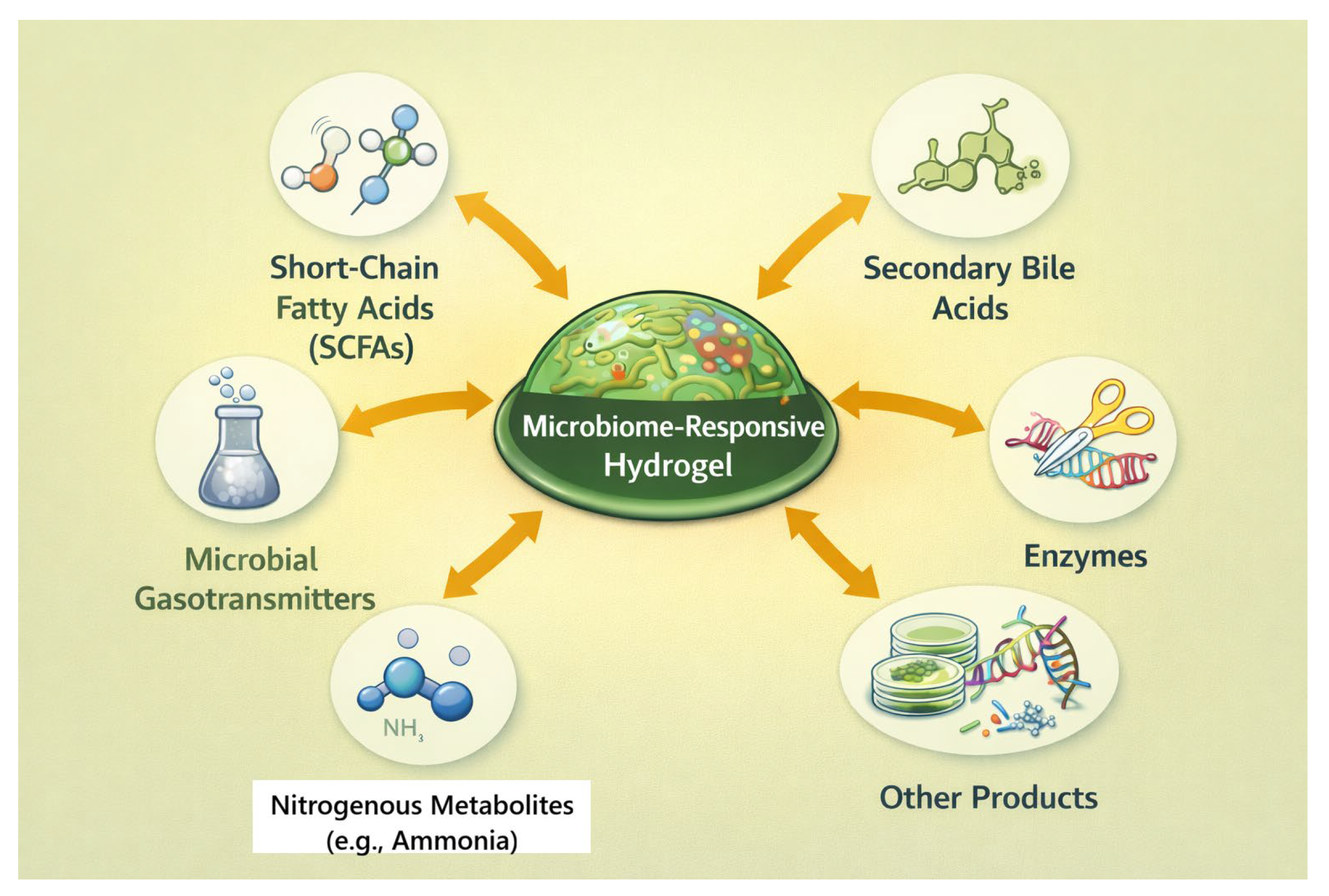
| Microbial | Representative Metabolites/Signals | Typical Microbial Sources/Sites | Microenvironmental Effect | Hydrogel Activation Mechanism | Potential Biomedical Applications |
|---|---|---|---|---|---|
| SCFAs | Acetate, propionate, butyrate [70] | Gut microbiota (Bacteroides, Firmicutes); chronic wounds [70] | Local pH reduction; osmotic changes | pH-responsive swelling/deswelling; ionizable polymer transitions | Colon-targeted drug delivery; inflammation-responsive release |
| Microbial gasotransmitters | Hydrogen sulfide (H2S), nitric oxide (NO), carbon dioxide (CO2) [72] | Anaerobic gut bacteria; infected or ischemic wounds [72] | Redox modulation; gas accumulation | Redox-sensitive linkers; gas-responsive degradation | Infection-responsive drug release; wound healing |
| Nitrogenous metabolites | Ammonia, amines [71] | Oral biofilms; skin; urogenital tract [71,73] | Local alkalinization; chemical stress | pH-triggered network collapse or accelerated degradation | Oral disease treatment; antimicrobial delivery |
| Secondary bile acids | Deoxycholic acid, lithocholic acid [74] | Intestinal microbiota-mediated bile metabolism [74] | Formation of hydrophobic microdomains; membrane perturbation | Hydrophobic interaction-driven network reorganization | Gut-specific drug release; metabolic disease intervention |
| Biofilm-associated metabolite gradients | Mixed organic acids, alcohols, indoles [71,73] | Biofilms in wounds, gut, and medical-device-associated infections [73] | Sharp spatial chemical gradients; localized hypoxia | Gradient-dependent spatial activation or erosion | Biofilm-targeted therapy; site-specific delivery |
Disclaimer/Publisher’s Note: The statements, opinions and data contained in all publications are solely those of the individual author(s) and contributor(s) and not of MDPI and/or the editor(s). MDPI and/or the editor(s) disclaim responsibility for any injury to people or property resulting from any ideas, methods, instructions or products referred to in the content. |
© 2026 by the authors. Licensee MDPI, Basel, Switzerland. This article is an open access article distributed under the terms and conditions of the Creative Commons Attribution (CC BY) license.
Share and Cite
Vadlapatla, R.; Shirazi, A.N.; Koomer, A.; Weng, J.; Ghilarducci, M.E.; Qudus, A.; Parang, K. Microbiome-Responsive Hydrogels: From Biological Cues to Smart Biomaterials. Pharmaceutics 2026, 18, 284. https://doi.org/10.3390/pharmaceutics18030284
Vadlapatla R, Shirazi AN, Koomer A, Weng J, Ghilarducci ME, Qudus A, Parang K. Microbiome-Responsive Hydrogels: From Biological Cues to Smart Biomaterials. Pharmaceutics. 2026; 18(3):284. https://doi.org/10.3390/pharmaceutics18030284
Chicago/Turabian StyleVadlapatla, Rajesh, Amir Nasrolahi Shirazi, Ajoy Koomer, Judy Weng, Matthew Ernest Ghilarducci, Alai Qudus, and Keykavous Parang. 2026. "Microbiome-Responsive Hydrogels: From Biological Cues to Smart Biomaterials" Pharmaceutics 18, no. 3: 284. https://doi.org/10.3390/pharmaceutics18030284
APA StyleVadlapatla, R., Shirazi, A. N., Koomer, A., Weng, J., Ghilarducci, M. E., Qudus, A., & Parang, K. (2026). Microbiome-Responsive Hydrogels: From Biological Cues to Smart Biomaterials. Pharmaceutics, 18(3), 284. https://doi.org/10.3390/pharmaceutics18030284