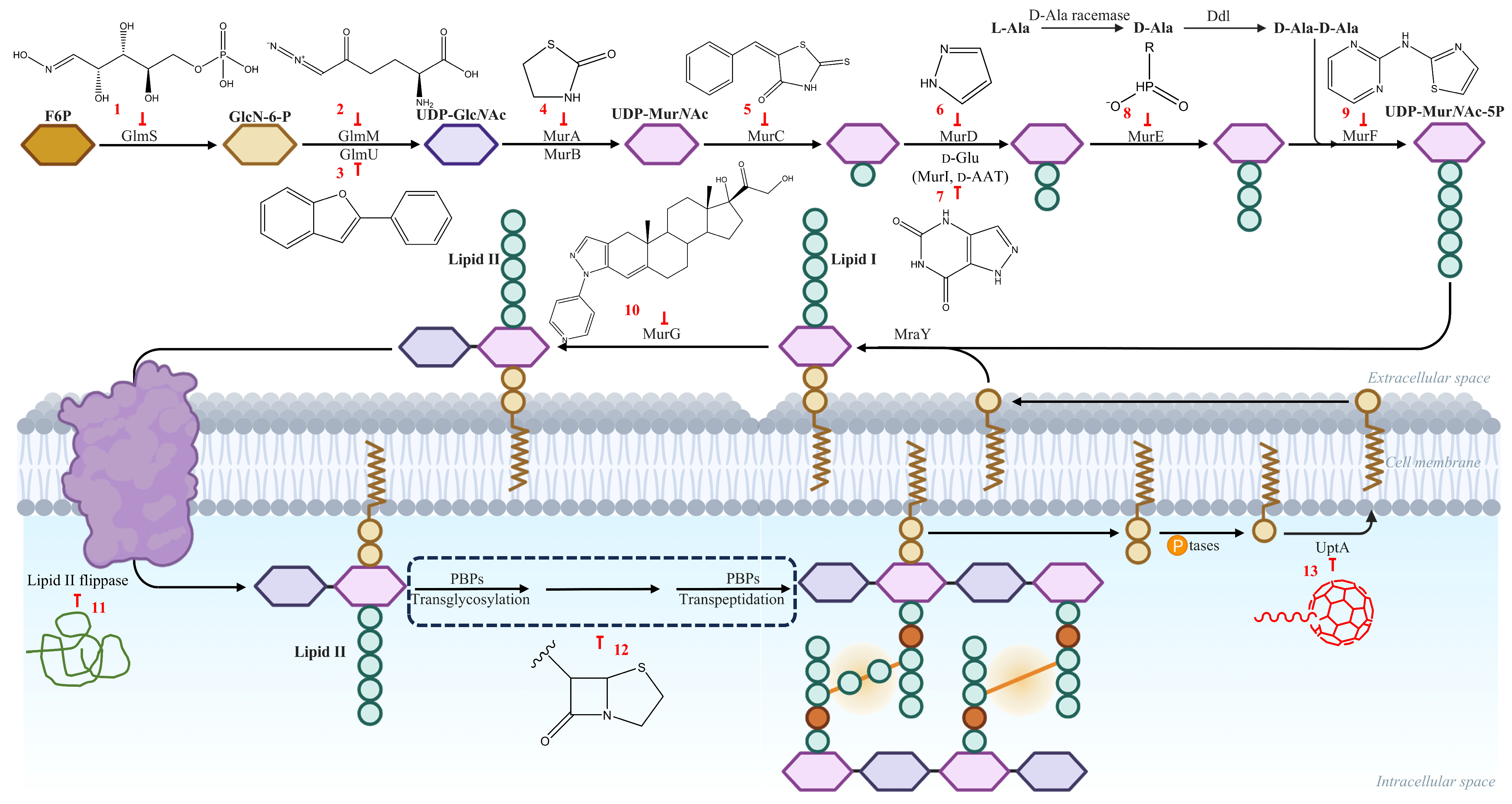
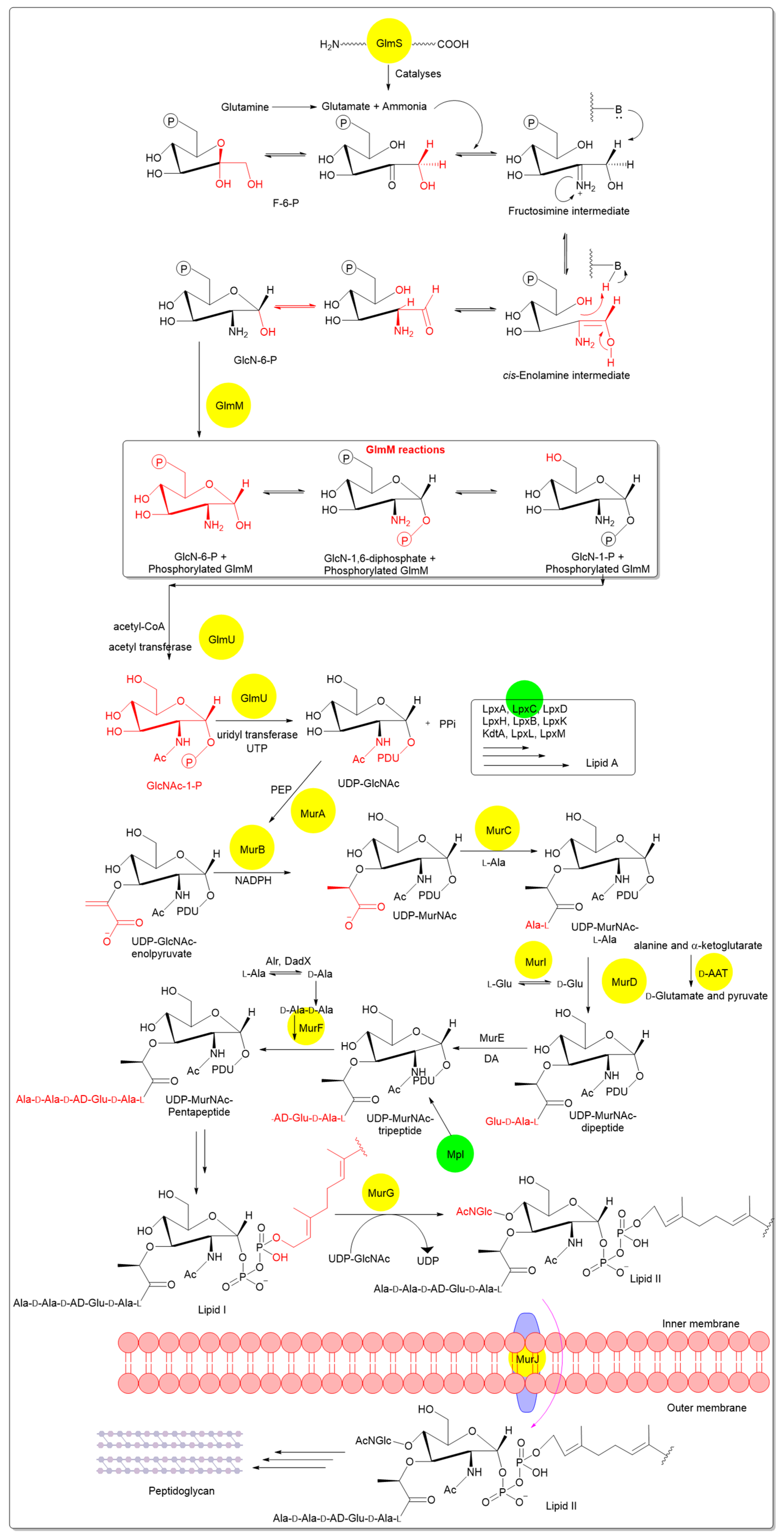
Targeting Bacterial Cell Wall Synthesis: Structural Insights and Emerging Therapeutic Strategies



Abstract
1. Introduction
2. Established and Clinically Exploited Targets in Bacterial Cell Wall Biosynthesis
2.1. Periplasmic Cross-Linking Enzymes
2.2. Cytoplasmic Peptide Stem Synthesis Enzymes
2.3. Lipid Carrier Recycling and Membrane-Associated Targets
2.4. Cell Wall Remodeling Enzymes
2.5. Structural Basis of Target Exploitation
3. Unexplored Targets in Cell Wall Biosynthesis
3.1. Glucosamine-6-phosphate Synthase (l-glutamine: d-fructose-6-phosphate Amidotransferase; GlmS)
3.2. Phosphoglucosamine Mutase (GlmM)
3.3. N-Acetylglucosamine-1-phosphate Uridyl Transferase (GlmU)
3.4. Mur Ligases
3.4.1. MurA (UDP-GlcNAc Enolpyruvyl Transferase)
3.4.2. MurB (UDP-N-acetylenolpyruvylglucosamine Reductase)
3.4.3. MurC-F (Synthetases)
3.5. Mpl
3.6. Glutamate Racemase (MurI) and d-Amino Acid Amino Transferase (d-AAT)
3.7. MurG (Translocase II)
3.8. LpxC Enzyme
3.9. Auxiliary Cell Wall Enzymes: d,l-Transpeptidases and Lytic Transglycosylases
3.10. Bactoprenol Recycling Enzymes
3.11. Regulatory Proteins: FtsZ and Divisome Assembly
3.12. Outer Membrane Biogenesis Proteins in GNB
3.13. Teichoic Acid Biosynthesis
3.14. Peptidoglycan O-Acetyltransferases and Amidases
3.15. Non-Mevalonate or Methylerythritol 4-phosphate (MEP) Pathway
3.16. Two-Component Regulatory Systems
4. Structural Insights into Bacterial Cell Wall Targets: Implications for Antibiotic Discovery
5. Inhibitors of Bacterial Cell Wall Synthesis
6. Emerging Strategies and Combination Approaches Targeting Cell Wall Biosynthesis
6.1. Therapeutic Combinations and Synergistic Compounds
6.2. Emerging and Investigational Inhibitors
7. Author’s Perspective
8. Conclusions
Author Contributions
Funding
Institutional Review Board Statement
Informed Consent Statement
Data Availability Statement
Acknowledgments
Conflicts of Interest
Abbreviations
| MDR | Multidrug-resistant |
| XDR | Extensively drug-resistant |
| Ddl | d-Ala ligase |
| Alr | d-Ala racemase |
| cryo-EM | Cryo-electron microscopy |
| NMR | Nuclear magnetic resonance |
| FBDD | Fragment-based drug discovery |
| SBDD | Structure-based drug design |
| PBPs | Penicillin-binding proteins |
| DHp | Dimerization and histidine phosphotransfer |
| CA | Catalytic and ATP-binding domain |
| TCS | Two-component systems |
| BHK | Bacterial histidine kinases |
| IspH | 1-hydroxy-2-methyl-butenyl 4-diphosphate reductase |
| IspG | 4-hydroxy-3-methylbut-2-en-1-yl diphosphate synthase |
| IspF | 2-C-methyl-d-erythritol 2,4-cyclodiphosphate synthase |
| IspE | 4-diphosphocytidyl-2-C-methylerythritol kinase |
| IspD | 4-diphosphocytidyl-2-C-methyl-d-erythritol synthase |
| Dxr | 1-deoxy-d-xylulose 5-phosphate reductoisomerase |
| Dxs | 1-deoxy-d-xylulose-5-phosphate synthase |
| MEP | Non-mevalonate or methylerythritol 4-phosphate pathway |
| OatA | O-acetyltransferase A |
| LTAs | Lipoteichoic acids |
| WTAs | Wall teichoic acids |
| OMPs | Outer membrane proteins |
| PBPs | D,D-transpeptidases |
| LpxC | UDP-3O-(R-3-hydroxymyristoyl)-N-acteylglucosamine deacetylase |
| d-AAT | d-Amino acid aminotransferase |
| Mpl | Murein peptide ligase |
| PG | Peptidoglycan |
| mA2pm | meso-diaminopimelic acid |
References
- Salam, M.A.; Al-Amin, M.Y.; Salam, M.T.; Pawar, J.S.; Akhter, N.; Rabaan, A.A.; Alqumber, M.A. Antimicrobial resistance: A growing serious threat for global public health. Healthcare 2023, 11, 1946. [Google Scholar] [CrossRef] [Scilit]
- Ferri, M.; Ranucci, E.; Romagnoli, P.; Giaccone, V. Antimicrobial resistance: A global emerging threat to public health systems. Crit. Rev. Food Sci. Nutr. 2017, 57, 2857–2876. [Google Scholar] [CrossRef] [Scilit]
- World Health Organization. Global Research Agenda for Antimicrobial Resistance in Human Health; World Health Organization: Geneva, Switzerland, 2024. [Google Scholar]
- Hauser, A. Antibiotic Basics for Clinicians; Lippincott Williams & Wilkins: Ambler, PA, USA, 2018. [Google Scholar]
- Walsh, C. Antibiotics: Actions, Origins, Resistance; American Society for Microbiology (ASM): Washington, DC, USA, 2003. [Google Scholar]
- Scheffers, D.-J.; Pinho, M.G. Bacterial cell wall synthesis: New insights from localization studies. Microbiol. Mol. Biol. Rev. 2005, 69, 585–607. [Google Scholar] [CrossRef] [Scilit]
- Liu, Y.; Breukink, E. The membrane steps of bacterial cell wall synthesis as antibiotic targets. Antibiotics 2016, 5, 28. [Google Scholar] [CrossRef] [Scilit]
- Barreteau, H.; Kovač, A.; Boniface, A.; Sova, M.; Gobec, S.; Blanot, D. Cytoplasmic steps of peptidoglycan biosynthesis. FEMS Microbiol. Rev. 2008, 32, 168–207. [Google Scholar] [CrossRef] [Scilit]
- de Kruijff, B.; van Dam, V.; Breukink, E. Lipid II: A central component in bacterial cell wall synthesis and a target for antibiotics. Prostaglandins Leukot. Essent. Fat. Acids 2008, 79, 117–121. [Google Scholar] [CrossRef] [Scilit]
- Walter, A.; Mayer, C. Peptidoglycan structure, biosynthesis, and dynamics during bacterial growth. In Extracellular Sugar-Based Biopolymers Matrices; Springer International Publishing: Cham, Switzerland, 2019; pp. 237–299. [Google Scholar]
- Sarkar, P.; Haldar, J. Glycopeptide antibiotics: Mechanism of action and recent developments. In Antibiotic Drug Resistance; Wiley Online Library: Hoboken, NJ, USA, 2019; pp. 73–95. [Google Scholar]
- Binda, E.; Marinelli, F.; Marcone, G.L. Old and new glycopeptide antibiotics: Action and resistance. Antibiotics 2014, 3, 572–594. [Google Scholar] [CrossRef] [Scilit] [PubMed]
- Yoo, J.; Mashalidis, E.H.; Kuk, A.C.; Yamamoto, K.; Kaeser, B.; Ichikawa, S.; Lee, S.-Y. GlcNAc-1-P-transferase–tunicamycin complex structure reveals basis for inhibition of N-glycosylation. Nat. Struct. Mol. Biol. 2018, 25, 217–224. [Google Scholar] [CrossRef] [Scilit] [PubMed]
- Kernodle, D.S. Mechanisms of Resistance to β-Lactam Antibiotics. In Gram-Positive Pathogens; Wiley Online Library: Hoboken, NJ, USA, 2006; pp. 769–781. [Google Scholar]
- Kumar, S.; Mollo, A.; Kahne, D.; Ruiz, N. The bacterial cell wall: From lipid II flipping to polymerization. Chem. Rev. 2022, 122, 8884–8910. [Google Scholar] [CrossRef] [Scilit]
- Ng, V.; Chan, W.C. New found hope for antibiotic discovery: Lipid II inhibitors. Chem.–A Eur. J. 2016, 22, 12606–12616. [Google Scholar] [CrossRef] [Scilit] [PubMed]
- Ling, L.L.; Schneider, T.; Peoples, A.J.; Spoering, A.L.; Engels, I.; Conlon, B.P.; Mueller, A.; Schäberle, T.F.; Hughes, D.E.; Epstein, S.; et al. A new antibiotic kills pathogens without detectable resistance. Nature 2015, 517, 455–459. [Google Scholar] [CrossRef] [Scilit] [PubMed]
- Garde, S.; Chodisetti, P.K.; Reddy, M. Peptidoglycan: Structure, synthesis, and regulation. EcoSal Plus 2021, 9. [Google Scholar] [CrossRef] [Scilit]
- Torrens, G.; Cava, F. Mechanisms conferring bacterial cell wall variability and adaptivity. Biochem. Soc. Trans. 2024, 52, 1981–1993. [Google Scholar] [CrossRef] [Scilit]
- Bagdad, Y.; Miteva, M.A. Recent applications of artificial intelligence in discovery of new antibacterial agents. Adv. Appl. Bioinform. Chem. 2024, ume 17, 139–157. [Google Scholar] [CrossRef] [Scilit]
- Gangwal, A.; Lavecchia, A. Artificial Intelligence in Natural Product Drug Discovery: Current Applications and Future Perspectives. J. Med. Chem. 2025, 68, 3948–3969. [Google Scholar] [CrossRef] [Scilit]
- Vila, J.; Moreno-Morales, J.; Ballesté-Delpierre, C. Current landscape in the discovery of novel antibacterial agents. Clin. Microbiol. Infect. 2020, 26, 596–603. [Google Scholar] [CrossRef] [Scilit] [PubMed]
- Monaghan, R.L.; Barrett, J.F. Antibacterial drug discovery—Then, now and the genomics future. Biochem. Pharmacol. 2006, 71, 901–909. [Google Scholar] [CrossRef] [Scilit] [PubMed]
- Sauvage, E.; Terrak, M. Glycosyltransferases and transpeptidases/penicillin-binding proteins: Valuable targets for new antibacterials. Antibiotics 2016, 5, 12. [Google Scholar] [CrossRef] [Scilit] [PubMed]
- Miyachiro, M.M.; Contreras-Martel, C.; Dessen, A. Penicillin-binding proteins (PBPs) and bacterial cell wall elongation complexes. Macromol. Protein Complexes II Struct. Funct. 2019, 93, 273–289. [Google Scholar]
- Gloster, T.M. Advances in understanding glycosyltransferases from a structural perspective. Curr. Opin. Struct. Biol. 2014, 28, 131–141. [Google Scholar] [CrossRef] [Scilit]
- Halliday, J.; McKeveney, D.; Muldoon, C.; Rajaratnam, P.; Meutermans, W. Targeting the forgotten transglycosylases. Biochem. Pharmacol. 2006, 71, 957–967. [Google Scholar] [CrossRef] [Scilit]
- Batson, S.; de Chiara, C.; Majce, V.; Lloyd, A.J.; Gobec, S.; Rea, D.; Fülöp, V.; Thoroughgood, C.W.; Simmons, K.J.; Dowson, C.G.; et al. Inhibition of D-Ala: D-Ala ligase through a phosphorylated form of the antibiotic D-cycloserine. Nat. Commun. 2017, 8, 1939. [Google Scholar] [CrossRef] [Scilit] [PubMed]
- Zhao, H.; Sun, Y.; Peters, J.M.; Gross, C.A.; Garner, E.C.; Helmann, J.D. Depletion of undecaprenyl pyrophosphate phosphatases disrupts cell envelope biogenesis in Bacillus subtilis. J. Bacteriol. 2016, 198, 2925–2935. [Google Scholar] [CrossRef] [Scilit]
- Oluwole, A.O.; Hernández-Rocamora, V.M.; Cao, Y.; Li, X.; Vollmer, W.; Robinson, C.V.; Bolla, J.R. Real-time biosynthetic reaction monitoring informs the mechanism of action of antibiotics. J. Am. Chem. Soc. 2024, 146, 7007–7017. [Google Scholar] [CrossRef] [Scilit]
- Cudic, M.; Fields, G.B. Extracellular proteases as targets for drug development. Curr. Protein Pept. Sci. 2009, 10, 297–307. [Google Scholar] [CrossRef] [Scilit]
- Maddocks, S.E. Novel targets of antimicrobial therapies. Microbiol. Spectr. 2016, 4, 10–1128. [Google Scholar] [CrossRef] [Scilit]
- Peraman, R.; Sure, S.K.; Dusthackeer, V.A.; Chilamakuru, N.B.; Yiragamreddy, P.R.; Pokuri, C.; Kutagulla, V.K.; Chinni, S. Insights on recent approaches in drug discovery strategies and untapped drug targets against drug resistance. Future J. Pharm. Sci. 2021, 7, 56. [Google Scholar] [CrossRef] [Scilit]
- Ghosh, S.; Blumenthal, H.J.; Davidson, E.; Roseman, S. Glucosamine metabolism: V. enzymatic synthesis of glucosamine 6-phosphate. J. Biol. Chem. 1960, 235, 1265–1273. [Google Scholar] [CrossRef] [Scilit]
- Badet-Denisot, M.-A.; Rene, L.; Badet, B. Mechanistic investigations on glucosamine-6-phosphate synthase. Bull. De La Société Chim. De Fr. 1993, 130, 249–255. [Google Scholar]
- Massière, F.; Badet-Denisot, M.-A. The mechanism of glutamine-dependent amidotransferases. Cell. Mol. Life Sci. CMLS 1998, 54, 205–222. [Google Scholar] [CrossRef] [Scilit] [PubMed]
- Kort, M. Reactions of free sugars with aqueous ammonia. In Advances in Carbohydrate Chemistry and Biochemistry; Elsevier: Amsterdam, The Netherlands, 1970; Volume 25, pp. 311–349. [Google Scholar]
- Golinelli-Pimpaneau, B.a.; Le Goffic, F.; Badet, B. Glucosamine-6-phosphate synthase from Escherichia coli: Mechanism of the reaction at the fructose 6-phosphate binding site. J. Am. Chem. Soc. 1989, 111, 3029–3034. [Google Scholar] [CrossRef] [Scilit]
- Mei, B.; Zalkin, H. Amino-terminal deletions define a glutamine amide transfer domain in glutamine phosphoribosylpyrophosphate amidotransferase and other PurF-type amidotransferases. J. Bacteriol. 1990, 172, 3512–3514. [Google Scholar] [CrossRef] [Scilit]
- Zalkin, H. The amidotransferases. In Advances in Enzymology and Related Areas of Molecular Biology; Wiley Online Library: Hoboken, NJ, USA, 1993; Volume 66, p. 203. [Google Scholar]
- Denisot, M.-A.; Le Goffic, F.; Badet, B. Glucosamine-6-phosphate synthase from Escherichia coli yields two proteins upon limited proteolysis: Identification of the glutamine amidohydrolase and 2R ketose/aldose isomerase-bearing domains based on their biochemical properties. Arch. Biochem. Biophys. 1991, 288, 225–230. [Google Scholar] [CrossRef] [Scilit]
- Corizzi, V.; Badet, B.; Badet-Denisot, M.-A. Stereoselective synthesis of the 6-phosphono analogue of fructose-6-phosphate. J. Chem. Soc. Chem. Commun. 1992, 2, 189–190. [Google Scholar] [CrossRef] [Scilit]
- Badet-Denisot, M.-A.; Leriche, C.; Massière, F.; Badet, B. Nitrogen transfer in E. coli glucosamine-6P synthase. Investigations using substrate and bisubstrate analogs. Bioorganic Med. Chem. Lett. 1995, 5, 815–820. [Google Scholar] [CrossRef] [Scilit]
- Bearne, S.L. Active site-directed inactivation of Escherichia coli glucosamine-6-phosphate synthase: Determination of the fructose 6-phosphate binding constant using a carbohydrate-based inactivator. J. Biol. Chem. 1996, 271, 3052–3057. [Google Scholar] [CrossRef] [Scilit] [PubMed]
- Leriche, C.; Badet-Denisot, M.A.; Badet, B. Affinity Labeling of Escherichia coli Glucosamine-6-Phosphate Synthase with a Fructose 6-Phosphate Analog: Evidence for Proximity Between the N-Terminal Cysteine and the Fructose-6-Phosphate-Binding Site. Eur. J. Biochem. 1997, 245, 418–422. [Google Scholar] [CrossRef] [Scilit] [PubMed]
- Buchanan, J.M. The amidotransferases. In Advances in Enzymology and Related Areas of Molecular Biology; Wiley Online Library: Hoboken, NJ, USA, 1973; Volume 39, pp. 91–183. [Google Scholar]
- Bearne, S.L.; Blouin, C. Inhibition of Escherichia coli Glucosamine-6-phosphate Synthase by Reactive Intermediate Analogues: THE ROLE OF THE 2-AMINO FUNCTION IN CATALYSIS. J. Biol. Chem. 2000, 275, 135–140. [Google Scholar] [CrossRef] [Scilit]
- Mehra-Chaudhary, R.; Mick, J.; Beamer, L.J. Crystal structure of Bacillus anthracis phosphoglucosamine mutase, an enzyme in the peptidoglycan biosynthetic pathway. J. Bacteriol. 2011, 193, 4081–4087. [Google Scholar] [CrossRef] [Scilit]
- Regni, C.; Naught, L.; Tipton, P.A.; Beamer, L.J. Structural basis of diverse substrate recognition by the enzyme PMM/PGM from P. aeruginosa. Structure 2004, 12, 55–63. [Google Scholar] [CrossRef] [Scilit]
- Neidhardt, F.C. Escherichia coli and Salmonella: Cellular and Molecular Biology; ResearchGate: Berlin, Germany, 1996. [Google Scholar]
- Raetz, C.R. Molecular genetics of membrane phospholipid synthesis. Annu. Rev. Genet. 1986, 20, 253–291. [Google Scholar] [CrossRef] [PubMed]
- De Reuse, H.; Labigne, A.; Mengin-Lecreulx, D. The Helicobacter pylori ureC gene codes for a phosphoglucosamine mutase. J. Bacteriol. 1997, 179, 3488–3493. [Google Scholar] [CrossRef] [Scilit]
- Jolly, L.; Wu, S.; van Heijenoort, J.; de Lencastre, H.; Mengin-Lecreulx, D.; Tomasz, A. The femR315 gene from Staphylococcus aureus, the interruption of which results in reduced methicillin resistance, encodes a phosphoglucosamine mutase. J. Bacteriol. 1997, 179, 5321–5325. [Google Scholar] [CrossRef] [Scilit] [PubMed]
- Tavares, I.M.; Jolly, L.; Pompeo, F.; Leitão, J.H.; Fialho, A.N.M.; Sá-Correia, I.; Mengin-Lecreulx, D. Identification of the Pseudomonas aeruginosa glmM gene, encoding phosphoglucosamine mutase. J. Bacteriol. 2000, 182, 4453–4457. [Google Scholar] [CrossRef] [Scilit]
- Shimazu, K.; Takahashi, Y.; Uchikawa, Y.; Shimazu, Y.; Yajima, A.; Takashima, E.; Aoba, T.; Konishi, K. Identification of the Streptococcus gordonii glmM gene encoding phosphoglucosamine mutase and its role in bacterial cell morphology, biofilm formation, and sensitivity to antibiotics. FEMS Immunol. Med. Microbiol. 2008, 53, 166–177. [Google Scholar] [CrossRef] [Scilit]
- Dai, J.; Liu, Y.; Ray, W., Jr.; Konno, M. The crystal structure of muscle phosphoglucomutase refined at 2.7-angstrom resolution. J. Biol. Chem. 1992, 267, 6322–6337. [Google Scholar] [CrossRef] [Scilit] [PubMed]
- Li, Y.; Zhou, Y.; Ma, Y.; Li, X. Design and synthesis of novel cell wall inhibitors of Mycobacterium tuberculosis GlmM and GlmU. Carbohydr. Res. 2011, 346, 1714–1720. [Google Scholar] [CrossRef] [Scilit]
- Blaukat, A.; Abd Alla, S.; Lohse, M.J.; Müller-Esterl, W. Ligand-induced phosphorylation/dephosphorylation of the endogenous bradykinin B2 receptor from human fibroblasts. J. Biol. Chem. 1996, 271, 32366–32374. [Google Scholar] [CrossRef] [Scilit]
- Kang, J.; Xu, L.; Yang, S.; Yu, W.; Liu, S.; Xin, Y.; Ma, Y. Effect of phosphoglucosamine mutase on biofilm formation and antimicrobial susceptibilities in M. smegmatis glmM gene knockdown strain. PLoS ONE 2013, 8, e61589. [Google Scholar] [CrossRef] [Scilit]
- Gehring, A.M.; Lees, W.J.; Mindiola, D.J.; Walsh, C.T.; Brown, E.D. Acetyltransfer precedes uridylyltransfer in the formation of UDP-N-acetylglucosamine in separable active sites of the bifunctional GlmU protein of Escherichia coli. Biochemistry 1996, 35, 579–585. [Google Scholar] [CrossRef] [Scilit]
- Brown, K.; Pompeo, F.; Dixon, S.; Mengin-Lecreulx, D.; Cambillau, C.; Bourne, Y. Crystal structure of the bifunctional N-acetylglucosamine 1-phosphate uridyltransferase from Escherichia coli: A paradigm for the related pyrophosphorylase superfamily. EMBO J. 1999, 18, 4096–4107. [Google Scholar] [CrossRef] [Scilit]
- Tran, A.T.; Wen, D.; West, N.P.; Baker, E.N.; Britton, W.J.; Payne, R.J. Inhibition studies on Mycobacterium tuberculosis N-acetylglucosamine-1-phosphate uridyltransferase (GlmU). Org. Biomol. Chem. 2013, 11, 8113–8126. [Google Scholar] [CrossRef] [Scilit]
- Soni, V.; Suryadevara, P.; Sriram, D.; Kumar, S.; Nandicoori, V.K.; Yogeeswari, P. Structure-based design of diverse inhibitors of Mycobacterium tuberculosis N-acetylglucosamine-1-phosphate uridyltransferase: Combined molecular docking, dynamic simulation, and biological activity. J. Mol. Model. 2015, 21, 174. [Google Scholar] [CrossRef] [Scilit]
- Mehra, R.; Rani, C.; Mahajan, P.; Vishwakarma, R.A.; Khan, I.A.; Nargotra, A. Computationally guided identification of novel Mycobacterium tuberculosis GlmU inhibitory leads, their optimization, and in vitro validation. ACS Comb. Sci. 2016, 18, 100–116. [Google Scholar] [CrossRef] [Scilit]
- Rani, C.; Mehra, R.; Sharma, R.; Chib, R.; Wazir, P.; Nargotra, A.; Khan, I.A. High-throughput screen identifies small molecule inhibitors targeting acetyltransferase activity of Mycobacterium tuberculosis GlmU. Tuberculosis 2015, 95, 664–677. [Google Scholar] [CrossRef] [Scilit] [PubMed]
- Kouidmi, I.; Levesque, R.C.; Paradis-Bleau, C. The biology of Mur ligases as an antibacterial target. Mol. Microbiol. 2014, 94, 242–253. [Google Scholar] [CrossRef] [Scilit]
- Hervin, V.; Roy, V.; Agrofoglio, L.A. Antibiotics and Antibiotic Resistance—Mur Ligases as an Antibacterial Target. Molecules 2023, 28, 8076. [Google Scholar] [CrossRef] [Scilit] [PubMed]
- Skarzynski, T.; Mistry, A.; Wonacott, A.; Hutchinson, S.E.; Kelly, V.A.; Duncan, K. Structure of UDP-N-acetylglucosamine enolpyruvyl transferase, an enzyme essential for the synthesis of bacterial peptidoglycan, complexed with substrate UDP-N-acetylglucosamine and the drug fosfomycin. Structure 1996, 4, 1465–1474. [Google Scholar] [CrossRef] [Scilit] [PubMed]
- Aboushady, Y. Design and Synthesis of MurA Enzyme Inhibitors and Their Evaluation as Antibacterial Agents. Ph.D. Thesis, Universität des Saarlandes, Saarland, German, 2023. [Google Scholar]
- Chang, C.-M.; Chern, J.; Chen, M.-Y.; Huang, K.-F.; Chen, C.-H.; Yang, Y.-L.; Wu, S.-H. Avenaciolides: Potential MurA-targeted inhibitors against peptidoglycan biosynthesis in methicillin-resistant Staphylococcus aureus (MRSA). J. Am. Chem. Soc. 2015, 137, 267–275. [Google Scholar] [CrossRef] [Scilit]
- Benson, T.E.; Marquardt, J.L.; Marquardt, A.C.; Etzkorn, F.A.; Walsh, C.T. Overexpression, purification, and mechanistic study of UDP-N-acetylenolpyruvylglucosamine reductase. Biochemistry 1993, 32, 2024–2030. [Google Scholar] [CrossRef] [Scilit]
- Benson, T.E.; Walsh, C.T.; Hogle, J.M. X-ray crystal structures of the S229A mutant and wild-type MurB in the presence of the substrate enolpyruvyl-UDP-N-acetylglucosamine at 1.8-Å resolution. Biochemistry 1997, 36, 806–811. [Google Scholar] [CrossRef] [Scilit]
- Benson, T.E.; Walsh, C.T.; Massey, V. Kinetic characterization of wild-type and S229A mutant MurB: Evidence for the role of Ser 229 as a general acid. Biochemistry 1997, 36, 796–805. [Google Scholar] [CrossRef] [Scilit]
- Benson, T.E.; Harris, M.S.; Choi, G.H.; Cialdella, J.I.; Herberg, J.T.; Martin, J.P.; Baldwin, E.T. A structural variation for MurB: X-ray crystal structure of Staphylococcus aureus UDP-N-acetylenolpyruvylglucosamine reductase (MurB). Biochemistry 2001, 40, 2340–2350. [Google Scholar] [CrossRef] [Scilit]
- Sylvester, D.R.; Alvarez, E.; Patel, A.; Ratnam, K.; Kallender, H.; Wallis, N.G. Identification and characterization of UDP-N-acetylenolpyruvylglucosamine reductase (MurB) from the gram-positive pathogen Streptococcus pneumoniae. Biochem. J. 2001, 355, 431–435. [Google Scholar] [CrossRef]
- Katz, A.H.; Caufield, C.E. Structure-based design approaches to cell wall biosynthesis inhibitors. Curr. Pharm. Des. 2003, 9, 857–866. [Google Scholar] [CrossRef] [Scilit] [PubMed]
- Andres, C.J.; Bronson, J.J.; D’Andrea, S.V.; Deshpande, M.S.; Falk, P.J.; Grant-Young, K.A.; Harte, W.E.; Ho, H.-T.; Misco, P.F.; Robertson, J.G. 4-Thiazolidinones: Novel inhibitors of the bacterial enzyme MurB. Bioorganic Med. Chem. Lett. 2000, 10, 715–717. [Google Scholar] [CrossRef] [Scilit]
- Bronson, J.J.; DenBleyker, K.L.; Falk, P.J.; Mate, R.A.; Ho, H.-T.; Pucci, M.J.; Snyder, L.B. Discovery of the first antibacterial small molecule inhibitors of MurB. Bioorganic Med. Chem. Lett. 2003, 13, 873–875. [Google Scholar] [CrossRef] [Scilit] [PubMed]
- Reck, F.; Marmor, S.; Fisher, S.; Wuonola, M.A. Inhibitors of the bacterial cell wall biosynthesis enzyme MurC. Bioorganic Med. Chem. Lett. 2001, 11, 1451–1454. [Google Scholar] [CrossRef] [Scilit]
- Liger, D.; Masson, A.; Blanot, D.; Van Heijenoort, J.; Parquet, C. Over-production, Purification and Properties of the Uridine-diphosphate-N-Acetylmuramate: L-alanine Ligase from Escherichia coli. Eur. J. Biochem. 1995, 230, 80–87. [Google Scholar] [PubMed]
- Mahapatra, S.; Crick, D.C.; Brennan, P.J. Comparison of the UDP-N-acetylmuramate: L-alanine ligase enzymes from Mycobacterium tuberculosis and Mycobacterium leprae. J. Bacteriol. 2000, 182, 6827–6830. [Google Scholar] [CrossRef] [Scilit]
- El Zoeiby, A.; Sanschagrin, F.; Lamoureux, J.; Darveau, A.; Levesque, R.C. Cloning, over-expression and purification of Pseudomonas aeruginosa murC encoding uridine diphosphate N-acetylmuramate: L-alanine ligase. FEMS Microbiol. Lett. 2000, 183, 281–288. [Google Scholar] [CrossRef] [Scilit]
- Hesse, L.; Bostock, J.; Dementin, S.; Blanot, D.; Mengin-Lecreulx, D.; Chopra, I. Functional and biochemical analysis of Chlamydia trachomatis MurC, an enzyme displaying UDP-N-acetylmuramate: Amino acid ligase activity. J. Bacteriol. 2003, 185, 6507–6512. [Google Scholar] [CrossRef] [Scilit] [PubMed]
- Emanuele, J.J.; Jin, H.; Yanchunas, J.; Villafranca, J.J. Evaluation of the kinetic mechanism of Escherichia coli uridine diphosphate-N-acetylmuramate: L-alanine ligase. Biochemistry 1997, 36, 7264–7271. [Google Scholar] [CrossRef] [Scilit] [PubMed]
- Mol, C.D.; Brooun, A.; Dougan, D.R.; Hilgers, M.T.; Tari, L.W.; Wijnands, R.A.; Knuth, M.W.; McRee, D.E.; Swanson, R.V. Crystal structures of active fully assembled substrate-and product-bound complexes of UDP-N-acetylmuramic acid: L-alanine ligase (MurC) from Haemophilus influenzae. J. Bacteriol. 2003, 185, 4152–4162. [Google Scholar] [CrossRef] [Scilit]
- Fiuza, M.; Canova, M.J.; Patin, D.; Letek, M.; Zanella-Cléon, I.; Becchi, M.; Mateos, L.M.; Mengin-Lecreulx, D.; Molle, V.; Gil, J.A. The MurC ligase essential for peptidoglycan biosynthesis is regulated by the serine/threonine protein kinase PknA in Corynebacterium glutamicum. J. Biol. Chem. 2008, 283, 36553–36563. [Google Scholar] [CrossRef] [Scilit] [PubMed]
- Gordon, E.; Flouret, B.; Chantalat, L.; van Heijenoort, J.; Mengin-Lecreulx, D.; Dideberg, O. Crystal structure of UDP-N-acetylmuramoyl-L-alanyl-D-glutamate: Meso-diaminopimelate ligase from Escherichia coli. J. Biol. Chem. 2001, 276, 10999–11006. [Google Scholar] [CrossRef] [Scilit]
- Bertrand, J.A.; Auger, G.; Fanchon, E.; Martin, L.; Blanot, D.; Van Heijenoort, J.; Dideberg, O. Crystal structure of UDP-N-acetylmuramoyl-L-alanine: D-glutamate ligase from Escherichia coli. EMBO J. 1997, 16, 3416–3425. [Google Scholar] [CrossRef] [Scilit]
- Emanuele, J.J., Jr.; Jin, H.; Jacobson, B.L.; Chang, C.Y.; Einspahr, H.M.; Villafranca, J.J. Kinetic and crystallographic studies of Escherichia coli UDP-N-acetylmuramate: L-alanine ligase. Protein Sci. 1996, 5, 2566–2574. [Google Scholar] [CrossRef] [Scilit]
- Šink, R.; Kovač, A.; Tomašić, T.; Rupnik, V.; Boniface, A.; Bostock, J.; Chopra, I.; Blanot, D.; Mašič, L.P.; Gobec, S.; et al. Synthesis and biological evaluation of N-acylhydrazones as inhibitors of MurC and MurD ligases. ChemMedChem Chem. Enabling Drug Discov. 2008, 3, 1362–1370. [Google Scholar] [CrossRef] [Scilit]
- Schleifer, K.H.; Kandler, O. Peptidoglycan types of bacterial cell walls and their taxonomic implications. Bacteriol. Rev. 1972, 36, 407–477. [Google Scholar] [CrossRef]
- Auger, G.; Martin, L.; Bertrand, J.; Ferrari, P.; Fanchon, E.; Vaganay, S.; Pétillot, Y.; van Heijenoort, J.; Blanot, D.; Dideberg, O. Large-Scale Preparation, Purification, and Crystallization of UDP-N-Acetylmuramoyl-l-Alanine: D-Glutamate Ligase from Escherichia coli. Protein Expr. Purif. 1998, 13, 23–29. [Google Scholar] [CrossRef] [Scilit]
- Walsh, A.W.; Falk, P.J.; Thanassi, J.; Discotto, L.; Pucci, M.J.; Ho, H.-T. Comparison of the D-glutamate-adding enzymes from selected gram-positive and gram-negative bacteria. J. Bacteriol. 1999, 181, 5395–5401. [Google Scholar] [CrossRef] [Scilit]
- Pratviel-Sosa, F.; Mengin-Lecreulx, D.; van Heijenoort, J. Over-production, purification and properties of the uridine diphosphate N-acetylmuramoyl-l-alanine: D-glutamate ligase from Escherichia coli. Eur. J. Biochem. 1991, 202, 1169–1176. [Google Scholar] [CrossRef] [Scilit]
- Bertrand, J.A.; Auger, G.; Martin, L.; Fanchon, E.; Blanot, D.; Le Beller, D.; van Heijenoort, J.; Dideberg, O. Determination of the MurD mechanism through crystallographic analysis of enzyme complexes. J. Mol. Biol. 1999, 289, 579–590. [Google Scholar] [CrossRef] [Scilit]
- Kotnik, M.; Humljan, J.; Contreras-Martel, C.; Oblak, M.; Kristan, K.; Hervé, M.; Blanot, D.; Urleb, U.; Gobec, S.; Dessen, A.; et al. Structural and functional characterization of enantiomeric glutamic acid derivatives as potential transition state analogue inhibitors of MurD ligase. J. Mol. Biol. 2007, 370, 107–115. [Google Scholar] [CrossRef] [Scilit]
- Todhunter, J.A.; Purich, D.L. Use of the sodium borohydride reduction technique to identify a gamma-glutamyl phosphate intermediary in the Escherichia coli glutamine synthetase reaction. J. Biol. Chem. 1975, 250, 3505–3509. [Google Scholar] [CrossRef] [Scilit] [PubMed]
- Gupta, A.; Pal, S.K.; Pandey, D.; Fakir, N.A.; Rathod, S.; Sinha, D.; SivaKumar, S.; Sinha, P.; Periera, M.; Balgam, S. PknB remains an essential and a conserved target for drug development in susceptible and MDR strains of M. Tuberculosis. Ann. Clin. Microbiol. Antimicrob. 2017, 16, 56. [Google Scholar] [CrossRef] [Scilit]
- Joshi, A.A.; Narkhede, S.S.; Viswanathan, C. Design, synthesis and evaluation of 5-substituted amino-2, 4-diamino-8-chloropyrimido-[4,5-b] quinolines as novel antimalarials. Bioorganic Med. Chem. Lett. 2005, 15, 73–76. [Google Scholar] [CrossRef] [Scilit] [PubMed]
- Frlan, R.; Kovač, A.; Blanot, D.; Gobec, S.; Pečar, S.; Obreza, A. Design, Synthesis and in vitro Biochemical Activity of Novel Amino Acid Sulfonohydrazide Inhibitors of MurC. Acta Chim. Slov. 2011, 58, 295–310. [Google Scholar] [PubMed]
- Frlan, R.; Kovač, A.; Blanot, D.; Gobec, S.; Pečar, S.; Obreza, A. Design and synthesis of novel N-benzylidenesulfonohydrazide inhibitors of MurC and MurD as potential antibacterial agents. Molecules 2008, 13, 11–30. [Google Scholar] [CrossRef] [Scilit]
- Tomašić, T.; Zidar, N.; Kovač, A.; Turk, S.; Simčič, M.; Blanot, D.; Müller-Premru, M.; Filipič, M.; Grdadolnik, S.G.; Zega, A. 5-Benzylidenethiazolidin-4-ones as multitarget inhibitors of bacterial Mur ligases. ChemMedChem Chem. Enabling Drug Discov. 2010, 5, 286–295. [Google Scholar] [CrossRef] [Scilit]
- Antane, S.; Caufield, C.E.; Hu, W.; Keeney, D.; Labthavikul, P.; Naughton, S.M.; Petersen, P.J.; Rasmussen, B.A.; Singh, G.; Yang, Y.; et al. Pulvinones as bacterial cell wall biosynthesis inhibitors. Bioorganic Med. Chem. Lett. 2006, 16, 176–180. [Google Scholar] [CrossRef] [Scilit]
- Mengin-Lecreulx, D.; Falla, T.; Blanot, D.; Van Heijenoort, J.; Adams, D.J.; Chopra, I. Expression of the Staphylococcus aureus UDP-N-acetylmuramoyl-L-alanyl-D-glutamate: L-lysine ligase in Escherichia coli and effects on peptidoglycan biosynthesis and cell growth. J. Bacteriol. 1999, 181, 5909–5914. [Google Scholar] [CrossRef] [Scilit] [PubMed]
- Mengin-Lecreulx, D.; Michaud, C.; Richaud, C.; Blanot, D.; Van Heijenoort, J. Incorporation of LL-diaminopimelic acid into peptidoglycan of Escherichia coli mutants lacking diaminopimelate epimerase encoded by dapF. J. Bacteriol. 1988, 170, 2031–2039. [Google Scholar] [CrossRef] [Scilit]
- Michaud, C.; Mengin-Lecreulx, D.; van Heijenoort, J.; Blanot, D. Over-production, purification and properties of the uridine-diphosphate-N-acetylmuramoyl-l-alanyl-d-glutamate: Meso-2, 6-diaminopimelate ligase from Escherichia coli. Eur. J. Biochem. 1990, 194, 853–861. [Google Scholar] [CrossRef] [Scilit]
- Hammes, W.P.; Neukam, R.; Kandler, O. On the specificity of the uridine diphospho-N-acetylmuramyl-alanyl-D-glutamic acid: Diamino acid ligase of Bifidobacterium globosum. Arch. Microbiol. 1977, 115, 95–102. [Google Scholar] [CrossRef] [Scilit]
- Zeng, B.; Wong, K.K.; Pompliano, D.L.; Reddy, S.; Tanner, M.E. A phosphinate inhibitor of the meso-diaminopimelic acid-adding enzyme (MurE) of peptidoglycan biosynthesis. J. Org. Chem. 1998, 63, 10081–10085. [Google Scholar] [CrossRef] [Scilit]
- Healy, V.L.; Lessard, I.A.; Roper, D.I.; Knox, J.R.; Walsh, C.T. Vancomycin resistance in enterococci: Reprogramming of the d-Ala–d-Ala ligases in bacterial peptidoglycan biosynthesis. Chem. Biol. 2000, 7, R109–R119. [Google Scholar] [CrossRef] [Scilit]
- Miller, D.; Hammond, S.; Bugg, T.H. Aminoalkylphosphinate inhibitors of D-Ala-D-Ala adding enzyme. J. Chem. Soc. Perkin Trans. 1 1998, 131–142. [Google Scholar] [CrossRef] [Scilit]
- Mengin-Lecreulx, D.; van Heijenoort, J.; Park, J.T. Identification of the mpl gene encoding UDP-N-acetylmuramate: L-alanyl-gamma-D-glutamyl-meso-diaminopimelate ligase in Escherichia coli and its role in recycling of cell wall peptidoglycan. J. Bacteriol. 1996, 178, 5347–5352. [Google Scholar] [CrossRef] [Scilit] [PubMed]
- Hervé, M.; Boniface, A.; Gobec, S.; Blanot, D.; Mengin-Lecreulx, D. Biochemical characterization and physiological properties of Escherichia coli UDP-N-acetylmuramate: L-alanyl-γ-d-glutamyl-meso-diaminopimelate ligase. J. Bacteriol. 2007, 189, 3987–3995. [Google Scholar] [CrossRef] [Scilit]
- Doublet, P.; Van Heijenoort, J.; Bohin, J.-P.; Mengin-Lecreulx, D. The murI gene of Escherichia coli is an essential gene that encodes a glutamate racemase activity. J. Bacteriol. 1993, 175, 2970–2979. [Google Scholar] [CrossRef] [Scilit]
- Lundqvist, T.; Fisher, S.L.; Kern, G.; Folmer, R.H.; Xue, Y.; Newton, D.T.; Keating, T.A.; Alm, R.A.; de Jonge, B.L. Exploitation of structural and regulatory diversity in glutamate racemases. Nature 2007, 447, 817–822. [Google Scholar] [CrossRef] [Scilit]
- Ashiuchi, M.; Yoshimura, T.; Esaki, N.; Ueno, H.; Soda, K. Inactivation of glutamate racemase of Pediococcus pentosaceus with L-serine O-sulfate. Biosci. Biotechnol. Biochem. 1993, 57, 1978–1979. [Google Scholar] [CrossRef] [Scilit]
- Tanner, M.E.; Miao, S. The synthesis and stability of aziridino-glutamate, an irreversible inhibitor of glutamate racemase. Tetrahedron Lett. 1994, 35, 4073–4076. [Google Scholar] [CrossRef] [Scilit]
- Sugio, S.; Kashima, A.; Kishimoto, K.; Peisach, D.; Petsko, G.A.; Ringe, D.; Yoshimura, T.; Esaki, N. Crystal structures of L201A mutant of D-amino acid aminotransferase at 2.0 A resolution: Implication of the structural role of Leu201 in transamination. Protein Eng. 1998, 11, 613–619. [Google Scholar] [CrossRef] [Scilit] [PubMed]
- Bugg, T.; Walsh, C. Intracellular steps of bacterial cell wall peptidoglycan biosynthesis: Enzymology, antibiotics, and antibiotic resistance. Nat. Prod. Rep. 1992, 9, 199–215. [Google Scholar] [CrossRef] [Scilit] [PubMed]
- Ha, S.; Walker, D.; Shi, Y.; Walker, S. The 1.9 Å crystal structure of Escherichia coli MurG, a membrane-associated glycosyltransferase involved in peptidoglycan biosynthesis. Protein Sci. 2000, 9, 1045–1052. [Google Scholar] [CrossRef] [Scilit]
- Bouhss, A.; Trunkfield, A.E.; Bugg, T.D.; Mengin-Lecreulx, D. The biosynthesis of peptidoglycan lipid-linked intermediates. FEMS Microbiol. Rev. 2007, 32, 208–233. [Google Scholar] [CrossRef] [Scilit]
- Breukink, E.; de Kruijff, B. Lipid II as a target for antibiotics. Nat. Rev. Drug Discov. 2006, 5, 321–323. [Google Scholar] [CrossRef] [Scilit]
- Kitagawa, N.; Otani, T.; Inai, T. Nisin, a food preservative produced by Lactococcus lactis, affects the localization pattern of intermediate filament protein in HaCaT cells. Anat. Sci. Int. 2019, 94, 163–171. [Google Scholar]
- Kooy, J. Strains of Lactobacillus plantarum which inhibit the activity of the antibiotics produced by Streptococcus lactis. Neth. Milk Dairy J. 1952, 6, 323. [Google Scholar]
- Maisnier-Patin, S.; Richard, J. Cell wall changes in nisin-resistant variants of Listeria innocua grown in the presence of high nisin concentrations. FEMS Microbiol. Lett. 1996, 140, 29–35. [Google Scholar] [CrossRef]
- Kramer, N.E.; van Hijum, S.A.; Knol, J.; Kok, J.; Kuipers, O.P. Transcriptome analysis reveals mechanisms by which Lactococcus lactis acquires nisin resistance. Antimicrob. Agents Chemother. 2006, 50, 1753–1761. [Google Scholar] [CrossRef] [Scilit]
- Hvorup, R.N.; Winnen, B.; Chang, A.B.; Jiang, Y.; Zhou, X.F.; Saier, M.H., Jr. The multidrug/oligosaccharidyl-lipid/polysaccharide (MOP) exporter superfamily. Eur. J. Biochem. 2003, 270, 799–813. [Google Scholar] [PubMed]
- Inoue, A.; Murata, Y.; Takahashi, H.; Tsuji, N.; Fujisaki, S.; Kato, J.-i. Involvement of an essential gene, mviN, in murein synthesis in Escherichia coli. J. Bacteriol. 2008, 190, 7298–7301. [Google Scholar] [CrossRef] [Scilit]
- Ruiz, N. Bioinformatics identification of MurJ (MviN) as the peptidoglycan lipid II flippase in Escherichia coli. Proc. Natl. Acad. Sci. USA 2008, 105, 15553–15557. [Google Scholar] [CrossRef] [Scilit] [PubMed]
- Kuk, A.C.; Mashalidis, E.H.; Lee, S.-Y. Crystal structure of the MOP flippase MurJ in an inward-facing conformation. Nat. Struct. Mol. Biol. 2017, 24, 171–176. [Google Scholar] [CrossRef] [Scilit]
- Zheng, S.; Sham, L.-T.; Rubino, F.A.; Brock, K.P.; Robins, W.P.; Mekalanos, J.J.; Marks, D.S.; Bernhardt, T.G.; Kruse, A.C. Structure and mutagenic analysis of the lipid II flippase MurJ from Escherichia coli. Proc. Natl. Acad. Sci. USA 2018, 115, 6709–6714. [Google Scholar] [CrossRef] [Scilit]
- Kohga, H.; Mori, T.; Tanaka, Y.; Yoshikaie, K.; Taniguchi, K.; Fujimoto, K.; Fritz, L.; Schneider, T.; Tsukazaki, T. Crystal structure of the lipid flippase MurJ in a “squeezed” form distinct from its inward-and outward-facing forms. Structure 2022, 30, 1088–1097.e3. [Google Scholar] [CrossRef] [Scilit]
- Chu, J.; Vila-Farres, X.; Inoyama, D.; Ternei, M.; Cohen, L.J.; Gordon, E.A.; Reddy, B.V.B.; Charlop-Powers, Z.; Zebroski, H.A.; Gallardo-Macias, R. Discovery of MRSA active antibiotics using primary sequence from the human microbiome. Nat. Chem. Biol. 2016, 12, 1004–1006. [Google Scholar] [CrossRef] [Scilit] [PubMed]
- Kohga, H.; Lertpreedakorn, N.; Miyazaki, R.; Wu, S.; Hosoda, K.; Tanaka, H.; Takahashi, Y.S.; Yoshikaie, K.; Kuruma, Y.; Shigematsu, H.; et al. Phage lysis protein LysM acts as a wedge to block MurJ conformational changes. Sci. Adv. 2025, 11, eady8083. [Google Scholar] [CrossRef] [Scilit] [PubMed]
- Kuk, A.C.; Hao, A.; Lee, S.-Y. Structure and mechanism of the lipid flippase MurJ. Annu. Rev. Biochem. 2022, 91, 705–729. [Google Scholar] [CrossRef] [Scilit] [PubMed]
- Zhou, P.; Barb, A.W. Mechanism and inhibition of LpxC: An essential zinc-dependent deacetylase of bacterial lipid A synthesis. Curr. Pharm. Biotechnol. 2008, 9, 9–15. [Google Scholar] [CrossRef] [Scilit]
- Mochalkin, I.; Knafels, J.D.; Lightle, S. Crystal structure of LpxC from Pseudomonas aeruginosa complexed with the potent BB-78485 inhibitor. Protein Sci. 2008, 17, 450–457. [Google Scholar] [CrossRef] [Scilit]
- Tomaras, A.P.; McPherson, C.J.; Kuhn, M.; Carifa, A.; Mullins, L.; George, D.; Desbonnet, C.; Eidem, T.M.; Montgomery, J.I.; Brown, M.F.; et al. LpxC inhibitors as new antibacterial agents and tools for studying regulation of lipid A biosynthesis in Gram-negative pathogens. mBio 2014, 5, e01551-14. [Google Scholar] [CrossRef] [Scilit]
- Cordillot, M.; Dubée, V.; Triboulet, S.; Dubost, L.; Marie, A.; Hugonnet, J.-E.; Arthur, M.; Mainardi, J.-L. In vitro cross-linking of Mycobacterium tuberculosis peptidoglycan by L, D-transpeptidases and inactivation of these enzymes by carbapenems. Antimicrob. Agents Chemother. 2013, 57, 5940–5945. [Google Scholar] [CrossRef] [Scilit]
- de Munnik, M.; Lang, P.A.; Calvopiña, K.; Rabe, P.; Brem, J.; Schofield, C.J. Biochemical and crystallographic studies of l, d-transpeptidase 2 from Mycobacterium tuberculosis with its natural monomer substrate. Commun. Biol. 2024, 7, 1173. [Google Scholar] [CrossRef] [Scilit]
- Pidgeon, S.E.; Apostolos, A.J.; Nelson, J.M.; Shaku, M.; Rimal, B.; Islam, M.N.; Crick, D.C.; Kim, S.J.; Pavelka, M.S.; Kana, B.D.; et al. L, D-transpeptidase specific probe reveals spatial activity of peptidoglycan cross-linking. ACS Chem. Biol. 2019, 14, 2185–2196. [Google Scholar] [CrossRef] [Scilit]
- Dik, D.A.; Marous, D.R.; Fisher, J.F.; Mobashery, S. Lytic transglycosylases: Concinnity in concision of the bacterial cell wall. Crit. Rev. Biochem. Mol. Biol. 2017, 52, 503–542. [Google Scholar] [CrossRef] [Scilit]
- Roney, I.J.; Rudner, D.Z. Two broadly conserved families of polyprenyl-phosphate transporters. Nature 2023, 613, 729–734. [Google Scholar] [CrossRef] [Scilit]
- Oluwole, A.O.; Kalmankar, N.V.; Guida, M.; Bennett, J.L.; Poce, G.; Bolla, J.R.; Robinson, C.V. Lipopeptide antibiotics disrupt interactions of undecaprenyl phosphate with UptA. Proc. Natl. Acad. Sci. USA 2024, 121, e2408315121. [Google Scholar] [CrossRef] [Scilit]
- Kusuma, K.D.; Payne, M.; Ung, A.T.; Bottomley, A.L.; Harry, E.J. FtsZ as an antibacterial target: Status and guidelines for progressing this avenue. ACS Infect. Dis. 2019, 5, 1279–1294. [Google Scholar] [CrossRef] [Scilit] [PubMed]
- Nogales, E.; Downing, K.H.; Amos, L.A.; Löwe, J. Tubulin and FtsZ form a distinct family of GTPases. Nat. Struct. Biol. 1998, 5, 451–458. [Google Scholar] [CrossRef] [Scilit]
- Löwe, J.; Amos, L.A. Crystal structure of the bacterial cell-division protein FtsZ. Nature 1998, 391, 203–206. [Google Scholar] [CrossRef] [Scilit]
- Kifayat, S.; Yele, V.; Ashames, A.; Sigalapalli, D.K.; Bhandare, R.R.; Shaik, A.B.; Nasipireddy, V.; Sanapalli, B.K.R. Filamentous temperature sensitive mutant Z: A putative target to combat antibacterial resistance. RSC Adv. 2023, 13, 11368–11384. [Google Scholar] [CrossRef] [Scilit] [PubMed]
- Konovalova, A.; Kahne, D.E.; Silhavy, T.J. Outer membrane biogenesis. Annu. Rev. Microbiol. 2017, 71, 539–556. [Google Scholar] [CrossRef] [Scilit]
- Schiffrin, B.; Brockwell, D.J.; Radford, S.E. Outer membrane protein folding from an energy landscape perspective. BMC Biol. 2017, 15, 123. [Google Scholar] [CrossRef] [Scilit]
- Gatsos, X.; Perry, A.J.; Anwari, K.; Dolezal, P.; Wolynec, P.P.; Likić, V.A.; Purcell, A.W.; Buchanan, S.K.; Lithgow, T. Protein secretion and outer membrane assembly in Alphaproteobacteria. FEMS Microbiol. Rev. 2008, 32, 995–1009. [Google Scholar] [CrossRef] [Scilit]
- Miller, R.D.; Iinishi, A.; Modaresi, S.M.; Yoo, B.-K.; Curtis, T.D.; Lariviere, P.J.; Liang, L.; Son, S.; Nicolau, S.; Bargabos, R.; et al. Computational identification of a systemic antibiotic for gram-negative bacteria. Nat. Microbiol. 2022, 7, 1661–1672. [Google Scholar] [CrossRef] [Scilit] [PubMed]
- Srinivas, N.; Jetter, P.; Ueberbacher, B.J.; Werneburg, M.; Zerbe, K.; Steinmann, J.; Van der Meijden, B.; Bernardini, F.; Lederer, A.; Dias, R.L.; et al. Peptidomimetic antibiotics target outer-membrane biogenesis in Pseudomonas aeruginosa. Science 2010, 327, 1010–1013. [Google Scholar] [CrossRef] [Scilit]
- Storek, K.M.; Auerbach, M.R.; Shi, H.; Garcia, N.K.; Sun, D.; Nickerson, N.N.; Vij, R.; Lin, Z.; Chiang, N.; Schneider, K.; et al. Monoclonal antibody targeting the β-barrel assembly machine of Escherichia coli is bactericidal. Proc. Natl. Acad. Sci. USA 2018, 115, 3692–3697. [Google Scholar] [CrossRef] [Scilit] [PubMed]
- Rohmer, M.; Knani, M.; Simonin, P.; Sutter, B.; Sahm, H. Isoprenoid biosynthesis in bacteria: A novel pathway for the early steps leading to isopentenyl diphosphate. Biochem. J. 1993, 295, 517–524. [Google Scholar] [CrossRef] [Scilit]
- Rohmer, M.; Grosdemange-Billiard, C.; Seemann, M.; Tritsch, D. Isoprenoid biosynthesis as a novel target for antibacterial and antiparasitic drugs. Curr. Opin. Investig. Drugs 2004, 5, 154–162. [Google Scholar] [PubMed]
- Jansson, A.M.; Wieckowska, A.; Björkelid, C.; Yahiaoui, S.; Sooriyaarachchi, S.; Lindh, M.; Bergfors, T.; Dharavath, S.; Desroses, M.; Suresh, S.; et al. DXR inhibition by potent mono-and disubstituted fosmidomycin analogues. J. Med. Chem. 2013, 56, 6190–6199. [Google Scholar] [CrossRef] [Scilit] [PubMed]
- Bem, A.E.; Velikova, N.; Pellicer, M.T.; Baarlen, P.v.; Marina, A.; Wells, J.M. Bacterial histidine kinases as novel antibacterial drug targets. ACS Chem. Biol. 2015, 10, 213–224. [Google Scholar] [CrossRef] [Scilit]
- Rosales-Hurtado, M.; Meffre, P.; Szurmant, H.; Benfodda, Z. Synthesis of histidine kinase inhibitors and their biological properties. Med. Res. Rev. 2020, 40, 1440–1495. [Google Scholar] [CrossRef] [Scilit]
- Sauvage, E.; Kerff, F.; Terrak, M.; Ayala, J.A.; Charlier, P. The penicillin-binding proteins: Structure and role in peptidoglycan biosynthesis. FEMS Microbiol. Rev. 2008, 32, 234–258. [Google Scholar] [CrossRef] [Scilit]
- Nicola, G.; Tomberg, J.; Pratt, R.; Nicholas, R.A.; Davies, C. Crystal structures of covalent complexes of β-lactam antibiotics with Escherichia coli penicillin-binding protein 5: Toward an understanding of antibiotic specificity. Biochemistry 2010, 49, 8094–8104. [Google Scholar] [CrossRef] [Scilit]
- Nicola, G.; Peddi, S.; Stefanova, M.; Nicholas, R.A.; Gutheil, W.G.; Davies, C. Crystal structure of Escherichia coli penicillin-binding protein 5 bound to a tripeptide boronic acid inhibitor: A role for Ser-110 in deacylation. Biochemistry 2005, 44, 8207–8217. [Google Scholar] [CrossRef] [Scilit]
- Eschenburg, S.; Priestman, M.; Schönbrunn, E. Evidence that the fosfomycin target Cys115 in UDP-N-acetylglucosamine enolpyruvyl transferase (MurA) is essential for product release. J. Biol. Chem. 2005, 280, 3757–3763. [Google Scholar] [CrossRef] [Scilit]
- Ogris, I.; Zupančič, B.; Sosič, I.; Merzel, F.; Grdadolnik, S.G. Mechanistic insight into the dynamics of Mur ligase through a comprehensive timescale-specific approach. Commun. Chem. 2025, 8, 285.s. [Google Scholar] [CrossRef] [Scilit]
- Sullivan, G.J.; Delgado, N.N.; Maharjan, R.; Cain, A.K. How antibiotics work together: Molecular mechanisms behind combination therapy. Curr. Opin. Microbiol. 2020, 57, 31–40. [Google Scholar] [CrossRef] [Scilit] [PubMed]
- Avery, L.M.; Nicolau, D.P. Investigational drugs for the treatment of infections caused by multidrug-resistant Gram-negative bacteria. Expert Opin. Investig. Drugs 2018, 27, 325–338. [Google Scholar] [CrossRef] [Scilit] [PubMed]
- Appelbaum, P.C.; Jacobs, M.R. Recently approved and investigational antibiotics for treatment of severe infections caused by Gram-positive bacteria. Curr. Opin. Microbiol. 2005, 8, 510–517. [Google Scholar] [CrossRef] [Scilit] [PubMed]
- Terreni, M.; Taccani, M.; Pregnolato, M. New antibiotics for multidrug-resistant bacterial strains: Latest research developments and future perspectives. Molecules 2021, 26, 2671. [Google Scholar] [CrossRef] [Scilit]


| Target | Primary Function | Cellular Location | Representative PDB ID(s) | Pharmacophores/Inhibitors |
|---|---|---|---|---|
| GlmS | Fructose-6-P → Glucosamine-6-P | Cytoplasmic | 1MOQ, 1JXA, 2VF5, 4AMV | 6-chloro-5-oxo-l-norleucine, N-iodoacetylglucosamine-6-phosphate, 2-amino-2-deoxy-d-glucitol 6-phosphate |
| GlmM | Phosphoglucosamine mutase | Cytoplasmic | 7OJR, 7OML, 7OLH, 7OJS, 6GYZ, 3PDK, 6GYX | 2-azido-2-deoxy-α-d-glucopyranosyl phosphate, 2-amino-2,3-dideoxy-3-fluoro-α-d-glucopyranosyl phosphate |
| GlmU | Acetyltransferase/uridyltransferase | Cytoplasmic | 1NRK, 2QKX, 3D98, 3D8V, 3DJ4, 3ST8, 4G3Q, 4G87, 6GE9, 1G95, 1G97, 1HM0, 1HM8, 1HM9, 1HV9, 4KPZ, 8CU9 | Aminoquinazoline-based molecules |
| LpxA | Acylation of UDP-GlcNAc | Cytoplasmic | 2QIA, 1LXA, 2AQ9, 6P9Q, 5DEM, 5DG3, 7T60, 4MDT, 3PMO | Tetrahydropyran-based derivatives, Pyridopyrimidines/Heterobiaryls, Benzimidazoles, Sulfonyl Piperazines |
| MurA | Enolpyruvyl transfer to UDP-GlcNAc | Cytoplasmic | 1UAE, 3KR6, 3KQJ, 1EJC, 3VCY, 5VM7 | Fosfomycin, Avenaciolide, quinazolinone-based derivatives |
| MurB | Reduction in enolpyruvate moiety | Cytoplasmic | 5JZX, 2Q85, 2MBR, 4JAY, 1HSK, 2GQT, 4PYT | Trisubstituted thiazolidinones and imidazolidinone derivatives |
| MurC | Addition of L-Ala to UDP-MurNAc | Cytoplasmic | 2F00, 9D9K, 7BVA, 1P31, 1P3D, 1GQY | Phosphinate transition-state analogues, N-acylhydrazones, |
| MurD | Addition of D-Glu to UDP-MurNAc-L-Ala | Cytoplasmic | 1UAG, 2UAG, 1E0D, 1EEH, 2WJP, 5A5F | Peptide-based derivatives, 9H-Xanthene, N-Acylhydrazones, ulfonohydrazides, sulfonohydrazones, benzylidenethiazolidinones and pulvinones |
| MurE | Addition of meso-DAP or L-Lys | Cytoplasmic | 1E8C, 2XJA, 8G6P, 4C12, 7D27 | Phosphinate derivatives and diaminopimelic acid derivatives |
| MurF | Addition of D-Ala–D-Ala dipeptide | Cytoplasmic | 1GG4, 4QDI, 3ZM6, 8F5D | Aminoalkylphosphinate derivatives |
| Mpl | Peptide stem recycling | Cytoplasmic | 3HN7, 3EAG | Tri, tetra and pentapeptide substrates |
| D-Amino Acid Aminotransferase (D-AAT) | D-amino acid metabolism | Cytoplasmic | 1DAA, 2DAA, 3DAA, 3CSW, 8AHR, 8ONM | D-cycloserine, O-substituted hydroxylamines |
| MurI (Glutamate racemase) | L-Glu ↔ D-Glu conversion | Cytoplasmic | 2JFN, 2DWU, 5HJ7, 5IJW, 2JFQ, 2JFX, 2JFO | l-serine O-sulphate, aziridino glutamate, pyrazolopyrimidinedione |
| MurG | Lipid I → Lipid II conversion | Cytoplasmic face of inner membrane | 1F0K, 1NLM, 7D1I | Uridine Diphosphate (UDP) Mimetics, Muraymycins and Related Liposaccharide Nucleoside Antibiotics |
| MurJ | Lipid II flippase | Inner membrane | 6CC4, 5T77, 6NC9, 7WAG, 6NC6, 6NC7, 6NC8 | Humimycins, phage M lysis protein, small-molecule anthranilic acid/indole derivatives |
| LpxC | Deacetylation in lipid A synthesis | Cytoplasmic | Available 90 PDB structures, Few are 1P42, 2JT2, 4MDT, 7DEM, 8E4A | L161,240, CHIR-090, BB-7845, PF 05081090 and ACHN-975 |
| L,D-Transpeptidases | 3–3 peptidoglycan cross-linking | Periplasmic | 3DA2, 4ZFQ, 5E5L, 6IYW, 4JMN, 4LZH, 4QTF, 6D4K | Carbapenems, Monobactams, Boronate-Based derivatives, Glycopeptide Derivatives & Lipoglycopeptides, Rhodanine derivatives |
| Lytic Transglycosylases | Peptidoglycan remodeling | Periplasmic | 6GI4, 3T36, 1QUS, 4CFO, 2G6G, 6FC4, 6FCU, 4ANR, 5O24, 6QK4, 8GFP | Bulgecin A and Related Natural Products, Iminosugar-Based Inhibitors, Epoxyalkyl sugars, Arylthiazoles and benzimidazoles, β-Lactam hybrids |
| Bactoprenol Recycling Enzymes (UppP) | C55PP → C55P | Inner membrane/periplasmic face | 6CB2, 4H38, 5OON | Bisphosphonates, Amphomycin and Related Lipopeptides, Aryl-chloroacetamides, Thiazole derivatives, Quinazolinones |
| Bactoprenol Recycling Enzymes (PgpB) | C55PP → C55P | Inner membrane | 4PX7, 5JWY | Vanadate, Diacylglycerol Pyrophosphate (DGPP) Analogues, Bisphosphonates. |
| FtsZ | Z-ring formation (divisome) | Cytoplasmic | 6UMK, 6UNX, 6LL6, 3VOB, 3VO8, 5H5G, 5XDT, 2QIY, 6YM1, 1FSZ | Antimicrobial peptides, zantrins, benzamides, benimidazoles, taxanes, arene-diol digallates, pridopyrazine and pyridothiazine analogues, and substituted 1, 6 diphenyl naphthalene derivatives |
| Divisome proteins (FtsA) | Septal ring stabilization | Cytoplasmic | 4A2A, 1E4F, 4A2B, 7Q6D, 7Q6F, 7Q61, 3WQU | |
| Outer membrane biogenesis (BamA) | OM protein assembly (GNB) | Outer membrane | 4K3B, 4N75, 5D0Q, 5LJO, 8BWC, 7NRF, 7NRE, 7R1W, 7TT7 | Nitazolamide, darobactin, JB-95 and MAB1 |
| Teichoic acid biosynthesis (TarA, TarF/TagF, TarI, TarJ, TarL, TarGH and TarO) | Initiation of WTA synthesis | Cytoplasmic | 5WFG, 3L7L, 3L71, 3L7J, 7QXC and 6JBH | Tunicamycin |
| Peptidoglycan O-acetyltransferase (OatA) | O-acetylation of PG | Membrane/periplasmic | 6WN9, 6VJP, 4JHL, 2VPT, 5B5S, 5UFY, 8TLB, 7TRR | Chloroacetamide derivatives, Anacardic acid, curcumin, Aryl sulfonamides, benzimidazoles, CoA analogues, pantetheine derivatives |
| N-acetylmuramoyl-L-alanine amidase | Cell separation/remodeling | Periplasmic | 8C4D, 5EMI, 7AGO, 3D2Z, 4BIN, 6SSC | Succinylhydroxamate, DTT, Hydroxamic acids, Thiols, Benzimidazoles, Cationic peptides, Isoxazolidinones, |
| MEP pathway enzymes (IspG and IspH) | Isoprenoid precursor synthesis | Cytoplasmic | 3NOY, 4G9P, 4S3F, 3F7T, 3KE8, 3ZGL, 4MUX, 3DNF, 1WHJ | fosidomycin, Bisphosphonates, Cyclodiphosphate Analogues, Triazole and Tetrazole Derivatives, Cyanide and Azide Derivatives, Phenothiazines |
| Two-component systems (Histidine kinase domains) | Cell wall stress sensing | Membrane/cytoplasmic | 3DGE, 1EAY, 6LGQ, | Thiazole, bisamidineindole, amidinobenzimidazole, tyramines, 6-oxa isosteres of ana-cardic acids, salicylanilidines, thienopyridine, hexapeptides, cyanoacetoacetamide, ethodin, phneylocoumarin, DrrA peptide, sulfonamide, diaryltriazolea, thioridazine, carolacton derivatives |
| Stages of Cell Wall Synthesis | Drug | Discovered/FDA Approved Year | Source | MOA | Resistance | Resistance Discovered Year | Other Drugs (Year of Discovery) |
|---|---|---|---|---|---|---|---|
| Cytoplasmic stage | Fosfomycin | 1969 | Pseudomonas syringae and Streptomyces sp. | Inhibition of MurA by forming a thioether bond with Cys117 | Mutations in MurA and the synthesis of Fosfomycin inactivating proteins (FosA) | 2000 & 2010 | Not yet discovered |
| D-cycloserine | 1954 | Streptomyces sp. | Inhibition of d-Ala-d-Ala ligase (Ddl), d-Ala racemase (Alr) | Upregulation of Alr gene in M. smegmatis and also point mutations in CycA gene | 1965 | O-carbamyl-d-serine, Chlorvinyl glycine, alafosfalin | |
| Vancomycin | 1954 | Amycolatopsis orientalis | d-Ala-d-Ala terminal of peptide backbone of murein precursor, lipid II | Transfer of resistant genes and impermeability of cell wall | 1988 | Avoparcin (used in feed stock), ristocetin (discontinued), complestatin, corbomycin, teicoplanin, telavancin (2009), dalbavancin (2014) and oritavancin (2014) | |
| Membrane associated stage | Nucleoside antibiotics | 1971 | - | Inhibition of MraY | Mutations and efflux pumps | - | Tunicamycin (1971), lipsidomycins (1985), mureidomycins (1989), pacidamycins, and capuramycins |
| ramoplanin | Phase III (VREF) and Phase II (MRSA) | Actinoplanes | Inhibition of MurG enzyme or sequestering of Lipid II | Cross resistance to other drugs | - | Janiemycin | |
| Nisin | 1928 | Lactococcus lactis | Pore formation in Lipid II | Drug inactivation, ABC transporters and cell wall modification | 1952 | Mersacidin, Teixobactin | |
| Lantibiotics (NVB302) | 1990 (discontinued in the year 2018) | semisynthetic | Binds to lipid II | Not reported | - | Derivatives of NVB302 (under development) | |
| Extra cytoplasmic stage | Penicillin | 1940 | Penicillium notatum | Binds to PBPs | enzymatic degradation by the overexpressed β-lactamases | 1967 | Penicillin G, Penicillin V, Methicillin, Cloxacillin, Nafcillin, Oxacillin, dicloxacillin, Ampicillin, Amoxicillin and Hetacillin, Carbenicillin, Ticarcillin, piperacillin, Azlocillin, Mezlocillin, amidinocillin, sulbenicillin, Clavulanic acid, sulbactam |
| Cephalosporins | 1945, 1948 | Acremonium | Binds to PBPs | CTX-M-type-ESBLs and AmpC β-lactamases | 1983 | Cefazolin, Cephalexin, Cefadroxil, Cefapirin, Cefazedone, Ceftezole, Cefazaflur, Cefalonium, Cafaloridine, Cefatrizine, Cefaloglycin, Cefadrine, Cefalotin, Cefroxadine and Cefacetrile, Cefotetan, Cefoxitin, Cefuroxime, Cefaclor, Cefotetan, Cefoxitin, Cefprozil, Cefamandole, Cefminox, Cefonicid, Ceforanide, Cefbuperazone, Cefuzonam, Cefmetazole, Carbacephem, Loracarbef, Cefotaxime, Ceftazidime, Ceftriaxone, Cefdinir, Cefixime, Cefoperazone, Cefcapene, Cefdaloxime, Ceftizoxime, Cefmenoxime, Cefpiramide, Cefpodoxime, Ceftibuten, Cefditoren, Cefotiam, Cefetamet, Cefodizime, Cefpimizole, Cefsulodin, Cefteram, Ceftiolene, Oxacephem, Cefepime, Cefozopran, Cefpirome, Cefquinome, Ceftaroline, Ceftolozane, Ceftobiprole | |
| Carbapenems | 1976 | Streptomyces olivaceus | Bind to PBPs | Alteration of porin channels, reduced membrane permeability to β-lactams and production of carbapenemases | 1991 | Olivanic acids, Impenem (1985), meropenem (1996), ertapenem, doripenem, panipenem (JA-1993), biapenem (JA-2001), tebipenem (JA-2015), razupenem, lenapenem, tomopenem, thienamycin (1976) | |
| Monobactams | 1981 | Chromobacterium sp. | Inhibits peptidoglycan cross linking and also bind to PBPs | Alteration of PBPs, decreased permeability | - | Aztreonam, sulbactam, clavulanic acid, tigemonam, nocardicin A, carumonam and tabtoxin | |
| Siderophore conjugates | 1947 | - | Binds to PBPs | Loss of catecholate receptors | - | Albomycin (1947), Cefiderocol (2019) GSK-2696266 and BAL30072 | |
| Moenomycin | 1960 (failed in developmental trials in humans) | Streptomyces ghanaensis | Inhibits peptidoglycan glucosyltransferases | Mutations of glucosyltransferases | - | Flavomycin, Katanosin and plubascin A3 | |
| Bacitracin | 1943 | Bacillus subtilis and Bacillus licheniformis | Forms a complex with undecaisoprenyl pyrophosphate, thereby preventing the formation of phosphate which is carrier for the peptidoglycan building blocks | Mutations in genes bcrA and bcrB causing resistance in Clostridium perfringens strain | - | - | |
| L573,655 (lead molecule) | Mid-1980s | semisynthetic | LpxC inhibition | - | - | L161,240, CHIR-090, BB-7845, PF 05081090, ACHN-975 (clinical trials) |
Disclaimer/Publisher’s Note: The statements, opinions and data contained in all publications are solely those of the individual author(s) and contributor(s) and not of MDPI and/or the editor(s). MDPI and/or the editor(s) disclaim responsibility for any injury to people or property resulting from any ideas, methods, instructions or products referred to in the content. |
© 2026 by the authors. Licensee MDPI, Basel, Switzerland. This article is an open access article distributed under the terms and conditions of the Creative Commons Attribution (CC BY) license.
Share and Cite
Sanapalli, B.K.R.; Jones, C.R.; Sanapalli, V. Targeting Bacterial Cell Wall Synthesis: Structural Insights and Emerging Therapeutic Strategies. Pharmaceutics 2026, 18, 106. https://doi.org/10.3390/pharmaceutics18010106
Sanapalli BKR, Jones CR, Sanapalli V. Targeting Bacterial Cell Wall Synthesis: Structural Insights and Emerging Therapeutic Strategies. Pharmaceutics. 2026; 18(1):106. https://doi.org/10.3390/pharmaceutics18010106
Chicago/Turabian StyleSanapalli, Bharat Kumar Reddy, Christopher R. Jones, and Vidyasrilekha Sanapalli. 2026. "Targeting Bacterial Cell Wall Synthesis: Structural Insights and Emerging Therapeutic Strategies" Pharmaceutics 18, no. 1: 106. https://doi.org/10.3390/pharmaceutics18010106
APA StyleSanapalli, B. K. R., Jones, C. R., & Sanapalli, V. (2026). Targeting Bacterial Cell Wall Synthesis: Structural Insights and Emerging Therapeutic Strategies. Pharmaceutics, 18(1), 106. https://doi.org/10.3390/pharmaceutics18010106