1. Introduction
Influenza A virus is a major respiratory pathogen threatening global public health, infecting millions annually with high morbidity and mortality rates, imposing a significant socioeconomic burden [
1]. Hemagglutinin (HA) is the primary glycoprotein on the viral surface, playing a crucial role in mediating viral binding to host cell receptors and subsequent membrane fusion, while also serving as the primary target for host neutralizing antibodies [
2,
3]. However, HA continuously mutates through antigenic drift and shift, enabling the virus to evade immune protection and thus persistently circulate among populations, triggering seasonal epidemics and even pandemics [
4]. The influenza A(H1N1)pdm09 virus emerged in Mexico in 2009 and rapidly spread globally [
5,
6]. It continues to circulate seasonally in human populations, progressively replacing the previously circulating seasonal H1N1 strains [
7,
8]. In recent years, the virus has continued to evolve. The predominant circulating strains in 2023 belonged to clade 6B.1A.5a.2a and its derivative subclades, exhibiting significant genetic and antigenic drift [
9].
HA antigenic variation primarily occurs in its receptor-binding domain (RBD) within the globular head, which contains key epitopes, such as Sa, Sb, Ca1, Ca2, Cb, and the novel antigenic site Pa located in the 130-loop. Amino acid substitutions at these sites can significantly alter antigenicity and mediate immune escape [
10,
11]. Neutralizing antibodies targeting these epitopes exert protective effects by blocking viral binding to receptors, forming a crucial foundation for both host immune defense and passive immunotherapy [
12,
13,
14]. However, the persistent accumulation of mutations within antigenic sites poses a serious threat to the long-term efficacy of broad-spectrum neutralizing antibodies. Traditional single-point mutation experiments have limited throughput, while deep learning models, though capable of predicting mutation effects, have yet to be applied to the systematic assessment of H1N1-specific broad-spectrum antibody escape mechanisms.
To systematically track the antigenic drift of H1N1pdm09 since 2009, this study selected three representative viruses based on temporal and geographical dimensions: the starting strain A/California/04/2009, as the pandemic origin strain, and the long-standing vaccine reference strain [
15]; the intermediate strain A/Guangdong/GLW/2018, corresponding to a significant antigenic drift period (BR18 cluster formation), carrying the characteristic mutation S164T at the Sa epitope, reflecting local evolutionary features in South China [
16]; and the endpoint strain A/Guangzhou/4402/2023, belonging to clade 6B.1A.5a.2a, representing the current circulating frontline, which was used to assess the latest antigenic variations and their compatibility with the current vaccine strains. This continuous strain system provides a high-resolution model for analyzing the temporal evolution of HA antigenic sites and regional adaptation.
Broad-spectrum neutralizing antibody C12H5, reported by Li et al. in 2022, is a humanized monoclonal antibody targeting the HA receptor-binding domain [
16]. C12H5 exhibits cross-neutralizing activity against multiple H1N1 and H5N1 virus strains and provides dose-dependent protection in mouse models. Structural studies indicate that its epitope is primarily located in the 140-loop, covering the RBS and adjacent 130-loop and 190-helix regions, and exhibits tolerance to the D/E polymorphism at position 190 of HA. This characteristic provides the structural basis for its cross-subtype neutralizing capacity [
17]. Previous studies have shown that the K147 single-point mutation can lead to the inactivation of neutralizing antibodies [
14], but its escape risk during the long-term evolution of H1N1pdm09 has not been systematically assessed. Therefore, this study focuses on evaluating its escape risk in representative strains from 2009 to 2023.
This study combines machine learning predictions based on the ESM-2 large language model with traditional experimental validation to systematically evaluate the cross-neutralizing capacity of C12H5 against representative H1N1 strains from 2009 to 2023, identifying key mutation sites responsible for neutralization escape. Through reverse genetics, hemagglutination inhibition assays, microneutralization assays, viral growth kinetics analysis, and deep learning model predictions, we reveal that the K147N point mutation is the core mechanism mediating C12H5 escape. We further explore the potential impact of this mutation on viral adaptability, providing crucial theoretical foundations for broad-spectrum antibody optimization and next-generation influenza vaccine design.
2. Materials and Methods
2.1. Data Collection and Preprocessing
The broad-spectrum neutralizing antibody C12H5 represents a promising candidate for passive immunotherapy in high-risk populations, including immunocompromised patients, severe influenza cases, and individuals with vaccine-induced immunity limitations (Li et al., 2022) [
16]. While currently in preclinical development, C12H5 illustrates the potential of rationally designed antibodies targeting conserved epitopes. However, the therapeutic utility of such antibodies depends on their ability to neutralize contemporary circulating strains.
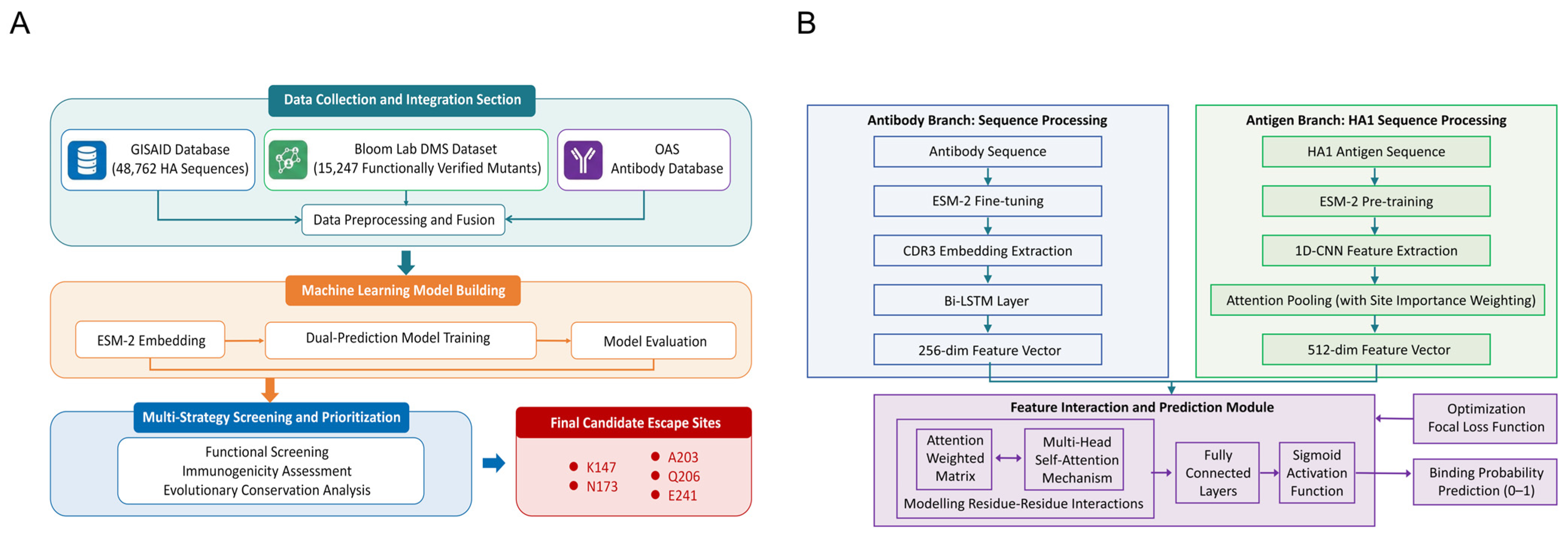
To identify escape mutation sites for the C12H5 antibody, a deep learning-based antigen–antibody binding prediction model was constructed. A total of 48,762 H1N1 pdm09 HA sequences from 2009 to 2024 were obtained from GISAID. After filtering for sequences with ≥90% coverage and excluding those with premature stop codons, 42,156 sequences were retained, covering major evolutionary clades such as 6B.1A.1, 6B.1A.3, 6B.1A.5a.1, and 6B.1A.5a.2. Integrated Bloom laboratory DMS data (A/WSN/1933 HA full-length 564 sites × 19 amino acid substitutions, totaling 10,716 mutants), using monoclonal antibody escape scores was used as the experimental benchmark. The sequence processing workflow was as follows: ➀ MAFFT alignment to reference strain A/California/04/2009 (NC_026438.1); ➁ BioPython extraction of HA1 domain (positions 1–345); and ➂ encoding using 20-dimensional amino acid physicochemical properties, outputting FASTA and numerical matrices for training.
2.2. Sequence Embedding and Feature Extraction Based on the ESM-2 Large Model
To obtain high-quality sequence representations, this study employed the ESM-2 large model (esm2_t33_650M_UR50D version) to embed the HA1 sequence. The specific workflow is as follows: Input the sequence into the model to extract embedding vectors for residues in key epitope regions such as the 130-loop, 140-loop, and 190-helix. Simultaneously, calculate the embedding variation coefficient for each position to quantify the degree of sequence variation.
2.3. Construction of Antigen–Antibody Binding Affinity Prediction Models
This study constructed a multi-task deep learning model based on a dual-branch architecture for predicting the binding affinity between the HA protein and the C12H5 antibody. Specifically, the antibody-encoding branch utilizes an ESM-2 model fine-tuned with antibody data to extract features from its CDR3 (Complementarity-Determining Region 3) region, then outputs antibody characteristics via a Bi-LSTM. The HA antigen encoding branch takes the aforementioned ESM-2 embeddings and residue physicochemical properties as input, employing a CNN to extract local patterns and enhance features at key sites (e.g., K147). The two feature pathways are fused through a feature interaction layer with a sequence alignment attention mechanism to model the interactions between the CDR (Complementarity-Determining Region) and antigenic epitopes. Finally, the combined probability is output through a fully connected layer and a sigmoid function. Model training is based on DMS data, employing binary cross-entropy and focal loss to address data imbalance. Optimization is achieved through the Adam optimizer, cosine annealing learning rate adjustment, and early stopping strategy.
2.4. Machine Learning Screening of Key Escape Sites
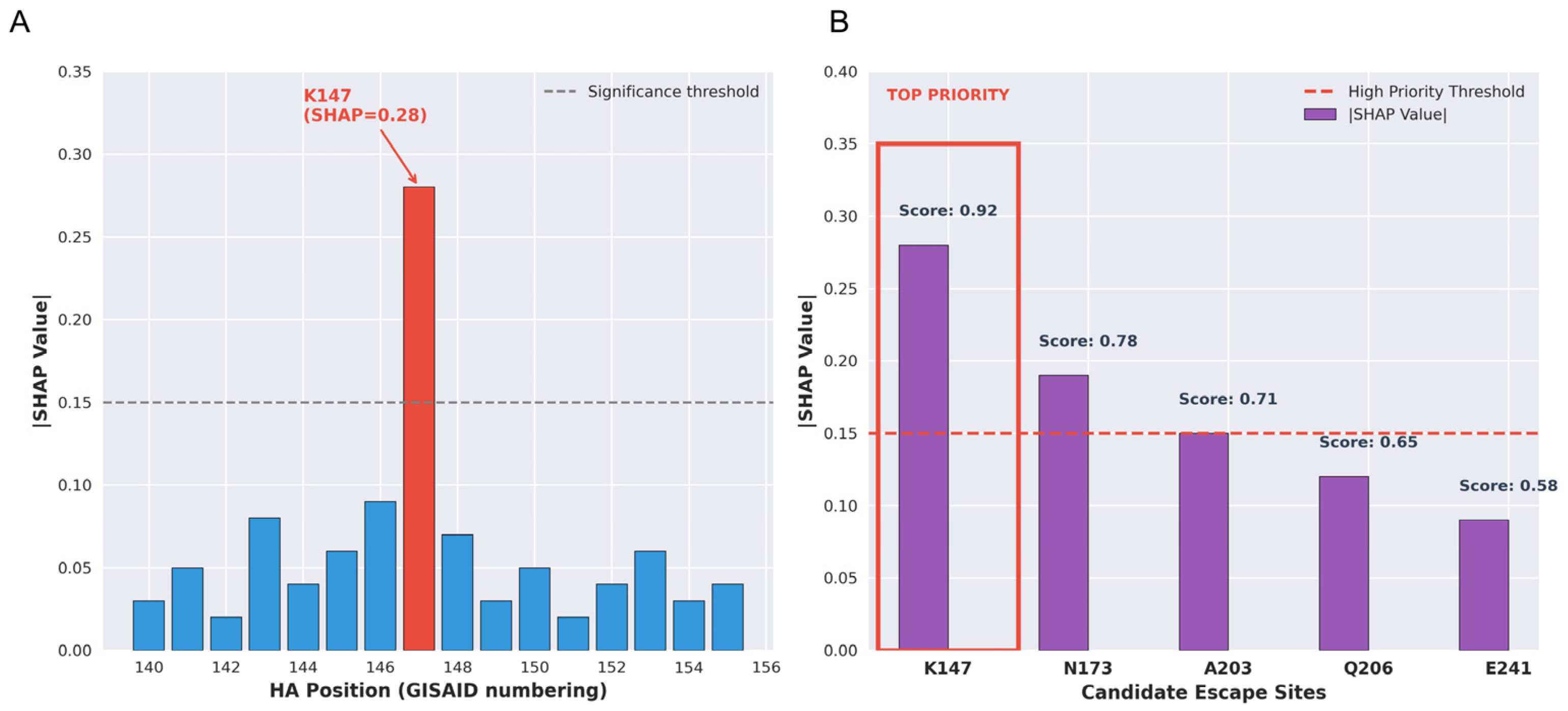
To identify potential escape mutation sites for C12H5, this study employed a multi-strategy machine learning framework for screening. First, based on the trained prediction model, we scanned all HA sequences of circulating strains. Then, we marked sites where population prediction combines with a significant probability decline (mean decrease > 0.15 or coefficient of variation > 0.25) as candidate sites. Second, SHAP value analysis was employed to quantify the marginal contribution of individual amino acid substitutions to model predictions, with a particular focus on key epitope regions such as the 130-loop and 140-loop. Finally, based on the population probability changes in the candidate sites, SHAP values, and their natural mutation frequencies, sites with high escape potential were selected for subsequent validation.
2.5. Virus Strain Selection and Sequence Analysis
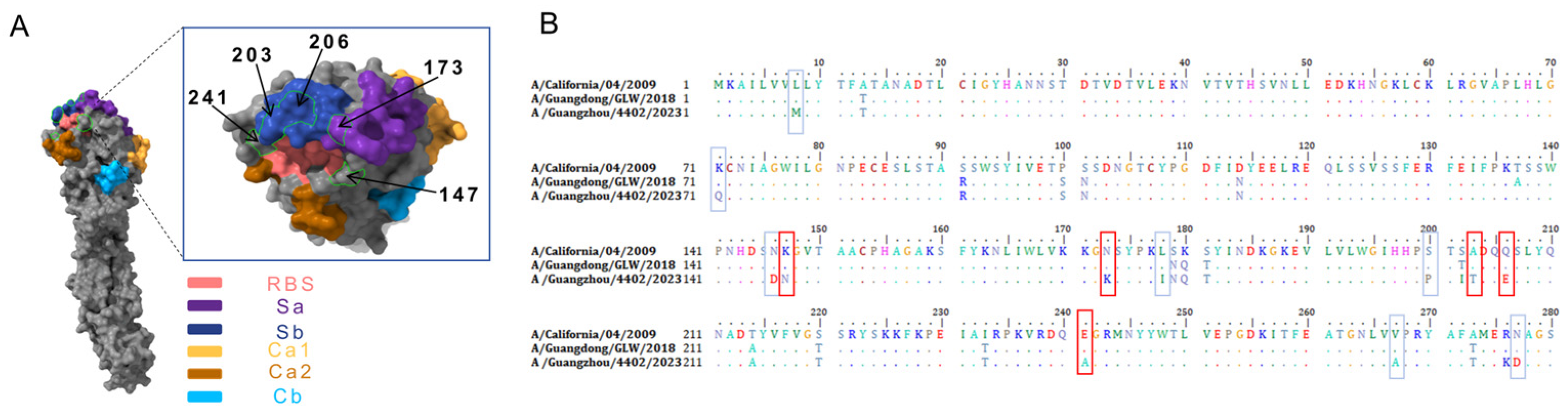
From the Global Initiative on Sharing Avian Influenza Data (GISAID) database, we selected the 2009 pandemic representative strain A/California/04/2009 (CA/09), the 2018 first significant antigenic drift strain A/Guangdong/GLW/2018 (GLW/18), and the currently circulating 2023 strain A/Guangzhou/4402/2023 (GZ/23). The complete HA gene coding sequences were downloaded. MAFFT v7.471 was used to align the three sequences, with a focus on observing the conservative changes in the HA1 region over time. Combining machine learning predictions, five substitutions visible in the 2009–2023 triple alignment and located at Pa (K147), Sa (N173), or Sb (A203/Q206) and the Cb edge (E241) were prioritized for subsequent experimental validation. The final selected sites are as follows: K147N (K133aN), N173K (N159K), A203T (A189T), Q206E (Q192E), and E241A (E227A) (H3 numbering). In this study, all HA protein amino acid positions were referenced using the GISAID numbering system based on the A/California/04/2009 sequence (EPI_ISL_29573). The corresponding classical H3 subtype numbering (based on A/Hong Kong/1/1968) is provided in parentheses for ease of comparison with the early structural literature. The first appearance of each mutation is annotated, and subsequent references use the GISAID numbering system.
2.6. Structural Localization and Analysis of Candidate Mutation Sites
To understand the impact of mutations at the structural level, the crystal structure of the A/California/04/2009 virus HA protein (PDB ID: 3LZG) was downloaded from the Protein Data Bank (RCSB PDB). ChimeraX version 1.10 software was used to visualize the mutation sites and determine their spatial positions within the HA antigenic epitope. In this study, the amino acid numbering corresponds to the GISAID reference sequence. The key mutation K147 (GISAID) corresponds to the K133a site (Chain A) in the PDB structure. To systematically screen for potential escape mutations while reducing experimental burden, we further developed an antigen–antibody binding prediction model based on ESM-2 to prioritize candidate mutation sites.
2.7. Virus Rescue and Mutant Construction
Rescue recombinant viruses using a plasmid-based reverse genetics system. Using the HA gene sequence of the CA/09 virus as a template, the QuikChange II Site-Directed Mutagenesis Kit (Agilent, Santa Clara, CA, USA; stored at −20 °C) was employed to sequentially mutate the five sites into amino acids corresponding to the 2023 strain. This process resulted in the construction of a mutant HA transcription/expression plasmid. All plasmids were verified by bidirectional Sanger sequencing (Shengong Bioengineering, Shanghai, China; sequencing reactions stored at 4 °C, products stored at −20 °C) to ensure no unexpected mutations. Subsequently, the verified mutant HA plasmid was optimized with the remaining seven gene segment plasmids according to the molar ratio optimized by Hoffmann et al. 2000 [
18], with an optimized molar ratio (HA:PB2:PB1:PA:NP:NA:M:NS = 1:1:1:1:1:1:1:1) for co-transfection into MDCK/HEK293T mixed cells. Cell supernatants were collected 48–72 h post-transfection to obtain the rescued virus stock. The stock virus was inoculated into MDCK cells and incubated at 37 °C with 5% CO
2 for 48 h for amplification. After aliquoting, the virus was stored at −80 °C, and the HA genotype was re-sequenced for confirmation. Ultimately, the wild-type recombinant virus (rCA09-WT) and five single-point mutant viruses (rCA09-K147N, rCA09-N173K, rCA09-A203T, rCA09-Q206E, and rCA09-E241A) were obtained. All virus-related procedures were performed within a biosafety cabinet in a BSL-2 laboratory. Generated waste was disposed of according to protocol after undergoing autoclaving at 121 °C for 30 min.
2.8. Hemagglutination Inhibition (HI) Assay
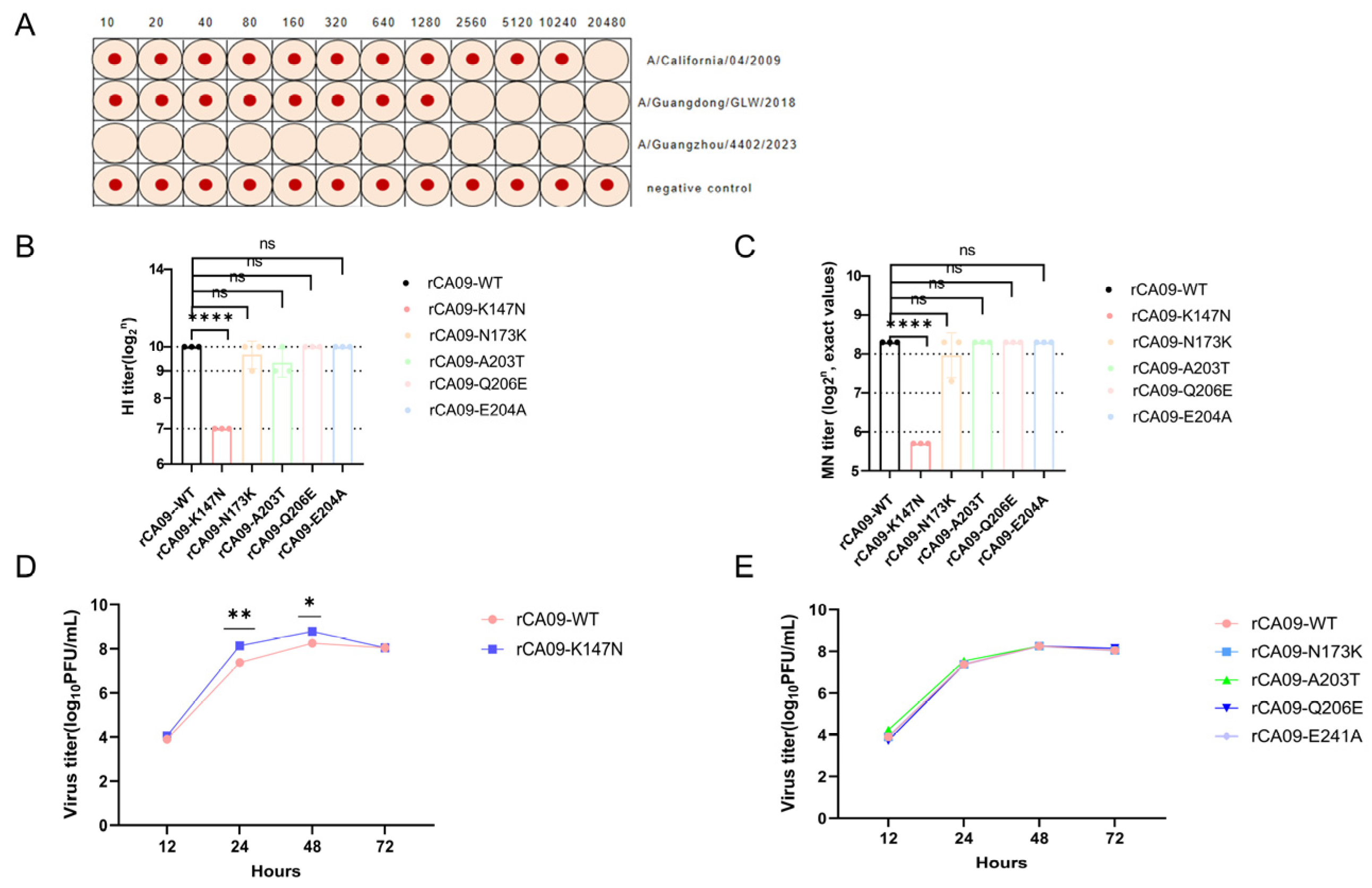
The virus supernatant was first centrifuged at 3000× g, 4 °C for 10 min to remove cell debris, followed by concentration by centrifugation at 50,000× g, 4 °C for 1 h. After resuspending in cold TN buffer (10 mM Tris-HCl, pH 7.4, 100 mM NaCl; stored at 4 °C), the hemagglutination titer was determined. The virus was then diluted to 8 HA units/50 µL using PBS (Gibco, Grand Island, NY, USA; stored at room temperature). Monoclonal antibody C12H5 (courtesy of Xiamen University, human–mouse chimeric IgG1) was diluted in PBS to an initial concentration of 50 µg/mL, followed by serial twofold dilutions. Mix equal volumes of virus solution and antibody dilution in a 96-well V-bottom plate and incubate at room temperature for 1 h. Add 50 µL of 0.5% (v/v) fresh turkey red blood cell suspension (stored at 4 °C and used within 48 h), then let stand at room temperature for 30–45 min. Immediately record agglutination inhibition in each well when a typical hammerhead-shaped sediment (i.e., red blood cells completely settled at the bottom forming a dense dot, consistent with the morphology of normal non-agglutinated red blood cells) appears only in the control wells containing virus and red blood cells. HI titer is defined as the reciprocal of the highest dilution that completely inhibits agglutination. Each combination included 3 replicate wells, with the experiment independently repeated 3 times. Data are expressed as geometric mean titers ± SD.
2.9. Microneutralization Assay
To quantitatively assess the reduction in neutralizing sensitivity conferred by the candidate mutations, microneutralization assays were performed in MDCK cells. Each recombinant virus (rCA09-WT, rCA09-K147N, rCA09-N173K, rCA09-A203T, rCA09-Q206E, and rCA09-E241A) was diluted to 100 TCID50 in culture medium (DMEM, Gibco, USA; stored at 4 °C). Serial two-fold dilutions of the C12H5 monoclonal antibody, starting from an initial concentration of 50 µg/mL, were prepared in 96-well plates and incubated with an equal volume of virus suspension for 1 h at 37 °C. Following incubation, the virus-antibody mixtures were transferred onto pre-seeded MDCK cell monolayers (2 × 10⁴ cells/well, 90% confluence) in 96-well plates and incubated at 37 °C with 5% CO2. After 72 h, the cells were fixed with 4% paraformaldehyde (Biosharp, beijing, China; stored at room temperature) and stained with 0.1% crystal violet solution (Sigma-Aldrich, St. Louis, MO, USA; stored at room temperature) for 30 min at room temperature to visualize cytopathic effect (CPE). The neutralization titer was defined as the reciprocal of the highest antibody dilution that completely prevented CPE. Each assay was performed in triplicate wells and independently repeated three times. For statistical analysis, titers were log2-transformed, and exact log2 values were used for graphical presentation. Intergroup comparisons were performed using one-way ANOVA with Dunnett’s multiple comparisons test (GraphPad Prism 10), with significance set at p < 0.05.
2.10. Virus Growth Kinetic Analysis
To assess the impact of mutations on viral replication kinetics, a one-step growth curve experiment was conducted in MDCK cells. Seed well-growing MDCK cells into a 24-well plate. When cell confluence reaches over 90%, infect each recombinant virus at a multiplicity of infection (MOI) = 0.01. After 1 h of adsorption, remove the viral solution. Gently wash the cells twice with PBS to remove unbound virus. Replace the medium with maintenance medium (DMEM, Gibco, USA; stored at 4 °C) supplemented with 1 µg/mL TPCK-treated trypsin (Macklin, Shanghai, China; stored dry at −20 °C). Cell supernatants were collected at 12, 24, 48, and 72 h post-infection and immediately stored at −80 °C for subsequent analysis. Virus titers were determined using the plaque assay and expressed as PFU/mL. Data are presented as mean ± SD. Three technical replicates were performed at each time point, and the experiment was independently repeated three times. Intergroup comparisons were performed using two-tailed Student’s t-tests or one-way ANOVA (GraphPad Prism 10). The significance threshold was set at p < 0.05. All virus culture and titration procedures were performed within a BSL-2 laboratory biosafety cabinet. Waste materials were uniformly processed after autoclaving at 121 °C for 30 min.
2.11. Epidemiological Analysis
H1N1pdm09 HA sequences were retrieved from the GISAID EpiFlu Database (2009–2024). K147N frequency was determined at HA1 position 130 (corresponding to HA position 147). Temporal trends were calculated as annual proportions. Geographic and subclade distributions used metadata annotations. Co-occurrence analysis used Fisher’s exact test (p < 0.05) to identify significantly enriched mutations in K147N strains versus the wild type.
4. Discussion
This study aims to systematically evaluate the cross-neutralizing capacity of the broad-spectrum antibody C12H5 against representative H1N1 strains from 2009 to 2023 and identify key mutation sites responsible for its escape. By integrating machine learning predictions based on the ESM-2 large model with traditional reverse genetics and functional experiments, we successfully identified and validated the K147N single-point mutation in the HA protein’s 130-loop region as the core mechanism mediating C12H5 immune escape. This mutation not only reduces the antibody neutralization titer by a factor of eight but also confers a certain replicative fitness advantage to the virus. The following sections will delve into the computational reliability of this discovery, its structural basis, evolutionary significance, and research limitations.
The integration of two independent neutralization assays—hemagglutination inhibition and microneutralization—provides robust validation of the K147N escape phenotype. While HI assays are widely used in influenza surveillance for their technical simplicity and correlation with antigenic drift, microneutralization offers distinct advantages for evaluating therapeutic antibodies: it measures complete neutralization of infectious virus in a physiologically relevant cell system, capturing post-entry inhibitory mechanisms that HI cannot assess. The strong concordance between these methods (both identifying K147N as the sole escape site among five candidates, with reductions of 8-fold and 6-fold, respectively) confirms the reliability of our findings. The modest difference in magnitude likely reflects the distinct mechanistic readouts: HI measures receptor-binding inhibition, whereas microneutralization captures the entire viral replication cycle. Notably, the 6-fold reduction observed in microneutralization exceeds the conventional ≥ 4-fold threshold defining antigenic variant status in influenza vaccine strain selection, underscoring the clinical significance of this mutation for C12H5 efficacy.
C12H5 is engineered as a human–mouse chimeric IgG1 antibody, incorporating human Fc regions to minimize immunogenicity while retaining the variable regions of the parental mouse 12H5 antibody. The chimeric design maintains high sequence identity to human germline (98.28% for light chain, 95.83% for heavy chain), reducing the risk of human anti-mouse antibody (HAMA) responses that have limited clinical utility of earlier murine antibodies. This design facilitates potential clinical translation while preserving potent neutralizing activity. C12H5 may serve as a critical component of combination therapy alongside a neuraminidase inhibitor. For severe influenza cases or immunocompromised patients where monotherapy shows limited efficacy, the dual mechanism of C12H5—targeting both viral entry and egress—provides complementary pressure to neuraminidase inhibition. This combination approach may reduce the risk of antiviral resistance development, a significant concern with single-agent therapy.
Beyond its direct therapeutic potential, the C12H5 antibody exemplifies a promising structural template for next-generation influenza countermeasures. Its unique mode of receptor mimicry, achieved through light chain CDR1 insertion, and its tolerance of the host-range-determining D/E190 polymorphism enable broad recognition of both H1N1 and H5N1 viruses [
16]. The high conservation of the C12H5 epitope (mean 90% among H1N1 isolates) and its localization to the functionally constrained receptor-binding site make this epitope an attractive target for structure-guided vaccine design. Indeed, immunization with peptides derived from the C12H5 epitope elicited antibody responses that partially blocked C12H5 binding and conferred modest protection against lethal H1N1 and H5N1 challenge in mice [
16]. These findings suggest that incorporating the C12H5 epitope into immunogens—for example, through epitope-focused or scaffold-based presentation—could help focus the immune response on a conserved vulnerability, advancing the goal of a universal influenza vaccine.
The machine learning methods introduced in this study demonstrate unique value primarily in three dimensions: enhanced efficiency, systematic analysis, and prediction reliability. Compared to traditional large-scale experimental screening methods based on deep mutation scanning (which require individual validation of numerous sites, resulting in substantial workload and high costs) [
19,
20], the deep learning model based on ESM-2 employed in this study enables rapid prediction and prioritization of all possible amino acid substitutions at key functional sites within the HA1 domain within hours. This process narrowed down approximately 950 theoretically verifiable possibilities to five high-risk candidate sites. Employing SHAP analysis for quantitative ranking enabled the precise allocation of subsequent experimental resources, significantly enhancing research efficiency. More importantly, the computational approach provided a systematic perspective that experimental methods struggle to achieve [
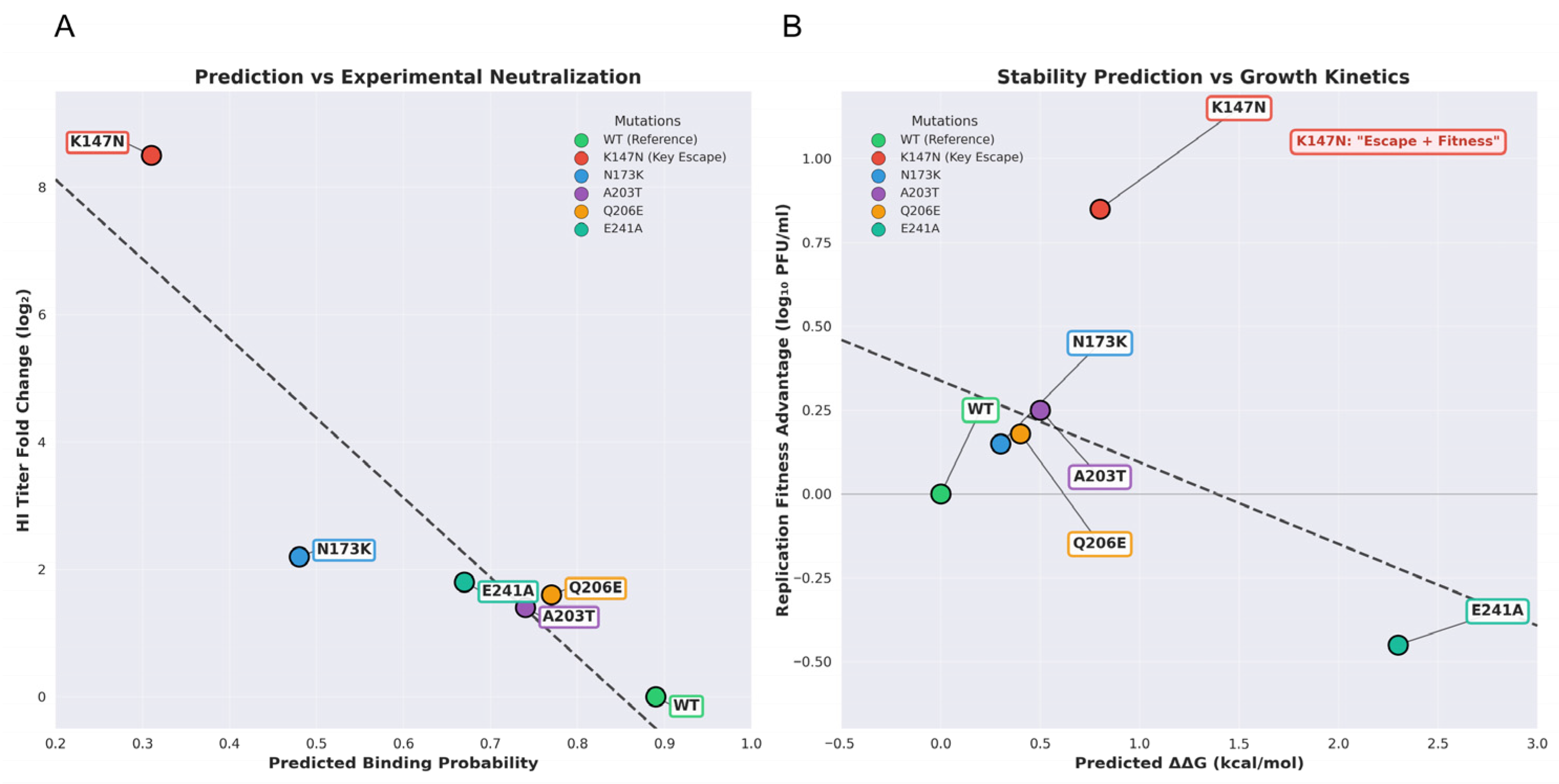
21]. By integrating sequence data from different time periods and evolutionary branches with multiple batches of DMS data, the model can capture antigenic drift patterns across temporal scales. For instance, analysis of the mutation trajectory at the K147 site from 2009 to 2024 clearly reveals its frequency rising from <1% before 2018 to >15% in 2023. This provides critical data references for understanding evolutionary pressures within viral populations and predicting future trends. Crucially, the computational predictions were highly consistent with experimental validation results in both the escape effect (Spearman ρ = 0.89) and replication fitness impact (e.g., the ΔΔG prediction for K147N aligns with its observed growth advantage). This not only strongly confirms the reliability of our machine learning framework but also establishes the feasibility and potential application of the “computational prediction → experimental validation → mechanistic elucidation” closed-loop research paradigm in viral immunology studies.
The HI assay results and microneutralization assay results in this study further validate that K147N reduces the neutralization titer in C12H5 by 8-fold in HI assays and approximately 6-fold in microneutralization assays without significantly impairing receptor affinity, indicating a highly specific escape mechanism that does not rely on sacrificing receptor function. Of note, while HI assays demonstrated an 8-fold reduction in neutralization potency, microneutralization assays showed an approximately 6-fold decrease. The 6-fold reduction in microneutralization exceeds the conventional ≥ 4-fold threshold defining antigenic variant status, underscoring the clinical significance of this mutation. Such variations are expected and well-documented in influenza antigenic characterization studies, as HI primarily measures inhibition of receptor binding while microneutralization assesses the ability of antibodies to prevent productive infection. The microneutralization result may be more predictive of in vivo protection, as it evaluates complete viral neutralization, including post-fusion steps. Matsuzaki et al. previously mapped the A(H1N1)pdm09 antigenic landscape using 599 escape mutant systems, first identifying the K147-containing region as the novel epitope Pa adjacent to the receptor-binding pocket. They suggested that conversion of the side chain from a positive charge to a neutral amide might weaken antibody binding through local electrostatic interactions or conformational changes. Our dual-assay validation extends this observation by quantifying the functional impact on both receptor-binding inhibition and complete viral neutralization. Matsuzaki et al. mapped the A(H1N1)pdm09 antigenic map using 599 escape mutant systems, for the first time identifying this site as the novel epitope Pa adjacent to the receptor-binding pocket. They suggested that the conversion of its side chain from a positive charge to a neutral amide might weaken antibody binding through local electrostatic interactions or conformational changes [
10]. It was observed in retrospective sequencing of isolates from 2009 to 2013 that the K147 site exhibited only sporadic substitutions and had not yet become fixed in the population. This temporal gradient suggests that, under immune selection pressure in the past two years, this mutation has rapidly expanded, which is highly consistent with the “high-risk drift alert” predicted by the machine learning model. It further confirms that the apex of the 130-loop is a critical region that must be continuously monitored for broad-spectrum antibodies and vaccine strains [
22].
In contrast to the traditional “antigenicity–adaptability trade-off” concept, this study found that the K147N mutation mediates C12H5 escape without compromising the virus’s replication adaptability. After 48 h of infection in MDCK cells, the viral titers of the K147N mutant strain were significantly higher than those of the wild type. Computational predictions also indicate that K147N has a minor effect on protein stability (ΔΔG = +0.8 kcal/mol), consistent with experimental observations. Koel et al. [
10] previously noted that Sa region mutations (e.g., S164T) often reduce adaptability by disrupting HA trimer stability. However, K147N, located at the apex of the 130-loop, may compensate through local conformational fine-tuning or enhanced membrane fusion kinetics. This represents the first demonstration of dual advantages—escape and replication—at the apex of the 130-loop. Although ΔΔG is close to neutral, the subsequent increase in titer suggests that it can achieve net adaptive benefits by fine-tuning fusion kinetics, thereby circumventing classical trade-off constraints. This exception indicates that certain RBS marginal sites can transcend the traditional trade-off framework, offering viruses a more “economical” route for immune escape. It also poses a more formidable challenge to single-epitope broad-spectrum antibody strategies [
23,
24,
25]. In addition, the co-occurrence patterns between K147N and other antigenic mutations suggest potential synergistic effects in immune evasion. The significant enrichment of S164T (Sa site) and A203T (Sb site) in K147N strains indicates that these mutations may act in concert to enhance immune escape. The absence of antagonistic interactions demonstrates that K147N is compatible with diverse antigenic drift trajectories, allowing it to become fixed across multiple subclades. Deep mutational scanning (DMS) for systematic epistasis analysis would provide quantitative measures of mutation interactions and is planned as future work.
Regarding the convergence of K147N and WT titers at 72 h, we note that this pattern reflects standard cell culture dynamics rather than the intrinsic instability of the K147N mutant. Both strains reach similar peak titers as MDCK cultures become confluence-limited, creating a “ceiling effect.” The absence of titer decline after peak argues against intrinsic instability. The mid-phase replication advantage (24–48 h) likely reflects optimized receptor-binding kinetics or enhanced membrane fusion efficiency, consistent with the near-neutral ∆∆G prediction (+0.8 kcal/mol). The global fixation of K147N (>98% by 2023–2024) provides additional evidence against instability, as natural selection would eliminate truly deleterious mutations.
Although this study provides important findings, it still has several limitations that require further refinement in subsequent work. Assessment of K147N effects on viral pathogenicity, transmission, and in vivo replication requires animal model studies that were beyond the scope of this work. The 130-loop region where K147 is located has been associated with viral fitness and pathogenicity in previous studies. We have initiated discussions with collaborators regarding ferret transmission studies to assess K147N effects on pathogenicity and transmissibility. These experiments will provide essential data for understanding the full phenotypic impact of this globally dominant mutation. Firstly, all experiments were conducted using in vitro cell models, and the transmissibility and pathogenicity of the K147N mutation in animal models have yet to be validated. Therefore, future studies should utilize mouse or ferret models to evaluate the in vivo adaptability of K147N mutant viruses, combined with pathological analysis to comprehensively understand their impact on the host. Secondly, antibody escape assessments primarily relied on hemagglutination inhibition (HI) assays. Although this method is widely used, it lacks more precise neutralization titer or affinity data, which may, to some extent, underestimate the true extent of immune escape [
26]. Therefore, integrating more efficient neutralization assay methods will be a key direction for future research. Additionally, this study only validated the effects of single mutations without considering potential synergistic or antagonistic interactions among high-frequency mutations. To further elucidate the complex relationships among these mutations, it is recommended to employ deep mutation scanning technology to analyze the synergistic or antagonistic effects between K147N and high-frequency mutations in the Sa region (e.g., S164T) and the Sb region (e.g., A203T) [
27]. Furthermore, although this study observed that the K147N mutation confers certain replicative fitness advantages to the virus, this conclusion has only been validated in MDCK cells. Its performance in human airway models or in vivo settings requires further confirmation [
28]. Finally, the specific effects of K147N on viral thermostability, receptor affinity, and membrane fusion kinetics remain understudied. To better understand the adaptive advantage of this mutation, it is recommended to utilize cryo-electron microscopy (cryo-EM) technology to resolve the three-dimensional structure of the virus-antibody complex, combined with molecular dynamics simulations to analyze its molecular mechanism [
29]. These further studies will help reveal the key role of the K147N mutation in influenza virus evolution and provide an important theoretical basis for future vaccine design.
The near-complete fixation of K147N in global H1N1pdm09 populations (>98% by 2023–2024) suggests that contemporary circulating strains have largely diverged from the C12H5 recognition pattern. This has significant implications for the clinical development of C12H5 and similar broadly neutralizing antibodies, potentially limiting their therapeutic utility against current infections. Based on this discovery, prospective research can be conducted at multiple levels in the future. In antibody engineering, rational design of C12H5 can enhance its neutralizing potency against the K147N mutant strain. For vaccine design, prospective incorporation of such critical mutations into candidate vaccine strains should be considered to preemptively induce specific immune responses. At the same time, there is an urgent need to incorporate the K147 site into the global surveillance network and establish an early warning model by integrating deep sequencing with machine learning [
30]. The synergistic strategy combining antibody engineering, vaccine design, and active surveillance holds promise for establishing a more adaptable and proactive influenza prevention and control system. This approach is expected to significantly enhance overall responsiveness and long-term control capabilities against sudden antigenic shifts in the virus.




 and
and