Article

Increased Mortality Rates During the 2025 Chikungunya Epidemic in Réunion Island

by
André Ricardo Ribas Freitas
1,*,
Luana Hughes Freitas
2,
Antonio Silva Lima Neto
3,4,
Luciano Pamplona Goes Cavalcanti
5,6 and
Pedro María Alarcón-Elbal
7
1
Curso de Medicina, Faculdade São Leopoldo Mandic, Instituto de Pesquisa São Leopoldo Mandic, Campinas 13045-755, SP, Brazil
2
Faculdade de Engenharia de Computação, Insper, Vila Olímpia, São Paulo 04546-042, SP, Brazil
3
Centro de Ciências da Saúde, Universidade de Fortaleza, Fortaleza 60811-000, CE, Brazil
4
Secretaria de Saúde do Ceará, Fortaleza 60000-000, CE, Brazil
5
Faculdade de Medicina, Centro Universitário Christus, Fortaleza 60160-000, CE, Brazil
6
Faculdade de Medicina, Universidade Federal do Ceará, Fortaleza 60000-000, CE, Brazil
7
Department of Animal Production and Health, Public Veterinary Health and Food Science and Technology, Faculty of Veterinary Medicine, Universidad Cardenal Herrera-CEU, CEU Universities, 45115 Valencia, Spain
*
Author to whom correspondence should be addressed.
Viruses 2026, 18(2), 180; https://doi.org/10.3390/v18020180
Submission received: 4 August 2025 / Revised: 16 January 2026 / Accepted: 22 January 2026 / Published: 29 January 2026
(This article belongs to the Special Issue Current Trends in Arbovirus Outbreaks and Research)

Abstract

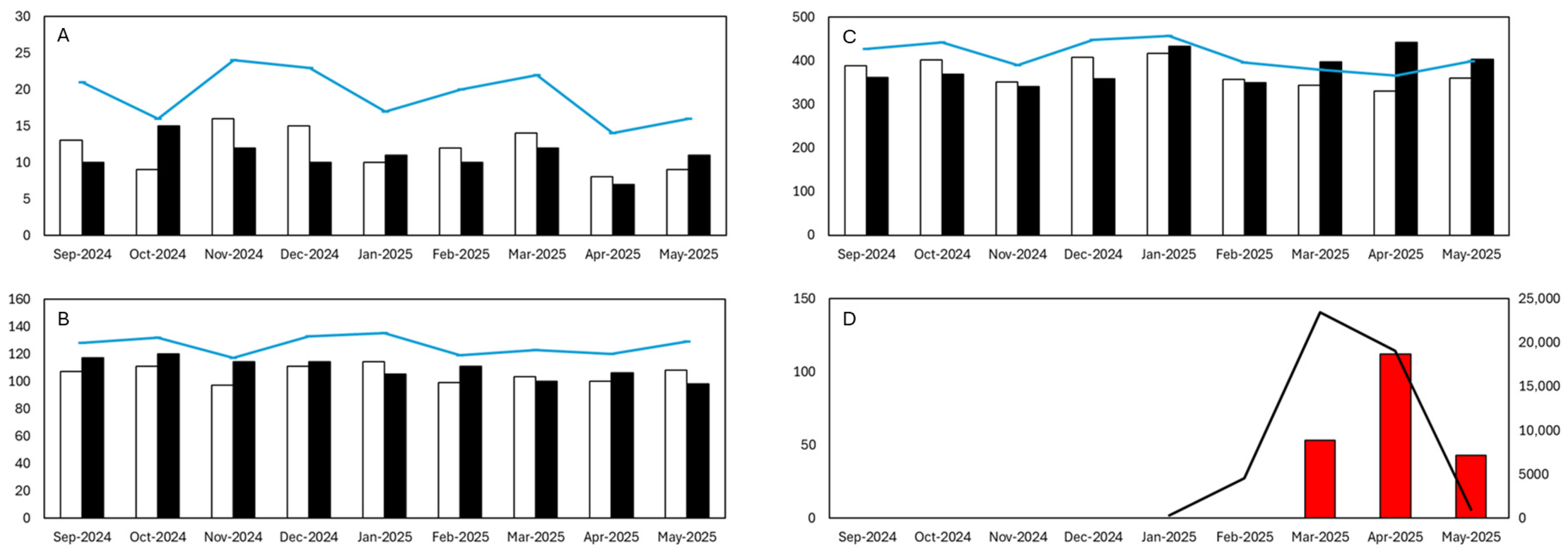
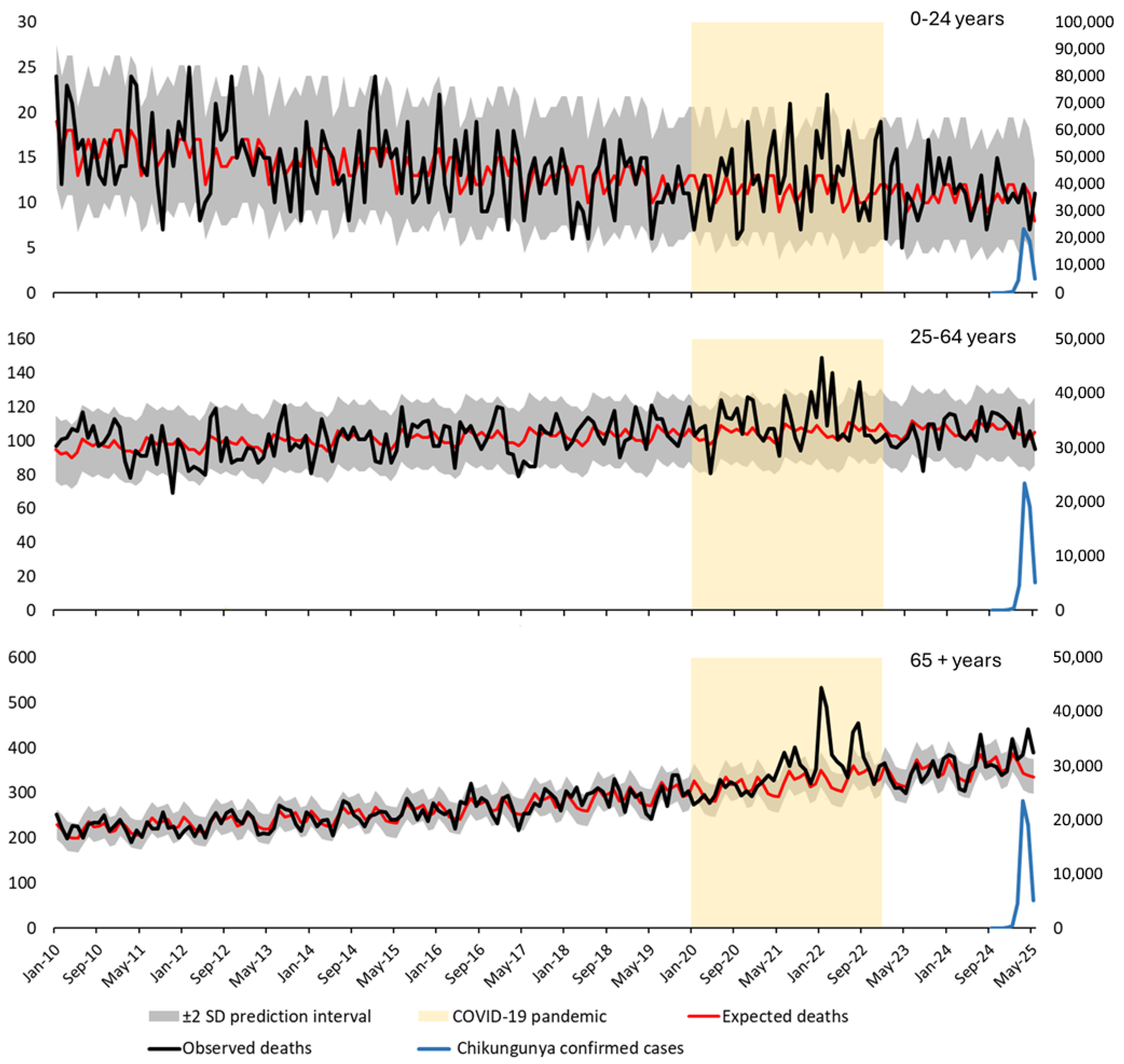
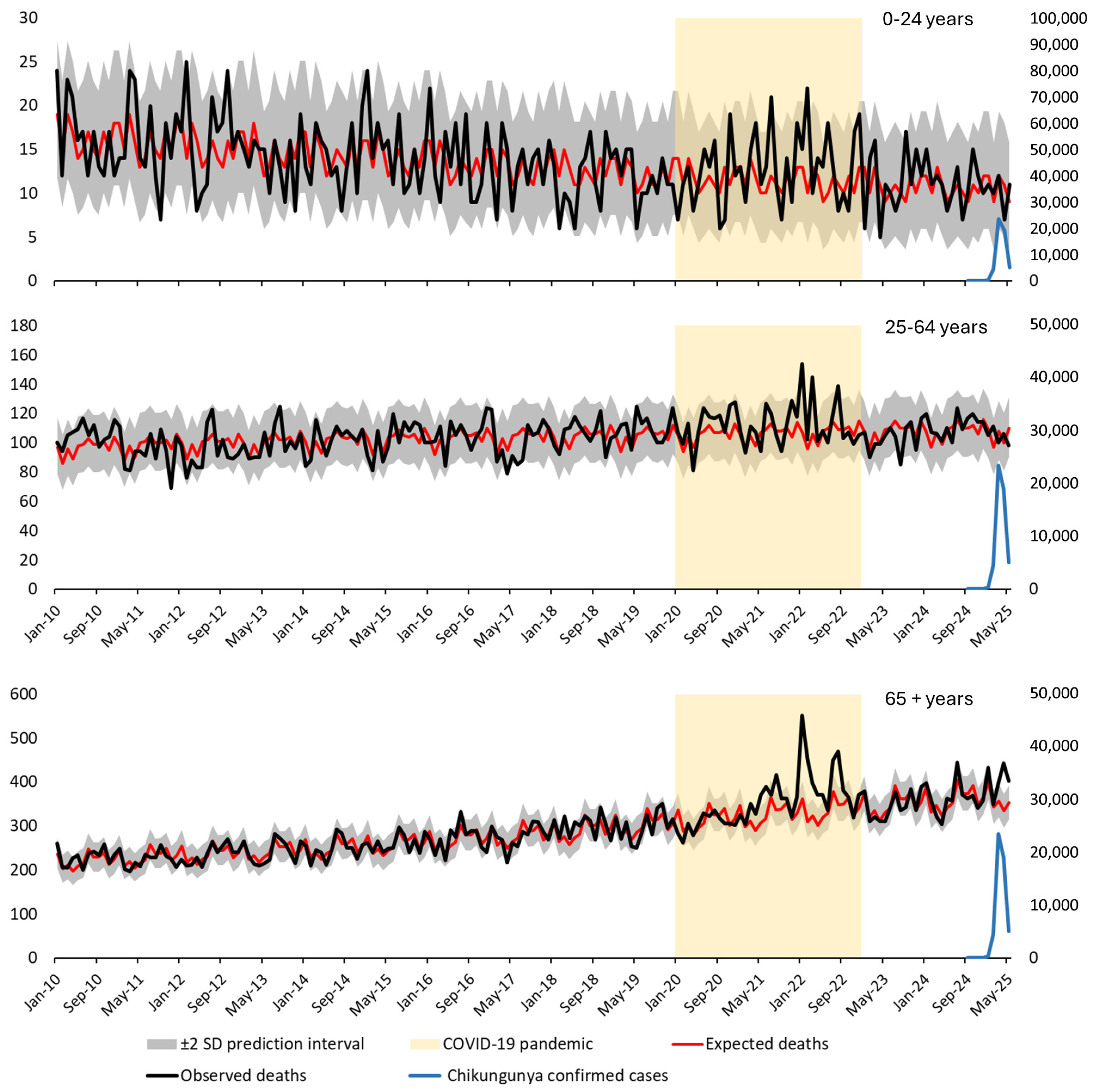
Background: Chikungunya virus (CHIKV) has historically been regarded as a low-fatality infection; however, growing evidence from diverse study designs demonstrated a substantial mortality burden during large-scale epidemics. In 2025, Réunion Island experienced a major CHIKV outbreak, raising renewed concerns about its fatal impact. Methods: We conducted an ecological time-series analysis of all-cause mortality during the 2025 chikungunya epidemic. Expected deaths were estimated using two complementary approaches: (i) a baseline based on age-specific mean mortality rates from the same calendar months in the post-pandemic period and (ii) long-term Poisson regression models using a log-link function and population offset, excluding the COVID-19 pandemic period. Excess mortality was calculated as the difference between observed and expected deaths during periods when observed mortality significantly exceeded the upper bound of the 95% confidence interval. Results: Observed mortality exceeded the upper 95% confidence interval (CI) limit for three consecutive months, coinciding with the epidemic curve and resulting in an estimated 208 excess deaths. These deaths were concentrated among older adults, peaking in April 2025 with a mortality rate ratio of 1.34 (95% CI: 1.22–1.47; p < 0.001). Among older adults, the age-specific excess mortality rate reached 145.3 per 100,000 (95% CI: 125.5–165.0) with a case fatality rate (CFR) of 2.4%, resulting in an overall population excess mortality rate of 23.2 per 100,000 and a total CFR of 0.4%. The number of deaths identified through routine surveillance was substantially lower than our estimates, highlighting a significant discrepancy between reported and excess chikungunya-associated mortality. Conclusions: Chikungunya epidemics are consistently associated with substantial underrecognized mortality worldwide. Routine surveillance relying solely on laboratory confirmation underestimates the true burden of the disease. Integrating excess mortality analysis, strengthening diagnostic and postmortem investigations, and implementing timely mitigation measures are essential to accurately assess and reduce preventable deaths during future CHIKV outbreaks.
Keywords: chikungunya virus; excess mortality; underreporting; arboviruses; public health surveillance; Réunion Island; emerging infectious diseases chikungunya virus; excess mortality; underreporting; arboviruses; public health surveillance; Réunion Island; emerging infectious diseases