Elements of Viral Outbreak Preparedness: Lessons, Strategies, and Future Directions



Abstract
1. Introduction
2. Methods
3. Surveillance Systems and Early Warning
3.1. Traditional Surveillance
3.1.1. Passive Surveillance: Routine Monitoring and Systemic Gaps
3.1.2. Active Surveillance: Targeted Case-Finding and Enhanced Sensitivity
3.1.3. Sentinel Surveillance: High-Resolution Pathogen Monitoring
3.1.4. Examples of National Surveillance Systems
3.2. Genomic Surveillance
3.3. Digital Surveillance
3.4. Wastewater-Based Surveillance

| Study Location | Sample Type | Concentration Method | Detection Rate | SARS-CoV(-2) Titre | Key Findings | Reference |
|---|---|---|---|---|---|---|
| SARS-CoV-2 | ||||||
| New Haven, USA | Primary sewage sludge | Direct extraction by RNeasey PowerSoil Total RNA Kit | 100% (10-week study) | 3.23–5.66 log10 gc/mL | Viral RNA tracked clinical cases 6–8 days ahead; correlated with hospitalizations. | [105] |
| Murcia, Spain | WWTP influent | Aluminum hydroxide adsorption | 84% (35/42) WWTPs | Avg (5.1–5.6 log10 gc/L) | Detected SARS-CoV-2 RNA 12–16 days before clinical confirmation in low-prevalence regions. | [106] |
| Secondary treated | 11%(2/18) | Avg(5.4 log10 gc/L) | ||||
| Porto, Portugal | Untreated/treated | PEG 8000 precipitation | 81% (39/48) in untreated liquid samples, 0% in treated samples | 0–0.15 gc/ng RNA | Wastewater-based surveillance to complement clinical testing | [107] |
| Milan, Rome, Italy | WWTP influent | a two-phase (PEG-dextran) separation | 50% (6/12 samples) | The virus was found in Italian wastewaters, even before the first reported clinical case in the country | [90] | |
| Finland | municipal wastewater influent | ultrafiltration | 79% | 6.62–8.72 log10 gc/day/person | WBS tracks SARS-CoV-2 trends at the community level | [108] |
| Madrid, Spain | Network-wide sewage | Not reported | Not reported | 0–7 log10 gc/L | Strong correlation (3–8-day lead) with hospitalizations; identified regional transmission waves. | [109] |
| Japan | Weekly/biweekly influent | PEG 8000 | 46.7% (21/45(Omicron wave) | 4.08–4.54 log10 gc/L | SARS-CoV-2 in wastewater increased when the number of confirmed cases exceeded 10 per 100,000 people. | [94] |
| Japan | Weekly influent wastewater | PEG 8000 | 67% (88 out of 132) | 3.5–6.3 log10 gc/L | Significantly higher SARS-CoV-2 RNA concentrations were detected during the Omicron variant phase | [110] |
| Northern California USA | Wastewater settled solids | - | 100% (974/974) | 6.57 log10 gc/g dry weight | Both grab and composite samples performed similarly for SARS-CoV-2 quantification in settled solid | [111] |
| Egypt | WWTP influent | PEG 6000 precipitation | 62.5% (30/48) | - | Highlighted value for LMICs surveillance. | [88] |
| Canada | Primary clarified sludge, post-grit solids | PEG-8000 PPT | N1 gene: 92.7%, N2 gene 90.6% N1 gene 79.2%, N2 gene 82.3% | 3.23–5.58 log10 gc/L | PMMoV normalization improved correlation with clinical data (r = 0.84). | [112] |
| Netherlands | WWTP influent | Ultracentrifugation | 69% (for late-epidemic rounds, 100%) | 3.4–4.3 log10 gc/L | Detected SARS-CoV-2 RNA 6 days before the first clinical cases in Amersfoort. | [91] |
| Australia | WWTP influent (3 plants) | Electronegative membrane filtration and ultrafiltration | N1 gene 30.1% E: 3.17% N2: 0% | 3.05 log10 gc/L–5.08 log10 gc/L | Early detection, 3 weeks before the first clinical case; highlighted the need for public health collaboration. | [113] |
| Germany | WWTP influent and effluent | centrifugal ultrafiltration | 77% (17/22 samples) | Inlet: 3.48–4.30 log10 gene equivalents/L Outlet: 3.43 to 4.57 log10 gene equivalents/L | The replication potential tests were negative for wastewater samples. | [93] |
| UAE | Municipal wastewater (Influents and effluents) | Ultrafiltration/PEG 8000 PPT | 85% (untreated) | 2.88 log10 gc/L–4.53 log10 gc/L | WBE can help authorities take prompt actions to contain a potential outbreak | [95] |
| USA (Montana) | Municipal wastewater(influent) | Centrifugal ultrafiltration | 53% (9/17) | 2.85–4.12 log10 gc/L | Viral titers correlated with case numbers; provided an early warning. | [97] |
| USA (Massachusetts) | Municipal wastewater | PEG precipitation | 100% (all samples) | 1.76– 2.48 log10 gc/mL | Viral titers anticipated clinical trends by 4–10 days. | [96] |
| France | WWTP influent (3 plants) | Centrifugation | 100% | 4.70–6.48 log10 gc/L | Viral RNA trends mirrored the national lockdown and resurgence. | [98] |
| Veneto, Italy | Raw wastewater | PEG precipitation. | High correlation with clinical cases | 0–2.85 log10 gc/µL | Wastewater peaks preceded clinical cases by 5.2 days; CUSUM charts are effective for early outbreak detection | [114] |
| Chengdu, China | A composite Wastewater treatment plant influent | PEG precipitation | 0.012–3.27% | 0.21–1.62 log10 gc/mL | Model predicted infections using viral load and population size; provided early warning for FISU Games. | [115] |
| Arkansas, USA | Wastewater treatment plant samples | filtered and eluted to approximately 500 µL using a column-based system | >1 log10 gc/mL–6 log10 gc/mL | Amplicon sequencing tracked variants effectively; S-gene detection was lost with JN.1 predominance. | [116] | |
| Denmark | Influent wastewater | NanoTrap Microbiome A particles | consistent detection (LoD: 4 copies/reaction for N1, 2 for N2) | Including wastewater SARS-CoV-2 levels in models improved the prediction accuracy of COVID-19 hospital admissions up to 2 weeks in advance | [117] | |
| Monkeypox Virus | ||||||
| Study Location | Sample Type | Concentration Method | Detection Rate | MPXV Titre | Key Findings | Reference |
| Netherlands | Wastewater 24-h composite | Centrifugation | 42% (45/108 samples) | Not quantified | The detection patterns in wastewater aligned with the confirmed monkeypox cases | [118] |
| Baltimore, USA | Grab, 24-h composite | PEG precipitation, adsorption-elution | 72% (13/18 samples) | Not quantified | PEG precipitation is more effective than AE; no correlation between wastewater MPXV and clinical cases | [119] |
| Paris, France | 24-h composite | Centrifugation | 10.6% (34/321) | 3.30−4.60 log10 gc/L | Strong correlation between MPXV concentration and weekly MPXV cases; early detection demonstrated | [120] |
| California, USA | 24-h composite influent, solids | Nanotrap particles (liquid), buffer suspension (solids) | 26.5 (76/287) | 4.4 log10 gc/g (103-fold higher in solids) | MPXV DNA is more concentrated in solids; positive correlation with reported cases | [121] |
| Miami, USA | Grab, Wastewater | Electronegative filtration | 3.1% (1/32, hospital Wastewater) 38.5% (5/13 regional WWTP | 3.8 log10 gc/L 4.0–4.42 log10 gc/L | First detection in July 2022; positivity increased during the study period; detected in hospital and municipal wastewater | [122] |
| Canada | 24-h composite | Centrifugation | G2R_G: 16%, G2R_WA: 22%, G2R_NML: 76% | Not specified | In-house G2R_NML assay outperformed CDC assays for MPXV surveillance | [123] |
| Italy | Airport Wastewater 24-h composite | PEG/NaCl precipitation | 15% (3/20) | Not quantified | Detection using N3R, F3L, CDC G2R_G; airport wastewater also analyzed | [124] |
| Thailand | Grab | Centricon Plus-70 ultrafilter | 9.52% (6/63) | 4.2−4.9 log10 gc/L | Feasibility demonstrated in Southeast Asia; positivity increased over the monitoring period | [125] |
| Spain | Grab | Aluminum adsorption-precipitation | 18% (56/312 samples) | 3.3−4.9 log10 gc/L | Large-scale study; aluminum-based concentration effective for MPXV detection | [126] |
| Multiple US States | 24-h composite untreated | Vacuum filtration + pre-amplification | 13% (8/60 samples) | Not quantified | Pre-amplification reduced false negatives by 87%; detected in multiple states; detection during case increases and waning. | [127] |
| Slovenia | 24 h composite untreated Wastewater | affinity-based capture using Nanotrap particles | 0% during the monitoring period | Not detected | No MPXV detected June–September 2023; validated methods for emergency response. | [128] |
| Zibo, China | Wastewater at high-risk sites | Magnetic beads, PEG, ultrafiltration | 14.3 (1/7) Detected September 2023 | 3.1 log10 gc/mL | First MPXV detection in Chinese wastewater; NGS confirmed IIb branch C.1 lineage; suggested hidden transmission | [129] |
| United States | Composite/Grab Wastewater samples | Various methods | 2.7% (95/3492) | Not specified | Sensitivity increased with case number; high predictive value; useful complement to case surveillance | [130] |
| USA | Composite | Adsorption extraction | 3.8% (5/131) | 3.2 log10 gc/L | Same-day result is feasible with the affinity capture method and microfluidic digital PCR | [131] |
| Poland | Composite | Not specified | 20.5% (9/44) | Not specified | The MPXV virus detection does not correlate with the number of hospitalizations in Poznan, Poland | [132] |
| Korea, Seoul | Grab&composite | Dyna beads of the KingFisher equipment | 1.2% (1/82) | Not specified | Wastewater-based surveillance is feasible for tracking low-prevalence, socially stigmatized pathogens at the community | [133] |
3.5. A Coordinated International Effort and Data Sharing
4. Diagnostic and Laboratory Capacity
4.1. Nucleic Acid-Based Diagnosis
4.2. Immunological Assays
4.3. Impact of Poor Diagnostic Capacity
5. Prevention and Control Measures
5.1. Vaccination
5.1.1. Vaccine Platform Technologies
5.1.2. Potential Use of Preparedness Vaccines
5.1.3. Vaccine Safety Monitoring and Adverse Effects
5.1.4. Key Considerations in Vaccine Development and Regulatory Evaluation
5.2. Antiviral Therapeutics
5.2.1. Drug Repurposing Attempts
| Drug Name | Original Indication | Repurposed Viral Use | Mechanism of Action | Current Status | Reference |
|---|---|---|---|---|---|
| Remdesivir | Ebola virus treatment | COVID-19, SARS-CoV-2 | RNA-dependent RNA polymerase inhibitor | FDA-approved for COVID-19 | [232] |
| Favipiravir | Influenza (Japan) | COVID-19 | RNA polymerase inhibitor | EUA in multiple countries | [233] |
| Nitazoxanide | Antiparasitic (Cryptosporidiosis) | Influenza, COVID-19 | HA maturation inhibition; immunomodulation | Phase III for influenza | [234] |
| Lopinavir/Ritonavir | HIV protease inhibition | COVID-19, MERS-CoV | Viral protease inhibitor | Discontinued for COVID-19 | [235] |
| Hydroxychloroquine | Malaria, autoimmune diseases | COVID-19 (early pandemic) | Endosomal pH modulation; immunomodulation | Withdrawn due to inefficacy | [236] |
| Umifenovir | Influenza (Russia/China) | COVID-19 | Viral entry/fusion inhibition | Investigational (Phase III) | [237] |
| Molnupiravir | Investigational for RNA viruses | COVID-19 | RNA mutagenesis (error catastrophe) | FDA/EUA approved | [238] |
| Atorvastatin | Hypercholesterolemia | Influenza adjunct therapy | HMG-CoA reductase inhibition; immunomodulation | Phase II completed | [239] |
| Baricitinib | Rheumatoid arthritis | COVID-19 cytokine storm | JAK-STAT pathway inhibition | FDA-approved for COVID-19 | [240] |
| Camostat mesylate | Pancreatitis (Japan) | COVID-19 | TMPRSS2 protease inhibition | Phase III trials ongoing | [241] |
| Dexamethasone | Inflammatory conditions | COVID-19 ARDS | Broad-spectrum anti-inflammatory | Standard of care for severe COVID-19 | [242] |
| Ruxolitinib | Myelofibrosis | COVID-19 cytokine storm | JAK1/JAK2 inhibition | Investigational | [243] |
| Interferon-β combination | Hepatitis C, malignancies | COVID-19 combination therapy | Broad antiviral cytokine induction | Limited use in combinations | [244] |
| Zapnometinib | Cancer | Influenza virus/COVI-19 | MEK Inhibitor/immunomodulation | Preclinical/phase II | [245] |
5.2.2. Direct-Acting Therapeutics Development
5.2.3. Neutralizing Monoclonal Antibody Efficacy and Variant Escape
5.2.4. Host-Targeted Therapeutics Development
5.3. Non-Pharmaceutical Interventions
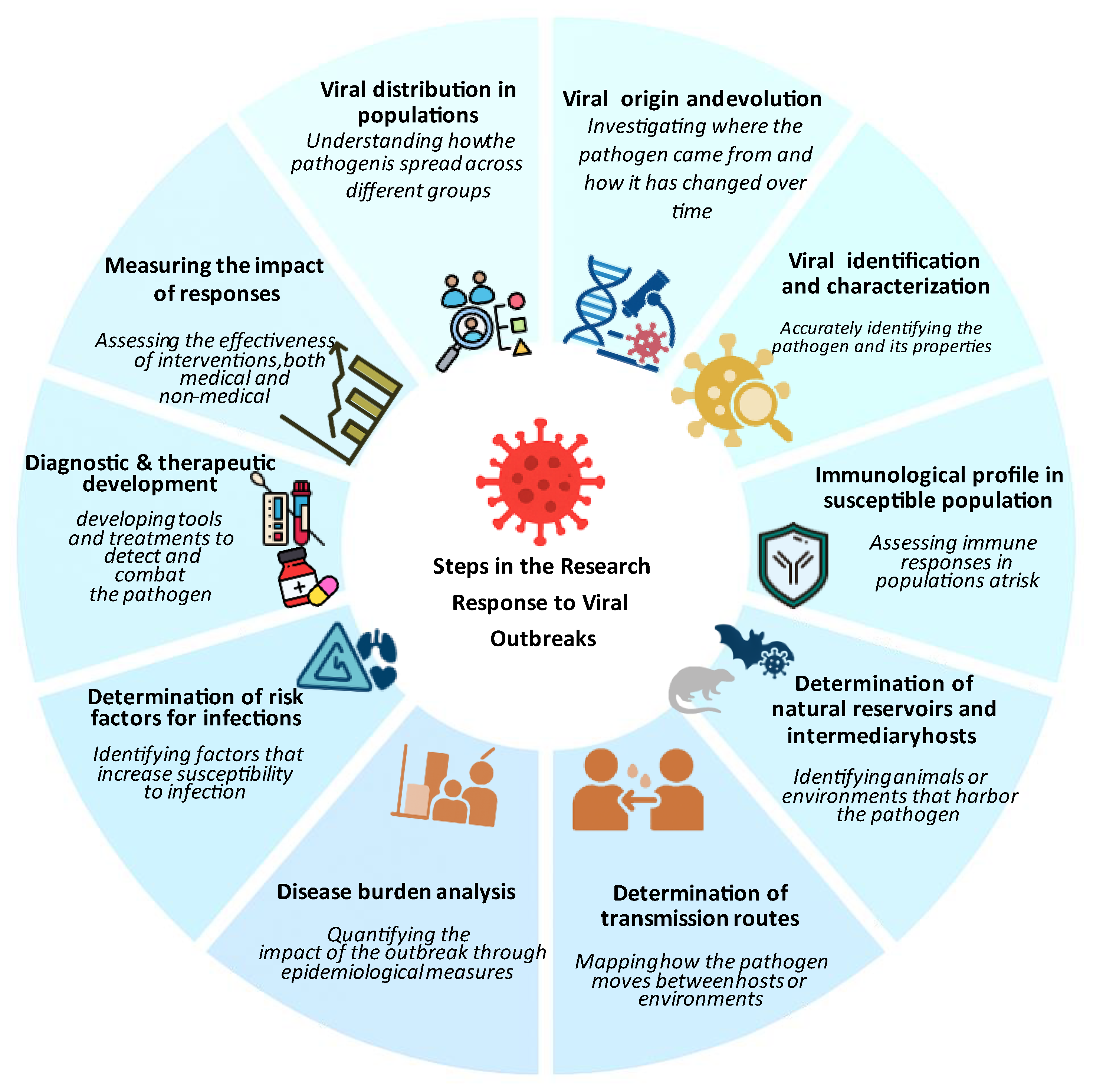
6. Research and Development
- Understanding Viral Threats: Researching the epidemiology, transmission dynamics, and pathogenesis of viral diseases is crucial. This involves studying the genetic structure of viruses, their host range, and factors influencing their emergence and spread, with a priority focus on zoonotic viruses.
- Diagnostic Tools and Technologies: Developing new and improved diagnostic tools is essential for early detection and containment of outbreaks. This includes researching novel testing methods like POC diagnostics and multiplex assays, as well as enhancing existing laboratory-based techniques.
- Therapeutics and Vaccines: Accelerating research and development efforts for therapeutics and vaccines against viral diseases is paramount. This entails conducting preclinical and clinical trials to evaluate safety and efficacy, as well as exploring innovative approaches such as monoclonal antibodies, antiviral peptides, and RNA-based therapeutics.
- Surveillance and Monitoring Tools: Innovating in surveillance and monitoring tools enhances early detection and response to outbreaks. Research in this area focuses on developing algorithms for analyzing large datasets using artificial intelligence, such as machine learning, creating real-time monitoring systems, and integrating diverse information sources to identify potential threats and assess their impact.
- Capacity Building and Collaboration: Strengthening research capacity, infrastructure, and partnerships at national and international levels is essential. This involves supporting research institutions, academic centers, and public health laboratories and fostering collaboration among scientists, clinicians, policymakers, and industry stakeholders to accelerate progress towards shared goals.
7. Global Equity and Response Coordination
8. Conclusions and Future Directions
- Boost the Early Warning System:
- Make an investment in integrated surveillance that includes WBS, real-time digital monitoring technologies, and clinical reporting.
- Integrate One Health concepts to monitor zoonotic spillover at the interface between humans, animals, and the environment.
- Increase Rapid Diagnosis:
- Within weeks of pathogen detection, scale up low-cost, high-sensitivity POC diagnostic assays or portable devices and implement them across the country.
- Encourage open access platforms (such as metagenomic assays) for objective, sequence-independent detection.
- Increase Immunization Readiness:
- Give top priority to the development of multiplex and prototype vaccinations that target high-risk virus families.
- Keep critical vaccine supplies on hand and use education and awareness initiatives to overcome reluctance.
- To shorten development durations, use flexible platforms like viral vector vaccines and mRNA.
- Boost Antiviral Treatment Readiness:
- Develop broad-spectrum antivirals and keep emergency supplies of necessary medications on hand.
- Examine and reuse approved medications for action against newly discovered viruses in a methodical manner.
- Optimize NPIs by:
- Ensuring that health systems have the flexibility to scale personnel, hospital beds, and logistics during periods of high epidemiological demand.
- Use open, culturally appropriate communication to encourage adherence to mask use, distance, and hygiene practices.
- In accordance with the risk of transmission, implement strict contact tracing, isolation, and targeted travel procedures.
- Encourage ongoing development:
- Obtain specific funds for studies in implementation science, vaccinations, treatments, and diagnostics.
- Establish official international data-sharing agreements and coordinated training programs to guarantee that readiness frameworks remain adaptable and interoperable.
Author Contributions
Funding
Institutional Review Board Statement
Informed Consent Statement
Data Availability Statement
Conflicts of Interest
Abbreviations
| CDC | Centers for Disease Control and Prevention |
| CMV | Cytomegalovirus |
| COBRA | Computational Optimized Broadly Reactive Antigen |
| CRISPR | Clustered Regularly Interspaced Short Palindromic Repeats |
| ddPCR | Droplet Digital PCR |
| EIOS | Epidemic Intelligence from Open Sources |
| ELISA | Enzyme-Linked Immunosorbent Assay |
| EOCs | Emergency Operations Centers |
| FDA | US Food and Drug Administration |
| GDD | Global Disease Detection |
| GISAID | Global Initiative on Sharing All Influenza Data |
| GISRS | Global Influenza Surveillance and Response System |
| GPHIN | Global Public Health Intelligence Network |
| gRNAs | Guide RNAs |
| HEIs | Higher Education Institutions |
| HSV | Herpes Simplex Virus |
| IHR | International Health Regulations |
| JAK | Janus kinase |
| LFA | Lateral Flow Assay |
| LMICs | Low- and Middle-Income Countries |
| LNP-mRNA | Lipid Nanoparticle mRNA |
| mAbs | Monoclonal Antibodies |
| MERS | Middle East Respiratory Syndrome |
| MoHP | Ministry of Health and Population |
| MPXV | Monkeypox Virus |
| NGS | Next-Generation Sequencing |
| NPIs | Non-pharmaceutical Interventions |
| PHEIC | Public Health Emergency of International Concern |
| POC | Point-of-Care |
| ProMED | Program for Monitoring Emerging Diseases |
| PV | Poliovirus |
| RNA | Ribonucleic Acid |
| RT-LAMP | Reverse Transcription Loop-Mediated Isothermal Amplification |
| RT–qPCR | Quantitative Reverse Transcription Polymerase Chain Reaction |
| SARS-CoV | Severe Acute Respiratory Syndrome Coronavirus |
| WBS | Wastewater-Based Surveillance |
References
- Peiris, J.S.; Guan, Y.; Yuen, K.Y. Severe acute respiratory syndrome. Nat. Med. 2004, 10, S88–S97. [Google Scholar] [CrossRef]
- CDC. Swine influenza A (H1N1) infection in two children--Southern California, March–April 2009. MMWR Morb. Mortal. Wkly. Rep. 2009, 58, 400–402. [Google Scholar]
- Zaki, A.M.; van Boheemen, S.; Bestebroer, T.M.; Osterhaus, A.D.; Fouchier, R.A. Isolation of a novel coronavirus from a man with pneumonia in Saudi Arabia. N. Engl. J. Med. 2012, 367, 1814–1820. [Google Scholar] [CrossRef] [PubMed]
- Dudas, G.; Carvalho, L.M.; Bedford, T.; Tatem, A.J.; Baele, G.; Faria, N.R.; Park, D.J.; Ladner, J.T.; Arias, A.; Asogun, D.; et al. Virus genomes reveal factors that spread and sustained the Ebola epidemic. Nature 2017, 544, 309–315. [Google Scholar] [CrossRef] [PubMed]
- Gubler, D.J.; Vasilakis, N.; Musso, D. History and Emergence of Zika Virus. J. Infect. Dis. 2017, 216, S860–S867. [Google Scholar] [CrossRef]
- Huang, C.; Wang, Y.; Li, X.; Ren, L.; Zhao, J.; Hu, Y.; Zhang, L.; Fan, G.; Xu, J.; Gu, X.; et al. Clinical features of patients infected with 2019 novel coronavirus in Wuhan, China. Lancet 2020, 395, 497–506. [Google Scholar] [CrossRef]
- Fineberg, H.V. Pandemic preparedness and response—lessons from the H1N1 influenza of 2009. N. Engl. J. Med. 2014, 370, 1335–1342. [Google Scholar] [CrossRef]
- Archer, B.N.; Thomas, J.; Weyer, J.; Cengimbo, A.; Landoh, D.E.; Jacobs, C.; Ntuli, S.; Modise, M.; Mathonsi, M.; Mashishi, M.S.; et al. Epidemiologic Investigations into Outbreaks of Rift Valley Fever in Humans, South Africa, 2008–2011. Emerg. Infect. Dis. 2013, 19, 1918–1925. [Google Scholar] [CrossRef]
- Zeller, H.; Van Bortel, W.; Sudre, B. Chikungunya: Its History in Africa and Asia and Its Spread to New Regions in 2013–2014. J. Infect. Dis. 2016, 214, S436–S440. [Google Scholar] [CrossRef]
- Lambrou, A.S.; South, E.; Midgley, C.M.; Harrington, C.; Wang, L.; Cubeñas, C.; Lowe, D.; Abedi, G.R.; Jones, C.; Hughes, L.J.; et al. Update on the Epidemiology of Middle East Respiratory Syndrome Coronavirus—Worldwide, 2017–2023. MMWR Morb. Mortal. Wkly. Rep. 2025, 74, 313–320. [Google Scholar] [CrossRef]
- Li, Q.; Zhou, L.; Zhou, M.; Chen, Z.; Li, F.; Wu, H.; Xiang, N.; Chen, E.; Tang, F.; Wang, D.; et al. Epidemiology of human infections with avian influenza A(H7N9) virus in China. N. Engl. J. Med. 2014, 370, 520–532. [Google Scholar] [CrossRef]
- WHO. Global Influenza Surveillance and Response System (GISRS). Available online: https://www.who.int/initiatives/global-influenza-surveillance-and-response-system (accessed on 14 December 2025).
- Kennedy, J.; Michailidou, D. Civil war, contested sovereignty and the limits of global health partnerships: A case study of the Syrian polio outbreak in 2013. Health Policy Plan. 2017, 32, 690–698. [Google Scholar] [CrossRef]
- Delamou, A.; Delvaux, T.; El Ayadi, A.M.; Beavogui, A.H.; Okumura, J.; Van Damme, W.; De Brouwere, V. Public health impact of the 2014-2015 Ebola outbreak in West Africa: Seizing opportunities for the future. BMJ Glob. Health 2017, 2, e000202. [Google Scholar] [CrossRef] [PubMed]
- Ikejezie, J.; Shapiro, C.N.; Kim, J.; Chiu, M.; Almiron, M.; Ugarte, C.; Espinal, M.A.; Aldighieri, S. Zika Virus Transmission—Region of the Americas, May 15, 2015-December 15, 2016. MMWR Morb. Mortal. Wkly. Rep. 2017, 66, 329–334. [Google Scholar] [CrossRef]
- Kinganda-Lusamaki, E.; Black, A.; Mukadi, D.B.; Hadfield, J.; Mbala-Kingebeni, P.; Pratt, C.B.; Aziza, A.; Diagne, M.M.; White, B.; Bisento, N.; et al. Integration of genomic sequencing into the response to the Ebola virus outbreak in Nord Kivu, Democratic Republic of the Congo. Nat. Med. 2021, 27, 710–716. [Google Scholar] [CrossRef]
- WHO. Measles: Fighting a Global Resurgence. Available online: https://www.who.int/news-room/feature-stories/detail/measles-fighting-a-global-resurgence (accessed on 14 December 2025).
- Lambrou, A.S.; Shirk, P.; Steele, M.K.; Paul, P.; Paden, C.R.; Cadwell, B.; Reese, H.E.; Aoki, Y.; Hassell, N.; Zheng, X.Y.; et al. Genomic Surveillance for SARS-CoV-2 Variants: Predominance of the Delta (B.1.617.2) and Omicron (B.1.1.529) Variants—United States, June 2021-January 2022. MMWR Morb. Mortal. Wkly. Rep. 2022, 71, 206–211. [Google Scholar] [CrossRef]
- Thornhill, J.P.; Barkati, S.; Walmsley, S.; Rockstroh, J.; Antinori, A.; Harrison, L.B.; Palich, R.; Nori, A.; Reeves, I.; Habibi, M.S.; et al. Monkeypox Virus Infection in Humans across 16 Countries—April–June 2022. N. Engl. J. Med. 2022, 387, 679–691. [Google Scholar] [CrossRef]
- Haider, N.; Hasan, M.N.; Onyango, J.; Billah, M.; Khan, S.; Papakonstantinou, D.; Paudyal, P.; Asaduzzaman, M. Global dengue epidemic worsens with record 14 million cases and 9000 deaths reported in 2024. Int. J. Infect. Dis. 2025, 158, 107940. [Google Scholar] [CrossRef] [PubMed]
- Caserta, L.C.; Frye, E.A.; Butt, S.L.; Laverack, M.; Nooruzzaman, M.; Covaleda, L.M.; Thompson, A.C.; Koscielny, M.P.; Cronk, B.; Johnson, A.; et al. Spillover of highly pathogenic avian influenza H5N1 virus to dairy cattle. Nature 2024, 634, 669–676. [Google Scholar] [CrossRef]
- Kyobe Bosa, H.; Wayengera, M.; Nabadda, S.; Olaro, C.; Bahatungire, R.; Kalungi, S.; Bakamutumaho, B.; Muruta, A.; Kagirita, A.; Muwonge, H.; et al. Sudan Ebola virus disease outbreak in Uganda—A role for cryptic transmission? Nat. Med. 2025. ahead of print. [Google Scholar] [CrossRef] [PubMed]
- Saravanan, K.A.; Panigrahi, M.; Kumar, H.; Rajawat, D.; Nayak, S.S.; Bhushan, B.; Dutt, T. Role of genomics in combating COVID-19 pandemic. Gene 2022, 823, 146387. [Google Scholar] [CrossRef]
- Sanjuán, R.; Nebot Miguel, R.; Chirico, N.; Mansky Louis, M.; Belshaw, R. Viral Mutation Rates. J. Virol. 2010, 84, 9733–9748. [Google Scholar] [CrossRef]
- Krammer, F.; Smith, G.J.D.; Fouchier, R.A.M.; Peiris, M.; Kedzierska, K.; Doherty, P.C.; Palese, P.; Shaw, M.L.; Treanor, J.; Webster, R.G.; et al. Influenza. Nat. Rev. Dis. Primers 2018, 4, 3. [Google Scholar] [CrossRef]
- Lauring, A.S.; Andino, R. Quasispecies theory and the behavior of RNA viruses. PLoS Pathog. 2010, 6, e1001005. [Google Scholar] [CrossRef]
- Baker, R.E.; Mahmud, A.S.; Miller, I.F.; Rajeev, M.; Rasambainarivo, F.; Rice, B.L.; Takahashi, S.; Tatem, A.J.; Wagner, C.E.; Wang, L.-F.; et al. Infectious disease in an era of global change. Nat. Rev. Microbiol. 2022, 20, 193–205. [Google Scholar] [CrossRef]
- Qiao, H.; Paansri, P.; Escobar, L.E. Global Mpox spread due to increased air travel. Geospat. Health 2024, 19, 1261. [Google Scholar] [CrossRef] [PubMed]
- Rose, N.H.; Sylla, M.; Badolo, A.; Lutomiah, J.; Ayala, D.; Aribodor, O.B.; Ibe, N.; Akorli, J.; Otoo, S.; Mutebi, J.-P.; et al. Climate and Urbanization Drive Mosquito Preference for Humans. Curr. Biol. 2020, 30, 3570–3579.e3576. [Google Scholar] [CrossRef] [PubMed]
- WHO. Disease Outbreak News; Measles in the Region of the Americas; World Health Organization: Geneva, Switzerland, 2025. [Google Scholar]
- Grotto, I.; Agha, H.; Abu Al-Halaweh, A.; Davidovitch, N.; McKee, M.; Nitzan, D. Public health, war and cross-border challenges: The recent cVDPV2 polio outbreak in Gaza. eClinicalMedicine 2025, 81, 103136. [Google Scholar] [CrossRef]
- WHO. Regional Health Ministers Rally to Support Immediate Steps to Stop Polio from Paralyzing Children in the Gaza Strip; World Health Organization: Geneva, Switzerland, 2024. [Google Scholar]
- CDC. Ongoing Risk of Dengue Virus Infections and Updated Testing Recommendations in the United States. Available online: https://www.cdc.gov/han/php/notices/han00523.html (accessed on 20 March 2025).
- WHO. Annual Review of Diseases Prioritized Under the Research and Development Blueprint. Available online: https://www.who.int/news-room/events/detail/2018/02/06/default-calendar/2018-annual-review-of-diseases-prioritized-under-the-research-anddevelopment-blueprint (accessed on 2 March 2025).
- WHO. Strategic Preparedness, Readiness and Response Plan to End the Global COVID-19 Emergency in 2022; World Health Organization: Geneva, Switzerland, 2022; p. 22. [Google Scholar]
- WHO. A Strategic Framework for Emergency Preparedness; World Health Organization: Geneva, Switzerland, 2017. [Google Scholar]
- WHO. WHO Pandemic Agreement (Resolution WHA78.1, Seventy-Eighth World Health Assembly); World Health Organization: Geneva, Switzerland, 2025. [Google Scholar]
- WHO. Taking a Multisectoral One Health Approach: A Tripartite Guide to Addressing Zoonotic Diseases in Countries; Food & Agriculture Org.: Rome, Italy, 2019; Available online: https://www.who.int/publications/i/item/9789241514934 (accessed on 25 February 2025).
- Ghai, R.R.; Wallace, R.M.; Kile, J.C.; Shoemaker, T.R.; Vieira, A.R.; Negron, M.E.; Shadomy, S.V.; Sinclair, J.R.; Goryoka, G.W.; Salyer, S.J. A generalizable one health framework for the control of zoonotic diseases. Sci. Rep. 2022, 12, 8588. [Google Scholar] [CrossRef]
- Berthe, F.C.J.; Bouley, T.; Karesh, W.B.; Le Gall, F.G.; Machalaba, C.C.; Plante, C.A.; Seifman, R.M. Operational Framework for Strengthening Human, Animal and Environmental Public Health Systems at Their Interface; World Bank Group: Washington, DC, USA, 2018. [Google Scholar]
- Basham, C.; Billings, E.; El Rifay, A.S.; Badra, R.; Ali, M.A.; Asy, A.; Refaey, S.; Kayali, G.; Meyer, C. Designing and validating a One Health Research Translation Framework through literature-based case studies in Egypt. One Health 2022, 15, 100454. [Google Scholar] [CrossRef] [PubMed]
- Chandra, F.; Lee, W.L.; Armas, F.; Leifels, M.; Gu, X.; Chen, H.; Wuertz, S.; Alm, E.J.; Thompson, J. Persistence of dengue (Serotypes 2 and 3), Zika, yellow fever, and murine hepatitis virus RNA in untreated wastewater. Environ. Sci. Technol. Lett. 2021, 8, 785–791. [Google Scholar] [CrossRef]
- Ribeiro Dos Santos, G.; Jawed, F.; Mukandavire, C.; Deol, A.; Scarponi, D.; Mboera, L.E.G.; Seruyange, E.; Poirier, M.J.P.; Bosomprah, S.; Udeze, A.O.; et al. Global burden of chikungunya virus infections and the potential benefit of vaccination campaigns. Nat. Med. 2025, 31, 2342–2349. [Google Scholar] [CrossRef]
- ECDC. Weekly Communicable Disease Threats Report: Week 33, 9–15 August 2025; European Centre for Disease Prevention and Control: Solna, Sweden, 2025. [Google Scholar]
- Zhang, M.; Li, Y.; Huang, X.; Liu, M.; Jiang, S.; Zeng, B.; Ouyang, L.; Huang, J.; Mai, B.; Guan, Q.; et al. Epidemiological characteristics and transmission dynamics of the early stage Chikungunya fever outbreak in Foshan City, Guangdong Province, China in 2025. Infect. Dis. Poverty 2025, 14, 93. [Google Scholar] [CrossRef]
- WHO. Technical Guidelines for Integrated Disease Surveillance and Response in the WHO African Region, Booklet Two: Sections 1, 2, and 3. Brazzaville, 3rd ed.; WHO Regional Office for Africa: Brazzaville, Congo, 2019. [Google Scholar]
- Gibbons, C.L.; Mangen, M.-J.J.; Plass, D.; Havelaar, A.H.; Brooke, R.J.; Kramarz, P.; Peterson, K.L.; Stuurman, A.L.; Cassini, A.; Fèvre, E.M.; et al. Measuring underreporting and under-ascertainment in infectious disease datasets: A comparison of methods. BMC Public Health 2014, 14, 147. [Google Scholar] [CrossRef] [PubMed]
- CDC. U.S. Influenza Surveillance: Purpose and Methods. In FluView; CDC: Atlanta, GA, USA, 2025. [Google Scholar]
- Böhmer, M.M.; Buchholz, U.; Corman, V.M.; Hoch, M.; Katz, K.; Marosevic, D.V.; Böhm, S.; Woudenberg, T.; Ackermann, N.; Konrad, R.; et al. Investigation of a COVID-19 outbreak in Germany resulting from a single travel-associated primary case: A case series. Lancet Infect. Dis. 2020, 20, 920–928. [Google Scholar] [CrossRef] [PubMed]
- Deckert, A.; Anders, S.; Morales, I.; De Allegri, M.; Nguyen, H.T.; Souares, A.; McMahon, S.; Meurer, M.; Burk, R.; Lou, D.; et al. Comparison of Four Active SARS-CoV-2 Surveillance Strategies in Representative Population Sample Points: Two-Factor Factorial Randomized Controlled Trial. JMIR Public Health Surveill. 2023, 9, e44204. [Google Scholar] [CrossRef]
- WHO. Global Polio Eradication Initiative: Annual Report 2023; World Health Organization: Geneva, Switzerland, 2024. [Google Scholar]
- Owusu, D.; Ndegwa, L.K.; Ayugi, J.; Kinuthia, P.; Kalani, R.; Okeyo, M.; Otieno, N.A.; Kikwai, G.; Juma, B.; Munyua, P.; et al. Use of Sentinel Surveillance Platforms for Monitoring SARS-CoV-2 Activity: Evidence From Analysis of Kenya Influenza Sentinel Surveillance Data. JMIR Public Health Surveill. 2024, 10, e50799. [Google Scholar] [CrossRef]
- ECDC. European Respiratory Virus Surveillance Summary (ERVISS); European Centre for Disease Prevention and Control: Solna, Sweden, 2023. [Google Scholar]
- Bresee, J.; Fitzner, J.; Campbell, H.; Cohen, C.; Cozza, V.; Jara, J.; Krishnan, A.; Lee, V. Progress and Remaining Gaps in Estimating the Global Disease Burden of Influenza. Emerg. Infect. Dis. 2018, 24, 1173–1177. [Google Scholar] [CrossRef]
- ECDC. Policy on Data Submission, Access, and Use of Data Within the European Surveillance System (TESSy); ECDC: Solna, Sweden, 2023. [Google Scholar]
- CDC. About National Notifiable Diseases Surveillance System—CDC. Available online: https://www.cdc.gov/nndss/about/index.html (accessed on 1 August 2025).
- CDC. SPHERES SARS-CoV-2 Sequencing for Public Health Emergency Response, Epidemiology, and Surveillance; CDC: Atlanta, GA, USA, 2020. [Google Scholar]
- Sun, H.; Hu, W.; Wei, Y.; Hao, Y. Drawing on the Development Experiences of Infectious Disease Surveillance Systems Around the World. China CDC Wkly. 2024, 6, 1065–1074. [Google Scholar] [CrossRef]
- Li, Z.; Li, D.; Dong, J.; Zhu, Q.; Zuo, Y.; Pu, J.; Wang, L.; Lei, W.; Cai, J.; Cheng, Q.; et al. Integrated health surveillance and early warning systems in China under the One Health perspective: Progress and challenges. Sci. One Health 2025, 4, 100132. [Google Scholar] [CrossRef]
- Nsawotebba, A.; Nabadda, S.; Nakintu, V.; Ssewanyana, I.; Wayengera, M.; Kabazzi, J.; Balinandi, S.; Pimundu, G.; Muyigi, T.; Ayitewala, A.; et al. Rapid laboratory confirmation of the 2025 Sudan Virus Disease (Svd) index case in Uganda. BMC Infect. Dis. 2025, 25, 888. [Google Scholar] [CrossRef] [PubMed]
- Chen, Z.; Azman, A.S.; Chen, X.; Zou, J.; Tian, Y.; Sun, R.; Xu, X.; Wu, Y.; Lu, W.; Ge, S.; et al. Global landscape of SARS-CoV-2 genomic surveillance and data sharing. Nat. Genet. 2022, 54, 499–507. [Google Scholar] [CrossRef]
- Brito, A.F.; Semenova, E.; Dudas, G.; Hassler, G.W.; Kalinich, C.C.; Kraemer, M.U.G.; Ho, J.; Tegally, H.; Githinji, G.; Agoti, C.N.; et al. Global disparities in SARS-CoV-2 genomic surveillance. Nat. Commun. 2022, 13, 7003. [Google Scholar] [CrossRef]
- Figee, M.; Mayberg, H. The future of personalized brain stimulation. Nat. Med. 2021, 27, 196–197. [Google Scholar] [CrossRef]
- WHO. Global Genomic Surveillance Strategy for Pathogens With pandemic and Epidemic Potential 2022–2032: Progress Report on the First Year of Implementation; 92-4-005740-4; World Health Organization: Geneva, Switzerland, 2023; p. 58. Available online: https://www.who.int/initiatives/genomic-surveillance-strategy (accessed on 2 March 2025).
- Gisaid. EpiCoV™ Database. 2024. Available online: https://gisaid.org/ (accessed on 1 October 2025).
- PAHO. COVID-19 Genomic Surveillance Regional Network: 2020–2022 Report; Pan American Health Organization: Washington, DC, USA, 2022. [Google Scholar]
- Hu, X.; Saxena, A.; Magstadt, D.R.; Gauger, P.C.; Burrough, E.R.; Zhang, J.; Siepker, C.; Mainenti, M.; Gorden, P.J.; Plummer, P.J.; et al. Genomic characterization of highly pathogenic avian influenza A H5N1 virus newly emerged in dairy cattle. Emerg. Microbes Infect. 2024, 13, 2380421. [Google Scholar] [CrossRef]
- Dholakia, V.; Quantrill, J.L.; Richardson, S.; Pankaew, N.; Brown, M.D.; Yang, J.; Capelastegui, F.; Masonou, T.; Case, K.-M.; Aejian, J.; et al. Polymerase mutations underlie early adaptation of H5N1 influenza virus to dairy cattle and other mammals. bioRxiv 2025. [Google Scholar] [CrossRef]
- Lail, A.J.; Vuyk, W.C.; Machkovech, H.; Minor, N.R.; Hassan, N.R.; Dalvie, R.; Emmen, I.E.; Wolf, S.; Kalweit, A.; Wilson, N.; et al. Amplicon sequencing of pasteurized retail dairy enables genomic surveillance of H5N1 avian influenza virus in United States cattle. PLoS ONE 2025, 20, e0325203. [Google Scholar] [CrossRef] [PubMed]
- Dien Bard, J.; Babady, N.E. The Successes and Challenges of SARS-CoV-2 Molecular Testing in the United States. Clin. Lab. Med. 2022, 42, 147–160. [Google Scholar] [CrossRef]
- Khan, W.; Kabir, F.; Kanwar, S.; Aziz, F.; Muneer, S.; Kalam, A.; Rajab Ali, M.N.; Ansari, N.; Vanaerschot, M.; Ahyong, V.; et al. Building up a genomic surveillance platform for SARS-CoV-2 in the middle of a pandemic: A true North-South collaboration. BMJ Glob. Health 2023, 8, e012589. [Google Scholar] [CrossRef] [PubMed]
- Camp, J.V.; Puchhammer-Stockl, E.; Aberle, S.W.; Buchta, C. Virus sequencing performance during the SARS-CoV-2 pandemic: A retrospective analysis of data from multiple rounds of external quality assessment in Austria. Front. Mol. Biosci. 2024, 11, 1327699. [Google Scholar] [CrossRef]
- Brochu, H.N.; Song, K.; Zhang, Q.; Zeng, Q.; Shafi, A.; Robinson, M.; Humphrey, J.; Croy, B.; Peavy, L.; Perera, M.; et al. A program for real-time surveillance of SARS-CoV-2 genetics. Sci. Rep. 2024, 14, 20249. [Google Scholar] [CrossRef]
- Yek, C.; Pacheco, A.R.; Vanaerschot, M.; Bohl, J.A.; Fahsbender, E.; Aranda-Diaz, A.; Lay, S.; Chea, S.; Oum, M.H.; Lon, C.; et al. Metagenomic Pathogen Sequencing in Resource-Scarce Settings: Lessons Learned and the Road Ahead. Front. Epidemiol. 2022, 2, 926695. [Google Scholar] [CrossRef]
- Ziegler, T.; Moen, A.; Zhang, W.; Cox, N.J. Global Influenza Surveillance and Response System: 70 years of responding to the expected and preparing for the unexpected. Lancet 2022, 400, 981–982. [Google Scholar] [CrossRef]
- Morse, S.S. Public health surveillance and infectious disease detection. Biosecurity Bioterrorism Biodefense Strat. Pract. Sci. 2012, 10, 6–16. [Google Scholar] [CrossRef]
- Plourde, A.R.; Bloch, E.M. A Literature Review of Zika Virus. Emerg. Infect. Dis. 2016, 22, 1185–1192. [Google Scholar] [CrossRef]
- Yu, V.L.; Madoff, L.C. ProMED-mail: An Early Warning System for Emerging Diseases. Clin. Infect. Dis. 2004, 39, 227–232. [Google Scholar] [CrossRef] [PubMed]
- Freifeld, C.C.; Mandl, K.D.; Reis, B.Y.; Brownstein, J.S. HealthMap: Global infectious disease monitoring through automated classification and visualization of Internet media reports. J. Am. Med. Inform. Assoc. 2008, 15, 150–157. [Google Scholar] [CrossRef]
- MacIntyre, C.R.; Lim, S.; Quigley, A. Preventing the next pandemic: Use of artificial intelligence for epidemic monitoring and alerts. Cell Rep. Med. 2022, 3, 100867. [Google Scholar] [CrossRef]
- Honeyman, D.; Gurdasani, D.; Notaras, A.; Akhtar, Z.; Edgeworth, J.; Moa, A.; Chughtai, A.A.; Quigley, A.; Lim, S.; MacIntyre, C.R. Global Epidemiology of Outbreaks of Unknown Cause Identified by Open-Source Intelligence, 2020–2022. Emerg. Infect. Dis. 2025, 31, 298–308. [Google Scholar] [CrossRef] [PubMed]
- Moa, A.; Muscatello, D.; Chughtai, A.; Chen, X.; MacIntyre, C.R. Flucast: A Real-Time Tool to Predict Severity of an Influenza Season. JMIR Public Health Surveill. 2019, 5, e11780. [Google Scholar] [CrossRef] [PubMed]
- Meckawy, R.; Stuckler, D.; Mehta, A.; Al-Ahdal, T.; Doebbeling, B.N. Effectiveness of early warning systems in the detection of infectious diseases outbreaks: A systematic review. BMC Public Health 2022, 22, 2216. [Google Scholar] [CrossRef]
- Budd, J.; Miller, B.S.; Manning, E.M.; Lampos, V.; Zhuang, M.; Edelstein, M.; Rees, G.; Emery, V.C.; Stevens, M.M.; Keegan, N.; et al. Digital technologies in the public-health response to COVID-19. Nat. Med. 2020, 26, 1183–1192. [Google Scholar] [CrossRef]
- Pöyry, T.; Stenvik, M.; Hovi, T. Viruses in sewage waters during and after a poliomyelitis outbreak and subsequent nationwide oral poliovirus vaccination campaign in Finland. Appl. Environ. Microbiol. 1988, 54, 371–374. [Google Scholar] [CrossRef] [PubMed]
- Slater, P.E.; Costin, C.; Yarrow, A.; Ben-Zvi, T.; Avni, A.; Epstein, I.; Orenstein, W.A.; Morag, A.; Handsher, R.; Green, M.S. Poliomyelitis outbreak in Israel in 1988: A report with two commentaries. Lancet 1990, 335, 1192–1195. [Google Scholar] [CrossRef] [PubMed]
- Mao, K.; Zhang, K.; Du, W.; Ali, W.; Feng, X.; Zhang, H. The potential of wastewater-based epidemiology as surveillance and early warning of infectious disease outbreaks. Curr. Opin. Environ. Sci. Health 2020, 17, 1–7. [Google Scholar] [CrossRef] [PubMed]
- Shaheen, M.N.; Elmahdy, E.M.; Shahein, Y.E. The first detection of SARS-CoV-2 RNA in urban wastewater in Giza, Egypt. J. Water Health 2022, 20, 1212–1222. [Google Scholar] [CrossRef]
- D’Aoust, P.M.; Graber, T.E.; Mercier, E.; Montpetit, D.; Alexandrov, I.; Neault, N.; Baig, A.T.; Mayne, J.; Zhang, X.; Alain, T.; et al. Catching a resurgence: Increase in SARS-CoV-2 viral RNA identified in wastewater 48 h before COVID-19 clinical tests and 96 h before hospitalizations. Sci. Total Environ. 2021, 770, 145319. [Google Scholar] [CrossRef]
- La Rosa, G.; Iaconelli, M.; Mancini, P.; Bonanno Ferraro, G.; Veneri, C.; Bonadonna, L.; Lucentini, L.; Suffredini, E. First detection of SARS-CoV-2 in untreated wastewaters in Italy. Sci. Total Environ. 2020, 736, 139652. [Google Scholar] [CrossRef]
- Medema, G.; Heijnen, L.; Elsinga, G.; Italiaander, R.; Brouwer, A. Presence of SARS-Coronavirus-2 RNA in Sewage and Correlation with Reported COVID-19 Prevalence in the Early Stage of the Epidemic in The Netherlands. Environ. Sci. Technol. Lett. 2020, 7, 511–516. [Google Scholar] [CrossRef]
- Ahmed, W.; Angel, N.; Edson, J.; Bibby, K.; Bivins, A.; O’Brien, J.W.; Choi, P.M.; Kitajima, M.; Simpson, S.L.; Li, J.; et al. First confirmed detection of SARS-CoV-2 in untreated wastewater in Australia: A proof of concept for the wastewater surveillance of COVID-19 in the community. Sci. Total Environ. 2020, 728, 138764. [Google Scholar] [CrossRef]
- Westhaus, S.; Weber, F.-A.; Schiwy, S.; Linnemann, V.; Brinkmann, M.; Widera, M.; Greve, C.; Janke, A.; Hollert, H.; Wintgens, T.; et al. Detection of SARS-CoV-2 in raw and treated wastewater in Germany—Suitability for COVID-19 surveillance and potential transmission risks. Sci. Total Environ. 2021, 751, 141750. [Google Scholar] [CrossRef] [PubMed]
- Hata, A.; Hara-Yamamura, H.; Meuchi, Y.; Imai, S.; Honda, R. Detection of SARS-CoV-2 in wastewater in Japan during a COVID-19 outbreak. Sci. Total Environ. 2021, 758, 143578. [Google Scholar] [CrossRef]
- Hasan, S.W.; Ibrahim, Y.; Daou, M.; Kannout, H.; Jan, N.; Lopes, A.; Alsafar, H.; Yousef, A.F. Detection and quantification of SARS-CoV-2 RNA in wastewater and treated effluents: Surveillance of COVID-19 epidemic in the United Arab Emirates. Sci. Total Environ. 2021, 764, 142929. [Google Scholar] [CrossRef]
- Wu, F.; Zhang, J.; Xiao, A.; Gu, X.; Lee, W.L.; Armas, F.; Kauffman, K.; Hanage, W.; Matus, M.; Ghaeli, N.; et al. SARS-CoV-2 Titers in Wastewater Are Higher than Expected from Clinically Confirmed Cases. mSystems 2020, 5, e00614-20. [Google Scholar] [CrossRef]
- Nemudryi, A.; Nemudraia, A.; Wiegand, T.; Surya, K.; Buyukyoruk, M.; Cicha, C.; Vanderwood, K.K.; Wilkinson, R.; Wiedenheft, B. Temporal Detection and Phylogenetic Assessment of SARS-CoV-2 in Municipal Wastewater. Cell Rep. Med. 2020, 1, 100098. [Google Scholar] [CrossRef] [PubMed]
- Wurtzer, S.; Marechal, V.; Mouchel, J.M.; Maday, Y.; Teyssou, R.; Richard, E.; Almayrac, J.L.; Moulin, L. Evaluation of lockdown effect on SARS-CoV-2 dynamics through viral genome quantification in waste water, Greater Paris, France, 5 March to 23 April 2020. Eurosurveillance 2020, 25, 2000776. [Google Scholar] [CrossRef] [PubMed]
- Rector, A.; Bloemen, M.; Thijssen, M.; Pussig, B.; Beuselinck, K.; Ranst, M.V.; Wollants, E. Respiratory Viruses in Wastewater Compared with Clinical Samples, Leuven, Belgium. Emerg. Infect. Dis. J. 2024, 30, 141. [Google Scholar] [CrossRef]
- Haraguchi, M.; Klaassen, F.; Cohen, T.; Salomon, J.A.; Menzies, N.A. Statistical Relationship Between Wastewater Data and Case Notifications for COVID-19 Surveillance in the United States From 2020 to 2023: Bayesian Hierarchical Modeling Approach. JMIR Public Health Surveill. 2025, 11, e68213. [Google Scholar] [CrossRef]
- Tiwari, A.; Adhikari, S.; Kaya, D.; Islam, M.A.; Malla, B.; Sherchan, S.P.; Al-Mustapha, A.I.; Kumar, M.; Aggarwal, S.; Bhattacharya, P.; et al. Monkeypox outbreak: Wastewater and environmental surveillance perspective. Sci. Total Environ. 2023, 856, 159166. [Google Scholar] [CrossRef]
- Vo, V.; Tillett, R.L.; Papp, K.; Shen, S.; Gu, R.; Gorzalski, A.; Siao, D.; Markland, R.; Chang, C.L.; Baker, H.; et al. Use of wastewater surveillance for early detection of Alpha and Epsilon SARS-CoV-2 variants of concern and estimation of overall COVID-19 infection burden. Sci. Total Environ. 2022, 835, 155410. [Google Scholar] [CrossRef]
- Gao, C.; Xu, W.; Xu, Z.; Chen, Z.; Hu, M.; Zhang, K.; Hamza, I.A.; Mao, K.; Zhang, H. Passive samplers for detecting viruses in aquatic environments: Progress and future perspectives. Eng. Environ. 2026, 20, 1–17. [Google Scholar]
- Hamza, I.A.; Leifels, M. Assessment of PCR Inhibitor Removal Methods to Monitor Viruses in Environmental Water Samples: DAX-8 Outperforms Competitors. Water Air Soil Pollut. 2023, 235, 20. [Google Scholar] [CrossRef]
- Peccia, J.; Zulli, A.; Brackney, D.E.; Grubaugh, N.D.; Kaplan, E.H.; Casanovas-Massana, A.; Ko, A.I.; Malik, A.A.; Wang, D.; Wang, M.; et al. Measurement of SARS-CoV-2 RNA in wastewater tracks community infection dynamics. Nat. Biotechnol. 2020, 38, 1164–1167. [Google Scholar] [CrossRef] [PubMed]
- Randazzo, W.; Truchado, P.; Cuevas-Ferrando, E.; Simón, P.; Allende, A.; Sánchez, G. SARS-CoV-2 RNA in wastewater anticipated COVID-19 occurrence in a low prevalence area. Water Res. 2020, 181, 115942. [Google Scholar] [CrossRef] [PubMed]
- Tomasino, M.P.; Semedo, M.; Vieira e Moreira, P.; Ferraz, E.; Rocha, A.; Carvalho, M.F.; Magalhães, C.; Mucha, A.P. SARS-CoV-2 RNA detected in urban wastewater from Porto, Portugal: Method optimization and continuous 25-week monitoring. Sci. Total Environ. 2021, 792, 148467. [Google Scholar] [CrossRef] [PubMed]
- Tiwari, A.; Lipponen, A.; Hokajarvi, A.M.; Luomala, O.; Sarekoski, A.; Rytkonen, A.; Osterlund, P.; Al-Hello, H.; Juutinen, A.; Miettinen, I.T.; et al. Detection and quantification of SARS-CoV-2 RNA in wastewater influent in relation to reported COVID-19 incidence in Finland. Water Res. 2022, 215, 118220. [Google Scholar] [CrossRef]
- Lastra, A.; Botello, J.; Pinilla, A.; Urrutia, J.I.; Canora, J.; Sánchez, J.; Fernández, P.; Candel, F.J.; Zapatero, A.; Ortega, M.; et al. SARS-CoV-2 detection in wastewater as an early warning indicator for COVID-19 pandemic. Madrid region case study. Environ. Res. 2022, 203, 111852. [Google Scholar] [CrossRef]
- Shrestha, S.; Malla, B.; Angga, M.S.; Sthapit, N.; Raya, S.; Hirai, S.; Rahmani, A.F.; Thakali, O.; Haramoto, E. Long-term SARS-CoV-2 surveillance in wastewater and estimation of COVID-19 cases: An application of wastewater-based epidemiology. Sci. Total Environ. 2023, 896, 165270. [Google Scholar] [CrossRef] [PubMed]
- Wolfe, M.K.; Topol, A.; Knudson, A.; Simpson, A.; White, B.; Vugia, D.J.; Yu, A.T.; Li, L.; Balliet, M.; Stoddard, P.; et al. High-Frequency, High-Throughput Quantification of SARS-CoV-2 RNA in Wastewater Settled Solids at Eight Publicly Owned Treatment Works in Northern California Shows Strong Association with COVID-19 Incidence. mSystems 2021, 6, e0082921. [Google Scholar] [CrossRef]
- D’Aoust, P.M.; Mercier, E.; Montpetit, D.; Jia, J.-J.; Alexandrov, I.; Neault, N.; Baig, A.T.; Mayne, J.; Zhang, X.; Alain, T.; et al. Quantitative analysis of SARS-CoV-2 RNA from wastewater solids in communities with low COVID-19 incidence and prevalence. Water Res. 2021, 188, 116560. [Google Scholar] [CrossRef]
- Ahmed, W.; Tscharke, B.; Bertsch, P.M.; Bibby, K.; Bivins, A.; Choi, P.; Clarke, L.; Dwyer, J.; Edson, J.; Nguyen, T.M.H.; et al. SARS-CoV-2 RNA monitoring in wastewater as a potential early warning system for COVID-19 transmission in the community: A temporal case study. Sci. Total Environ. 2021, 761, 144216. [Google Scholar] [CrossRef]
- Ocagli, H.; Zambito, M.; Da Re, F.; Groppi, V.; Zampini, M.; Terrini, A.; Rigoli, F.; Amoruso, I.; Baldovin, T.; Baldo, V.; et al. Wastewater Monitoring During the COVID-19 Pandemic in the Veneto Region, Italy: Longitudinal Observational Study. JMIR Public Health Surveill. 2025, 11, e58862. [Google Scholar] [CrossRef]
- Kuang, D.; Gao, X.; Du, N.; Huang, J.; Dai, Y.; Chen, Z.; Wang, Y.; Wang, C.; Lu, R. Wastewater surveillance as a predictive tool for COVID-19: A case study in Chengdu. PLoS ONE 2025, 20, e0324521. [Google Scholar] [CrossRef]
- Tryndyak, V.P.; Kudlyk, T.; Shores, P.; Vanlandingham, M.M.; Mullis, L.; Camacho, L.; Azevedo, M.; Silva, C.S. Wastewater dataset on the SARS-CoV-2 sublineages circulating in Central Arkansas, USA, post-COVID-19 pandemic. Sci. Data 2025, 12, 934. [Google Scholar] [CrossRef] [PubMed]
- Gudde, A.; Krogsgaard, L.W.; Benedetti, G.; Schierbech, S.K.; Brokhattingen, N.; Petrovic, K.; Rasmussen, L.D.; Franck, K.T.; Ethelberg, S.; Larsen, N.B.; et al. Predicting hospital admissions due to COVID-19 in Denmark using wastewater-based surveillance. Sci. Total Environ. 2025, 966, 178674. [Google Scholar] [CrossRef] [PubMed]
- de Jonge, E.F.; Peterse, C.M.; Koelewijn, J.M.; van der Drift, A.-M.R.; van der Beek, R.F.H.J.; Nagelkerke, E.; Lodder, W.J. The detection of monkeypox virus DNA in wastewater samples in the Netherlands. Sci. Total Environ. 2022, 852, 158265. [Google Scholar] [CrossRef]
- Sherchan, S.P.; Solomon, T.; Idris, O.; Nwaubani, D.; Thakali, O. Wastewater surveillance of Mpox virus in Baltimore. Sci. Total Environ. 2023, 891, 164414. [Google Scholar] [CrossRef]
- Wurtzer, S.; Levert, M.; Dhenain, E.; Boni, M.; Tournier, J.N.; Londinsky, N.; Lefranc, A.; Ferraris, O.; Moulin, L. First Detection of Monkeypox Virus Genome in Sewersheds in France: The Potential of Wastewater-Based Epidemiology for Monitoring Emerging Disease. Environ. Sci. Technol. Lett. 2022, 9, 991–996. [Google Scholar] [CrossRef]
- Wolfe Marlene, K.; Yu Alexander, T.; Duong, D.; Rane Madhura, S.; Hughes, B.; Chan-Herur, V.; Donnelly, M.; Chai, S.; White Bradley, J.; Vugia Duc, J.; et al. Use of Wastewater for Mpox Outbreak Surveillance in California. N. Engl. J. Med. 2023, 388, 570–572. [Google Scholar] [CrossRef] [PubMed]
- Sharkey, M.E.; Babler, K.M.; Shukla, B.S.; Abelson, S.M.; Alsuliman, B.; Amirali, A.; Comerford, S.; Grills, G.S.; Kumar, N.; Laine, J.; et al. Monkeypox viral nucleic acids detected using both DNA and RNA extraction workflows. Sci. Total Environ. 2023, 890, 164289. [Google Scholar] [CrossRef]
- Mejia, E.M.; Hizon, N.A.; Dueck, C.E.; Lidder, R.; Daigle, J.; Wonitowy, Q.; Medina, N.G.; Mohammed, U.P.; Cox, G.W.; Safronetz, D.; et al. Detection of mpox virus in wastewater provides forewarning of clinical cases in Canadian cities. Sci. Total Environ. 2024, 933, 173108. [Google Scholar] [CrossRef]
- La Rosa, G.; Mancini, P.; Veneri, C.; Ferraro, G.B.; Lucentini, L.; Iaconelli, M.; Suffredini, E. Detection of Monkeypox Virus DNA in Airport Wastewater, Rome, Italy. Emerg. Infect. Dis. 2023, 29, 193–196. [Google Scholar] [CrossRef]
- Wannigama, D.L.; Amarasiri, M.; Hongsing, P.; Hurst, C.; Modchang, C.; Chadsuthi, S.; Anupong, S.; Phattharapornjaroen, P.; S.M., A.H.R.; Fernandez, S.; et al. Multiple traces of monkeypox detected in non-sewered wastewater with sparse sampling from a densely populated metropolitan area in Asia. Sci. Total Environ. 2023, 858, 159816. [Google Scholar] [CrossRef] [PubMed]
- Girón-Guzmán, I.; Díaz-Reolid, A.; Truchado, P.; Carcereny, A.; García-Pedemonte, D.; Hernáez, B.; Bosch, A.; Pintó, R.M.; Guix, S.; Allende, A.; et al. Spanish wastewater reveals the current spread of Monkeypox virus. Water Res. 2023, 231, 119621. [Google Scholar] [CrossRef]
- Bowes, D.A.; Henke, K.B.; Driver, E.M.; Newell, M.E.; Block, I.; Shaffer, G.; Varsani, A.; Scotch, M.; Halden, R.U. Enhanced detection of mpox virus in wastewater using a pre-amplification approach: A pilot study informing population-level monitoring of low-titer pathogens. Sci. Total Environ. 2023, 903, 166230. [Google Scholar] [CrossRef] [PubMed]
- Rožanec, J.; Kranjec, N.; Obid, I.; Steyer, A.; Cerar Kišek, T.; Koritnik, T.; Fafangel, M.; Galičič, A. Wastewater Surveillance of Mpox during the Summer Season of 2023 in Slovenia. Infect. Dis. Rep. 2024, 16, 836–845. [Google Scholar] [CrossRef]
- Xu, J.; Liu, C.; Zhang, Q.; Zhu, H.; Cui, F.; Zhao, Z.; Song, M.; Zhou, B.; Zhang, Y.; Hu, P.; et al. The first detection of mpox virus DNA from wastewater in China. Sci. Total Environ. 2024, 932, 172742. [Google Scholar] [CrossRef] [PubMed]
- Adams, C.; Kirby, A.E.; Bias, M.; Riser, A.; Wong, K.K.; Mercante, J.W.; Reese, H. Detecting Mpox Cases Through Wastewater Surveillance—United States, August 2022-May 2023. MMWR Morb. Mortal. Wkly. Rep. 2024, 73, 37–43. [Google Scholar] [CrossRef]
- Brighton, K.; Fisch, S.; Wu, H.; Vigil, K.; Aw, T.G. Targeted community wastewater surveillance for SARS-CoV-2 and Mpox virus during a festival mass-gathering event. Sci. Total Environ. 2024, 906, 167443. [Google Scholar] [CrossRef]
- Gazecka, M.; Sniezek, J.; Maciolek, K.; Kowala-Piaskowska, A.; Zmora, P. Mpox virus detection in the wastewater and the number of hospitalized patients in the Poznan metropolitan area, Poland. Int. J. Infect. Dis. 2023, 133, 75–77. [Google Scholar] [CrossRef]
- Lee, J.H.; Sim, G.; Park, H.J.; Lee, M.; Yi, H.; Chung, Y.-S. Monkeypox virus detection using wastewater surveillance during the Mpox outbreak in the Republic of Korea. J. Environ. Chem. Eng. 2024, 12, 114775. [Google Scholar] [CrossRef]
- Hill, R.; Stentiford, G.D.; Walker, D.I.; Baker-Austin, C.; Ward, G.; Maskrey, B.H.; van Aerle, R.; Verner-Jeffreys, D.; Peeler, E.; Bass, D. Realising a global One Health disease surveillance approach: Insights from wastewater and beyond. Nat. Commun. 2024, 15, 5324. [Google Scholar] [CrossRef] [PubMed]
- Williams, G.S.; Koua, E.L.; Abdelmalik, P.; Kambale, F.; Kibangou, E.; Nguna, J.; Okot, C.; Akpan, G.; Moussana, F.; Kimenyi, J.P.; et al. Evaluation of the epidemic intelligence from open sources (EIOS) system for the early detection of outbreaks and health emergencies in the African region. BMC Public Health 2025, 25, 857. [Google Scholar] [CrossRef]
- Crone, M.A.; Freemont, P.S. Thinking beyond pathogen surveillance: Building resilient biotech ecosystems to combat the next pandemic. Front. Sci. 2024, 2, 1412291. [Google Scholar] [CrossRef]
- WHO. International Health Regulations, 2nd ed.; World Health Organization: Geneva, Switzerland, 2005; p. 86. Available online: https://www.who.int/publications/i/item/9789241580410 (accessed on 2 March 2025).
- Williams, S.; Fitzner, J.; Merianos, A.; Mounts, A. The challenges of global case reporting during pandemic A (H1N1) 2009. Bull. World Health Organ. 2013, 92, 60–67. [Google Scholar] [CrossRef] [PubMed]
- Elbe, S.; Buckland-Merrett, G. Data, disease and diplomacy: GISAID’s innovative contribution to global health. Glob. Chall. 2017, 1, 33–46. [Google Scholar] [CrossRef]
- WHO. Progress Report on Epidemic Intelligence from Open Source (EIOS) Initiative in the WHO African Region, September 2024; World Health Organization: Geneva, Switzerland; Regional Office for Africa: Brazzaville, Congo, 2024. [Google Scholar]
- CDC. Event-Based Surveillance|Division of Global Health Protection|Global Health|CDC. Available online: https://www.cdc.gov/globalhealth/healthprotection/gddopscenter/event-based-surveillance.html (accessed on 14 March 2024).
- Miller, F.A.; Young, S.B.; Dobrow, M.; Shojania, K.G. Vulnerability of the medical product supply chain: The wake-up call of COVID-19. BMJ Qual. Saf. 2021, 30, 331–335. [Google Scholar] [CrossRef]
- Vandenberg, O.; Martiny, D.; Rochas, O.; van Belkum, A.; Kozlakidis, Z. Considerations for diagnostic COVID-19 tests. Nat. Rev. Microbiol. 2021, 19, 171–183. [Google Scholar] [CrossRef]
- Hannay, E.; Fernández-Suárez, M.; Duneton, P. COVID-19 diagnostics: Preserving manufacturing capacity for future pandemics. BMJ Glob. Health 2022, 7, e007494. [Google Scholar] [CrossRef]
- Zuckerman, D.M. Emergency Use Authorizations (EUAs) Versus FDA Approval: Implications for COVID-19 and Public Health. Am. J. Public Health 2021, 111, 1065–1069. [Google Scholar] [CrossRef]
- Perkins, M.D.; Dye, C.; Balasegaram, M.; Bréchot, C.; Mombouli, J.-V.; Røttingen, J.-A.; Tanner, M.; Boehme, C.C. Diagnostic preparedness for infectious disease outbreaks. Lancet 2017, 390, 2211–2214. [Google Scholar] [CrossRef] [PubMed]
- Kevadiya, B.D.; Machhi, J.; Herskovitz, J.; Oleynikov, M.D.; Blomberg, W.R.; Bajwa, N.; Soni, D.; Das, S.; Hasan, M.; Patel, M.; et al. Diagnostics for SARS-CoV-2 infections. Nat. Mater. 2021, 20, 593–605. [Google Scholar] [CrossRef]
- Pandey, S.K.; Mohanta, G.C.; Kumar, V.; Gupta, K. Diagnostic Tools for Rapid Screening and Detection of SARS-CoV-2 Infection. Vaccines 2022, 10, 1200. [Google Scholar] [CrossRef]
- FDA. U.S. Food and Drug Administration, Center for Biologics Evaluation and Research. FDA Approves First Respiratory Syncytial Virus (RSV) Vaccine. 2023. Available online: https://www.fda.gov/news-events/press-announcements/fda-approves-first-respiratory-syncytial-virus-rsv-vaccine (accessed on 1 July 2025).
- Okba, N.M.; Müller, M.A.; Li, W.; Wang, C.; GeurtsvanKessel, C.H.; Corman, V.M.; Lamers, M.M.; Sikkema, R.S.; de Bruin, E.; Chandler, F.D. Severe acute respiratory syndrome coronavirus 2− specific antibody responses in coronavirus disease patients. Emerg. Infect. Dis. 2020, 26, 1478. [Google Scholar] [CrossRef]
- WHO. Laboratory Testing for Coronavirus Disease (COVID-19) in Suspected Human Cases: Interim Guidance, 19 March 2020; World Health Organization: Geneva, Switzerland, 2020; p. 7. Available online: https://www.who.int/publications/i/item/10665-331501 (accessed on 1 July 2025).
- Liu, R.; Han, H.; Liu, F.; Lv, Z.; Wu, K.; Liu, Y.; Feng, Y.; Zhu, C. Positive rate of RT-PCR detection of SARS-CoV-2 infection in 4880 cases from one hospital in Wuhan, China, from Jan to Feb 2020. Clin. Chim. Acta 2020, 505, 172–175. [Google Scholar] [CrossRef]
- Vasudevan, H.N.; Xu, P.; Servellita, V.; Miller, S.; Liu, L.; Gopez, A.; Chiu, C.Y.; Abate, A.R. Digital droplet PCR accurately quantifies SARS-CoV-2 viral load from crude lysate without nucleic acid purification. Sci. Rep. 2021, 11, 780. [Google Scholar] [CrossRef]
- Suo, T.; Liu, X.; Feng, J.; Guo, M.; Hu, W.; Guo, D.; Ullah, H.; Yang, Y.; Zhang, Q.; Wang, X.; et al. ddPCR: A more accurate tool for SARS-CoV-2 detection in low viral load specimens. Emerg. Microbes Infect. 2020, 9, 1259–1268. [Google Scholar] [CrossRef] [PubMed]
- Yu, F.; Yan, L.; Wang, N.; Yang, S.; Wang, L.; Tang, Y.; Gao, G.; Wang, S.; Ma, C.; Xie, R. Quantitative detection and viral load analysis of SARS-CoV-2 in infected patients. Clin. Infect. Dis. 2020, 71, 793–798. [Google Scholar] [CrossRef]
- Chen, Z.; Mao, K.; Chen, Z.; Feng, R.; Du, W.; Zhang, H.; Tu, C. Isothermal nucleic acid amplification for monitoring hand-foot-and-mouth disease: Current status and future implications. Mikrochim. Acta 2024, 192, 31. [Google Scholar] [CrossRef] [PubMed]
- Rhoads, D.D.; Cherian, S.S.; Roman, K.; Stempak, L.M.; Schmotzer, C.L.; Sadri, N. Comparison of Abbott ID Now, DiaSorin Simplexa, and CDC FDA emergency use authorization methods for the detection of SARS-CoV-2 from nasopharyngeal and nasal swabs from individuals diagnosed with COVID-19. J. Clin. Microbiol. 2020, 58, e00760-20. [Google Scholar] [CrossRef]
- Jhou, Y.-R.; Wang, C.-H.; Tsai, H.-P.; Shan, Y.-S.; Lee, G.-B. An integrated microfluidic platform featuring real-time reverse transcription loop-mediated isothermal amplification for detection of COVID-19. Sens. Actuators B Chem. 2022, 358, 131447. [Google Scholar] [CrossRef]
- Heithoff, D.M.; Barnes, L.V.; Mahan, S.P.; Fox, G.N.; Arn, K.E.; Ettinger, S.J.; Bishop, A.M.; Fitzgibbons, L.N.; Fried, J.C.; Low, D.A.; et al. Assessment of a Smartphone-Based Loop-Mediated Isothermal Amplification Assay for Detection of SARS-CoV-2 and Influenza Viruses. JAMA Netw. Open 2022, 5, e2145669. [Google Scholar] [CrossRef]
- Cao, H.; Mao, K.; Ran, F.; Xu, P.; Zhao, Y.; Zhang, X.; Zhou, H.; Yang, Z.; Zhang, H.; Jiang, G. Paper Device Combining CRISPR/Cas12a and Reverse-Transcription Loop-Mediated Isothermal Amplification for SARS-CoV-2 Detection in Wastewater. Environ. Sci. Technol. 2022, 56, 13245–13253. [Google Scholar] [CrossRef]
- Maeki, T.; Tajima, S.; Ando, N.; Wakimoto, Y.; Hayakawa, K.; Kutsuna, S.; Kato, F.; Taniguchi, S.; Nakayama, E.; Lim, C.K.; et al. Analysis of cross-reactivity among flaviviruses using sera of patients with dengue showed the importance of neutralization tests with paired serum samples for the correct interpretations of serological test results for dengue. J. Infect. Chemother. 2023, 29, 469–474. [Google Scholar] [CrossRef]
- Madere, F.S.; Andrade da Silva, A.V.; Okeze, E.; Tilley, E.; Grinev, A.; Konduru, K.; García, M.; Rios, M. Flavivirus infections and diagnostic challenges for dengue, West Nile and Zika Viruses. npj Viruses 2025, 3, 36. [Google Scholar] [CrossRef]
- Espejo, A.P.; Akgun, Y.; Al Mana, A.F.; Tjendra, Y.; Millan, N.C.; Gomez-Fernandez, C.; Cray, C. Review of current advances in serologic testing for COVID-19. Am. J. Clin. Pathol. 2020, 154, 293–304. [Google Scholar] [CrossRef]
- Cox, A.; Stevens, M.; Kallon, D.; Gupta, A.; White, E. Comparative evaluation of Luminex based assays for detection of SARS-CoV-2 antibodies in a transplantation laboratory. J. Immunol. Methods 2023, 517, 113472. [Google Scholar] [CrossRef] [PubMed]
- Wu, M.; Ma, L.; Cong, F.; Zhu, Y.; Xu, F.; Lian, Y.; Huang, B.; Xiao, L.; Chen, M.; Zhang, Y.; et al. High-throughput Luminex xMAP assay for simultaneous detection of antibodies against rabbit hemorrhagic disease virus, Sendai virus and rabbit rotavirus. Arch. Virol. 2019, 164, 1639–1646. [Google Scholar] [CrossRef] [PubMed]
- Olsen, D.A.; Brasen, C.L.; Kahns, S.; Madsen, J.B.; Kierkegaard, H.; Christensen, H.; Jensen, A.; Sydenham, T.V.; Møller, J.K.; Madsen, J.S.; et al. Quantifying SARS-CoV-2 nucleocapsid antigen in oropharyngeal swabs using single molecule array technology. Sci. Rep. 2021, 11, 20323. [Google Scholar] [CrossRef]
- Wilson, D.H.; Rissin, D.M.; Kan, C.W.; Fournier, D.R.; Piech, T.; Campbell, T.G.; Meyer, R.E.; Fishburn, M.W.; Cabrera, C.; Patel, P.P.; et al. The Simoa HD-1 Analyzer: A Novel Fully Automated Digital Immunoassay Analyzer with Single-Molecule Sensitivity and Multiplexing. SLAS Technol. 2016, 21, 533–547. [Google Scholar] [CrossRef] [PubMed]
- Vogl, T.; Leviatan, S.; Segal, E. SARS-CoV-2 antibody testing for estimating COVID-19 prevalence in the population. Cell Rep. Med. 2021, 2, 100191. [Google Scholar] [CrossRef]
- Michel, M.; Bouam, A.; Edouard, S.; Fenollar, F.; Di Pinto, F.; Mège, J.-L.; Drancourt, M.; Vitte, J. Evaluating ELISA, immunofluorescence, and lateral flow assay for SARS-CoV-2 serologic assays. Front. Microbiol. 2020, 11, 597529. [Google Scholar] [CrossRef]
- Heskin, J.; Pallett, S.J.C.; Al-Hindawi, A.; Davies, G.W.; Rayment, M.; Mughal, N.; Randell, P.; Jones, R.; Moore, L.S.P. Evaluating the performance characteristics of five lateral flow assays for the detection of the SARS-CoV-2 nucleocapsid antigen. Sci. Rep. 2022, 12, 8811. [Google Scholar] [CrossRef]
- Freeman, M.C.; Freeman, T.J.; Iagnemma, J.; Rasmussen, J.; Heidenreich, K.; Wells, A.; Hoberman, A.; Mitchell, S.L. Performance of the Sofia SARS-CoV-2 Rapid Antigen Test in Symptomatic and Asymptomatic Pediatric Patients. J. Pediatr. Infect. Dis. Soc. 2022, 11, 417–421. [Google Scholar] [CrossRef]
- Lippi, G.; Henry, B.M.; Plebani, M. Pooled analysis of diagnostic performance of the instrument-read Quidel Sofia SARS antigen Fluorescent Immunoassay (FIA). Ejifcc 2023, 34, 123–141. [Google Scholar]
- Smith, R.D.; Johnson, J.K.; Clay, C.; Girio-Herrera, L.; Stevens, D.; Abraham, M.; Zimand, P.; Ahlman, M.; Gimigliano, S.; Zhao, R.; et al. Clinical evaluation of Sofia Rapid Antigen Assay for detection of severe acute respiratory syndrome coronavirus 2 (SARS-CoV-2) among emergency department to hospital admissions. Infect. Control Hosp. Epidemiol. 2022, 43, 968–973. [Google Scholar] [CrossRef]
- Pray, I.W.; Ford, L.; Cole, D.; Lee, C.; Bigouette, J.P.; Abedi, G.R.; Bushman, D.; Delahoy, M.J.; Currie, D.; Cherney, B.; et al. Performance of an Antigen-Based Test for Asymptomatic and Symptomatic SARS-CoV-2 Testing at Two University Campuses—Wisconsin, September-October 2020. MMWR Morb. Mortal. Wkly. Rep. 2021, 69, 1642–1647. [Google Scholar] [CrossRef] [PubMed]
- Pradas, L.; Viceconte, N.; Hannen, J.; Schölz, C.; Schubert, A.; Knote, R.; Wille, L.; Kleinow, P.; Heuer, A.; Weckesser, V.; et al. Comparison of SARS-CoV-2 Antigen Tests in Asymptomatic Testing of Passengers at German Airports under Time Constraints: Application of Three Different Antigen Test Formats. COVID 2021, 1, 546–554. [Google Scholar] [CrossRef]
- Siddiqui, Z.K.; Chaudhary, M.; Robinson, M.L.; McCall, A.B.; Peralta, R.; Esteve, R.; Callahan, C.W.; Manabe, Y.C.; Campbell, J.D.; Johnson, J.K.; et al. Implementation and Accuracy of BinaxNOW Rapid Antigen COVID-19 Test in Asymptomatic and Symptomatic Populations in a High-Volume Self-Referred Testing Site. Microbiol. Spectr. 2021, 9, e0100821. [Google Scholar] [CrossRef]
- Ghaffari, A.; Meurant, R.; Ardakani, A. COVID-19 Point-of-Care Diagnostics That Satisfy Global Target Product Profiles. Diagnostics 2021, 11, 115. [Google Scholar] [CrossRef] [PubMed]
- Eshaghi, G.; Kaiser, D.; Rasouli, H.R.; Ennaciri, R.; Frey, M.; Neumann, C.; Gary, D.; Fischer, T.; Frankenfeld, K.; Turchanin, A. Highly sensitive and label-free detection of SARS-CoV-2 proteins via surface plasmon resonance using biofunctionalization with 1 nm thick carbon nanomembranes. Sci. Rep. 2025, 15, 31248. [Google Scholar] [CrossRef]
- Calvo-Lozano, O.; Sierra, M.; Soler, M.; Estevez, M.C.; Chiscano-Camon, L.; Ruiz-Sanmartin, A.; Ruiz-Rodriguez, J.C.; Ferrer, R.; Gonzalez-Lopez, J.J.; Esperalba, J.; et al. Label-Free Plasmonic Biosensor for Rapid, Quantitative, and Highly Sensitive COVID-19 Serology: Implementation and Clinical Validation. Anal. Chem. 2022, 94, 975–984. [Google Scholar] [CrossRef]
- Berkley, S. Health security’s blind spot. Science 2018, 359, 1075. [Google Scholar] [CrossRef]
- Barrett, A.D. Yellow fever in Angola and beyond—The problem of vaccine supply and demand. N. Engl. J. Med. 2016, 375, 301–303. [Google Scholar] [CrossRef] [PubMed]
- Chowell, G.; Hengartner, N.W.; Castillo-Chavez, C.; Fenimore, P.W.; Hyman, J.M. The basic reproductive number of Ebola and the effects of public health measures: The cases of Congo and Uganda. J. Theor. Biol. 2004, 229, 119–126. [Google Scholar] [CrossRef]
- Peddu, V.; Shean, R.C.; Xie, H.; Shrestha, L.; Perchetti, G.A.; Minot, S.S.; Roychoudhury, P.; Huang, M.L.; Nalla, A.; Reddy, S.B.; et al. Metagenomic Analysis Reveals Clinical SARS-CoV-2 Infection and Bacterial or Viral Superinfection and Colonization. Clin. Chem. 2020, 66, 966–972. [Google Scholar] [CrossRef]
- Kelly-Cirino, C.D.; Nkengasong, J.; Kettler, H.; Tongio, I.; Gay-Andrieu, F.; Escadafal, C.; Piot, P.; Peeling, R.W.; Gadde, R.; Boehme, C. Importance of diagnostics in epidemic and pandemic preparedness. BMJ Glob. Health 2019, 4, e001179. [Google Scholar] [CrossRef] [PubMed]
- Polack, F.P.; Thomas, S.J.; Kitchin, N.; Absalon, J.; Gurtman, A.; Lockhart, S.; Perez, J.L.; Pérez Marc, G.; Moreira, E.D.; Zerbini, C. Safety and efficacy of the BNT162b2 mRNA Covid-19 vaccine. N. Engl. J. Med. 2020, 383, 2603–2615. [Google Scholar] [CrossRef]
- Baden, L.R.; El Sahly, H.M.; Essink, B.; Kotloff, K.; Frey, S.; Novak, R.; Diemert, D.; Spector, S.A.; Rouphael, N.; Creech, C.B.; et al. Efficacy and Safety of the mRNA-1273 SARS-CoV-2 Vaccine. N. Engl. J. Med. 2021, 384, 403–416. [Google Scholar] [CrossRef]
- Cleve, M. What the lightning-fast quest for Covid vaccines means for other diseases. Nature 2021, 589, 16–18. [Google Scholar]
- van Riel, D.; de Wit, E. Next-generation vaccine platforms for COVID-19. Nat. Mater. 2020, 19, 810–812. [Google Scholar] [CrossRef]
- FDA. FDA Approves First COVID-19 Vaccine [Press Release]. 2021. Available online: https://www.fda.gov/news-events/press-announcements/fda-approves-first-covid-19-vaccine (accessed on 11 March 2025).
- EMA. EMA Recommends First COVID-19 Vaccine for Authorisation in the EU. Available online: https://www.ema.europa.eu/en/news/ema-recommends-first-covid-19-vaccine-authorisation-eu (accessed on 14 March 2025).
- EMA. Vaccine AstraZeneca for Authorisation in the EU. Available online: https://www.ema.europa.eu/en/news/ema-recommends-covid-19-vaccine-astrazeneca-authorisation-eu (accessed on 12 March 2025).
- EMA. Vaccine Moderna for Authorisation in the EU. Available online: https://www.ema.europa.eu/en/news/ema-recommends-covid-19-vaccine-moderna-authorisation-eu (accessed on 14 March 2025).
- Liu, M.A. A comparison of plasmid DNA and mRNA as vaccine technologies. Vaccines 2019, 7, 37. [Google Scholar] [CrossRef]
- Ghattas, M.; Dwivedi, G.; Lavertu, M.; Alameh, M.G. Vaccine Technologies and Platforms for Infectious Diseases: Current Progress, Challenges, and Opportunities. Vaccines 2021, 9, 1490. [Google Scholar] [CrossRef] [PubMed]
- Excler, J.-L.; Saville, M.; Berkley, S.; Kim, J.H. Vaccine development for emerging infectious diseases. Nat. Med. 2021, 27, 591–600. [Google Scholar] [CrossRef]
- Frederiksen, L.S.F.; Zhang, Y.; Foged, C.; Thakur, A. The Long Road Toward COVID-19 Herd Immunity: Vaccine Platform Technologies and Mass Immunization Strategies. Front. Immunol. 2020, 11, 1817. [Google Scholar] [CrossRef]
- El-Shesheny, R.; El Taweel, A.; Gomaa, M.R.; Roshdy, W.H.; Kandeil, A.; Webby, R.J.; Kayali, G.; Ali, M.A. Induced humoral immunity of different types of vaccines against most common variants of SARS-CoV-2 in Egypt prior to Omicron outbreak. Vaccine 2022, 40, 4303–4306. [Google Scholar] [CrossRef]
- FDA. Clinical Data Needed to Support the Licensure of Pandemic Influenza Vaccines; FDA: Silver Spring, MD, USA, 2012. [Google Scholar]
- Rockman, S.; Laurie, K.; Barr, I. Pandemic Influenza Vaccines: What did We Learn from the 2009 Pandemic and are We Better Prepared Now? Vaccines 2020, 8, 211. [Google Scholar] [CrossRef] [PubMed]
- Kanekiyo, M.; Graham, B.S. Next-generation influenza vaccines. Cold Spring Harb. Perspect. Med. 2021, 11, a038448. [Google Scholar] [CrossRef] [PubMed]
- Frutos, A.M. Interim Estimates of 2023–24 Seasonal Influenza Vaccine Effectiveness—United States. MMWR. Morb. Mortal. Wkly. Rep. 2024, 73. [Google Scholar] [CrossRef]
- Shehata, M.M.; Kandeil, A.; Mostafa, A.; Mahmoud, S.H.; Gomaa, M.R.; El-Shesheny, R.; Webby, R.; Kayali, G.; Ali, M.A. A Recombinant Influenza A/H1N1 Carrying A Short Immunogenic Peptide of MERS-CoV as Bivalent Vaccine in BALB/c Mice. Pathogens 2019, 8, 281. [Google Scholar] [CrossRef]
- Awasthi, S.; Hook, L.M.; Pardi, N.; Wang, F.; Myles, A.; Cancro, M.P.; Cohen, G.H.; Weissman, D.; Friedman, H.M. Nucleoside-modified mRNA encoding HSV-2 glycoproteins C, D, and E prevents clinical and subclinical genital herpes. Sci. Immunol. 2019, 4, eaaw7083. [Google Scholar] [CrossRef]
- Freyn, A.W.; da Silva, J.R.; Rosado, V.C.; Bliss, C.M.; Pine, M.; Mui, B.L.; Tam, Y.K.; Madden, T.D.; de Souza Ferreira, L.C.; Weissman, D. A multi-targeting, nucleoside-modified mRNA influenza virus vaccine provides broad protection in mice. Mol. Ther. 2020, 28, 1569–1584. [Google Scholar] [CrossRef] [PubMed]
- John, S.; Yuzhakov, O.; Woods, A.; Deterling, J.; Hassett, K.; Shaw, C.A.; Ciaramella, G. Multi-antigenic human cytomegalovirus mRNA vaccines that elicit potent humoral and cell-mediated immunity. Vaccine 2018, 36, 1689–1699. [Google Scholar] [CrossRef]
- Cohen, J.I.; Dropulic, L.; Wang, K.; Gangler, K.; Morgan, K.; Liepshutz, K.; Krogmann, T.; Ali, M.A.; Qin, J.; Wang, J.; et al. Comparison of Levels of Nasal, Salivary, and Plasma Antibody to Severe Acute Respiratory Syndrome Coronavirus 2 During Natural Infection and After Vaccination. Clin. Infect. Dis. An. Off. Publ. Infect. Dis. Soc. Am. 2023, 76, 1391–1399. [Google Scholar] [CrossRef] [PubMed]
- Martínez, M.J.; Cotten, M.; Phan, M.V.T.; Becker, K.; Espasa, M.; Leegaard, T.M.; Lisby, G.; Schneider, U.V.; Casals-Pascual, C. Viral epidemic preparedness: A perspective from five clinical microbiology laboratories in Europe. Clin. Microbiol. Infect. 2023, 30, 582–585. [Google Scholar] [CrossRef]
- Peng, L.; Fang, Z.; Renauer, P.A.; McNamara, A.; Park, J.J.; Lin, Q.; Zhou, X.; Dong, M.B.; Zhu, B.; Zhao, H.; et al. Multiplexed LNP-mRNA vaccination against pathogenic coronavirus species. Cell Rep. 2022, 40, 111160. [Google Scholar] [CrossRef]
- Arevalo, C.P.; Bolton, M.J.; Le Sage, V.; Ye, N.; Furey, C.; Muramatsu, H.; Alameh, M.-G.; Pardi, N.; Drapeau, E.M.; Parkhouse, K.; et al. A multivalent nucleoside-modified mRNA vaccine against all known influenza virus subtypes. Science 2022, 378, 899–904. [Google Scholar] [CrossRef] [PubMed]
- Neumann, G.; Kawaoka, Y. Influenza: The Cutting Edge: A Subject Collection from Cold Spring Harbor Perspectives in Medicine; Cold Spring Harbor Laboratory Press: Woodbury, NY, USA, 2021. [Google Scholar]
- Uno, N.; Ross, T.M. Multivalent next generation influenza virus vaccines protect against seasonal and pre-pandemic viruses. Sci. Rep. 2024, 14, 1440. [Google Scholar] [CrossRef]
- Sautto, G.A.; Ross, T.M. Hemagglutinin consensus-based prophylactic approaches to overcome influenza virus diversity. Vet. Ital. 2019, 55, 195–201. [Google Scholar]
- Barda, N.; Dagan, N.; Ben-Shlomo, Y.; Kepten, E.; Waxman, J.; Ohana, R.; Hernan, M.A.; Lipsitch, M.; Kohane, I.; Netzer, D.; et al. Safety of the BNT162b2 mRNA Covid-19 Vaccine in a Nationwide Setting. N. Engl. J. Med. 2021, 385, 1078–1090. [Google Scholar] [CrossRef]
- Shavit, R.; Maoz-Segal, R.; Iancovici-Kidon, M.; Offengenden, I.; Haj Yahia, S.; Machnes Maayan, D.; Lifshitz-Tunitsky, Y.; Niznik, S.; Frizinsky, S.; Deutch, M.; et al. Prevalence of Allergic Reactions After Pfizer-BioNTech COVID-19 Vaccination Among Adults With High Allergy Risk. JAMA Netw. Open 2021, 4, e2122255. [Google Scholar] [CrossRef] [PubMed]
- Laffan, M.A.; Rees, S.; Yadavalli, M.; Ferstenberg, L.B.; Kumar Shankar, N.; Medin, J.; Foskett, N.; Arnold, M.; Gomes da Silva, H.; Bhuyan, P.; et al. Thrombosis with thrombocytopenia after AZD1222 (ChAdOx1 nCov-19) vaccination: Case characteristics and associations. Vaccine 2022, 40, 5585–5593. [Google Scholar] [CrossRef]
- Le Vu, S.; Bertrand, M.; Botton, J.; Jabagi, M.J.; Drouin, J.; Semenzato, L.; Weill, A.; Dray-Spira, R.; Zureik, M. Risk of Guillain-Barré Syndrome Following COVID-19 Vaccines: A Nationwide Self-Controlled Case Series Study. Neurology 2023, 101, e2094–e2102. [Google Scholar] [CrossRef]
- Andersson, N.W.; Thiesson, E.M.; Hviid, A. Safety of JN.1-Updated mRNA COVID-19 Vaccines. JAMA Netw. Open 2025, 8, e2523557. [Google Scholar] [CrossRef]
- Dzau, V.J.; Balatbat, C.A.; Offodile, A.C., II. Closing the global vaccine equity gap: Equitably distributed manufacturing. Lancet 2022, 399, 1924–1926. [Google Scholar] [CrossRef]
- Feddema, J.J.; Fernald, K.D.S.; Schikan, H.; van de Burgwal, L.H.M. Upscaling vaccine manufacturing capacity—Key bottlenecks and lessons learned. Vaccine 2023, 41, 4359–4368. [Google Scholar] [CrossRef]
- Newall, A.T.; Beutels, P.; Kis, Z.; Towse, A.; Jit, M. Placing a value on increased flexible vaccine manufacturing capacity for future pandemics. Vaccine 2023, 41, 2317–2319. [Google Scholar] [CrossRef]
- Wouters, O.J.; Shadlen, K.C.; Salcher-Konrad, M.; Pollard, A.J.; Larson, H.J.; Teerawattananon, Y.; Jit, M. Challenges in ensuring global access to COVID-19 vaccines: Production, affordability, allocation, and deployment. Lancet 2021, 397, 1023–1034. [Google Scholar] [CrossRef]
- Quinn, S.C.; Jamison, A.M.; Freimuth, V. Communicating Effectively About Emergency Use Authorization and Vaccines in the COVID-19 Pandemic. Am. J. Public Health 2021, 111, 355–358. [Google Scholar] [CrossRef] [PubMed]
- Nalbandian, A.; Sehgal, K.; Gupta, A.; Madhavan, M.V.; McGroder, C.; Stevens, J.S.; Cook, J.R.; Nordvig, A.S.; Shalev, D.; Sehrawat, T.S.; et al. Post-acute COVID-19 syndrome. Nat. Med. 2021, 27, 601–615. [Google Scholar] [CrossRef] [PubMed]
- Watanabe, A.; Iwagami, M.; Yasuhara, J.; Takagi, H.; Kuno, T. Protective effect of COVID-19 vaccination against long COVID syndrome: A systematic review and meta-analysis. Vaccine 2023, 41, 1783–1790. [Google Scholar] [CrossRef]
- Azzolini, E.; Levi, R.; Sarti, R.; Pozzi, C.; Mollura, M.; Mantovani, A.; Rescigno, M. Association Between BNT162b2 Vaccination and Long COVID After Infections Not Requiring Hospitalization in Health Care Workers. JAMA 2022, 328, 676–678. [Google Scholar] [CrossRef] [PubMed]
- WHO. Global Strategy on Infection Prevention and Control; Resolution WHA75.13: Global strategy on infection prevention and control. Proceedings of the Seventy-Fifth World Health March 1 2022; World Health Organization: Geneva, Switzerland, 2024. [Google Scholar]
- Horby, P.; Mafham, M.; Linsell, L.; Bell, J.L.; Staplin, N.; Emberson, J.R.; Wiselka, M.; Ustianowski, A.; Elmahi, E.; Prudon, B.; et al. Effect of Hydroxychloroquine in Hospitalized Patients with Covid-19. N. Engl. J. Med. 2020, 383, 2030–2040. [Google Scholar] [CrossRef] [PubMed]
- Izcovich, A.; Siemieniuk, R.A.; Bartoszko, J.J.; Ge, L.; Zeraatkar, D.; Kum, E.; Qasim, A.; Khamis, A.M.; Rochwerg, B.; Agoritsas, T.; et al. Adverse effects of remdesivir, hydroxychloroquine and lopinavir/ritonavir when used for COVID-19: Systematic review and meta-analysis of randomised trials. BMJ Open 2022, 12, e048502. [Google Scholar] [CrossRef]
- Pan, H.; Peto, R.; Henao-Restrepo, A.M.; Preziosi, M.P.; Sathiyamoorthy, V.; Abdool Karim, Q.; Alejandria, M.M.; Hernández García, C.; Kieny, M.P.; Malekzadeh, R.; et al. Repurposed Antiviral Drugs for Covid-19—Interim WHO Solidarity Trial Results. N. Engl. J. Med. 2021, 384, 497–511. [Google Scholar] [CrossRef] [PubMed]
- Ader, F.; Bouscambert-Duchamp, M.; Hites, M.; Peiffer-Smadja, N.; Poissy, J.; Belhadi, D.; Diallo, A.; Lê, M.-P.; Peytavin, G.; Staub, T.; et al. Remdesivir plus standard of care versus standard of care alone for the treatment of patients admitted to hospital with COVID-19 (DisCoVeRy): A phase 3, randomised, controlled, open-label trial. Lancet Infect. Dis. 2022, 22, 209–221. [Google Scholar] [CrossRef]
- Pan, H.; Peto, R.; Henao Restrepo, A.M.; Preziosi, M.-P.; Sathiyamoorthy, V.; Karim, Q.A.; Alejandria, M.; Hernàndez García, C.; Kieny, M.-P.; Malekzadeh, R.; et al. Remdesivir and three other drugs for hospitalised patients with COVID-19: Final results of the WHO Solidarity randomised trial and updated meta-analyses. Lancet 2022, 399, 1941–1953. [Google Scholar] [CrossRef]
- Beigel, J.H.; Tomashek, K.M.; Dodd, L.E.; Mehta, A.K.; Zingman, B.S.; Kalil, A.C.; Hohmann, E.; Chu, H.Y.; Luetkemeyer, A.; Kline, S.; et al. Remdesivir for the Treatment of Covid-19—Final Report. N. Engl. J. Med. 2020, 383, 1813–1826. [Google Scholar] [CrossRef]
- Shah, P.L.; Orton, C.M.; Grinsztejn, B.; Donaldson, G.C.; Crabtree Ramírez, B.; Tonkin, J.; Santos, B.R.; Cardoso, S.W.; Ritchie, A.I.; Conway, F.; et al. Favipiravir in patients hospitalised with COVID-19 (PIONEER trial): A multicentre, open-label, phase 3, randomised controlled trial of early intervention versus standard care. Lancet Respir. Med. 2023, 11, 415–424. [Google Scholar] [CrossRef]
- Haffizulla, J.; Hartman, A.; Hoppers, M.; Resnick, H.; Samudrala, S.; Ginocchio, C.; Bardin, M.; Rossignol, J.F. Effect of nitazoxanide in adults and adolescents with acute uncomplicated influenza: A double-blind, randomised, placebo-controlled, phase 2b/3 trial. Lancet Infect. Dis. 2014, 14, 609–618. [Google Scholar] [CrossRef]
- Cao, B.; Wang, Y.; Wen, D.; Liu, W.; Wang, J.; Fan, G.; Ruan, L.; Song, B.; Cai, Y.; Wei, M.; et al. A Trial of Lopinavir-Ritonavir in Adults Hospitalized with Severe Covid-19. N. Engl. J. Med. 2020, 382, 1787–1799. [Google Scholar] [CrossRef]
- Liuzzo, G.; Patrono, C. The widely promoted antimalarial drug hydroxychloroquine confers no mortality benefit in hospitalized patients with COVID-19: Comment on the ‘Effect of Hydroxychloroquine in Hospitalized Patients with COVID-19’. Eur. Heart J. 2020, 41, 4389–4390. [Google Scholar] [CrossRef] [PubMed]
- Huang, D.; Yu, H.; Wang, T.; Yang, H.; Yao, R.; Liang, Z. Efficacy and safety of umifenovir for coronavirus disease 2019 (COVID-19): A systematic review and meta-analysis. J. Med. Virol. 2021, 93, 481–490. [Google Scholar] [CrossRef]
- Jayk Bernal, A.; Gomes da Silva, M.M.; Musungaie, D.B.; Kovalchuk, E.; Gonzalez, A.; Delos Reyes, V.; Martín-Quirós, A.; Caraco, Y.; Williams-Diaz, A.; Brown, M.L.; et al. Molnupiravir for Oral Treatment of Covid-19 in Nonhospitalized Patients. N. Engl. J. Med. 2022, 386, 509–520. [Google Scholar] [CrossRef]
- Chase, M.; Cocchi, M.N.; Grossestreuer, A.V.; Liu, X.; Vine, J.; Moskowitz, A.L.; Donnino, M.W. Randomized Controlled Trial of Atorvastatin in Acute Influenza in the Emergency Department. West. J. Emerg. Med. 2025, 26, 600–608. [Google Scholar] [CrossRef] [PubMed]
- Wolfe, C.R.; Tomashek, K.M.; Patterson, T.F.; Gomez, C.A.; Marconi, V.C.; Jain, M.K.; Yang, O.O.; Paules, C.I.; Palacios, G.M.R.; Grossberg, R.; et al. Baricitinib versus dexamethasone for adults hospitalised with COVID-19 (ACTT-4): A randomised, double-blind, double placebo-controlled trial. Lancet Respir. Med. 2022, 10, 888–899. [Google Scholar] [CrossRef]
- Sun, G.; Sui, Y.; Zhou, Y.; Ya, J.; Yuan, C.; Jiang, L.; Huang, M. Structural Basis of Covalent Inhibitory Mechanism of TMPRSS2-Related Serine Proteases by Camostat. J. Virol. 2021, 95, e0086121. [Google Scholar] [CrossRef]
- Horby, P.; Lim, W.S.; Emberson, J.R.; Mafham, M.; Bell, J.L.; Linsell, L.; Staplin, N.; Brightling, C.; Ustianowski, A.; Elmahi, E.; et al. Dexamethasone in Hospitalized Patients with Covid-19. N. Engl. J. Med. 2021, 384, 693–704. [Google Scholar] [CrossRef]
- Hammersen, J.; Birndt, S.; Döhner, K.; Reuken, P.; Stallmach, A.; Sauerbrey, P.; La Rosée, F.; Pfirrmann, M.; Fabisch, C.; Weiss, M.; et al. The JAK1/2 inhibitor ruxolitinib in patients with COVID-19 triggered hyperinflammation: The RuxCoFlam trial. Leukemia 2023, 37, 1879–1886. [Google Scholar] [CrossRef] [PubMed]
- Hung, I.F.-N.; Lung, K.-C.; Tso, E.Y.-K.; Liu, R.; Chung, T.W.-H.; Chu, M.-Y.; Ng, Y.-Y.; Lo, J.; Chan, J.; Tam, A.R.; et al. Triple combination of interferon beta-1b, lopinavir–ritonavir, and ribavirin in the treatment of patients admitted to hospital with COVID-19: An open-label, randomised, phase 2 trial. Lancet 2020, 395, 1695–1704. [Google Scholar] [CrossRef]
- Füll, Y.; Schüssele, L.M.; Hamza, H.; Hoffmann, H.; Bauer, M.; Stenglein, S.; Pötz, O.; Steinhilber, A.; Anselm, V.; Delany, M.W.; et al. Antiviral and immunomodulatory effect of zapnometinib in animal models and hospitalized COVID-19 patients. Front. Immunol. 2025, 16, 1631721. [Google Scholar] [CrossRef]
- Ader, F.; Peiffer-Smadja, N.; Poissy, J.; Bouscambert-Duchamp, M.; Belhadi, D.; Diallo, A.; Delmas, C.; Saillard, J.; Dechanet, A.; Mercier, N.; et al. An open-label randomized controlled trial of the effect of lopinavir/ritonavir, lopinavir/ritonavir plus IFN-beta-1a and hydroxychloroquine in hospitalized patients with COVID-19. Clin. Microbiol. Infect. 2021, 27, 1826–1837. [Google Scholar] [CrossRef]
- Maruyama, S.; Wada, D.; Inoue, A.; Kashihara, M.; Shimazaki, J.; Saito, F.; Ishii, K.; Nakamori, Y.; Kuwagata, Y. Efficacy of initial combination therapy with anti-SARS-CoV-2 antivirals targeting viral clearance in COVID-19 patients with B-cell lymphoma treated with anti-CD20 antibodies: A retrospective single-centre study in Japan. J. Infect. Chemother. 2025, 31, 102726. [Google Scholar] [CrossRef]
- Shyr, Z.A.; Cheng, Y.S.; Lo, D.C.; Zheng, W. Drug combination therapy for emerging viral diseases. Drug Discov. Today 2021, 26, 2367–2376. [Google Scholar] [CrossRef]
- Yoon, J.J.; Toots, M.; Lee, S.; Lee, M.E.; Ludeke, B.; Luczo, J.M.; Ganti, K.; Cox, R.M.; Sticher, Z.M.; Edpuganti, V.; et al. Orally Efficacious Broad-Spectrum Ribonucleoside Analog Inhibitor of Influenza and Respiratory Syncytial Viruses. J. Antimicrob. Chemother. 2018, 62, e00766-18. [Google Scholar] [CrossRef] [PubMed]
- Crotty, S.; Cameron, C.E.; Andino, R. RNA virus error catastrophe: Direct molecular test by using ribavirin. Proc. Natl. Acad. Sci. USA 2001, 98, 6895–6900. [Google Scholar] [CrossRef] [PubMed]
- Urakova, N.; Kuznetsova, V.; Crossman, D.K.; Sokratian, A.; Guthrie, D.B.; Kolykhalov, A.A.; Lockwood, M.A.; Natchus, M.G.; Crowley, M.R.; Painter, G.R. β-d-N 4-hydroxycytidine is a potent anti-alphavirus compound that induces a high level of mutations in the viral genome. J. Virol. 2018, 92. [Google Scholar] [CrossRef]
- Kabinger, F.; Stiller, C.; Schmitzova, J.; Dienemann, C.; Kokic, G.; Hillen, H.S.; Hobartner, C.; Cramer, P. Mechanism of molnupiravir-induced SARS-CoV-2 mutagenesis. Nat. Struct. Mol. Biol. 2021, 28, 740–746. [Google Scholar] [CrossRef]
- Zeldin, R.K.; Petruschke, R.A. Pharmacological and therapeutic properties of ritonavir-boosted protease inhibitor therapy in HIV-infected patients. J. Antimicrob. Chemother. 2004, 53, 4–9. [Google Scholar] [CrossRef] [PubMed]
- Wong, C.K.H.; Au, I.C.H.; Lau, K.T.K.; Lau, E.H.Y.; Cowling, B.J.; Leung, G.M. Real-world effectiveness of early molnupiravir or nirmatrelvir–ritonavir in hospitalised patients with COVID-19 without supplemental oxygen requirement on admission during Hong Kong’s omicron BA.2 wave: A retrospective cohort study. Lancet Infect. Dis. 2022, 22, 1681–1693. [Google Scholar] [CrossRef]
- Mesfin, Y.M.; Blais, J.E.; Kibret, K.T.; Tegegne, T.K.; Cowling, B.J.; Wu, P. Effectiveness of nirmatrelvir/ritonavir and molnupiravir in non-hospitalized adults with COVID-19: Systematic review and meta-analysis of observational studies. J. Antimicrob. Chemother. 2024, 79, 2119–2131. [Google Scholar] [CrossRef]
- Schilling, W.H.K.; Jittamala, P.; Watson, J.A.; Boyd, S.; Luvira, V.; Siripoon, T.; Ngamprasertchai, T.; Batty, E.M.; Cruz, C.; Callery, J.J.; et al. Antiviral efficacy of molnupiravir versus ritonavir-boosted nirmatrelvir in patients with early symptomatic COVID-19 (PLATCOV): An open-label, phase 2, randomised, controlled, adaptive trial. Lancet Infect. Dis. 2024, 24, 36–45. [Google Scholar] [CrossRef]
- Abbott, T.R.; Dhamdhere, G.; Liu, Y.; Lin, X.; Goudy, L.; Zeng, L.; Chemparathy, A.; Chmura, S.; Heaton, N.S.; Debs, R.; et al. Development of CRISPR as an Antiviral Strategy to Combat SARS-CoV-2 and Influenza. Cell 2020, 181, 865–876.e812. [Google Scholar] [CrossRef]
- Kose, N.; Fox, J.M.; Sapparapu, G.; Bombardi, R.; Tennekoon, R.N.; de Silva, A.D.; Elbashir, S.M.; Theisen, M.A.; Humphris-Narayanan, E.; Ciaramella, G.; et al. A lipid-encapsulated mRNA encoding a potently neutralizing human monoclonal antibody protects against chikungunya infection. Sci. Immunol. 2019, 4, eaaw6647. [Google Scholar] [CrossRef]
- Wec, A.Z.; Wrapp, D.; Herbert, A.S.; Maurer, D.P.; Haslwanter, D.; Sakharkar, M.; Jangra, R.K.; Dieterle, M.E.; Lilov, A.; Huang, D. Broad neutralization of SARS-related viruses by human monoclonal antibodies. Science 2020, 369, 731–736. [Google Scholar] [CrossRef]
- Davey, R.T., Jr.; Dodd, L.; Proschan, M.A.; Neaton, J.; Neuhaus Nordwall, J.; Koopmeiners, J.S.; Beigel, J.; Tierney, J.; Lane, H.C.; Fauci, A.S.; et al. A Randomized, Controlled Trial of ZMapp for Ebola Virus Infection. N. Engl. J. Med. 2016, 375, 1448–1456. [Google Scholar] [CrossRef] [PubMed]
- Dougan, M.; Nirula, A.; Azizad, M.; Mocherla, B.; Gottlieb, R.L.; Chen, P.; Hebert, C.; Perry, R.; Boscia, J.; Heller, B.; et al. Bamlanivimab plus Etesevimab in Mild or Moderate Covid-19. N. Engl. J. Med. 2021, 385, 1382–1392. [Google Scholar] [CrossRef]
- Weinreich, D.M.; Sivapalasingam, S.; Norton, T.; Ali, S.; Gao, H.; Bhore, R.; Xiao, J.; Hooper, A.T.; Hamilton, J.D.; Musser, B.J.; et al. REGEN-COV Antibody Combination and Outcomes in Outpatients with Covid-19. N. Engl. J. Med. 2021, 385, e81. [Google Scholar] [CrossRef]
- Gupta, A.; Gonzalez-Rojas, Y.; Juarez, E.; Crespo Casal, M.; Moya, J.; Falci, D.R.; Sarkis, E.; Solis, J.; Zheng, H.; Scott, N.; et al. Early Treatment for Covid-19 with SARS-CoV-2 Neutralizing Antibody Sotrovimab. N. Engl. J. Med. 2021, 385, 1941–1950. [Google Scholar] [CrossRef] [PubMed]
- Weisblum, Y.; Schmidt, F.; Zhang, F.; DaSilva, J.; Poston, D.; Lorenzi, J.C.; Muecksch, F.; Rutkowska, M.; Hoffmann, H.H.; Michailidis, E.; et al. Escape from neutralizing antibodies by SARS-CoV-2 spike protein variants. Elife 2020, 9, e61312. [Google Scholar] [CrossRef] [PubMed]
- Rockett, R.; Basile, K.; Maddocks, S.; Fong, W.; Agius, J.E.; Johnson-Mackinnon, J.; Arnott, A.; Chandra, S.; Gall, M.; Draper, J.; et al. Resistance Mutations in SARS-CoV-2 Delta Variant after Sotrovimab Use. N. Engl. J. Med. 2022, 386, 1477–1479. [Google Scholar] [CrossRef]
- NIH. Anti-SARS-CoV-2 Monoclonal Antibodies. Available online: https://www.ncbi.nlm.nih.gov/books/NBK570371/pdf/Bookshelf_NBK570371.pdf (accessed on 4 March 2025).
- Cameroni, E.; Bowen, J.E.; Rosen, L.E.; Saliba, C.; Zepeda, S.K.; Culap, K.; Pinto, D.; VanBlargan, L.A.; De Marco, A.; di Iulio, J.; et al. Broadly neutralizing antibodies overcome SARS-CoV-2 Omicron antigenic shift. Nature 2022, 602, 664–670. [Google Scholar] [CrossRef] [PubMed]
- Nachbagauer, R.; Krammer, F. Universal influenza virus vaccines and therapeutic antibodies. Clin. Microbiol. Infect. 2017, 23, 222–228. [Google Scholar] [CrossRef]
- Hershberger, E.; Sloan, S.; Narayan, K.; Hay, C.A.; Smith, P.; Engler, F.; Jeeninga, R.; Smits, S.; Trevejo, J.; Shriver, Z.; et al. Safety and efficacy of monoclonal antibody VIS410 in adults with uncomplicated influenza A infection: Results from a randomized, double-blind, phase-2, placebo-controlled study. eBioMedicine 2019, 40, 574–582. [Google Scholar] [CrossRef] [PubMed]
- Baranovich, T.; Jones, J.C.; Russier, M.; Vogel, P.; Szretter, K.J.; Sloan, S.E.; Seiler, P.; Trevejo, J.M.; Webby, R.J.; Govorkova, E.A. The Hemagglutinin Stem-Binding Monoclonal Antibody VIS410 Controls Influenza Virus-Induced Acute Respiratory Distress Syndrome. Antimicrob. Agents Chemother. 2016, 60, 2118–2131. [Google Scholar] [CrossRef]
- Tharakaraman, K.; Subramanian, V.; Viswanathan, K.; Sloan, S.; Yen, H.L.; Barnard, D.L.; Leung, Y.H.; Szretter, K.J.; Koch, T.J.; Delaney, J.C.; et al. A broadly neutralizing human monoclonal antibody is effective against H7N9. Proc. Natl. Acad. Sci. USA 2015, 112, 10890–10895. [Google Scholar] [CrossRef]
- Wallis, R.S.; O’Garra, A.; Sher, A.; Wack, A. Host-directed immunotherapy of viral and bacterial infections: Past, present and future. Nat. Rev. Immunol. 2023, 23, 121–133. [Google Scholar] [CrossRef]
- Leisman, D.E.; Ronner, L.; Pinotti, R.; Taylor, M.D.; Sinha, P.; Calfee, C.S.; Hirayama, A.V.; Mastroiani, F.; Turtle, C.J.; Harhay, M.O.; et al. Cytokine elevation in severe and critical COVID-19: A rapid systematic review, meta-analysis, and comparison with other inflammatory syndromes. Lancet Respir. Med. 2020, 8, 1233–1244. [Google Scholar] [CrossRef] [PubMed]
- Abani, O.; Abbas, A.; Abbas, F.; Abbas, M.; Abbasi, S.; Abbass, H.; Abbott, A.; Abdallah, N.; Abdelaziz, A.; Abdelfattah, M.; et al. Tocilizumab in patients admitted to hospital with COVID-19 (RECOVERY): A randomised, controlled, open-label, platform trial. Lancet 2021, 397, 1637–1645. [Google Scholar] [CrossRef]
- Rosas, I.O.; Bräu, N.; Waters, M.; Go, R.C.; Malhotra, A.; Hunter, B.D.; Bhagani, S.; Skiest, D.; Savic, S.; Douglas, I.S.; et al. Tocilizumab in patients hospitalised with COVID-19 pneumonia: Efficacy, safety, viral clearance, and antibody response from a randomised controlled trial (COVACTA). eClinicalMedicine 2022, 47, 101409. [Google Scholar] [CrossRef]
- Rosas, I.O.; Bräu, N.; Waters, M.; Go, R.C.; Hunter, B.D.; Bhagani, S.; Skiest, D.; Aziz, M.S.; Cooper, N.; Douglas, I.S.; et al. Tocilizumab in Hospitalized Patients with Severe Covid-19 Pneumonia. N. Engl. J. Med. 2021, 384, 1503–1516. [Google Scholar] [CrossRef]
- Kalil, A.C.; Patterson, T.F.; Mehta, A.K.; Tomashek, K.M.; Wolfe, C.R.; Ghazaryan, V.; Marconi, V.C.; Ruiz-Palacios, G.M.; Hsieh, L.; Kline, S.; et al. Baricitinib plus Remdesivir for Hospitalized Adults with Covid-19. N. Engl. J. Med. 2021, 384, 795–807. [Google Scholar] [CrossRef]
- Tomazini, B.M.; Maia, I.S.; Cavalcanti, A.B.; Berwanger, O.; Rosa, R.G.; Veiga, V.C.; Avezum, A.; Lopes, R.D.; Bueno, F.R.; Silva, M.V.A.O.; et al. Effect of Dexamethasone on Days Alive and Ventilator-Free in Patients With Moderate or Severe Acute Respiratory Distress Syndrome and COVID-19: The CoDEX Randomized Clinical Trial. J. Am. Med. Assoc. 2020, 324, 1307–1316. [Google Scholar] [CrossRef]
- Crothers, K.; DeFaccio, R.; Tate, J.; Alba, P.R.; Goetz, M.B.; Jones, B.; King, J.T.; Marconi, V.; Ohl, M.E.; Rentsch, C.T.; et al. Dexamethasone in hospitalised COVID-19 patients not on intensive respiratory support. Eur. Respir. J. 2022, 60, 2102532. [Google Scholar] [CrossRef]
- Covello, R.D.; Pasin, L.; Fresilli, S.; Tóth, K.; Damiani, C.; Hajjar, L.A.; Zangrillo, A.; Landoni, G. Meta-Analysis of Glucocorticoids for Covid-19 Patients Not Receiving Oxygen. NEJM Evid. 2023, 2, EVIDoa2200283. [Google Scholar] [CrossRef] [PubMed]
- Russell, C.D.; Millar, J.E.; Baillie, J.K. Clinical evidence does not support corticosteroid treatment for 2019-nCoV lung injury. Lancet 2020, 395, 473–475. [Google Scholar] [CrossRef]
- Majeed, A.; Quint, J.K.; Bhatt, S.; Davies, F.; Islam, N. Non-pharmaceutical interventions: Evaluating challenges and priorities for future health shocks. Bmj 2024, 387, e080528. [Google Scholar] [CrossRef] [PubMed]
- Ashcroft, T.; McSwiggan, E.; Agyei-Manu, E.; Nundy, M.; Atkins, N.; Kirkwood, J.R.; Ben Salem Machiri, M.; Vardhan, V.; Lee, B.; Kubat, E.; et al. Effectiveness of non-pharmaceutical interventions as implemented in the UK during the COVID-19 pandemic: A rapid review. J. Public Health 2025, 47, 268–302. [Google Scholar] [CrossRef] [PubMed]
- Guy, D.; Kodjamanova, P.; Woldmann, L.; Sahota, J.; Bannister-Tyrrell, M.; Elouard, Y.; Degail, M.A. Contact tracing strategies for infectious diseases: A systematic literature review. PLoS Glob. Public Health 2025, 5, e0004579. [Google Scholar] [CrossRef]
- Hossain, A.D.; Jarolimova, J.; Elnaiem, A.; Huang, C.X.; Richterman, A.; Ivers, L.C. Effectiveness of contact tracing in the control of infectious diseases: A systematic review. Lancet Public Health 2022, 7, e259–e273. [Google Scholar] [CrossRef]
- Chan, L.Y.H.; Yuan, B.; Convertino, M. COVID-19 non-pharmaceutical intervention portfolio effectiveness and risk communication predominance. Sci. Rep. 2021, 11, 10605. [Google Scholar] [CrossRef]
- Mader, S.; Rüttenauer, T. The Effects of Non-pharmaceutical Interventions on COVID-19 Mortality: A Generalized Synthetic Control Approach Across 169 Countries. Front. Public Health 2022, 10, 820642. [Google Scholar] [CrossRef]
- Porat, T.; Nyrup, R.; Calvo, R.A.; Paudyal, P.; Ford, E. Public Health and Risk Communication During COVID-19-Enhancing Psychological Needs to Promote Sustainable Behavior Change. Front. Public Health 2020, 8, 573397. [Google Scholar] [CrossRef] [PubMed]
- Tomczyk, S.; Twyman, A.; de Kraker, M.E.A.; Coutinho Rehse, A.P.; Tartari, E.; Toledo, J.P.; Cassini, A.; Pittet, D.; Allegranzi, B. The first WHO global survey on infection prevention and control in health-care facilities. Lancet Infect. Dis. 2022, 22, 845–856. [Google Scholar] [CrossRef] [PubMed]
- CDC. Infection Control Guidance: SARS-CoV-2|COVID-19. Available online: https://www.cdc.gov/covid/hcp/infection-control/index.html (accessed on 24 June 2024).
- Cassini, A.; Hogberg, L.D.; Plachouras, D.; Quattrocchi, A.; Hoxha, A.; Simonsen, G.S.; Colomb-Cotinat, M.; Kretzschmar, M.E.; Devleesschauwer, B.; Cecchini, M.; et al. Attributable deaths and disability-adjusted life-years caused by infections with antibiotic-resistant bacteria in the EU and the European Economic Area in 2015: A population-level modelling analysis. Lancet Infect. Dis. 2019, 19, 56–66. [Google Scholar] [CrossRef]
- Mahmoud, M.; Badra, R.; Kandeil, A.; El-Shesheny, R.; Abdallah, J.; Ali, M.A.; Kayali, G. Role of research Laboratories in pandemic and epidemic response in the Eastern Mediterranean Region: Experiences from COVID-19, avian influenza, and MERS-CoV. Influenza Other Respir. Viruses 2024, 18, e13257. [Google Scholar] [CrossRef]
- Kayali, G.; Kandeil, A.; El-Shesheny, R.; Kayed, A.S.; Maatouq, A.M.; Cai, Z.; McKenzie, P.P.; Webby, R.J.; El Refaey, S.; Kandeel, A.; et al. Avian Influenza A(H5N1) Virus in Egypt. Emerg. Infect. Dis. 2016, 22, 379–388. [Google Scholar] [CrossRef] [PubMed]
- El-Shesheny, R.; Moatasim, Y.; Mahmoud, S.H.; Song, Y.; El Taweel, A.; Gomaa, M.; Kamel, M.N.; Sayes, M.E.; Kandeil, A.; Lam, T.T.Y.; et al. Highly Pathogenic Avian Influenza A(H5N1) Virus Clade 2.3.4.4b in Wild Birds and Live Bird Markets, Egypt. Pathogens 2022, 12, 36. [Google Scholar] [CrossRef]
- Kandeil, A.; Gomaa, M.; Shehata, M.; El-Taweel, A.; Kayed, A.E.; Abiadh, A.; Jrijer, J.; Moatasim, Y.; Kutkat, O.; Bagato, O.; et al. Middle East respiratory syndrome coronavirus infection in non-camelid domestic mammals. Emerg. Microbes Infect. 2019, 8, 103–108. [Google Scholar] [CrossRef] [PubMed]
- Gomaa, M.R.; Kandeil, A.; Mostafa, A.; Roshdy, W.H.; Kayed, A.E.; Shehata, M.; Kutkat, O.; Moatasim, Y.; El Taweel, A.; Mahmoud, S.H.; et al. Prevalence of Severe Acute Respiratory Syndrome Coronavirus 2 Neutralizing Antibodies in Egyptian Convalescent Plasma Donors. Front. Microbiol. 2020, 11, 596851. [Google Scholar] [CrossRef]
- Fayad, N.; Habib, W.A.; El-Shesheny, R.; Kandeil, A.; Mourad, Y.; Mokhbat, J.; Kayali, G.; Goldstein, J.; Abdallah, J. Lebanese SARS-CoV-2 genomics: 24 months of the pandemic. Virus Res. 2022, 317, 198824. [Google Scholar] [CrossRef] [PubMed]
- El Sayes, M.; Kandeil, A.; Moatasim, Y.; El Taweel, A.; Rubrum, A.; Kutkat, O.; Kamel, M.N.; Badra, R.; Barakat, A.B.; McKenzie, P.P.; et al. Insights into Genetic Characteristics and Virological Features of Endemic Avian Influenza A (H9N2) Viruses in Egypt from 2017–2021. Viruses 2022, 14, 1484. [Google Scholar] [CrossRef]
- Gomaa, M.R.; Khalil, A.A.; Kandeil, A.; Sabir, J.S.M.; Kayed, A.; Moatasim, Y.; El saied, M.F.; El-safty, M.M.; Kayali, G.; Ali, M.A. Development of an effective contemporary trivalent avian influenza vaccine against circulating H5N1, H5N8, and H9N2 in Egypt. Poult. Sci. 2019, 98, 6289–6295. [Google Scholar] [CrossRef]
- Privor-Dumm, L.; Excler, J.L.; Gilbert, S.; Abdool Karim, S.S.; Hotez, P.J.; Thompson, D.; Kim, J.H. Vaccine access, equity and justice: COVID-19 vaccines and vaccination. BMJ Glob. Health 2023, 8, e011881. [Google Scholar] [CrossRef]
- Usher, A.D. Vaccine shortages prompt changes to COVAX strategy. Lancet 2021, 398, 1474. [Google Scholar] [CrossRef] [PubMed]
- Storeng, K.T.; Stein, F.; de Bengy Puyvallee, A. COVAX and the many meanings of sharing. BMJ Glob. Health 2021, 6, e007763. [Google Scholar] [CrossRef]
- Holzer, F.; Roa, T.M.; Germani, F.; Biller-Andorno, N.; Luna, F. Charity or empowerment? The role of COVAX for low and middle-income countries. Dev. World Bioeth. 2023, 23, 59–66. [Google Scholar] [CrossRef]
- Radin, E.; Eleftheriades, C. Financing Pandemic Preparedness and Response. Background Paper 14; The Secretariat for the Independent Panel for Pandemic Preparedness and Response: Geneva, Switzerland, 2021. Available online: https://theindependentpanel.org/wp-content/uploads/2021/05/Background-Paper-14-Financing-Pandemic-Preparedness-and-Response.pdf (accessed on 20 November 2025).
- Moore, M.; Robertson, H.; Rosado, D.; Graeden, E.; Carlson, C.J.; Katz, R. Core components of infectious disease outbreak response. SSM-Health Syst. 2024, 3, 100030. [Google Scholar] [CrossRef]
- Parums, D.V. Editorial: The 2025 World Health Assembly Pandemic Agreement and the 2024 Amendments to the International Health Regulations Combine for Pandemic Preparedness and Response. Med. Sci. Monit. 2025, 31, e950411. [Google Scholar] [CrossRef]
- WHO. National Outbreak Response Handbook by the Global Outbreak Alert and Response Network; World Health Organization: Geneva, Switzerland, 2024. [Google Scholar]
- Gooding, K.; Bertone, M.P.; Loffreda, G.; Witter, S. How can we strengthen partnership and coordination for health system emergency preparedness and response? Findings from a synthesis of experience across countries facing shocks. BMC Health Serv. Res. 2022, 22, 1441. [Google Scholar] [CrossRef]
- CDC. Emergency Operations Centers and Incident Management Structure; CDC: Atlanta, GA, USA, 2025. [Google Scholar]
- Schiff, E.; Mallinson, D.J. Trumping the Centers for Disease Control: A Case Comparison of the CDC’s Response to COVID-19, H1N1, and Ebola. Adm. Soc. 2023, 55, 158–183. [Google Scholar] [CrossRef] [PubMed]
- WHO. WHO Guidance on Preparing for National Response to Health Emergencies and Disasters; World Health Organization: Geneva, Switzerland, 2021. [Google Scholar]
- WHO. Intergovernmental Negotiating Body to Draft and Negotiate a WHO Convention, Agreement or Other International Instrument on Pandemic Prevention, Preparedness and Response; Report by the Director-General; World Health Organization: Geneva, Switzerland, 2025. [Google Scholar]


| Year | Pathogen | Location(s) | Key Preparedness Lessons Learned | Reference |
|---|---|---|---|---|
| 2009 | H1N1 Influenza A virus | Global | Early global surveillance enabled rapid detection; gaps in preparedness, surge capacity, and risk communication; delays and inequities in vaccine availability; need for adaptable and equitable response systems. | [7] |
| 2010–2012 | Rift Valley fever virus | South Africa, Mauritania | Need for integrated One Health surveillance; importance of climate and vector monitoring to anticipate outbreaks. | [8] |
| 2010–2014 | Chikungunya virus | Indian Ocean islands, Asia, spread to Americas | Importance of vector surveillance and rapid detection; global travel accelerates spread; need for community mosquito-control strategies. | [9] |
| 2012–ongoing | MERS-CoV | Middle East (especially Saudi Arabia), exported cases globally | Importance of real-time genomic surveillance; nosocomial transmission control; zoonotic reservoir monitoring (camels). | [10] |
| 2013 | H7N9 avian influenza | China | Early detection in live poultry markets; need for sustained genomic surveillance; importance of risk communication and cross-sectoral coordination. | [11] |
| 2013 | H1N1 seasonal influenza waves, “post-pandemic H1N1 seasonal waves (2010s)” | Global | Reinforced need for strong vaccine manufacturing pipelines and annual preparedness; importance of surveillance for antigenic drift. | [12] |
| 2013–2014 | Polio resurgence | Syria, Horn of Africa | Impact of conflict on vaccination systems; need for emergency immunization campaigns and global coordination. | [13] |
| 2014–2016 | Ebola virus (Zaire ebolavirus) | West Africa (Guinea, Sierra Leone, Liberia) | Weak health systems amplify outbreaks; need for rapid diagnostics, community engagement, and global surge capacity. | [14] |
| 2015–2016 | Zika virus | Americas (Brazil, Colombia) | Integration of vector control, reproductive health services, and real-time surveillance; addressing asymptomatic transmission. | [15] |
| 2018–2020 | Ebola virus (DRC outbreak) | DRC | Genomic surveillance (MinION), ring vaccination, field sequencing; logistics in conflict zones critically affect outcomes. | [16] |
| 2019–2020 | Measles resurgences | Samoa, DRC, Ukraine | Declining vaccination coverage drives explosive outbreaks; importance of routine immunization + misinformation management. | [17] |
| 2020–present (PHEIC 2020–May 2023) | SARS-CoV-2 (COVID-19) | Global | Need for scalable genomic surveillance, supply chain resilience, rapid vaccine platforms, and equitable access to countermeasures. | [18] |
| 2022 | Mpox (Clade IIb) | Europe, Americas, global spread | Early detection in non-endemic regions; sexual-network surveillance; potential of WBS. | [19] |
| 2024 | Dengue virus (record global cases) | Americas, Southeast Asia | Climate-driven vector expansion; need for climate-linked forecasting and integrated vector management. | [20] |
| 2024–2025 | H5N1 avian influenza (B3.13 genotype) | USA (dairy cattle), global birds | Urgent need for One Health surveillance; cross-species genomic monitoring; bulk milk testing enabled early detection. | [21] |
| 2025 | Sudan ebolavirus | Uganda | Decentralized sequencing enabled <24 h confirmation; vaccine gaps for non-Zaire Ebola species remain a major preparedness issue. | [22] |
| Surveillance Domain | Existing Tools/Networks | Key Gaps/Challenges |
|---|---|---|
| Case-based (human) | National notification systems (IHR reporting, IDSR), sentinel sites (flu, SARI), NNDSS, and TESSy. | Many countries under-report cases; coverage gaps in rural/LMIC settings; delays in data sharing [134]. Labs may be limited, leading to slow confirmation. |
| Event-based (early warning) | Global alert systems (WHO EIOS), platforms (ProMED, HealthMap, Nextstrain alerts), collaborative surveillance frameworks (WHO Hub for Pandemic and Epidemic Intelligence, 2024). | Data are unstructured and sometimes false; alerts often need follow-up confirmation. Coverage is patchy in low-access regions. Integration into official surveillance is limited [135]. |
| Genomic sequencing | GISAID and country genomics networks (e.g., national influenza centers, COVID Genome initiatives). Emerging: Real-time surveillance systems (UK Respiratory Metagenomics Programme, 2024). | Sequencing capacity and bioinformatics vary widely [136]. Many regions still cannot sequence routinely. Data sharing lags and is uneven, slowing variant tracking [62]. |
| Animal/One-Health | OIE (WOAH) animal disease reporting, FAO/WHO zoonoses networks; sentinel livestock/wildlife programs. Quadripartite One Health Joint Plan of Action (FAO, WOAH, UNEP, WHO, 2022–2026). | Human–animal surveillance is poorly integrated. Wildlife and farm surveillance are limited. Many zoonotic hotspots have no routine animal testing, delaying detection of spillovers [134]. |
| Environmental surveillance | Wastewater monitoring (used for PV, expanded for SARS-CoV-2); vector surveillance (mosquito trapping for arboviruses). | Coverage is limited to areas with sanitation infrastructure (Crone & Freemont, 2024). Few data from rural or informal settlements. Environmental methods are still pilot-stage and not globally standardized. |
| Data sharing & analytics | Platforms like WHO’s Global Health Observatory, CDC Epicenters, DHIS2 (in some countries). WHO Hub for Pandemic and Epidemic Intelligence; BRIDGE Alliance | Systems are siloed by country/sector; lack real-time interoperability. During outbreaks, slow data reporting and privacy/legal issues hinder global situational awareness. |
| Viral Category (Examples) | Diagnostics (Readiness) | Vaccines (Readiness) |
|---|---|---|
| Respiratory viruses (SARS-CoV-2, Influenza, RSV, Measles) | Widespread PCR and rapid tests (TRL ≈ 9) exist for flu and SARS-CoV-2. RSV/flu point-of-care tests are common; measles lab tests are routine. | Licensed vaccines for influenza (annual), measles (MMR) and now RSV (first approved 2023) [149] (TRL ≈ 9). SARS-CoV-2 vaccines (mRNA, vector) are TRL ≈ 9. |
| Filoviruses & Hemorrhagic (Ebola, Marburg, Lassa) | PCR and some rapid assays exist (Ebola RDTs in TRL 7–8), but coverage is limited. Early detection often delayed [136]. Lassa diagnostics are mainly PCR (TRL ≈ 6). | Ebola vaccine (rVSV-Zebov) is licensed (TRL ≈ 9), Marburg and Lassa vaccines are in development (TRL ≈ 4–7) with few in human trials. |
| Henipaviruses (Nipah, Hendra) | PCR tests are available (TRL ≈ 6–7) but not widely deployed; field assays are experimental. | No licensed vaccines; candidates (vector or subunit) are in early/animal stages (TRL ≈ 3–5). |
| Arboviruses (Dengue, Zika, Chikungunya, West Nile) | PCR and serologic tests exist for dengue and Zika (TRL ≈ 7–8), but antigen tests suffer cross-reactivity. Chikungunya PCR available. | Dengue: one tetravalent vaccine licensed (TRL ≈ 8, limited use). Zika, chikungunya, WNV: no licenced vaccines (TRL ≈ 3–6; several candidates in trials). |
| Other (e.g., PV, HIV) (Enteroviruses/Retroviruses) | PV: sensitive lab diagnostics/AFP surveillance exist (TRL ≈ 9). HIV: high-quality PCR/ELISA tests (TRL ≈ 9). | PV vaccines (OPV/IPV) were TRL ≈ 9 (nearly eradicated). HIV: despite decades of effort, no effective vaccine (TRL ≈ 2–3). |
| Challenges | Proposed Solutions | |
|---|---|---|
| Research and Development | Lack of a diagnostic for field use |
|
| Insufficient funding and donor coordination cause duplication of efforts |
| |
| Low commercial sustainability of diagnostics outside outbreak periods |
| |
| Limited sample availability slows down progress in diagnostic development |
| |
| Limited collaboration between experts and laboratories with pathogen-specific expertise |
| |
| Delays in the sharing of diagnostic data are affecting response and containment times |
| |
| Logistical and healthcare system | Shortages of diagnostic materials and supply chain interruptions during outbreaks |
|
| Poor diagnostic and surveillance capacity at the national level in many countries |
|
Disclaimer/Publisher’s Note: The statements, opinions and data contained in all publications are solely those of the individual author(s) and contributor(s) and not of MDPI and/or the editor(s). MDPI and/or the editor(s) disclaim responsibility for any injury to people or property resulting from any ideas, methods, instructions or products referred to in the content. |
© 2025 by the authors. Licensee MDPI, Basel, Switzerland. This article is an open access article distributed under the terms and conditions of the Creative Commons Attribution (CC BY) license.
Share and Cite
Hamza, I.A.; Mao, K.; Gao, C.; Hamza, H.; Zhang, H. Elements of Viral Outbreak Preparedness: Lessons, Strategies, and Future Directions. Viruses 2026, 18, 50. https://doi.org/10.3390/v18010050
Hamza IA, Mao K, Gao C, Hamza H, Zhang H. Elements of Viral Outbreak Preparedness: Lessons, Strategies, and Future Directions. Viruses. 2026; 18(1):50. https://doi.org/10.3390/v18010050
Chicago/Turabian StyleHamza, Ibrahim Ahmed, Kang Mao, Chen Gao, Hazem Hamza, and Hua Zhang. 2026. "Elements of Viral Outbreak Preparedness: Lessons, Strategies, and Future Directions" Viruses 18, no. 1: 50. https://doi.org/10.3390/v18010050
APA StyleHamza, I. A., Mao, K., Gao, C., Hamza, H., & Zhang, H. (2026). Elements of Viral Outbreak Preparedness: Lessons, Strategies, and Future Directions. Viruses, 18(1), 50. https://doi.org/10.3390/v18010050