Article

High-Throughput Discovery of Inhibitors Targeting Monkeypox Virus H1 Phosphatase

1
College of Pharmacy, Chongqing Medical University, Chongqing 400016, China
2
Department of Laboratory Medicine, The Affiliated Hospital of Southwest Medical University, Sichuan Province Engineering Technology Research Center of Molecular Diagnosis of Clinical Diseases, Molecular Diagnosis of Clinical Diseases Key Laboratory of Luzhou, Sichuan 646000, China
3
Center for Novel Target and Therapeutic Intervention, College of Pharmacy, Chongqing Medical University, Chongqing 400016, China
*
Authors to whom correspondence should be addressed.
These authors contributed equally to this work.
Viruses 2025, 17(11), 1493; https://doi.org/10.3390/v17111493
Submission received: 24 September 2025 / Revised: 30 October 2025 / Accepted: 10 November 2025 / Published: 12 November 2025
(This article belongs to the Section Viral Immunology, Vaccines, and Antivirals)

Abstract

Mpox, caused by monkeypox virus (MPXV), remains a Public Health Emergency of International Concern (PHEIC) and poses a serious global health threat. Current therapeutic options for MPXV infection are limited. The orthopoxvirus dual-specificity phosphatase H1 plays critical roles in suppressing interferon signaling, regulating early viral transcription, and modulating viral core protease activity. Suppressing H1 expression markedly reduces the production of infectious viral particles, highlighting it as a promising antiviral target. Here, we developed a high-throughput enzymatic assay using p-nitrophenyl phosphate as a substrate to discover MPXV H1 inhibitors. We demonstrated that both the N-terminal helix α1, which mediates H1 dimerization, and the catalytic residue Cys110 are indispensable for enzymatic activity, validating them as potential “hot spots” for drug design. Screening identified 17 potent inhibitors with nanomolar IC50 values and minimal cytotoxicity. Molecular docking revealed that these inhibitors bind within the active site of MPXV H1, interacting with residues in the P-loop and WPD-loop, thereby restricting substrate access and suppressing activity. This study identifies several potent inhibitors of MPXV H1, establishing a foundation for the development of novel antivirals against MPXV infection.

1. Introduction

Mpox, caused by monkeypox virus (MPXV), has spread globally since May 2022. Over the past three years, the World Health Organization (WHO) has declared two Public Health Emergencies of International Concern (PHEIC) related to mpox. To date, more than 150,000 confirmed cases and 380 deaths have been reported. Antivirals initially developed for smallpox, including tecovirimat, brincidofovir, and cidofovir, have been evaluated against MPXV infection [1]. However, a recent clinical trial demonstrated that tecovirimat did not shorten mpox symptom duration compared with placebo [2]. While brincidofovir and cidofovir show antiviral activity in cell and animal studies, their clinical use is constrained by safety concerns [3,4]. No antivirals have demonstrated efficacy against MPXV infection in controlled clinical trials, underscoring the urgent need for new therapeutic candidates.
MPXV is a member of the Orthopoxvirus genus, which also includes vaccinia virus (VACV), cowpox virus (CPXV), and variola virus (VARV) [5,6]. MPXV possess linear double-stranded DNA (dsDNA) genomes of ~200 kb encoding ~190 open reading frames essential for viral replication, pathogenesis, and immune evasion [7,8]. Upon entry, specialized lateral bodies deliver viral effector proteins into the host cytosol, including the dual-specificity phosphatase H1 [9]. Suppressing H1 markedly reduces the production of infectious viral particles [10,11]. Mechanistic studies reveal that H1 regulates phosphorylation of the viral early transcription factor A7, whose hyperphosphorylation lead to transcription deficiency [11,12]. H1 also modulates host immunity by dephosphorylating STAT1, thereby blocking interferon-γ (IFN-γ) signaling [13,14]. More recently, H1 has been implicated in virion maturation through regulation of the viral core protease (CorePro); H1-deficient virions harbor hyperphosphorylated CorePro at S134, leading to aberrant substrate cleavage [12]. Thus, H1 functions at the interface of viral replication and immune evasion, making it an attractive target for antiviral development.
We previously reported a 1.8-Å crystal structure of MPXV H1, which revealed a butterfly-like, domain-swapped dimer. The N-terminal helix α1 is exchanged between monomers, forming a stable dimer interface critical for function [15]. This dimerization mode is conserved across poxvirus H1 proteins, and disruption of α1-mediated dimerization impairs dephosphorylation of STAT1 [13]. The two catalytic sites are located ~39 Å apart on the same side of the dimer, each comprising a Cys-Arg-Asp triad essential for dephosphorylation [13,15]. These structural insights identify two promising “hot spots” for inhibitor design: the dimer interface and the catalytic site. However, no systematic high-throughput screening for MPXV H1 inhibitors has been reported.
In this study, we established a high-throughput enzymatic assay using p-nitrophenyl phosphate (pNPP) as the substrate. The wild-type MPXV H1 exhibited robust catalytic activity with a Michaelis constant (Km) of 1.5 mM toward pNPP. Functional analyses confirmed that deletion of helix α1 or substitution of Cys110 with serine significantly impaired enzymatic activity. Screening the L4000 compound library (7065 small molecules) yielded 76 compounds with significant H1 inhibitory activity. Subsequent validation identified 17 candidates with potent inhibition, nanomolar-range IC50 values, and minimal cytotoxicity. Molecular docking revealed that five inhibitors occupy the substrate-binding site, suggesting direct competition with substrate access and inhibition of dephosphorylation. Together, our findings identify potent inhibitors of MPXV H1, providing critical leads for the development of novel antiviral agents against MPXV infection.

2. Materials and Methods

2.1. Cloning, Expression, and Purification of MPXV H1 and Variants

The wild-type (WT) MPXV H1 coding sequence (GenBank: ON563414) was codon-optimized for Escherichia coli (E. coli) expression and commercially synthesized (Tsingke Biotech, Beijing, China). The optimized sequence was cloned into the pETDuet-1 vector via EcoR I and Nde I restriction sites. Site-directed mutagenesis was carried out using a Mut Express II Fast Mutagenesis Kit V2 (Vazyme Biotech, Nanjing, China), and all constructs were verified by sequencing.
For protein expression, E. coli BL21 (DE3) cells were transformed with the respective plasmids. Expression was induced with 1 mM isopropyl β-D-1-thiogalactopyranoside (IPTG) when the optical density at 600 nm (OD600) reached 0.6–0.8. Cultures were incubated at 16 °C for 16 h, after which cells were harvested by centrifugation. Pellets were resuspended in lysis buffer (20 mM Tris-HCl, pH 8.0, 500 mM NaCl, 10 mM imidazole, 5 mM MgCl2, 10% glycerol) and lysed using a high-pressure homogenizer. Insoluble debris was removed by centrifugation (16,000× g). The clarified lysate was subjected to Ni-NTA affinity chromatography (Cytiva) at 4 °C. Columns were washed with ≥10 column volumes (CV) of wash buffer (20 mM Tris-HCl, pH 8.0, 200 mM NaCl, 50 mM imidazole, 5 mM MgCl2, 10% glycerol), and proteins were eluted with buffer containing 250 mM imidazole. Fractions were further purified by heparin affinity chromatography (HiTrap Heparin HP, Cytiva, Marlborough, MA, USA) and size-exclusion chromatography (SEC) using a Superdex 200 Increase 10/300 GL column. Proteins were stored in SEC buffer (20 mM Tris-HCl, pH 8.0, 500 mM NaCl, 5 mM MgCl2).

2.2. Dephosphorylation Activity Assay

MPXV H1 activity was assayed using p-nitrophenyl phosphate (pNPP) as the substrate [16]. Hydrolysis of pNPP generates p-nitrophenol (pNP), which was quantified spectrophotometrically at 405 nm.
To determine kinetic parameters, reactions containing 0.24 μM MPXV H1 and pNPP concentrations ranging from 0.05–5 mM were initiated by adding enzyme to pre-warmed substrate in assay buffer (100 mM Bis-Tris pH 6.5, 1 mM DTT, 1 mM EDTA, 10% DMSO) at 37 °C. Absorbance at 405 nm was recorded every 30 s for 3 min using a SpectraMax iD5 microplate reader (Molecular Devices). pNP concentrations were calculated using the molar extinction coefficient (ε405 = 18,000 M−1cm−1). Initial velocities (V0) were derived from the linear range of product formation curves, and kinetic constants (Km and Vmax) were obtained by fitting to the Michaelis–Menten equation (GraphPad Prism 8).
Relative activities of MPXV H1 variants were compared by incubating 1.2 μM of each variant with 1 mM pNPP for 30 min at 37 °C, followed by absorbance measurement at 405 nm. Enzyme-free reactions served as negative controls.
The inhibitory activity of protein tyrosine phosphatase (PTP) inhibitor IV was assessed using 1.2 μM enzyme and 1.5 mM pNPP with inhibitor concentrations ranging from 1.5–400 μM. MPXV H1 was preincubated with the inhibitor at room temperature (RT) for 12 h before initiating reactions at 37 °C. Inhibitory efficacy was calculated as:
Inhibitory efficacy   =   1 R a t e w i t h   i n h i b i t o r R a t e w i t h o u t   i n h i b i t o r × 100 %
The IC50 value was determined by fitting dose–response data to a sigmoidal equation using GraphPad Prism.

2.3. High-Throughput Inhibitor Screening

High-throughput screening was performed using the Explore G3 integrated workstation and the L4000 bioactive compound library (TargetMol, Boston, MA, USA), which contains 7065 compounds. In each reaction, 1.2 μM MPXV H1 was incubated with 25 μM test compound in 384-well plates at RT for 12 h. The reaction was initiated with pNPP (final concentration 1.5 mM), and pNP production was quantified after 3 min using an EnSight multimode plate reader. PTP inhibitor IV served as the positive control, and reactions without inhibitors served as the negative control. Compounds showing >95% inhibition in the first screen were subjected to a second validation screen.

2.4. IC50 Determination

IC50 values of candidate compounds were determined as described for PTP inhibitor IV. In the first round, reactions contained 1.2 μM enzyme, 1.5 mM pNPP, and inhibitor concentrations ranging from 97.7 nM–25 μM. A second round with refined concentration ranges was conducted based on initial results. All assays were performed in triplicate, and results are reported as mean ± standard deviation.

2.5. Cell Viability Assay

Cytotoxicity of candidate inhibitors was evaluated using a Cell Counting Kit-8 (CCK-8; Beyotime Biotechnology, Shanghai, China), which uses a compound named water-soluble tetrazolium 8 (WST-8) for evaluation of cell viability. HeLa cells were seeded at 1.0 × 10⁴ cells/well in 96-well plates with 100 μL complete medium containing 10 μM test compound. DMSO (0.1% v/v) served as the negative control. After 24 h of incubation at 37 °C, 10 μL CCK-8 reagent was added to each well and incubated for 2 h. Absorbance was measured at 450 nm with a microplate reader.

2.6. Molecular Docking

Molecular docking was performed using the CDOCKER module in Discovery Studio, followed by energy minimization using the CHARMm force field. Compound structures were retrieved from PubChem (https://pubchem.ncbi.nlm.nih.gov/) (accessed on 20 March 2025). The MPXV H1 structure (PDB ID: 8GZ4; 1.80 Å resolution) was prepared using the Prepare Protein tool, defining catalytic residues Asp79, Cys110, and Arg116 as the docking site. Representative compounds were docked, and binding modes were visualized using PyMOL 2.0.7 (Schrödinger, LLC, New York, NY, USA).

3. Results

3.1. Development of an Enzymatic Assay for MPXV H1 Activity

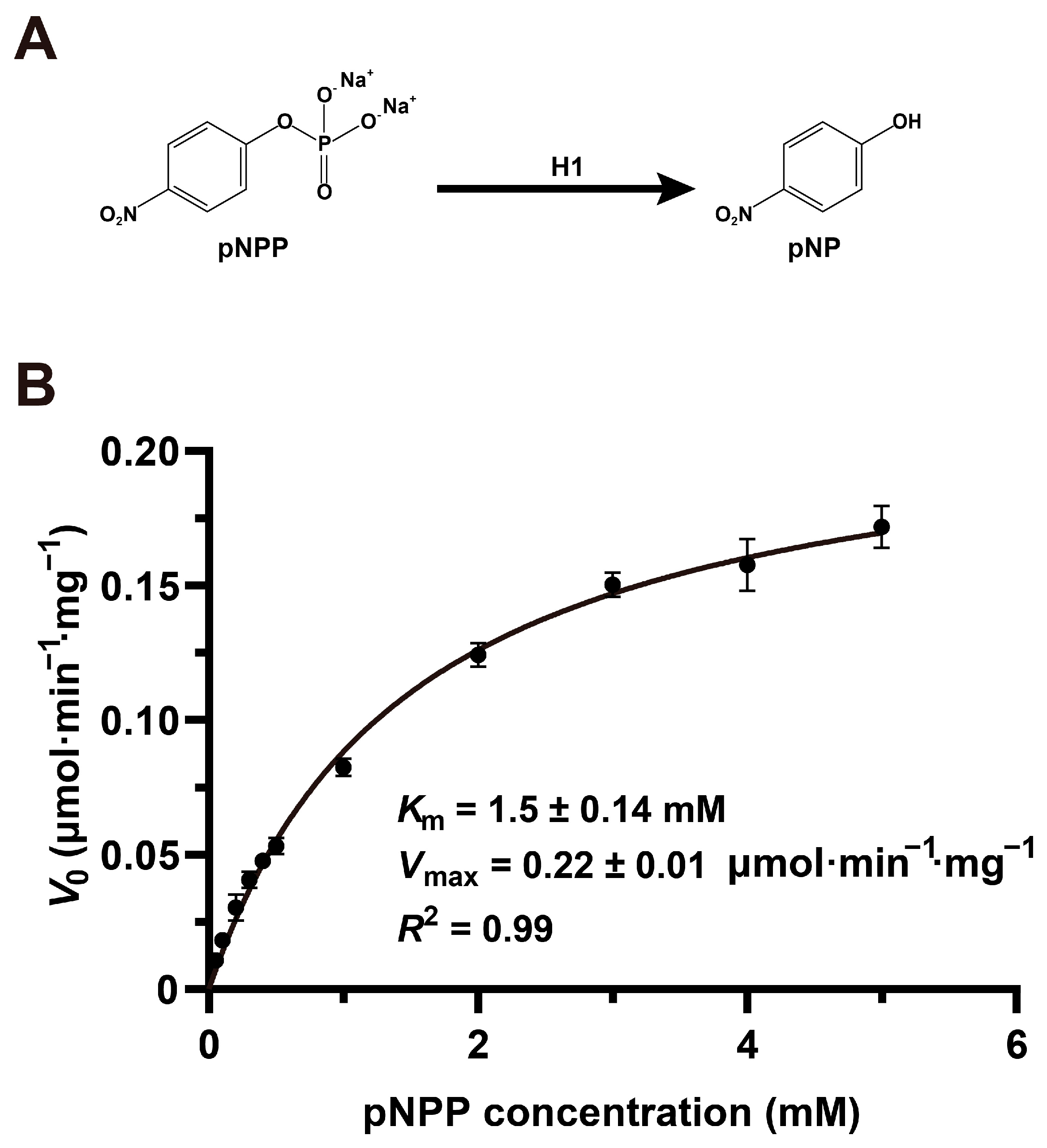
To enable high-throughput inhibitor screening, we established an enzymatic assay for MPXV H1. The enzyme catalyzes the hydrolysis of pNPP, producing pNP and inorganic phosphate. Because pNP exhibits a strong absorbance peak at 405 nm, its accumulation served as a direct readout of enzymatic activity (Figure 1A). Michaelis–Menten kinetics were determined across a pNPP concentration range of 0.05–5 mM. MPXV H1 displayed typical saturation kinetics, with a maximum velocity (Vmax) of 0.22 μmol·min−1·mg−1 and a Michaelis constant (Km) of 1.5 mM, confirming that the wild-type (WT) enzyme is catalytically active under these conditions.

3.2. Validation of the Dimer Interface and Catalytic Site as Inhibitor “Hot Spots”

Structural analysis of MPXV H1 identified two regions as potential druggable “hot spots”: the dimer interface and the catalytic pocket. To validate their functional importance, we generated two variants: one that disrupts dimerization and another that targets the catalytic residue.
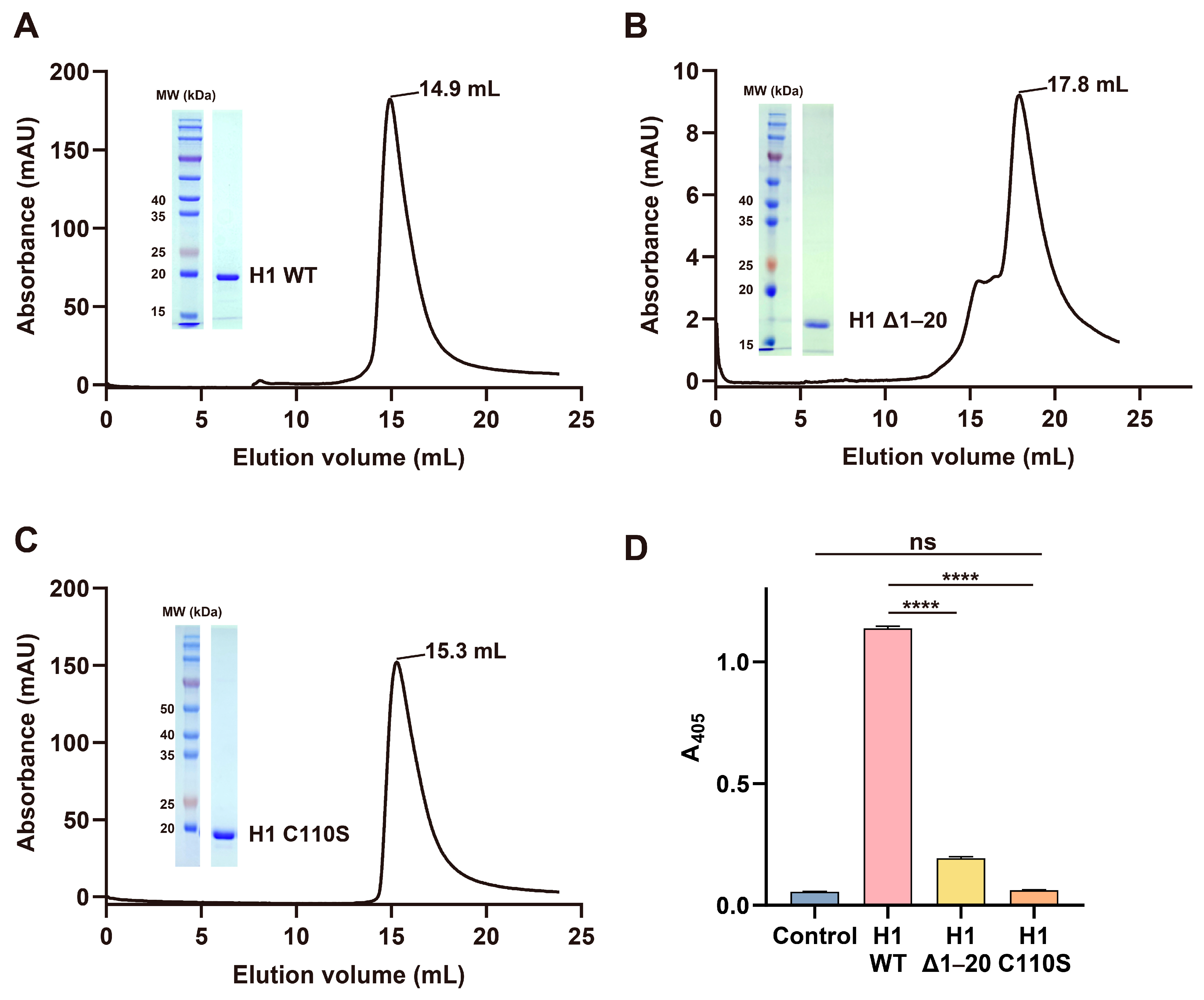
To assess the role of helix α1 in dimerization, we constructed a deletion mutant lacking residues 1–20 (Δ1–20). Size-exclusion chromatography (SEC) revealed that WT H1 eluted at 14.9 mL, corresponding to a ~40 kDa dimer (Figure 2A), whereas Δ1–20 eluted at 17.8 mL, consistent with a ~20 kDa monomer (Figure 2B). Thus, deletion of helix α1 effectively disrupted dimerization. Functionally, WT H1 showed strong activity: a 30-min reaction with 1.2 μM enzyme and 1.5 mM pNPP produced an absorbance (A405) of 1.14, indicating robust pNP generation. In contrast, Δ1–20 displayed markedly reduced activity, with A405 reaching only 0.19, marginally above the negative control (Figure 2D). These results demonstrate that helix α1 is essential for both dimer formation and enzymatic activity.
We next examined the role of the catalytic residue Cys110. This residue directly attacks the phosphorus atom during the dephosphorylation reaction, generating a transient enzyme-phosphate intermediate. The intermediate is then hydrolyzed to release inorganic phosphate and regenerate the enzyme. The C110S substitution yielded a protein with elution behavior comparable to WT H1 (15.3 mL; Figure 2C) but completely abolished catalytic activity (Figure 2D). This confirms the indispensability of C110 for catalysis and highlights the active site as a key inhibitory target.

3.3. Protein Tyrosine Phosphatase Inhibitor IV Potently Inhibits MPXV H1

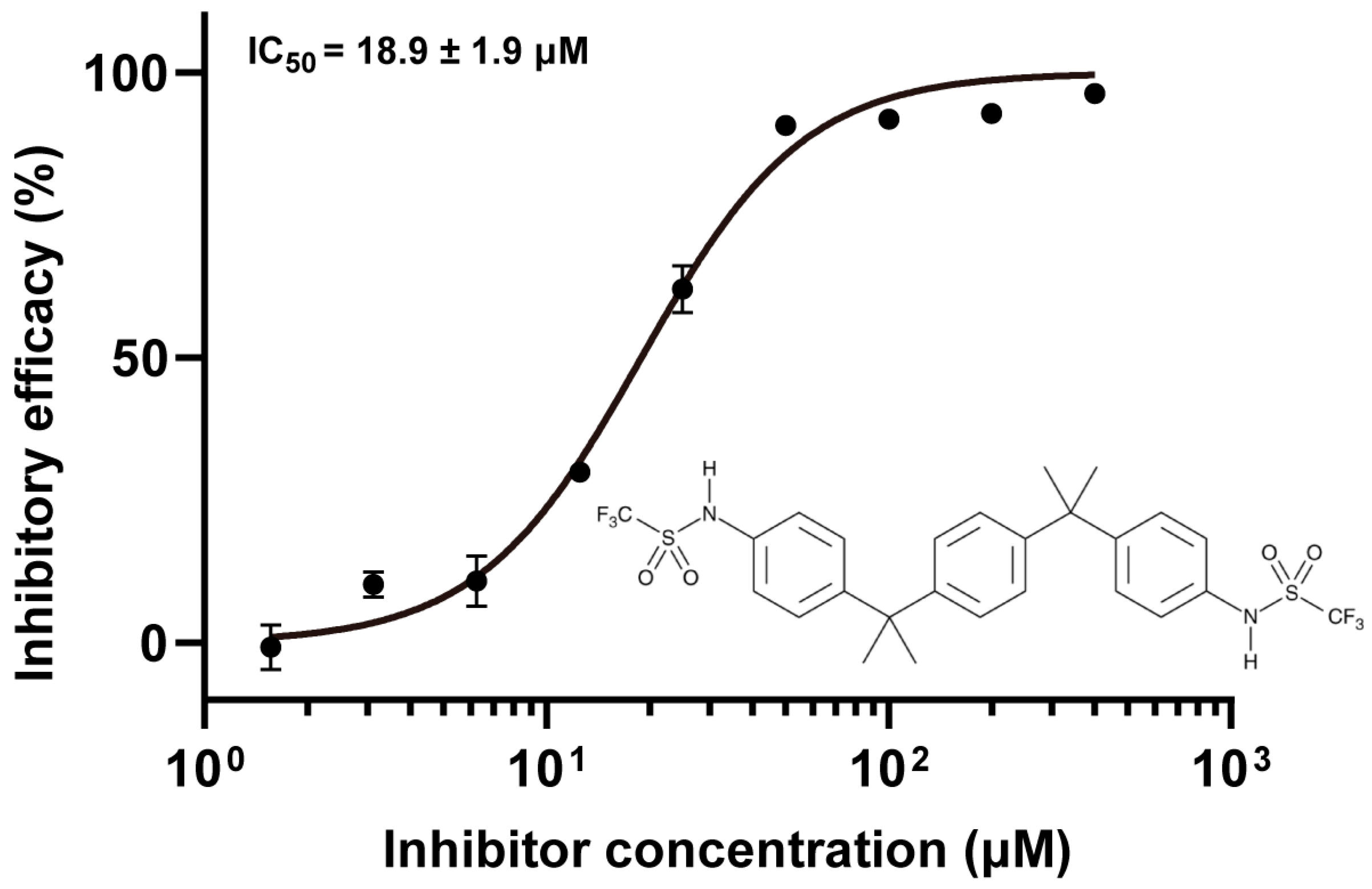
A positive control inhibitor was required for subsequent screening. Protein tyrosine phosphatase (PTP) inhibitor IV is known to target the catalytic triad of PTPs and effectively inhibits VARV H1 with low-micromolar potency [17,18]. Because this catalytic triad is conserved across poxvirus H1 homologs, we tested its efficacy against MPXV H1. Consistent with expectations, PTP inhibitor IV strongly inhibited MPXV H1, yielding an IC50 of 18.9 μM (Figure 3). It was therefore adopted as the positive control in high-throughput screening experiments.

3.4. High-Throughput Screening of MPXV H1 Inhibitors

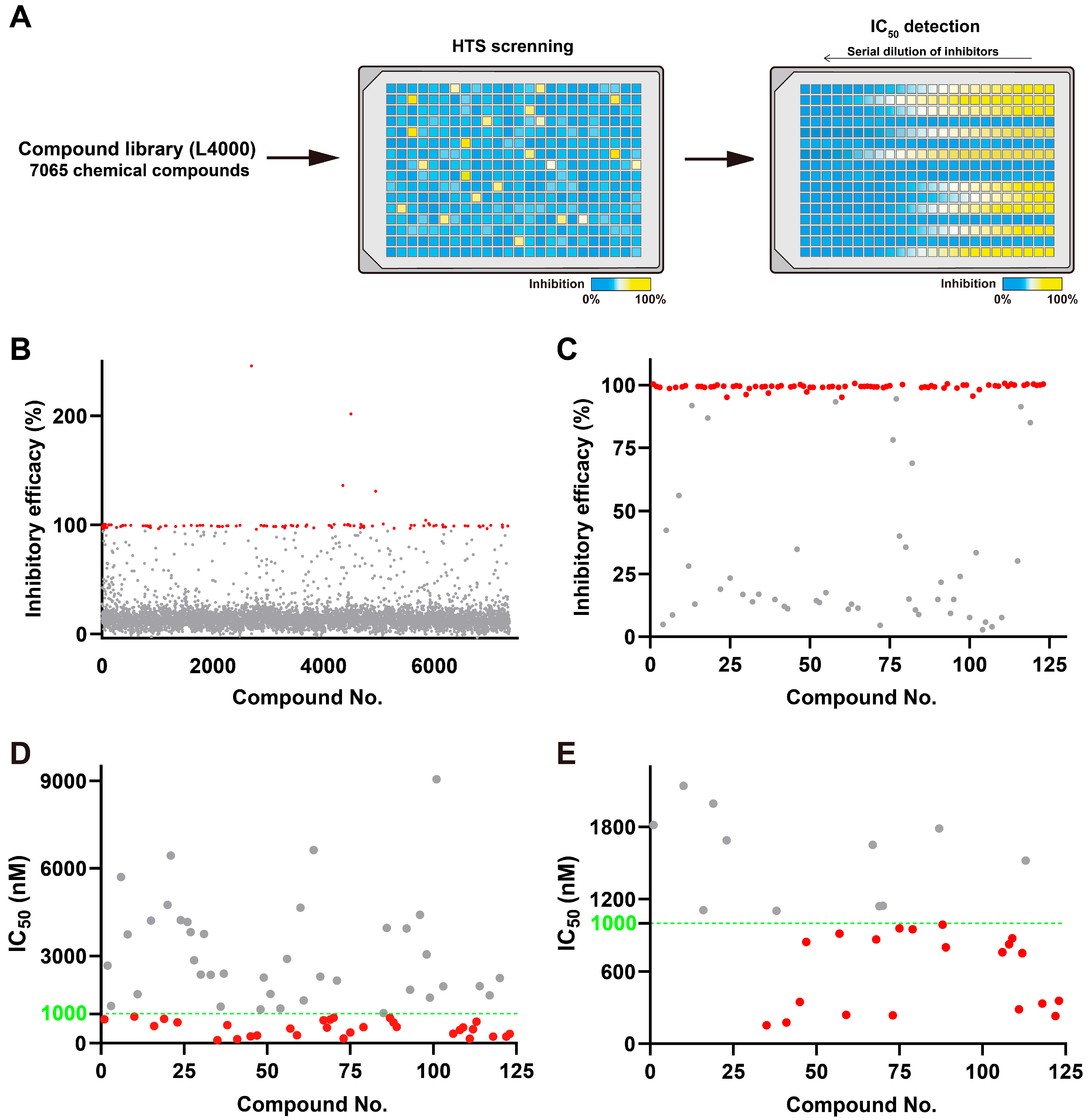
To identify novel inhibitors of MPXV H1, we performed high-throughput screening of the L4000 bioactive compound library, which contains 7065 chemical compounds (Figure 4A). Screening was conducted with 1.2 μM MPXV H1 and 25 μM of each compound. At this concentration, PTP inhibitor IV completely inhibited MPXV H1 activity, validating the assay setup. The first-round screen identified 123 compounds with >95% inhibition. These were renumbered as compounds 1123 and retested under identical conditions (Figure 4B). Of these, 76 compounds consistently retained >95% inhibition (Figure 4C) and were selected for IC50 determination.
Dose–response analysis revealed that 31 of the 76 compounds exhibited IC50 values below 1 μM (Figure 4D and Figure S1). These candidates were re-evaluated under optimized concentration ranges, yielding 20 compounds that consistently displayed sub-micromolar IC50 values (Figure 4E and Figure S2). A summary of these top candidates is provided in Table 1.
To further assess therapeutic potential, we tested the cytotoxicity of the 20 compounds using a CCK-8 viability assay in HeLa cells. Cells were treated with 10 μM compound for 24 h, followed by absorbance-based viability measurements (Figure S3). Seventeen compounds maintained >85% cell viability, with compounds No. 41, 45, 47, 57, 88, 89, 109, and 123 exhibiting particularly low cytotoxicity. In contrast, compounds No. 68, 75, and 108 induced substantial cytotoxicity. These 17 compounds, therefore, represent promising candidates for further investigation.

3.5. Inhibitory Mechanism of Candidate Compounds

To elucidate the mechanisms by which candidate compounds inhibit MPXV H1, we first attempted to obtain high-resolution crystal structures of H1–inhibitor complexes. Although both soaking and co-crystallization trials yielded crystals, no interpretable electron density corresponding to the inhibitors was observed in the refined structures. We therefore employed molecular docking to investigate potential binding modes within the active site.
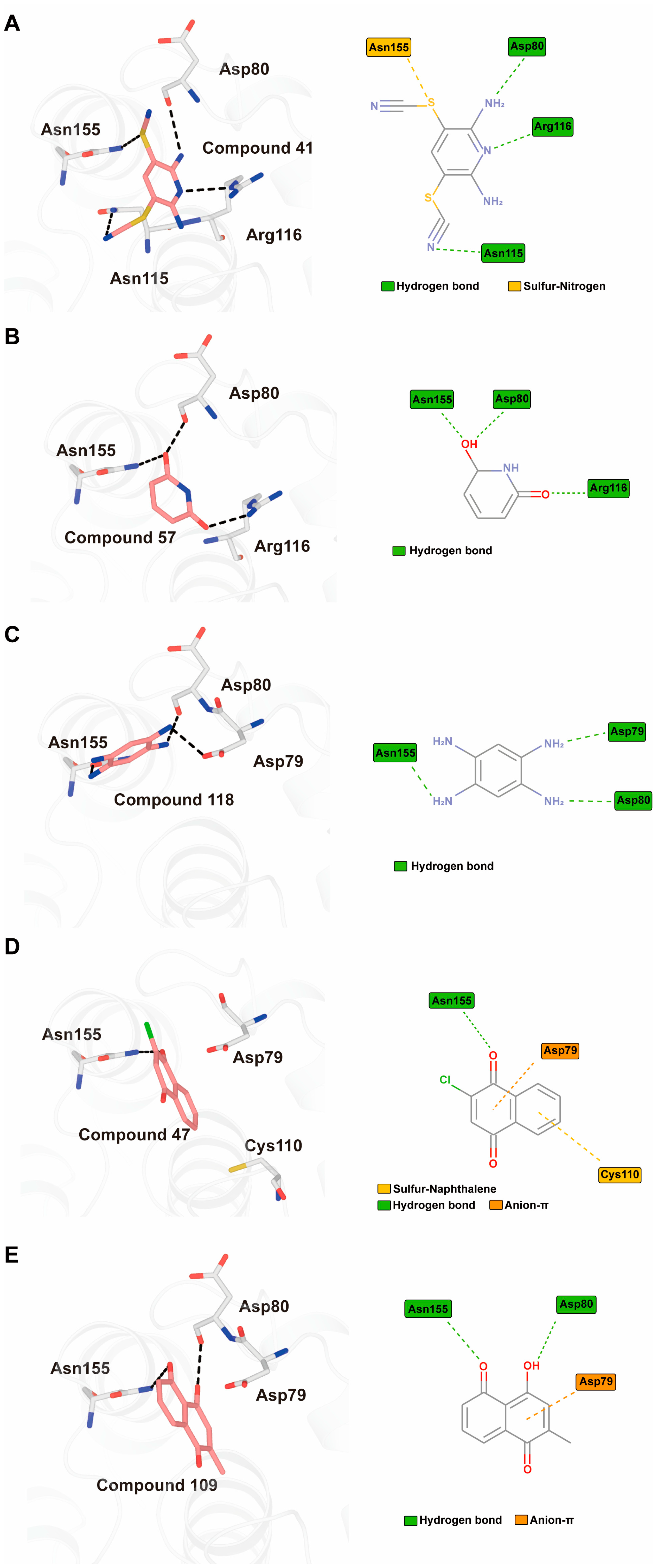
Using the CDOCKER module in Discovery Studio, five of the seventeen candidate compounds were successfully docked into the H1 catalytic pocket, all of which comprise one or two rings. The calculated CDOCKER energy values, reflecting receptor–ligand interactions and internal strain energies, are summarized in Table 2. Among these, compound No. 41 (PR619), one of the most potent inhibitors, showed the lowest CDOCKER energy of −24.9 kcal/mol, consistent with strong binding affinity. Docking revealed that PR619 establishes hydrogen bonds with Arg116, Asn115, and Asp80, while the thiocyanate sulfur at the 5-position engages in a sulfur–nitrogen interaction with Asn155 (Figure 5A) [19]. These interactions likely underlie both the favorable docking energy and its potent inhibitory activity.
Compound No. 57 (2,6-dihydroxypyridine hydrochloride), which shares a central pyridine scaffold with PR619, forms hydrogen bonds via its hydroxyl groups with Asn155, Asp80, and Arg116. However, lacking the thiocyanate moiety present in PR619, it displayed a higher (less favorable) CDOCKER energy of −13.2 kcal/mol and reduced potency, highlighting the contribution of the thiocyanate-mediated interactions (Figure 5B). Compound No. 118 (1,2,4,5-benzenetetramine tetrahydrochloride) replaces the pyridine ring with a benzene core bearing four amine substituents. Its amine groups form hydrogen bonds with Asp79, Asp80, and Asn155, yielding a docking energy of −22.5 kcal/mol, comparable to PR619 and indicative of stable binding (Figure 5C).
Compound No. 47 (2-chloro-1,4-naphthoquinone) displayed a docking energy of −16 kcal/mol. The carbonyl group at the 1-position forms a hydrogen bond with Asn155, while the naphthalene ring engages in an anion–π interaction with Asp79 and a sulfur–naphthalene interaction with Cys110 (Figure 5D) [20]. Compound No. 109 (Plumbagin), a structural analog of compound 47, differs by carrying a methyl group at the 2-position in place of chlorine, along with a hydroxyl substituent at the 5-position. Docking results indicated hydrogen bonds between the 5-ketone oxygen and Asn155, and between the 4-hydroxyl group and Asp80. The naphthalene ring additionally participates in an anion–π interaction with Asp79, closely mirroring the binding mode of compound 47 (Figure 5E).
Taken together, the five inhibitors share a conjugated aromatic core, typically comprising one or two six-membered rings decorated with polar oxygen- or nitrogen-containing substituents. All dock within the catalytic pocket, forming non-covalent interactions predominantly with hydrophilic residues, including Asp79, Asp80, Asn115, Asn155, and Arg116. These binding features suggest direct competition with substrate binding. The docking analyses thus provide mechanistic insights into inhibitor engagement with MPXV H1 and may guide future optimization of these compounds.

4. Discussion

The dual-specificity phosphatase H1 of MPXV plays a central role in viral replication by dephosphorylating both phosphotyrosine and phosphoserine/threonine residues and has thus emerged as a promising antiviral target [21]. In this study, we characterized MPXV H1 activity and demonstrated that both the N-terminal helix α1 and the catalytic residue Cys110 are indispensable for enzymatic function, validating them as potential inhibitory “hot spots.” Through high-throughput screening (HTS), we identified 17 compounds with potent activity (IC50 < 1 µM) and minimal cytotoxicity. Docking analyses further elucidated their binding modes within the catalytic pocket. Together, these findings provide mechanistic insight into MPXV H1-mediated dephosphorylation and establish a foundation for developing novel inhibitors targeting this enzyme.
The importance of helix α1 in MPXV H1 function is consistent with prior work showing that disruption of VACV H1 dimerization impairs its ability to dephosphorylate 3-O-methylfluorescein phosphate and phosphorylated STAT1 [13]. Structural studies indicate that helix α1 is located far from the active site [13,15], raising the mechanistic question of how it modulates catalytic activity. One possibility is that dimerization positions the α1 helix of one protomer to induce local conformational changes in the partner, compacting the active site and enhancing catalysis [13,22]. Definitive confirmation will require structural characterization of an H1 variant lacking helix α1. Taken together with previous reports, our results highlight helix α1 as a critical determinant of catalytic activity and suggest that the dimerization interface represents a unique druggable site in poxvirus H1 phosphatases [13,15].
Both HTS and in silico screening are widely used strategies for inhibitor discovery. Here, HTS identified 17 low-micromolar candidates, most of which share a common structural motif: an aromatic core with polar substituents. In silico approaches have also been applied to MPXV H1. One study screened FDA-approved and natural product libraries and identified mefloquine and aromadendrin as top candidates [23]. Notably, mefloquine was recently shown to inhibit MPXV in cell-based assays [24]. Inhibitors of variola virus H1 have also been reported [18], like our compounds, they feature aromatic scaffolds with polar groups, though they exhibited substantially lower potency in enzymatic assays [18]. Notably, the candidate compounds identified in our study are clinically applied or approved drugs. Referring to their well-established biosafety profiles, we found that these compounds, which have IC50 values in the nanomolar range against H1, can effectively inhibit H1 at clinically safe doses. These findings underscore the strength of our HTS-derived inhibitors.
Docking analysis revealed that the aromatic rings of compounds No. 41, 47, 57, 109, and 118 occupy the catalytic pocket, likely blocking substrate access. The critical residues mediating inhibitor interactions map to the P-loop (110–116) and WPD-loop (74–86), both of which are essential for catalysis [25,26]. The P-loop binds the phosphate moiety, whereas the WPD-loop stabilizes the thiolate form of Cys110, thereby enhancing nucleophilicity [26,27]. Beyond these motifs, Asn155 emerged as a key residue, forming hydrogen bonds or sulfur–nitrogen interactions with all five compounds analyzed. Interestingly, Asn155 also interacts with mefloquine and aromadendrin [23], suggesting it may serve as a conserved anchor point for inhibitor binding. Asp80 was likewise found to form hydrogen bonds with most compounds, except compound No. 47, highlighting its role as an additional hotspot for ligand engagement. These findings point to Asn155 and Asp80 as particularly promising residues for structure-guided drug design.
Although we performed docking analysis for all candidate molecules, only five of them were successfully docked into the active site. These molecules have only one or two rings, whereas the larger molecules were unable to dock at this site. The relatively small size of the H1 active site (PDB: 8GZ4) may hinder direct docking of molecules containing more than two benzene rings. The candidates that were not successfully docked may inhibit H1 through one of the following mechanisms. First, some of them may bind at the active site through an induced-fit mechanism. Upon binding, they may induce conformational changes in regions surrounding the active site (for example, in the WPD-loop), a process not simulated in the docking analysis. It is acknowledged that docking analysis cannot perfectly simulate the bona fide interactions between protein and small molecules, as it is influenced by multiple factors, such as salt concentration in the buffer, pH, and temperature conditions. This is also reflected in that CDOCKER energy values and IC50 values may not be directly proportional, as the former is derived from docking simulations, while the latter is obtained from wet-lab experiments. Alternatively, some of the candidates may bind H1 at an allosteric site, leading to an overall conformational change in H1 and reduced activity. Experimental structures are needed to elucidate the location of the putative allosteric site and the interaction mode of such molecules.
In conclusion, we performed HTS against MPXV H1 and identified 17 potent inhibitors with favorable cytotoxicity profiles. Docking analyses clarified their inhibitory mechanisms and revealed their interactions with the WPD-loop, P-loop, and the N155 residue (Figure S4). Given that phosphatases are increasingly recognized as druggable targets [28,29], our results provide a strong foundation for the rational design and optimization of anti-poxvirus therapeutics targeting MPXV H1.

Supplementary Materials

The following supporting information can be downloaded at https://www.mdpi.com/article/10.3390/v17111493/s1: Figure S1: The first round of IC50 determination; Figure S2: The second round of IC50 determination; Figure S3: Cell viability of potential inhibitors; Figure S4. The common motifs involved in candidate molecule binding.

Author Contributions

W.C. and W.W. conceived the project and designed the experiments; M.A. and H.H. cloned, expressed and purified proteins; C.T., M.A. and H.H. measured the catalytic activity; H.H., Z.L., Y.L. and J.H. performed the high-throughput screening and IC50 determination; H.H., X.G. and J.H. carried out docking and molecular dynamics simulation; C.T., M.A., H.H., M.L., W.C. and W.W. analyzed and discussed the data; C.T., W.C. and W.W. wrote the manuscript. All authors have read and agreed to the published version of the manuscript.

Funding

This work was supported by grants from the National Natural Science Foundation of China (81902063, 82202505), the Natural Science Program of Chongqing Science and Technology Commission (CSTB2022NSCQ-BHX0679, CSTB2024NSCQ-MSX0391, CSTB2023NSCQ-BHX0154), Science and Technology Research Program of Chongqing Municipal Education Commission (KJQN202300401, KJQN202300442, KJQN202400433, KJQN202500443) and CQMU Program for Youth Innovation in Future Medicine (W0094, W0073). This work was also supported by undergraduate Research Skills Development Program of College of Pharmacy Chongqing Medical University (YCZX20250712).

Institutional Review Board Statement

Not applicable.

Informed Consent Statement

Not applicable.

Data Availability Statement

The original contributions presented in this study are included in the article/Supplementary Material. Further inquiries can be directed to the corresponding authors.

Acknowledgments

We thank Ping Deng from College of Pharmacy at Chongqing Medical University for assistance with Discovery Studio.

Conflicts of Interest

The authors declare no competing interests.

References

  1. Moss, B. Understanding the Biology of Monkeypox Virus to Prevent Future Outbreaks. Nat. Microbiol. 2024, 9, 1408–1416. [Google Scholar] [CrossRef] [PubMed]
  2. Ali, R.; Alonga, J.; Biampata, J.-L.; Basika, M.K.; Berry, I.M.; Bisento, N.; Blum, E.; Bonnett, T.; Cone, K.; Crozier, I.; et al. Placebo-Controlled Trial of Tecovirimat for Endemic (Clade I MPXV) Mpox, DRC. N. Engl. J. Med. 2025, 392, 1484–1496. [Google Scholar] [CrossRef] [PubMed]
  3. Chittick, G.; Morrison, M.; Brundage, T.; Nichols, W.G. Short-Term Clinical Safety Profile of Brincidofovir: A Favorable Benefit-Risk Proposition in the Treatment of Smallpox. Antivir. Res. 2017, 143, 269–277. [Google Scholar] [CrossRef]
  4. Prévost, J.; Sloan, A.; Deschambault, Y.; Tailor, N.; Tierney, K.; Azaransky, K.; Kammanadiminti, S.; Barker, D.; Kodihalli, S.; Safronetz, D. Treatment Efficacy of Cidofovir and Brincidofovir against Clade II Monkeypox Virus Isolates. Antivir. Res. 2024, 231, 105995. [Google Scholar] [CrossRef] [PubMed]
  5. Eid, R.E.; Allaw, F.; Haddad, S.F.; Kanj, S.S. Human Monkeypox: A Review of the Literature. PLoS Pathog. 2022, 18, e1010768. [Google Scholar] [CrossRef]
  6. Reynolds, M.G.; Guagliardo, S.A.J.; Nakazawa, Y.J.; Doty, J.B.; Mauldin, M.R. Understanding Orthopoxvirus Host Range and Evolution: From the Enigmatic to the Usual Suspects. Curr. Opin. Virol. 2018, 28, 108–115. [Google Scholar] [CrossRef] [PubMed]
  7. Lu, J.; Xing, H.; Wang, C.; Tang, M.; Wu, C.; Ye, F.; Yin, L.; Yang, Y.; Tan, W.; Shen, L. Mpox (Formerly Monkeypox): Pathogenesis, Prevention and Treatment. Signal Transduct. Target. Ther. 2023, 8, 458. [Google Scholar] [CrossRef]
  8. Shchelkunov, S.N.; Totmenin, A.V.; Safronov, P.F.; Mikheev, M.V.; Gutorov, V.V.; Ryazankina, O.I.; Petrov, N.A.; Babkin, I.V.; Uvarova, E.A.; Sandakhchiev, L.S.; et al. Analysis of the Monkeypox Virus Genome. Virology 2002, 297, 172–194. [Google Scholar] [CrossRef]
  9. Schmidt, F.I.; Bleck, C.K.E.; Reh, L.; Novy, K.; Wollscheid, B.; Helenius, A.; Stahlberg, H.; Mercer, J. Vaccinia Virus Entry is Followed by Core Activation and Proteasome-Mediated Release of the Immunomodulatory Effector VH1 from Lateral Bodies. Cell Rep. 2013, 4, 464–476. [Google Scholar] [CrossRef]
  10. Derrien, M.; Punjabi, A.; Khanna, M.; Grubisha, O.; Traktman, P. Tyrosine Phosphorylation of A17 during Vaccinia Virus Infection: Involvement of the H1 Phosphatase and the F10 Kinase. J. Virol. 1999, 73, 7287–7296. [Google Scholar] [CrossRef]
  11. Liu, K.; Lemon, B.; Traktman, P. The Dual-Specificity Phosphatase Encoded by Vaccinia Virus, VH1, is Essential for Viral Transcription In Vivo and In Vitro. J. Virol. 1995, 69, 7823–7834. [Google Scholar] [CrossRef] [PubMed]
  12. Novy, K.; Kilcher, S.; Omasits, U.; Bleck, C.K.E.; Beerli, C.; Vowinckel, J.; Martin, C.K.; Syedbasha, M.; Maiolica, A.; White, I.; et al. Proteotype Profiling Unmasks a Viral Signalling Network Essential for Poxvirus Assembly and Transcriptional Competence. Nat. Microbiol. 2018, 3, 588–599. [Google Scholar] [CrossRef] [PubMed]
  13. Koksal, A.C.; Cingolani, G. Dimerization of Vaccinia Virus VH1 is Essential for Dephosphorylation of STAT1 at Tyrosine 701. J. Biol. Chem. 2011, 286, 14373–14382. [Google Scholar] [CrossRef] [PubMed]
  14. Najarro, P.; Traktman, P.; Lewis, J.A. Vaccinia Virus Blocks Gamma Interferon Signal Transduction: Viral VH1 Phosphatase Reverses Stat1 Activation. J. Virol. 2001, 75, 3185–3196. [Google Scholar] [CrossRef]
  15. Cui, W.; Huang, H.; Duan, Y.; Luo, Z.; Wang, H.; Zhang, T.; Nguyen, H.C.; Shen, W.; Su, D.; Li, X.; et al. Crystal Structure of Monkeypox H1 Phosphatase, an Antiviral Drug Target. Protein Cell 2022, 14, 469–472. [Google Scholar] [CrossRef]
  16. Mann, B.A.; Huang, J.H.; Li, P.; Chang, H.-C.; Slee, R.B.; O’Sullivan, A.; Anita, M.; Yeh, N.; Klemsz, M.J.; Brutkiewicz, R.R.; et al. Vaccinia Virus Blocks Stat1-Dependent and Stat1-Independent Gene Expression Induced by Type I and Type II Interferons. J. Interf. Cytokine Res. 2008, 28, 367–380. [Google Scholar] [CrossRef]
  17. Park, J.E.; Park, B.C.; Song, M.; Park, S.G.; Lee, D.H.; Park, S.-Y.; Kim, J.H.; Cho, S. PTP Inhibitor IV Protects JNK Kinase Activity by Inhibiting Dual-Specificity Phosphatase 14 (DUSP14). Biochem. Biophys. Res. Commun. 2009, 387, 795–799. [Google Scholar] [CrossRef]
  18. Phan, J.; Tropea, J.E.; Waugh, D.S. Structure-Assisted Discovery of Variola Major H1 Phosphatase Inhibitors. Acta Crystallogr. D Biol. Crystallogr. 2007, 63, 698–704. [Google Scholar] [CrossRef]
  19. Koebel, M.R.; Cooper, A.; Schmadeke, G.; Jeon, S.; Narayan, M.; Sirimulla, S. S···O and S···N Sulfur Bonding Interactions in Protein-Ligand Complexes: Empirical Considerations and Scoring Function. J. Chem. Inf. Model. 2016, 56, 2298–2309. [Google Scholar] [CrossRef]
  20. Zauhar, R.J.; Colbert, C.L.; Morgan, R.S.; Welsh, W.J. Evidence for a Strong Sulfur-Aromatic Interaction Derived from Crystallographic Data. Biopolymers 2000, 53, 233–248. [Google Scholar] [CrossRef]
  21. Bottini, A.; Pacheco, D.R.D.C.G.; Forti, F.L.; Bottini, N. Revisiting VH1 Phosphatase at the Time of Monkeypox: Back to the Spotlight. Biochem. Soc. Trans. 2023, 51, 1419–1427. [Google Scholar] [CrossRef] [PubMed]
  22. Koksal, A.C.; Nardozzi, J.D.; Cingolani, G. Dimeric Quaternary Structure of the Prototypical Dual Specificity Phosphatase VH1. J. Biol. Chem. 2009, 284, 10129–10137. [Google Scholar] [CrossRef]
  23. Tiwari, H.; Ilyas, A.; Upadhyay, S.; Rai, P.K.; Borkotoky, S. Computational Screening of FDA-Approved and Natural Compounds against Mpox Dual Specificity Protein Phosphatase (H1). Indian J. Biochem. Biophys. 2025, 62, 398–405. [Google Scholar] [CrossRef]
  24. Akazawa, D.; Ohashi, H.; Hishiki, T.; Morita, T.; Iwanami, S.; Kim, K.S.; Jeong, Y.D.; Park, E.-S.; Kataoka, M.; Shionoya, K.; et al. Potential Anti-Mpox Virus Activity of Atovaquone, Mefloquine, and Molnupiravir, and Their Potential Use as Treatments. J. Infect. Dis. 2023, 228, 591–603. [Google Scholar] [CrossRef]
  25. Brandão, T.A.S.; Johnson, S.J.; Hengge, A.C. The Molecular Details of WPD-Loop Movement Differ in the Protein-Tyrosine Phosphatases YopH and PTP1B. Arch. Biochem. Biophys. 2012, 525, 53–59. [Google Scholar] [CrossRef]
  26. Xiao, J.; Engel, J.L.; Zhang, J.; Chen, M.J.; Manning, G.; Dixon, J.E. Structural and Functional Analysis of PTPMT1, a Phosphatase Required for Cardiolipin Synthesis. Proc. Natl. Acad. Sci. USA 2011, 108, 11860–11865. [Google Scholar] [CrossRef]
  27. Shen, R.; Crean, R.M.; Olsen, K.J.; Corbella, M.; Calixto, A.R.; Richan, T.; Brandão, T.A.S.; Berry, R.D.; Tolman, A.; Loria, J.P.; et al. Insights into the Importance of WPD-Loop Sequence for Activity and Structure in Protein Tyrosine Phosphatases. Chem. Sci. 2022, 13, 13524. [Google Scholar] [CrossRef] [PubMed]
  28. Pan, J.; Zhou, L.; Zhang, C.; Xu, Q.; Sun, Y. Targeting Protein Phosphatases for the Treatment of Inflammation-Related Diseases: From Signaling to Therapy. Signal Transduct. Target. Ther. 2022, 7, 177. [Google Scholar] [CrossRef] [PubMed]
  29. Delibegović, M.; Dall’Angelo, S.; Dekeryte, R. Protein Tyrosine Phosphatase 1B in Metabolic Diseases and Drug Development. Nat. Rev. Endocrinol. 2024, 20, 366–378. [Google Scholar] [CrossRef]
Figure 1. Enzymatic activity assay and Michaelis-Menten kinetic characterization of MPXV H1. (A) The dephosphorylation reaction catalyzed by MPXV H1 was monitored by quantifying pNP production via absorbance measurements at 405 nm. (B) Michaelis-Menten kinetic characterization of MPXV H1 using a range of pNPP concentrations. Km, Michaelis constant; Vmax, maximum velocity; V0, initial reaction velocity; R2, coefficient of determination. All assays were performed in triplicate, with mean values and standard deviations plotted.
Viruses 17 01493 g001
Figure 2. Size-exclusion chromatography and relative activity of MPXV H1 variants. Size-exclusion chromatography (SEC) analysis and SDS-PAGE of (A) WT MPXV H1, (B) MPXV H1 Δ1–20, and (C) MPXV H1 C110S. (D) Comparison of enzymatic activities of MPXV H1 variants. A control reaction without enzyme was included. All activity assays were performed in triplicate, with mean values and standard deviations plotted. ns, not significant. **** p < 0.0001.
Viruses 17 01493 g002
Figure 3. Inhibitory activity of PTP inhibitor IV against MPXV H1. The inhibitory efficacy of PTP inhibitor IV was assessed across concentrations ranging from 1.5 to 400 μM, and the resulting data were fitted to determine the IC50 value. The inhibition assays were conducted in triplicate, with mean values and standard deviations plotted.
Viruses 17 01493 g003
Figure 4. High-throughput screening of inhibitors targeting MPXV H1 and IC50 determination. (A) Schematic illustration of the high-throughput inhibitor screening process. (B) The first round of high-throughput screening identified 123 candidate compounds. (C) A subsequent round of screening confirmed the inhibitory activities of 76 compounds. Compounds exhibiting inhibitory efficacy greater than 95% are indicated by red dots, whereas those with lower efficacy are shown in gray. (D,E) IC50 determination of the candidate compounds. The green dashed line marks the IC50 threshold of 1000 nM; red dots represent compounds with IC50 values below this threshold, while gray dots denote those above it.
Viruses 17 01493 g004
Figure 5. Interactions between representative inhibitors and MPXV H1. The interactions between MPXV H1 and compounds (A) No. 41, (B) No. 57, (C) No. 118, (D) No. 47 and (E) No. 109 are shown. The compounds and the residues involved in the interaction are shown as sticks in the structural models. Hydrogen bonds are shown as black dashed lines. The 2D diagrams highlighting the types of interactions are shown to the right of the structural models.
Viruses 17 01493 g005
Table 1. Top candidate compounds and the IC50 values.
Compound No.StructuresNameIC50 (nM)
35Viruses 17 01493 i001SF1670154 ± 12
41Viruses 17 01493 i002PR619176 ± 7
45Viruses 17 01493 i003Beta-lapachone348 ± 17
47Viruses 17 01493 i0042-Chloro-1,4-naphthoquinone837 ± 56
57Viruses 17 01493 i0052,6-Dihydroxypyridine hydrochloride911 ± 64
59Viruses 17 01493 i006Phanquinone241 ± 7
68Viruses 17 01493 i007TAS-103 (dihydrochloride)865 ± 16
73Viruses 17 01493 i008Vitamin B12238 ± 5
75Viruses 17 01493 i009Napabucasin957 ± 40
79Viruses 17 01493 i010Crizotinib hydrochloride946 ± 52
88Viruses 17 01493 i011Delavirdine (mesylate)987 ± 48
89Viruses 17 01493 i012BYK204165794 ± 46
106Viruses 17 01493 i013Tanshinone IIA531 ± 19
108Viruses 17 01493 i014YM155826 ± 65
109Viruses 17 01493 i015Plumbagin874 ± 24
111Viruses 17 01493 i016Tanshinone IIA sulfonate sodium287 ± 10
112Viruses 17 01493 i017Nuciferine752 ± 9
118Viruses 17 01493 i0181,2,4,5-Benzenetetramine tetrahydrochloride333 ± 30
122Viruses 17 01493 i019Crebanine229 ± 21
123Viruses 17 01493 i020Dehydronuciferine356 ± 25
Table 2. Information on CDOCKER results.
Compound No.NameCDOCKER Energy (kcal/mol)
41PR619−24.9
472-Chloro-1,4-naphthoquinone−16.0
572,6-Dihydroxypyridine hydrochloride−13.2
109Plumbagin−5.5
1181,2,4,5-Benzenetetramine tetrahydrochloride−22.5
Disclaimer/Publisher’s Note: The statements, opinions and data contained in all publications are solely those of the individual author(s) and contributor(s) and not of MDPI and/or the editor(s). MDPI and/or the editor(s) disclaim responsibility for any injury to people or property resulting from any ideas, methods, instructions or products referred to in the content.