


Abstract
Secondary transportation of raw and comminuted forest products is a major component in forest harvesting operations in terms of economics, public perception, and safety. Consequently, there is a substantial amount of literature on this topic. The existing literature has dealt with many of the technical aspects of transportation with a majority of them focusing on improving supply chain issues; however, there are only few specific to secondary transportation issues in general. This annotated bibliography will help practitioners, researchers, and stakeholders gain a better understanding of the existing literature from 2000 to 2015. To this end, we began by classifying the selected literature into six themes: cost, roads and routes, trucking, efficiency and safety, other modes of transportation, and supply chain and optimization. Woody biomass for bioenergy production was the most researched forest product with respect to transportation. About one-third of the articles were presented in the context of supply chain modeling and optimization. More than half of the studies originated from Europe while the United States had the most publications for any given country. Most articles (16) were published in 2013. Biomass and Bioenergy published the highest number of articles (29) during the timeframe.
1. Introduction
Transportation in forest operations can be broadly divided into two phases. The first phase involves moving wood from the stump to the roadside/landing sites, referred to as primary transportation. The second phase involves the hauling of the processed forest products (sawlog, pulpwood, or energy wood biomass) from the roadside/landing sites to the processing facilities, referred to as secondary transportation [1]. Secondary transportation is considered to be one of the most expensive elements in the harvesting operation, generally accounting for 30%–50% of the total cost, depending on the distance travelled and compared to the cost of the primary transportation [2,3,4]. Therefore, improvements in secondary transportation may yield significant overall cost reductions.
Secondary transportation is predominantly road-based. Various factors influence the cost of secondary transportation including—but not limited to—the road network (road types) and conditions (infrastructure), cost of operating the truck, weight limitations, and hauling distance. Research generally focuses on the transportation problem addressing one or some of these factors, but rarely all at the same time. It cannot be expected that one research activity can look into all of these factors because addressing each topic requires expertise in different domains. Nonetheless, having all informational aspects on transportation integrated will be of great value to stakeholders.
The purpose of this study is to address this gap by proposing a classification of a collection of scientific literature and addressing several relevant topics in forest products secondary transportation. It provides an overview of the current state of the art, and helps in identifying knowledge gaps that require further attention. To this end, the objective of this article is to list the major findings from these studies and assess the chronological development of forest products secondary transportation research from 2000 to 2015.
2. Materials and Methods
2.1. Literature Review
The literature was searched using major online databases and library catalogs: CrossRef, Scopus, Google Scholar, and Web of Science. The initial search started in November 2016 with three keywords: “forest transportation”, “forest trucking”, and “wood supply chain”, which yielded 71 scientific articles. After careful analysis of those articles, four more keywords, “forest optimization”, “biomass”, “sawlogs”, and “forest roads” were used to gather more literature. Additionally, the reference section of the previously-selected articles was also utilized for more specific search. A total of 169 scientific articles (related to forest products secondary transportation) were identified as relevant to this process. The four major journals with the highest publication frequency of related articles were selected and every issue of those journals from year 2000 to 2015 was searched again (Table 1). These journals were accessed through the University of Maine library resources from January to April 2016. A total of 369 volumes and issues of these four journals were assessed in order to include all information in these four journals related to forest products transportation. A total of 131 articles were chosen as relevant for the purpose of this review. The article search was limited to English-written scientific articles.
Table 1.
Peer-reviewed journals that published articles related to forest products secondary transportation, 2000–2015.
2.2. Literature Categorization and Classification
Based on the scope and objectives of articles identified, six major research themes emerged:
- Cost of transportation
- Roads and route planning
- Trucking characteristics
- Efficiency and safety
- Other modes of transportation
- Supply chain and optimization.
The classification is intended to facilitate compilation and reporting. Understandably, some of the themes overlapped. For example, there were several software and models which generated results that could be included in Theme II—roads and route planning and VI—supply chain and optimizations. Several articles dealt with more than one theme. Additionally, for minimizing ambiguity, no articles in one theme have been repeated in another.
Theme I (cost) primarily dealt with articles focusing on financial aspects of trucking operations. The theme also included articles related to detailed time studies; strategies to minimize the overall transportation costs; assessing the impacts of transportation distance on the final cost of delivered forest products; and evaluating the performance of transportation cost estimating software and models. Theme II (roads and route planning), focused on every aspect of forest roads, including engineering, planning, design, construction, maintenance, spatial modeling, and computer software. Theme III (trucking characteristics) was specific to road transportation: truck size and configuration, speed at various road conditions, weight limits, payload enhancement measures, trucking performance, and features of trailers. Theme IV (efficiency and safety) dealt with fuel efficiency, log truck accident analysis, social surveys with related stakeholders, evaluation of fuel consumption capacity, and potential effects of forest road erosion on the supply chain. Theme V (other modes of transportation) focused on articles dealing with railways and water transportation. Theme VI (supply chain and optimizations) included modelling supply chain in different regions, geospatial evaluations, linear programming, strategic and tactical planning, optimization of supply chain, decision support tools for wood procurement and management, and simulation of logistics models.
Each article was evaluated for country of study, objectives researched and major findings, resulting in Table 2.
Table 2.
Distribution of articles related to forest products secondary transportation based on the geographic location of the study.
3. Results
Out of the 131 articles reviewed, 127 were published in peer-reviewed scientific journals, three in conference proceedings, and one was a cooperative extension article. With more than 22% publications, Biomass and Bioenergy published the highest number of articles related to the field, followed by the Croatian Journal of Forest Engineering (Table 1). On a regional basis, about 56% of the research articles were published by authors based in Europe, followed by 33% from North America (Table 2). However, the United States had the highest number of publications on a per country basis. Several articles were authored by authors from multiple countries.
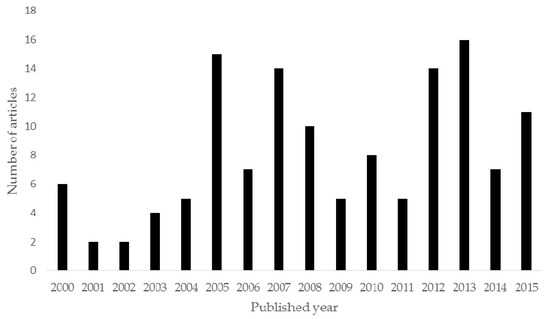
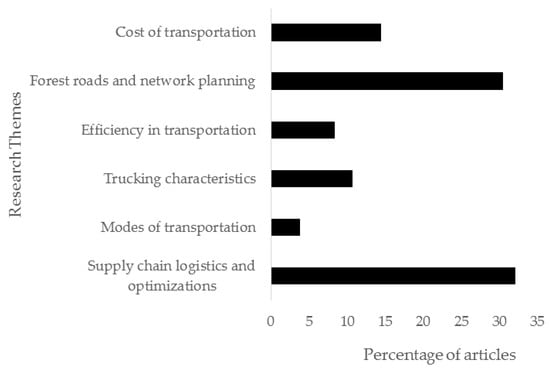
For the given period, the highest number of articles was published in 2013 (16 articles) followed by 2005 (15) (Figure 1). Hence, the interest seems to be growing. On average, eight articles related to forest products transportation and supply chain were published per year from 2000 to 2015. Nearly 33% of the reviews were related to supply chain logistics and optimization (Figure 2).
Figure 1.
Distribution of articles related to forest products secondary transportation over the years of publication (2000 to 2015).
Figure 2.
Distribution of articles in forest products secondary transportation based on research themes.
3.1. Theme I—Cost
There were 18 articles in this category, accounting for approximately 15% of the total articles reviewed. An average of a little more than one article per year was published in this category. A majority of the articles (more than 80%) were based on comminuted forest products, mainly wood chips, logging, and industrial residues for bioenergy and biofuel production (Table 3). The greatest number of publications (six articles) were based in the USA, followed by Sweden, Finland, and Austria.
Table 3.
Published scientific articles handling the cost of transportation. The cost values mentioned reflects the actual value presented in the article.
3.2. Theme II—Roads and Route Planning
A total of 40 articles (about 31%) were categorized under this theme, averaging 2.5 articles published per year. Similar to the Theme I, the greatest number of publications were from the United States (12 articles) followed by Turkey, Croatia, Slovenia, Sweden, Iran, and Japan (Table 4). Articles related to GIS (Geographic Information Systems/Studies) modeling and linear and mixed integer programming to solve forest road planning problems were included in this theme instead of Theme VI (supply chain and optimization). Similarly, for articles analyzing costs related to certain aspects of forest roads (i.e., construction) were included in Theme II instead of Theme I (cost).
Table 4.
Published scientific articles handling various aspects related to forest roads. The recommendation/findings are specific to the research/region and conditions described in the article.
3.3. Theme III—Trucking Characteristics
This section comprised of 14 articles which was about 11% of the total (Table 5). About 60% of the studies were related to the transportation of sawlogs and pulpwood. A total of five studies were carried out in the USA followed by four in Finland. Apart from trucking features, Theme III also included topics such as GPS tracking systems, options for backhauling empty trucks, and a solution for truck scheduling problems in forest operations.
Table 5.
Published scientific articles handling various aspects related to forest trucking. The recommendations/findings are specific to the research/region and conditions described in the article.
3.4. Theme IV—Efficiency and Safety
There were 11 articles in this category contributing to 8% of total literature, with an average of less than one article was published per year (Table 6).
Table 6.
Published scientific articles handling various aspects related to efficiency in transportation. The recommendations/findings are specific to the research/region and conditions described in the article.
3.5. Theme V—Other Modes of Transportation
Only five articles comprised this category which was the least of all categories (Table 7). Even though this theme is associated with modes of transportation other than trucking, certain articles involved trucking as internodal or intermediate transportation.
Table 7.
Published scientific articles handling various aspects related to other modes of primary transportation. The recommendation/ findings are specific to the research/ region and conditions described in the article.
3.6. Theme VI—Supply Chain and Optimization
The supply chain logistics and optimization was the most studied topic related to forest products transportation in the given timeline. There were 42 articles in this category with an average frequency of 2.6 articles per year (Table 8). More than 70% of the studies were based on biomass, energy woods and logging residues. The highest number of studies were carried out in Canada and the US with eight articles each, followed by Sweden (six articles), and Finland and Greece (five articles each).
Table 8.
Published scientific articles handling various aspects related to forest products supply chains. The recommendations/findings are specific to the research/region and conditions described in the article.
4. Discussion
The collection and classification of scientific literature on secondary forest products’ transportation found that more than half of the studies addressed the transportation of woody biomass from forests and industrial residues for bioenergy generation. Generally, woody biomass generated from forest operations and forest products industries are regarded as low-value products compared to the primary forest products, such as sawlogs and pulpwood. This raises a question as to why the frequency of the scientific studies was higher for transportation of low-value biomass. Woody biomass constitutes forest residues with low bulk density that are not economically feasible to transport in the raw form. In regions without a demand for biomass, forest residues are generally left at the harvesting site [133].
Much of the reasoning for this comes from the funding sources for research. Empirical evidence tells us that most research funding comes from government agencies, as opposed to direct industry input, and government policies lately have been focused more upon biomass than high-value forest products. Much of this is driven by interests in atmospheric carbon issues and in the reduction of hazardous forest fire fuels.
Several governments have supported logistics research on national or regional grounds, substantiating the significance of the topic. For example, the United States has published the Billion-ton Report which focuses on the holistic nature of logistics from a utilization perspective [134]. Even though the results derived from these studies can be helpful in acquiring regional information, they should still be used with caution for local research. The primary constraint in adopting these results lies in the variation of multiple factors, including policies, road conditions, vehicles utilized, biomass yield, transportation distance, and social aspects of the region. To a large extent, on the ground research is also being conducted by the forest products industries; however, this knowledge remains confidential due to the inter-competition within the industry.
An important outcome of analyzing the literature was to assess the possibilities of implementing strategies developed or applied in other regions to any given situation. Such approaches will be crucial to policymakers, natural resource managers, and the forest product industry for the continual improvement of the forest products supply chain. Even though abundant studies have been conducted on the different themes discussed in the article, there was still a dearth of knowledge on the social aspects of logistics [135]. These opinions from the stakeholders, including public, foresters, landowners, loggers, truck drivers, and policymakers, are critical in terms of actual implementation of any research. Another gap in the knowledge base is the lack of connection between the engineering advancements in modern trucks and its application in forestry. There was limited scientific research conducted on the productivity of different trucking systems (based on the products hauled) on distinct road conditions. This aspect is a crucial input for developing accurate logistic models. Moreover, it may not be either practical or cost effective to perform experiments to quantify transport performance. Therefore, discrete-event simulation models for biomass supply logistics can be an inexpensive tool to estimate transport cost and its performance. With the integration of Geographic Information Systems, biomass logistics simulation models can provide more accurate and reliable information regarding transport cost and identify bottlenecks. Other than cost, biomass transportation also affects the environment (i.e., greenhouse gas emissions, forest ecology, wildlife, etc.) and social aspects of society (job creation, fatal accidents, traffic congestion, etc.), which requires further study.
On a regional basis, a higher number of studies were published from Europe, followed by North America and Asia. This high number of articles from Europe can be attributed to the policies favoring biomass utilization. While transportation cost is considered to be one of the major limiting factors for biomass utilization, the feasibility also depends heavily on favorable policies. Country-wise, USA had the highest number of publications, which could be due to the large area of managed timberland, and a developed economy which sustains a high level of research.
The Biomass and Bioenergy journal published the highest number of articles on the subject. This is related to the higher number of studies focusing on the transportation of forest residues. Forest products transportation is an important component of forest engineering, thus, there was a significant number of articles in journals like the Croatian Journal of Forest Engineering and the International Journal of Forest Engineering.
Two of the most studied research topics on forest products transportation were supply chain models and forest roads. Many site- and region-specific optimization and supply chain models have been tested and presented, which increased the number of publications. Similarly, forest roads are crucial for hauling wood materials from harvesting sites to the markets. Construction and maintenance of roads requires huge amount of investment. In this study, there were only 14 articles directly related to trucking characteristics, however, most of the other articles (dealt with in the study) also discussed trucking in many different ways.
Overall, the results indicated a need for more research on increasing the efficiency of transportation systems, specifically trucking. Except for one study conducted in Finland, there was no research focusing on the overall challenges facing the forest trucking industry as a whole [66]. The cost of transportation is also another major topic that needs to be addressed in the future.
5. Conclusions
Regardless of the categorization into different research themes, the main aim of all of the collected articles in this study was to address the challenges faced by the secondary transportation of forest products. Major details on each article, including research location, forest products dealt with, primary objectives, and key findings related to transportation, were presented in tabular format. This review is expected to help researchers by summarizing prior studies on forest transportation. It will also serve as a repository for the strategies implemented for addressing distinct challenges. This could eventually help in assessing the suitability of these strategies for specific on-the-ground situations. The variabilities and uncertainties for the forest biomass transportation cost were due to the variability of input factors, such as biomass yield, transport distance, road conditions, vehicle utilization, etc. More research is required in the area of the development of integrated logistics models to provide site-specific transportation costs and its performance. The review is also expected to provide insight on the details that are lacking in this sector and show the way ahead for future research and innovation. This article is based on literature collection and assortment and, thus, should not be regarded as a critical literature synthesis article.
Author Contributions
Conceptualization of this article was done by A.K. and A.R.K.; methodology, data analysis, and manuscript preparation for this article was primarily done by A.K.; A.K., A.R.K., C.F.D.H., B.E.R., H-S.H., P.H., D.A., S.G., S.B. (Srijana Baral), S.B. (Steve Bick) and K.S. contributed to editing and partially to data collection; and project administration and funding acquisition for the study was done by A.R.K.
Funding
Maine Agricultural and Forest Experiment Station Publication Number 3610. This project was supported by the USDA National Institute of Food and Agriculture, McIntire-Stennis project number #ME041621 through the Maine Agricultural and Forest Experiment Station.
Conflicts of Interest
The authors declare no conflict of interest. The funders had no role in the design of the study; in the collection, analyses, or interpretation of data; in the writing of the manuscript; or in the decision to publish the results.
Abbreviations
| BSC | Biomass Supply Chains |
| CHP | Combined Heat and Power |
| CJFE | Croatian Journal of Forest Engineering |
| CTL | Cut-to-length |
| EU | European Union |
| GIS | Geographic Information System/Studies |
| GT | Green Ton |
| IJFE | International Journal of Forest Engineering |
| Km | Kilometer |
| L | Liter |
| m | Meter |
| MPa | Megapascals |
| MW | Mega Watts |
| ODT | Oven Dry Ton |
| PMH | Productive Machine Hour |
| Tg year−1 | Tera-gram per year |
| TWh | Terawatt Hour(s) |
| WPS | Wood Procurement System |
| WT | Whole-tree |
| US/USA | United States of America |
References
- Pentek, T.; Poršinsky, T. Forest transportation systems as a key factor in quality management of forest ecosystems. In Forest Ecosystems—More Than Just Trees; Blanco, J.A., Lo, Y.H., Eds.; InTech: Rijeka, Croatia, 2012; pp. 433–464. [Google Scholar]
- Hachemi, N.E.; Gendreau, M.; Rousseau, L.-M. A heuristic to solve the synchronized log-truck scheduling problem. Comput. Oper. Res. 2013, 40, 666–673. [Google Scholar] [CrossRef] [Scilit]
- Kizha, A.R.; Han, H.-S.; Montgomery, T.; Hohl, A. Biomass power plant feedstock procurement: Modeling transportation cost zones and the potential for competition. Calif. Agric. 2015, 69, 184–190. [Google Scholar] [CrossRef] [Scilit]
- Koirala, A.; Kizha, A.R.; Roth, B. Forest trucking industry in Maine: A review on challenges and resolutions. In Proceedings of the 39th Annual Meeting of the Council on Forest Engineering, Vancouver, BC, Canada, 19–21 September 2016. [Google Scholar]
- Acuna, M.; Mirowski, L.; Ghaffariyan, M.R.; Brown, M. Optimising transport efficiency and costs in Australian wood chipping operations. Biomass Bioenergy 2012, 46, 291–300. [Google Scholar] [CrossRef] [Scilit]
- Aksoy, B.; Cullinan, H.; Webster, D.; Gue, K.; Sukumaran, S.; Eden, M.; Sammons, N., Jr. Woody biomass and mill waste utilization opportunities in Alabama: Transportation cost minimization, optimum facility location, economic feasibility, and impact. Environ. Prog. Sustain. Energy 2011, 30, 720–732. [Google Scholar] [CrossRef] [Scilit]
- Frisk, M.; Göthe-Lundgren, M.; Jörnsten, K.; Rönnqvist, M. Cost allocation in collaborative forest transportation. Eur. J. Oper. Res. 2010, 205, 448–458. [Google Scholar] [CrossRef] [Scilit]
- Graham, R.L.; English, B.C.; Noon, C.E. A geographic information system-based modeling system for evaluating the cost of delivered energy crop feedstock. Biomass Bioenergy 2000, 18, 309–329. [Google Scholar] [CrossRef] [Scilit]
- Grebner, D.L.; Grace, L.A.; Stuart, W.; Gilliland, D.P. A practical framework for evaluating hauling costs. Int. J. For. Eng. 2005, 16, 115–128. [Google Scholar]
- Jones, G.; Loeffler, D.; Butler, E.; Hummel, S.; Chung, W. The financial feasibility of delivering forest treatment residues to bioenergy facilities over a range of diesel fuel and delivered biomass prices. Biomass Bioenergy 2013, 48, 171–180. [Google Scholar] [CrossRef] [Scilit]
- Junginger, M.; Faaij, A.; Björheden, R.; Turkenburg, W.C. Technological learning and cost reductions in wood fuel supply chains in Sweden. Biomass Bioenergy 2005, 29, 399–418. [Google Scholar] [CrossRef] [Scilit]
- Kurka, T.; Jefferies, C.; Blackwood, D. GIS-based location suitability of decentralized, medium scale bioenergy developments to estimate transport CO2 emissions and costs. Biomass Bioenergy 2012, 46, 366–379. [Google Scholar] [CrossRef] [Scilit]
- Möller, B.; Nielsen, P.S. Analysing transport costs of Danish forest wood chip resources by means of continuous cost surfaces. Biomass Bioenergy 2007, 31, 291–298. [Google Scholar] [CrossRef] [Scilit]
- Paolotti, L.; Martino, G.; Marchini, A.; Pascolini, R.; Boggia, A. Economic and environmental evaluation of transporting imported pellet: A case study. Biomass Bioenergy 2015, 83, 340–353. [Google Scholar] [CrossRef] [Scilit]
- Ranta, T.; Rinne, S. The profitability of transporting uncomminuted raw materials in Finland. Biomass Bioenergy 2006, 30, 231–237. [Google Scholar] [CrossRef] [Scilit]
- Rauch, P.; Gronalt, M. The effects of rising energy costs and transportation mode mix on forest fuel procurement costs. Biomass Bioenergy 2011, 35, 690–699. [Google Scholar] [CrossRef] [Scilit]
- Rauch, P.; Gronalt, M.; Hirsch, P. Co-operative forest fuel procurement strategy and its saving effects on overall transportation costs. Scand. J. For. Res. 2010, 25, 251–261. [Google Scholar] [CrossRef] [Scilit]
- Spinelli, R.; Ward, S.M.; Owende, P.M. A harvest and transport cost model for Eucalyptus spp. fast-growing short rotation plantations. Biomass Bioenergy 2009, 33, 1265–1270. [Google Scholar] [CrossRef] [Scilit]
- Tahvanainen, T.; Anttila, P. Supply chain cost analysis of long-distance transportation of energy wood in Finland. Biomass Bioenergy 2011, 35, 3360–3375. [Google Scholar] [CrossRef] [Scilit]
- Yemshanov, D.; McKenney, D.W.; Fraleigh, S.; McConkey, B.; Huffman, T.; Smith, S. Cost estimates of post harvest forest biomass supply for Canada. Biomass Bioenergy 2014, 69, 80–94. [Google Scholar] [CrossRef] [Scilit]
- Yoshioka, T.; Aruga, K.; Nitami, T.; Sakai, H.; Kobayashi, H. A case study on the costs and the fuel consumption of harvesting, transporting, and chipping chains for logging residues in Japan. Biomass Bioenergy 2006, 30, 342–348. [Google Scholar] [CrossRef] [Scilit]
- Abeli, W.S.; Shemwetta, D.T.; Meiludie, R.O.; Kachwele, M. Road alignment and gradient issues in the maintenance of logging roads in Tanzania. J. For. Eng. 2000, 11, 15–21. [Google Scholar]
- Akay, A.E.; Sessions, J. Applying the decision support system, TRACER, to forest road design. West. J. Appl. For. 2005, 20, 184–191. [Google Scholar]
- Akay, A.E.; Boston, K.; Sessions, J. The evolution of computer-aided road design systems. Int. J. For. Eng. 2005, 16, 73–79. [Google Scholar]
- Aruga, K.; Tasaka, T.; Sessions, J.; Miyata, E.S. Tabu search optimization of forest road alignments combined with shortest paths and cubic splines. Croat. J. For. Eng. 2006, 27, 37–47. [Google Scholar]
- Beck, S.; Sessions, J. Forest road access decisions for woods chip trailers using Ant Colony Optimization and breakeven analysis. Croat. J. For. Eng. 2013, 34, 201–215. [Google Scholar]
- Beck, S.J.C.; Olsen, M.J.; Sessions, J.; Wing, M.G. Automated Extraction of Forest Road Network Geometry from Aerial LiDAR. Eur. J. For. Eng. 2015, 1, 21–33. [Google Scholar]
- Boston, K.; Pyles, M.; Bord, A. Compaction of forest roads in Northwestern Oregon–room for improvement. Int. J. For. Eng. 2008, 19, 24–28. [Google Scholar]
- Contreras, M.A.; Chung, W.; Jones, G. Applying ant colony optimization metaheuristic to solve forest transportation planning problems with side constraints. Can. J. For. Res. 2008, 38, 2896–2910. [Google Scholar] [CrossRef] [Scilit]
- Contreras, M.A.; Aracena, P.; Chung, W. Improving accuracy in earthwork volume estimation for proposed forest roads using a high-resolution digital elevation model. Croat. J. For. Eng. 2012, 33, 125–142. [Google Scholar]
- Demir, M. Impacts, management and functional planning criterion of forest road network system in Turkey. Transp. Res. Part A Policy Pract. 2007, 41, 56–68. [Google Scholar] [CrossRef] [Scilit]
- Devlin, G.J.; McDonnell, K.; Ward, S. Timber haulage routing in Ireland: An analysis using GIS and GPS. J. Transp. Geogr. 2008, 16, 63–72. [Google Scholar] [CrossRef] [Scilit]
- Ghaffarian, M.R.; Sobhani, H. Optimization of an existing forest road network using Network 2000. Croat. J. For. Eng. 2007, 28, 185–193. [Google Scholar]
- Ghajar, I.; Najafi, A.; Torabi, S.A.; Khamehchiyan, M.; Boston, K. An adaptive network-based fuzzy inference system for rock share estimation in forest road construction. Croat. J. For. Eng. 2012, 33, 313–328. [Google Scholar]
- Greulich, F. Transportation networks in forest harvesting: Early development of the theory. In Proceedings of the International Seminar on New Roles of Plantation Forestry Requiring A ppropriate Tending and Harvesting Operations, Tokyo, Japan, 29 September–5 October 2003. [Google Scholar]
- Gumus, S. Evaluation of forest road networks located in Karadeniz Technical University Research and Practice Forest. Eur. J. For. Eng. 2015, 1, 15–20. [Google Scholar]
- Gumus, S.; Acar, H.H.; Toksoy, D. Functional forest road network planning by consideration of environmental impact assessment for wood harvesting. Environ. Monit. Assess. 2008, 142, 109–116. [Google Scholar] [CrossRef] [Scilit] [PubMed]
- Hernández-Díaz, C.; Soto-Cervantes, J.; Corral-Rivas, J.; Montiel-Antuna, E.; Alvarado, R.; Goche-Télles, R. Impacts of Forest Roads on Soil in a Timber Harvesting Area in Northwestern Mexico (a Case Study). Croat. J. For. Eng. 2015, 36, 259–267. [Google Scholar]
- Košir, B.; Krč, J. Where to Place and Build Forest Roads—Experience From the Model. J. For. Eng. 2000, 11, 7–19. [Google Scholar]
- Krč, J.; Beguš, J. Planning Forest Opening with Forest Roads. Croat. J. For. Eng. 2013, 34, 217–228. [Google Scholar]
- Lugo, A.E.; Gucinski, H. Function, effects, and management of forest roads. For. Ecol. Manag. 2000, 133, 249–262. [Google Scholar] [CrossRef] [Scilit]
- Murphy, G.; Stander, H. Robust optimisation of forest transportation networks: A case study. South. Hemisph. For. J. 2007, 69, 117–123. [Google Scholar] [CrossRef] [Scilit]
- Najafi, A.; Richards, E.W. Designing a forest road network using mixed integer programming. Croat. J. For. Eng. 2013, 34, 17–30. [Google Scholar]
- Najafi, A.; Sobhani, H.; Saeed, A.; Makhdom, M.; Mohajer, M.M. Planning and assessment of alternative forest road and skidding networks. Croat. J. For. Eng. 2008, 29, 63–73. [Google Scholar]
- Nevečerel, H.; Pentek, T.; Pičman, D.; Stankic, I. Traffic load of forest roads as a criterion for their categorization—GIS analysis. Croat. J. For. Eng. 2007, 28, 27–38. [Google Scholar]
- Olsson, L. Road investment scenarios in Northern Sweden. For. Policy Econ. 2005, 7, 615–623. [Google Scholar] [CrossRef] [Scilit]
- Olsson, L. Optimal upgrading of forest road networks: Scenario analysis vs. stochastic modelling. For. Policy Econ. 2007, 9, 1071–1078. [Google Scholar] [CrossRef] [Scilit]
- Olsson, L.; Lohmander, P. Optimal forest transportation with respect to road investments. For. Policy Econ. 2005, 7, 369–379. [Google Scholar] [CrossRef] [Scilit]
- Pellegrini, M.; Grigolato, S.; Cavalli, R. Spatial multi-criteria decision process to define maintenance priorities of forest road network: An application in the Italian alpine region. Croat. J. For. Eng. 2013, 34, 31–42. [Google Scholar]
- Pentek, T.; Pičman, D.; Potočnik, I.; Dvorsčak, P.; Nevečerel, H. Analysis of an existing forest road network. Croat. J. For. Eng. 2005, 26, 39–50. [Google Scholar]
- Pentek, T.; Nevečerel, H.; Pičman, D.; Poršinsky, T. Forest road network in the Republic of Croatia—Status and perspectives. Croat. J. For. Eng. 2007, 28, 93–106. [Google Scholar]
- Péterfalvi, J.; Primusz, P.; Markó, G.; Kisfaludi, B.; Kosztka, M. Evaluation of the effect of lime-stabilized subgrade on the performance of an experimental road pavement. Croat. J. For. Eng. 2015, 36, 269–282. [Google Scholar]
- Potočnik, I.; Yoshioka, T.; Miyamoto, Y.; Igarashi, H.; Sakai, H. Maintenance of forest road network by natural forest management in Tokyo University Forest in Hokkaido. Croat. J. For. Eng. 2005, 26, 71–78. [Google Scholar]
- Potočnik, I.; Pentek, T.; Pičman, D. Impact of traffic characteristics on forest roads due to forest management. Croat. J. For. Eng. 2005, 26, 51–57. [Google Scholar]
- Robek, R.; Klun, J. Recent developments in forest traffic way construction in Slovenia. Croat. J. For. Eng. 2007, 28, 83–91. [Google Scholar]
- Saito, M.; Goshima, M.; Aruga, K.; Matsue, K.; Shuin, Y.; Tasaka, T. Study of automatic forest road design model considering shallow landslides with LiDAR data of Funyu Experimental Forest. Croat. J. For. Eng. 2013, 34, 1–15. [Google Scholar]
- Sessions, J.; Boston, K.; Thoreson, R.; Mills, K. Optimal policies for managing aggregate resources on temporary forest roads. West. J. Appl. For. 2006, 21, 207–216. [Google Scholar]
- Stückelberger, J.A.; Heinimann, H.R.; Burlet, E.C. Modeling spatial variability in the life-cycle costs of low-volume forest roads. Eur. J. For. Res. 2006, 125, 377–390. [Google Scholar] [CrossRef] [Scilit]
- Tan, J. Application of dynamic programming to optimum location of a forest road. J. For. Eng. 2000, 11, 33–42. [Google Scholar]
- Trzcinski, G.; Kaczmarzyk, S. Estimation of carrying capacity of slag and gravel forest road pavements. Croat. J. For. Eng. 2006, 27, 27–36. [Google Scholar]
- Antoniade, C.; Şlincu, C.; Stan, C.; Ciobanu, V.; Ştefan, V. Maximum loading heights for heavy vehicles used in timber transportation. Bull. Transilv. Univ. Braşov. Ser. II–For. Wood Ind. Agric. Food Eng. 2012, 5, 7–12. [Google Scholar]
- Devlin, G.J.; McDonnell, K. Performance accuracy of real-time GPS asset tracking systems for timber haulage trucks travelling on both internal forest road and public road networks. Int. J. For. Eng. 2009, 20, 45–49. [Google Scholar]
- Han, S.-K.; Murphy, G.E. Solving a woody biomass truck scheduling problem for a transport company in Western Oregon, USA. Biomass Bioenergy 2012, 44, 47–55. [Google Scholar] [CrossRef] [Scilit]
- Han, H.-S.; Halbrook, J.; Pan, F.; Salazar, L. Economic evaluation of a roll-off trucking system removing forest biomass resulting from shaded fuelbreak treatments. Biomass Bioenergy 2010, 34, 1006–1016. [Google Scholar] [CrossRef] [Scilit]
- Laitila, J.; Väätäinen, K. Truck transportation and chipping productivity of whole trees and delimbed energy wood in Finland. Croat. J. For. Eng. 2012, 33, 199–210. [Google Scholar]
- Malinen, J.; Nousiainen, V.; Palojarvi, K.; Palander, T. Prospects and challenges of timber trucking in a changing operational environment in Finland. Croat. J. For. Eng. 2014, 35, 91–100. [Google Scholar]
- McDonald, T.P.; Haridass, K.; Valenzuela, J.; Gallagher, T.V.; Smidt, M.F. Savings in distance driven from optimization of coordinated trucking. Int. J. For. Eng. 2013, 24, 31–41. [Google Scholar] [CrossRef] [Scilit]
- Nurminen, T.; Heinonen, J. Characteristics and time consumption of timber trucking in Finland. Silva Fenn. 2007, 41, 471–487. [Google Scholar] [CrossRef] [Scilit]
- Palander, T.; Väätäinen, J.; Laukkanen, S.; Malinen, J. Modeling backhauling on Finnish energy-wood network using minimizing of empty routes. Int. J. For. Eng. 2004, 15, 79–84. [Google Scholar]
- Picchi, G.; Eliasson, L. Chip truck utilization for a container handling chipper truck when chipping logging residues and the effect of two grapple types on chipping efficiency. Int. J. For. Eng. 2015, 26, 203–211. [Google Scholar]
- Roscher, M.; Fjeld, D.; Parklund, T. Spatial patterns of round wood transport associated with mobile data systems in Sweden. Int. J. For. Eng. 2004, 15, 53–59. [Google Scholar]
- Shaffer, R.M.; Stuart, W.B. A Checklist for Efficient Log Trucking. Available online: https://vtechworks.lib.vt.edu/bitstream/handle/10919/54904/420-094.pdf?sequence=1 (accessed on 9 June 2018).
- Spinelli, R.; De Francesco, F.; Eliasson, L.; Jessup, E.; Magagnotti, N. An agile chipper truck for space-constrained operations. Biomass Bioenergy 2015, 81, 137–143. [Google Scholar] [CrossRef] [Scilit]
- Thompson, J.D.; Klepac, J. Trucking characteristics for an in-woods biomass chipping operation. In Proceedings of the 35th Council on Forest Engineering Annual Meeting, New Bern, NC, USA, 9–12 September 2012. [Google Scholar]
- Abbas, D.; Handler, R.; Hartsough, B.; Dykstra, D.; Lautala, P.; Hembroff, L. A survey analysis of forest harvesting and transportation operations in Michigan. Croat. J. For. Eng. 2014, 35, 179–192. [Google Scholar]
- Arce, J.E.; Carnieri, C.; Sanquetta, C.R.; Filho, A.F. A forest-level bucking optimization system that considers customer’s demand and transportation costs. For. Sci. 2002, 48, 492–503. [Google Scholar]
- Greene, W.D.; Baker, S.A.; Lowrimore, T. Analysis of Log Hauling Vehicle Accidents in the State of Georgia, USA, 1988–2004. Int. J. For. Eng. 2007, 18, 52–57. [Google Scholar]
- Hall, P.; Gigler, J.K.; Sims, R.E.H. Delivery systems of forest arisings for energy production in New Zealand. Biomass Bioenergy 2001, 21, 391–399. [Google Scholar] [CrossRef] [Scilit]
- Hedlinger, C.; Nilsson, B.; Fjeld, D. Service divergence in swedish round wood transport. Int. J. For. Eng. 2005, 16, 153–166. [Google Scholar]
- Holzleitner, F.; Kanzian, C.; Stampfer, K. Analyzing time and fuel consumption in road transport of round wood with an onboard fleet manager. Eur. J. For. Res. 2011, 130, 293–301. [Google Scholar] [CrossRef] [Scilit]
- Jerbi, W.; Gaudreault, J.; D’Amours, S.; Nourelfath, M.; Lemieux, S.; Marier, P.; Bouchard, M. Optimization/simulation-based framework for the evaluation of supply chain management policies in the forest product industry. In Proceedings of the 2012 IEEE International Conference on Systems, Man, and Cybernetics (SMC), Seoul, Korea, 14–17 Octber 2012; pp. 1742–1748. [Google Scholar]
- Klvač, R.; Kolařík, J.; Volná, M.; Drápela, K. Fuel consumption in timber haulage. Croat. J. For. Eng. 2013, 34, 229–240. [Google Scholar]
- Rackley, J.; Chung, W. Incorporating forest road erosion into forest resource transportation planning: A case study in the Mica Creek Watershed in northern Idaho. Trans. ASAE (Am. Soc. Agric. Eng.) 2008, 51, 115–127. [Google Scholar] [CrossRef] [Scilit]
- Ranta, T.; Korpinen, O.-J. How to analyse and maximise the forest fuel supply availability to power plants in Eastern Finland. Biomass Bioenergy 2011, 35, 1841–1850. [Google Scholar] [CrossRef] [Scilit]
- Sikanen, L.; Asikainen, A.; Lehikoinen, M. Transport control of forest fuels by fleet manager, mobile terminals and GPS. Biomass Bioenergy 2005, 28, 183–191. [Google Scholar] [CrossRef] [Scilit]
- Ackerman, P.A.; Pulkki, R.E. Economic impact of secondary intermediate transport of pulpwood to truck transport depots in South Africa: Three case studies. Int. J. For. Eng. 2003, 14, 53–63. [Google Scholar]
- Asikainen, A. Simulation of logging and barge transport of wood from forests on islands. Int. J. For. Eng. 2001, 12, 43–50. [Google Scholar]
- Flodén, J.; Williamsson, J. Business models for sustainable biofuel transport: The potential for intermodal transport. J. Clean. Prod. 2016, 113, 426–437. [Google Scholar] [CrossRef] [Scilit]
- Gonzales, D.; Searcy, E.M.; Ekşioğlu, S.D. Cost analysis for high-volume and long-haul transportation of densified biomass feedstock. Transp. Res. Part A Policy Pract. 2013, 49, 48–61. [Google Scholar] [CrossRef] [Scilit]
- Lautala, P.; Pouryousef, H.; Handler, R.; Chartier, S. The role of railroads in multimodal woody biomass transportation in Michigan. In Proceedings of the 2012 Joint Rail Conference, Philadelphia, PA, USA, 17–19 April 2012; pp. 465–473. [Google Scholar]
- Akhtari, S.; Sowlati, T.; Day, K. Economic feasibility of utilizing forest biomass in district energy systems—A review. Renew. Sustain. Energy Rev. 2014, 33, 117–127. [Google Scholar] [CrossRef] [Scilit]
- Arabatzis, G.; Petridis, K.; Galatsidas, S.; Ioannou, K. A demand scenario based fuelwood supply chain: A conceptual model. Renew. Sustain. Energy Rev. 2013, 25, 687–697. [Google Scholar] [CrossRef] [Scilit]
- Asikainen, A. Integration of work tasks and supply chains in wood harvesting-cost savings or complex solutions? Int. J. For. Eng. 2004, 15, 11–17. [Google Scholar]
- Aydinel, M.; Sowlati, T.; Cerda, X.; Cope, E.; Gerschman, M. Optimization of production allocation and transportation of customer orders for a leading forest products company. Math. Comput. Model. 2008, 48, 1158–1169. [Google Scholar] [CrossRef] [Scilit]
- Beaudoin, D.; LeBel, L.; Frayret, J.-F. Tactical supply chain planning in the forest products industry through optimization and scenario-based analysis. Can. J. For. Res. 2007, 37, 128–140. [Google Scholar] [CrossRef] [Scilit]
- Cambero, C.; Sowlati, T. Assessment and optimization of forest biomass supply chains from economic, social and environmental perspectives—A review of literature. Renew. Sustain. Energy Rev. 2014, 36, 62–73. [Google Scholar] [CrossRef] [Scilit]
- Carlsson, D.; Rönnqvist, M. Supply chain management in forestry—Case studies at Södra Cell AB. Eur. J. Oper. Res. 2005, 163, 589–616. [Google Scholar] [CrossRef] [Scilit]
- Díaz-Yáñez, O.; Mola-Yudego, B.; Anttila, P.; Röser, D.; Asikainen, A. Forest chips for energy in Europe: Current procurement methods and potentials. Renew. Sustain. Energy Rev. 2013, 21, 562–571. [Google Scholar] [CrossRef] [Scilit]
- Dumanli, A.; Gulyurtlu, I.; Yurum, Y. Fuel supply chain analysis of Turkey. Renew. Sustain. Energy Rev. 2007, 11, 2058–2082. [Google Scholar] [CrossRef] [Scilit]
- Eriksson, A.; Eliasson, L.; Jirjis, R. Simulation-based evaluation of supply chains for stump fuel. Int. J. For. Eng. 2014, 25, 23–36. [Google Scholar] [CrossRef] [Scilit]
- Forsberg, G. Biomass energy transport: Analysis of bioenergy transport chains using life cycle inventory method. Biomass Bioenergy 2000, 19, 17–30. [Google Scholar] [CrossRef] [Scilit]
- Frayret, J.-M.; D’Amours, S.; Rousseau, A.; Harvey, S.; Gaudreault, J. Agent-based supply-chain planning in the forest products industry. Int. J. Flex. Manuf. Syst. 2007, 19, 358–391. [Google Scholar] [CrossRef] [Scilit]
- Freppaz, D.; Minciardi, R.; Robba, M.; Rovatti, M.; Sacile, R.; Taramasso, A. Optimizing forest biomass exploitation for energy supply at a regional level. Biomass Bioenergy 2004, 26, 15–25. [Google Scholar] [CrossRef] [Scilit]
- Frombo, F.; Minciardi, R.; Robba, M.; Rosso, F.; Sacile, R. Planning woody biomass logistics for energy production: A strategic decision model. Biomass Bioenergy 2009, 33, 372–383. [Google Scholar] [CrossRef] [Scilit]
- Gautam, S.; LeBel, L.; Beaudoin, D. Agility capabilities in wood procurement systems: A literature synthesis. Int. J. For. Eng. 2013, 24, 216–232. [Google Scholar] [CrossRef] [Scilit]
- Gerasimov, Y.; Sokolov, A.; Karjalainen, T. GIS-based decision-support srogram for planning and analyzing short-wood transport in Russia. Croat. J. For. Eng. 2008, 29, 163–175. [Google Scholar]
- Gold, S.; Seuring, S. Supply chain and logistics issues of bio-energy production. J. Clean. Prod. 2011, 19, 32–42. [Google Scholar] [CrossRef] [Scilit]
- Gronalt, M.; Rauch, P. Designing a regional forest fuel supply network. Biomass Bioenergy 2007, 31, 393–402. [Google Scholar] [CrossRef] [Scilit]
- Gunnarsson, H.; Rönnqvist, M.; Lundgren, J.T. Supply chain modelling of forest fuel. Eur. J. Oper. Res. 2004, 158, 103–123. [Google Scholar] [CrossRef] [Scilit]
- Haartveit, E.Y.; Fjeld, D.E. Simulating effects of supply chain configuration on industrial dynamics in the forest sector. Int. J. For. Eng. 2003, 14, 21–30. [Google Scholar]
- Kanzian, C.; Kühmaier, M.; Zazgornik, J.; Stampfer, K. Design of forest energy supply networks using multi-objective optimization. Biomass Bioenergy 2013, 58, 294–302. [Google Scholar] [CrossRef] [Scilit]
- Kühmaier, M.; Stampfer, K. Development of a multi-criteria decision support tool for energy wood supply management. Croat. J. For. Eng. 2012, 33, 181–198. [Google Scholar]
- Kudakasseril Kurian, J.; Raveendran Nair, G.; Hussain, A.; Vijaya Raghavan, G.S. Feedstocks, logistics and pre-treatment processes for sustainable lignocellulosic biorefineries: A comprehensive review. Renew. Sustain. Energy Rev. 2013, 25, 205–219. [Google Scholar] [CrossRef] [Scilit]
- Lautala, P.T.; Hilliard, M.R.; Webb, E.; Busch, I.; Richard Hess, J.; Roni, M.S.; Hilbert, J.; Handler, R.M.; Bittencourt, R.; Valente, A.; et al. Opportunities and challenges in the design and analysis of biomass supply chains. Environ. Manag. 2015, 56, 1397–1415. [Google Scholar] [CrossRef] [Scilit] [PubMed]
- Miao, Z.; Shastri, Y.; Grift, T.E.; Hansen, A.C.; Ting, K.C. Lignocellulosic biomass feedstock transportation alternatives, logistics, equipment configurations, and modeling. Biofuels Bioprod. Biorefin. 2012, 6, 351–362. [Google Scholar] [CrossRef] [Scilit]
- Nivala, M.; Anttila, P.; Laitila, J. A GIS-based comparison of long-distance supply of energy wood for future needs from young forests to the coast of Finland. Int. J. For. Eng. 2015, 26, 185–202. [Google Scholar]
- Rantala, J.; Kiljunen, N.; Harstela, P. Effect of seedling production and long-distance transportation planning strategies on transportation costs of a nursery company. Int. J. For. Eng. 2003, 14, 65–73. [Google Scholar]
- Rauch, P.; Gronalt, M. The terminal location problem in the forest fuels supply network. Int. J. For. Eng. 2010, 21, 32–40. [Google Scholar]
- Ravula, P.; Grisso, R.; Cundiff, J. Cotton logistics as a model for a biomass transportation system. Biomass Bioenergy 2008, 32, 314–325. [Google Scholar] [CrossRef] [Scilit]
- Rentizelas, A.A.; Tolis, A.J.; Tatsiopoulos, I.P. Logistics issues of biomass: The storage problem and the multi-biomass supply chain. Renew. Sustain. Energy Rev. 2009, 13, 887–894. [Google Scholar] [CrossRef] [Scilit]
- Selkimäki, M.; Mola-Yudego, B.; Röser, D.; Prinz, R.; Sikanen, L. Present and future trends in pellet markets, raw materials, and supply logistics in Sweden and Finland. Renew. Sustain. Energy Rev. 2010, 14, 3068–3075. [Google Scholar] [CrossRef] [Scilit]
- Shabani, N.; Akhtari, S.; Sowlati, T. Value chain optimization of forest biomass for bioenergy production: A review. Renew. Sustain. Energy Rev. 2013, 23, 299–311. [Google Scholar] [CrossRef] [Scilit]
- Sharma, B.; Ingalls, R.G.; Jones, C.L.; Khanchi, A. Biomass supply chain design and analysis: Basis, overview, modeling, challenges, and future. Renew. Sustain. Energy Rev. 2013, 24, 608–627. [Google Scholar] [CrossRef] [Scilit]
- Stone, I.J.; Benjamin, J.G.; Leahy, J.E. Innovation impacts on biomass supply in Maine’s logging industry. For. Prod. J. 2011, 61, 579–585. [Google Scholar] [CrossRef] [Scilit]
- Troncoso, J.J.; Garrido, R.A. Forestry production and logistics planning: An analysis using mixed-integer programming. For. Policy Econ. 2005, 7, 625–633. [Google Scholar] [CrossRef] [Scilit]
- Uusitalo, J. A framework for CTL method-based wood procurement logistics. Int. J. For. Eng. 2005, 16, 37–46. [Google Scholar]
- Valenzuela, J.F.; Balci, H.H.; McDonald, T. A Transportation-scheduling system for managing silvicultural projects. Int. J. For. Eng. 2005, 16, 65–75. [Google Scholar]
- Van Belle, J.-F.; Temmerman, M.; Schenkel, Y. Three level procurement of forest residues for power plant. Biomass Bioenergy 2003, 24, 401–409. [Google Scholar] [CrossRef] [Scilit]
- Van Dyken, S.; Bakken, B.H.; Skjelbred, H.I. Linear mixed-integer models for biomass supply chains with transport, storage and processing. Energy 2010, 35, 1338–1350. [Google Scholar] [CrossRef] [Scilit]
- Windisch, J.; Röser, D.; Sikanen, L.; Routa, J. Reengineering business processes to improve an integrated industrial roundwood and energywood procurement chain. Int. J. For. Eng. 2013, 24, 233–248. [Google Scholar] [CrossRef] [Scilit]
- Wolfsmayr, U.J.; Rauch, P. The primary forest fuel supply chain: A literature review. Biomass Bioenergy 2014, 60, 203–221. [Google Scholar] [CrossRef] [Scilit]
- Zhang, F.; Johnson, D.M.; Johnson, M.A. Development of a simulation model of biomass supply chain for biofuel production. Renew. Energy 2012, 44, 380–391. [Google Scholar] [CrossRef] [Scilit]
- Kizha, A.R.; Han, H.-S. Processing and sorting forest residues: Cost, productivity and managerial impacts. Biomass Bioenergy 2016, 93, 97–106. [Google Scholar] [CrossRef] [Scilit]
- Langholtz, M.H.; Stokes, B.J.; Eaton, L.M.; Brandt, C.C.; Davis, M.R.; Theiss, T.J.; Turhollow, A.F., Jr.; Webb, E.; Coleman, A.; Wigmosta, M.; et al. 2016 Billion-Ton Report: Advancing Domestic Resources for A Thriving Bioeconomy, Volume 1: Economic Availability of Feedstocks; ORNL/TM-2016/160; Oak Ridge National Laboratory: Oak Ridge, TN, USA, 2016.
- Koirala, A.; Kizha, A.; De Urioste-Stone, S. Policy Recommendation from stakeholders to improve forest products transportation: A qualitative study. Forests 2017, 8, 434. [Google Scholar] [CrossRef] [Scilit]

© 2018 by the authors. Licensee MDPI, Basel, Switzerland. This article is an open access article distributed under the terms and conditions of the Creative Commons Attribution (CC BY) license (http://creativecommons.org/licenses/by/4.0/).