Systematic Review of Applications Using Artificial Intelligence (AI) for Wooden Materials


Abstract
1. Introduction
2. Methodology
2.1. Study Design
2.1.1. Data Acquisition and Search Strategy
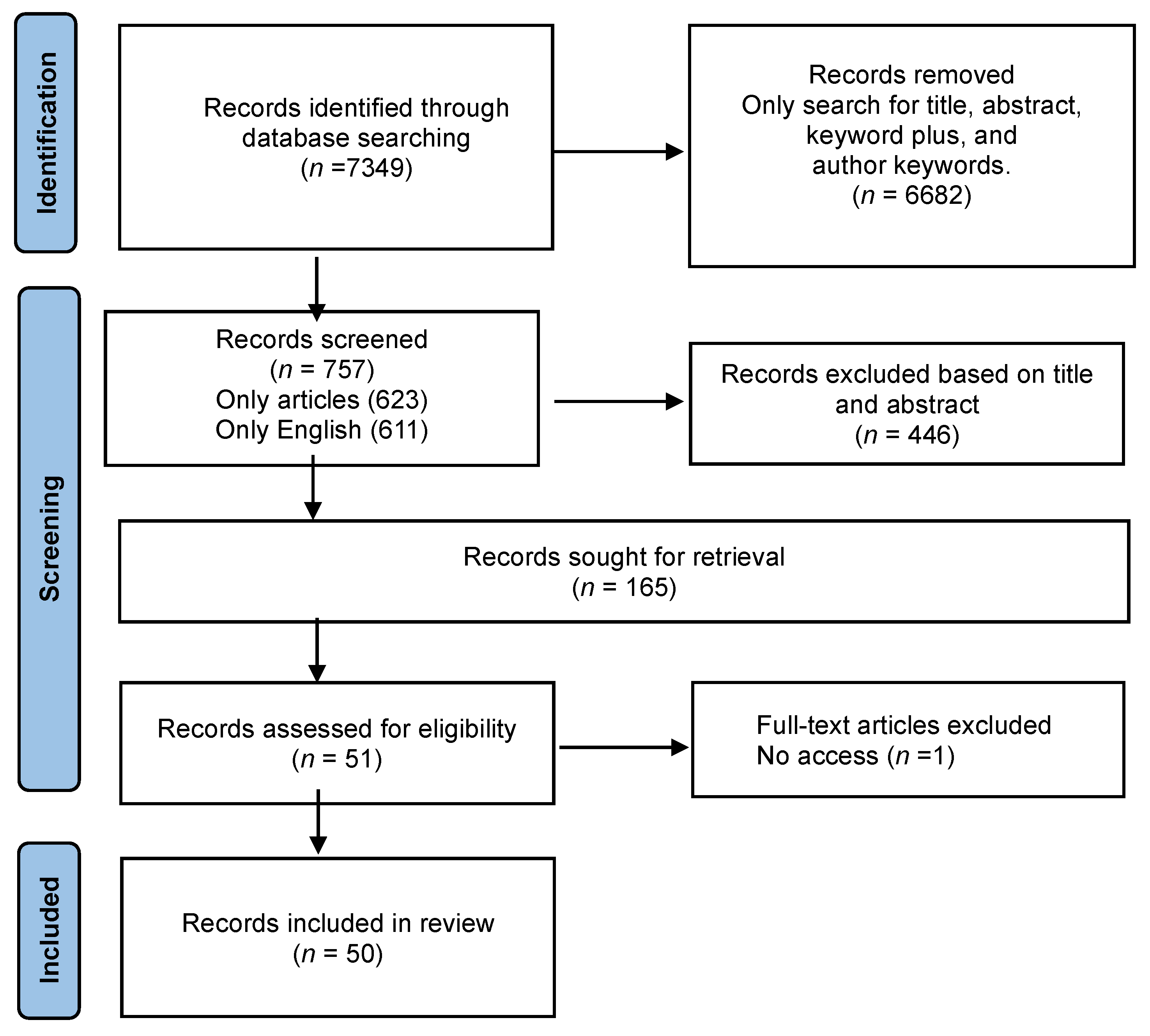
2.1.2. Inclusion Criteria and Selection Process
2.1.3. Data Processing and Evaluation
2.1.4. Synthesis Process
2.2. Limitations
3. Results
3.1. Bibliometric Analysis
3.1.1. Data Summary of Bibliometrics
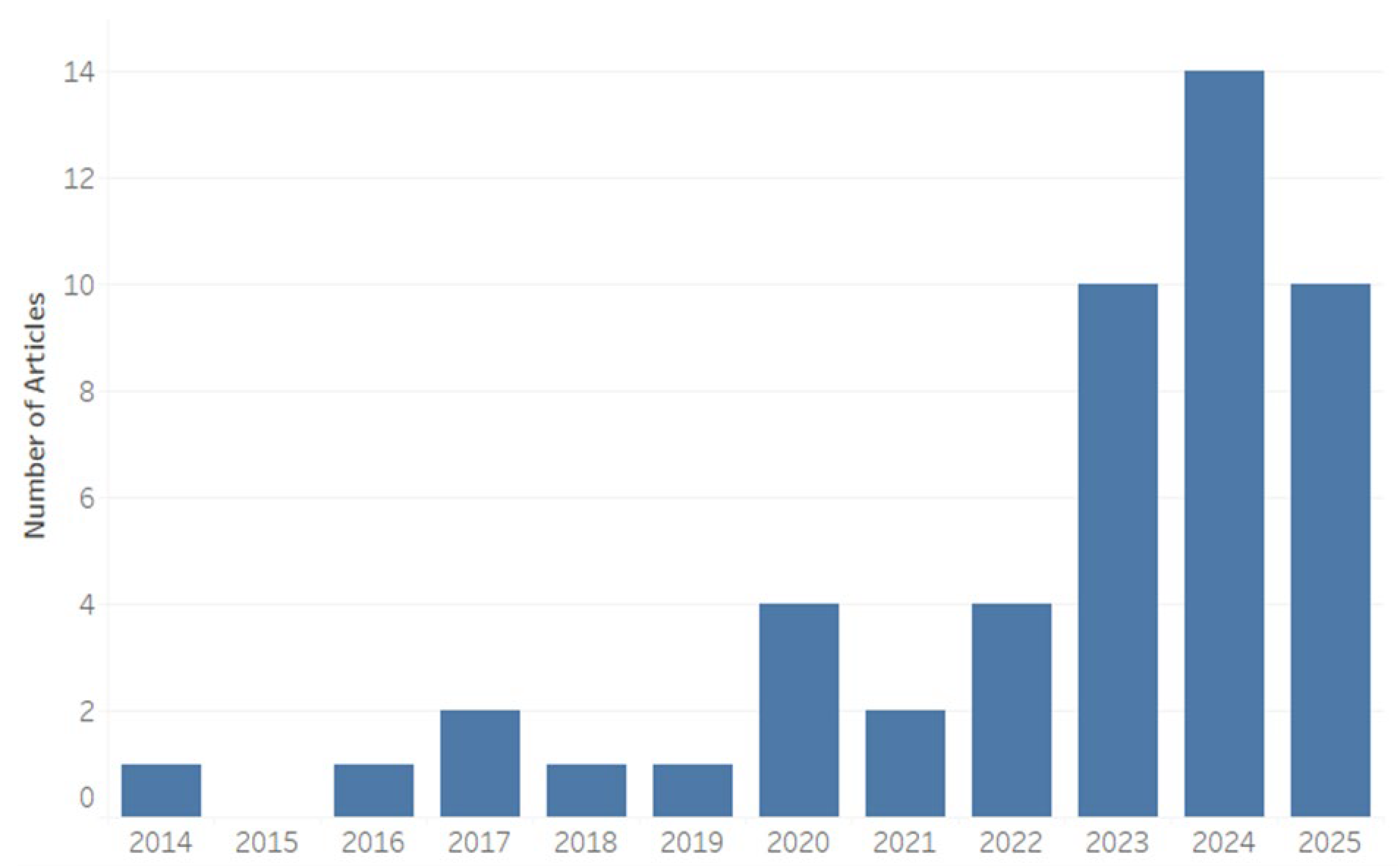
3.1.2. Annual Publication Trends

| Summary | Results |
|---|---|
| Data | |
| Timespan | 2014–2025 |
| Sources (Journals, Books, etc.) | 35 |
| Documents | 50 |
| Annual Growth Rate of Publications (%) (2014–2025) | 23.28 |
| Document Average Age (years) | 2.46 |
| Average citations per doc (as of November. 2025) | 6.92 |
| Total References cited | 1806 |
| Document Contents | |
| Keywords Plus * | 84 |
| Author’s Keywords | 229 |
| Authors | |
| Total Authors | 204 |
| Single-authored documents | 0 |
| Average Co-Authors per document | 4.48 |
| International co-authorships (%) | 12 |
3.1.3. Journal Distribution
3.1.4. Most Cited Publications
3.1.5. Country-Level Scientific Output
3.1.6. Country-Level Analysis of Corresponding Authors
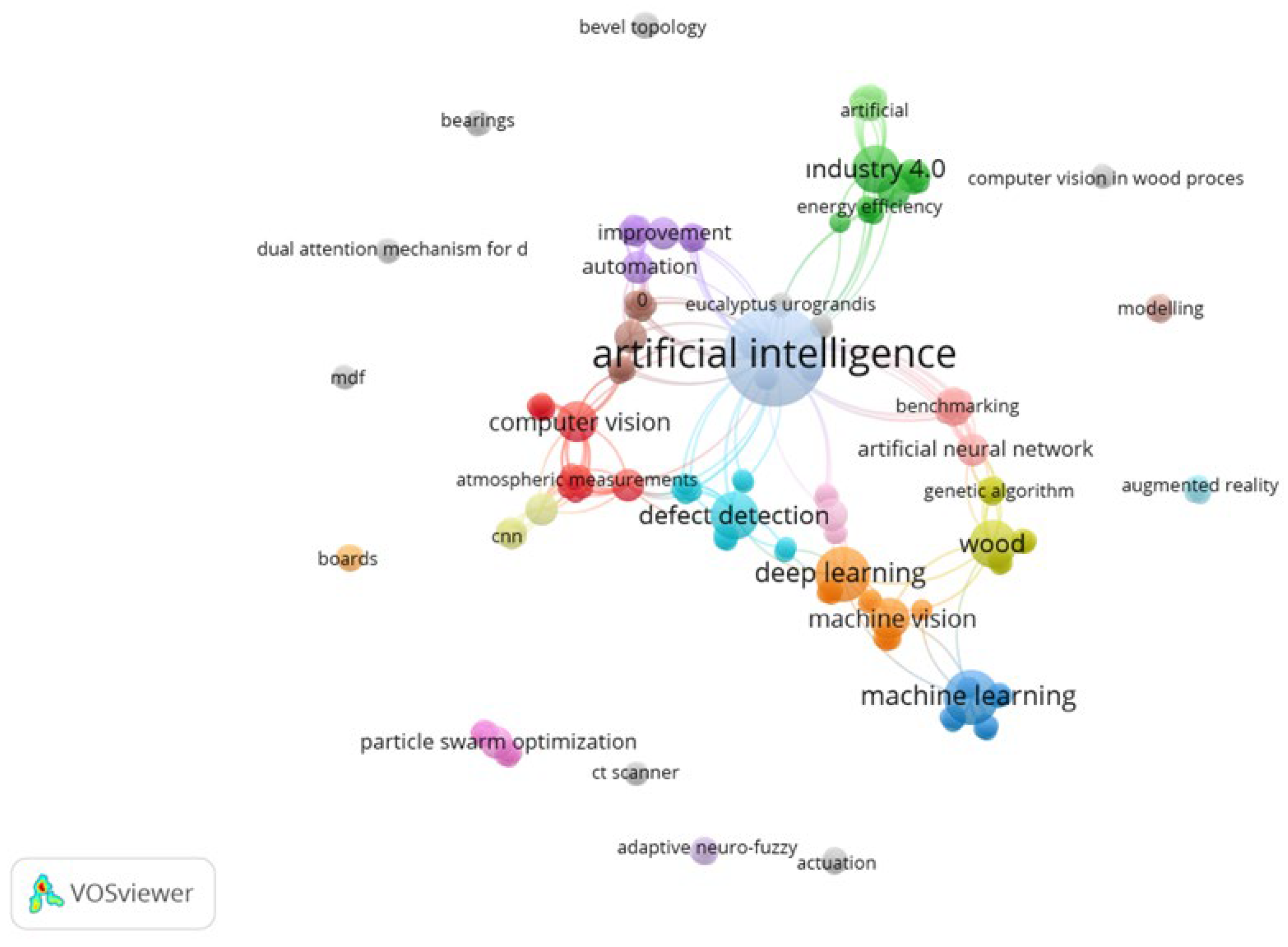
3.1.7. Keyword Analysis
3.1.8. Application Focus of Publications
3.1.9. Wood Material Types Used
| Publication | Application Focus | Material |
|---|---|---|
| [62] | Motor-Bearing Diagnostics | Particleboard |
| [82] | Predicting Particleboard Quality | Particleboards (Eucalyptus grandis) |
| [66] | Prediction of the Wood Density | Wood Samples—Pedunculate oak (Quercus robur) |
| [67] | The Wood Bonding Strength Analyzing | Wood Samples—Beech and Spruce |
| [70] | Predicting Wood Resistance | Wood Samples—Eucalyptus grandis |
| [42] | Monitoring Sawing Process | Wood Samples—Douglas-fir wood |
| [48] | Wood Knot Detection | Wooden Board—Southern yellow pine |
| [57] | Defect Detection | Wood Utility Poles |
| [74] | Sawmill Process Monitoring | Wood Logs—Norway spruce |
| [75] | Production Monitoring | Wood Logs |
| [43] | Wood Knot Detection | Wood Logs—SpruceWood |
| [83] | Automated Inspection System for Wood Surfaces | Cross Laminated Timber (CLT) |
| [58] | Defect Detection | Timber—Cedar |
| [44] | Defect Detection | Edge-Glued Wooden Panels |
| [72] | Evaluating Operational Performance in Sawmills | Not Applicable |
| [76] | Monitoring The Operational Performance of Sawmilling Facilities | Wood Logs—Coniferous Logs |
| [71] | Determination of Mechanical Properties | Wood Samples—Larch, Hemlock, and Mongolica |
| [51] | Defect Detection and Grading | Timber—Betula |
| [59] | Defect Detection | Wood Logs—Black Cherry, Red Oak, White Oak, Cottonwood |
| [63] | Monitoring Drilling Operations | Medium-Density Fiberboard (MDF) |
| [64] | Tool Condition Monitoring | Particleboard—(Melamine Faced Chipboard) |
| [45] | Detecting Tool Wear | Particleboard—(Chipboard) |
| [8] | Drill Wear Recognition | Particleboard—(Melamine Faced Chipboard) |
| [47] | Manufacturing Efficiency Measurement | Lightweight Wood Panelized Construction |
| [73] | Log Diameter Measurement | Wood Logs |
| [46] | Surface Roughness Prediction | Medium-Density Fiberboard (MDF) |
| [52] | Defect Detection | Particleboard—(melamine-impregnated decorative particleboard) |
| [54] | Defect Detection | Timber—Meranti, Merbau, KSK, and Rubberwood |
| [60] | Species Classification and Pith Detection | Wood Logs—Oak, Aspen, Beech, Linden, Ash, Spruce, Pine |
| [53] | Defect Detection | Particleboard |
| [50] | Defect Detection | Timber—(Cerasus pseudocerasus, Fagus longipetiolata Seem, Pinus yunnanensis Franch, Fraxinus mandschurica Rupr, and Betula platyphylla Suk.) |
| [56] | Defect Detection | Wood Samples—Jungle Cork (Holoptelea integrifolia or the Indian elm), Babul (Vachellia nilotica, commonly known as Acacia nilotica), and Pala Indigo (Wrightia tinctoria or dyer’s oleander) |
| [65] | Drill Wear Recognition | Particleboard—(melamine-faced chipboard) |
| [7] | AI Applications Review | Not Applicable |
| [87] | Tool Pose Detection | Not Applicable |
| [77] | Model-Based Control of Wood Planers | Lumber samples |
| [68] | Tensile Strength Prediction | Timber—Terminalia superba (Fraké) |
| [69] | Bonding Strength Prediction | Flakeboard, MDF, Oriented Strand board (OSB), and Veneer (beech, oak, pine) |
| [84] | Wood Stave Classification | Staves—Oak Staves |
| [12] | Surface Defect Inspection | Not Applicable |
| [49] | Wood Knot Detection and Classification | Wood Samples—Acacia |
| [55] | Quality Classification | Wood Logs—(Spruce, Fir, Douglas Fir, Larch) |
| [10] | Particleboard Surface Defect Detection | Particleboard |
| [61] | Delamination Of Wood Composite Material | Wood Plastic Composite—(WPC) |
| [78] | Energy Efficiency Management | MDF and Melamine Panels |
| [79] | Drilling Process Optimization | Wood Plastic Composite—(WPC) |
| [80] | Virtual Factory Modeling | Wooden Window Frames and Doors |
| [81] | Mechanical Properties Optimization | Wood Plastic Composite—(WPC) |
| [85] | Defect Detection | Glue-Laminated Timber—(Glulam) |
| [86] | Veneer Quality Prediction | Plywood—Pinus radiata veneer |
3.1.10. AI Techniques Employed
| Reference | AI-Based Techniques * |
|---|---|
| [62] | Fuzzy Logic |
| [55] | ResNet50, EfficientNetB0, Grad-CAM |
| [74] | ANN |
| [47] | YOLOv4 |
| [8] | ResNet-18, KNN, RF, XGBoost, LGBM, SVM |
| [66] | FIS |
| [76] | NN, RF |
| [73] | YOLOv4 |
| [63] | SVM |
| [44] | Inception ResNetV2, K-means |
| [75] | ANN |
| [54] | ResNet50 |
| [83] | CNN |
| [50] | YOLOv5, YOLOX, YOLOv7 |
| [43] | ResNet-18 |
| [78] | ANN |
| [64] | SVM, KNN, RF, RBF, MLP |
| [51] | Machine Vision, NN |
| [68] | ANFIS, LSTM |
| [67] | ANN |
| [58] | Shallow CNN |
| [69] | ANN, ANFIS |
| [71] | SE-DenseNet |
| [52] | YOLOv8 |
| [82] | ANN |
| [70] | ANN |
| [61] | Fuzzy Logic, PSO, HOA |
| [42] | ANFIS, PSO |
| [45] | Decision Trees, RF, XGBoost, Gradient Boosting, KNN, SVM, LGBM |
| [80] | K-means clustering |
| [86] | RF, XGBoost, KNN, SVM, Lasso, Logistic Regression |
| [84] | EfficientNet-B1, ResNet152V2, Saliency Maps, Grad-CAM |
| [85] | SAM |
| [87] | ResNet18, EfficientNetV2 |
| [77] | Gaussian Processes |
| [72] | ANN |
| [65] | VGG16, VGG19, ResNet101, LIME, Grad-CAM |
| [79] | BWOA |
| [46] | RBF-NN, TSK Fuzzy Logic |
| [49] | DenseNet201, YOLO |
| [60] | AlexNet, GoogleNet, NASNet-Large, Inception-v3, ViT, HRNet-W32 |
| [48] | YOLOv3 |
| [56] | U-Net, YOLO |
| [59] | improved PSO |
| [81] | ANN, Genetic Algorithm |
| [57] | CART, KNN, SVM |
| [10] | Ganomaly, ResNet |
| [53] | Transformer, YOLOv8 |
4. Discussion
5. Conclusions
Author Contributions
Funding
Data Availability Statement
Acknowledgments
Conflicts of Interest
Abbreviations
| AI | Artificial Intelligence |
| ANN | Artificial Neural Network |
| ANFIS | Adaptive Neuro-Fuzzy Inference System |
| BWOA | Binary Whale Optimization Algorithm |
| CNN | Convolutional Neural Network |
| DenseNet | Densely Connected Convolutional Network |
| EfficientNet | Efficient Convolutional Neural Network Architecture |
| FIS | Fuzzy Inference System |
| Grad-CAM | Gradient-weighted Class Activation Mapping |
| HOA | Hippopotamus Optimization Algorithm |
| HRNet | High-Resolution Network |
| KNN | k-Nearest Neighbors |
| LGBM | Light Gradient Boosting Machine |
| LIME | Local Interpretable Model-Agnostic Explanations |
| LSTM | Long Short-Term Memory |
| MLP | Multi-layer Perception |
| NASNet | Neural Architecture Search Network |
| NN | Neural Network |
| PSO | Particle Swarm Optimization |
| RBF | Radial Basis Function |
| ResNet | Residual Network |
| RF | Random Forest |
| SAM | Segment Anything Model |
| SVM | Support Vector Machine |
| TSK | Takagi–Sugeno–Kang (Fuzzy Model) |
| XAI | Explainable Artificial Intelligence |
| ViT | Vision Transformer |
| XGBoost | Extreme Gradient Boosting |
| YOLO | You Only Look Once |
References
- Wieneke, H.; Voigt, I. Principles of Artificial Intelligence and Its Application in Cardiovascular Medicine. Clin. Cardiol. 2024, 47, e24148. [Google Scholar] [CrossRef] [Scilit] [PubMed]
- Rajaraman, V. JohnMcCarthy—Father of Artificial Intelligence. Resonance 2014, 19, 198–207. [Google Scholar] [CrossRef] [Scilit]
- McCarthy, J. Programs with Common Sense; Her Majesty’s Stationery Office (HMSO): Teddington, UK, 1958; pp. 75–84.
- Russell, S.; Norvig, P. A Modern, Agent-Oriented Approach to Introductory Artificial Intelligence. ACM SIGART Bull. 1995, 6, 24–26. [Google Scholar] [CrossRef] [Scilit]
- Göde, A.; Kalkan, A. What is Artificial Intelligence? In Matematik ve Fen Bilimleri Üzerine Araştırmalar-IV; Akpınar, A., Ed.; Özgür Yayınları: Gaziantep, Turkey, 2023; ISBN 978-975-447-841-9. [Google Scholar]
- Liu, N.; Shapira, P.; Yue, X. Tracking Developments in Artificial Intelligence Research: Constructing and Applying a New Search Strategy. Scientometrics 2021, 126, 3153–3192. [Google Scholar] [CrossRef] [Scilit]
- Kitek-Kuzman, M.; Kropivšek, J.; Kariž, M. Possibilities of Using Artificial Intelligence in Furniture/Woodworking Industry. Drv. Ind. 2024, 75, 371–380. [Google Scholar] [CrossRef] [Scilit]
- Antoniuk, I.; Kurek, J.; Krupa, A.; Wieczorek, G.; Bukowski, M.; Kruk, M.; Jegorowa, A. Advanced Feature Extraction Methods from Images of Drillings in Melamine Faced Chipboard for Automatic Diagnosis of Drill Wear. Sensors 2023, 23, 1109. [Google Scholar] [CrossRef] [Scilit]
- Elustondo, D.; Matan, N.; Langrish, T.; Pang, S. Advances in Wood Drying Research and Development. Dry. Technol. 2023, 41, 890–914. [Google Scholar] [CrossRef] [Scilit]
- Zhang, C.; Wang, C.; Zhao, L.; Qu, X.; Gao, X. A Method of Particleboard Surface Defect Detection and Recognition Based on Deep Learning. Wood Mater. Sci. Eng. 2025, 20, 50–61. [Google Scholar] [CrossRef] [Scilit]
- Liu, J.; Gao, H.; Yezhova, O. Generative Design of Bamboo Furniture Combining Game Theory and AI-Generated Content. BioRes 2025, 20, 8611–8631. [Google Scholar] [CrossRef] [Scilit]
- Yi, L.P.; Akbar, M.F.; Wahab, M.N.A.; Rosdi, B.A.; Fauthan, M.A.; Shrifan, N.H.M.M. The Prospect of Artificial Intelligence-Based Wood Surface Inspection: A Review. IEEE Access 2024, 12, 84706–84725. [Google Scholar] [CrossRef] [Scilit]
- Sandvik, Y.J.; Futsæther, C.M.; Liland, K.H.; Tomic, O. A Comparative Literature Review of Machine Learning and Image Processing Techniques Used for Scaling and Grading of Wood Logs. Forests 2024, 15, 1243. [Google Scholar] [CrossRef] [Scilit]
- Hong Chun, T.; Hashim, U.R.; Ahmad, S.; Salahuddin, L.; Choon, N.H.; Kanchymalay, K. A Review of the Automated Timber Defect Identification Approach. Int. J. Electr. Comput. Eng. IJECE 2023, 13, 2156. [Google Scholar] [CrossRef] [Scilit]
- Xiao, Y.; Watson, M. Guidance on Conducting a Systematic Literature Review. J. Plan. Educ. Res. 2019, 39, 93–112. [Google Scholar] [CrossRef] [Scilit]
- Donthu, N.; Kumar, S.; Mukherjee, D.; Pandey, N.; Lim, W.M. How to Conduct a Bibliometric Analysis: An Overview and Guidelines. J. Bus. Res. 2021, 133, 285–296. [Google Scholar] [CrossRef] [Scilit]
- Page, M.J.; McKenzie, J.E.; Bossuyt, P.M.; Boutron, I.; Hoffmann, T.C.; Mulrow, C.D.; Shamseer, L.; Tetzlaff, J.M.; Akl, E.A.; Brennan, S.E.; et al. The PRISMA 2020 Statement: An Updated Guideline for Reporting Systematic Reviews. BMJ 2021, 372, n71. [Google Scholar] [CrossRef] [Scilit] [PubMed]
- Tranfield, D.; Denyer, D.; Smart, P. Towards a Methodology for Developing Evidence-Informed Management Knowledge by Means of Systematic Review. Br. J. Manag. 2003, 14, 207–222. [Google Scholar] [CrossRef] [Scilit]
- Saunders, M.; Lewis, P.; Thornhill, A. Research Methods for Business Students, 5th ed.; Person Education Limited: Harlow, UK, 2009. [Google Scholar]
- Dodgson, J.E. Critical Analysis: The Often-Missing Step in Conducting Literature Review Research. J. Hum. Lact. 2021, 37, 27–32. [Google Scholar] [CrossRef] [Scilit]
- Paul, J.; Criado, A.R. The Art of Writing Literature Review: What Do We Know and What Do We Need to Know? Int. Bus. Rev. 2020, 29, 101717. [Google Scholar] [CrossRef] [Scilit]
- Rowley, J.; Slack, F. Conducting a Literature Review. Manag. Res. News 2004, 27, 31–39. [Google Scholar] [CrossRef] [Scilit]
- Fahimnia, B.; Sarkis, J.; Davarzani, H. Green Supply Chain Management: A Review and Bibliometric Analysis. Int. J. Prod. Econ. 2015, 162, 101–114. [Google Scholar] [CrossRef] [Scilit]
- Birkle, C.; Pendlebury, D.A.; Schnell, J.; Adams, J. Web of Science as a Data Source for Research on Scientific and Scholarly Activity. Quant. Sci. Stud. 2020, 1, 363–376. [Google Scholar] [CrossRef] [Scilit]
- Zhu, J.; Liu, W. A Tale of Two Databases: The Use of Web of Science and Scopus in Academic Papers. Scientometrics 2020, 123, 321–335. [Google Scholar] [CrossRef] [Scilit]
- Chadegani, A.A.; Salehi, H.; Yunus, M.M.; Farhadi, H.; Fooladi, M.; Farhadi, M.; Ebrahim, N.A. A Comparison between Two Main Academic Literature Collections: Web of Science and Scopus Databases. arXiv 2013, arXiv:1305.0377. [Google Scholar] [CrossRef] [Scilit]
- Aria, M.; Cuccurullo, C. Bibliometrix: An R-Tool for Comprehensive Science Mapping Analysis. J. Informetr. 2017, 11, 959–975. [Google Scholar] [CrossRef] [Scilit]
- VOSviewer—Visualizing Scientific Landscapes. Available online: https://www.vosviewer.com// (accessed on 27 March 2026).
- Citation Topics. Available online: https://incites.zendesk.com/hc/en-gb/articles/22514077746961-Citation-Topics (accessed on 27 March 2026).
- Mendeley|Homepage. Available online: https://www.mendeley.com/ (accessed on 27 March 2026).
- Gazquez-Garcia, J.; Sánchez-Bocanegra, C.L.; Sevillano, J.L. AI in the Health Sector: Systematic Review of Key Skills for Future Health Professionals. JMIR Med. Educ. 2025, 11, e58161. [Google Scholar] [CrossRef] [Scilit]
- Singer, H.; İlçe, A.C.; Şenel, Y.E.; Burdurlu, E. Artificial Neural Network–Based Prediction Model to Minimize Dust Emission in the Machining Process. Saf. Health Work 2024, 15, 317–326. [Google Scholar] [CrossRef] [Scilit]
- Nguyen, T.; Nguyen, T.; Ji, X.; Guo, M. Predicting Color Change in Wood During Heat Treatment Using an Artificial Neural Network Model. BioResources 2018, 13, 6250–6264. [Google Scholar] [CrossRef] [Scilit]
- Thomas, E. An Artificial Neural Network for Real-Time Hardwood Lumber Grading. Comput. Electron. Agric. 2017, 132, 71–75. [Google Scholar] [CrossRef] [Scilit]
- Abyaneh, A.G.; Ghanbari, H.; Mohammadi, E.; Amirsahami, A.; Khakbazan, M. An Analytical Review of Artificial Intelligence Applications in Sustainable Supply Chains. Supply Chain Anal. 2025, 12, 100173. [Google Scholar] [CrossRef] [Scilit]
- Chintalapati, S.; Pandey, S.K. Artificial Intelligence in Marketing: A Systematic Literature Review. Int. J. Mark. Res. 2022, 64, 38–68. [Google Scholar] [CrossRef] [Scilit]
- Vishwakarma, L.P.; Singh, R.K.; Mishra, R.; Kumari, A. Application of Artificial Intelligence for Resilient and Sustainable Healthcare System: Systematic Literature Review and Future Research Directions. Int. J. Prod. Res. 2025, 63, 822–844. [Google Scholar] [CrossRef] [Scilit]
- Vlačić, B.; Corbo, L.; Costa E Silva, S.; Dabić, M. The Evolving Role of Artificial Intelligence in Marketing: A Review and Research Agenda. J. Bus. Res. 2021, 128, 187–203. [Google Scholar] [CrossRef] [Scilit]
- Wang, S.; Wang, F.; Zhu, Z.; Wang, J.; Tran, T.; Du, Z. Artificial Intelligence in Education: A Systematic Literature Review. Expert Syst. Appl. 2024, 252, 124167. [Google Scholar] [CrossRef] [Scilit]
- Pham, D.T.; Alcock, R.J. Artificial Intelligence Based Techniques for Processing Segmented Images of Wood Boards. Proc. Inst. Mech. Eng. Part E J. Process Mech. Eng. 1998, 212, 119–129. [Google Scholar] [CrossRef] [Scilit]
- KeyWords Plus Generation, Creation, and Changes. Available online: https://support.clarivate.com/ScientificandAcademicResearch/s/article/KeyWords-Plus-generation-creation-and-changes?language=en_US (accessed on 27 March 2026).
- Nasir, V.; Cool, J.; Sassani, F. Acoustic Emission Monitoring of Sawing Process: Artificial Intelligence Approach for Optimal Sensory Feature Selection. Int. J. Adv. Manuf. Technol. 2019, 102, 4179–4197. [Google Scholar] [CrossRef] [Scilit]
- Gao, M.; Song, P.; Wang, F.; Liu, J.; Mandelis, A.; Qi, D. A Novel Deep Convolutional Neural Network Based on ResNet-18 and Transfer Learning for Detection of Wood Knot Defects. J. Sens. 2021, 2021, 4428964. [Google Scholar] [CrossRef] [Scilit]
- Chen, L.-C.; Pardeshi, M.S.; Lo, W.-T.; Sheu, R.-K.; Pai, K.-C.; Chen, C.-Y.; Tsai, P.-Y.; Tsai, Y.-T. Edge-Glued Wooden Panel Defect Detection Using Deep Learning. Wood Sci. Technol. 2022, 56, 477–507. [Google Scholar] [CrossRef] [Scilit]
- Przybyś-Małaczek, A.; Antoniuk, I.; Szymanowski, K.; Kruk, M.; Kurek, J. Application of Machine Learning Algorithms for Tool Condition Monitoring in Milling Chipboard Process. Sensors 2023, 23, 5850. [Google Scholar] [CrossRef] [Scilit]
- Szwajka, K.; Zielińska-Szwajka, J.; Trzepieciński, T. The Use of a Radial Basis Function Neural Network and Fuzzy Modelling in the Assessment of Surface Roughness in the MDF Milling Process. Materials 2023, 16, 5292. [Google Scholar] [CrossRef] [Scilit]
- Alsakka, F.; El-Chami, I.; Yu, H.; Al-Hussein, M. Computer Vision-Based Process Time Data Acquisition for Offsite Construction. Autom. Constr. 2023, 149, 104803. [Google Scholar] [CrossRef] [Scilit]
- Verly Lopes, D.J.; Bobadilha, G.D.S.; Grebner, K.M. A Fast and Robust Artificial Intelligence Technique for Wood Knot Detection. BioResources 2020, 15, 9351–9361. [Google Scholar] [CrossRef] [Scilit]
- Tran, V.; Lam, D.; Le, T. VNWoodKnot: A Benchmark Image Dataset for Wood Knot Detection and Classification. Data Brief 2025, 62, 112039. [Google Scholar] [CrossRef] [Scilit] [PubMed]
- Fan, C.; Zhuang, Z.; Liu, Y.; Yang, Y.; Zhou, H.; Wang, X. Bilateral Defect Cutting Strategy for Sawn Timber Based on Artificial Intelligence Defect Detection Model. Sensors 2024, 24, 6697. [Google Scholar] [CrossRef] [Scilit] [PubMed]
- Ji, M.; Zhang, W.; Diao, X.; Wang, G.; Miao, H. Intelligent Automation Manufacturing for Betula Solid Timber Based on Machine Vision Detection and Optimization Grading System Applied to Building Materials. Forests 2023, 14, 1510. [Google Scholar] [CrossRef] [Scilit]
- Li, R.; Xu, Z.; Yang, F.; Yang, B. Defect Detection for Melamine-Impregnated Paper Decorative Particleboard Surface Based on Deep Learning. Wood Mater. Sci. Eng. 2026, 21, 379–392. [Google Scholar] [CrossRef] [Scilit]
- Zhou, H.; Xia, H.; Fan, C.; Lan, T.; Liu, Y.; Yang, Y.; Shen, Y.; Yu, W. Intelligent Detection Method for Surface Defects of Particleboard Based on Super-Resolution Reconstruction. Forests 2024, 15, 2196. [Google Scholar] [CrossRef] [Scilit]
- Chun, T.H.; Hashim, U.R.; Ahmad, S. Timber Defect Identification: Enhanced Classification with Residual Networks. Int. J. Adv. Comput. Sci. Appl. 2024, 15, 665–671. [Google Scholar] [CrossRef] [Scilit]
- Achatz, J.; Schubert, M. Optical Detection of Beetle-Related Indicators and Stem Quality in Roundwood Using Convolutional Neural Networks. J. Wood Sci. 2025, 71, 27. [Google Scholar] [CrossRef] [Scilit]
- Vijayalakshmi, S.; Mrudhula, S.; Ashok Kumar, V.; Agastin; Varun; Latha, A.M. Artificial Intelligence-Driven Timber Wood Defect Characterization from Terahertz Images. J. Nondestruct. Eval. 2024, 43, 116. [Google Scholar] [CrossRef] [Scilit]
- Yu, Y.; Subhani, M.; Hoshyar, A.N.; Li, J.; Li, H. Automated Health Condition Diagnosis of in Situ Wood Utility Poles Using an Intelligent Non-Destructive Evaluation (NDE) Framework. Int. J. Struct. Stab. Dyn. 2020, 20, 2042002. [Google Scholar] [CrossRef] [Scilit]
- Kato, S.; Wada, N.; Shiogai, K.; Tamaki, T.; Kagawa, T.; Toyosaki, R.; Nobuhara, H. Automatic Classification of Crack Severity from Cross-Section Image of Timber Using Simple Convolutional Neural Network. Appl. Sci. 2022, 12, 8250. [Google Scholar] [CrossRef] [Scilit]
- Xu, F.; Wu, Y.; Lin, H.; Liu, Y.; Wang, X.; Ross, R.J.; Tian, G. IPSO-VMD Based Signal Feature Extraction and Internal Defect Detection of Hardwood Logs through Acoustic Impact Test. NDT E Int. 2023, 139, 102942. [Google Scholar] [CrossRef] [Scilit]
- Vacek, O.; Gergeľ, T.; Bucha, T.; Gracovský, R.; Gejdoš, M. Automatic Wood Species Classification and Pith Detection in Log CT Images. Forests 2024, 15, 2207. [Google Scholar] [CrossRef] [Scilit]
- Murugesan, S.; Kayaroganam, P.; Natarajan, S.; Balasubramanian, L. Analysis and Optimization of the Delamination Factor in the Drilling of Wood-Thermo Plastic Composites: An Approach Based on Artificial Intelligence. J. Thermoplast. Compos. Mater. 2025, 08927057251391670. [Google Scholar] [CrossRef] [Scilit]
- Abramov, I.; Nikitin, Y.; Zorina, O.; Bozek, P.; Stepanov, P.; Stollmann, V. Monitoring of technical condition of motors and bearigs of woodworking equipment. Acta Fac. Xylologiae Zvolen Publica Slovaca 2014, 56, 97–104. [Google Scholar]
- Chaiprabha, K.; Chancharoen, R. Innovative Smart Drilling with Critical Event Detection and Material Classification. J. Manuf. Mater. Process. 2023, 7, 155. [Google Scholar] [CrossRef] [Scilit]
- Jegorowa, A.; Kurek, J.; Antoniuk, I.; Krupa, A.; Wieczorek, G.; Świderski, B.; Bukowski, M.; Kruk, M. Automatic Estimation of Drill Wear Based on Images of Holes Drilled in Melamine Faced Chipboard with Machine Learning Algorithms. Forests 2023, 14, 205. [Google Scholar] [CrossRef] [Scilit]
- Sieradzki, A.; Bednarek, J.; Jegorowa, A.; Kurek, J. Explainable AI (XAI) Techniques for Convolutional Neural Network-Based Classification of Drilled Holes in Melamine Faced Chipboard. Appl. Sci. 2024, 14, 7462. [Google Scholar] [CrossRef] [Scilit]
- Bardak, T.; Bardak, S. Prediction of Wood Density by Using Red-Green-Blue (RGB) Color and Fuzzy Logic Techniques. J. Polytech. 2017, 20, 979–984. [Google Scholar] [CrossRef] [Scilit]
- Jovic, S.; Golubovic, Z.; Stojanovic, J. Wood Bonding Strength Sensitivity Estimation and Power Consumption Prediction in Wood Machining Process by Artificial Intelligence Methods. Sens. Rev. 2017, 37, 444–447. [Google Scholar] [CrossRef] [Scilit]
- Josué, D.F.; Agnès Virginie, T.; Guy Edgar, N.; Bienvenu, K. Prediction of the Tensile Strength of a Tropical Wood Species Terminalia superba Assembled by Gluing: A Comparative Intelligent Study. Geomech. Geoengin. 2024, 19, 1113–1125. [Google Scholar] [CrossRef] [Scilit]
- Kiliç, K.; Karaman, İ.; Kiliç, İ.; Özcan, U. Prediction of Veneer Bonding Strength of Wood-Based Composites Through Soft-Computing Models. Drew. Pr. Nauk. Doniesienia Komun. 2024, 67, 214. [Google Scholar] [CrossRef] [Scilit]
- Miguel, E.P.; Melo, R.R.D.; Serenini Junior, L.; Menezzi, C.H.S.D. Using Artificial Neural Networks in Estimating Wood Resistance. Maderas Cienc. Tecnol. 2018, 20, 531–542. [Google Scholar] [CrossRef] [Scilit]
- Li, C.; Chen, X.; Zhang, L.; Wang, S. Determination of Coniferous Wood’s Compressive Strength by SE-DenseNet Model Combined with Near-Infrared Spectroscopy. Appl. Sci. 2022, 13, 152. [Google Scholar] [CrossRef] [Scilit]
- Shahi, S.K.; Dia, M.; Yan, P.; Choudhury, S. Developing and Training Artificial Neural Networks Using Bootstrap Data Envelopment Analysis for Best Performance Modeling of Sawmills in Ontario. J. Model. Manag. 2022, 17, 788–811. [Google Scholar] [CrossRef] [Scilit]
- Carratù, M.; Gallo, V.; Liguori, C.; Lundgren, J.; O’Nils, M.; Pietrosanto, A. Vision-Based System for Measuring the Diameter of Wood Logs. IEEE Open J. Instrum. Meas. 2023, 2, 5000112. [Google Scholar] [CrossRef] [Scilit]
- Alexandru Borz, S.; Păun, M. Integrating Offline Object Tracking, Signal Processing, and Artificial Intelligence to Classify Relevant Events in Sawmilling Operations. Forests 2020, 11, 1333. [Google Scholar] [CrossRef] [Scilit]
- Cheţa, M.; Marcu, M.V.; Iordache, E.; Borz, S.A. Testing the Capability of Low-Cost Tools and Artificial Intelligence Techniques to Automatically Detect Operations Done by a Small-Sized Manually Driven Bandsaw. Forests 2020, 11, 739. [Google Scholar] [CrossRef] [Scilit]
- Borz, S.A.; Forkuo, G.O.; Oprea-Sorescu, O.; Proto, A.R. Development of a Robust Machine Learning Model to Monitor the Operational Performance of Fixed-Post Multi-Blade Vertical Sawing Machines. Forests 2022, 13, 1115. [Google Scholar] [CrossRef] [Scilit]
- Sexton, J.-T.; Morin, M.; Georges, R.; Abasian, F.; Gaudreault, J. Wood Planer Control: Predictive and Prescriptive Approaches via Automatic State Matching Gaussian Processes. Eng. Appl. Artif. Intell. 2024, 132, 107843. [Google Scholar] [CrossRef] [Scilit]
- Haddouche, M.; Ilinca, A.; Chaouch, M. Enhancing Energy Efficiency in the Wood Furniture Sector Through Industry 4.0: Real-Time Implementation and Case Study. Energy Technol. 2026, 14, e202501297. [Google Scholar] [CrossRef] [Scilit]
- Sundarapandiyan, M.; Palanikumar, K.; Senthilkumar, N.; Latha, B. Artificial Intelligence-Based Optimization and Response Surface Analysis of Thrust Force and Torque in Drilling Wood–Thermoplastic Composite (WPC) Panels. Wood Mater. Sci. Eng. 2025, 1–19. [Google Scholar] [CrossRef] [Scilit]
- Raamets, T.; Karjust, K.; Hermaste, A.; Kelpman, K. Virtual Factory Model Development for AI-Driven Optimization in Manufacturing. Proc. Est. Acad. Sci. 2025, 74, 228–233. [Google Scholar] [CrossRef] [Scilit]
- Yeshiwas, T.A.; Siyoum, Y.B.; Tiruneh, A.B.; Bekele, A.A.; Nega, A.Y.; Adamu, T.K. Parameter Optimization for Enhancing Mechanical Properties of Wood-Plastic Composites Using Artificial Neural Network with Genetic Algorithm and Taguchi Method. Wood Mater. Sci. Eng. 2025, 1–16. [Google Scholar] [CrossRef] [Scilit]
- Melo, R.R.D.; Miguel, E.P. Use of artificial neural networks in predicting particleboard quality parameters. Rev. Árvore 2016, 40, 949–958. [Google Scholar] [CrossRef] [Scilit]
- Ericsson, M.; Johansson, D.; Stjern, D. AI-Based Quality Control of Wood Surfaces with Autonomous Material Handling. Appl. Sci. 2021, 11, 9965. [Google Scholar] [CrossRef] [Scilit]
- Ricardo, F.A.; Eizaguirre, M.; Moru, D.K.; Borro, D. Intelligent Manufacturing in Wine Barrel Production: Deep Learning-Based Wood Stave Classification. AI 2024, 5, 2018–2036. [Google Scholar] [CrossRef] [Scilit]
- Ruttico, P.; Bordoni, F.; Deval, M. Woodot: An AI-Driven Mobile Robotic System for Sustainable Defect Repair in Custom Glulam Beams. Sustainability 2025, 17, 5574. [Google Scholar] [CrossRef] [Scilit]
- Ramos-Maldonado, M.; Gutiérrez, F.; Gallardo-Venegas, R.; Bustos-Avila, C.; Contreras, E.; Lagos, L. Machine Learning and Industrial Data for Veneer Quality Optimization in Plywood Manufacturing. Processes 2025, 13, 1229. [Google Scholar] [CrossRef] [Scilit]
- Settimi, A.; Chutisilp, N.; Aymanns, F.; Gamerro, J.; Weinand, Y. TTool: A Supervised Artificial Intelligence-Assisted Visual Pose Detector for Tool Heads in Augmented Reality Woodworking. Appl. Sci. 2024, 14, 3011. [Google Scholar] [CrossRef] [Scilit]
- Explainable Artificial Intelligence|DARPA. Available online: https://www.darpa.mil/research/programs/explainable-artificial-intelligence (accessed on 27 March 2026).
- Tikhomirov, O.K. Philosophical and Psychological Problems of Artificial Intelligence. In Proceedings of the 4th International Joint Conference on Artificial Intelligence—Volume 1; Morgan Kaufmann Publishers Inc.: San Francisco, CA, USA, 1975; pp. 932–937. [Google Scholar]
- China’s AI Ambitions Target US Tech Dominance. Available online: https://www.dw.com/en/china-ai-artificial-intelligence-deepseek-us-chatgpt-semiconductors-graphics-technology-v2/a-74361630 (accessed on 27 March 2026).
- Almada-Lobo, F. The Industry 4.0 Revolution and the Future of Manufacturing Execution Systems (MES). J. Innov. Manag. 2016, 3, 16–21. [Google Scholar] [CrossRef] [Scilit]


| Source | Document | Citation |
|---|---|---|
| Forests | 7 | 51 |
| Applied Sciences | 5 | 13 |
| Wood Material Science and Engineering | 4 | 7 |
| Sensors | 3 | 24 |
| References | Journal | Total Citations | Avg. Per Year |
|---|---|---|---|
| [42] | International Journal of Advanced Manufacturing Technology | 54 | 7.71 |
| [43] | Journal of Sensors | 32 | 6.40 |
| [44] | Wood Science and Technology | 28 | 7.00 |
| [45] | Sensors | 18 | 6.00 |
| [46] | Materials | 17 | 5.67 |
| [47] | Automation in Construction | 17 | 5.67 |
| Frequency | Country |
|---|---|
| 18 | China |
| 16 | Canada |
| 12 | Poland |
| 9 | India |
| 5 | Brazil, Malaysia, Slovakia |
| 4 | Cameroon, Turkey |
| 3 | Australia, Italy, Japan, Romania, Russia, Spain, Switzerland, USA |
| 2 | Sweden |
| 1 | Chile, Estonia, Ethiopia, Nigeria, Serbia, Slovenia, Thailand, United Kingdom, Vietnam |
| Number of Publications | Countries |
|---|---|
| 9 | China |
| 5 | Canada, Poland |
| 3 | India, Romania |
| 2 | Brazil, Italy, Malaysia, Switzerland, Turkey |
| 1 | Australia, Cameroon, Chile, Estonia, Ethiopia, Japan, Russia, Serbia, Slovakia, Slovenia, Spain, Sweden, Thailand, USA, Vietnam |
Disclaimer/Publisher’s Note: The statements, opinions and data contained in all publications are solely those of the individual author(s) and contributor(s) and not of MDPI and/or the editor(s). MDPI and/or the editor(s) disclaim responsibility for any injury to people or property resulting from any ideas, methods, instructions or products referred to in the content. |
© 2026 by the authors. Licensee MDPI, Basel, Switzerland. This article is an open access article distributed under the terms and conditions of the Creative Commons Attribution (CC BY) license.
Share and Cite
Kucuk, E.; Buehlmann, U. Systematic Review of Applications Using Artificial Intelligence (AI) for Wooden Materials. Forests 2026, 17, 477. https://doi.org/10.3390/f17040477
Kucuk E, Buehlmann U. Systematic Review of Applications Using Artificial Intelligence (AI) for Wooden Materials. Forests. 2026; 17(4):477. https://doi.org/10.3390/f17040477
Chicago/Turabian StyleKucuk, Enis, and Urs Buehlmann. 2026. "Systematic Review of Applications Using Artificial Intelligence (AI) for Wooden Materials" Forests 17, no. 4: 477. https://doi.org/10.3390/f17040477
APA StyleKucuk, E., & Buehlmann, U. (2026). Systematic Review of Applications Using Artificial Intelligence (AI) for Wooden Materials. Forests, 17(4), 477. https://doi.org/10.3390/f17040477