Article

Identification, Evaluation and Optimization of Urban Park System Network Structure

1
School of Landscape Architecture and Forestry, Qingdao Agricultural University, Qingdao 266000, China
2
Department of Design, Shanghai Academy of Fine Arts, Shanghai University, Shanghai 200444, China
3
Key Laboratory of Ecology and Energy Saving Study of Dense Habitat, Ministry of Education, Shanghai 200092, China
4
College of Architecture and Urban Planning, Tongji University, Shanghai 200092, China
*
Author to whom correspondence should be addressed.
Forests 2026, 17(2), 186; https://doi.org/10.3390/f17020186
Submission received: 2 January 2026 / Revised: 23 January 2026 / Accepted: 28 January 2026 / Published: 30 January 2026
(This article belongs to the Special Issue Protection and Management of Urban Parks and Nature Reserves)

Abstract

A well-structured urban park system (UPS) is crucial for optimizing urban spatial layout and improving the quality of the human living environment. In response to the tendency of current planning to prioritize quantitative indicators while overlooking the relational structure arising from the collective spatial configuration of parks, this study introduces Social Network Analysis (SNA) to evaluate the spatial structure of Shanghai’s park system by constructing a service-coverage overlap network. The findings reveal the following: (1) Parks with high degree centrality are concentrated in high-density urban core areas due to service overlap, whereas large suburban parks with high betweenness centrality function as critical bridging hubs, reflecting a polycentric structure. (2) There is a discernible discrepancy between these emergent network tiers and the statutory park hierarchy, highlighting a tension between bottom-up spatial patterns and top-down planning frameworks. (3) Stability simulations indicate a dual character of the system, where the network topology is vulnerable to attacks yet functionally resilient to failures due to spatial redundancy, suggesting that a decline in service quality may precede the loss of basic accessibility. This study demonstrates the value of SNA in diagnosing park system structure, identifying key nodes, and assessing system resilience. The insights advocate for planning approaches that transcend rigid hierarchical frameworks, integrate the actual functional roles of parks, and protect structural hubs, thereby enhancing systemic resilience and promoting equitable service provision.

1. Introduction

The Urban Park System (UPS) is an indispensable component of urban green infrastructure, playing a crucial role in enhancing environmental quality and providing recreational opportunities for residents [1,2,3]. It is typically conceptualized as a hierarchical network comprising various types of parks, designed to support ecosystem functions and meet diverse public needs [4,5,6]. However, in rapidly urbanizing regions such as China, the development of the UPS has often emphasized achieving quantitative targets and complying with formal standards. While this has led to growth in the number and area of parks, it may also shift the focus toward the attributes of individual parks at the expense of the relational performance of the system as a whole [7,8]. Consequently, a disconnect may emerge between the planned, attribute-based park hierarchy and their de facto functional roles within the urban spatial network.
Common analytical methods for studying the UPS, including fractal theory [9,10], GIS-based network analysis [11,12,13], and space syntax, have proven effective in examining the morphological patterns and physical accessibility of parks [14,15]. However, these approaches often treat parks as independent entities within predefined spatial units, offering limited insight into the structural relationships that arise from their coordinated functioning—such as how parks collectively serve populations through overlapping service areas. Understanding these relational patterns is valuable for assessing systemic efficiency, integration, and resilience.
Social Network Analysis (SNA) provides a complementary framework by shifting the analytical focus from node attributes to the patterns of connections between them [16,17]. When applied to the UPS, SNA allows parks to be modeled as nodes within a network, with links representing relational ties such as shared service populations. This perspective facilitates the examination of a system’s structural configuration, the identification of functionally critical nodes, and the assessment of its cohesive properties. Previous applications of SNA in park-related research have explored themes such as accessibility and governance [18,19,20,21], yet they often treat parks as undifferentiated nodes and seldom address the stability of the UPS as a functional network under different disturbance scenarios.
To address these considerations, this study employs SNA to evaluate the network structure of Shanghai’s urban park system through the lens of service-coverage overlap. Specifically, it aims to answer the following questions: (1) What characterizes the relational structure of Shanghai’s UPS based on service-coverage overlap, and which parks occupy structurally important positions? (2) To what extent does the functional importance of parks within this network diverge from their statutory planning hierarchy? (3) How does this network respond, in terms of both topological integrity and service continuity, when subjected to different disruption scenarios?
To this end, we construct a service-coverage overlap network for Shanghai, where the connections between parks are weighted by the number of residential blocks they jointly serve. This approach models the supply-side relational structure shaped by park locations and service ranges, using residential areas as a spatial proxy for demand. Our analysis evaluates node centrality, examines tiered structures, and assesses network stability under various disruption scenarios, combining topological metrics with an evaluation of service coverage loss.
This study seeks to contribute in the following ways: (a) by demonstrating the application of SNA to model a UPS as a coverage-based relational network, linking supply configuration to spatial proxies of demand; (b) by diagnosing systemic mismatches between emergent network roles and formal planning categories; and (c) by introducing a dual-perspective stability analysis to explore the resilience of a park system, thereby providing a more nuanced understanding of its vulnerabilities. The findings may inform a shift from purely hierarchical planning toward a more relational and resilience-sensitive approach to the planning and management of urban park systems.

2. Materials and Methods

2.1. Construction of the Urban Park Service-Coverage Overlap Network

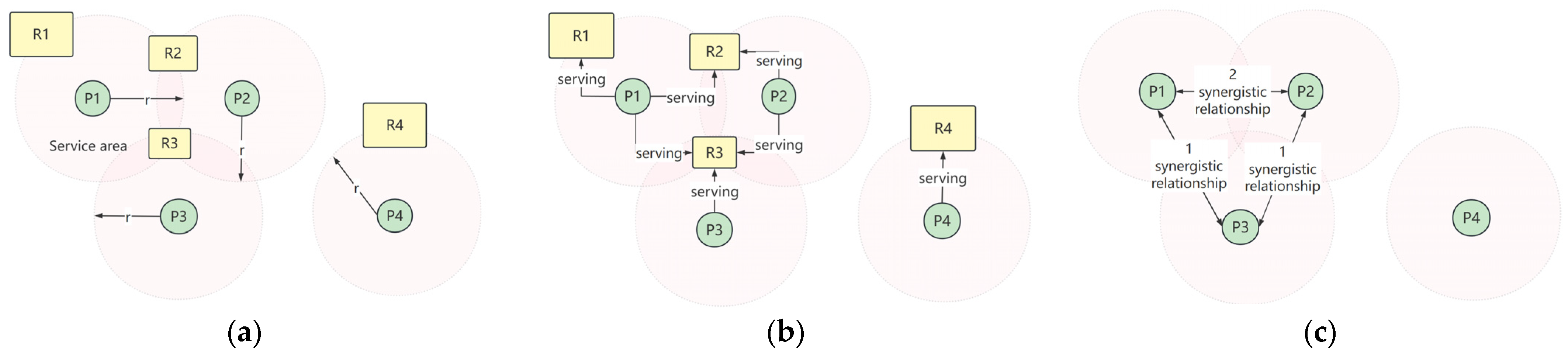
A social network is defined by a set of nodes and the relationships (links) between them [22]. In this study, the nodes represent urban parks, and the links are derived from their spatial service relationships. The construction of the park network involved two key steps. First, a service relationship was established between a park (P) and a residential area (R) if the residential area fell within the park’s service radius. This created a bipartite (two-mode) network connecting the set of parks to the set of residential areas (Figure 1a,b). Second, this two-mode network was projected onto the set of parks to create a one-mode network where parks are directly linked to each other. A link between two parks is formed if they serve at least one common residential area. The strength of this link—the edge weight—is defined as the number of residential blocks jointly covered by both parks. For example, if parks P1 and P2 jointly serve two residential areas (R2 and R3), the link weight between them is 2. This weighted, undirected one-mode network is termed the service-coverage overlap network (Figure 1c). It does not measure functional synergy or user flow, but quantifies the extent of spatial redundancy or potential substitutability in service provision between parks.
The network was constructed using UCINET software (v6.773) [23]. The two-mode adjacency matrix was converted to a one-mode park matrix using the Affiliations function with the Sums of Cross-Products (Overlaps) method, which directly calculates the co-coverage counts. No threshold filtering was applied, and self-loops were excluded by default. This resulted in a weighted adjacency matrix for all parks, which was used for all subsequent network analyses.
Figure 1. Network relationship between urban park (P) and residential area (R). (a) Relationship between urban park and residential area; (b) ‘Two-mode’ service network; (c) ‘One-mode’ service-coverage network (Adapted from Ref. [24]).
Forests 17 00186 g001

2.2. Study Area and Data Sources

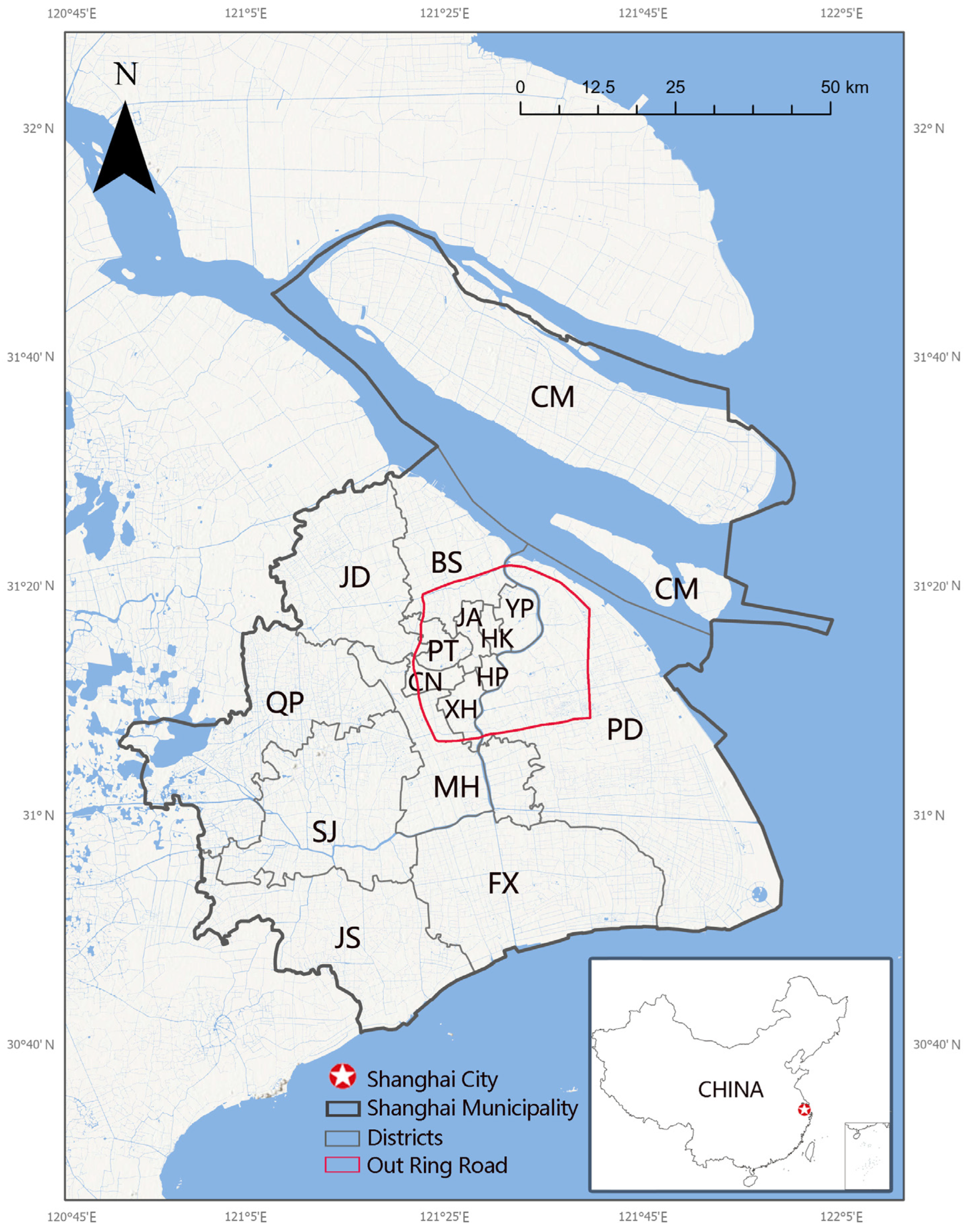
Shanghai is located at the estuary of the Yangtze River, covering an area of 6340 km2 with a built-up area of 1237.85 km2, lying between longitudes 120°52′ E and 122°12′ E and latitudes 30°40′ N and 31°53′ N (Figure 2).
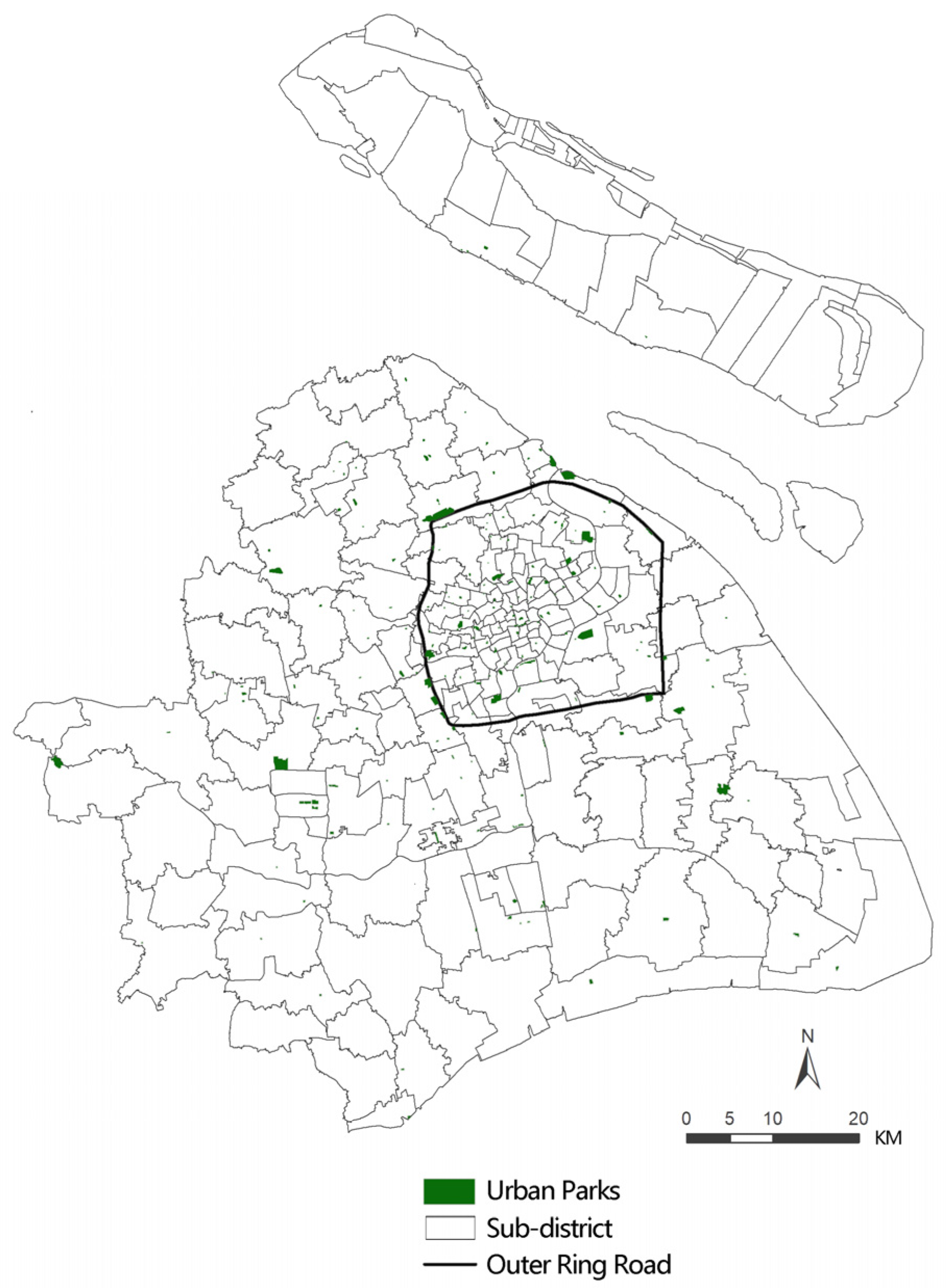
A total of 304 parks (Figure 3) were used in this study, which were divided into four types: comprehensive parks (41), theme parks (18), community parks (221), and small-scale urban parks (24) (Table 1). The park service radiuses for parks in this study were determined based on the Urban Green Space Planning Standard (GB/T51346-2019) [25] and the Shanghai Ecological Space Master Plan (2021–2035) [26]. Service radii for comprehensive parks, community parks, and small-scale urban parks were assigned based on park scale. For theme parks, which lack a unified standard in the guidelines, a radius of 3.5 to 6 km was adopted by comparing the actual service radius [27,28,29]. The distribution of urban parks in Shanghai was obtained from the Shanghai Landscape and City Appearance Administrative Bureau (https://lhsr.sh.gov.cn/).
Figure 2. Location of Shanghai and its Districts, China. District abbreviations: BS (BaoShan); YP (YangPu); HK (HongKou); JA (JingAn); PT (PuTuo); JD (JiaDing); CN (ChangNing); MH (MinHang); XH (XuHui); HP (HuangPu); PD (PuDong); JS (JinShan); CM (ChongMing); QP (QingPu); FX (FengXian); SJ (SongJiang) (Reprinted from Ref. [30]).
Forests 17 00186 g002
Figure 3. Distribution of urban parks in Shanghai City (Reprinted from Ref. [30]).
Forests 17 00186 g003
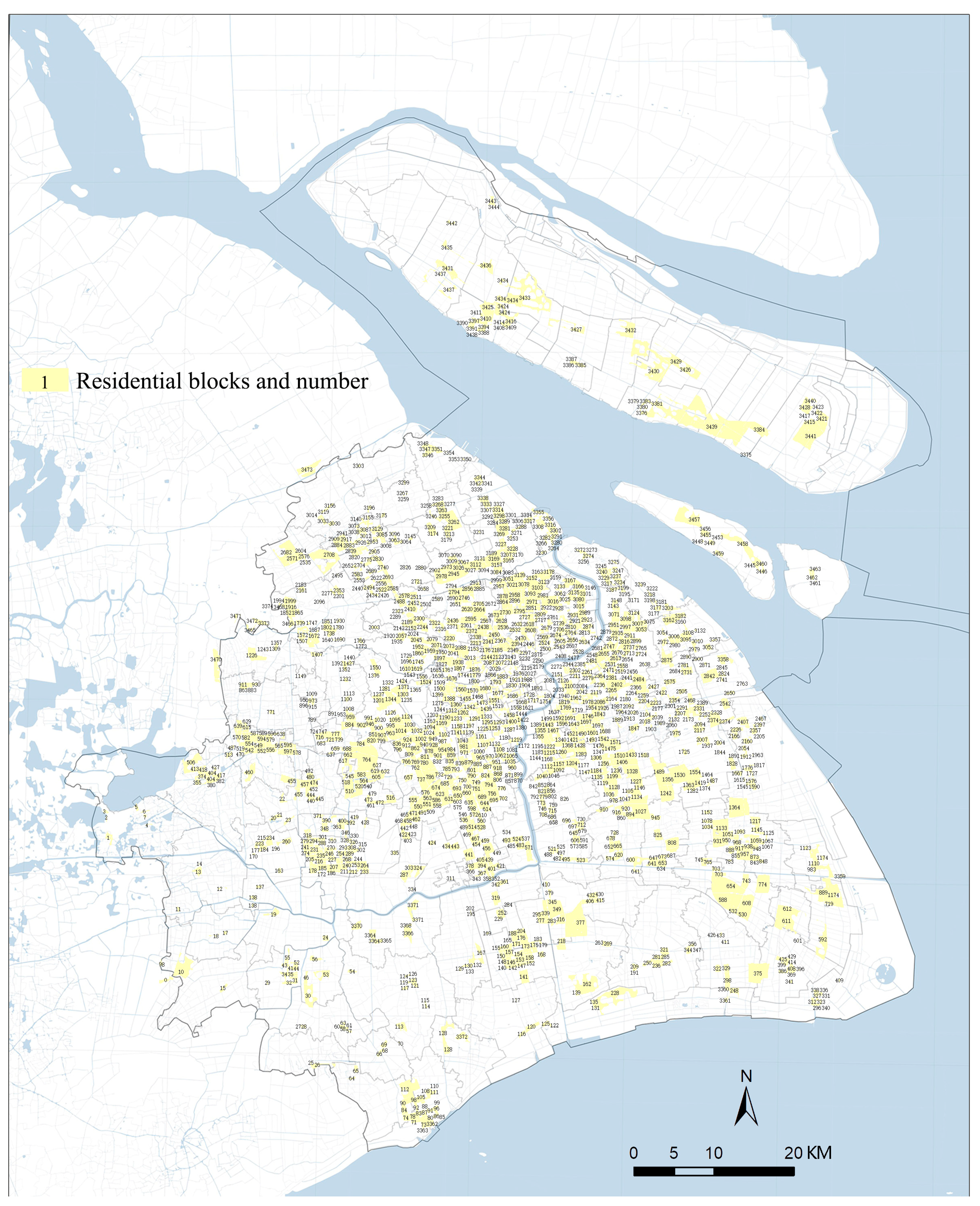
According to the definition of ‘5-min living circle’ in the Urban Residential Area Planning and Design Standard (GB50180-2018) [31], centralized and contiguous residential plots with an area of >4 ha can be used as residential nodes in the network structure (Figure 4). Data on parks and residential areas were derived from Landsat 8 OLI/TIRS imagery (obtained from the USGS Data Center, https://glovis.usgs.gov/) and concurrent Sentinel-2 imagery (obtained from the Copernicus Open Access Hub, https://dataspace.copernicus.eu/) acquired in September 2019. A 10-m resolution dataset was generated through image fusion techniques. Supervised classification was performed using the Random Forest algorithm, with training samples and validation samples independently obtained via visual interpretation. The overall accuracy of the classification result was 85%, with a Kappa coefficient of 0.82, which was fused to generate a 10 m resolution dataset. Supervised classification was performed using a Random Forest classifier trained on visually interpreted samples, achieving an overall accuracy exceeding 80%. The classification results were post-processed through clustering and filtering, and patches were screened according to area and continuity criteria. Finally, the result was spatially calibrated and validated against Shanghai Land Use Change Survey data. The boundaries of Shanghai and its districts were obtained from the National Platform for Common GeoSpatial Information Services (https://www.tianditu.gov.cn/).

2.3. Network Structure Evaluation for Urban Park System

Urban park networks are holistic structures consisting of nodes and their relationships. Therefore, the network structure of a park system can be evaluated at two levels: the nodes themselves and the overall network structure [32]. Regarding network nodes, attention must be paid to their individual characteristics and the survival ability of the nodes within the network [33]. The importance of each node must be analyzed from an individual perspective. Regarding the overall network structure, the status of different parks when functioning as an integrated system must be considered; that is, the stability of the network structure must be analyzed from a global perspective. This enhances the structural optimization and functional stability of the system by promoting internal connections within the urban park system, ultimately achieving perfection in the park network.

2.3.1. Analysis of Node Importance

The purpose of analyzing the importance of individuals within a network is to allocate more resources to important nodes and promote connections between nodes within an urban park system. This improves the tier structure, functional stability, and service efficiency of the system. This study selected the centrality indicators (Degree Centrality and Betweenness Centrality) that best reflect the importance and connectivity of urban parks for evaluation.
(1) Degree centrality measures the total strength of a park’s direct connections within the service coverage network, quantified as the sum of weights from all its incident links [34]. In this context, the link weight represents the extent of service overlap (i.e., the number of residential blocks jointly covered by two parks). A higher degree centrality indicates a greater aggregate service coverage through direct partnerships and a stronger local influence within the park system. The formula for degree centrality is as follows:
C D n i = j = 1 g W i j i j
where C D n i is the weighted degree centrality of node i, g is the total number of nodes in the network, and W i j denotes the weight of the undirected link between node i to node j (i.e., the number of residential blocks amount they jointly cover). The sum is taken over all other nodes j (i ≠ j), excluding self-connections.
(2) Betweenness centrality measures the frequency with which a park lies on the shortest paths between other parks in the binary, unweighted service-overlap network, reflecting its potential role as a bridge or broker in the overall connectivity [35]. This indicates a park’s position as a structural bridge within the pattern of service coverage overlaps, not necessarily a geographical bridge. A park with high betweenness centrality thus occupies a critical position in maintaining the global connectivity of the service-overlap network. The formula is as follows:
C B n i = j < k g j k n i g j k
where C B n i is the absolute betweenness centrality of node i, g j k denotes the total number of shortest paths between nodes j and k, and g j k n i   is the number of those shortest paths that pass-through node i.
(3) The results of each centrality index were normalized to a comparable scale. The comprehensive importance index for each node was then calculated as the arithmetic mean of its normalized degree centrality C D n i and betweenness centrality C B n i . The detailed calculation results are provided in Table A1. Finally, the nodes were classified into three tiers (high, medium, and low) using the natural breaks (Jenks) method.

2.3.2. Analysis of Network Stability

To comprehensively assess the stability of urban park systems in response to disturbances, this study simulates the system’s performance under different failure scenarios from two dimensions: the topological structure and its service function. During operation, urban parks are inevitably exposed to various disruptions, such as natural disasters (typhoons, floods) or human-induced damage (fires, overcrowding), which may impair their service capacity and alter the structure of the service network [36,37]. Therefore, evaluating the system’s ability to maintain services, withstand damage, and restore its original service level after disturbances is critical. This study assesses stability by simulating network changes after park node failures, employing two classic disturbance scenarios for analysis: targeted attacks and random failures [38].
(1) Network disturbance scenarios: Attacks and Failures
Attacks refer to the targeted removal of nodes from a network according to a specific rule [39]. In this study, we employ a non-adaptive attack strategy, where the importance order of park nodes (based on degree, betweenness, or comprehensive importance) is calculated from the initial intact network. Nodes are then removed in a fixed order of descending importance. Each removal simulates a planned human-induced disruption (e.g., park closure, functional change). This scenario models long-term, value-driven planning pressures, such as the potential repurposing or redevelopment of highly central parks due to their locational advantage or high visitation, allowing us to assess the network’s vulnerability when critical nodes are systematically compromised.
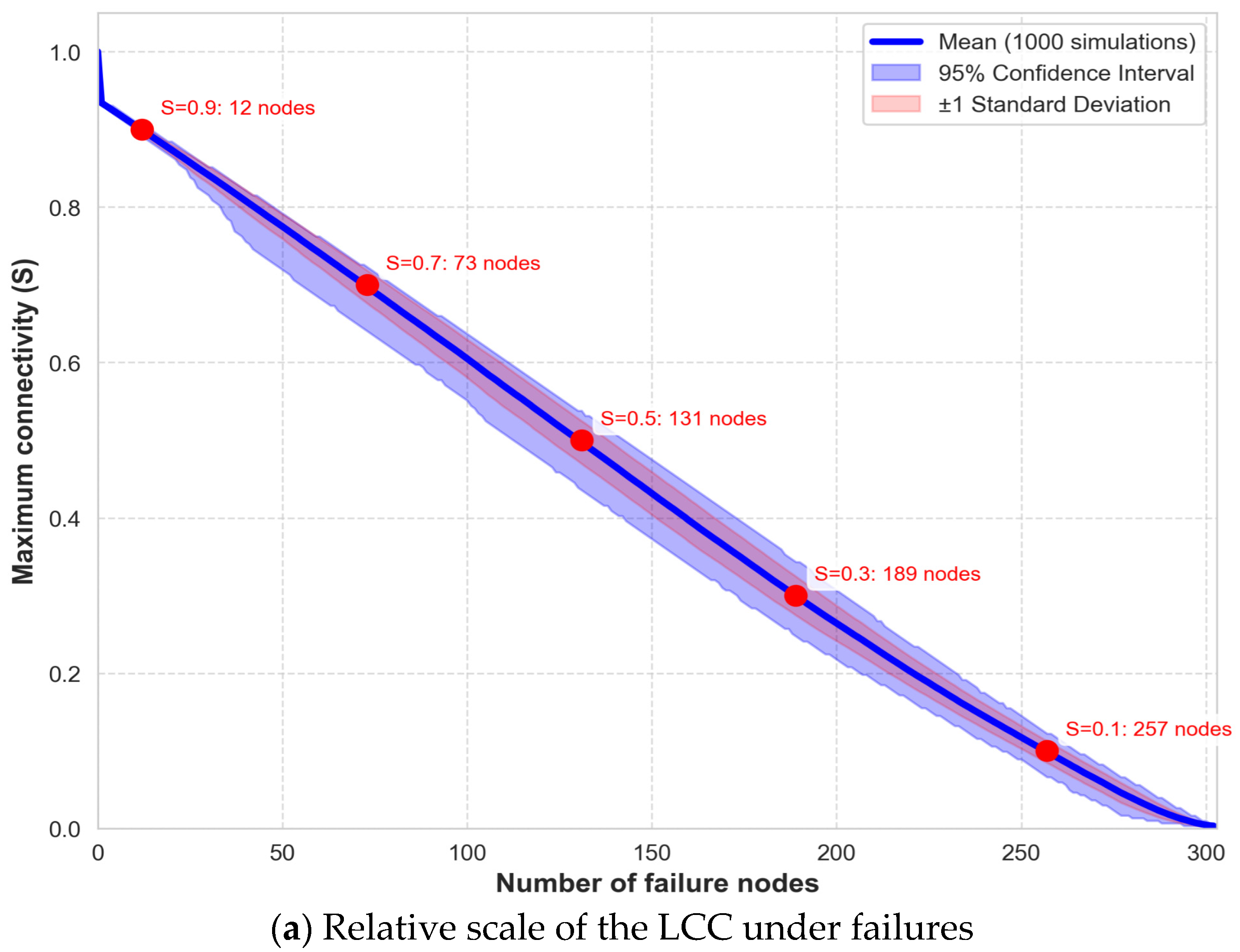
Failures refer to the completely random failure of nodes within the network, simulating damage caused by natural disasters or other sudden, unforeseen events (e.g., local flooding, equipment failures). To accurately evaluate the network’s inherent resistance to such random disturbances and ensure statistical robustness, this study adopts a Monte Carlo simulation approach: the random failure process is repeated for 1000 independent experimental runs. In each run, nodes fail in a random sequence, and the final results are averaged across all runs.
(2) Network Stability
When the urban park network is disrupted, it may fragment into multiple subnetworks of varying sizes. The largest of these, containing the most interconnected park nodes, is termed the Largest Connected Component (LCC) [40]. To quantify network stability, this study employs the maximum connectivity (S), defined as the ratio of the number of nodes in the LCC after disruption to the total number of nodes in the initial network. The metric S primarily reflects the topological integrity and structural redundancy of the park synergy network. A high S value indicates that the network remains largely connected as a graph, which is a foundational aspect of structural stability. The calculation formula is:
s = N m a x N
where Nmax is the number of nodes in the LCC after disruption; and N is the total number of nodes in the initial network.
(3) Service Stability Analysis
The topological stability (S) assesses the structural connectivity of the park service-overlap network but does not directly measure the resulting impact on service provision for residents. To bridge this gap and link network disruptions explicitly to service accessibility, we introduce a complementary metric of service coverage loss. In each step of the attack and failure simulations, following the removal of a set of parks, we identify all residential areas that are no longer covered by the service area of any remaining park. The service impact is quantified by the Residential Coverage Loss Rate (RCLR), calculated as:
R C L R = N u n c o v e r e d N t o t a l × 100 %
where N u n c o v e r e d is the number of residential areas that have lost all park coverage, and N t o t a l is the total number of residential areas in the study.

2.4. Mapping the Networks of Urban Park System

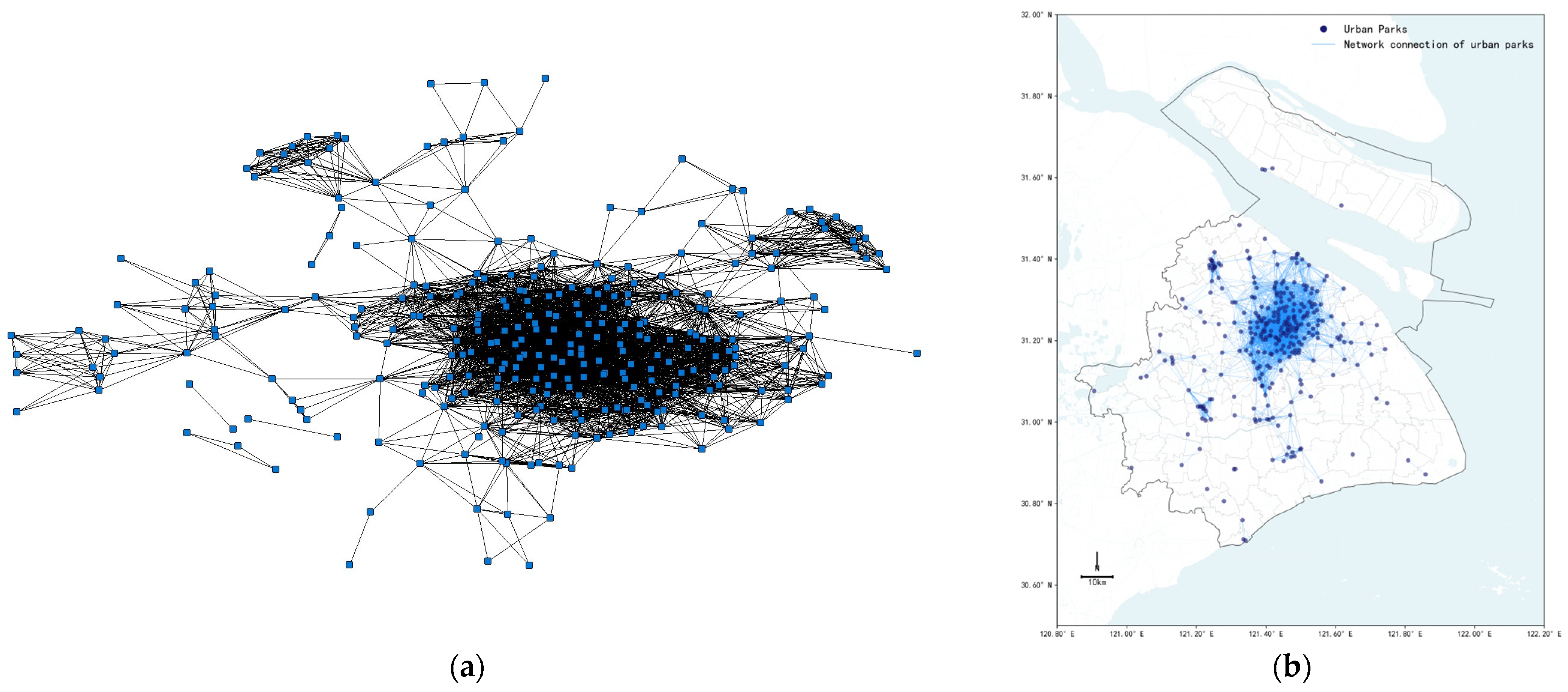
Constructing a network model of Shanghai’s urban parks using UCINET software reveals that the network consists of one large cluster, several smaller clusters, and a few isolated nodes. The overall network was highly interconnected and concentrated (Figure 5a). Subsequently, adding the geographical location information of the parks in ArcGIS software (v 10.7) obtained the network relationships of urban parks in Shanghai (Figure 5b).

3. Results

3.1. Importance Results of Network Nodes

3.1.1. Spatial Distribution of Important Network Nodes

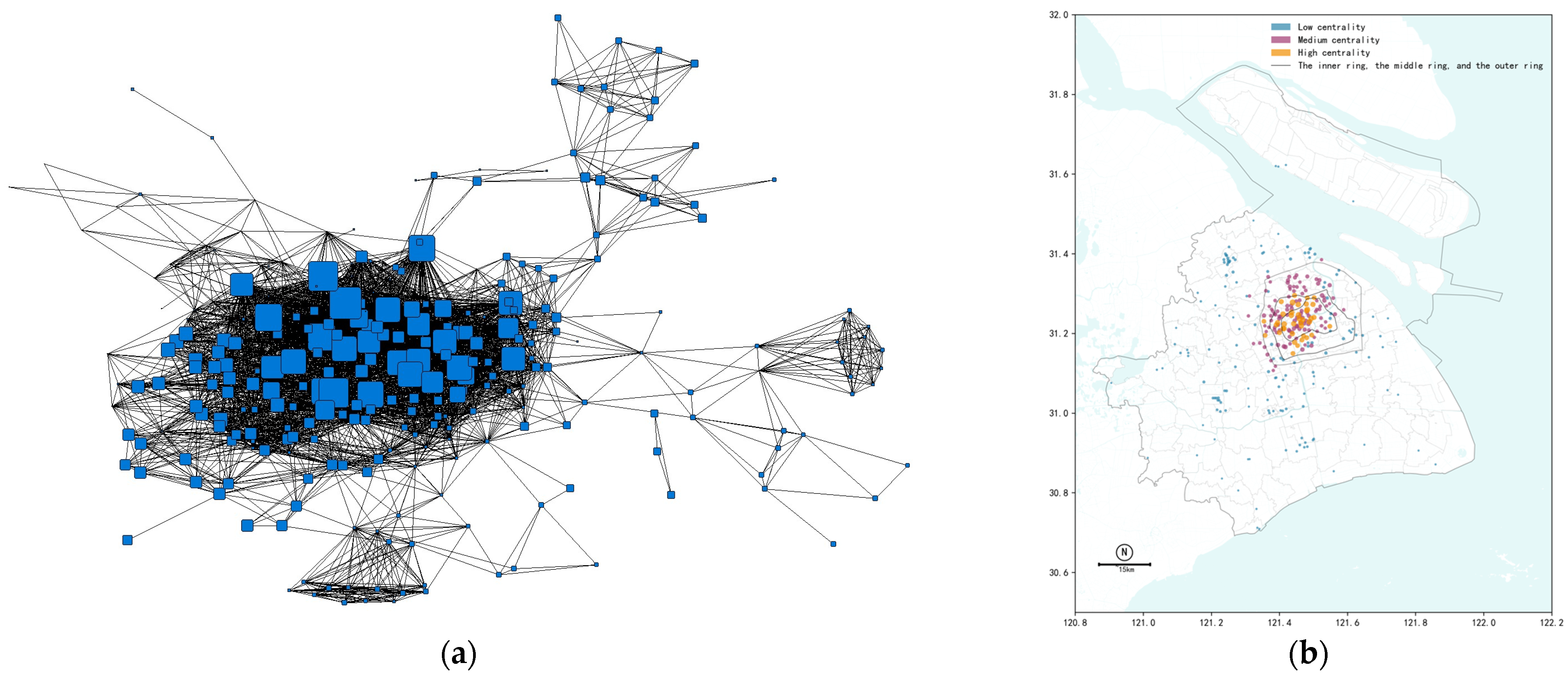
Analysis of the network revealed that 39 parks exhibited high degree centrality within the service-overlap network (Figure 6), with an average area of 24.62 ha. Most of these parks are located in the densely populated central urban area west of the Huangpu River, such as Renmin Park, Jing’an Park, and Luxun Park. The high connectivity of these parks in the network primarily results from the dense residential development and high population density in this area, which leads to extensive overlap in their service coverage with many other parks.
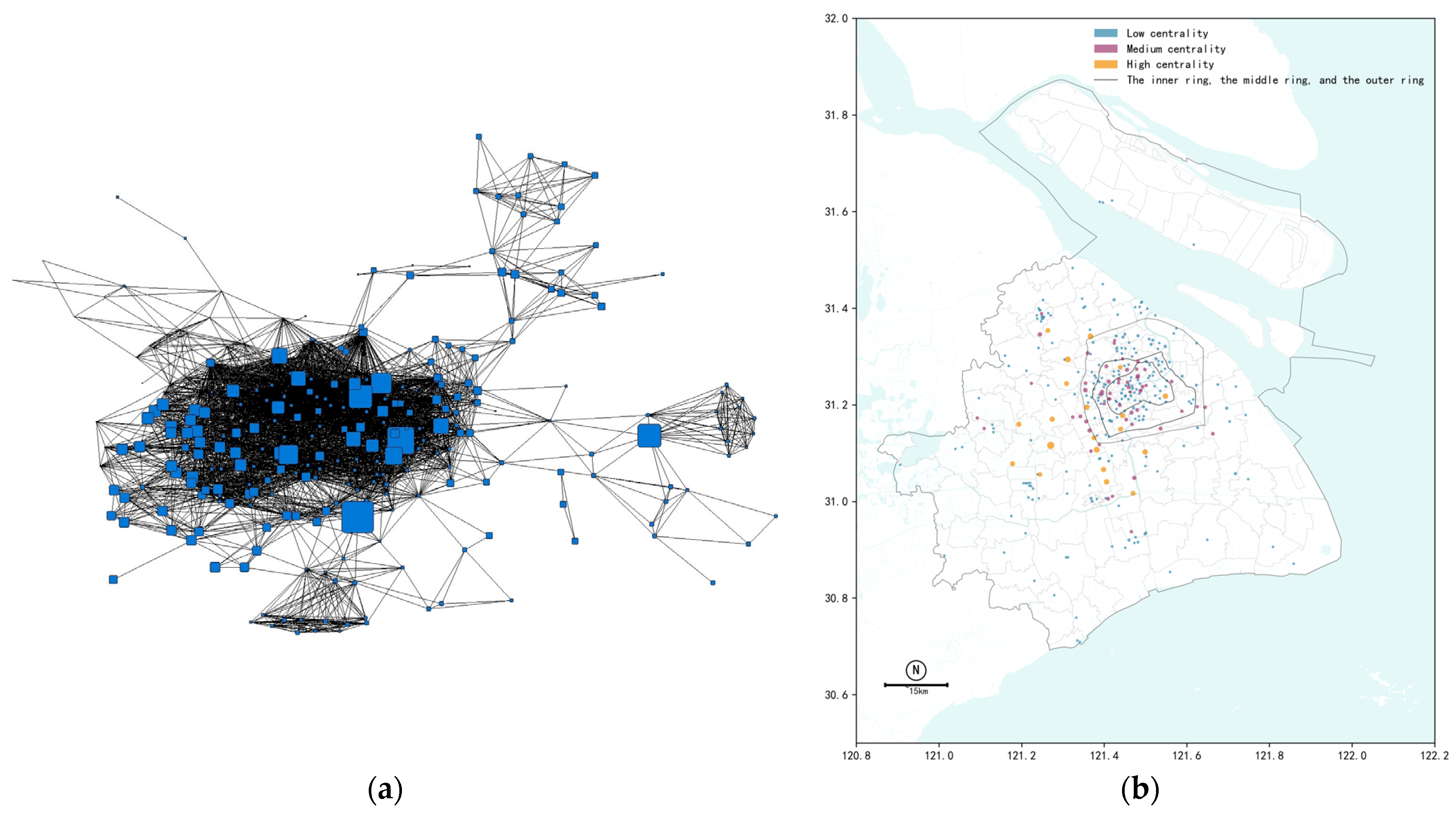
Within the service-overlap network, 20 parks were identified with high betweenness centrality (Figure 7). These parks are predominantly large in scale (average area 48.28 ha), such as Gucun Park, Century Park, and Shanghai Zoo, and are mainly located in outer-ring and suburban areas. Their high betweenness centrality indicates that they serve as structural bridges within the overlap pattern—their service areas extensively intersect with those of multiple other parks that are not directly connected to each other. This position makes them critical for maintaining the overall connectivity of the service-overlap network.
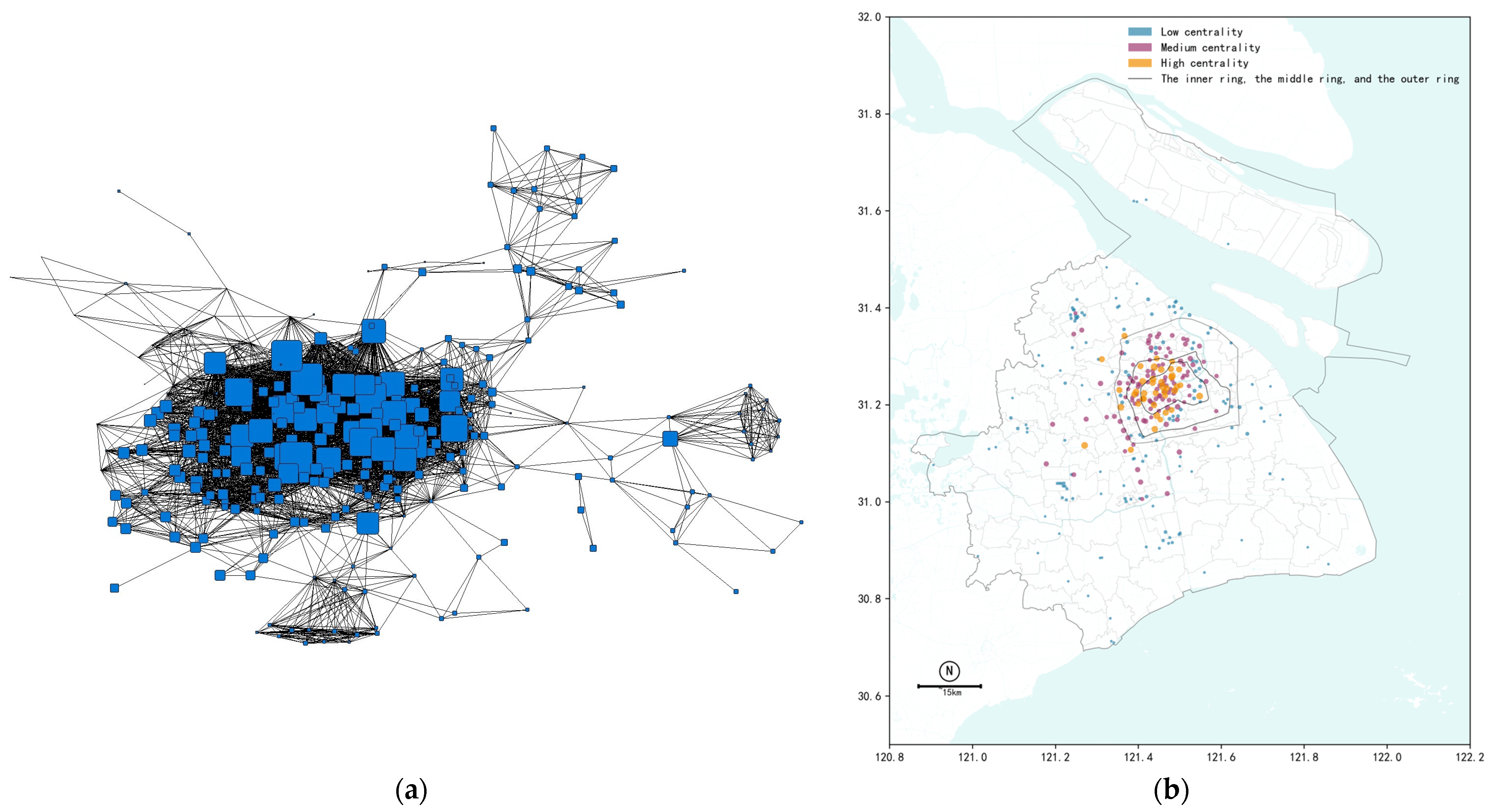
The comprehensive importance of each park node was derived by integrating its degree centrality and betweenness centrality in the service-overlap network (Figure 8, Table 2). Spatially, nodes were classified into three tiers: 39 parks were of high importance, primarily clustered in the densely populated central city west of the Huangpu River and near the Outer Ring Road; 111 parks were of medium importance, mainly distributed in the central city and in western and southern suburban districts such as Qingpu, Songjiang, and Minhang; and 154 parks were of low importance, distributed primarily outside the central urban area.
A Pearson correlation analysis indicated a statistically significant but weak positive relationship between a park’s comprehensive importance and its area (r = 0.203, n = 304, p < 0.01). The average park area decreased across importance tiers: high-importance parks averaged 24.62 ha, medium-importance 9.54 ha, and low-importance 7.14 ha. Overall, parks with higher structural importance within the service-overlap network tended to have larger areas.

3.1.2. Tier Structure of Urban Park Networks Based on Node Importance

The comprehensive importance of nodes was classified into three tiers using the Natural Breaks method, delineating a three-tiered structure within the urban park service-overlap network (Table 3). Tier-1 comprises 40 parks characterized by the highest combined connectivity (degree centrality) and bridging function (betweenness centrality) within the network. These parks, averaging 24.62 ha in size, include 21 comprehensive parks, 8 theme parks, and 11 community parks and are predominantly located in the high-density central urban area. Tier-2 consists of 111 parks where community parks constitute the dominant type (76.58%), indicating a layer with substantial local service redundancy. This tier also includes 9 comprehensive parks, 3 theme parks, and 14 small-scale urban parks, with an average area of 9.54 ha. Tier-3 forms the extensive base layer of the network, containing 153 parks with the lowest structural importance and the smallest average area (7.14 ha). Community parks are the main component (81.70%), and these parks are primarily distributed outside the central urban area, providing widespread foundational coverage.

3.2. Stability Results of Network Structure

3.2.1. Network Stability Under Attacks

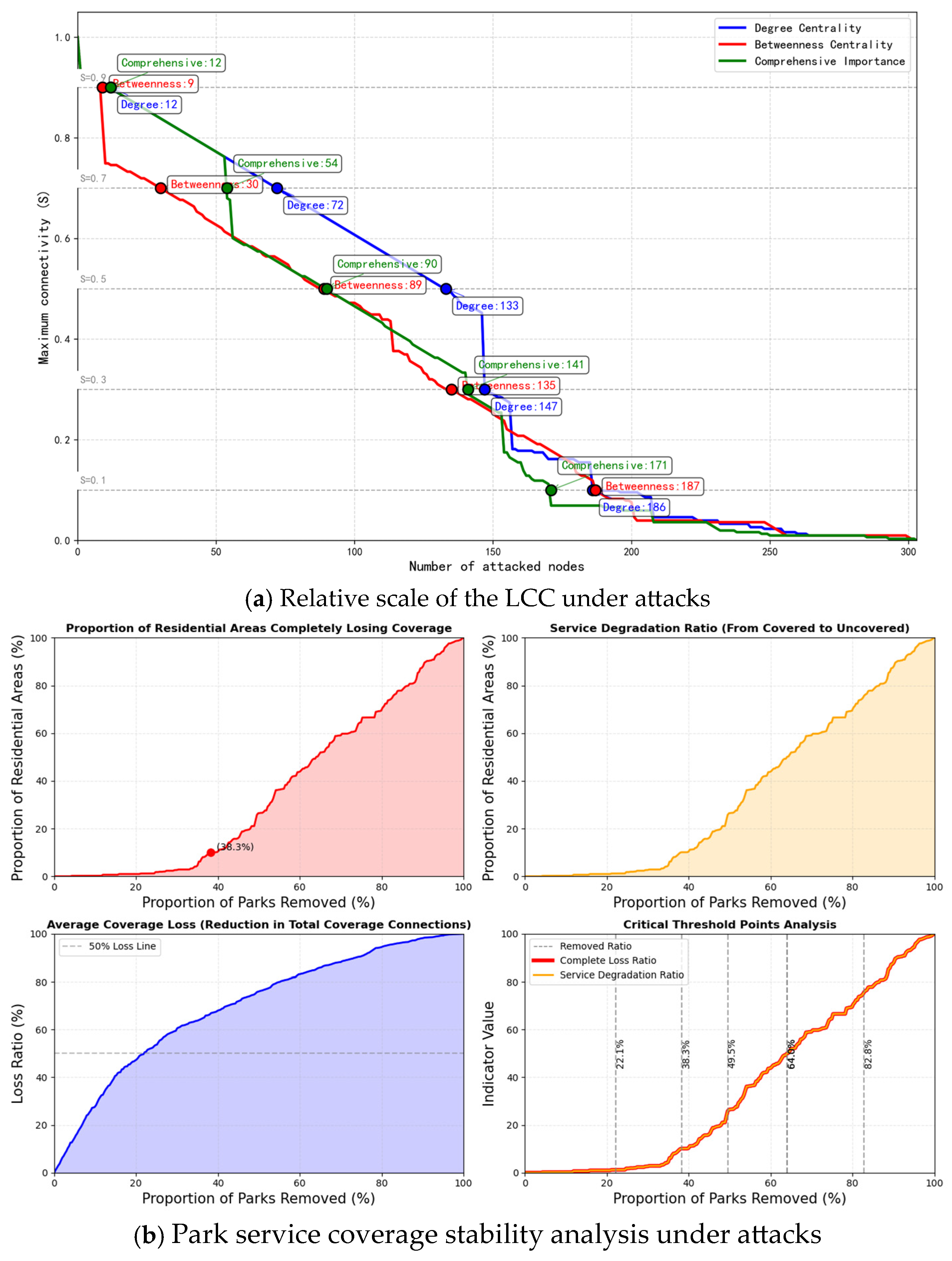
Under attacks on the park service overlap network, both the topological structure and service function of the network exhibit differentiated and phased failure characteristics (Figure 9).
In terms of topological connectivity, the size of the LCC (S) continuously decreases as the number of attacked nodes increases, indicating a gradual decline in structural stability (Figure 9a). Attack efficiency varies significantly depending on the node attribute used for targeting. Specifically, when attacks follow the order of betweenness centrality, the network shows the highest initial vulnerability: removing only 9 nodes (3.0%) causes S to drop sharply from 0.97 to 0.79. This suggests that a few park nodes (e.g., 176, Zhuanlian Leisure Park), which act as structural bridges in the service overlap pattern, play a critical role in maintaining the overall connectivity of the network. In contrast, attacks based on degree centrality result in the most gradual decline in stability; a significant drop in S (from 0.47 to 0.31) only occurs after approximately 147 nodes (48.5%) are removed. This reflects the network’s strong redundancy against attacks based on local connectivity. Taking severe structural disruption (S = 0.5) as the threshold [41,42], attacks based on the comprehensive importance measure require the removal of 90 nodes (29.7%). This efficiency is similar to that of betweenness-based attacks (requiring 89 nodes, 29.4%) and significantly higher than that of degree-based attacks (requiring 133 nodes, 43.9%).
From the perspective of service function, its decline occurs earlier and is more severe than that of topological connectivity (Figure 9b). When attacks are conducted in the order of node comprehensive importance, the loss of service coverage exhibits a clear phased pattern. Removing the top 67 park nodes (22.1%) results in a 50% reduction in the average park coverage per residential area across the city, marking a halving of the service choices and redundant space available to residents. When the scope of failure expands to the top 116 nodes (38.3%), 10.1% of residential areas completely lose park services. As the number of removed nodes increases to 150 (49.5%), this proportion rapidly rises to 25.8%, indicating the onset of regional service collapse.

3.2.2. Network Stability Under Failures

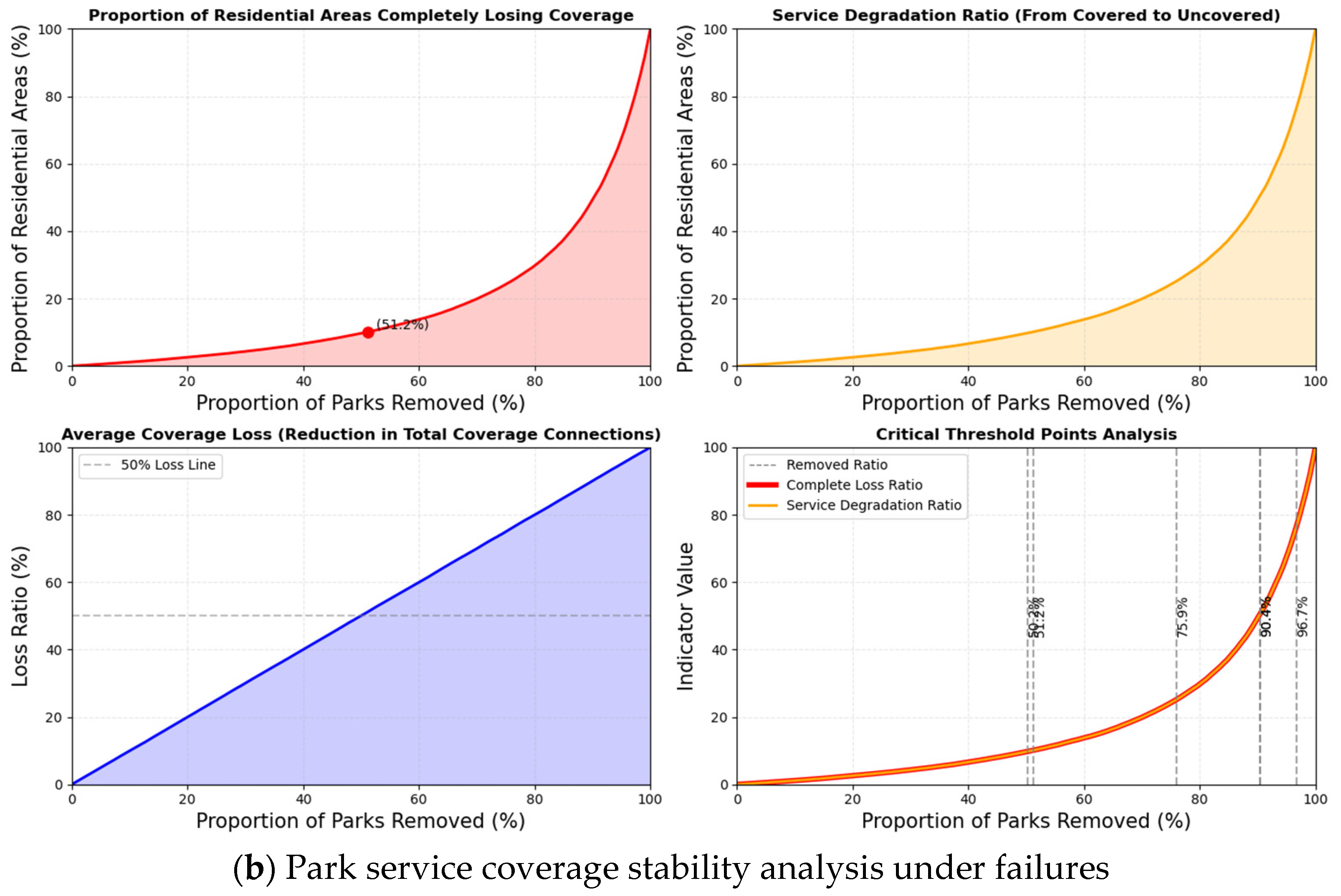
Under failure scenarios, the urban park network in Shanghai exhibits strong robustness in both topological structure and service function (Figure 10). In terms of topological connectivity, based on 1000 independent Monte Carlo simulations, the size of S shows a steady, slow, and approximately linear decline as the number of failed nodes increases (Figure 10a). On average, 132.4 nodes (43.6%) need to fail to reduce S to 0.5, and 152.8 nodes (50.3%) are required to lower it to 0.3. This indicates that the network can maintain over half of its structural connectivity even when nearly half of its nodes fail randomly. The 95% confidence interval is relatively narrow in the early stages of failure, suggesting consistent network behavior under small-scale failures. As the failure scale expands, the interval gradually widens, reflecting increased uncertainty in the collapse pathway as the network approaches its load-bearing limit. The failure curve is significantly flatter than all targeted attack curves (Figure 9a). The number of node failures required to maintain 50% connectivity under random failure is much higher than under targeted attacks based on comprehensive importance (132.4 compared to 90), highlighting the network’s structural redundancy against random disturbances.
From the perspective of service function, its loss also exhibits a gradual, high-threshold characteristic (Figure 10b). The proportion of residential areas completely losing service coverage increases slowly: it requires failure of up to 90.4% (274) of park nodes to cause 50% of residential areas to lose all park services; even with 50.8% (154) of nodes failing, only about 10.1% of residential areas are affected. Meanwhile, the indicator reflecting the overall service redundancy of the system—the average number of parks covering residential areas—decreases by 50.3% when 50.5% (153) of nodes fail randomly. Contrary to the ‘service collapse precedes topological failure’ characteristic observed under attacks, under failures, topological stability and service functionality stability demonstrate highly consistent and strong resilience. Both require the failure of nearly half or more nodes for their core indicators (S = 0.5 and 50% of residential areas losing all coverage) to drop to the threshold, jointly confirming that the system’s spatial redundancy effectively buffers random, localized impacts.

4. Discussion

4.1. Spatial Patterns and Influencing Factors of Key Park Nodes

In densely populated residential areas, the demand for park services is pronounced, which elevates the structural importance of parks located there. Consequently, parks within historic, high-density central urban areas—such as those in the Puxi old town—frequently emerge as key nodes in the network [8], exhibiting high degree centrality due to extensive overlap in service coverage with neighboring parks. As urban expansion continues, parks in suburban areas have developed rapidly, often leveraging their proximity to the central city [43,44]. Compared to the central core, these areas generally possess more available land and superior environmental conditions [45,46], attracting visitors from across the municipality [47]. Notably, our analysis reveals that many larger suburban parks (e.g., Gucun Park, Century Park) attain high betweenness centrality. They act as critical bridging hubs within the service-overlap network, connecting otherwise disparate park clusters. This pattern aligns with the polycentric spatial structure of Shanghai, where large suburban parks serve as regional destinations that integrate broader sectors of the urban park system.
Although important parks are concentrated in central areas, a park’s network importance is not determined solely by its location. Central Shanghai also contains parks of lower importance (e.g., Penglai Park), while some suburban parks hold pivotal structural roles. This indicates that importance is mediated by additional factors: (1) Park attractiveness and functional capacity. High quality park environments are known to significantly enhance usage rates [48,49]. Parks with greater aesthetic, recreational, or cultural appeal can attract users from beyond their nominal service radius, extending their influence and network relevance. (2) Spatial connectivity and service extent. The spatial relationship between parks and residential areas is fundamental. A larger service radius, often associated with park scale, increases the potential for co-coverage with other parks [50,51]. This enhances a park’s role in creating redundancy and connectivity within the network, making it less replaceable in structural terms.
It is also important to consider that in highly saturated urban areas, extensive service-coverage overlap, while beneficial for network resilience, may entail a trade-off [52]. The clustering of numerous parks with similar service radii and functions can lead to a certain degree of service homogenization, potentially diluting the distinctiveness and appeal of individual parks. Under such conditions, the marginal utility of additional spatial redundancy—in terms of enhancing residents’ recreational experience or choice quality—may diminish. Therefore, planning practice should not only leverage overlap for structural stability but also strategically promote functional complementarity and distinctive differentiation among spatially proximate parks. This approach can mitigate homogenization and elevate overall service efficacy and experiential diversity beyond the provision of basic structural redundancy.

4.2. Discrepancy Between Emergent Network Tiers and Statutory Park Hierarchies

China’s Urban Green Space Classification Standard (CJJ/T85-2017) [53] defines a hierarchical park system (e.g., comprehensive, community, theme parks, etc.) based primarily on scale and facility provisions, reflecting a conventional, top-down planning approach [54,55]. Our SNA, however, reveals a discernible discrepancy between these statutory hierarchies and the emergent functional tiers identified within the service-coverage overlap network (Table 4). For instance, several community parks (e.g., Sichuan North Road Park, etc.) were positioned in the top network tier (Tier-1). This outcome appears to stem from highly concentrated and overlapping service radii in dense urban cores, representing a case of high network tier but low statutory hierarchy. Conversely, some comprehensive parks (e.g., Shenzhuang Park, Fangta Park, etc.) were identified in lower network tiers (Tier-2/3), illustrating low network tier but high statutory hierarchy.
This observed discrepancy may be attributed to several interacting factors: (1) Spatial adaptation to land constraints: In high-density central areas, the proximity of numerous small parks leads to extensive service overlap, which can elevate their structural importance in the network beyond their nominal statutory grade. (2) Structural influence from co-coverage: The overlap network captures relationships based on shared service populations—a form of spatial redundancy or potential substitutability that is not accounted for in static, attribute-based classifications. (3) Institutional pacing of statutory planning: The established classification system may evolve more slowly than dynamic urban spatial patterns and de facto service coverage.
These findings prompt a pertinent planning reflection: Should statutory hierarchies be adjusted to better reflect the emergent spatial patterns of service overlap and usage? Alternatively, should spatial configurations be actively steered to align with predefined hierarchical categories? This consideration underscores a tension between the bottom-up, spatially self-organized network structure and the top-down, attribute-based planning framework, while also indicating a limitation of current planning approaches that tend to emphasize individual park attributes over the relational structure of the park system as a whole.
Building on this analysis, we propose a network-informed optimization strategy that tailors interventions to the specific functional-spatial role of parks, rather than applying uniform standards based solely on statutory grade.
For parks with high network importance (e.g., Tier-1) but lower statutory grades (e.g., central community parks): The planning priority should be to augment their service capacity and manage localized demand. This involves: (1) Targeted investments to upgrade facilities, landscape quality, and management intensity to sustainably support the high demand within their overlapping service zones; (2) In surrounding high-density areas where land is scarce, actively incorporating pocket parks, vertical greening, and recreational gardens into urban renewal projects to increase local park density [56,57], disperse usage pressure, and enrich the network’s fine-grained redundancy.
For parks with high statutory grades but lower network importance (e.g., some comprehensive parks in Tier-2/3): The focus should shift to activating their potential and enhancing systemic integration. Key strategies include: (1) Prioritizing ecological protection and functional resilience as their primary role, while reserving service capacity for future surrounding development [58,59]; (2) Strengthening their network connectivity by improving multi-modal accessibility (e.g., via greenway development [60]) from broader residential areas and cultivating distinctive functional themes to attract users and solidify their role as regional destinations.
For parks where network tier and statutory hierarchy are aligned: The emphasis should be on the protection and steady maintenance of their existing service functions to ensure they continue to serve as reliable backbone elements of the system.
Looking ahead, the planning of urban park systems could be viewed not merely as an application of static hierarchies, but as a dynamic and integrative process—one that seeks to both accommodate the functional network patterns emerging from actual use (adapting from the bottom up) and to guide the development of more balanced and resilient networks through strategic investment and design (steering from the top down).

4.3. The Duality of Network Stability: Topological Structure, Service Function, and Planning Implications

This study evaluated the stability of Shanghai’s urban park system by simulating two disturbance scenarios—targeted attacks and random failures—from two dimensions: topological structure (size of the Largest Connected Component, S) and service function (Residential Coverage Loss Rate, RCLR). The results reveal a notable duality in system stability: topological integrity and service continuity respond asynchronously, and at times inversely, to different disturbances, presenting deeper requirements for resilience-oriented planning.
Under targeted attacks, service function proves more vulnerable than topological structure. When parks were removed in descending order of comprehensive importance, the decline in service function occurred significantly earlier than the breakdown of the topological network. Data analysis indicates that removing only 22.1% of key nodes led to a 50% reduction in the average park coverage options for residents, while the topological network remained largely intact (S ≈ 0.85). More notably, regional service interruption (over 25% of residential blocks losing all coverage) occurred before the network topology reached a severe damage threshold (S = 0.5). This highlights an important contrast: traditional topological connectivity analysis may overestimate the system’s capacity to maintain actual service provision. The decline in service quality and choice experienced by residents represents a more sensitive and pressing risk signal than the abstract rupture of network connections. Therefore, “service coverage stability” should be considered a core resilience metric that more closely aligns with public needs.
Under random failures, the system demonstrates general robustness based on spatial redundancy. Both topological connectivity and service coverage showed considerable resistance to random node failures, requiring the failure of nearly half the nodes to cause severe degradation in connectivity or coverage. This robustness stems from structural redundancy created by the extensive overlap of park service radii in the high-density urban form, allowing the system to effectively buffer common random disturbances such as temporary maintenance or minor disasters, thereby ensuring the reliability of the basic service network.
The comparison between the two scenarios underscores the heterogeneity of system resilience and its deep dependence on key nodes. The high stability under random failures (high redundancy) contrasts sharply with the marked vulnerability under targeted attacks (high dependency). This insight reveals that the overall redundant efficacy of the system heavily relies on the connective skeleton and service coverage maintained by a few key nodes. Should these structural hubs be strategically removed, the service efficacy of the seemingly redundant network could decline rapidly.
In summary, this study provides a tiered framework for resilience management in park system planning. First, the inherent resilience to random failures validates the effectiveness of the current polycentric, high-overlap spatial layout, which should be maintained as a foundational structure. Second, the research clearly indicates that planning and management must pay heightened attention to the system’s acute sensitivity to the failure of key nodes, rather than being satisfied with average redundancy. Therefore, the core strategy lies in implementing differentiated management and a segmented protection scheme based on node importance.
As the attack simulations confirmed that network stability hinges on a small number of critical parks, we propose ranking all park nodes by their comprehensive importance and segmenting them into three protection tiers (e.g., top 10%, next 20%, and remaining 70%) [61]. Corresponding protection measures—ranging from core to priority to basic—should be applied accordingly (specific measures are detailed in Table 5). This protocol should be dynamically updated if network structure shifts due to disturbances or planning interventions.
Through this approach, priority is given to ensuring the integrity and service capacity of the critical functional nodes that underpin extensive service coverage, while still safeguarding the network’s overall redundancy. This dual focus helps prevent systemic service crises and supports the stable and equitable operation of the urban park network in uncertain environments.

4.4. Limitations and Future Directions

This study has certain limitations in terms of methodology and data, while also pointing the way for future research. First, the model is constructed based on the static spatial overlay of park service radii and residential areas, which essentially represents a “geographic dependency” assumption regarding potential service relationships. Although this approach can effectively depict the coverage pattern of service provision and the network structure, it fails to incorporate dynamic factors such as residents’ actual travel behavior, time preferences, and destination choices. For instance, residents may choose parks beyond their immediate “service circles” due to park quality, social needs, or accessibility—a complex decision-making process that the current static model cannot capture. Second, the key parameters on which the model relies, such as the area threshold for residential nodes (>4 hectares) and the assigned park service radii (based on planning standards and referenced empirical studies), though reasonably simplified, still influence the identification of network structure and key nodes. Therefore, future research should conduct systematic sensitivity analysis to examine the impact of relevant parameters (e.g., different residential area thresholds, service radius values) on the robustness of the conclusions. Additionally, the use of single time-slice data in this study makes it difficult to reflect the spatiotemporal dynamics of park use (such as differences between weekdays and weekends, seasonal variations) and the long-term evolution of supply and demand driven by urban development.
To address these limitations, future research could advance in the following three directions: (1) Integrate multi-source dynamic behavioral data: Combine datasets such as mobile phone signaling, social media check-ins, and shared bicycle trajectories to construct park usage networks based on “actual human flow connections” rather than “theoretical service coverage”, thereby more authentically revealing the system structure driven by resident behavior. (2) Conduct longitudinal temporal analysis: Introduce a temporal dimension to trace the evolution process and mechanisms of park network structure alongside urban renewal, demographic changes, and spatial development. (3) Incorporate user perceptions and social semantics: Use questionnaires, interviews, and other methods to explore the micro-level socio-demographic factors and subjective preferences influencing park choice, infusing the network model with richer social semantics to enhance its explanatory power.
Through advancements in these directions, the application of SNA in urban park system research is expected to become more precise, dynamic, and multidimensional, thereby providing more insightful decision support for scientific planning and refined management.

5. Conclusions

This study applied SNA to evaluate the spatial structure of Shanghai’s urban park system and the key conclusions are as follows:
  • Park importance is spatially clustered and influenced by both location and intrinsic attributes. High-degree parks concentrate in dense central areas due to service overlap, while high-betweenness parks in outer areas act as bridging hubs, reflecting the polycentric urban structure.
  • A clear discrepancy exists between the emergent functional tiers of the network and the statutory park hierarchy. This stems from spatial adaptation, relational effects of co-coverage, and institutional inertia, highlighting a tension between bottom-up network patterns and top-down planning frameworks.
  • The system shows dual stability: topologically vulnerable to targeted attacks yet functionally resilient due to spatial redundancy. This implies service quality may degrade before basic access is lost, requiring planning to address both network integrity and equitable coverage.
  • Social network analysis offers a relational framework for optimizing park systems. It enables the identification of key nodes, diagnosis of mismatches, and stability simulation, supporting targeted, tiered interventions for more resilient and effective green space planning.
In summary, a network-oriented perspective can help align park resources with actual use patterns, contributing to more resilient green spaces in high-density cities.

Author Contributions

Conceptualization, Y.Y. and S.L.; methodology, Y.Y.; software, Y.Y.; investigation, Y.Y.; resources, S.L.; data curation, Y.Y. and L.J.; writing—original draft preparation, Y.Y.; writing—review and editing, S.L. and K.W.; visualization, Y.Y.; supervision, S.L.; project administration, Y.Y.; funding acquisition, Y.Y. and L.J. All authors have read and agreed to the published version of the manuscript.

Funding

This research was supported by Shandong Provincial Natural Science Foundation for Youths, grant number ZR2024QE329; Qingdao Agricultural University Doctoral Start-Up Fund, grant number 6631125712; Key Laboratory of Ecology and Energy Saving Study of Dense Habitat, Ministry of Education, grant number 20240111; National Natural Science Foundation of China Young Scholars, grant number 52408080.

Data Availability Statement

The original contributions presented in the study are included in the article, further inquiries can be directed to the corresponding author.

Acknowledgments

This article is an expanded and deepened version of our previously published Chinese paper [30], Network structure evaluation and optimization path for urban park system of Shanghai city based on social network analysis, originally published in Chinese by Beijing Landscape Architecture Journal Periodical Office Co., Ltd., Landscape Architecture, 2023, Vol. 30, No. 11, pp. 51–58. The research presented here extends the original work by incorporating a comprehensive analysis of network stability, encompassing both topological integrity and service coverage functionality. Furthermore, the methodology has been refined, and the Introduction, Discussion, and Conclusion sections have been substantially developed to provide a more robust and nuanced interpretation of the findings.

Conflicts of Interest

The authors declare no conflicts of interest.

Appendix A

Table A1. Results of node importance in the social network of urban parks in Shanghai.
NumberPark NameDegree
Centrality
Betweenness
Centrality
Comprehensive
Importance
NumberPark NameDegree
Centrality
Betweenness
Centrality
Comprehensive
Importance
1Shanghai Zoo0.6230.5270.575153Shuisheng Garden0.0960.0510.074
2Guyi Garden0.2630.6310.447154Li’an Park0.2980.3940.346
3Shanghai Binjiang Forest Park0.2370.0120.125155Xinzhuang Mei Garden0.2540.1260.190
4Shanghai Botanical Garden0.6140.3890.501156Huaxiang Green Space0.2630.1330.198
5Shanghai Chenshan Botanical Garden0.1580.4350.296157Xincheng Central Park0.2370.6680.453
6Shanghai Gongqing Forest Park0.4650.0870.276158Jiwang Park0.0180.0000.009
7Yu Garden0.8950.2160.556159Chuzhai Park0.0530.0000.026
8Huangpu Park0.4210.0060.214160Tian Park0.0880.0050.046
9People’s Park0.8250.0900.457161Chenxing Park0.0260.0000.013
10Penglai Park0.3680.0030.186162Maqiao Park0.0610.0000.031
11Gucheng Park0.3770.0030.190163Meilong Leisure Park0.1750.0010.088
12Plaza Park
(Huangpu Section)
0.8250.0930.459164Pingyang Shuangyong Park0.1490.0000.075
13Jiuzi Park0.4740.0040.239165Xiyang Garden0.0960.0510.074
14Fuxing Park0.7810.0660.424166Meilong Park0.1670.0010.084
15Shaoxing Park0.4820.0050.244167Mei Xin Long Yun0.1140.0110.063
16South Park0.6490.0550.352168Jinbo Garden0.0350.0000.018
17Huaihai Park0.4560.0050.230169Xinhua Garden0.0790.0020.041
18Liyuan Park0.4300.0040.217170Jiangwei Green Space0.0260.0000.013
19Yanfu Park0.4040.0020.203171Jinta Park0.0960.5110.304
20Daguanyuan Green Space0.4300.0030.216172Zhuanqiao paper-cut Park0.0960.0430.070
21Xiaotaoyuan Green Space0.4120.0030.208173Pukang Recreation Park0.1320.5200.326
22Hengshan Park0.4210.0020.212174Yindu Green Space0.0880.0050.046
23Xiangyang Park0.4910.0040.247175Jinhongqiao Park0.2190.0030.111
24Longhua Martyrs Cemetery0.7720.4440.608176Zhuanlian Leisure Park0.1140.4980.306
25Kangjian Garden0.5440.0750.310177Pujiang First Bay Park0.1230.4220.273
26Guilin Park0.5350.0730.304178Minhang Cultural Park0.3600.2230.291
27Caoxi Park0.3070.0060.156179Huilongtan Park0.1580.0880.123
28GuangqiPark0.4040.0070.205180Qiuxia Garden0.1750.1120.144
29Dong’an Park0.3510.0010.176181Jiading District Youth Activity Centre0.1400.0010.071
30Caohejing High-tech Park0.5090.0630.286182Anting Park0.0350.0060.021
31Xujiahui Park0.8070.1770.492183Shanghai Auto Expo
Park
0.0440.0080.026
32Huang Daopo Memorial Park0.1400.0070.074184Jiading Wisteria Garden0.1320.0000.066
33Paodao Park0.5880.1970.392185Chenjiashan Lotus Park0.1320.0000.066
34Donghu Green Space0.4740.0030.238186Fuhua Park0.1320.0000.066
35Wuzhong Green Space0.4820.0040.243187South Wall Park0.1320.0000.066
36Xikang Park0.4820.0030.243188Jinhe Park0.2630.3790.321
37Jing’an Park0.8250.0720.448189Wisteria Park0.1320.0000.066
38Jing’an Sculpture Park1.0000.2530.627190Xiaohekou Gingko Garden0.1230.0000.061
39Zhabei Park0.8600.2190.539191South Park0.1230.0000.061
40Jiaotong Park0.4650.0040.234192Shanghai Millenium Ginkgo Garden0.0700.0170.043
41Pengpu Park0.3420.0060.174193Shin Shing Park0.1320.0000.066
42Lingnan Park0.2890.0040.147194Jinsha Park0.5000.1560.328
43Sanquan Park0.2630.0030.133195Malu Park0.0790.0030.041
44Daning Park0.9560.3480.652196Huangdu Park0.0260.0000.013
45Buyecheng Green Space0.8680.1360.502197Nanshuiguan Park0.1320.0000.066
46Hudiewan Garden0.5000.0040.252198Pantuozi Park0.1320.0000.066
47Plaza Park
(Jing’an section)
0.4650.0040.235199Ziqidonglai Park
(Phase 1)
0.1840.2990.242
48Zhongxing Green Space0.4040.0030.203200Tanyuan Park0.0790.0200.049
49Dongjiaojing Park0.2460.0020.124201Century Green0.1050.0000.053
50Jing’an Central Park0.6930.1100.401202Haibo Park0.1580.0050.081
5199 Guangzhong Green Space0.3680.0050.187203Yuanxiang Lake Park0.1840.3680.276
52Pengpu New Village Park0.4650.0610.263204Guzhong Garden0.0090.0000.004
53Yonghe Park0.3600.0100.185205Shanghai Wildlife Park0.0180.0690.043
54Zhongshan Park0.8420.1300.486206Chuansha Park0.0700.0880.079
55Huashan Children’s Park0.4470.0040.226207Changqing Park0.1580.0000.079
56Tianshan Park0.7890.1130.451208Meiyuan Park0.3250.0040.164
57Tianyuan Park0.3330.0040.169209Manqu Park0.1930.0000.097
58Hongqiao Park0.4210.0080.215210Jingdong Park0.2110.0010.106
59Shuixia Park0.3600.0060.183211Gaoqiao Park0.1580.0060.082
60Xinhongqiao Central Garden0.7190.1260.423212Linyi Park0.2630.0020.133
61Huashan Green Space0.4650.0050.235213Jiyang Park0.2460.0030.124
62Haisu Green Space0.8070.1200.464214Shangnan Park0.4650.0540.259
63Xinjing Park0.2540.0030.129215Nanpu Square Park0.2980.0050.151
64Yanhong Green Space0.3680.0050.187216Century Park0.6140.5370.576
65Hongqiao Riverside Park0.4040.0080.206217Jinqiao Park0.2890.0730.181
66Hami Park0.3250.0070.166218Tangqiao Park0.2980.0060.152
67Linkong Skate Park0.5880.3230.455219Jingnan Park0.2110.0150.113
68Zhongxinjing Park0.2720.0060.139220Lujiazui central Green Space0.7280.1080.418
69Putuo Park0.4210.0040.212221Riverside Promenade0.8510.1810.516
70Caoyang Park0.4300.0050.217222Mingren Yuan Park0.4040.1600.282
71Changfeng Park0.7980.2640.531223Expo Park0.6670.1820.424
72Lanxi Youth Park0.3950.0040.199224Douxiang Yuen0.2630.0040.134
73Yichuan Park0.4470.0070.227225Huaxia Park0.1230.1460.134
74Hutai Park0.4040.0050.204226Gaodong Park0.0880.0020.045
75Guannong Park0.4300.0060.218227Jiangzhen Citizen Square
Park
0.0180.0000.009
76Ganquan Park0.4210.0120.216228Riverside Cultural Park0.0090.0000.004
77Haitang Park0.3680.0080.188229Haumu Park0.1490.0050.077
78Zhenguang Park0.2980.0090.154230Zhangheng Park0.1320.0930.112
79Meichuan Park0.3680.0030.186231Bailianjing Park0.6400.0550.348
80Weilaidao Park0.2630.0100.137232Houtan Park0.6840.2390.462
81Changshou Park0.8510.1080.479233Ziwei Park0.0790.0000.040
82Mengqing Garden0.8950.2080.551234Jinfeng Park0.0440.0310.037
83Qingjian Park0.2630.0060.134235Heyuan Park0.0350.0190.027
84Xianghe Park0.3250.0120.169236Heqing Park0.0180.0000.009
85Wuning Park0.8420.2550.549237Zhoupu Park0.0440.0240.034
86Taopu Park0.2890.0130.151238Dezhou Leisure Green Space 0.1670.0060.087
87Zhenru Park0.3420.0030.173239Shuguang Green Space 0.2280.1250.177
88Danba Park0.3330.0060.170240Youcheng Park0.5090.1480.329
89Zaoyang Garden0.4120.0050.208241Xingyuan Park0.0790.1790.129
90Changfeng No. 2 Green Space0.7540.2160.485242Gangcheng Park0.1400.0010.071
91Kunshan Park0.3250.0020.163243Mianqing Park0.0960.0490.073
92Luxun Park0.7810.1120.446244Pufa Park0.2280.2110.220
93Huoshan Park0.2980.0020.150245Xiangmei Park0.2370.0040.121
94Aisi Children’s Park0.9560.2770.616246Zhangjiang theme Park0.0960.0000.048
95Heping Park0.7720.1280.450247Luchaogang Park0.0090.0000.004
96Liangcheng Park0.3330.0030.168248Jinkui Green Space0.0880.0310.059
97Jiangwan Park0.3250.0020.163249Guanglan Park0.0880.0000.044
98Quyang Park0.6400.1750.408250Zhangyan Park0.0000.0000.000
99Sichuan North Road Park0.8330.1420.487251Jinshan Park0.0090.0000.004
100Caohongwan Park0.2890.0010.145252Gusong Garden0.0090.0000.004
101Guangdong Sports Park0.3770.0050.191253Binhai Park0.0180.0000.009
102Fuxingdao Park0.3420.0230.182254Huicui Garden0.0180.0000.009
103Boyang Park0.2370.0010.119255Tinglin Park0.0090.0000.004
104Yangpu Park0.4820.0570.270256Fengxi Park0.0000.0000.000
105Pingliang Park0.2460.0010.123257Chejing Park0.0000.0000.000
106Huimin Park0.3250.0040.164258Jinshan New Town Park0.0180.0000.009
107Neijiang Park0.2190.0030.111259Zuibaichi Park0.1050.0000.053
108Songhe Park0.2890.0030.146260Fangta Park0.1050.0000.053
109Yanchun Park0.2630.0050.134261Sijing Park0.1141.0000.557
110Gongnong Park0.1490.0010.075262Sixian Park0.1050.0000.053
111Minxing Park0.1750.0020.089263Xinqiao Park0.0180.0000.009
112Haungxing Park0.5530.0800.316264Maogang Park0.0090.0000.004
113Siping Science and Technology Park0.6320.0820.357265Shihudangtahui Park0.0000.0000.000
114Jiangpu Park0.2980.0030.151266Qichang Park0.1050.0000.053
115Xinjaingwancheng Park0.3860.0440.215267Songjiang People’s Square0.1050.0000.053
116Dalian Road Green Space0.3250.0030.164268Silu Garden0.0960.0000.048
117Xinjiangwancheng Ecological Corridor (Phase I) 0.4040.0510.227269Central Green Space
(Phase III)
0.1050.0000.053
118Xinjiangwancheng Ecological Corridor (Phase II) 0.4820.0670.275270Central Green Space
(Phase 4)
0.1050.0000.053
119Baoshan Martyrs’ Cemetery0.1840.0130.099271Wulonghu Park (Phase I) 0.0960.0000.048
120Shanghai Songhu anti-japanese War Memorial Park0.1670.0030.085272Central Park
(Phase 1)
0.1050.0000.053
121Wusong Paotaiwan Wetland0.1580.0020.080273Central Park
(Phase II)
0.1050.0000.053
122Yuepu Park0.1750.0780.127274Wulonghu Park (Phase II) 0.1230.3490.236
123Luoxi Park0.0350.0000.018275Chedun Health Park0.0180.0000.009
124Youyi Park0.1490.0040.077276Qushui Park0.0700.1100.090
125Sitang Park0.4120.0790.245277Daguan Garden0.0000.0000.000
126Yongqing Park0.1140.0000.057278Zhuxi Garden0.0180.0000.009
127Songnan Park0.4120.0780.245279Beijing Garden0.0440.0000.022
128Dahuaxingzhi Park0.6930.1870.440280Huaxin People’s Park0.0440.1080.076
129Gonghe Park0.4650.1080.286281Nanjing Garden0.0530.0020.027
130Luojing Park0.0000.0000.000282Xujing Square0.0960.4870.292
131Gucun Park0.3600.5790.469283Zhaoxiang Park0.0790.4740.276
132Baoshan Waterfront Park0.1140.0000.057284Minhui Plaza Park0.0090.0000.004
133Zhili Park0.3860.0610.223285Zhujiajiao Residents
Park
0.0260.0000.013
134Yijing Palace0.1930.0120.103286Xiayanghu Park0.0530.0020.027
135Miaoxing Park0.4560.0940.275287Qinyuanhu Park0.0610.0980.080
136Meilanhu Park0.1050.0190.062288Zhaoxiang Sports Park0.0440.0200.032
137Nobel Park0.0700.0070.039289Guhua Park0.0880.0580.073
138Shengqiao Park0.0090.0000.004290Siji Ecological Garden0.0960.1070.102
139Qilian Park0.2370.0420.139291Wangchun Garden0.0700.0000.035
140Jusheng Park0.1670.0180.093292Xidu Park0.0530.0000.026
141Zoumatang Garden0.1400.0010.071293People’s Park0.0880.0340.061
142Hulin Park0.3680.0490.209294Fengcheng Park0.0000.0000.000
143Yangquan Garden0.2630.0050.134295Zhuangxing Park0.0700.0000.035
144Nanda Park0.3160.2110.264296Xinghuo Park0.0260.0000.013
145Hong Garden0.1140.2030.158297Youth Art Park0.0880.0340.061
146Minhang Park0.1050.1030.104298 Sculpture Art Park0.0880.0340.061
147Xinzhuang Park0.2020.1650.184299Zhengyang Central Park0.0700.0000.035
148Wujing Park0.0610.2780.170300Punan Canal North Bank Park0.0790.0110.045
149Guteng Garden0.0610.0000.031301Yingzhou Park0.0180.0000.009
150Huacao Park0.1320.0100.071302Xincheng Park0.0180.0000.009
151Hanghua Park0.3330.2070.270303Baozhen Citizen Park0.0000.0000.000
152Minhang Sports Park0.4040.3030.353304Nanmen Green Space0.0000.0000.000

References

  1. Bertram, C.; Rehdanz, K. Preferences for cultural urban ecosystem services: Comparing attitudes, perception, and use. Ecosyst. Serv. 2015, 12, 187–199. [Google Scholar] [CrossRef]
  2. Wu, S.; Wang, D.; Yan, Z.; Wang, X.; Han, J. Coupling or contradiction? The spatiotemporal relationship between urbanization and urban park system development in China. Ecol. Indic. 2023, 154, 110703. [Google Scholar] [CrossRef]
  3. Jiang, Y.; Li, T.; Xu, H.; Huang, X.; Li, H.; Wang, Z. Exploring the factors influencing visits to urban parks: A case study of Beijing’s central urban area. Appl. Geogr. 2025, 178, 103613. [Google Scholar] [CrossRef]
  4. Rigolon, A.; Browning, M.; Jennings, V. Inequities in the quality of urban park systems: An environmental justice investigation of cities in the United States. Landsc. Urban Plan. 2018, 178, 156–169. [Google Scholar] [CrossRef]
  5. Aly, D.; Dimitrijevic, B. Systems approach to the sustainable management of urban public parks. Urban For. Urban Green. 2022, 68, 127482. [Google Scholar] [CrossRef]
  6. Liyan, X.; Yin, H.; Fang, J. Evaluating the supply-demand relationship for urban green parks in Beijing from an ecosystem service flow perspective. Urban For. Urban Green. 2023, 85, 127974. [Google Scholar] [CrossRef]
  7. Jin, J.; Sheppard, S.R.J.; Jia, B.; Wang, C. Planning to Practice: Impacts of Large-Scale and Rapid Urban Afforestation on Greenspace Patterns in the Beijing Plain Area. Forests 2021, 12, 316. [Google Scholar] [CrossRef]
  8. Liang, H.; Yan, Q.; Yan, Y. Evaluating green space provision development in Shanghai (2012–2021): A focus on accessibility and service efficiency. Sust. Cities Soc. 2024, 103, 105269. [Google Scholar] [CrossRef]
  9. Lee, H.; Chang, H.; Herianto, S.; Wu, C.; Liu, W.; Yu, C.; Pan, W.; Wu, C. Do greenness and landscape indices for greenspace correlate with suicide ratio? Landsc. Urban Plan. 2024, 242, 104935. [Google Scholar] [CrossRef]
  10. You, M.; Guan, C.; Lai, R. Spatial Structure of an Urban Park System Based on Fractal Theory: A Case Study of Fuzhou, China. Remote Sens. 2022, 14, 2144. [Google Scholar] [CrossRef]
  11. Fei, W.; Lu, D.; Li, Z. Research on the layout of urban disaster-prevention and risk-avoidance green space under the improvement of supply and demand match: The case study of the main urban area of Nanjing, China. Ecol. Indic. 2023, 154, 110657. [Google Scholar] [CrossRef]
  12. Zandniapour, K.; Soroush, A.; Khezerlu Agdam, E.; Sanaieian, H. Integrating GIS, 3D-Isovist, and an NSGA-II multi-objective optimization algorithm for automation of design process in urban parks and public open spaces. Int. J. Geoheritage Parks 2025, 13, 1–16. [Google Scholar] [CrossRef]
  13. Ma, F. Spatial equity analysis of urban green space based on spatial design network analysis (sDNA): A case study of central Jinan, China. Sust. Cities Soc. 2020, 60, 102256. [Google Scholar] [CrossRef]
  14. Tannous, H.O.; Major, M.D.; Furlan, R. Accessibility of green spaces in a metropolitan network using space syntax to objectively evaluate the spatial locations of parks and promenades in Doha, State of Qatar. Urban For. Urban Green. 2021, 58, 126892. [Google Scholar] [CrossRef]
  15. Jia, J.; Zlatanova, S.; Liu, H.; Aleksandrov, M.; Zhang, K. A design-support framework to assess urban green spaces for human wellbeing. Sust. Cities Soc. 2023, 98, 104779. [Google Scholar] [CrossRef]
  16. Brass, D.J.; Burkhardt, M.E. Centrality and Power in Organizations. In Networks and Organizations: Structure, Form and Action; Harvard Business School Press: Boston, MA, USA, 1992. [Google Scholar]
  17. Guenat, S.; Dougill, A.J.; Dallimer, M. Social network analysis reveals a lack of support for greenspace conservation. Landsc. Urban Plan. 2020, 204, 103928. [Google Scholar] [CrossRef]
  18. Chen, J.; Chang, Z. Rethinking urban green space accessibility: Evaluating and optimizing public transportation system through social network analysis in megacities. Landsc. Urban Plan. 2015, 143, 150–159. [Google Scholar] [CrossRef]
  19. Qiao, L.; Su, X.; Liao, W.; Pan, L. Accessibility Analysis of Urban Park Green Spaces in Nanning City Based on Network Analysis and G2SFCA. Sci. J. Technol. 2025, 7, 60–72. [Google Scholar] [CrossRef]
  20. Jazayeri, S.H.; Poursaeed, A.; Najafabadi, M.O. Social network analysis of green space management actors in Tehran. Int. J. Geoheritage Parks 2023, 11, 276–285. [Google Scholar] [CrossRef]
  21. Cai, Z.; Gao, D.; Xiao, X.; Zhou, L.; Fang, C. The Flow of Green Exercise, Its Characteristics, Mechanism, and Pattern in Urban Green Space Networks: A Case Study of Nangchang, China. Land 2023, 12, 673. [Google Scholar] [CrossRef]
  22. Granovetter, M.S. The Strength of Weak Ties. Am. J. Sociol. 1973, 78, 1360–1380. [Google Scholar] [CrossRef]
  23. Borgatti, S.P.; Everett, M.G.; Freeman, L.C. UCINET. In Encyclopedia of Social Network Analysis and Mining; Springer: Berlin/Heidelberg, Germany, 2014. [Google Scholar]
  24. Yang, Y.; Jiang, L.; Ma, X.; Liu, S.; Wang, L. A Comprehensive Approach to Identifying the Supply and Demand of Urban Park Cultural Ecosystem Services in the Megalopolis Area of Shanghai, China. Land 2025, 14, 455. [Google Scholar] [CrossRef]
  25. GB/T51346-2019; Urban Green Space Planning Standard. Ministry of Housing and Urban-Rural Development of the People’s Republic of China: Beijing, China, 2019.
  26. Shanghai Ecological Space Master Plan (2021–2035); Shanghai Greening and City Appearance Administration & Shanghai Planning and Natural Resources Bureau: Shanghai, China, 2020.
  27. Liu, Z.; Huang, Q.; Yang, H. Supply-demand spatial patterns of park cultural services in megalopolis area of Shenzhen, China. Ecol. Indic. 2021, 121, 107066. [Google Scholar] [CrossRef]
  28. Guo, S.; Yang, G.; Pei, T.; Ma, T.; Song, C.; Shu, H.; Du, Y.; Zhou, C. Analysis of factors affecting urban park service area in Beijing: Perspectives from multi-source geographic data. Landsc. Urban Plan. 2019, 181, 103–117. [Google Scholar] [CrossRef]
  29. Zhai, Y.; Wu, H.; Fan, H.; Wang, D. Using mobile signaling data to exam urban park service radius in Shanghai: Methods and limitations. Comput. Environ. Urban Syst. 2018, 71, 27–40. [Google Scholar] [CrossRef]
  30. Yang, Y.; Liu, S. Network structure evaluation and optimization path for urban park system of Shanghai city based on social network analysis. Lands. Archit. 2023, 30, 51–58. [Google Scholar]
  31. GB 50180-2018; Standards for Urban Residential Area Planning and Design. Ministry of Housing and Urban-Rural Development of the People’s Republic of China: Beijing, China, 2018.
  32. Shen, Z.; Yin, H.; Kong, F.; Wu, W.; Sun, H.; Su, J.; Tian, S. Enhancing ecological network establishment with explicit species information and spatially coordinated optimization for supporting urban landscape planning and management. Landsc. Urban Plan. 2024, 248, 105079. [Google Scholar] [CrossRef]
  33. Huang, K.; Peng, L.; Wang, X.; Deng, W.; Liu, Y. Incorporating circuit theory, complex networks, and carbon offsets into the multi-objective optimization of ecological networks: A case study on karst regions in China. J. Clean. Prod. 2023, 383, 135512. [Google Scholar] [CrossRef]
  34. Freeman, L.C. Centrality in social networks: Conceptual clarification. Soc. Netw. 1979, 1, 215–239. [Google Scholar] [CrossRef]
  35. Knoke, D.; Song, Y. Social Network Analysis, 2nd ed.; Gezhi Publishing House: Shanghai, China, 2012; pp. 108–110. [Google Scholar]
  36. Yildirim, Y.; Keshavarzi, G.; Aman, A.R. Can urban parks help with disaster risk reduction through educational awareness? A case study of Hurricane Harvey. Int. J. Disaster Risk Reduct. 2021, 61, 102377. [Google Scholar] [CrossRef]
  37. Staccione, A.; Essenfelder, A.H.; Bagli, S.; Mysiak, J. Connected urban green spaces for pluvial flood risk reduction in the Metropolitan area of Milan. Sust. Cities Soc. 2024, 104, 105288. [Google Scholar] [CrossRef]
  38. Albert, R.; Jeong, H.; Barabasi, A.L. Error and attack tolerance of complex networks. Nature 2000, 406, 378–382. [Google Scholar] [CrossRef] [PubMed]
  39. Cohen, R.; Erez, K.; Ben-Avraham, D.; Havlin, S. Resilience of the Internet to Random Breakdowns. Phys. Rev. Lett. 2000, 85, 4626. [Google Scholar] [CrossRef] [PubMed]
  40. Zhang, Q. Research on the Reliability of Southwest Urban Park Service Network. Master’s Thesis, Chongqing University, Chongqing, China, 2017. [Google Scholar]
  41. Shi, C. Research on the Robustness of Complex Communication Network Topologies. Master’s Thesis, University of Electronic and Technology of China, Beijing, China, 2012. [Google Scholar]
  42. Wu, Q.; Li, F.; Zhang, Q.; Li, M. Optimization of urban ecological spatial structure based on network analysis: A case study of Changzhou city, China. Ying Yong Sheng Tai Xue Bao J. Appl. Ecol. 2022, 33, 1983–1992. [Google Scholar]
  43. Guan, C.; Zhou, Y. Exploring environmental equity and visitation disparities in peri-urban parks: A mobile phone data-driven analysis in Tokyo. Landsc. Urban Plan. 2024, 248, 105104. [Google Scholar] [CrossRef]
  44. Marshall, F.; Dolley, J.; Bisht, R.; Priya, R.; Waldman, L.; Randhawa, P.; Scharlemann, J.; Amerasinghe, P.; Saharia, R.; Kapoor, A.; et al. Recognising peri-urban ecosystem services in urban development policy and planning: A framework for assessing agri-ecosystem services, poverty and livelihood dynamics. Landsc. Urban Plan. 2024, 247, 105042. [Google Scholar] [CrossRef]
  45. Bing, Z.; Qiu, Y.; Huang, H.; Chen, T.; Zhong, W.; Jiang, H. Spatial distribution of cultural ecosystem services demand and supply in urban and suburban areas: A case study from Shanghai, China. Ecol. Indic. 2021, 127, 107720. [Google Scholar] [CrossRef]
  46. Yang, L.; Lu, Y.; Cao, M.; Wang, R.; Chen, J. Assessing accessibility to peri-urban parks considering supply, demand, and traffic conditions. Landsc. Urban Plan. 2025, 257, 105313. [Google Scholar] [CrossRef]
  47. Shan, L.; He, S. The role of peri-urban parks in enhancing urban green spaces accessibility in high-density contexts: An environmental justice perspective. Landsc. Urban Plan. 2025, 254, 105244. [Google Scholar] [CrossRef]
  48. Łaszkiewicz, E.; Kronenberg, J.; Mohamed, A.A.; Roitsch, D.; De Vreese, R. Who does not use urban green spaces and why? Insights from a comparative study of thirty-three European countries. Landsc. Urban Plan. 2023, 239, 104866. [Google Scholar] [CrossRef]
  49. Ye, J.; Chen, Z.; Dong, J. Beyond quantity: Image segmentation-based assessment on quality of urban green spaces in China’s 20 major cities. Ecol. Indic. 2025, 178, 113973. [Google Scholar] [CrossRef]
  50. Li, F.; Yao, N.; Liu, D.; Liu, W.; Sun, Y.; Cheng, W.; Li, X.; Wang, X.; Zhao, Y. Explore the recreational service of large urban parks and its influential factors in city clusters—Experiments from 11 cities in the Beijing-Tianjin-Hebei region. J. Clean. Prod. 2021, 314, 128261. [Google Scholar] [CrossRef]
  51. Zeng, J.; Ai, K.; Lin, S.; Li, J.; Kong, N.; Ke, Y.; Chen, J.; Wang, J. An Empirical Study on the Interaction and Synergy Effects of Park Features on Park Vitality for Sustainable Urban Development. Sustainability 2025, 17, 8335. [Google Scholar] [CrossRef]
  52. Zhang, D.; Cai, Y.; Lv, J.; Ma, S.; Cheng, H.; Zhao, Y.; Zhang, X.; Wu, L. Re-identifying green infrastructure network towards sustainable urban futures: A dynamic temporal trade-off simulation. Cities 2025, 162, 105994. [Google Scholar] [CrossRef]
  53. CJJ/T 85-2017; Urban Green Space Classification Standard. Ministry of Housing and Urban-Rural Development of the People’s Republic of China: Beijing, China, 2017.
  54. Ghale, B.; Gupta, K.; Roy, A. Exploring the impact of urban planning on access to hierarchical green spaces: A comparative study between planned and unplanned cities. Urban For. Urban Green. 2025, 112, 128913. [Google Scholar] [CrossRef]
  55. Zhang, H.; Zhu, Y.; Du, C.; Hong, L.; Ouyang, M.; Xu, M. Advancing facility accessibility analysis across hierarchies and scales in mainland China. Appl. Geogr. 2025, 179, 103611. [Google Scholar] [CrossRef]
  56. Geng, H.; Lin, T.; Han, J.; Zheng, Y.; Zhang, J.; Jia, Z.; Chen, Y.; Lin, M.; Yu, L.; Zhang, Y. Urban green vitalization and its impact on green exposure equity: A case study of Shanghai city, China. J. Environ. Manag. 2024, 370, 122889. [Google Scholar] [CrossRef]
  57. Xu, Q.; Ma, X.; Ding, Z.; Wang, H. Unlocking urban green spaces: Retrofitting potential green roofs to enhance bird connectivity and comprehensive ecological benefits in high-density areas. Urban For. Urban Green. 2025, 107, 128817. [Google Scholar] [CrossRef]
  58. Wang, H.; Gholami, S.; Xu, W.; Samavatekbatan, A.; Sleipness, O.; Tassinary, L.G. Where and how to invest in greenspace for optimal health benefits: A systematic review of greenspace morphology and human health relationships. Lancet Planet. Health 2024, 8, e574–e587. [Google Scholar] [CrossRef]
  59. Wang, G.; Li, J.; Liu, X.; Li, B.; Zhang, Y. Social-ecological network of peri-urban forest in urban expansion: A case study of urban agglomeration in Guanzhong Plain, China. Land Use Policy 2024, 139, 107074. [Google Scholar] [CrossRef]
  60. Vatanparast, E.; Shataee Joibari, S.; Salmanmahiny, A.; Hansen, R. Urban greenway planning: Identifying optimal locations for active travel corridors through individual mobility assessment. Urban For. Urban Green. 2024, 101, 128464. [Google Scholar] [CrossRef]
  61. Guo, M.; Gao, Y. Invulnerability analysis of power network based on complex network. Complex Syst. Complex. Sci. 2022, 19, 1–6. [Google Scholar]
Figure 4. Information about residential blocks in Shanghai City (Adapted from Ref. [24]).
Forests 17 00186 g004
Figure 5. Construction of social network model for the urban park system in Shanghai City: (a) Network topology structure of urban parks in Shanghai City; (b) Network of urban parks in Shanghai City (Adapted from Ref. [24]).
Forests 17 00186 g005
Figure 6. (a) Topological network structure of degree centrality and (b) importance evaluation of urban parks in Shanghai City.
Forests 17 00186 g006
Figure 7. (a) Topological network structure of betweenness centrality and (b) importance evaluation of urban parks in Shanghai City.
Forests 17 00186 g007
Figure 8. (a) Topological network structure of comprehensive node importance and (b) importance evaluation of urban parks in Shanghai City.
Forests 17 00186 g008
Figure 9. Results of network stability under attacks.
Forests 17 00186 g009
Figure 10. Results of network stability under failures.
Forests 17 00186 g010aForests 17 00186 g010b
Table 1. Functions and size of different parks in Shanghai.
Types of ParksFeatures of FunctionNumberPark Area
(ha)
Service
Radius (km)
Area Range
(ha)
Comprehensive parksMunicipal and regional parks suitable for conducting various outdoor activities, are equipped with comprehensive recreational facilities and provide multiple services.41≥5053.55~140.3
10~<503
<102
Theme parksParks with specific themes and corresponding service facilities, including zoos, botanical parks, historical parks, and heritage park etc.18≥5061.6~207
<503.5
Community parksParks equipped with basic recreational facilities, primarily serving residents within a certain community for nearby daily leisure activities.221≥510.35~51.7
<5 ha0.5
Small-scale urban parksParks that are independently sited, relatively small in scale or varied in shape, conveniently accessible to nearby residents, and offer certain recreational functions.24——0.30.07~7.47
Table 2. Statistics of node importance of urban parks in Shanghai City.
IndicatorsClassNumbers of ParksAverage Park Size/haMean Value
Degree CentralityHigh3918.610.482
Medium1119.340.212
Low15410.190.073
Betweenness CentralityHigh2048.280.405
Medium5411.680.346
Low2307.550.116
Comprehensive ImportanceHigh4024.620.490
Medium1119.540.225
Low1537.140.058
Table 3. The tier structure of node importance of urban parks in Shanghai City.
Tier StructureNumber of ParksPercentageAverage Park Size (ha)CompositionTier Structure Chart
Types of ParksAmount
Tier-1 network4013.16%24.62Comprehensive parks21Forests 17 00186 i001
Theme parks8
Community parks11
Small-scale urban parks0
Tier-2 network11136.51%9.54Comprehensive parks9Forests 17 00186 i002
Theme parks3
Community parks85
Small-scale urban parks14
Tier-3 network15350.33%7.14Comprehensive parks10Forests 17 00186 i003
Theme parks8
Community parks125
Small-scale urban parks10
Table 4. Different types between network tiers and statutory hierarchies.
TypesContentsExamples of Parks
Aligned tier and
hierarchy
Comprehensive parks and Theme parks in the Tier-1 networkComprehensive parks: Century Park, Lu Xun Park, etc.
Theme parks: Shanghai Botanical Garden, Guyiyuan Garden, etc.
Theme parks and Community parks in the Tier-2 networkTheme parks: Shanghai Gongqing Forest Park, Shanghai Chenshan Botanical Garden, etc.
Community parks: Huashan Green Space, Xiangyang Park, etc.
Theme parks and Small-scale parks in the Tier-3 networkTheme parks: Baoshan Martyrs’ Cemetery, Shanghai Auto Expo Park, etc.
Small-scale parks: Kunshan Park, Xinhua Garden, etc.
High network tier but low statutory hierarchyCommunity parks in the Tier-1 networkSichuan North Road Park, Mengqing Park, Haisu Greenland, etc.
Small-scale parks in the Tier-2 networkShaoxing Park, Xikang Park, Wuzhong Greenland, etc.
Low network tier but high statutory hierarchyComprehensive parks in the Tier-2 networkShenzhuang Park, Guilin Park, Youcheng Park, etc.
Comprehensive parks and Community parks in the Tier-3 networkComprehensive parks: Guhua Park, Fangta Park, etc.
Community parks: Mianqing Park, Meilan Lake Park, etc.
Table 5. The segmented protection measures of park nodes.
CategoryKey Measures
Core protection
(Top 10% by comprehensive importance)
Function-Oriented Planning Safeguards: Incorporate the impact on the service function and population coverage of key node parks as a specialized assessment component in urban renewal and development approvals. Prioritize the protection of their service areas from being compressed and their accessibility from being compromised through land use adjustments and design guidelines.
• Intelligent Monitoring and Dynamic Carrying Capacity Management: Establish a real-time monitoring and early-warning system for service population and usage intensity based on IoT and mobile signaling data. Implement dynamic visitor guidance or reservation management during peak periods according to recreational carrying capacity models to optimize visitor experience and prevent overuse.
• Service Function and Network Resilience Enhancement: Target investments to upgrade their composite recreational, ecological, and cultural functions, ensuring their service capacity matches their structural role of high network centrality. Develop specialized contingency plans to guarantee prioritized recovery and sustained core services following disturbances.
Priority protection
(Next 20% by comprehensive importance)
• Preventive Maintenance and Adaptive Management: Conduct high-frequency inspections of facilities and the ecological environment, establishing a preventive maintenance protocol. Implement adaptive service management during predictable peak periods to balance usage demand with infrastructure sustainability.
• Connectivity Optimization and Service Maintenance: Optimize pedestrian and cycling connections to surrounding neighborhoods and public transit stops, reinforcing their accessibility as local service hubs. Maintain and appropriately enhance existing landscapes and facilities to ensure stable service delivery.
Basic protection
(Remaining nodes)
• Routine Maintenance and Basic Safeguards: Execute standardized, periodic inspection and maintenance routines to ensure facility safety and general environmental upkeep.
• Ecological Base Conservation and Redundancy Maintenance: Perform sustainable green space management, focusing on preserving their role as fundamental redundant units within the service coverage network, thereby supporting the overall resilience of the system.
Disclaimer/Publisher’s Note: The statements, opinions and data contained in all publications are solely those of the individual author(s) and contributor(s) and not of MDPI and/or the editor(s). MDPI and/or the editor(s) disclaim responsibility for any injury to people or property resulting from any ideas, methods, instructions or products referred to in the content.