


Abstract
Radiata pine (Pinus radiata D. Don) is New Zealand’s dominant plantation species, supporting carbon sequestration under the national Emissions Trading Scheme. However, existing stand-level carbon models cannot estimate individual tree carbon stocks which are often required for modern remote sensing-based forest inventories. This study developed comprehensive allometric equations for predicting tree-level carbon in radiata pine using an extensive dataset of 894 trees spanning ages 1–42 years across eight New Zealand locations. We fitted 12 models predicting stem wood, bark, branch, and foliage biomass from varying combinations of tree height, diameter at breast height, stand age, stand density and wood density. Models incorporating both height and diameter achieved excellent accuracy for stem wood and bark (R2 > 0.99, log-transformed scale), while inclusion of age, stand density and wood density substantially improved crown component predictions (R2 = 0.95 for branches and 0.93 for foliage). Biomass predictions were converted to carbon using component-specific and age-dependent carbon fractions derived from New Zealand radiata pine, avoiding biases from generic conversion factors. The resulting equations provide a tiered system accommodating different data availability levels and are directly compatible with LiDAR-derived tree attributes. These models provide a robust framework for accurate individual-tree carbon estimation, supporting both operational plantation management and robust carbon accounting across New Zealand’s radiata pine estate.
1. Introduction
Radiata pine (Pinus radiata D. Don) is among the most widely planted and commercially significant softwood species globally, occupying over 4 million hectares across the Southern Hemisphere, with significant plantation areas in Chile, Australia, South Africa and New Zealand [1,2,3,4,5]. In New Zealand, radiata pine accounts for approximately 90% of the 1.8 M ha planted forest estate, forming the foundation of the country’s forest industry and contributing substantially to its economy, carbon sequestration goals, and sustainable resource management [6]. Given its economic importance and the increasing pressures posed by climate change and abiotic and biotic risk factors [7], efficient monitoring and management of radiata pine plantations is essential to support evidence-based decision-making and maintain productivity [8].
The New Zealand Emissions Trading Scheme (ETS), which is globally unique for its inclusion of forestry [9], provides a significant revenue stream for forest growers through carbon credits [10]. In New Zealand, the standard method of estimating carbon sequestration for radiata pine forests is the C_Change model [11]. C_Change is a process-based model developed to predict carbon stocks and stock changes over time in radiata pine plantations. It simulates carbon dynamics in multiple tree pools using stand-level variables such as age, stand density, silvicultural history, and site productivity [12].
However, because C_Change operates at the stand level, it cannot estimate carbon for individual trees within a stand. This limitation does not align with the growing industry demand for precise, tree-level inventories to support modern mensuration, valuation, and carbon accounting [13,14,15]. Remote sensing, and in particular Light Detection and Ranging (LiDAR), has been found to accurately predict stand density and key tree-level attributes such as height (H) and diameter at breast height (D) within structurally simple stands, typical of radiata pine plantations [15,16,17]. Given that these attributes are the fundamental inputs for allometric equations that predict individual-tree biomass, and by extension carbon, application of these methods provides a means of predicting these important stand properties at a broad scale. However, use of such remote sensing methods requires the development of individual tree carbon models which are currently not available for radiata pine in New Zealand.
Although allometric equations are routinely used for predictive modelling, most radiata pine studies have concentrated on estimating biomass, with far less attention given to developing equations for carbon. Individual tree biomass equations have been developed for several regions [18,19]. At a broader scale, New Zealand equations for total aboveground radiata pine biomass were also derived from individual tree metrics [20] but did not partition biomass into stem wood, bark, branches, and foliage. Component-level equations developed for radiata pine in Australia and New Zealand were similarly constrained as they predict biomass rather than carbon and used plot-level predictors [21].
Ideally, allometric equations should include multiple tree and stand variables as predictors to improve accuracy and reduce bias. There is strong methodological and biological rationale for inclusion of tree diameter, height, and, where possible, wood density and stand context (age and stand density) in allometric equations. This is supported by global literature demonstrating that biomass allocation and crown mass vary with competition, stand structure, ontogeny, and climate [22,23,24]. Consequently, models based solely on diameter are prone to bias which can be mitigated through inclusion of height, age and stand density [23,25]. Wood density is also an important variable in allometric models, and inclusion of the often wide intra-specific variation in this property has been found to substantially improve predictive accuracy [23]. Furthermore, developing equations that predict individual carbon components rather than total biomass alone provides operational flexibility. Using this approach, components can be summed to estimate total tree biomass and carbon or used separately to inform product-specific assessments such as nutrient budget calculations [26].
A further source of uncertainty is the carbon fraction used to convert biomass to carbon. Although many inventories apply either 50% to all components or use IPCC defaults [27], multiple syntheses show that carbon fraction varies among species and tissues, e.g., [28]. For temperate conifers, tissue-specific carbon fraction differences in several percentage points are common and using a single value can bias both component and total-tree carbon [29]. Data collection within New Zealand has described radiata-specific component carbon fractions and demonstrates their effect on stock estimates, supporting component-specific conversion rather than a general constant [30].
Using an extensive New Zealand dataset collected from radiata pine, this study develops individual-tree allometric equations for radiata pine components and total biomass from D, H, wood density, and stand variables (age and stand density). Through applying component-specific carbon fractions, these predictions are converted to carbon. The resulting set of equations provides a robust system for prediction of tree-level biomass and carbon.
2. Materials and Methods
2.1. Site Description and Measurements
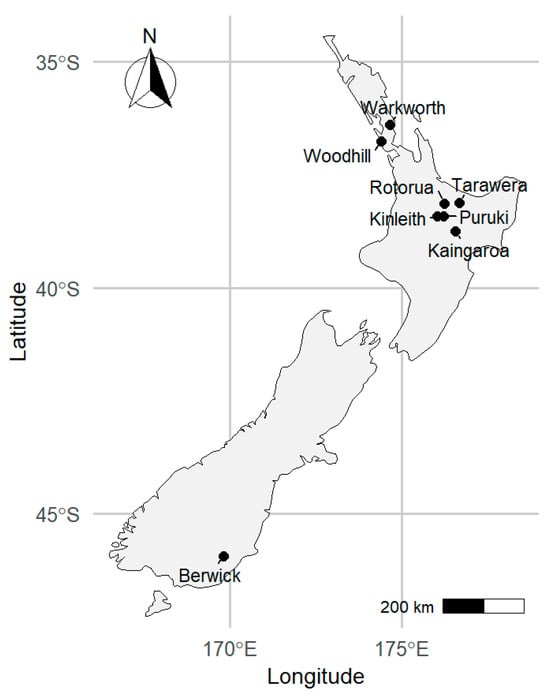
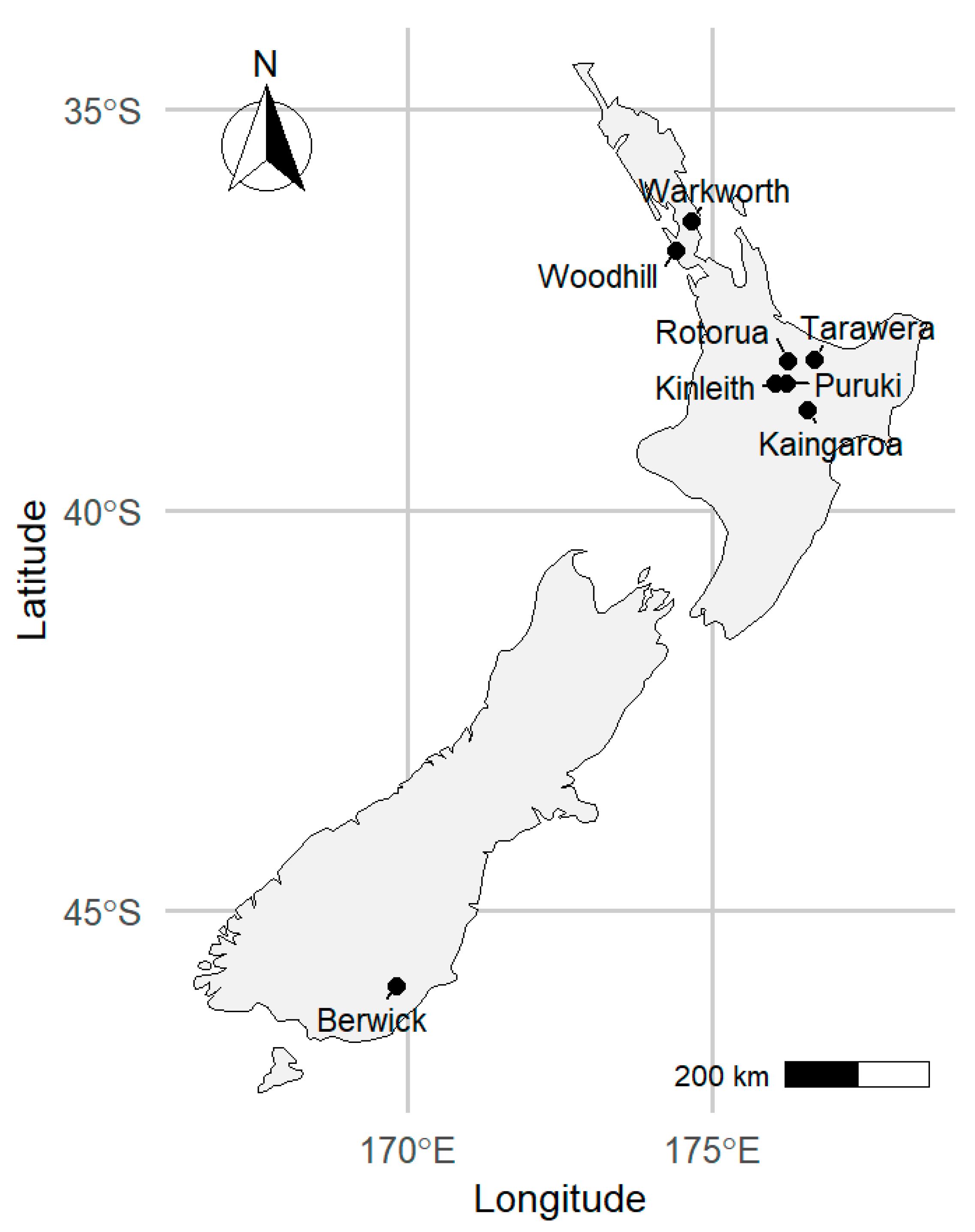
This study drew on historical biomass data from individual radiata pine trees collected in multiple studies across eight sites in both the North and South Islands of New Zealand (Table 1). The dataset spans 1971–2015 and includes stem biomass measurements for 894 trees. The studies covered a wide latitudinal range from northern to southern New Zealand, although most measurements were taken in the North Island (Figure 1).
Table 1.
Summary of the radiata pine biomass data by study, showing year of study, stand age and density, and number of biomass trees measured for height (H), diameter at breast height (D), and wood density (Den), reported separately for trees measured for stem biomass and trees measured for crown biomass.
Figure 1.
Locations of the radiata pine biomass study sites used in the analysis.
For all trees, the oven-dry weights (kg) of stem wood (Wd) and stem bark (Bk) were determined. For most trees, additional measurements were also made of tree crown components, consisting of dead branches (DeadBr), live branches (LiveBr), cones/strobili (Cones), and foliage (Fol). Because DeadBr and Cones were typically relatively minor components, they were combined with LiveBr to form Br = LiveBr + DeadBr + Cones in most analyses presented in this paper. Total above-ground biomass can be calculated as AGB = Wd + Bk + Br + Fol.
The procedures used to measure tree biomass varied among studies. In earlier studies (e.g., [32,33]), stems were cut into bolts and weighed fresh in the field. Discs taken from each bolt were weighed fresh and oven-dried and used to determine dry-to-fresh ratios, which were then applied to total fresh weights to estimate stem wood and bark biomass for each tree. All branches, foliage and cones were weighed fresh, and random subsamples collected, dried, and used to determine component-specific dry-to-fresh ratios.
Later studies adopted less labour-intensive approaches. For example, ref. [34] calculated stem volume using diameter measurements taken at regular intervals along the stem and determined wood density from the volumes and dry weights of discs. These densities were applied to the stem volumes to estimate stem wood and bark biomass. Branch numbers were counted, and a subsample of branches was collected, dried, and weighed; total branch biomass was estimated by multiplying mean branch weight by branch count. Foliage biomass was estimated similarly, by scaling mean foliage weight per branch by the total number of branches.
In all cases, trees were measured for height or stem length (H, m), and diameter at breast height (D (cm), measured at 1.4 m height) except for some very young trees less than 1.4 m in height where only H could be measured. The Age (years) and stand density (N, stems/ha) of each stand were also recorded. In most studies, stem volume inside bark (Vol (m3)) was measured along with basic wood density of the stem wood Den (kg/m3) = Wd/Vol.
Measurements of root biomass were available for only a very limited subset of the dataset and were not analysed in this study. Therefore, to estimate the dry weight of roots in this study, a root–shoot ratio of 0.20 was applied following Beets, Pearce, Oliver and Clinton [38], so that Roots = 0.2 × AGB. Total biomass of each tree was therefore calculated as 1.2 × AGB.
2.2. Calculation of Carbon Content from Biomass
In the biomass studies described above, oven-dry weights by component were determined for each tree. To calculate carbon content, these were multiplied by appropriate carbon fraction. The carbon fraction of dry matter varies both among conifer species and among tree components [28]. Beets and Garrett [30] reported component-specific carbon fractions for radiata pine based on stands of different ages across multiple sites in New Zealand. Carbon fractions were generally consistent across ages, except for stem bark which showed an increase in carbon fraction with age (Table 2). These values were used in the present study to convert dry weights into carbon weights for each tree.
Table 2.
Carbon fractions by biomass component for radiata pine [30].
2.3. Statistical Analyses
2.3.1. General Principles
Allometric relationships for biomass as a function of tree dimension describe how biomass (or one of its components) scales with measurable tree size attributes such as diameter, height, or a combination of both. The relationships are typically modelled using a power function of the form:
where B is biomass of a component and X is a size variable such as diameter or height [39], and a and b are coefficients derived from the data using a regression model. The model can be extended to include both D and H:
This formulation reflects the allometric scaling principle where biological structures grow in predictable proportions as tree dimensions increase [23]. In forestry, allometric equations are widely used to estimate biomass from easily measured field variables, avoiding destructive sampling.
Examination of the biomass data used in this study showed that the standard deviation of residuals increased approximately in proportion to the mean prediction. To allow standard regression model assumptions, i.e., that the errors are normally distributed with homogeneous variance, the simplest solution in such a case is to log-transform the data and fit the function as a log-log regression model. Thus, the model described by Equation (2) is fitted using the following regression model:
where ln( ) is the natural logarithm.
This regression model provides parameter estimates , and . One issue with this method is that predictions obtained by applying Equation (2) using the parameter are biased. This bias can be removed using the Duan smearing correction [40]:
where is the intercept coefficient estimated using the log-log regression model, ei are the residuals of the model, and n is the sample size. This method was applied to all regression models in this study.
Model fit was quantified on the original scale using the geometric coefficient of variation (GCV) calculated using:
where is the residual standard error of the log-transformed regression model. This provides an estimate of the typical proportional error of predictions on the original scale.
The general procedure adopted in the study for all biomass components was firstly to fit models using H as the independent variable. Such models could be used when only a height measurement is available, such as in very young trees. Then models were fitted using both H and D as independent variables. For some biomass components, these models were extended to include the stand-level variables Age and stand density, N. Finally, models were fitted using H, D (and Age and N for some components) and Den as independent variables. These could be used when trees have a measurement of wood density in addition to height and diameter.
Prior to fitting the models, an exploratory analysis was performed by plotting biomass in each component B against D2 × H, by age class. This exploratory analysis was used to determine whether a simple log-log model was adequate or whether additional stand-level variables such as Age or N could be used to improve model fit.
2.3.2. Models of Stem Components
The exploratory analyses showed that for Wd and Bk, the relationship against D2 × H became non-linear for smaller trees. It was concluded that this behaviour occurred because D is measured at breast height rather than at the stem base. Consequently, for example, a stem that is only 1.4 m tall would have a D of zero, leading to a predicted biomass of zero, even though it must in fact contain some biomass. Models based on Equation (3) therefore tend to underpredict biomass for shorter trees.
To address this issue, Equation (3) was modified by introducing a height-dependent correction term that increases as H decreases. This approach is similar to that used in the stem volume model of Kimberley and Beets [41] which was fitted using an earlier version of the database employed in the current study. The modified model including the correction term is as follows:
The final term in this model adjusts the basic allometric relationship to account for short stems. Predictions from this model are undefined for H ≤ 1.4 m and in practice become unstable for H less than 2 m. Accordingly, only stems with H > 2 m were included when fitting the model. The model was fitted as a non-linear regression model using the R version 4.5.2 [42] nls function.
2.3.3. Models of Crown Components
For Br and Fol, the exploratory analysis showed a different behaviour. For open-grown trees, one might expect a simple log-log relationship such as Equation (3) should hold, but within a stand, the competition between trees means that although a log-log relationship holds for a given age, both the slope and intercept change with age. It would be expected that the relationship should also be influenced by stand density.
To achieve this, we fitted log–log regression models in which biomass was expressed as a quadratic function of D, H, Age, and N. Initial models included all linear, quadratic, and first-order interaction terms. Model simplification was performed by sequentially removing less significant terms (using the criterion |t| < 4 to achieve parsimonious but not over-parameterised models). Models were fitted using the lm function in R. The final model formulations are presented in Section 3.
2.3.4. Assessing Model Fit
Models for each component were checked using residual diagnostics and plots of actual vs. predicted biomass. The bias correction for the A parameter shown by Equation (4) was applied to all models.
2.3.5. Predictions of Component and Total Carbon
The component biomass equations were then converted into carbon equations using the carbon fractions shown in Table 2. A final check of the models was carried out by estimating total carbon for each tree using the measured biomass of each component, and plotting this against total carbon predicted using the carbon equations.
3. Results
3.1. Component Biomasses
Table 3 shows the mean weights of each biomass component against age for all trees with crown measurements. The percentage of AGB stored in the stem wood increases with age, reaching 70% in the oldest age class, as does the percentage biomass in stem bark which reaches 8% in the oldest age class. The percentage biomass in the foliage (needles) decreases rapidly with age, averaging 36% of AGB in the youngest age class, but only 3% in the oldest age class. Live branches stored about 15% of AGB but dead branches stored only 4% and cones less than 2%. Because of this, dead branches and cones were combined with live branches in all subsequent modelling. The resulting variable, Br = DeadBr + LiveBr + Cones, averaged about 21% of AGB and this percentage did not vary greatly with age.
Table 3.
Mean dry weight (kg/tree) of different radiata pine components by age class.
3.2. Exploratory Analysis
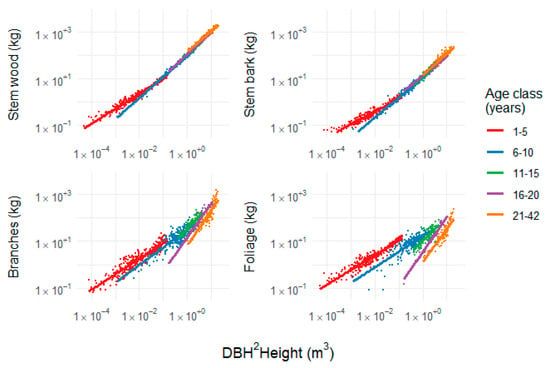
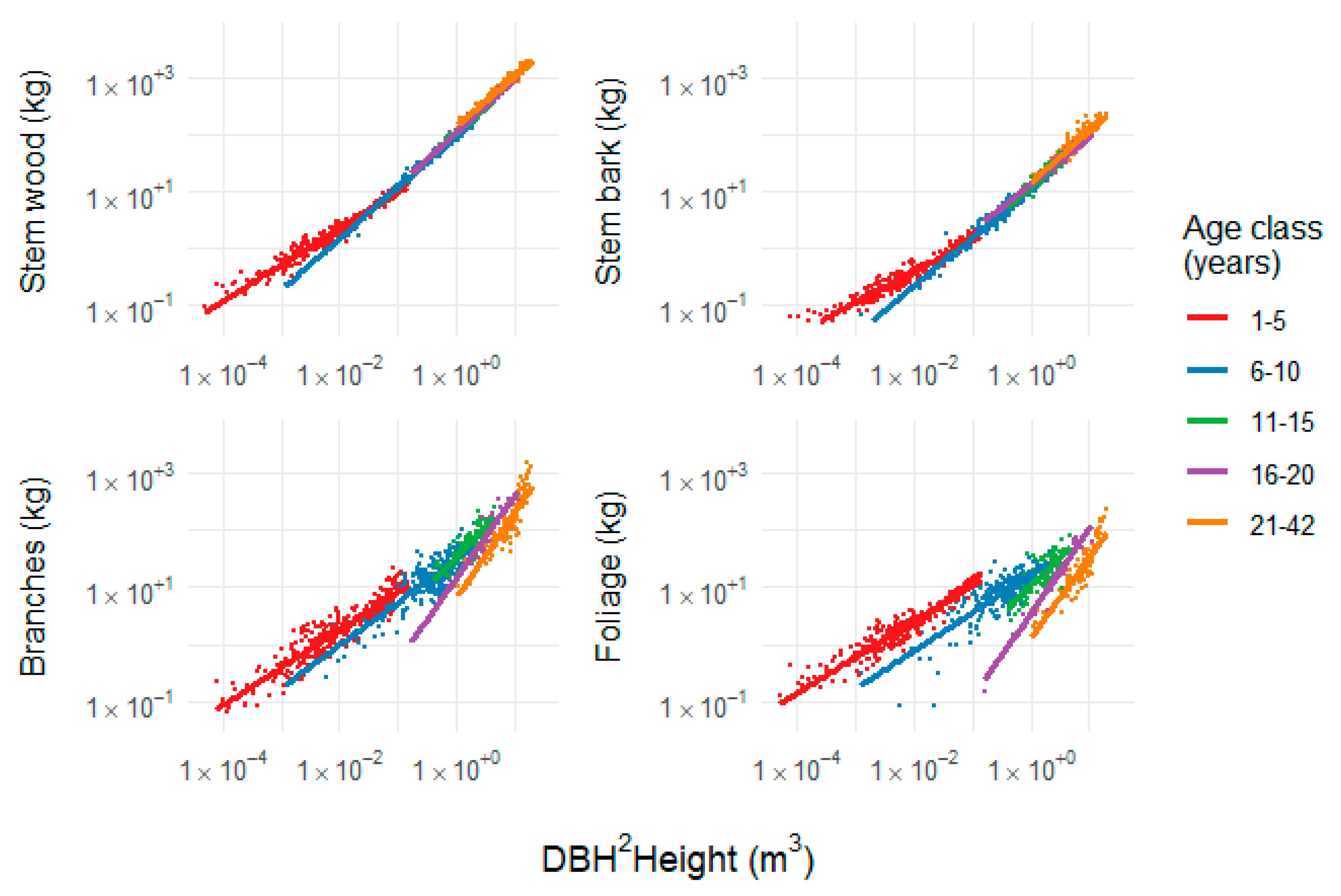
An exploratory analysis showing log-log charts of each biomass component against D2 × H is shown in Figure 2. As explained in Section 2, the relationships show some departure from the simple allometric relationship represented by Equations (2) or (3) for all four biomass components. The methods described in Section 2.3 were used to account for this when fitting the biomass models.
Figure 2.
Biomass vs. DBH2 × Height by age class for radiata pine trees by biomass component. Dots indicate values for individual trees and lines show linear regressions fitted within each age class.
3.3. Model Development
The results of fitting the biomass models for each component using H only, H and D (and Age and N for Br and Fol), and H, D and Den (and Age and N for Br and Fol) as predictors are shown in Table 4. Statistics shown in Table 4 include the coefficients of determination (R2 on the log-transformed scale) and the GCV, with the latter statistic calculated for all trees, and separately for trees ≤ 10 years old and trees > 10 years old. The fitted equations are shown in Table 5.
Table 4.
Sample size, R2 (log-transformed scale), and geometric coefficient of variation (GCV) of radiata pine component biomass equations. The biomass components include stem wood (Wd), stem bark (Bk), branches (Br) and foliage (Fol) while the predictors include stem height (H), diameter at breast height (D), stand age (Age), stand density (N) and stem wood density (Den).
Table 5.
Radiata pine biomass equations for predicting dry weight (kg) of stem wood (Wd), stem bark (Bk), branches (Br) and foliage (Fol) from stem height (H, m), diameter at breast height (D, cm), stem wood density (Den, kg/m3), stand age (Age, years) and stand density (N, stems/ha).
Across all four biomass components, model performance improved markedly as additional predictor variables were included. For stem wood (Wd) and stem bark (Bk), R2 on the log-transformed scale increased from approximately 0.97 using H alone to over 0.99 once D was added. Across all trees, the GCV indicated that the typical deviation of observed values from model predictions for Wd (predicted from H and D) was ±15.5% on the original, untransformed scale. Model precision varied with tree age: younger trees showed a larger typical deviation (±17.4%), whereas older trees showed markedly better precision, with a deviation of only ±11.5%. Incorporating Den resulted in only marginal additional gains for predicting Wd and Bk, reflecting their strong dependence on tree size variables.
Improvements through sequential variable addition were more pronounced for crown components. For branches (Br), R2 increased from 0.86 using H alone to 0.95 when D, Age, and N were included. There were only slight improvements in the model R2 through addition of Den. The model of foliage biomass showed the largest relative improvement through variable addition: R2 increased from 0.69 for the height-only model to 0.91 with the addition of D, Age, and N, and further to 0.93 when Den was included. Collectively, these results illustrate the progressive strengthening of model fit as biologically relevant stand and wood properties are incorporated.
Note that Model 3 in Table 5 predicts dry weight of the stem wood directly by multiplying stem volume by wood density, where stem volume is calculated from D and H using the individual tree volume function of Kimberley and Beets [41] which was derived from an earlier version of the same database:
The performance of this model is of particular interest. Because it estimates stem wood biomass by multiplying wood density by stem volume predicted using Equation (7), all uncertainty in its predictions reflects tree-to-tree variation in actual stem volume relative to that given by the generic volume function. The GCV shows that the typical error arising from this source is 14% across all trees, somewhat higher in younger trees (16.8%) and markedly lower in older trees (8.9%).
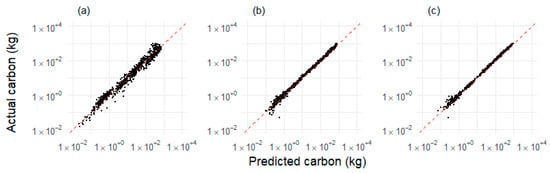
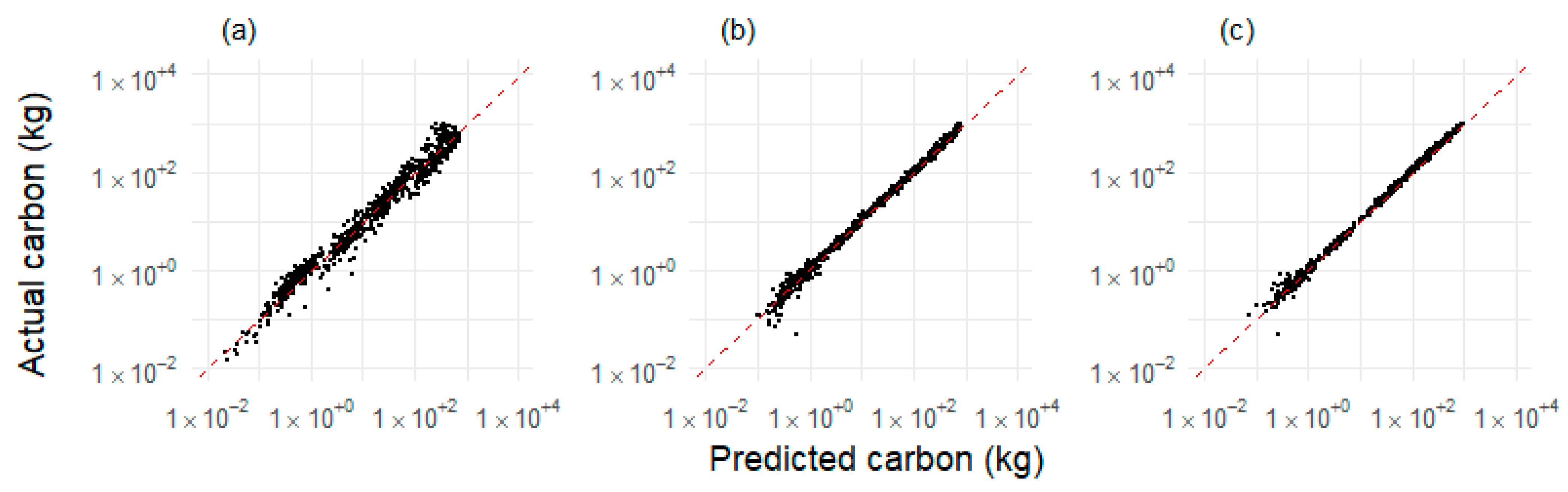
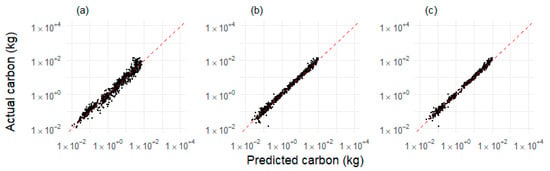
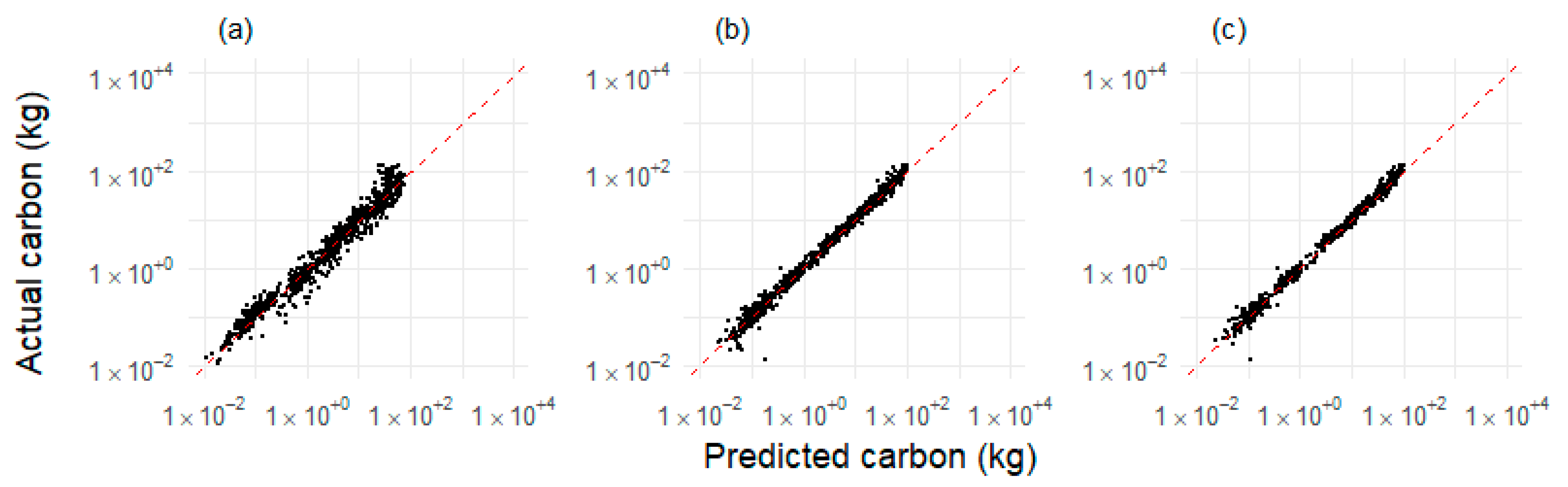
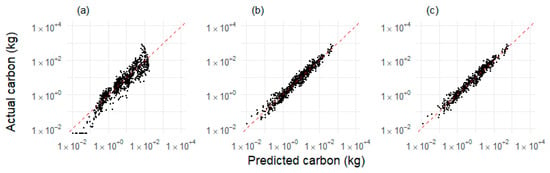
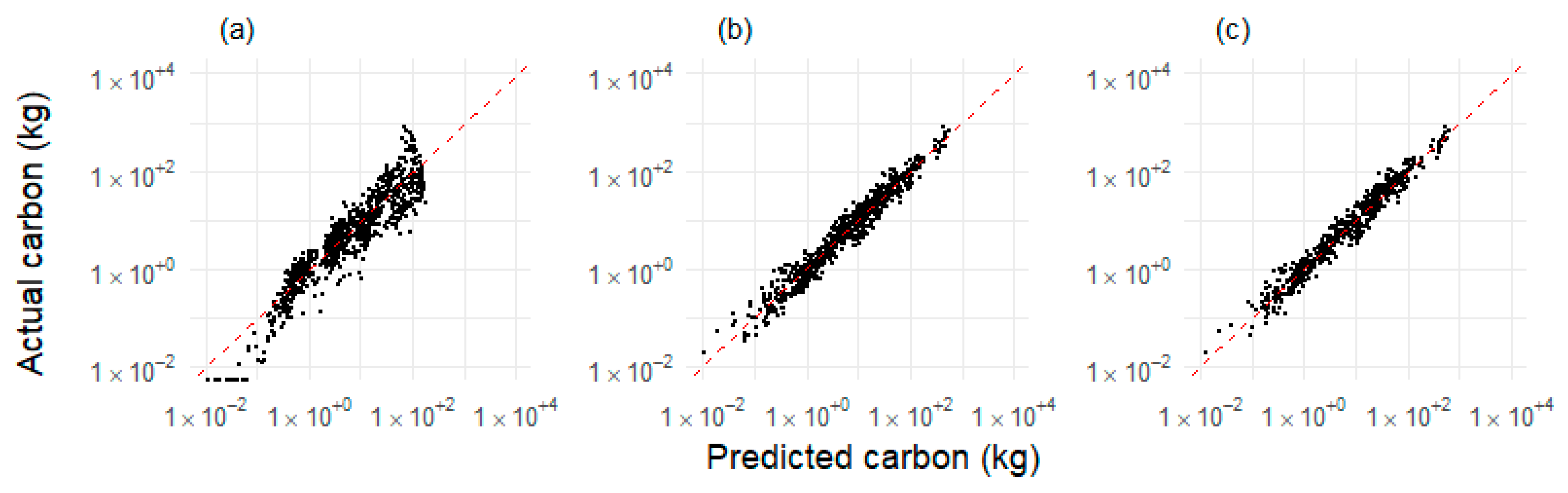
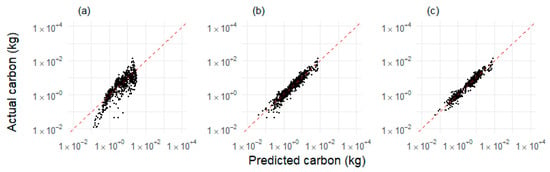
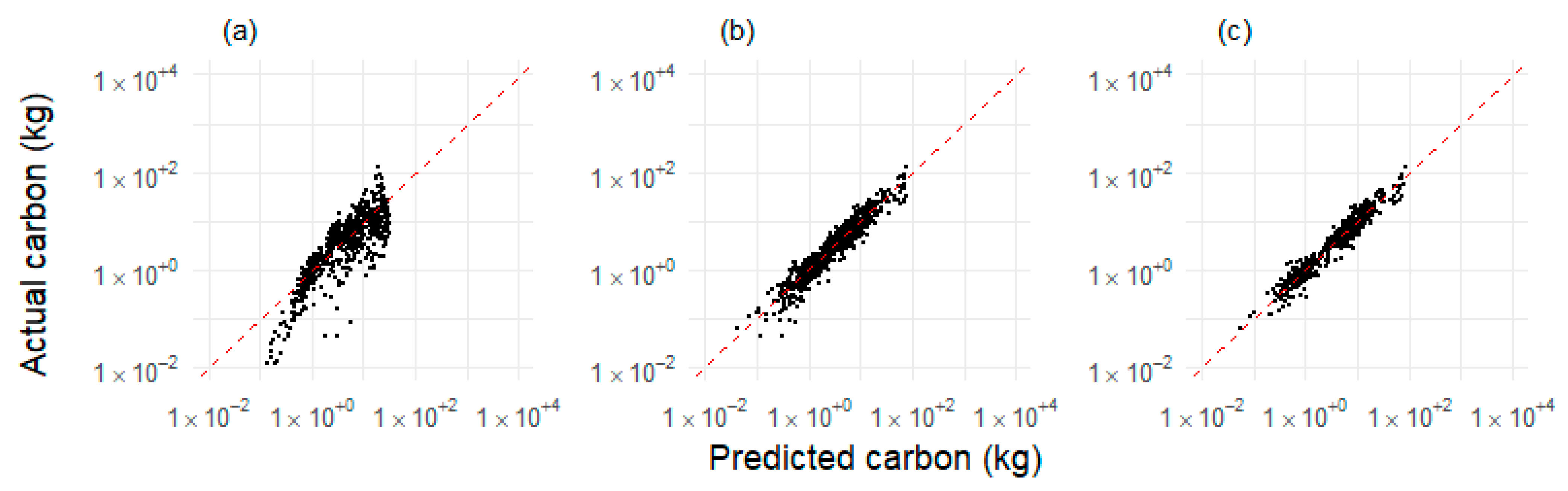
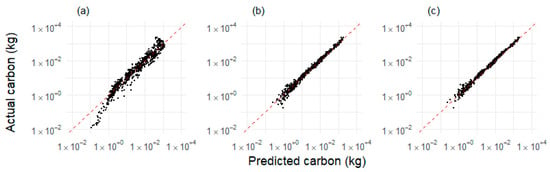
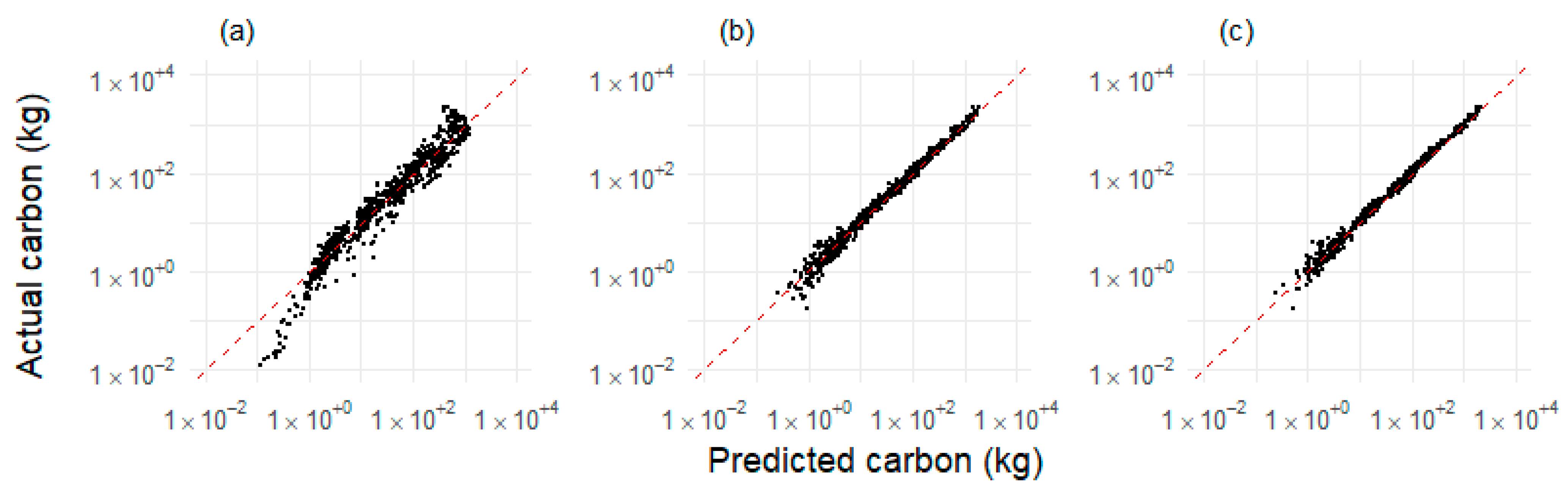
After predicting dry weights, these were converted into carbon using the carbon fractions shown in Table 2. Across all components, Figure 3, Figure 4, Figure 5, Figure 6 and Figure 7 demonstrate strong agreement between observed and predicted carbon, with most points clustering tightly around the 1:1 line, especially for models incorporating both height and diameter.
Figure 3.
Actual stem wood carbon vs. stem wood carbon predicted using (a) Height, (b) Height and diameter at breast height (D), and (c) Height, D and Wood Density. Dots indicate values for individual trees and lines show identity relationship y = x.
Figure 4.
Actual stem bark carbon vs. stem bark carbon predicted using (a) Height, (b) Height and diameter at breast height (D), and (c) Height, D and Wood Density. Dots indicate values for individual trees and lines show identity relationship y = x.
Figure 5.
Actual branch carbon vs. branch carbon predicted using (a) Height, (b) Height, diameter at breast height (D), Age and Stand density, and (c) Height, D, Age, Stand density and Wood Density. Dots indicate values for individual trees and lines show identity relationship y = x.
Figure 6.
Actual foliage carbon vs. foliage carbon predicted using (a) Height, (b) Height, diameter at breast height (D), Age and Stand density, and (c) Height, D, Age, Stand density and Wood Density. Dots indicate values for individual trees and lines show identity relationship y = x.
Figure 7.
Actual total tree carbon vs. total tree carbon predicted using (a) Height, (b) Height, diameter at breast height (D), Age and Stand density, and (c) Height, D, Age, Stand density and Wood Density. Dots indicate values for individual trees and lines show identity relationship y = x.
For stem wood and stem bark, the improvement from the H-only model to the H and D model is clearly visible as scatter decreases markedly and prediction bias at larger tree sizes is almost completely removed (Figure 3 and Figure 4). The addition of Den provides a small further tightening of fit, consistent with the statistical improvements reported in Table 4. These plots underscore the high predictive reliability of the stem biomass models, which represent the largest and most stable tree-level carbon pools.
Prediction of the two crown components using only H shows greater scatter overall, reflecting the biological variability in branch and foliage allocation (Figure 5 and Figure 6). Nonetheless, inclusion of D, Age, and N produces a substantial improvement, with the model residuals substantially reducing and systematic deviations largely eliminated. This pattern is consistent with the greater sensitivity of crown structure to competition and developmental stage.
The combined total carbon plots, which integrate model performance across all components, show excellent predictive behaviour (Figure 7). Even for the largest tree sizes where small component errors can accumulate, the models incorporating H, D, Age and N have little apparent bias for any tree size. Collectively, these figures provide strong visual confirmation of the robustness of the fitted allometric equations and their suitability for operational carbon estimation across diverse stand conditions.
The GCVs for the three total carbon models illustrated in Figure 7 are summarised in Table 6. Results are presented for all trees combined, for trees ≤ 10 years old, and for trees > 10 years old. When carbon is modelled using height alone, the typical deviation between observed and predicted values is ±67.6%. This is reduced by more than half to ±24.2% when diameter, age, and stem density are included as predictors. Adding wood density yields a further improvement, lowering the typical error to ±20.6%. Errors are substantially smaller for older trees, particularly for Models 2 and 3, with typical deviations for trees > 10 years old falling to ±12.9% and ±10.1%, respectively.
Table 6.
Geometric coefficient of variation (GCV) of three radiata pine models for predicting individual tree total carbon.
4. Discussion
This study successfully developed a comprehensive suite of allometric equations for predicting individual tree-level carbon in New Zealand’s radiata pine plantations, addressing a critical gap between stand-level carbon models and the increasing demand for high-resolution forest inventories. By leveraging an extensive historical dataset encompassing nearly 900 trees across a wide range of ages, stand densities, and geographical locations, we produced a tiered set of 12 robust models for key biomass components. A significant advance of this work is the direct conversion of biomass to carbon using component-specific and age-dependent carbon fractions, moving beyond the inaccuracies of generic conversion factors. The resulting equations are designed for operational flexibility, providing reliable estimates from varying levels of input data and predictions can be readily scaled up with remote sensing technologies like LiDAR.
The predictive performance of the developed models, and in particular the marked increase in accuracy when including both height and diameter, aligns with and builds upon previous allometric work for radiata pine and other temperate conifers. The high accuracy of stem wood and bark models (R2 > 99% when using both height and diameter) demonstrated that predictions for the largest carbon pools are very reliable. These results compare favourably with previous total above-ground biomass models for New Zealand radiata pine [20], but our approach offers the significant advantage of partitioning biomass into its core components. This level of detail is crucial not only for more accurate total carbon estimation but also for practical applications such as calculating nutrient removal during harvesting or assessing the availability of logging residues for bioenergy [26].
A key finding of this research is the critical importance of incorporating stand age and density into models for crown components (branches and foliage), reflecting the strong biological influence of competition and ontogeny on biomass allocation. The exploratory analysis (Figure 2) clearly demonstrated that a simple allometric relationship is insufficient for crown biomass, as the slope and intercept of the relationship varied distinctly with stand age. This pattern is biologically intuitive as young, open-grown trees allocate proportionally more resources to crown development to maximise light capture and early growth, whereas older trees in dense stands experience crown recession and altered allocation patterns due to intense competition for light and growing space [43,44]. The inclusion of terms for age and stand density significantly improved model fit for branches and foliage demonstrating that stand context is essential for accurately predicting these more plastic components. This finding is consistent with generalised European allometric models, which have similarly shown that biomass allocation patterns, particularly in the crown, are strongly influenced by stand structure, tree age, and competitive environment [22]. The study also revealed ontogenetic shifts in biomass partitioning: foliage as a percentage of total above-ground biomass decreased dramatically from 36% in the youngest age class (1–5 years) to just 3% in mature stands (21–42 years), while stem wood increased correspondingly from approximately 32% to 70%. These shifts underscore the necessity of accounting for stand dynamics when predicting crown components, and they align with broader ecological theory on size-dependent resource allocation in trees [45,46].
By applying component-specific carbon fractions derived from local data [30], this study provides a more accurate and defensible method for converting biomass to carbon than widely used generic constants. Using a standard 50% conversion factor, as is common practice in many forest inventories, would have introduced systematic bias in our carbon estimates, underestimating bark carbon and overestimating stem wood carbon due to the actual variation in tissue carbon content. The use of an age-dependent carbon fraction for bark is a particularly important refinement, as it accounts for known physiological changes in bark composition, such as the accumulation of carbon-rich compounds like suberin and lignin, as a tree matures and thickens over time. Studies on temperate conifers have also documented tissue-specific variation in several percentage points, confirming that use of a single uniform conversion factor can introduce substantial bias in both component and total-tree carbon estimates [28,29,47]. The component-specific approach employed here is particularly important when predicting carbon in partial-tree harvests, estimating nutrient budgets, or assessing the fate of different biomass pools during forest operations [26]. By summing the carbon predicted for each component using tissue-specific fractions, we provide a more robust and biologically realistic estimate of total tree carbon than would be achieved by applying a single equation for total biomass with a uniform conversion factor.
The statistical rigor of the modelling approach, which included specific adjustments for known biases and data structures, enhanced the reliability of the equations. The log-transformation of both response and predictor variables effectively addressed the heteroscedasticity commonly observed in allometric data [48,49]. Application of the Duan smearing correction [40] eliminated the systematic bias that arises when back-transforming logarithmic predictions to the original scale, ensuring that our equations provide unbiased estimates across the full range of tree sizes. The adjustment incorporated into stem wood and bark models for trees approaching breast height is a crucial refinement that prevents biomass underestimation in very young stands, where diameter at breast height becomes an inappropriate predictor as trees approach 1.4 m in total height. This approach, adapted from the stem volume equations of Kimberley and Beets [41], accounts for the biological reality that a tree at exactly 1.4 m height would have zero diameter but non-zero biomass.
The equations presented in this study serve as a critical enabling tool for modern precision forestry, directly linking remotely sensed tree attributes to individual-tree carbon stocks for enhanced forest management and carbon accounting. The models ingest tree height, diameter and stand density as primary inputs, which are metrics that are increasingly derived at an operational scale from unmanned aerial vehicle (UAV) and airborne LiDAR systems [15,16,17]. When wood density measurements are available from increment cores or other sampling methods, the inclusion of this variable further refines predictions, particularly for foliage and stem biomass. However, where direct measurement of wood density is not feasible, the property can be reliably estimated throughout New Zealand across a range of stand conditions using a previously developed spatially explicit modelling approach [50]. Such high-resolution biomass and carbon predictions can support a wide range of operational decisions, including pre-harvest inventory and valuation [13], optimisation of thinning regimes to maximise both timber production and carbon sequestration, and precise verification of carbon credits under the New Zealand Emissions Trading Scheme [10]. The integration of these allometric equations with emerging LiDAR-based individual tree detection algorithms [17,51] and attribute prediction methods [16] would represent a significant step forward in operational forest carbon monitoring.
The models are intended for applications requiring estimates of carbon at the individual-tree level, such as forest inventories and research studies. They are particularly well-suited to inventories in which individual tree attributes, notably height and diameter, are measured directly or predicted using remote-sensing technologies such as terrestrial or airborne LiDAR. The equations may also be incorporated into tree-based growth and prediction systems as an alternative to stand-level models such as C_Change. In such applications, growth models would be used to predict diameter and height as functions of environmental variables and management, together with auxiliary models for wood density, with the allometric equations presented here used to estimate carbon in the living trees. Carbon pools associated with dead wood and litter would require separate modelling, based on predicted mortality, thinning events, litterfall, and using appropriate decay functions. For all applications, the height-only allometric models are recommended for trees shorter than 2 m, after which the models incorporating both height and diameter (and, where available, wood density) should be applied.
Future research should develop allometric equations for radiata pine root systems to replace the current fixed root-to-shoot ratio, given that root biomass allocation is known to vary widely with stand age, tree height, nutrition, and water stress [52,53,54]. Independent validation of the allometric equations using datasets from other regions, management systems, and across a greater silvicultural range would further test model generality. Further research should also assess whether improved genetic stock alters allometric relationships compared with the older genetic material used in this study. Linking the allometry described here with process-based growth models could support dynamic, mechanistic predictions of tree growth and carbon allocation under current and future climate [55,56]. Quantifying and propagating uncertainty from the tree to the stand level would strengthen inventory confidence and carbon credit verification and allow comparisons with predictions from C_Change. Extending the methods developed here to alternative exotic species would broaden their application within the ETS, while the development of automated LiDAR-to-carbon workflows at the stand level could reveal practical constraints.
5. Conclusions
This study successfully developed a comprehensive suite of allometric equations that bridge the critical gap between traditional stand-level carbon models and the demands of modern precision forestry for individual tree estimates. A key advance lies in the component-based approach, which models stem wood, bark, branches, and foliage separately before applying component-specific carbon fractions. This method yields more accurate and biologically sound carbon estimates than those derived from total biomass models using a generic conversion factor. The incorporation of stand age and density proved essential for accurately predicting crown components, correctly capturing the significant influence of competition and tree development on biomass allocation patterns.
The operational flexibility of these tiered equations makes them directly applicable for integration with remote sensing technologies like LiDAR, which can provide the necessary tree-level inputs at scale. This research provides forest managers with a powerful tool to enhance pre-harvest inventories, optimise silvicultural regimes for carbon and timber, and reliably verify carbon stocks for market-based schemes. While future research should focus on developing specific root allometry and validating these models across a wider range of regions, genetics, and silvicultural systems, this study provides the foundational framework needed to predict individual-tree-level biomass and carbon.
Supplementary Materials
The following supporting information can be downloaded at: https://www.mdpi.com/article/10.3390/f17010061/s1.
Author Contributions
Conceptualization, M.O.K.; methodology, M.O.K.; software, M.O.K.; validation, M.O.K.; formal analysis, M.O.K.; investigation, M.O.K.; resources, M.O.K.; data curation, M.O.K.; writing—original draft preparation, M.O.K. and M.S.W.; writing—review and editing, M.O.K. and M.S.W.; visualization, M.O.K.; supervision, M.O.K.; project administration, M.S.W.; funding acquisition, M.S.W. All authors have read and agreed to the published version of the manuscript.
Funding
This research was funded by the Ministry of Business, Innovation and Employment (MBIE) programme entitled “Seeing the forest for the trees: transforming tree phenotyping for future forests” (programme grant number C04X2101).
Data Availability Statement
The data used in this study are available for download as Supplementary Material.
Conflicts of Interest
While Mark O. Kimberley is an employee of the company Environmental Statistics Ltd., his employer’s company was not involved in this study, and there is no relevance between this research and the company. The remaining author declares that the research was conducted in the absence of any commercial or financial relationships that could be construed as a potential conflict of interest. The funders had no role in the design of the study; in the collection, analyses, or interpretation of data; in the writing of the manuscript; or in the decision to publish the results.
Abbreviations
The following abbreviations are used in this manuscript:
| AGB | dry weight of above-ground biomass (kg) |
| Age | age of stand (years) |
| BGB | dry weight of below-ground biomass (kg) |
| Bk | dry weight of stem bark (kg) |
| Br | dry weight of all branches and cones (kg) |
| Cones | dry weight of cones and strobili (kg) |
| D | diameter at breast height (cm, at 1.4 m) |
| DeadBr | dry weight of dead branches (kg) |
| Den | basic density of stem wood (kg/m3) |
| Fol | dry weight of foliage (kg) |
| H | Stem height (m) |
| LiDAR | Light Detection and Ranging |
| LiveBr | dry weight of live branches (kg) |
| N | stocking of stand (stems/ha) |
| Total | dry weight of total biomass (kg) |
| V | predicted stem volume inside bark (m3), Kimberley and Beets [41] |
| Vol | measured stem volume inside bark (m3) |
| Wd | dry weight of stem wood inside bark (kg) |
References
- Lavery, P.B.; Mead, D.J. Pinus radiata: A narrow endemic from North America takes on the world. In Ecology and Biogeography of Pinus; Cambridge University Press: Cambridge, UK, 1998; pp. 432–449. [Google Scholar]
- Toro, J.; Gessel, S. Radiata pine plantations in Chile. New For. 1999, 18, 33–44. [Google Scholar] [CrossRef] [Scilit]
- Lewis, N.B.; Ferguson, I.S. Management of Radiata Pine; Inkata Press: Melbourne, Australia, 1993; 404p. [Google Scholar]
- Sutton, W.R. The need for planted forests and the example of radiata pine. New For. 1999, 17, 95–110. [Google Scholar] [CrossRef] [Scilit]
- Rogers, D.L. In situ genetic conservation of Monterey pine (Pinus radiata D. Don): Information and recommendations. N. Z. J. For. Sci. 2022, 32, 395–398. [Google Scholar]
- NZFOA. New Zealand Forestry Industry, Facts and Figures 2022/2023. New Zealand Plantation Forest Industry. New Zealand Forest Owners Association, Wellington. 2023. Available online: https://www.nzfoa.org.nz/images/Facts_and_Figures_2022-2023_-_WEB.pdf (accessed on 11 March 2024).
- Clark, A.; Nottage, R.A.C. (Eds.) Impacts of Climate Change on Land-Based Sectors and Adaptation Options: Technical Report; Prepared for the Ministry for Primary Industries by NIWA; Ministry for Primary Industries: Wellington, New Zealand, 2012; MPI Technical Paper No. 2012/33. [Google Scholar]
- Mead, D.J. Sustainable Management of Pinus radiata Plantations; FAO Forestry Paper No. 170; FAO: Rome, Italy, 2013. [Google Scholar]
- Doda, B.; Wildgrube, T.; Borghesi, S.; Ferrari, A.; Heinrich, L. State-of-Play in International Carbon Markets in 2024, EUI, RSC, Policy Brief, 2024/15, Florence School of Regulation, LIFE COASE—Collaborative Observatory for Assessment of the EU ETS, [Climate]. 2024. Available online: https://hdl.handle.net/1814/77086 (accessed on 10 June 2025).
- Manley, B. Impact of carbon price on the relative profitability of production forestry and permanent forestry for New Zealand plantations. For. Policy Econ. 2023, 156, 103057. [Google Scholar] [CrossRef] [Scilit]
- Beets, P.N.; Kimberley, M.O.; Paul, T.S.H.; Garrett, L.G. Planted Forest Carbon Monitoring System—Forest carbon model validation study for Pinus radiata. N. Z. J. For. Sci. 2011, 41, 177–189. [Google Scholar]
- Beets, P.N.; Robertson, K.A.; Ford-Robertson, J.B.; Gordon, J.; Maclaren, J.P. Description and validation of C_Change: A model for simulating carbon content in managed Pinus radiata stands. N. Z. J. For. Sci. 1999, 29, 409–427. [Google Scholar]
- Peuhkurinen, J.; Maltamo, M.; Malinen, J.; Pitkänen, J.; Packalén, P. Preharvest measurement of marked stands using airborne laser scanning. For. Sci. 2007, 53, 653–661. [Google Scholar] [CrossRef] [Scilit]
- White, J.C.; Coops, N.C.; Wulder, M.A.; Vastaranta, M.; Hilker, T.; Tompalski, P. Remote sensing technologies for enhancing forest inventories: A review. Can. J. Remote Sens. 2016, 42, 619–641. [Google Scholar] [CrossRef] [Scilit]
- Keefe, R.F.; Zimbelman, E.G.; Picchi, G. Use of individual tree and product level data to improve operational forestry. Curr. For. Rep. 2022, 8, 148–165. [Google Scholar] [CrossRef] [Scilit]
- Watt, M.S.; Jayathunga, S.; Mohan, M.; Hartley, R.J.; Camarretta, N.; Steer, B.S.; Zhang, W.; Bryson, M. Predicting Tree-Level Diameter and Volume for Radiata Pine Using UAV LiDAR-Derived Metrics Across a National Trial Series in New Zealand. Remote Sens. 2025, 17, 1456. [Google Scholar] [CrossRef] [Scilit]
- Chadwick, A.J.; Goodbody, T.R.; Coops, N.C.; Hervieux, A.; Bater, C.W.; Martens, L.A.; White, B.; Röeser, D. Automatic delineation and height measurement of regenerating conifer crowns under leaf-off conditions using uav imagery. Remote Sens. 2020, 12, 4104. [Google Scholar] [CrossRef] [Scilit]
- Van Laar, A. Sampling for above-ground biomass for Pinus radiata in the Bosboukloof Catchment at Jonkershoek. S. Afr. For. J. 1982, 123, 8–13. [Google Scholar] [CrossRef] [Scilit]
- Baker, T.; Attiwill, P.; Stewart, H. Biomass equations for Pinus radiata in Gippsland, Victoria. N. Z. J. For. Sci. 1984, 14, 89–96. [Google Scholar]
- Moore, J.R. Allometric equations to predict the total above-ground biomass of radiata pine trees. Ann. For. Sci. 2010, 67, 806. [Google Scholar] [CrossRef] [Scilit]
- Bi, H.; Long, Y.; Turner, J.; Lei, Y.; Snowdon, P.; Li, Y.; Harper, R.; Zerihun, A.; Ximenes, F. Additive prediction of aboveground biomass for Pinus radiata (D. Don) plantations. For. Ecol. Manag. 2010, 259, 2301–2314. [Google Scholar] [CrossRef] [Scilit]
- Forrester, D.I.; Tachauer, I.H.H.; Annighoefer, P.; Barbeito, I.; Pretzsch, H.; Ruiz-Peinado, R.; Stark, H.; Vacchiano, G.; Zlatanov, T.; Chakraborty, T. Generalized biomass and leaf area allometric equations for European tree species incorporating stand structure, tree age and climate. For. Ecol. Manag. 2017, 396, 160–175. [Google Scholar] [CrossRef] [Scilit]
- Chave, J.; Réjou-Méchain, M.; Búrquez, A.; Chidumayo, E.; Colgan, M.S.; Delitti, W.B.; Duque, A.; Eid, T.; Fearnside, P.M.; Goodman, R.C. Improved allometric models to estimate the aboveground biomass of tropical trees. Glob. Change Biol. 2014, 20, 3177–3190. [Google Scholar] [CrossRef] [Scilit] [PubMed]
- Picard, N.; Saint-André, L.; Henry, M. Manual for Building Tree Volume and Biomass Allometric Equations: From Field Measurement to Prediction. Food and Agricultural Organization of the United Nations, Rome, and Centre de Coopé-Ration Internationale en Recherche Agronomique pour le Développement, Montpellier, 2012, 215p. Available online: https://www.fao.org/4/i3058e/i3058e.pdf (accessed on 2 September 2025).
- Zhao, D.; Kane, M.; Markewitz, D.; Teskey, R.; Clutter, M. Additive tree biomass equations for midrotation loblolly pine plantations. For. Sci. 2015, 61, 613–623. [Google Scholar] [CrossRef] [Scilit]
- Palviainen, M.; Finér, L. Estimation of nutrient removals in stem-only and whole-tree harvesting of Scots pine, Norway spruce, and birch stands with generalized nutrient equations. Eur. J. For. Res. 2012, 131, 945–964. [Google Scholar] [CrossRef] [Scilit]
- IPCC. 2006 IPCC Guidelines for National Greenhouse Gas Inventories, Vol. 4: AFOLU, Ch. 4 “Forest Land,” Table 4.3. IGES, Japan. 2006. Available online: https://www.ipcc-nggip.iges.or.jp/public/2006gl/pdf/4_Volume4/V4_04_Ch4_Forest_Land.pdf (accessed on 20 September 2025).
- Thomas, S.C.; Martin, A.R. Carbon content of tree tissues: A synthesis. Forests 2012, 3, 332–352. [Google Scholar] [CrossRef] [Scilit]
- Jones, D.A.; O’Hara, K.L. Variation in carbon fraction, density, and carbon density in conifer tree tissues. Forests 2018, 9, 430. [Google Scholar] [CrossRef] [Scilit]
- Beets, P.N.; Garrett, L.G. Carbon fraction of Pinus radiata biomass components within New Zealand. N. Z. J. For. Sci. 2018, 48, 14. [Google Scholar] [CrossRef] [Scilit]
- Garrett, L.; Smith, C.; Beets, P.; Kimberley, M. Early rotation biomass and nutrient accumulation of Pinus radiata forests after harvest residue management and fertiliser treatment on contrasting types of soil. For. Ecol. Manag. 2021, 496, 119426. [Google Scholar] [CrossRef] [Scilit]
- Madgwick, H.; Jackson, D.S.; Knight, P. Above-ground dry matter, energy, and nutrient contents of trees in an age series of Pinus radiata plantations. N. Z. J. For. Sci. 1977, 7, 445–468. [Google Scholar]
- Webber, B.; Madgwick, H. Biomass and nutrient content of a 29-year-old Pinus radiata stand. N. Z. J. For. Sci. 1983, 13, 222–228. [Google Scholar]
- Oliver, G.R.; Beets, P.N.; Pearce, S.H.; Graham, J.D.; Garrett, L.G. Carbon accumulation in two Pinus radiata stands in the North Island of New Zealand. N. Z. J. For. Sci. 2011, 41, 71–86. [Google Scholar]
- Barton, P.G. Preliminary results from spray irrigating septic tank effluent into Pinus radiata forests at Warkworth. In Proceedings of the 16th New Zealand Biotechnology Conference; Paterson, A., Ed.; Forest Industries and Biotechnology: Palmerston North, New Zealand, 1984; pp. 258–275. [Google Scholar]
- Smith, C.; Lowe, A.; Beets, P.; Dyck, W. Nutrient accumulation in second-rotation Pinus radiata after harvest residue management and fertiliser treatment of coastal sand dunes. N. Z. J. For. Sci. 1994, 24, 362–389. [Google Scholar]
- Smith, C.; Dyck, W.; Beets, P.; Hodgkiss, P.; Lowe, A. Nutrition and productivity of Pinus radiata following harvest disturbance and fertilization of coastal sand dunes. For. Ecol. Manag. 1994, 66, 5–38. [Google Scholar] [CrossRef] [Scilit]
- Beets, P.N.; Pearce, S.H.; Oliver, G.R.; Clinton, P.W. Root/shoot ratios for deriving below-ground biomass of Pinus radiata stands. N. Z. J. For. Sci. 2007, 37, 267–288. [Google Scholar]
- Jenkins, J.C.; Chojnacky, D.C.; Heath, L.S.; Birdsey, R.A. National-scale biomass estimators for United States tree species. For. Sci. 2003, 49, 12–35. [Google Scholar] [CrossRef] [Scilit]
- Duan, N. Smearing estimate: A nonparametric retransformation method. J. Am. Stat. Assoc. 1983, 78, 605–610. [Google Scholar] [CrossRef]
- Kimberley, M.O.; Beets, P.N. National volume function for estimating total stem volume of Pinus radiata stands in New Zealand. N. Z. J. For. Sci. 2007, 37, 355–371. [Google Scholar]
- R Core Team. R: A Language and Environment for Statistical Computing; R Foundation for Statistical Computing: Vienna, Austria, 2025. [Google Scholar]
- Pretzsch, H.; Dieler, J. Evidence of variant intra-and interspecific scaling of tree crown structure and relevance for allometric theory. Oecologia 2012, 169, 637–649. [Google Scholar] [CrossRef] [Scilit] [PubMed]
- Oliver, C.D.; Larson, B.C.; Oliver, C. Forest Stand Dynamics; Wiley: New York, NY, USA, 1996; Volume 520. [Google Scholar]
- Enquist, B.J.; Niklas, K.J. Global allocation rules for patterns of biomass partitioning in seed plants. Science 2002, 295, 1517–1520. [Google Scholar] [CrossRef] [Scilit] [PubMed]
- Litton, C.M.; Raich, J.W.; Ryan, M.G. Carbon allocation in forest ecosystems. Glob. Change Biol. 2007, 13, 2089–2109. [Google Scholar] [CrossRef] [Scilit]
- Lamlom, S.; Savidge, R. A reassessment of carbon content in wood: Variation within and between 41 North American species. Biomass Bioenergy 2003, 25, 381–388. [Google Scholar] [CrossRef] [Scilit]
- Baskerville, G. Use of logarithmic regression in the estimation of plant biomass. Can. J. For. Res. 1972, 2, 49–53. [Google Scholar] [CrossRef] [Scilit]
- Parresol, B.R. Assessing tree and stand biomass: A review with examples and critical comparisons. For. Sci. 1999, 45, 573–593. [Google Scholar] [CrossRef] [Scilit]
- Kimberley, M.O.; Cown, D.J.; McKinley, R.B.; Moore, J.R.; Dowling, L.J. Modelling variation in wood density within and among trees in stands of New Zealand-grown radiata pine. N. Z. J. For. Sci. 2015, 45, 22. [Google Scholar] [CrossRef] [Scilit]
- Kaartinen, H.; Hyyppa, J.; Yu, X.W.; Vastaranta, M.; Hyyppa, H.; Kukko, A.; Holopainen, M.; Heipke, C.; Hirschmugl, M.; Morsdorf, F.; et al. An International Comparison of Individual Tree Detection and Extraction Using Airborne Laser Scanning. Remote Sens. 2012, 4, 950–974. [Google Scholar] [CrossRef] [Scilit]
- Cairns, M.A.; Brown, S.; Helmer, E.H.; Baumgardner, G.A. Root biomass allocation in the world’s upland forests. Oecologia 1997, 111, 1–11. [Google Scholar] [CrossRef] [Scilit] [PubMed]
- Mokany, K.; Raison, R.J.; Prokushkin, A.S. Critical analysis of root: Shoot ratios in terrestrial biomes. Glob. Change Biol. 2006, 12, 84–96. [Google Scholar] [CrossRef] [Scilit]
- Ryan, M.G.; Hubbard, R.M.; Pongracic, S.; Raison, R.J.; McMurtrie, R.E. Foliage, fine-root, woody-tissue and stand respiration in Pinus radiata in relation to nitrogen status. Tree Physiol. 1996, 16, 333–343. [Google Scholar] [CrossRef] [Scilit]
- Landsberg, J.J.; Waring, R.H. A generalized model of forest productivity using simplified concepts of radiation-use efficiency, carbon balance and partitioning. For. Ecol. Manag. 1997, 95, 209–228. [Google Scholar] [CrossRef] [Scilit]
- Battaglia, M.; Sands, P.; White, D.; Mummery, D. CABALA: A linked carbon, water and nitrogen model of forest growth for silvicultural decision support. For. Ecol. Manag. 2004, 193, 251–282. [Google Scholar] [CrossRef] [Scilit]

Disclaimer/Publisher’s Note: The statements, opinions and data contained in all publications are solely those of the individual author(s) and contributor(s) and not of MDPI and/or the editor(s). MDPI and/or the editor(s) disclaim responsibility for any injury to people or property resulting from any ideas, methods, instructions or products referred to in the content. |
© 2025 by the authors. Licensee MDPI, Basel, Switzerland. This article is an open access article distributed under the terms and conditions of the Creative Commons Attribution (CC BY) license.