Article

Understanding the Heterogeneity of Forest Insurance Adoption: A Comparative Study of Insurance Mechanisms Between France and China

1
Institute of Forestry Policy and Information, Chinese Academy of Forestry, Beijing 100091, China
2
Université de Lorraine, Université de Strasbourg, AgroParisTech, CNRS, INRAE, BETA, 54000 Nancy, France
*
Author to whom correspondence should be addressed.
Forests 2026, 17(1), 107; https://doi.org/10.3390/f17010107
Submission received: 24 November 2025 / Revised: 19 December 2025 / Accepted: 8 January 2026 / Published: 13 January 2026
(This article belongs to the Section Forest Economics, Policy, and Social Science)

Abstract

In a context of increasing natural hazards due to climate change, forest insurance is a relevant tool to consider. However, the development of forest insurance schemes varies widely across countries, reflecting differences in forest characteristics, institutional frameworks, and public risk management policies. In this article, we investigate the drivers of this heterogeneity by comparing forest insurance schemes in two contrasting national contexts: France and China. While forest insurance coverage remains relatively limited in France, China has implemented large-scale insurance programs. By examining the design, governance, and role of government intervention in both schemes, we identify the key factors that help explain the differences in insurance uptake across countries. Finally, we discuss innovative insurance products and policy mechanisms that could encourage the adoption of forest insurance.

1. Introduction

Forests play a crucial role in global socio-ecological systems by providing a wide range of ecological, economic, and social benefits. They contribute to climate regulation through carbon sequestration, support biodiversity conservation, protect soils and water resources, and provide livelihoods, raw materials, and recreational values to millions of people worldwide. According to the 2025 FAO’s Global Forest Resources Assessment [1], the world’s forests cover approximately 4.14 billion hectares, representing 32% of the global land area. Over recent decades, global forest area has undergone significant changes, with persistent losses driven by deforestation and land-use change in some regions. Natural hazards pose the greatest threat to forests worldwide. According to the 2024 State of the World’s Forests report [2], there is evidence that climate change is making forests more vulnerable to stressors such as wildfires and pests. Wildfire intensity and frequency are increasing, including in areas that were not previously affected. In 2023, wildfires released an estimated 6687 megatons of carbon dioxide globally. Such fires reached a new high in 2021, mainly due to extended drought causing increased fire severity and fuel consumption. They accounted for nearly one-quarter of total wildfire emissions. Climate change also makes forests more vulnerable to invasive species, with insects, pests and pathogens threatening tree growth and survival. Pinewood nematodes have already caused significant damage to native pine forests in some Asian countries, and areas of North America are projected to experience devastating damage from insects and diseases by 2027.
In Europe, windstorms are the most devastating natural event. Various disturbances over the last 20 years have accounted for timber losses totalling 44 million m3, equivalent to 16% of the mean annual harvest [3]. Windstorms accounted for 46% of the total damage, fire for 24%, and bark beetles for 17%. Climate change is suspected to have a serious impact on the occurrence of storms, in terms of both frequency and intensity. Consequently, the return period is projected to decrease significantly, as is the associated damage [4,5,6]. Furthermore, studies [7] indicate that future forest damage from wind is primarily expected to result from an increase in total growing stock and vulnerability.
In the context of increasing risks due to climate change, forest insurance against natural hazards has become an essential risk management tool. Forest insurance is a set of mechanisms designed to protect forest owners or managers against economic losses caused by natural or biological hazards, such as wildfires and storms. Forests hold significant economic value as resources for timber and land, and as critical providers of ecosystem services including carbon sequestration, climate change mitigation, and biodiversity conservation. However, these natural assets are increasingly vulnerable to multiple, cascading climate-related risks that threaten the economic stability of private forest owners and the continued provision of vital ecosystem services [8]. Therefore, forest insurance plays a key role as a risk-sharing mechanism and a means of financing adaptation to climate change (OECD, 2015; Global Agenda Council on Climate Change, 2014; [9]). Furthermore, forest insurance can be viewed as a means of encouraging investment in planted forests and stabilizing forest owners’ income [9]. Forest owners can transfer the risk of natural hazards to an insurer by taking out an insurance policy. This involves a contract between the insurance company and the forest owner, whereby the forest owner pays a premium in exchange for coverage. Forest insurance generally comes in two forms: third-party liability coverage, which protects forest owners from damage caused by their trees to third parties; and damage insurance, which covers losses to the forest itself resulting from events such as fires or storms. In this article, we use the term “forest insurance” to refer to insurance against natural hazards affecting forests. However, the extent of forest insurance coverage varies considerably from country to country, reflecting the diversity of approaches to natural hazard management worldwide. Ref. [10] reported that some countries have a large proportion of their forest area covered by insurance. For example, Finland has 40% covered, Denmark 50%, China 50%, New Zealand 55%, and Sweden 95%. In other countries, such as Japan, France and the United States, the proportion is much lower, at less than 10%. The authors highlight differences in forestry practices between these countries. Planted forests are easier to insure in Scandinavia than natural forests because their well-defined location, species composition, and age reduce transaction costs for the insurer. Despite the impact of increased climate-related risks and the professionalisation of forest management, forest insurance as we know it today is still struggling to develop. Providers are generally insurance companies or forest insurance groups. These policies typically cover physical damage to forest stands (e.g., loss of timber volume), reforestation costs and, sometimes, loss of income.
In a context of climate change and increasing exposure of forests to natural hazards, forest insurance is often presented as a key risk management tool. However, insurance coverage remains highly heterogeneous across countries, with some national systems displaying widespread adoption while others remain marginal. Although existing studies have documented forest insurance schemes in specific national contexts, limited attention has been paid to the comparative analysis of the institutional, policy, and market-related factors that may explain these differences. In particular, the role of public intervention, insurance design, and historical implementation paths remains insufficiently explored in a cross-country perspective. Addressing this gap, this article aims to identify the determinants of forest insurance adoption by comparing the forest insurance schemes of France and China, two countries characterized by contrasting levels of insurance coverage.
Forest insurance has been analysed in the literature for a long time, with the first article on fire insurance in the US being published by [11]. A literature review has recently brought forest insurance to the attention of researchers. Ref. [9] provides an overview of the existing literature on this topic. They conclude that articles on forest insurance are likely to identify determinants of insurance demand, focusing on fire risk in the US or storm risk in Europe. Interestingly, the methodologies used to identify these determinants vary from theoretical models (such as actuarial models, insurance economics models, forest economics and cost–benefit analysis, and risk models and spatialization) to empirical analyses (such as experimental economics, surveys, descriptive analyses/reports/reviews). Importantly, some articles present insurance schemes, such as those in Sweden [12], Slovakia [13] and Japan [14]. However, to our knowledge, no comparison of insurance schemes between countries has been made to highlight the drivers of insurance coverage.
In this article, we examine the determinants of the insurance coverage using an original approach that can be classified as “descriptive analyses” according to the categorization in [9], and is further complemented by comparative historical analysis and case study methods. Specifically, the study proposes a comparative analysis of two distinct forest insurance schemes, in France and China. For each country, we provide a contextual overview of forest management, natural hazards, and insurance schemes. This allows us to highlight both the differences and the similarities between the two countries.
China and France were chosen as case studies for a comparative analysis of forest insurance systems in the face of natural hazards based on a combination of scientific and strategic criteria. Firstly, the majority of the recent literature on forest insurance originates from France and China, indicating that this issue carries significant importance in both countries. The French literature deals with the negative impact of government assistance on insurance decisions [15], the positive effect of ambiguity regarding the probability of an event occurring on willingness to insure [16], and the joint analysis of forest owners’ insurance decisions and rotation age [17]. In China, the literature addresses factors influencing insurance participation, such as socio-demographic characteristics and production practices, through data collection in various provinces, such as Fujian [18] and Zhejiang [19], as well as through modelling using a multi-agent simulation model [20] and an insurance game model [21].
Secondly, as joint proponents of the Paris Agreement, China and France have demonstrated a sustained political commitment to cooperating in the face of global challenges such as climate change and biodiversity loss since 2015. The importance of strengthening cooperation in nature conservation has been consistently emphasised in many bilateral high-level meetings. Forest risk governance is a critical component of climate change adaptation. Despite their marked differences in socio-political, economic, and institutional contexts, both countries are placing an increasing emphasis on building resilience in forest areas that are exposed to more frequent natural hazards. A comparative analysis of forest insurance systems in China and France not only aligns with the broader agenda of bilateral cooperation, but also offers valuable insights into improving forest risk governance and climate adaptation policies across nations.
Institutionally, China operates a highly centralized state model, in which the State plays a direct role in financing and regulating forest insurance mechanisms. In contrast, France operates a liberal model, in which insurance schemes are mainly market-based and heavily subsidized by public authorities. These contrasting models enable us to compare different institutional approaches.
Moreover, both countries have extensive forest coverage. China is engaged in extensive reforestation and ecological restoration programs and its forest area is growing. Meanwhile, France has one of the largest forest areas in Europe, most of which is privately owned. These dynamics provide a valuable context for studying how insurance systems adapt to different land tenure structures.
Finally, the level of insurance adoption and maturity in the field of forest insurance differs between these two countries. France has an established system, but coverage remains limited (only 9% of private land is insured [22] due to high costs and a perception of inefficiency among forest owners). In contrast, forest insurance in China has developed more recently, often as part of pilot or regional initiatives, and now covers over 70% of the area. However, both countries are exposed to the same natural hazards (mainly wildfires, storms and pathogens). This study contributes to the literature by providing one of the first comparative analyses of forest insurance schemes in two countries with contrasting institutional and policy contexts. It highlights how government involvement and scheme design influence insurance adoption.
The remainder of this article is organised as follows. Section 2 describes the materials and methods used, including theoretical insights from insurance economics and our conceptual comparative framework, as well as providing a description of our two case studies: China and France. Section 3 presents our results, offering a comparative and descriptive analysis that explains the heterogeneity in insurance adoption and highlights key issues in both countries. Section 4 discusses the implications for forest insurance markets. Finally, Section 5 concludes by offering policy recommendations, and outlining limitations and avenues for future research.

2. Materials and Methods

2.1. Theoretical Insights from Insurance Economics

Before describing the forest insurance scheme in each country, we provide some key information on insurance economics to make it easier to understand. The first insurance economics model was provided by [23]. The idea is simple: an individual will take out an insurance contract as soon as their satisfaction level (known as utility) is equal to or greater than it would be without the contract. The contract is characterized by two variables: the premium, which is paid by the individuals at regular intervals, and the indemnity, which is paid by the insurer in the event of a disaster. Equation (1) precisely describes how the insurance premium is computed.
π = ρδL
With π the premium, ρ the probability of occurrence of a loss, δ > 1 the discount rate and L the expected loss. The premium is the product of the probability of a loss occurring, the discount rate, and the expected loss amount. The discount rate is specific to each insurer and is used to cover the associated contract costs. Let us consider a very simple example. For an annual fire probability of 0.2% (variable ρ) as considered in [15], a discount rate of 30% (variable δ) and an expected loss (variable L) of €2000/ha, the insurance premium is €12/ha.
Sometimes, the insurance contract covers full or partial costs of the actual loss, in which case the insurer must evaluate the potential loss in advance. Other times, the contract only covers replantation costs, in which case the owner chooses the amount of indemnity they want to receive in the event of a disaster. This is a lump sum payment. This means that, in the computation of the premium presented in Equation (1), the chosen indemnity replaces the “expected loss”.
This classical framework by [23] has been adapted to include features specific to forestry contexts. These include the fact that losses are a function of the initial wealth, the existence of public programmes [24], and the ambiguity surrounding the probability of occurrence [15].
As can be seen from the forestry context presented above, many variables can impact premium computation. For example, the probability of a loss occurring depends on the location of the forest stand (i.e., there is a higher probability of fire occurring in the south of France than in the north) and the hazards covered (a higher premium is charged for a higher number of hazards covered), whereas the expected loss depends on the tree species (some species are more valuable than others; for example, broadleaved trees are more valuable than coniferous trees) and the age of the stand (the older the stand, the higher the potential loss).

2.2. Qualitative Comparative Analysis

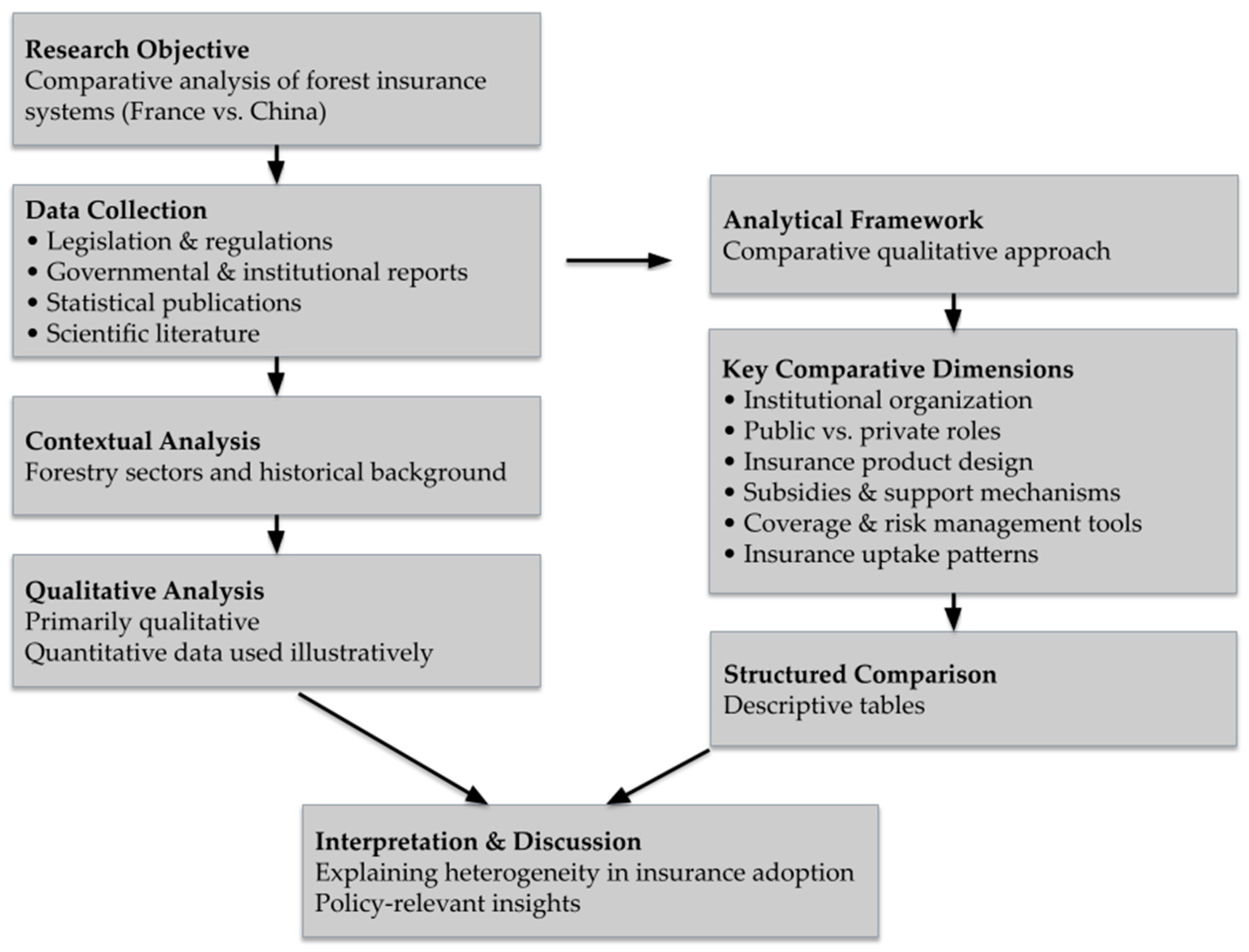
Comparative methods play a significant role in the macro social sciences, particularly in research contexts involving a large number of explanatory variables and a small number of cases [25]. Analysing forest insurance systems involves considering many comparable variables, such as insurance product design, claims and client feedback. However, access to firm-level empirical data is limited due to insurance companies’ reluctance to share such information. Ref. [26] finds that, since the beginning of the twenty-first century, there has been a gradual increase in the number of studies employing multiple comparative approaches or mixed methods. However, it also reveals that, despite the growing complexity and formalization of comparative methodologies, many influential works in the field of comparative research continue to rely primarily on descriptive statistics [26]. For these two reasons, this study adopts a mixed comparative analytical approach. This approach integrates descriptive analysis, comparative historical analysis (CHA), and case study methods. The aim is to mitigate the limitations associated with any single method while providing a comprehensive comparison and examination of the key factors influencing the development of forest insurance in China and France, as shown in Figure 1 representing our conceptual framework.
Firstly, a descriptive analysis of forest resources in China and France was conducted using a literature review combined with data collection, as described in ref. [9]. For China, data on forest resources were primarily sourced from FAO [2] and National reports [27,28]. Information on the distribution of tree species and Chinese forest ownership data were derived from the Ninth National Forest Inventory of Forest Resources in China (2019). Trends in forest fire occurrences in China and the situation of forest biological disasters were examined through descriptive analyses based on data from the China Statistical Yearbook (2006–2024) [29] and the China Biological Disaster Prevention and Control Bulletin (2024) [30].
Data on forest resources and forest sector characteristics for France were obtained from a combination of national institutional and governmental sources. Information on forest area, forest ownership structure, and tree species distribution was primarily drawn from the National Forest Inventory, which is conducted by the National Institute of Geographic and Forest Information (IGN) and the Office National des Forêts (ONF). Additional data on private forest ownership was obtained from the National Centre for Forest Ownership (CNPF). Official statistics and policy-related information were supplemented with data from governmental statistical publications. Data on forest health, biotic and abiotic disturbances, and damage trends were obtained from the Forest Health Department.
After this first part, we conducted a contextual analysis. Through a comparative historical analysis, we examined the significant historical events that shaped the origins and development of forest insurance in China and France. We then conducted a qualitative comparative study of the two countries, focusing on several key dimensions: institutional organization and the respective roles of public and private actors; insurance product design; subsidy mechanisms; coverage levels and risk management tools; and uptake patterns among forest owners. Based on these dimensions, we developed a structured comparison, complemented by a descriptive table to highlight the similarities and differences between the two systems. Finally, using a case study approach, we identified the emergence of several innovative insurance products related to climate resilience that have emerged in both countries, such as biodiversity loss insurance and carbon sink loss insurance.
The study is subject to several methodological limitations, including differences in data availability and the timeliness and granularity of public statistics between countries, as well as reliance on secondary sources. These limitations are nonetheless unavoidable in order to ensure comprehensive coverage of all stages in the development of forest insurance in the two countries. Despite these limitations, this exploratory qualitative study is a vital first step before conducting a more in-depth analysis.

2.3. Description of the Case Studies: China and France

2.3.1. Forestry Context in China

In recent decades, China has experienced the fastest and largest growth in forest resources of any country globally. According to [2], China had the largest annual increase in forest area of 1,937,000 hectares annually between 2010 and 2020. China’s forest area is the fifth largest in the world and reached 231 million hectares by 2022 [27]. Forest coverage has increased steadily from 12% in 1981 to 25% by the end of 2024, and the area of artificial forests has reached 86 million hectares. This ranks China first in the world for many years and accounts for over one-third of the total forest area. China’s vast territory and diverse geographical and climatic conditions have created a wide variety of habitats for different vegetation types. There are more than 2000 species of tree in total. However, differences in geomorphology and climatology have resulted in an uneven distribution of forests across the country. Coniferous forests cover 49.8% of China’s total forest area, slightly more than broad-leaved forests (47.2%). The most common broadleaf species in China is oak (Quercus) covering 16.56 million hectares (9.2% of the total forest area), followed by birch (Betula), poplar (Populus), eucalypt (Eucalyptus) and other evergreen and deciduous trees. In coniferous forests, the primary species, including larch (Larch gmelinii) and spruce (Picea asperata), are widely distributed in the mountains of north-east, north, north-west and south-west China. The Yunnan pine (Pinus yunnanensis) is mainly found in the hilly areas of southwestern China, while the Chinese arborvitae (Platycladus orientalis) is widespread throughout the country. The main tree species used in plantation forests are Chinese fir (Cunninghamia lanceolata) and Chinese red pine (Pinus massoniana), which are situated in south-central and southeast China.
China began implementing forest classification management in the 1990s. Based on the need for ecological protection, the state designated forests that were important for their ecological location or fragile ecological conditions, and whose main purpose was to provide ecological benefits, as non-commercial forests. This means that non-commercial forests are not harvested for timber production. The remainder are commercial forests, which can be used for timber production. Currently, 57% of China’s forest area consists of non-commercial forests, while the remaining 43% consists of commercial forests.
Another key point is Chinese forest ownership. Unlike in Europe, land ownership and forest ownership are separate in China. As all land belongs to the state and the collective, the forest ownership by individuals is equivalent to a usage right. This means that China does not have any real private forests. However, since 2008, the government has encouraged the transfer of forest management and contracting rights by strengthening collective forest tenure reform. Enterprises and forest farmers have obtained more management contracts to invigorate the forest economy. By 2023, nearly 300,000 new forest management entities had been established nationwide, including family forest enterprises, large professional households, and forest cooperatives, following the implementation of the reform [28].
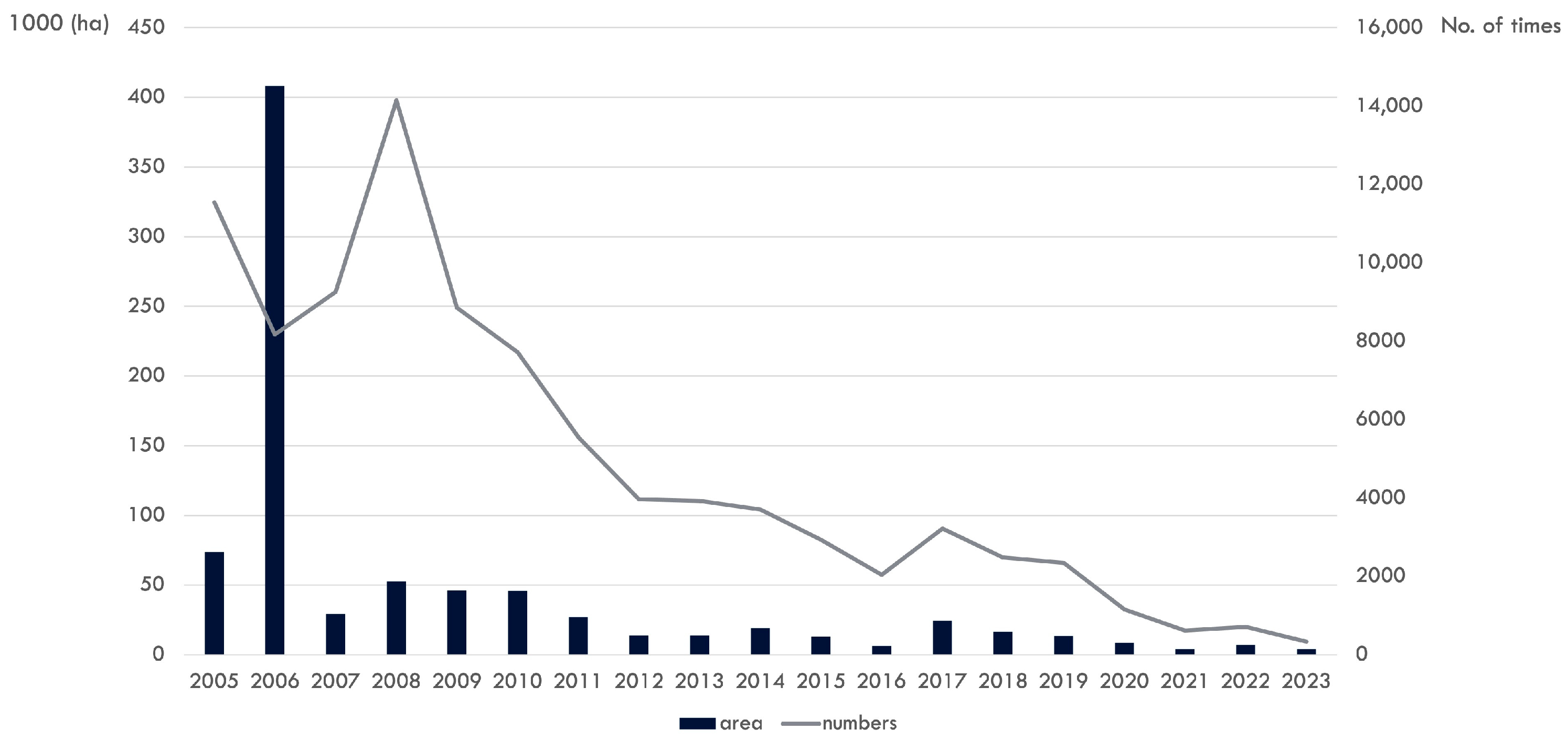
China is severely affected by natural hazards. Forest fires and especially biological hazards in particular pose a major threat to forests. In China, forest fires are classified into four categories based on the affected forest area and the number of casualties: General Forest Fire (affected area < 1 hectare), Large Forest Fire (1–100 hectares), Major Forest Fire (100–1000 hectares) and Extremely Severe Forest Fire (>1000 hectares). After more than 30 years of efforts to prevent and control forest fires, both the frequency of forest fires and the area burned decreased, as shown in Figure 2. However, in 2006, a total of 8170 forest fires occurred, including five extremely severe fires [29]. Three of these occurred in May and were all caused by lightning. Due to dry conditions and strong winds at the fire sites, the flames spread rapidly, resulting in severe damage to forest areas.
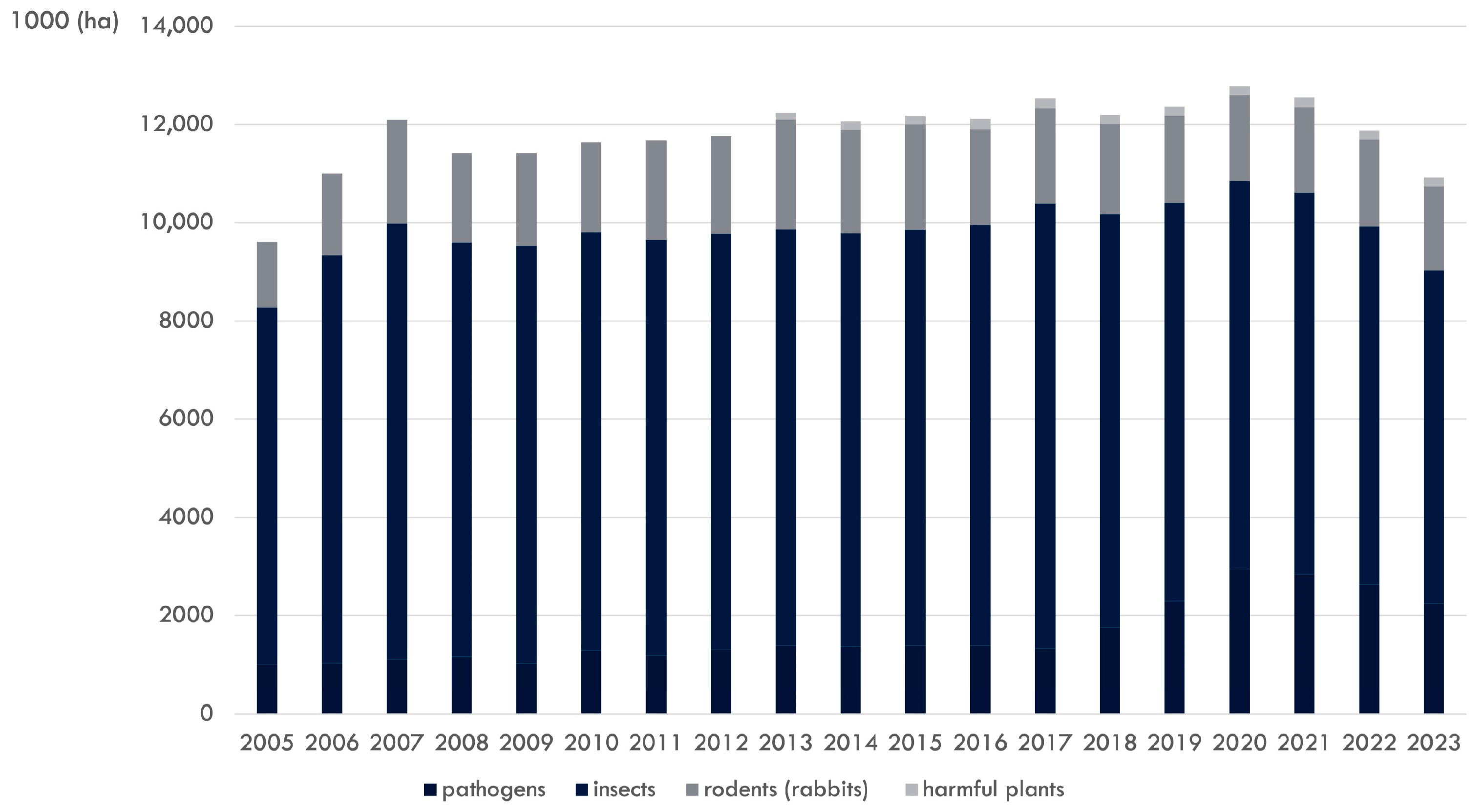
However, the economic losses caused by forest biological hazards in Chinese forests are 1000 times greater than those caused by forest fires. The massive planting of pine monocultures is probably one reason for the increased damage caused by biological hazards. The main biological agents damaging China’s forests include pathogens, insects, rodents (rabbits) and harmful plants, as shown in Figure 3. The areas affected by these problems are significant. Furthermore, the proportion of moderate and severe forest catastrophes has increased. Since the 21st century, the State Forestry and Grassland Administration has issued annual forecasts indicating that forest biological disasters will remain severe in the coming year. Since 2007, forest biological hazards have occurred annually on over 11.7 million hectares of land in China, accounting for 50.69% of the total area affected by forestry hazards. This is dozens of times the area affected by forest fires and results in average annual losses of more than 110 billion yuan [28]. The pinewood nematode (Bursaphelenchus xylophilus) and the fall webworm (Hyphantria cunea) are the organisms causing the most severe forest biological hazards in China. The pinewood nematode was first introduced to China in 1982. In 2023, the disease caused by the pinewood nematode affected an area of 1.22 million hectares, resulting in the death of 7.6 million pine trees [30].

2.3.2. Forestry Context in France

France has one of the most significant forest resources in Europe. It has the continent’s largest broadleaved forest and the third-largest timber stock in Europe, after Germany and Sweden. In terms of overall forest area, France is the fourth-most forested country in Europe, after Sweden, Finland, and Spain [31]. These rankings highlight the importance of French forests as valuable economic resources and major contributors to Europe’s ecological landscape.
French forests cover around 17 million hectares, accounting for almost a third of the country’s land area. Of this, at least 2.1 million hectares are planted, with conifers accounting for 80% of these forests [32]. The diverse French forest landscape is shaped by various climates, landscapes, and soil types, resulting in a wide variety of tree species and forest ecosystems. Broadleaf species make up around 67% of French forests, while coniferous species account for around 21% of the total forest area. The most common broadleaf species is oak representing around 40% of these forests, followed by beech, chestnut, and other deciduous trees. The primary species in coniferous forests include maritime pine in the southwest (notably in the Landes region) and fir and spruce in mountainous areas (such as the Vosges and the Alps). Mixed oak and beech forests are primarily found in central and northern France. Coniferous species dominate the mountainous regions, while the Landes forest, the largest man-made forest in Europe, is predominantly covered with maritime pines [33].
An important characteristic of the French forestry sector is that forests are mainly privately owned. In fact, approximately 75% of the forest area in France is owned by private individuals: 3.8 million owners, including 200,000 who own more than 10 hectares (representing 68% of the total area). Forest ownership in France is rarely an individual’s main activity. According to [34], the main socio-professional categories of private forest owners in France are retired people, farmers, employees, people in liberal professions, intermediate professionals, senior managers, etc. This means that many forest owners do not rely on their forestry income for a living and are therefore less inclined to insure this “secondary” income. Public forests, which are owned by the state (10%) or local authorities (16%), are managed by the Office National des Forêts [35]. This means that management of natural hazards is mainly at the scale of private forest properties.
Between 1900 and early 2022, 14% of the very serious natural events recorded in Europe occurred in Metropolitan France [36]. The natural hazards affecting French forests are similar to those affecting forests across Europe: windstorms, fires and biological hazards.
Storms pose a significant threat to French forests. Storms generate huge losses when they occur. For example, the storms Lothar and Martin in 1999 caused 140 Mm3 of damage in France, amounting to 4.57 billion euros [37]. More recently, Klaus in 2009 was responsible for a total of 42 Mm3 of damage in south-western France, causing losses estimated at between 1.34 and 1.77 billion euros [38].
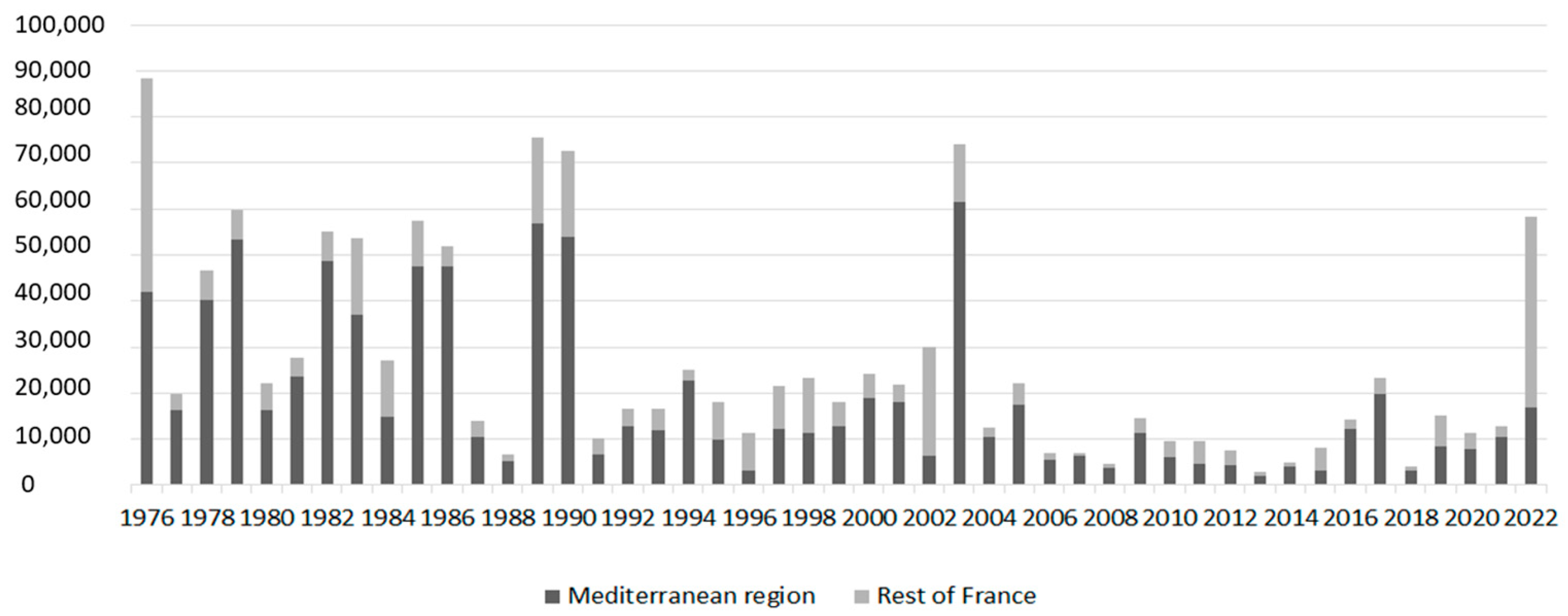
Fire also caused significant damage to French forests. On average, 26,400 hectares of forest burned each year in France between 1976 and 2022. As indicated in Figure 4, the areas burnt and the number of fires starting vary greatly from year to year. The years 1989, 1991 and 2003 stand out, with over 70,000 hectares burnt. More recently, 2022 was a particularly bad year, with 62,000 hectares of forest and 10,000 hectares of other vegetation burnt. The south-west region was particularly badly affected, with over 36,000 hectares burnt in 2653 fires. Among these were the Landiras (Gironde) fires, which occurred in July and August and burnt almost 20,000 hectares. The La Teste-de-Buch fire (Gironde) destroyed almost 6000 hectares and required the evacuation of 22,000 people, 6000 of whom were staying in five campsites that were 90% destroyed.
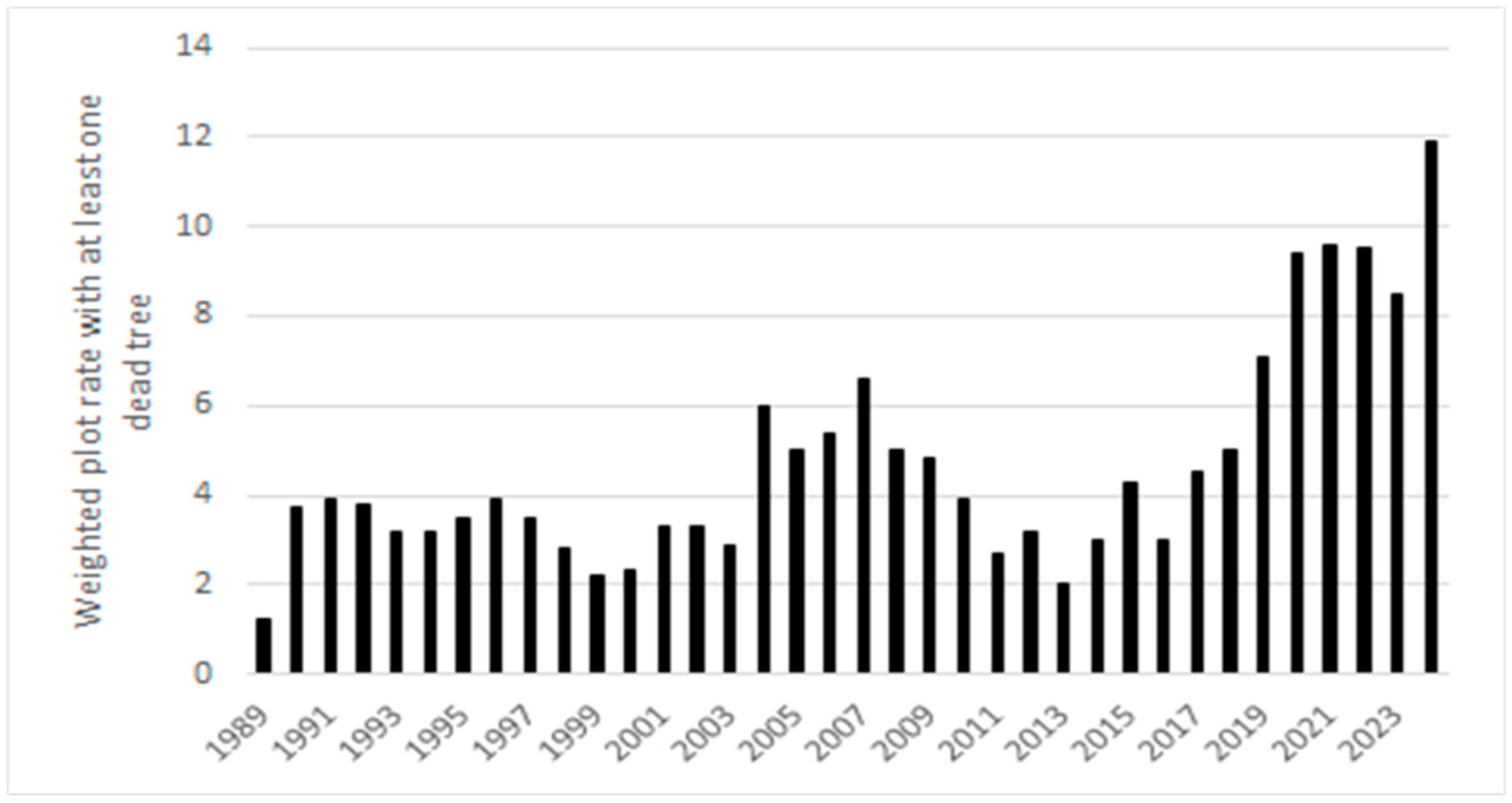
Biological hazards often emerge when the forest is vulnerable, which usually means it has already been affected by a natural event. For instance, bark beetle infestations were observed after the storms in France in 1999, particularly affecting maritime pine in the Landes region and Norway spruce in the north-east of the country [39]. Similarly, a major infestation occurred after the 2009 storm. The bark beetle attack increased total wood loss by approximately 7 Mm3, of which 4 Mm3 was green wood from standing trees [37]. Following the wildfires in south-west France in 2022, bark beetles also appeared and considerably increased the total timber damage in subsequent years, as shown in Figure 5, which illustrates the increase in damage in 2024. This figure shows that the weighted plot rate of at least one dead tree due to biological hazards has increased in France between 1989 and 2024. Like other European countries, France is suffering from an unprecedented outbreak of bark beetles [40]. Other pathogens have also caused significant damage, such as ash dieback and pinewood nematodes.

2.4. Forest Insurance in China and France

2.4.1. Development of Forest Insurance in China

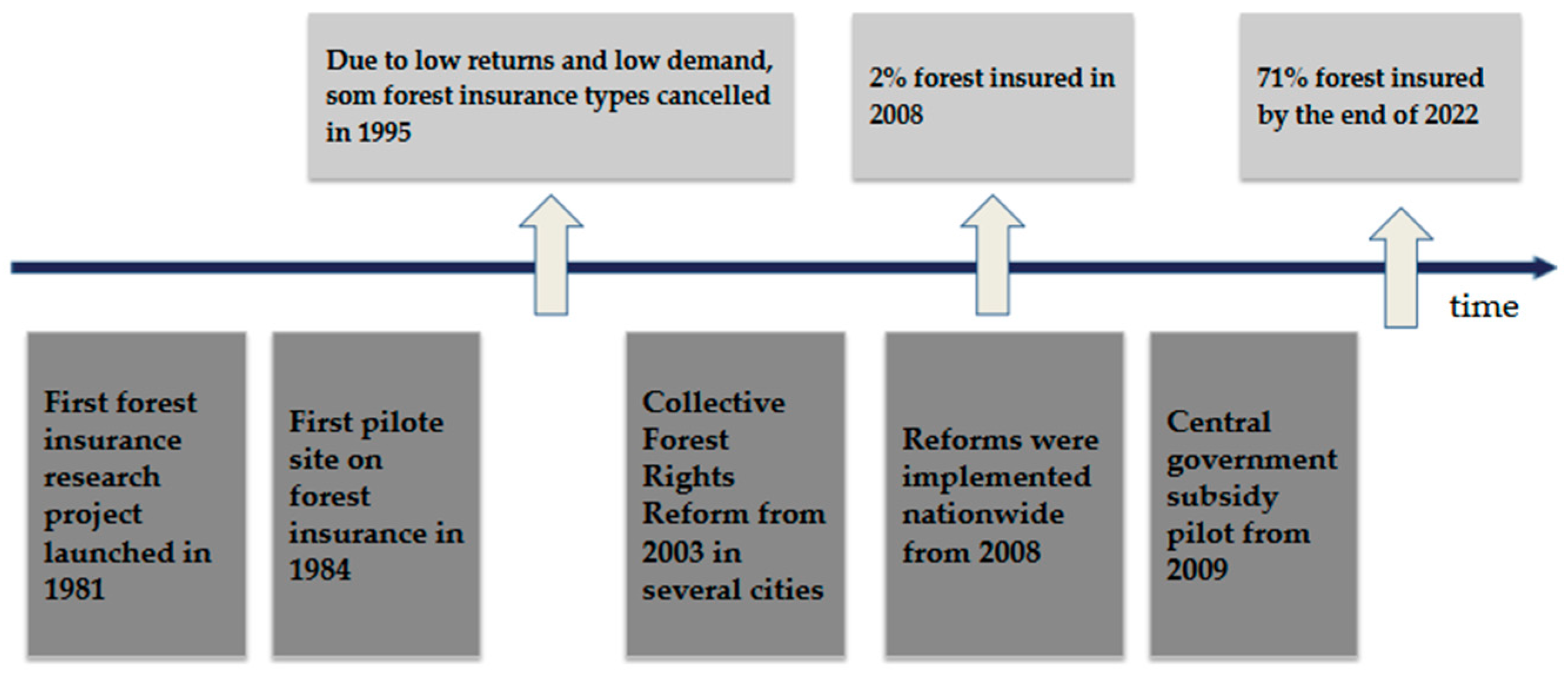
To strengthen forest resource management and reduce losses from forest disasters, the Ministry of Forestry of China (now the State Forestry and Grassland Administration) and the People’s Insurance Company of China jointly launched a forest insurance research project in 1981. In 1983, the two organizations completed the “Research Report on Forest Insurance Issues in China”. Also in 1983, the People’s Insurance Company of China drafted China’s first “Forest Insurance Clauses”, which set out made preliminary provisions for the coverage, actuarial rate calculation and loss compensation of forest insurance business [41]. In 1984, the Chinese government began piloting forest insurance [19]. Guilin, a southwestern city in Guangxi Province, became the first Chinese pilot site of forest insurance. Guangxi is a prominent forestry province. In 1984, the People’s Insurance Company of China (PICC) provided forest fire insurance for collective fir forests on a trial basis [41]. According to incomplete statistics, the cumulative area covered by forest insurance in China accounted for approximately 4% of the total forest area between 1989 and 1994. However, from 1995 onwards, the development of the forest insurance sector stagnated. This was primarily due to the transformation of China’s insurance industry in 1995, when it shifted from a state-led, policy-oriented system to a fully commercialized model. For forestry, which is characterized by long production cycles and multiple types of risk, this transition inevitably resulted in high-risk exposure, high loss ratios and low returns for insurers. This led to a gradual contraction of forest insurance operations. Consequently, the insured forest area had declined to around 2% by 2008 [42].
However, a positive turning point occurred in 2008 when the Chinese government announced the nationwide rollout of the collective forest tenure reform that had been piloted since 2003. Following this reform, the majority of forest farmers have paid more attention to preserving forest assets as forest owners and operators. This created a demand for insurance in the forestry sector, leading to the rapid development and establishment of forestry insurance mechanisms in China. In 2009, the government initiated a trial of the Forest Insurance Premium Subsidy Policy (CFIP). This policy has enabled considerable progress to be made in China’s forestry insurance industry. Although this method is called a “subsidy”, it does not provide financial compensation to forest farmers after they purchase insurance. Rather, the government provides insurance companies with funds to encourage them to reduce premiums, enabling forest farmers to purchase forest insurance at a lower price. Furthermore, it is an important financial support measure that promotes the reform of the collective forest rights system. By the end of 2022, the trial had expanded to 28 provinces, with the insured area representing 71.1% of China’s total forest area [28]—30 times more than in 2008.
In China, the area of insured ecological forests is much larger than the area of commercial forests. This can be explained by (i) higher subsidies for ecological forests (almost above 95% of the insurance premium) than for commercial forests (around 70%); (ii) a higher proportion of non-commercial forests (57% of China’s forest area) than commercial forests (43%). Figure 6 illustrates the evolution of forest insurance in China.
Currently, 29 agencies operate in China’s forest insurance market. PICC Property and Casualty Insurance ranks first in terms of insured area, with 71.6 million hectares insured in 2022—accounting for 43.54% of the industry’s total [28]. The next highest ranked agencies are China Life Property & Casualty Insurance, China Pacific Insurance Company, China Insurance, China Ping An Property Insurance and Groupama SDIG Property Insurance. Groupama SDIG Property Insurance is a joint venture between Shudao Investment Group Co., Ltd. and Groupama Assurances Mutuelles, each holding a 50% equity stake. It is the only joint venture insurance company in China that operates a policy-based agricultural insurance business. In 2022, forest insurance premiums reached 3.83 billion yuan, the highest figure in recent years. The amount of compensation was 1.1 billion yuan in 2022 [28].
The simple claims ratio for forest insurance is the ratio of compensation to premium. It is an important indicator in insurance claims accounting. Apart from a fluctuation of 31.45% in 2019, the ratio has dropped from 36.06% in 2016 to 20.99% in 2021, indicating an overall downward trend. From 2017 to 2021, the total ratio of claims for commercial forest insurance has consistently been higher than for public ecological forest insurance.
In China, premium rates lack differentiation in the sense that they are not based on classical actuarial methods that consider risk level, site conditions, tree species, and age. Forest owners receive a payment to replant. The current premium rates are still simply based on the administrative divisions. This is because public ecological forests are managed according to land and forest rights jurisdiction. County-level forestry departments and county-level insurance companies verify the details of forest land and right owners, collect information on willingness to insure on the basis of voluntary participation by right owners, and organize forest farmers to purchase insurance uniformly. Consequently, local governments will establish a team to select an insurance operation agency, comprising finance, forestry, agriculture and emergency management departments, to select a forest insurance provider through public bidding. The insurance premium rate offered by the winning insurance agency will become the unified rate for that administrative area. For commercial forests, insurance is provided in various forms. State forest enterprises, forest enterprises, forest cooperatives, and large plantation households with extensive landholdings can purchase separate insurance policies, while smaller-scale plantation households can participate in joint township or village insurance schemes.
As the compensation only covers the replanting fees, it is often considered too low. In 2020, the average insured amount per hectare nationwide for ecological forests was less than 1200 euros, and for commercial forests it was 1400 euros. These amounts were not sufficient to meet the actual needs of the clients. For commercial forestry operators whose business purpose is timber production, this only covers the replanting costs to a limited extent and does not make up for the economic losses suffered by forest farmers who cannot harvest timber due to disasters. This reduces the desire to purchase and makes it difficult for insurance companies to expand their market. For example, the current insurance coverage for commercial forests in Guangxi Province is 1250 yuan per mu (€2400 per hectare). However, the actual afforestation investment period for major tree species such as eucalyptus, fir and pine is usually three years, with costs reaching about 900 yuan per mu (€1700 per hectare). For other rare tree species, the planting cost is approximately 2500 yuan per mu (€4700 per hectare) [43].

2.4.2. Development of Forest Insurance in France

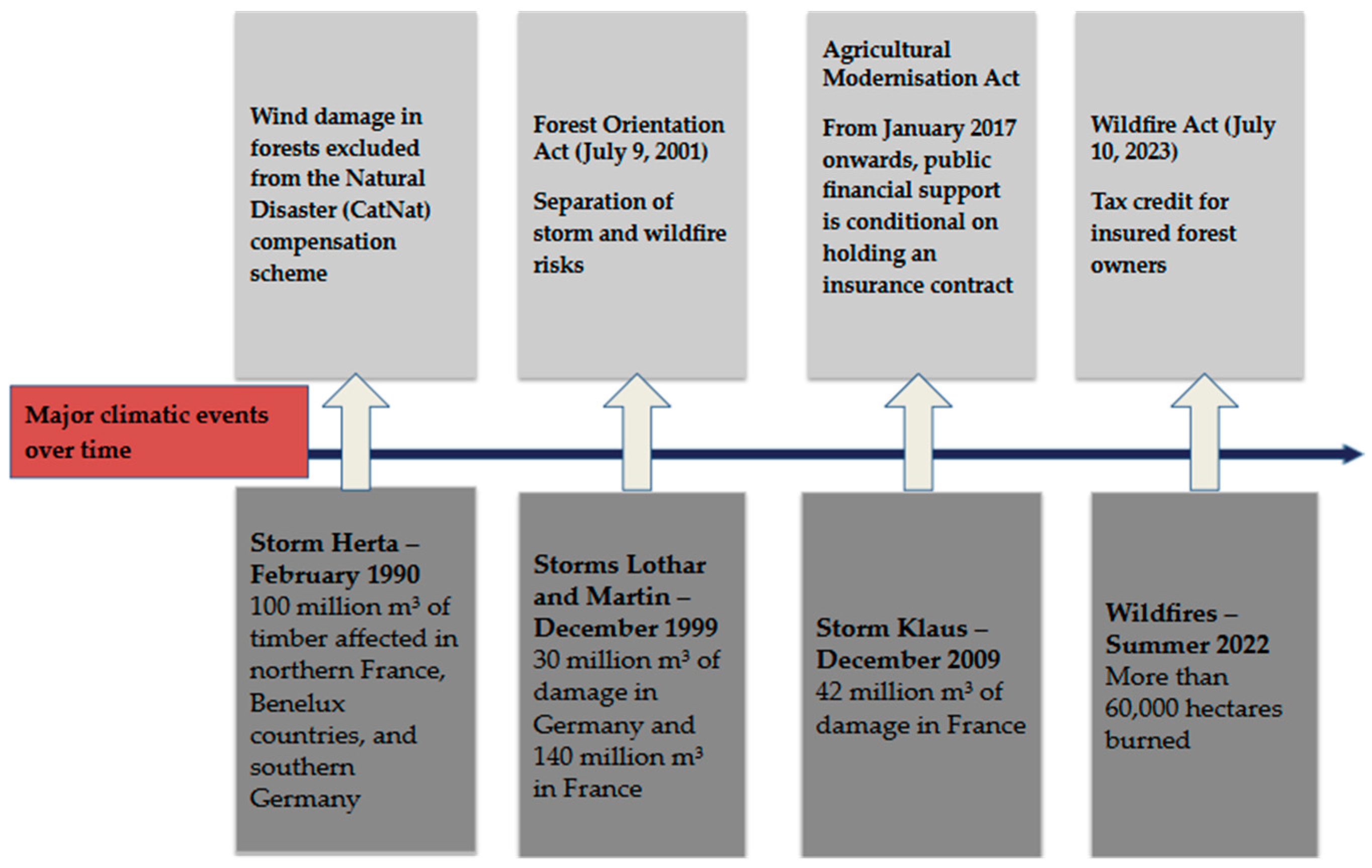
The first forest insurance contract was introduced in France in 1947 by the “Mutuelle Indépendante des Sylviculteurs du Sud-Ouest” (MISSO), which aimed to provide protection against fire in southwestern France. MISSO later became “Groupama MISSO” and is now known as “Groupama forêts assurance”, the main French insurer. The first hazard covered was fire. Storms in 1982, 1984, 1987 and 1990 were compensated under the Cat Nat system. This is a public fund that compensates for the losses due to catastrophic events. The February 1990 storm Herta, which destroyed 100 Mm3 of wood in northern France, the Benelux countries and southern Germany, was the last to be treated as a natural disaster and compensated by the Cat Nat system. In order to preserve the Cat Nat system’s accounts, the French legislator excluded the effects of wind on forests, considering them to be “insurable”. The only way to receive compensation in the event of a storm is to take out an insurance policy. Private insurance to cover fire and storm damage already exists in France. Private forests are regarded as property by insurers, meaning the contracts offered are “damage” insurance contracts. These contracts are governed by articles 121 and following of the Insurance Code.
The major storms of December 1999 (Lothar and Martin) were devastating, particularly in the Aquitaine region (southwest France) and Vosges (northeast France) regions, which are the top two French regions for timber production. At the time, less than 0.5% of forest owners were insured against fire and storms, representing 700,000 hectares (7% of French private forests), of which around 150,000 hectares were insured against fire with limited storm cover.
Prior to the storms of 1999, private forest owners in France could insure their forests with two companies: Groupama and L’Equité. Together, these two insurers accounted for over 90% of the market, with the remainder split between several other insurers, including AXA, AGF and Mutuelle du Mans. The impact of these storms on the insurers’ accounts was exacerbated by the limitations of their reinsurance, with reinsurers bearing 55% of the costs compared to 70% for the 1990 storms. Of the 20 billion francs insurers had to pay out, Groupama paid 1.2 billion francs in 1999 for 560,000 recorded claims (after reinsurance and reversal of provisions). In parallel, the French government implemented annual compensation of 91.5 million euros for 10 years to facilitate the harvesting of blown-down timber, clearing of destroyed stands, storage of harvested timber and reforestation. This covered approximately 20% of the damage [24].
Following the occurrence of the storms, Groupama and L’Equité increased their insurance premiums by almost 300% and reduced the level of cover (by a factor of four for Groupama). Meanwhile, the Forestry Orientation Act of 9 July 2001 removed the link between fire and storms. Consequently, insurers are no longer required to include storm cover in their fire policies. This decoupling enables insurers to offer fire and storm cover separately. The Act also introduced a tax incentive scheme for forestry investment (DEFI, or ‘’Dispositif d’encouragement fiscal à l’investissement”) which provides income tax relief for French taxpayers who invest in forestry. These tax credits are grouped together under the “DEFI forêt” scheme, and apply to the acquisition of woodland, forestry work, and the purchase of insurance for wooded areas. Such a tax incentive scheme should encourage the adoption of insurance.
The last major storm to hit France was Klaus in December 2009. The storm mainly affected the south-west of the country, an area already impacted by previous storms in 1990 and 1999. The damage was extensive, prompting the government to implement a compensation plan totalling 138.5 million euros [37]. However, such a plan does not encourage forest owners to insure their property, since they receive financial compensation without paying a premium [15,24]. Consequently, this storm prompted legislative changes. Indeed, under the Agricultural Modernisation Act (Loi No. 2010-874, 2010), the French government decided that, from January 2017 onwards, public assistance would be provided only to insured private forest owners. The prospect of the end of public aid after 2017 prompted the French Forest Owners Association, “Fransylva”, to negotiate with a private insurance company to insure timber. The latest insurance offer is Sylvassur. As it was initiated by Fransylva, it is expected to meet the needs and expectations of forest owners. This should therefore increase demand for insurance from private owners.
In 2022, France was hit by severe wildfires, with over 60,000 hectares burnt. While these fires did not directly affect the forest insurance scheme, they did have consequences in terms of prevention. The “wildfire law” of 10 July 2023 aimed to reinforce prevention measures and combat the intensification and spread of fire risk. The law makes forest fire protection plans compulsory in at-risk regions, strengthens the legal obligation to clear undergrowth to reduce the risk of fires starting, and encourages forest owners to insure their holdings and build up precautionary savings to cover fire damage. The government wants forest owners to insure their holdings more effectively against the risks of storms and fire. To this end, the French government has introduced several obligations to enable private forest owners to obtain the “DEFI Forêt” tax credit, including providing proof that their land is properly insured against storm and fire risks. Owners must therefore provide an insurance certificate detailing the hectares covered for the current tax year. To further encourage forest owners to insure their woodlands, the tax credit covers 76% of eligible storm and fire insurance contributions, up to a maximum of €15/hectare [44]. An increase in demand for forest insurance is then expected.
In summary, the main drivers of changes to forest insurance in France are major natural hazards, namely three storms in 1990, 1999 and 2009, as well as wildfires in the summer 2022. Figure 7 shows this historical evolution chronologically.
In conclusion, all the conditions for forestry insurance to work in France are in place: increasing natural risks, public subsidies conditional on taking out an insurance policy, tax incentives via the “DEFI forêt” scheme… Yet demand does not seem to be increasing. The question is: why not? Perhaps the answer lies in the insurance on offer.
Several insurance companies in France have developed tailored solutions to protect forest owners against natural hazards. Leading players in this niche market include Groupama (through “Groupama Forêts Assurances”), Pacifica-XLB and Sylvassur. This section outlines the main features of these companies’ insurance products, comparing features such as coverage options, type of risks and deductible levels.
One key difference lies in the coverage of storm-related damage, such as wind, hail, and snow. Groupama Forêts Assurances enables forest owners to insure against fire alone, but does not offer storm coverage as a standalone option. Sylvassur operates in a similar way, whereas Pacifica-XLB is the only provider that offers storm insurance as a standalone option.
Another important aspect is the calculation of insurance premiums. As explained in Equation (1), insurance premiums depend on three parameters: the probability of damage occurring, the expected loss, and the discount rate. These parameters depend on factors such as the age of the forest, the species of tree and its geographical location. Although location is formally accounted for in the contracts, in practice, premium variations are structured around three main regions: the southwest, the Mediterranean, and the rest of France. Some companies offer a lump sum for replantation, which avoids the need to estimate the expected loss, whereas others also compensate for loss of timber value. The latter option often requires a customized contract with a precise estimate of the stand’s value.
Each insurer also offers unique features and specific conditions within their policies. For example, Groupama Forêts Assurances and Sylvassur allow forest owners to choose whether to insure all or only part of their forested property, whereas Pacifica-XLB does not allow this. Intervention thresholds, deductible structures, and compensation levels also vary. These differences reflect the various approaches of insurers to tailoring their policies to the specific needs of forest owners, as well as the challenges posed by different regional risks.

3. Results

3.1. Comparison of Chinese and French Insurance Mechanisms

In this article, we selected two countries with large forested areas and varied areas in terms of insurance with a large insured area in China and a small one in France. Aside from certain non-insurance-related differences, such as the massive plantations realized in China whereas in France regeneration is favored, the existence of commercial/ecological forests in China (and not in France), or the fact that ownership is not really “private” in China, whereas it is for the most part in France, certain differences specific to forest insurance appeared that we will highlight now. We categorize them as characteristics of the insurance contract, public support and insurance market as presented in Table 1. We present this table in detail. The insurance contracts provided in China and France have some differences that impact premium and/or indemnity.
First, in China the contract is “unique” in the sense that it is the same for all forest owners at the scale of the administrative division (taking the difference between commercial and non-commercial forests into account). This means that in an administrative division, all the forest owners pay the same premium and receive the same indemnity in case of hazard occurrence. This is partly explained by the fact that indemnities paid covered only replantation costs. This situation, however, began to evolve in 2024 with policy developments in the Guangxi Zhuang Autonomous Region. In April 2024, Guangxi issued its Implementation Plan for Policy-Oriented Forest Insurance, which introduced differentiated forest insurance premium rates based on regional risk levels. Under this framework, premium rates were set at 0.4% for medium and high risk areas and 0.16% for low-risk areas. To the best of the authors’ knowledge, Guangxi represents one of the first subnational jurisdictions in China to implement risk-based differentiation of forest insurance premiums. In France, the computation of the premium is influenced by various variables acting on the probability of the occurrence of a loss (variable in Equation (1)) and/or on the expected loss (variable L in Equation (1)): the age of the stand that impacts the expected loss, its location that impacts the probability of occurrence of a loss and the species composition affecting both. This means that in France each contract is different from the others. In addition, it can cover the replanting cost and/or the production loss. This introduced complexity and required more time to establish the relevant insurance contract associated with a forest property. This also means that the administrative cost to the insurer associated with each insurance contract is high.
Second, the hazards insured are different. Fire is insured in both countries and is among the major threats for both countries in terms of damage. Storm is also insured in each country. However, other hazards may be insured in China and not in France, especially biological hazards like forestry pests and diseases. The consequence of these differences in terms of characteristics of the contract is that insurance premiums are very different in each country. In China the nationwide average is €2.7/ha for commercial forest and €3.7/ha for non-commercial forests whereas in France, it ranges between €5/ha and €6.5/ha.
Public support plays a role in each country by providing financial compensation to encourage the adoption of insurance contracts. However, the type of public help is different and takes the form of tax incentives in France and premium subsidy in China. Recall that the Chinese subsidy system is original in that the subsidy is perceived by the insurer and the forest farmer pays the premium net of the subsidy.
Finally, the resulting insurance market is different in the two countries. As mentioned in the previous section, the French forestry insurance market has evolved in line with the occurrence of large-scale natural events, which is not the case in China. General insurance companies are present in both countries. However, in France, we also have forest insurance contracts proposed by an insurance company associated with a brokerage company (Pacifica—XLB), and a partnership between the Fransylva federation and a brokerage company (Sylvassur). In China, the forest insurance market is well-developed and competitive with 29 insurance companies. In France, the market is very small with only three insurers sharing the market, i.e., a high degree of concentration. In France, the market share is the smallest for the last insurer that came into the market, Sylvassur both in terms of insured area and number of signed contracts. In China, the six main forest insurers represent more than 80% of the market share. Note that Groupama is an insurance company that is present in both countries.

3.2. Insurance Issues in China and France

The issue, both in France and China, is currently to increase the insured forest area to raise the resilience of the forest sector in face of climate change and also to encourage planted forests in China. The potential barriers/brakes come from both sides of the insurance market. Relevant ideas to try to improve the situation in each country may be taken in the practices of the other country. Indeed, in France, the low coverage rate may be explained by problems coming from the supply side of the market but also from the demand side.
Concerning the supply side, as already indicated in Table 1, the market is very concentrated with few competition leading to traditional problems in economics: few incentives to innovate, higher price level, etc. The low take-up rate (9% of private area insured) suggests very limited mutualization, and potentially higher premiums due to less risk diversification. This may pose a problem of anti-selection [46]: only the most at-risk forest owners take insurance contracts, which raises premiums and further limits adoption. The low uptake in France creates a vicious circle: few forest owners take out insurance, implying a poorly distributed risk and higher premiums, which means there is no incentive to adopt. In addition, the proposed contracts cover only two types of hazards, and insure only replanting costs and timber loss (no other ecosystem services).
From the demand side, the explanations may be multiple. First, French forests are mainly held for leisure purposes [47], so owners do not want to commit money to insurance. In addition, the average surface area in France is very small, at 8.8 hectares for 3.5 million owners, meaning that owners of small areas do not see the point of taking out insurance. This fragmentation of forest ownership in France presents significant challenges for the development and uptake of forest insurance. Indeed, many small owners consider forest insurance unnecessary or unprofitable, given the limited value of their properties relative to the cost of premiums.
Finally, the compensation plans implemented by the French government after windstorms Lothar and Martin in 1999 (€915 million) and Klaus in 2009 (€138.5 million) clearly appeared as “public insurance” and discourage private forest owners to pay for private insurance [15,24]. It is the classical “charity hazard” as defined by [48]: “the tendency of an individual at risk not to procure insurance or other risk financing as a result of a reliance on expected charity from others such as friends, family, community, non-profit organizations, or a government emergency program”.
In China, several problems come from the supply side such as the fact that the insurance premium rate is uniform by administrative division and by forest type. Chinese insurers propose a more mutualized pricing model, which allows for greater adoption but introduces a moral hazard problem (high-risk owners pay the same price as low-risk ones). This can also contribute to adverse selection in the forest insurance market. Adverse selection occurs when insurers are unable to differentiate premiums according to individual risk characteristics, resulting in disproportionate participation by high-risk forest owners, whereas low-risk owners choose not to insure. This can be problematic for the financial viability of the insurance pool, as payouts can exceed premiums collected. Introducing heterogeneity by location, tree species and forest age may encourage forest owners to adopt contracts. In this way, insurers could attract a larger, more balanced group of forest owners, reducing adverse selection and improving market efficiency. In the same way, it appears that the compensation amount is not enough to fully compensate the losses of forestry operators. Covering the production loss in addition to the replanting cost may be a good option. In line with that, another idea is to promote the gradual transformation of forest insurance from a “cost insurance” model to a “value insurance” and “income insurance” model.
On the demand side, Chinese forest owners appear to be unaware of forest insurance, poorly informed and therefore do not understand the importance of insuring their forest [19]. In addition, the income from forestry is often not sufficient and the premium charged by the insurance companies may be perceived as too high [49]. Ref. [19] indicated that increasing the income level of Chinese forest owners is the fundamental path to enhance forest insurance demands.
Something common to forest owners in lots of countries is the lack of information available to them on the subjects of the impact of climate change on natural hazards in forest generally, as obtained by [50] in Sweden. However, it seems that more and more the forest owners are aware of the impact of climate change [47,51] and ready to act, so that we can expect an increase in insurance adoption in the future. Another information going in the same direction, is the fact that private forest owners are found to be risk averse [52,53,54,55] and from a theoretical point of view, a risk averse economic agent should insure [23].
In this context, we can see that each country has already done lots of efforts to develop traditional forest insurance with not much success, especially in France. This observation, let us think that innovative insurance products may be necessary to try to increase the forest area insured in each country. This observation is in line with [56], who recommend implementing adaptive management strategies and developing new forest insurance products as climate change risks increase.

4. Discussion

Both France and China have introduced a range of innovative approaches in forest insurance in response to increasing climate-related risks. These innovations concern not only insurance contract design, but also public support mechanisms and market organization. This section discusses the most promising developments observed in the two countries, structured around the three analytical categories presented in Table 1.

4.1. Innovation in Insurance Contract Design

On one hand, the two countries share the idea to insure something different than “replanting cost” and/or “production loss”, and they innovate on that point. Indeed, in the context of climate change, when it comes to forests, there is a growing interest in the ecological functions of forests, such as carbon storage and biodiversity conservation, and wood production is becoming secondary.
In China, it is possible to insure forest carbon sink [41,57], or to insure biodiversity loss through an insurance contract. The insurance of carbon sinks has been a topic in forestry for a long time [58] but few countries currently propose it and China is one of them. Carbon sink insurance represents a promising innovation in forest insurance, offering financial protection for carbon sequestration [59]. By insuring the value of carbon sinks, forest owners and project leaders can protect their investments in carbon compensation initiatives. In addition, insuring carbon sinks aligns with global climate objectives, with the aim of achieving carbon neutrality under international agreements such as the Paris Agreement. This type of insurance also encourages sustainable forest management practices, such as species diversification and fire prevention, which not only protect carbon storage, but also enhance forest resilience and biodiversity. The insurance of biodiversity loss is less developed and more confidential, but already in place in China. Indeed, in July 2023, the PICC Ningbo Branch signed China’s first forest biodiversity insurance policy with the Government of Longguan Township, Haishu District, Ningbo City. Haishu District, a national ecological civilization demonstration area, has a forest coverage rate of 49.8% and 2232 species recorded in the area. The insurance is based on the Nature-based Solutions (NbS) principle, with forest resources, rare species, wildlife, water sources, vegetation and human–animal conflicts in the insured geographical area as insured subjects. If, during the policy period, risks such as natural disasters, accidents, invasion of alien species and attacks by wild animals on humans occur in the area, also difficulties for living creatures to survive reproduce, vegetation destroyed and needs of protection and treatment for the relevant ecosystems, the PICC Insurance Ningbo Branch will provide a total of 2 million yuan of coverage for the necessary and reasonable protection and rescue costs to treat and repair the insured objects and improve the ecosystem [60]. A few months later, in February 2024, the region suffered from a cold wave, which resulted in significant tree lodging and forest damage due to the combination of ice and snow. After investigation, PICC determined that 100,000 yuan would be used for forest repair and ecological protection work in the affected area, aiming to conserve local biodiversity [61].
In France, to our knowledge, Groupama has begun experimenting with insurance policies specifically designed to cover plantation failures. At this end, Groupama Forêts Assurances has joined forces with “Stock CO2”, an intermediary between the “Label Bas Carbone” and the forest owners, to propose an insurance contract protecting plantations against drought, in addition to storm, fire, frozen and hail. This development is all the more relevant as forest plantations are becoming increasingly popular, due to efforts to reforest and improve carbon sequestration. However, plantation failure, caused by factors such as drought and pests, represents a significant risk for forest owners. Indeed, as indicated by [6], the seedling stage is known to be the most vulnerable phase in the life cycle of a forest stand since the young plants may be subject to various stresses including abiotic (e.g., frost, hail, high temperatures, drought); biotic (attacks by insects and fungi, which are often specific to very young trees, tree competition, grazing); or anthropogenic (inappropriate soil work, preparation or storage of seedlings, planting or other silvicultural operations). For example, in France, the dry summers of 2018, 2019, and 2020 are responsible for important damage to the forests and decreased planting success [62]. Almost 89% of the plants died due to abiotic causes of which 60% perished due to drought [62]. Recognising this emerging threat, this insurance product aims to mitigate the financial losses associated with plantation failure. It can be used to finance the replanting and work required in the event of a hazard. Such an insurance product may be very relevant in China where the plantation area is quite large. In addition, Groupama is already present on the Chinese forest insurance market. On the other hand, the innovation may simply concern the type of insurance contract mobilized.
Another innovative approach to consider is the implementation of co-insurance mechanisms in forest insurance, where several insurers collaborate to share the risk associated with large-scale natural hazards. This allows a better mutualization of the risks. Given the increasing scale and frequency of climate-related risks, joint coverage of these risks by two or three insurers could be an interesting approach to strengthening the insurance system. This model is already practiced in China, where insurers share the burden of large payouts, reducing individual exposure while ensuring adequate compensation for policyholders. These contracts first appeared in China’s agricultural sector and have since been extended to forestry insurance. The introduction of co-insurance in France could offer similar advantages. By spreading risks between several insurers, this approach could help to stabilise the market, reduce financial pressure on insurance companies and make forest insurance more sustainable in the long term.
Other innovative products that had not been experienced may be to use index insurance. The principles of index insurance based on meteorological indices were initiated by [63] and further developed by [64]. This type of insurance was initially proposed in agriculture. It is used in France for some agricultural risks but not yet for forestry hazards even if, from a scientific perspective, it has already been envisaged to cope with drought [65]. Index insurance for carbon sinks exists in China. Index insurance works by linking payments to predefined indices, such as rainfall levels, wind speed or temperature thresholds, rather than to the assessment of actual damage. This approach would eliminate the need for on-site damage assessment, reducing administrative costs and enabling forest owners to be compensated more quickly. The potential benefits of index insurance for forestry are considerable. Firstly, it is a more transparent and predictable system, as payments are triggered automatically when the index reaches a certain threshold. Secondly, it reduces moral hazard and adverse selection since payments are based on observable and objective indicators. Finally, it could make forest insurance more accessible and affordable by reducing insurers’ operating costs, which could translate into lower premiums for forest owners. However, implementing index insurance in the forestry sector would require a number of challenges to be overcome. For example, accurate and reliable indices need to be developed to reflect the risks faced by forests, such as fires, storms or droughts. This means that the availability of high-quality meteorological and satellite data is crucial if such products are to be designed and implemented effectively. Another challenge lies in attribution, i.e., being able to establish the causal link between the observed damage and the occurrence of a precise natural event.

4.2. Public Support Mechanisms and Policy Innovation

This category mainly deals with the government support for forestry insurance. Currently, in France, the public support is granted directly to the forest owners (demand side of the market), in the form of tax incentives. In China, the subsidy is directly perceived by the insurer allowing the forest farmers to pay the net insurance premium. The way public support is implemented in China is in line with some studies in the literature suggesting that a more efficient approach would be to allocate these supports directly to insurance companies (supply side of the market), especially for the subsidies [17,66]. By subsidising insurers, the government reduces administrative complexity and encourages insurance companies to develop more competitive and accessible products for forest owners. This approach also encourages insurers to expand their coverage and invests in risk management innovations, ultimately increasing the uptake of forest insurance. From the demand side, the forest owners will pay directly the net insurance premium (premium minus the public support), and not receive the public support several months later. Such a way to allocate subsidies improves the overall efficiency of the insurance system. Note that such a direct subsidy to the insurance company is currently in place in Spain on the agricultural insurance market where the farmers pay the insurer the net insurance premium (premium minus the subsidy). The Spanish agricultural insurance market is currently an example of success for lots of other European countries like France, whose last reform was clearly inspired from Spain [67].
The consequences are that, for France, the way public support is granted in China may be inspiring. Indeed, rather than (or in complement with) tax incentives, we can imagine the French government subsidizing the forest insurance premium (as already done for agricultural insurance in the context of the Common Agricultural Policy). In addition, the subsidy may be transferred directly to the insurer to increase the efficiency of the public support.

4.3. Market Organization and Insurance Integration

In China, agricultural insurance and forest insurance are linked and correspond to only one insurance market, whereas in France these two markets operate separately. Most of China’s forest managers are also farmers, and they are increasing their economic income by adopting the agroforestry integrated management model. In 2009, the Chinese government issued guidance required all localities to integrate forest insurance with the overall arrangement of agricultural insurance [68]. Therefore, many insurance companies in China provide both agricultural and forestry insurance. We can imagine linking them also in France since more than one third (34%) of the private forest owners representing more than one third of the private forest area (36%) declared as socio-professional category “farmer” [34]. This dual status suggests that many forest owners are also farmers, and that a combined insurance product could rationalise cover, reduce costs and provide a better response to the risks faced by these actors.

5. Conclusions

5.1. Key Results

This article compares forest insurance schemes in two contrasting national contexts, France and China, with the objective of identifying the factors that may explain the relatively low level of forest insurance adoption observed in France. The analysis considers both the demand and supply sides of the insurance market and places particular emphasis on institutional arrangements and public policy involvement. In addition, the paper discusses innovative insurance products that could improve risk transfer mechanisms in the forestry sector.
The comparison highlights substantial differences in how forests are conceptualized and governed in the two countries. In China, forests are formally classified into “commercial” and “non-commercial” categories, while in France forests are generally assumed to be multifunctional, combining economic, environmental, and social objectives. Ownership structures also differ markedly: forests are predominantly privately owned in France, whereas the notion of forest property rights has only recently gained importance in China. Although these differences are not directly related to insurance mechanisms, they shape the broader institutional environment in which forest insurance develops.
Beyond these structural characteristics, the analysis identifies both similarities and contrasts that are directly linked to forest insurance. These include differences in insurance contract design (types of coverage and hazards insured), premium levels and subsidy mechanisms, as well as market organization (number of insurers and market concentration). China’s scheme is characterized by strong public involvement, particularly through premium subsidies and public reinsurance mechanisms, which contributes to higher insurance uptake. In contrast, the French system relies more heavily on private market mechanisms, resulting in lower coverage levels.
Finally, the article discusses several innovative approaches that could foster forest insurance adoption in both countries and beyond. These innovations relate to contract design (e.g., parametric insurance), public support instruments (e.g., redesigned subsidies or incentives), and market organization, including potential synergies between agricultural and forest insurance schemes.

5.2. Policy Implications

Beyond existing schemes, the comparative analysis highlights the growing importance of insurance innovation in adapting forest risk management to climate change. Both France and China are experimenting with alternative forms of coverage that move beyond traditional compensation for replanting costs or production losses, reflecting a broader recognition of the ecological functions of forests, such as carbon sequestration and biodiversity conservation.
Innovations related to insurance contract design, including carbon sink insurance, biodiversity-related coverage, plantation failure insurance, co-insurance arrangements, and index-based products, illustrate the potential for more flexible and resilient insurance mechanisms.
In parallel, differences in public support mechanisms and market organization, particularly the integration of agricultural and forest insurance in China, suggest that innovation is not limited to insurance products alone, but also concerns the institutional and market frameworks within which insurance operates. Together, these developments indicate that the future expansion of forest insurance will likely depend on the ability of insurance systems to incorporate ecological values, reduce transaction costs, and align public support with efficient market incentives.

5.3. Limitations and Future Directions

This study is subject to several limitations. First, the analysis relies primarily on secondary data sources and qualitative information, which constrains the ability to conduct empirical testing and limits the robustness of the conclusions. However, given the scarcity and fragmentation of data on forest insurance, this approach remains necessary to ensure a comprehensive overview of national schemes.
Future research could extend this work in several directions. A broader multi-country comparison would allow for a more systematic assessment of the determinants of forest insurance adoption. Comparisons between countries with similarly low insurance coverage (e.g., France and Germany) or, conversely, between countries with high coverage levels (e.g., Sweden, Norway, Finland, and Denmark) would be particularly informative.
In addition, firm-level analyses could provide valuable insights. For instance, Groupama operates in both France and China, and a comparison of the forest insurance products it offers in these two markets could shed light on the role of institutional and regulatory environments in shaping insurance design. Finally, access to micro-level insurance data would significantly enhance future comparative analyses, although such data remain difficult to obtain.

Author Contributions

Conceptualization, Y.W., M.B. and F.C.; methodology, Y.W., M.B. and F.C.; formal analysis, Y.W., M.B. and F.C.; investigation, Y.W., M.B. and F.C.; resources, Y.W., M.B. and F.C.; data curation, Y.W., M.B. and F.C.; writing—original draft preparation, Y.W., M.B. and F.C.; writing—review and editing. All authors have read and agreed to the published version of the manuscript.

Funding

This research was funded by the European eco2adapt project, grant number 101059498, and by the Fundamental Research Funds of Chinese Academy of Forestry (CAFYBB2020GC017). This work is part of project X-RISKS of the research program FORESTT and received government funding managed by the Agence Nationale de la Recherche under the France 2030 program, reference ANR-24-PEFO-0005.

Data Availability Statement

No new data were created or generated in this study. The analysis is based exclusively on secondary data derived from publicly available sources, including official reports, legislation, institutional publications, and peer-reviewed literature.

Acknowledgments

We acknowledge Stéphane Couture for his proofreading and comments.

Conflicts of Interest

The authors declare no conflicts of interest. The funders had no role in the design of the study; in the collection, analyses, or interpretation of data; in the writing of the manuscript; or in the decision to publish the results.

Abbreviations

The following abbreviations are used in this manuscript:
CFIPForest Insurance Premium Subsidy Policy
CHAComparative Historical Analysis
CNPFCentre National de la Propriété Forestière
DEFIDispositif d’encouragement fiscal à l’investissement en forêt
IGNInstitut National de l’information géographique et forestière
MISSOMutuelle Indépendante des Sylviculteurs du Sud-Ouest
NbSNature Based Solutions
ONFOffice National des Forêts
PICCPeople’s Insurance Company of China

References

  1. FAO. Global Forest Resources Assessment 2025. 2025. Available online: https://openknowledge.fao.org/handle/20.500.14283/cd6709en (accessed on 19 December 2025).
  2. FAO. The State of the World’s Forests 2024—Forest-Sector Innovations Towards a More Sustainable Future; FAO: Rome, Italy, 2024. [Google Scholar]
  3. Patacca, M.; Lindner, M.; Lucas-Borja, M.-E.; Cordonnier, T.; Fidej, G.; Gardiner, B.; Hauf, Y.; Jasinevičius, G.; Labonne, S.; Linkevičius, E.; et al. Significant increase in natural disturbance impacts on European forests since 1950. Glob. Change Biol. 2023, 29, 1359–1376. [Google Scholar]
  4. Della-Marta, P.; Pinto, J. Statistical uncertainty of changes in winter storms over the North Atlantic and Europe in an ensemble of transient climate simulations. Geophys. Res. Lett. 2009, 36, L14703. [Google Scholar] [CrossRef]
  5. Gardiner, B.; Blennow, K.; Carnus, J.; Fleischner, P.; Ingemarson, F.; Landmann, G.; Lindner, M.; Marzano, M.; Nicoll, B.; Orazio, C.; et al. Destructive Storms in European Forests: Past and Forthcoming Impacts; Final Report; European Commission–DG Environment: Brussels, Belgium, 2011. [Google Scholar]
  6. Brèteau-Amores, S.; Yousefpour, R.; Hanewinkel, M.; Fortin, M. Forest adaptation strategies to reconcile timber production and carbon sequestration objectives under multiple risks of extreme drought and windstorm events. Ecol. Econ. 2023, 212, 107903. [Google Scholar] [CrossRef]
  7. Schelhaas, M.J.; Hengeveld, G.; Moriondo, M.; Reinds, G.J.; Kundzewicz, Z.W.; Ter Maat, H.; Bindi, M. Assessing risk and adaptation options to fires and windstorms in European forestry. Mitig. Adapt. Strateg. Glob. Change 2010, 15, 681–701. [Google Scholar]
  8. Brunette, M.; Hanewinkel, M. Assurance financière et assurance naturelle: Une application à la forêt. Rev. For. Française 2023, 74, 247–254. [Google Scholar]
  9. Brunette, M.; Couture, S. Forest Insurance for Natural Events: An Overview by Economists. Forests 2023, 14, 289. [Google Scholar] [CrossRef]
  10. Zhang, D.; Stenger, A. Timber insurance: Perspectives from a legal case and a preliminary review of practices throughout the world. N. Z. J. For. Sci. 2014, 44, S9. [Google Scholar]
  11. Kaul, J. Report of committee on forest fire insurance of the commercial forestry conference. J. For. 1928, 26, 76–84. [Google Scholar] [CrossRef]
  12. Angström, A. Forest insurance in Sweden. For. Fire Prev. Control 1982, 7, 223–227. [Google Scholar]
  13. Hillayová, M.; Báliková, K.; Giertliová, B.; Drábek, J.; Holécy, J. Possibilities of forest property insurance against the risk of fire in Slovakia. J. For. Sci. 2021, 67, 204–211. [Google Scholar] [CrossRef]
  14. Yatagai, M. History and present status of forest fire insurance in Japan. J. For. 1933, 31, 79–84. [Google Scholar] [CrossRef]
  15. Brunette, M.; Cabantous, L.; Couture, S.; Stenger, A. The impact of governmental assistance on insurance demand under ambiguity: A theoretical model and an experimental test. Theory Decis. 2013, 75, 153–174. [Google Scholar]
  16. Brunette, M.; Couture, S.; Foncel, J.; Garcia, S. The decision to insure against forest fire risk: An econometric analysis combining hypothetical and real data. Geneva Pap. Risk Insur.-Issues Pract. 2020, 45, 111–133. [Google Scholar] [CrossRef]
  17. Loisel, P.; Brunette, M.; Couture, S. Insurance and forest rotation decisions under storm risk. Environ. Resour. Econ. 2020, 76, 347–367. [Google Scholar] [CrossRef]
  18. Dai, Y.; Chang, H.; Liu, W. Do forest producers benefit from the forest disaster insurance program? Empirical evidence in Fujian Province of China. For. Policy Econ. 2015, 50, 127–133. [Google Scholar] [CrossRef]
  19. Qin, T.; Gu, X.; Tian, Z.; Pan, H.; Deng, J.; Wan, L. An empirical analysis of the factors influencing farmer demand for forest insurance: Based on surveys from Lin’an County in Zhejiang Province of China. J. For. Econ. 2016, 24, 37–51. [Google Scholar] [CrossRef]
  20. Ma, N.; Li, C.; Zuo, Y. Research on forest insurance policy simulation in China. For. Econ. Rev. 2019, 1, 82–95. [Google Scholar] [CrossRef]
  21. Feng, X.; Dai, Y. An innovative type of forest insurance in China based on the robust approach. For. Policy Econ. 2019, 104, 23–32. [Google Scholar] [CrossRef]
  22. Adrast, M. Incendies: Seulement 9% des Forêts Françaises, Majoritairement Privées, sont Assurées Challenges. 5 August 2022. Available online: https://www.challenges.fr/entreprise/green-economie/incendies-seulement-9-des-forets-francaises-majoritairement-privees-sont-assurees_823451 (accessed on 19 December 2025).
  23. Mossin, J. Aspects of rational insurance purchasing. J. Political Econ. 1968, 76, 553–568. [Google Scholar]
  24. Brunette, M.; Couture, S. Public Compensation for Windstorm Damage Reduces Incentives for Risk Management Investments. For. Policy Econ. 2008, 10, 491–499. [Google Scholar] [CrossRef]
  25. Lijphart, A. Comparative Politics and the Comparative Method. Am. Political Sci. Rev. 1971, 65, 683–693. [Google Scholar] [CrossRef]
  26. Ferragina, E.; Deeming, C. Comparative mainstreaming? mapping the uses of the comparative method in social policy, sociology and political science since the 1970s. J. Eur. Soc. Policy 2022, 33, 132–147. [Google Scholar] [CrossRef]
  27. National Greening Committee Office in China. Report on China’s Land Greening Status 2024. 2025. Available online: https://www.gov.cn/lianbo/bumen/202503/content_7013112.htm (accessed on 30 March 2025).
  28. National Forestry and Grasslands Administration; National Financial Regulatory Administration in China. The Development Report on Forest Insurance in China; China Forestry Publishing House: Beijing, China, 2023; pp. 9–27.
  29. National Bureau of Statistics of China. China Statistical Yearbook, 2007; China Statistics Press: Beijing, China, 2007.
  30. China Biological Disaster Prevention and Control Bulletin (2024). Available online: https://www.forestry.gov.cn/u/cms/fkzx/202410/15105028m3yw.pdf (accessed on 29 January 2025).
  31. CNPF. Chiffres Clés de la Forêt Privée Française. Centre National de la Propriété Forestière. 2021. Available online: https://www.cnpf.fr/le-cnpf-et-la-foret-privee/la-foret-et-les-proprietaires-forestiers/les-chiffres-cles-de-la-foret (accessed on 19 December 2025).
  32. IGN. La Forêt Plantée en France: État des Lieux. L’IF, la Feuille de l’Inventaire Forestier. IF40. May 2017. Available online: https://inventaire-forestier.ign.fr/IMG/pdf/if40_plantations.pdf (accessed on 19 December 2025).
  33. IGN. La Diversité des Peuplements Forestiers. Institut Géographique National. 2024. Available online: https://inventaire-forestier.ign.fr/spip.php?rubrique78 (accessed on 19 December 2025).
  34. Agreste. Enquête sur la Structure de la Forêt Privée en 2012. Numéro 222—Décembre 2014. 2014. Available online: https://foret.ign.fr/api-obs/upload/Theme1_agreste_structure_foret_privee.pdf (accessed on 19 December 2025).
  35. MASA. Forêt—Bois. Ministère de l’Agriculture, de la Souveraineté Alimentaire et de la Forêt. 2020. Available online: https://agriculture.gouv.fr/foret-bois (accessed on 19 December 2025).
  36. Chiffres Clés des Risques Naturels. Ministères Territoires Ecologie Logement. 2023. Available online: https://www.statistiques.developpement-durable.gouv.fr/chiffres-cles-des-risques-naturels-edition-2023 (accessed on 19 December 2025).
  37. Caurla, S.; Garcia, S.; Niedzwiedz, A. Store or export? An economic evaluation of financial compensation to forest sector after windstorm. The case of Hurricane Klaus. For. Policy Econ. 2015, 61, 30–38. [Google Scholar] [CrossRef]
  38. Lecocq, M.; Costa, S.; Peyron, J.-L.; Drouinea, S. Estimate of the financial impact of hurricane Klaus for forest owners. Forêt Entrep. 2009, 189, 48–52. [Google Scholar]
  39. Nageleisen, L.M. Monitoring of bark and wood-boring beetles in France after the December 1999 storms. Integr. Pest Manag. Rev. 2001, 6, 159–162. [Google Scholar] [CrossRef]
  40. Washaya, P.; Modlinger, R.; Tyser, D.; Hlasny, T. Patterns and impacts of an unprecedented outbreak of bark beetles in Central Europe: A glimpse into the future? For. Ecosyst. 2024, 11, 100243. [Google Scholar] [CrossRef]
  41. Qin, T.; Li, H.; Song, R. Comparison of restriction factors and optimization strategy of forestry carbon sink insurance model. Rural. Econ. 2022, 3, 60–66. [Google Scholar]
  42. Qin, T.; Deng, J.; Gu, X. Forest Insurance; Nankai University Press: Nanjing, China, 2022; pp. 57–68. [Google Scholar]
  43. Guangxi Forestry Bureau; Guangxi Forestry Survey and Design Institute; Guangxi Regulatory Bureau of China Banking and Insurance Regulatory Commission. Guangxi Forest Insurance Development Report 2022; China Forestry Publishing House: Beijing, China, 2023; pp. 102–103.
  44. CNPF. Réduire son Impôt sur le Revenu: Synthèse des Différents DEFI pour les Investissements Réalisés en 2023. Centre National de la Propriété Forestière. 2023. Available online: https://www.cnpf.fr/sites/socle/files/2025-11/Fiche-DEFI-synthese-2025-A3_CNPF_nov%20jh_repriseCD_0.pdf (accessed on 19 December 2025).
  45. Holecy, J.; Hanewinkel, M. A forest management risk insurance model and its application to coniferous stands in southwest Germany. For. Policy Econ. 2006, 8, 161–174. [Google Scholar] [CrossRef]
  46. Dionne, G.; Doherty, N. Adverse Selection in Insurance Markets: A Selective Survey; Springer: Dordrecht, The Netherlands, 1992; pp. 97–140. [Google Scholar]
  47. Thomas, J.; Brunette, M.; Leblois, A. The determinants of adapting forest management practices to climate change: Lessons from a survey of French private forest owners. For. Policy Econ. 2022, 135, 102662. [Google Scholar] [CrossRef]
  48. Browne, M.J.; Hoyt, R.E. The demand for flood insurance: Empirical evidence. J. Risk Uncertain. 2000, 20, 291–306. [Google Scholar] [CrossRef]
  49. Wan, Q.; Qin, T.; Pan, H. Analysis of factors that affect farmers’ participation in policy forest insurance—An empirical study based on surveys of farmers in Fujian. Southeast Acad. Res. 2012, 3, 62–74. (In Chinese) [Google Scholar]
  50. Lidskog, R.; Sjödin, D. Why do forest owners fail to heed warnings? Conflicting risk evaluations made by the Swedish forest agency and forest owners. Scand. J. For. Res. 2014, 29, 275–282. [Google Scholar] [CrossRef]
  51. Sousa-Silva, R.; Ponette, Q.; Verheyen, K.; Van Herzele, A.; Muys, B. Adaptation of forest management to climate change as perceived by forest owners and managers in Belgium. For. Ecosyst. 2016, 3, 22. [Google Scholar] [CrossRef]
  52. Musshoff, O.; Maart-Noelck, S. An experimental analysis of the behavior of forestry decision-makers—The example of timing in sales decisions. For. Policy Econ. 2014, 41, 31–39. [Google Scholar] [CrossRef]
  53. Sauter, P.; Musshoff, O.; Möhring, B.; Wilhelm, S. Faustmann vs. real options theory—An experimental investigation of foresters’ harvesting decisions. J. For. Econ. 2016, 24, 1–20. [Google Scholar] [CrossRef]
  54. Sauter, P.; Möllmann, T.B.; Anastassiadis, F.; Musshoff, O.; Möhring, B. To insure or not to insure? Analysis of foresters’ willingness-to-pay for fire and storm insurance. For. Policy Econ. 2016, 73, 78–89. [Google Scholar] [CrossRef]
  55. Brunette, M.; Foncel, J.; Kéré, E. Attitude towards risk and production decision: An empirical analysis on French private forest owners. Environ. Model. Assess. 2017, 22, 563–576. [Google Scholar] [CrossRef]
  56. Fuhrer, J.; Beniston, M.; Fischlin, A.; Frei, C.; Goyette, S.; Jasper, K.; Pfister, C. Climate risks and their impact on agriculture and forests in Switzerland. In Climate Variability, Predictability and Climate Risks; Wanner, H., Ed.; Springer: Dordrecht, The Netherlands, 2006. [Google Scholar]
  57. He, Y.; Ren, Y. Can carbon sink insurance and financial subsidies improve the carbon sequestration capacity of forestry? J. Clean. Prod. 2023, 397, 136618. [Google Scholar] [CrossRef]
  58. Manley, B.; Watt, R. Forestry Insurance, Risk Pooling and Risk Minimization Options; Ministry of Agriculture and Forestry: Wellington, New Zealand, 2009; pp. 6–54.
  59. Chiti, T.; Rey, A.; Abildtrup, J.; Böttcher, H.; Diaci, J.; Frings, O.; Lehtonen, A.; Schindlbacher, A.; Zavala, M.A. Carbon Farming in the European Forestry Sector. From Science to Policy 17; European Forest Institute: Joensuu, Finland, 2024. [Google Scholar] [CrossRef]
  60. Ningbo Municipal Government of Zhejiang Province. China’s First Forest Land Biodiversity Insurance for Biological Invasion Launched in Ningbo. 2023. Available online: http://www.haishu.gov.cn/art/2023/8/4/art_1229829112_59019170.html (accessed on 10 January 2025).
  61. Ningbo Municipal Government of Zhejiang Province. Longguan Township Secures China’s First Payout for Forest Land Biodiversity Insurance. 2024. Available online: http://www.haishu.gov.cn/art/2024/3/8/art_1229100495_58993606.html (accessed on 10 January 2025).
  62. Boutte, B. Réussite des Plantations Forestières de l’année 2020: 2020 est la Plus Mauvaise Année au Niveau de la Reprise des Plantations Forestières Depuis 2007. Rapport, Bilan de la Santé des Forêts en 2020, March 2021. Ministère de l’Agriculture et de l’Alimentation, Département de la Santé des Forêts. 2021. Available online: https://agriculture.gouv.fr/bilans-annuels-en-sante-des-forets (accessed on 3 February 2023).
  63. Halcrow, H.G. The Theory of Crop Insurance. Ph.D. Thesis, University of Chicago, Chicago, IL, USA, 1948. [Google Scholar]
  64. Dandekar, V.M. Crop Insurance for Developing Countries; Agricultural Development Council: New York, NY, USA, 1977; Volume 10.
  65. Brèteau-Amores, S.; Brunette, M.; Leblois, A.; François, C.; Martin, N. Index Insurance to Cope with Drought-Induced Risk of Production Losses in French Forests. 2021. Available online: https://www.beta-economics.fr/working-papers/2021-44/ (accessed on 19 December 2025).
  66. Song, Y.; Peng, H. Strategies of forestry carbon sink under forest insurance and subsidies. Sustainability 2019, 11, 4607. [Google Scholar] [CrossRef]
  67. Koenig, R.; Brunette, M.; Delacote, P.; Tevenart, C. Assurance récolte en France: Spécificités du régime et déterminants du taux de souscription. Écon. Rural. 2022, 380, 7–25. [Google Scholar] [CrossRef]
  68. People’s Bank of China. Guiding Opinions on Improving Financial Services for the Reform of the Collective Forest Rights System and Forestry Development issued by the People’s Bank of China, the Ministry of Finance, the China Banking Regulatory Commission, the China Insurance Regulatory Commission, and the State Forestry Administration. 2009. Available online: https://www.pbc.gov.cn/xindaishichangsi/5443861/5443863/2847515/index.html (accessed on 10 January 2025).
Figure 1. Conceptual framework.
Forests 17 00107 g001
Figure 2. Area of burnt forest and times of forest fires in China between 2005 and 2023. Source: China Statistical Yearbook 2006–2024.
Forests 17 00107 g002
Figure 3. The damaged forest area by biological disasters in China between 2005 and 2023. Source: China Statistical Yearbook 2006–2024 (No statistics on harmful plants from 2005 to 2012).
Forests 17 00107 g003
Figure 4. Area of forest burnt each year in mainland France between 1976 and 2022. Source: https://www.statistiques.developpement-durable.gouv.fr/chiffres-cles-des-risques-naturels-edition-2023 (accessed on 27 October 2025).
Forests 17 00107 g004
Figure 5. Weighted plot rate with at least one dead tree due to biological hazard in France for the period 1989 to 2024. Source: Forest Health Department, France.
Forests 17 00107 g005
Figure 6. Development of forest insurance in China.
Forests 17 00107 g006
Figure 7. Development of forest insurance in France.
Forests 17 00107 g007
Table 1. Summary table of differences between insurance schemes in France and China.
ChinaFrance
Insurance contractDifference in terms of tree speciesNoYes
Age/enhancement of the forest standNoYes
Difference in terms of degree of risk exposure (location)No (excluding the Guangxi Zhuang Autonomous Region)Yes
Replantation costYesYes
Production lossNoYes
Carbon/biodiversity lossYes (in non-commercial forests)No
Hazards covered- Fire
- Comprehensive Insurance:
Fire, drought, storm, snowstorm, windstorm, typhoon, flood, landslide, mudslide, hailstones, frost, forestry pests and diseases, wild animals
- Storm
- Fire
- Storm and fire
Cost per hectare (premium)- Non-commercial forests: €2.7/ha
(National average)
- Commercial forests: €3.7/ha
(National average)
Range from €5/ha to €6.5/ha [45]
Public supportPublic supportPremium subsidy level:
- Non-commercial forests: 95%
(National average)
- Commercial forests: 74%
(National average)
DEFI: tax incentive scheme for forestry investment, tax credits
Insurance marketType of insurance company- General insurance company
- Joint venture insurance company: Shudao Investment Group Co., Ltd. and Groupama Assurances Mutuelles with 50% equity each.
- General insurance company
- Insurance company associated with a brokerage company
- Partnership between the Fransylva federation and a brokerage company
Concentration29 companies (2022)3 main insurance companies
Market shareIn terms of insured area (2022):
- PICC P&C 43.5%,
- China Life 11.8%,
- CPIC 9.8%,
- China Insurance 9.7%,
- China Ping An Property Insurance 6.6%
- Groupama SDIG Property Insurance 6.3%
In terms of signed contracts:
- Pacifica—XLB: 53%
- Groupama Forêts Assurances: 30%
- Sylvassur: 17%
In terms of insured area:
- Groupama Forêts Assurances: 45%
- Pacifica—XLB: 35%
- Sylvassur: 15%
Disclaimer/Publisher’s Note: The statements, opinions and data contained in all publications are solely those of the individual author(s) and contributor(s) and not of MDPI and/or the editor(s). MDPI and/or the editor(s) disclaim responsibility for any injury to people or property resulting from any ideas, methods, instructions or products referred to in the content.