Article

A Comparative Analysis of UAV LiDAR and Mobile Laser Scanning for Tree Height and DBH Estimation in a Structurally Complex, Mixed-Species Natural Forest

by
Lucian Mîzgaciu
1,
Gheorghe Marian Tudoran
1,
Andrei Eugen Ciocan
1,
Petru Tudor Stăncioiu
2 and
Mihai Daniel Niță
1,*
1
Department of Forest Engineering, Forest Management Planning and Terrestrial Measurements, Faculty of Silviculture and Forest Engineering, Transilvania University of Brasov, Şirul Beethoven 1, 500123 Brasov, Romania
2
Department of Silviculture, Faculty of Silviculture and Forest Engineering, Transilvania University of Brasov, Şirul Beethoven 1, 500123 Brasov, Romania
*
Author to whom correspondence should be addressed.
Forests 2025, 16(9), 1481; https://doi.org/10.3390/f16091481
Submission received: 24 June 2025 / Revised: 28 August 2025 / Accepted: 13 September 2025 / Published: 18 September 2025

Abstract

Accurate measurement of tree height and diameter at breast height (DBH) is essential for forest inventory, biomass estimation, and habitat assessment but remains challenging in structurally complex, multi-layered forests. This study evaluates the accuracy and operational feasibility of Unmanned Aerial Vehicle (UAV) LiDAR and Mobile Laser Scanning (MLS) for estimating tree height and DBH in such stands with a diverse structure in the Romanian Carpathians. Field measurements from six plots encompassing mixed-species (Fagus sylvatica L., Abies alba Mill., Picea abies (L.) H.Karst.) and single-species (Picea abies) stands were compared against UAV- and MLS-derived metrics. MLS delivered near-inventory-grade DBH accuracy across all species (R2 up to 0.98) and reliable height estimates for intermediate and suppressed trees, while UAV LiDAR consistently underestimated tree height, especially in dense, multi-layered stands (R2 < 0.2 in mixed plots). Voxel-based occlusion analysis revealed that over 93% of area under canopy and interior crown volume was captured only by MLS, confirming its dominance below the canopy, whereas UAV LiDAR primarily delineated the outer canopy surface. Species traits influenced DBH accuracy locally, but structural complexity and canopy layering were the main drivers of height underestimation. We recommend hybrid UAV–MLS workflows combining UAV efficiency for canopy-scale mapping with MLS precision for stem and sub-canopy structure. Future research should explore multi-season acquisitions, improved SLAM robustness, and automated data fusion to enable scalable, multi-layer forest monitoring for carbon accounting, biodiversity assessment, and sustainable forest management decision making.

1. Introduction

Accurate measurements of tree height and diameter at breast height (DBH) are fundamental in forest inventory, biomass estimation, carbon accounting, and habitat assessment [1,2,3]. The combination of these two metrics underpins allometric models used to calculate stem volume and aboveground biomass, allowing forest scientists and managers to estimate stand productivity, simulate future yield, and inform sustainable harvesting strategies [4,5,6]. Tree height is particularly influential in determining the vertical complexity of forests, which is a key driver of biodiversity, especially for canopy-dwelling organisms [7,8]. DBH, on the other hand, offers a direct and easily measurable proxy for tree age, vigor, and carbon storage potential [6,9]. Together, height and DBH provide a structural signature of forest dynamics, capturing growth trajectories, species competition, and ecosystem functioning [10].
Field-based methods remain the standard approach for collecting these variables. Instruments such as tapes, calipers, and hypsometers (ultrasound or laser) are widely used and generally reliable. However, their accuracy can vary depending on terrain conditions, user experience, and forest structure [11]. In rugged, densely vegetated forests—especially those with multilayered canopies—accurate field measurement is often difficult and time-consuming [12]. Sloped terrain can affect measurement geometry, while canopy obstruction limits visibility of tree tops, reducing height accuracy [2]. As a result, collecting detailed data across large or structurally complex areas becomes labor-intensive and limited in spatial coverage [12].
These challenges are more pronounced in natural forests compared to plantations. While plantations are typically composed of single species and regular spacing, natural forests—especially those with high conservation value—often feature multiaged stands, multiple canopy layers, and dense understory vegetation [13]. Such complexity introduces variability in crown form, stem taper, and species composition, all of which can affect measurement quality [14]. Additionally, access limitations in steep or inaccessible terrain restrict the feasibility of comprehensive field surveys [15].
To address these limitations, remote sensing technologies have increasingly been used for forest structure assessment. Unmanned Aerial Vehicle (UAV) LiDAR systems provide detailed top-down information on canopy surface and structure. These systems can generate dense point clouds and accurate digital surface models, particularly effective for estimating the height of dominant and co-dominant trees [16]. They are also well suited for surveying areas that are otherwise difficult to access. However, their performance is affected by occlusion, especially in forests with closed canopies or tall understory layers [17]. Laser pulses may not fully penetrate to the forest floor or lower stem sections, reducing the ability to derive structural metrics beyond canopy height [18].
Mobile Laser Scanning (MLS), typically operated via backpack or handheld units, offers a complementary ground-based perspective. These systems use simultaneous localization and mapping (SLAM) techniques to produce georeferenced point clouds as the operator moves through the forest [1]. MLS can capture detailed stem geometry, making it suitable for DBH estimation and analysis of understory structure [12]. It is also more flexible than Terrestrial Laser Scanning (TLS), requiring less time to deploy and cover a given area. Nonetheless, MLS accuracy can be affected by the density of surrounding vegetation, path geometry, and drift from imperfect SLAM correction in feature-sparse environments [19]
Both UAV LiDAR and MLS have shown promise in forest structure estimation, but their relative performance varies by context. UAVs tend to be more efficient for canopy height mapping across large areas, while MLS provides finer-scale data on stems and lower strata [15,20,21]. However, few studies have directly compared these platforms in structurally complex, mixed-species natural forests. Most existing evaluations have focused on either plantations or simplified test plots, which may not reflect many of the challenges of real-world forest conditions [17,22].
In addition, variation in tree species can influence the quality of structural measurements. Crown shape, branching density, and bark reflectance can all affect how LiDAR pulses interact with the tree [12]. As a result, some species may be more easily detected and modeled than others. Understanding how remote sensing performance varies by species is important for accurate biomass modeling and forest monitoring, particularly in mixed stands [23,24].
Finally, occlusion remains a major source of error in both aerial and ground-based LiDAR acquisitions. In dense forests, upper canopy layers may block laser returns to lower strata in UAV LiDAR, while MLS can struggle to capture upper crown structure or trees located in mid and top canopy. These occlusion effects contribute to underestimation or loss of trees in the dataset, particularly smaller individuals or those in subordinate canopy positions [25].
While it is well established that UAV LiDAR generally outperforms ground-based approaches for capturing upper canopy structure, and that MLS excels in detailed stem mapping [26,27,28], most comparisons have been limited to simplified or single-layered forest types where occlusion and structural complexity are minimal [29]. Our work focuses specifically on multi-layered, multiaged, spatially heterogeneous forests in steep terrain—an operational context that remains underrepresented in the literature. This study not only quantifies performance differences in such challenging environments, but also discusses potential hybrid workflows that leverage the complementary strengths of UAV LiDAR and MLS [30,31]. Such integration could mitigate known limitations—for example, combining MLS-derived DBH with UAV-derived canopy height for more complete biomass estimation—and provide a practical template for forest monitoring in similarly complex ecosystems worldwide.
This study aims to evaluate the accuracy and operational feasibility of UAV LiDAR and Mobile Laser Scanning (MLS) for estimating tree height and DBH in structurally complex, mixed species montane forests in Postăvaru Mountains, Romania. Using clinometer-based and tape field measurements as reference, we conduct a comparative analysis under real-world forest conditions that include mixed-species composition, steep terrain, and dense and heterogeneous canopy cover. Specifically, the study:
(i) quantifies the accuracy and bias of tree height and DBH estimates derived from UAV LiDAR and MLS platforms;
(ii) investigates how accuracy varies with tree species and structural context (single species vs. mixed), highlighting performance differences among Fagus sylvatica (European beech), Abies alba (silver fir), and Picea abies (Norway spruce);
(iii) examines the limitations imposed by occlusion and canopy layering on data acquisition and reconstruction quality.

2. Materials and Methods

2.1. Study Area

The study was conducted in a structurally complex, mixed species montane forest located in the Postăvaru Mountain Natural Reserve, part of the Southern Carpathians in Romania. The region lies within the temperate continental climatic zone, with annual precipitation ranging between 800 and 1000 mm and mean annual temperatures of 6–8 °C. The elevation in the study area ranges from 800 to 1300 m above sea level, with steep slopes exceeding 30° in many parts. The dominant soil types include dystric cambisols and podzols, typical of montane forest ecosystems [32].
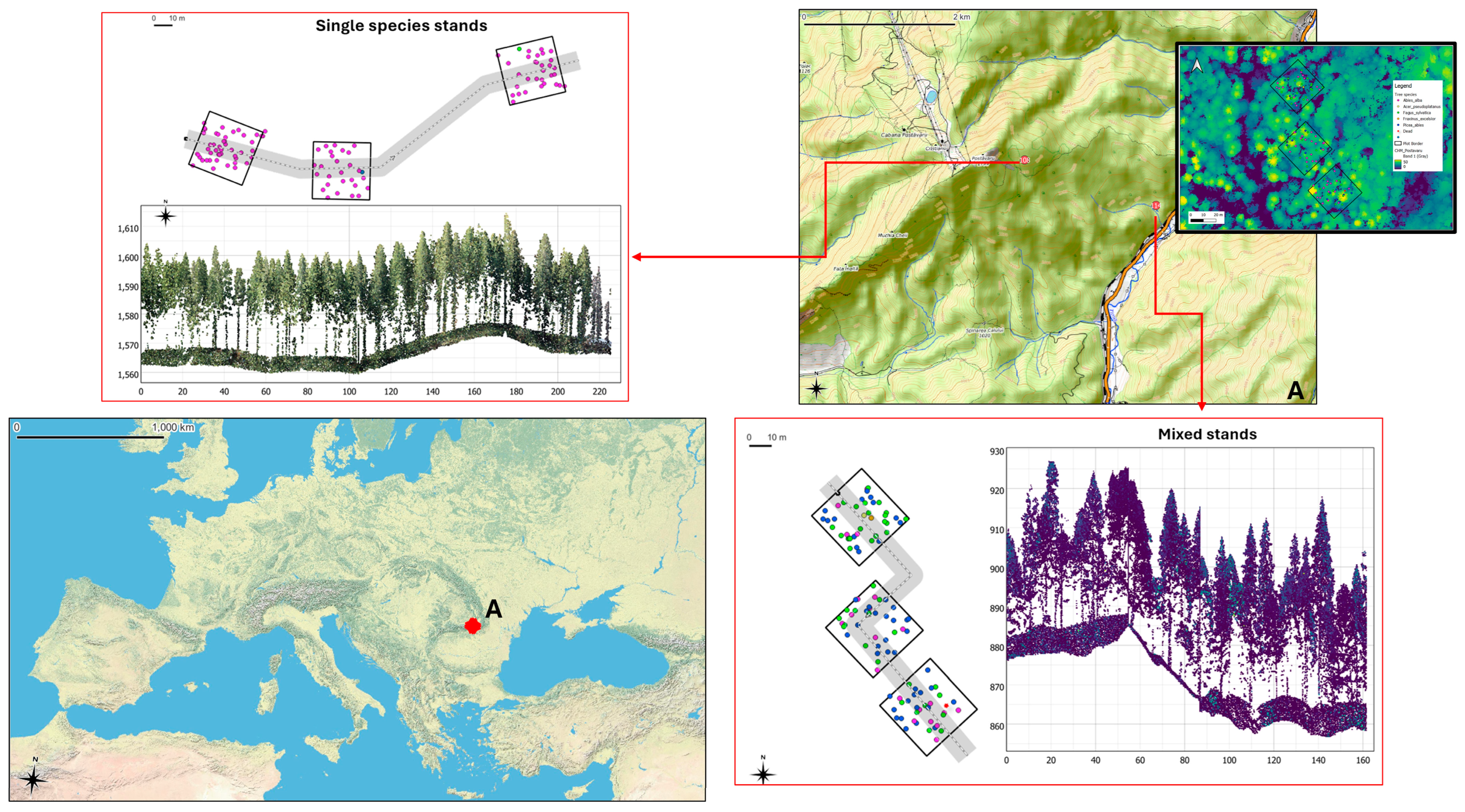
The survey plots are located in naturally regenerated stands, dominated by Fagus sylvatica (European beech), Abies alba (silver fir), and Picea abies (Norway spruce). These stands are typical of montane mixed forests and are characterized by a high degree of structural heterogeneity, with multiple canopy layers, dense understory vegetation, and significant volumes of standing and fallen deadwood. Accessibility is limited due to steep terrain and dense vegetation, simulating real-world conditions where traditional inventory techniques are less effective (Figure 1).
To allow comparison between mixed-forest conditions and simpler, single-species stands, we added three plots located in Picea abies-dominated forest of similar age, within the same area. These additional plots represent structurally simpler conditions, enabling us to assess how sensor performance varies between heterogeneous and more homogeneous canopy structures.
The selection of species (Fagus sylvatica, Abies alba, and Picea abies) was based on their prevalence in Romania’s high conservation value forests, particularly in mountainous regions, where most of these forests are located [33]. Moreover, these species are dominant in temperate montane forests across Central and Eastern Europe, including the Carpathians, Alps, and Dinaric Mountains [34,35]. These species represent contrasting structural and morphological traits: broadleaf beech forms dense, more round, horizontally layered crowns, and fir develops intermediate architectures with persistent lower branches, while spruce exhibits narrow, conical crowns with reduced understory shading [34]. Such differences in crown layering, branching density, and bark reflectance directly influence LiDAR signal interactions, affecting both canopy height detection and stem visibility [25,35,36]. Furthermore, these species often occur in mixed stands that present high structural heterogeneity, a condition representative not only of the Carpathian region but also of temperate mixed forests across Europe [37].
Although the six plots are located within the same protected area in the Postăvaru Mountains to ensure similar climatic and edaphic conditions, they are distributed across two contrasting stand types: (i) mixed Fagus sylvaticaAbies albaPicea abies forests with high structural heterogeneity, and (ii) Picea abies-dominated stands of more homogeneous structure. The distance between the most distant plots is approximately 2.3 km, and the design of the plots are triplets on the same altitude (Figure 1). This spatial arrangement balances logistical feasibility with representation of structural variability relevant to montane forests in the Carpathians.

2.2. Field Data Collection

We established six rectangular plots, each covering 900 m2, located within the same forest district but representing different stand types. POS-1 plots correspond to mixed-species stands dominated by Abies alba, Fagus sylvatica, and Picea abies, while POS-3 plots correspond to single-species Picea abies stands. Ground truth data were collected in May 2025 across six sample plots—three mixed-species plots and three Picea abies-dominated plots. The plots were selected to represent contrasting combinations of species dominance, canopy density, and topographic variation. Within each plot, trees were selected for measurement based on visibility and spatial separation to minimize ambiguity in later point cloud matching. A total of 114 trees were measured in the mixed-species plots encompassing a mix of dominant, co-dominant, and suppressed individuals and 104 trees in the Picea abies plots.
Table 1 summarizes the main structural attributes and diversity indices, illustrating marked differences in species richness and stand structure despite the relative proximity of the plots.
For each tree, DBH was measured using a diameter tape at 1.3 m height above ground, following standard forestry protocol. Total tree height was recorded using a Haglöf Vertex IV ultrasonic hypsometer (Haglöf Sweden AB, Långsele, Sweden). The instrument was positioned at a fixed horizontal distance from the tree, and height was calculated by triangulation using inclination and distance measurements. Each measurement was repeated twice, and the average was used to reduce observer-related variability. Tree species were recorded for all individuals, and spatial coordinates were acquired using a Trimble GNSS receiver with sub-meter accuracy in open conditions.
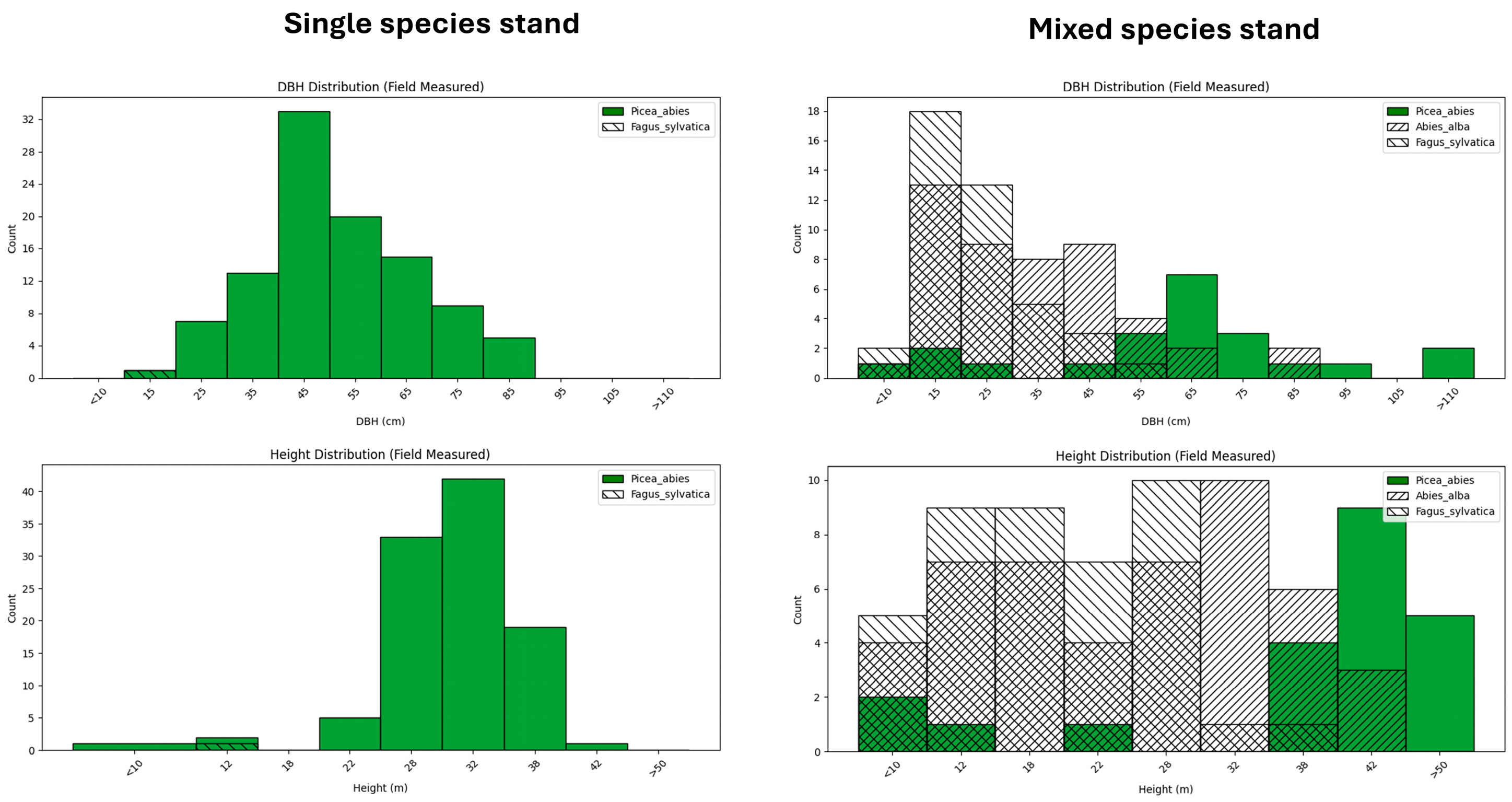
These field data served as reference measurements for evaluating the accuracy of UAV LiDAR and Mobile Laser Scanning (MLS)-derived estimates. The DBH and height distributions for each species (Figure 2), highlight the range of tree sizes included in the analysis.

2.3. UAV LiDAR Acquisition and Processing

UAV LiDAR data were acquired using a DJI Matrice 300 RTK drone equipped with a DJI Zenmuse L1 LiDAR sensor. The Zenmuse L1 integrates a Livox AVIA laser scanner, China, a high-precision IMU, and a GNSS module to enable direct georeferencing and real-time kinematic (RTK) corrections. Flights were conducted during stable weather conditions to ensure safe operation and consistent data quality. The drone was flown at a height of approximately 70 m above ground level, with 70% overlap between flight lines and 60% side overlap, following a systematic grid pattern to maximize point coverage.
The sensor generated point clouds with an average density of 500–700 points/m2 over the forested plots. Raw LiDAR data were processed using DJI Terra to perform initial trajectory correction and point cloud generation. Ground classification was completed using the Cloth Simulation Filter (CSF) in DJI Terra, and a digital terrain model (DTM) was created at 0.25 m resolution. A Canopy Height Model (CHM) was obtained by subtracting the DTM from the digital surface model (DSM). For each field-measured tree, a 2 m circular buffer was created around the GNSS position, and the maximum, mean, and median values of the CHM within this buffer were extracted as potential height estimates. These were used to compare the effectiveness of different UAV-derived height metrics.
Due to the top-down acquisition perspective of UAV LiDAR, DBH could not be estimated directly and was not included in the UAV dataset. While UAV LiDAR is typically used for canopy height modeling rather than stem mapping, recent studies have demonstrated initial attempts at stem detection and DBH estimation from UAV-based LiDAR, usually in plantations or less complex forest ecosystems [38,39]. These approaches rely on very high point densities, advanced stem segmentation algorithms, and optimized flight trajectories designed specifically for stem exposure, often under conditions of low canopy closure or leaf-off seasons. In contrast, the present study focused on leaf-on, multi-layered, spatially heterogeneous forests where UAV LiDAR point densities and canopy occlusion strongly limit ground and stem visibility.

2.4. Mobile Laser Scanning (MLS) Acquisition and Processing

Mobile Laser Scanning data were collected using a GeoSLAM ZEB-HORIZON scanner, UK, operated in backpack mode. The system uses a 360° rotating LiDAR sensor operating at 300,000 points per second and integrates SLAM-based positioning to allow GNSS-free georeferencing, ideal for dense canopy or steep terrain. Each plot was scanned using looped walking trajectories designed to maximize visibility of stems and crowns from multiple angles, including zig-zag passes and perimeter loops [1].
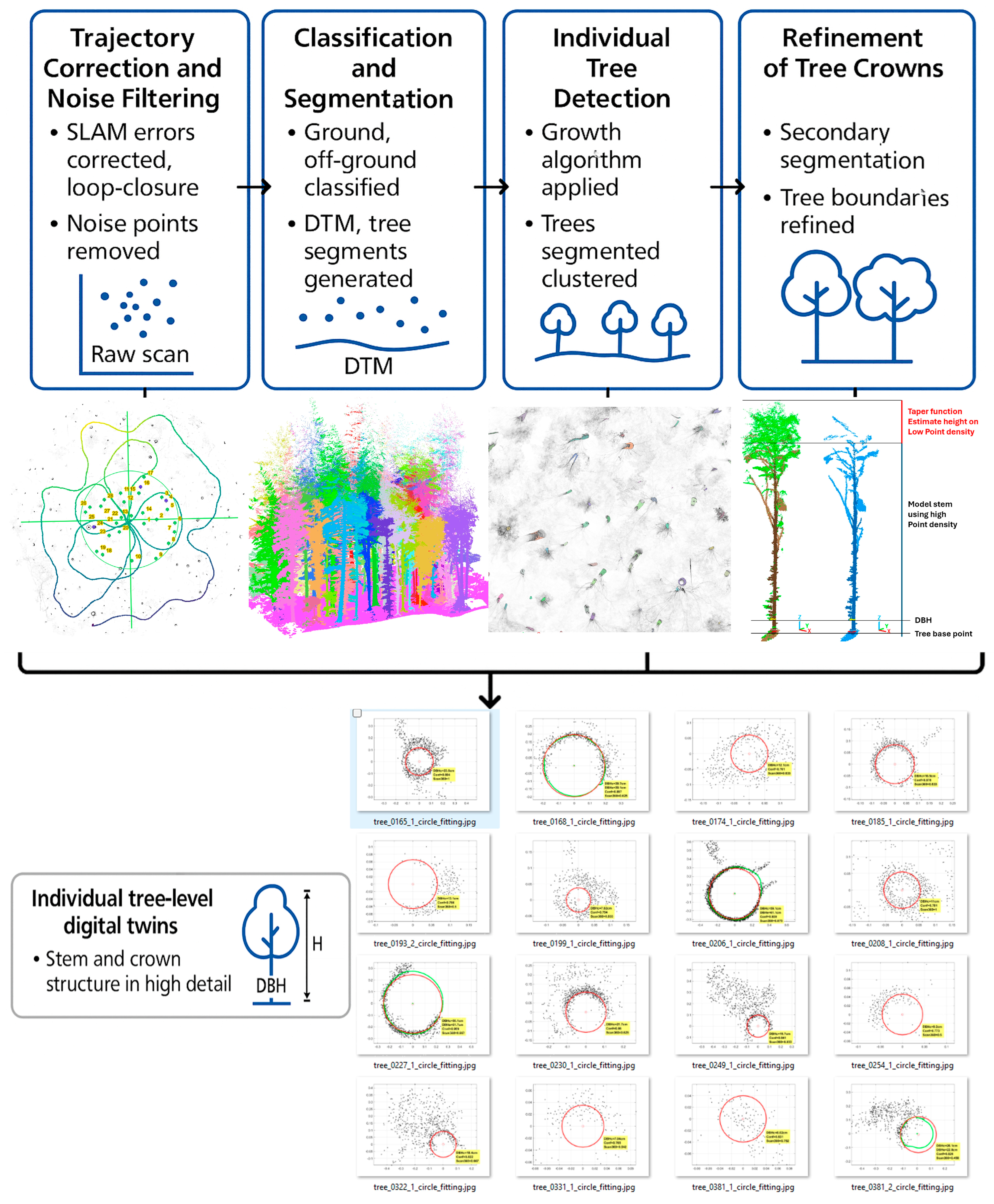
The raw scan data were processed using the VirtSilv workflow, a modular processing chain developed for high-resolution forest structure analysis [1]. The processing pipeline includes several key stages:
  • Trajectory Correction and Noise Filtering: SLAM errors were corrected through loop-closure algorithms, and noise points were removed using statistical outlier filtering.
  • Classification and Segmentation: Points were classified into ground and off-ground returns. Ground points were used to construct a Digital Terrain Model (DTM), while off-ground points were used for tree segmentation.
  • Individual Tree Detection: Off-ground points were segmented into individual trees using an accretion-based growth algorithm. Starting from seed points representing local apexes, points were progressively clustered based on vertical connectivity and spatial coherence. The algorithm takes three steps to estimate each tree’s footprint simultaneously. It begins at a large nucleus of points with high density and then grows by accretion until it meets neighboring trees.
  • Refinement of Tree Crowns: In dense stands or regeneration patches where trees overlapped or were double-stemmed, a secondary segmentation step was applied. This used local neighborhood rules (crown diameter, minimum tree distance) and manual correction to refine tree boundaries and reduce merging errors.
The final product consisted of individual tree-level digital twins, combining stem and crown structure in high geometric detail (Figure 3). These 3D reconstructions enabled extraction of structural metrics for each tree and were used for downstream modeling and accuracy assessment. Once all individual tree segments are identified, the next step is to recognize the tree trunks and model their numerical dimensions in a simple yet flexible way, enabling the digital twinning process. The VirtSilv algorithm addresses the limitations of current techniques by assuming that, within sufficiently small height intervals, the trunk shape can be accurately approximated by a series of inclined conical frustums. The vertical projection of each segment is represented by a dense ring of points, providing reliable cross-sectional information, while successive vertical segments are generally well aligned, ensuring that angular deviations and bending remain minimal along the stem axis. For each segmented tree, the lowest visible stem point (typically ground contact) and the highest crown point were identified. The vertical distance between these two points was recorded as the total tree height. This method leveraged the high vertical point density (~15,000 pts/m2) of the MLS scans and proved robust for most trees. Regarding DBH, a horizontal cross-section of 10–20 cm thickness was extracted at 1.3 m above the local DTM to capture the stem profile at breast height. Points in this slice were analyzed using a polygon-fitting algorithm capable of adapting to elliptical or irregular contours. The equivalent circular diameter of the fitted polygon was used as the DBH estimate.

2.5. Occlusion Mapping

Occlusion was quantified by comparing MLS and UAV occupancy within a shared three-dimensional voxel grid (edge length 0.5–1.0 m). To eliminate slope effects, both point clouds were terrain-normalized prior to analysis. A digital terrain model was computed from the 5th percentile of elevation in a 1 m grid and holes were filled by nearest-neighbor propagation; point heights were then converted to height-above-ground (HAG). Three HAG layers were analyzed per plot: ground (P0–P30), mid-canopy (P30–P70), and top-canopy (P70–P100). For each layer and sensor we counted occupied voxels and derived the union, intersection, and sensor-specific sets. “Top-down occlusion” was defined as the fraction of union voxels occupied only by MLS, and “bottom-up occlusion” as the fraction occupied only by UAV. Point densities (pts m−3) were computed over the union volume. For interpretation, voxel counts were collapsed along the vertical axis to produce plan-view rasters: a categorical map identifying columns seen by both sensors, MLS only, or UAV only (presence anywhere in the column within the layer), and a ratio map of MLS to MLS + UAV.

2.6. Data Integration and Accuracy Assessment

To match field-measured trees with LiDAR-derived trees, we used a top-view orthographic map of the forest floor generated from the MLS point cloud. This approach minimized the influence of GNSS positional errors, which under dense canopy conditions can exceed ±3 m, even with post-processing corrections [40]. Field tree positions, initially recorded with a Trimble GNSS receiver, were visually aligned with the segmented tree locations on the MLS-derived top view. This allowed precise correspondence between measured and modeled trees, even in areas with overlapping crowns or reduced GNSS accuracy.
Tree segmentation was performed following the VirtSilv workflow, which includes trajectory correction, noise filtering, point classification, individual tree delineation, and crown refinement. This segmentation process was previously tested and validated in similar forests [1]. The matching procedure ensured that each field-measured tree was linked to the correct digital twin derived from MLS.
For UAV-derived height estimation, the MLS and UAV point clouds were co-registered to achieve perfect alignment using the Fine Registration (ICP) tool in CloudCompare, starting from a roughly aligned state. Once aligned, the MLS-validated tree positions were used as spatial references to extract corresponding UAV point clouds for each tree. Tree height was calculated as the difference between the highest point in the UAV point cloud within a 2 m buffer around the tree center and the local ground elevation from the MLS-derived DTM. This process ensured that UAV height estimates corresponded precisely to the same individual trees measured in the field and segmented in the MLS data.

3. Results

3.1. Accuracy of MLS in Estimating Tree Height and DBH

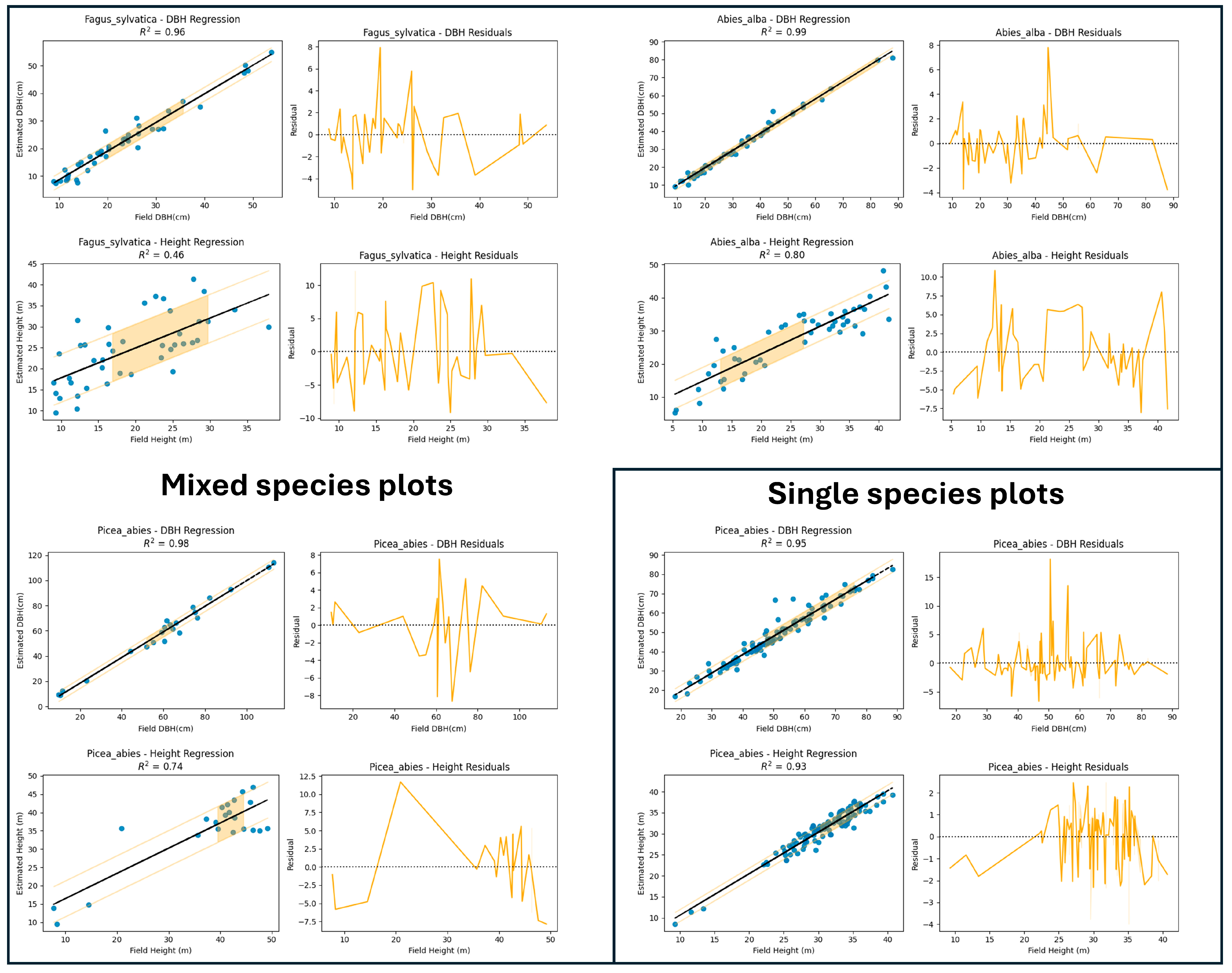
Regression analysis revealed that the Mobile Laser Scanning (MLS) system produced highly accurate DBH estimates across the three studied species, with Abies alba demonstrating the strongest performance. In mixed-species plots, Abies alba achieved a near-perfect correlation with field-measured DBH (R2 = 0.99), while in single-species plots, Picea abies maintained similarly high accuracy (R2 = 0.95). Residual distributions for this species showed minimal bias, indicating consistent accuracy across the DBH spectrum. The high performance can be attributed to the species’ straight, cylindrical stems and reduced interference from lower branches, which allowed optimal laser penetration and accurate diameter reconstruction. (Figure 4).
Fagus sylvatica also performed well in DBH estimation in mixed plots (R2 = 0.96), with residuals symmetrically distributed around zero, suggesting no strong systematic bias. By contrast, height estimation proved more challenging across all species. Picea abies achieved the highest agreement between MLS-derived and field-measured heights (R2 = 0.74 in mixed plots and R2 = 0.93 in single-species plots), reflecting the advantages of its narrow, conical crown in facilitating apex detection. Abies alba showed moderate accuracy (R2 = 0.80), while Fagus sylvatica had the lowest performance (R2 = 0.46), with underestimation increasing in taller individuals. This underperformance is likely linked to occlusion in the upper canopy, where limited scanner perspective and dense crown layers hindered accurate apex detection (Figure 4).

3.2. Influence of Plot Structure on Estimation Accuracy

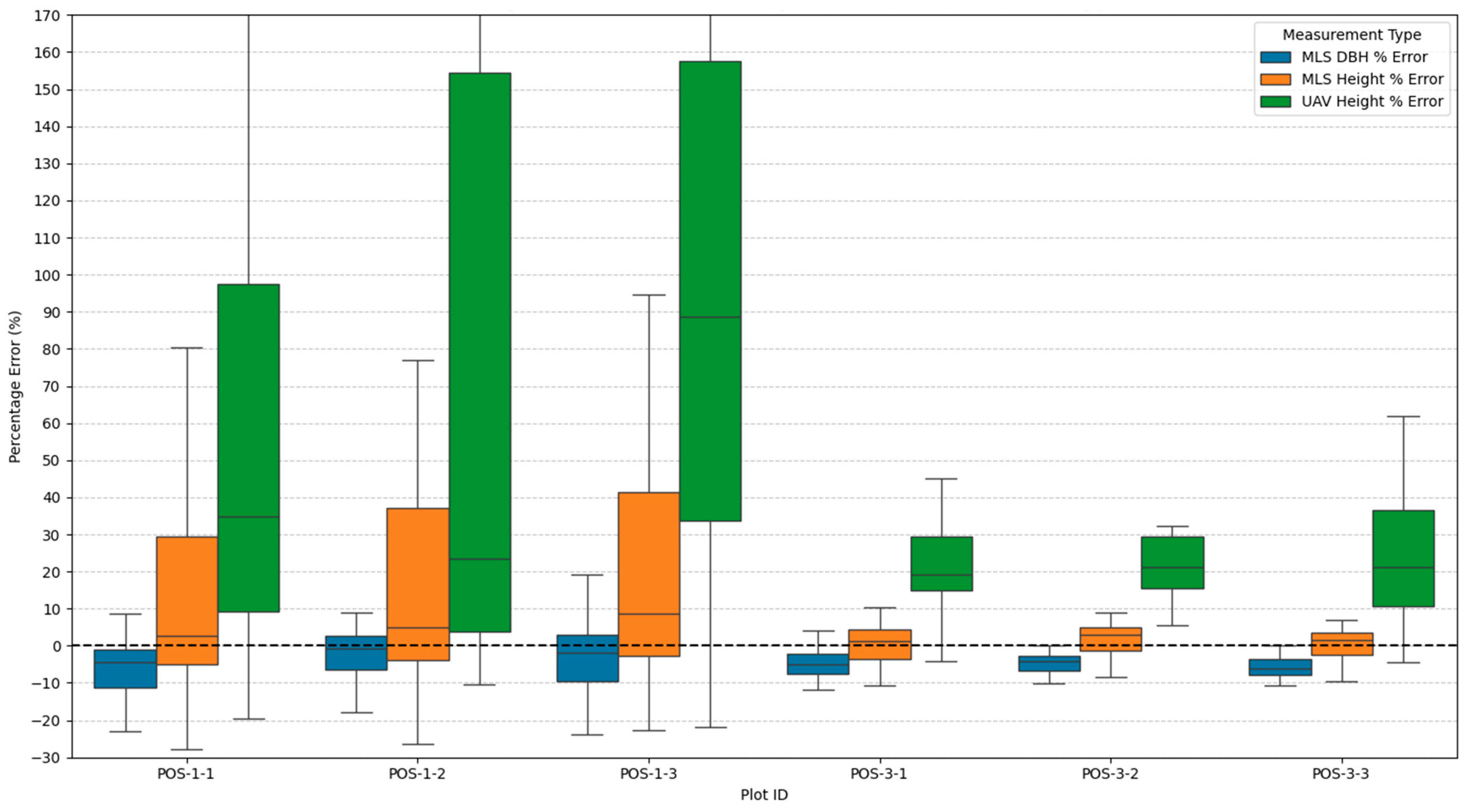
Statistical tests showed that plot type exerted a notable influence on height estimation errors, whereas DBH accuracy was relatively stable across plots. Kruskal–Wallis analysis indicated no significant differences in MLS DBH percentage errors between plots (p = 0.134), with mean percentage deviations ranging from –6.55% in POS-1-1 to –2.40% in POS-1-3 (Figure 5. However, MLS height percentage errors differed significantly between plots (p = 0.024). Mixed plots exhibited mean overestimations in the range of 14%–25%, while single-species plots showed far smaller deviations, between 0 and 1.8%.
The differences were even more pronounced for UAV-derived heights, where highly significant differences between plots were found (p < 0.001). The first three plots, which are mixed-species plots, showed a tendency towards overestimation, with the median percentage error for UAV height ranging from approximately 30% to over 90%. In contrast, the single-species plots (POS-3-1, POS-3-2, POS-3-3) exhibited much lower variability and a median error closer to 10%–20%. These patterns indicate that structural complexity, particularly in mixed plots, exerts a strong influence on the accuracy of both MLS and UAV-derived height estimates, though UAV data are more affected (Figure 5).

3.3. Accuracy of UAV-Derived Tree Heights

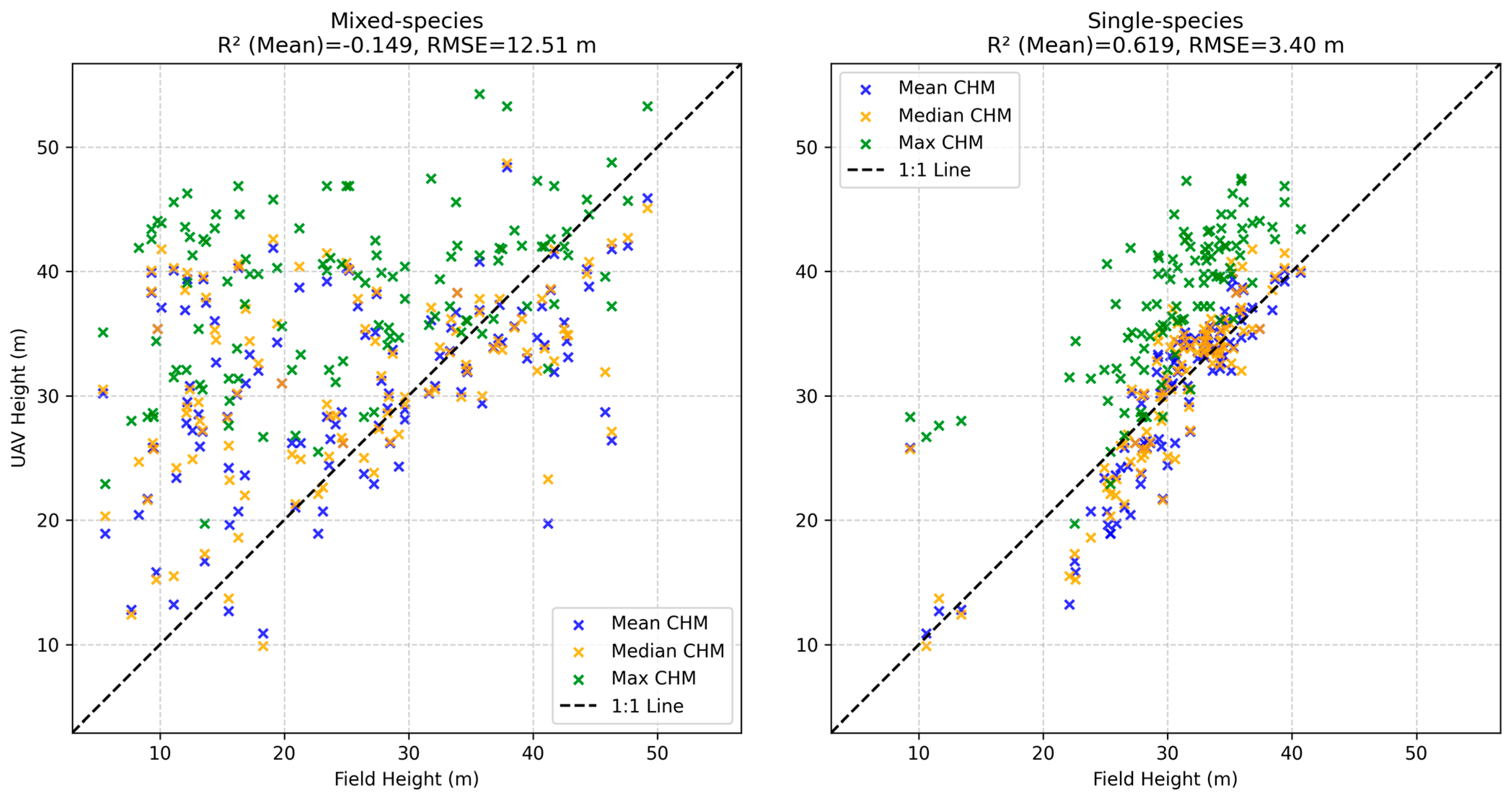
Comparison of field-measured heights with UAV-derived estimates from canopy height models (CHMs) confirmed a consistent underestimation trend across both mixed- and single-species plots (Figure 6). Among the tested UAV height metrics—the mean, median, and maximum height within a 2 m buffer around each tree—the performance differed markedly between plot types.
In mixed-species plots, UAV-derived heights showed poor correlation with field data, with R2 values of −0.149, −0.210, and −1.210 for the mean, median, and maximum CHM heights, respectively. Corresponding RMSE values reached 12.51 m, 12.83 m, and 17.35 m (Table 2). The negative R2 values and large errors highlight that UAV-derived CHM heights often failed to capture true canopy apices in these structurally complex stands. Multiple canopy layers, irregular crown shapes, and shading from taller neighbors likely hindered accurate apex detection and introduced substantial variability.
In single-species plots (dominated by Picea abies), performance improved considerably for mean and median CHM heights, with R2 values of 0.619 and 0.629 and RMSE values of 3.40 m and 3.36 m, respectively. The more uniform canopy structure in these stands likely facilitated better detection of treetops from UAV imagery. However, the maximum CHM height metric still performed poorly (R2 = −1.219; RMSE = 8.21 m), suggesting that outlier pixels or noise in the CHM can lead to large errors when using maximum values directly.
Overall, mixed-species plots exhibited larger errors and greater variability in UAV height estimates than single-species plots, confirming that forest structural complexity strongly influences UAV-based height measurement accuracy.
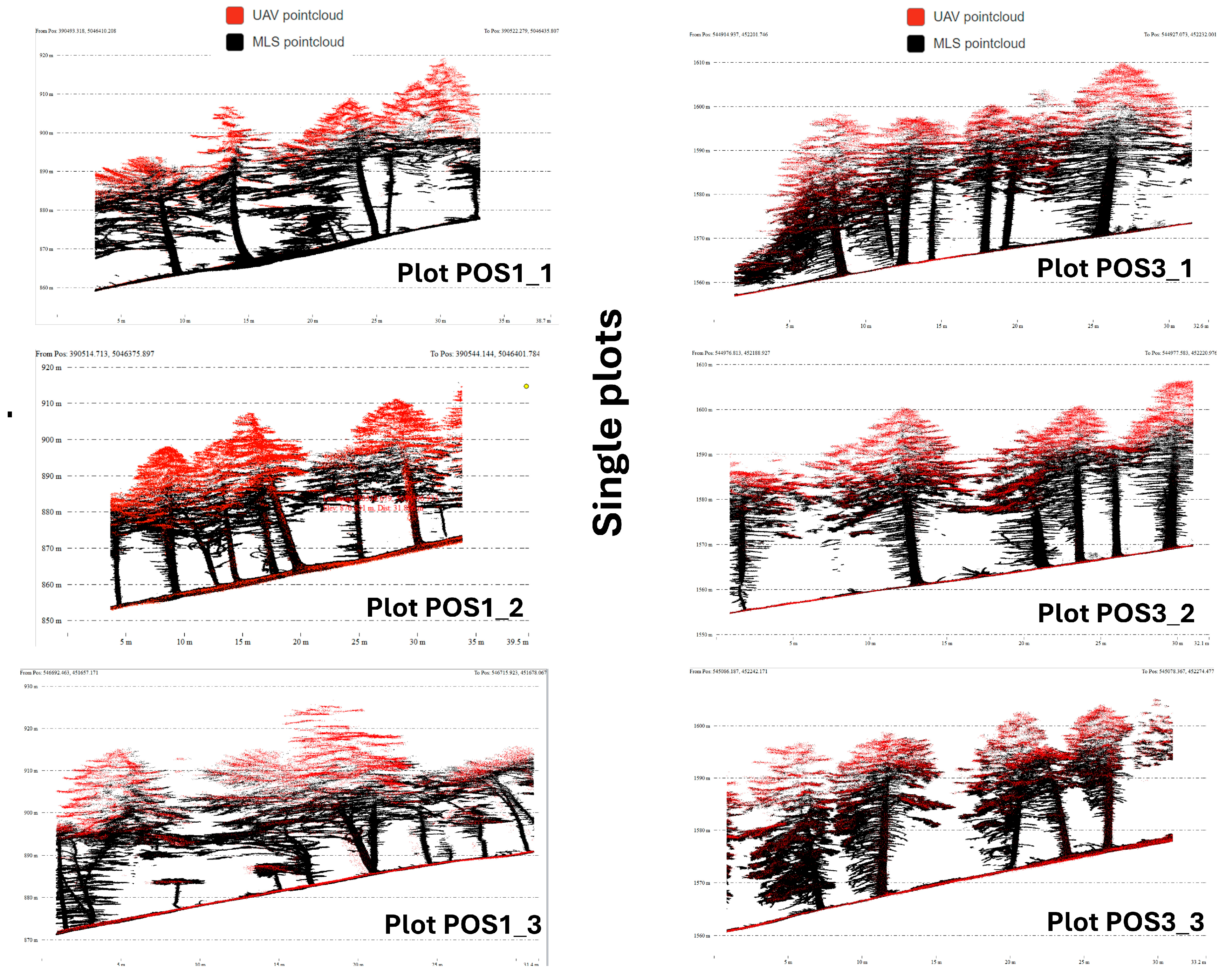
Direct overlays of MLS and UAV point clouds (Figure 7 and Figure 8) showed that UAV data primarily captured the outer canopy surface, missing stems and lower crown structures—especially for suppressed and intermediate trees. This limitation was particularly clear in mixed plots POS1_2 and POS1_3, where entire mid-canopy layers were absent from the UAV dataset. In contrast, MLS data reconstructed complete stem profiles and lower branch architecture, even in dense stands.
In all six plots (Figure 8), the UAV data accurately delineates the canopy surface but fails to consistently capture stems and lower crown layers. This is especially visible in POS3_2 and POS3_3, where several intermediate and suppressed trees are not represented in the UAV dataset. In contrast, the MLS point cloud reconstructs full stem profiles and branching structures, even in the lower vegetation strata.
Vertical alignment between the two datasets is generally consistent, supporting the quality of the georeferencing workflow. However, slight vertical and horizontal mismatches were observed in the tips of the crowns, likely due to differences in data acquisition angles and segmentation boundaries.

3.4. Visual Analysis and Point Density Considerations

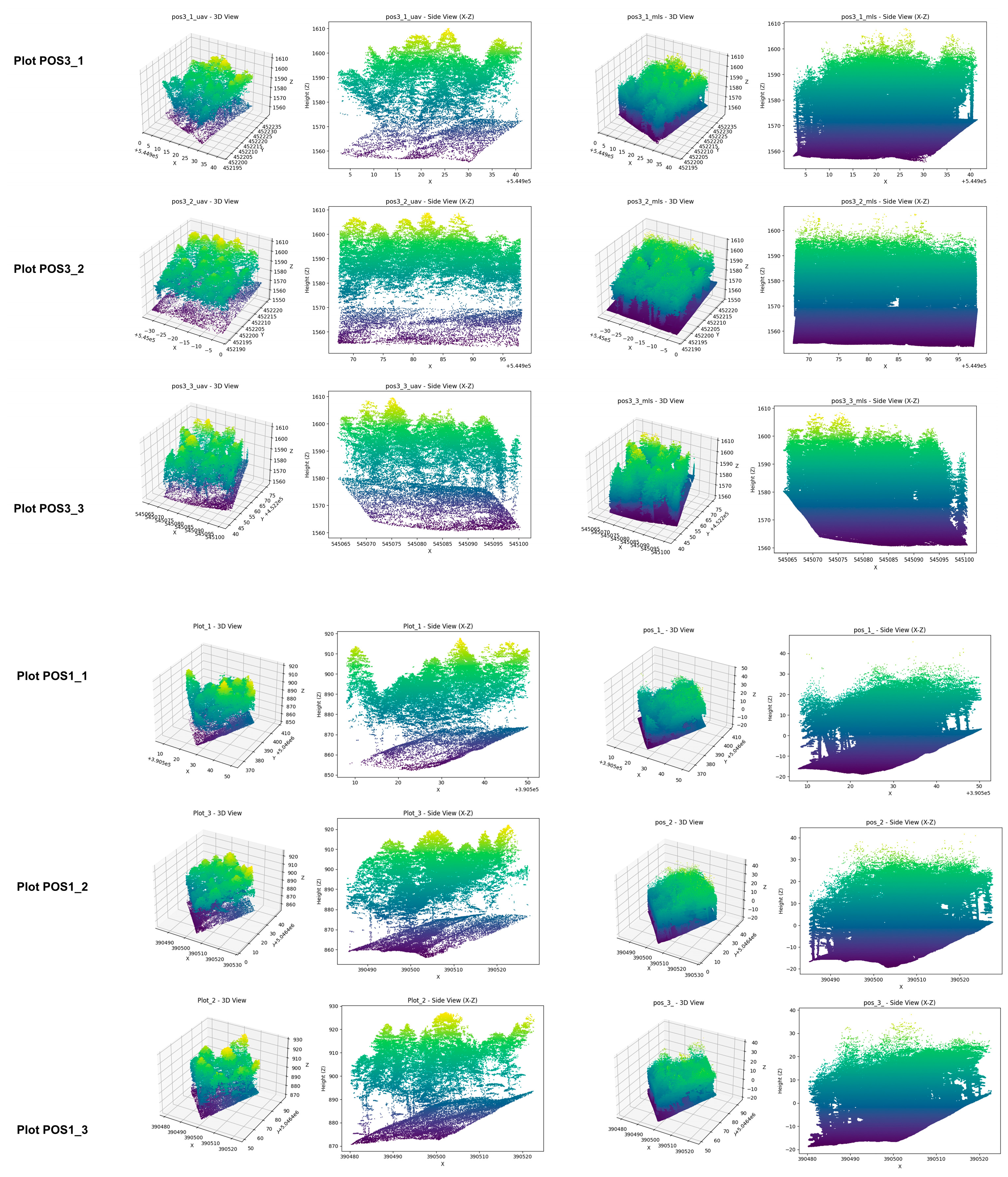
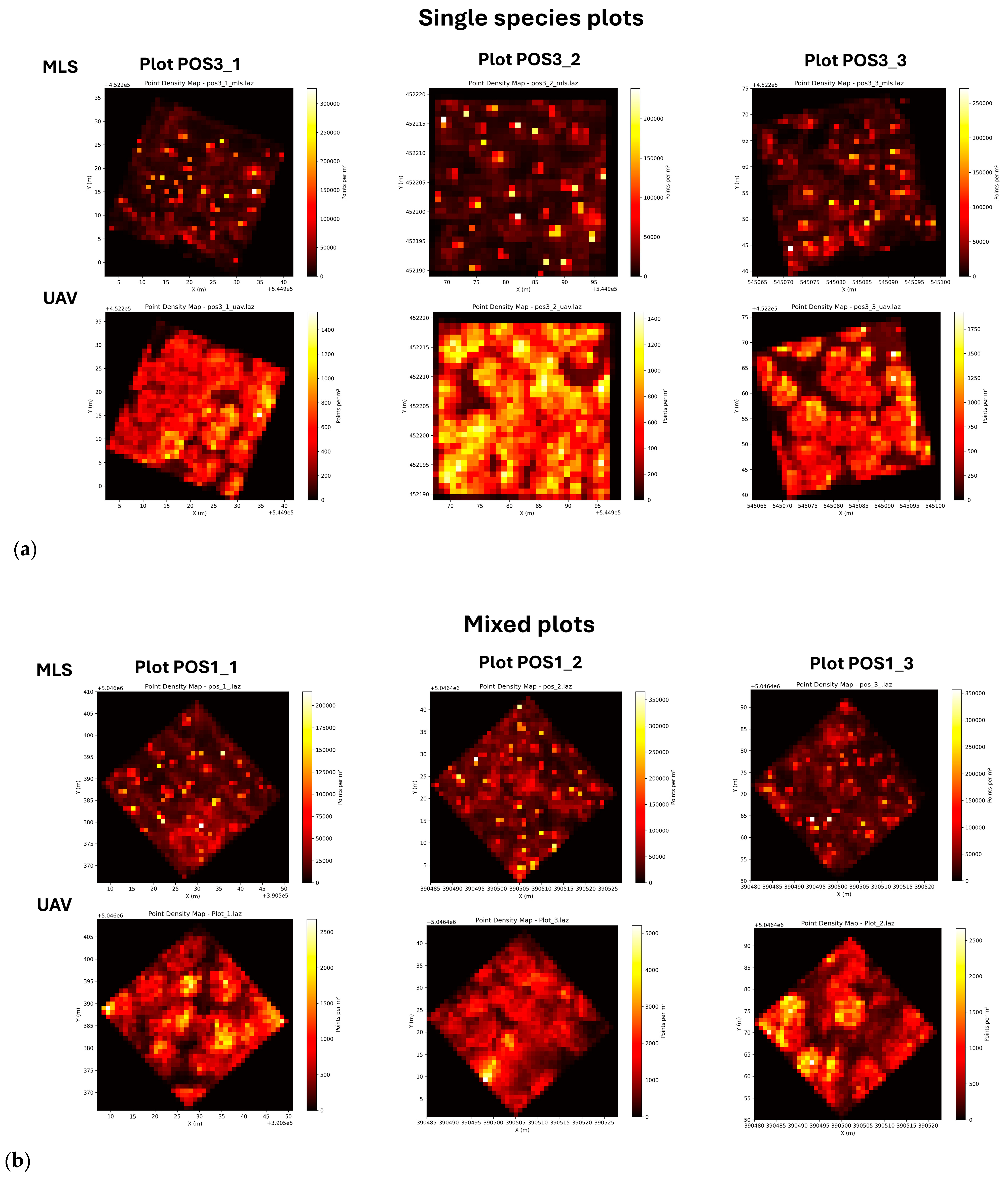
Visualization of point clouds confirmed the complementary nature of UAV and MLS datasets. MLS point clouds showed comprehensive structural detail from ground to canopy, including stems and lower crowns. In contrast, UAV point clouds captured only the upper canopy layers, with reduced penetration to lower strata. This difference was also reflected in point density maps: MLS densities exceeded 150,000 pts/m2, compared to UAV’s 500–3000 pts/m2, with UAV density varying with slope and canopy openness (Figure 9).
Overlaid side views (X-Z) illustrated how MLS and UAV data align vertically but diverge in their ability to capture lower canopy elements. Intermediate and suppressed trees, visible in MLS data, were often missing in UAV scans. Despite accurate georeferencing, slight mismatches in crown tips highlighted the impact of different scanning angles and segmentation thresholds.

3.5. Analysis of Occlusion and Canopy Layering Limitations

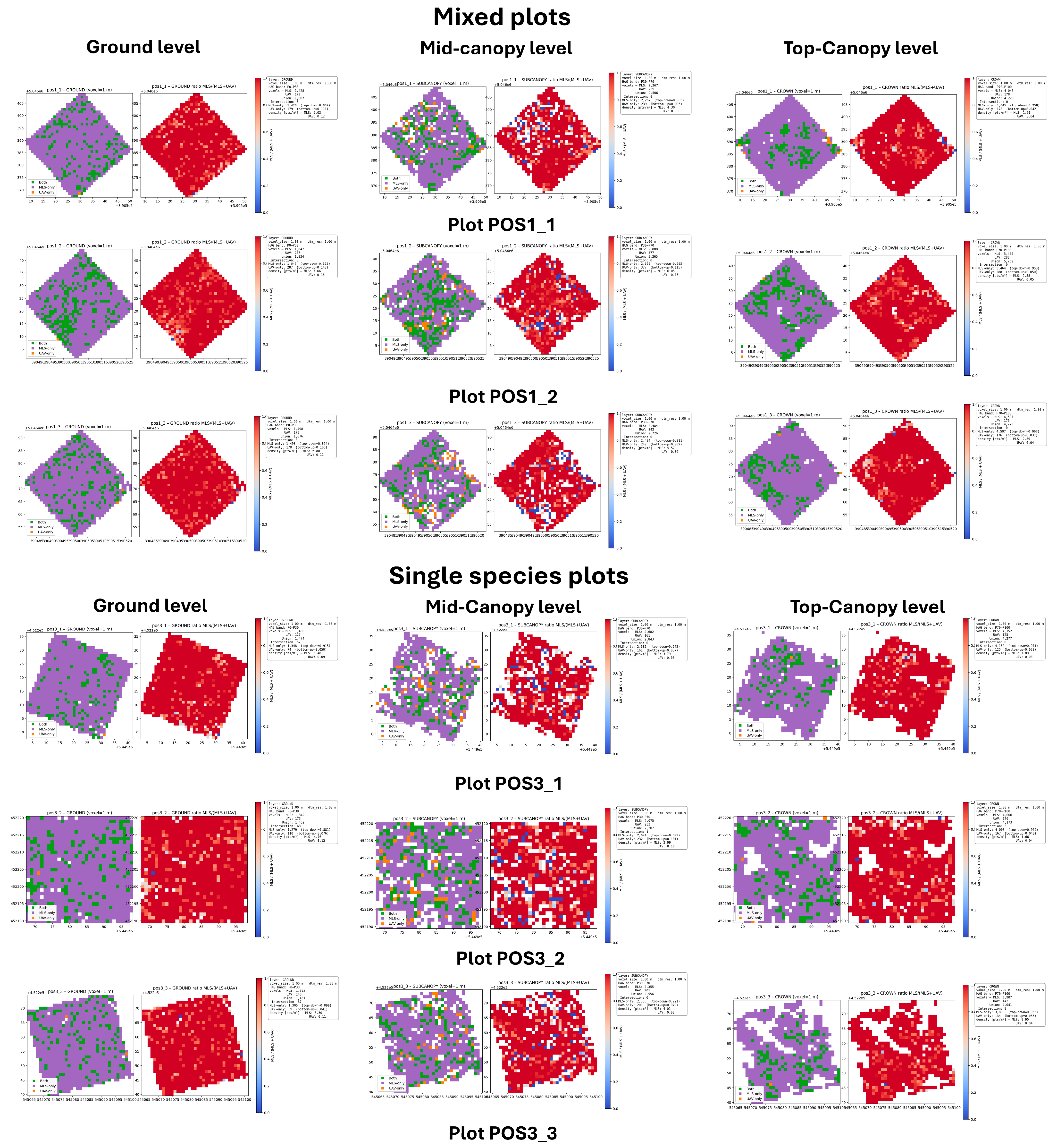
Across all plots and layers the analysis revealed strong, systematic top-down occlusion. In the crown layer (Figure 10), representative values from the metric panels show MLS-only fractions of 0.970 for POS3_1 (UAV-only = 0.030; union = 4 075 voxels) and 0.969 for POS3_2 (UAV-only = 0.031; union ≈ 5 811), with union-volume densities of roughly 9–10 pts m−3 for MLS and ~0.25 pts m−3 for UAV. Mid-canopy results remained MLS-dominated: for POS3_2 the MLS-only fraction was 0.947 and UAV-only 0.053 (union = 4490), with densities near 16.4 and 0.43 pts m−3 for MLS and UAV, respectively. Near the forest floor, UAV penetration was minimal; for POS3_2 ground the MLS-only and UAV-only fractions were 0.936 and 0.054 (union = 2802; intersection = 28), with densities ~19.7 and 0.52 pts m−3. Taken together, these values indicate that more than 93% of the observable voxel volume within each layer is visible only to MLS, while UAV-only coverage rarely exceeds 6% (Figure 10).
Comparisons between single-species Picea abies plots and mixed-species plots show similar averages for the occlusion ratios. Mixed stands display more patchy spatial patterns in the categorical and ratio maps—particularly in the mid-canopy and top-canopy—consistent with heterogeneous crowns and localized gaps, but the mean fractions differ from the single-species plots by only a few percentage points and do not alter the overall balance. In both plot types, UAV predominantly delineates the outer canopy surface whereas MLS supplies nearly all information below the canopy, including stems and lower crowns. These findings justify a hybrid workflow in which MLS is used for stems and understory structure and UAV for the canopy envelope.

4. Discussion

4.1. Comparison of UAV and MLS Performance in Height and DBH Estimation

In line with objective (i), we emphasize that UAV LiDAR was used exclusively for height estimation, whereas DBH was derived only from MLS. The UAV LiDAR captured dominant and co-dominant apices where crowns were well exposed, but height was overestimated for the dominated trees especially in the mixed species plots. This pattern, evident in the regressions and residuals (Figure 4, Figure 5 and Figure 6; Table 2), accords with the smoothing intrinsic to CHMs and limited pulse penetration in vertically layered, leaf-on forests [37]. In the single-species Picea abies plots the mean/median CHM metrics reached moderate agreement with field height, while mixed plots exhibited larger, more variable overestimation, consistent with greater vertical heterogeneity.
MLS delivered reliable height estimates for intermediate and understory trees, benefitting from high local point density and a ground-based perspective that provides line-of-sight into lower crowns; occasional overestimation occurred where bright returns within dense crowns were misidentified as apices, a limitation reported for SLAM trajectories in closed forests [41,42]. For DBH, MLS was performing well as deviations were typically <2 cm across species, reflecting dense stem sampling and robust geometric fitting at 1.3 m. Focusing on P. abies to compare stand structure, MLS achieved very high DBH accuracy in both conditions—near-perfect agreement in mixed plots (R2 ≈ 0.98) and similarly strong performance in single-species plots (R2 ≈ 0.95)—with residuals showing minimal bias. Overall, MLS DBH accuracy was stable across stand types, while height accuracy for both platforms was more sensitive to canopy layering and occlusion, which are quantified in Section 4.2 below.
While previous studies have demonstrated UAV LiDAR efficiency for canopy mapping [17,29,36,43] and MLS accuracy for stem detection [9,26,35,44,45], most were conducted in relatively simple or single-layered forests. Our results extend this evidence base by providing quantitative analysis from structurally complex, multi-layered, leaf-on stands, showing how canopy closure and vertical layering govern the complementary roles of UAV and MLS under specific operational conditions.

4.2. Influence of Tree Species and Forest Structure

Addressing objective (ii) through the lens of our occlusion analysis, we found that top-down occlusion—the fraction of union voxels visible only to MLS—was consistently high across all plots and layers (≈0.93–0.97), while bottom-up occlusion from the MLS perspective remained low (≈0.03–0.06), and true co-coverage was minimal. Comparing mixed versus single-species (Picea abies) stands, the categorical and ratio maps showed greater spatial patchiness in mixed plots (more small UAV-only pockets along gaps), but the layer-averaged occlusion rates differed by only a few percentage points, indicating broadly similar net visibility between stand types. In other words, structural heterogeneity modulates where occlusion appears, not how much total volume each platform sees. This pattern is consistent with the idea that vertical layering and canopy closure—more than species identity per se—govern sensor line-of-sight and thus height recoverability [17,22].
Species traits still matter locally. The higher MLS DBH accuracy in P. abies reflects regular stem form and sparser lower crowns that preserve trunk visibility, whereas according to previous studies irregular stems and denser basal foliage in Fagus sylvatica can obscure the stem and reduce local coverage [9]. However, these species effects did not overturn the occlusion balance: even in mixed stands the MLS-only fraction remained dominant in crown, subcanopy, and ground layers, aligning with established platform roles—UAV delineates the canopy envelope; MLS resolves stems and lower strata [15,20,21].

4.3. Sources of Uncertainty and Limitations

Objective (iii) focused on limitations imposed by occlusion and vertical layering; our results show that these factors dominate the error budget for both platforms. UAV LiDAR height underestimation increased with canopy closure and tree height, reflecting restricted pulse penetration and CHM smoothing under leaf-on conditions, as widely reported for vertically complex stands [36,43]. The voxel analysis makes this explicit: across plots and layers, ~0.94–0.97 of the union volume was visible only to MLS, while UAV-only fractions were ~0.03–0.06, leaving little true co-coverage. Consequently, UAV seldom observes the interior crown and subcanopy volumes that determine true apex height in mixed, multilayered forests.
For MLS, trajectory design and SLAM behavior were critical. Where path geometry provided strong loop closures and diverse view angles (zig-zag passes plus perimeter loops), drift was minimized and vertical completeness improved; in feature-sparse corridors or with long, weakly constrained segments, SLAM drift and pose noise increased, producing local misalignments and occasional apex omission—well-known sensitivities of SLAM in closed forests [41,46]. Because visibility from the ground is inherently directional, insufficient angular diversity around tall crowns amplifies self-occlusion and reduces the likelihood of observing the true apex, even when overall point density is high. Thus, MLS accuracy depends as much on where and how the operator walks as on nominal sensor specifications.
Cross-platform alignment is a second source of uncertainty. Despite careful ICP co-registration, small horizontal and vertical residuals persisted and likely contributed to height differences near plot edges, particularly where crowns are narrow or overhanging, consistent with prior reports that co-registration precision constrains inter-sensor comparisons in forest canopies [1,7]. Height-above-ground (HAG) normalization mitigated slope artifacts but introduces sensitivities: DTM resolution and the low-percentile ground filter control the HAG; over-smooth DTMs can depress HAG in concavities, whereas under-smooth DTMs can inflate HAG over rough ground, subtly shifting percentile bands and layer membership. Voxel size trades spatial detail for stability; subsampling primarily affects density estimates rather than occupancy at the resolutions used.
Finally, the study was conducted in a single, leaf-on season across a modest number of plots. Leaf-off acquisitions typically increase ground and lower-crown visibility for both platforms, reducing occlusion-driven bias [47,48]. Broader structural gradients and multi-season data would improve generality and permit formal variance partitioning among trajectory design, occlusion, and co-registration. Even so, within these constraints, the patterns we observe—UAV dominance at the canopy envelope, MLS dominance below, and limited co-coverage—are consistent with established platform roles in heterogeneous forests [15,20,21].
We acknowledge that some DBH and height classes, particularly at the extremes of the distribution, were represented by few individuals, which may limit the statistical robustness of error estimates in these size ranges. Future studies should incorporate larger sample sizes across broader structural gradients, ideally through multi-season acquisitions and expanded plot networks, to better capture variability in rarely represented tree classes.

4.4. Practical Implications and Recommendations

The findings translate into operational guidance aligned with the aims in the introduction (accurate height and DBH for inventory, biomass, carbon, and habitat assessments). UAV LiDAR should be deployed primarily for rapid, canopy-level mapping and terrain modeling over large or inaccessible areas, where its strengths are coverage and efficient delineation of the canopy envelope [29,36,43]. In structurally complex stands, flight plans should prioritize high overlap and consistent viewing geometry; acquisitions outside peak leaf-on conditions can improve penetration and reduce height bias, as reported in seasonal studies [43,49]. Because UAV did not provide DBH in this study and offers limited information below the canopy, DBH and lower-crown structure should be obtained with MLS, which delivered inventory-grade diameters and reliable heights for intermediate and understory trees. For MLS, trajectory design is critical: loop closures, zig-zag passes, and perimeter loops reduce SLAM drift and increase angular diversity around crowns, improving vertical completeness and apex detection [41].
For integrated workflows, we recommend co-registration with robust ICP and routine quality checks against fixed references, followed by height-above-ground (HAG) normalization to remove slope effects before any cross-platform comparison. Occlusion mapping on a shared voxel grid (0.5–1.0 m) offers a practical diagnostic: in our plots, more than ~93% of the union volume per layer was visible only to MLS, while UAV-only coverage was ~3%–6%. This quantitative partitioning helps decide where UAV height products are trustworthy and where MLS is needed to fill subcanopy and stem blind spots. In conservation or research settings, a hybrid strategy is therefore advisable: use UAV to scale canopy height and surface structure efficiently, and MLS to supply DBH, stem form, and subcanopy detail, integrating the two for biomass and habitat modeling as advocated by recent multi-platform studies [42,50]. Future operational gains are likely from improved SLAM robustness, tighter co-registration, and automated fusion algorithms that leverage complementary coverage at plot-to-landscape scales.

5. Conclusions

This study compared UAV LiDAR and Mobile Laser Scanning (MLS) for estimating tree height and DBH in a structurally complex, natural forest. MLS provided highly accurate DBH measurements and reasonable height estimates for understory and mid-canopy trees. First, regarding accuracy and bias quantification, MLS achieved near-inventory accuracy for DBH across all species and plot types, while UAV LiDAR consistently underestimated tree height, particularly in multi-layered stands where canopy closure limited pulse penetration. Height estimation improved in single-species Picea abies plots, yet voxel analysis showed that over 93% of the forest interior volume was visible only to MLS, confirming its dominance below the canopy, while UAV primarily mapped the outer canopy surface.
Second, species traits and stand structure jointly influenced sensor performance. Picea abies achieved the highest DBH accuracy in both mixed plots and single-species plots, closely followed by Abies alba. Fagus sylvatica showed slightly lower accuracy but still with values close to 1, indicating minimal bias across species. For height estimation, however, structural complexity rather than species identity alone drove the strong underestimation observed in mixed-species plots, highlighting the importance of vertical canopy layering in determining UAV and MLS performance in heterogeneous forests.
Third, the analysis of occlusion confirmed the complementary roles of UAV and MLS for forest monitoring. UAV LiDAR is most effective for rapid, large-scale canopy mapping, while MLS provides the detailed stem and sub-canopy structure required for inventory, biomass, and carbon modeling.
For operational applications, we recommend hybrid UAV–MLS workflows combining canopy-scale UAV data with MLS-based stem geometry, supported by robust co-registration, trajectory optimization, and voxel-based occlusion diagnostics. Future research should include multi-season acquisitions to mitigate leaf-on occlusion effects, improve SLAM robustness for complex terrain, and develop automated UAV–MLS fusion algorithms. Scaling these methods across larger landscapes will further support sustainable forest management, biodiversity assessment, and climate-resilient conservation planning.

Author Contributions

Conceptualization, L.M. and M.D.N.; methodology, L.M. and G.M.T.; software, A.E.C.; validation, L.M., G.M.T., P.T.S. and A.E.C.; formal analysis, L.M.; investigation, L.M. and A.E.C.; resources, M.D.N.; data curation, A.E.C. and P.T.S.; writing—original draft preparation, L.M.; writing—review and editing, M.D.N., P.T.S. and G.M.T.; visualization, L.M.; supervision, M.D.N.; project administration, M.D.N.; funding acquisition, M.D.N. All authors have read and agreed to the published version of the manuscript.

Funding

This research received no external funding.

Data Availability Statement

The original contributions presented in the study are included in the article; further inquiries can be directed to the corresponding authors.

Acknowledgments

This research was conducted in the field plots established in the FORTRESS project (EP/Y003810/1—Forest ecosystems and their resilience to climate extremes across Europe).

Conflicts of Interest

The authors declare no conflicts of interest.

References

  1. Niță, M.D. Testing Forestry Digital Twinning Workflow Based on Mobile LiDAR Scanner and AI Platform. Forests 2021, 12, 1576. [Google Scholar] [CrossRef]
  2. Dutcă, I.; Cernat, A.; Stăncioiu, P.T.; Ioraș, F.; Niță, M.D. Does Slope Aspect Affect the Aboveground Tree Shape and Volume Allometry of European Beech (Fagus sylvatica L.) Trees? Forests 2022, 13, 1071. [Google Scholar] [CrossRef]
  3. Foley, J.A.; Defries, R.; Asner, G.P.; Barford, C.; Bonan, G.; Carpenter, S.R.; Chapin, F.S.; Coe, M.T.; Daily, G.C.; Gibbs, H.K.; et al. Global Consequences of Land Use. Science 2005, 309, 570–574. [Google Scholar] [CrossRef]
  4. Stylianidis, E.; Akca, D.; Poli, D.; Hofer, M.; Gruen, A.; Sanchez Martin, V.; Smagas, K.; Walli, A.; Altan, O.; Jimeno, E.; et al. FORSAT: A 3D Forest Monitoring System for Cover Mapping and Volumetric 3D Change Detection. Int. J. Digit. Earth 2020, 13, 854–885. [Google Scholar] [CrossRef]
  5. Hu, T.; Sun, Y.; Jia, W.; Li, D.; Zou, M.; Zhang, M. Study on the Estimation of Forest Volume Based on Multi-Source Data. Sensors 2021, 21, 7796. [Google Scholar] [CrossRef] [PubMed]
  6. Popescu, S.C.; Wynne, R.H.; Nelson, R.F. Measuring Individual Tree Crown Diameter with Lidar and Assessing Its Influence on Estimating Forest Volume and Biomass. Can. J. Remote Sens. 2003, 29, 564–577. [Google Scholar] [CrossRef]
  7. Baban, G.; Daniel Niţă, M. Measuring Forest Height from Space. Opportunities and Limitations Observed in Natural Forests. Measurement 2023, 211, 112593. [Google Scholar] [CrossRef]
  8. Potapov, P.; Li, X.; Hernandez-Serna, A.; Tyukavina, A.; Hansen, M.C.; Kommareddy, A.; Pickens, A.; Turubanova, S.; Tang, H.; Silva, C.E.; et al. Mapping Global Forest Canopy Height through Integration of GEDI and Landsat Data. Remote Sens. Environ. 2021, 253, 112165. [Google Scholar] [CrossRef]
  9. Holopainen, M.; Vastaranta, M.; Kankare, V.; Räty, M.; Vaaja, M.; Liang, X.; Yu, X.; Hyyppä, J.; Hyyppä, H.; Viitala, R.; et al. Biomass Estimation of Individual Trees Using Stem and Crown Diameter TLS Measurements. ISPRS—Int. Arch. Photogramm. Remote Sens. Spat. Inf. Sci. 2012, XXXVIII-5/W12, 91–95. [Google Scholar] [CrossRef]
  10. Dubayah, R.; Blair, J.B.; Goetz, S.; Fatoyinbo, L.; Hansen, M.; Healey, S.; Hofton, M.; Hurtt, G.; Kellner, J.; Luthcke, S.; et al. The Global Ecosystem Dynamics Investigation: High-Resolution Laser Ranging of the Earth’s Forests and Topography. Sci. Remote Sens. 2020, 1, 100002. [Google Scholar] [CrossRef]
  11. Dassot, M.; Constant, T.; Fournier, M. The Use of Terrestrial LiDAR Technology in Forest Science: Application Fields, Benefits and Challenges. Ann. For. Sci. 2011, 68, 959–974. [Google Scholar] [CrossRef]
  12. Florea, S.C.; Dutca, I.; Nita, M.D. Tradeoffs and Limitations in Determining Tree Characteristics Using 3D Pointclouds from Terrestrial Laser Scanning: A Comparison of Reconstruction Algorithms on European Bech (Fagus sylvatica L.) Trees. Ann. For. Res. 2024, 67, 185–199. [Google Scholar] [CrossRef]
  13. Assmann, J.J.; Pedersen, P.B.M.; Moeslund, J.E.; Senf, C.; Treier, U.A.; Corcoran, D.; Koma, Z.; Nord-Larsen, T.; Normand, S. Temperate Forests of High Conservation Value Are Successfully Identified by Satellite and LiDAR Data Fusion. Conserv. Sci. Pract. 2025, 7, e13302. [Google Scholar] [CrossRef]
  14. Pascu, I.S.; Dobre, A.C.; Badea, O.; Tănase, M.A. Estimating Forest Stand Structure Attributes from Terrestrial Laser Scans. Sci. Total Environ. 2019, 691, 205–215. [Google Scholar] [CrossRef]
  15. Apostol, B.; Chivulescu, S.; Ciceu, A.; Petrila, M.; Pascu, I.S.; Apostol, E.N.; Leca, S.; Lorent, A.; Tanase, M.; Badea, O. Data Collection Methods for Forest Inventory: A Comparison between an Integrated Conventional Equipment and Terrestrial Laser Scanning. Ann. For. Res. 2018, 61, 189–202. [Google Scholar] [CrossRef]
  16. Wilkes, P.; Jones, S.; Suarez, L.; Mellor, A.; Woodgate, W.; Soto-Berelov, M.; Haywood, A.; Skidmore, A. Mapping Forest Canopy Height Across Large Areas by Upscaling ALS Estimates with Freely Available Satellite Data. Remote Sens. 2015, 7, 12563–12587. [Google Scholar] [CrossRef]
  17. Peng, X.; Zhao, A.; Chen, Y.; Chen, Q.; Liu, H.; Wang, J.; Li, H. Comparison of Modeling Algorithms for Forest Canopy Structures Based on UAV-LiDAR: A Case Study in Tropical China. Forests 2020, 11, 1324. [Google Scholar] [CrossRef]
  18. Windrim, L.; Bryson, M.; McLean, M.; Randle, J.; Stone, C. Automated Mapping of Woody Debris over Harvested Forest Plantations Using UAVs, High-Resolution Imagery, and Machine Learning. Remote Sens. 2019, 11, 733. [Google Scholar] [CrossRef]
  19. Schöps, T.; Sattler, T.; Häne, C.; Pollefeys, M. 3D Modeling on the Go: Interactive 3D Reconstruction of Large-Scale Scenes on Mobile Devices. In Proceedings of the 2015 International Conference on 3D Vision, Lyon, France, 19–22 October 2015; pp. 291–299. [Google Scholar]
  20. Pearse, G.D.; Dash, J.P.; Persson, H.J.; Watt, M.S. Comparison of High-Density LiDAR and Satellite Photogrammetry for Forest Inventory. ISPRS J. Photogramm. Remote Sens. 2018, 142, 257–267. [Google Scholar] [CrossRef]
  21. White, J.C.; Wulder, M.A.; Vastaranta, M.; Coops, N.C.; Pitt, D.; Woods, M. The Utility of Image-Based Point Clouds for Forest Inventory: A Comparison with Airborne Laser Scanning. Forests 2013, 4, 518–536. [Google Scholar] [CrossRef]
  22. Caroti, G.; Martínez-Espejo Zaragoza, I.; Piemonte, A. Accuracy Assessment in Structure from Motion 3D Reconstruction from UAV-Born Images: The Influence of the Data Processing Methods. Int. Arch. Photogramm. Remote Sens. Spat. Inf. Sci.—ISPRS Arch. 2015, 40, 103–109. [Google Scholar] [CrossRef]
  23. Kangas, A.; Gobakken, T.; Puliti, S.; Hauglin, M.; Naesset, E. Value of Airborne Laser Scanning and Digital Aerial Photogrammetry Data in Forest Decision Making. Silva Fenn. 2018, 52, 9923. [Google Scholar] [CrossRef]
  24. Iglhaut, J.; Cabo, C.; Puliti, S.; Piermattei, L.; O’Connor, J.; Rosette, J. Structure from Motion Photogrammetry in Forestry: A Review. Curr. For. Rep. 2019, 5, 155–168. [Google Scholar] [CrossRef]
  25. LaRue, E.A.; Fahey, R.; Fuson, T.L.; Foster, J.R.; Matthes, J.H.; Krause, K.; Hardiman, B.S. Evaluating the Sensitivity of Forest Structural Diversity Characterization to LiDAR Point Density. Ecosphere 2022, 13, e4209. [Google Scholar] [CrossRef]
  26. Liang, X.; Hyyppä, J.; Kaartinen, H.; Lehtomäki, M.; Pyörälä, J.; Pfeifer, N.; Holopainen, M.; Brolly, G.; Francesco, P.; Hackenberg, J.; et al. International Benchmarking of Terrestrial Laser Scanning Approaches for Forest Inventories. ISPRS J. Photogramm. Remote Sens. 2018, 144, 137–179. [Google Scholar] [CrossRef]
  27. Trochta, J.; Kruček, M.; Vrška, T.; Kraâl, K. 3D Forest: An Application for Descriptions of Three-Dimensional Forest Structures Using Terrestrial LiDAR. PLoS ONE 2017, 12, e0176871. [Google Scholar] [CrossRef] [PubMed]
  28. Puliti, S.; Dash, J.P.; Watt, M.S.; Breidenbach, J.; Pearse, G.D. A Comparison of UAV Laser Scanning, Photogrammetry and Airborne Laser Scanning for Precision Inventory of Small-Forest Properties. For. Int. J. For. Res. 2020, 93, 150–162. [Google Scholar] [CrossRef]
  29. Liu, K.; Shen, X.; Cao, L.; Wang, G.; Cao, F. Estimating Forest Structural Attributes Using UAV-LiDAR Data in Ginkgo Plantations. ISPRS J. Photogramm. Remote Sens. 2018, 146, 465–482. [Google Scholar] [CrossRef]
  30. Terryn, L.; Calders, K.; Bartholomeus, H.; Bartolo, R.E.; Brede, B.; D’hont, B.; Disney, M.; Herold, M.; Lau, A.; Shenkin, A.; et al. Quantifying Tropical Forest Structure through Terrestrial and UAV Laser Scanning Fusion in Australian Rainforests. Remote Sens. Environ. 2022, 271, 112912. [Google Scholar] [CrossRef]
  31. Giannetti, F.; Puletti, N.; Quatrini, V.; Travaglini, D.; Bottalico, F.; Corona, P.; Chirici, G. Integrating Terrestrial and Airborne Laser Scanning for the Assessment of Single-Tree Attributes in Mediterranean Forest Stands. Eur. J. Remote Sens. 2018, 51, 795–807. [Google Scholar] [CrossRef]
  32. Tudose, N.C.; Ungurean, C.; Davidescu, Ș.; Clinciu, I.; Marin, M.; Nita, M.D.; Adorjani, A.; Davidescu, A. Torrential Flood Risk Assessment and Environmentally Friendly Solutions for Small Catchments Located in the Romania Natura 2000 Sites Ciucas, Postavaru and Piatra Mare. Sci. Total Environ. 2020, 698, 134271. [Google Scholar] [CrossRef]
  33. INCDS “Marin Dracea” National Forest Inventory: Forest Resources Assessment in Romania, Cycle II. Available online: https://roifn.ro/site/rezultate-ifn-2/ (accessed on 12 September 2025).
  34. Pretzsch, H.; Biber, P.; Schütze, G.; Uhl, E.; Rötzer, T. Forest Stand Growth Dynamics in Central Europe Have Accelerated since 1870. Nat. Commun. 2014, 5, 4967. [Google Scholar] [CrossRef]
  35. Calders, K.; Adams, J.; Armston, J.; Bartholomeus, H.; Bauwens, S.; Bentley, L.P.; Chave, J.; Danson, F.M.; Demol, M.; Disney, M.; et al. Terrestrial Laser Scanning in Forest Ecology: Expanding the Horizon. Remote Sens. Environ. 2020, 251, 112102. [Google Scholar] [CrossRef]
  36. Neuville, R.; Bates, J.S.; Jonard, F. Estimating Forest Structure from UAV-Mounted LiDAR Point Cloud Using Machine Learning. Remote Sens. 2021, 13, 352. [Google Scholar] [CrossRef]
  37. Paluch, J.; Keren, S.; Govedar, Z. The Dinaric Mountains versus the Western Carpathians: Is Structural Heterogeneity Similar in Close-to-Primeval Abies–Picea–Fagus Forests? Eur. J. For. Res. 2021, 140, 209–225. [Google Scholar] [CrossRef]
  38. Ye, N.; Mason, E.; Xu, C.; Morgenroth, J. Estimating Individual Tree DBH and Biomass of Durable Eucalyptus Using UAV LiDAR. Ecol. Inform. 2025, 89, 103169. [Google Scholar] [CrossRef]
  39. Moreira, B.M.; Goyanes, G.; Pina, P.; Vassilev, O.; Heleno, S. Assessment of the Influence of Survey Design and Processing Choices on the Accuracy of Tree Diameter at Breast Height (DBH) Measurements Using UAV-Based Photogrammetry. Drones 2021, 5, 43. [Google Scholar] [CrossRef]
  40. Tudor Stăncioiu, P.; Dutcă, I.; Constantin Florea, S.; Paraschiv, M. Measuring Distances and Areas under Forest Canopy Conditions—A Comparison of Handheld Mobile Laser Scanner and Handheld Global Navigation Satellite System. Forests 2022, 13, 1893. [Google Scholar] [CrossRef]
  41. Guan, T.; Shen, Y.; Wang, Y.; Zhang, P.; Wang, R.; Yan, F.; Guan, T.; Shen, Y.; Wang, Y.; Zhang, P.; et al. Advancing Forest Plot Surveys: A Comparative Study of Visual vs. LiDAR SLAM Technologies. Forests 2024, 15, 2083. [Google Scholar] [CrossRef]
  42. Gollob, C.; Ritter, T.; Nothdurft, A. Forest Inventory with Long Range and High-Speed Personal Laser Scanning (PLS) and Simultaneous Localization and Mapping (SLAM) Technology. Remote Sens. 2020, 12, 1509. [Google Scholar] [CrossRef]
  43. Gao, T.; Gao, Z.; Sun, B.; Qin, P.; Li, Y.; Yan, Z. An Integrated Method for Estimating Forest-Canopy Closure Based on UAV LiDAR Data. Remote Sens. 2022, 14, 4317. [Google Scholar] [CrossRef]
  44. Liang, X.; Kankare, V.; Hyyppä, J.; Wang, Y.; Kukko, A.; Haggrén, H.; Yu, X.; Kaartinen, H.; Jaakkola, A.; Guan, F.; et al. Terrestrial Laser Scanning in Forest Inventories. ISPRS J. Photogramm. Remote Sens. 2016, 115, 63–77. [Google Scholar] [CrossRef]
  45. Maas, H.-G.; Bienert, A.; Scheller, S.; Keane, E. Automatic Forest Inventory Parameter Determination from Terrestrial Laser Scanner Data. Int. J. Remote Sens. 2008, 29, 1579–1593. [Google Scholar] [CrossRef]
  46. Chen, X.; Milioto, A.; Palazzolo, E.; Giguère, P.; Behley, J.; Stachniss, C. SuMa++: Efficient LiDAR-Based Semantic SLAM. In Proceedings of the IEEE International Conference on Intelligent Robots and Systems, Macau, China, 3–8 November 2021; pp. 4530–4537. [Google Scholar] [CrossRef]
  47. Hodgson, M.E.; Jensen, J.; Raber, G.; Tullis, J.; Davis, B.A.; Thompson, G.; Schuckman, K. An Evaluation of Lidar-Derived Elevation and Terrain Slope in Leaf-off Conditions. Photogramm. Eng. Remote Sens. 2005, 71, 817–823. [Google Scholar] [CrossRef]
  48. Zhen, Z.; Quackenbush, L.; Zhang, L. Trends in Automatic Individual Tree Crown Detection and Delineation—Evolution of LiDAR Data. Remote Sens. 2016, 8, 333. [Google Scholar] [CrossRef]
  49. Alonzo, M.; Andersen, H.E.; Morton, D.C.; Cook, B.D. Quantifying Boreal Forest Structure and Composition Using UAV Structure from Motion. Forests 2018, 9, 119. [Google Scholar] [CrossRef]
  50. Tupinambá-Simões, F.; Pascual, A.; Guerra-Hernández, J.; Ordóñez, C.; de Conto, T.; Bravo, F. Assessing the Performance of a Handheld Laser Scanning System for Individual Tree Mapping—A Mixed Forests Showcase in Spain. Remote Sens. 2023, 15, 1169. [Google Scholar] [CrossRef]
Figure 1. Location of the study (A) and the plots within the study area. (right mixed species plots, left single species plots).
Forests 16 01481 g001
Figure 2. DBH and Height distribution of sampled trees by species.
Forests 16 01481 g002
Figure 3. MLS scanning strategy and digital twinning workflow based on VirtSilv algorithms for individual tree detection and size determination.
Forests 16 01481 g003
Figure 4. Comparison of field-measured heights and diameters with Mobile Laser Scanning (MLS)-derived estimates. Regression showing Individual Tree Measurements (blue points), the Trend Line (solid black line), the 95% Confidence Interval (yellow lines) and Confidence Band (yellow area).
Forests 16 01481 g004
Figure 5. Percentage error distributions by plot and measurement type. Note: thick horizontal lines represent the median; boxes are mid quartile ranges; whiskers extend to the upper and lower quartile limits.
Forests 16 01481 g005
Figure 6. UAV estimated versus field measured height.
Forests 16 01481 g006
Figure 7. Point density heatmaps (UAV and MLS data sources)—(a) Single-species plots (b) Mixed species plots.
Forests 16 01481 g007
Figure 8. Structural representation of overlapping point clouds derived from MLS and UAV.
Forests 16 01481 g008
Figure 9. Point clouds illustration for all three plots. Single species stands (POS3_1, POS3_2, POS3_3) and Mixed species stands (POS1_1, POS1_2, POS1_3).
Forests 16 01481 g009
Figure 10. Occlusion mapping and voxel statistics.
Forests 16 01481 g010
Table 1. Main structural attribute and diversity indices at plot level.
Plot IDTrees/haBasal Area m2/haQuadratic Mean Diameter (cm)SD (cm)Lorey Mean Height (m)SD (m)Tree Species RichnessShannon Index
POS-1-138561.2145.025.138.112.031.06
POS-1-240766.4545.623.938.711.931.04
POS-1-346240.8933.618.432.410.251.11
Mixed species stand41856.1841.422.437.011.451.13
POS-3-1495101.8051.214.432.24.610.00
POS-3-229786.3460.915.234.25.710.00
POS-3-335267.6149.514.430.45.720.14
Single species stands38185.2553.414.832.45.220.05
Table 2. Performance of UAV-Derived Canopy Height Models (CHMs) in Mixed- and Single-Species Plots: R2 and RMSE Metrics.
Plot TypeMetricR2RMSE (m)
Mixed-speciesMean Height−0.14912.51
Mixed-speciesMedian Height−0.2112.83
Mixed-speciesMax Height−1.2117.35
Single-speciesMean Height0.6193.4
Single-speciesMedian Height0.6293.36
Single-speciesMax Height−1.2198.21
Disclaimer/Publisher’s Note: The statements, opinions and data contained in all publications are solely those of the individual author(s) and contributor(s) and not of MDPI and/or the editor(s). MDPI and/or the editor(s) disclaim responsibility for any injury to people or property resulting from any ideas, methods, instructions or products referred to in the content.