Abstract
Pinus ayacahuite is an important species for reforestation in Mexico, as it is a pioneer species in open areas. Its regeneration could be threatened by rising temperatures. The effect of a temperature gradient on germination was analyzed, and potential distribution projections of climate change scenarios were modeled at various time scales. Seeds were collected in Huayacocotla, Veracruz; these were germinated under nine constant temperatures (5–45 °C). Germination parameters, cardinal temperatures, and thermal time were estimated using a Gaussian model. Germination occurred between 10 and 40 °C, with optimal, base, and ceiling temperatures of 27 °C, 10 °C, and 42 °C, respectively, and a thermal time (Tt50) of 118.5 °C d−1. Based on climate change projections (SSP1-2.6 and SSP5-8.5), NASA’s GISS-E2-1-G model predicts temperature increases from 1.1 to 2.3 °C by 2050 and from 1.7 to 3.6 °C by 2090, which would accelerate germination by 12.9–25 days. However, the species’ potential distribution is projected to decline by 15%–22%, primarily in southern states such as Chiapas, Oaxaca, and Puebla, although it could shift to new suitable areas in Tamaulipas and Nuevo León. These results suggest that while higher temperatures may favor earlier germination, water availability will remain the main limiting factor for successful establishment. Integrating physiological parameters into distribution models offers a stronger foundation for seed storage, conservation, and reforestation strategies in the face of changing climatic conditions.
1. Introduction
In Mexico, conifers can be found in a wide range of habitat types, including mesophilic mountain forests, mixed forests such as pine-oak forests, xerophytic scrub, gallery forests, and pine forests, pine scrub, Abies forests, Pseudotsuga and Picea forests, Juniperus forests or scrub, and Cupressus forests [1]. There are between 94 and 104 conifer species spread throughout the country [2]. Coniferous forests account for 12.1% of total forest cover but account for 87% of all timber harvesting, contributing 0.23% to the national Gross Domestic Product and generating 166,664 direct jobs annually [3]. Mexico harbors 46 species of the genus Pinus L. [4], representing the highest diversity worldwide; thus, it is considered a secondary center of diversification [5]. Pinus forests are the dominant component of montane vegetation, influencing essential ecosystem processes such as biogeochemical and hydrological cycles, fire regimes, and providing habitat and food sources for wildlife [6]. They also possess high economic value as sources of timber, firewood, pulp, resin, edible seeds, and other products. Moreover, they provide important environmental services and influence the regional climate [7]. However, Pinus forests face severe threats such as land-use change, overexploitation, overgrazing, forest fires, pests, and diseases [8], which place many species at risk. In Mexico, 30 Pinus species (65%) are threatened or endangered [9].
Pinus ayacahuite Ehrenb. ex Schltdl. (ayacahuite, acalocote, ocote) is mainly distributed along the Sierra Madre Occidental, central Mexico, and Central America [10,11,12]. It grows under specific ecological conditions, forming mixed coniferous forests on well-drained soils [13], between 2200 and 3000 m a.s.l., preferring humid sites such as ravines, in cold temperate climates with mean annual temperatures of 13 °C and annual precipitation between 700 and 1200 mm [10]. P. ayacahuite can reach 40 m in height, with fascicles of five needles; its orthodox seeds are oval (8 mm) with a long wing (30–35 mm) and develop in strobili 25–50 cm long [14]. The maturation period of strobili is two years, and seed dispersal requires an increase in temperature to induce cone opening [15]. Cones ripen from September to November, and seeds generally show high germination rates (>80%) [12]. This species is the most commercially important pine in Mexico [16] and is also the most widely used as Christmas trees [3].
In some regions of Mexico, development has been supported by the sustainable management of P. ayacahuite forests, which host approximately 9.1% of the national population [3] and constitute a significant element of the biocultural heritage of indigenous communities. However, climate change (CC) poses a severe threat to these forests [11]. Forest regeneration relies on seed production, and seedling recruitment depends on the ability of seeds to germinate [17]. Germination responds to temperature and moisture cues [18], both of which are expected to shift under climate change, potentially affecting reproductive phenology and physiological processes. Since forest conservation is considered a matter of national importance, it is essential to generate knowledge about the physiological processes underlying germination as a prerequisite for species establishment and habitat restoration [19].
Between 1990 and 2010, Mexico lost approximately 5.5 million hectares of forest, equivalent to an average annual deforestation rate of 0.39% [20]. P. ayacahuite is widely used in ecological restoration, reforestation, and conservation projects in humid and cold temperate regions, particularly in montane cloud forests of central and southern Mexico, where it coexists with other pines and Quercus species. Seed selection must prioritize high-quality genetic material from healthy, locally adapted populations to ensure plantation resilience and genetic diversity. In high mountain and humid temperate climates, reforestation with P. ayacahuite not only increases forest cover but also restores key ecological functions, such as carbon sequestration, water regulation, and soil protection [21,22]. Additionally, due to the commercial and ecological importance of P. ayacahuite, it is a strategic species for the forest communities of the country and the environment.
Germination and seedling establishment are the most vulnerable stages in the life cycle of trees, as these processes must withstand temperature and precipitation, which are two of the main climatic factors that are affected by the CC [23,24,25]. However, no studies have quantified the thermal time or cardinal temperatures required for P. ayacahuite seed germination. Such studies are essential to determine both the thermal limits within which germination is possible and the optimal temperature for achieving the highest germination percentage in the shortest time [26]. Therefore, it is important to model the effect of temperature on seed germination. The thermal time models make it possible to incorporate parameters such as thermal time, optimal temperature, and base temperature into distribution models that generate medium- and long-term predictions of potential species distribution, as well as the impact of CC under different climate scenarios. These projections support the development of bioclimatic models for extreme ecological conditions, helping to design and implement conservation strategies for populations at risk due to CC and to develop restoration strategies for fragmented habitats. Thus, the aim of this study was to analyze the effect of temperature on the germination of P. ayacahuite and to model these responses so that germination parameters can be incorporated into models used to estimate the potential distribution of this species under two climate change scenarios.
Climate change will cause significant alterations to climatic patterns, affecting both the amount and frequency of precipitation, as well as increasing global temperatures [27]. Consequently, the increasing frequency of extreme weather events (e.g., unusually high or low precipitation and temperature) will impact diverse ecosystems, including tropical rainforests worldwide, modifying flowering periods and the temporal dynamics of seed germination [26,28,29,30,31,32]. Such alterations can affect the structure and composition of tree communities, influencing their migration processes and geographic distribution [33,34,35,36,37,38,39].
Among the most important factors determining species distribution are seed dispersal and establishment, where appropriate environmental conditions for germination play a fundamental role in ecosystem development [40]. Understanding the thermal tolerance parameters, or cardinal temperatures, which define the optimal temperature range for species germination, makes it possible to identify new areas where populations may successfully establish, as well as regions where environmental conditions will no longer permit germination and establishment in the future [18].
Most physiological processes involved in plant growth and development are strongly influenced by temperature, which regulates the hormonal mechanisms responsible for flowering and fruiting [41]. These processes determine dispersal capacity, species distribution, and ultimately, ecosystem functionality and forest diversity [15].
Nowadays, several tools are available to model the effect of climate change on the current and future distribution of plant species, using databases of climatic variables and their projected changes under different CO2 emission scenarios [41,42,43]. These tools have been applied to estimate the potential distribution of various species in North America [44], such as Abies religiosa (Kunth) Schltdl & Cham [45], Cedrela odorata L. [46,47], Pinus chiapensis (Martínez) Andresen [48], Pinus leiophylla Schiede ex Schltdl & Cham [49] and Swietenia macrophylla King [19].
Pinus ayacahuite propagates mainly through seeds; therefore, germination constitutes a key stage for recruitment, establishment, and migration of the species. This process represents the essential mechanism for its natural regeneration in the environment, and its success depends on the germinative capacity of the seeds and the temperature range that allows their survival [10].
In this study, we used models based on the statistical principle of maximum entropy (MaxEnt) to predict both the current and future distribution of the species. Following Kurpis et al. [40], model construction incorporated available presence records of the species, complemented with climatic variables from the Digital Climate Atlas of Mexico (http://atlasclimatico.unam.mx/AECC/servmapas/ (accessed on 26 November 2025)) and the WorldClim database to estimate its potential distribution. These models also included germination-related variables—such as thermal sum, base temperature, and optimal temperature—among the predictors of present and future plant distribution. The specific objectives of this study were to use an asymmetric peak function thermal model to estimate thermal time (considered equivalent to thermal sum in agronomy) and the species’ cardinal temperatures; to generate predictions of P. ayacahuite distribution under high and low CO2 emission scenarios for both near- and long-term futures; and to evaluate which of four General Circulation Models was most suitable based on its climate sensitivity and resolution for regional impact studies.
2. Materials and Methods
2.1. Origin of the Seeds
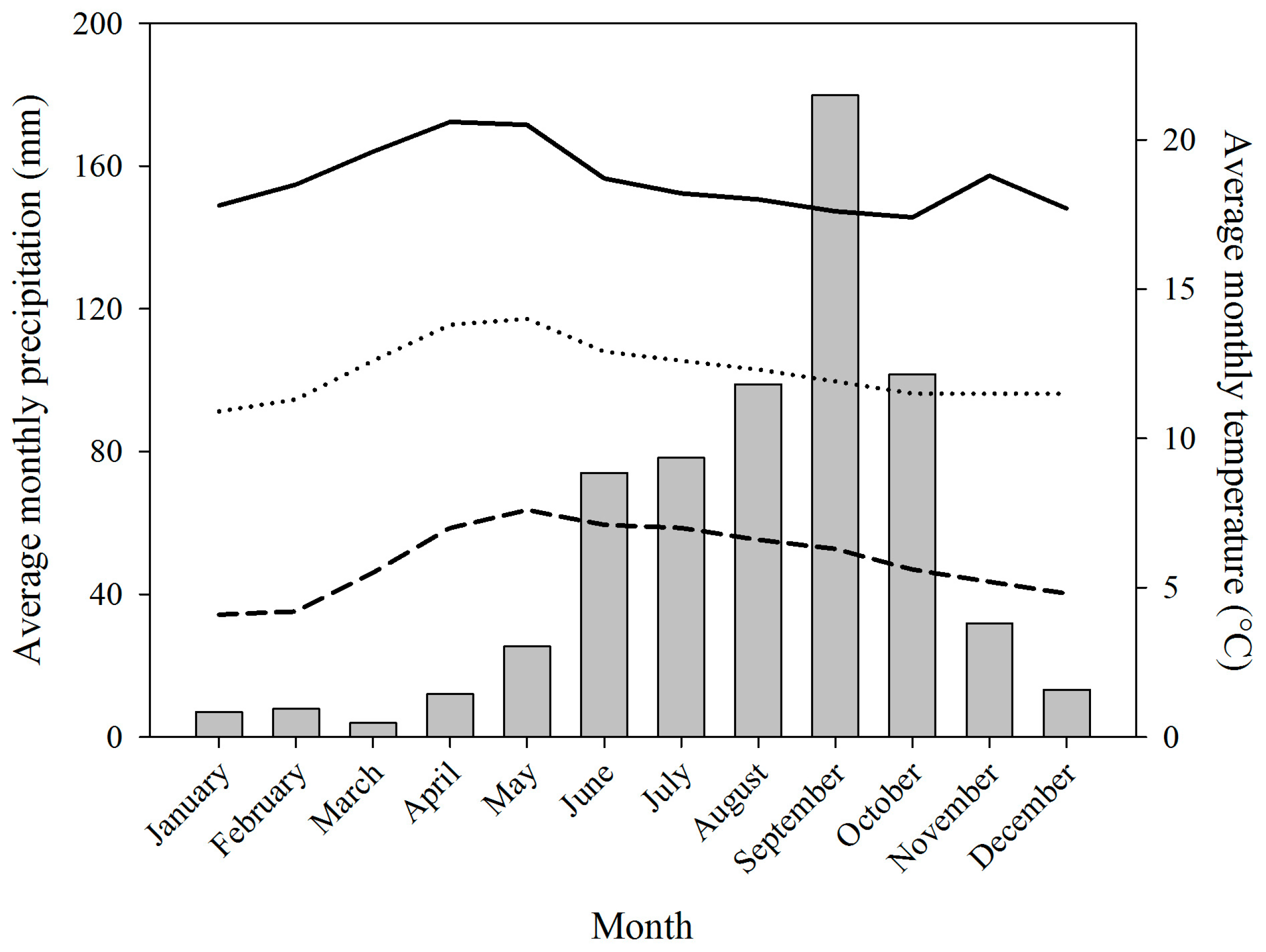
Seeds were collected at the end of October 2022, when ripe P. ayacahuite fruits were observed at the Carbonero Jacales site in the municipality of Huayacocotla, Veracruz, Mexico (UTM 14 N, 555,748.23 E and 2,257,473.44 N; 2649 m a.s.l.) [50]. The soil at the site of seed collection is well-drained cambisol, and the climate is classified as Cw (humid temperate with summer rains, Köppen classification), with an average annual rainfall of 1305 mm. The mean monthly temperature and rainfall patterns for the site are shown in Figure 1.
Figure 1.
Monthly precipitation (bars), and maximum (—), mean (•••), and minimum (---) temperatures for Palo Bendito, Huayacocotla, Veracruz, Mexico, averaged over the period 1981–2010. Climate data are sourced from Comisión Nacional del Agua (CONAGUA). Normales Climatológicas 1981–2010 [51].
The study site was located in an agrarian community, known in Mexico as an ejido, dedicated to forest germplasm production, nursery cultivation, timber harvesting, and the sustainable provision of environmental services. Germplasm material was collected by the community during a field trip conducted in collaboration with the Seed Bank of FES Iztacala, UNAM. The P. ayacahuite cones were harvested directly from ten mature trees bearing ripe cones, and the seeds were pooled to obtain a representative sample capturing population-level genetic variability.
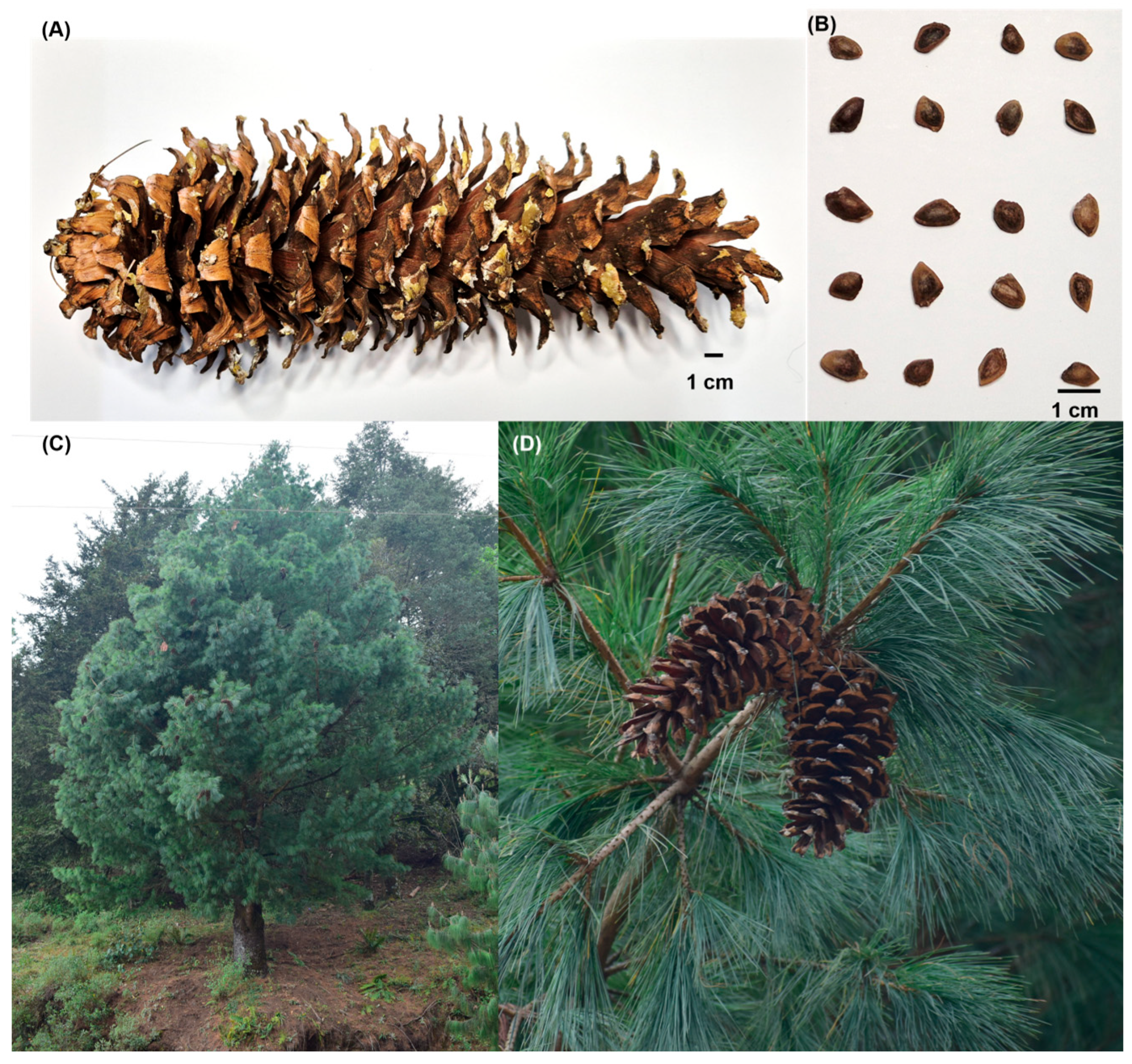
The seed bank provided cones and seeds. They were collected from cones measuring approximately 43.5 × 12 cm (Figure 2A). The seeds of Pinus ayacahuite were cleaned and processed before being delivered for use. Seeds have an average length of 8.3 ± 0.26 mm and a width of 3.55 ± 0.09 mm (Figure 2B), with a mean seed mass of 0.044 ± 0.004 g. The parental trees reach heights of 35–40 m, with trunk diameters up to 2 m and a conical crown, exhibiting moderate growth and an estimated lifespan of around 100 years (Figure 2C). Seed dispersal occurs as the cones mature; when the cone scales dry, the seeds are released and dispersed by wind (anemochory) from the parent tree (Figure 2D).
Figure 2.
Pinus ayacahuite. (A) Collected cones, (B) seeds, (C) trees in the study area, and (D) cones before being collected. Photographs by Armando Ponce Vargas.
An initial germination test was conducted in 6 cm Petri dishes with agar as the culture medium (10 g L−1). Four replicates of 25 seeds each were prepared. The seeds were maintained in a controlled-environment chamber at 25 ± 2 °C and 70% relative humidity. They exhibited an initial moisture content of 10.1 ± 1.2% and had a germination rate of 98%. No further germination tests were conducted, as the high germination percentage rendered additional assays unnecessary.
2.2. General Procedures
In all cases, the seeds were sown in Petri dishes (6 cm in diameter) on an agar substratum (Bioxon, Estado de Mexico, Mexico, 10 g L−1); five replicates of 25 seeds were used per treatment. Petri dishes were placed inside one of nine climate-controlled chambers under a 12 h/12 h light/dark photoperiod provided by halogen lamps with a photon flux density of 28.05 μmol m−2 s−1 measured with a Quantum Meter (Apogee Mod. QMSW-SS, Logan, UT, USA), RH = 70%. Seeds were considered germinated when the radicle protruded at least 1 mm in length, following ISTA [52]. The temperature inside each chamber is outlined below.
2.3. Effect of Temperature on Germination
Temperature treatments were performed on incubated seeds inside the described chambers; each chamber was at one of the nine different constant temperatures: (5, 10, 15, 20, 25, 30, 35, 40, and 45 °C; all with a variation of ±2 °C). Germination was recorded daily for 160 days.
2.3.1. Variables Evaluated
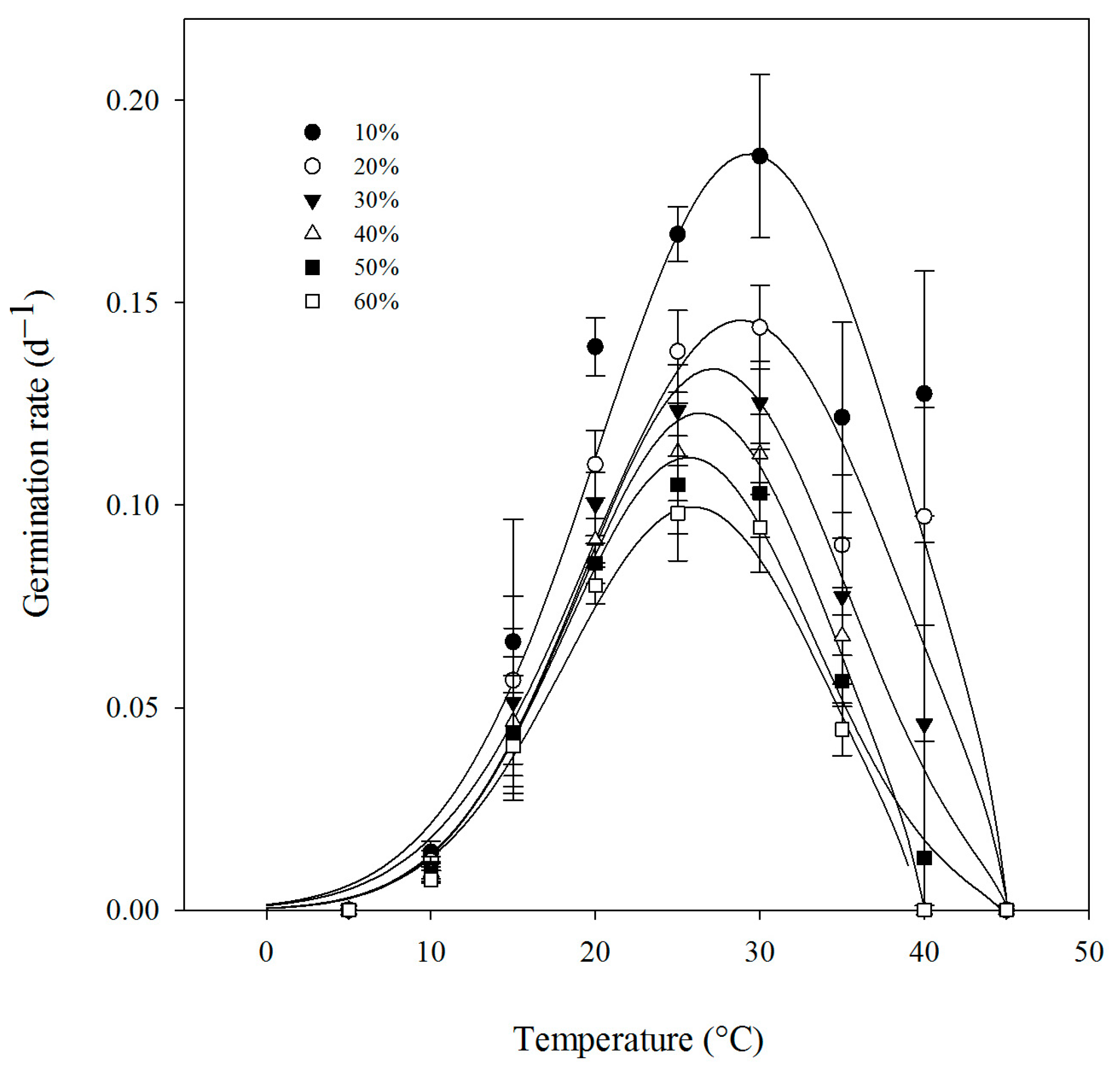
For each germination temperature and replication, cumulative germination data (expressed as percentages) were fitted to an exponential sigmoid function (% of germinated seeds vs. time (days)). With these functions, we estimated the maximum germination percentages, the lag times (time for germination of the first seed), and the time to reach 50% germination (t50), as a velocity indicator of the germination of the seed population. Additionally, from each exponential sigmoid curve, we extracted the time required to reach each one of the percentile subpopulations, defined as 10, 20, 30, 40, 50, or 60% of germination obtained in each germination temperature. Subsequently, we calculated the germination rates (GR) as the inverse of the time to reach each percentile, in each replicate and temperature of the gradient (1/days, d−1).
2.3.2. Cardinal Temperatures and Thermal Time Determination by an Asymmetric Peak Function (Curvilinear Model)
The determination of the cardinal temperatures and thermal times for the germination in each percentile subpopulation of Pinus ayacahuite seeds was carried out by analyzing the relationship between the germination rates (GR) and temperature. For each replicate and each percentile subpopulation, GR were related to germination temperatures with an asymmetric peak function (curvilinear model, Equation (1); [53]; Alma Orozco-Segovia, unpublished data):
The cardinal temperatures were determined as follows: The base temperature (Tb), minimum temperature for germination, corresponded to the intersection of the tangent at the inflection point of the curve (asymmetric peak function), in the sub-optimal temperature ranges, with the temperature axis. The ceiling temperature (Tc), maximum temperature for germination, corresponded to the intersection of the tangent at the inflection point of the curve, in the portion of the supra-optimal temperature ranges, with the temperature axis. Thermal times for the sub-optimal (Ttsub) and supra-optimal temperatures (Ttsup) were determined as the inverse of the slope of the tangents at the inflection points of the curve. The optimal temperature (To) was defined as the temperature or range of temperatures at which the highest and fastest germination was found.
The effect of temperature on the evaluated germination variables was analyzed using a factorial experimental design. The results were tested with ANOVA, followed by LSD as a post hoc test. Normality and homoscedasticity were also assessed [54]. The zero value in germination was excluded. All statistical analyses were performed in Statgraphics v. 5.0 (Statistical Graphics Corporation, Englewood Cliffs, NJ, USA), and curve fittings were carried out with TableCurve 2D, v.3 software (AISN Software, Chicago, IL, USA).
2.4. Germination in Climate Change Scenarios
The Digital Climate Atlas of Mexico (http://atlasclimatico.unam.mx/AECC/servmapas/ (accessed on 26 November 2025) [55] provides projections of average temperature layers derived from several General Circulation Models (GCM), including: the CNRM-CM5, GFDL-CM3, HadGEM2-ES, and MPI-ESM-LR models. These projections were updated for the Sixth Assessment Report of the Intergovernmental Panel on Climate Change (IPCC) (CMIP6) and correspond to two time horizons: the intermediate future (2045–2069) and the far future (2075–2099). These models were derived from the Phase 6 Coupled Model Intercomparison Project Regional Models of the IPCC. Assuming Shared Socioeconomic Trajectories (SSP1-2.6), a conservative scenario involves constant CO2 emissions of 2.6 Watts/m2. According to Cámara-Cabrales et al. [56], the average temperatures were projected for June, which is when P. ayacahuite seed dispersal begins. Following the method described by Flores-Magdaleno et al. [57], the mean temperature method was used, and the thermal time was calculated using the asymmetric peak function (118.55 ± 19.73 °C d−1) alongside the June environmental temperature (13 °C).
2.5. Potential Distribution in Climate Change Scenarios
Specimen collection was georeferenced, including data required for the Global Biodiversity Information Facility (GBIF) platform for specimens deposited in herbaria at the national level (https://www.gbif.org/) GBIF Occurrence Download. Available online: https://doi.org/10.15468/dl.gpstyb (accessed on 26 November 2025).
Twenty-two climatic variables were used at a resolution of 1 km2 per pixel with a spatial resolution of 0.3 arc minutes, collected from the WorldClim database [58] for the period 1970–2000 [59]. In addition, data on soil type, altitude [60], vegetation, and land-use layers (series 6) were included [59].
The twenty-two climatic variables were subjected to multicollinearity tests and validated using the Pearson correlation coefficient. The criteria used to select the predictor variables were as follows [61]: a major contribution according to the Jackknife test, a correlation of r ≤ 0.8, and normal distribution.
To calculate the current distribution, data from the years 1970–2000 were used. BioClim version 2.1 was employed to identify regions with the optimal climatic habitat for the species’ current distribution. The distribution was then modeled using MaxEnt 3.4.1 [41,62], a process also known as environmental niche modeling [42,43]. MaxEnt provides the relative contribution of each climatic variable to the model, which was assessed using the Jackknife method. The spatial distribution of the optimal climatic habitat was mapped in ArcMap 9.3®, converting the number of pixels to km2 for areas with a predicted probability greater than 50%.
The future distribution was modeled using BioClim version 1.4 to identify regions with optimal climatic habitats. The MaxEnt algorithm was then applied to project the potential future distribution of Pinus ayacahuite. Climate projections were based on the GCM GISS-E2-1-G, developed by the Goddard Institute for Space Studies (National Aeronautics and Space Administration. (NASA), Washington, DC, USA), and derived from the regional Coupled Model Intercomparison Project. Projections were generated for two time horizons: the near future (2050; mean of 2041–2060) and the distant future (2090; mean of 2081–2100) [55], under the Shared Socioeconomic Pathways SSP1-2.6 (low CO2 emissions) and SSP5-8.5 (high CO2 emissions). Distribution models were constructed using georeferenced presence records within the average optimal temperature range (To = 27.45 ± 2 °C). The Jackknife method was used to assess variable contributions, and species distribution maps for future scenarios were generated at probability thresholds above 50%. Finally, regression analyses were performed in TableCurve 2D version 5.01 to compare current and projected coverage areas across the four combinations of CO2 emission scenarios and time horizons.
3. Results
3.1. Effect of Temperature on Germination Parameters
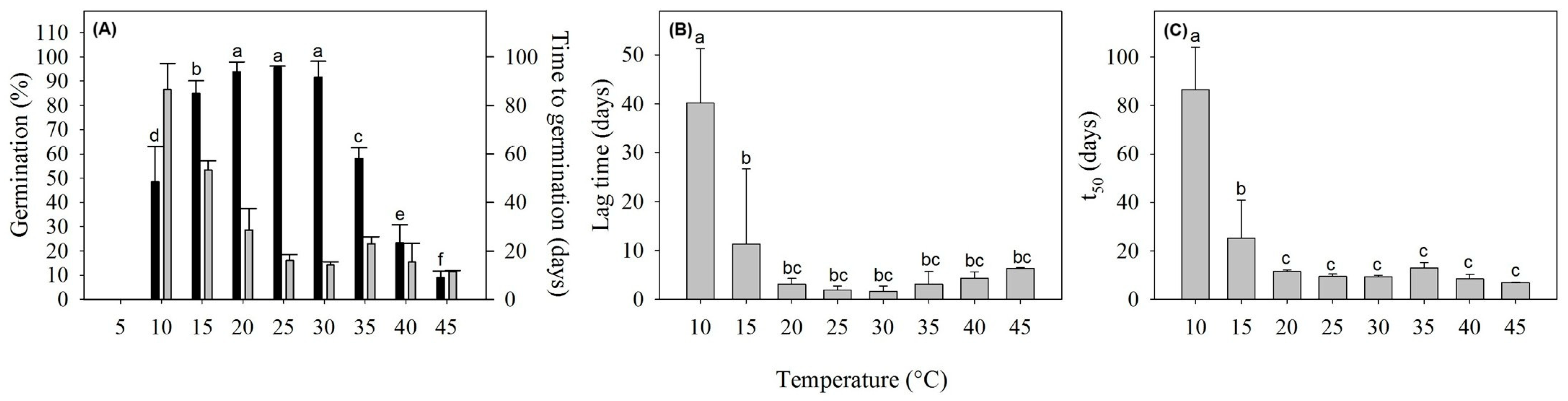
Germination temperature had a significant effect on all the evaluated germination variables (Figure 3 and Figure 4, Table 1 and Table 2).
Figure 3.
(A) Maximum germination percentage (black bars) and time to reach each percentage (gray bars), (B) lag time, and (C) time to attain 50% of germination of the Pinus ayacahuite seeds collected at the Carbonero Jacales ejido in the Huayacocotla Municipality of Veracruz, Mexico, and incubated in a thermal gradient. Different lowercase letters indicate significant differences between temperature treatments. Note that (B,C) does not include data for 5 °C, as germination was zero at this temperature. Mean values ± standard deviation are shown, N = 5.
Figure 4.
Germination rates for the percentile subpopulations (from 10 to 60%) were obtained in a temperature gradient from 5 to 45 °C.
Table 1.
Results of the ANOVA testing the effect of germination temperature on the maximum germination percentage, lag time, and t50 of Pinus ayacahuite seeds, collected in Carbonero Jacales, Huayacocotla, Veracruz, Mexico, incubated across a temperature gradient. t50 represents the time required to reach 50% germination.
Table 2.
Results of the ANOVA testing the effect of the germination temperature on the thermal requirements of the germination of Pinus ayacahuite seeds collected in Carbonero Jacales, Huayacocotla, Veracruz, Mexico. Ns = non-significant.
The highest maximum germination percentages were found in seeds incubated at 30 °C (91.67 ± 6.51%), 25 °C (95.56 ± 0.66%), or 20 °C (93.86 ± 4.04%) without significant differences. The lowest maximum germination percentages were obtained at 45 °C (8.99 ± 2.70%) and 40 °C (23.24 ± 7.55%), with a significant difference between them. Intermediate germination percentages were obtained at 10, 15, or 35 °C (48.46 ± 14.57%, 84.86 ± 5.35% and 58.05 ± 4.49%, respectively, Figure 2A, Table 1). The shortest times to reach the maximum germination percentages were found at 25° and 30 °C (16 ± 2.54 and 14.2 ± 1.3 days), Figure 3A.
Lag time ranged from 1.6 ± 1.02 to 6.28 ± 0.23 days from 20 to 45 °C, without significant differences between them. The longest lag times (40.13 ± 11.08 days and 11.33 ± 15.39 days) were obtained at both lowest germination temperatures, 10 and 15 °C, respectively, with a significant difference between them (Figure 3B, Table 1).
At 5 °C, no germination was recorded, so the T50 for this temperature is not reported. On the other hand, the longest t50 (86.60 ± 17.31 days and 25.98 ± 15.70 days) were obtained in both germination temperatures, 10 and 15 °C, respectively, with a significant difference between them. For the remaining six germination temperatures, t50 ranged from 6.96 ± 0.14 days to 13.03 ± 2.21 days, without significant differences between them (Figure 3C).
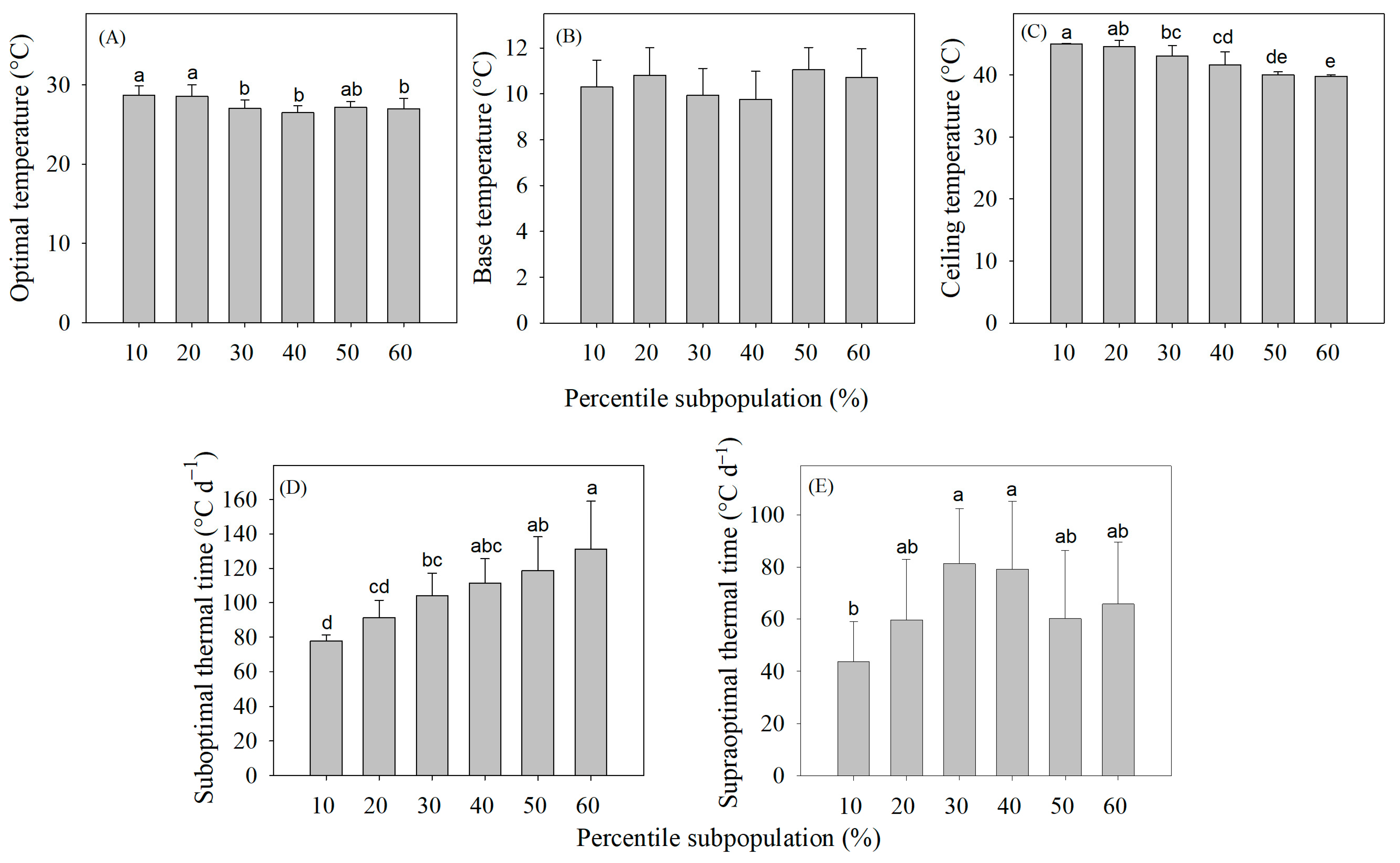
Optimal temperatures ranged from 26.47 ± 0.87 °C to 27.15 ± 0.50 °C for the 30 to 60 percentile subpopulations, without a significant difference. The significantly highest To were estimated for the 50 and 60 percentile subpopulations (27.15 ± 0.77 °C and 26.98 ± 1.31 °C, respectively) without significant differences between them (Figure 5A, Table 2).
Figure 5.
(A) Optimal temperature, (B) base temperature, (C) ceiling temperature, (D) suboptimal thermal time, and (E) supraoptimal thermal time required for the Pinus ayacahuite seeds, collected at the Carbonero Jacales ejido in the Huayacocotla Municipality of Veracruz, Mexico, and incubated in a thermal gradient, to germinate at different percentile subpopulations. Gray bars show average values, Lowercase letters indicate statistical differences between treatments, while error bars depict the standard deviation. N = 5.
Base temperature varied from 9.76 ± 1.21 °C to 11.07 ± 0.98 °C without significant differences between percentile subpopulations (Figure 5B, Table 2). Ceiling temperatures varied from 39.82 ± 0.24 °C to 45.04 ± 0.05 °C, suggesting a direct decreasing tendency related to percentile subpopulation. All Tc values were significantly different (Figure 5C, Table 2). The Ttsub values ranged from 77.90 ± 3.40 °C d−1 to 131.04 ± 28.1 °C d−1, suggesting a direct increasing trend related to percentile subpopulation. The Ttsub to reach the 50% percentile subpopulation was 118.55 ± 19.73 °C d−1 (Figure 5D, Table 2). The lowest significant Ttsup value (43.78 ± 15.11 °C d−1) was required to attain the percentile subpopulation of 10%. This ranged from 59.64 ± 23.32 °C d−1 to 81.32 ± 21.21 °C d−1 to attain the percentile subpopulations from 20 to 60%, without significant differences. The Ttsup to reach the 50% percentile subpopulation was 60.11 ± 26.25 °C d−1 (Figure 5E, Table 2).
3.2. Germination in Climate Change Scenarios
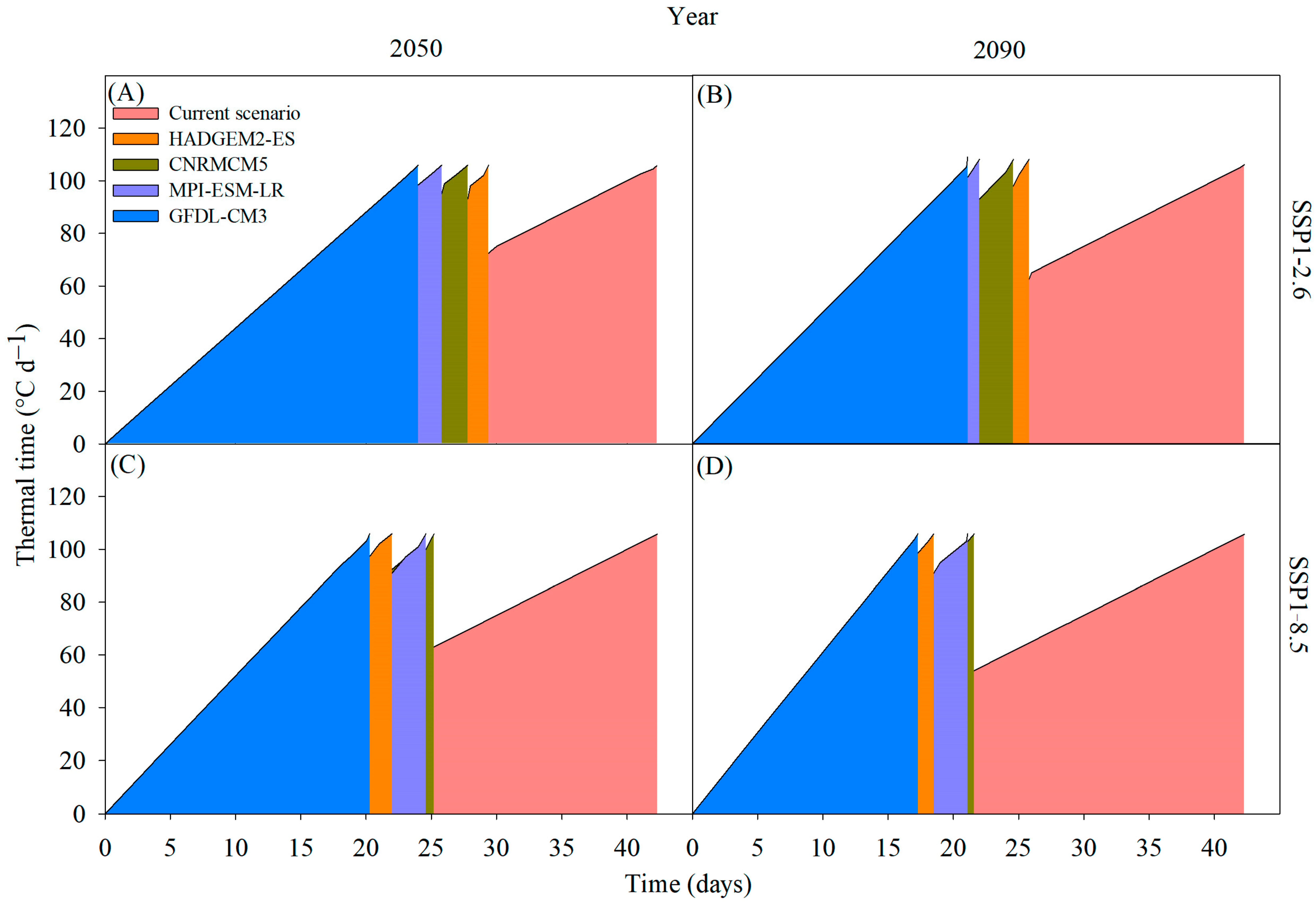
Under the current scenario, the thermal time required for 50% germination (Tt50 = 118.55 ± 19.73 °C d−1) is accumulated in 42.3 days (Tt C = Thermal time current). Under scenario SSP1-2.6 (Tt M = Thermal time model), the projections for the mid-term future (2050) indicated rising temperatures (1.1 to 1.9 °C depending on model, Table 3) that will take time to reach the Tt50. These results suggest that, depending on the model, the accumulation of thermal time might occur between 12.9 and 18.3 days earlier than in the current scenario, evidencing an acceleration of the germination process (Table 3; Figure 6A). For the distant future (2090), the temperature increase is greater (1.6 to 2.5 °C, depending on the model, Table 4) than for the current scenario, thus the accumulation of thermal time is expected to occur between 16.5 and 21.2 days earlier compared to the current scenario (Table 3; Figure 6B).
Table 3.
Increases in temperature and time to reach thermal time for 50% of germination (Tt50), and the difference between Tt50 calculated for the current scenario (Tt C = 42.3 days) and those predicted for two climate change scenarios for four General Circulation Models (Tt M). Values projected for the years 2050 and 2090. Bold font indicates the extreme values.
Figure 6.
Time for seeds to accumulate thermal time to reach 50% of germination (Tt50), calculated for June with the asymmetric peak function. Times to reach Tt50 were calculated for a mid-term future (2050) in the general circulation models SSP1-2.6 (A) and SSP1-8.5 (C). In the distant future (2090), in the general circulation model SSP1-2.6 (B) and SSP1-8.5 (D).
Table 4.
Estimated areas (km2) for the distribution of P. ayacahuite in Mexico, according to the GISS-E2-1-G model. Projections are included for the mid-term (year 2050) and distant term (year 2090), based on the low CO2 emissions scenario (SSP1-2.6) and the high CO2 emissions scenario (SSP5-8.5). Positive percentages indicate increases in the area covered by P. ayacahuite, and negative percentages indicate loss of the area covered by this species. New = New distribution area.
Under the extreme scenario (SSP1-8.5) (Tt M = Thermal time model), the projections for the mid-term future (2050) indicated that, with respect to the current scenario, temperatures will be 1.7 to 2.7 °C higher, depending on the model (Table 3), which will reduce the time to reach the Tt50. Depending on the model, the accumulation of thermal time could occur between 17.1 and 22 days earlier than in the current scenario, evidencing a significant acceleration of the germination process (Table 3; Figure 6C). For the distant future (2090), the projected temperature increase ranges from 2.4 to 3.6 °C depending on the model (Table 3). The accumulation of thermal time is expected to occur earlier (20.7 and 25 days) compared to the current scenario (Table 3; Figure 6D).
3.3. Potential Distribution Under Climate Change Scenarios
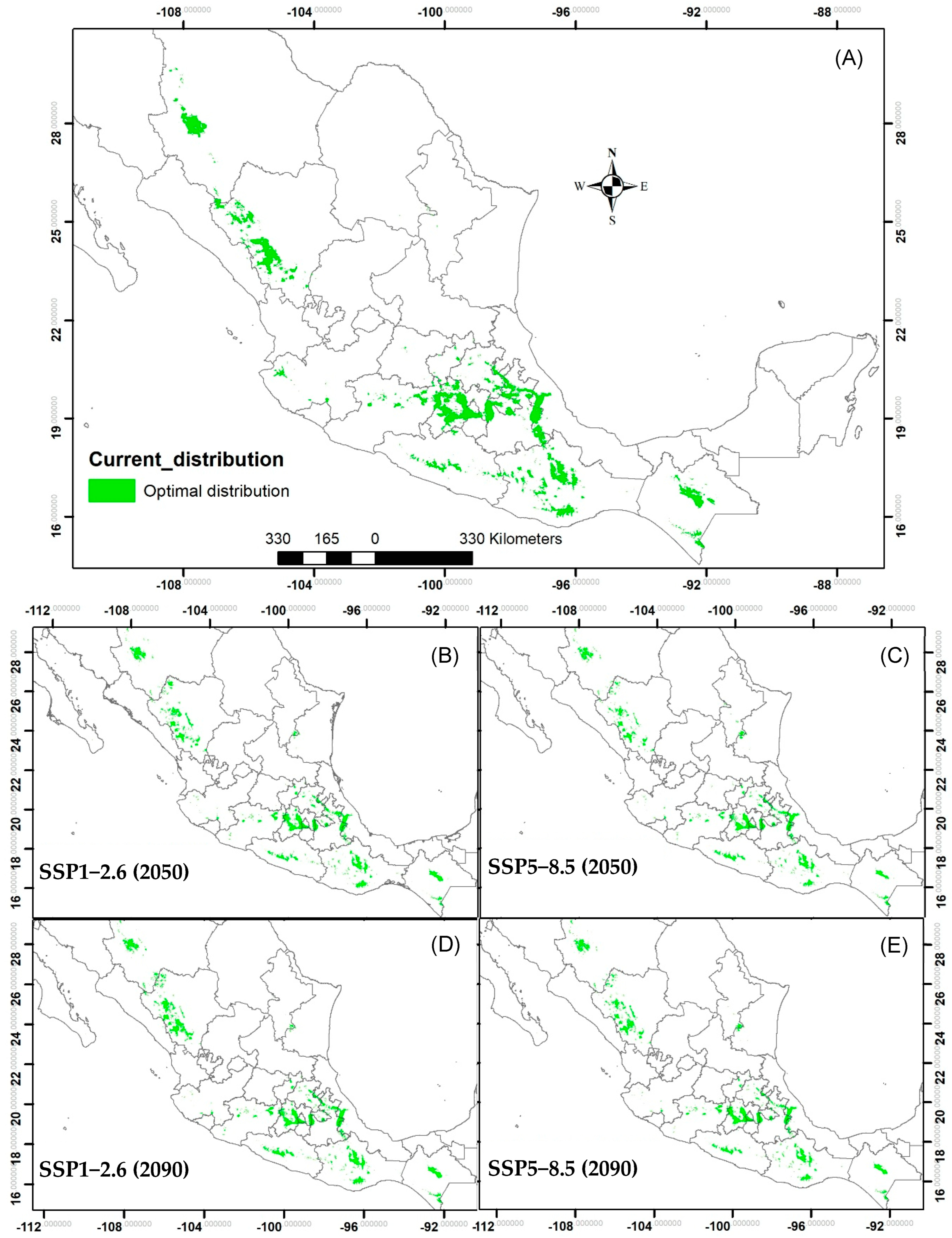
The distribution models had an area under the curve (AUC, Tt d−1) with accuracy =0.95 ± 0.01. With a probability greater than 50%, this value indicates a good fit to calculate the areas where the species might be distributed. According to the climate change scenarios from the NASA GISS-E2-1-G model, the distribution of P. ayacahuite is projected to decline by 15%–22% from its current distribution in the future (Table 4, Figure 7A).
Figure 7.
Distribution maps of P. ayacahuite in Mexico are presented for both the mid-term future (2050) and the distant future (2090), under two climate change scenarios: a conservative scenario with lower CO2 concentrations (SSP1–2.6) and an extreme scenario with higher CO2 concentrations (SSP5–8.5). (A) Current distribution of P. ayacahuite in Mexico. (B) Projected potential distribution in 2050 under SSP1–2.6. (C) Projected potential distribution in 2050 under SSP5–8.5. (D) Projected potential distribution in 2090 under SSP1–2.6. (E) Projected potential distribution in 2090 under SSP5–8.5.
According to the Jackknife test implemented in MaxEnt, the variables that contributed most to the construction of the current distribution model were altitude (30.9%), maximum temperature of the warmest month (29.8%), annual precipitation (9.8%), and mean temperature of the wettest quarter of the year (4.6%).
For the mid-term future (year 2050), under both climate change scenarios SSP1-2.6 and SSP5-8.5 (Figure 7B and Figure 7C, respectively), the potential distribution area of P. ayacahuite is projected to decrease by 15.9% and 18.3%, respectively, compared with the current distribution (Table 4). Under favorable climatic conditions, the species is expected to expand its range into Tamaulipas. In the SSP1-2.6 (low CO2 emissions) scenario, the variables contributing most to the model were: maximum temperature of the warmest month (48.4%), altitude (18.1%), precipitation of the wettest quarter of the year (9.5%), and mean temperature of the wettest month (5.0%). In contrast, under the SSP5-8.5 scenario (high CO2 emissions), the most influential variables were maximum temperature of the warmest month (45.0%), altitude (15.4%), precipitation of the rainiest month (11.4%), mean temperature of the wettest month (6.8%), and mean temperature of the warmest month (5.0%). Overall, the distribution decreased 2.4% more than in the SSP1-2.6 scenario, indicating a slightly stronger contraction, although the general distribution pattern remained relatively stable between scenarios.
For the distant future (2090), the potential distribution of P. ayacahuite is predicted to decline by 16.7%–22.2% under SSP1-2.6 and SSP5-8.5, respectively (Figure 7D and Figure 7E, respectively), compared with the current distribution (Table 4). Despite this general reduction, the presence of P. ayacahuite is also projected in Tamaulipas under both scenarios. Under the extreme SSP5-8.5 scenario, habitat loss is projected in 18 of 24 states, while increases are predicted in Sinaloa (−60%), Tlaxcala (−48%), Chiapas (−41%), Jalisco (−35%), Estado de México (−33%), Puebla (−30%), and Oaxaca (−27%). By 2090, expansions are projected in San Luis Potosí (+468%), Nuevo León (+1869%), Nayarit (+314%), and Querétaro (66%). Under the same extreme 2090 scenario, severe reductions are expected in Coahuila (−95%), Tlaxcala (−45%), Sinaloa (−45%), and Jalisco (−43%), whereas substantial gains are projected in Nayarit (+866%), Nuevo León (+800%), and San Luis Potosí (+407%); Figure 7E.
For the 2090 models, the variables with the highest contributions were: maximum temperature of the warmest month (44.8%), altitude (21.0%), precipitation of the wettest month (9.3%), mean temperature of the warmest month (5.5%), and mean temperature of the wettest month (4.7%). Under SSP5-8.5, the distribution is projected to decline by more than 22% relative to the current scenario, primarily influenced by the maximum temperature of the warmest month (42.5%), altitude (24.7%), annual precipitation (5.9%), annual mean temperature (5.2%), and mean monthly temperature (4.2%).
Currently, the largest suitable areas for P. ayacahuite are in Oaxaca, Durango, Estado de México, Puebla, and Chiapas. Under the distant-future, high-emission scenario, these regions will remain the principal regions, along with Chihuahua, despite a general contraction in total area. Regression analyses revealed a strong positive correlation (r2 = 0.90–0.98) between current and projected coverages (km2) across the different combinations of emission scenarios and time horizons, indicating that future distributions are largely determined by the magnitude and spatial pattern of the species’ present range. This suggests that, although the total suitable area is expected to decrease, regions currently occupied by the species will continue to be the core predictor of its future habitat under both moderate (SSP1-2.6) and high-emission (SSP5-8.5) scenarios. (Table 4; Figure 7).
4. Discussion
4.1. Germination, Cardinal Temperatures, and Thermal Time Determinations
The results of germination in the temperature gradient indicate that P. ayacahuite has a wide phenotypic plasticity. Seed germination of non-dormant seeds (22%–98%) occurred in a wide thermal window, from 10 to 40 °C. Differences between seed germination at different temperatures are due to conditional dormancy [63]. The seeds of this species are dispersed from September to November at the end of the rainy season, at the same time that other Pinus species are dispersed [64]. This is likely timed for germination the following June, when the rains are well established and average temperatures are ~13 °C [64]; taking into account that P. ayacahuite grows in cold temperate areas with average temperatures of 13 °C [10,65]. These conditions include the base temperature calculated in this research (t50 = 11.04 °C), which is easily reached in the rainy season. Under most temperatures where germination occurred in the temperature gradient (≥15 °C), the lag time of germination was short (1.64–6.28 days), which might allow germination after dispersal in any month of the year. Nevertheless, the time to reach maximum germination under the average temperature in the study area is long (53–86 days); due to that the successful fate of the young seedlings immediately after dispersal is uncertain due to the dry season being extended for around 7 months (Figure 1). In the seed collection area, average maximum temperatures (18.61 ± 1.1 °C) are lower than the calculated optimal temperatures for germination of P. ayacahuite (26–27 °C). However, for this species, maximal temperatures close to the hour of maximal insolation, in open areas, might play an important role in covering the Tt to obtain 50% germination, which could explain the abundance of individuals of this species in open areas. Considering that, germination was faster at relatively high temperatures (35–40 °C) and ceiling temperature was also high (40–45 °C), and the fact that Tt50 was higher than for Pinus maximinoi and P. douglassiana [66], it is likely that P. ayacahuite tolerance to GCC might be high. Germination and seedling establishment might be restricted mainly by the low water availability predicted for GCC [67], rather than by temperature. The rainy season is established when the mean air temperature is 13 °C, which suggests also slow germination in the case of water availability might be sufficient to reach 50% germination. To understand germination and establishment of P. douglassiana in open sites, it is necessary to take into account that meteorological stations usually are located in the open; thus, the air temperature in the understory might be lower than the 13 °C that stations report and higher in the soil of open sites, where P. ayacahuite is mainly established [68].
4.2. Germination Under Climate Change Scenarios and Potential Distribution Under Climate Change Scenarios
Research on the effect of climate change on forest species should take into account that increases in temperature will affect the periods of flowering, fruiting, and germination, which will impact the function of coniferous populations [69]. The GFDL-CM3, under an extreme climatic change scenario, predicted an increment in temperature of 3.6 °C, which will not have a significant effect on P. ayacahuite germination due to its traits as a pioneer tree growing in open areas [65]. This change is also linked to a high acceleration of the germination process; the time to reach Gt50 will be reduced to just 26 days instead of 42.3 days. According to Funes et al. [70], fast germination is an advantage to compete for space and ensure the establishment of individuals.
The GFDL-CM3 model predicted, under an extreme CO2 scenario and a distant future, that the areas covered by P. ayacahuite will be reduced by 22%. In the Tamaulipas state, although projected to be a new area covered for this species in 2050, this new coverage is also reduced in 2090. To survive the new climatic conditions, many Pinus spp. populations will have to migrate in altitude and latitude [10]. In this study, the migration of this species to the north (except in Tamaulipas) is not supported by the projected distributions in each state in the mid-term and distant futures (conservative and extreme projections). Area covered is also lost in the South, the surfaces covered in these scenarios are related (r2 = 0.90–0.99) to the current P. ayacahuite coverage. In northern states with a wide surface coverage, under the current scenario, in Chihuahua and Durango, coverage decreased by 15% and 9%, respectively, under the distant future, extreme scenario. Coahuila had a small coverage under the current scenario and will lose 95% of its coverage due to this state being in the most arid area of Mexico [71]; in the southern states with a wide current surface coverage—Oaxaca, Chiapas and Guerrero—the reduction in areas was 26%, 35%, and 6%, respectively, under the distant future, extreme scenario. P. ayacahuite distribution is sharply restricted to secondary forest in moist and protected ravines and slopes covered by pine-oak and mountain forest. Distribution projections reveal a contrasting pattern depending on the projected future and the CO2 emissions considered in the model. Changes in areas occupied by P. ayacahuite indicated that in the most severe scenarios and longest projection (2090), the reduction in areas covered by P. ayacahuite will be in most of the states (18 of 24). Based on the total reduction in P. ayacahuite cover (22%), this species appears to be less sensitive to climate change than the mountain forest and pine-oak forests, which will be affected by climate change in ~52% and 65%–70%, respectively [72].
The variables to build the distribution models do not include the presence of novel open spaces resulting from deforestation or the effect of climatic changes on other species’ distribution, which might favor P. ayacahuite migration. That is, variables such as the actual successful competition of other species against P. ayacahuite might explain the current distribution of this species under the current climatic conditions [73]. The germination characteristics of P. ayacahuite, such as its wide phenotypic plasticity and its thermal requirements, suggest a wider potential distribution than the current one. Any change in species distribution impacts the diversity of ecosystems, with negative effects on the sustainability of the country’s forest regions [10]. Nevertheless, based on the phenotypic plasticity [74] of P. ayacahuite, in the mid-term, it might be appropriate for ecological restoration, reforestation, and forest exploitation.
In environments without water availability constraints, temperature is the most important factor for the germination and distribution of a species [24,35,64] because, without sufficient water availability, there is no germination, early seedling establishment, and growth [75]. Thus, specific germination requirements of temperature and water availability allow us to delimit the critical niche of the species [76] and consequently to map species distribution [68]. The variables considered to build models for P. ayacahuite distribution included those linked to water availability for germination and growth: precipitation of the rainiest month and the temperature of the moistest month of the year. However, for the current and climate change models, temperature and altitude (directly linked to temperature) were the variables that most contributed to building the distribution models. With climate change, the rainfall regime is expected to change, which can lengthen droughts by increasing the rate at which water evaporates from the soil and its ability to hold water. The permanent presence of fog may also have an important role in the evaporation rate [66]. The use of scenario models to calculate future temperature changes and their effect on species distribution requires the consideration of the seed germination plasticity of species, and the models include the preadaptation of individual species to low and high temperatures. To determine species phenotypic plasticity, it is necessary to carry out germination studies in temperature gradients and apply thermal time models to calculate cardinal temperatures and thermal time to reach 50% germination.
5. Conclusions
Pinus ayacahuite is a pioneer tree growing in open areas that has a wide phenotypic plasticity and a wide thermal window for germination. It exhibits a thermophilic germination. Thus, the absence of water availability in any form—precipitation, fog, dew, or other sources—may be a more significant limiting factor for P. ayacahuite than temperature. The estimated cardinal temperatures and the thermal time required for G50 constitute fundamental physiological parameters that explain P. ayacahuite distribution. The use of thermal time instead of “thermal sum” allows us to include in the distribution models a parameter that accurately integrates the temperature and time required to reach a determined germination percentage. According to the GFDL-CM3 model in an extreme scenario, for the distant future (year 2090), Tt50 might be accumulated in just 17.3 days instead of 43 days calculated for the current scenario, suggesting earlier germination in the future. Among the Global Circulation Models used in this research, we mainly used the GFDL-CM3 Model because it produced the most severe increases in temperature among any of the IPCC models considered. Overall, the projected distribution areas for the year 2090 will be reduced by 22%, representing a moderate loss of P. ayacahuite coverage. Pinus ayacahuite may migrate toward Tamaulipas under CC, establishing a new distribution area in Mexico. These results provide a scientific basis for guiding conservation strategies, including seed banks, nurseries in climate refugia, and reforestation programs adapted to global warming scenarios. This study is the first to examine cardinal temperatures, thermal time, and their relationship with the impacts of CC on P. ayacahuite germination and distribution, as well as the first to assess climate change effects on the distribution of P. ayacahuite based on models from the IPCC Sixth Assessment Report. General Circulation Models should place greater emphasis on precipitation and moisture when estimating species distributions, as these climatic factors are critical for seed germination and plant establishment in species such as P. ayacahuite.
Author Contributions
Conceptualization: L.V.P.-L., S.S.-M., C.M.F.-O., D.C.A.-R. and P.D.A.; Methodology: L.V.P.-L., S.S.-M., A.O.-S. and C.M.F.-O.; Software: L.V.P.-L., S.S.-M., M.E.S.-C. and D.C.-S.; Validation: L.V.P.-L. and S.S.-M.; Formal analysis: A.O.-S., M.E.S.-C.; Investigation: L.V.P.-L., S.S.-M. and M.Y.N.-V.; Resources: C.M.F.-O., D.C.A.-R. and I.R.-A.; Data curation: C.M.F.-O., A.O.-S. and M.E.S.-C.; Writing—original draft: L.V.P.-L. and S.S.-M.; Writing—review and editing: C.M.F.-O. and D.C.A.-R.; Visualization: D.C.-S. and I.R.-A.; Supervision: C.M.F.-O.; Project administration: P.D.A., C.M.F.-O. and D.C.A.-R.; Funding acquisition: P.D.A., C.M.F.-O. and D.C.A.-R. All authors have read and agreed to the published version of the manuscript.
Funding
This study was funded by the Scholarship Program of the General Directorate of Academic Personnel Affairs, National Autonomous University of Mexico. DGAPA–UNAM and by the Garfield Weston Foundation, as part of the Global Tree Seed Bank: Unlocked Project, managed by the Millennium Seed Bank Partnership at the Royal Botanic Gardens, Kew.
Data Availability Statement
The original contributions presented in this study are included in the article. Further inquiries can be directed to the corresponding author.
Acknowledgments
We thank the local ejido community in Carbonero Jacales for allowing and supporting us in collecting seeds on their land. We thank the Scholarship Program of the General Directorate of Academic Personnel Affairs (DGAPA–UNAM) and the Garfield Weston Foundation for providing funding for this research. We also thank Biol. Armando Ponce Vargas for providing photographs of Pinus ayacahuite.
Conflicts of Interest
The research was conducted in the absence of any commercial or financial relationships that could be construed as a potential conflict of interest.
References
- Rzedowski, J. Vegetación de Mexico; Limusa: Mexico City, Mexico, 1978; 504p. [Google Scholar]
- Gernandt, D.S.; Pérez-de la Rosa, J.A. Biodiversidad de Pinophyta (coníferas) en Mexico. Rev. Mex. Biodivers. 2014, 85, 126–133. [Google Scholar] [CrossRef]
- Comisión Nacional Forestal (CONAFOR). Estado que Guarda el Sector Forestal en Mexico. 2019; CONAFOR: Zapopan, Mexico, 2020; pp. 60–277.
- Sánchez-González, A. Una visión actual de la diversidad y distribución de los pinos de Mexico. Madera Bosques 2008, 14, 107–120. [Google Scholar] [CrossRef]
- Piñero, D.; Caballero-Mellado, J.; Cabrera-Toledo, D. La diversidad genética como instrumento para la conservación y el aprovechamiento de la biodiversidad: Estudios en especies mexicanas. In Capital Natural de Mexico, Vol. I: Conocimiento Actual de la Biodiversidad; CONABIO: Mexico City, Mexico, 2008; pp. 437–494. [Google Scholar]
- García-Arévalo, A.; González-Elizondo, M.S. Pináceas de Durango, 2nd ed.; Instituto de Ecología A.C.: Xalapa, Mexico, 2003; 187p. [Google Scholar]
- Ramírez-Herrera, C.; Vargas-Hernández, J.J.; López-Upton, J. Distribución y conservación de las poblaciones naturales de Pinus greggii. Acta Bot. Mex. 2005, 72, 1–16. [Google Scholar] [CrossRef]
- Fremout, T.; Thomas, E.; Gaisberger, H.; Van-Meerbeek, K.; Muenchow, J.; Briers, S.; Gutierrez-Miranda, C.E.; Marcelo-Peña, J.L.; Kindt, R.; Atkinson, R.; et al. Mapping tree species vulnerability to multiple threats as a guide to restoration and conservation of tropical dry forests. Glob. Change Biol. 2020, 26, 3552–3568. [Google Scholar] [CrossRef] [PubMed]
- Secretaría del Medio Ambiente, Recursos Naturales y Pesca (SEMARNAT). Norma Oficial Mexicana NOM-059-SEMARNAT-2010. Protección Ambiental—Especies Nativas de Flora y Fauna Silvestres—Categorías de Riesgo y Especificaciones para su Inclusión, Exclusión o Cambio—Lista de Especies en Riesgo; SEMARNAT: Mexico City, Mexico, 2010.
- Ortiz-Medrano, A.; Moreno-Letelier, A.; Piñero, D. Fragmentación y expansión demográfica en las poblaciones mexicanas de Pinus ayacahuite var. ayacahuite. Bol. Soc. Bot. Méx. 2008, 83, 25–36. [Google Scholar] [CrossRef]
- Gutiérrez, E.; Trejo, I. Efecto del cambio climático en la distribución potencial de cinco especies arbóreas de bosque templado en Mexico. Rev. Mex. Biodivers. 2014, 85, 179–188. [Google Scholar] [CrossRef]
- Munive-Martínez, E.; Vázquez-Cuecuecha, O.; Zamora-Campos, E.M.; Fernández-Pedraza, E.; García-Gallegos, E. Variación de conos y semillas de Pinus ayacahuite var. veitchii Saw de dos procedencias del estado de Tlaxcala. For. Verac. 2008, 10, 39–46. [Google Scholar]
- Farjon, A.; Styles, B.T. Pinus (Pinaceae). Flora Neotropica Monograph 75; The New York Botanical Garden: New York, NY, USA, 1997. [Google Scholar]
- Royal Botanic Gardens, Kew. Seed Information Database: Storage Behavior Pinus ayacahuite Ehrenb. ex Schltdl. Available online: https://species.data.kew.org/search?q=Pinus%20ayacahuite&_gl=1*teqduw*_ga*MjI1NTc4NzU1LjE3MTcxMDIwMDc.*_ga_ZVV2HHW7P6*czE3NjQ5NDU3MDAkbzMyJGcwJHQxNzY0OTQ1NzAwJGo2MCRsMCRoMA..&lang=es-419 (accessed on 26 November 2025).
- Núñez, M.R.; Calvo, L. Effect of high temperatures on seed germination of Pinus sylvestris and Pinus halepensis. For. Ecol. Manag. 2000, 131, 183–190. [Google Scholar] [CrossRef]
- Ramírez-Martínez, A.; Santiago-García, W.; Quiñonez-Barraza, G.; Ruíz-Aquino, F.; Antúnez, P. Modelación del perfil fustal y volumen total para Pinus ayacahuite Ehren. Madera Bosques 2018, 24, e2421496. [Google Scholar] [CrossRef]
- Walck, J.L.; Hidayati, S.N.; Dixon, K.W.; Thompson, K.; Poschlod, P. Climate change and plant regeneration from seed. Glob. Change Biol. 2011, 17, 2145–2161. [Google Scholar] [CrossRef]
- Fernández-Pascual, E.; Mattana, E.; Pritchard, H.W. Seeds for future past: Climate chang and the thermal memory of plant reproductive traits. Biol. Rev. 2019, 94, 439–456. [Google Scholar] [CrossRef]
- Sampayo-Maldonado, S.; Ordoñez-Salanueva, C.A.; Mattana, E.; Way, M.; Castillo-Lorenzo, E.; Dávila-Aranda, P.D.; Lira-Sadde, R.; Téllez-Valdéz, O.; Rodríguez-Arevalo, N.I.; Ulian, T.; et al. Thermal niche for seed germination and species distribution modelling of Swietenia macrophylla King (mahogany) under climate change scenarios. Plants 2021, 10, 2377. [Google Scholar] [CrossRef] [PubMed]
- World Rainforests. Mexico Forest Information and Data—The Tropical Rainforest. Available online: https://worldrainforests.com/deforestation/2000/Mexico.htm (accessed on 13 August 2025).
- Martínez-Cruz, L. Efectos del Manejo Forestal y de Estrategias de Conservación en Bosques de Pino-Encino de la Comunidad de Analco, Oaxaca, México. Master’s Thesis, Centro Agronómico Tropical de Investigación y Enseñanza, Turrialba, Costa Rica, 2019. [Google Scholar]
- Secretaría de Medio Ambiente y Recursos Naturales (SEMARNAT); Comisión Nacional Forestal (CONAFOR). Pinus ayacahuite Ehren; Paquete Tecnológico; SEMARNAT: Mexico City, Mexico, 2020.
- Bewley, J.D.; Black, M. Seeds: Physiology of Development and Germination, 2nd ed.; Plenum Press: New York, NY, USA, 1994. [Google Scholar] [CrossRef]
- Bradford, K.J. Applications of hydrothermal time to quantifying and modeling seed germination and dormancy. Weed Sci. 2002, 50, 248–260. [Google Scholar] [CrossRef]
- Probert, R.J. The Role of Temperature in the Regulation of Seed Dormancy and Germination. In Seeds: The Ecology of Regeneration in Plant Communities, 2nd ed.; Fenner, M., Ed.; CAB International: Wallingford, UK, 2000; pp. 261–292. [Google Scholar] [CrossRef]
- Sampayo-Maldonado, S.; Ordoñez-Salanueva, C.A.; Mattana, E.; Ulian, T.; Way, M.; Castillo, E.; Dávila-Aranda, P.D.; Lira-Sadde, R.; Téllez-Valdéz, O.; Rodríguez-Arevalo, N.I.; et al. Thermal time and cardinal temperatures for germination of Cedrela odorata L. Forests 2019, 10, 841. [Google Scholar] [CrossRef]
- Franks, S.J.; Sim, S.; Weis, A.E. Rapid evolution of flowering time in response to a climate fluctuation. Proc. Natl. Acad. Sci. USA 2007, 104, 1278–1282. [Google Scholar] [CrossRef]
- Anderson, J.T.; Inouye, D.W.; McKinney, A.M.; Colautti, R.I.; Mitchell-Olds, T. Phenotypic plasticity and adaptive evolution contribute to advancing flowering phenology in response to climate change. Proc. R. Soc. B 2012, 279, 3843–3852. [Google Scholar] [CrossRef] [PubMed]
- Craufurd, P.Q.; Wheeler, T.R. Climate change and the flowering time of annual crops. J. Exp. Bot. 2009, 60, 2529–2539. [Google Scholar] [CrossRef]
- Iler, A.M.; Høye, T.K.; Inouye, D.W.; Schmidt, N.M. Nonlinear flowering responses to climate: Are species approaching their phenological limits? Philos. Trans. R. Soc. B 2013, 368, 20120489. [Google Scholar] [CrossRef]
- Gaira, K.S.; Rawal, R.S.; Rawat, B.; Bhatt, I.D. Impact of climate change on the flowering of Rhododendron arboreum in central Himalaya, India. Curr. Sci. 2014, 106, 1735–1738. [Google Scholar]
- Wang, B.; Liu, D.L.; Asseng, S.; Macadam, I.; Yu, Q. Impact of climate change on the flowering time of wheat in eastern Australia. Agric. For. Meteorol. 2015, 209, 11–21. [Google Scholar] [CrossRef]
- Iverson, L.R.; McKenzie, D. Tree-species range shifts in a changing climate: Detecting, modeling, assisting. Landsc. Ecol. 2013, 28, 879–889. [Google Scholar] [CrossRef]
- Kelly, A.E.; Goulden, M.L. Rapid shifts in plant distribution with recent climate change. Proc. Natl. Acad. Sci. USA 2007, 105, 11823–11826. [Google Scholar] [CrossRef] [PubMed]
- McKenney, D.W.; Pedlar, J.H.; Lawrence, K.; Campbell, K.; Hutchison, M.F. Potential impacts of climate change on the distribution of North American trees. BioScience 2007, 57, 939–948. [Google Scholar] [CrossRef]
- Parmesan, C.; Yohe, G. A globally coherent fingerprint of climate change impacts across natural systems. Nature 2003, 421, 37–42. [Google Scholar] [CrossRef]
- Pautasso, M. Forest ecosystems and global change: The case study of Insubria. Ann. Bot. 2013, 3, 1–29. [Google Scholar] [CrossRef]
- Root, T.L.; MacMynowski, D.P.; Mastrandrea, M.D.; Schneider, S.H. Human-modified temperatures induce species changes: Joint attribution. Proc. Natl. Acad. Sci. USA 2005, 102, 7465–7469. [Google Scholar] [CrossRef]
- Thuiller, W.; Albert, C.; Araújo, M.B. Predicting global change impacts on plant species’ distributions: Future challenges. Perspect. Plant Ecol. Evol. Syst. 2008, 9, 137–152. [Google Scholar] [CrossRef]
- Kurpis, J.; Serrato-Cruz, M.A.; Arroyo, T.P.F. Modeling the effects of climate change on the distribution of Tagetes lucida Cav. (Asteraceae). Glob. Ecol. Conserv. 2019, 20, e00747. [Google Scholar] [CrossRef]
- Phillips, S.J.; Anderson, R.P.; Dudík, M.; Schapire, R.E.; Blair, M.E. Opening the black box: An open-source release of MaxEnt. Ecography 2017, 40, 887–893. [Google Scholar] [CrossRef]
- Phillips, S.J.; Anderson, R.P.; Schapire, R.E. Maximum entropy modeling of species geographic distributions. Ecol. Model. 2006, 190, 231–259. [Google Scholar] [CrossRef]
- Elith, J.; Phillips, S.J.; Hastie, T.; Dudík, M.; Chee, Y.E.; Yates, C.J. A statistical explanation of MaxEnt for ecologists. Divers. Distrib. 2011, 17, 43–57. [Google Scholar] [CrossRef]
- Kelley, M.; Schmidt, G.A.; Nazarenko, L.S.; Bauer, S.E.; Ruedy, R.; Russell, G.L.; Ackerman, A.S.; Aleinov, I.; Bauer, M.; Bleck, R.; et al. GISS-E2.1: Configurations and climatology. J. Adv. Model. Earth Syst. 2020, 12, e2019MS002025. [Google Scholar] [CrossRef] [PubMed]
- Sáenz-Romero, C.; Rehfeldt, G.E.; Duval, P.; Lindig-Cisneros, R.A. Abies religiosa habitat prediction in climatic change scenarios and implications for monarch butterfly conservation in Mexico. For. Ecol. Manag. 2012, 275, 98–106. [Google Scholar] [CrossRef]
- Hernández-Ramos, J.; Reynoso-Santos, R.; Hernández-Ramos, A.; García-Cuevas, X.; Hernández-Máximo, E.; Cob-Uicab, J.V.; Sumano-López, D. Historical, current and future distribution of Cedrela odorata in Mexico. Acta Bot. Mex. 2018, 124, 117–134. [Google Scholar] [CrossRef]
- Sampayo-Maldonado, S.; Ordoñez-Salanueva, C.A.; Mattana, E.; Way, M.; Castillo, E.; Davila-Aranda, P.D.; Lira-Sadde, R.; Téllez-Valdés, O.; Rodríguez-Arevalo, N.I.; Ulian, T.; et al. Potential distribution of Cedrela odorata L. in Mexico according to its optimal thermal range for seed germination under different climate change scenarios. Plants 2023, 12, 150. [Google Scholar] [CrossRef]
- del Castillo, R.F.; Trujillo-Argueta, S.; Sáenz-Romero, C. Pinus chiapensis, a keystone species: Genetics, ecology, and conservation. For. Ecol. Manag. 2009, 257, 2201–2208. [Google Scholar] [CrossRef]
- Sáenz-Romero, C.; Rehfeldt, G.E.; Ortega-Rodríguez, J.M.; Marín-Togo, M.C.; Madrigal-Sánchez, X. Pinus leiophylla suitable habitat for 1961–1990 and future climate. Bot. Sci. 2015, 93, 709–718. [Google Scholar] [CrossRef]
- García, E. Modifications to the Climate Classification System of Köppen, 5th ed.; Series #6; Instituto de Geografía, Universidad Nacional Autónoma de Mexico: Mexico City, Mexico, 2004; pp. 19–49. [Google Scholar]
- Comisión Nacional del Agua (CONAGUA). Normales Climatológicas 1981–2010, Estación 30359. Available online: https://smn.conagua.gob.mx/tools/RESOURCES/Normales_Climatologicas/Normales8110/ver/nor8110_30359.txt (accessed on 26 November 2025).
- International Seed Testing Association (ISTA). International Rules for Seed Testing; International Seed Testing Association: Zurich, Switzerland, 2005; 243p. [Google Scholar]
- Orozco-Segovia, A.; González-Zertuche, L.; Mendoza, A.; Orozco, S. A mathematical model that uses Gaussian distribution to analyze the germination of Manfreda brachystachya (Agavaceae) in a thermogradient. Physiol. Plant. 1996, 98, 431–438. [Google Scholar] [CrossRef]
- Zar, J.H. Biostatistical Analysis, 5th ed.; Prentice–Hall: Englewood Cliffs, NJ, USA, 2010. [Google Scholar]
- Fernández-Eguiarte, A.; Zavala-Hidalgo, J.; Romero-Centeno, R.; Conde-Álvarez, A.C.; Trejo-Vázquez, R.I. Actualización de los Escenarios de Cambio Climático para Estudios de Impactos, Vulnerabilidad y Adaptación en México y Centroamérica; Centro de Ciencias de la Atmósfera, UNAM; Instituto Nacional de Ecología y Cambio Climático; Secretaría de Medio Ambiente y Recursos Naturales; Instituto de Geografía, UNAM: Mexico City, Mexico, 2015; 22p. [Google Scholar]
- Cámara-Cabrales, L.; Kelty, M.J. Seed dispersal of big-leaf mahogany (Swietenia macrophylla) and its role in natural forest management in the Yucatan Peninsula, Mexico. J. Trop. For. Sci. 2009, 21, 235–245. [Google Scholar]
- Flores-Magdaleno, H.; Flores-Gallardo, H.; Ojeda-Bustamante, W. Phenological prediction of potato crop by means of thermal time. Rev. Fitotec. Mex. 2014, 37, 149–157. [Google Scholar]
- WorldClim. Free Climate Data for Ecological Modeling and GIS. WorldClim, Global Climate Data. Available online: http://www.worldclim.org/ (accessed on 15 August 2022).
- Instituto Nacional de Estadística y Geografía (INEGI). Conjunto de Datos Vectoriales Edafológicos, Escala 1:250,000 Serie IV.; Continuo Nacional, Escala: 1:250,000 Ed. 2; Instituto Nacional de Estadística y Geografía: Aguascalientes, Mexico, 2014.
- Hijmans Rj Cameron, S.E.; Parra, J.L.; Jones, P.G.; Jarvis, A. Very higt resolution interpolated climate surfaces for global land areas. Int. J. Climatol. 2005, 25, 1965–1978. [Google Scholar] [CrossRef]
- Comisión Nacional para el Conocimiento y Uso de la Biodiversidad (CONABIO). Red Mundial de Información Sobre Biodiversidad (REMIB). Comisión Nacional para el Conocimiento y Uso de la Biodiversidad: Mexico City, Mexico. Available online: http://www.conabio.gob.mx/remib/doctos/remib_esp.html (accessed on 26 November 2025).
- Peterson, A.T.; Soberón, J. Rethinking receiver operating characteristic analysis applications in ecological niche modeling. Ecol. Model. 2008, 213, 63–72. [Google Scholar] [CrossRef]
- Baskin, C.C.; Baskin, J.M. Seeds: Ecology, Biogeography, and Evolution of Dormancy and Germination, 2nd ed.; Academic Press: San Diego, CA, USA, 2014; pp. i–iii. [Google Scholar] [CrossRef]
- Cabrera-Santos, D.; Ordoñez-Salanueva, C.A.; Sampayo-Maldonado, S.; Campos, J.E.; Orozco-Segovia, A.; Flores-Ortiz, C.M. Quantifying cardinal temperatures of chia (Salvia hispanica L.) using non-linear regression models. Plants 2022, 11, 1142. [Google Scholar] [CrossRef] [PubMed]
- Quintana-Ascencio, P.F.; Ramírez-Marcial, N.; González-Espinosa, M.; Martínez-Icó, M. Sapling survival and growth of coniferous and broad-leaved trees in successional highland habitats in Mexico. Appl. Veg. Sci. 2004, 7, 81–88. [Google Scholar] [CrossRef]
- Ordoñez-Salanueva, C.A.; Orozco-Segovia, A.; Mattana, E.; Castillo-Lorenzo, E.; Dávila-Aranda, P.; Pritchard, H.W.; Ulian, T.; Flores-Ortiz, C.M. Thermal niche for germination and early seedling establishment at the leading edge of two pine species, under a changing climate. Environ. Exp. Bot. 2021, 181, 104288. [Google Scholar] [CrossRef]
- Bendou, O.; Gutiérrez-Fernández, I.; Marcos-Barbero, E.L.; Bueno-Ramos, N.; Miranda-Apodaca, J.; González-Hernández, A.I.; Morcuende, R.; Arellano, J.B. Physiological and antioxidant response to different water deficit regimes of flag leaves and ears of wheat grown under combined elevated CO2 and high temperature. Plants 2022, 11, 2384. [Google Scholar] [CrossRef]
- Sánchez-Rendón, J.A.; Suárez-Rodríguez, A.G.; Montejo-Valdés, L.; Muñoz-Garcia, C. Climate change and the seeds from the Cuban native plants. Acta Bot. Cuba. 2011, 214, 38–50. [Google Scholar]
- Funes, G.; Díaz, S.; Venier, P. La temperatura como principal determinante de la germinación en especies del Chaco seco de Argentina. Ecol. Austral 2009, 19, 129–138. [Google Scholar]
- Díaz-Padilla, G.; Sánchez-Cohen, I.; Guajardo-Panes, R.A.; Del Ángel-Pérez, A.L.; Ruíz-Corral, A.; Medina-García, G.; Ibarra-Castillo, D. Mapeo del índice de aridez y su distribución poblacional en Mexico. Rev. Chapingo Ser. Cienc. For. Ambient. 2011, 17, 5–20. [Google Scholar] [CrossRef]
- Villers, L.; Trejo, I. Evaluación de la vulnerabilidad en los ecosistemas forestales. In Cambio Climático: Una Visión Desde Mexico; Martínez, J., Fernández, A., Eds.; SEMARNAT/INE: Mexico City, Mexico, 2004; pp. 239–254. [Google Scholar]
- Anthelme, F.; Cavieres, L.A.; Dangles, O. Facilitation among plants in alpine environments in the face of climate change. Front. Plant Sci. 2014, 5, 387. [Google Scholar] [CrossRef]
- Vitt, P.; Havens, K.; Kramer, A.T.; Sollenberger, D.; Yates, E. Assisted migration of plants: Changes in latitudes, changes in attitudes. Biol. Conserv. 2010, 143, 18–27. [Google Scholar] [CrossRef]
- Kitajima, K. Seed and Seedling Ecology. In Functional Ecology, 2nd ed.; Pugnaire, F.I., Valladares, F., Eds.; CRC Press, Taylor & Francis Group: Boca Raton, FL, USA, 2007; pp. 549–580. [Google Scholar] [CrossRef]
- Martínez-Villegas, J.A.; Castillo-Argüero, S.; Márquez-Guzmán, J.; Orozco-Segovia, A. Plant attributes and their relationship to the germination response to different temperatures of 18 species from central Mexico. Plant Biol. 2018, 20, 1042–1052. [Google Scholar] [CrossRef] [PubMed]
- Correa-Islas, J.D.J.; Romero-Padilla, J.M.; Pérez-Rodríguez, P.; Vázquez-Alarcón, A. Application of geostatistical models for aridity scenarios in northern Mexico. Atmósfera 2023, 37, 233–244. [Google Scholar] [CrossRef]
Disclaimer/Publisher’s Note: The statements, opinions and data contained in all publications are solely those of the individual author(s) and contributor(s) and not of MDPI and/or the editor(s). MDPI and/or the editor(s) disclaim responsibility for any injury to people or property resulting from any ideas, methods, instructions or products referred to in the content. |
© 2025 by the authors. Licensee MDPI, Basel, Switzerland. This article is an open access article distributed under the terms and conditions of the Creative Commons Attribution (CC BY) license (https://creativecommons.org/licenses/by/4.0/).