Article

Productivity and Carbon Sequestration in Pure and Mixed Tropical Forest Plantations in Western Mexico


by
Bayron Alexander Ruiz-Blandon
1,
Efrén Hernández-Alvarez
2,*,
Vincenzo Bertolini
3 and
Tomás Martínez-Trinidad
4
1
Instituto Nacional de Investigaciones Forestales, Agrícolas y Pecuarias, Ciudad de México 04010, Mexico
2
Departamento de Producción Forestal, Centro Universitario de Ciencias Biológicas y Agropecuarias (CUCBA), Universidad de Guadalajara (UDG), Camino Ramón Padilla Sánchez 2100, Las Agujas, Zapopan 44600, Mexico
3
Departamento de Conservación de la Biodiversidad, El Colegio de la Frontera Sur Unidad Tapachula, Carretera Antiguo Aeropuerto Km. 2.5, Tapachula 30700, Mexico
4
Posgrado en Ciencias Forestales, Colegio de Postgraduados, Km. 36.5 Carretera México-Texcoco Montecillo, Texcoco 56230, Mexico
*
Author to whom correspondence should be addressed.
Forests 2025, 16(10), 1558; https://doi.org/10.3390/f16101558
Submission received: 4 September 2025 / Revised: 3 October 2025 / Accepted: 8 October 2025 / Published: 9 October 2025
(This article belongs to the Section Forest Inventory, Modeling and Remote Sensing)

Abstract

Commercial forest plantations (CFPs) provide timber and ecosystem services, particularly carbon (C) sequestration, but the performance of native tropical hardwoods in pure versus mixed systems is still poorly understood. We evaluated growth, productivity, biomass, and C storage in 17-year-old plantations of Tabebuia rosea, T. donnell-smithii, and Swietenia humilis in western Mexico. Four plantation systems were assessed: pure T. rosea (PPT1), pure T. donnell-smithii (PPT2), mixed T. rosea + T. donnell-smithii (MPT1T2), and mixed T. donnell-smithii + S. humilis (MPT2S). Tree structure (DBH, height, basal area, volume), litter layer, and soils (0–15 cm) were measured. Thirty trees per species were destructively sampled to develop species-specific biometric models. Model performance was evaluated with adjusted R2, RMSE, and residual analysis. PPT1 was the most productive system (39.8 m3 ha−1; 55 Mg C ha−1), while PPT2 had the lowest values (20.5 m3 ha−1; 45.1 Mg C ha−1). MPT1T2 increased basal area (+29.8% vs. PPT1) and litter layer C (3.3 Mg C ha−1; +190% vs. PPT2) but did not surpass PPT1 in standing volume. Soil C was highest in PPT1 (36.5 Mg C ha−1). Biometric models achieved high accuracy (R2 = 0.91–0.99), confirming DBH as a reliable predictor of biomass and C. We conclude that pure T. rosea maximizes short-term productivity and soil C, whereas mixed systems diversify C allocation by enhancing litter layer pools. These findings highlight the complementary roles of pure and mixed CFPs and provide reliable models for C accounting in tropical hardwood plantations.

1. Introduction

Tabebuia rosea (Bertol.) DC. and Tabebuia donnell-smithii Rose (Bignoniaceae) are tropical hardwood species widely distributed in Mesoamerica, from southern Mexico to Central America [1,2]. Both are valued for their fast growth, straight stems, and timber used in construction, furniture, and flooring [3,4]. In addition, T. rosea is widely applied in reforestation because of its tolerance to degraded soils and drought [5]. Swietenia humilis Zucc. (Meliaceae), another high-value native hardwood, is distributed along the Pacific coast of Mexico and Central America [6,7]. Although it grows more slowly than Tabebuia spp., its wood is precious, durable, and highly demanded in local and international markets [8,9]. Together, these species represent strategic options for reforestation, restoration, and commercial forest plantations (CFPs). In terms of growth, T. rosea is recognized as a fast-growing tropical hardwood, especially in early development, reaching over 9 m in height within approximately three years [10]. T. donnell-smithii also exhibits rapid growth under favorable conditions, producing straight stems suitable for timber. By contrast, S. humilis is a small to medium-sized tree that typically grows to 15–20 m in height and has slower diameter growth compared with Tabebuia spp. [11]. Nursery studies have further demonstrated that S. humilis responds positively to exponential fertilization regimes, improving morphological and physiological traits [12]. Recent experiments also indicate that this species adjusts its growth strategy under different light and nutrient conditions [13]. These contrasting growth patterns make T. rosea and T. donnell-smithii suitable for short-rotation timber production, while S. humilis remains a high-value option for long-term, high-density wood.
Beyond timber, CFPs provide environmental services such as soil conservation, biodiversity enhancement, and especially carbon (C) sequestration [14,15,16]. C stocks in tropical plantations vary according to species, stand age, and management [17,18,19]. For example, T. rosea can store 84–185 Mg C ha−1, S. humilis can store between 0.2 and 65 Mg C ha−1, and T. donnell-smithii can store around 16 Mg C ha−1 [20,21,22]. However, most studies have focused on single-species plantations or exotic taxa such as Tectona grandis or Gmelina arborea [23,24]. Comparative analyses of native CFPs in pure vs. mixed arrangements remain scarce in Mexico. Recent international studies also indicate that mixed plantations do not necessarily outperform monocultures, but their ecological and economic outcomes are strongly context-dependent [25].
Recent research in tropical regions has demonstrated the advantages and trade-offs between pure and mixed plantations of other hardwood species. For example, studies in Asia and Africa have shown that mixtures of native and exotic species can improve biomass production and C storage compared with monocultures [26,27]. Similar results have been reported for Gmelina arborea in Latin America, where plantations provide significant C sequestration potential but differ in growth performance compared with mixtures [28]. Moreover, global assessments indicate that mixed plantations may offer economic and ecological benefits, though outcomes vary by species combination and management [25]. Despite this growing body of international research, comparable evaluations of native Mexican hardwoods in pure versus mixed systems remain extremely limited.
Mixed-species plantations can improve ecological stability, soil fertility, and resistance to pests and climate extremes [29,30,31]. Yet, pure plantations often maximize short-term productivity and C capture [32,33]. This trade-off between productivity and stability is poorly quantified for native Mexican species such as T. rosea, T. donnell-smithii, and S. humilis. No study has simultaneously compared the productivity, biomass allocation, and C sequestration of pure and mixed plantations of these native species in western Mexico. In addition, species-specific biometric models remain scarce, although they are essential for accurate forest C accounting [34,35].
Although evidence from exotic tropical species demonstrates the potential benefits of mixed plantations, there is still little information on how native hardwoods such as T. rosea, T. donnell-smithii, and S. humilis perform in terms of productivity, biomass allocation, and C storage when grown in pure versus mixed arrangements. This knowledge gap constrains the design of sustainable silvicultural strategies and highlights the need for species-specific biometric models in Mexico.
We hypothesized that pure plantations of T. rosea accumulate more biomass and sequester more C than mixed plantations, whereas mixed systems including T. donnell-smithii and S. humilis enhance the stability and diversification of C pools in tree biomass, litter, and soil.
The objectives of this study were to (a) evaluate forest structure, biomass production, and soil properties in pure and mixed plantations of T. rosea, T. donnell-smithii, and S. humilis; (b) quantify and compare C sequestration capacity; and (c) develop and validate species-specific biometric models for biomass and C estimation in tropical CFPs.

2. Materials and Methods

2.1. Study Area

The research was conducted in four 17-year-old commercial forest plantations (CFPs) established in 2005 on the La Laguna and El Poso properties in Tuxpan, Jalisco, Mexico (Figure 1) (19°33′13.68″ N, 103°22′31.80″ W). The altitude is 1133 m, with slopes < 8.7%, a semi-warm, semi-humid climate, mean annual temperature of 22.2 °C, and mean annual rainfall of 1121 mm [36]. The soils at the plantation sites are classified as Vertisols, with predominantly clay to clay-loam texture, as reported for this region by the national edaphological survey [37]. According to the Mexican soil standard [38], Vertisols in western Mexico are typically moderately acidic to neutral, with pH values between 6.0 and 7.0, high cation exchange capacity (30–40 cmol(+) kg−1), and organic C contents ranging from 2% to 3%. These soils generally exhibit bulk density values of 1.2–1.3 g cm−3 and have high water-holding capacity but poor drainage due to their clay-rich nature [39]. Such edaphic conditions influence tree growth, litter decomposition, and nutrient cycling in tropical plantations of the study region.

2.2. Establishment and Silvicultural Management

Before planting, weed control was performed using glyphosate (2 L ha−1) combined with acetochlor (Harness®, 2 L ha−1) diluted in 200 L of water, applied evenly across the area. Soil was mechanically prepared by plowing and harrowing. Seedlings of Tabebuia rosea, Tabebuia donnell-smithii, and Swietenia humilis were supplied by the Tomatlán nursery of FIPRODEFO (Trust for the Administration of the Forest Development Program of the State of Jalisco). The planting pattern was rectangular, at 3 × 3 m spacing (1111 trees ha−1). Seedlings were planted in pits measuring 30 × 30 × 30 cm, following standard plantation practices in tropical forestry; at the time of establishment, seedlings averaged 25–30 cm in height. Survival after the first year ranged from 85 to 90%, with slightly higher rates observed in T. rosea compared with S. humilis. These values are consistent with reported establishment success in native tropical hardwood plantations in Mexico [39]. Fertilization was carried out with 120 g plant−1 of a compound fertilizer (17-17-17 + S, MgO, CaO, B). Silvicultural management included weed control during the first three years, selective thinning at year 10, and pruning of lower branches to improve stem form, following national guidelines [40].

2.3. Tree Structural Measurements, Biomass, Litter Layer, and Soil Sampling

2.3.1. Tree Structural Measurements

In each plantation type (pure or mixed), three rectangular plots (40 × 25 m; 1000 m2) were randomly established. All trees within plots were measured for diameter at breast height (DBH, 1.3 m) using a Forestry Suppliers Inc. (Jackson, MS, USA) diameter tape, and total height was measured with a Haga hypsometer (Haga GmbH + Co KG, Núremberg, Germany).

2.3.2. Biomass Sampling, Quantification and Carbon Concentration

To develop biometric models, 30 trees per species (n = 30) representing the full DBH range were destructively harvested. Trees were felled and separated into leaves, branches, stem, and roots, and each component was weighed in the field with Rhino BAC-300 (±100 g, 300 kg capacity) and Rhino BAR-8 scales (40 kg ± 2 g capacity) (Rhino Machinery, Ciudad López Mateos, Mexico). Subsamples were taken from each component, oven-dried at 70 ± 3 °C (Terlab S.A. de C.V., El Crucero, Mexico) until constant weight, ground, and sieved (60 mesh).
Dry biomass (B) was calculated using (1):
B = F W × D W s u b F W s u b
where FW is the fresh weight, and DWsub and FWsub are the dry and fresh weights of subsamples, respectively [41].
C concentration was determined by combustion at 900 °C in a CHNS-O TruSpec® Micro analyzer (LECO Corporation, St. Joseph, MI, USA).

2.3.3. Litter Layer Sampling

In each plot, three litter layer samples (1 m2 each) were collected using the center of four surrounding trees as reference. Fresh weight was determined in the field with a Rhino BAR-8 scale. Subsamples were oven-dried at 70 ± 3 °C to determine moisture content and dry biomass [42].

2.3.4. Soil Sampling, Determination of Properties, Carbon and Nitrogen Content

Three soil samples (0–15 cm depth) per plot were collected in a zigzag pattern. Samples were air-dried, ground, and sieved (75 μm). Bulk density (BD) was determined by the clod method. Soil texture was measured with a Bouyoucos hydrometer; pH with an Orion Star A210 potentiometer (Thermo Fisher Scientific, Waltham, MA, USA); cation exchange capacity (CEC) with ammonium acetate; and electrical conductivity (EC) with a conductometer. Soil organic C and nitrogen (N) were measured with the CHNS-O analyzer. The C:N ratio was calculated as C divided by N [43]. Soil C stock (Mg ha−1) was estimated using (2):
C s o i l = B D × D × % C
where BD is bulk density (g cm−3), D is soil depth (cm), and %C is soil organic C [44].

2.4. Growth and Productivity

Basal area (BA) and standing volume (V) were calculated to evaluate stand growth and productivity. BA was estimated using (3):
B A = π × D B H 2 2 × N
where DBH is tree diameter (measured at 1.3 m, recorded in centimeters, and converted to meters for the calculation) and N is the number of trees per hectare [45].
Tree volume (V) was estimated using (4):
V = B A × H × f
where H is mean tree height (m), and f is the form factor. A fixed value of f = 0.75 was applied, consistent with standard practice for tropical hardwood species of comparable age [46]. To verify robustness, we also tested values ranging from 0.70 to 0.80, which produced nearly identical results and did not affect the relative ranking of plantation systems. Productivity was expressed as m3 ha−1 and Mg ha−1. Survival and final density were recorded in each plot.

2.5. Litter Layer Biomass

Litter subsamples were dried at 70 ± 3 °C to constant weight, and moisture content was determined using (5):
M C = W w s D w s D w s × 100
where Wws is wet weight and Dws is dry weight of the subsample. Dry litter biomass was estimated from MC and total wet weight [42].

2.6. Biometric Models

Species-specific allometric models were developed to estimate biomass and C based on the destructive sampling of 30 trees per species (n = 30). Trees were felled and separated into leaves, branches, stems, and roots, and each component was weighed individually in the field. Subsamples were oven-dried to constant weight and used to calculate dry-to-fresh ratios. Total tree biomass was obtained by summing component values. The measured dry biomass (kg tree−1) was then regressed against diameter at breast height (DBH, cm), which was used as the main predictor variable. Separate models were fitted for each tree component (leaves, branches, stem, roots) and for total biomass. Once biomass equations were developed, the same procedure was applied to generate C models, using C content (%) obtained from the CHNS-O analyzer.
Linear, logarithmic, and exponential functions were tested. Datasets were randomly split into training (70%) and testing (30%) subsets for model validation. Model performance was evaluated using adjusted R2, root mean square error (RMSE), and residual analysis. The final models were selected based on the lowest RMSE and highest adjusted R2, avoiding the previous misstatement of “R2 ≤ 1” [24,30].

2.7. Carbon Sequestration and Distribution in Forest Systems

C sequestration at the stand level was estimated by combining tree biomass, litter layer, and soil C pools. First, the species-specific biometric models described in Section 2.6 were applied to the inventory data from each plot to predict biomass per tree (kg tree−1) for each component (leaves, branches, stem, roots) and for total biomass. Predicted biomass values were converted to C using the measured C content (%) of each component. The C stored per tree was then scaled to the plantation level (Mg ha−1) using the final stand density of each plot. In parallel, C content in the litter layer was calculated from dry biomass values, and soil C stock was estimated using BD, soil depth, and C content. Total C sequestration in each plantation system was obtained as the sum of tree biomass C, litter layer C, and soil C. To assess the relative importance of each pool, a percentage distribution analysis was conducted, showing the proportion of C stored in aboveground biomass, belowground biomass, litter layer, and soil.

2.8. Statistical Analysis

Data distribution was examined using probability–probability (P–P) plots to verify the assumption of normality. To account for the hierarchical structure of the data (trees nested within plots), differences among plantation systems in forest structure (H, DBH, BA, and V), litter layer, soil properties, biomass, and C stocks were analyzed using linear mixed-effects models (LMMs). Plantation system was included as a fixed effect, and plot (12 plots; three per system) was treated as a random intercept to account for within-plot correlation. When significant effects were detected (p ≤ 0.05), pairwise comparisons were performed using Tukey’s HSD adjustment on estimated marginal means. Model performance was evaluated based on marginal and conditional R2, residual distribution, and homoscedasticity. For the development of biometric models, destructive tree-level data were analyzed with standard regression approaches, since the response variable was the individual tree and not aggregated at the plot level. Model validation was based on adjusted R2, root mean square error (RMSE), and residual analysis. All statistical analyses were performed using SAS v9.4 [47].

3. Results

3.1. Forest Structure of Commercial Forest Plantations

LMMs detected clear differences among plantation systems (Table 1), with Tukey-adjusted pairwise contrasts (Table 1). The pure plantation of T. rosea (PPT1) recorded the best growth, with DBH and height being approximately 20%–25% higher than in the pure T. donnell-smithii plantation (PPT2). As a result, standing volume in PPT1 was nearly double that of PPT2 (p = 0.031). Mixed systems performed at intermediate levels. The T. rosea + T. donnell-smithii mixture (MPT1T2) exhibited the largest basal area, about 30% greater than PPT1, although its standing volume remained slightly lower (p = 0.047). The T. donnell-smithii + S. humilis mixture (MPT2S) also exceeded PPT2, with basal area 15% higher, but was significantly less productive than PPT1 (p = 0.012). Within mixtures, T. rosea and T. donnell-smithii in MPT1T2 did not differ significantly in DBH or height, indicating balanced interspecific competition. By contrast, in MPT2S, T. donnell-smithii outperformed S. humilis, with basal area nearly 30% larger and volume about 20% higher (p = 0.001), reflecting uneven growth dynamics.

3.2. Soil Properties

LMMs showed significant differences among plantation systems in soil properties (Table 2). The pure T. rosea plantation (PPT1) showed the most favorable conditions, with pH significantly higher than in PPT2, MPT1T2, and MPT2S (p = 0.012, p = 0.018, and p = 0.004, respectively). CEC was also highest in PPT1 (40.1 cmol(+) kg−1), differing from PPT2 (p = 0.027), MPT1T2 (p = 0.021), and MPT2S (p = 0.004). Organic C was greatest in PPT1 (2.7%), nearly 40% higher than MPT2S (1.9%), with this difference being highly significant (p = 0.003). By contrast, C content did not differ significantly between PPT1, PPT2, and MPT1T2 (p > 0.05). The C:N ratio followed a strong decreasing gradient, with PPT1 and PPT2 showing similar values (>32), MPT1T2 at 26.7, and MPT2S at 21.1. The difference between PPT1 and MPT2S was highly significant (p = 0.001), while PPT2 and MPT1T2 were intermediate (p = 0.023). N content was slightly higher in mixed plantations (0.09%) compared with pure plantations, particularly PPT2 (0.07%; p = 0.037). BD and EC showed no significant differences among systems (p > 0.05). Overall, soils under PPT1 combined higher fertility indicators (pH, CEC, and organic C) with greater stability of soil organic matter, while MPT2S exhibited the least favorable conditions, with soil acidification, reduced organic C, and the lowest C:N ratio.

3.3. Carbon Content in Plant Tissue

LMMs indicated that C contents in tree tissues were relatively stable across species, with no significant species or component effects (Table 3). Leaves consistently showed the lowest values (~46%–48%), whereas stems and roots had the highest concentrations (≈49%–50%). However, no significant differences were detected among species or components (p > 0.05). Overall, C content varied within a narrow range of 46%–50%, with stems averaging about 7%–8% higher than leaves. This pattern reflects the greater lignin content of structural tissues compared with photosynthetic organs and confirms the consistency of C fractions among tropical hardwoods. In the litter layer, LMMs detected significant differences among plantation systems (Table 4). The lowest concentration was recorded in PPT2 (36.9%), which was significantly lower than the other systems (p = 0.014). By contrast, PPT1, MPT1T2, and MPT2S exhibited similar values (~39%–40%), with no statistical differences among them (p > 0.05). In relative terms, litter C content in PPT1, MPT1T2, and MPT2S was 7%–8% higher than in PPT2, indicating that litter from T. donnell-smithii monocultures contained less C compared with pure T. rosea and mixed plantations.

3.4. Biometric Models for Biomass and Carbon Estimation

Allometric equations developed for biomass and C estimation showed strong predictive capacity across species and tree components (Table 5). Coefficients of determination were consistently high (R2 = 0.94–0.99), with standard errors below 1.0 in most cases. Stems exhibited the best model performance, with R2 values close to 0.99 for all three species, confirming the reliability of DBH as a predictor of structural biomass. Leaf and branch biomass also showed high accuracy (R2 ≥ 0.97), although slightly greater variability was observed in S. humilis branches. Root biomass models performed well but tended to display the highest residual variation, particularly in T. rosea (R2 = 0.95; SE = 1.02) and S. humilis (R2 = 0.94; SE = 0.96). C allocation models followed the same trends, with R2 values above 0.95 in most components. Stems and total tree C consistently showed the strongest fits (R2 = 0.97–0.99), while root C displayed greater variability, especially in T. rosea (R2 = 0.91). Overall, the biometric models demonstrate robust performance for biomass and C estimation in T. rosea, T. donnell-smithii, and S. humilis, supporting their application in C accounting of tropical CFPs.

3.5. Biomass Production and Carbon Sequestration

LMMs revealed significant differences in biomass and C allocation among plantation systems (Table 6). In pure plantation, T. rosea (PPT1) accumulated the highest total biomass (44 Mg ha−1), almost double that of T. donnell-smithii (PPT2; 22 Mg ha−1, p = 0.009). Mixed systems generally performed at intermediate levels, with MPT1T2 reaching 49 Mg ha−1—comparable to PPT1—while MPT2S accumulated 45 Mg ha−1. Stem biomass was the dominant component across all systems, representing 50%–55% of total aboveground biomass. PPT1 and MPT1T2 stems were significantly heavier than those of PPT2 (p = 0.015). Root biomass accounted for 15%–20% of totals and was consistently higher in PPT1 and mixed plantations than in PPT2 (p = 0.031). C stocks followed similar patterns. The highest values were found in PPT1 and MPT1T2 (55 Mg C ha−1), significantly exceeding PPT2 (45 Mg C ha−1, p = 0.022). Soil organic C (0–15 cm) constituted the largest pool in all systems (31–36 Mg C ha−1), with PPT1 significantly surpassing MPT2S (p = 0.028). Litter C was greatest in MPT1T2 (3.3 Mg C ha−1) and lowest in PPT2 (1.1 Mg C ha−1), representing a threefold difference (p = 0.004). Overall, PPT1 and MPT1T2 were the most productive systems in terms of both biomass and C sequestration, while PPT2 consistently showed the lowest values. These patterns highlight the advantage of T. rosea, both in monoculture and in mixtures, for enhancing C storage in tropical commercial plantations.

3.6. Percentage Distribution of Carbon Sequestration in Commercial Forest Systems

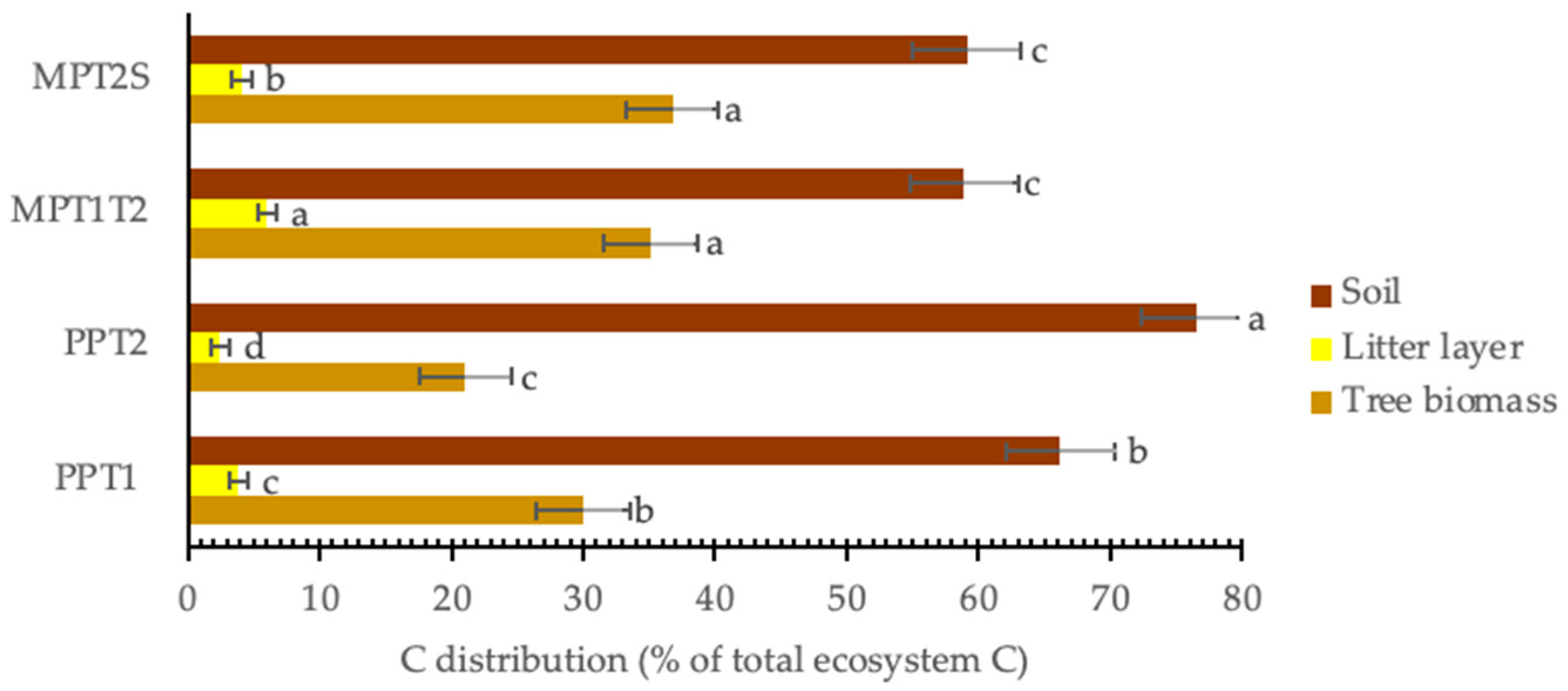
According to LMMs, C distribution differed significantly among plantation systems (Figure 2). In all systems, the soil fraction was the dominant reservoir, accounting for 59%–77% of total ecosystem C (31–36 Mg C ha−1). This pool was significantly greater in PPT2 compared with PPT1 and the mixed plantations (p = 0.008). Tree biomass represented the second largest pool (21%–37%; 9.6–19.5 Mg C ha−1). The highest proportions were observed in PPT1 and MPT1T2, where tree biomass accounted for nearly one third of total C, significantly exceeding PPT2 (p = 0.014). The litter layer contributed the smallest share (2%–6%; 1.1–3.3 Mg C ha−1) but still showed marked differences among systems. MPT1T2 had the highest litter C contribution (~7%), significantly greater than PPT2 (~3%; p = 0.004). Overall, soil dominated C storage in all plantations, while T. rosea—either in pure or mixed systems—enhanced the relative proportion of biomass C and increased litter contributions compared with T. donnell-smithii monocultures.

4. Discussion

4.1. Growth, Productivity, and Soil Properties of Pure and Mixed Plantations

PPT1 demonstrated the highest growth and productivity, confirming the species’ strong adaptation to local conditions. Standing volume in PPT1 (39.8 m3 ha−1) was comparable to values reported for 17-year-old T. rosea plantations in Veracruz (35–42 m3 ha−1) [48] and higher than yields for T. donnell-smithii in Chiapas (22–30 m3 ha−1) [49]. In contrast, the lower productivity of PPT2 (20.5 m3 ha−1) suggests greater sensitivity of T. donnell-smithii to site conditions in Jalisco.
Mixed plantations increased BA relative to pure systems, consistent with findings presented in [5] for tropical mixtures in Michoacán. However, standing volume was not higher than pure T. rosea, indicating that mixtures enhance structural diversity but not necessarily total productivity in the short term. Recent studies reinforce that mixed plantations do not always outperform monocultures in terms of growth or productivity. For instance, ref. [50] demonstrated that mixtures may enhance certain ecological functions but do not necessarily increase ecosystem multifunctionality compared with monocultures. Similarly, ref. [25] reported that tropical mixed-species plantations in Central America provide economic and ecological benefits, yet their productive advantage is highly context-dependent. These findings are consistent with our results, where mixtures improved basal area but did not exceed pure T. rosea in standing volume.
Soil analyses revealed that PPT1 maintained higher pH, CEC, and organic C than mixtures involving S. humilis (MPT2S). This supports previous findings that Tabebuia spp. contribute base-rich litter layer, improving soil fertility [51]. In contrast, S. humilis mixtures were associated with more acidic soils and lower C:N ratios, a pattern also observed in mahogany plantations in Panama [52].

4.2. Carbon Content in Tree Biomass and Litter Layer

C content in tree tissues (46%–50%) was consistent across species, confirming the relative stability of C content in hardwood tissues regardless of growth form. These values align with those reported for tropical hardwoods such as Swietenia macrophylla and Cedrela odorata [8,53]. The higher C fractions in stems and roots reflect the greater lignin content of structural tissues [54].
In the litter layer, C content varied among systems, with PPT2 presenting the lowest values (36.9%). Similar patterns were reported in [29] in tropical plantations in China, where litter layer C content ranged between 37 and 42%. These results suggest that species composition influences litter layer chemistry and decomposition dynamics, with mixtures enhancing C content relative to pure T. donnell-smithii. The relatively stable C concentrations (46%–50%) observed in this study are in line with global evidence. Ref. [55] reported similar stability in clonal teak plantations, where C content in tree tissues remained within a narrow range despite differences in growth performance. In addition, ref. [56] highlighted that teak yield tables and C estimation models consistently show wood C fractions of ~48%–50%. Our results therefore confirm that C fractions in tropical hardwoods are stable across species and organs, while litter quality and composition appear more sensitive to species identity.

4.3. Efficiency of Biometric Models for Estimating Biomass and Carbon of Tropical Forest Species

The biometric models developed in this study showed high accuracy (R2 = 0.91–0.99) for both biomass and C estimation. Similar levels of performance have been reported in tropical species such as Tectona grandis and Gmelina arborea [23,24].
Among species, S. humilis produced the most robust models, with R2 = 0.999 for total C. Although root models had slightly higher standard errors, these values remain within the range reported for other tropical hardwoods [35]. Importantly, models were validated with training and testing datasets, increasing confidence in their applicability. These findings highlight the potential of species-specific models for improving C accounting in tropical plantations. Nonetheless, we recognize that the limited number of destructively sampled trees (n = 30 per species) constrains the generalizability of the equations, and future studies should test them across broader ecological gradients. Recent contributions emphasize the importance of accurate allometric models for tropical species. Refs. [25,57] showed that models integrating C, biodiversity, and timber values improve forest management planning. Our species-specific equations, validated with independent datasets, align with these recommendations by providing robust tools for biomass and C estimation in native hardwoods.

4.4. Carbon Sequestration in Pure and Mixed Plantations

Total C sequestration varied from 45 Mg ha−1 in PPT2 to 55 Mg ha−1 in PPT1 and MPT1T2. These values are within the range reported for 15–20-year-old tropical plantations (40–60 Mg C ha−1) [58,59]. Pure T. rosea maximized C capture, while mixtures diversified C allocation, especially to the litter layer.
Soil contributed substantially to total C, representing 60%–65% of stocks in systems with lower aboveground biomass. Similar proportions have been observed in tropical dry forests and plantations in Latin America [17]. These results highlight the dual role of pure and mixed plantations: pure systems enhance short-term C capture, while mixtures promote resilience through diversified C pools. Our estimates of total C stocks (45–55 Mg C ha−1) are comparable to values reported for tropical plantations of similar age elsewhere. For example, ref. [58] noted that Tectona grandis plantations accumulate substantial soil and biomass C, with distributions similar to those reported in our study. Moreover, ref. [59] argued that planted forests should be designed as multifunctional systems that integrate biodiversity and C objectives. This perspective supports our finding that while pure T. rosea maximizes short-term capture, mixed plantations diversify C pools and enhance ecological resilience.

4.5. Direct and Indirect Implications Involved in Carbon Sequestration in Managed Tropical Forests Plantations

C sequestration in CFPs is influenced by direct management factors (species choice, planting density, thinning, residue management) and indirect ecosystem processes (soil fertility, decomposition, nutrient cycling). Pure T. rosea plantations demonstrate high short-term capture, but mixtures including S. humilis appeared to enhance stability and resilience by diversifying C reservoirs. Mixed plantations may also provide potential indirect benefits such as pest reduction, drought resilience, and improved N cycling, as noted by [30]. These advantages may contribute to the long-term sustainability of tropical production systems, although broader validation is still required. Mixed plantations are increasingly recognized for potential contribution to long-term sustainability. Ref. [50] and [47] highlighted that species-diverse planted forests can provide resilience to climate extremes, pest outbreaks, and soil degradation, even when short-term productivity is lower. This aligns with our observation that mixtures involving S. humilis tended to enhance litter and soil C fractions, may contribute to system stability. These implications should, however, be interpreted with caution given the limitations of this study, including the restricted number of plots (n = 12) and the lack of statistical independence of trees within plots. The present analyses were conducted with linear mixed-effects models (LMMs) to account for the hierarchical structure of the data [45]. Expanding the number of sites and including additional native species will also be necessary to strengthen the generalization of our findings.

5. Conclusions

This study provides evidence on growth, productivity, and C sequestration in pure and mixed CFPs of Tabebuia rosea, T. donnell-smithii, and Swietenia humilis in western Mexico. Results highlight three major findings. First, pure T. rosea plantations exhibited the highest growth and productivity, confirming the species’ strong adaptation to local conditions, whereas pure T. donnell-smithii plantations showed the lowest values. Mixed plantations, particularly T. rosea + T. donnell-smithii, enhanced basal area and diversified stand structure but did not surpass pure T. rosea in terms of total volume. Second, C content in tree tissues was relatively constant across species (~48%), with stems and roots showing higher concentrations than leaves, although the distribution of C across ecosystem compartments varied. Pure T. rosea plantations maximized soil C storage, while mixtures, especially T. rosea + T. donnell-smithii, increased litter layer C, thus diversifying C pools. Third, the species-specific biometric models developed in this study demonstrated high predictive accuracy (R2 = 0.91–0.99) for biomass and C estimation.
We acknowledge two important limitations: (i) the restricted number of research areas and plots, which constrains the extrapolation of results, and (ii) the lack of statistical independence of trees within plots. To address the latter, analyses were conducted using LMMs, which account for the hierarchical structure of the data and provide more robust inference at the plot level. Consequently, our models and management inferences should be considered preliminary and site-specific. Future research including more sites, larger sample sizes, and linear mixed-effects models will be necessary to confirm the trends identified here and broaden the applicability of the equations.
Despite these constraints, the findings suggest complementary roles of pure and mixed CFPs: pure T. rosea plantations may provide higher short-term productivity and soil C accumulation, whereas mixed systems appear to enhance stability through diversified C allocation. These insights contribute to understanding the potential of native hardwood plantations in Mexico, but broader testing is required before deriving general management or policy recommendations.

Author Contributions

Conceptualization, B.A.R.-B. and E.H.-A.; methodology, B.A.R.-B. and E.H.-A.; validation, V.B. and T.M.-T.; formal analysis, B.A.R.-B. and E.H.-A.; resources, B.A.R.-B., E.H.-A., V.B. and T.M.-T.; writing—original draft preparation, B.A.R.-B.; writing—review and editing, B.A.R.-B., E.H.-A., V.B. and T.M.-T.; supervision, E.H.-A.; project administration, E.H.-A.; funding acquisition, B.A.R.-B. and E.H.-A. All authors have read and agreed to the published version of the manuscript.

Funding

This project was funded through the Postdoctoral Fellowships for Mexico 2022 (1) (I1200/320/2022) program of the former Consejo Nacional de Ciencia y Tecnología (CONACYT).

Data Availability Statement

All data supporting the results presented in this research are included in the manuscript.

Acknowledgments

The main author is deeply grateful to Dellanira Blandon Renteria for giving him life. Rest in peace.

Conflicts of Interest

The authors declare that they have no conflict of interest.

Abbreviations

The following abbreviations are used in this manuscript:
CCarbon
CFPsCommercial forest plantations
PPT1Pure Plantation of Tabebuia rosea
PPT2Pure Plantation of Tabebuia donnell-smithii
MPT1T2Mixed Plantation of Tabebuia rosea + Tabebuia donnell-smithii
MPT2SMixed Plantation of Tabebuia donnell-smithii + Swietenia humilis
FIPRODEFOTrust for the Administration of the Forest Development Program of the State of Jalisco
HTotal height tree
DBHDiameter at Breast Height
BABasal area
VVolume
DDiameter
MCMorphic coefficient
BDBulk density
CECCation exchange capacity
ECElectrical conductimetry
NNitrogen
CHSN-OCarbon, Hydrogen, Sulfur, Nitrogen and Oxygen
DB Dry biomass
FWFresh weight
DWDry weight
MCMoisture content
WwsWet weight sub-sample
DwsDry weight sub-sample
WcMoisture content
MgMegagrams
ha−1Per hectare
LMMsLinear Mixed-effects Models
T1Tabebuia rosea
T2Tabebuia donnell-smithii
SSwietenia humilis
ClClay loam

References

  1. USDA-ARS. Tabebuia rosea (Bertol.) DC. Germplasm Resources Information Network (GRIN). 2025. Available online: https://npgsweb.ars-grin.gov/gringlobal/taxonomydetail?id=105257 (accessed on 2 September 2025).
  2. USDA-ARS. Tabebuia donnell-smithii Rose. Germplasm Resources Information Network (GRIN). 2025. Available online: https://npgsweb.ars-grin.gov/gringlobal/taxonomydetail?id=36142 (accessed on 2 September 2025).
  3. Aguirre-Medina, J.F.; Culebro-Cifuentes, F.; Cadena-Iñiguez, J.; Aguirre-Cadena, J.F. Crecimiento de Tabebuia donnell-smithii Rose inoculada con hongos micorrízicos y Azospirillum brasilense. Agrociencia 2014, 48, 99–112. [Google Scholar]
  4. Hernández-Álvarez, E.; Ruiz-Blandon, B.A.; Gómez-Cárdenas, M.; Quiñonez-Barraza, G. Análisis tecnológico en Gmelina arborea Roxb. proveniente de rodales juveniles puros y mezclados en México. Colomb. For. 2024, 27, e21313. [Google Scholar] [CrossRef]
  5. USDA-ARS. Swietenia humilis Zucc. Germplasm Resources Information Network (GRIN). 2025. Available online: https://npgsweb.ars-grin.gov/gringlobal/taxonomydetail?id=35954 (accessed on 2 September 2025).
  6. Rodríguez-Coca, L.I.; Ciocîrlan, E.; Trocones Boggiano, A.G.; Delgado Fernández, L.A.; Lorenzo Évora, J.F.; Codrean, C.; Curtu, A.L. Leaf-based characterization of intermediate forms between Cuban and Honduran mahogany. Not. Bot. Horti Agrobot. Cluj-Napoca 2024, 52, 13731. [Google Scholar] [CrossRef]
  7. Jiménez Nehring, N.G. Timber Production and Carbon Storage in Coffee with Cedar (Cedrela odorata) and Mahogany (Swietenia macrophylla) in Honduras. Master’s Thesis, University of Florida, Gainesville, FL, USA, 2012. [Google Scholar]
  8. Akhilraj, T.M.; Inamati, S.S.; Kambli, S.S.; Soman, D.; Vasudeva, R. Growth performance of mahogany (Swietenia macrophylla) under different soil types in Northern Karnataka. Indian J. Ecol. 2023, 50, 1712–1715. [Google Scholar] [CrossRef]
  9. CABI. Tabebuia rosea (rosy trumpet tree). In Invasive Species Compendium; CAB International: Wallingford, UK, 2016; Available online: https://doi.org/10.1079/cabicompendium.52577 (accessed on 29 September 2025).
  10. Basave Villalobos, J.M.; Santiago-García, W.; López-Upton, J.; Cetina-Alcalá, V.M.; Vargas-Hernández, J.J. Nursery practices increase seedling performance on nutrient-poor soils in Swietenia humilis. iForest 2014, 7, 313–319. [Google Scholar] [CrossRef]
  11. Calixto-Valencia, M.A.; López-López, M.A.; Hernández-Álvarez, E.; Muñoz-Flores, H.J.; Cetina-Alcalá, V.M. Morpho-Physiological Adjustment of Swietenia humilis to Light and Nutritional Availability in the Nursery Stage. Forests 2024, 15, 2125. [Google Scholar] [CrossRef]
  12. Paquette, A.; Messier, C. The role of plantations in managing the world’s forests in the Anthropocene. Front. Ecol. Environ. 2010, 8, 27–34. [Google Scholar] [CrossRef]
  13. Osuri, A.M.; Gopal, A.; Raman, T.S.; DeFries, R.; Cook-Patton, S.C.; Naeem, S. Greater stability of carbon capture in species-rich natural forests compared to species-poor plantations. Environ. Res. Lett. 2020, 15, 034011. [Google Scholar] [CrossRef]
  14. Ameray, A.; Bergeron, Y.; Valeria, O.; Montoro Girona, M.; Cavard, X. Forest carbon management: A review of silvicultural practices and management strategies across boreal, temperate, and tropical forests. Curr. For. Rep. 2021, 7, 245–266. [Google Scholar] [CrossRef]
  15. Mora-Orozco, C.; Garnica, J.; Acuña, I.; Solorio, J.; Martínez, C.; Valencia, L. Soil carbon storage in experimental forest plantations with tropical species. Open J. For. 2022, 12, 1–18. [Google Scholar] [CrossRef]
  16. Gao, Y.; Cheng, J.; Ma, Z.; Zhao, Y.; Su, J. Carbon storage in biomass, litter, and soil of different plantations in a semiarid temperate region of northwest China. Ann. For. Sci. 2014, 71, 427–435. [Google Scholar] [CrossRef]
  17. Eslamdoust, J.; Sohrabi, H. Carbon storage in biomass, litter, and soil of different native and introduced fast-growing tree plantations in the South Caspian Sea. J. For. Res. 2018, 29, 449–457 . [Google Scholar] [CrossRef]
  18. Jha, K.K. Carbon storage and sequestration rate assessment and allometric model development in young teak plantations of tropical moist deciduous forest, India. J. For. Res. 2015, 26, 589–604. [Google Scholar] [CrossRef]
  19. Guerra-De la Cruz, V.; Galicia, L. Tropical and highland temperate forest plantations in Mexico: Pathways for climate change mitigation and ecosystem services delivery. Forests 2017, 8, 489. [Google Scholar] [CrossRef]
  20. Derwisch, S.; Schwendenmann, L.; Olschewski, R.; Hölscher, D. Estimation and economic evaluation of aboveground carbon storage of Tectona grandis plantations in Western Panama. New For. 2009, 37, 227–240. [Google Scholar] [CrossRef]
  21. Ruiz-Blandon, B.A.; Salcedo-Pérez, E.; Rodríguez-Macías, R.; Hernández-Álvarez, E.; Campo, J.; Merino, A. Growth, biomass, carbon and nutrient pools in Gmelina arborea established in pure and mixed forest stand production systems in Mexico. New For. 2022, 53, 735–757. [Google Scholar] [CrossRef]
  22. Rodríguez, M.; Arias, D.; Valverde, J.C.; Camacho, D. Allometric equations for estimation of tree biomass from plantation residues of Gmelina arborea Roxb. and Tectona grandis L.f. in Guanacaste, Costa Rica. Rev. For. Mesoam. Kurú 2018, 15, 61–68. [Google Scholar] [CrossRef]
  23. Pinnschmidt, A.; Yousefpour, R.; Nölte, A.; Murillo, O.; Hanewinkel, M. Economic potential and management of tropical mixed-species plantations in Central America. New For. 2023, 54, 565–586. [Google Scholar] [CrossRef]
  24. Anbarashan, M.; Parthiban, K.T.; Kumar, R.S. Survival, growth, aboveground biomass, and carbon sequestration of mono and mixed native tree species plantations on the Coromandel Coast of India. Geol. Ecol. Landsc. 2020, 4, 111–120. [Google Scholar] [CrossRef][Green Version]
  25. Le, H.D.; Smith, C.; Herbohn, J.; Harrison, S. Comparing growth and structure in mixed-species and monoculture plantations in tropical and subtropical regions. J. Sustain. For. 2021, 40, 401–430. [Google Scholar] [CrossRef]
  26. Tamang, M.; Chettri, R.; Vineeta; Shukla, G.; Bhat, J.A.; Kumar, A.; Kumar, M.; Suryawanshi, A.; Cabral-Pinto, M.; Chakravarty, S. Stand Structure, Biomass and Carbon Storage in Gmelina arborea Plantation at Agricultural Landscape in Foothills of Eastern Himalayas. Land 2021, 10, 387. [Google Scholar] [CrossRef]
  27. Liu, C.L.C.; Kuchma, O.; Krutovsky, K.V. Mixed-species versus monocultures in plantation forestry: Development, benefits, ecosystem services and perspectives for the future. Glob. Ecol. Conserv. 2018, 15, e00419. [Google Scholar] [CrossRef]
  28. Forrester, D.I.; Bauhus, J.; Cowie, A.L. Mixed-species plantations of Eucalyptus with nitrogen-fixing trees: A review. For. Ecol. Manag. 2006, 233, 211–230. [Google Scholar] [CrossRef]
  29. Wang, Y.; Li, X.; Liu, J.; Yan, H. Functional diversity enhances the stability of carbon storage in tropical forests under climate change. Glob. Ecol. Biogeogr. 2022, 31, 1423–1437. [Google Scholar] [CrossRef]
  30. Chave, J.; Réjou-Méchain, M.; Búrquez, A.; Chidumayo, E.; Colgan, M.S.; Delitti, W.B.; Duque, A.; Eid, T.; Fearnside, P.M.; Goodman, R.C.; et al. Improved allometric models to estimate the aboveground biomass of tropical trees. Glob. Change Biol. 2014, 20, 3177–3190. [Google Scholar] [CrossRef]
  31. Álvarez, E.; Duque, A.; Saldarriaga, J.; Cabrera, K.; de las Salas, G.; del Valle, I.; Orrego, S. Tree above-ground biomass allometries for carbon stocks estimation in the natural forests of Colombia. For. Ecol. Manag. 2012, 267, 297–308. [Google Scholar] [CrossRef]
  32. Sileshi, G.W. A critical review of forest biomass estimation models, common mistakes and corrective measures. For. Ecol. Manag. 2014, 329, 237–254. [Google Scholar] [CrossRef]
  33. Mokany, K.; Raison, R.J.; Prokushkin, A.S. Critical analysis of root:shoot ratios in terrestrial biomes. Glob. Change Biol. 2006, 12, 84–96. [Google Scholar] [CrossRef]
  34. Instituto de Información Estadística y Geográfica [IIEG]. Diagnóstico del municipio de Tuxpan. Gobierno de Jalisco; 2021. Available online: https://iieg.gob.mx/ns/wp-content/uploads/2021/12/Tuxpan.pdf (accessed on 2 September 2025).
  35. INEGI. Edafología. Continuo Nacional, Serie II; Instituto Nacional de Estadística y Geografía: Aguascalientes, Mexico, 2014. [Google Scholar]
  36. SEMARNAT. Norma Oficial Mexicana NOM-021-RECNAT-2000, que Establece las Especificaciones de Fertilidad, Salinidad y Clasificación de Suelos. Estudios, Muestreo y Análisis; Secretaría de Medio Ambiente y Recursos Naturales: México, Mexico, 2002.
  37. FAO. World Reference Base for Soil Resources 2014, Update 2015; World Soil Resources Reports No. 106; FAO: Rome, Italy, 2015. [Google Scholar]
  38. Secretaría de Medio Ambiente, Recursos Naturales y Pesca [SEMARNAP]. Texto Guía Forestal; Gobierno de Mexico: Mexico City, Mexico, 2000.
  39. Schlegel, B.; Gayoso, J.; Guerra, J. Manual de Procedimientos de Muestreo de Biomasa Forestal: Medición de la Capacidad de Captura de Carbono en Los Bosques de Chile y Promoción en el Mercado Mundial; Universidad Austral de Chile: Valdivia, Chile, 2001. [Google Scholar]
  40. Nelson, D.W.; Sommers, L.E. Total carbon, organic carbon, and organic matter. In Methods of Soil Analysis: Part 3—Chemical Methods; Sparks, D.L., Ed.; Soil Science Society of America: Madison, WI, USA, 1996; pp. 961–1010. [Google Scholar]
  41. Zuur, A.F.; Ieno, E.N.; Walker, N.; Saveliev, A.A.; Smith, G.M. Mixed Effects Models and Extensions in Ecology with R; Springer: New York, NY, USA, 2009. [Google Scholar]
  42. SAS Institute Inc. SAS/STAT® 9.4 User’s Guide; SAS Institute Inc.: Cary, NC, USA, 2013; Available online: https://support.sas.com/documentation/cdl/en/statug/63962/HTML/default/viewer.htm (accessed on 2 September 2025).
  43. Alder, D.; Synnott, T.J. Permanent Sample Plot Techniques for Mixed Tropical Forest; Oxford Forestry Institute: Oxford, UK, 1992. [Google Scholar]
  44. López-Ayala, J.L.; Sánchez-Monsalvo, V.; Hernández-Máximo, E. Crecimiento inicial de una plantación mixta de especies tropicales en Veracruz. Rev. Mex. Cienc. For. 2010, 1, 65–79. [Google Scholar]
  45. Larrea, R.G.; de los Santos-Posadas, H.M.; Hernández, J.I.V. Crecimiento y rendimiento de Cedrela odorata L. y Tabebuia donnell-smithii Rose en San José Chacalapa, Pochutla, Oaxaca. Madera Bosques 2008, 14, 65–82. [Google Scholar] [CrossRef]
  46. Alcudia-Aguilar, A.; Villanueva-López, G.; Alayón-Gamboa, J.A.; Nahed-Toral, J.; Aryal, D.R.; Casanova-Lugo, F.; Medrano-Pérez, O.R. Plant species richness in agroforestry systems correlates to soil fertility in the humid tropic of Mexico. Agrofor. Syst. 2024, 98, 891–909. [Google Scholar] [CrossRef]
  47. Li, X.; Liu, Y.; Zhang, Y.; Wang, J.; Zhou, G. Mixed plantations do not necessarily provide higher ecosystem multifunctionality than monoculture plantations. Sci. Total Environ. 2024, 914, 170156. [Google Scholar] [CrossRef]
  48. Powers, J.S.; Becknell, J.M.; Irving, J.; Pèrez-Aviles, D. Diversity and structure of regenerating tropical dry forests in Costa Rica: Geographic patterns and environmental drivers. For. Ecol. Manag. 2009, 258, 959–970. [Google Scholar] [CrossRef]
  49. Thomas, S.C.; Martin, A.R. Carbon content of tree tissues: A synthesis. Forests 2012, 3, 332–352. [Google Scholar] [CrossRef]
  50. Cusack, D.F.; Chou, W.W.; Yang, W.H.; Harmon, M.E.; Silver, W.L. Controls on long-term root and leaf litter decomposition in neotropical forests. Glob. Change Biol. 2009, 15, 1339–1355. [Google Scholar] [CrossRef]
  51. Becknell, J.M.; Kissing Kucek, L.; Powers, J.S. Aboveground biomass in mature and secondary seasonally dry tropical forests: A literature review and global synthesis. For. Ecol. Manag. 2012, 276, 88–95. [Google Scholar] [CrossRef]
  52. Wirabuana, P.Y.A.P.; Dewi, S.; Putra, B.A. Growth performance, biomass accumulation, and energy storage in clonal teak plantations. Trees For. People 2022, 8, 100217. [Google Scholar] [CrossRef]
  53. Balasubramanian, A. Carbon estimation and carbon yield table for teak at Cauvery Delta zone of Tamil Nadu. J. Trop. For. Sci. 2022, 34, 296–304. [Google Scholar] [CrossRef]
  54. Nölte, A.; Muñoz-Rojas, J.; Yousefpour, R.; Hanewinkel, M. Incorporating values of carbon, biodiversity and timber in management of Tectona grandis plantations. For. Ecol. Manage. 2018, 430, 168–177. [Google Scholar] [CrossRef]
  55. Brown, S.; Hall, M.; Andrasko, K.; Ruiz, F.; Marzoli, W.; Guerrero, G.; Masera, O.; Dushku, A.; DeJong, B.; Cornell , J. Baselines for land-use change in the tropics: Application to avoided deforestation projects. Mitig. Adapt. Strateg. Glob. Change 2007, 12, 1001–1026. [Google Scholar] [CrossRef]
  56. Don, A.; Schumacher, J.; Freibauer, A. Impact of tropical land-use change on soil organic carbon stocks—A meta-analysis. Glob. Change Biol. 2011, 17, 1658–1670. [Google Scholar] [CrossRef]
  57. Cusack, D.F.; Silver, W.L.; Torn, M.S.; McDowell, W.H. Effects of nitrogen additions on above- and belowground carbon dynamics in two tropical forests. Ecology 2011, 92, 2313–2323. [Google Scholar] [CrossRef]
  58. Asigbaase, M.; Biasi, C.; Hiltunen, J.; Kalliokoski, T. Teak–Soil Interaction: Teak (Tectona grandis) plantations and soil properties in tropical systems. Appl. Environ. Soil Sci. 2024, 2024, 7931830. [Google Scholar] [CrossRef]
  59. Ali, A. Global change solutions must embrace biodiverse, multifunctional planted forest ecosystems. Front. For. Glob. Change 2024, 7, 1346966. [Google Scholar] [CrossRef]
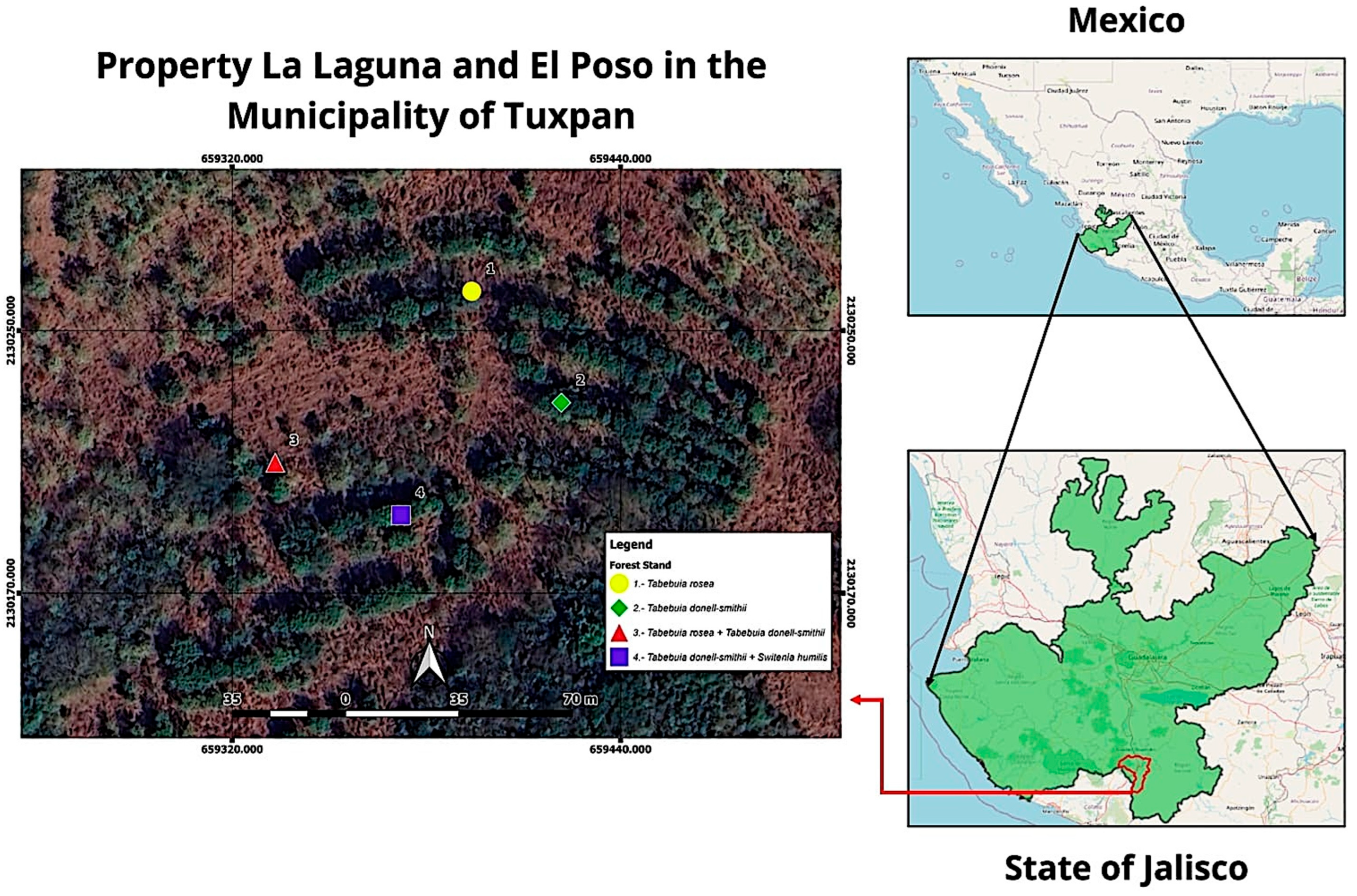
Figure 1. Geolocation of 17-year-old commercial forest plantations established in Tuxpan, Jalisco, Mexico.
Forests 16 01558 g001
Figure 2. Percentage distribution of ecosystem carbon among Soil, Litter layer, and Tree biomass in 17-year-old commercial forest plantations (PPT1, PPT2, MPT1T2, MPT2S). Bars show percent of total ecosystem C (means ± SE). Different letters indicate significant differences among systems within each compartment according to Tukey-adjusted LMMs (p ≤ 0.05). PPT1 = pure T. rosea; PPT2 = pure T. donnell-smithii; MPT1T2 = T. rosea + T. donnell-smithii; MPT2S = T. donnell-smithii + S. humilis.
Forests 16 01558 g002
Table 1. Structure and productivity of 17-year-old pure and mixed commercial forest plantations in Tuxpan (Jalisco, Mexico). n= 3.
PlantationInitial Density
(Trees ha−1)
Final Density
(Trees ha−1)
H
(m Trees −1)
DBH
(cm Trees −1)
BA
(m2 ha−1)
V
(m3 ha−1)
PPT11111 ± 12.1 a 209 ± 4.8 a11.1 ± 1.7 a17.5 ± 2.2 a4.7 ± 1.5 a39.8 ± 5.9 a
Total1111 ± 12.1 A209 ± 4.8 B11.1 ± 1.7 A17.5 ± 2.2 A4.7 ± 1.5 B39.8 ± 5.9 A
PPT21111 ± 6.1 a201 ± 3.5 a8.3 ± 3.8 b14.4 ± 4.3 b3.3 ± 0.2 b20.5 ± 3.1 b
Total1111 ± 6.3 A201± 3.5 B8.3 ± 3.8 B14.4 ± 4.3 B3.37 ± 0.2 B20.5 ± 3.1 C
T1556 ± 4.7 c171 ± 6.2 b7.2 ± 1.3 b15.4 ± 3.2 b3.2 ± 0.1 b17.3 ± 3.3 c
T2555 ± 7.2 c167 ± 7.0 b7.9 ± 1.9 b15.1 ± 3.1 b2.9 ± 0.1 b17.7 ± 2.9 c
Total/average1111 ± 11.9 A338 ± 6.3 A7.5 ± 0.3 B15.2 ± 3.0 B6.1 ± 0.2 A35.0 ± 2.2 B
T2 700 ± 16.4 b210 ± 10.0 a7.7 ± 1.0 b13.8 ± 4.0 b3.1 ± 0.2 b18.2 ± 4.7 c
S411 ± 22.9 d123 ± 14.5 c8.3 ± 0.6 b15.7 ± 3.5 b2.4 ± 0.3 b14.9 ± 4.4 d
Total/average1111 ± 12.7 A333 ± 8.6 A8.0 ± 0.1 B14.7 ± 1.3 B5.5 ± 0.1 A33.1 ± 3.9 B
The means (± standard error) with different letters indicate significant differences according to Tukey-adjusted comparisons from LMMs fitted to tree-level data with plot as random intercept (p ≤ 0.05). Capital letters compare plantations; lowercase letters compare trees within mixtures. H is the total height, DBH is the diameter at breast height, BA, is the basal area, V, is the volume, PPT1 is the pure plantation of Tabebuia rosea, PPT2 is the pure plantation of Tabebuia donnell-smithii, and S is the Swietenia humilis.
Table 2. Physical and chemical properties of soils from 17-year-old commercial forest plantations in Tuxpan (Jalisco, Mexico). n = 3.
Depth
(cm)
TextureBD
(g cm−3)
pHCEC
(cmol(+) kg−1)
EC
(dS m−1)
C
(%)
N
(%)
C:N
PPT1
0–15Cl 0.9 ± 0.01 a6.6 ± 0.1 a40.1 ± 0.1 a0.04 ± 0.03 a2.7 ± 0.3 a0.08 ± 0.001 a33.8 ± 0.7 a
PPT2
0–15Cl1.0 ± 0.03 a5.8 ± 0.2 b38.4 ± 0.4 b0.05 ± 0.02 a2.3 ± 0.3 a0.07 ± 0.003 b32.98 ± 1.8 a
MPT1T2
0–15Cl0.9 ± 0.01 a5.7 ± 0.4 b36.1 ± 0.4 b0.04 ± 0.02 a2.4 ± 0.1 a0.09 ± 0.001 a26.7 ± 0.6 b
MPT2S
0–15Cl1.1 ± 0.04 a5.5 ± 0.2 b34.7 ± 0.4 b0.06 ± 0.02 a1.9 ± 0.1 a0.09 ± 0.001 b21.10 ± 1.3 c
The mean values (± standard error) with different letters in each row differ according to Tukey-adjusted comparisons from LMMs with plot as random intercept (p ≤ 0.05). Cl is clay loam, BD is the bulk density, CEC is the cation exchange capacity, EC is the electrical conductivity, C is the carbon, N is the nitrogen, PPT1 is the pure plantation of Tabebuia rosea, PPT2 is the pure plantation of Tabebuia donnell-smithii, MPT1T2 is the mixed plantation of Tabebuia rosea and Tabebuia donnell-smithii, MPT2S is the mixed plantation of Tabebuia donnell-smithii and Swietenia humilis.
Table 3. Carbon content by species. n = 3.
Tree ComponentC Content (%)
Tabebuia roseaTabebuia donnell-smithiiSwietenia humilis
Leaves46.2 ± 0.001 a47.8 ± 0.003 a46.4 ± 0.003 a
Branches47.6 ± 0.004 a47.0 ± 0.001 a48.5 ± 0.005 a
Stem49.1 ± 0.04 a49.5 ± 0.01 a50.3 ± 0.02 a
Root48.5 ± 0.003 a47.3 ± 0.002 a48.2 ± 0.002 a
The means (± standard error) with different letters denote significant differences according to Tukey-adjusted LMMs (p ≤ 0.05). %C is the carbon content in percent.
Table 4. C content in litter layer from commercial forest plantations. n = 3.
PlantationC (%)
PPT139.8 ± 0.1 a
PPT236.9 ± 0.5 b
MPT1T239.3 ± 0.1 a
MPT2S40.2 ± 0.4 a
The means (±standard error) with different letters denote significant differences according to Tukey-adjusted LMMs (p ≤ 0.05). %C is the carbon content. PPT1 is the pure plantation of Tabebuia rosea, PPT2 is the pure plantation of Tabebuia donnell-smithii, MPT1T2 is the mixed plantation of Tabebuia rosea and Tabebuia donnell-smithii, MPT2S is the mixed plantation of Tabebuia donnell-smithii and Swietenia humilis.
Table 5. Biometric models of biomass and carbon for Tabebuia rosea, Tabebuia donnell-smithii, and Swietenia humilis. n = 30.
ComponentsBiometric ModelR2Standard Error
Biomass Tabebuia rosea
LeavesLB = exp (ln(1.049) + 0.595597·ln(DBH))0.9750.431
BranchesBB = exp(0.898 + 0.010994·DBH2)0.9870.661
StemSB = exp(−12.169 + 1.124917·DBH)0.9910.138
RootBR = exp(ln(1.217) + 1.24987·ln(DBH))0.9451.022
Total BTB = exp(0.492 + 0.313714·DBH)0.9830.473
Carbon
LeavesLC = exp(ln(0.462) + ln(1.049) + 0.595597·ln(DBH))0.9890.532
BranchesBC = exp(ln(0.476) + 0.898 + 0.010994·DBH2)0.9970.568
StemSC = exp(ln(0.491) − 12.169 + 1.124917·DBH)0.9990.157
RootRC = exp(ln(0.485) + ln(1.217) + 1.24987·ln(DBH))0.9081.730
Total CTC = exp(ln(0.491) + 0.492 + 0.313714·DBH)0.9770.141
Biomass Tabebuia donnell-smithii
LeavesLB = exp(ln(1.037) + 0.496899·ln(DBH))0.9960.821
BranchesBB = exp(−0.149 + 0.010157·DBH2)0.9930.415
StemSB = exp(−11.978 + 1.068938·DBH)0.9780.722
RootBR = exp(ln(0.947) + 1.18423·ln(DBH))0.9640.837
Total BTB = exp(0.036 + 0.300157·DBH)0.9910.429
Carbon
LeavesLC = exp(ln(0.478) + ln(1.037) + 0.496899·ln(DBH))0.9520.432
BranchesBC = exp(ln(0.470) − 0.149 + 0.010157·DBH2)0.9930.619
StemSC = exp(ln(0.495) − 11.978 + 1.068938·DBH)0.9670.577
RootRC = exp(ln(0.473) + ln(0.947) + 1.18423·ln(DBH)).0.9530.428
Total CTC = exp(ln(0.495) + 0.036 + 0.300157·DBH)0.9970.753
Biomass Swietenia humilis
LeavesLB = exp(0.185 + 0.008021·DBH2)0.9770.329
BranchesBB = exp(ln(1.050) + 1.064059·ln(DBH))0.9810.777
StemSB = exp(−12.797 + 1.15965·DBH)0.9900.346
RootBR = exp(ln(1.057) + 1.36186·ln(DBH))0.9780.963
Total BTB = exp(0.800 + 0.287992·DBH)0.9930.578
Carbon
LeavesLC = exp(ln(0.464) + 0.185 + 0.008021·DBH2)0.9910.302
BranchesBC = exp(ln(0.485) + ln(1.050) + 1.064059·ln(DBH))0.9950.415
StemSC = exp(ln(0.503) − 12.797 + 1.15965·DBH)0.9990.126
RootRC = exp(ln(0.482) + ln(1.057) + 1.36186·ln(DBH))0.9370.272
Total CTC = exp(ln(0.503) + 0.800 + 0.287992·DBH)0.9990.261
B is the biomass (kg per tree), C is the carbon (kg per tree), DBH is the diameter at breast height. Statistical significance at a 95% confidence level.
Table 6. C sequestration in 17-year-old forest plantations in Tuxpan (Jalisco, Mexico). n = 3.
SystemBiomass (Mg ha−1)C (Mg ha−1)
Tabebuia rosea
Leaves1.1 ± 0.1 a0.6 ± 0.03 a
Branches6.1 ± 0.1 a2.4 ± 0.2 a
Stem23.1 ± 2.0 a9.9 ± 0.2 a
Root7.5 ± 0.9 a3.6 ± 0.04 a
Litter layer *6.2 ± 0.3 b2.1 ± 0.3 b
Soil 0–15 cm **-36.45 ± 7.7 a
Total 44.0 ± 5.5 B55.0 ± 8.1 A
Tabebuia donnell-smithii
Leaves0.8 ± 0.1 ab0.4 ± 0.04 ab
Branches1.7 ± 0.3 c0.9 ± 0.01 b
Stem11.6 ± 1.9 c6.1 ± 0.4 b
Root4.7 ± 0.2 bc2.2 ± 0.7 b
Litter layer *3.2 ± 0.1 c1.1 ± 0.1 c
Soil 0–15 cm **-34.5 ± 6.8 b
Total 22.0 ± 6.3 C45.1 ± 6.7 B
Tabebuia rosea
Leaves0.9 ± 0.04 a0.4 ± 0.02 ab
Branches2.3 ± 0.1 b1.1 ± 0.3 b
Stem14.1 ± 3.2 b6.8 ± 0.3 b
Root5.2 ± 0.2 b2.5 ± 0.6 b
Tabebuia donnell-smithii
Leaves0.6 ± 0.04 b0.3 ± 0.01 b
Branches1.7 ± 0.3 c0.9 ± 0.03 b
Stem10.6 ± 2.9 c5.4 ± 0.1 bc
Root4.2 ± 0.7 c1.9 ± 0.04 c
Litter layer *9.3 ± 3.4 a3.3 ± 0.1 a
Soil 0–15 cm **-32.4 ± 8.2 c
Total 49.0 ± 9.6 A55.0 ± 9.8 A
Tabebuia donnell-smithii
Leaves0.8 ± 0.01 ab0.4 ± 0.01 ab
Branches1.5 ± 0.4 c0.8 ± 0.04 b
Stem11.1 ± 3.1 c6.0 ± 0.4 b
Root4.7 ± 0.5 bc2.2 ± 0.3 b
Swietenia humilis
Leaves0.9 ± 0.02 a0.5 ± 0.01 a
Branches2.3 ± 0.2 b1.1 ± 0.3 b
Stem12.2 ± 3.4 bc6.0 ± 0.1 b
Root5.2 ± 0.01 b2.5 ± 0.3 b
Litter layer *6.2b ± 0.42.2 ± 0.1 b
Soil 0–15 cm **-31.4 ± 6.6 c
Total 44.9 ± 11.2 B53.0 ± 7.5 A
The means (± standard error) with different letters indicate significant differences according to Tukey-adjusted comparisons from LMMs fitted to tree-level data with plot as random intercept (p ≤ 0.05). Capital letters are comparisons between plantations and lowercase letters between tree components by species, * litter layer, and ** soil.
Disclaimer/Publisher’s Note: The statements, opinions and data contained in all publications are solely those of the individual author(s) and contributor(s) and not of MDPI and/or the editor(s). MDPI and/or the editor(s) disclaim responsibility for any injury to people or property resulting from any ideas, methods, instructions or products referred to in the content.