



Mapping Mangrove Above-Ground Carbon Using Multi-Source Remote Sensing Data and Machine Learning Approach in Loh Buaya, Komodo National Park, Indonesia

 ,
,  ,
,
Abstract
1. Introduction
2. Materials
2.1. Study Area
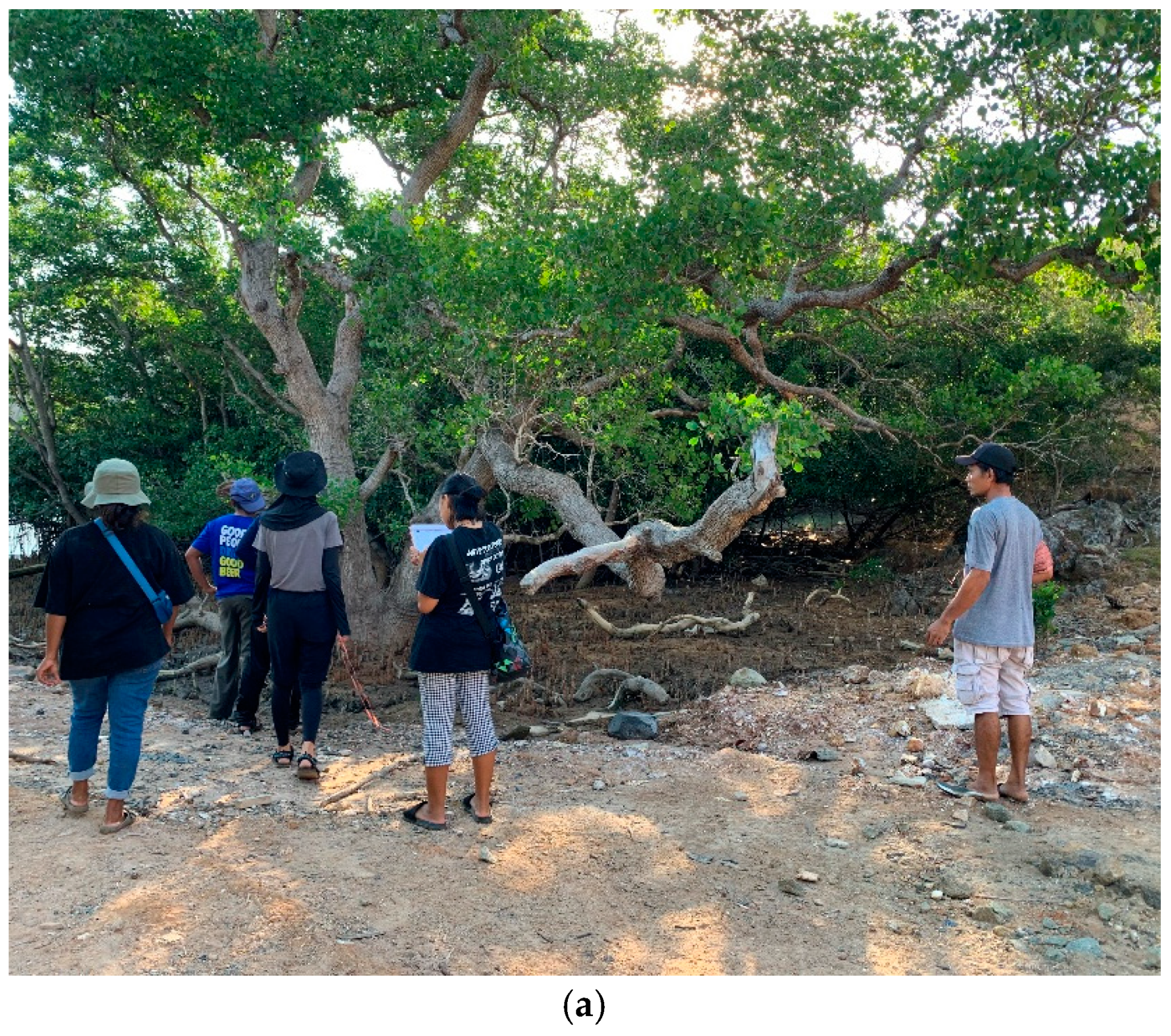
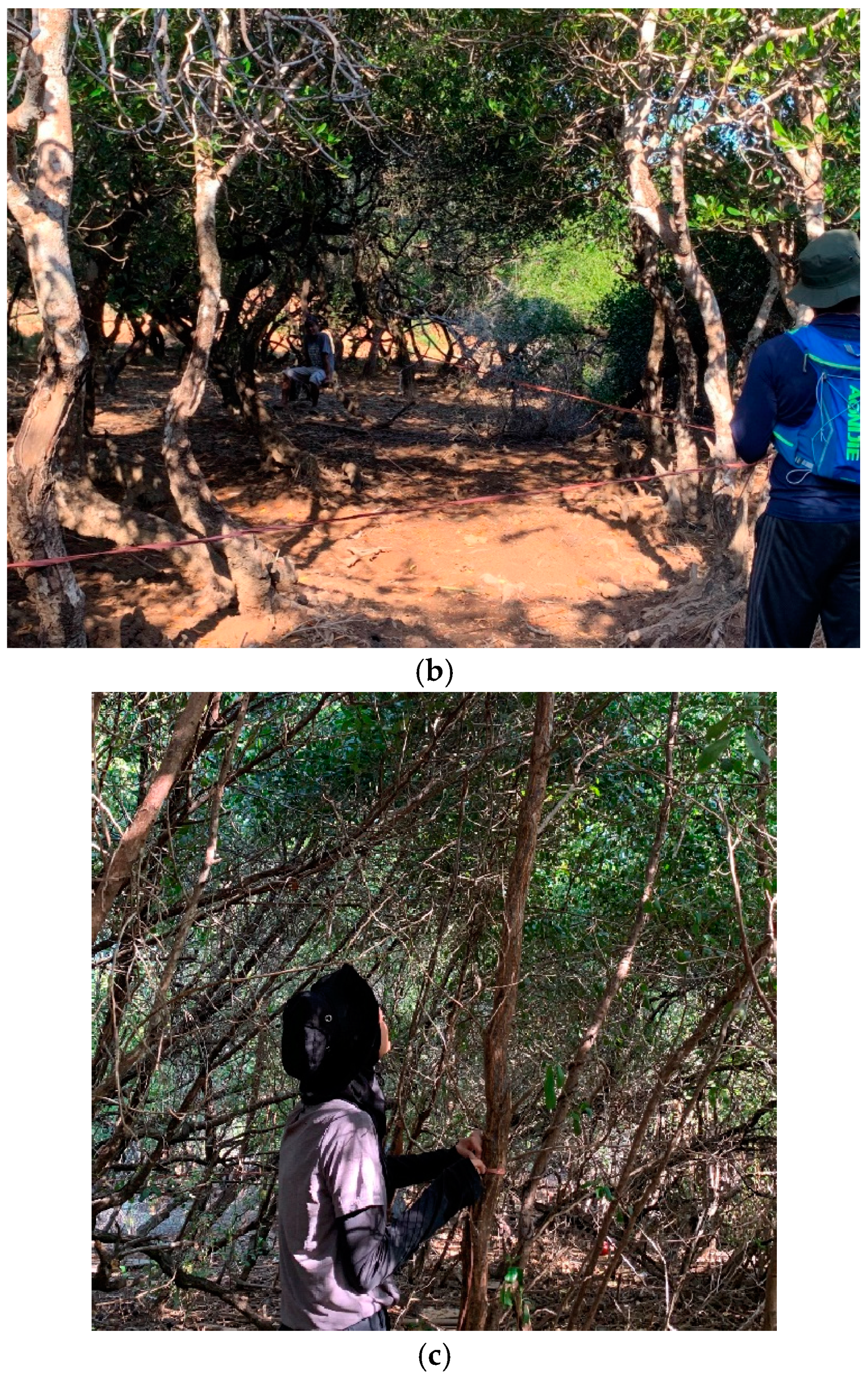
2.2. Field Survey
2.3. Biomass and Carbon Estimations
2.4. Earth Observations (EO) Data
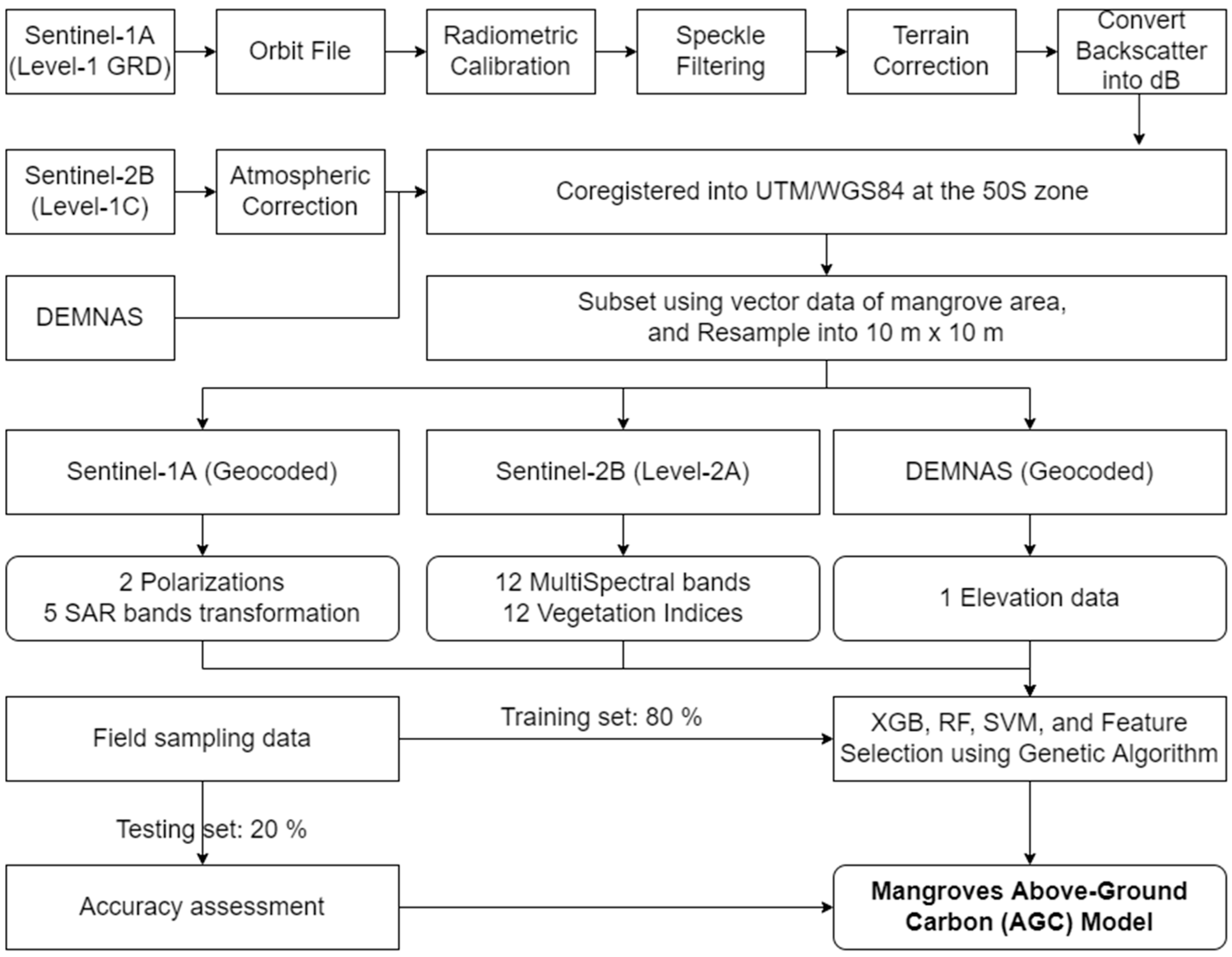
3. Methods
3.1. EO Image Processing
3.1.1. EO Image Pre-Processing
3.1.2. EO Image Transformations
3.2. Machine Learning Algorithms
3.2.1. Random Forest (RF)
3.2.2. Support Vector Machine (SVM)
3.2.3. Extreme Gradient Boosting (XGB)
3.3. Model Configuration, Implementation, and Accuracy Assessment
3.3.1. Configuration and Training
3.3.2. Hyperparameters Tuning
3.3.3. Feature Selection Using the Genetic Algorithm (GA)
3.3.4. Accuracy Assessment
4. Results
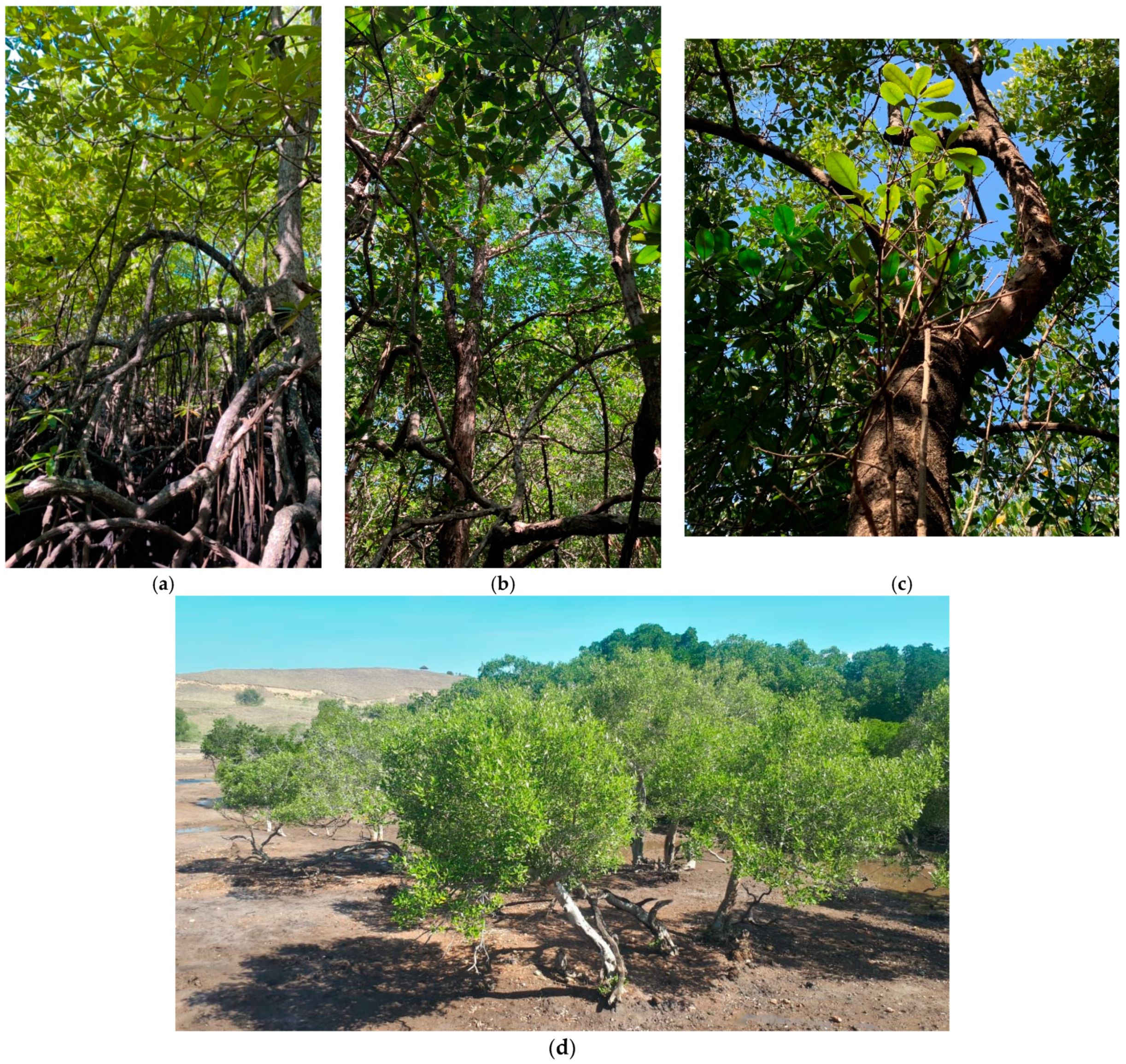
4.1. Characteristics of Mangrove Forests
4.2. Model Performance and Comparison
4.3. The Important Variables
4.4. Mangroves AGC Models
5. Discussion
6. Conclusions
Author Contributions
Funding
Data Availability Statement
Acknowledgments
Conflicts of Interest
References
- Kumari, A.; Rathore, M.S. Roles of Mangroves in Combating the Climate Change. In Mangroves: Ecology, Biodiversity and Management; Rastogi, R.P., Phulwaria, M., Gupta, D.K., Eds.; Springer Singapore: Gateway East, Singapore, 2021; pp. 225–255. ISBN 978-981-16-2494-0. [Google Scholar]
- Hu, T.; Zhang, Y.Y.; Su, Y.; Zheng, Y.; Lin, G.; Guo, Q. Mapping the global mangrove forest aboveground biomass using multisource remote sensing data. Remote Sens. 2020, 12, 1690. [Google Scholar] [CrossRef]
- Mumby, P.J.; Edwards, A.J.; Ernesto Arias-González, J.; Lindeman, K.C.; Blackwell, P.G.; Gall, A.; Gorczynska, M.I.; Harborne, A.R.; Pescod, C.L.; Renken, H.; et al. Mangroves enhance the biomass of coral reef fish communities in the Caribbean. Nature 2004, 427, 533–536. [Google Scholar] [CrossRef]
- Buelow, C.; Sheaves, M. A birds-eye view of biological connectivity in mangrove systems. Estuar. Coast. Shelf Sci. 2015, 152, 33–43. [Google Scholar] [CrossRef]
- Hernández-Blanco, M.; Costanza, R.; Cifuentes-Jara, M. Economic valuation of the ecosystem services provided by the mangroves of the Gulf of Nicoya using a hybrid methodology. Ecosyst. Serv. 2021, 49, 101258. [Google Scholar] [CrossRef]
- Marlianingrum, P.R.; Kusumastanto, T.; Adrianto, L.; Fahrudin, A. Valuing habitat quality for managing mangrove ecosystem services in coastal Tangerang District, Indonesia. Mar. Policy 2021, 133, 104747. [Google Scholar] [CrossRef]
- Goldberg, L.; Lagomasino, D.; Thomas, N.; Fatoyinbo, T. Global declines in human-driven mangrove loss. Glob. Chang. Biol. 2020, 26, 5844–5855. [Google Scholar] [CrossRef]
- Fauzi, A.; Sakti, A.; Yayusman, L.; Harto, A.; Prasetyo, L.; Irawan, B.; Kamal, M.; Wikantika, K. Contextualizing mangrove forest deforestation in southeast asia using environmental and socio-economic data products. Forests 2019, 10, 952. [Google Scholar] [CrossRef]
- Latiff, A.; Faridah-Hanum, I. Mangrove Ecosystem of Malaysia: Status, Challenges and Management Strategies. In Mangrove Ecosystems of Asia; Faridah-Hanum, I., Latiff, A., Hakeem, K.R., Ozturk, M., Eds.; Springer New York: New York, NY, USA, 2014; pp. 1–22. ISBN 978-1-4614-8582-7. [Google Scholar]
- Pendleton, L.; Donato, D.C.; Murray, B.C.; Crooks, S.; Jenkins, W.A.; Sifleet, S.; Craft, C.; Fourqurean, J.W.; Kauffman, J.B.; Marbà, N.; et al. Estimating Global “Blue Carbon” Emissions from Conversion and Degradation of Vegetated Coastal Ecosystems. PLoS ONE 2012, 7, e43542. [Google Scholar] [CrossRef]
- Hutchison, J.; Manica, A.; Swetnam, R.; Balmford, A.; Spalding, M. Predicting Global Patterns in Mangrove Forest Biomass. Conserv. Lett. 2014, 7, 233–240. [Google Scholar] [CrossRef]
- Hagger, V.; Worthington, T.A.; Lovelock, C.E.; Adame, M.F.; Amano, T.; Brown, B.M.; Friess, D.A.; Landis, E.; Mumby, P.J.; Morrison, T.H.; et al. Drivers of global mangrove loss and gain in social-ecological systems. Nat. Commun. 2022, 13, 6373. [Google Scholar] [CrossRef]
- Friess, D.A.; Yando, E.S.; Abuchahla, G.M.O.; Adams, J.B.; Cannicci, S.; Canty, S.W.J.; Cavanaugh, K.C.; Connolly, R.M.; Cormier, N.; Dahdouh-Guebas, F.; et al. Mangroves give cause for conservation optimism, for now. Curr. Biol. 2020, 30, R153–R154. [Google Scholar] [CrossRef]
- Sani, D.A.; Hashim, M.; Hossain, M.S. Remote sensing models used for mapping and estimation of blue carbon biomass in seagrass-mangrove habitats: A review. In Proceedings of the 39th Asian Conference on Remote Sensing (ACRS), Renaissance Kuala Lumpur Hotel, Lumpur, Malaysia, 15–19 October 2018; Volume 1, pp. 399–408. [Google Scholar]
- Lamont, K.; Saintilan, N.; Kelleway, J.J.; Mazumder, D.; Zawadzki, A. Thirty-Year Repeat Measures of Mangrove Above- and Below-Ground Biomass Reveals Unexpectedly High Carbon Sequestration. Ecosystems 2020, 23, 370–382. [Google Scholar] [CrossRef]
- Purnamasari, E.; Kamal, M.; Wicaksono, P. Comparison of vegetation indices for estimating above-ground mangrove carbon stocks using PlanetScope image. Reg. Stud. Mar. Sci. 2021, 44, 101730. [Google Scholar] [CrossRef]
- Saintilan, N.; Lymburner, L.; Wen, L.; Haigh, I.D.; Ai, E.; Kelleway, J.J.; Rogers, K.; Pham, T.D.; Lucas, R. The lunar nodal cycle controls mangrove canopy cover on the Australian continent. Sci. Adv. 2022, 8, eabo6602. [Google Scholar] [CrossRef]
- Jones, A.R.; Raja Segaran, R.; Clarke, K.D.; Waycott, M.; Goh, W.S.H.; Gillanders, B.M. Estimating Mangrove Tree Biomass and Carbon Content: A Comparison of Forest Inventory Techniques and Drone Imagery. Front. Mar. Sci. 2020, 6, 784. [Google Scholar] [CrossRef]
- Tran, T.V.; Reef, R.; Zhu, X. A Review of Spectral Indices for Mangrove Remote Sensing. Remote Sens. 2022, 14, 4868. [Google Scholar] [CrossRef]
- Pham, T.D.; Xia, J.; Ha, N.T.; Bui, D.T.; Le, N.N.; Tekeuchi, W. A Review of Remote Sensing Approaches for Monitoring Blue Carbon Ecosystems: Mangroves, Seagrasses and Salt Marshes during 2010–2018. Sensors 2019, 19, 1933. [Google Scholar] [CrossRef]
- Wang, L.; Jia, M.; Yin, D.; Tian, J. A review of remote sensing for mangrove forests: 1956–2018. Remote Sens. Environ. 2019, 231, 111223. [Google Scholar] [CrossRef]
- Nuthammachot, N.; Askar, A.; Stratoulias, D.; Wicaksono, P. Combined use of Sentinel-1 and Sentinel-2 data for improving above-ground biomass estimation. Geocarto Int. 2020, 37, 366–376. [Google Scholar] [CrossRef]
- USGS. Imagery for Everyone… Timeline Set to Release Entire USGS Landsat Archive at No Charge. 2008. Available online: https://www.usgs.gov/media/files/2008-imagery-everyonetimeline-set-release-entire-usgs-landsat-0 (accessed on 1 November 2022).
- European Space Agency. Sentinel-2 MSI—Technical Guide—Sentinel Online 2019. Available online: https://sentinels.copernicus.eu/web/sentinel/technical-guides/sentinel-2-msi (accessed on 5 September 2022).
- European Space Agency. Sentinel-1 SAR User Guide. 2013. Available online: https://sentinel.esa.int/web/sentinel/user-guides/sentinel-1-sar (accessed on 1 November 2022).
- Bunting, P.; Rosenqvist, A.; Hilarides, L.; Lucas, R.M.; Thomas, N.; Tadono, T.; Worthington, T.A.; Spalding, M.; Murray, N.J. Global Mangrove Extent Change 1996–2020: Global Mangrove Watch Version 3.0. Remote Sens. 2022, 14, 3657. [Google Scholar] [CrossRef]
- Lagomasino, D.; Fatoyinbo, T.; Lee, S.; Feliciano, E.; Trettin, C.; Shapiro, A.; Mangora, M.M. Measuring mangrove carbon loss and gain in deltas. Environ. Res. Lett. 2019, 14, 25002. [Google Scholar] [CrossRef]
- Liu, X.; Fatoyinbo, T.E.; Thomas, N.M.; Guan, W.W.; Zhan, Y.; Mondal, P.; Lagomasino, D.; Simard, M.; Trettin, C.C.; Deo, R.; et al. Large-Scale High-Resolution Coastal Mangrove Forests Mapping Across West Africa With Machine Learning Ensemble and Satellite Big Data. Front. Earth Sci. 2021, 8, 560933. [Google Scholar] [CrossRef]
- Sidhu, N.; Pebesma, E.; Câmara, G. Using Google Earth Engine to detect land cover change: Singapore as a use case. Eur. J. Remote Sens. 2018, 51, 486–500. [Google Scholar] [CrossRef]
- Nemani, R.; Votava, P.; Michaelis, A.; Melton, F.; Milesi, C. Collaborative Supercomputing for Global Change Science. Eos Trans. Am. Geophys. Union 2011, 92, 109–116. [Google Scholar] [CrossRef]
- Argamosa, R.J.; Blanco, A.C.; Baloloy, A.B.; Candido, C.G.; Dumalag, J.B.; DImapilis, L.L.; Paringit, E.C. Modelling above Ground Biomass of Mangrove Forest Using Sentinel-1 Imagery. ISPRS Ann. Photogramm. Remote Sens. Spat. Inf. Sci. 2018, 4, 13–20. [Google Scholar] [CrossRef]
- Diniz, C.; Cortinhas, L.; Nerino, G.; Rodrigues, J.; Sadeck, L.; Adami, M.; Souza-Filho, P.W.M. Brazilian Mangrove Status: Three Decades of Satellite Data Analysis. Remote Sens. 2019, 11, 808. [Google Scholar] [CrossRef]
- Pham, T.D.; Le, N.N.; Ha, N.T.; Nguyen, L.V.; Xia, J.; Yokoya, N.; To, T.T.; Trinh, H.X.; Kieu, L.Q.; Takeuchi, W. Estimating mangrove above-ground biomass using extreme gradient boosting decision trees algorithm with fused sentinel-2 and ALOS-2 PALSAR-2 data in can Gio biosphere reserve, Vietnam. Remote Sens. 2020, 12, 777. [Google Scholar] [CrossRef]
- Tian, Y.; Huang, H.; Zhou, G.; Zhang, Q.; Tao, J.; Zhang, Y.; Lin, J. Aboveground mangrove biomass estimation in Beibu Gulf using machine learning and UAV remote sensing. Sci. Total Environ. 2021, 781, 146816. [Google Scholar] [CrossRef]
- Pham, T.D.; Yokoya, N.; Xia, J.; Ha, N.T.; Le, N.N.; Nguyen, T.T.T.; Dao, T.H.; Vu, T.T.P.; Pham, T.D.; Takeuchi, W. Comparison of machine learning methods for estimating mangrove above-ground biomass using multiple source remote sensing data in the red river delta biosphere reserve, Vietnam. Remote Sens. 2020, 12, 1334. [Google Scholar] [CrossRef]
- UNESCO. Komodo National Park—UNESCO World Heritage Centre 2014. Available online: http://whc.unesco.org/en/list/685 (accessed on 3 November 2022).
- Erdmann, A.M. A Natural History Guide to Komodo National Park; The Nature Conservancy: Virginia, UK, 2004; p. 198. [Google Scholar]
- Suraji, S.; Hasan, S.; Suharyanto, S.; Yonvitner, Y.; Koeshendrajana, S.; Prasetiyo, D.E.; Widianto, A.; Dermawan, A. Nilai Penting Dan Strategis Nasional Rencana Zonasi Kawasan Taman Nasional Komodo. J. Sos. Ekon. Kelaut. dan Perikan. 2020, 15, 15–32. [Google Scholar] [CrossRef]
- Dharmawan, I.W.E.; Suyarso; Yaya, I.U.; Prayudha, B.; Pramudji. Panduan Monitoring Struktur Komunitas Mangrove Di Indonesia, 1st ed.; Media Sains Nasional: Bogor, Indonesia, 2020; ISBN 9786239430603. [Google Scholar]
- Dharmawan, I.W.; Sastrosuwondo, P. Panduan Monitoring Status Ekosistem Mangrove di Indonesia; COREMAP CITI LIPI: Jakarta, Indonesia, 2014. [Google Scholar]
- Komiyama, A.; Poungparn, S.; Kato, S. Common allometric equations for estimating the tree weight of Common allometric equations for estimating the tree weight of mangroves. J. Trop. Ecol. 2005, 21, 471–477. [Google Scholar] [CrossRef]
- World Agroforestry. ICRAF Database—Wood Density. 2016. Available online: http://db.worldagroforestry.org/wd (accessed on 5 October 2022).
- Badan Standar Nasional. Pengukuran dan Penghitungan Cadangan Karbon—Pengukuran Lapangan untuk Penaksiran Cadangan Karbon Hutan (Ground Based Forest Carbon Accounting); BSNI: Jakarta, Indonesia, 2011. [Google Scholar]
- European Space Agency. User Guides—Sentinel-1 SAR—Polarimetry—Sentinel Online. 2022. Available online: https://sentinels.copernicus.eu/web/sentinel/user-guides/sentinel-1-sar/product-overview/polarimetry (accessed on 5 November 2022).
- Badan Informasi Geospasial (BIG)/Indonesian Geospatial Information Agency. DEMNAS. 2022. Available online: https://tanahair.indonesia.go.id/demnas/#/demnas (accessed on 5 October 2022).
- Susetyo, D.B.; Lumban-Gaol, Y.A.; Sofian, I. Prototype of national digital elevation model in Indonesia. Int. Arch. Photogramm. Remote Sens. Spat. Inf. Sci.—ISPRS Arch. 2018, 42, 687–692. [Google Scholar] [CrossRef]
- Kamal, M.; Phinn, S.; Johansen, K. Assessment of multi-resolution image data for mangrove leaf area index mapping. Remote Sens. Environ. 2016, 176, 242–254. [Google Scholar] [CrossRef]
- Wicaksono, P. Mangrove above-ground carbon stock mapping of multi-resolution passive remote-sensing systems. Int. J. Remote Sens. 2017, 38, 1551–1578. [Google Scholar] [CrossRef]
- Wicaksono, P.; Danoedoro, P.; Hartono, H.; Nehren, U.; Ribbe, L. Preliminary work of mangrove ecosystem carbon stock mapping in small island using remote sensing: Above and below ground carbon stock mapping on medium resolution satellite image. Remote Sens. Agric. Ecosyst. Hydrol. XIII 2011, 8174, 81741B. [Google Scholar] [CrossRef]
- Thapa, R.B.; Watanabe, M.; Motohka, T.; Shimada, M. Potential of high-resolution ALOS–PALSAR mosaic texture for aboveground forest carbon tracking in tropical region. Remote Sens. Environ. 2015, 160, 122–133. [Google Scholar] [CrossRef]
- Nesha, M.K.; Hussin, Y.A.; van Leeuwen, L.M.; Sulistioadi, Y.B. Modeling and mapping aboveground biomass of the restored mangroves using ALOS-2 PALSAR-2 in East Kalimantan, Indonesia. Int. J. Appl. Earth Obs. Geoinf. 2020, 91, 102158. [Google Scholar] [CrossRef]
- Pham, T.D.; Yoshino, K.; Le, N.N.; Bui, D.T. Estimating aboveground biomass of a mangrove plantation on the Northern coast of Vietnam using machine learning techniques with an integration of ALOS-2 PALSAR-2 and Sentinel-2A data. Int. J. Remote Sens. 2018, 39, 7761–7788. [Google Scholar] [CrossRef]
- Stovall, A.E.L.; Fatoyinbo, T.; Thomas, N.M.; Armston, J.; Ebanega, M.O.; Simard, M.; Trettin, C.; Obiang Zogo, R.V.; Aken, I.A.; Debina, M.; et al. Comprehensive comparison of airborne and spaceborne SAR and LiDAR estimates of forest structure in the tallest mangrove forest on earth. Sci. Remote Sens. 2021, 4, 100034. [Google Scholar] [CrossRef]
- Lucas, R.; Van De Kerchove, R.; Otero, V.; Lagomasino, D.; Fatoyinbo, L.; Omar, H.; Satyanarayana, B.; Dahdouh-Guebas, F. Structural characterisation of mangrove forests achieved through combining multiple sources of remote sensing data. Remote Sens. Environ. 2020, 237, 111543. [Google Scholar] [CrossRef]
- Maeda, Y.; Fukushima, A.; Imai, Y.; Tanahashi, Y.; Nakama, E.; Ohta, S.; Kawazoe, K.; Akune, N. Estimating carbon stock changes of mangrove forests using satellite imagery and airborne LiDAR data in the South Sumatra state, Indonesia. Int. Arch. Photogramm. Remote Sens. Spat. Inf. Sci.—ISPRS Arch. 2016, 41, 705–709. [Google Scholar] [CrossRef]
- Jin, Z.; Azzari, G.; You, C.; Di Tommaso, S.; Aston, S.; Burke, M.; Lobell, D.B. Smallholder maize area and yield mapping at national scales with Google Earth Engine. Remote Sens. Environ. 2019, 228, 115–128. [Google Scholar] [CrossRef]
- Schulz, D.; Yin, H.; Tischbein, B.; Verleysdonk, S.; Adamou, R.; Kumar, N. Land use mapping using Sentinel-1 and Sentinel-2 time series in a heterogeneous landscape in Niger, Sahel. ISPRS J. Photogramm. Remote Sens. 2021, 178, 97–111. [Google Scholar] [CrossRef]
- Hajduch, G.; Bourbigot, M.; Johnsen, H.; Piantanida, R. Sentinel-1 User Handbook. 2022. Available online: https://sentinel.esa.int/documents/247904/1877131/Sentinel-1-Product-Specification-18052021.pdf (accessed on 10 November 2022).
- Simental, E.; Verner Guthrie, M.; Scientist Bruce Blundell, P.S. Polarimetry Band Ratios, Decompositions, and Statistics for Terrain Characterization. In Global Priorities in Land Remote Sensing, Proceedings of the Pecora 16, Sioux Falls, South Dakota, 23–27 October 2005; American Society for Photogrammetry and Remote Sensing: Bethesda, MD, USA, 2005. [Google Scholar]
- Nasonova, S.; Scharien, R.; Geldsetzer, T.; Howell, S.; Power, D. Optimal Compact Polarimetric Parameters and Texture Features for Discriminating Sea Ice Types during Winter and Advanced Melt. Can. J. Remote Sens. 2019, 44, 390–411. [Google Scholar] [CrossRef]
- Baronti, S.; Carla, R.; Sigismondi, S.; Alparone, L. Principal component analysis for change detection on polarimetric multitemporal SAR data. In Proceedings of the IGARSS’94—1994 IEEE International Geoscience and Remote Sensing Symposium, Pasadena, CA, USA, 8–12 August 1994; Volume 4, pp. 2152–2154. [Google Scholar] [CrossRef]
- European Space Agency. Sentinel-2 User Handbook. 2015. Available online: https://sentinels.copernicus.eu/web/sentinel/user-guides/document-library/-/asset_publisher/xlslt4309D5h/content/sentinel-2-user-handbook (accessed on 15 November 2022).
- Jordan, C.F. Derivation of Leaf-Area Index from Quality of Light on the Forest Floor. Ecology 1969, 50, 663–666. [Google Scholar] [CrossRef]
- Tucker, C.J. Red and photographic infrared linear combinations for monitoring vegetation. Remote Sens. Environ. 1979, 8, 127–150. [Google Scholar] [CrossRef]
- Candiago, S.; Remondino, F.; De Giglio, M.; Dubbini, M.; Gattelli, M. Evaluating Multispectral Images and Vegetation Indices for Precision Farming Applications from UAV Images. Remote Sens. 2015, 7, 4026–4047. [Google Scholar] [CrossRef]
- Soria, J.; Ruiz, M.; Morales, S. Monitoring Subaquatic Vegetation Using Sentinel-2 Imagery in Gallocanta Lake (Aragón, Spain). Earth 2022, 3, 363–382. [Google Scholar] [CrossRef]
- Huete, A.R. A soil-adjusted vegetation index (SAVI). Remote Sens. Environ. 1988, 25, 295–309. [Google Scholar] [CrossRef]
- Gómez-Giráldez, P.J.; Pérez-Palazón, M.J.; Polo, M.J.; González-Dugo, M.P. Monitoring grass phenology and hydrological dynamics of an oak-grass savanna ecosystem using sentinel-2 and terrestrial photography. Remote Sens. 2020, 12, 600. [Google Scholar] [CrossRef]
- Daughtry, C.S.T.; Walthall, C.L.; Kim, M.S.; de Colstoun, E.B.; McMurtrey, J.E. Estimating Corn Leaf Chlorophyll Concentration from Leaf and Canopy Reflectance. Remote Sens. Environ. 2000, 74, 229–239. [Google Scholar] [CrossRef]
- Qi, J.; Chehbouni, A.; Huete, A.R.; Kerr, Y.H.; Sorooshian, S. A modified soil adjusted vegetation index. Remote Sens. Environ. 1994, 48, 119–126. [Google Scholar] [CrossRef]
- Richardson, A.J.; Wiegand, C.L. Distinguishing vegetation from soil background information. Photogramm. Eng. Remote Sensing 1977, 43, 1541–1552. [Google Scholar]
- Breiman, L. Random Forests. Mach. Learn. 2001, 45, 5–32. [Google Scholar] [CrossRef]
- Vapnik, V.N. An overview of statistical learning theory. IEEE Trans. Neural Networks 1999, 10, 988–999. [Google Scholar] [CrossRef] [PubMed]
- Pham, T.D.; Yoshino, K.; Bui, D.T. Biomass estimation of Sonneratia caseolaris (l.) Engler at a coastal area of Hai Phong city (Vietnam) using ALOS-2 PALSAR imagery and GIS-based multi-layer perceptron neural networks. GIScience Remote Sens. 2017, 54, 329–353. [Google Scholar] [CrossRef]
- Chen, T.; Guestrin, C. XGBoost: A Scalable Tree Boosting System. In KDD’16, Proceedings of the 22nd ACM SIGKDD International Conference on Knowledge Discovery and Data Mining, San Francisco, CA, USA, 13–17 August 2016; Association of Computing Machinery: New York, NY, USA, 2016. [Google Scholar]
- Nielsen, D. Tree Boosting With XGBoost Why Does XGBoost Win “Every” Machine Learning Competition? Master’s Thesis, NTNU: Norwegian University of Science and Trcnology, Trondheim, Norway, December 2016. [Google Scholar]
- Pedregosa, F.; Grisel, O.; Weiss, R.; Passos, A.; Brucher, M.; Varoquax, G.; Gramfort, A.; Michel, V.; Thirion, B.; Grisel, O.; et al. Scikit-learn: Machine Learning in Python. J. Mach. Learn. Res. 2011, 12, 2825–2830. [Google Scholar]
- Davis, L. Handbook of Genetic Algorithms; VNR Computer Library, Van Nostrand Reinhold: New York, NY, USA, 1991; ISBN 9780442001735. [Google Scholar]
- Pham, T.D.; Yoshino, K. Aboveground biomass estimation of mangrove species using ALOS-2 PALSAR imagery in Hai Phong City, Vietnam. J. Appl. Remote Sens. 2017, 11, 026010. [Google Scholar] [CrossRef]
- Rahmandhana, A.D.; Kamal, M.; Wicaksono, P. Spectral Reflectance-Based Mangrove Species Mapping from WorldView-2 Imagery of Karimunjawa and Kemujan Island, Central Java Province, Indonesia. Remote Sens. 2022, 14, 183. [Google Scholar] [CrossRef]
- Wicaksono, P.; Danoedoro, P.; Hartono; Nehren, U. Mangrove biomass carbon stock mapping of the Karimunjawa Islands using multispectral remote sensing. Int. J. Remote Sens. 2016, 37, 26–52. [Google Scholar] [CrossRef]
- Kamal, M.; Sidik, F.; Prananda, A.R.A.; Mahardhika, S.A. Mapping Leaf Area Index of restored mangroves using WorldView-2 imagery in Perancak Estuary, Bali, Indonesia. Remote Sens. Appl. Soc. Environ. 2021, 23, 100567. [Google Scholar] [CrossRef]
- Kamal, M.; Hidayatullah, M.F.; Mahyatar, P.; Ridha, S.M. Estimation of aboveground mangrove carbon stocks from WorldView-2 imagery based on generic and species-specific allometric equations. Remote Sens. Appl. Soc. Environ. 2022, 26, 100748. [Google Scholar] [CrossRef]
- Cerón-Souza, I.; Rivera-Ocasio, E.; Medina, E.; Jiménez, J.A.; McMillan, W.O.; Bermingham, E. Hybridization and introgression in New World red mangroves, Rhizophora (Rhizophoraceae). Am. J. Bot. 2010, 97, 945–957. [Google Scholar] [CrossRef] [PubMed]
- Dharmawan, I.W.S.; Siregar, C.A. Karbon tanah dan pendugaan karbon tegakan. Jurnal Penelitian Hutan Dan Konservasi Alam 2008, 5, 317–328. [Google Scholar] [CrossRef]
- Alimbon, J.A.; Manseguiao, M.R.S. Species composition, stand characteristics, aboveground biomass, and carbon stock of mangroves in panabo mangrove park, philippines. Biodiversitas 2021, 22, 3130–3137. [Google Scholar] [CrossRef]
- Jachowski, N.R.A.; Quak, M.S.Y.; Friess, D.A.; Duangnamon, D.; Webb, E.L.; Ziegler, A.D. Mangrove biomass estimation in Southwest Thailand using machine learning. Appl. Geogr. 2013, 45, 311–321. [Google Scholar] [CrossRef]
- Pham, T.D.; Yokoya, N.; Bui, D.T.; Yoshino, K.; Friess, D.A. Remote sensing approaches for monitoring mangrove species, structure, and biomass: Opportunities and challenges. Remote Sens. 2019, 11, 230. [Google Scholar] [CrossRef]
- KLHK. Rencana Operasional FOLU Net Sink 2030; Kementerian LHK: Jakarta, Indonesia, 2022. [Google Scholar]
- Simard, M.; Fatoyinbo, T.; Smetanka, C.; Rivera-Monroy, V.H.; Castaneda-Mova, E.; Thomas, N.; van der Stocken, T. Global Mangrove Distribution, Aboveground Biomass, and Canopy Height; ORNL DAAC: Oak Ridge, TN, USA, 2019. [Google Scholar] [CrossRef]
- Ximenes, A.C.; Cavanaugh, K.C.; Arvor, D.; Murdiyarso, D.; Thomas, N.; Arcoverde, G.F.B.; da Conceição Bispo, P.; Van der Stocken, T. A comparison of global mangrove maps: Assessing spatial and bioclimatic discrepancies at poleward range limits. Sci. Total Environ. 2022, in press. [Google Scholar] [CrossRef]
- Nguyen, H.-H.; Nguyen, T.T.H. Above-ground biomass estimation models of mangrove forests based on remote sensing and field-surveyed data: Implications for C-PFES implementation in Quang Ninh Province, Vietnam. Reg. Stud. Mar. Sci. 2021, 48, 101985. [Google Scholar] [CrossRef]
- Chrysafis, I.; Mallinis, G.; Siachalou, S.; Patias, P. Assessing the relationships between growing stock volume and Sentinel-2 imagery in a Mediterranean forest ecosystem. Remote Sens. Lett. 2017, 8, 508–517. [Google Scholar] [CrossRef]
- Pham, L.T.H.; Brabyn, L. Monitoring mangrove biomass change in Vietnam using SPOT images and an object-based approach combined with machine learning algorithms. ISPRS J. Photogramm. Remote Sens. 2017, 128, 86–97. [Google Scholar] [CrossRef]
- Pribadi, S.; Yatimantoro, T. Peta Bahaya Tsunami Jawa Timur; BMKG: Surabaya, Indonesia, 2021. [Google Scholar]
- Denicko Roynaldi, A.; Maryono, M. Estimation of Waste Generation from Tidal Flood in North Semarang Sub-District. E3S Web Conf. 2019, 125, 07019. [Google Scholar] [CrossRef]

| Earth Observations Data | Scene ID | Acquisition Date (Date/Month/Year) | Processing Level | Spatial Resolution (m) | Spectral/Polarization Used |
|---|---|---|---|---|---|
| S1A SAR | S1A_05460F | 20 July 2022 | Level-1 GRD | 20 | C Band (VV and VH polarizations) |
| S2B MSI | S2B_MSI_T50LQR | 18 July 2022 | Level-1C | 10–20 | 11 multispectral bands |
| DEMNAS | 2007-33_v1.0 | 2018 | - | 8.33 | - |
| Band/Polarizations/Index | Central Wavelength/Formula | References | Sensor |
|---|---|---|---|
| VH | Horizontally polarized backscatter | [58] | S1A |
| VV | Vertically polarized backscatter | [58] | S1A |
| VH/VV | SAR polarization ratio | [44,59] | S1A |
| VV/VH | SAR polarization ratio | [44,59] | S1A |
| (VV+VH)/2 | SAR polarization ratio | [44,59] | S1A |
| VV, VH GLCM | SAR image transformations | [60] | S1A |
| VV, VH PCA | SAR image transformations | [61] | S1A |
| B1—Coastal Aerosol | 442.2 | [62] | S2B |
| B2—Blue | 492.1 | [62] | S2B |
| B3—Green | 559.0 | [62] | S2B |
| B4—Red | 664.9 | [62] | S2B |
| B5—Red Edge 1 | 703.8 | [62] | S2B |
| B6—Red Edge 2 | 739.1 | [62] | S2B |
| B7—Red Edge 3 | 779.7 | [62] | S2B |
| B8—Near InfraRed (NIR) | 832.9 | [62] | S2B |
| B8A—Narrow NIR | 864.0 | [62] | S2B |
| B9—Water Vapor | 943.2 | [62] | S2B |
| B11—Short Wave InfraRed (SWIR-1) | 1610.4 | [62] | S2B |
| B12—Short Wave InfraRed (SWIR-2) | 2185.7 | [62] | S2B |
| Ratio Vegetation Index (RVI) | [63] | S2B | |
| Normalized Difference Vegetation Index (NDVI) | [64] | S2B | |
| Green NDVI (GNDVI) | [65] | S2B | |
| Normalized Difference Index using Bands 4 and 5 (NDI45) | [66] | S2B | |
| Soil-Adjusted Vegetation Index (SAVI) | L = 0.5 in most conditions | [67] | S2B |
| Inverted Red-Edge Vegetation Index (IRECI) | [68] | S2B | |
| Modified Chlorophyll Absorption in Reflectance Index (MCARI) | [69] | S2B | |
| Modified Soil-Adjusted Vegetation Index (MSAVI) | L = 0.5 in most conditions | [70] | S2B |
| The Second Modified Soil-Adjusted Vegetation Index (MSAVI2) | [70] | S2B | |
| Different Vegetation Index (DVI) | [71] | S2B | |
| Perpendicular Vegetation Index (PVI) | a = angle between the soil line and the NIR axis, in degrees | [71] | S2B |
| The Second Enhanced Vegetation Index (EVI-2) | [68] | S2B | |
| Elevation Data | - | [45] | DEMNAS |
| Plot | Longitude (E) | Latitude (S) | DBH (cm) | AGC (Mg C ha−1) | Dominant Species | Canopy Cover (%) | Substrate |
|---|---|---|---|---|---|---|---|
| 1 | 119°42′56.62″ | 8°39′13.42″ | 11.86 | 43.99 | Rhizophora mucronata | 77.29 | Sandy Mud |
| 2 | 119°42′56.72″ | 8°39′12.22″ | 14.62 | 76.36 | Rhizophora apiculata | 73.94 | Sandy Mud |
| 3 | 119°42′56.58″ | 8°39′11.25″ | 12.98 | 57.05 | Rhizophora apiculata | 84.32 | Sandy Mud |
| 4 | 119°42′55.84″ | 8°39′10.41″ | 11.94 | 46.39 | Rhizophora apiculata | 86.24 | Muddy Sand |
| 5 | 119°42′55.23″ | 8°39′9.68″ | 7.48 | 14.72 | Rhizophora apiculata | 72.96 | Muddy Sand |
| 6 | 119°42′56.71″ | 8°39′9.97″ | 10.40 | 31.79 | Rhizophora mucronata | 72.03 | Sandy Mud |
| 7 | 119°42′57.61″ | 8°39′9.55″ | 8.49 | 18.97 | Lumnitzera racemosa | 83.21 | Sand |
| 8 | 119°42′57.48″ | 8°39′10.84″ | 9.38 | 24.21 | Lumnitzera racemosa | 73.54 | Sand |
| 9 | 119°42′57.59″ | 8°39′11.79″ | 14.53 | 72.37 | Rhizophora mucronata | 68.97 | Sand |
| 10 | 119°42′57.47″ | 8°39′12.99″ | 10.75 | 34.52 | Rhizophora mucronata | 82.35 | Sand |
| 11 | 119°42′53.96″ | 8°39′8.82″ | 14.99 | 81.25 | Rhizophora apiculata | 69.04 | Muddy Sand |
| 12 | 119°42′59.76″ | 8°39′15.21″ | 12.77 | 45.08 | Ceriops decandra | 75.74 | Muddy Sand |
| 13 | 119°42′00.45” | 8°39′15.82″ | 16.02 | 78.70 | Ceriops decandra | 70.34 | Muddy Sand |
| 14 | 119°42′58.88″ | 8°39′16.17″ | 7.85 | 13.63 | Ceriops decandra | 79.69 | Sand |
| 15 | 119°42′59.53″ | 8°39′16.80″ | 9.86 | 23.82 | Ceriops decandra | 76.73 | Muddy Sand |
| 16 | 119°42′58.63″ | 8°39′17.75″ | 14.04 | 66.51 | Rhizophora mucronata | 78.24 | Muddy Sand |
| 17 | 119°42′57.87″ | 8°39′17.01″ | 14.64 | 73.76 | Rhizophora mucronata | 80.04 | Muddy Sand |
| 18 | 119°42′56.89″ | 8°39′16.25″ | 14.43 | 73.98 | Rhizophora apiculata | 83.12 | Muddy Sand |
| 19 | 119°42′54.96″ | 8°39′16.22″ | 10.82 | 36.41 | Rhizophora apiculata | 85.28 | Muddy Sand |
| 20 | 119°42′55.90″ | 8°39′17.12″ | 13.20 | 59.42 | Rhizophora apiculata | 82.14 | Muddy Sand |
| 21 | 119°42′56.89″ | 8°39′17.96″ | 10.65 | 35.06 | Rhizophora apiculata | 83.04 | Muddy Sand |
| 22 | 119°42′57.80″ | 8°39′18.85″ | 8.98 | 23.07 | Rhizophora apiculata | 81.54 | Muddy Sand |
| 23 | 119°42′56.89″ | 8°39′19.91″ | 8.89 | 21.64 | Rhizophora mucronata | 77.4 | Sandy Mud |
| 24 | 119°42′56.02″ | 8°39′18.94″ | 9.37 | 25.56 | Rhizophora apiculata | 83.3 | Muddy Sand |
| 25 | 119°42′54.93″ | 8°39′18.01″ | 8.79 | 17.98 | Ceriops decandra | 83.2 | Muddy Sand |
| 26 | 119°42′54.05″ | 8°39′17.21″ | 16.07 | 96.45 | Rhizophora apiculata | 78.41 | Muddy Sand |
| 27 | 119°42′53.87″ | 8°39′18.84″ | 19.21 | 143.94 | Rhizophora mucronata | 78.84 | Muddy Sand |
| 28 | 119°42′55.02″ | 8°39′19.88″ | 15.02 | 81.64 | Rhizophora apiculata | 87.64 | Muddy Sand |
| 29 | 119°42′55.97″ | 8°39′20.89″ | 10.83 | 35.14 | Rhizophora mucronata | 81.19 | Muddy Sand |
| 30 | 119°42′55.02″ | 8°39′21.84″ | 8.84 | 18.22 | Ceriops decandra | 81.61 | Muddy Sand |
| 31 | 119°42′53.78″ | 8°39′21.94″ | 17.04 | 111.42 | Rhizophora apiculata | 85.1 | Muddy Sand |
| 32 | 119°42′53.65″ | 8°39′20.50″ | 16.37 | 100.89 | Rhizophora apiculata | 82.38 | Muddy Sand |
| 33 | 119°42′53.10″ | 8°39′23.06″ | 15.70 | 90.97 | Rhizophora apiculata | 80.96 | Muddy Sand |
| 34 | 119°42′52.23″ | 8°39′24.30″ | 8.33 | 15.77 | Ceriops decandra | 83.63 | Muddy Sand |
| 35 | 119°42′50.21″ | 8°39′24.47″ | 12.67 | 50.76 | Lumnitzera racemosa | 82.9 | Muddy Sand |
| 36 | 119°42′51.24″ | 8°39′22.98″ | 8.97 | 18.90 | Ceriops decandra | 79.4 | Muddy Sand |
| 37 | 119°42′51.97″ | 8° 9′21.75″ | 13.29 | 58.13 | Rhizophora mucronata | 82.24 | Muddy Sand |
| 38 | 119°42′50.99″ | 8°39′20.23″ | 17.61 | 120.65 | Rhizophora apiculata | 88.28 | Muddy Sand |
| 39 | 119°42′50.10″ | 8°39′21.53″ | 14.59 | 75.95 | Rhizophora apiculata | 85.6 | Muddy Sand |
| 40 | 119°42′49.17″ | 8°39′22.71″ | 9.22 | 20.22 | Ceriops decandra | 79.62 | Muddy Sand |
| 41 | 119°42′49.07″ | 8°39′20.05″ | 14.68 | 77.18 | Rhizophora apiculata | 83.96 | Muddy Sand |
| 42 | 119°42′50.11″ | 8°39′18.93″ | 13.36 | 58.89 | Rhizophora mucronata | 76.91 | Muddy Sand |
| 43 | 119°42′48.76″ | 8°39′18.03″ | 13.73 | 63.04 | Rhizophora mucronata | 85.35 | Muddy Sand |
| 44 | 119°42′47.52″ | 8°39′16.97″ | 18.22 | 131.36 | Rhizophora apiculata | 82.2 | Sandy Mud |
| 45 | 119°42′46.77″ | 8°39′15.50″ | 13.01 | 47.12 | Ceriops decandra | 82.87 | Sandy Mud |
| 46 | 119°42′45.96″ | 8°39′13.78″ | 14.98 | 81.12 | Rhizophora apiculata | 84.39 | Sandy Mud |
| 47 | 119°42′45.42″ | 8°39′12.29″ | 7.96 | 14.08 | Ceriops decandra | 81.1 | Sandy Mud |
| 48 | 119°42′43.83″ | 8°39′12.11″ | 15.53 | 83.73 | Lumnitzera racemosa | 77.42 | Sandy Mud |
| 49 | 119°42′44.60″ | 8°39′10.84″ | 18.10 | 129.16 | Rhizophora apiculata | 83.39 | Muddy Sand |
| 50 | 119°42′42.76″ | 8°39′8.20″ | 11.79 | 45.01 | Rhizophora apiculata | 82.41 | Sandy Mud |
| No | Machine Learning Model | R2 Training (80%) | R2 Testing (20%) | RMSE (Mg C ha−1) |
|---|---|---|---|---|
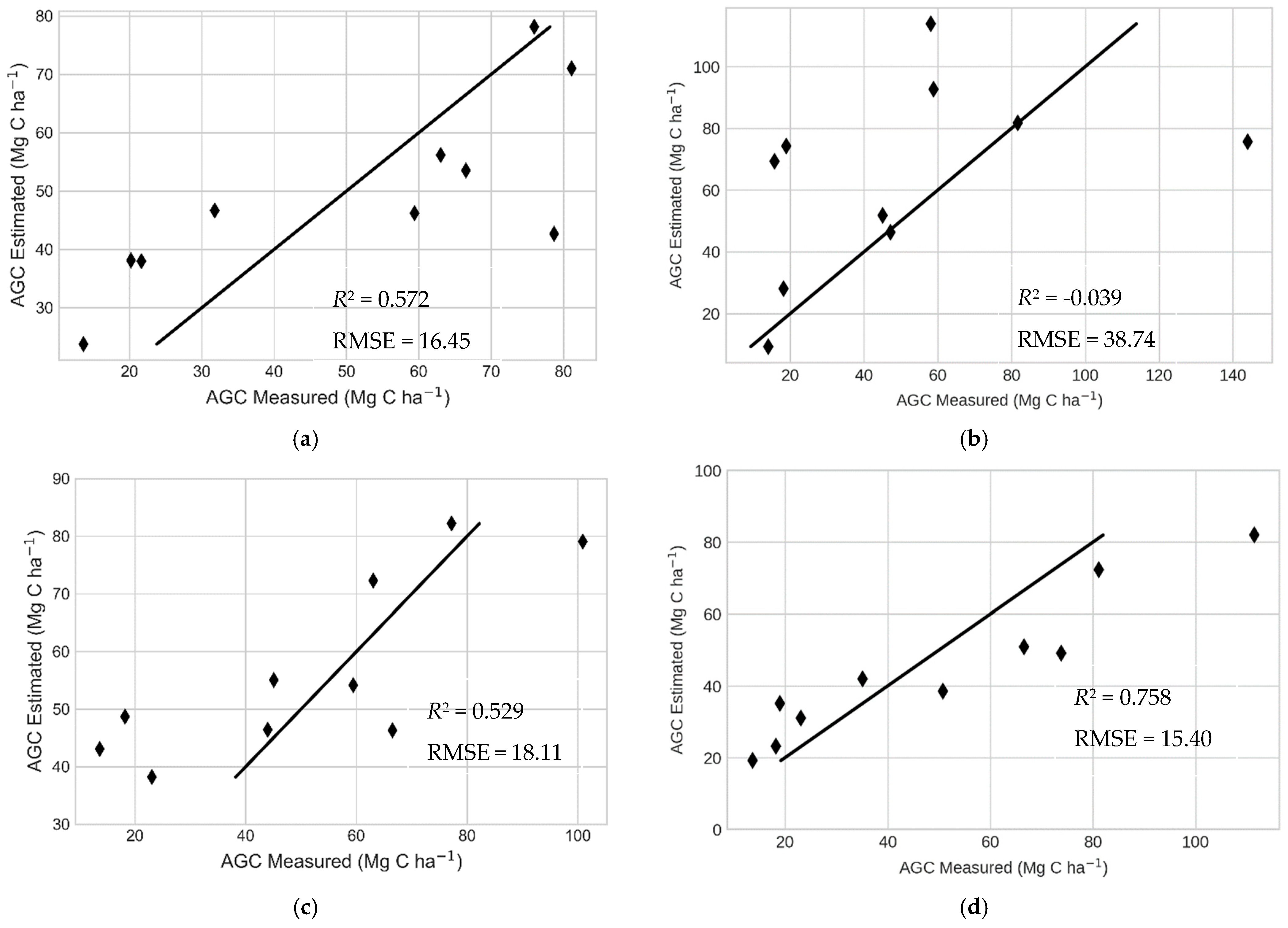
| 1 | Extreme Gradient Boosting (XGB) | 0.892 | 0.572 | 16.45 |
| 2 | Support Vector Machine (SVM) | 0.747 | −0.039 | 38.74 |
| 3 | Random Forests (RF) | 0.807 | 0.529 | 18.11 |
| 4 | Extreme Gradient Boosting optimized by Genetic Algorithm (XGB-GA) | 0.857 | 0.758 | 15.40 |
| Scenario (SC) | Number of Variables | R2 Training Set | R2 Testing Set | RMSE (Mg C ha−1) |
|---|---|---|---|---|
| SC1 | 14 variables (12 MS bands of S2B data + 2 backscatter coefficients VV and VH of S1A) | 0.997 | 0.651 | 21.66 |
| SC2 | 27 variables (12 MS bands of S2B + 12 VIs + 2 backscatter coefficients VV & VH of S1A + DEM) | 0.892 | 0.572 | 16.45 |
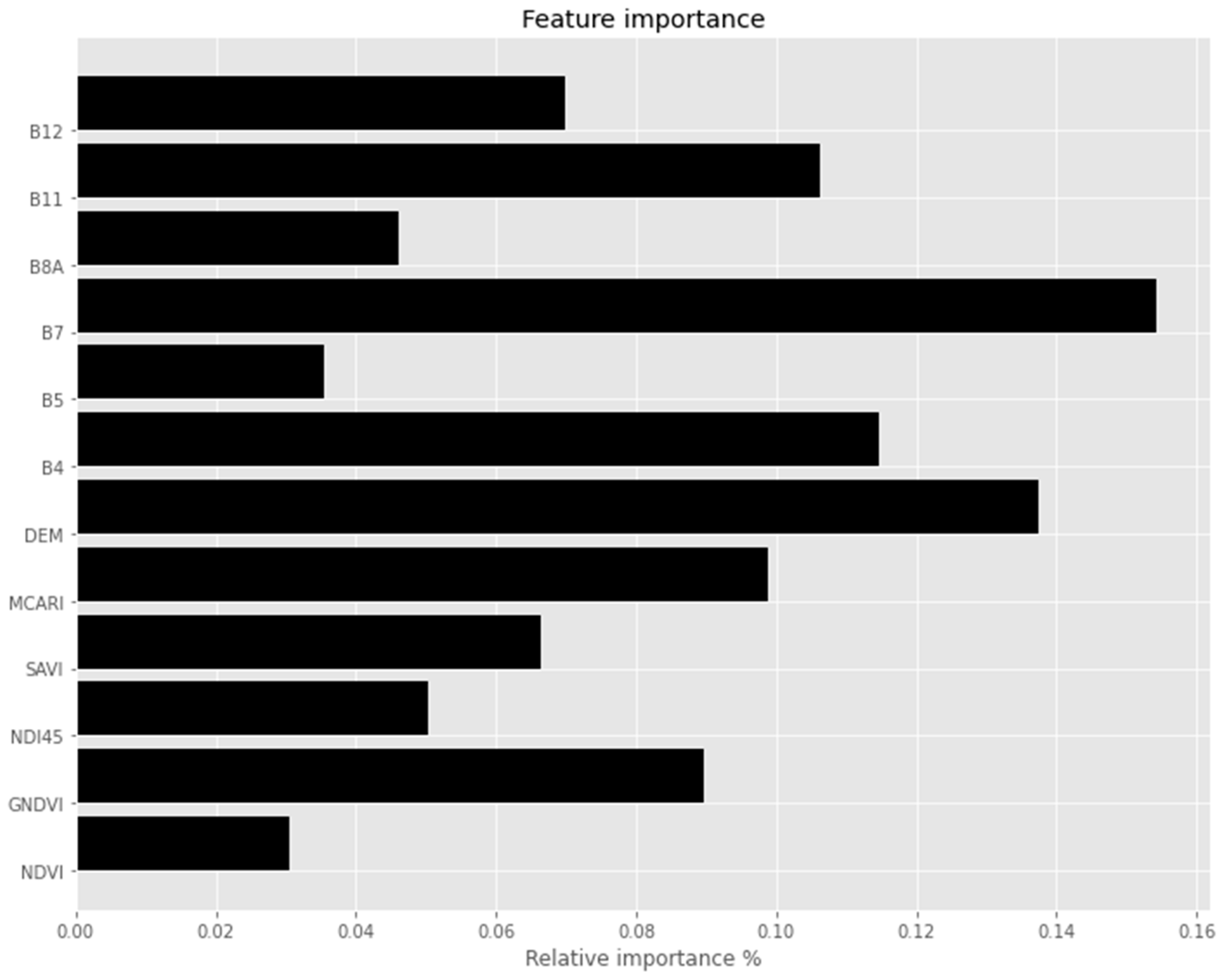
| SC3 | 12 optimal variables (6 MS bands of S2B + 5 VIs + DEM) | 0.857 | 0.758 | 15.40 |
| SC4 | 32 variables (2 backscatter coefficients VV & VH of S1A + 30 SAR transformations) | 0.991 | 0.573 | 15.82 |
Disclaimer/Publisher’s Note: The statements, opinions and data contained in all publications are solely those of the individual author(s) and contributor(s) and not of MDPI and/or the editor(s). MDPI and/or the editor(s) disclaim responsibility for any injury to people or property resulting from any ideas, methods, instructions or products referred to in the content. |
© 2023 by the authors. Licensee MDPI, Basel, Switzerland. This article is an open access article distributed under the terms and conditions of the Creative Commons Attribution (CC BY) license (https://creativecommons.org/licenses/by/4.0/).
Share and Cite
Rijal, S.S.; Pham, T.D.; Noer’Aulia, S.; Putera, M.I.; Saintilan, N. Mapping Mangrove Above-Ground Carbon Using Multi-Source Remote Sensing Data and Machine Learning Approach in Loh Buaya, Komodo National Park, Indonesia. Forests 2023, 14, 94. https://doi.org/10.3390/f14010094
Rijal SS, Pham TD, Noer’Aulia S, Putera MI, Saintilan N. Mapping Mangrove Above-Ground Carbon Using Multi-Source Remote Sensing Data and Machine Learning Approach in Loh Buaya, Komodo National Park, Indonesia. Forests. 2023; 14(1):94. https://doi.org/10.3390/f14010094
Chicago/Turabian StyleRijal, Seftiawan Samsu, Tien Dat Pham, Salma Noer’Aulia, Muhammad Ikbal Putera, and Neil Saintilan. 2023. "Mapping Mangrove Above-Ground Carbon Using Multi-Source Remote Sensing Data and Machine Learning Approach in Loh Buaya, Komodo National Park, Indonesia" Forests 14, no. 1: 94. https://doi.org/10.3390/f14010094
APA StyleRijal, S. S., Pham, T. D., Noer’Aulia, S., Putera, M. I., & Saintilan, N. (2023). Mapping Mangrove Above-Ground Carbon Using Multi-Source Remote Sensing Data and Machine Learning Approach in Loh Buaya, Komodo National Park, Indonesia. Forests, 14(1), 94. https://doi.org/10.3390/f14010094

