Private Forest Owners’ Social Economic Profiles Weakly Influence Forest Management Conceptualizations

Abstract
1. Introduction
2. Materials and Methods
2.1. Study Area and Sampling
2.2. Causal Indicators of the Conceptualization of Forest Management
3. Results
4. Discussion
5. Conclusions
Funding
Conflicts of Interest
References
- Schmithüsen, F.; Hirsch, F. Private Forest Ownership in Europe; Geneva Timber and Forest Study Papers 26; United Nations, Economic Commission for Europe: Geneva, Switzerland, 2010; Available online: http://www.unece.org/fileadmin/DAM/timber/publications/SP-26.pdf (accessed on 20 May 2015).
- Ficko, A.; Lidestav, G.; Ní Dhubháin, Á.; Karppinen, H.; Zivojinovic, I.; Westin, K. European private forest owner typologies: A review of methods and use. For. Policy Econ. 2019, 99, 21–31. [Google Scholar] [CrossRef] [Scilit]
- Huff, E.S.; Leahy, J.E.; Kittredge, D.B.; Noblet, C.L.; Weiskittel, A.R. Psychological distance of timber harvesting for private woodland owners. For. Policy Econ. 2017, 81, 48–56. [Google Scholar] [CrossRef] [Scilit]
- Ficko, A.; Boncina, A. Forest owner representation of forest management and perception of resource efficiency: A structural equation modeling study. Ecol. Soc. 2015, 20, 36. [Google Scholar] [CrossRef] [Scilit]
- Steiner Davis, M.L.E.; Fly, J.M. Do You Hear What I Hear: Better Understanding How Forest Management Is Conceptualized and Practiced by Private Forest Landowners. J. For. 2010, 108, 321–328. [Google Scholar]
- Tumpach, C.; Dwivedi, P.; Izlar, R.; Cook, C. Understanding perceptions of stakeholder groups about Forestry Best Management Practices in Georgia. J. Environ. Manag. 2018, 213, 374–381. [Google Scholar] [CrossRef] [Scilit] [PubMed]
- Moscovici, S. Psychoanalysis. Its Image and Its Public; Polity Press: Cambridge, UK, 2008. [Google Scholar]
- Feliciano, D.; Bouriaud, L.; Brahic, E.; Deuffic, P.; Dobsinska, Z.; Jarsky, V.; Lawrence, A.; Nybakk, E.; Quiroga, S.; Suarez, C.; et al. Understanding private forest owners’ conceptualisation of forest management: Evidence from a survey in seven European countries. J. Rural Stud. 2017, 54, 162–176. [Google Scholar] [CrossRef] [Scilit]
- Sörbom, D. A general method for studying differences in factor means and factor structures between groups. Br. J. Math. Stat. Psychol. 1974, 27, 229–239. [Google Scholar] [CrossRef] [Scilit]
- Häyrinen, L.; Mattila, O.; Berghäll, S.; Toppinen, A. Changing objectives of non-industrial private forest ownership: A confirmatory approach to measurement model testing. Can. J. For. Res. 2014, 44, 290–300. [Google Scholar] [CrossRef] [Scilit]
- Karppinen, H.; Berghäll, S. Forest owners’ stand improvement decisions: Applying the Theory of Planned Behavior. For. Policy Econ. 2015, 50, 275–284. [Google Scholar] [CrossRef] [Scilit]
- Martin, J.L.; Lee, M.; Wright, J.D. Social Structure. In International Encyclopedia of the Social & Behavioral Sciences, 2nd ed.; Elsevier: Oxford, UK, 2015; pp. 713–718. [Google Scholar]
- Hatcher, J.E.; Straka, T.J.; Greene, J.L. The Size of Forest Holding/Parcelization Problem in Forestry: A Literature Review. Resourcs 2013, 2, 39–57. [Google Scholar] [CrossRef] [Scilit]
- Seesholtz, D.; Wickwar, D.; Russell, J.C. Social and Economic Profile Technical Guide; Gen. Tech. Rep. WO-74; U.S. Department of Agriculture, Forest Service: Washington, DC, USA, 2006; p. 74.
- Butler, B.; Caputo, J.; Robillard, A.; Sass, E. Size Matters: The Relevance of Size of Forest Holdings Among Private Forest Ownerships. In Proceedings of the IUFRO 3.08.00 Small-Scale Forestry 2019 Conference Proceedings, Duluth, MN, USA, 8–10 July 2019; University of Minnesota: Duluth, MN, USA, 2019; p. 59. [Google Scholar]
- Snyder, S.A.; Butler, B.J.; Markowski-Lindsay, M. Small-Area Family Forest Ownerships in the USA. Small-Scale For. 2019, 18, 127–147. [Google Scholar] [CrossRef] [Scilit]
- Matilainen, A.; Lähdesmäki, M. Passive or Independent? An Empirical Study of Different Reasons Behind Private Forest Owners: Passiveness in Finland. In Proceedings of the IUFRO 3.08.00 Small-scale Forestry 2019 Conference Proceedings, Duluth, MN, USA, 8–10 July 2019; University of Minnesota: Duluth, MN, USA, 2019; p. 42. [Google Scholar]
- Hogl, K.; Pregernig, M.; Weiss, G. What is new about new forest owners? A typology of private forest ownership in Austria. Small–Scale For. 2005, 4, 325–342. [Google Scholar]
- Ficko, A.; Boncina, A. Probabilistic typology of management decision making in private forest properties. For. Policy Econ. 2013, 27, 34–43. [Google Scholar] [CrossRef] [Scilit]
- JASP; Version 0.10.2; JASP Team: Amsterdam, The Netherlands, 2019.
- Trizano-Hermosilla, I.; Alvarado, J.M. Best Alternatives to Cronbach’s Alpha Reliability in Realistic Conditions: Congeneric and Asymmetrical Measurements. Front. Psychol. 2016, 7, 769. [Google Scholar] [CrossRef] [Scilit]
- Joreskog, K.G.; Goldberger, A.S. Estimation of a Model with Multiple Indicators and Multiple Causes of a Single Latent Variable. J. Am. Stat. Assoc. 1975, 70, 631–639. [Google Scholar]
- Bryne, B.M. Structural Equation Modeling with EQS. Basic Concepts, Applications, and Programming, 2nd ed.; Lawrence Erlbaum Associates, Publishers: Mahwah, NJ, USA, 2006. [Google Scholar]
- Bentler, P.M. EQS 6 Structural Equations Program Manual; Multivariate Software: Encino, CA, USA, 2006. [Google Scholar]
- Satorra, A.; Bentler, P. Corrections to test statistics and standard errors in covariance structure analysis. In Latent Variables Analysis: Applications for Developmental Research; Von Eye, A., Clogg, C.C., Eds.; Sage Publications: Thousand Oaks, CA, USA, 1994; pp. 399–419. [Google Scholar]
- Sattora, A.; Bentler, P.M. Scaling Considerations for Chi-Square Statistics in Covariance Structure Analysis (UCLA Statistic Series 2); University of California, Department of Psychology: Los Angeles, CA, USA, 1988. [Google Scholar]
- Medved, M.; Matijasic, D.; Pisek, R. Private property conditions of Slovenian forests: Preliminary results from 2010. In Proceedings of the IUFRO Conference Proceedings Small-Scale for in a Changing Worlds: Opportunities and Challanges and the Role of Extension and Technology Transfer, Bled, Slovenia, 6–12 June 2010; pp. 457–472. Available online: https://www.iufro.org › download › file › 30800-et-at-bled10_pdf (accessed on 10 May 2012).
- Winkler, I. Sedanje stanje in temeljni problem gospodarjenja z zasebnimi gozdovi v SR Sloveniji (Present situation and basic problems in private forest management in SR Slovenia). Zbornik Gozdarstva Lesarstva 1976, 14, 123–154. [Google Scholar]
- Medved, M. Gozdnogospodarske Posledice Posestne Sestave Slovenskih Gozdov (Consequences of Property Structure on Forest Management in Slovenian Small-Scale Private Forests). Ph.D. Thesis, University of Ljubljana, Biotechnical Faculty Ljubljana, Ljubljana, Slovenia, 2000. [Google Scholar]
- SURS. Republic of Slovenia Statistical Office. Available online: https://www.stat.si/StatWeb/en (accessed on 30 May 2019).
- Medved, M. Vključevanje Lastnikov Gozdov v Gozdno Proizvodnjo (Attracting Private Forest Owners into Forest Operations). Master’s Thesis, University of Ljubljana, Biotechnical Faculty, Ljubljana, Slovenia, 28 March 1991. [Google Scholar]
- Fransson, N.; Gärling, T. Environmental concern: Conceptual definitions, measurement methods, and research findings. J. Environ. Psychol. 1999, 19, 369–382. [Google Scholar] [CrossRef] [Scilit]
- Vaske, M.P.J.J.; Williams, D.R.; Jonker, S. Demographic Influences on Environmental Value Orientations and Normative Beliefs About National Forest Management. Soc. Nat. Resour. 2001, 14, 761–776. [Google Scholar]
- Karppinen, H. New forest owners and owners-to-be: Apples and oranges? Small-Scale For. 2012, 11, 15–26. [Google Scholar] [CrossRef] [Scilit]
- Butler, S.M.; Butler, B.J.; Markowski-Lindsay, M. Family Forest Owner Characteristics Shaped by Life Cycle, Cohort, and Period Effects. Small-Scale For. 2017, 16, 1–18. [Google Scholar] [CrossRef] [Scilit]
- Côté, M.-A.; Généreux-Tremblay, A.; Gilbert, D.; Gélinas, N. Comparing the profiles, objectives and behaviours of new and longstanding non-industrial private forest owners in Quebec, Canada. For. Policy Econ. 2017, 78, 116–121. [Google Scholar] [CrossRef] [Scilit]
- Laakkonen, A.; Hujala, T.; Pykäläinen, J. Integrating intangible resources enables creating new types of forest services-developing forest leasing value network in Finland. For. Policy Econ. 2019, 99, 157–168. [Google Scholar] [CrossRef] [Scilit]
- Milbrath, L.W. Environmentalists: Vanguard for a New Society; State University of New York Press: Albany, NY, USA, 1984. [Google Scholar]
- Bollen, K.A.; Ting, K.-F. A tetrad test for causal indicators. Psychol. Meth. 2000, 5, 3–22. [Google Scholar] [CrossRef]
- Ullman, J.B. Structural Equation Modeling: Reviewing the Basics and Moving Forward. J. Pers. Assess 2006, 87, 35–50. [Google Scholar] [CrossRef] [Scilit] [PubMed]


| Code | Variable and Type | Variable Definition | Missing Values (Recoded from Official Register (REC), Multiple Imputation (MI)) | Mean, Median (Standard Deviation), Range or % Where Applicable | |
|---|---|---|---|---|---|
| AGE | Age (years) | Calculated from the reported year of birth | 1.5% (REC) | 61.0, 61.0, (12.4), 84.0 | |
| SOC | Socio-economic type of holding (ordinal) | Full-time farmers | None of the active household members (age 15 to 65) employed outside family farm (1) | - | 4.4 |
| Part-time farmers | Combinations of employment (2) | - | 30.6 | ||
| Elder farmers | All household members older than 65 (3) | - | 15.0 | ||
| Non farmers | All household members employed outside family farm (4) | 50.0 | |||
| EDU | Formal education level (ordinal) | <8 years (1) | - | 2.1 | |
| primary school (2) | 12.3 | ||||
| high school undergraduate (3) | 0.5 | ||||
| vocational school (4) | 20.0 | ||||
| high school graduate (5) | 35.9 | ||||
| higher professional studies (6) | 15.8 | ||||
| college or higher (7) | 13.3 | ||||
| AREA | Total forest area of the owner’s holding (ha) | Total area of forest land in the holding | 15.9% (REC) | 4.6, 2.0, (9.9), 167.9 | |
| CUT | Mean annual cut in the last decade (m3 ha-1) | Cubic meters harvested according to owner’s statement | 14.2% (MI) | 8.7, 2.5, (22.1), 323.3 | |
| INC | Monthly income (ordinal) | No income | 13.9% (MI) | 23.7 | |
| <500 EUR | 48.4 | ||||
| 500–1000 | 19.5 | ||||
| 1001–2000 | 3.6 | ||||
| >2000 EUR | 4.8 | ||||
| Please Indicate the Level of Agreement with the Following Statements Defining Forest Management with a 5-Point Likert Scale. Forest Management Is… | AGE | INC | EDU | CUT | AREA | SOC | |
|---|---|---|---|---|---|---|---|
| q3_1 | The application of knowledge on how to manage the forest ecosystem | −0.025 | 0.046 | 0.170* | 0.029 | −0.069 | −0.039 |
| q3_2 | Capital management | −0.025 | −0.010 | 0.077* | 0.082* | 0.032 | 0.009 |
| q3_3 | Making decisions on what, when and how a particular forest stand should be managed | −0.067 | 0.051 | 0.102* | 0.102* | −0.030 | −0.102* |
| q3_4 | A good business opportunity | 0.030 | −0.073* | 0.045 | 0.011 | 0.035 | −0.016 |
| q3_5 | Taking care of the forest health and disease prevention | −0.035 | 0.046 | 0.156* | 0.014 | −0.048 | −0.048 |
| q3_6 | Possessing the forest, taking care of the property and borders | 0.020 | −0.049 | −0.009 | 0.082* | 0.010 | −0.029 |
| q3_7 | Preserving the forestland for future generations | −0.065 | 0.055 | 0.041 | 0.081* | 0.015 | −0.039 |
| q3_8 | Good opportunity to earn additional money or to improve the family budget, as any other side-business opportunity | −0.011 | 0.025 | 0.082* | 0.075* | 0.039 | −0.035 |
| q3_9 | Leisure and free-time activity in the woods instead of recreation | 0.037 | 0.071 | 0.050 | 0.058 | −0.025 | −0.075* |
| q3_10 | Systematic continuation of the work started by our ancestors | 0.009 | 0.091* | 0.079* | 0.086* | −0.032 | −0.061 |
| q3_11 | Mimicking natural processes in the forest and securing natural regeneration | −0.032 | 0.097* | 0.125* | 0.103* | −0.025 | −0.053 |
| q3_12 | About work in the forest, e.g., using a chainsaw and winch, doing forest operations | −0.035 | −0.003 | −0.041 | 0.050 | −0.013 | −0.140* |
| q3_13 | Ensuring regular flow of goods from my forest which I need, such as fuel-wood | −0.058 | −0.031 | −0.049 | 0.126* | −0.008 | −0.186* |
| q3_14 | Ensuring a clean and natural environment in the neighborhood | 0.004 | 0.080* | 0.050 | 0.091* | −0.061 | −0.105* |
| q3_15 | Preserving large-diameter trees and removing low-quality trees | −0.060 | 0.085* | 0.096* | 0.096* | −0.064 | −0.065 |
| q3_16 | A source of subsidies | −0.015 | -0.083* | −0.050 | 0.080* | 0.007 | −0.051 |
| q3_17 | Keeping the forest beautiful exactly the way I like it | −0.031 | 0.000 | −0.043 | 0.066 | −0.066 | −0.046 |
| q3_18 | Making sure the forest is not left neglected or messy | 0.016 | −0.025 | −0.001 | 0.084* | −0.060 | −0.072* |
| q3_19 | Cutting large-diameter trees when they are ready to be cut | 0.005 | 0.021 | 0.013 | 0.111* | −0.050 | −0.064 |
| Factor (% of Variance Explained) | Covariates and Factors | Standardized Coefficients (z) |
|---|---|---|
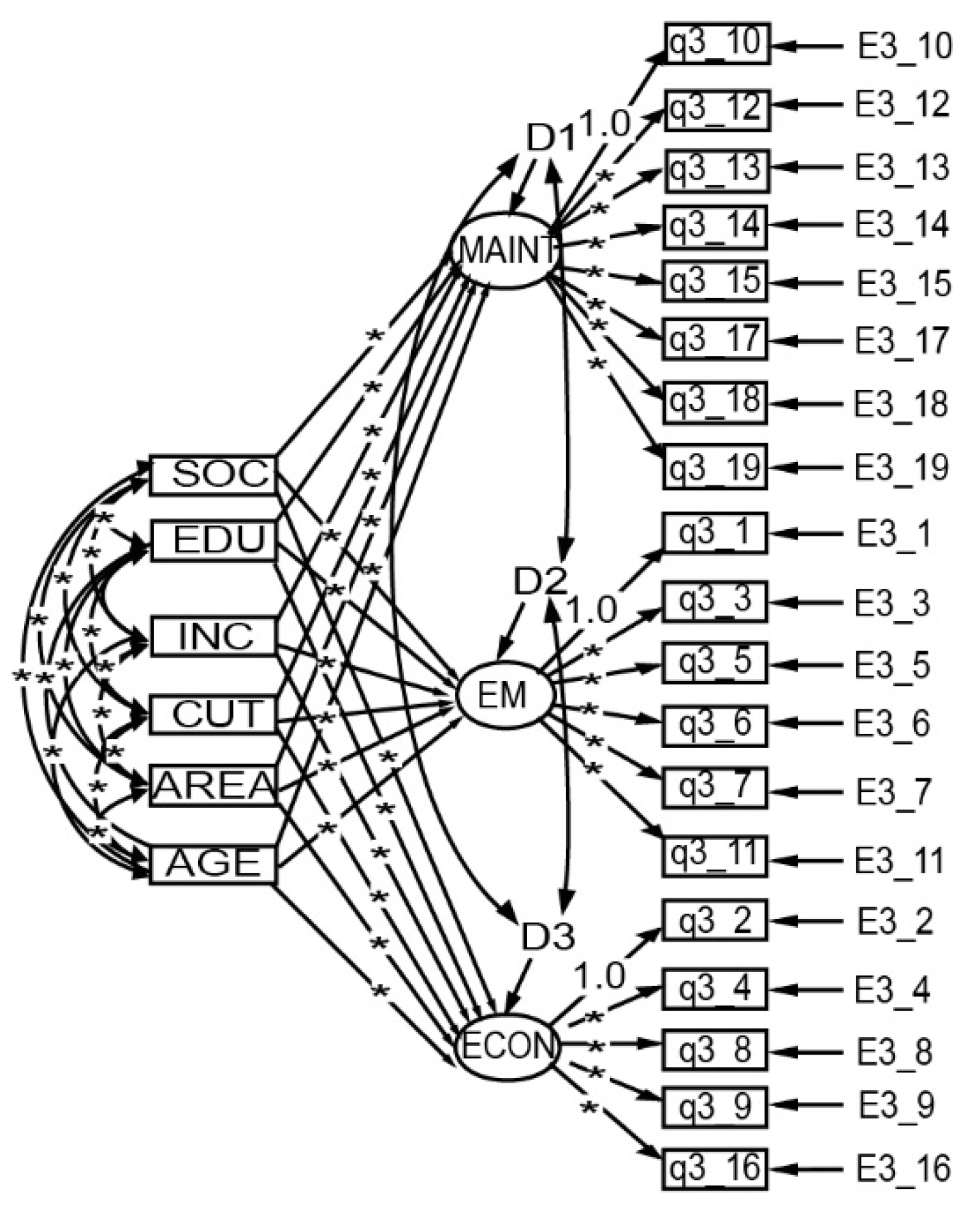
| Maintenance-centered management (MAINT) (3.0%) | SOC | −0.142 * |
| EDU | 0.074 * | |
| INC | 0.021 | |
| CUT | 0.044 * | |
| AREA | −0.095 * | |
| AGE | −0.028 * | |
| “Ecosystem-centered management” factor (EM) | 0.805 * | |
| “Economics-centered management” factor (ECON) | 0.407 * | |
| Ecosystem-centered management (EM) (5.1%) | SOC | −0.128 * |
| EDU | 0.193 * | |
| INC | −0.020 | |
| CUT | −0.009 | |
| AREA | −0.076 * | |
| AGE | −0.055 * | |
| “Economics-centered management” factor (ECON) | 0.494 * | |
| Economics-centered management (ECON) (2.4%) | SOC | −0.060 * |
| EDU | 0.146 * | |
| INC | −0.076 * | |
| CUT | 0.064 * | |
| AREA | 0.009 | |
| AGE | 0.008 |
| CFI | χ2 (df) | S-B χ2 (df) | RMSEA | SRMR | χ2/df | |
|---|---|---|---|---|---|---|
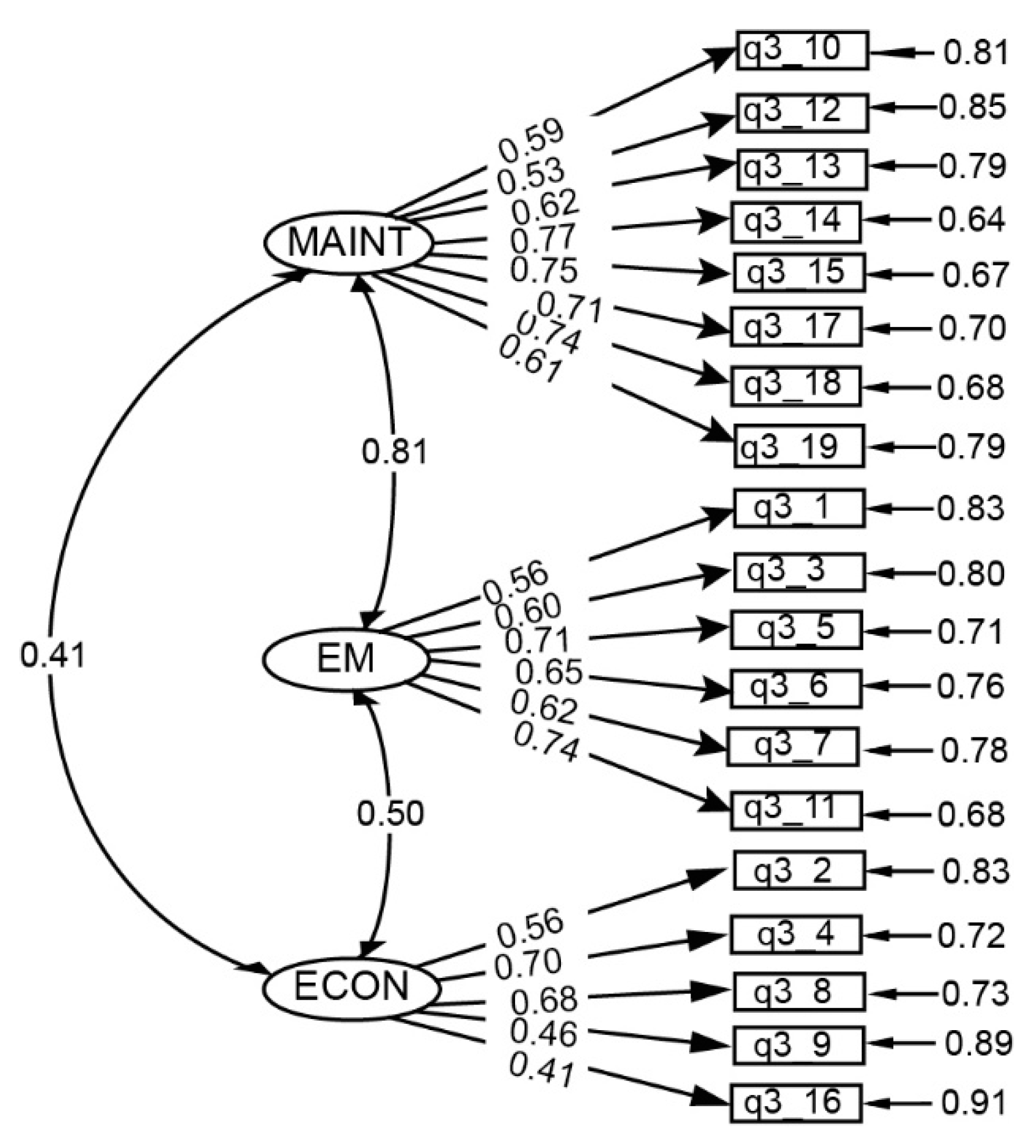
| Baseline measurement model (CFA) | 0.939 | 954 (149) | 9534 (149) | 0.289 | 0.066 | 6.4 |
| MIMIC model | 0.926 | 1111 (245) | 12787 (245) | 0.261 | 0.055 | 4.5 |
| MIMIC model vs. baseline measurement model | ∆CFI | ∆χ2 (∆df) | ∆S-B χ2 (∆df) | |||
| 0.013 | 157 (96)* | 2363 (96)* |
| Year | Socio-Economic Type of Private Forest Holdings1 | Education2 (%) | Average Size of Forest Holding (ha)3 | |||||
|---|---|---|---|---|---|---|---|---|
| Family Farms (%) | Other Non-Industrial Private Forests (%) | 1 | 2 | 3 | 4 | 5 | ||
| 1951 | 95.5 | 4.5 | 3.8 | |||||
| 1963 | 79.4 | 20.6 | ||||||
| 1968 | 69.9 | 30.1 | 3.0 | |||||
| 1985 | 59.7 | 40.3 | 2.7 | |||||
| 1995 | 57.5 | 42.5 | 13.4 | 44.8 | 3.0 | 15.2 | 3.6 | 2.3 |
| 2000 | 49.3 | 50.7 | 2.0 | 41.5 | 28.6 | 21.0 | 6.9 | 2.6 |
| 2005 | 45.1 | 54.9 | 1.2 | 38.2 | 28.4 | 22.0 | 10.3 | |
| 2010 | 39.0 | 61.0 | 0.3 | 34.9 | 28.2 | 23.0 | 13.6 | 2.8 |
| 2013 | 35.0 | 65.0 | 2.1 | 12.3 | 20.6 | 35.9 | 29.0 | |
© 2019 by the author. Licensee MDPI, Basel, Switzerland. This article is an open access article distributed under the terms and conditions of the Creative Commons Attribution (CC BY) license (http://creativecommons.org/licenses/by/4.0/).
Share and Cite
Ficko, A. Private Forest Owners’ Social Economic Profiles Weakly Influence Forest Management Conceptualizations. Forests 2019, 10, 956. https://doi.org/10.3390/f10110956
Ficko A. Private Forest Owners’ Social Economic Profiles Weakly Influence Forest Management Conceptualizations. Forests. 2019; 10(11):956. https://doi.org/10.3390/f10110956
Chicago/Turabian StyleFicko, Andrej. 2019. "Private Forest Owners’ Social Economic Profiles Weakly Influence Forest Management Conceptualizations" Forests 10, no. 11: 956. https://doi.org/10.3390/f10110956
APA StyleFicko, A. (2019). Private Forest Owners’ Social Economic Profiles Weakly Influence Forest Management Conceptualizations. Forests, 10(11), 956. https://doi.org/10.3390/f10110956