3.1. LLMs Adaptation in Orthopedics
Large language models (LLMs) are steadily transforming clinical documentation, decision support, medical education, and patient engagement [
19]. While full-parameter fine-tuning theoretically offers maximum expressivity, it is often ill-suited for clinical domains due to the high risk of catastrophic forgetting, in which the model overwrites its general biomedical reasoning capabilities to overfit on small, institution-specific datasets.
Parameter efficiency is crucial for orthopedic-specific models, particularly when addressing computational and privacy constraints. The MedAdapter framework exemplifies this paradigm, fine-tuning only a 110 M-parameter BERT-sized adapter rather than full model weights. This approach achieves 99.35% of supervised fine-tuning performance while using 14.75% of GPU memory, enabling deployment in resource-constrained healthcare environments [
20]. Similarly, instruction fine-tuning using orthopedic clinical notes demonstrates particular promise. Vaid et al. fine-tuned LLaMA-7B on musculoskeletal pain characteristics extracted from unstructured clinical notes. This approach resulted in privacy-preserving models capable of parsing patient histories without transmitting protected health information to third-party APIs. This methodology addresses critical regulatory requirements while maintaining clinical utility [
21].
In the context of Multimodal LLMs, such as those analyzing orthopedic imagery, architectural decisions regarding adapter placement are critical. Research [
22] demonstrates that fine-tuning the vision encoder can lead to ‘feature collapse,’ effectively destroying the robust representations learned during pre-training. Domain-specific fine-tuning has proved its value in multimodal systems that automatically draft diagnostic reports and perform quantitative measurements with expert-level precision.
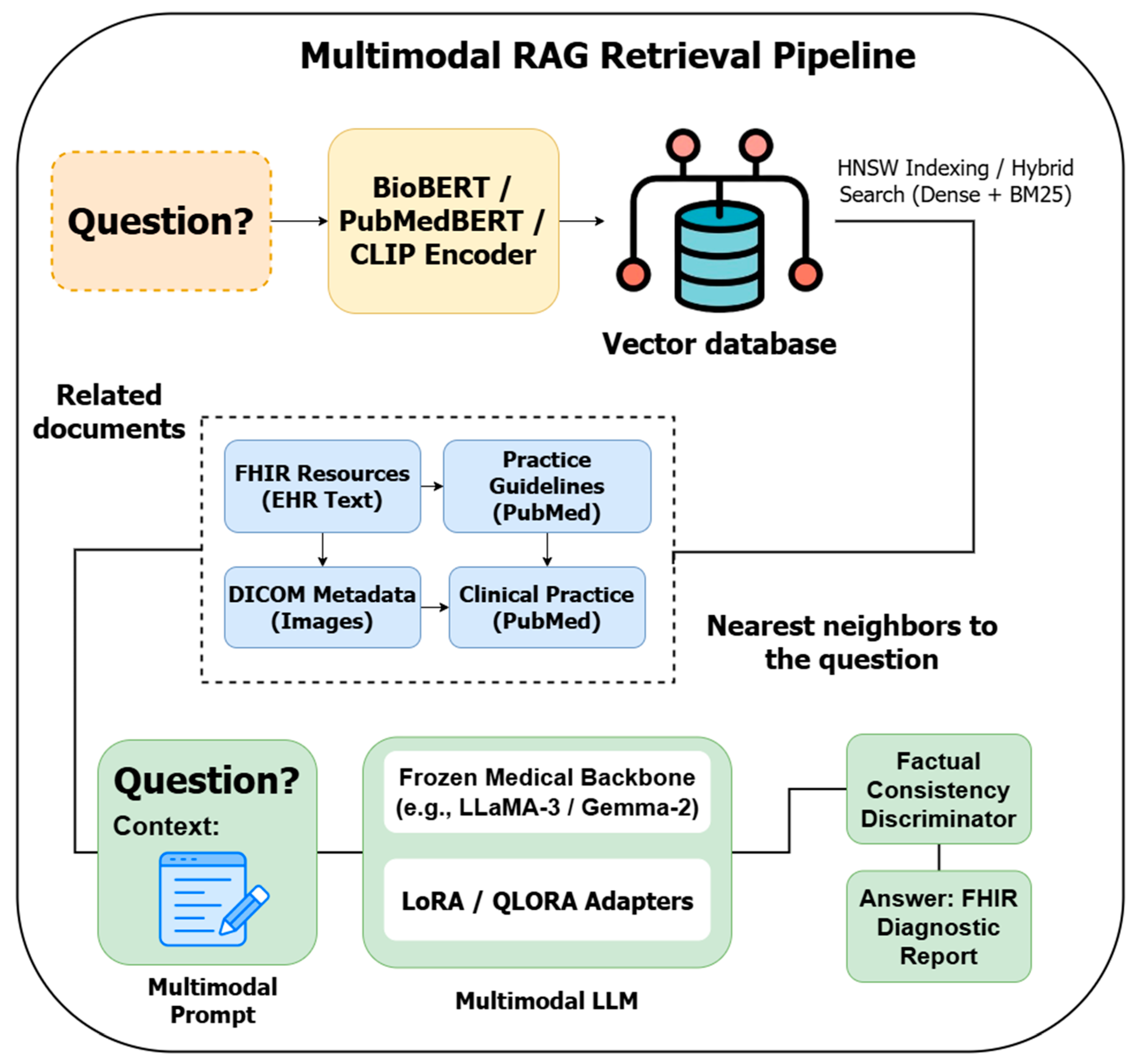
Retrieval-Augmented Generation (RAG) has emerged as a leading strategy for boosting factual correctness and serves as the dominant adaptation strategy for orthopedic applications. The pipeline in
Figure 3 begins with curating a knowledge base of articles, clinical guidelines, and electronic health records. For orthopedics, this typically involves integrating 13–28 authoritative sources, including AAOS Comprehensive Review textbooks [
23]. The OrthoWizard evaluation demonstrated the transformative impact of retrieval-augmented generation (RAG). GPT-4 with RAG achieved an accuracy of 73.80% on 1023 orthopedic examination questions, which was statistically equivalent to human orthopedic surgeons (73.97%) and significantly higher than GPT-4 alone (64.91%) [
23]. This source-grounding reduces hallucinations while providing traceable citations, critical features for clinical adoption.
Figure 3 depicts the retrieval-augmented generation (RAG) pipeline for orthopedic clinical question answering. It synthesizes well-documented retrieval strategies from recent clinical AI implementations while emphasizing specific architectural innovations that address the clinical precision bottleneck. While RAG itself is an established technique in the literature [
24], the clinical instantiation presented here makes explicit three critical technical refinements. (1) The system integrates a hybrid search strategy that combines dense vector retrieval with Okapi BM25 sparse retrieval to address the lexical gap inherent in clinical text. Dense embeddings capture semantic intent but may fail to match exact terminology, particularly for rigid medical identifiers such as ICD-10 codes and medication dosages. (2) The incorporation of Hierarchical Navigable Small World (HNSW) [
25,
26] indexing to scale retrieval to million-scale vector databases while maintaining logarithmic time complexity, which is crucial for real-time clinical decision support. (3) The end-to-end tracking of factual grounding from curated authoritative knowledge sources through multimodal encoding to final model inference.
To implement this high-precision retrieval, the architecture integrates a semantic embedding substrate, a retrieval-augmented generation pathway, and a parameter-efficient multimodal language model to deliver fact-checked answers grounded in heterogeneous evidence. A dedicated embedding service maps both user queries and a corpus of text–image pairs into a shared vector space stored in a high-performance database.
The weighting parameter
[0, 1] serves as a critical hyperparameter that balances semantic depth with lexical precision [
27,
28]. In the context of clinical applications, this hybrid approach is essential for mitigating the ‘vocabulary mismatch’ problem, where patients and clinicians use disparate terminologies for the same condition [
29]. For instance, in orthopedic surgery, a value of
α > 0.5 (typically 0.7) is preferred when seeking conceptual matches, such as linking ‘degenerative disc disease’ with ‘vertebral wear’—a task where dense embeddings excel by capturing nuanced semantic relationships [
30,
31]. Conversely, a lower is utilized for retrieving specific clinical entities, such as precise implant serial numbers or specific surgical instruments, where exact keyword matching (sparse retrieval via BM25) is non-negotiable for clinical safety [
28,
32]. Recent meta-analyses in biomedicine demonstrate that such hybrid indexing significantly outperforms single-method retrieval, providing a 35% improvement in accuracy for clinical decision support systems [
29].
Beyond these technical architectures, prompt engineering enables zero-shot adaptation without model parameter updates. Effective orthopedic prompts incorporate structured clinical templates, imaging findings, and differential diagnosis frameworks. In-context learning allows clinicians to embed few-shot examples within prompts, adapting generalist models to subspecialty contexts (e.g., spine surgery, sports medicine) without retraining [
2]. Advanced prompting techniques include chain-of-thought reasoning for complex cases and multimodal prompts combining radiology reports with imaging descriptions. However, prompt-based approaches show performance ceilings, with GPT-4 achieving only 64.91% accuracy on orthopedic examinations without RAG augmentation [
23].
Ultimately, the success of these adaptations is measured by clinical performance benchmarks. Standardized orthopedic examinations serve as primary benchmarks for LLM competency. Performance varies significantly by model architecture and adaptation method, as presented in
Table 1. Standalone models such as GPT 3.5 and Bard demonstrate accuracy levels ranging from 49.8 percent to 58 percent, placing their performance at or below the level of early-stage residents from PGY 1 to PGY 3 [
23,
33]. While the transition to GPT 4 shows substantial improvement, reaching 64.91 percent accuracy and corresponding to the level of a PGY 5 senior resident, this performance still falls short of the human surgeon benchmark [
34]. The most significant finding presented in these results is the impact of Retrieval Augmented Generation. When GPT 4 is augmented with RAG, accuracy increases to 73.80 percent [
23], achieving performance comparable to that of human orthopedic surgeons, whose reference accuracy typically ranges from approximately 74.2 percent to 75.3 percent [
33]. These findings demonstrate that domain-specific grounding is algorithmically necessary to bridge the gap between general medical knowledge and specialized surgical expertise.
GPT-4 demonstrates superior performance on higher-order and image-associated questions compared to predecessors. However, orthopedic residents consistently outperform unaugmented LLMs, highlighting the gap between general medical knowledge and specialized orthopedic expertise. Diagnostic accuracy across studies ranges from 55 to 93%, with substantial heterogeneity in evaluation methodologies [
33].
The transition of LLMs from general-purpose assistants to orthopedic specialists requires selecting adaptation frameworks that balance computational cost with clinical reliability. A key challenge is bridging the gap between broad pre-training and domain-specific reasoning without causing catastrophic forgetting. Parameter-efficient fine-tuning methods such as LoRA and RAG provide stronger domain grounding, enabling models to meet or exceed human surgeon benchmarks.
Table 2 summarizes these strategies and their trade-offs reported in recent orthopedic AI research.
In terms of practical workflow integration, LLMs demonstrate immediate utility in automating repetitive documentation tasks. Studies show GPT-3 and ChatGPT can generate clinical letters and management plans for common orthopedic scenarios, reducing administrative burden. Applications include preoperative planning, where LLMs assist spinal surgeons by analyzing imaging reports and suggesting surgical approaches. Additional applications include postoperative documentation through the automated generation of operative notes and discharge summaries. However, accuracy limitations persist: 35% of initial lumbar spine report translations contained major omissions, and 6% had major inaccuracies. Enhanced prompting reduced omission rates to 7%, but inaccuracy rates remained stable. Multimodal LLMs represent the next frontier, with GPT-4Vision showing potential to integrate imaging data directly into diagnostic reasoning. Early applications include bone metastasis detection from scintigraphy, achieving an AUROC > 0.8 when developed through LLM-assisted programming. Finally, in orthopedic education, LLMs serve as interactive tools, providing explanations and engaging in Socratic dialog with trainees. Performance on board-style questions suggests utility for knowledge reinforcement, though current models cannot replace structured residency curricula.
While the reviewed literature unanimously positions LLMs as powerful reasoning engines, a significant contradiction persists regarding their deployment architectures. Several studies, such as Wiest et al. [
35], highlight the trade-offs of large, cloud-based general-purpose models (e.g., GPT-4) regarding data privacy, whereas others like Labrak et al. [
36] demonstrate that smaller, domain-specifically fine-tuned models (e.g., BioMistral) offer superior privacy preservation and reduced computational requirements. A major limitation identified across most architectural studies is the ‘hallucination trade-off’: techniques like RAG significantly reduce factual errors, achieving near 0% hallucination rates in some frameworks [
37], but introduce higher computational latency [
37,
38], rendering them less suitable for real-time intraoperative assistance where sub-second responses are critical. Furthermore, few studies adequately address the ‘catastrophic forgetting’ phenomenon when fine-tuning models on specific medical datasets [
39], highlighting a clear gap in continuous learning frameworks for surgical subspecialties.
3.2. Natural Language Understanding for Orthopedic Narratives and Operative Notes
Approximately 80% of healthcare data exists in an unstructured free-text format within electronic health records (EHRs), representing a largely untapped resource for clinical research and quality improvement. In the specialized field of orthopedics, this vast data repository includes operative notes, radiology reports, clinical narratives, and patient communications that document complex musculoskeletal procedures, complications, and outcomes. Natural Language Processing (NLP) has emerged as the pivotal computational layer capable of unlocking this rich narrative content. A systematic mapping of clinical NLP projects reveals a significant methodological shift from brittle rule-based extraction to robust transformer architectures. This transition mirrors the broader trajectory of biomedical informatics, where early pipelines coupled handcrafted lexicons with statistical classifiers before progressing to foundation models adaptable with minimal task-specific data [
40].
Unstructured clinical narratives constitute the richest but historically least accessible stratum of the EHR. Comparative studies indicate that fewer than two-thirds of predefined quality indicators are recoverable from structured fields alone, underscoring the critical analytical value locked in free-text notes [
41]. Transforming these narratives into computable signals begins with rigorous preprocessing to normalize the highly variable clinical text. Essential preprocessing steps such as tokenization, lemmatization, part-of-speech tagging, and spelling correction are applied to mitigate lexical noise. Domain-specific abbreviation disambiguation, which is critical for orthopedic terminology, along with stop-word removal, further restores implicit semantics prior to downstream modeling [
42].
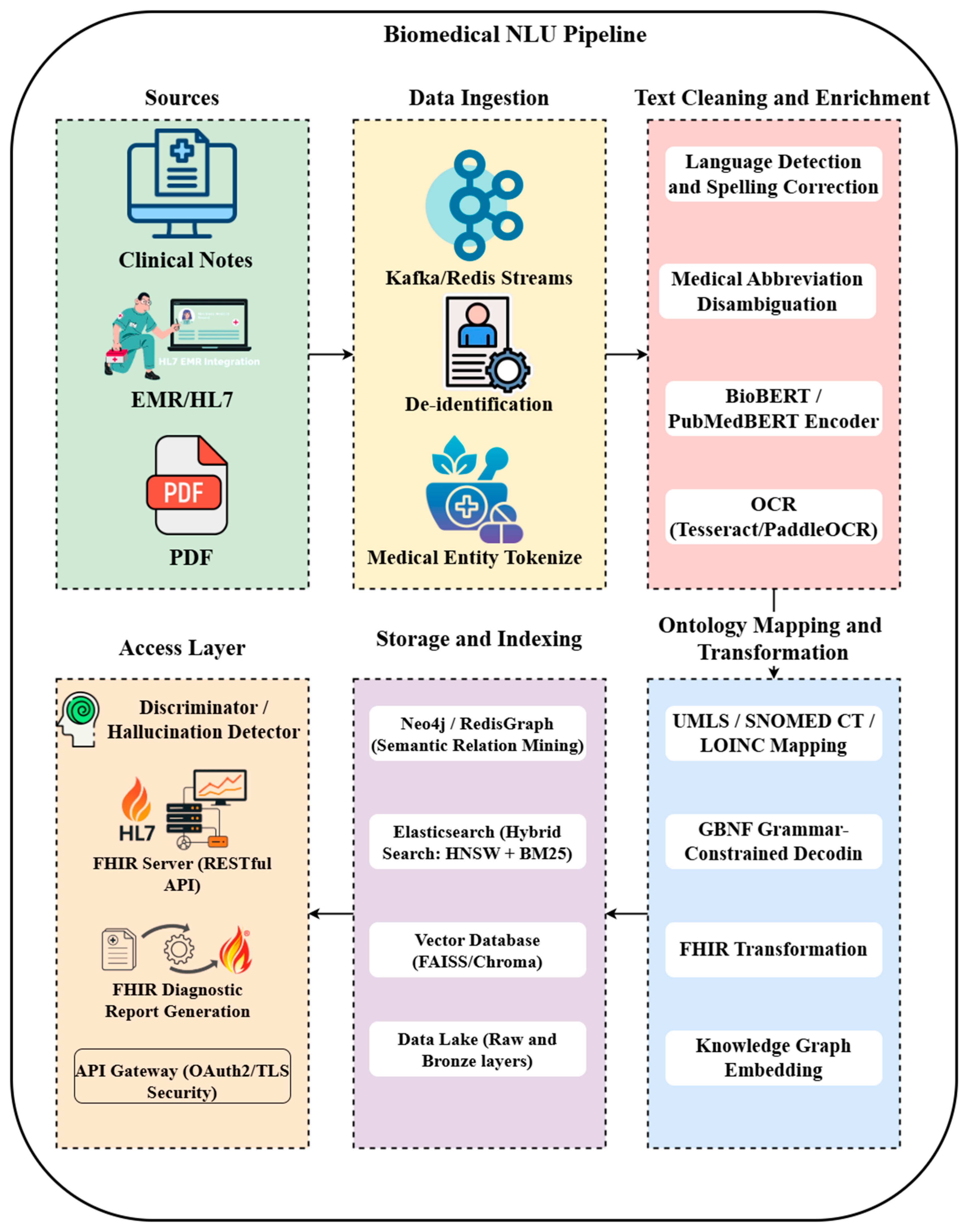
This data transformation process is supported by a multi-layer architecture, illustrated in
Figure 4, which is designed to support low-latency processing in high-throughput clinical environments. As depicted, the pipeline ingests clinical notes, HL7-formatted message streams, and PDF documents via streaming services such as Kafka for immediate de-identification and section segmentation. Following preprocessing, an ontology mapping module aligns text spans with standardized medical terminology from sources such as UMLS, SNOMED, or LOINC to ensure semantic consistency. The resulting structured outputs are stored in a multi-model persistence layer. However, maintaining consistency across these disparate systems, Graph Databases (Neo4j) for relationships, Vector Stores (FAISS) for semantic search, and Document Stores for logs, presents a significant data engineering challenge. The choice of Hierarchical Navigable Small World (HNSW) indexing is theoretically grounded in its ability to maintain O(logN) search complexity even as the orthopedic dataset scales to millions of clinical records [
25,
43]. This efficiency is achieved through a multi-layered graph structure, analogous to a skip-list, where the top layers contain long-range edges for coarse-grained navigation, and the bottom layers provide fine-grained local connectivity [
25,
44]. Formally, for a dataset of size N, the search process involves a greedy traversal where the number of distance evaluations is minimized by the small-world property, ensuring sub-linear retrieval times (e.g., <50 ms for 106 vectors), which is essential for real-time surgical assistant feedback [
45,
46]. Simple “plug-and-play” integration is insufficient; robust pipelines require Event-Driven Architectures (e.g., Change Data Capture) to ensure that updates in the EHR are instantaneously reflected across all indices. Without this rigorous synchronization, the risk of serving stale or conflicting clinical data increases. The pipeline illustrated in
Figure 4 represents a logical view of these components, emphasizing the necessity of an orchestration layer to manage the complex data lifecycle from ingestion to inference.
Figure 4 presents the architectural synthesis of the complete NLU data lifecycle required to support clinical AI pipelines in orthopedic settings at scale. The figure integrates well-established NLP preprocessing steps, including tokenization, lemmatization, part-of-speech tagging, and domain-specific abbreviation disambiguation [
47,
48] that are crucial for orthopedic terminology. The conceptual contribution of
Figure 4 lies in explicitly modeling the orchestration layer and change data capture mechanisms required to maintain consistency and prevent stale or conflicting clinical data across interconnected systems. The illustrated pipeline reflects the recognition that low-latency clinical inference at scale depends on more than accurate NLP models. It also requires robust and consistent data flows that prevent clinicians from accessing outdated or conflicting information during critical decision-making processes.
In the domain of orthopedics, the application of such architectures has witnessed exponential growth, with 90% of relevant studies published between 2019 and 2021. Clinical and operative notes currently constitute the largest application domain, accounting for 50% of orthopedic NLP studies. These applications have demonstrated remarkable precision in extracting granular surgical data [
49]. In total knee arthroplasty (TKA), rule-based algorithms have successfully extracted key data elements, such as implant constraint type and patellar resurfacing status, from 20,000 operative notes with accuracy exceeding 98%. In addition, implant model identification algorithms have achieved an F1-score of 99.9% [
40,
50]. Similarly, for Prosthetic Joint Infection (PJI) detection, algorithms processing consultation notes and microbiology results have achieved a sensitivity of 0.887 and a specificity of 0.991, significantly outperforming administrative coding data [
51].
Beyond operative documentation, approximately 36% of orthopedic NLP research focuses on extracting information from radiology reports [
49]. In this sub-domain, models have demonstrated the ability to identify periprosthetic femur fractures with 100% sensitivity and determine Vancouver classifications with 94.8% specificity [
40]. Deep learning approaches have largely supplanted bespoke feature engineering, with transformer-based models proving superior as general-purpose encoders. BioClinicalBERT has been utilized to classify treatment outcomes for proximal humerus fractures with 87% accuracy by analyzing the final 512 tokens of clinical notes, which typically contain the most relevant discharge status information [
52]. Scaling to the billion-parameter regime, large models like GatorTron have delivered absolute gains of up to 9.6% on medical question-answering benchmarks [
53].
As large language models (LLMs) mature and enter high-stakes clinical settings, orchestration frameworks such as MAI-Dx emerge to coordinate model reasoning and mitigate diagnostic uncertainty through collaborative agents. In this architecture, transformer-powered agents are assigned distinct clinical roles, including hypothesis formulation and checklist validation, acting as a virtual doctor panel engaged in “chain-of-thought” debate. Modern LLMs, such as GPT-4, have demonstrated quality comparable to that of physicians when assessing treatment recommendations based on knee and shoulder MRI reports, though with limitations in evaluating treatment urgency and patient context. Furthermore, the automation of CPT coding using ChatGPT-4 has demonstrated effectiveness in spine operative notes, promising a reduction in healthcare costs and coding errors [
54]. The practical utility of such an integrated pipeline is further exemplified in Total Knee Arthroplasty (TKA) planning. In this clinical scenario, the system ingests unstructured data from a patient’s longitudinal EHR, including radiology reports describing ‘severe joint space narrowing’ and operative notes from prior arthroscopic interventions. By utilizing the HNSW-indexed vector store, the NLU module retrieves relevant surgical protocols and implant specifications in sub-50 ms. An agentic assistant then synthesizes this data into a ‘Digital Twin’ of the patient’s knee, highlighting potential risks such as prior hardware interference or bone loss. By integrating foundation models with FHIR-standardized data, the system provides the surgeon with a pre-operative checklist and a tailored surgical plan, reducing manual chart review time and ensuring that specific patient comorbidities are accounted for in the final prosthetic selection.
Despite these achievements, deployment faces challenges regarding data quality, overfitting, and interpretability. The lack of understandability and transparency in AI models leads to inadequate accountability, although attention mechanisms offer the dominant approach to explainability in healthcare. Privacy issues are addressed using tools such as the certified de-identification pipeline Philter V1.0, which removes 17 types of personal data with a re-identification risk of less than 0.025% [
55]. Moreover, federated learning enables the training of models on disparate data without transferring it, keeping model weights local and ensuring collaborative learning across institutions. However, despite a tenfold increase in publications, less than 6% of studies reach routine deployment within the National Health Service, indicating a persistent gap between research achievements and clinical practice [
56].
3.3. Three-Dimensional Geometric Reasoning and Volumetric Intelligence
The orthopedic field is currently undergoing a fundamental paradigm shift from 2D approximation, characterized by X-ray-based templating, to 3D volumetric intelligence a capability driven by the convergence of geometric deep learning, statistical shape models (SSMs), and automated reasoning systems [
57]. This transition is not merely about enhanced visualization; rather, it represents the emergence of “reasoning” systems capable of autonomously solving complex spatial puzzles. These systems can determine how to reduce a comminuted fracture, predict optimal implant fit from partial data, or reconstruct full 3D bone density models from low-dose 2D imaging [
58].
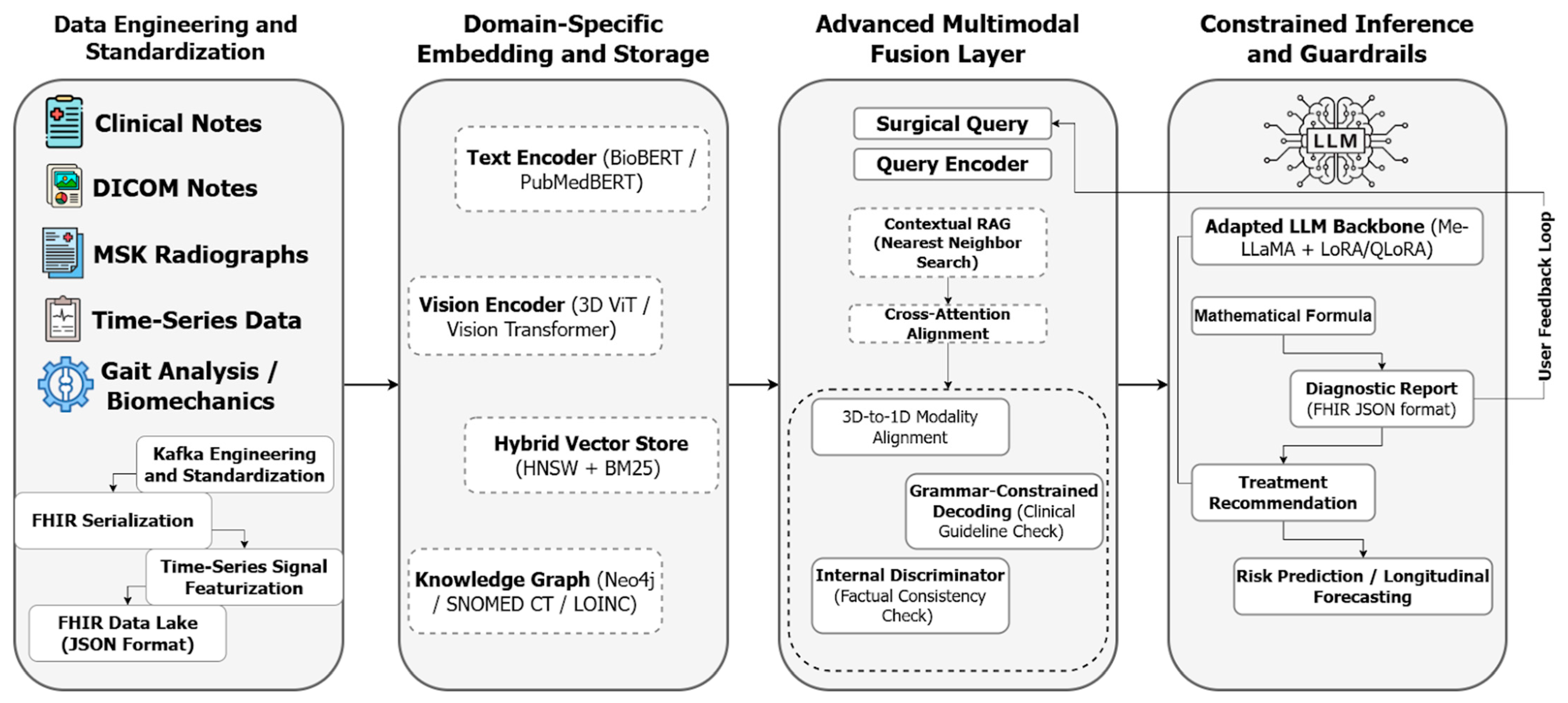
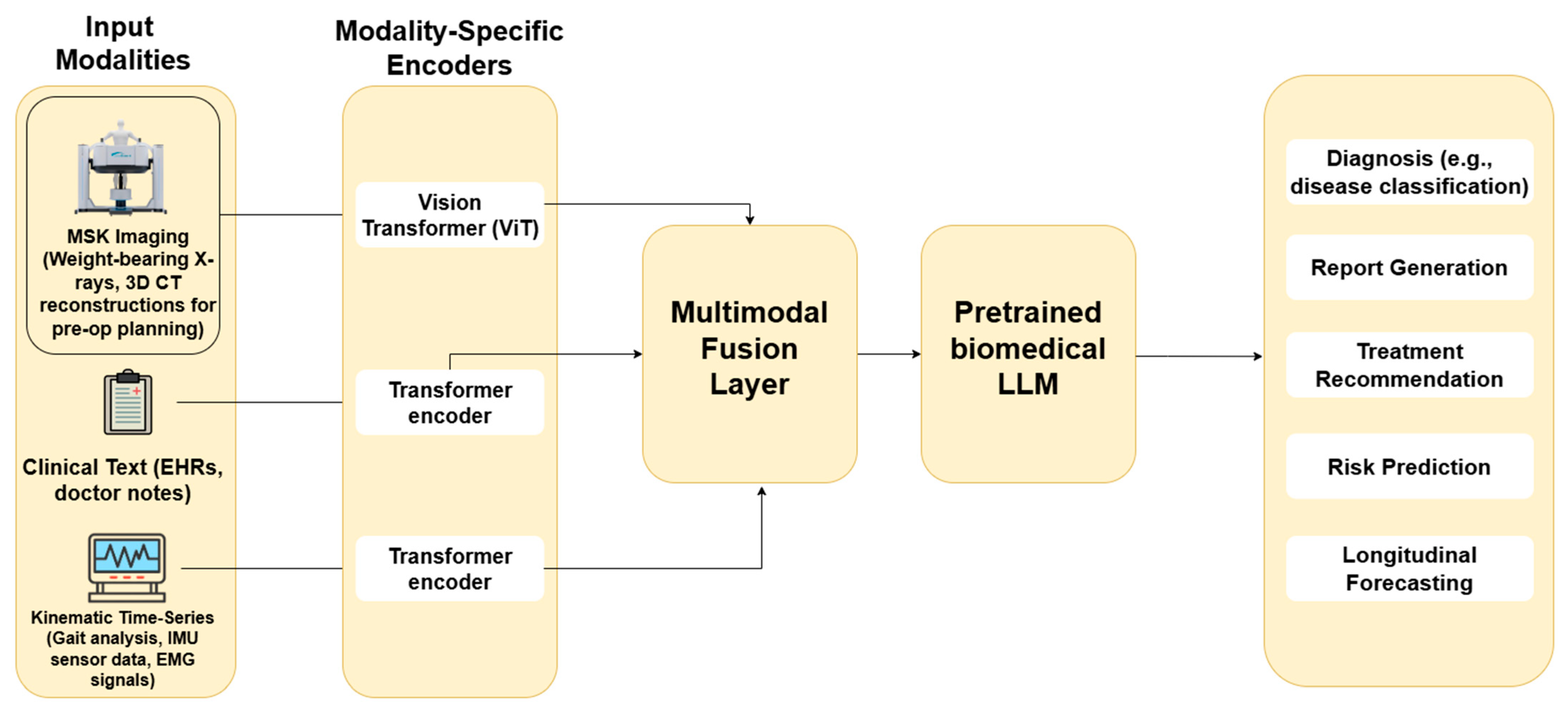
This architecture in
Figure 5 illustrates the integration of diverse input modalities, including MSK imaging (weight-bearing X-rays, 3D CT reconstructions), clinical text (EHRs, notes), and kinematic time-series data (gait analysis, IMU sensors) processed through modality-specific encoders (Vision Transformer, Transformer encoder). These inputs are synthesized in a Multimodal Fusion Layer and processed by a pretrained biomedical LLM to generate actionable outputs such as diagnosis, report generation, treatment recommendations, risk prediction, and longitudinal forecasting. This architectural arrangement will allow a pretrained biomedical LLM to generate actionable outputs ranging from automated 3D reconstruction to longitudinal recovery forecasting, effectively solving spatial surgical problems before operative intervention.
At the core of this transformation are three technologies that function as the “brain” behind the 3D model. Unlike traditional 3D imaging, which is passive, geometric reasoning is active and capable of understanding anatomy. Statistical Shape Models (SSMs) serve as the foundation of this reasoning. By training on thousands of scans, these models learn the “modes of variation” in human anatomy, such as the curvature of a femur, the wear patterns of a glenoid, or the torsion of a tibia [
57]. This reasoning capability allows algorithms to “hallucinate” or infer accurate 3D shapes from incomplete data. For instance, when presented with a partial view of a damaged knee, the AI can infer what the healthy anatomy should look like based on population statistics, thereby enabling precise reconstruction for patient-specific implants (PSI) [
59]. This technology is currently used to design off-the-shelf implants that fit the vast majority of the population or to generate specific guides for complex cases.
Complementing SSMs is the application of Geometric Deep Learning and Graph Neural Networks (GNNs). GNNs can reason about relationships between anatomical landmarks; in orthognathic or trauma surgery, they can simulate how moving one bone fragment affects the soft tissue and alignment of connected structures, effectively “solving” the geometry of a fracture [
60]. This is particularly applicable in the automated segmentation of complex structures, such as pelvic fractures or the temporal bone, where standard pixel-based methods often fail due to noise or metal artifacts.
The third core component is Volumetric Segmentation and Intelligence, which refers to the direct analysis of voxel data using architectures like the 3D U-Net [
61]. Instead of merely delineating the boundary of a bone, these systems differentiate between cortical and trabecular bone quality, detect tumors with sub-millimeter precision, and calculate volumes automatically. New platforms are now analyzing the quality of the volume rather than just the shape, for example, analyzing 3D bone density to recommend screw trajectories that maximize hold strength in osteoporotic patients [
62,
63,
64].
The integration of these technologies has established distinct classes of clinical tools, which is in
Table 3. It outlines the transition from 2D approximations to 3D volumetric intelligence through specific clinical domains. In the field of trauma and fracture management, AI systems are now capable of solving the spatial puzzles of complex fractures by matching bone fragments to healthy templates with high precision [
60]. For joint replacement, commercialized algorithms can generate full 3D models from standard 2D X-rays, maintaining sub-millimeter accuracy and effectively eliminating the need for more radiation-intensive CT scans [
65]. Moreover, in spine surgery, these systems have become the standard of care for advanced navigation, analyzing vertebral geometry to propose optimal pedicle screw paths that maximize bone purchase while protecting delicate neural structures [
66]. These applications demonstrate that geometric reasoning has matured from a research concept into a clinical necessity that allows surgeons to solve complex surgical problems before the patient even enters the operating room.
Looking forward, the next frontier for volumetric intelligence is Functional Reasoning. The field is moving from static questions of fit to dynamic questions of movement. Future “4D” systems, combining volumetric data with time, will use geometric reasoning to predict kinematics, simulating how a specific implant alignment will affect gait or wear years post-operation [
67]. Furthermore, intraoperative replanning will allow AI to update surgical plans in real time based on live video or digitized landmarks, compensating for bone deflection or soft-tissue tension changes [
68]. Ultimately, 3D Geometric Reasoning has matured from a research topic to a clinical necessity. It has bridged the “data gap” in orthopedics, allowing surgeons to obtain CT-quality insights from X-ray-level inputs. For the orthopedic professional, Volumetric Intelligence is no longer just about visualization; it is about algorithmically solving the surgical problem before the patient enters the operating room [
69].
3.4. Data Engineering for Clinical AI Pipelines
Integrating Large Language Models with HL7 FHIR exposes two distinct but complementary interoperability challenges at the input and output stages of the clinical AI pipeline. On the input side, direct ingestion of nested FHIR JSON introduces high-frequency syntactic noise that degrades attention and retrieval performance. This limitation is addressed through JSON-to-narrative linearization techniques, which flatten structured resources into semantically coherent natural-language representations prior to embedding [
16,
67]. Frameworks such as CLEAR demonstrate that this approach improves retrieval density and relevance compared with raw JSON indexing, particularly for guideline-driven clinical queries [
70]. However, narrative linearization does not resolve the reciprocal output-side challenge: the inherently probabilistic nature of LLM decoding, which risks producing syntactically invalid or schema-noncompliant FHIR resources. Grammar-Constrained Decoding (GCD) addresses this by restricting generation to tokens permitted by grammars or finite-state machines derived from FHIR schemas, ensuring syntactic validity of generated resources. Critically, while narrative linearization enhances semantic access to clinical data and GCD enforces structural correctness, neither method alone guarantees clinical correctness. GCD functions as an interoperability safeguard rather than a fact-checking mechanism. As a result, it must be integrated with upstream grounding mechanisms, such as retrieval-augmented generation, and downstream verification layers to prevent clinically incorrect yet syntactically valid outputs from entering production EHR systems.
Beyond structural validity, the algorithmic pipeline must address the “Context-Latency Trade-off” inherent in real-time clinical systems. While FHIR provides a robust graph of patient data, feeding raw, verbose JSON resources directly into an LLM’s context window is computationally inefficient and increases token consumption. To optimize this, the framework incorporates a semantic flattening layer that transforms complex FHIR bundles into dense, token-efficient summaries before ingestion. This ensures that the limited context window of the model is prioritized for high-value clinical reasoning rather than repetitive schema metadata.
Furthermore, the inference latency of querying a live FHIR server can become a bottleneck for RAG-based decision support. To mitigate this, our framework suggests an asynchronous indexing strategy, where clinical data is pre-processed and synchronized into a vector database. This decouples the high-latency retrieval of structured records from the low-latency requirements of the inference engine, allowing the model to access historical patient context in milliseconds. By treating the interoperability layer as a high-speed context substrate, the system achieves the responsiveness required for point-of-care clinical applications.
3.5. Explainability Frameworks and Clinical Trust
Explainability and interpretability have emerged as foundational pillars for establishing clinical trust in AI-driven CDSSs across healthcare domains, particularly in high-risk fields such as orthopedics. According to [
71], interpretability is essential for the application of clinical decision support systems (CDSSs) in healthcare settings. Interpretability is defined as a transparent model structure with clear input–output relationships and explainable AI algorithms, and it critically influences both clinician and patient acceptance of AI-powered recommendations [
71]. The absence of explainability in black box AI models presents a significant barrier to adoption, as healthcare professionals require transparent and justifiable reasoning before incorporating AI-generated recommendations into clinical decision-making processes. Ref. [
72] further emphasize that explainability allows clinicians, surgeons, and patients to understand the contributing factors underlying AI-powered predictive models, thereby fostering trust and improving comprehension of reasoning processes that directly influence clinical outcomes in orthopedics [
72]. The integration of explainability frameworks also aligns with regulatory requirements such as the General Data Protection Regulation, which mandates that individuals have the right to meaningful explanations of automated decision-making logic [
71]. This requirement reinforces the necessity of developing transparent AI systems that can clearly articulate their decision pathways to both healthcare providers and patients seeking to understand orthopedic diagnoses, treatment recommendations, and prognostic assessments.
The practical implementation of explainability in orthopedic artificial intelligence systems requires the use of diverse methodological approaches that range from inherently interpretable ante hoc methods to post hoc explanation techniques applied to complex black box models. Ref. [
73] describes several explainable AI approaches, including saliency maps that visually highlight regions in medical images which strongly influence diagnostic decisions. These methods are particularly valuable in orthopedic imaging analysis, where identifying specific features in X-ray, CT, and MRI scans is critical for fracture detection and classification.
Shapley values and explainable boosting machines have gained prominence as model-agnostic techniques that quantify the contribution of individual input features to final predictions. These methods enable orthopedic surgeons to assess the reasoning underlying artificial intelligence outputs and to identify potential areas for improvement in preoperative surgical planning [
73,
74]. Recent evidence from [
75] demonstrates that combining clinical explanations with machine learning outputs significantly improves clinician acceptance, trust, satisfaction, and system usability. Specifically, integrating SHAP-based visualizations with natural language explanations outperforms both results-only outputs and traditional SHAP visualizations alone.
In the context of orthopedic surgical guidance, explainable artificial AI systems can provide interpretable justifications for recommendations related to implant selection, alignment parameters, and surgical strategy. This supports informed surgical decision making and reduces the risk of complications such as implant loosening and alignment errors that can negatively affect long-term patient outcomes [
76].
The advancement of agentic AI in healthcare introduces new challenges for clinical trust that require transparency and accountability. Ref. [
77] emphasize that medical AI agents must provide transparent reasoning for their decisions, particularly when offering diagnostic suggestions or treatment strategies. Clinician understanding of artificial intelligence rationale is essential for informed decision-making and for fostering confidence in autonomous systems. Ref. [
74] observes that healthcare professionals often struggle to trust complex machine learning models due to limited evaluation scope and reliance on specialized technical expertise [
74].
The successful deployment of explainable AI in orthopedic agentic clinical assistants requires overcoming technical, regulatory, and organizational challenges while demonstrating clear improvements in diagnostic performance and clinician adoption. Ref. [
78] illustrates this potential through DeepKneeExplainer, which combines high diagnostic accuracy with interpretable visual explanations for knee osteoarthritis assessment. Contemporary applications in orthopedic surgery demonstrate that AI-based preoperative 3D planning systems achieve superior accuracy in predicting prosthesis size and axial alignment compared to traditional 2D template planning. However, these systems require explainability features to justify why specific implant sizes and positioning angles are recommended for individual patients based on their unique anatomical characteristics [
76]. Ref. [
72] identifies several implementation barriers, including the trade-off between model interpretability and predictive accuracy. They also highlight challenges in explaining advanced deep neural networks with numerous hyperparameters and complex interactions. In addition, they emphasize the need for user-centric interface designs that present explanations in formats clinicians can readily understand and trust without adding complexity to already demanding clinical workflows [
72]. Addressing these implementation challenges requires collaborative interdisciplinary efforts involving AI practitioners, orthopedic specialists, regulatory entities, and patient advocates. These stakeholders must work together to establish clear standards, guidelines, and best practices for the deployment of explainable AI in orthopedic settings. In parallel, small-scale pilot projects, continuous user feedback collection, and comprehensive clinician training are essential to ensure successful integration into clinical practice.





 ,
,