


Abstract
Background: Stepped-wedge cluster randomized trials (SW-CRTs) are increasingly used to evaluate population-level interventions, but trial validity depends on timely cluster transitions. Rollout feasibility is often assumed rather than modelled. In the context of a planned national trial of CPR training kiosks, we developed a Monte Carlo simulation algorithm to quantify logistical feasibility under uncertainty. Methods: A stochastic Monte Carlo algorithm was implemented to simulate deploying 100 CPR kiosks across eight Canadian cities under four team structures. Inputs included productivity (0.8–1.2 kiosks/day), disruption probabilities (weather, venue access, technical failure, staff illness, transport delays), and cost parameters (salaries, per diems, travel). Each scenario was simulated across 3000 iterations. Outputs included per-city feasibility (p ≤ 60 days), total project duration, and risk–cost trade-offs. Results: Single-team strategies required 9–10 months for full rollout, with winter-exposed cities such as Halifax and Charlottetown having up to 30% probability of exceeding 60 days. Two-team strategies halved rollout time (4–5 months) and achieved >95% on-time rollout across cities. Adding a third onsite staff member reduced risk by 5–15% with modest additional cost (~CAD 1500–2000 per city). Risk–cost analysis identified two teams with three staff as the most reliable strategy. Conclusions: Monte Carlo simulation provides a practical framework for assessing rollout feasibility in SW-CRTs. Applied to CPR kiosk deployment, it highlights the importance of staffing, seasonality, and city-level context. The approach is generalizable to other national interventions requiring phased rollout under uncertainty.
1. Introduction
Out-of-hospital cardiac arrest (OHCA) is one of the leading causes of sudden death worldwide, with more than 350,000 cases annually in the United States alone and approximately 60,000 in Canada [1,2]. Survival remains low—often under 10%—and is highly dependent on early bystander cardiopulmonary resuscitation (CPR) and rapid defibrillation. Yet, despite decades of education and awareness campaigns, bystander CPR rates remain suboptimal, typically between 36% and 49% in Canadian communities and similarly variable internationally [3]. Addressing this persistent gap requires population-scale interventions that are feasible, cost-effective, and capable of reaching diverse segments of society.
Several countries have demonstrated that sustained national or regional campaigns can improve bystander CPR rates. In Denmark, systematic training initiatives targeting high school students, drivers, and lay citizens reached approximately 4% of the population annually. They were associated with an increase in bystander CPR from 21% in 2001 to 45% in 2010, with corresponding improvements in survival [4]. Scotland’s “Save a Life for Scotland” campaign, which trained roughly 10% of its population over four years, raised bystander CPR rates from 49% to 64% [5]. Singapore’s Pan-Asian Resuscitation Outcomes Study (PAROS) reported a doubling of bystander CPR, from 25% to over 50%, following training of 1–2% of the population annually [6]. In Arizona, a statewide hands-only CPR program increased bystander CPR rates from 28% to 40% within four years [7]. These precedents confirm that large-scale training is feasible and strongly associated with population-level survival gains.
Despite these successes, challenges remain. Traditional CPR courses are time-consuming, resource-intensive, and difficult to scale equitably across urban, rural, and underserved communities. They also require periodic retraining to address skill decay, which can occur within months of initial instruction [8]. Innovative, low-cost, and accessible models are therefore needed to complement traditional training. One such model is the CPR kiosk: A self-contained, interactive station equipped with a manikin, audiovisual guidance, and real-time feedback. Studies suggest that even brief kiosk-based training sessions—often under five minutes—can substantially improve CPR performance and willingness to act [9]. Because kiosks can be placed in airports, shopping centers, schools, and community hubs, they offer the potential to reach populations who might otherwise lack access to formal training while supporting repeated booster practice to counteract skill decay.
Although kiosks’ educational impact has been documented, little is known about the logistics of scaling kiosk deployment at national levels, particularly in the context of a research trial. Large-scale deployment requires transport, installation, networking, and maintenance across diverse geographic and climatic conditions. Potential stumbling blocks include staff illness, vehicle breakdowns, weather disruptions, technical failures, and site-specific access or networking challenges. Without careful planning, these logistical uncertainties could compromise trial integrity, increase costs, or delay implementation.
The stepped-wedge cluster randomized trial (SW-CRT) is increasingly employed for evaluating complex health system and public health interventions [10,11]. In this design, clusters (e.g., cities or regions) cross over from control to intervention at regular intervals until all have received the intervention. The design is attractive when simultaneous rollout is infeasible or ethically undesirable, but its validity depends on timely cluster transitions. Delays in rollout can introduce imbalance, reduce statistical power, and threaten internal validity. Yet, despite the growing use of SW-CRTs, the feasibility of rollout logistics is rarely assessed prospectively, and delays are often underreported in trial publications [12].
To address this gap, we developed a stochastic Monte Carlo simulation algorithm to model the feasibility of rolling out 100 CPR kiosks across eight Canadian cities in the context of a planned SW-CRT. The model incorporates productivity ranges, disruption probabilities, costs, and seasonality to generate distributions of rollout duration, per-city feasibility (probability of completion within 60 days), and overall project cost. By comparing team structures—single vs. two travelling teams, and two vs. three onsite staff—we aimed to quantify trade-offs between risk and expense.
2. Materials and Methods
2.1. Problem Statement
The planned trial involves the deployment of 100 CPR training kiosks across eight Canadian cities: Toronto, Montreal, Vancouver, Calgary, Ottawa, Winnipeg, Halifax, and Charlottetown. As the largest urban center, Toronto was allocated 30 kiosks, while the remaining 70 were distributed proportionally according to population. Each city represents one cluster in a stepped-wedge cluster randomized trial (SW-CRT) design. To maintain trial validity, each cluster must complete kiosk installation within a 60-day window before transition.
Rollout feasibility is challenged by geographic dispersion, climatic variability, and logistical uncertainties. To capture this complexity, we constructed a stochastic Monte Carlo simulation algorithm to evaluate the probability of successful rollout under varying deployment team structures.
2.2. Deployment Strategies
Four team structures were modelled:
- A single team, three onsite staff, and one central travelling team of three staff members managing all deployments.
- Single team, two onsite staff + remote coordinator—one central team of two travelling staff supported by a remote coordinator.
- Two teams, three onsite staff each—two central travelling teams deployed in parallel.
- Two teams, two onsite staff + remote coordinator—two travelling pairs supported by remote coordination.
These strategies were selected to capture trade-offs between cost, redundancy, and feasibility.
2.3. Monte Carlo Simulation Algorithm
We developed a Monte Carlo simulation algorithm Algorithm 1 implemented in Python. For each scenario, 3000 iterations were run to capture variability. Each iteration simulated the complete rollout across all eight cities. Random draws were taken for productivity, disruption events, and costs.
| Algorithm 1: Monte Carlo rollout-feasibility for stepped-wedge trials |
| 1: Inputs: Cities, kiosks, team structures, productivity, disruption probabilities, costs, seasonality rules 2: Outputs: Per-city P(≤60 d), project duration, cost distributions 3: For each scenario s: 4: For iteration i = 1..N: 5: Sample productivity, disruptions, costs 6: For each city: 7: Compute base workdays = kiosks/(teams × productivity) 8: Add stochastic delays (weather, illness, technical, access) 9: Convert to calendar days 10: Record if ≤60 days; accrue costs 11: Aggregate project duration and total costs 12: Summarize distributions and risk–cost trade-offs |
2.4. Input Parameters
Parameters were informed by pilot data, literature, and expert consensus.
- Productivity: 0.8–1.2 kiosks/team/day (based on pilot deployments);
- Staff illness: 10% probability per deployment, with 1–3 days lost (based on pilot data);
- Vehicle breakdown: 5% probability per deployment, with 1–2 days lost (expert consensus);
- Technical failure (hardware/software): 10% per kiosk, with 0.5–1 day lost per event (expert consensus);
- Networking/electrical delays: 20% per city, with 2–4 days lost (expert consensus).
- Weather: 15% in temperate regions (Toronto, Vancouver), 30% in Atlantic provinces (Halifax, Charlottetown), with 2–5 days lost (Based on Environment Canada historical data);
- Holiday blackout: fixed 7-day penalty if deployment overlapped December 20–January 5;
- Costs: salaries CAD 90,000–130,000 per full-time equivalent, per diem CAD 180–300/day, travel CAD 2000–8000 per city (expert consensus and standard institutional rates).
Seasonality multipliers increased disruption probabilities during the winter months.
2.5. Outcomes
The primary outcome was the probability of on-time rollout (p ≤ 60 days) per city and scenario. Secondary outcomes included the following:
- Total project duration (calendar days from first to last city);
- Total logistics cost (salary, per diem, travel);
- Risk–cost trade-off, defined as the balance between the probability of exceeding 60 days and the total cost.
Scenario performance was summarized with medians, interquartile ranges, and 90th and 95th percentiles.
2.6. Sensitivity Analyses
Sensitivity analyses assessed the impact of varying the following factors:
- Seasonality (weather probability ± 10%);
- Technical failure probability (5–15%);
- Staffing (2 vs. 3 onsite members);
- Team number (1 vs. 2).
Results are presented in Appendix A.
2.7. Implementation
Simulations were conducted in Python (v3.11) using NumPy for random sampling and Matplotlib for visualization. Each scenario of 3000 iterations ran in under 5 min on a standard laptop (Intel i7, 16 GB RAM). Convergence was confirmed by inspecting cumulative averages and the stability of distributions.
2.8. AI Disclosure
Portions of the drafting and language refinement of this section were assisted by ChatGPT (OpenAI, San Francisco, CA, USA). These were predominantly grammatical in nature. All content was reviewed, edited, and verified for accuracy by the authors, who take full responsibility for the final manuscript.
3. Results
The Monte Carlo simulation algorithm converged consistently across all scenarios. Cumulative averages stabilized after approximately 1000 iterations, and the runtime per scenario was under five minutes on standard hardware, confirming computational feasibility. Outputs were reproducible across independent runs, ensuring the stability of the distributions.
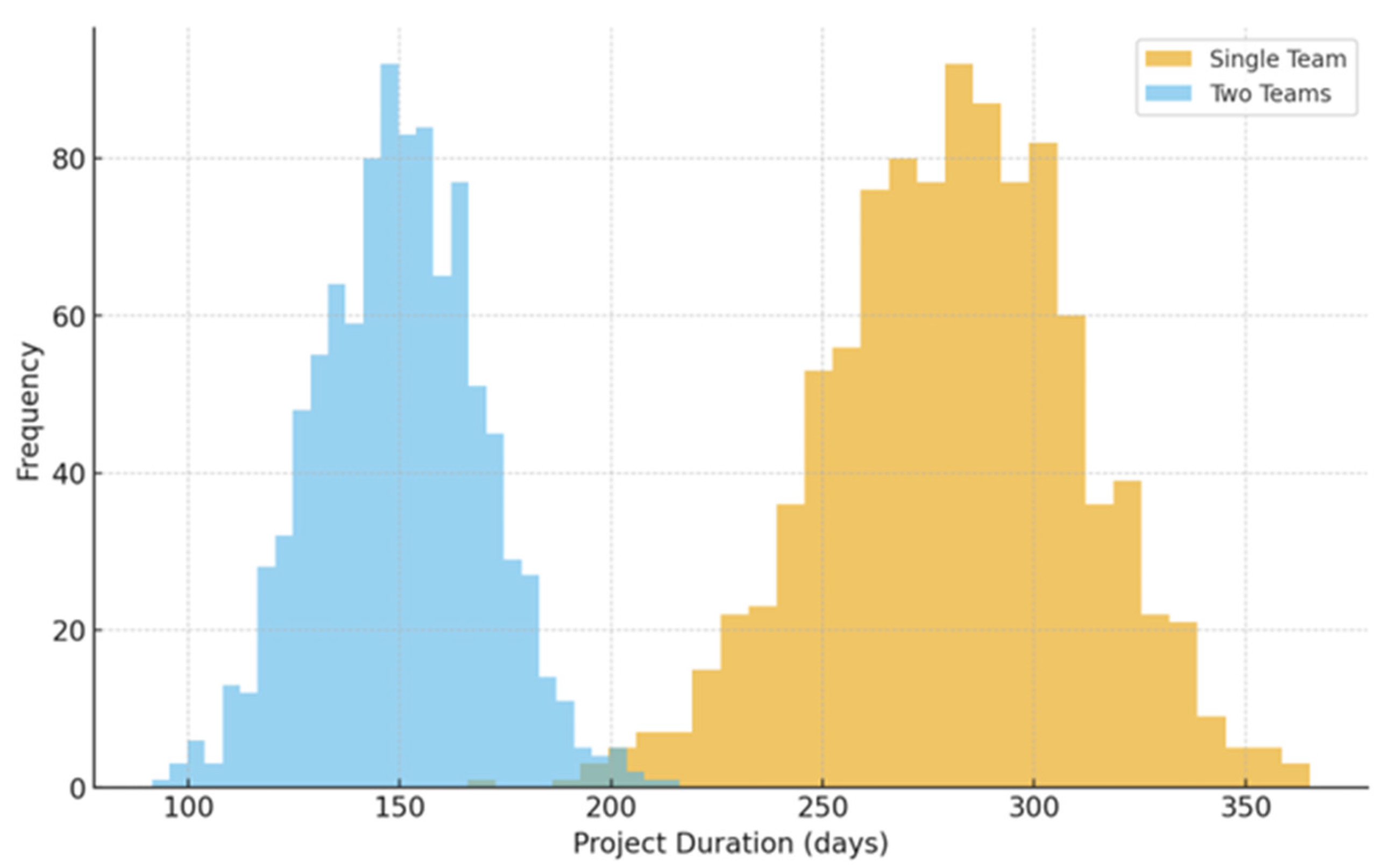
Single-team deployment strategies required a median of approximately 280 days (9–10 months) to complete rollout across all eight cities. The resulting duration distributions were right-skewed, with a long tail extending beyond one year when winter deployments coincided with smaller, more weather-exposed cities. By contrast, two-team strategies substantially reduced rollout time, with median durations of 140–150 days (4–5 months) and interquartile ranges of 130–160 days. Notably, no two-team simulations exceeded eight months, underscoring the feasibility advantage of parallel deployment (Figure 1).
Figure 1.
Project duration distributions for single vs. two-team deployment strategies. Histograms display the distribution of rollout durations across 1000 simulations. The single-team strategy (orange) exhibits high variability, with some durations exceeding one year. In contrast, the two-team approach (blue) produces a narrower distribution centred around 4–5 months, significantly reducing extreme delays. These results highlight the operational efficiency of parallel deployments in accelerating project timelines and improving predictability.
City-level outcomes highlighted considerable geographic variation (Table 1). With 30 kiosks, Toronto consistently required the longest deployment but maintained over 90% probability of completion within 60 days under all but the most constrained scenarios. Vancouver demonstrated robust feasibility, with probabilities exceeding 95% across all team structures, reflecting the benefit of a milder climate and strong infrastructure. Halifax, however, showed up to a 28% probability of exceeding 60 days under the weakest staffing model. At the same time, despite only seven kiosks, Charlottetown displayed the widest distribution of completion times, with an interquartile range of 48–70 days. Montreal, Calgary, Ottawa, and Winnipeg showed intermediate results, typically achieving greater than 90% feasibility under two-team strategies.
Table 1.
Per-city simulation results with uncertainty intervals. Results show the median deployment duration, probability of completing rollout within 60 days (p ≤ 60), and median cost per kiosk. Ranges in parentheses represent the 25th–75th percentile for durations and costs, and approximate 95% confidence intervals for p ≤ 60. Results highlight how larger cities (e.g., Toronto, Vancouver) demonstrate high feasibility, while winter-prone or smaller markets (e.g., Halifax, Charlottetown) face greater rollout risk and higher per-unit costs.
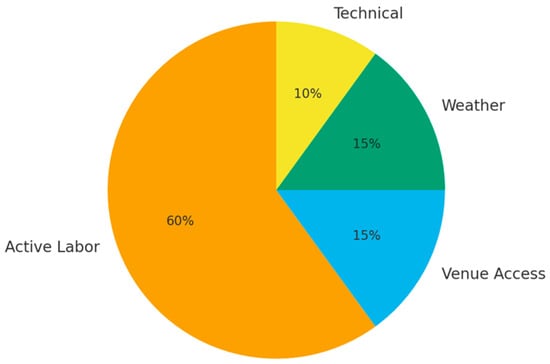
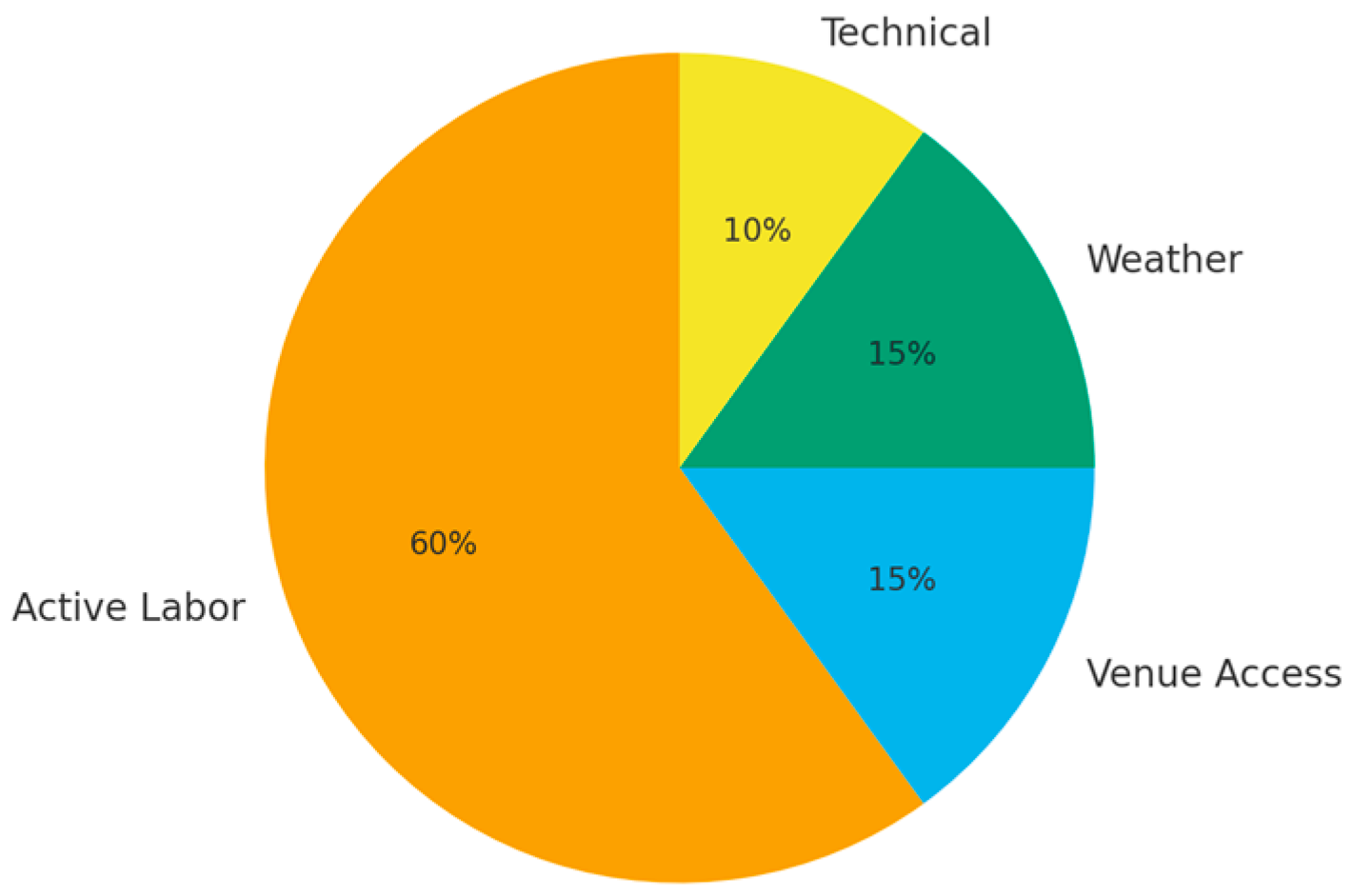
The decomposition of per-kiosk installation time revealed that delays contributed substantially to total deployment duration. Active labour accounted for approximately 60% of the time, venue access and weather-related delays accounted for around 15%, and technical and networking challenges added 10% (Figure 2). These results indicate that predictable, recurrent disruptions such as weather and site access exert a larger cumulative effect than technical failures.
Figure 2.
Per-kiosk breakdown of active labour and delays. Pie chart showing the proportion of time attributed to active labour, venue access, weather, and technical/networking issues. Active labour accounted for ~60% of the time, while weather and venue access contributed 30%. Technical and networking issues accounted for only 10%, indicating that predictable, recurring disruptions were the dominant causes of delay.
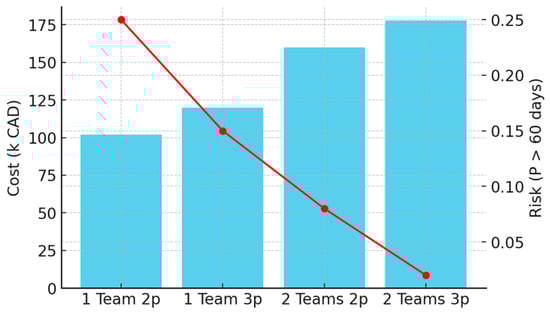
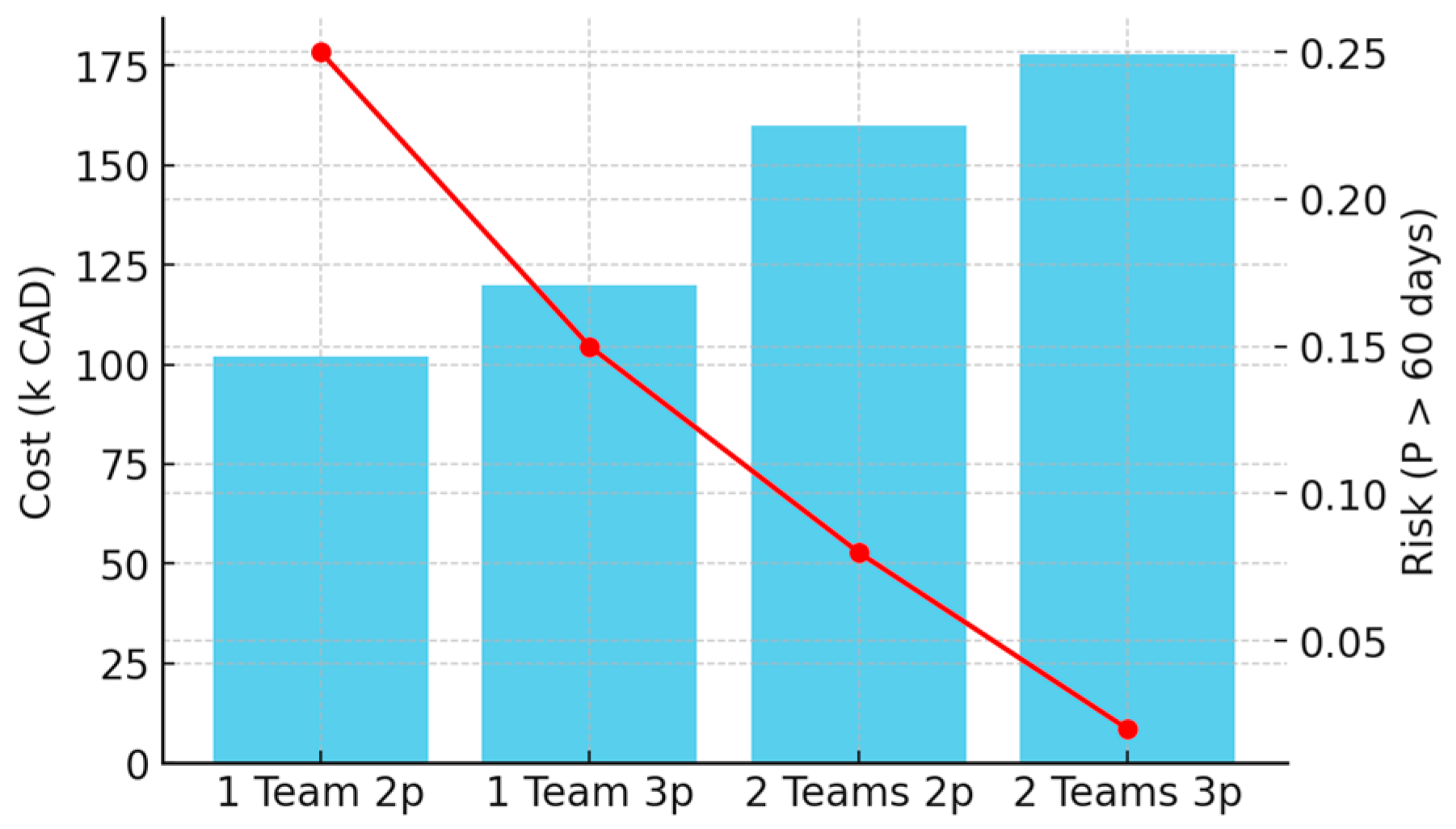
Risk–cost trade-offs are summarized in Figure 3. The single-team, two-person model was the lowest-cost option (median ~CAD 102,000) but carried the most significant risk, with roughly 25% probability of exceeding the 60-day rollout window in at least one city. Adding a third onsite staff member reduced risk to ~15% while only modestly increasing costs (~CAD 120,000). Two-team, two-person strategies increased costs to ~CAD 160,000 but reduced risk to below 8%. In contrast, two-team, three-person deployments represented the most expensive option (~CAD 178,000) yet achieved near-perfect feasibility, with over 98% probability of on-time rollout across all cities. Incremental cost-effectiveness analysis demonstrated that the largest efficiency gains were realized when moving from two- to three-person teams, as the cost increase was modest relative to the reduction in risk.
Figure 3.
Cost–risk trade-off across four deployment strategies. Bar heights indicate total project cost (in thousands of CAD), while the overlaid line shows the probability of exceeding a 60-day rollout target. The single-team, two-person strategy (leftmost) is the least expensive but carries the highest risk of delay (~25%). Adding a third person significantly lowers the risk with only a modest increase in cost. The two-team, three-person model (rightmost) achieves near-perfect on-time rollout (>98%) but at the highest cost, illustrating the trade-off between operational feasibility and resource investment.
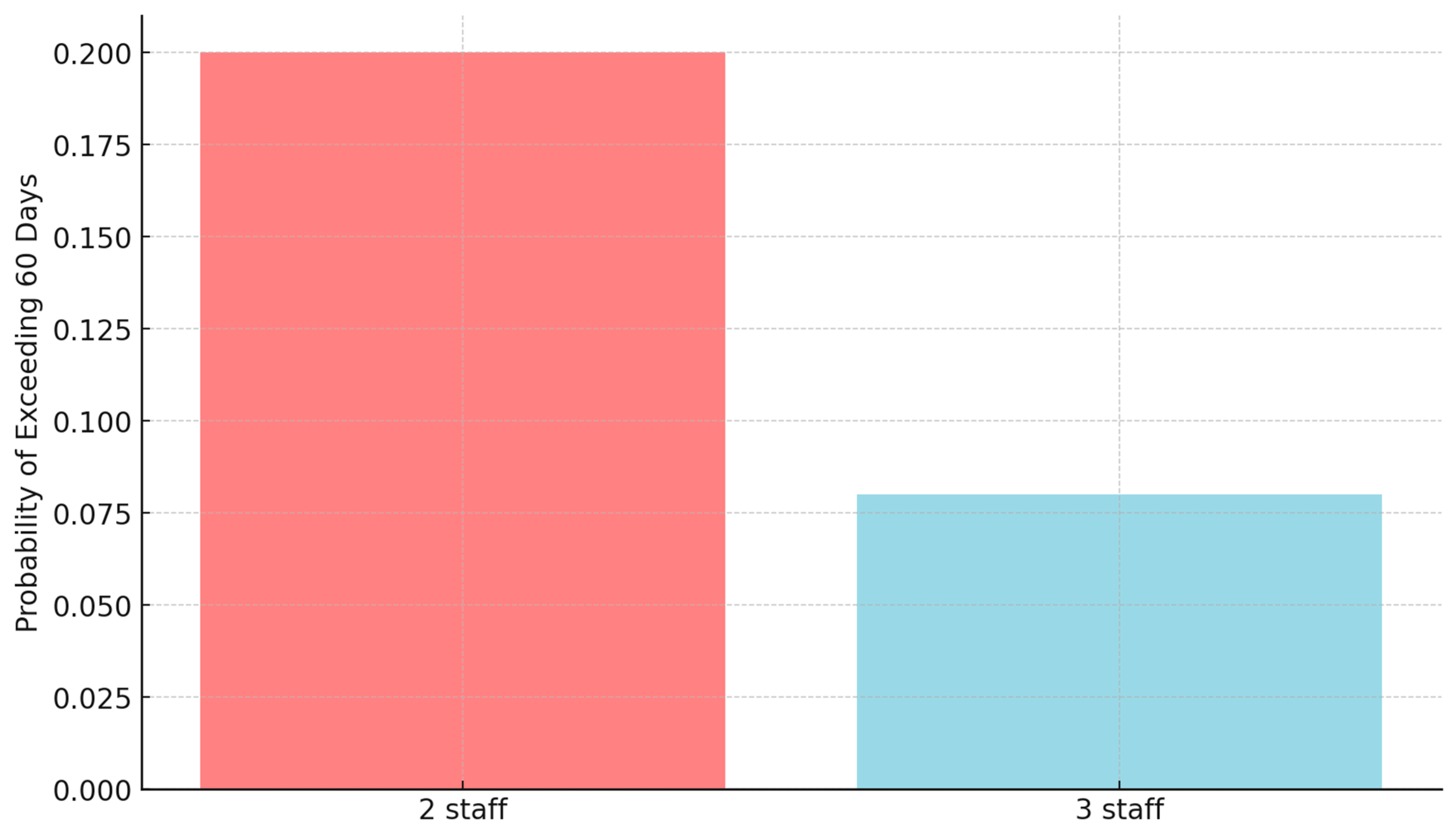
Sensitivity analyses, detailed in Appendix A, reinforced these findings. Increasing weather disruption probabilities from 15% to 30% extended median rollout durations by 20–30% (Figure A1) and, by contrast, reducing technical failure probabilities from 10% to 5% shortened rollout by only 2–3%. Adding a third onsite staff member reduced the probability of exceeding 60 days by 5–15%, while deploying two teams halved total project duration compared with single-team models. Figure A2 further demonstrates the benefit of increased staffing, with the probability of exceeding 60 days falling from ~20% under two-person teams to ~8% under three-person teams.
In summary, the simulations showed that two-team deployments consistently halve rollout duration relative to single-team approaches. Adding a third onsite staff member substantially reduced risk at modest additional cost, while weather and site access emerged as the most consequential sources of delay. Smaller, winter-prone cities such as Halifax and Charlottetown were most vulnerable to overruns, and risk–cost analysis identified two teams with three onsite staff as the most reliable strategy for ensuring timely rollout.
Sensitivity Analyses
- Increasing weather probabilities from 15% to 30% extended the median duration by 20–30%;
- Reducing technical failures from 10% to 5% shortened rollout by only 2–3%;
- Adding a third staff member reduced overrun risk by 5–15%;
- Deploying two teams halved the project duration relative to single teams.
4. Discussion
4.1. Principal Findings
We developed and applied a Monte Carlo simulation algorithm to evaluate the feasibility of deploying 100 CPR training kiosks across eight Canadian cities in a stepped-wedge cluster randomized trial (SW-CRT). Our analysis demonstrates that rollout feasibility is strongly influenced by team composition, number of teams, and seasonality. Two central teams of three onsite staff each achieved near-perfect adherence to 60-day cluster windows, halving rollout duration compared to single-team models. They minimized the probability of overruns in weather-exposed cities. Although more costly, this approach provided the most reliable balance between feasibility and resource investment. Adding a third onsite staff member yielded substantial risk reduction at modest incremental cost, suggesting that staffing decisions may be among the most cost-effective levers to improve rollout performance.
4.2. Delay Components and Their Impact
Decomposition of per-kiosk time revealed that delays accounted for nearly 40% of total deployment duration. Weather and venue access were the dominant contributors, accounting for ~30% of total time. Technical failures and networking issues were less common but could cause multi-day disruptions. These findings align with practical experience in health system interventions: recurrent, predictable barriers often exert a greater cumulative effect than rare, catastrophic events. Notably, smaller winter-prone cities such as Halifax and Charlottetown demonstrated disproportionately high risks of exceeding 60-day windows, underscoring the need for additional contingency planning in such locations.
4.3. Interpretation in the Context of Literature
The Resuscitation Outcomes Consortium (ROC) studies highlighted that improvements in OHCA survival were often attributable to system-level logistics—such as EMS response times, bystander CPR, and AED availability—rather than novel therapies [2]. Similarly, our work emphasizes that logistical feasibility is not peripheral but central to intervention effectiveness. A kiosk that is delayed or never installed cannot contribute to population training, just as an AED that is poorly placed cannot be used.
Parallels also exist with other public health interventions. Cold-chain analyses during COVID-19 vaccine distribution identified weather, transport, and site readiness as critical sources of delay [12]. These same categories emerged in our simulation as the most consequential barriers. Likewise, cancer screening rollouts and digital health interventions have underscored the need for phased, well-planned deployments, where logistical bottlenecks can undermine program fidelity and reach. Our algorithmic approach offers a structured method to anticipate and mitigate these risks.
4.4. Relation to Implementation Science Frameworks
Implementation science frameworks such as RE-AIM and Proctor’s taxonomy identify feasibility, fidelity, and cost as essential outcomes [13,14]. Our model operationalizes all three: feasibility through probabilities of on-time rollout, fidelity through adherence to stepped-wedge timelines, and cost through explicit modelling of staff, travel, and per diem expenditures. By embedding these constructs into a simulation framework, we extend implementation science from conceptual models to quantitative tools that can directly inform trial design and policy decisions.
4.5. Limitations
This study has several limitations. First, disruption probabilities were derived from pilot data and expert consensus rather than large empirical datasets. Although ranges were intentionally conservative, actual probabilities may differ regionally or temporally. Second, costs were modelled as direct logistics expenses and did not include downstream programmatic costs such as kiosk maintenance or community engagement. Third, our model did not incorporate infrequent but potentially impactful events such as labour disputes, natural disasters, or significant regulatory delays. Fourth, while results were tailored to Canadian geography and costs, generalizability to other health systems requires adaptation of parameter inputs. This model could be applied to other countries’ contexts by varying the parameters.
Finally, although the algorithm provides distributions of likely outcomes, it cannot eliminate uncertainty. Real-world rollouts will inevitably include unforeseen disruptions. However, by sampling across wide parameter ranges, our approach provides conservative estimates that highlight vulnerabilities and inform contingency planning. The authors are part of the team developing the CPR kiosk. This could introduce bias in the interpretation of the results. However, as the paper is focused on exploring the feasibility of a trial and not whether the CPR kiosk can deliver the educational intervention, the bias is likely minimal as it relates to this study.
4.6. Implications
Our results have important implications for both trialists and health system decision-makers. For stepped-wedge trials, timely cluster transitions are essential for maintaining statistical power and internal validity. By modelling rollout feasibility in advance, investigators can select strategies that minimize the risk of overruns, justify resource allocation, and improve trial integrity.
Beyond CPR education, this algorithm is generalizable to any phased intervention requiring multi-site deployment. Examples include mass screening initiatives, the introduction of digital health technologies, or national vaccination campaigns. By quantifying the trade-offs between risk and cost, decision-makers can identify efficient strategies and anticipate vulnerabilities. This approach also supports funders, who increasingly demand evidence of feasibility before committing resources.
For CPR education specifically, our findings suggest that investment in additional staff yields outsized benefits. Modest increases in personnel cost substantially reduce rollout risk, particularly in smaller or weather-prone cities. This highlights the importance of considering equity in deployment strategies: smaller communities may disproportionately experience delays without additional resources, undermining the goal of universal access to training.
4.7. Future Directions
Future research should validate these simulations against real-world deployments. Pilot implementation of kiosks in diverse Canadian cities would provide empirical disruption rates, refine parameter estimates, and allow model recalibration. As a next step within the simulation framework, it will be important to explicitly model heterogeneity in venue readiness (e.g., airports vs. malls vs. community centers), alternative kiosk densities within cities, and different stepped-wedge schedules (shorter vs. longer cluster windows, varying numbers of clusters per step). These extensions can be operationalized by introducing venue-level strata with distinct disruption and installation-time distributions, and by testing scenarios in which kiosk teams are reallocated adaptively in response to local delays or early usage data. Additionally, extending the framework to include downstream outcomes—such as bystander CPR rates, skill retention, and OHCA survival—would provide an even more comprehensive cost-effectiveness assessment. Finally, integrating this algorithm with implementation science frameworks could facilitate its use by policymakers and trialists across diverse contexts.
Author Contributions
Conceptualization S.M. and R.O.; methodology, validation, formal analysis, R.O. project administration, S.M.; All authors have read and agreed to the published version of the manuscript.
Funding
This research received no external funding.
Data Availability Statement
No new data were created or analyzed in this study.
Conflicts of Interest
The authors declare no conflicts of interest.
Appendix A. Sensitivity Analyses
Sensitivity analyses tested the robustness of results to parameter variation.
- Seasonality: Increasing weather probability from 15% to 30% extended median rollout by 20–30%.
- Technical failures: Reducing from 10% to 5% shortened rollout by only 2–3%.
- Staffing: Adding a third onsite staff member reduced the risk of exceeding 60 days by 5–15%.
- Team number: Two-team deployments halve project duration compared to single-team models.
Figure A1.
Impact of seasonality on project duration distributions. Baseline rollout durations are shifted to the right under increased winter weather disruption, with median duration extending by ~20–30%.
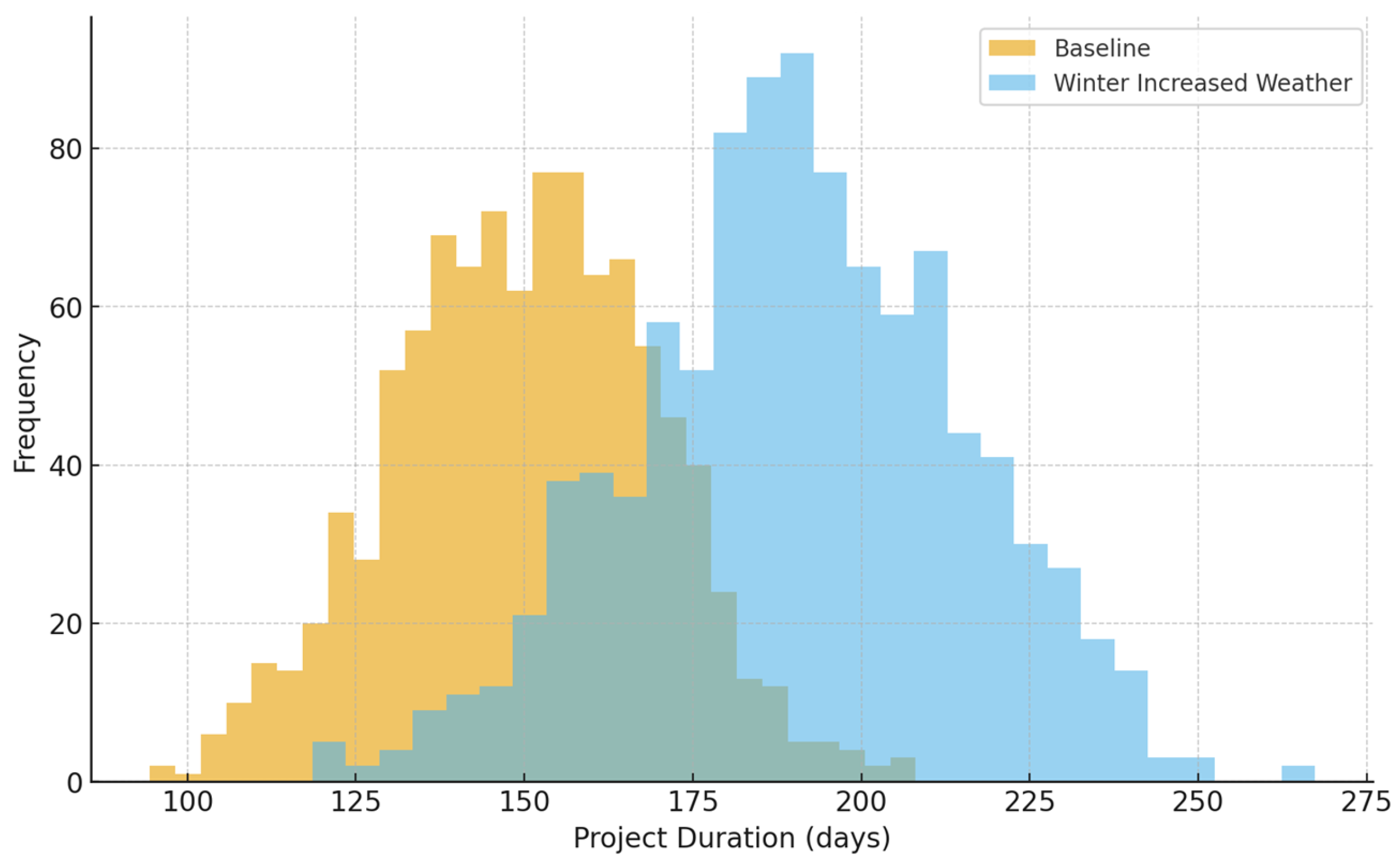
Figure A2.
Effect of staffing variation on probability of exceeding 60 days. The probability of exceeding 60 days falls from ~20% with two staff to ~8% with three staff.
References
- Drennan, I.R.; Strum, R.P.; Byers, A.; Buick, J.E.; Lin, S.; Cheskes, S.; Hu, S.; Morrison, L.J. Out-of-hospital cardiac arrest in high-rise buildings: Delays to patient care and effect on survival. CMAJ 2016, 188, 413–419. [Google Scholar] [CrossRef] [Scilit] [PubMed]
- Yan, S.; Gan, Y.; Jiang, N.; Wang, R.; Chen, Y.; Luo, Z.; Zong, Q.; Chen, S.; Lv, C. The global survival rate among adult out-of-hospital cardiac arrest patients who received cardiopulmonary resuscitation: A systematic review and meta-analysis. Crit. Care 2020, 24, 61. [Google Scholar] [CrossRef] [Scilit] [PubMed]
- Wissenberg, M.; Lippert, F.K.; Folke, F.; Weeke, P.; Hansen, C.M.; Christensen, E.F.; Jans, H.; Hansen, P.A.; Lang-Jensen, T.; Olesen, J.B.; et al. Association of national initiatives to improve cardiac arrest management with rates of bystander intervention and patient survival after out-of-hospital cardiac arrest. JAMA 2013, 310, 1377–1384. [Google Scholar] [CrossRef] [Scilit] [PubMed]
- Lyon, R.M.; Clarke, S.; Milligan, D.; Clegg, G.R. Resuscitation feedback and targeted education improves quality of pre-hospital resuscitation in Scotland. Resuscitation 2012, 83, 70–75. [Google Scholar] [CrossRef] [Scilit] [PubMed]
- Ong, M.E.; Shin, S.D.; De Souza, N.N.; Tanaka, H.; Nishiuchi, T.; Song, K.J.; Ko, P.C.; Leong, B.S.; Khunkhlai, N.; Naroo, G.Y.; et al. Outcomes for out-of-hospital cardiac arrests across 7 Asian countries: Pan-Asian Resuscitation Outcomes Study. Resuscitation 2015, 96, 100–108. [Google Scholar] [CrossRef] [Scilit] [PubMed]
- Bobrow, B.J.; Spaite, D.W.; Berg, R.A.; Stolz, U.; Sanders, A.B.; Kern, K.B.; Vadeboncoeur, T.F.; Clark, L.L.; Gallagher, J.V.; Stapczynski, J.S.; et al. Chest compression-only CPR by lay rescuers and survival from out-of-hospital cardiac arrest. JAMA 2010, 304, 1447–1454. [Google Scholar] [CrossRef] [Scilit]
- Simmons, K.M.; McIsaac, S.M.; Ohle, R. Impact of community-based interventions on out-of-hospital cardiac arrest outcomes: A systematic review and meta-analysis. Sci. Rep. 2023, 13, 10231. [Google Scholar] [CrossRef] [Scilit]
- Prost, A.; Binik, A.; Abubakar, I.; Roy, A.; De Allegri, M.; Mouchoux, C.; Dreischulte, T.; Ayles, H.; Lewis, J.J.; Osrin, D. Logistic, ethical, and political dimensions of stepped wedge trials: Critical review and case studies. BMC Med. Res. Methodol. 2015, 15, 51. [Google Scholar] [CrossRef] [Scilit] [PubMed]
- Kristunas, C.A.; Hemming, K.; Eborall, H.C.; Gray, L.J. The use of feasibility studies in stepped-wedge trials: A review. BMJ Open 2017, 7, e017290. [Google Scholar] [CrossRef] [Scilit]
- Hemming, K.; Haines, T.P.; Chilton, P.J.; Girling, A.J.; Lilford, R.J. The stepped wedge cluster randomized trial: Rationale, design, analysis, and reporting. BMJ 2015, 350, h391. [Google Scholar] [CrossRef] [Scilit] [PubMed]
- Chan, T.C.; Li, H.; Lebovic, G.; Tang, S.K.; Chan, J.Y.; Cheng, H.C.; Morrison, L.J.; Brooks, S.C. Identifying locations for public access defibrillators using mathematical optimization. Circulation 2013, 127, 1801–1809. [Google Scholar] [CrossRef] [Scilit] [PubMed]
- Fahrni, M.L.; Ismail, I.A.-N.; Refi, D.M.; Almeman, A.; Yaakob, N.C.; Saman, K.M.; Mansor, N.F.; Noordin, N.; Babar, Z.-U. Management of COVID-19 vaccines cold chain logistics: A scoping review. J. Pharm. Policy Pract. 2022, 15, 16. [Google Scholar] [CrossRef] [Scilit] [PubMed]
- Glasgow, R.E.; Vogt, T.M.; Boles, S.M. Evaluating the public health impact of health promotion interventions: The RE-AIM framework. Am. J. Public Health 1999, 89, 1322–1327. [Google Scholar] [CrossRef] [Scilit] [PubMed]
- Proctor, E.; Silmere, H.; Raghavan, R.; Hovmand, P.; Aarons, G.; Bunger, A.; Griffey, R.; Hensley, M. Outcomes for implementation research: Conceptual distinctions, measurement challenges, and research agenda. Adm. Policy Ment. Health 2011, 38, 65–76. [Google Scholar] [CrossRef] [Scilit] [PubMed]

Disclaimer/Publisher’s Note: The statements, opinions and data contained in all publications are solely those of the individual author(s) and contributor(s) and not of MDPI and/or the editor(s). MDPI and/or the editor(s) disclaim responsibility for any injury to people or property resulting from any ideas, methods, instructions or products referred to in the content. |
© 2025 by the authors. Licensee MDPI, Basel, Switzerland. This article is an open access article distributed under the terms and conditions of the Creative Commons Attribution (CC BY) license (https://creativecommons.org/licenses/by/4.0/).