
An Overview of Demand Analysis and Forecasting Algorithms for the Flow of Checked Baggage among Departing Passengers


Abstract
1. Introduction
2. The Current Research Status on Airport Baggage Demand
3. Influence Factor Analysis of the Airport Baggage Flow
3.1. Macro-Factors
3.2. Micro-Factors
4. Analysis of Methods for Forecasting Transportation Flow
4.1. Based on Mathematical and Statistical Models
4.2. Based on Intelligent Algorithmic Models
4.3. Combined Algorithm Model Based on ANN
5. Conclusions
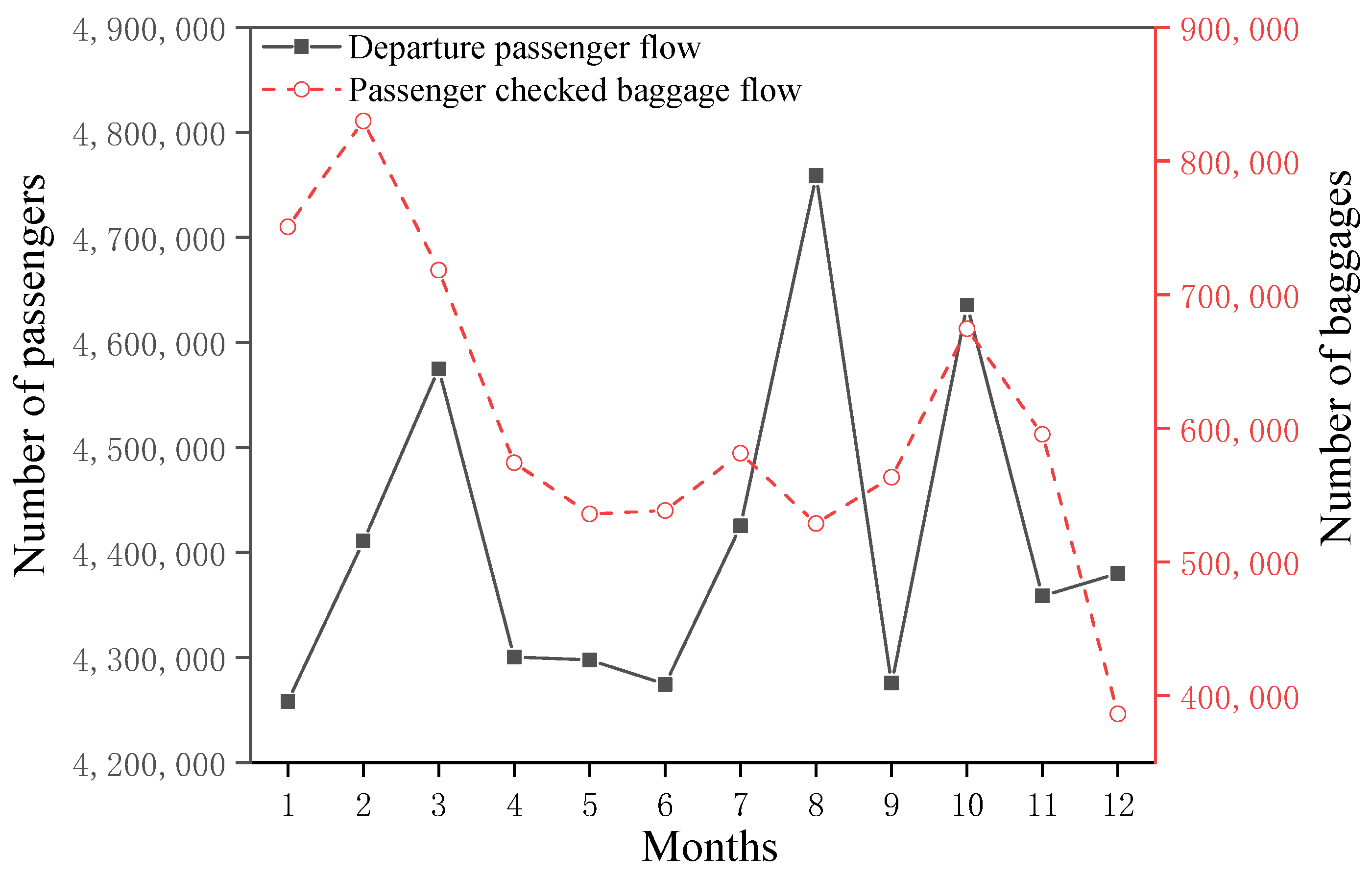
- The prediction of checked baggage flow for departing passengers at airports exhibits characteristics of nonlinearity and strong randomness. Although there exists a significant correlation between passenger flow and baggage flow, the growth in departing passenger flow at airports does not necessarily result in a proportional increase in checked baggage flow. The relationship between these two variables is nonlinear, implying that solely relying on forecasting passenger flow to predict baggage flow may overlook the inherent characteristics associated with it.
- When studying the relationship between the economy and baggage flow, GDP should not be used as a sole indicator in general. Instead, it should be comprehensively analyzed in conjunction with other economic indicators such as the total retail sales of consumer goods and value added of the tertiary sector.
- How some factors that are difficult to quantify, such as passenger psychological factors, airport service levels, checked baggage prices, and ticket discounts, affect baggage demand; and how to optimize the relevant service resources of airports based on the research results of baggage flow, including by scientifically allocating check-ins, security, and human resources for different airlines and routes, can be critical directions for future research.
- An ANN should be one of the best baggage flow prediction methods. An ANN can approximate any complex nonlinear function, which makes it more advantageous than other flow prediction methods in terms of its nonlinear mapping ability and generalization performance. At the same time, the application of the combined model based on an ANN overcomes the shortcomings of the single algorithm, forms a complementary advantage, and has huge development potential. Therefore, researchers believe that a combined model based on a neural network can solve complex time series problems such as airport baggage flow prediction.
- An ANN has a wide range of applications. In the future, the development of the ANN prediction model may move forward in the following directions: by further improving the generalization ability of the ANN prediction model; by studying the standard algorithm for the optimal number of network layers and neural nodes to establish a combined forecasting model which is more suitable for the actual demand; and by designing a light and efficient neural network structure.
Author Contributions
Funding
Conflicts of Interest
References
- Society International de Telecommunicatioan Aero-Nautiques. Baggage IT Insights in 2023. 2023. Available online: https://www.sita.aero/resources/surveys-reports/baggage-it-insights-2023/ (accessed on 3 April 2024).
- Yfantis, E.A. An Intelligent Baggage-tracking System for Airport Security. Eng. Appl. Artif. Intell. 1997, 10, 603–606. [Google Scholar] [CrossRef]
- Brunettal, L.; Romanin-Jacu, J.G.; San, N.A.S. Passenger and Baggage Flow in an Airport Terminal: A Flexible Simulation Model. J. Air Traffic Manag. 1999, 6, 361–363. [Google Scholar]
- Takakuwa, S.; Oyama, T. Modeling People Flow: Simulation Analysis of International-Departure Passenger Flows in an Airport terminal. In Proceedings of the 35th Conference on Winter Simulation: Driving Innovation, New Orleans, LA, USA, 7–10 December 2003; pp. 1627–1634. [Google Scholar]
- Zeinaly, Y.; De Schutter, B.; Hellenoorn, H. An Integrated Model Predictive Scheme for Baggage-Handling Systems: Routing, Line Balancing, and Empty-Cart Management. IEEE Trans. Control Syst. Technol. 2015, 23, 1536–1545. [Google Scholar] [CrossRef]
- Yang, Z.C. The Demand Forecasting for the Checked Baggage of the Departing Passengers the Airport Terminal. Master’s Thesis, Harbin University of Technology, Harbin, China, 2013. [Google Scholar]
- Cheng, S.; Gao, Q.; Zhang, Y. Comparative Study on Forecasting Method of Departure Flight Baggage Demand. In Proceedings of the 2014 IEEE Chinese Guidance, Navigation and Control Conference, Yantai, China, 8–10 August 2014; pp. 1600–1605. [Google Scholar]
- Meuter, R.F.; Lacherez, P.Z. When and Why Threats Go Undetected: Impacts of Event Rate and Shift Length on Threat Detection Accuracy during Airport Baggage Screening. Hum. Factors. 2015, 58, 1536–1545. [Google Scholar] [CrossRef] [PubMed]
- Li, Z.; Bi, J.; Zhang, J.; Li, Q. Analysis of Airport Departure Baggage Check-in Process Based on Passenger Behavior. In Proceedings of the 2017 10th International Symposium on Computational Intelligence and Design (ISCID), Hangzhou, China, 9–10 December 2017; pp. 204–207. [Google Scholar]
- Liu, X.; Li, L.; Liu, X.; Zhang, T.; Rong, X.; Yang, L.; Xiong, D. Field Investigation on Characteristics of Passenger Flow in a Chinese Hub Airport Terminal. Build. Environ. 2018, 133, 1536–1545. [Google Scholar] [CrossRef]
- Li, Z.Y. Forecast Research on the Demand for Checked Baggage of Eparting Passengers at the Airport Terminal Based on Data Driven. Master’s Thesis, Beijing Jiaotong University, Beijing, China, 2018. [Google Scholar]
- Xie, X.D. Study on the Forecasting of Passenger Checked Baggage Demand for Departure Flights. Master’s Thesis, Civil Aviation University of China, Tianjin, China, 2020. [Google Scholar]
- Xu, X.B.; He, X.; Li, G.F.; Yang, L.; Kan, X.W. Check-in Baggage Flow Prediction Based on Support Vector Machine Regression Algorithm. Logist. Technol. Appl. 2022, 27, 159–163. [Google Scholar]
- Gao, W.; Xiao, X.M. Prediction of Airport Passenger Throughput Based on Entropy BP Neural Network. Comput. Simul. 2021, 38, 67. [Google Scholar]
- Hong, J.; Chu, Z.F.; Wang, C.Q. Transport Infrastructure and Regional Economic Growth: Evidence from China. Transportation 2011, 38, 737–752. [Google Scholar] [CrossRef]
- Hakim, M.M.; Merkert, R. The Causal Relationship between Air Transport and Economic Growth: Empirical Evidence from South Asia. J. Transp. Geogr. 2016, 56, 120–127. [Google Scholar] [CrossRef]
- Jiao, P.P. Forecasting Method and Its Mechanism of Impacts on Airport Passenger Throughput. J. Transp. Syst. Eng. Inf. Technol. 2005, 5, 107–110. [Google Scholar]
- Silva, P.; Ribeiro, D.; Mendes, J.; Seabra, E.A.R.; Postolache, O. Railways Passengers Comfort Evaluation through Motion Parameters: A Systematic Review. Machines 2023, 11, 465–495. [Google Scholar] [CrossRef]
- Li, C.P. Analysis of the Influencing Factors of China’s Civil Aviation Passenger Volume. Sci. Technol. Ind. 2011, 11, 59–61. [Google Scholar]
- Huang, Z.; Wu, X.; Garcia, A.J.; Fik, T.J.; Tatem, A.J. An Open-Access Modeled Passenger Flow Matrix for the Global Air Network in 2010. PLoS ONE 2013, 8, e64317. [Google Scholar] [CrossRef] [PubMed]
- Zhang, Z.D.; Xu, J.H. An Analysis of Major Factors on Airport Passenger Volumes. Urban Transp. China 2007, 5, 54–57. [Google Scholar]
- Wang, J.; Mo, H.H.; Wang, F.H.; Jin, F.J. Exploring the Network Structure and Nodal Centrality of China’s Air Transport Network: A Complex Network Approach. J. Transp. Geogr. 2011, 19, 712–721. [Google Scholar] [CrossRef]
- Wang, J.; Jin, F. China’s Air Passenger Transport: An Analysis of Recent Trends. Eurasian Geogr. Econ. 2007, 48, 469–480. [Google Scholar] [CrossRef]
- Civil Aviation Administration of China. Report on Development of China Civil Aviation Transportation Industry (2007/2008). 2008. Available online: http://www.caac.gov.cn/GYMH/MHGK/ZGMH/201509/t20150923_1952.html (accessed on 25 February 2023).
- Liu, S.; Wan, Y.; Ha, H.K. Impact of High-speed Rail Network Development on Airport Traffic and Traffic Distribution: Evidence from China and Japan. Transp. Res. Part A Policy Pract. 2019, 127, 115–135. [Google Scholar] [CrossRef]
- Zuidberg, J. Exploring the Determinants for Airport Profitability: Traffic Characteristics, Low-cost Carriers, Seasonality and Cost Efficiency. Transp. Res. Part A Policy Pract. 2017, 101, 61–72. [Google Scholar] [CrossRef]
- Strand, S. Airport-specific Traffic Forecasts: The Resultant of Local and Non-Local Forces. J. Transp. Geogr. 1999, 7, 17–29. [Google Scholar] [CrossRef]
- Zhu, F.; Bao, J.G. A Study on the Conceptual Model of the Influential Elements if Throughput of Tourism Airport. Hum. Geogr. 2010, 25, 128–133. [Google Scholar]
- Zhong, X.; Zhu, C.Y.; Han, X. The Prediction Model Based on BP Neural Network About Airport Security Check Passenger Flow. Adv. Aeronaut. Sci. Eng. 2019, 10, 655–663. [Google Scholar]
- Laña, I.; Lobo, J.L.; Capecci, E.; Ser, J.D.; Kasabov, N. Adaptive Long-Term Traffic State Estimation with Evolving Spiking Neural. Transp. Res. Part C Emerg. Technol. 2019, 101, 126–144. [Google Scholar] [CrossRef]
- Vlahogianni, E.I.; Karlaftis, M.G.; Golias, J.C. Short-Term Traffic Forecasting: Where We are and Where We’re Going. Transp. Res. Part C Emerg. Technol. 2014, 43, 3–19. [Google Scholar] [CrossRef]
- Lana, J.; Velez, M.; Vlahogianni, E.I. Road Traffic Forecasting: Recent Advances and New Challenges. IEEE Intell. Transp. Syst. Mag. 2018, 10, 93–109. [Google Scholar] [CrossRef]
- Feng, B.; Li, Y.; Liu, H. Tying Mechanism for Airlines’ air Cargo Capacity Allocation. Eur. J. Oper. Res. 2015, 224, 322–330. [Google Scholar] [CrossRef]
- Chen, Z.; Ma, M.; Li, T.; Wang, H.; Li, C. Long. Sequence Time-Series Forecasting with Deep Learning: A Survey. Inf. Fusion 2023, 97, 101819. [Google Scholar] [CrossRef]
- Anilkumar, L.J. Time Series Analysis of Airline Passengers. Available online: https://rstudio-pubs-static.s3.amazonaws.com/782060_9f7c2afb62bd4de28c0774cf4ded2658.html (accessed on 1 April 2024).
- Chandra, S.R.; Al-Deek, H. Cross-Correlation Analysis and Multivariate Prediction of Spatial Time Series of Freeway Traffic Speeds. Transp. Res. Rec. 2008, 2089, 64–76. [Google Scholar] [CrossRef]
- Wang, C.; Li, D.; Zhang, Y. Application of Dynamic Improved Grey Model in Airport Throughput Prediction. Comput. Simul. 2019, 36, 74–77. [Google Scholar]
- Okutani, I.; Stephanedes, Y.J. Dynamic Prediction of Traffic Volume through Kalman Filtering Theory. Transp. Res. Part B Methodol. 1984, 18, 1–11. [Google Scholar] [CrossRef]
- Chen, F.; Jia, Y.; An, W. Research of Short-Term Traffic Flow Forecast Method Based on the Kalman Filter. In Proceedings of the 11th International Conference of Chinese Transportation Professionals (ICCTP), Nanjing, China, 14–17 August 2011; pp. 960–968. [Google Scholar]
- Cao, Y.; Zhao, J.; Qu, X.; Wang, X.; Liu, B. Prediction of Abrasive Belt Wear Based on BP Neural Network. Machines 2002, 9, 314–332. [Google Scholar] [CrossRef]
- Filipovska, M.; Mahmassani, H.S. Traffic Flow Breakdown Prediction using Machine Learning Approaches. Transp. Res. Rec. J. Transp. Res. Board. 2020, 2674, 560–570. [Google Scholar] [CrossRef]
- Liu, H.; Li, B.; Liu, C.; Zu, M.; Lin, M. Research on Yield Prediction Technology for Aerospace Engine Production Lines Based on Convolutional Neural Networks-Improved Support Vector Regression. Machines 2023, 11, 875–897. [Google Scholar] [CrossRef]
- Hess, S.; Polak, J.W. Mixed Logit Modelling of Airport Choice in Multi-airport Regions. J. Air Transp. Manag. 2005, 11, 59–68. [Google Scholar] [CrossRef]
- Grosche, T.; Roth, F.; Heinzl, A. Gravity Models for Airline Passenger Volume Estimation. J. Air Transp. Manag. 2007, 13, 175–183. [Google Scholar] [CrossRef]
- Zhang, L.F.; Bian, T. Forecast of Large Airport Access Mode Choice Based on Nested Logit Model. In Proceedings of the COTA International Conference of Transportation Professionals, Shanghai, China, 7–9 July 2017; pp. 4391–5120. [Google Scholar]
- Wang, X.M.; Zhang, N.; Yun, Y.L.; Shi, Z.B. Forecasting of Short-Term Metro Ridership with Support Vector Machine Online Model. J. Adv. Transp. 2018, 2018, 3189238. [Google Scholar] [CrossRef]
- Hou, Y.; Edarap, P.; Sun, C. Traffic Flow Forecasting for Urban Work Zones. IEEE Trans. Intell. Transp. Syst. 2015, 16, 1761–1770. [Google Scholar] [CrossRef]
- Bas, E.; Egrioglu, E. A Fuzzy Regression Functions Approach Based on Gustafson-Kessel Clustering Algorithm. Inf. Sci. 2022, 592, 206–214. [Google Scholar] [CrossRef]
- Yang, L.; Liu, J.; Ye, F.; Wang, Y.; Nugent, C.; Wang, H.; Martinez, L. Highly Explainable Cumulative Belief Rule-Based System with Effective Rule-Base Modeling and Inference Scheme. Knowl.-Based Syst. 2022, 240, 107805. [Google Scholar] [CrossRef]
- Zhou, Z.J.; Hu, C.H.; Yang, D.L.X.J.B.; Zhou, D.H. New Model for System Behavior Prediction Based on Belief Rule Based Systems. Inf. Sci. 2010, 180, 4834–4864. [Google Scholar] [CrossRef]
- Song, S.; Xiong, X.; Wu, X.; Xue, Z. Modeling the SOFC by BP Neural Network Algorithm. Int. J. Hydrogen Energy 2017, 46, 20065–20077. [Google Scholar] [CrossRef]
- Mcculloch, W.S.; Pitts, W.H. A Logical Calculus of Ideas Immanent in Nervous Activity. Bull. Math. Biophys. 1942, 5, 115–133. [Google Scholar] [CrossRef]
- Krizhevsky, A.; Sutskever, I.; Hinton, G.E. ImageNet Classification with Deep Convolutional Neural Networks. Commun. ACM 2017, 60, 84–90. [Google Scholar] [CrossRef]
- Haque, M.U.; Dharmadasa, I.; Sworna, Z.T.; Rajapakse, R.N.; Ahmad, H. “I think this is the most disruptive technology”: Exploring Sentiments of ChatGPT Early Adopters Using Twitter Data. arXiv 2022, arXiv:2212.05856. [Google Scholar]
- Liu, H.; Tian, H.Q.; Li, Y.F.; Zhang, L. Comparison of Four AdaBoost Algorithm Based Artificial Neural Networks in Wind Speed Predictions. Energy Convers. Manag. 2015, 92, 67–81. [Google Scholar] [CrossRef]
- Chen, X.W.; Zhu, W.Y.; Qian, X.M.; Luo, T.; Sun, G.; Liu, Q.; Li, X.B. Estimation of Surface Layer Optical Turbulence Using Artificial Neural Network. Acta Opt. Sin. 2020, 40, 15–21. [Google Scholar]
- Athreya, R.G.; Bansal, S.; Ngomo, A.C.N. Template-based Question Answering using Recursive Neural Networks. In Proceedings of the 2021 IEEE 15th International Conference on Semantic Computing (ICSC), Laguna Hills, CA, USA, 27–29 January 2020; pp. 1–19. [Google Scholar]
- Hocheiter, S.; Schmidhuber, J. Long Short-Term Memory. Neural Comput. 1997, 9, 1735–1780. [Google Scholar] [CrossRef]
- Ling, J.; Liu, G.J.; Li, J.L.; Shen, X.C.; You, D.D. Fault Prediction Method for Nuclear Power Machinery Based on Bayesian PPCA Recurrent Neural Network Model. Nucl. Sci. Tech. 2020, 31, 8–11. [Google Scholar] [CrossRef]
- Hu, Q.H.; Souzal, L.F.F.; Holanda, G.B.; Alves, S.S.; Reboucas Filho, P.P. An Effective Approach for CT Lung Segmentation Using Mask Region-Based Convolutional Neural Networks. Artif. Intell. Med. 2020, 103, 101792. [Google Scholar] [CrossRef]
- Shi, M.; Cai, S.W.; Yi, Q.M. A Traffic Congestion Prediction Model Based on Dilated-Dense Network. J. Shanghai Jiaotong Univ. 2021, 55, 124–130. [Google Scholar]
- Yang, S.; Chen, L.F.; Shi, Y.; Mao, M. Semantic Segmentation of Blue-green Algae Based on Deep Generative Adversarial Net. J. Comput. Appl. 2018, 38, 1554–1561. [Google Scholar]
- Utku, A.; Kaya, S.K. New Deep Learning-Based Passenger Flow Prediction Model. Transp. Res. Rec. J. Transp. Res. Board 2023, 2677, 1–17. [Google Scholar] [CrossRef]
- Yang, D.; Chen, K.R.; Yang, M.N.; Zhao, X.C. Urban Rail Transit Passenger Flow Forecast Based on LSTM with Enhanced Long-Term Features. IET Intell. Transp. Syst. 2019, 13, 1475–1482. [Google Scholar] [CrossRef]
- Huang, T.T.; Yu, L. Application of SDAE-LSTM Model on Financial Time Series Forecasting. Comput. Eng. Appl. 2019, 55, 142–148. [Google Scholar]
- Vlahogianni, E.I.; Karlaftis, M.G. Testing and Comparing Neural Network and Statistical Approaches for Predicting Transportation Time Series. Transp. Res. Rec. J. Transp. Res. Board 2013, 2399, 9–22. [Google Scholar] [CrossRef]
- Sang, B. Application of Genetic Algorithm and BP Neural Network in Supply China Finance under Information Sharing. J. Comput. Appl. Math. 2020, 384, 113–170. [Google Scholar]
- Chen, M.Q.; Feng, J.H. Research of Air Traffic Flow Forecasts Based on BP Neural Network. Adv. Mater. Res. 2022, 671–674, 2912–2915. [Google Scholar] [CrossRef]
- Lou, J.; Li, W. Forecasting Model for the Scale of New-Built Airport Logistics Demand Based on the Back Propagation Artificial Neural Network. In Proceedings of the 2010 International Conference on E-Product E-Service and E-Entertainment, Henan, China, 7–9 November 2010; pp. 3021–3027. [Google Scholar]
- Luo, W.H.; Dong, B.T.; Wang, Z.J. Short-Term Traffic Flow Prediction Based on CNN-SVR Hybrid Deep Learning Model. J. Transp. Syst. Eng. Inf. Technol. 2017, 17, 68–74. [Google Scholar]
- Liu, Y.H. Network Flow Prediction Based on Principal Component Analysis and BP Neural Network. Laser J. 2015, 36, 151–153. [Google Scholar]
- Guo, S.; Lin, Y.; Feng, N.; Song, C.; Wang, H. Attention Based Spatial-Temporal Graph Convolutional Networks for Traffic Flow Forecasting. In Proceedings of the Thirty-Third AAAI Conference on Artificial Intelligence, Honolulu, HI, USA, 27 January–1 February 2019; pp. 922–929. [Google Scholar]
- Jiang, J.; Zhang, J.X. Improved ACO-Optimized BP Neural Network for Short-Term Traffic Flow Prediction. Comput. Simul. 2021, 38, 99–101. [Google Scholar]
- Hui, Y.; Wang, Y.G.; Peng, H.; Hou, S.Q. Subway Passenger Flow Prediction Based on Optimized PSO-BP Algorithm with Coupled Spatial-temporal Characteristics. J. Traffic Transp. Eng. 2021, 21, 210–222. [Google Scholar]
- Deng, S.; Jia, S.; Chen, J. Exploring Spatial–Temporal Relations via Deep Convolutional Neural Networks for Traffic Flow Prediction with Incomplete Data. Appl. Soft Comput. 2019, 78, 714–721. [Google Scholar] [CrossRef]
- Ji, X.F.; Ge, Y.C. Holiday Highway Traffic Flow Prediction Method Based on Deep Learning. J. Syst. Simul. 2020, 32, 1164–1171. [Google Scholar]



| Macro-Factors | Micro-Factors | Other Factors |
|---|---|---|
| Regional GDP | Passenger flow | Airport service quality |
| Total retail sales of consumer goods | Number of flights/air lines | Passengers’ psychological factors |
| Regional industrial structure | Different types of dates (weekdays or non-workdays, and periods like summer and winter vacations, etc.) | Purpose of passenger travel |
| Regional population | Different date types | Airfare costs and discount strength |
| Tourist resources | International/Domestic flight | |
| Other modes of transport (highway transport, railway transport, adjacent airports, etc.) | Visa policies | |
| Income of the population | Weather conditions |
| Model Category | Algorithm Name | Advantages | Disadvantages | Application Example |
|---|---|---|---|---|
| Mathematical statistics model | ARIMA | The model is simple, malleable, and transplantable. | It is required that the time series data are stable, sensitive to data, and the nonlinear problem is not solved effectively. | Time series problems such as traffic flow prediction. |
| GM | Better prediction accuracy for problems with short time period and small amount of data. | Unable to be used as a long-term forecasting tool as the calculation is very cumbersome. | Time series problems such as traffic flow prediction. | |
| KF | High prediction accuracy and strong nonlinear processing ability. | The model is complex, sensitive to data, and requires a large amount of calculation | Traffic flow prediction, image recognition, etc. | |
| Intelligent algorithm model | NLM | Structure of the model is simple, and has good characteristics of time transfer and regional transfer. | The mathematical foundation is weak, the structural rigor of the model is insufficient, and the error of the collective calculation results is large. | Flow forecasting, spatial pattern research, etc. |
| SVM | Binary classification algorithm, applicable to both linear and nonlinear problems, and has advantages for high-dimensional data. | It is difficult to determine the parameters of kernel function, and the multiclassification problem is not well solved. | Traffic flow prediction, image recognition, etc. | |
| DT | The algorithm is simple and has advantages in dealing with missing attribute samples. | Easy to overfit. | Traffic flow prediction, classification, and other issues. | |
| ANN | It has good nonlinear mapping ability, learning ability, self-organization ability, and self-adaptive ability. | Easy to overfit. | Traffic flow prediction, image recognition, condition monitoring, etc. | |
| Combined algorithm model | Combined algorithm model based on ANN | High prediction accuracy and low calculation time. | Traffic flow prediction, image recognition, condition monitoring, etc. |
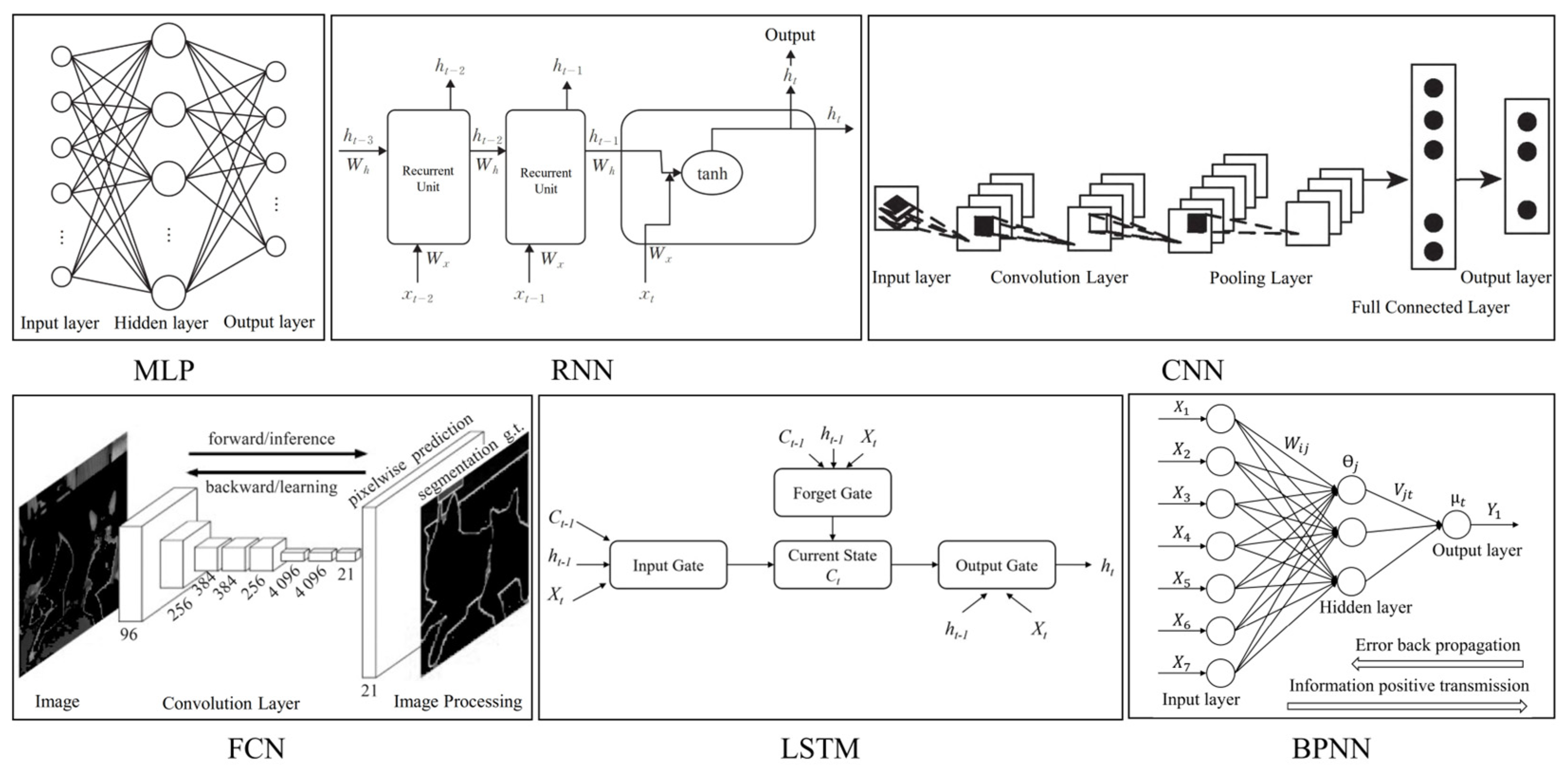
| Algorithm Name | Structural Features | Advantages | Disadvantages | Application Example |
|---|---|---|---|---|
| MLP | A fully connected neural network, based on back-propagation algorithm. | Excellent nonlinear mapping capability, high parallelism. | Insufficient generalization ability and poor processing of multidimensional data. | Pattern recognition, etc. |
| RNN | The hidden layer node output value depends on the current node output and the previous node value. | Strong ability to extract temporal features and relatively good generalization ability. | The long-term dependence of processing accuracy will decrease. | Automatic speech recognition, fault detection, time series problems such as traffic flow prediction, etc. |
| CNN | The convolutional layer and pooling layer are alternately set, convolution kernel feature extraction, sparse connection, weight sharing. | Self-learning for feature extraction and classification with high recognition rate. | It requires a large training data set and high computer performance. | Image recognition, condition monitoring, etc. |
| FCN | The full connection of neurons is replaced by convolution stacking. | It can accept input data of any size with high segmentation accuracy. | The model complexity can be very large when large size convolution kernels are required. | Image processing, video processing, etc. |
| LSTM | It is composed of input gate, forget door, and output gate, and the information dissemination process can selectively abandon useless information. | It can make better use of the time characteristics of the data center and has good robustness. | It requires a large training data set, is sensitive to data, and has a slow convergence speed. | Time series problems such as traffic flow prediction. |
| BPNN | Forward transfer of information, reverse transfer of errors, based on back-propagation algorithm. | Strong nonlinear mapping ability and flexible network structure, fast convergence speed, and can more fully map the relationship between data. | For highly nonlinear problems, it is easy to fall into local minimum rather than global minimum. | Time series problems such as traffic flow prediction. |
Disclaimer/Publisher’s Note: The statements, opinions and data contained in all publications are solely those of the individual author(s) and contributor(s) and not of MDPI and/or the editor(s). MDPI and/or the editor(s) disclaim responsibility for any injury to people or property resulting from any ideas, methods, instructions or products referred to in the content. |
© 2024 by the authors. Licensee MDPI, Basel, Switzerland. This article is an open access article distributed under the terms and conditions of the Creative Commons Attribution (CC BY) license (https://creativecommons.org/licenses/by/4.0/).
Share and Cite
Jiang, B.; Ding, G.; Fu, J.; Zhang, J.; Zhang, Y. An Overview of Demand Analysis and Forecasting Algorithms for the Flow of Checked Baggage among Departing Passengers. Algorithms 2024, 17, 173. https://doi.org/10.3390/a17050173
Jiang B, Ding G, Fu J, Zhang J, Zhang Y. An Overview of Demand Analysis and Forecasting Algorithms for the Flow of Checked Baggage among Departing Passengers. Algorithms. 2024; 17(5):173. https://doi.org/10.3390/a17050173
Chicago/Turabian StyleJiang, Bo, Guofu Ding, Jianlin Fu, Jian Zhang, and Yong Zhang. 2024. "An Overview of Demand Analysis and Forecasting Algorithms for the Flow of Checked Baggage among Departing Passengers" Algorithms 17, no. 5: 173. https://doi.org/10.3390/a17050173
APA StyleJiang, B., Ding, G., Fu, J., Zhang, J., & Zhang, Y. (2024). An Overview of Demand Analysis and Forecasting Algorithms for the Flow of Checked Baggage among Departing Passengers. Algorithms, 17(5), 173. https://doi.org/10.3390/a17050173