Comparative Analysis of the Application of Five-, Seven- and Nine-Roll Sheet Straightening Using Numerical Tools

 ,
,  ,
,  , ,
, ,
Abstract
1. Introduction
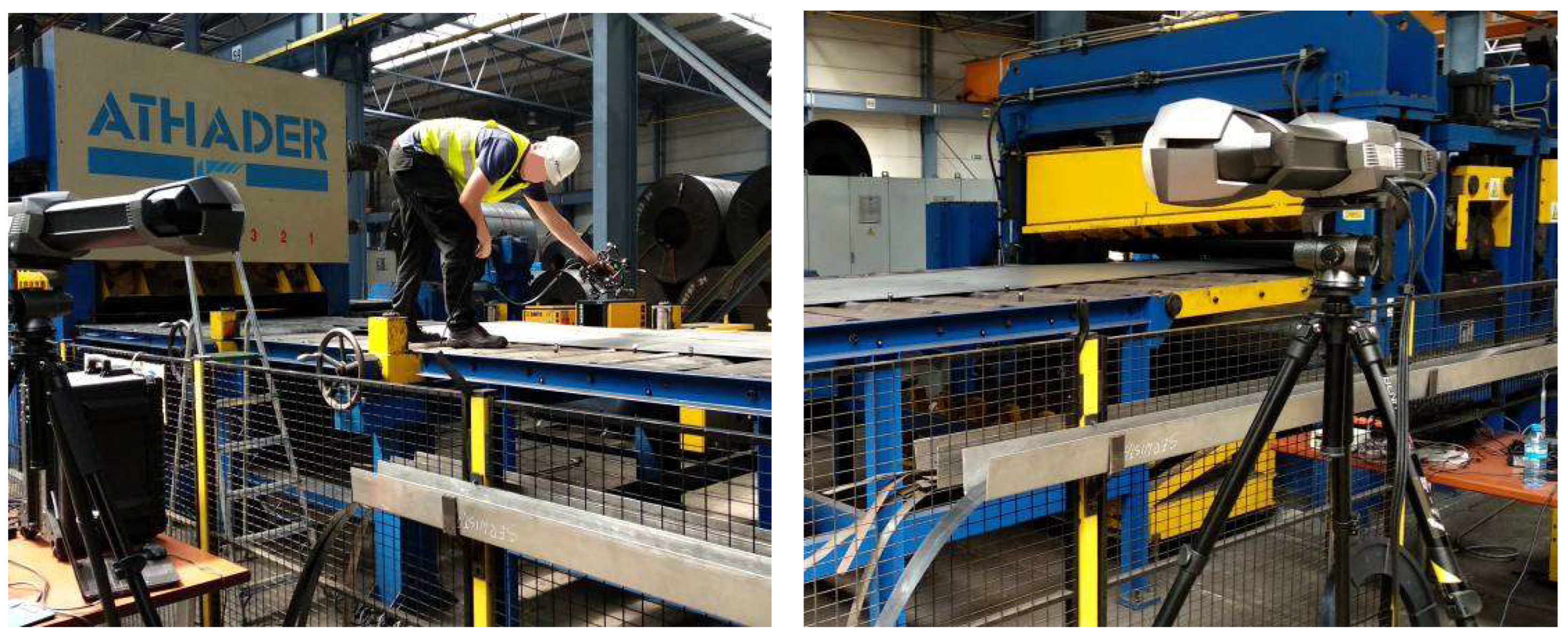
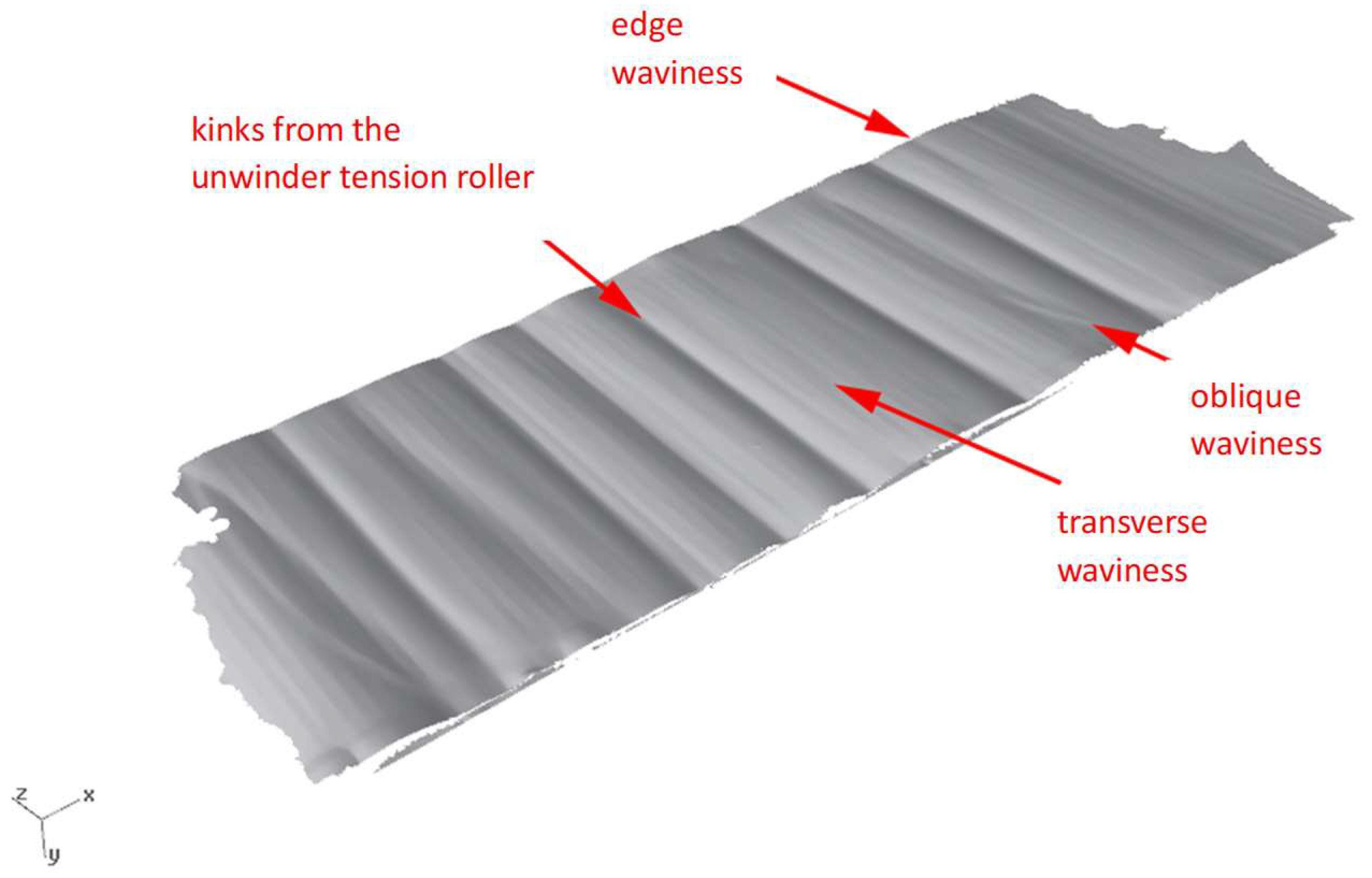
2. Research Material and Preliminary Tests
3. Validation of the Mathematical Model of the Material Database
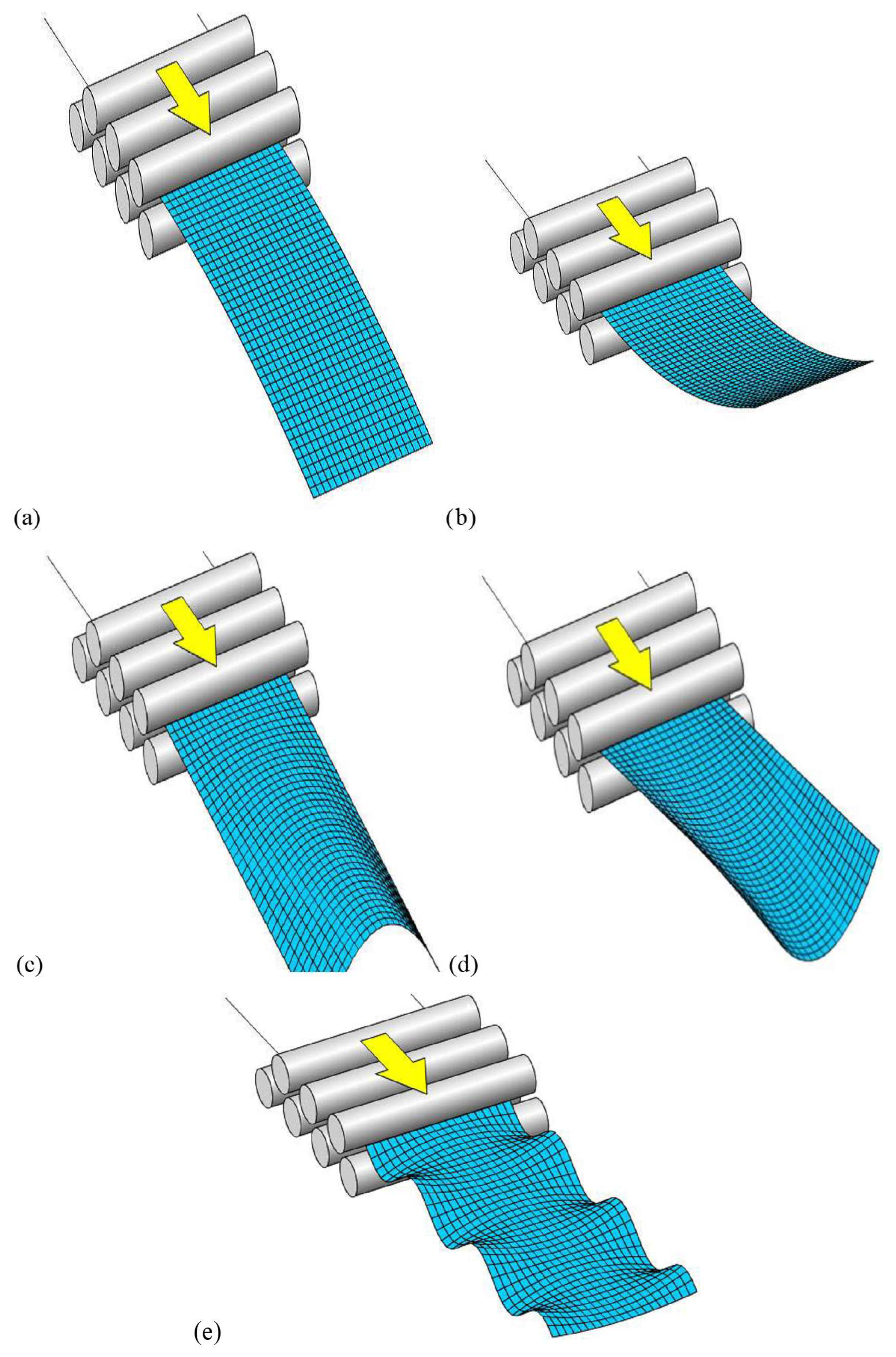
4. Numerical Analysis of Sheet Straightening in a Roll Straightener
5. Conclusions
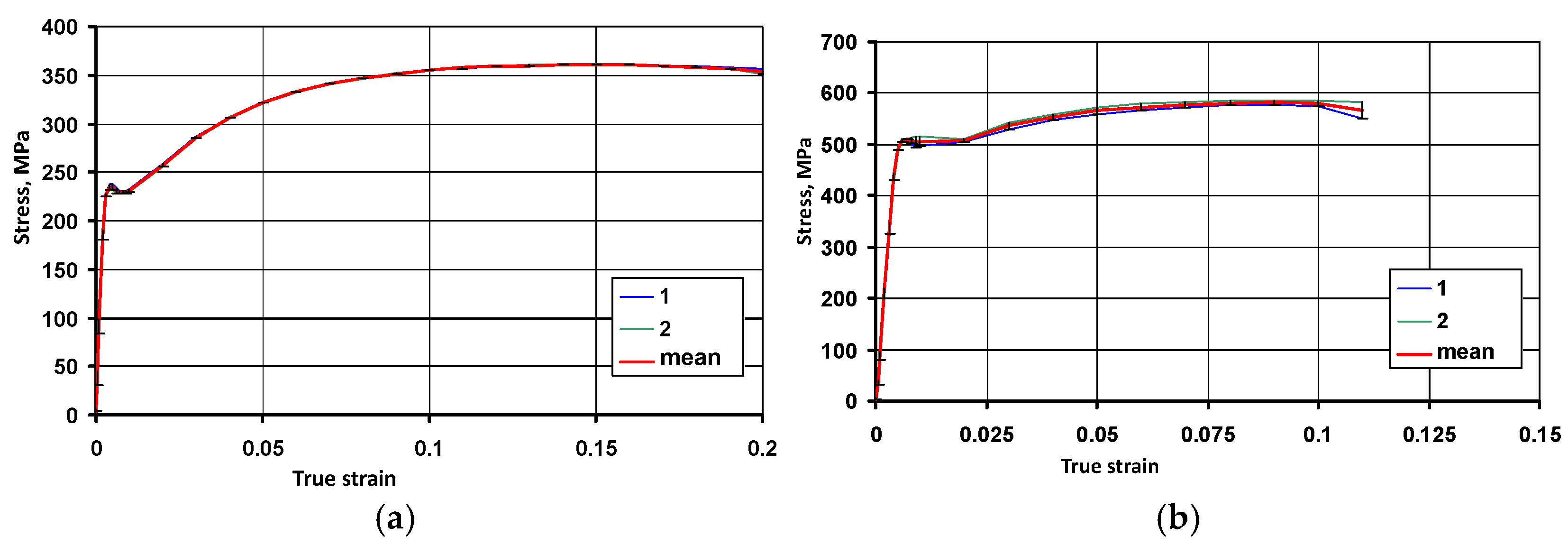
- The anisotropy of the examined sheets, determined both by hardness measurements and static tensile tests, is evident. Therefore, for proper numerical analyses, it is essential to average the real material properties based on the obtained data.
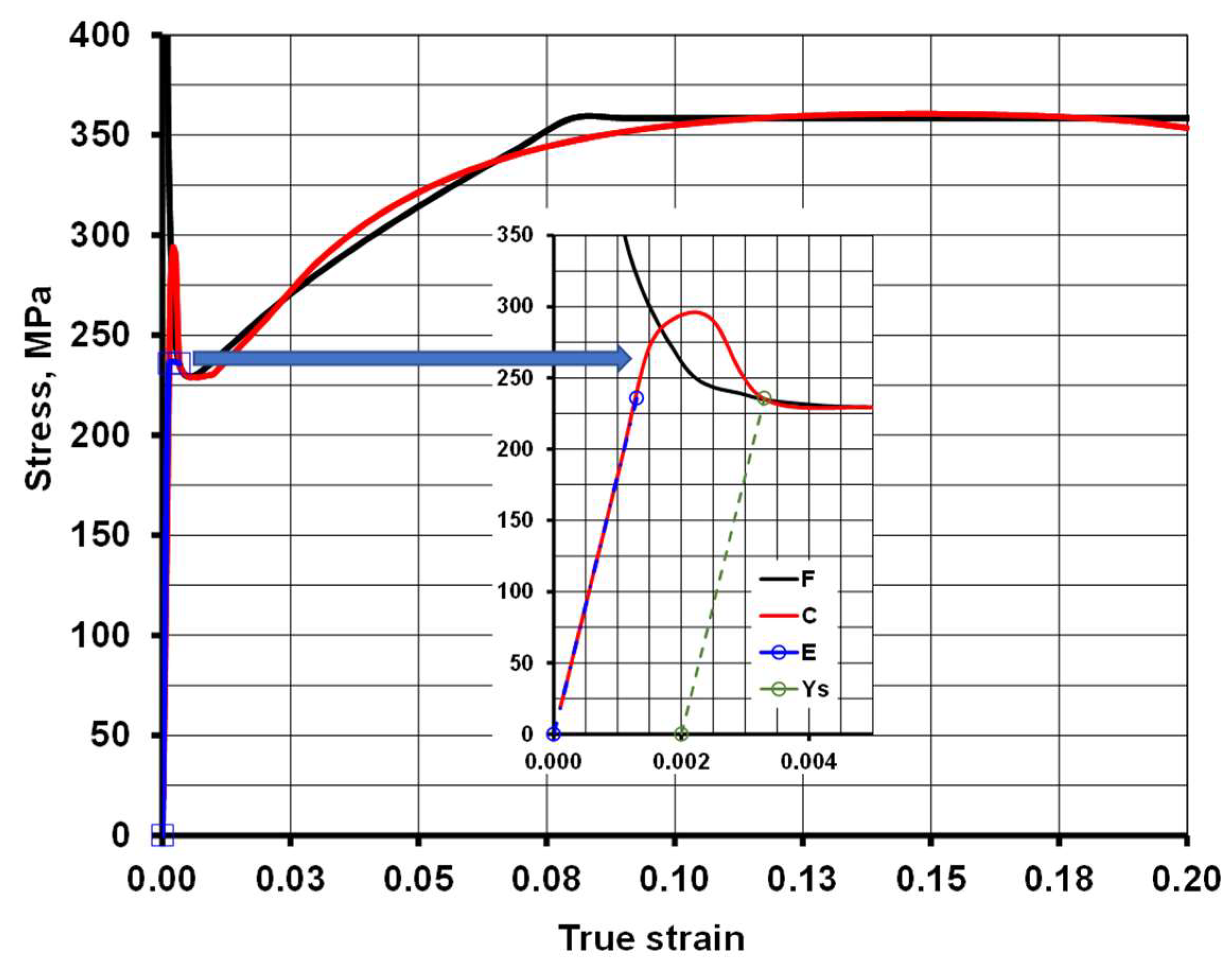
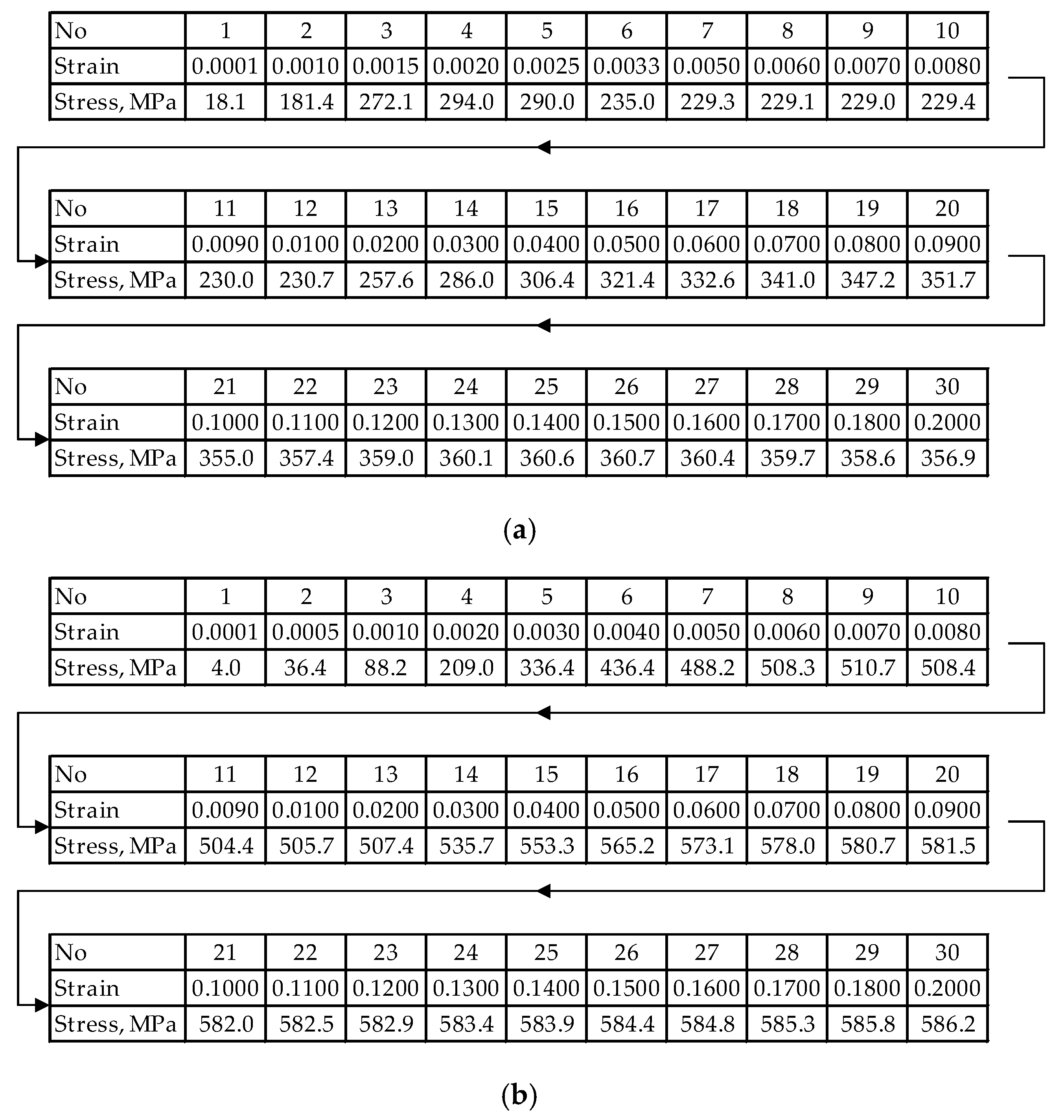
- To perform computer simulations with higher computational accuracy, it was necessary to transition from a material model based on the flow curve equation to a tabular form of data.
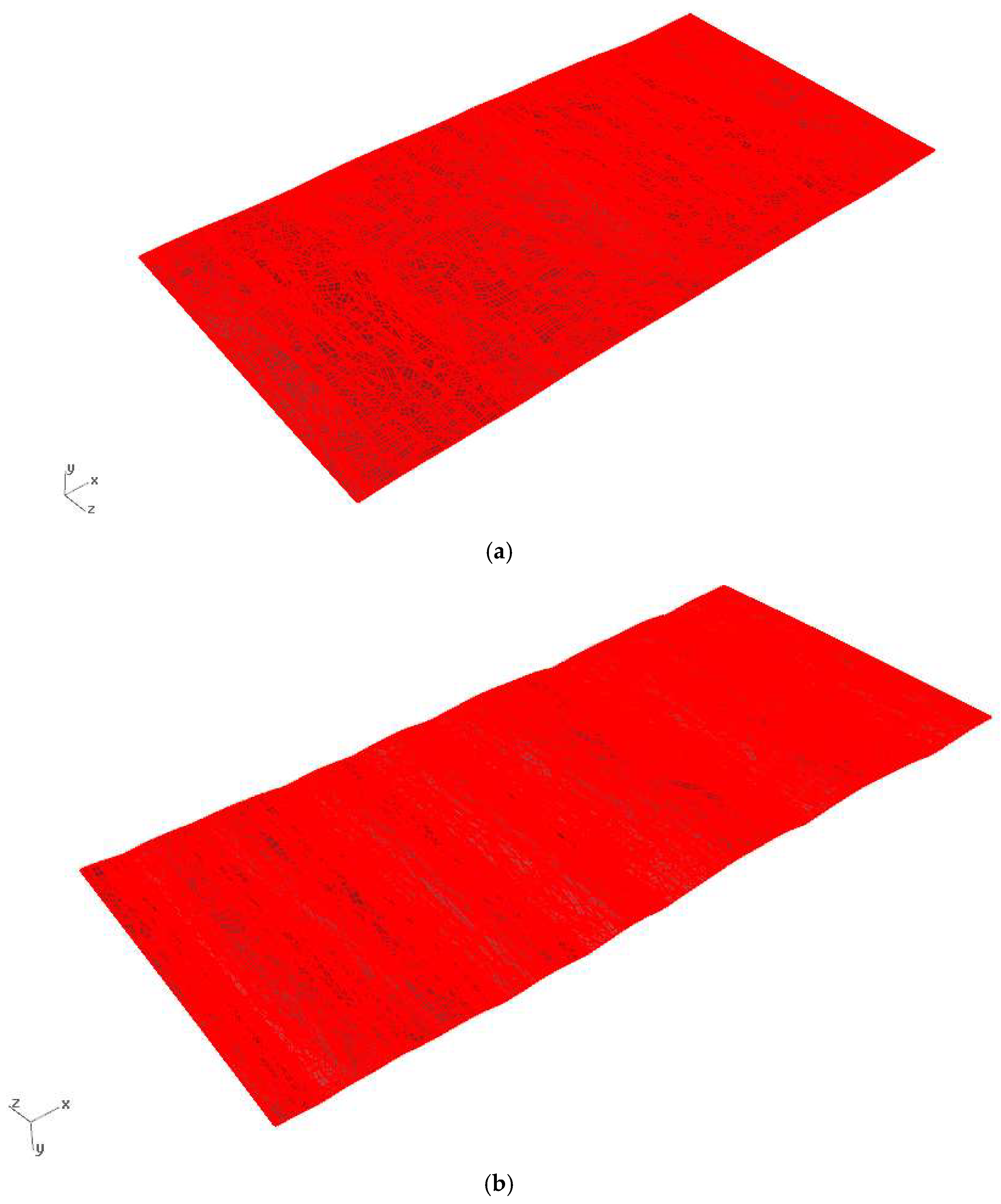
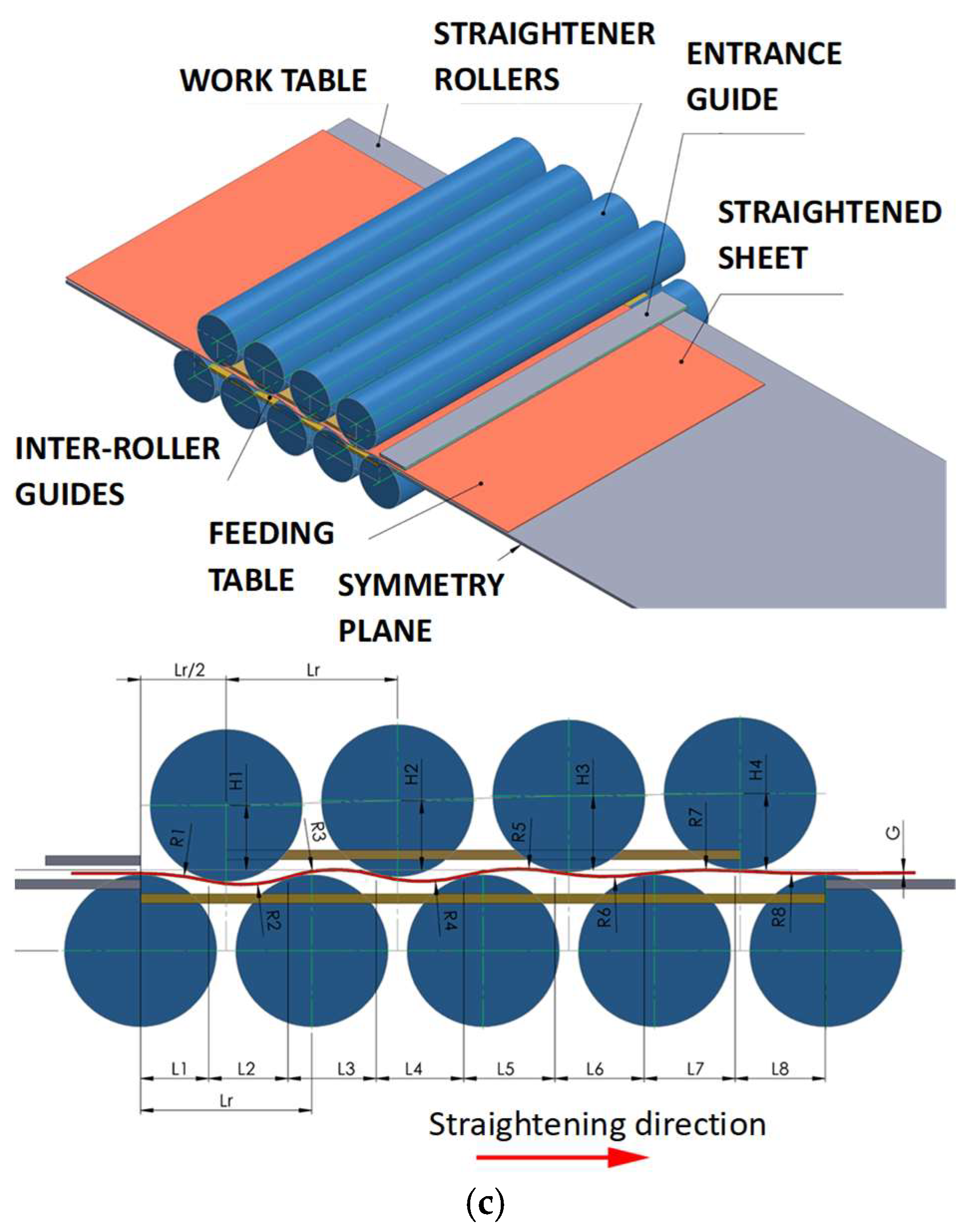
- The incorporation of real sheet geometries, correlated with actual anisotropy properties, allowed for a high degree of accuracy in the obtained research results.
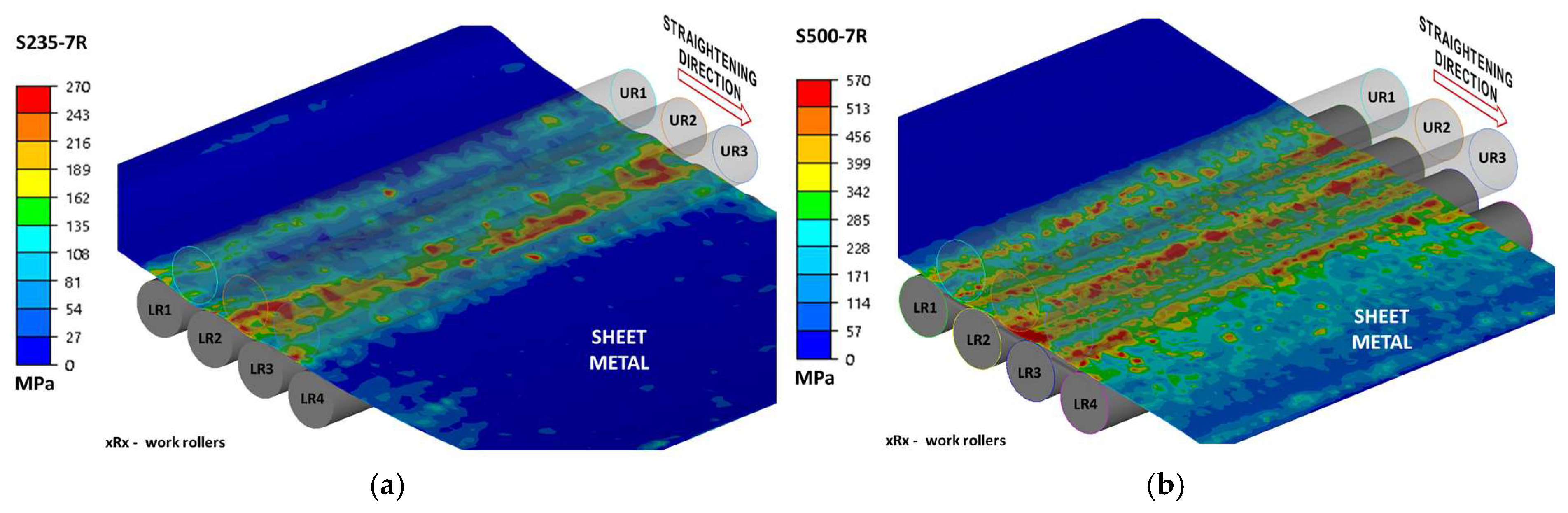
- In the case of the nine-roll straightener, plastic deformations are distributed over the first seven rolls; total deformations reach their highest and most intense values (as a sum of elastic and plastic strains), and then decrease sharply in the last two rolls, where the sheet is deformed only within the elastic range.
- On the base of numerical simulation it can be stated that use of a nine-roll configuration has a positive effect on the sheet straightening capability.
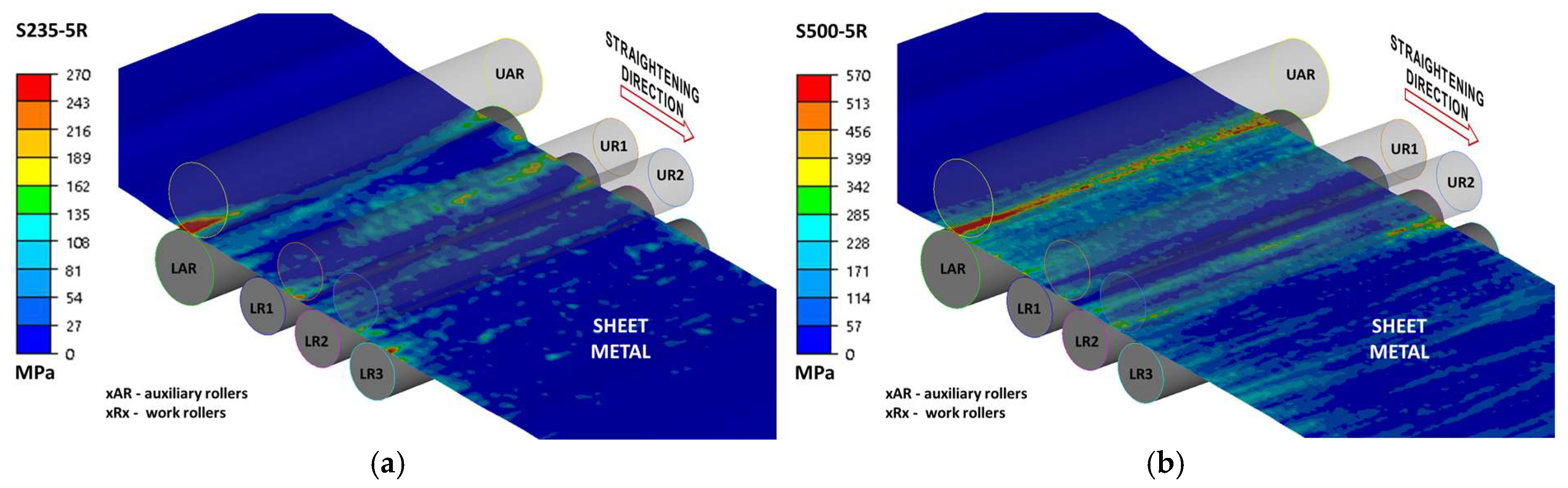
- The proprietary method of analyzing the state of internal stresses enables a quick and rough assessment that can be applied in industrial conditions.
- The measurements of real materials showed some differences between the tested steel grades and confirmed that the use of a nine-roll straightening system significantly reduces the stress on the material.
Author Contributions
Funding
Data Availability Statement
Conflicts of Interest
References
- Hidveghy, J.; Michel, J.; Bursak, M. Residual Stress in Microaloyed Steel Sheet. Metalurgija 2003, 42, 103–106. [Google Scholar]
- Abvabi, A. Effect of Residual Stresses in Roll Forming Process of Metal Sheets. Ph.D. Thesis, Deakin University, Melbourne, Australia, 2014. [Google Scholar]
- Alhalaybeh, T.S.; Akhtar, H.; Chowdhury, A.I.; Lou, Y. Anisotropic Hardening of HC420 Steel Sheet: Experiments and Analytical Modeling. Metals 2025, 15, 149. [Google Scholar] [CrossRef]
- Mróz, S.; Szota, P.; Garstka, T.; Stradomski, G.; Gróbarczyk, J.; Gryczkowski, R. The Selection of Leveler Parameters Using FEM Simulation. Materials 2024, 17, 52. [Google Scholar] [CrossRef] [PubMed]
- Garstka, T.; Szota, P.; Mróz, S.; Stradomski, G.; Gróbarczyk, J.; Gryczkowski, R. Calibration Method of Measuring Heads for Testing Residual Stresses in Sheet Metal Using the Barkhausen Method. Materials 2024, 17, 4584. [Google Scholar] [CrossRef]
- Jeon, Y.; Jeong, K.; Kim, G.-h.; Yoon, J. 1.5 GPa Grade High-Strength Steel Sheet Flattening by Roll Gap Adjustment Considering Pattern Roll Effects. Materials 2025, 18, 1702. [Google Scholar] [CrossRef] [PubMed]
- Available online: https://www.arku.com/pl/blog/jak-wyeliminowac-defekty-w-blasze (accessed on 19 September 2025).
- Dömling, F.; Paysan, F.; Breitbarth, E. Numerical Simulations of Stress Intensity Factors and Fatigue Life in L-Shaped Sheet Profiles. Metals 2024, 14, 1463. [Google Scholar] [CrossRef]
- Mroziński, S.; Golański, G.; Jagielska-Wiaderek, K.; Szarek, A. Impact of Microstructural Anisotropy on the Low-Cycle Fatigue of S420M Steel. Materials 2025, 18, 2365. [Google Scholar] [CrossRef]
- Roh, Y.-H.; Lee, D.; Lee, S.-E.; Kim, S.-G.; Lee, Y. Development and Validation of a Large Strain Flow Curve Model for High-Silicon Steel to Predict Roll Forces in Cold Rolling. Machines 2025, 13, 243. [Google Scholar] [CrossRef]
- Perzynski, K.; Pyzynski, K.; Swierczynski, S.; Pidvysots’kyy, V.; Klis, J.; Madej, L. Influence of the roll leveler setup parameters on the quality of high-strength steel leveling operation. Int. J. Adv. Manuf. Technol. 2022, 120, 1203–1217. [Google Scholar] [CrossRef]
- Liu, Z.; Luo, Y.; Wang, Y.; Liao, T.W. A new curvature analytical method in plate leveling process. ISIJ Int. 2018, 58, 1094–1101. [Google Scholar] [CrossRef][Green Version]
- Smith, R.P. The effect of the number of leveling rolls on the straightening process. Iron Steel Technol. 2007, 4, 57–68. [Google Scholar]
- Keecheol, P.; Kyungsuk, O. Effect of the Leveling Conditions on Residual Stress Evolution of Hot Rolled High Strength Steels for Cold Forming. J. Phys. Conf. Ser. 2017, 896, 012117. [Google Scholar]
- Brautigam, H.; Becker, S. Leveling with Roller Levelers; ARKU Maschinenbau GmbH: Baden-Baden, Germany, 2009. [Google Scholar]
- Zhao, J.; Wang, X.; Yang, Q.; Wang, Q.; Wang, Y.; Li, W. Mechanism of lateral metal flow on residual stress distribution during hot strip rolling. J. Mater. Process. Technol. 2021, 288, 116838. [Google Scholar] [CrossRef]
- Hu, Q.; Zhang, F.; Li, X.; Chen, J. Overview on the Prediction Models for Sheet Metal Forming Failure: Necking and Ductile Fracture. Acta Mech. Solida Sin. 2018, 31, 259–289. [Google Scholar] [CrossRef]
- Cazacu, O. New Yield Criteria for Isotropic and Textured Metallic Materials. Int. J. Solids Struct. 2018, 139–140, 200–210. [Google Scholar] [CrossRef]
- Richard, P.; Smith, J. Modeling Plastic Strain During Cold Leveling of Steel Plates. In Proceedings of the AISE Annual Conference, Pittsburgh, PA, USA, 10–12 May 1999. [Google Scholar]
- Gruber, M.; Hirt, G. A strategy for the controlled setting of flatness and residual stress distribution in sheet metals via roller leveling. Proc. Eng. 2017, 207, 1332–1337. [Google Scholar] [CrossRef]
- Behrens, B.-A.; El Nadi, T.; Krimm, R. Development of an analytical 3D-simulation model of the levelling process. J. Mater. Process. Technol. 2011, 211, 1060–1068. [Google Scholar] [CrossRef]
- Widmark, M.; Melander, A.; Meurling, F. Low cycle constant amplitude fully reversed strain-controlled testing of low carbon and stainless sheet steels for simulation of straightening operations. Int. J. Fatigue 2000, 22, 307–317. [Google Scholar] [CrossRef]
- Pietrzyk, M.; Madej, L.; Rauch, L.; Szeliga, D. Computational Materials Engineering; Elsevier: Amsterdam, The Netherlands, 2015. [Google Scholar] [CrossRef]
- Frederick, C.O.; Armstrong, P.J. A mathematical representation of the multiaxial Bauschinger effect. Mater. High Temp. 2007, 24, 1–26. [Google Scholar] [CrossRef]
- Lee, J.-B.; Kang, S.-S. Numerical modeling of roller leveler for thick plate leveling. Int. J. Precis. Eng. Manuf. 2018, 19, 425–430. [Google Scholar] [CrossRef]
- Wiewiórowska, S.; Siemiński, M.; Śleboda, T.; Dyl, T.; Koczurkiewicz, B. Determination of Two-Stage Heat Treatment Parameters in Industrial Conditions in Order to Obtain a TRIP Structure in Low-Alloy Carbon Steel Wires. Materials 2022, 15, 8965. [Google Scholar] [CrossRef]
- Rydz, D.; Dyja, H.; Berski, S. The prediction of curvature of bimetallic plate Al-Cu during asymmetrical cold rolling. Metalurgija 2003, 42, 261–264. [Google Scholar]
- Stradomski, G.; Gzik, S.; Jakubus, A.; Nadolski, M. The assessment of resistance to thermal fatigue and thermal shock of cast iron used for glass moulds. Arch. Foundry Eng. 2018, 18, 173–178. [Google Scholar] [CrossRef]
- Dyl, T.; Starosta, R.; Rydz, D.; Koczurkiewicz, B.; Kusmierska-Matyszczak, W. The experimental and numerical research for plastic working of nickel matrix composite coatings. Materials 2020, 13, 3177. [Google Scholar] [CrossRef]
- Dyl, T.; Rydz, D.; Szarek, A.; Stradomski, G.; Fik, J.; Opydo, M. The Influence of Slide Burnishing on the Technological Quality of X2CrNiMo17-12-2 Steel. Materials 2024, 17, 3403. [Google Scholar] [CrossRef]
- Garstka, T.; Dyl, T. Circumferential residual stresses in tubes estimated by means of deflection method. Arch. Metall. Mater. 2006, 2, 199–203. [Google Scholar]
- Dembiczak, T.; Knapiński, M. Shaping microstructure and mechanical properties of high-carbon bainitic steel in hot-rolling and long-term low-temperature annealing. Materials 2021, 14, 384. [Google Scholar] [CrossRef]
- Schindler, I.; Kawulok, R.; Opela, P.; Kawulok, P.; Rusz, S.; Sojka, J.; Sauer, M.; Navrátil, H.; Pindor, L. Effects of austenitization temperature and pre-deformation on CCT diagrams of 23MnNiCrMo5-3 steel. Materials 2020, 13, 5116. [Google Scholar] [CrossRef]
- Dyl, T.; Starosta, R. Effect of the Ceramic Dispersion in the Nickel Matrix Composite Coatings on Corrosion Properties after Plastic Working. Solid State Phenom. 2012, 183, 43–48. [Google Scholar] [CrossRef]
- Dyl, T.C.; Kuśmierska-Matyszczak, W. The Effect of the Burnishing Process on the Strain Rate and State Stress in Hollow Steel Tubes. Metals 2025, 15, 694. [Google Scholar] [CrossRef]
- Stradomski, G.; Rydz, D.; Dyja, H. Bimetal plate St3S + Cu. Metalurgija 2005, 44, 147–150. [Google Scholar]
- Transvalor, S.A. FORGE® Reference Guide Release; Parc de Haute Technologie: Sophia–Antipolis, France, 2024; Available online: https://www.transvalor.com/en/forge (accessed on 20 October 2025).
- Banaszek, G.; Stefanik, A. Theoretical and laboratory modelling of the closure of metallurgical defects during forming of a forging. J. Mater. Process. Technol. 2006, 177, 238–242. [Google Scholar] [CrossRef]
- Hartley, P.; Pillinger, I. Numerical simulation of the forging process. Comput. Methods Appl. Mech. Eng. 2006, 195, 6676–6690. [Google Scholar] [CrossRef]
- Chen, K.; Yang, Y.; Shao, G.; Liu, K. Strain function analysis method for void closure in the forging process of the large−sized steel ingot. Comput. Master. Sci. 2012, 51, 72–77. [Google Scholar] [CrossRef]
- Goh, C.-H.; Dachowicz, A.P.; Allen, J.K.; Mistree, F. A Computational Method for the Design of Materials Accounting for the Process–Structure–Property–Performance (PSPP) Relationship. In Integrated Computational Materials Engineering (ICME) for Metals; Horstemeyer, M.F., Ed.; John Wiley & Sons, Inc.: Hoboken, NJ, USA, 2018. [Google Scholar] [CrossRef]
- Norton, F.H. Creep of Steel at High Temperature; McGraw Hill: New York, NY, USA, 1929. [Google Scholar]
- Hoff, N.J. Approximate Analysis of Structures in the Presence of Moderately Large Steps Deformation. Quart. Appl. Mech. 1954, 12, 49–55. [Google Scholar]
- Trzepieciński, T. A Study of the Coefficient of Friction in Steel Sheets Forming. Metals 2019, 9, 988. [Google Scholar] [CrossRef]








| C | Si | Mn | P | S | Al | Fe | |
|---|---|---|---|---|---|---|---|
| S235JR + AR | 0.22 | 0.05 | 1.62 | 0.052 | 0.048 | 0.014 | ball. |
| S500MC | 0.11 | 0.45 | 1.55 | 0.021 | 0.010 | 0.012 | ball. |
| Steel Grade | Sample Designation | Sampling Location |
|---|---|---|
| S235JR + AR | 1 (b,m,e) | middle |
| 1_1 (b,m,e) | edge | |
| S500MC/3 | 2 (b,m,e) | middle |
| 2_1 (b,m,e) | edge |
| Des. | 1 | 2 | 3 | 4 | 5 | Mean | Std. Dev. | % Difference |
|---|---|---|---|---|---|---|---|---|
| 1b | 127.7 | 128.8 | 128.9 | 127.8 | 128.5 | 128.3 | 0.56 | |
| 1_1b | 135.5 | 136.7 | 135.2 | 133.4 | 131.4 | 134.4 | 2.07 | 4.75 |
| 2b | 229.8 | 226.4 | 226.3 | 229.4 | 227.1 | 227.8 | 1.68 | |
| 2_1b | 232.9 | 235.7 | 234.5 | 237.6 | 233.9 | 234.9 | 1.81 | 3.13 |
| 1m | 126.3 | 127.2 | 127.9 | 128.5 | 129.7 | 127.9 | 1.29 | |
| 1_1m | 132.1 | 131.0 | 132.4 | 134.2 | 132.1 | 132.4 | 1.16 | 3.47 |
| 2m | 228.9 | 225.3 | 226.5 | 224.7 | 225.1 | 226.1 | 1.70 | |
| 2_1m | 229.6 | 230.1 | 231.2 | 234.6 | 237.9 | 232.7 | 3.51 | 2.91 |
| 1e | 128.7 | 127.8 | 128.9 | 128.5 | 129.7 | 128.7 | 0.69 | |
| 1_1e | 142.1 | 144.2 | 142.8 | 138.0 | 139.0 | 141.2 | 2.62 | 9.71 |
| 2e | 231.8 | 234.4 | 233.4 | 236.1 | 234.1 | 234.0 | 1.56 | |
| 2_1e | 239.9 | 238.7 | 237.9 | 238.5 | 239.4 | 238.9 | 0.78 | 2.10 |
| Average Across Width | Difference, % | |||||
|---|---|---|---|---|---|---|
| Beginning of coil | ||||||
| Edge 1 | Center | Edge 2 | ||||
| Ys, MPa | 238 | 227 | 248 | 237.7 | 8.5 | |
| UTS, MPa | 364 | 353 | 375 | 364 | 5.9 | |
| Middle of coil | ||||||
| Edge 1 | Center | Edge 2 | ||||
| Ys, MPa | 231 | 226 | 234 | 230.3 | 3.4 | |
| UTS, MPa | 353 | 351 | 352 | 352.0 | 0.3 | |
| End of coil | ||||||
| Edge 1 | Center | Edge 2 | ||||
| Ys, MPa | 237 | 230 | 244 | 237.0 | 5.7 | |
| UTS, MPa | 365 | 346 | 381 | 364.0 | 9.2 | |
| Average along coil length | Ys, MPa | 235 | 228 | 242 | 235.0 | 5.9 |
| UTS, MPa | 361 | 350 | 369 | 360.0 | 5.1 | |
| Ys, % | 0.3 | 2.0 | 1.6 | |||
| UTS, % | 0.3 | 2.0 | 6.1 | |||
| Average Across Width | Difference, % | |||||
|---|---|---|---|---|---|---|
| Beginning of coil | ||||||
| Edge 1 | Center | Edge 2 | ||||
| Ys, MPa | 364 | 353 | 375 | 364.0 | 5.9 | |
| UTS, MPa | 520 | 499 | 535 | 518.0 | 6.7 | |
| Middle of coil | ||||||
| Edge 1 | Center | Edge 2 | ||||
| Ys, MPa | 353 | 351 | 352 | 352.0 | 0.3 | |
| UTS, MPa | 510 | 500 | 506 | 505.3 | 1.2 | |
| End of coil | ||||||
| Edge 1 | Center | Edge 2 | ||||
| Ys, MPa | 365 | 346 | 381 | 364.0 | 9.2 | |
| UTS, MPa | 506 | 489 | 516 | 503.7 | 5.2 | |
| Average along coil length | Ys, MPa | 360.7 | 350.0 | 369.3 | 360.0 | 5.1 |
| UTS, MPa | 512.0 | 496.0 | 519.0 | 509.0 | 4.4 | |
| Ys, % | 0.3 | 2.0 | 1.6 | |||
| UTS, % | 3.0 | 2.0 | 6.1 | |||
| Steel Grade | Conventional Yield Strength Ys, MPa | Tensile Strength UTS, MPa | Young’s Modulus E, GPa | Maximum Absolute Error Δ, MPa | Maximum Relative Error δ, % |
|---|---|---|---|---|---|
| S235JR + AR | 234 | 360 | 181 | ±8.25 | 2.29 |
| S500MC | 509 | 582 | 169 | ±10.63 | 1.83 |
| Steel Grade | K | m1 | m2 | m3 |
|---|---|---|---|---|
| S235JR + AR | 483 | 0.18 | 0.001 | 1.8 |
| S500MC | 787 | 0.12 | 0.001 | 0.01 |
| Steel Grade | Sheet Thickness, mm | Sheet Width, mm | Average Waviness Height, mm | Waviness Wavelength, mm | |
|---|---|---|---|---|---|
| Center of the Coil | End of the Coil | ||||
| S235JR + AR | 3 | 1500 | 15.2 | 21.5 | Irregular |
| S500MC | 3 | 1500 | 29.7 | 34.8 | Irregular |
| Steel Grade | Tensile Force F0.2 kN Experiment | Tensile Force F0.2 kN FEM Table | Tensile Force F0.2 kN FEM Function | Difference Experiment/FEM Table % | Difference Experiment/FEM Function % |
|---|---|---|---|---|---|
| S235JR + AR | 13.964 | 13.903 | 12.389 | −0.4 | −4.2 |
| S500MC | 30.170 | 29.866 | 26.238 | −1.0 | −2.7 |
| S235 | Straightening | Roll | Sum | Upper Rolls Settings | ||||||||||
| 1 | 2 | 3 | 4 | 5 | 6 | 7 | 8 | UR1 | UP2 | UP3 | UP4 | |||
| Strain | 5 | 0.0029 | 0.0066 | 0.0057 | 0.0042 | x | x | x | x | 0.0193 | 12.5 | 1.0 | x | x |
| Stress | 5 | 231.70 | 252.97 | 248.99 | 241.25 | x | x | x | x | |||||
| Strain | 7 | 0.0025 | 0.0063 | 0.0073 | 0.0074 | 0.0065 | 0.0056 | x | x | 0.0356 | 6.0 | 3.5 | 1.0 | x |
| Stress | 7 | 227.73 | 251.71 | 255.99 | 256.17 | 252.83 | 248.68 | x | x | |||||
| Strain | 9 | 0.0016 | 0.0043 | 0.0057 | 0.0062 | 0.0062 | 0.0060 | 0.0055 | 0.0050 | 0.0403 | 4.0 | 3.0 | 2.0 | 1.0 |
| Stress | 9 | 217.29 | 241.66 | 248.99 | 251.54 | 251.33 | 250.31 | 248.02 | 245.45 | |||||
| S500MC | Straightening | Roll | Sum | Upper Rolls Settings | ||||||||||
| 1 | 2 | 3 | 4 | 5 | 6 | 7 | 8 | UR1 | UP2 | UP3 | UP4 | |||
| Strain | 5 | 0.0033 | 0.0071 | 0.0063 | 0.0052 | x | x | x | x | 0.0219 | 13.0 | 2.5 | x | x |
| Stress | 5 | 501.06 | 517.00 | 514.57 | 510.42 | x | x | x | x | |||||
| Strain | 7 | 0.0027 | 0.0067 | 0.0077 | 0.0075 | 0.0071 | 0.0067 | x | x | 0.0385 | 6.5 | 3.5 | 2.5 | x |
| Stress | 7 | 454.44 | 515.82 | 518.44 | 518.13 | 516.97 | 515.82 | x | x | |||||
| Strain | 9 | 0.0020 | 0.0053 | 0.0068 | 0.0074 | 0.0072 | 0.0068 | 0.0064 | 0.0061 | 0.0479 | 5.0 | 4.0 | 2.5 | 2.0 |
| Stress | 9 | 340.76 | 510.85 | 516.08 | 517.76 | 517.04 | 515.86 | 514.63 | 513.61 | |||||
| Grade | Measurement Direction | Deflection Value, mm | Mean | |||||||||
|---|---|---|---|---|---|---|---|---|---|---|---|---|
| 1 | 2 | 3 | 4 | 5 | 6 | 7 | 8 | 9 | 10 | |||
| S235JR | Along the straightening | 1.82 | 1.15 | 0.95 | 1.23 | 1.06 | 0.86 | 1.32 | 1.26 | 1.46 | 1.48 | 1.26 |
| Across straightening | 0.78 | 0.71 | 0.63 | 0.51 | 0.49 | 0.49 | 0.41 | 0.53 | 0.54 | 0.76 | 0.59 | |
| S500MC | Along the straightening | 1.55 | 1.89 | 1.21 | 1.47 | 1.51 | 1.41 | 1.74 | 1.41 | 1.63 | 1.27 | 1.51 |
| Across straightening | 0.99 | 0.84 | 0.72 | 0.68 | 0.79 | 0.57 | 0.71 | 0.73 | 0.81 | 0.61 | 0.75 | |
Disclaimer/Publisher’s Note: The statements, opinions and data contained in all publications are solely those of the individual author(s) and contributor(s) and not of MDPI and/or the editor(s). MDPI and/or the editor(s) disclaim responsibility for any injury to people or property resulting from any ideas, methods, instructions or products referred to in the content. |
© 2026 by the authors. Licensee MDPI, Basel, Switzerland. This article is an open access article distributed under the terms and conditions of the Creative Commons Attribution (CC BY) license.
Share and Cite
Stradomski, G.; Mróz, S.; Szota, P.; Garstka, T.; Gróbarczyk, J.; Gryczkowski, R. Comparative Analysis of the Application of Five-, Seven- and Nine-Roll Sheet Straightening Using Numerical Tools. Materials 2026, 19, 1053. https://doi.org/10.3390/ma19061053
Stradomski G, Mróz S, Szota P, Garstka T, Gróbarczyk J, Gryczkowski R. Comparative Analysis of the Application of Five-, Seven- and Nine-Roll Sheet Straightening Using Numerical Tools. Materials. 2026; 19(6):1053. https://doi.org/10.3390/ma19061053
Chicago/Turabian StyleStradomski, Grzegorz, Sebastian Mróz, Piotr Szota, Tomasz Garstka, Jakub Gróbarczyk, and Radosław Gryczkowski. 2026. "Comparative Analysis of the Application of Five-, Seven- and Nine-Roll Sheet Straightening Using Numerical Tools" Materials 19, no. 6: 1053. https://doi.org/10.3390/ma19061053
APA StyleStradomski, G., Mróz, S., Szota, P., Garstka, T., Gróbarczyk, J., & Gryczkowski, R. (2026). Comparative Analysis of the Application of Five-, Seven- and Nine-Roll Sheet Straightening Using Numerical Tools. Materials, 19(6), 1053. https://doi.org/10.3390/ma19061053