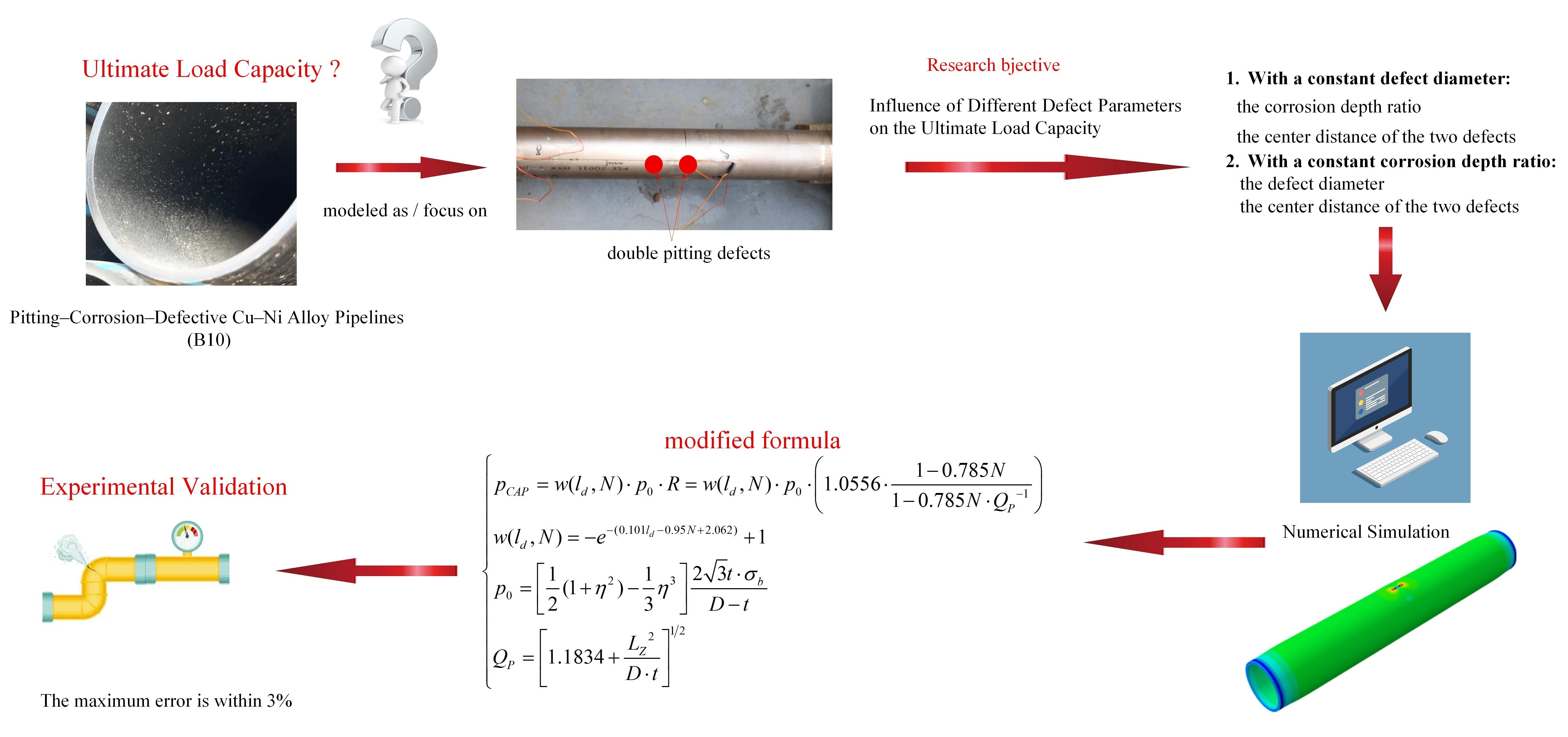
Study on the Ultimate Load Capacity of Cu-Ni Alloy Pipelines with Double Pitting Defects


Abstract
1. Introduction
- (1)
- Determining the critical axial/circumferential spacing between double defects beyond which their interaction ceases and the load capacity converges to that of a single defect of equivalent size. This defines the minimum non-interaction distance.
- (2)
- Establishing a quantitative mathematical model that characterizes the reduction in ultimate load capacity as a function of the center-to-center distance within the interaction zone, where mutual interference between defects is significant.
2. Materials and Research Methods
2.1. Test Materials
2.2. Research Methods
2.2.1. Simulation Method
2.2.2. Test Method
3. Results and Discussion
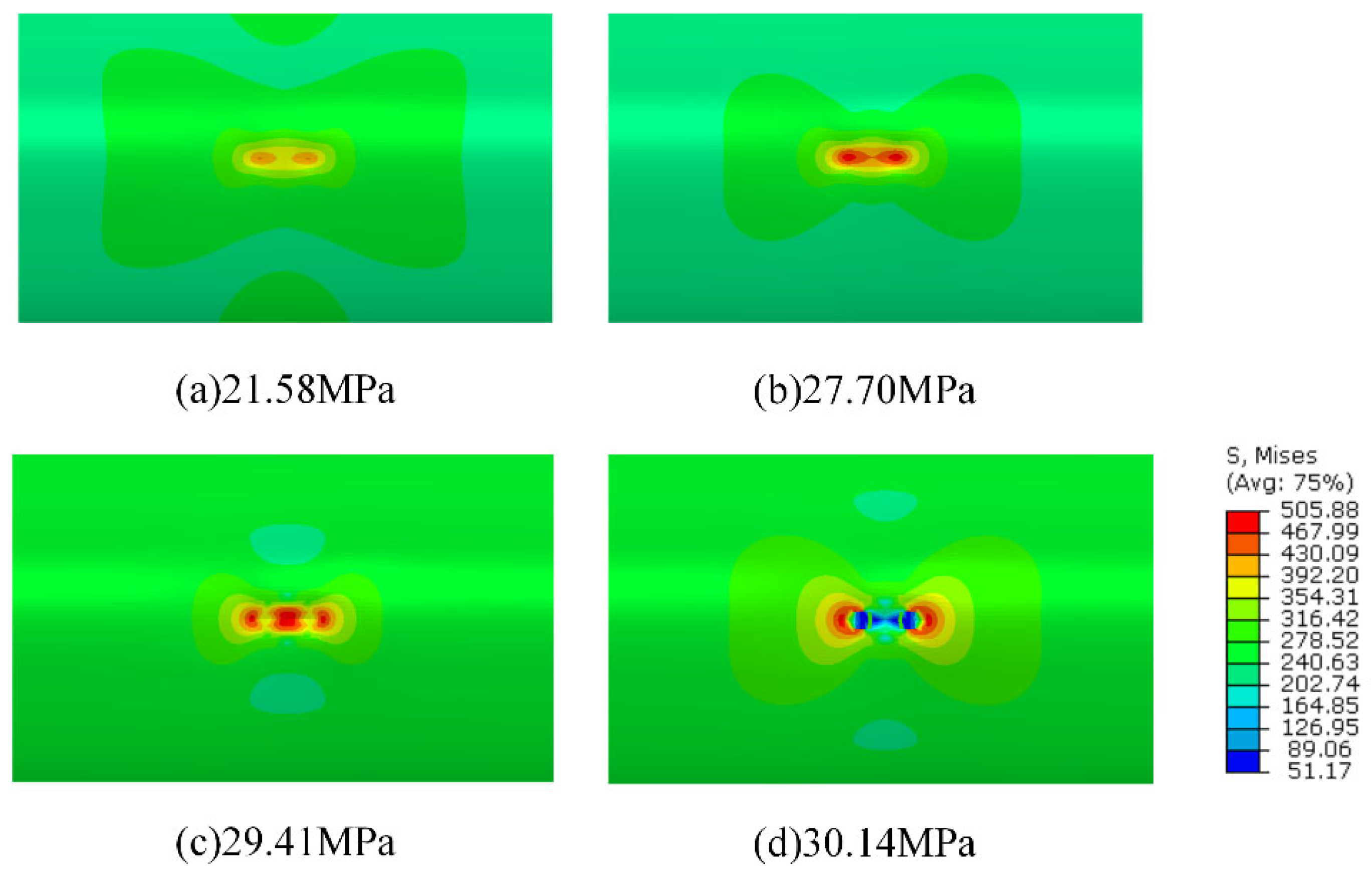
3.1. Finite Element Simulation of Failure Characteristics in Seawater Pipelines with Double Pitting Defects
3.2. Influence of Defect Parameters on the Ultimate Load Capacity
3.2.1. Influence of Defect Parameters on the Ultimate Load Capacity Under Constant Corrosion Diameter
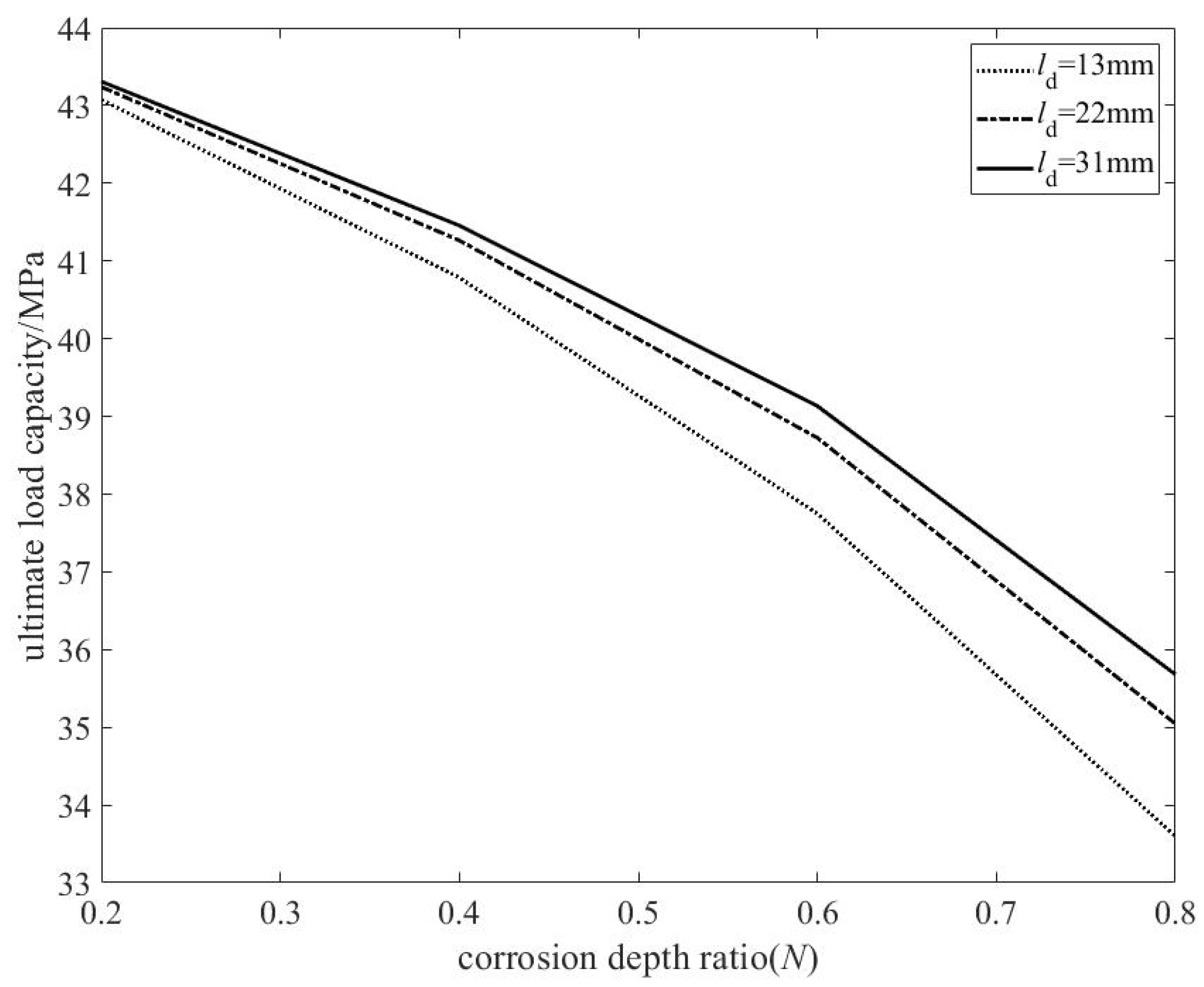
- ① Overall trend: The ultimate load capacity exhibits a significant negative correlation with the defect depth ratio N. As N increases from 0.2 to 0.8, the ultimate load capacity decreases by approximately 10 MPa (about a 20% reduction), indicating that material loss has a decisive impact on bearing capacity.
- ② Nonlinear acceleration effect: The slope of the curve increases noticeably with higher N values, demonstrating a nonlinear amplification effect of defect depth. When N < 0.4, the reduction in bearing capacity is gradual (approximately 0.5 MPa decrease per 0.1 increase in depth ratio). However, when N > 0.5, the decline accelerates sharply (exceeding 1 MPa decrease per 0.1 increase in depth ratio). This suggests that the structure enters a sensitive instability range once the defect depth exceeds half of the wall thickness.
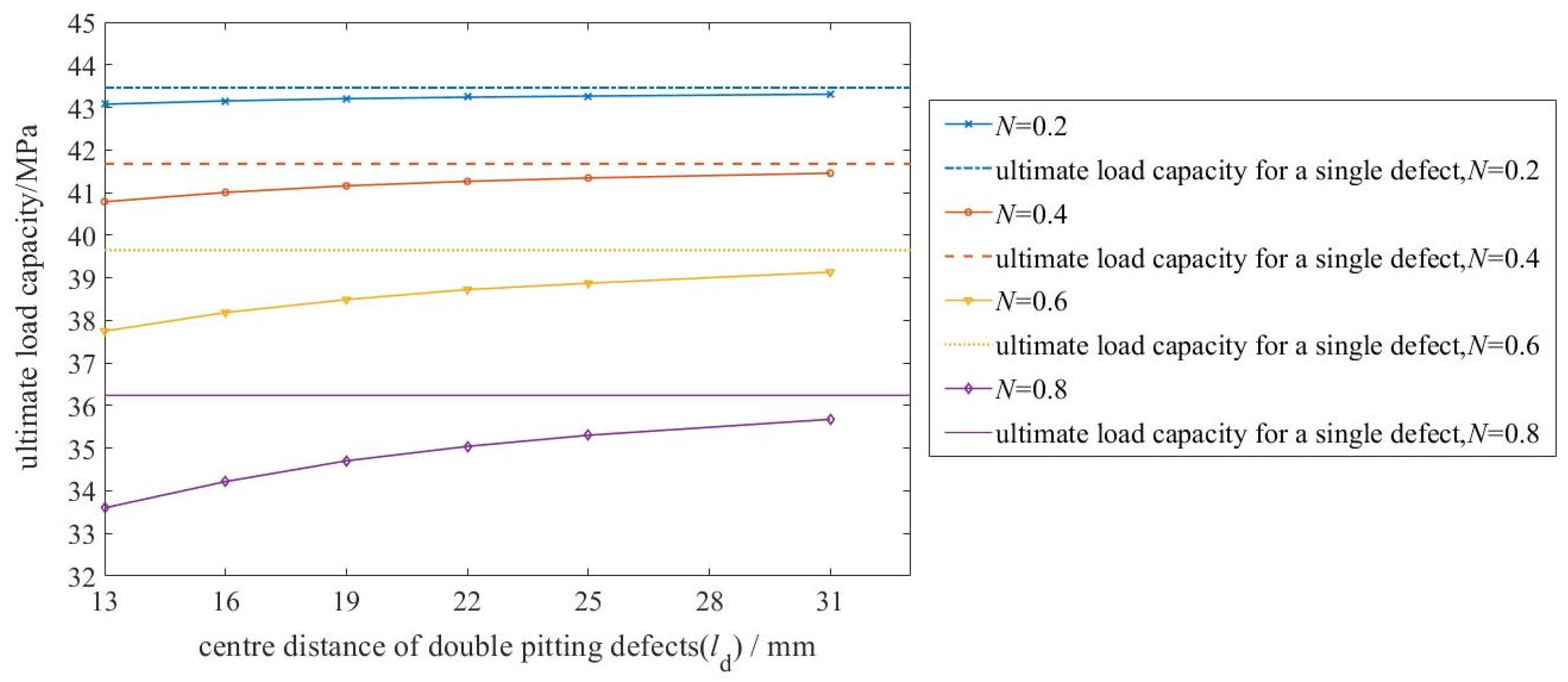
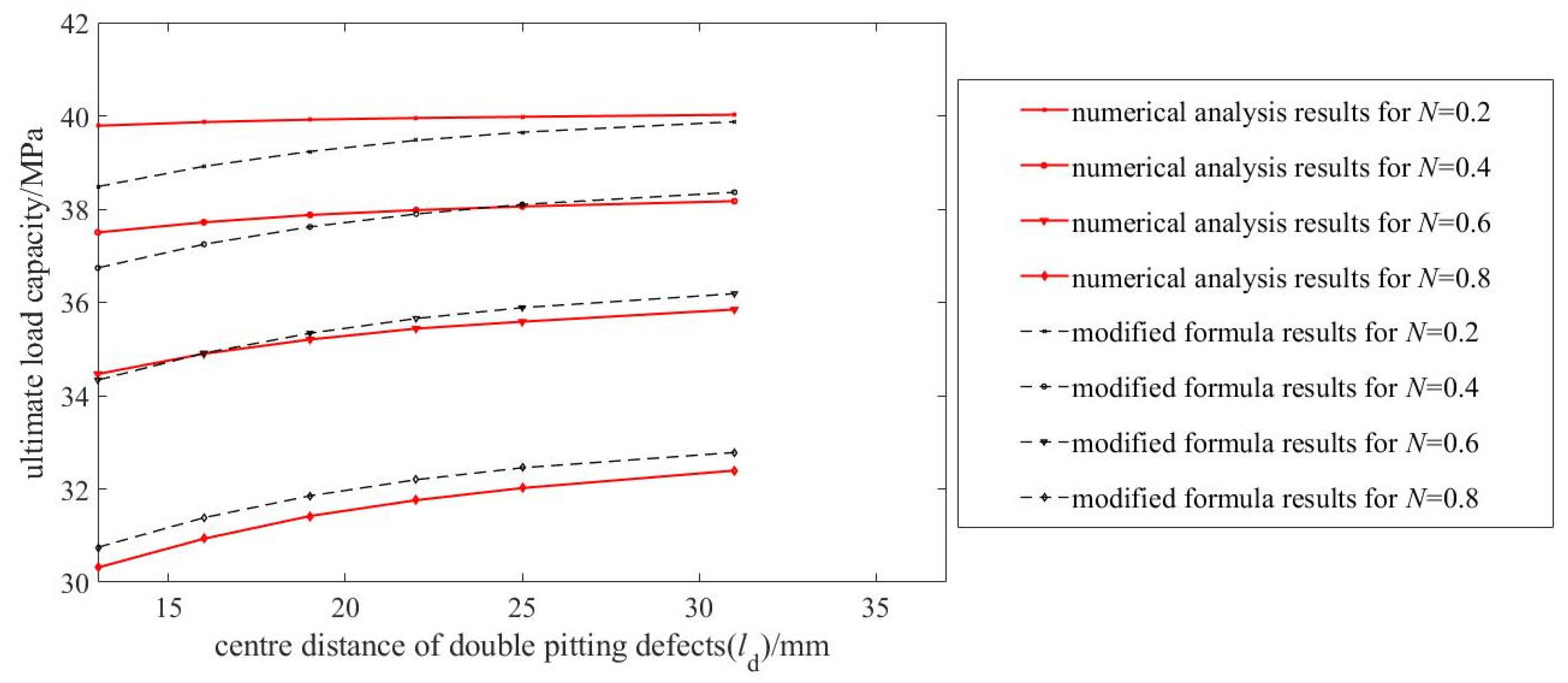
- ① The ultimate load capacity increases monotonically with the defect center distance ld, which aligns with the physical intuition that “the interaction between dual defects weakens with distance.”
- ② Nonlinearity and saturation of spacing influence: Within the range of ld < 20 mm, the load capacity recovers rapidly as the spacing increases (with a steeper gradient). When ld > 25 mm, the curve tends to flatten, indicating that the stress interference between the dual defects has diminished to a negligible level, and the structural behavior approximates that of an isolated defect.
- ① For the deep defect (N = 0.8) curve: within the range of ld < 20 mm, the curve exhibits a steeper ascending slope, indicating that the interaction between deep defects is stronger and that a larger spacing is required for the load-bearing capacity to recover to the level of a single pit defect.
- ② For the shallow defect (N = 0.2) curve: the overall variation is mild, and even at small spacings, its load-bearing capacity is already close to the value of a single pit defect, suggesting that the interaction between shallow defects is weaker.
3.2.2. Influence of Defect Parameters on the Ultimate Load Capacity Under a Constant Corrosion Depth Ratio
3.3. Ultimate Load Capacity Model for Cu-Ni Alloy Pipelines with Double Pitting Defects
3.3.1. Modification of the Ultimate Load Capacity Model
3.3.2. Experimental Validation of the Modified Ultimate Load Capacity Model
3.3.3. Analysis of Simulation and Experimental Results
Comparative Analysis of Ultimate Load Capacity
Comparative Analysis of Failure Characteristics

4. Conclusions
Author Contributions
Funding
Institutional Review Board Statement
Informed Consent Statement
Data Availability Statement
Acknowledgments
Conflicts of Interest
References
- Vijaya Kumar, S.D.; Karuppanan, S.; Ovinis, M. Artificial Neural Network-Based Failure Pressure Prediction of API 5L X80 Pipeline with Circumferentially Aligned Interacting Corrosion Defects Subjected to Combined Loadings. Materials 2022, 15, 2259. [Google Scholar] [CrossRef]
- Zhu, L.; Xia, Y.; Jia, B.; Ma, J. Prediction of Failure Pressure of Sulfur-Corrosion-Defective Pipelines Based on GABP Neural Networks. Materials 2025, 18, 3177. [Google Scholar] [CrossRef]
- Yuan, Y.; Deng, K.; Zhang, J.; Zeng, W.; Kong, X.; Lin, Y. Finite element study on residual internal pressure strength of corroded oil pipes and prediction method for remaining life. Anti-Corros. Methods Mater. 2021, 68, 481–488. [Google Scholar] [CrossRef]
- ASME B31G-2009; Manual for Determining the Remaining Strength of Corroded Pipelines. ASME B31 Committee: New York, NY, USA, 2009.
- Kiefner, J.F.; Vieth, P.H. A Modified Criterion for Evaluating the Remaining Strength of Corroded Pipe; United States Patent; Battelle Columbus Div.: Columbus, OH, USA, 1989. [Google Scholar]
- BS-7910; Guidance on the Method for Assessing the Acceptability of Flaws in Metallic Structure. British Standard: London, UK, 2005.
- API-579; Recommended Practice for Fitness-for-Service. American Petroleum Institute: Washington, DC, USA, 2016.
- Dong, S.E.; He, D.S.; Zhang, P.; Deng, X.S. Elastic-plastic finite element analysis of two-point corrosion pipeline. Machinery 2005, 32, 20–22. (In Chinese) [Google Scholar]
- Peng, J.; Zhou, C.Y.; Xue, J.L.; Dai, Q. Discussion on safety assessment of pressure pipe with multiple local wall thinning defects. Press. Vessel. Technol. 2010, 127, 21–25. (In Chinese) [Google Scholar]
- Coulson, K.; Worthingham, R. Pipe corrosion—Conclusion—New guidelines promise more accurate damage assessment. Oil Gas J. 1990, 88, 41–44. [Google Scholar]
- Coulson, K.; Worthingham, R. Standard damage-assessment approach is overly conservative. Oil Gas J. 1990, 88, 54–58. [Google Scholar]
- O’Grady, T.J.; Hisey, D.T.; Kiefner, J.F. A systematic method for the evaluation of corroded pipelines. Pipeline Eng. 1992, 46, 27–35. [Google Scholar]
- O’Grady, T.J.; Hisey, D.T.; Kiefner, J.F. Method for evaluation corroded pipe addresses variety of patterns. Oil Gas J. 1990, 90, 77–82. [Google Scholar]
- Chouchaoui, B.A.; Pick, R.J. Behavior of circumferentially aligned corrosion pits. Int. J. Press. Vessel. Pip. 1994, 57, 197–200. [Google Scholar] [CrossRef]
- Chouchaoui, B.A.; Pick, R.J. Behavior of longitudinally aligned corrosion pits. Int. J. Press. Vessel. Pip. 1996, 67, 17–35. [Google Scholar] [CrossRef]
- DNV-RP-F101; Recommend Practice Corroded Pipelines. Det Norske Veritas: Hovik, Norway, 2004.
- Chen, Y.F. Study on Failure Mechanism and Ultimate Load Capacity of Corroded Submarine Pipeline. Master’s Thesis, Dalian University of Technology, Dalian, China, 2009. (In Chinese). [Google Scholar]
- Chen, Y.F.; Li, X.; Zhou, J.; Guan, J. Study on interaction relationship for submarine pipeline with axial corrosion defects. China Ocean Press 2008, 22, 359–370. [Google Scholar]
- Zhou, R.; GU, X.; LUO, X. Residual strength prediction of X80 steel pipelines containing group corrosion defects. Ocean. Eng. 2023, 274, 114077. [Google Scholar] [CrossRef]
- Lu, H.; Iseley, T.; Matthews, J.; Liao, W.; Azimi, M. An ensemble model based on relevance vector machine and multi-objective salp swarm algorithm for predicting burst pressure of corroded pipelines. J. Pet. Sci. Eng. 2021, 203, 108585. [Google Scholar] [CrossRef]
- Soomro, A.A.; Mokhtar, A.A.; Kurnia, J.C.; Lashari, H.; Lu, H.; Sambo, C. Integrity assessment of corroded oil and gas pipelines using machine learning: A systematic review. Eng. Fail. Anal. 2022, 131, 105810. [Google Scholar] [CrossRef]
- Songling, L. The Evaluation Method of Pipeline Bearing Capacity Considering Complex Group Corrosion Defects. Master’s Thesis, Harbin Institute of Technology, Harbin, China, 2025. (In Chinese). [Google Scholar]
- Gao, X.; Wu, H.B.; Liu, M.; Zhang, Y.X.; Gao, F. Corrosion Behavior of High Strength C71500 Cu–Ni Alloy Pipe in Simulated High Sulfide Polluted Seawater at Different Temperatures. Int. J. Electrochem. Sci. 2021, 16, 210224. [Google Scholar] [CrossRef]
- Chandra, K.; Mahanti, A.; Singh, A.P.; Kain, V.; Gujar, H.G. Microbiologically influenced corrosion of 70/30 cupronickel tubes of a heat-exchanger. Eng. Fail. Anal. 2019, 105, 1328–1339. [Google Scholar] [CrossRef]
- Wu, L.; Ma, A.; Zhang, L.; Li, G.; Hu, L.; Wang, Z.; Zheng, Y. ABAQUS6. Erosion–Corrosion Behavior of 90/10 and 70/30 Copper–Nickel Tubes in 1 wt% NaCl Solution. Metals 2023, 13, 401. [Google Scholar] [CrossRef]
- Jin, T.; Zhang, W.F.; Li, N.; Liu, X.; Han, L.; Dai, W. Surface Characterization and Corrosion Behavior of 90/10 Copper-Nickel Alloy in Marine Environment. Materials 2019, 12, 1869. [Google Scholar] [CrossRef] [PubMed]
- Lin, S.; Li, D.; Zhou, Q.; Chu, M.; Sun, Y.; Liu, M.; Zheng, K.; Qiao, S.; Zhao, L.; Zhao, L.; et al. Study on corrosion perforation behavior of copper nickel alloy pipe during service in marine environment. Eng. Fail. Anal. 2023, 153. [Google Scholar] [CrossRef]
- GB/T 228.1-2010; Metallic Materials—Tensile Testing—Part 1: Method of Test at Room Temperature. National Standard of the People’s Republic: Beijing, China, 2010.
- GB/T 241-2007; Metal Materials-tube-hydrostatic Pressure Test. The Technical Committee on Steel of Standardization Committee of China: Beijing, China, 2007. (In Chinese)
- Zhang, P. Research on Ultimate Loading Capacity Model and Failure Behaviour of Seawater Pipelines in warship with Typical Defects. Master’s Thesis, Naval University of Engineering, Wuhan, China, 2020. (In Chinese). [Google Scholar]





| Parameter | Value |
|---|---|
| Tensile Strength | 306 MPa |
| Yield Strength | 120 MPa |
| Elongation | 32.5% |
| Poisson’s Ratio | 0.33 |
| Young’s Modulus | 136 GPa |
| Density | 8.94 g/cm3 |
| ld | N = 0.2 | N = 0.4 | N = 0.6 | N = 0.8 |
|---|---|---|---|---|
| ld = 13 mm | AP1# | AP2# | AP3# | AP4# |
| ld = 16 mm | AP5# | AP6# | AP7# | AP8# |
| ld = 19 mm | AP9# | AP10# | AP11# | AP12# |
| ld = 22 mm | AP13# | AP14# | AP15# | AP16# |
| ld = 25 mm | AP17# | AP18# | AP19# | AP20# |
| ld = 31 mm | AP21# | AP22# | AP23# | AP24# |
| ld = 37 mm | AP25# | AP26# | AP27# | AP28# |
| ld | Dp = 6 | Dp = 9 | Dp = 12 | Dp = 15 |
|---|---|---|---|---|
| ld = 13 mm | AP29# | AP30# | AP4# | AP31# |
| ld = 16 mm | AP32# | AP33# | AP8# | AP34# |
| ld = 19 mm | AP35# | AP36# | AP12# | AP37# |
| ld = 22 mm | AP38# | AP39# | AP16# | AP40# |
| ld = 25 mm | AP41# | AP42# | AP20# | AP43# |
| ld = 31 mm | AP44# | AP45# | AP24# | AP46# |
| ld = 37 mm | AP47# | AP48# | AP28# | AP49# |
| Pipeline No. | d | t | ld | |||
|---|---|---|---|---|---|---|
| Test-1# | 12 mm | 4.0 mm | 90.0 mm | 80.0 mm | 5.0 mm | 13.0 mm |
| Test-2# | 12 mm | 4.0 mm | 90.0 mm | 80.0 mm | 5.0 mm | 19.0 mm |
| Pipeline No. | Calculated Result (Equation (5)) | Experimental Result | Absolute Error (MPa) (Experimental vs. Equation (5)) | Relative Error (%) (Experimental vs. Equation (5)) |
|---|---|---|---|---|
| Test-1# | 29.131 | 28.356 | 0.775 | 2.73% |
| Test-2# | 30.176 | 29.736 | 0.440 | 1.47% |
Disclaimer/Publisher’s Note: The statements, opinions and data contained in all publications are solely those of the individual author(s) and contributor(s) and not of MDPI and/or the editor(s). MDPI and/or the editor(s) disclaim responsibility for any injury to people or property resulting from any ideas, methods, instructions or products referred to in the content. |
© 2025 by the authors. Licensee MDPI, Basel, Switzerland. This article is an open access article distributed under the terms and conditions of the Creative Commons Attribution (CC BY) license.
Share and Cite
Pan, X.; Han, J.; Guo, W.; Chen, H.; Zeng, Y.; Wu, Z.; Yu, L.; Yu, L. Study on the Ultimate Load Capacity of Cu-Ni Alloy Pipelines with Double Pitting Defects. Materials 2026, 19, 121. https://doi.org/10.3390/ma19010121
Pan X, Han J, Guo W, Chen H, Zeng Y, Wu Z, Yu L, Yu L. Study on the Ultimate Load Capacity of Cu-Ni Alloy Pipelines with Double Pitting Defects. Materials. 2026; 19(1):121. https://doi.org/10.3390/ma19010121
Chicago/Turabian StylePan, Xinglong, Jianggui Han, Wenyong Guo, Hantao Chen, Yan Zeng, Zhe Wu, Li Yu, and Liangwu Yu. 2026. "Study on the Ultimate Load Capacity of Cu-Ni Alloy Pipelines with Double Pitting Defects" Materials 19, no. 1: 121. https://doi.org/10.3390/ma19010121
APA StylePan, X., Han, J., Guo, W., Chen, H., Zeng, Y., Wu, Z., Yu, L., & Yu, L. (2026). Study on the Ultimate Load Capacity of Cu-Ni Alloy Pipelines with Double Pitting Defects. Materials, 19(1), 121. https://doi.org/10.3390/ma19010121