A Review on Properties of Electrodeposited Nickel Composite Coatings: Ni-Al2O3, Ni-SiC, Ni-ZrO2, Ni-TiO2 and Ni-WC


Abstract
1. Introduction
2. Electrodeposition
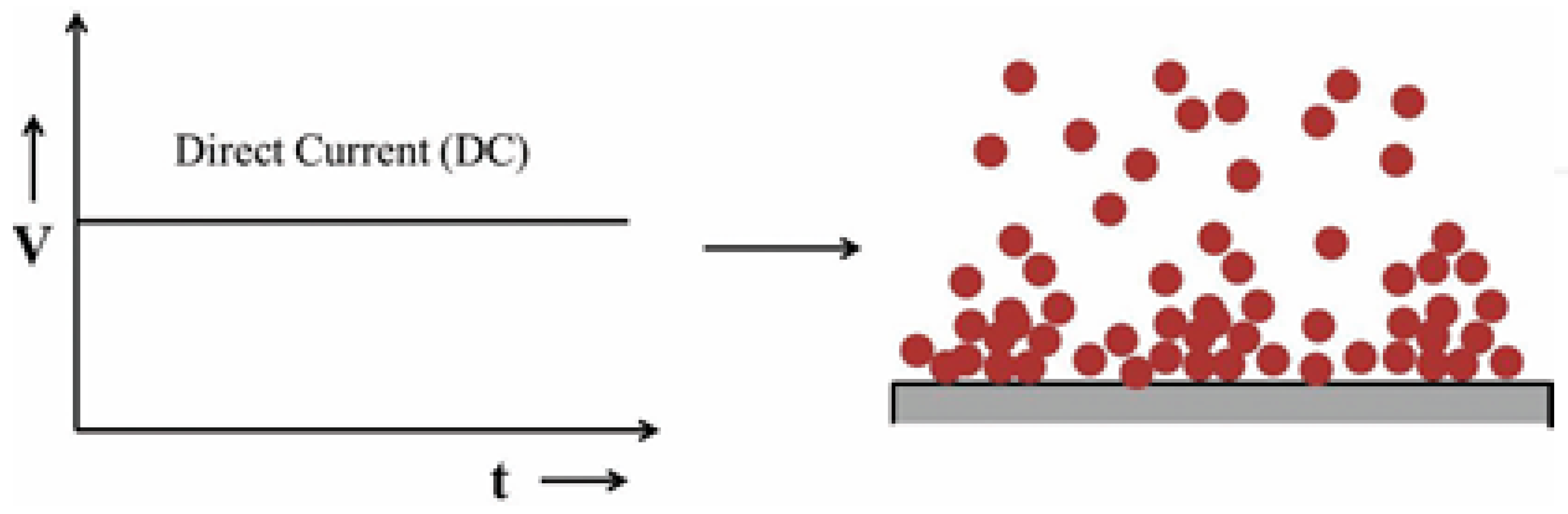
2.1. Direct Current Electrodeposition
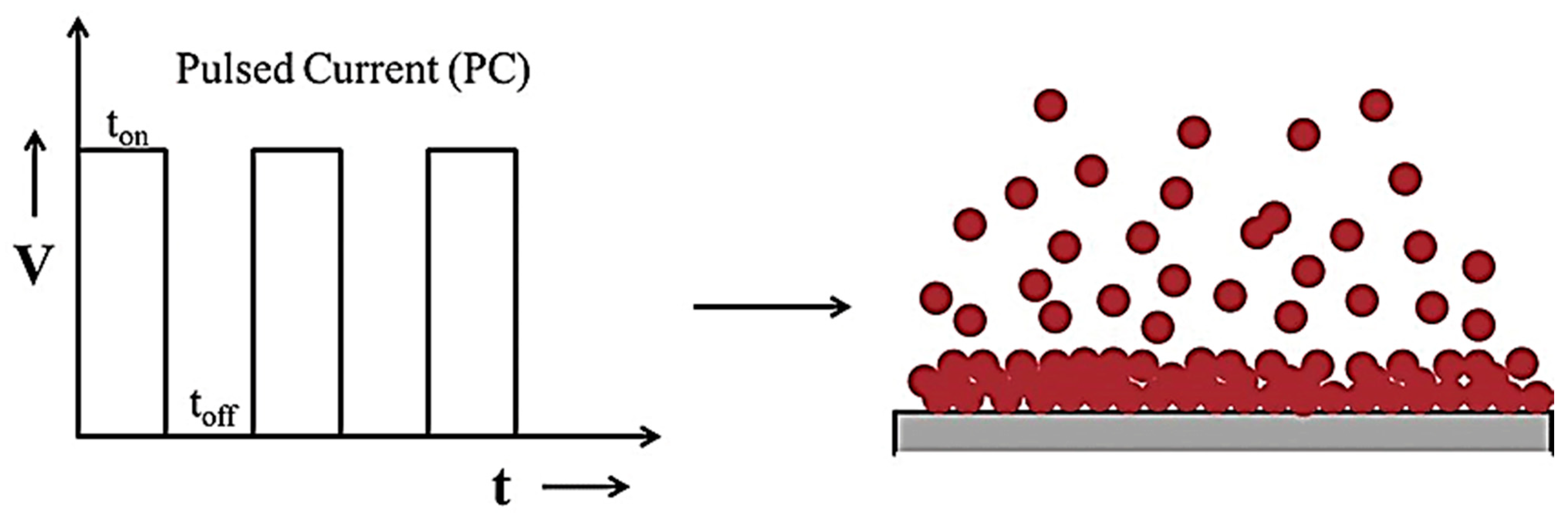
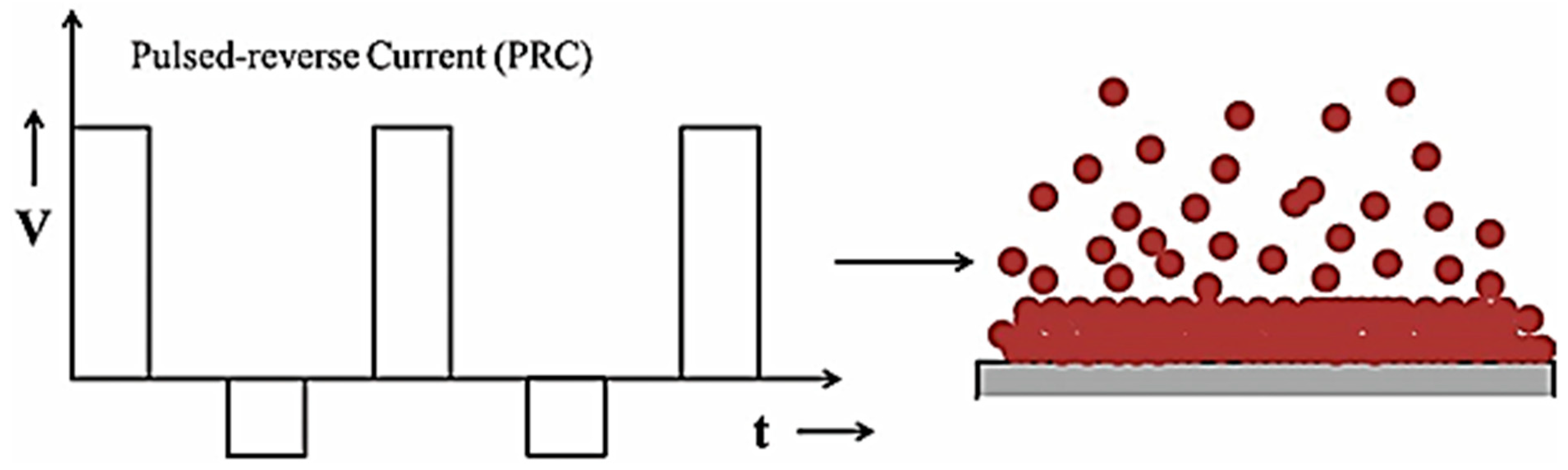
2.2. Pulse Electrodeposition
- During the toff period in PED, the electric double layer found around the cathode undergoes a discharge, allowing the ions to pass through it and reach the cathode surface. In contrast, during direct current electrodeposition, this same double electric layer hinders ions from reaching the desired surface on the cathode.
- During the process of electrodeposition, regions with high-current density inside the electrolyte bath experience greater ion depletion compared with those of low-current-density areas. Throughout the toff period, the migration of ions to these low-current areas (depleted areas) takes place, ensuring a better uniform ion distribution for deposition when the ton pulse happens.
- Replenishing metal ions in the diffusion layer during the off time significantly increases the limiting current density.
- Greater flexibility in pulse parameters minimizes process constraints.
- Leads to the formation of fine-grained deposits, which display a tighter structure with reduced porosity and experience less stress.
- Enhances deposit adhesion and ensures a consistent uniform thickness.
- Increases deposition rate while enhancing physical and mechanical properties.
- On the other hand, the pulse electrodeposition method has downsides:
- Expensive pulse generators compared with DC units.
- It requires careful advance planning and a sequence of working procedures to achieve optimal outcomes.
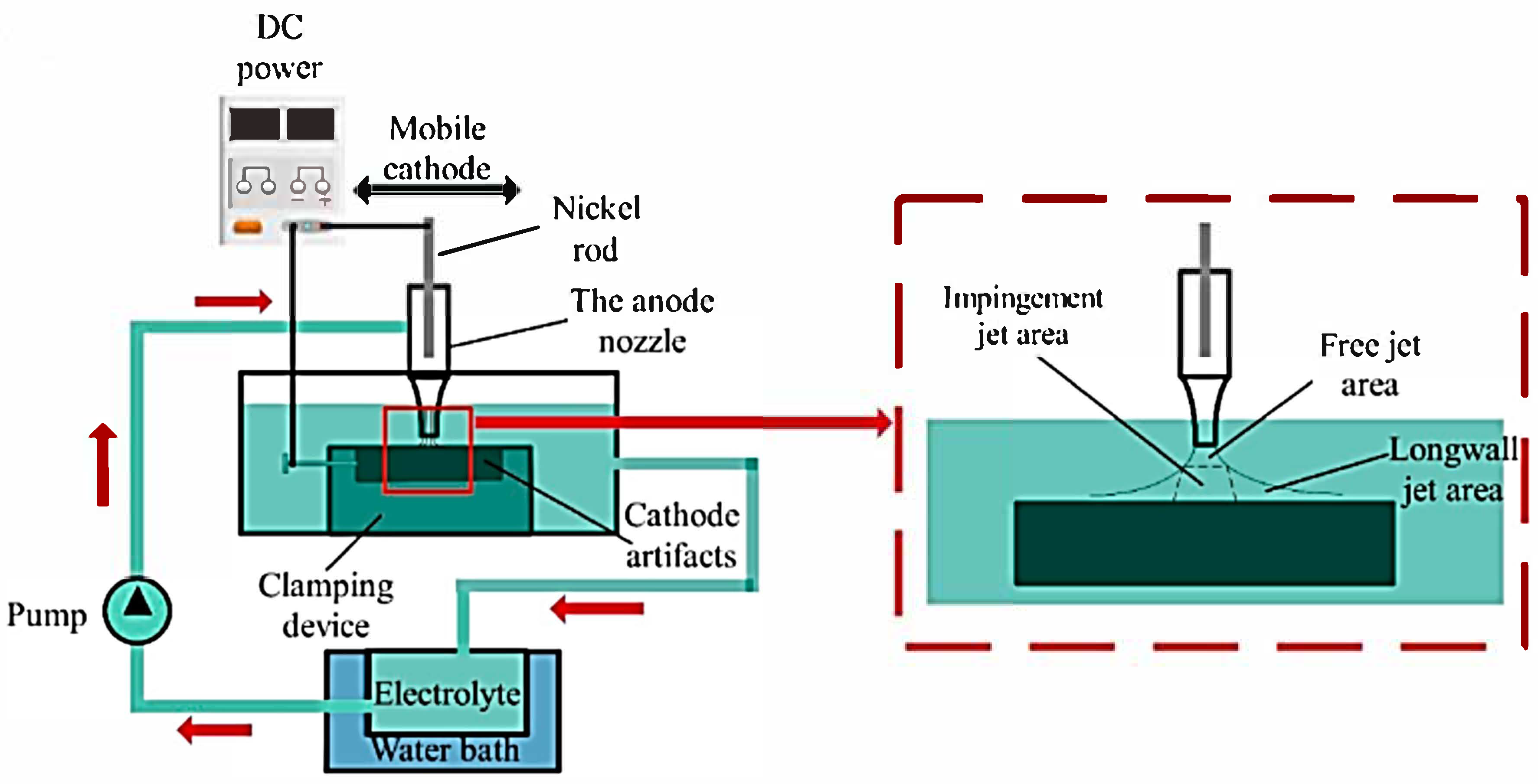
2.3. Jet Electrodeposition
2.4. Ni-Al2O3 Composite Coatings
2.5. Ni-SiC Composite Coatings
2.6. Ni-ZrO2 Composite Coatings
2.7. Ni-TiO2 Composite Coatings
2.8. Ni-WC Composite Coatings
2.9. Properties of Nickel Composite Coatings
2.9.1. Hardness
2.9.2. Corrosion Resistance
2.9.3. Wear Resistance
2.10. Applications
2.11. Conclusions and Future Outlooks
- Improved wear resistance: Researchers have found that incorporating Al2O3, SiC, ZrO2, WC, and TiO2 particles into nickel coatings can significantly improve wear resistance. The uniform distribution of the particles within the nickel matrix acts as a barrier to wear and tear.
- Enhanced mechanical properties: Studies have shown that electrodeposited nickel composite coatings with Al2O3, SiC, ZrO2, WC, and TiO2 particles exhibit superior mechanical properties, including increased hardness. The presence of these particles refines the grain size of the nickel matrix and hinders the movement of defects, leading to enhanced mechanical strength.
- Better corrosion resistance: Nickel composite coatings can offer improved protection against corrosion compared with pure nickel coatings.
Author Contributions
Funding
Conflicts of Interest
References
- Saini, A.; Singh, G.; Mehta, S.; Singh, H.; Dixit, S. A review on mechanical behaviour of electrodeposited Ni-composite coatings. Int. J. Interact. Des. Manuf. (IJIDeM) 2023, 17, 2247–2258. [Google Scholar] [CrossRef]
- Walsh, F.; Larson, C. Towards improved electroplating of metal-particle composite coatings. Trans. IMF 2020, 98, 288–299. [Google Scholar] [CrossRef]
- Nasirpouri, F.; Alipour, K.; Daneshvar, F.; Sanaeian, M.-R. Electrodeposition of anticorrosion nanocoatings. In Corrosion Protection at the Nanoscale; Elsevier: Amsterdam, The Netherlands, 2020; pp. 473–497. [Google Scholar]
- Kale, M.B.; Borse, R.A.; Gomaa Abdelkader Mohamed, A.; Wang, Y. Electrocatalysts by electrodeposition: Recent advances, synthesis methods, and applications in energy conversion. Adv. Funct. Mater. 2021, 31, 2101313. [Google Scholar] [CrossRef]
- Bakhit, B.; Akbari, A. Effect of particle size and co-deposition technique on hardness and corrosion properties of Ni–Co/SiC composite coatings. Surf. Coat. Technol. 2012, 206, 4964–4975. [Google Scholar] [CrossRef]
- Hessam, R.; Najafisayar, P.; Rasouli, S.S. A comparison between growth of direct and pulse current electrodeposited crystalline SnO2 films; electrochemical properties for application in lithium-ion batteries. Mater. Renew. Sustain. Energy 2022, 11, 259–266. [Google Scholar] [CrossRef]
- Borkar, T. Electrodeposition of Nickel Composite Coatings; Oklahoma State University: Stillwater, OK, USA, 2010. [Google Scholar]
- Mandati, S.; Sarada, B.; Dey, S.; Joshi, S. Pulsed Electrochemical Deposition of CuInSe2 and Cu (In, Ga) Se2 Semiconductor Thin-Films. In Semiconductors–Growth and Characterization; InTech: Rijeka, Croatia, 2018; pp. 109–132. [Google Scholar]
- Akbarpour, M.; Asl, F.G. Fabrication of high-performance graphene/nickel-cobalt composite coatings using ultrasonic-assisted pulse electrodeposition. Ceram. Int. 2023, 49, 13829–13835. [Google Scholar] [CrossRef]
- Xia, F.; Li, C.; Ma, C.; Li, Q.; Xing, H. Effect of pulse current density on microstructure and wear property of Ni-TiN nanocoatings deposited via pulse electrodeposition. Appl. Surf. Sci. 2021, 538, 148139. [Google Scholar] [CrossRef]
- Krajaisri, P.; Puranasiri, R.; Chiyasak, P.; Rodchanarowan, A. Investigation of pulse current densities and temperatures on electrodeposition of tin-copper alloys. Surf. Coat. Technol. 2022, 435, 128244. [Google Scholar] [CrossRef]
- Xian, J.; Shen, Z.; Zhang, Z.; Wu, H.; Jin, M.; Jiang, M. Effect of current density on the wear resistance of Ni–P alloy coating prepared through immersion-assisted jet-electrodeposition. Coatings 2021, 11, 527. [Google Scholar] [CrossRef]
- Deshmukh, V.K.; Rajput, M.S.; Narang, H. A systematic review on high speed selective jet electrodeposition manufacturing. World J. Eng. 2024, 21, 275–292. [Google Scholar] [CrossRef]
- Chen, Y.; Wen, X.; Li, H.; Zhu, F.; Fang, C.; Li, Z.; Zhou, Z.; Jiang, W. Effects of deposition current density, time and scanning velocity on scanning jet electrodeposition of Ni-Co alloy coating. J. Manuf. Process. 2023, 101, 458–468. [Google Scholar] [CrossRef]
- Karthik, R.; Mani, R.; Manikandan, P. Tribological studies of Ni-SiC and Ni-Al2O3 composite coatings by pulsed electrodeposition. Mater. Today Proc. 2021, 37, 701–706. [Google Scholar] [CrossRef]
- Kumar, N.; Kishore, K.; Yadav, S.; Sharma, P. Characterisation of Ni-Al2O3 composite coatings at different Al2O3 concentrations. Mater. Today Proc. 2024. [Google Scholar] [CrossRef]
- Fan, H.; Jiang, J.; Zhao, Y.; Wang, S.; Li, Z. Improvement of microstructure and properties of Ni–Al2O3 composite coating via jet electrodeposition. Int. J. Mod. Phys. B 2020, 34, 2050243. [Google Scholar] [CrossRef]
- Xie, W.; Li, S.; Li, X.; Wang, D.; Zhou, S.; Wang, Y.; Guo, C. Electrodeposition of Ni and Ni-Al2O3 Composite Coatings on Q345 Steels under Different Current Densities. Preprints 2024. [Google Scholar] [CrossRef]
- Gao, M.; Pei, Z.; Song, G.; Liu, Z.; Li, H.; Gong, J. Wear resistance of Ni/nano-Al2O3 composite coatings by brush electroplating. J. Mater. Sci. 2024, 59, 7009–7027. [Google Scholar] [CrossRef]
- Saha, R.; Khan, T. Effect of applied current on the electrodeposited Ni–Al2O3 composite coatings. Surf. Coat. Technol. 2010, 205, 890–895. [Google Scholar] [CrossRef]
- John, A.; Saeed, A.; Khan, Z.A. Influence of the Duty Cycle of Pulse Electrodeposition-Coated Ni-Al2O3 Nanocomposites on Surface Roughness Properties. Materials 2023, 16, 2192. [Google Scholar] [CrossRef]
- Góral, A.; Nowak, M.; Berent, K.; Kania, B. Influence of current density on microstructure and properties of electrodeposited nickel-alumina composite coatings. J. Alloys Compd. 2014, 615, S406–S410. [Google Scholar] [CrossRef]
- Rezgui, I.; Belloufi, A.; Mihi, A. Experimental investigation of the corrosion resistance of Ni-Al2O3 composite coatings obtained by electrodeposition. UPB Sci. Bull. B Chem. Mater. Sci. 2020, 82, 221–237. [Google Scholar]
- Chen, L.; Wang, L.; Zeng, Z.; Xu, T. Influence of pulse frequency on the microstructure and wear resistance of electrodeposited Ni–Al2O3 composite coatings. Surf. Coat. Technol. 2006, 201, 599–605. [Google Scholar] [CrossRef]
- Huang, P.-C.; Hou, K.-H.; Hong, J.-J.; Lin, M.-H.; Wang, G.-L. Study of fabrication and wear properties of Ni–SiC composite coatings on A356 aluminum alloy. Wear 2021, 477, 203772. [Google Scholar] [CrossRef]
- Li, J.; Lin, O.; Cheng, C.; Wang, W.; Xu, C.; Ren, L. Fabrication of a Ni/SiC composite coating on steel surface with excellent corrosion inhibition performance. J. Mater. Process. Technol. 2021, 290, 116987. [Google Scholar] [CrossRef]
- Rao, H.; Li, W.; Zhao, F.; Song, Y.; Liu, H.; Zhu, L.; Chen, H. Electrodeposition of High-Quality Ni/SiC Composite Coatings by Using Binary Non-Ionic Surfactants. Molecules 2023, 28, 3344. [Google Scholar] [CrossRef]
- Li, G.; Chen, Z.; Tan, Z.; Tian, R.; Zhao, Y.; Wang, L.; Li, W.; Liu, Y. Investigation on Microstructure and Properties of the Electrodeposited Ni-SiC Composite Coating. Coatings 2023, 13, 695. [Google Scholar] [CrossRef]
- Arghavanian, R.; Parvini Ahmadi, N. Electrodeposition of Ni–ZrO2 composite coatings and evaluation of particle distribution and corrosion resistance. Surf. Eng. 2011, 27, 649–654. [Google Scholar] [CrossRef]
- Parida, G.; Chaira, D.; Basu, A. Ni–ZrO2 Composite Coating by Electro-Co-Deposition. Trans. Indian Inst. Met. 2013, 66, 5–11. [Google Scholar] [CrossRef]
- Algailani, H.M.; Mahmoud, A.K.; Al-Kaisy, H.A. Fabrication of Ni-ZrO2 nanocomposite coating by electroless deposition technique. Eng. Technol. J. 2020, 38, 649–655. [Google Scholar] [CrossRef]
- Xiong, C.; Xiao, J.; Chen, L.; Du, W.; Hu, B.; Xu, W.; Tay, S.L. Improving the properties of Ni-ZrO2 composite coatings by sol-enhanced electroplating. Int. J. Electrochem. Sci. 2018, 13, 11049–11057. [Google Scholar] [CrossRef]
- Zhang, Y.; Xia, F.; Yan, P.; Ma, C.; Wang, C.; Wang, Q. Microstructure, wear and corrosion resistances of Ni–ZrO2–CeO2 nanocoatings. Ceram. Int. 2024, 50, 20949–20957. [Google Scholar]
- Benea, L. Electrodeposition and tribocorrosion behaviour of ZrO2–Ni composite coatings. J. Appl. Electrochem. 2009, 39, 1671–1681. [Google Scholar] [CrossRef]
- Laszczyńska, A.; Winiarski, J.; Szczygieł, B.; Szczygieł, I. Electrodeposition and characterization of Ni–Mo–ZrO2 composite coatings. Appl. Surf. Sci. 2016, 369, 224–231. [Google Scholar] [CrossRef]
- Bostani, B.; Parvini Ahmadi, N.; Yazdani, S.; Arghavanian, R. Synthesis and characterization of functionally gradient Ni-ZrO2 composite coating. Prot. Met. Phys. Chem. Surf. 2018, 54, 222–229. [Google Scholar] [CrossRef]
- Hammad Nazir, M.; Khan, Z.A.; Saeed, A.; Bakolas, V.; Braun, W.; Bajwa, R.; Rafique, S. Analyzing and modelling the corrosion behavior of Ni/Al2O3, Ni/SiC, Ni/ZrO2 and Ni/Graphene nanocomposite coatings. Materials 2017, 10, 1225. [Google Scholar] [CrossRef]
- Novytska, N.; Zaverach, I. Composition, topography and electrocatalytic properties of Ni-TiO2 composite coatings. Mater. Today Proc. 2022, 50, 442–447. [Google Scholar] [CrossRef]
- Lajevardi, S.; Shahrabi, T. Effects of pulse electrodeposition parameters on the properties of Ni–TiO2 nanocomposite coatings. Appl. Surf. Sci. 2010, 256, 6775–6781. [Google Scholar] [CrossRef]
- Salehi, M.; Mozammel, M.; Emarati, S.M.; Alinezhadfar, M. The role of TiO2 nanoparticles on the topography and hydrophobicity of electrodeposited Ni-TiO2 composite coating. Surf. Topogr. Metrol. Prop. 2020, 8, 025008. [Google Scholar] [CrossRef]
- Tehrani, H.M.; Shoja-Razavi, R.; Erfanmanesh, M.; Hashemi, S.H.; Barekat, M. Evaluation of the mechanical properties of WC-Ni composite coating on an AISI 321 steel substrate. Opt. Laser Technol. 2020, 127, 106138. [Google Scholar] [CrossRef]
- Li, Y.; Song, P.; Wang, W.; Lei, M.; Li, X. Microstructure and wear resistance of a Ni-WC composite coating on titanium grade 2 obtained by electroplating and electron beam remelting. Mater. Charact. 2020, 170, 110674. [Google Scholar] [CrossRef]
- Zhao, S.; Yang, L.; Huang, Y.; Xu, S. A novel method to fabricate Ni/WC composite coatings by laser wire deposition: Processing characteristics, microstructural evolution and mechanical properties under different wire transfer modes. Addit. Manuf. 2021, 38, 101738. [Google Scholar] [CrossRef]
- Oganov, A.R.; Lyakhov, A.O. Towards the theory of hardness of materials. J. Superhard Mater. 2010, 32, 143–147. [Google Scholar] [CrossRef]
- Shakoor, R.; Kahraman, R.; Waware, U.; Wang, Y.; Gao, W. Properties of electrodeposited Ni–B–Al2O3 composite coatings. Mater. Des. 2014, 64, 127–135. [Google Scholar] [CrossRef]
- Kumar, D.; Shree, G.; Dwivedi, V.K. Wear and hardness evaluation of electrodeposited Ni-SiC nanocomposite coated copper. Int. J. Microstruct. Mater. Prop. 2020, 15, 87–106. [Google Scholar] [CrossRef]
- Parida, G.; Chaira, D.; Chopkar, M.; Basu, A. Synthesis and characterization of Ni-TiO2 composite coatings by electro-co-deposition. Surf. Coat. Technol. 2011, 205, 4871–4879. [Google Scholar] [CrossRef]
- Chen, W.; Gao, W. Sol-enhanced electroplating of nanostructured Ni–TiO2 composite coatings—The effects of sol concentration on the mechanical and corrosion properties. Electrochim. Acta 2010, 55, 6865–6871. [Google Scholar] [CrossRef]
- Sun, J. Comparative Investigations from Tribological and Corrosion Properties of Alumina and Nickel-Alumina Coatings on Cast Iron. Master’s Thesis, University of Windsor, Windsor, ON, Canada, 2021. [Google Scholar]
- Mouna, R.; Noureddine, A.; Ferkhi, M. Anticorrosive Properties of Nickel-Alumina Composite Coatings on A Steel Substrate. Anal. Bioanal. Electrochem. 2023, 15, 382–393. [Google Scholar]
- Levi, G. Energy and Structure of Nickel-Alumina Interfaces; Technion-Israel Institute of Technology, Department of Materials Engineering: Haifa, Israel, 2002. [Google Scholar]
- Rezgui, I.; Belloufi, A.; Abdelkrim, M. Investigating corrosion resistance in Ni–Al2O3 composite coatings: A fuzzy logic-based predictive study. Int. J. Adv. Manuf. Technol. 2024, 132, 4363–4381. [Google Scholar] [CrossRef]
- Zhang, H.; Wang, J.; Chen, S.; Wang, H.; He, Y.; Ma, C. Ni–SiC composite coatings with improved wear and corrosion resistance synthesized via ultrasonic electrodeposition. Ceram. Int. 2021, 47, 9437–9446. [Google Scholar] [CrossRef]
- Nikitasari, A.; Amrani, D.O.; Zulaifa, L.; Prasetyo, M.A.; Anwar, M.; Mabruri, E. The influence of coating time on corrosion resistance of Ni/Ni-SiC composite. In AIP Conference Proceedings; AIP Publishing: Melville, NY, USA, 2020. [Google Scholar]
- Pedrizzetti, G.; Paglia, L.; Genova, V.; Cinotti, S.; Bellacci, M.; Marra, F.; Pulci, G. Microstructural, mechanical and corrosion characterization of electroless Ni-P composite coatings modified with ZrO2 reinforcing nanoparticles. Surf. Coat. Technol. 2023, 473, 129981. [Google Scholar] [CrossRef]
- Abdel Hamid, Z.; Refai, M.; El-kilani, R.M.; Nasr, G.E. Use of a Ni-TiO2 nanocomposite film to enhance agricultural cutting knife surfaces by electrodeposition technology. J. Mater. Sci. 2021, 56, 14096–14113. [Google Scholar] [CrossRef]
- Lemya, L.; Hachemi, B.T.; Elhachmi, G.T. Microstructural, surface and electrochemical properties of electrodeposited Ni-WC nanocomposites coatings. Main Group Chem. 2022, 21, 763–772. [Google Scholar] [CrossRef]
- Qu, G.; Wang, D.; Wang, Q.; Hua, M. Microstructure and Wear Resistance of Ni-Al2O3 Nano-composite Coating. J. Phys. Conf. Ser. 2021, 1965, 012113. [Google Scholar] [CrossRef]
- Wang, Q.; Li, Q.; Zhang, L.; Chen, D.X.; Jin, H.; Li, J.D.; Zhang, J.W.; Ban, C.Y. Microstructure and properties of Ni-WC gradient composite coating prepared by laser cladding. Ceram. Int. 2022, 48, 7905–7917. [Google Scholar] [CrossRef]
- Alidokht, S.A.; Chromik, R.R. Sliding wear behavior of cold-sprayed Ni-WC composite coatings: Influence OF WC content. Wear 2021, 477, 203792. [Google Scholar] [CrossRef]
- Natarajan, P.; Jegan, A.; Mohanraj, M. Wear Behavior of Ni-TiO2 Nano-Composite Coating on AISI 1022 CS by Pulse Electrodeposition Wear Behavior of Ni-TiO2 Nano-Composite Coating on AISI 1022 CS by Pulse Electrodeposition. JN Mater. Electrochem. Syst. 2020, 23, 177–181. [Google Scholar] [CrossRef]
- Gül, H. The effect of TiO2 concentration on morphology, wear and corrosion properties of NiB-TiO2 composite coatings by ultrasonic-assisted pulse electrodeposition. Surf. Topogr. Metrol. Prop. 2023, 11, 015001. [Google Scholar] [CrossRef]
- Aruna, S.; Latha, S.; Lakshmi, R. Multifunctional properties of electrodeposited nickel composite coating containing nanosized monoclinic zirconia particles. J. Metall. Mater. Sci. 2020, 66, 77–91. [Google Scholar]
- Qiu, Y.; Jiang, G.-Y. Study on friction, wear and thermal insulation properties of laser deposition Ni/ZrO2. Optik 2021, 247, 167783. [Google Scholar] [CrossRef]
- Wang, H.; Liu, H.; He, Y.; Ma, C.; Li, L. Ni-SiC composite coatings with good wear and corrosion resistance synthesized via ultrasonic electrodeposition. J. Mater. Eng. Perform. 2021, 30, 1535–1544. [Google Scholar] [CrossRef]
- Farzam, M. The Wear Performance of Ni-TiO2 Nanocomposite Coatings. In Proceedings of the 2nd National Nano Materials and Nano Technology Conference, Esfahan, Iran, 5 May 2010; pp. 1–7. [Google Scholar]
- Vaezi, M.; Sadrnezhaad, S.; Nikzad, L. Electrodeposition of Ni–SiC nano-composite coatings and evaluation of wear and corrosion resistance and electroplating characteristics. Colloids Surf. A Physicochem. Eng. Asp. 2008, 315, 176–182. [Google Scholar] [CrossRef]
- Bełtowska-Lehman, E.; Goral, A.; Indyka, P. Electrodeposition and characterization of Ni/Al2O3 nanocomposite coatings. Arch. Metall. Mater. 2011, 56, 919–931. [Google Scholar] [CrossRef]
- Li, R.; Chu, Q.; Liang, J. Electrodeposition and characterization of Ni–SiC composite coatings from deep eutectic solvent. RSC Adv. 2015, 5, 44933–44942. [Google Scholar] [CrossRef]
- Sindhuja, M.; Sudha, V.; Harinipriya, S.; Venugopal, R.; Usmani, B. Electrodeposited Ni/SiC composite coating on graphite for high temperature solar thermal applications. Mater. Sci. Energy Technol. 2018, 1, 3–10. [Google Scholar] [CrossRef]
- Huang, B.; Li, N. Corrosion resistance of electrodeposited Ni-ZrO2 composite coating. Min. Metall. Eng. 2009, 29, 102–105. [Google Scholar]
- Birlik, I.; Ak Azem, N.F.; Toparli, M.; Celik, E.; Koc Delice, T.; Yildirim, S.; Bardakcioglu, O.; Dikici, T. Preparation and characterization of Ni–TiO2 nanocomposite coatings produced by electrodeposition Technique. Front. Mater. 2016, 3, 46. [Google Scholar] [CrossRef]
- Makarava, I.; Esmaeili, M.; Kharytonau, D.S.; Pelcastre, L.; Ryl, J.; Bilesan, M.R.; Vuorinen, E.; Repo, E. Influence of CeO2 and TiO2 Particles on Physicochemical Properties of Composite Nickel Coatings Electrodeposited at Ambient Temperature. Materials 2022, 15, 5550. [Google Scholar] [CrossRef]
- De, R.; Haque, S.M.; Tripathi, S.; Rao, K.D.; Singh, R.; Som, T.; Sahoo, N. Temperature dependent optical characterization of Ni-TiO2 thin films as potential photocatalytic material. AIP Adv. 2017, 7, 095115. [Google Scholar] [CrossRef]
- Zhao, G.; Zhao, M.; Zhang, W. Preparation of Ni-TiO2 Composite Coatings on Q390E Steel by Pulse Electrodeposition and their Photocatalytic and Corrosion Resistance Properties. Int. J. Electrochem. Sci. 2022, 17, 220819. [Google Scholar] [CrossRef]
- Surender, M.; Basu, B.; Balasubramaniam, R. Wear characterization of electrodeposited Ni–WC composite coatings. Tribol. Int. 2004, 37, 743–749. [Google Scholar] [CrossRef]
- Sombatsompop, N.; Sukeemith, K.; Markpin, T.; Tareelap, N. A new experimental apparatus of electro-codeposited system for Ni–WC composite coatings. Mater. Sci. Eng. A 2004, 381, 175–188. [Google Scholar] [CrossRef]
- Surender, M.; Balasubramaniam, R.; Basu, B. Electrochemical behavior of electrodeposited Ni–WC composite coatings. Surf. Coat. Technol. 2004, 187, 93–97. [Google Scholar] [CrossRef]
- Karakurkchi, H.V.; Sakhnenko, N.D.; Korohodska, A.N.; Yar-Mukhamedova, G.S.; Stepanova, I.I.; Zyubanova, S.I. Features of plasma-electrolyte synthesis of heterooxide nanocomposites on multicomponent alloys of valve metals. In Nanooptics and Photonics, Nanochemistry and Nanobiotechnology, and Their Applications: Selected Proceedings of the IX International Conference Nanotechnology and Nanomaterials (NANO2021), Lviv, Ukraine, 25–28 August 2021; Springer International Publishing: Cham, Switzerland, 2023; pp. 123–147. [Google Scholar]
- Yar-Mukhamedova, G.; Ved, M.; Yermolenko, I.; Sakhnenko, N.; Karakurkchi, A. Effect of electrodeposition parameters on the composition and surface topography of nanostructured coatings by tungsten with iron and cobalt. Eurasian Chem.-Technol. J. 2020, 22, 19–25. [Google Scholar] [CrossRef]
- Zelele, D.M.; Rutkowska-Gorczyca, M. Electrochemical synthesis and functional properties of metal and alloy-based composition coatings. Recent Contrib. Phys. 2024, 88, 41–48. [Google Scholar] [CrossRef]



| Nickel Composite Coating | Applications | Key Properties for Application | References |
|---|---|---|---|
| Ni-Al2O3 | Aerospace components Automotive engine parts Cutting tools Wear-resistant industrial components High-temperature applications | Improved wear resistance Enhanced hardness Higher thermal stability Resistance to oxidation at high temperatures | [17,68] |
| Ni-SiC | Precision machinery Automotive components (pistons, cylinders) Engine parts Coatings for molds and dies Textile machinery Electrical contacts | Superior resistance to wear Improved hardness and lower friction Enhanced corrosion resistance | [69,70] |
| Ni-ZrO2 | Aerospace components Corrosion resistant coatings High-temperature applications (turbines, fuel cells) Structural ceramics | Higher temperature stability Better corrosion resistance Improved toughness and wear resistance | [36,71] |
| Ni-TiO2 | Anticorrosion coatings Agricultural machineries Medical devices Self-cleaning and photocatalytic coatings Electronics | Excellent resistance to corrosion Self-cleaning and photocatalytic properties Enhanced mechanical properties | [38,56,72,73,74,75] |
| Ni-WC | Cutting and drilling tools Wear resistant coatings for mining equipment Abrasive environments (oil and gas, mining) Machine components subjected to high friction | Extremely hard and wear resistant Highly durable in erosive and abrasive conditions Better resistance to high temperatures | [76,77,78,79,80,81] |
Disclaimer/Publisher’s Note: The statements, opinions and data contained in all publications are solely those of the individual author(s) and contributor(s) and not of MDPI and/or the editor(s). MDPI and/or the editor(s) disclaim responsibility for any injury to people or property resulting from any ideas, methods, instructions or products referred to in the content. |
© 2024 by the authors. Licensee MDPI, Basel, Switzerland. This article is an open access article distributed under the terms and conditions of the Creative Commons Attribution (CC BY) license (https://creativecommons.org/licenses/by/4.0/).
Share and Cite
Zellele, D.M.; Yar-Mukhamedova, G.S.; Rutkowska-Gorczyca, M. A Review on Properties of Electrodeposited Nickel Composite Coatings: Ni-Al2O3, Ni-SiC, Ni-ZrO2, Ni-TiO2 and Ni-WC. Materials 2024, 17, 5715. https://doi.org/10.3390/ma17235715
Zellele DM, Yar-Mukhamedova GS, Rutkowska-Gorczyca M. A Review on Properties of Electrodeposited Nickel Composite Coatings: Ni-Al2O3, Ni-SiC, Ni-ZrO2, Ni-TiO2 and Ni-WC. Materials. 2024; 17(23):5715. https://doi.org/10.3390/ma17235715
Chicago/Turabian StyleZellele, Daniel M., Gulmira Sh. Yar-Mukhamedova, and Malgorzata Rutkowska-Gorczyca. 2024. "A Review on Properties of Electrodeposited Nickel Composite Coatings: Ni-Al2O3, Ni-SiC, Ni-ZrO2, Ni-TiO2 and Ni-WC" Materials 17, no. 23: 5715. https://doi.org/10.3390/ma17235715
APA StyleZellele, D. M., Yar-Mukhamedova, G. S., & Rutkowska-Gorczyca, M. (2024). A Review on Properties of Electrodeposited Nickel Composite Coatings: Ni-Al2O3, Ni-SiC, Ni-ZrO2, Ni-TiO2 and Ni-WC. Materials, 17(23), 5715. https://doi.org/10.3390/ma17235715