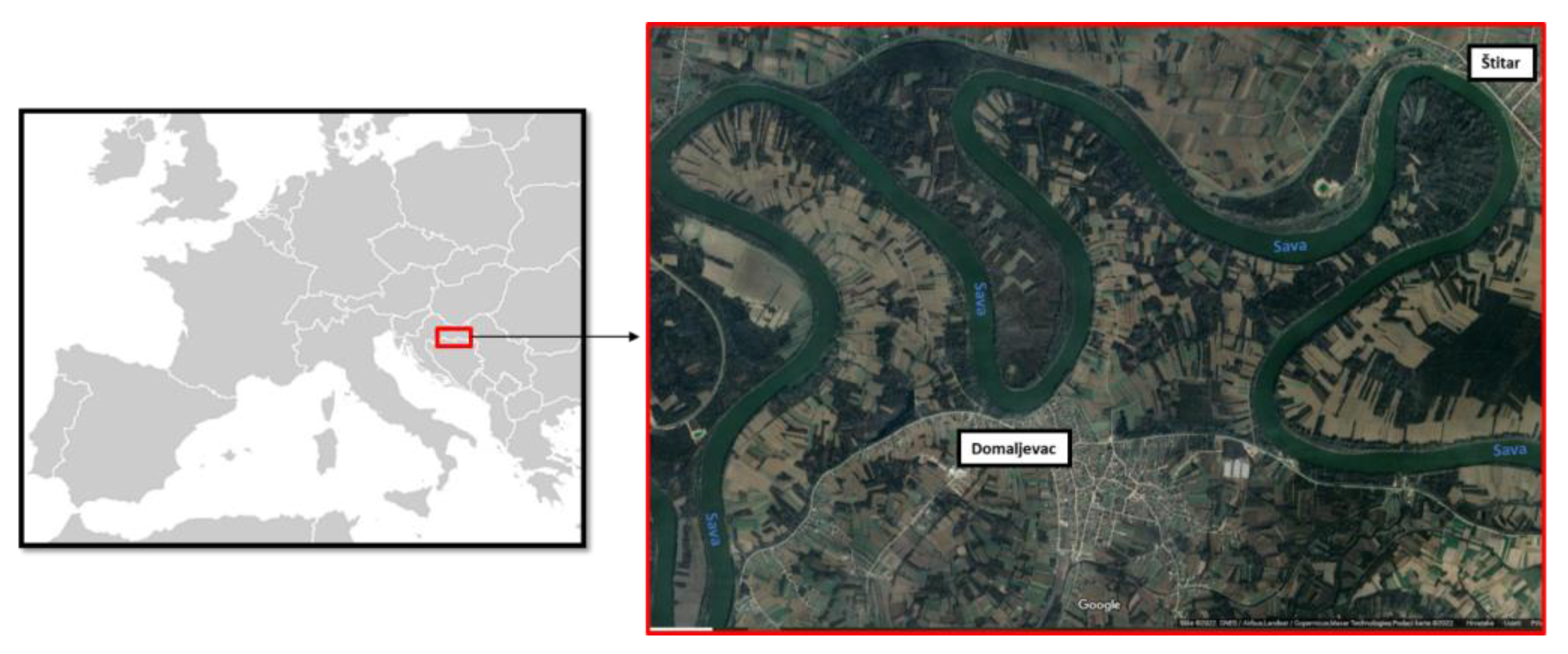
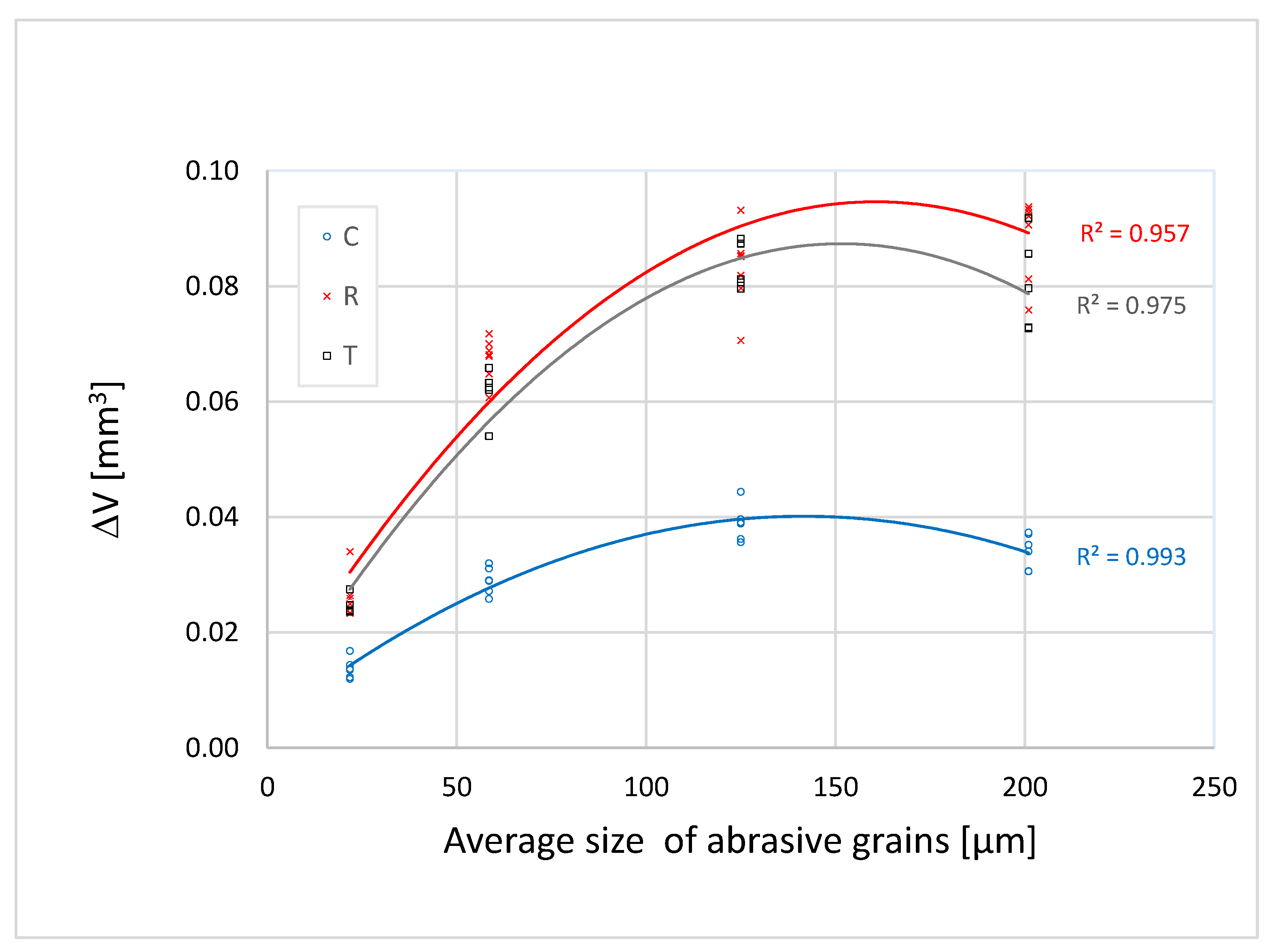
Effect of Abrasive Grain Size on the Abrasion Volume Loss of Subfossil and Recent Oak Wood in Three Characteristic Sections



Abstract
1. Introduction
2. Materials and Methods
Abrasion Volume Loss Tests
3. Results and Discussion
4. Conclusions
Author Contributions
Funding
Informed Consent Statement
Conflicts of Interest
References
- Baker, I. Wood. In Fifty Materials That Make the World; Baker, I., Ed.; Springer International Publishing AG Part of Springer Nature: Cham, Switzerland, 2018; pp. 255–261. [Google Scholar]
- Bednar, H.; Fengel, D. Physialische, chemische und strukturelle Eigenschafte von rezentem und subfossilem Eichenholz. Holz Roh-Werkstoff 1974, 32, 99–107. [Google Scholar] [CrossRef] [Scilit]
- Kránitz, K.; Sonderegger, W.; Bues, C.T.; Niemz, P. Effects of aging on wood: A literature review. Wood Sci. Technol. 2016, 50, 7–22. [Google Scholar] [CrossRef] [Scilit]
- Bürck, U.; Wagner, F.E.; Lerf, A. Mössbauer studies of subfossil oak. Hyperfine Interact 2011, 208, 105–110. Available online: https://link.springer.com/content/pdf/10.1007/s10751-011-0439-9.pdf (accessed on 1 December 2022). [CrossRef] [Scilit]
- Kolář, T.; Rybniček, M.; Střelcová, M.; Hedbávny, J.; Vit, J. The changes in chemical composition and properties of subfossil oak deposited in Holocene sediments. Wood Res. 2014, 59, 149–166. Available online: http://www.centrumdp.sk/wr/01/13.pdf (accessed on 1 December 2022).
- Krutul, D.; Radomski, A.; Zawadzki, J.; Zielenkiewicz, T.; Antczak, A. Comparison of the chemical composition of the fossil and recent oak wood. Wood Res. 2010, 55, 113–120. Available online: http://www.woodresearch.sk/articles/5-17-143435_WR201003_11krutul.pdf (accessed on 1 December 2022).
- Ghavidel, A.; Hofmann, T.; Bak, M.; Sandu, I.; Vasilache, V. Comparative archaeometric characterization of recent and historical oak (Quercus spp.) wood. Wood Sci. Technol. 2020, 54, 1121–1137. [Google Scholar] [CrossRef] [Scilit]
- Baar, J.; Paschová, Z.; Hofmann, T.; Kolář, T.; Koch, G.; Saake, B.; Rademacher, P. Natural durability of subfossil oak: Wood chemical composition changes through the ages. Holzforschung 2020, 74, 47–59. [Google Scholar] [CrossRef] [Scilit]
- Koch, G.; Melcher, E.; Lenz, M.-T.; Bauch, J. Biological and topochemical studies on the resistance of excavated oak piles (Quercus sp.) from a historical bridge in Bavaria. Holzforschung 2018, 72, 133–141. [Google Scholar] [CrossRef] [Scilit]
- Welling, J.; Schwarz, T.; Bauch, J. Biological, chemical and technological characteristics of waterlogged archaeological piles (Quercus petraea (Matt.) Liebl.) of a medieval bridge foundation in Bavaria. Eur. J. Wood Prod. 2018, 76, 1173–1186. [Google Scholar] [CrossRef] [Scilit]
- Essert, S.; Rede, V.; Šokčević, Z. The bending modulus of elasticity of subfossil elm wood. Wood Res. 2018, 63, 239–248. Available online: http://www.woodresearch.sk/wr/201802/06.pdf (accessed on 1 December 2022).
- Von Kudela, J.; Reinprecht, L. Einfluss der Holzfeuchte auf die Druckfestigkeit von rezenten und subfossilen Eichenholz (Quercus robur L.). Holzforschung 1990, 44, 211–215. [Google Scholar] [CrossRef] [Scilit]
- Rede, V.; Essert, S.; Kodvanj, J. Annual ring orientation effect on bending strength of subfossil elm wood. J. Wood Sci. 2017, 63, 31–36. [Google Scholar] [CrossRef] [Scilit]
- Kolář, T.; Rybniček, M. Physical and mechanical properties of subfossil oak (Quercus, sp.) wood. Acta Univ. Agric. Silvic. 2010, 4, 123–133. [Google Scholar]
- Sinković, T.; Govorčin, S.; Dubravac, T.; Roth, V.; Sedlar, T. Comparison some physical and mechanical properties of abonos and recent oak (Quercus robur L.) (in Croatian). Šumarski List 2009, 11–12, 605–611. Available online: https://hrcak.srce.hr/clanak/69794 (accessed on 1 December 2022).
- Straže, A.; Dremelj, M.; Žveplan, E.; Čufar, K. Changes in physical properties of oak wood from historical constructions during service life. Wood 2018, 67, 5–14. [Google Scholar] [CrossRef] [Scilit]
- Bhushan, B. (Ed.) Modern Tribology Handbook; RS Press: Boca Raton, FL, USA; London, UK; New York, NY, USA; Washington, DC, USA, 2000. [Google Scholar] [CrossRef] [Scilit]
- Ohtani, T.; Inoue, A.; Tanaka, C. Abrasive wear properties of compressed sugi wood. J. Wood Sci. 2002, 48, 473–478. [Google Scholar] [CrossRef] [Scilit]
- Ohtani, T.; Kamasaki, K. Effect of microscopic tissue on three-body abrasion in cell structure of wood. Wear 2007, 262, 453–460. [Google Scholar] [CrossRef] [Scilit]
- Ohtani, T.; Kamasaki, K.; Tanaka, C. On abrasive wear property during three-body abrasion of wood. Wear 2003, 255, 60–66. [Google Scholar] [CrossRef] [Scilit]
- Ncube, E. Use of simple abrasive-wear resistance test device to assess the suitability of selected hardwoods for wood flooring. Sci. Res. Essay 2008, 3, 168–173. [Google Scholar] [CrossRef]
- Rede, V.; Essert, S.; Kocijan, M.; Dubravac, T. Influence of Ageing on Abrasion Volume Loss, Density, and Structural Components of Subfossil Oak. Appl. Sci. 2022, 12, 1814. [Google Scholar] [CrossRef] [Scilit]
- ISO 6344-2:2021; Coated Abrasives—Determination and Designation of Grain Size Distribution—Part 2: Macrogrit Sizes P12 to P220. ISO: Geneva, Switzerland, 2021.
- ISO 6344-3:2021; Coated Abrasives—Determination and Designation of Grain Size Distribution—Part 3: Microgrit Sizes P240 to P5000. ISO: Geneva, Switzerland, 2021.
- ISO 13061-1; Physical and Mechanical Properties of Wood. Test Methods for Small Clear Wood Specimens—Part 1. Determination of Moisture Content for Physical and Mechanical Tests. ISO: Geneva, Switzerland, 2014.
- >ISO 13061-2; Physical and Mechanical Properties of Wood. Test Methods for Small Clear Wood Specimens—Part 2. Determination of Density for Physical and Mechanical Tests. ISO: Geneva, Switzerland, 2014.
- Sin, I.-I.; Saka, N.; Suh, N.P. Abrasive wear mechanism and the grit size effect. Wear 1979, 55, 163–190. [Google Scholar] [CrossRef] [Scilit]
- Coronado, J.J.; Sinatora, A. Effect of abrasive size on wear of metallic materials and its relationship with microchips morphology and wear micromechanisms: Part 1. Wear 2011, 271, 1794–1803. [Google Scholar] [CrossRef] [Scilit]
- Coronado, J.J.; Sinatora, A. Effect of abrasive size on wear of metallic materials and its relationship with microchips morphology and wear micromechanisms Part 2. Wear 2011, 271, 1804–1812. [Google Scholar] [CrossRef] [Scilit]
- Coronado, J.J. Effect of Abrasive Size on Wear. In Abrasion Resistance of Materials; Adamiak, M., Ed.; InTech: Rijeka, Croatia, 2012. [Google Scholar] [CrossRef] [Scilit]
- Ohtani, T. The effects of mechanical parameters of the stress-strain diagram on wood abrasion. Wear 2008, 265, 1557–1564. Available online: https://www.sciencedirect.com/science/article/pii/S0043164808000811 (accessed on 1 December 2022). [CrossRef] [Scilit]
- Rede, V.; Essert, S.; Šokčević, Z. Effects of microstructural orientation on the abrasive wear resistance of subfossil elm wood in three orthogonal planes. Wear 2017, 380–381, 1–5. [Google Scholar] [CrossRef] [Scilit]

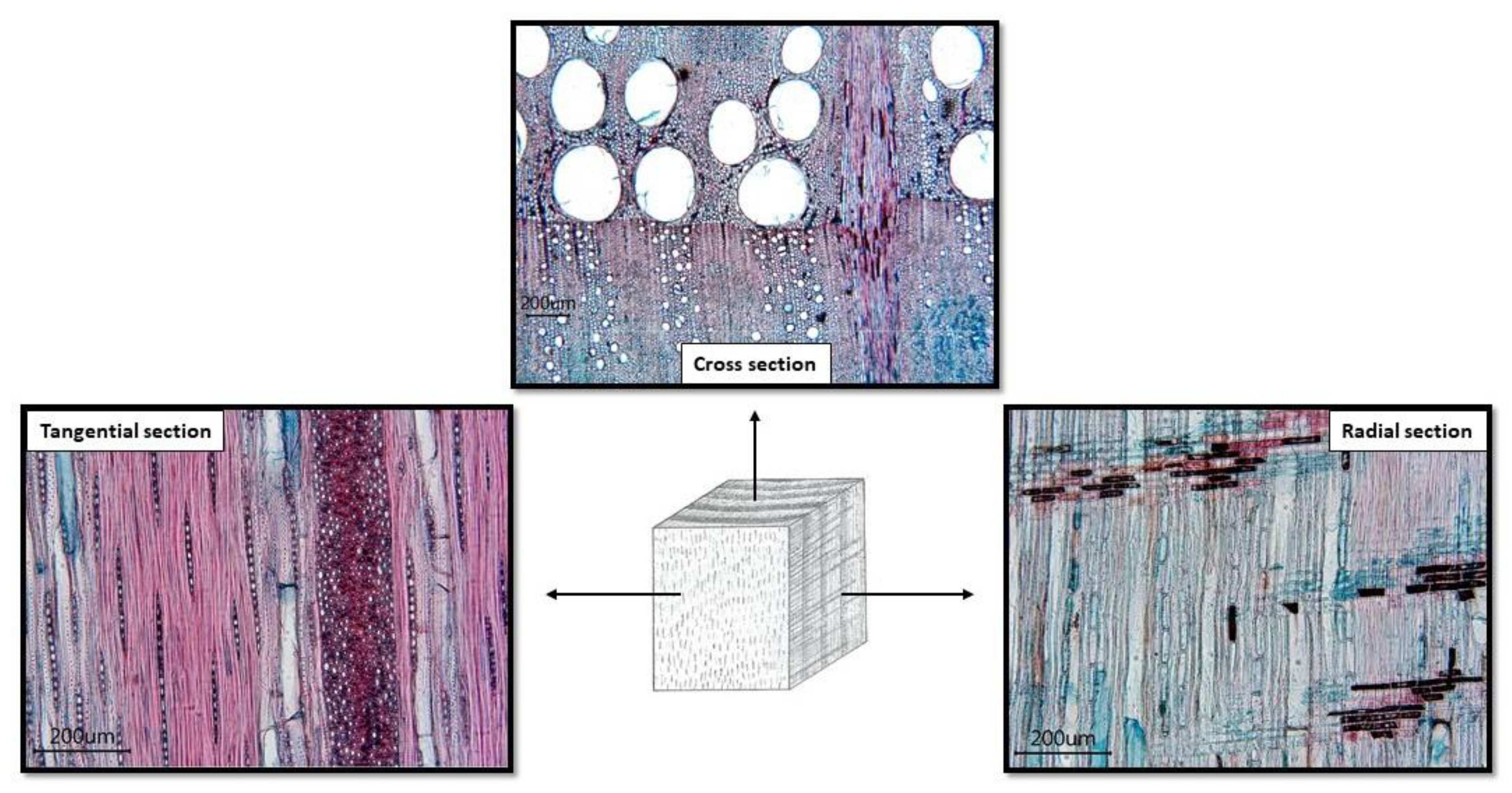
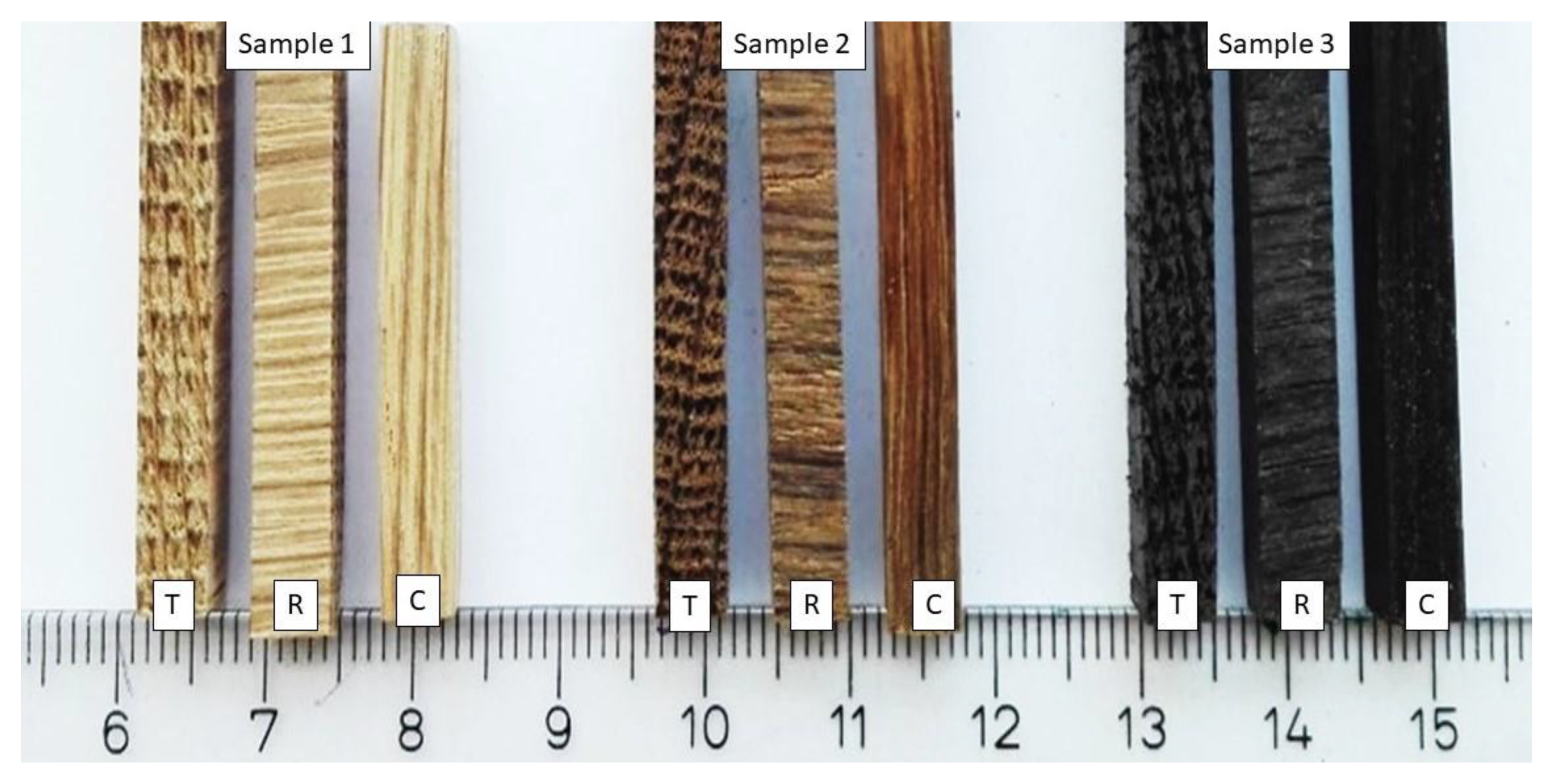
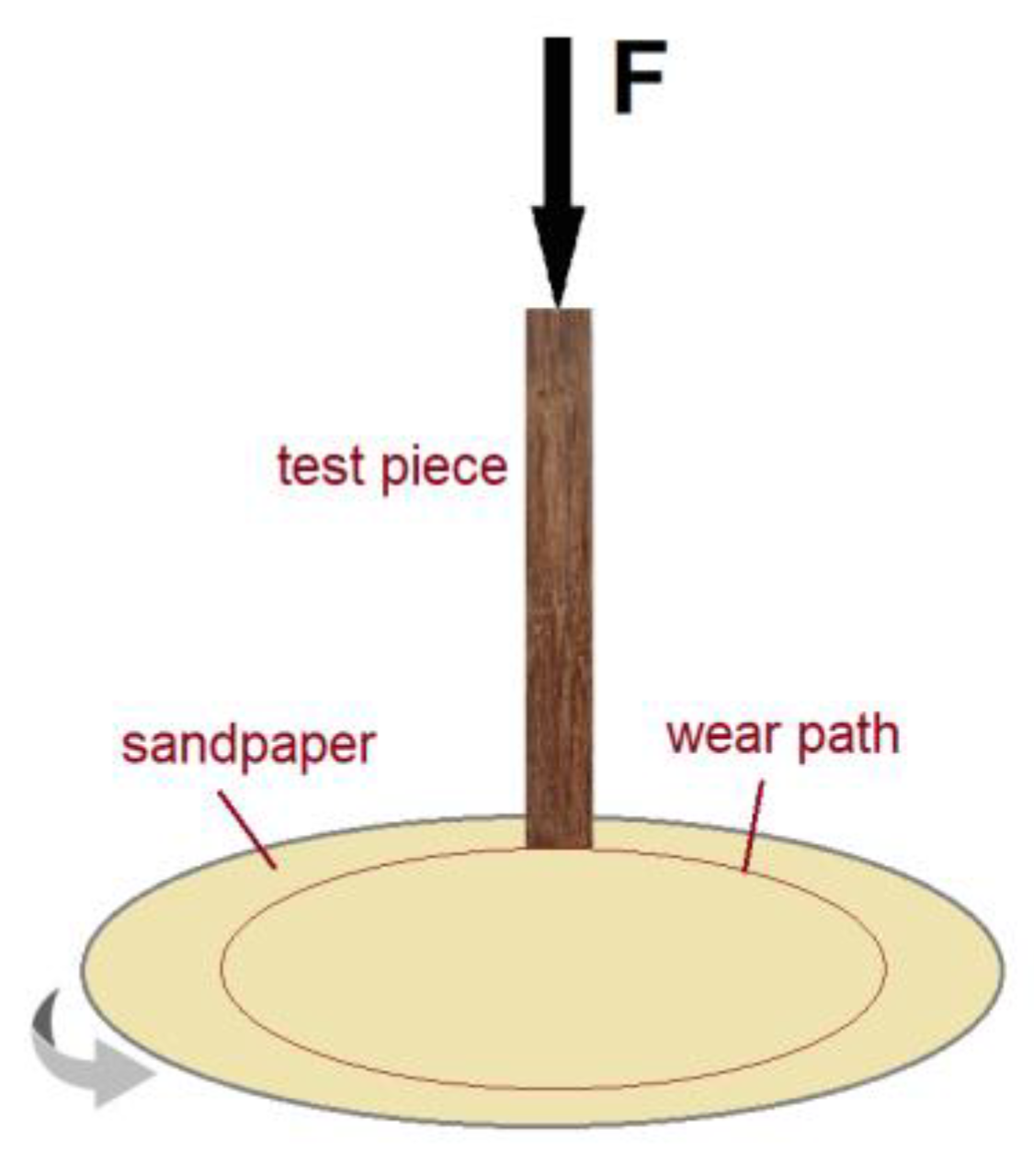

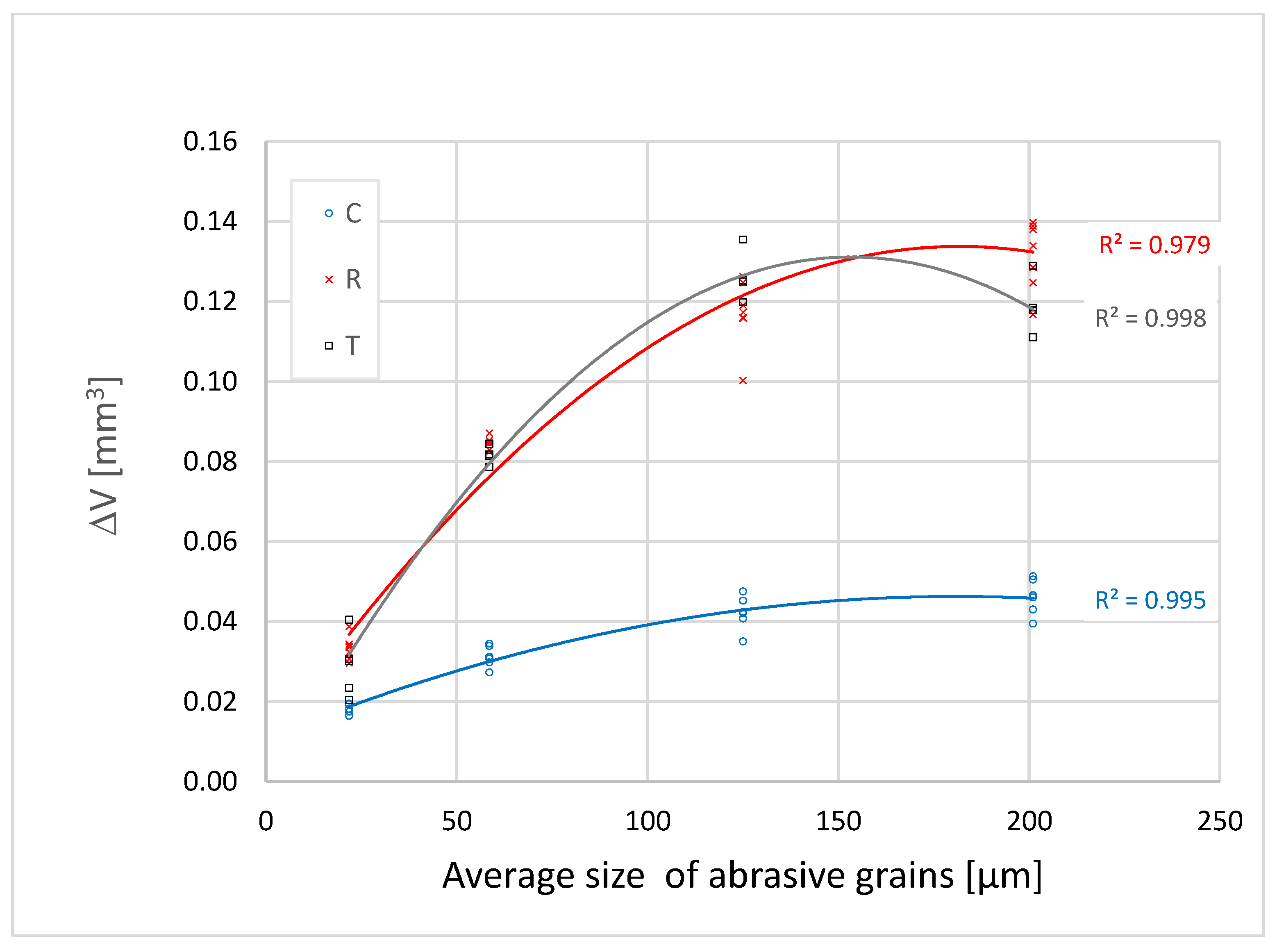
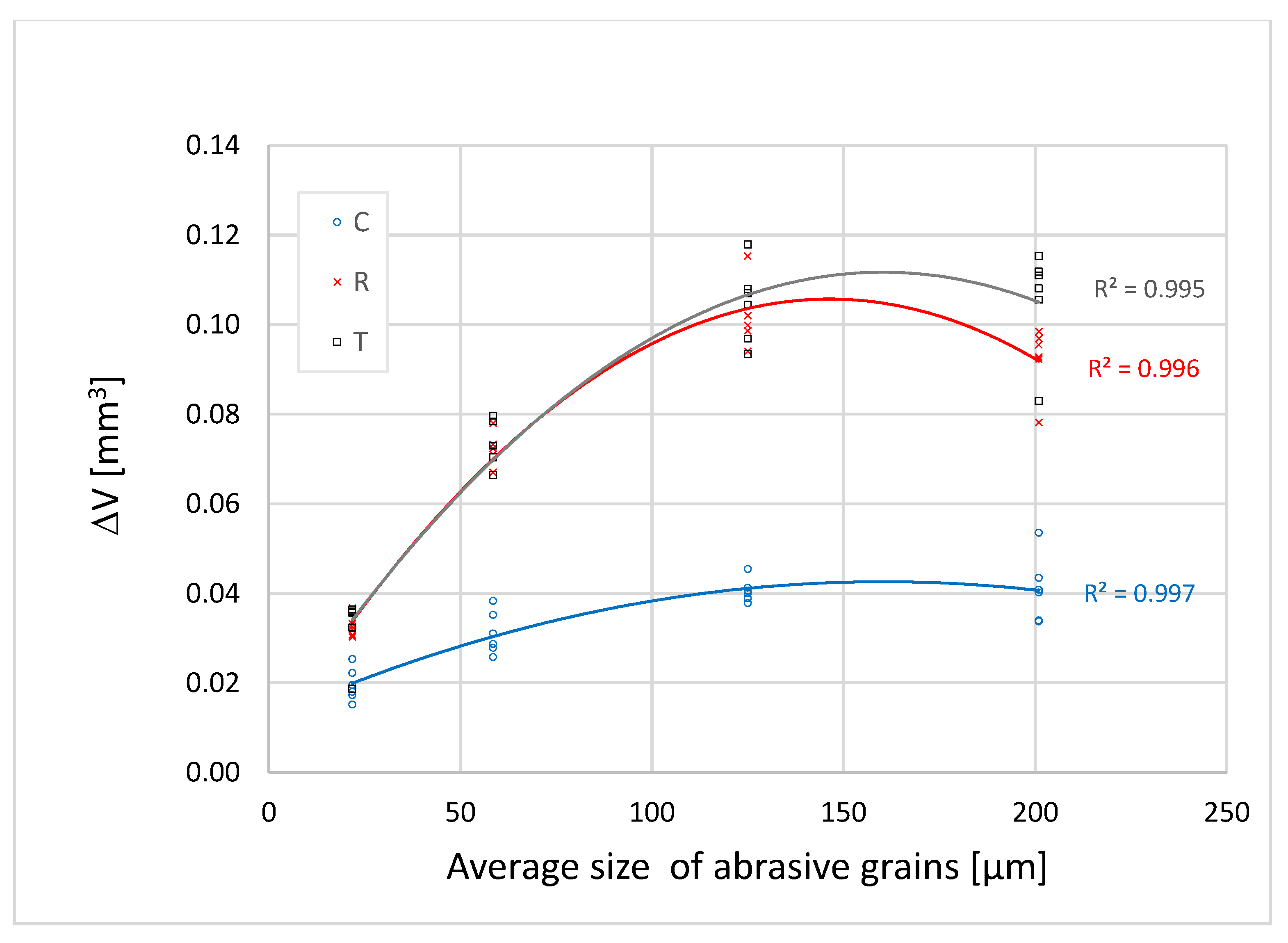

| Conventional 14C Age (BP)/Years | |
|---|---|
| Sample 2 | 1130 ± 50 |
| Sample 3 | 1840 ± 55 |
| Sandpaper Designation according to ISO [23,24] | Average Abrasive Grain Size [µm] |
|---|---|
| P 80 | 201 |
| P 120 | 125 |
| P 240 | 57 |
| P 800 | 22.5 |
| Δ12 (g/cm3) | At 12 % Moisture Content | |||||||||||||||||||||
|---|---|---|---|---|---|---|---|---|---|---|---|---|---|---|---|---|---|---|---|---|---|---|
| Δm800 (g) | Δm240 (g) | Δm120 (g) | Δm80 (g) | |||||||||||||||||||
| Xp | SD | min | max | CV | Xp | SD | min | max | Xp | SD | min | max | Xp | SD | min | max | Xp | SD | min | max | ||
| C | 0.82 | 0.040 | 0.80 | 0.87 | 4.89 | 0.01 | 0.001 | 0.01 | 0.01 | 0.02 | 0.001 | 0.02 | 0.03 | 0.03 | 0.001 | 0.03 | 0.03 | 0.03 | 0.002 | 0.03 | 0.03 | |
| 1 | R | 0.84 | 0.015 | 0.82 | 0.86 | 1.74 | 0.02 | 0.004 | 0.02 | 0.03 | 0.06 | 0.003 | 0.05 | 0.06 | 0.07 | 0.004 | 0.07 | 0.08 | 0.08 | 0.005 | 0.07 | 0.08 |
| T | 0.86 | 0.016 | 0.84 | 0.88 | 1.91 | 0.02 | 0.001 | 0.02 | 0.02 | 0.05 | 0.004 | 0.05 | 0.06 | 0.07 | 0.006 | 0.06 | 0.08 | 0.07 | 0.006 | 0.06 | 0.08 | |
| C | 0.73 | 0.025 | 0.70 | 0.76 | 3.39 | 0.01 | 0.001 | 0.01 | 0.01 | 0.02 | 0.001 | 0.02 | 0.02 | 0.03 | 0.003 | 0.03 | 0.03 | 0.03 | 0.003 | 0.03 | 0.04 | |
| 2 | R | 0.72 | 0.020 | 0.71 | 0.76 | 2.79 | 0.02 | 0.001 | 0.02 | 0.02 | 0.06 | 0.001 | 0.06 | 0.06 | 0.08 | 0.007 | 0.07 | 0.09 | 0.10 | 0.005 | 0.10 | 0.10 |
| T | 0.71 | 0.023 | 0.69 | 0.73 | 3.25 | 0.02 | 0.006 | 0.01 | 0.03 | 0.06 | 0.002 | 0.06 | 0.06 | 0.09 | 0.004 | 0.08 | 0.09 | 0.08 | 0.006 | 0.08 | 0.09 | |
| C | 0.75 | 0.025 | 0.76 | 0.78 | 3.35 | 0.01 | 0.003 | 0.01 | 0.02 | 0.02 | 0.003 | 0.02 | 0.03 | 0.03 | 0.001 | 0.03 | 0.03 | 0.03 | 0.005 | 0.03 | 0.04 | |
| 3 | R | 0.78 | 0.007 | 0.78 | 0.79 | 0.91 | 0.03 | 0.002 | 0.02 | 0.03 | 0.06 | 0.003 | 0.05 | 0.06 | 0.08 | 0.006 | 0.07 | 0.09 | 0.07 | 0.006 | 0.06 | 0.08 |
| T | 0.74 | 0.018 | 0.72 | 0.77 | 2.47 | 0.02 | 0.005 | 0.01 | 0.03 | 0.05 | 0.004 | 0.05 | 0.06 | 0.08 | 0.006 | 0.07 | 0.09 | 0.08 | 0.008 | 0.06 | 0.08 | |
| Sample | Ratio | Average Size of Abrasive Grains (µm) | |||
|---|---|---|---|---|---|
| 21.8 | 58.5 | 125.0 | 201.0 | ||
| C/R | 0.5 | 0.4 | 0.5 | 0.4 | |
| 1 | C/T | 0.6 | 0.5 | 0.5 | 0.4 |
| R/T | 1.1 | 1.1 | 1.0 | 1.1 | |
| C/R | 0.6 | 0.4 | 0.4 | 0.3 | |
| 2 | C/T | 0.6 | 0.4 | 0.3 | 0.4 |
| R/T | 1.1 | 1.0 | 0.9 | 1.1 | |
| C/R | 0.6 | 0.4 | 0.4 | 0.4 | |
| 3 | C/T | 0.6 | 0.4 | 0.4 | 0.4 |
| R/T | 1.0 | 1.0 | 1.0 | 0.9 | |
Disclaimer/Publisher’s Note: The statements, opinions and data contained in all publications are solely those of the individual author(s) and contributor(s) and not of MDPI and/or the editor(s). MDPI and/or the editor(s) disclaim responsibility for any injury to people or property resulting from any ideas, methods, instructions or products referred to in the content. |
© 2023 by the authors. Licensee MDPI, Basel, Switzerland. This article is an open access article distributed under the terms and conditions of the Creative Commons Attribution (CC BY) license (https://creativecommons.org/licenses/by/4.0/).
Share and Cite
Essert, S.; Rede, V.; Barišić, J. Effect of Abrasive Grain Size on the Abrasion Volume Loss of Subfossil and Recent Oak Wood in Three Characteristic Sections. Materials 2023, 16, 432. https://doi.org/10.3390/ma16010432
Essert S, Rede V, Barišić J. Effect of Abrasive Grain Size on the Abrasion Volume Loss of Subfossil and Recent Oak Wood in Three Characteristic Sections. Materials. 2023; 16(1):432. https://doi.org/10.3390/ma16010432
Chicago/Turabian StyleEssert, Sara, Vera Rede, and Josip Barišić. 2023. "Effect of Abrasive Grain Size on the Abrasion Volume Loss of Subfossil and Recent Oak Wood in Three Characteristic Sections" Materials 16, no. 1: 432. https://doi.org/10.3390/ma16010432
APA StyleEssert, S., Rede, V., & Barišić, J. (2023). Effect of Abrasive Grain Size on the Abrasion Volume Loss of Subfossil and Recent Oak Wood in Three Characteristic Sections. Materials, 16(1), 432. https://doi.org/10.3390/ma16010432