Next Article in Journal
Enhancing Hydrogenotrophic Methanation in a Bentonite-Amended Bubble Reactor Under Mesophilic Conditions
Previous Article in Journal
Hydrodynamic Simulations of a 2MW Offshore Solar Farm with Floating Breakwater Protection
 
 
Due to scheduled maintenance work on our servers, there may be short service disruptions on this website between 11:00 and 12:00 CEST on March 28th.
Article

Parameter Optimization of Tunnel Oxide Passivated Back Contact (TBC) Solar Cells

1
School of Materials Science and Engineering, Sun Yat-sen University, Guangzhou 510006, China
2
Institute for Solar Energy System, Sun Yat-sen University, Guangzhou 510006, China
*
Authors to whom correspondence should be addressed.
Energies 2026, 19(7), 1612; https://doi.org/10.3390/en19071612
Submission received: 15 February 2026 / Revised: 21 March 2026 / Accepted: 23 March 2026 / Published: 25 March 2026
(This article belongs to the Special Issue Solar Cells: Materials Design and Performance Optimization)

Abstract

Traditional simulation work often starts from the study of the impact of a single factor on device performance to obtain the optimal value of that factor and then regards the combination of the optimal values of each factor as the optimization condition. Obviously, this approach ignores the impacts of the interactions among factors on device performance. To address this issue, this paper uses Quokka3 v2.6.0 and JMP Pro 17.0.0 to perform device simulation and parameter optimization research on tunnel oxide passivated back contact (TBC) solar cells. First, Quokka3 was employed to investigate the effects of silicon wafer properties, rear-side passivation and contact characteristics, and rear-side geometry on the performance of TBC solar cells. Subsequently, a total of 625 simulations were performed by using Quokka3 with four factors (wafer thickness, wafer resistivity, P/N ratio, and pitch) at five levels. Finally, JMP Pro was used to analyze the simulation results statistically. It was found that the pitch, P/N ratio, quadratic power terms, quadratic interaction terms except the interaction between wafer thickness and resistivity, cubic power terms, and some cubic interaction terms all have significant impact on power conversion efficiency (PCE). JMP Pro predicted that the TBC solar cell could achieve the maximum PCE of 26.784% under the conditions of wafer thickness = 143.25 μm, wafer resistivity = 1.09 Ω·cm, P/N ratio = 1.94, and pitch = 380 μm.

1. Introduction

With the growth of population and social progress, the consumption of fossil fuels and the resulting environmental pollution are rapidly increasing. To mitigate environmental pollution and promote sustainable development, extensive research on renewable energy sources, including solar energy, wind energy, tidal energy, etc., is being carried out worldwide. According to predictions by the International Energy Agency (IEA) [1], renewable energy will account for 46% of global power generation by 2030, with wind and solar photovoltaic (PV) generation together contributing 30%. Moreover, solar PV is projected to become the most important source of renewable electricity, followed by wind power, both surpassing hydropower.
Crystalline silicon (c-Si) solar cells have long dominated the PV market due to their high efficiency, excellent stability, long lifetime, abundant material resources, and mature manufacturing processes. According to the International Technology Roadmap for Photovoltaics (ITRPV) [2], in 2024, c-Si solar cells accounted for approximately 98% of the market share, with the remaining share being occupied by thin-film technologies. Furthermore, Czochralski-grown monocrystalline silicon (Cz-Si) wafers captured the entire market share of silicon wafers for c-Si solar cells, with n-type wafers accounting for about 70%. Additionally, n-type TOPCon (Tunnel Oxide Passivated Contact) solar cells surpassed p-type PERC (Passivated Emitter and Rear Cell) solar cells in market share for the first time and will maintain this leadership at least until 2032. Among n-type Cz-Si solar cells, silicon heterojunction (SHJ) and back contact (BC) solar cells also occupied a certain market share. To further enhance the power conversion efficiency (PCE) of c-Si solar cells, TOPCon, SHJ, and BC technologies have been combined to form tunnel oxide passivated back contact (TBC) [3], heterojunction back contact (HBC) [4], and hybrid interdigitated back contact (HIBC) [5] solar cells and have become the current research focus.
As the TOPCon solar cell is the current mainstream technology, it is of great practical significance to study TBC solar cells that combine TOPCon and BC technologies, when considering the equipment compatibility and cost for upgrading to next-generation technology. As far as research on p-type TBC solar cells is concerned, Krügener et al. [6] demonstrated that highly doped n-type POLO (polycrystalline silicon on oxide) junctions can simultaneously provide low contact resistivity, excellent surface passivation, and strong impurity gettering effects, which effectively improve the Shockley–Read–Hall (SRH) lifetime of silicon wafers. By integrating POLO passivated contacts into an interdigitated back contact (IBC) architecture, a p-type TBC solar cell with a PCE of 25% was achieved. Subsequent studies further improved device performance and clarified the major loss mechanisms. Haase et al. [7,8] fabricated POLO-IBC cells with optimized passivated contacts and laser contact opening processes, achieving a PCE of up to 26.1%. Their studies also indicated that recombination in peripheral regions and series resistance are important contributors to power losses. Hollemann et al. [9,10] further investigated the influence of silicon wafer properties and the intrinsic polycrystalline silicon (poly-Si) isolation region between the p+ and n+ contacts. Their results showed that the width of the intrinsic poly-Si region plays a critical role in suppressing recombination through the p–i–n poly-Si diode and that appropriate design of this region is essential to achieving high PCE. In addition, alternative fabrication approaches for passivated contacts have also been explored. Mertens et al. [11] employed plasma-enhanced chemical vapor deposition (PECVD)-grown SiOxNy and SiOx as interfacial oxides combined with poly-Si passivated contacts, achieving PCEs of 23.8% and 23.7%, respectively. Their analysis suggested that further improvements in contact resistance, laser contact opening fraction, and wafer resistivity could enable PCE exceeding 25%.
In terms of research on n-type TBC solar cells, Yang et al. [12] demonstrated n-type TBC solar cells using ion-implanted poly-Si/SiO2 passivated contacts as carrier-selective contacts. By optimizing rear contact isolation and front optical design, a PCE of 23.0% was achieved. Their results also showed that proper electrical isolation between emitter and back surface field (BSF) regions is essential to suppressing shunt losses. In addition to device fabrication, several studies have focused on optical and structural optimization of n-type TBC cells. For example, Tong et al. [3] improved the optical performance of TBC cells by introducing hierarchical front-side texturing and nanostructured polished rear surface in the gap region, which effectively reduces optical losses. Moreover, numerical simulations have also been used to investigate the design principles of n-type TBC solar cells. Cao et al. [13] analyzed the influence of key electrical parameters on device performance using Quokka3 simulations and showed that high-efficiency TBC cells require high-lifetime silicon wafers, appropriate wafer resistivity, and excellent surface passivation. Their results also indicated that the optimal proportion of the p-type contact area depends strongly on the device pitch, reflecting the coupling between rear contact geometry and carrier transport.
From the above literature review, it can be seen that previous experimental investigations on TBC solar cells have mainly focused on p-type POLO-IBC structures, while experimental reports on n-type TBC solar cells, which generally offer higher carrier lifetime and greater efficiency potential, remain relatively limited. In addition, the optimization of TBC solar cells involves many material and structural parameters, including wafer thickness, resistivity, surface passivation quality, contact resistivity, rear contact geometry, the p- and n-region area ratio (P/N ratio), gap region width, diffusion region sheet resistance, etc. Experimental optimization of these parameters is both time-consuming and costly. In contrast, numerical simulation can greatly reduce these costs. Among available tools, Quokka3 is a specialized 3D simulation software for c-Si solar cells that can output similar simulation results to Sentaurus TCAD but is easier to use and has faster simulation speed [14]. It has been widely used for simulating various c-Si solar cells, such as PERC [15], TOPCon [16], SHJ [17], IBC [18], TBC [13], HBC [19], HIBC [5], etc.
However, a significant knowledge gap exists in current modeling efforts. Traditional simulation approaches, including previous optimization studies on TBC cells [13], typically optimize one single parameter at a time while keeping all other parameters constant. This single-variable methodology inherently ignores the impact of interactions between multiple parameters on cell performance. Therefore, simply combining individually optimized parameter values does not necessarily yield the true maximum PCE of the device.
To address this problem, we performed a systematic device simulation and parameter optimization study for n-type TBC solar cells using Quokka3 v2.6.0 combined with JMP Pro 17.0.0. First, based on the values and ranges of the parameters reported in the literature, Quokka3 was used to simulate the effects of silicon wafer properties (thickness, resistivity, and lifetime), rear-side passivation and contact characteristics, and rear-side geometry on the performance of TBC cells. Then, JMP Pro was used to perform statistical analysis on the results of 625 simulations conducted by Quokka3 based on an orthogonal experimental design, considering four key parameters (wafer thickness, wafer resistivity, P/N ratio, and pitch) at five levels each. The optimized parameter set predicted by the statistical model yields a maximum PCE of 26.784%, corresponding to a wafer thickness of 143.25 μm, a wafer resistivity of 1.09 Ω·cm, a P/N ratio of 1.94, and a pitch of 380 μm. Furthermore, a power loss analysis (PLA) was performed for the optimized device to identify the dominant power loss mechanisms. The results indicate that reducing rear surface recombination, SRH recombination, and bulk transport losses is critical to further improving the performance of TBC solar cells. These results provide useful insights into the parameter coupling effects in TBC solar cells and offer guidance for the design and optimization of high-efficiency devices.

2. Simulation Methodology

Quokka3 is a 3D simulation software tool for silicon solar cells which divides a solar cell into bulk, skin, contact, metal, and pad areas. Among them, the skin layer is a unique concept in Quokka3, which uses lumped parameters (e.g., sheet resistance and junction depth to represent the diffusion layer, and recombination current density and contact resistivity to represent the selective passivation contact layer) to characterize the properties of functional layers. When solving the 2D or 3D transport of charge carriers, skins are used as parameterized boundary conditions for numerical processing. Quokka3 discretizes the solution domain using structured, orthogonal, and non-equidistant mesh, and numerically solves the Poisson’s equation and current continuity equation using the finite element method. For the optical modeling of the TBC cells studied, we used the Text-Z model in Quokka3 [20,21].

Structure and Parameter Settings of TBC Solar Cells for Simulation

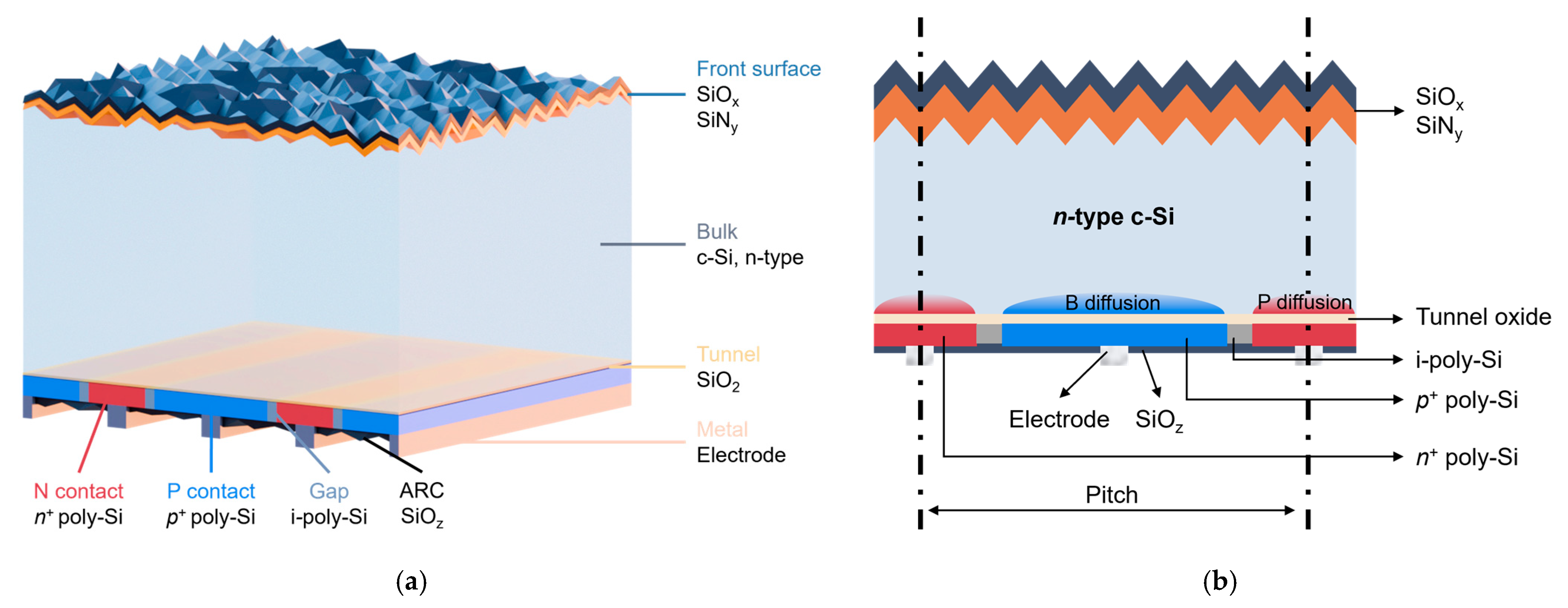
Figure 1a,b respectively show the 3D and 2D schematic diagrams of the structure of the simulated TBC solar cell. As shown in Figure 1, an n-type monocrystalline silicon wafer with front surface possessing random pyramid texture is employed as substrate. The SiOx (92 nm)/SiNy (61 nm) stack is used as a passivation and anti-reflection layer of the front surface [13]. Interdigitated boron-doped emitter and phosphorus-doped BSF regions are on the rear side. The passivated selective contacts for the p-type and n-type regions are provided by SiO2 (2 nm)/p+ poly-Si and SiO2 (2 nm)/n+ poly-Si, respectively, with the p+ and n+ poly-Si separated by an i-poly-Si gap. The rear surface is passivated by SiO2, and interdigitated silver electrodes are used as rear contacts. Table 1 lists the parameter settings used for the Quokka3 simulation of the TBC cell. It should be noted that in the controlled simulation experiments, the control variables take the “Ranges” in Table 1, while the fixed parameters take the “Values” in Table 1.
Notably, the parameter ranges and baseline values used in the Quokka3 simulations were carefully determined based on recent experimental or simulation studies of n-type TBC and related high-efficiency c-Si solar cells, as referenced in Table 1. Specifically, the ranges for wafer thickness (120–200 μm), wafer resistivity (0.7–1.5 Ω·cm), and wafer lifetime (1–20 ms) were taken from Refs. [4,13,22,23], which encompass the typical parameter ranges for n-type Cz-Si wafers widely used in the PV industry. The ranges of other parameters were mainly adopted from the recent device simulation study of n-type TBC solar cells reported in Ref. [13]. Baseline values were either taken directly from the literature (such as gap width, recombination current density, contact resistivity, etc.) or chosen as the midpoint of their ranges to represent typical conditions (e.g., wafer thickness, wafer resistivity, and SRH lifetime). For those parameters that strongly affect device performance, like pitch and P/N ratio, the baseline values were selected to correspond to high-performance devices reported in previous studies.

3. Results and Discussion

3.1. Effects of Different Parameters on Performance

3.1.1. Effects of Silicon Wafer Properties

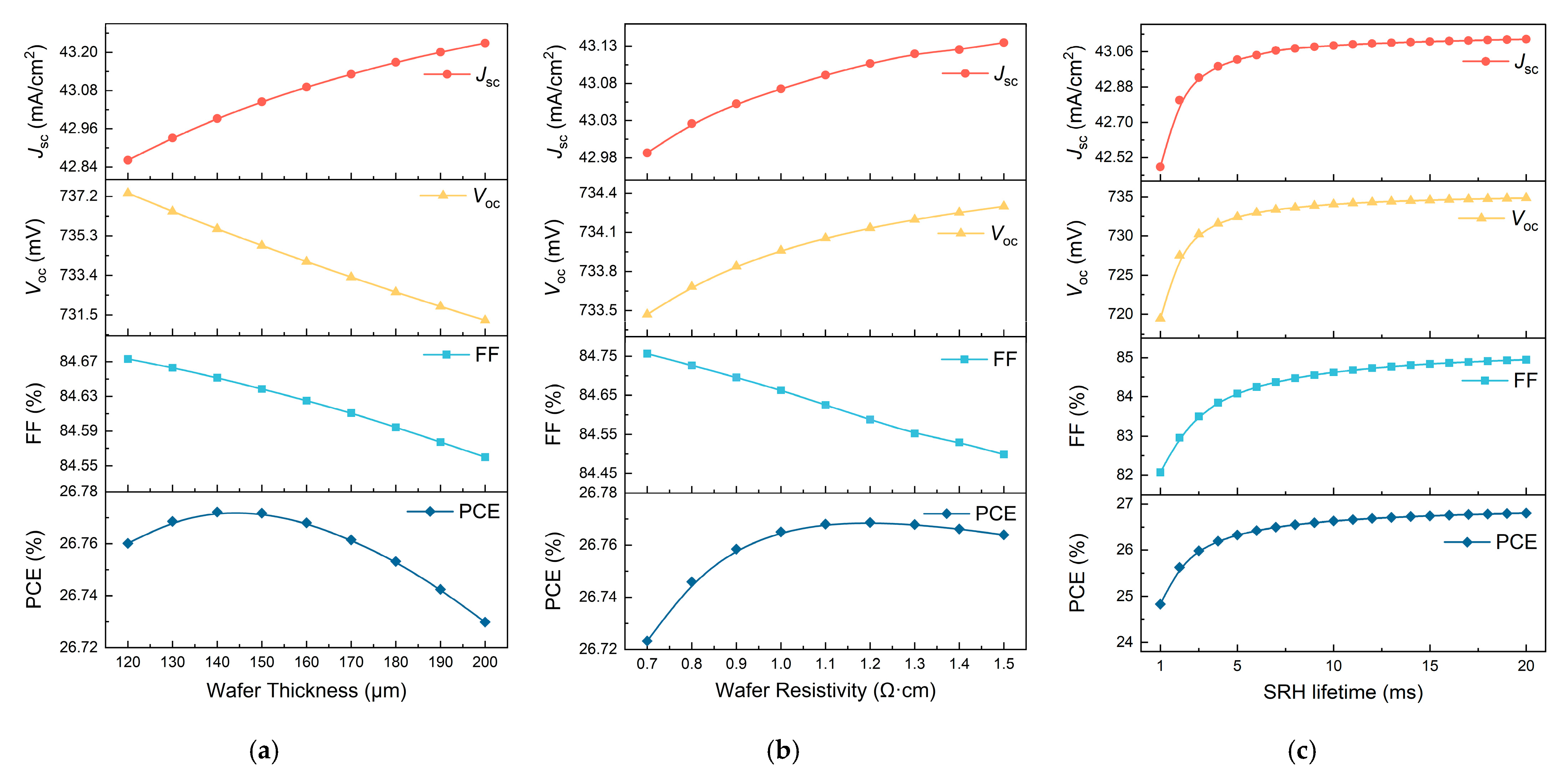
Figure 2a shows the variation in the illuminated J-V characteristic parameters (JSC, VOC, FF, and PCE) of the TBC cell with wafer thickness. As shown in Figure 2a, JSC increases monotonically with the increase in wafer thickness, while VOC and FF decrease monotonically. Consequently, the PCE of the TBC cell first increases and then decreases. The increase in JSC can be attributed to the rise in the number of absorbed photons and photogenerated carriers with the increase in wafer thickness, whereas the decrease in VOC and FF is due to enhanced recombination caused by the longer carrier transport path. At lower wafer thickness (thickness < 140 μm), the PCE improvement is dominated by the increase in JSC. At higher wafer thickness (thickness > 140 μm), the PCE decline is governed by the decrease in VOC and FF. The maximum PCE achieved at a wafer thickness of 140 μm results from a balance between the rise in the number of photogenerated carriers and enhanced recombination loss induced by the increase in transport path, which is basically consistent with Ref. [3]. It should be noted that the optimal wafer thickness is closely related to wafer resistivity, bulk lifetime, rear-side geometrical sizes, front and rear surface passivation quality, and contact region passivation quality. The optimal wafer thickness of 140 μm shown in Figure 2a was obtained under the condition that other parameters take the baseline values listed in Table 1. Figure 2b shows the dependence of the illuminated J-V characteristic parameters on wafer resistivity. As illustrated in Figure 2b, with the increase in wafer resistivity, both JSC and VOC increase monotonically, whereas FF decreases monotonically, resulting first in the rise in PCE and then in its fall. The highest PCE is achieved at a resistivity of 1.2 Ω·cm, which is similar to the result reported in Ref. [23]. An increase in wafer resistivity implies a reduction in wafer doping concentration. Lower doping concentration corresponds to lower defect density and recombination losses, thus leading to an increase in both JSC and VOC. On the other hand, the increase in wafer resistivity leads to the increase in series resistance, thus the decrease in FF. Figure 2c shows the illuminated J-V characteristic parameters as a function of SRH lifetime. As shown in Figure 2c, when the SRH lifetime is small (<5 ms), JSC, VOC, FF and PCE increase rapidly with the increase in SRH lifetime. At higher SRH lifetime (>5 ms), these four parameters increase slowly with SRH lifetime. This indicates that when the wafer quality is poor, SRH lifetime is the main PCE limiting factor.

3.1.2. Effects of Rear-Side Passivation and Contact Properties

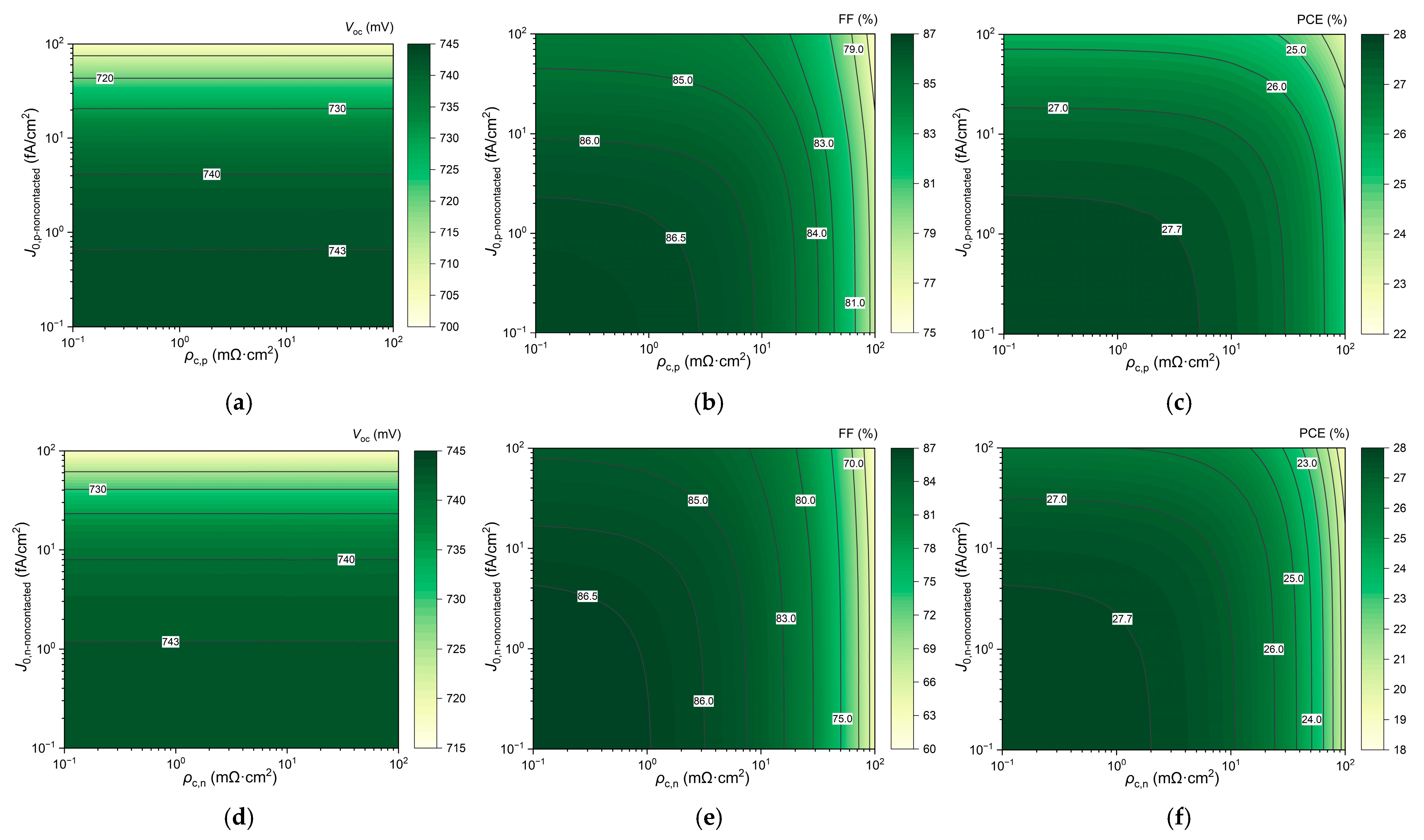
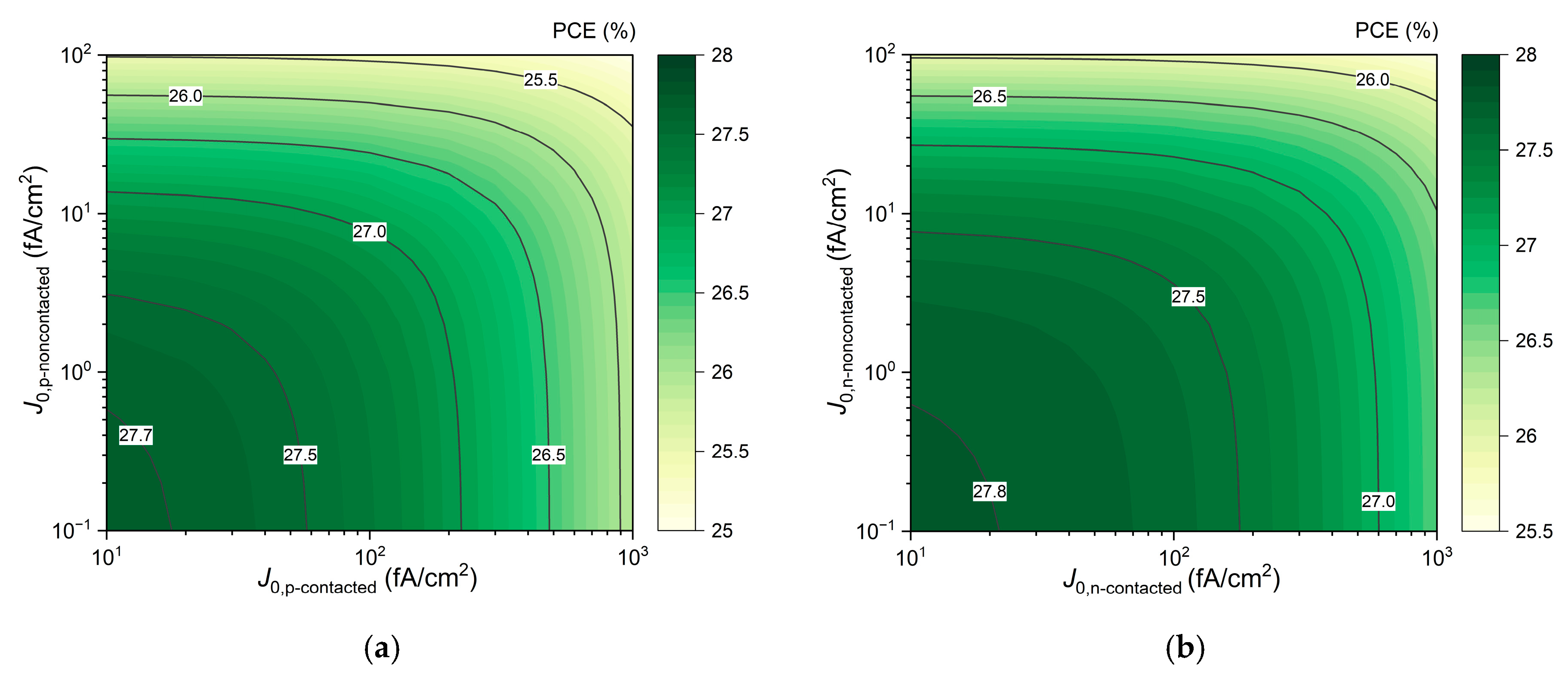
Passivation and contact properties are two key factors determining the PCE of TBC cells. Therefore, the influence of the passivation (represented by recombination current density J0,p/n-noncontacted) and contact characteristics (characterized by contact resistivity ρc,p/n) of the p-type and n-type regions on the performance of TBC cells was investigated in detail. Figure 3a–c show the VOC, FF and PCE as functions of the p-type region’s contact resistivity (ρc,p) and recombination current density (J0,p-noncontacted), respectively. From Figure 3a, it can be seen that VOC is almost independent of ρc,p but decreases significantly with the increase in J0,p-noncontacted, especially when J0,p-noncontacted exceeds 10 fA/cm2. This indicates that VOC is mainly governed by the passivation quality of the p-type region. To obtain higher VOC, improving p-type region passivation is crucial. Compared with VOC, both FF and PCE are simultaneously affected by ρc,p and J0,p-noncontacted, as shown in Figure 3b,c. To achieve high-efficiency TBC cells, low J0,p-noncontacted (≤10 fA/cm2) and ρc,p (≤10 mΩ·cm2) are required. Furthermore, the passivation and contact characteristics of the n-type region have similar effects on the performance of TBC cells as those of the p-type region, as shown in Figure 3d–f. According to previous reports [8,27], the passivation quality of the p-type region is generally inferior to that of the n-type region. Therefore, improving the p-type region’s passivation quality is particularly important for achieving high-efficiency TBC cells. In addition, passivation of the metal contact area (J0,p/n-contacted) is equally important, and its impact on the performance of TBC cells is similar to that of the passivation of the non-metallized area (J0,p/n-noncontacted), as shown in Figure 4.

3.1.3. Effects of Rear-Side Geometrical Sizes and Sheet Resistance of Diffusion Zones

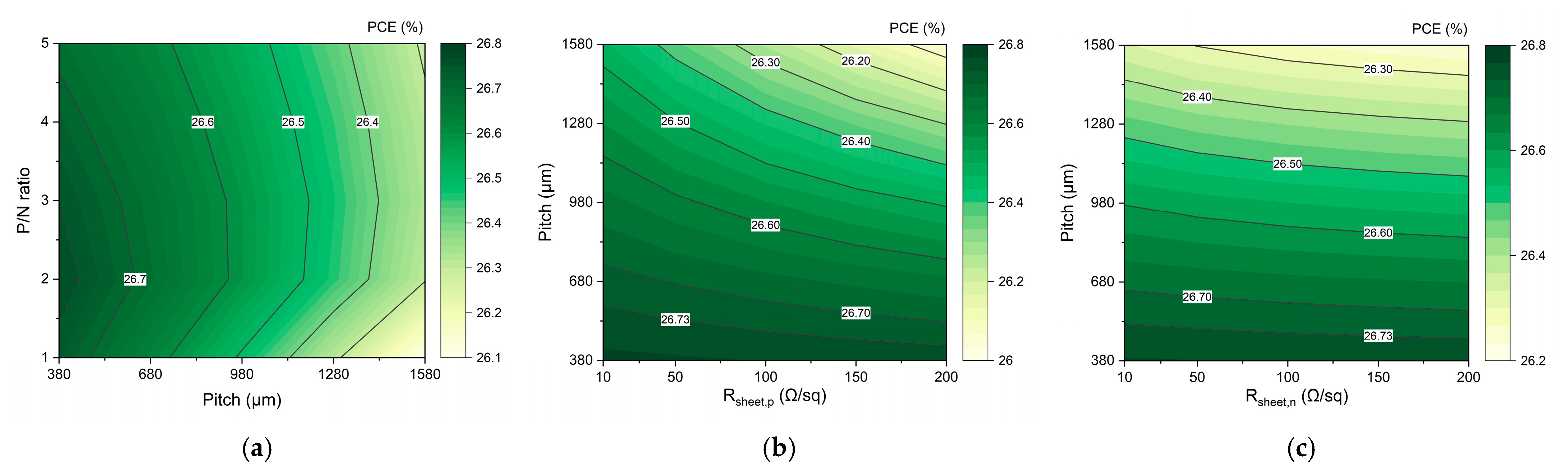
The rear-side geometrical sizes and sheet resistance of diffusion regions (Rsheet,p/n) are important parameters affecting the performance of TBC cells, with the former including the width of the p-type region, n-type region and gap region. The gap region aims to separate the p-type region from the n-type region; thus its width should be as small as possible while ensuring electrical isolation. According to Refs. [25,26], a gap width of 40 µm was selected in this work. When using n-type c-Si wafers, the p-type region serves as the emitter; therefore the width of the p-type region must be larger than that of the n-type region to achieve ideal PCE [3,13]. In this section, we investigate the impacts of key parameters, i.e., the P/N ratio (the area ratio of the p-type region to the n-type region), Rsheet,p/n, and pitch (including the width of one p-type region, one n-type region and two gap regions, as shown in Figure 1b), on the PCE of TBC cells.
Figure 5a shows the influence of the P/N ratio and pitch on the PCE of TBC cells. As shown in Figure 5a, at small pitches (380–980 µm), the highest PCE is achieved when the P/N ratio is about 2, while at large pitches (1280–1580 µm), the highest PCE is obtained when the P/N ratio is around 3. This conclusion is basically consistent with the finding of Ref. [13]. Additionally, the smaller the pitch, the higher the PCE. However, small pitch imposes higher requirements on process equipment and processing accuracy. Based on Refs. [23,24], 380 µm was chosen as the minimum pitch in this study. It should be noted that the above results were obtained under the conditions of Rsheet,p = 80 Ω/sq and Rsheet,n = 40 Ω/sq. Figure 5b,c show the influence of pitch and Rsheet,p as well as pitch and Rsheet,n on PCE under the condition of P/N ratio = 2, respectively. It can be seen from Figure 5b,c that the PCE decreases with the increase in pitch and Rsheet,p/n and that the pitch has more significant impact on PCE than Rsheet,p/n. In the case of large pitch, the effect of Rsheet,p on PCE is greater than that of Rsheet,n. When the pitch is large, a smaller Rsheet,p is required to obtain the ideal PCE due to the increase in the carrier lateral transport path. However, when the pitch is small, PCE exhibits higher tolerance to the variation in Rsheet,p.

3.2. Multi-Factor Interaction-Based Optimization (MFIO) and Results

3.2.1. Four-Factor, Five-Level Orthogonal Experimental Design

Traditional single-parameter optimization (SPO) is employed to sequentially optimize single parameters while keeping other parameters unchanged, treating the combination of the separately optimized parameter values as the optimal condition. However, the obtained optimal condition does not necessarily correspond to the highest PCE, because this method ignores the impact of the interaction of different factors on the results. In order to obtain the optimal condition corresponding to the highest PCE, we performed a four-factor, five-level orthogonal experiment, with wafer thickness (T), wafer resistivity (ρ), P/N ratio (R), and pitch (P) as the factors and PCE as the optimization goal. Table 2 lists the five levels of the four factors. According to the five levels of the four factors given in Table 2, a total of 625 simulations were conducted using Quokka3. The values of the four factors and the resulting illuminated I-V characteristic parameters including PCE are shown in Supplementary Table S1.

3.2.2. Prediction Model of Simulation Results

The simulation results were fitted by the least squares method to obtain the fitting model. The resulting fitting formula for PCE is
PCE = β 0 + β 1 · x 1 + β 2 · x 2 + β 3 · x 3 + β 4 · x 4 + β 12 · x 1 · x 2 + β 13 · x 1 · x 3 + β 14 · x 1 · x 4 + β 23 · x 2 · x 3 + β 24 · x 2 · x 4 + β 34 · x 3 · x 4 + β 11 · x 1 · x 1 + β 22 · x 2 · x 2 + β 33 · x 3 · x 3 + β 44 · x 4 · x 4 + β 122 · x 1 · x 2 · x 2 + β 134 · x 1 · x 3 · x 4 + β 114 · x 1 · x 1 · x 4 + β 144 · x 1 · x 4 · x 4 + β 223 · x 2 · x 2 · x 3 + β 233 · x 2 · x 3 · x 3 + β 234 · x 2 · x 3 · x 4 + β 224 · x 2 · x 2 · x 4 + β 334 · x 3 · x 3 · x 4 + β 344 · x 3 · x 4 · x 4 + β 111 · x 1 · x 1 · x 1 + β 222 · x 2 · x 2 · x 2 + β 333 · x 3 · x 3 · x 3 + β 444 · x 4 · x 4 · x 4
where x1 = (T − 160)/40, x2 = (ρ − 1.1)/0.4, x3 = (R − 3)/2, and x4 = (P − 980)/600, in which T, ρ, R and P denote wafer thickness, wafer resistivity, P/N ratio, and pitch, respectively. For clarity and conciseness, the fitted coefficients are listed in Supplementary Table S2. This model allows PCE to be estimated under different combinations of the four key parameters and thus serves as a quantitative guide for experimental design and optimization of n-type TBC cells.
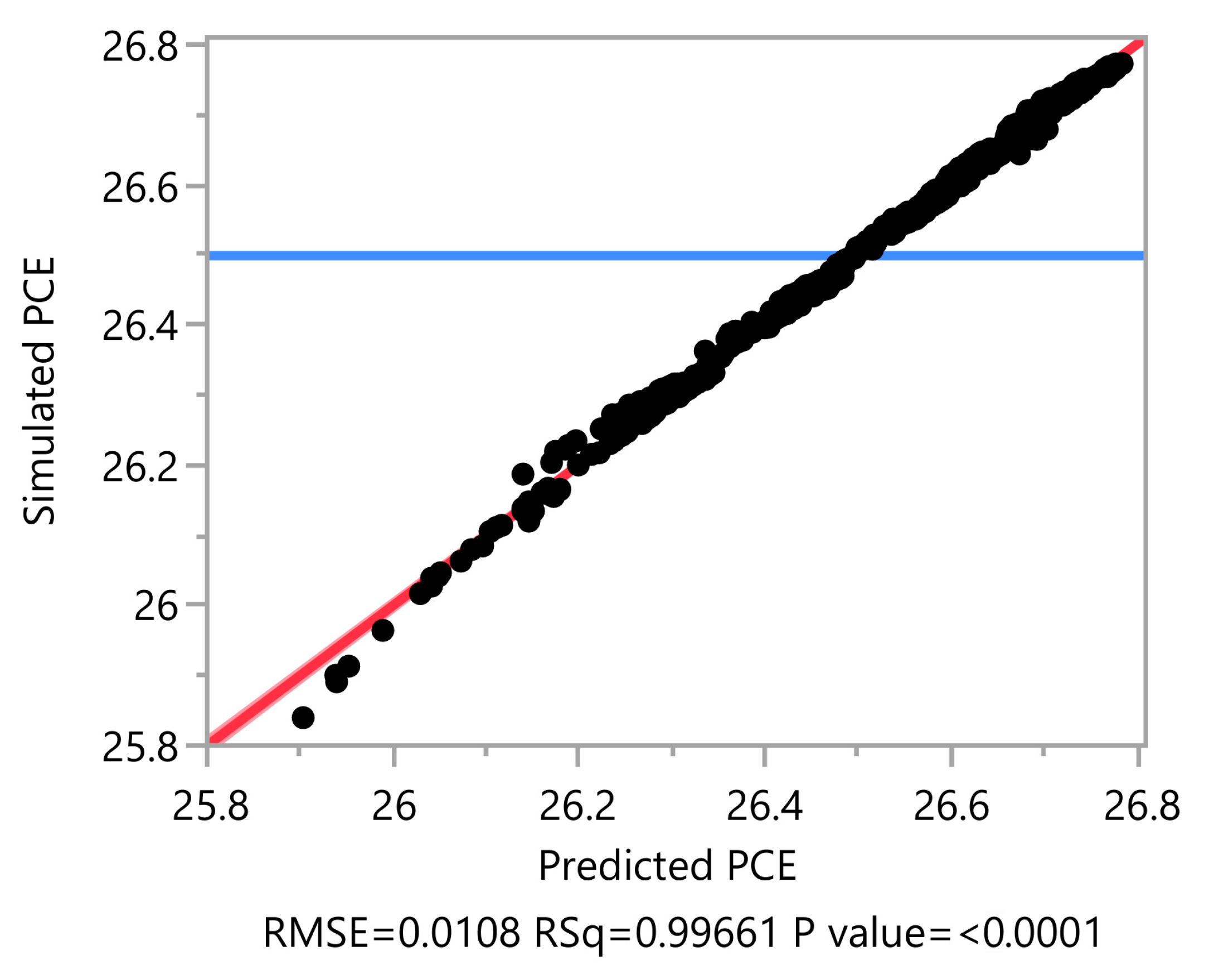
Figure 6 shows the simulated PCE and the PCE predicted by the fitting formula obtained by the least squares method. As shown in Figure 6, the simulated PCE values are represented by black dots, the possible area of predicted values is indicated by the red-shaded area, and the predicted PCE values are denoted by the red solid line with the slope of 1. Most of the black spots fall within the red-shaded area, indicating that the prediction model is relatively reliable. The blue solid line represents the average value of the simulated PCE. The R2 of the fitting model is 0.99661, p ≤ 0.0001, and the RMSE is 0.0108, further demonstrating that the prediction model can correctly estimate the PCE of TBC cells.

3.2.3. Variance Analysis of Fitting Results

Table 3 presents the variance analysis outcome of the fitting results. It can be seen from Table 3 that the pitch, P/N ratio, quadratic power terms, quadratic interaction terms except the interaction between wafer thickness and resistivity, cubic power terms, and some cubic interaction terms all have significant impact on PCE. Among the single factors, pitch has the most significant impact on PCE, followed by the P/N ratio. Among the quadratic power terms, the square of the P/N ratio shows the most significant impact on PCE. For the quadratic interaction terms, the interaction between the P/N ratio and pitch is the most significant, followed by the interaction between the P/N ratio and wafer resistivity. Among the cubic power terms, the cube of the P/N ratio exhibits the most significant effect on PCE. For the cubic interaction terms, the interaction between the square of the P/N ratio and pitch is the most pronounced. Notably, the LogWorth metric, where LogWorth = −log10(p-value), provides an effective way to evaluate and rank the relative importance of the parameters and their interactions. In this work, the p-values and corresponding LogWorth values for all terms were calculated using JMP Pro, as shown in Table 3. The results indicate that P, R2, R × P and P2 dominate the performance variation, followed by ρ × R, R2 × P, R3, ρ2, T2, T × P and R. Furthermore, the overall model significance (p < 0.0001) indicates that the fitted response surface is statistically significant within the investigated parameter space.

3.2.4. Cross-Verification of Prediction Model

Due to the inclusion of high-order terms (e.g., R2 × P, R3, etc.) in the prediction model, there exists the risk of overfitting. To address this problem, 75% of the 625 simulation data points (469 points) were randomly selected as the training set, and the remaining 25% (156 points) were used as an independent validation set. The fitting model was established using only the training set, and its prediction performance was cross-verified on the validation set. For the training set, the newly established model shows high prediction capability, with R2 = 0.9967 and RMSE = 0.01044. For the validation set, the fitting model also exhibits excellent agreement between predicted and actual PCE values, with R2 = 0.9962 and RMSE = 0.01111. The results confirm that the high-order terms are necessary to capture the complex nonlinear physics of the TBC cell within the studied parameter space without significant overfitting. While the original model was built using all 625 points, this cross-validation demonstrates that the model is not overfitted and possesses strong prediction capability.

3.2.5. Response Surface and Contour Analysis

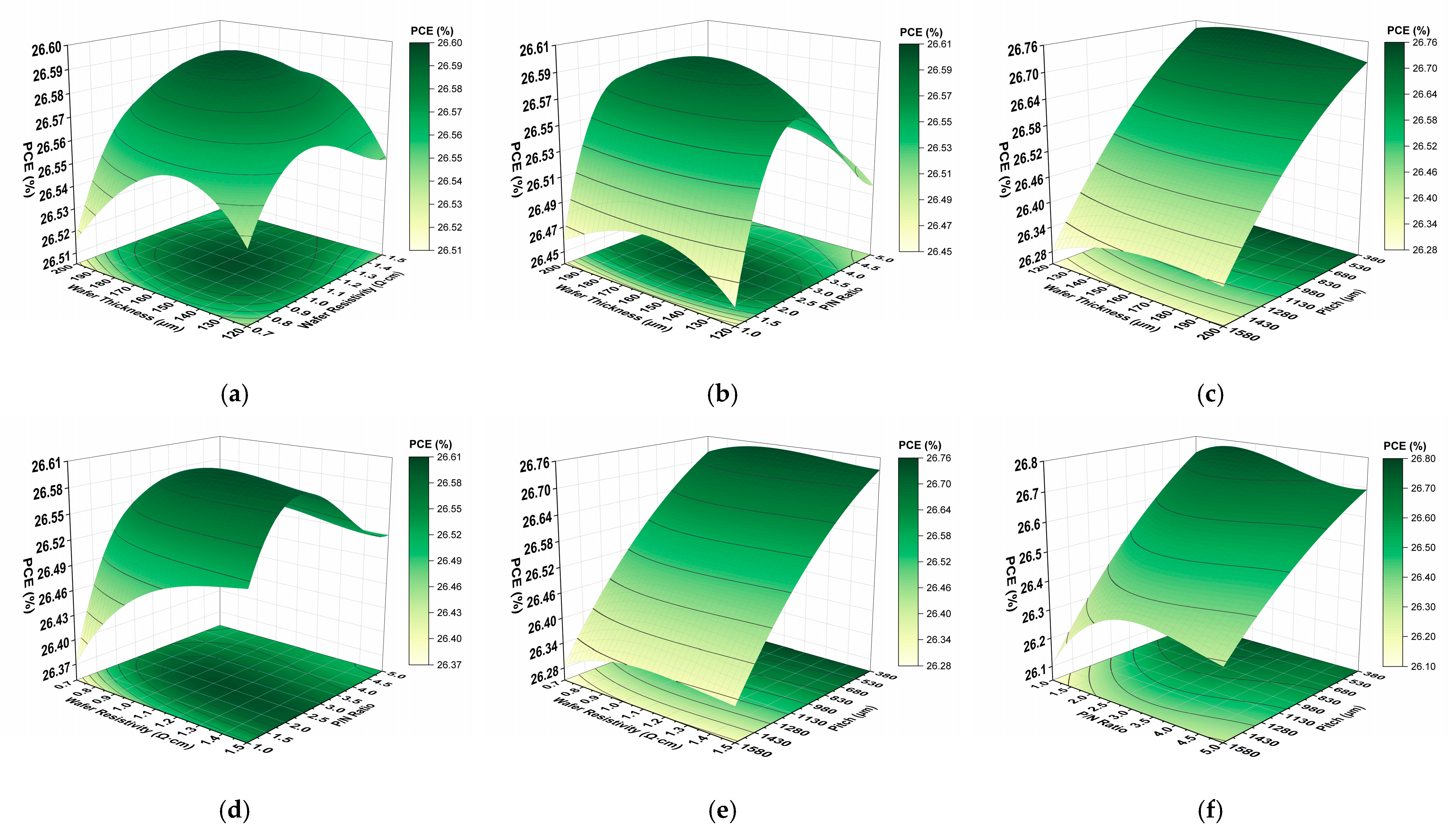
PCE as a function of wafer thickness and resistivity is shown in Figure 7a. As wafer thickness and resistivity increase, the PCE first increases and then decreases. The maximum PCE (26.6%) is achieved when the wafer thickness is 158.7 μm and the resistivity is 1.1 Ω·cm. The relationship between PCE, wafer thickness and the P/N ratio is presented in Figure 7b. With the increase in wafer thickness and P/N ratio, the PCE initially rises and then declines. The maximum PCE (26.6%) occurs at the wafer thickness of 158.7 μm and the P/N ratio of 2.5. According to the contour map at the bottom, the contour lines are denser along the axis of the P/N ratio, indicating that the P/N ratio has a greater impact on PCE than wafer thickness. Figure 7c illustrates the relationship between PCE, wafer thickness and pitch. As the pitch decreases, the PCE increases monotonically. The contour plot shows a denser distribution of contour lines along the pitch axis, suggesting that the pitch has a more significant impact on the PCE than wafer thickness.
PCE as a function of wafer resistivity and the P/N ratio is shown in Figure 7d. With the increase in the P/N ratio, the PCE first increases and then decreases. The minimum PCE appears when both wafer resistivity and P/N ratio are at their lowest, while the maximum PCE (26.6%) occurs when the wafer resistivity is 1.1 Ω·cm and the P/N ratio is 2.5. According to the contour map, the contour lines are more densely distributed along the axis of the P/N ratio, indicating that the P/N ratio has a greater influence on PCE than wafer resistivity. Figure 7e illustrates the relationship between PCE and wafer resistivity as well as pitch. The PCE increases monotonically as the pitch decreases. The denser distribution of contour lines along the pitch axis suggests that the pitch has a stronger impact on PCE than wafer resistivity. The relationship between PCE, the P/N ratio and pitch is presented in Figure 7f. The PCE increases monotonically with the decrease in pitch. From the contour plot, it can be seen that at larger pitch values, the PCE first increases and then decreases with the increase in the P/N ratio. It should be noted that the above response surfaces were plotted when other parameters took intermediate values. These intermediate values are as follows: wafer thickness = 160 μm, wafer resistivity = 1.1 Ω·cm, P/N ratio = 3, and pitch = 980 μm.

3.2.6. Optimal Parameter Prediction Results

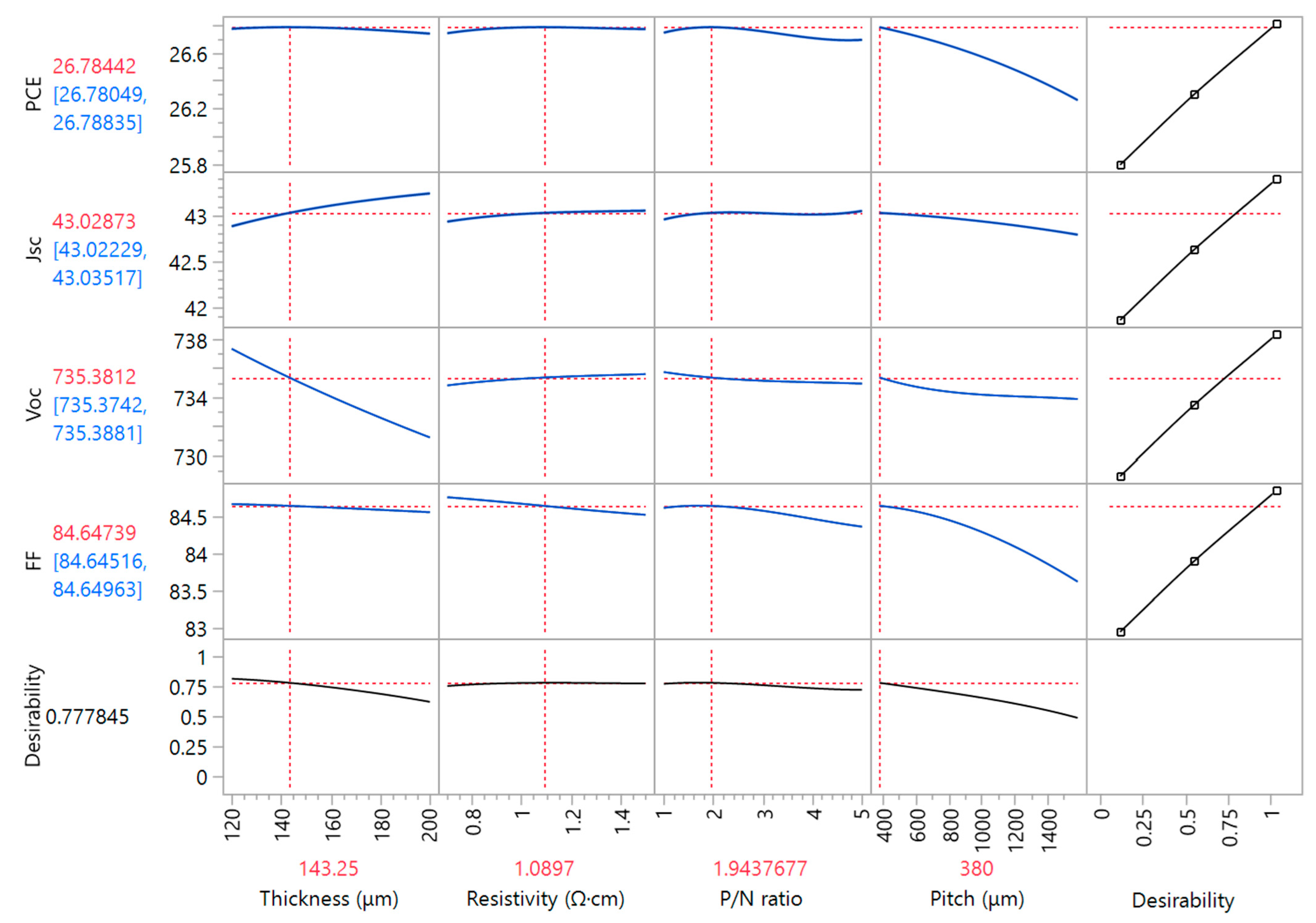
Figure 8 shows the maximum PCE and the corresponding parameter values predicted by JMP Pro 17.0.0 software along with the profiles of JSC, Voc and FF. From Figure 8, the trade-offs among JSC, VOC and FF during PCE optimization can be clearly observed. Specifically, JSC varies only slightly with the electrical and geometrical parameters, indicating that optical generation is largely unaffected. In contrast, VOC and FF exhibit more pronounced variations and dominate the behavior of PCE. Deviations from the optimal P/N ratio or increases in pitch mainly reduce VOC and FF due to enhanced carrier recombination and lateral transport losses. Therefore, the maximum PCE is achieved by maintaining high VOC and FF, while JSC remains close to its peak value. This indicates that minimizing recombination and resistive losses is more critical than further improving JSC under the studied conditions. As shown in Figure 8, the maximum PCE predicted is 26.784%, which is achieved under the conditions of wafer thickness = 143.25 μm, wafer resistivity = 1.09 Ω·cm, P/N ratio = 1.94, and pitch = 380 μm. The highest PCE obtained from the four-factor, five-level experiment (625 simulations) is 26.772%, while the maximum PCE predicted is 26.784%. In order to verify the accuracy of the prediction, simulation was conducted using the optimal parameters predicted, and the simulated maximum PCE is 26.773%. The relative error between the simulated maximum PCE (26.773%) and the predicted maximum PCE (26.784%) is 0.041%, indicating that the model could accurately predict the PCE of the TBC cell. It should be mentioned that the maximum PCE predicted (26.784%) was achieved under the premise of the cell structure shown in Figure 1 and realistic technique parameters reported in the literature (see Table 1), which do not represent the theoretical limit of PCE of n-type TBC cells.

3.2.7. Sensitivity Analysis of Optimized Parameters

To evaluate the sensitivity of the optimized parameters to variations in key parameters, we conducted additional simulations to assess the impact of perturbations in several key parameters on PCE. The preliminary sensitivity analysis shows the following: (1) A ± 10 μm variation in wafer thickness around the optimized value of 143.25 μm results in <0.0022% absolute PCE change. (2) A ± 10% variation in wafer resistivity around the optimized value of 1.09 Ω·cm leads to <0.0032% absolute change in PCE. (3) A ± 10% variation in the P/N ratio around the optimized value of 1.94 results in <0.0017% absolute change in PCE. (4) A ± 10 μm lithography tolerance in pitch around the optimized value of 380 μm leads to <0.0027% absolute PCE change. (5) A ± 10% variation around the baseline value of 3 mΩ·cm2 for p-type region contact resistivity (ρc,p) results in <0.0166% absolute change in PCE, while a ± 10% variation around the baseline value of 0.7 mΩ·cm2 for n-type region contact resistivity (ρc,n) results in <0.0103% absolute change in PCE. (6) A ± 10% variation around the baseline value of 80 Ω/□ for p-type region sheet resistance leads to <0.0009% absolute change in PCE, while a ± 10% variation around the baseline value of 40 Ω/□ for n-type region sheet resistance results in <0.0003% absolute change in PCE. More detailed sensitivity analysis data can be found in Supplementary Table S3. These results indicate that the optimized parameter set exhibits reasonable robustness against typical industrial process variations.

3.2.8. Power Loss Analysis

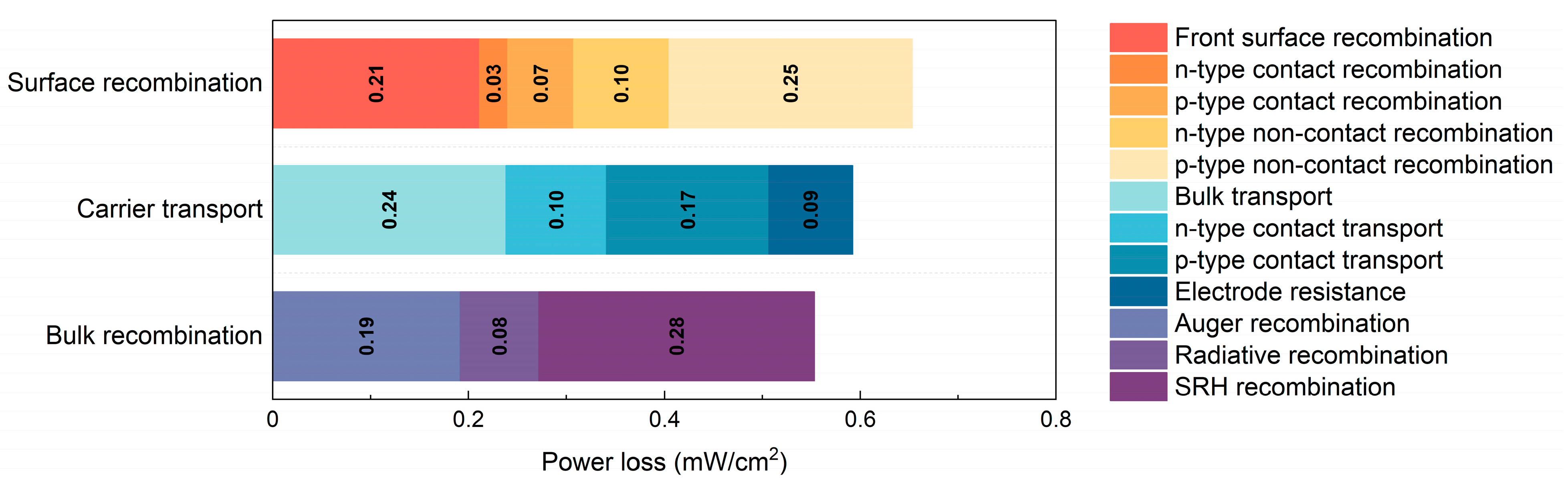
We used Quokka3 to quantify the power losses of the optimized TBC solar cell from the perspective of carrier recombination and transport. Figure 9 presents the contributions of surface recombination, carrier transport and bulk recombination to the total power loss of the optimized TBC cell. Total recombination accounts for 67% of the total power loss, while total transport accounts for 33%. Within total recombination, surface recombination constitutes 54%, and bulk recombination constitutes 46%. For surface recombination, 32% of recombination occurs on the front surface, while 68% occurs on the rear surface. In bulk recombination, SRH recombination accounts for about half, and Auger recombination accounts for 35%. Regarding carrier transport loss, bulk transport contributes 40% of the total transport loss, n-type contact contributes 17%, p-type contact contributes 28%, and electrode resistance contributes 15%. Notably, both recombination and transport losses in the p-type region are higher than those in the n-type region, highlighting the importance of improving the passivation and contact properties of the p-type region. This result is consistent with Refs. [5,13,27]. Since recombination is the major source of power loss, further efficiency improvement should focus on minimizing rear surface and SRH recombination. This can be achieved through several material and interface engineering strategies. First, advanced rear-side passivation using high-quality dielectric stacks (e.g., SiO2/Al2O3/SiNx) can significantly reduce surface recombination. Second, the formation of high-quality ultra-thin interfacial oxides can effectively lower interface trap density. Third, the use of high-lifetime silicon wafers and defect passivation treatments (e.g., hydrogenation) can suppress bulk SRH recombination. In addition, optimized contact and gap region design can reduce parasitic recombination while maintaining efficient carrier extraction. These approaches provide practical pathways for reducing recombination losses in TBC cells.

3.3. Discussion

3.3.1. Comparison with Single-Parameter Optimization (SPO) Method

To evaluate the advantage of the multi-factor interaction-based optimization (MFIO) approach, a comparison with the traditional SPO method was performed. SPO optimizes each parameter independently and neglects interactions among variables. In contrast, MFIO captures parameter interactions through a statistical regression framework. The ANOVA results (Table 3) reveal that several higher-order terms, particularly the interaction between the P/N ratio and pitch, have a statistically significant impact on PCE (p < 0.0001). This indicates that the optimal value of one parameter depends on the level of others, which cannot be captured by SPO. Consequently, SPO fails to identify the true optimum. Quantitatively, the maximum PCE predicted by the SPO method is 26.736% (see Supplementary Figure S1, which was obtained using the parameter settings as shown in Supplementary Table S4), whereas the MFIO approach yields a higher value of 26.784% under a different parameter combination. This improvement demonstrates the importance of considering parameter interactions in achieving more accurate and reliable optimization results. Although experimental validation is not included, the results are supported by the proven accuracy of the Quokka3 simulation framework and the use of literature-based, technologically realistic parameter settings. Therefore, the MFIO approach provides a more reliable and physically meaningful guideline for TBC cell design.

3.3.2. Physical Origin of Nonlinear Interaction Effects

The strong nonlinear interactions, particularly the quadratic and cubic terms involving the P/N ratio and pitch, originate from the coupled effects of carrier transport, recombination, and lateral resistance in TBC cells. The quadratic dependence on the P/N ratio reflects the need for a balanced area between electron- and hole-collecting regions. Deviations from this balance increase recombination and reduce carrier collection efficiency. The interaction between the P/N ratio and pitch is related to the balance between recombination and lateral resistive losses. At small pitch values, the lateral transport distance is short, and device performance is relatively insensitive to small variations in the P/N ratio. However, at larger pitch values, longer transport paths increase recombination and resistive losses, making device performance more sensitive to the P/N ratio, because the P/N ratio governs the local electric field distribution and the collection efficiency of minority carriers. Higher-order terms (e.g., cubic terms) capture the asymmetric response of the device, where insufficient or excessive p-type region area leads to nonlinear degradation in Voc and FF. These effects are consistent with the nonlinear nature of the carrier transport equations governing device operation.

3.3.3. Experimental Relevance and Reproducibility

The predicted maximum PCE (~26.78%) was obtained from device simulations and has not yet been experimentally validated due to the lack of necessary fabrication facilities and the absence of reported data for the specified TBC cell structure (as shown in Figure 1) studied here. Nevertheless, the reliability of the prediction is supported by the proven accuracy of the Quokka3 simulation framework and the use of literature-based, experimentally grounded input parameters. In addition, sensitivity analysis (see Section 3.2.7) shows that small variations in key parameters have a limited impact on PCE, suggesting a certain degree of process tolerance. Therefore, the proposed optimization result is expected to be reproducible under practical fabrication conditions and provides a useful guideline for experimental investigation on TBC cells.

3.3.4. Scalability to Industrial Manufacturing

From a manufacturing perspective, the scalability of the proposed optimization results is supported by several factors. First, the TBC solar cell technology builds on mature TOPCon and IBC solar cell technologies and is therefore largely compatible with existing industrial production lines. Second, all materials considered in the simulations (n-type Cz-Si wafers, SiO2, poly-Si, Ag paste, etc.) are widely used in current PV production. Third, the optimized parameter set (wafer thickness, resistivity, P/N ratio, and pitch) lies within realistic industrial processing windows, demonstrating its technological feasibility. Finally, we note that the primary goal of this work is to identify general performance trends and key design parameters rather than to define a fixed industrial process window. Even if specific optimal values shift under practical manufacturing conditions, the main conclusions—such as the benefits of smaller pitch and the importance of effective p-type region passivation—are expected to remain valid. Therefore, these insights can provide practical guidance for the large-scale manufacturing of TBC cells.

3.3.5. Limitations and Outlook

Although the proposed Quokka3–JMP Pro framework provides useful insights into the coupled effects of key electrical and geometrical parameters in n-type TBC cells, several limitations of this work should be pointed out. First, the simulations were based on an assumed device structure and literature-based input parameters. Therefore, the predicted optimal parameter set should be interpreted within the defined device architecture and parameter space rather than as a universal optimum. Second, the prediction accuracy is inherently limited by the modeling approach used in Quokka3, which employs a lumped-parameter skin model to represent each functional layer and the Text-Z optical model to describe light trapping. Although previous studies indicate that these simplifications generally have a limited influence on the overall prediction accuracy, some deviation from real device performance may still exist. Third, several practical factors were not included in the simulations, such as edge recombination, process-induced defects, process-related damage, etc. Fourth, the light trapping structure was assumed to be identical in all simulations to allow for a focused investigation of the coupled effects of electrical and geometrical parameters. In practice, different surface textures (e.g., pyramids or random pits) may affect light trapping and optical generation profile, thereby influencing device performance. A more comprehensive evaluation of these effects would require coupled optical–electrical simulations. Fifth, recombination current density (J0) and contact resistivity (ρc) were treated as fixed input parameters in the Quokka3 lumped-parameter skin model and assumed to be independent of electrical and geometrical parameters (e.g., wafer thickness, resistivity, P/N ratio, and pitch). This approach allows us to isolate and quantify the coupled effects of the electrical and geometrical parameters on device performance. In practical devices, these parameters may indirectly influence J0 and ρc. However, capturing these interactions would require more advanced coupled modeling. Finally, it should be noted that the present simulations mainly provide theoretical guidance for the design of high-efficiency TBC cells, and the predicted optimal parameters also lie within realistic fabrication windows. However, experimental validation is still required to confirm the predicted trends and optimal parameter set under practical fabrication conditions. Future work will focus on fabricating n-type TBC prototype devices based on the predicted optimal parameters to experimentally verify the simulation results.

4. Conclusions

In this work, we systematically optimized electrical and geometrical parameters of n-type TBC solar cells using a multi-factor interaction-based optimization method by combining Quokka3 simulations with JMP Pro statistical analysis. First, the effects of silicon wafer properties (thickness, resistivity, and lifetime), rear-side passivation and contact characteristics, and rear-side geometry on the performance of TBC cells were investigated by using Quokka3. Then, with JMP Pro software, we performed statistical analysis on the 625 simulation results obtained from Quokka3 based on the four-factor (wafer thickness, wafer resistivity, P/N ratio, and pitch), five-level experimental design. Variance analysis revealed that pitch, P/N ratio, quadratic power terms, quadratic interaction terms except the interaction between wafer thickness and resistivity, cubic power terms, and some cubic interaction terms all have significant impact on PCE. JMP Pro predicted that the TBC cell could achieve the maximum PCE of 26.784% under the conditions of wafer thickness = 143.25 μm, wafer resistivity = 1.09 Ω·cm, P/N ratio = 1.94, and pitch = 380 μm, which is in excellent agreement with direct simulation results, demonstrating the prediction accuracy of the obtained regression model. Sensitivity analysis further confirms that the optimized design exhibits good tolerance to typical process variations. Finally, we performed power loss analysis on the optimized TBC cell by using Quokka3. The result shows that recombination dominates total losses, particularly rear surface and SRH recombination, followed by bulk transport losses. These findings highlight that further efficiency enhancements should focus on improving rear-side passivation, suppressing bulk defects, and optimizing carrier transport pathways. Overall, this study demonstrates that incorporating multi-parameter interactions is essential to accurate optimization of TBC cells. Furthermore, this work also provides a reliable and scalable framework for the design and optimization of high-efficiency TBC cells.

Supplementary Materials

The following supporting information can be downloaded at: https://www.mdpi.com/article/10.3390/en19071612/s1, Table S1. The values of the four factors and the resulting illuminated I-V characteristic parameters of 625 times of simulations. Table S2. The fitted coefficients of the prediction model. Table S3. Sensitivity analysis result of the optimized parameters. Table S4. Parameter settings of the TBC solar cell simulated by Quokka3 using traditional single-parameter optimization (SPO) method. Figure S1. PCEs as function of different parameters, with maximum PCE of 26.736 achieved by using traditional single-parameter optimization (SPO) method at the condition of wafer thickness = 160 μm, wafer resistivity = 1.1 Ω·cm, P/N ratio = 3, and pitch = 380 μm.

Author Contributions

Conceptualization, Y.C. (Yang Chen) and B.A.; methodology, Y.C. (Yang Chen) and B.A.; software, Y.C. (Yang Chen) and Y.C. (Yongqiang Chen); validation, Y.C. (Yang Chen) and B.A.; formal analysis, Y.C. (Yang Chen), B.A. and Y.Z.; investigation, Y.C. (Yang Chen) and Y.C. (Yongqiang Chen); resources, B.A.; data curation, Y.C. (Yang Chen); writing—original draft preparation, Y.C. (Yang Chen); writing—review and editing, Y.C. (Yang Chen), B.A. and Y.Z.; supervision, B.A. and Y.Z.; funding acquisition, B.A. All authors have read and agreed to the published version of the manuscript.

Funding

The authors gratefully acknowledge the financial support from the National Natural Science Foundation of China (Grant No. 61774171).

Data Availability Statement

The core experimental datasets and analytical results supporting this study are fully documented within the main body of this article. All processed data points and statistical analyses referenced throughout this work can be directly traced to the corresponding sections in the main text.

Conflicts of Interest

The authors declare that they have no known competing financial interest or personal relationships that could have appeared to influence the work reported in this paper.

References

  1. Bahar, H.; Abdelilah, Y.; Báscones, A.A.; Anatolitis, V.; Bojek, P.; Briens, F.; Criswell, T.; Moorhouse, J.; Veerakumar, K.; Martinez, L.M. Renewables 2024 Analysis and Forecast to 2030. Available online: https://www.iea.org/reports/renewables-2024 (accessed on 15 February 2026).
  2. Fischer, M. International Technology Roadmap for Photovoltaics (ITRPV) 2025 (16th Edition). Available online: https://www.vdma.eu/en-GB/international-technology-roadmap-photovoltaic (accessed on 15 February 2026).
  3. Tong, H.; Tan, S.; Zhang, Y.; He, Y.; Ding, C.; Zhang, H.; He, J.; Cao, J.; Liu, H.; Li, Y.; et al. Total-Area World-Record Efficiency of 27.03% for 350.0 Cm2 Commercial-Sized Single-Junction Silicon Solar Cells. Nat. Commun. 2025, 16, 5920. [Google Scholar] [CrossRef]
  4. Wang, G.; Su, Q.; Tang, H.; Wu, H.; Lin, H.; Han, C.; Wang, T.; Xue, C.; Lu, J.; Fang, L.; et al. 27.09%-Efficiency Silicon Heterojunction Back Contact Solar Cell and Going Beyond. Nat. Commun. 2024, 15, 8931. [Google Scholar] [CrossRef] [PubMed]
  5. Wang, G.; Yu, M.; Wu, H.; Li, Y.; Xie, L.; Wei, J.; Deng, X.; Zhou, S.; Yuan, T.; Luo, F.; et al. Silicon Solar Cells with Hybrid Back Contacts. Nature 2025, 647, 369–374. [Google Scholar] [CrossRef]
  6. Krügener, J.; Haase, F.; Rienäcker, M.; Brendel, R.; Osten, H.J.; Peibst, R. Improvement of the SRH Bulk Lifetime upon Formation of N-Type POLO Junctions for 25% Efficient Si Solar Cells. Sol. Energy Mater. Sol. Cells 2017, 173, 85–91. [Google Scholar] [CrossRef]
  7. Haase, F.; Schafer, S.; Klamt, C.; Kiefer, F.; Krugener, J.; Brendel, R.; Peibst, R. Perimeter Recombination in 25%-Efficient IBC Solar Cells with Passivating POLO Contacts for Both Polarities. IEEE J. Photovolt. 2018, 8, 23–29. [Google Scholar] [CrossRef]
  8. Haase, F.; Hollemann, C.; Schäfer, S.; Merkle, A.; Rienäcker, M.; Krügener, J.; Brendel, R.; Peibst, R. Laser Contact Openings for Local Poly-Si-Metal Contacts Enabling 26.1%-Efficient POLO-IBC Solar Cells. Sol. Energy Mater. Sol. Cells 2018, 186, 184–193. [Google Scholar] [CrossRef]
  9. Hollemann, C.; Haase, F.; Schäfer, S.; Krügener, J.; Brendel, R.; Peibst, R. 26.1%-efficient POLO-IBC Cells: Quantification of Electrical and Optical Loss Mechanisms. Prog. Photovolt. 2019, 27, 950–958. [Google Scholar] [CrossRef]
  10. Hollemann, C.; Haase, F.; Rienäcker, M.; Barnscheidt, V.; Krügener, J.; Folchert, N.; Brendel, R.; Richter, S.; Großer, S.; Sauter, E.; et al. Separating the Two Polarities of the POLO Contacts of an 26.1%-Efficient IBC Solar Cell. Sci. Rep. 2020, 10, 658. [Google Scholar] [CrossRef] [PubMed]
  11. Mertens, V.; Dorn, S.; Langlois, J.; Stöhr, M.; Larionova, Y.; Veurman, W.; Brendel, R.; Ambrosius, N.; Vogt, A.; Pernau, T.; et al. Plasma-Enhanced Chemical-Vapor-Deposited SiOx(Ny)/N-type Polysilicon-on-Oxide-Passivating Contacts in Industrial Back-Contact Si Solar Cells. Sol. RRL 2024, 8, 2300919. [Google Scholar] [CrossRef]
  12. Yang, G.; Guo, P.; Procel, P.; Limodio, G.; Weeber, A.; Isabella, O.; Zeman, M. High-Efficiency Black IBC c-Si Solar Cells with Poly-Si as Carrier-Selective Passivating Contacts. Sol. Energy Mater. Sol. Cells 2018, 186, 9–13. [Google Scholar] [CrossRef]
  13. Cao, K.; Yang, Z.; Wang, M.; Liang, Y.; Liu, J.; Bao, Y.; Zhang, Y.; Shi, L.; Cao, G.; Li, X.; et al. Physical Mechanisms and Design Strategies for High-Efficiency Back Contact Tunnel Oxide Passivating Contact Solar Cells. Sol. Energy Mater. Sol. Cells 2025, 289, 113656. [Google Scholar] [CrossRef]
  14. Fell, A.; Fong, K.C.; McIntosh, K.R.; Franklin, E.; Blakers, A.W. 3-D Simulation of Interdigitated-Back-Contact Silicon Solar Cells with Quokka Including Perimeter Losses. IEEE J. Photovolt. 2014, 4, 1040–1045. [Google Scholar] [CrossRef]
  15. Fell, A.; Altermatt, P.P. A Detailed Full-Cell Model of a 2018 Commercial PERC Solar Cell in Quokka3. IEEE J. Photovolt. 2018, 8, 1443–1448. [Google Scholar] [CrossRef]
  16. Yan, D.; Phang, S.P.; Wan, Y.; Samundsett, C.; Macdonald, D.; Cuevas, A. High Efficiency N-Type Silicon Solar Cells with Passivating Contacts Based on PECVD Silicon Films Doped by Phosphorus Diffusion. Sol. Energy Mater. Sol. Cells 2019, 193, 80–84. [Google Scholar] [CrossRef]
  17. Qiu, D.; Duan, W.; Lambertz, A.; Bittkau, K.; Steuter, P.; Liu, Y.; Gad, A.; Pomaska, M.; Rau, U.; Ding, K. Front Contact Optimization for Rear-Junction SHJ Solar Cells with Ultra-Thin n-Type Nanocrystalline Silicon Oxide. Sol. Energy Mater. Sol. Cells 2020, 209, 110471. [Google Scholar] [CrossRef]
  18. Chen, Y.; Yang, Y.; Marmon, J.K.; Zhang, X.; Feng, Z.; Verlinden, P.J.; Shen, H. Independent Al2O3/SiNx:H and SiO2/SiN x:H Passivation of P+ and N+ Silicon Surfaces for High-Performance Interdigitated Back Contact Solar Cells. IEEE J. Photovolt. 2017, 7, 51–57. [Google Scholar] [CrossRef]
  19. Liu, H.; Qu, S.; Zhao, L.; Wang, W. Optimization of Heterojunction Back-Contact (HBC) Crystalline Silicon Solar Cell Based on Quokka Simulation. Mater. Today Commun. 2023, 36, 106816. [Google Scholar] [CrossRef]
  20. McIntosh, K.R.; Baker-Finch, S.C. A Parameterization of Light Trapping in Wafer-Based Solar Cells. IEEE J. Photovolt. 2015, 5, 1563–1570. [Google Scholar] [CrossRef]
  21. Fell, A.; McIntosh, K.R.; Fong, K.C. Simplified Device Simulation of Silicon Solar Cells Using a Lumped Parameter Optical Model. IEEE J. Photovolt. 2016, 6, 611–616. [Google Scholar] [CrossRef]
  22. Khokhar, M.Q.; Yousuf, H.; Alamgeer; Chu, M.; Ur Rahman, R.; Jony, J.A.; Qamar Hussain, S.; Pham, D.P.; Yi, J. Systematic Modeling and Optimization for High-Efficiency Interdigitated Back-Contact Crystalline Silicon Solar Cells. Energy Tech. 2024, 12, 2400831. [Google Scholar] [CrossRef]
  23. Wu, H.; Ye, F.; Yang, M.; Luo, F.; Tang, X.; Tang, Q.; Qiu, H.; Huang, Z.; Wang, G.; Sun, Z.; et al. Silicon Heterojunction Back-Contact Solar Cells by Laser Patterning. Nature 2024, 635, 604–609. [Google Scholar] [CrossRef]
  24. Sun, Z.; Kang, Q.; Li, J.; Zhou, S.; Fang, L.; Xu, X.; Wu, S.; Zheng, Z.; Chen, X.; Yan, H.; et al. Evaluating the Practical Efficiency Limit of Silicon Heterojunction–Interdigitated Back Contact Solar Cells by Creating Digital Twins of Silicon Heterojunction Solar Cells with Amorphous Silicon and Nanocrystalline Silicon Hole Contact Layers. Phys. Status Solidi (A) 2024, 221, 2300758. [Google Scholar] [CrossRef]
  25. Peibst, R.; Rienäcker, M.; Larionova, Y.; Folchert, N.; Haase, F.; Hollemann, C.; Wolter, S.; Krügener, J.; Bayerl, P.; Bayer, J.; et al. Towards 28%-Efficient Si Single-Junction Solar Cells with Better Passivating POLO Junctions and Photonic Crystals. Sol. Energy Mater. Sol. Cells 2022, 238, 111560. [Google Scholar] [CrossRef]
  26. Jiang, K.; Zhang, H.; Zhang, L.; Meng, F.; Gao, Y.; Yu, X.; Zhao, D.; Li, R.; Huang, H.; Hao, Z.; et al. Triple-Layered Nc-Si:H Films Improve Electrical Properties and Expand Process Window of IBC-SHJ Solar Cells Simulated by Silvaco TCAD. Sci. China Mater. 2023, 66, 4891–4896. [Google Scholar] [CrossRef]
  27. Wang, Q.; Guo, K.; Gu, S.; Huang, W.; Peng, H.; Wu, W.; Ding, J. Electrical Performance, Loss Analysis, and Efficiency Potential of Industrial-Type PERC, TOPCon, and SHJ Solar Cells: A Comparative Study. Progress. Photovolt. 2024, 32, 889–903. [Google Scholar] [CrossRef]
  28. Schmidt, J.; Peibst, R.; Brendel, R. Surface Passivation of Crystalline Silicon Solar Cells: Present and Future. Sol. Energy Mater. Sol. Cells 2018, 187, 39–54. [Google Scholar] [CrossRef]
  29. Wang, Q.; Gao, B.; Wu, W.; Guo, K.; Huang, W.; Ding, J. Effects on Metallization of N+-Poly-Si Layer for N-Type Tunnel Oxide Passivated Contact Solar Cells. Materials 2024, 17, 2747. [Google Scholar] [CrossRef]
  30. Fell, A.; McIntosh, K.R.; Altermatt, P.P.; Janssen, G.J.M.; Stangl, R.; Ho-Baillie, A.; Steinkemper, H.; Greulich, J.; Muller, M.; Min, B.; et al. Input Parameters for the Simulation of Silicon Solar Cells in 2014. IEEE J. Photovolt. 2015, 5, 1250–1263. [Google Scholar] [CrossRef]
Figure 1. (a) The 3D structure of the TBC solar cell for modeling; (b) The 2D structure of the TBC solar cell for simulation. The figure is not drawn to scale.
Energies 19 01612 g001
Figure 2. Effects of (a) wafer thickness, (b) wafer resistivity, and (c) SRH lifetime on illuminated J-V characteristic parameters of the TBC solar cells.
Energies 19 01612 g002
Figure 3. (a) VOC (b) FF, and (c) PCE of TBC solar cells as functions of J0,p-noncontacted and ρc,p; (d) VOC, (e) FF, and (f) PCE of TBC solar cells as functions of J0,n-noncontacted and ρc,n.
Energies 19 01612 g003
Figure 4. (a) PCE as a function of J0,p-noncontacted and J0,p-contacted; (b) PCE as a function of J0,n-noncontacted and J0,n-contacted.
Energies 19 01612 g004
Figure 5. (a) PCE as a function of pitch and P/N ratio; (b) PCE as a function of Rsheet,p and pitch; (c) PCE as a function of Rsheet,n and pitch.
Energies 19 01612 g005
Figure 6. Predicted and simulated PCE values of TBC solar cells.
Energies 19 01612 g006
Figure 7. PCE as a function of (a) wafer thickness and resistivity, (b) wafer thickness and P/N ratio, (c) wafer thickness and pitch, (d) wafer resistivity and P/N ratio, (e) wafer resistivity and pitch, and (f) P/N ratio and pitch.
Energies 19 01612 g007
Figure 8. Prediction of the maximum PCE and corresponding parameter values of TBC solar cells together with the profiles of JSC, VOC and FF.
Energies 19 01612 g008
Figure 9. Power loss of the optimal TBC solar cell.
Energies 19 01612 g009
Table 1. Parameter settings of the TBC solar cell simulated by Quokka3.
ParameterUnitRangeValueRef.
Bulk
Doping type\\n-type
Wafer thicknessμm120–200160[22]
Wafer resistivityΩ·cm0.7–1.51.1[13,22]
SRH lifetimems1–2010[4,23]
Geometrical sizes
Pitchμm380–1580380[13,23,24]
P/N ratio\1–52[13,23]
Width of gapμm\40[25,26]
Front surface
J0,frontfA/cm2\2[13]
P-region
J0,p-noncontactedfA/cm20.1–1006[13,27,28]
J0,p-contactedfA/cm210–100026[13,29]
Sheet resistance Rsheet,pΩ/sq10–20080[13,29]
Contact resistivity ρc,pmΩ·cm20.1–1003[13,27,28]
Contact area fraction%\5.94[27,28]
N-region
J0,n-noncontactedfA/cm20.1–1004[13,27,28]
J0,n-contactedfA/cm210–100026[13,29]
Sheet resistance Rsheet,nΩ/sq10–20040[13,29]
Contact resistivity ρc,nmΩ·cm20.1–1000.7[13,27,28]
Contact area fraction%\4.34[27,28]
External circuit
Electrode resistanceΩ·cm2\0.05[30]
Table 2. Four-factor, five-level experimental design.
FactorsLevels
Wafer thickness (μm)120140160180200
Wafer resistivity
(Ω·cm)
0.70.91.11.31.5
P/N ratio12345
Pitch (μm)38068098012801580
Table 3. The variance analysis outcome of the fitting results.
SourceDeg. of FreedomSum of SquaresF Ratiop-ValueLogWorthRank
T10.000133181.14880.28420.54628
ρ10.000264072.27780.13180.88026
R10.05645614486.9835<0.0001 *78.60711
P10.936683708079.715<0.0001 *348.0621
T*ρ10.0008017869.1552<0.0001 *15.20816
T*R10.000186711.61060.20490.68827
T*P10.06493292560.1031<0.0001 *87.07910
ρ*R10.178281641537.835<0.0001 *166.4825
ρ*P10.0092158779.4949<0.0001 *17.23115
R*P10.512976804424.873<0.0001 *277.2673
T210.08777937757.1737<0.0001 *107.4809
ρ210.09355269806.9736<0.0001 *112.1648
R210.872228967523.736<0.0001 *339.4892
P210.283050472441.557<0.0001 *212.2084
T*ρ210.0024850421.4356<0.0001 *5.34719
T*R*P10.0023358620.1489<0.0001 *5.06520
T2*P10.0013512311.65560.0007 *3.16522
T*P210.000458223.95250.0473 *1.32625
ρ2*R10.0103442389.2281<0.0001 *19.10314
ρ*R210.03153776272.0407<0.0001 *49.89713
ρ*R*P10.04678463403.5583<0.0001 *68.20912
ρ2*P10.0015350513.24120.0003 *3.52621
R2*P10.167407221444.033<0.0001 *160.6606
R*P210.0070096960.4647<0.0001 *13.48018
T310.001030488.88880.0030 *2.52523
ρ310.0078705567.8904<0.0001 *14.95817
R310.135012311164.599<0.0001 *141.5807
P310.000493434.25630.0395 *1.40324
Model2820.3150196258.385
Error5960.069094
Corrected total62420.384114 <0.0001 *
* means that the term has significant impact on PCE.
Disclaimer/Publisher’s Note: The statements, opinions and data contained in all publications are solely those of the individual author(s) and contributor(s) and not of MDPI and/or the editor(s). MDPI and/or the editor(s) disclaim responsibility for any injury to people or property resulting from any ideas, methods, instructions or products referred to in the content.