1. Introduction
Ingrown toenail is a common and painful condition that negatively impacts daily life. Genetic factors, incorrect nail cutting, fungal diseases, congenital nail disorders, and wearing unsuitable shoes are major factors that play a role in the development of ingrown toenails [
1,
2,
3]. Frequent clinical complaints include pain, swelling, redness, and discharge [
1] The Heifetz staging system is used for staging ingrown toenails. According to this system, stage 1 refers to the inflammatory stage, with minimal edema and hyperemia in the lateral folds of the nail. Stage 2 involves abscess formation, and stage 3 refers to the formation of hypertrophic granulation tissue. The granulation tissue that develops in stage 3 is epithelized on the outer corner of the nail, preventing drainage of the abscess, and thus leading to a vicious circle [
4] The treatment of stage 1 is conservative, and the treatment of stages 2 and 3 is frequently surgical. The recurrence rates in most of the treatment methods reported in the literature are similar [
4]. However, it is reported in recent studies that surgical treatment methods are more successful than conservative treatments, and procedures such as electrocauterization and phenol used in addition to the surgical method reduce the recurrence rate [
5,
6,
7].
The Winograd method was first published in 1929 by Alvin Winograd, who was a surgical assistant [
8]. In this method, the germinal matrix in the proximal end is resected completely with the periosteum along the incision line. Later, Heifetz added the wedge-shaped excision of the lateral fold of the nail to the Winograd method [
4]. This study compares the outcomes of the Heifetz and Winograd methods used in the surgical treatment of ingrown toenails and their efficacy in different age groups.
2. Methods
2.1. Patients and Methods
We retrospectively evaluated the ingrown nail cases in 160 toes of 143 patients surgically treated at Kocaeli City Hospital (Kocaeli, Turkey) by the same surgeon (Ü.G) (International Classification of Diseases code L60.0) from 1 June 2012, through 31 July 2019. Approval to conduct this study was obtained from the institutional review board of Kocaeli University Ethics Committee. The approval date and number were 7 July 2023 and E-80418770-020-422177. The age, sex, involved foot, involved toe, and relevant Heifetz stages of the patients were assessed. The patients underwent either the Winograd or Heifetz surgical treatment method. To achieve a homogeneous patient group, only patients in stage 3 according to the Heifetz staging system in whom no response could be achieved with conservative treatment were included in the study. Patients in stages 1 and 2 according to the Heifetz staging system, patients with diabetes, patients with nail bed injury due to trauma, and patients with ram’s horn toenail deformity were excluded from the study.
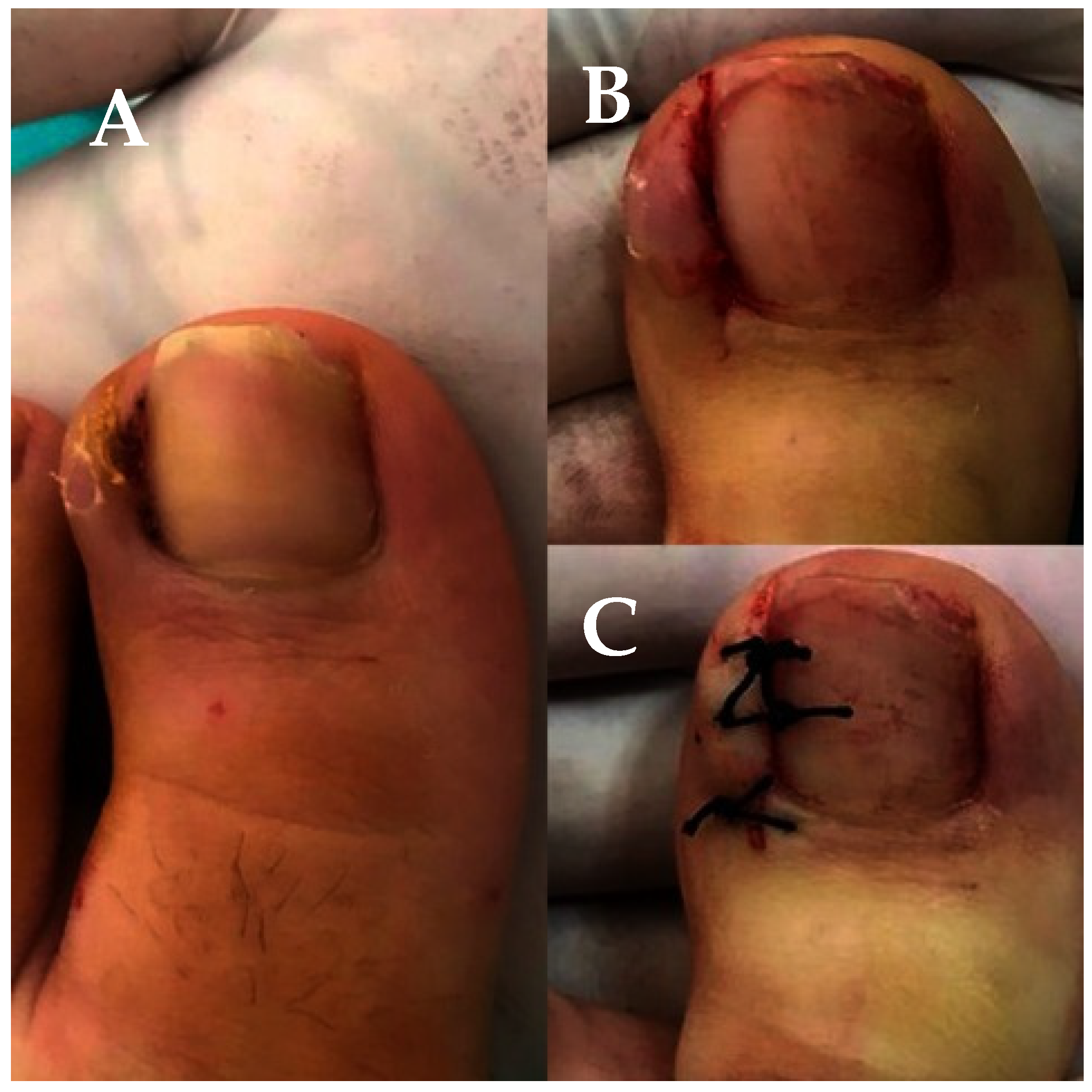
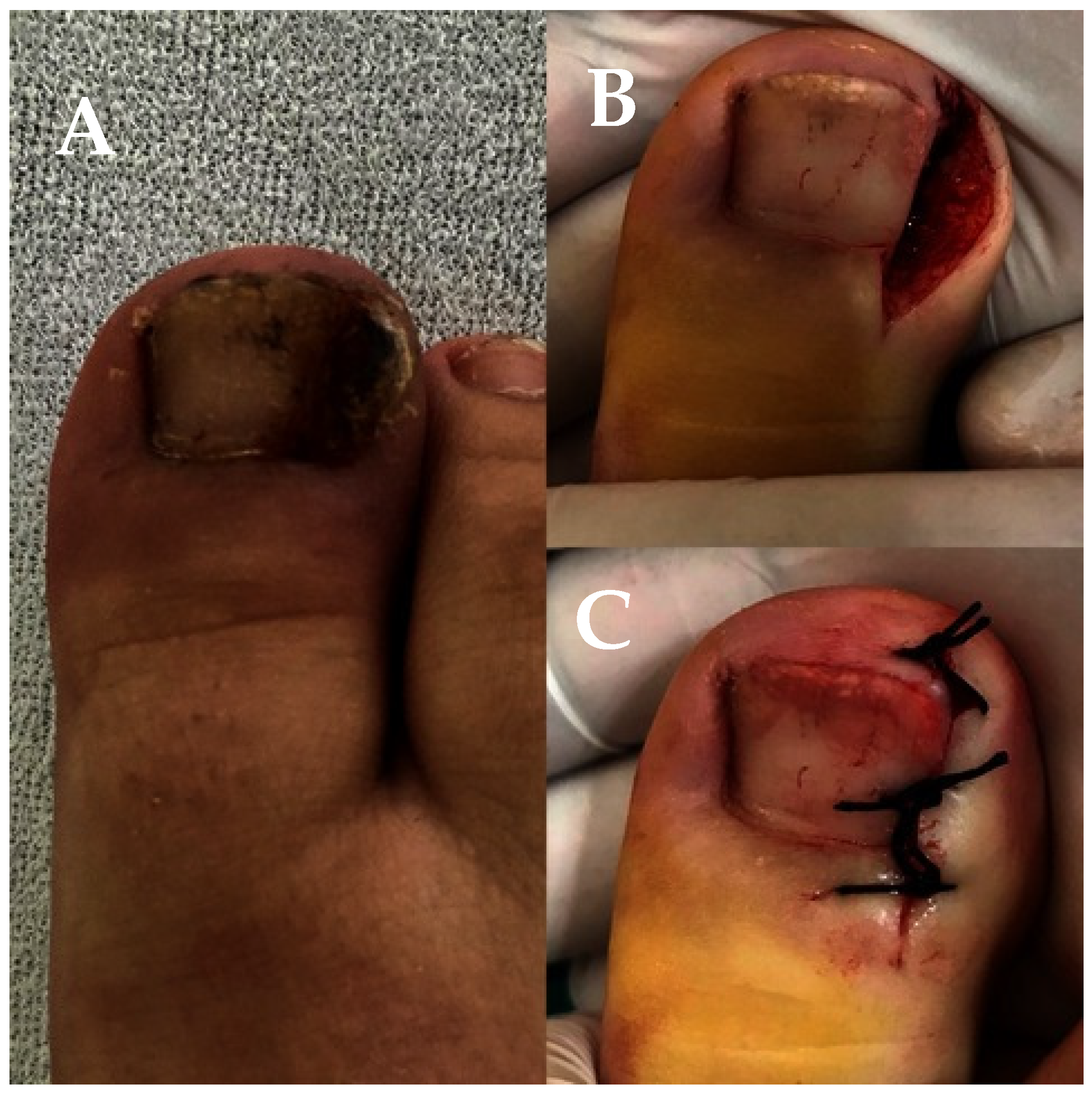
A written informed consent form was signed by each patient before the surgical procedure. The surgery was performed with the patient under digital block anesthesia (prilocaine 2% in vial form) and digital tourniquet hemostasis. With a scalpel, approximately one-fifth of the toe on the ingrown side was resected longitudinally 5 mm, on average, proximal to the eponychium. The nail plate germinal matrix, sterile matrix, nail bed, and hypertrophic granulation tissue were excised along the incision. The periosteum was excised with a scalpel and curette. In patients who underwent the Heifetz method, the lateral soft-tissue fold of the nail was also excised as a wedge-shaped ellipsis. The lateral soft-tissue fold of the nail was sutured with a 2-0 nonabsorbable suture (
Figure 1 and
Figure 2). A noncompressive dressing was applied. Nonsteroidal anti-inflammatory drugs and oral antibiotic drugs (cephalosporin, 1 g) were administered for 1 week in the postoperative period. A dressing was applied once every other day. The patients were advised not to wear closed-toe shoes for 1 week. After removal of the sutures, patients were followed up once a month in the first 3 months and then once every 6 months. Recurrence rates (second surgery for the same reason), complications, time to return to work, and satisfaction with the intervention were evaluated postoperatively. The postoperative pain rating, cosmetic satisfaction, and whether they would accept the same treatment for the same disease were asked when evaluating patient satisfaction.
2.2. Statistical Analysis
All of the statistical analyses were performed using IBM SPSS Statistics for Windows, Version 20.0 (IBM Corp, Armonk, NY, USA). Numeric variables are presented as mean ± SD, and categorical variables are summarized as counts (percentages). The association between two categorical variables was examined by the χ2 test. All of the statistical analyses were performed with 5% significance, and a two-sided p < 0.05 was considered statistically significant.
3. Results
The surgical method was applied in 160 toes of 143 patients. All of the surgeries were performed by the same foot surgeon (Ü.G). The mean age of patients was 26 years (range, 10–82 years), with 83 male (58%) and 60 female (42%) patients. Fifty-eight patients (40.6%) had involvement in the right foot, 68 (47.6%) had involvement in the left foot, and 17 (11.9%) had bilateral involvement. Surgical treatment was performed in the toes of 29 patients (20.3%) due to the same diagnosis. The patients were followed up for a mean of 20.9 months (range 10–48 months). Those without pain, infection, or recurrence returned to work in a mean of 18.11 days (range, 8–42 days). The sutures were removed in a mean of 14.29 days (range, 11–16 days) with the criterion of healing the first proximal suture’s soft tissue. Superficial infection (only edema and hyperemia) was seen in 14 toes (8.8%) in the first month. Nine patients in whom a superficial infection developed were treated with antibiotherapy, and recurrence was detected in five patients. Recurrence occurred in 11 of the 143 patients (7.7%). Recurrences were seen within a mean of 2.33 months (range, 1.7–4.1 months) postoperatively. All of the patients who experienced recurrence were also treated with the same surgical method. Osteomyelitis or any other severe complication did not develop in any patient, and 136 patients (95.1%) recorded that they were satisfied with the surgical treatment administered. The patients stated that the reason for their dissatisfaction was the prolongation of the treatment period due to the recurrence of infection.
The patients were divided into two groups according to the surgical treatment administered: Winograd and Heifetz (
Table 1). No statistically significant differences were found in terms of age, sex, side, early infection, and recurrence rates. When the groups were subgrouped according to age, the recurrence rates in the Heifetz group were significantly higher in patients younger than 18 years (
Table 2). All of the recurrences were detected together with spicule growth at the proximal end.
4. Discussion
Ingrown toenail is a problem that presents with pain and hyperemia in the toe and discharge and granulation tissue development in advanced stages due to ingrowth of the soft tissue in the lateral sides of the nail [
2]. Methods such as excision of the current granulation tissue and hypertrophic lateral edge, nail plate excision, excision of the lateral side of the nail and underlying matrix, abscess drainage, lateral wedge excision, and the Syme procedure are used in stage 3. Matrixectomy procedures may be used in combination with electrocauterization, carbon dioxide laser, or chemical cauterizations [
9]. In the Winograd method, the germinal matrix in the proximal end is resected completely with the periosteum along the incision line. Heifetz added the wedge-shaped excision of the lateral fold of the nail to the Winograd method [
4]. Low recurrence rates ranging from 5% to 13% and high patient satisfaction were reported in the surgical procedures involving lateral edge excision [
5,
8,
10,
11]. Furthermore, even lower recurrence rates were reported in patients who underwent electrocoagulation, and it is believed that this is because periosteum resection is better achieved with supplementary methods [
5]. Low recurrence rates were seen in the present study, matching those in the literature, and no significant difference was identified between the groups. However, it was believed that the reason for the significantly lower recurrence rates (
p = 0.017) in patients younger than 18 years who underwent the Heifetz method was better periosteum exposure thanks to the lateral wedge resection, which enabled the conduct of a better periosteum resection.
The rate of infections developing after such types of surgeries drops to 0% in the literature and generally ranges from 6% to 14% [
5]. The rate of superficial infections in the present study was similar to that in the literature, and although a significant difference was not observed between the two methods (
p = 0.051), we believe that the reason for a higher percentage in the Heifetz method may be that a wider soft-tissue resection was performed in this method.
A total of 95.1% of patients recorded that they were satisfied with the procedure, in line with the literature [
5,
11,
12]. It was noted that the reason for dissatisfaction in the other patients was prolonged treatment due to recurrence. Cosmetic complaints due to excessive nail narrowing and wide scar tissue formation were not seen in any patient. In the administration of the surgical techniques, the granulation tissue growing in the lateral aspect and the abscess tissue, where present, were excised first, and the lateral edge border was better defined. This approach prevented the conduct of unnecessary nail resection. However, a decrease occurred also in the number of lateral wedge resections. Hence, excessive narrowing or excess scar tissues were not seen in any nail.
It is appropriate to select the procedure depending on the experience of the surgeon when designating the type of surgical treatment. Our selection was made in this direction, and although our postoperative outcomes resemble the methods involving nail excision and matrixectomy in the literature, the results obtained in this study trigger the thought that the Heifetz method may be more suitable for patients younger than 18 years.
The limitations of the study include the fact that this is a retrospective study, that especially patients who smoke and those who consume alcohol cannot be identified, that immunosuppressed patients cannot be distinguished, and that the body mass indexes and biochemical and infection markers of the patients were not evaluated preoperatively.
In conclusion, despite the availability of many different surgical methods intended for the treatment of ingrown toenails, our clinic preferred the Winograd and Heifetz methods, which are well accepted in the literature. Aligned with the literature, these two surgical methods are significantly successful, easily administered, and safe in ingrown toenail cases, and they cause insignificant complications. Although it is more appropriate to select the surgical treatment method according to the experience of the surgeon, we believe that it is necessary to give priority to the Heifetz method as it provides better outcomes in terms of recurrence in patients younger than 18 years.