

From Adoption to Audit Quality: Mapping the Intellectual Structure of Artificial Intelligence-Enabled Auditing

Abstract
1. Introduction
1.1. Background and Context
1.2. Challenges in AI-Enabled Auditing
1.3. Research Gap and Motivation
1.4. Significance of This Study
1.5. Research Objectives and Questions
- Objective 1: Map the publication trends and evolution of AI-enabled auditing research
- RQ1: What are the current trends in the publication of research related to AI-enabled auditing?
- Objective 2: Identify and analyze the dominant thematic structures in existing research
- RQ2: What are the dominant themes in the existing research on AI-enabled auditing?
- Objective 3: Determine this study’s theoretical and practical implications and potential future research on AI-enabled auditing.
- RQ3: What are the theoretical and practical implications of AI-enabled auditing research, and what avenues exist for future investigation?
1.6. Structure of This Paper
2. Materials and Methods
2.1. Data Collection Procedure and Search Strategy
Database Selection and Justification
2.2. Search Terms and Initial Retrieval
- Peer-reviewed journal articles and early access articles.
- Published in the English language.
- Focus on artificial intelligence, machine learning, or advanced analytics applications in auditing contexts.
- Published between 1986 and July 2025.
- Indexed in Business, Business Finance, and Management subject areas in Scopus.
- Conference papers, book chapters, editorials, and non-peer-reviewed materials.
- Articles not published in English.
- Studies focused exclusively on algorithm development without auditing applications.
- Articles where AI or audit technology was mentioned only tangentially or in passing.
- Duplicate publications or multiple versions of the same study.
2.3. Data Analysis Techniques
2.3.1. Performance Analysis
2.3.2. Science Mapping and Thematic Analysis
2.3.3. Keyword Co-Occurrence Analysis Procedure
2.4. Methodological Limitations and Boundary Conditions
3. Results
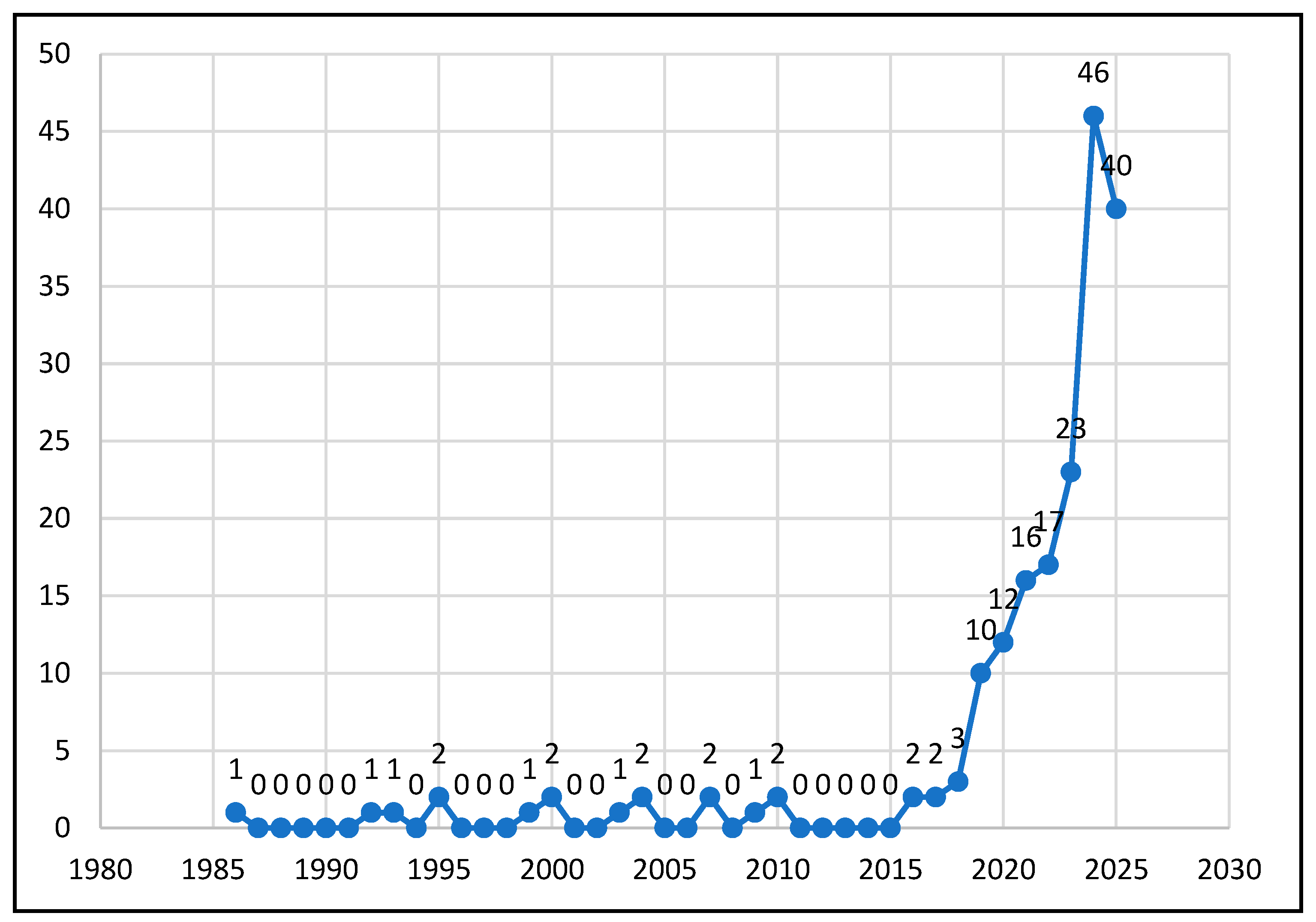
3.1. Publication Trend
3.2. Most Cited Articles
3.3. Most Published Authors (On AI-Enabled Auditing) and Affiliations
3.4. Prominent Sources
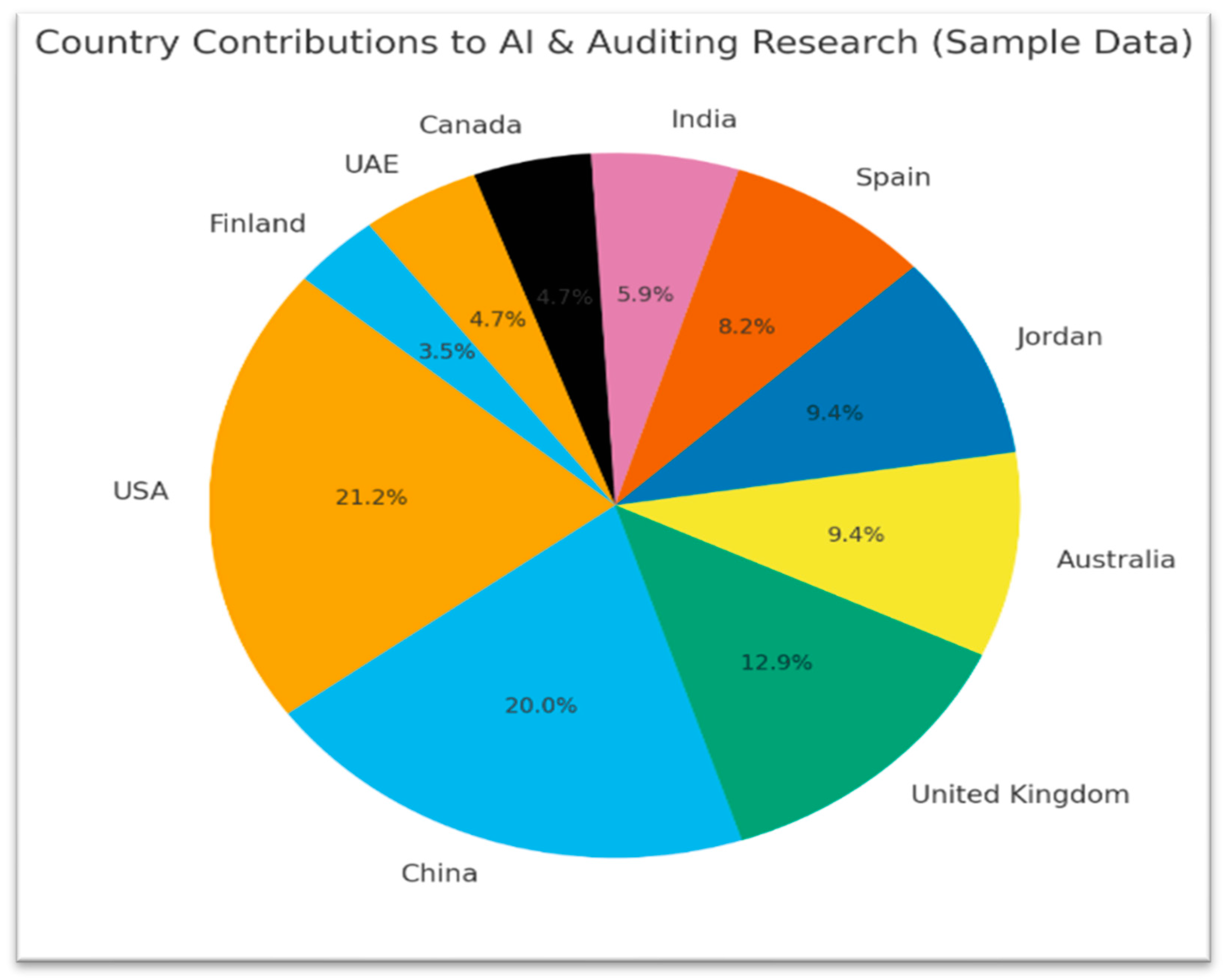
3.5. Country Contribution
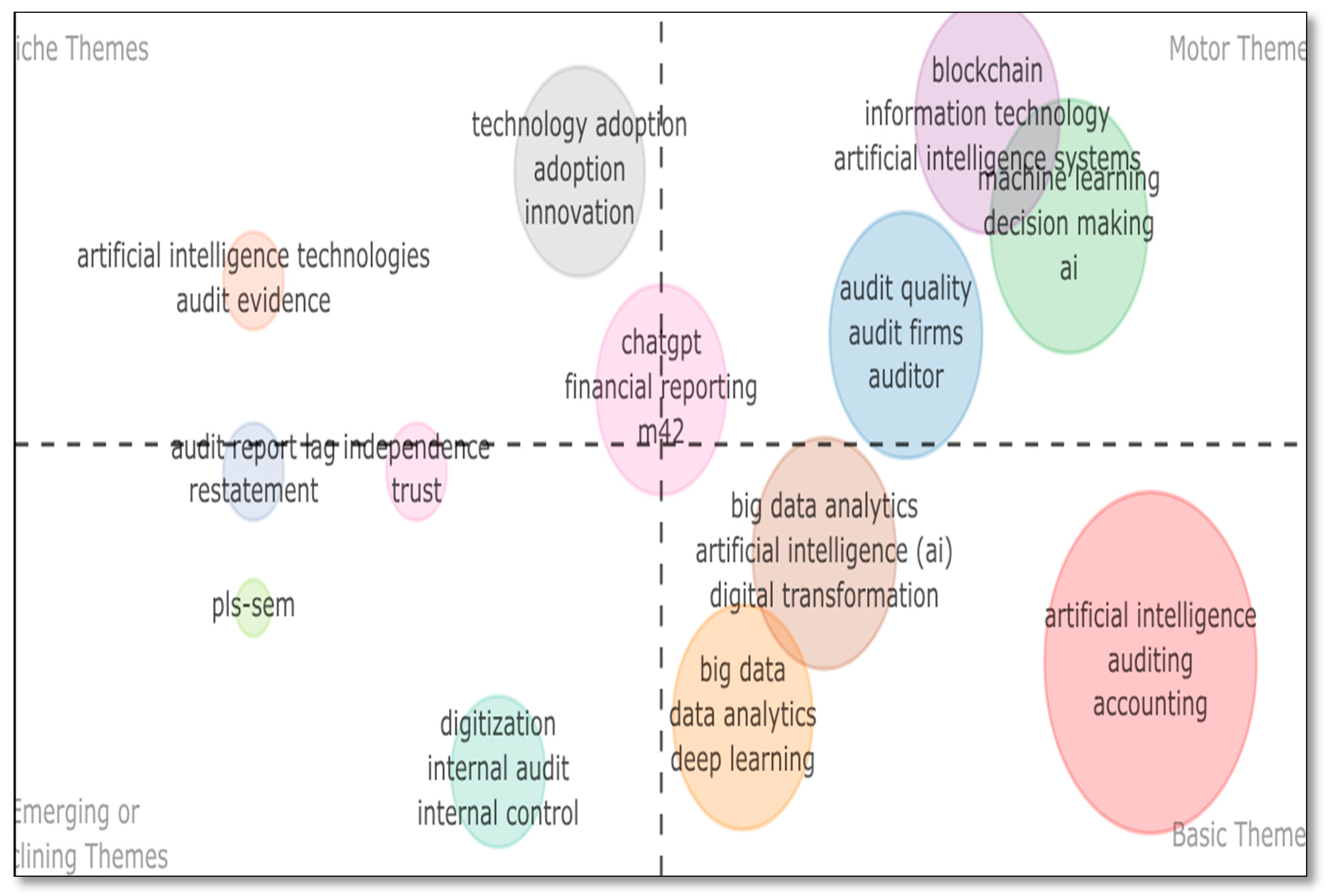
3.6. Thematic Map
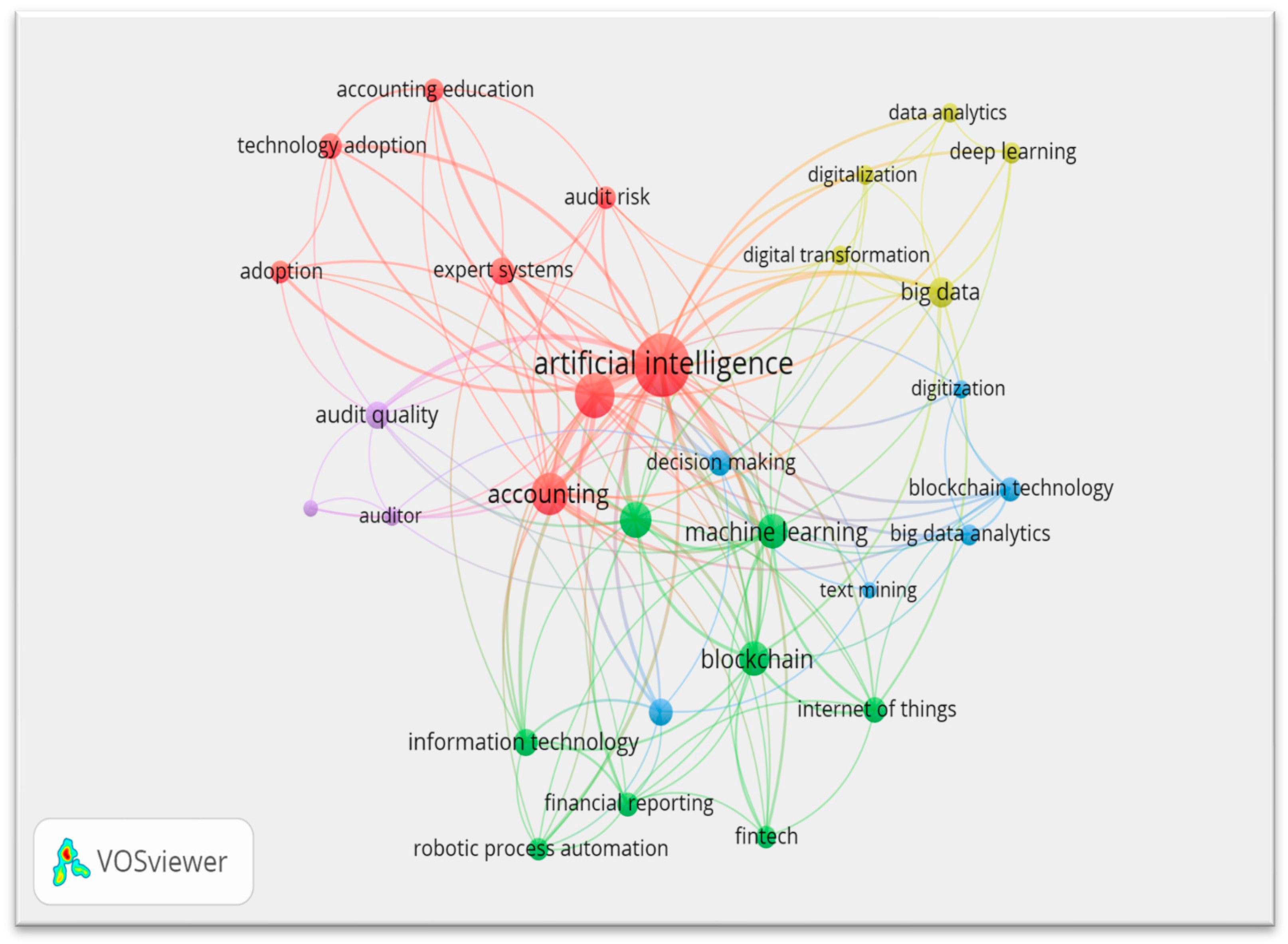
3.7. Keyword Network and Thematic Analysis
- (i)
- Audit and audit quality.
- (ii)
- Data and digital technologies (e.g., machine learning, deep learning, big data, blockchain, RPA, IoT, text mining).
- (iii)
- Judgment, ethics, and governance (e.g., decision making, auditor, transparency).
- Cluster Composition and Thematic Characterization:
- Cluster 1 (Red)—AI Adoption, Readiness, and Organizational Transformation:
- Cluster 2 (Green, Blue, and Yellow)—Digital Technologies and Data-Driven Audit Ecosystems:
- Cluster 3 (Purple)—Audit Quality, Professional Skepticism, and Ethical Governance:
- (a)
- Concerns regarding the maintenance of professional standards;
- (b)
- Managing the risks associated with algorithmic decision making;
- (c)
- Developing appropriate oversight mechanisms for the use of AI technologies.
3.7.1. Theme 1: AI in Auditing: Readiness, Representation, and Implementation
3.7.2. Theme 2: Data-Driven Audit Ecosystems and Digital Technologies
- (Combination: Machine Learning, Deep Learning, Big Data, Blockchain, RPA, IoT)
3.7.3. Theme 3: Audit Quality, Professional Skepticism, and Ethical Governance
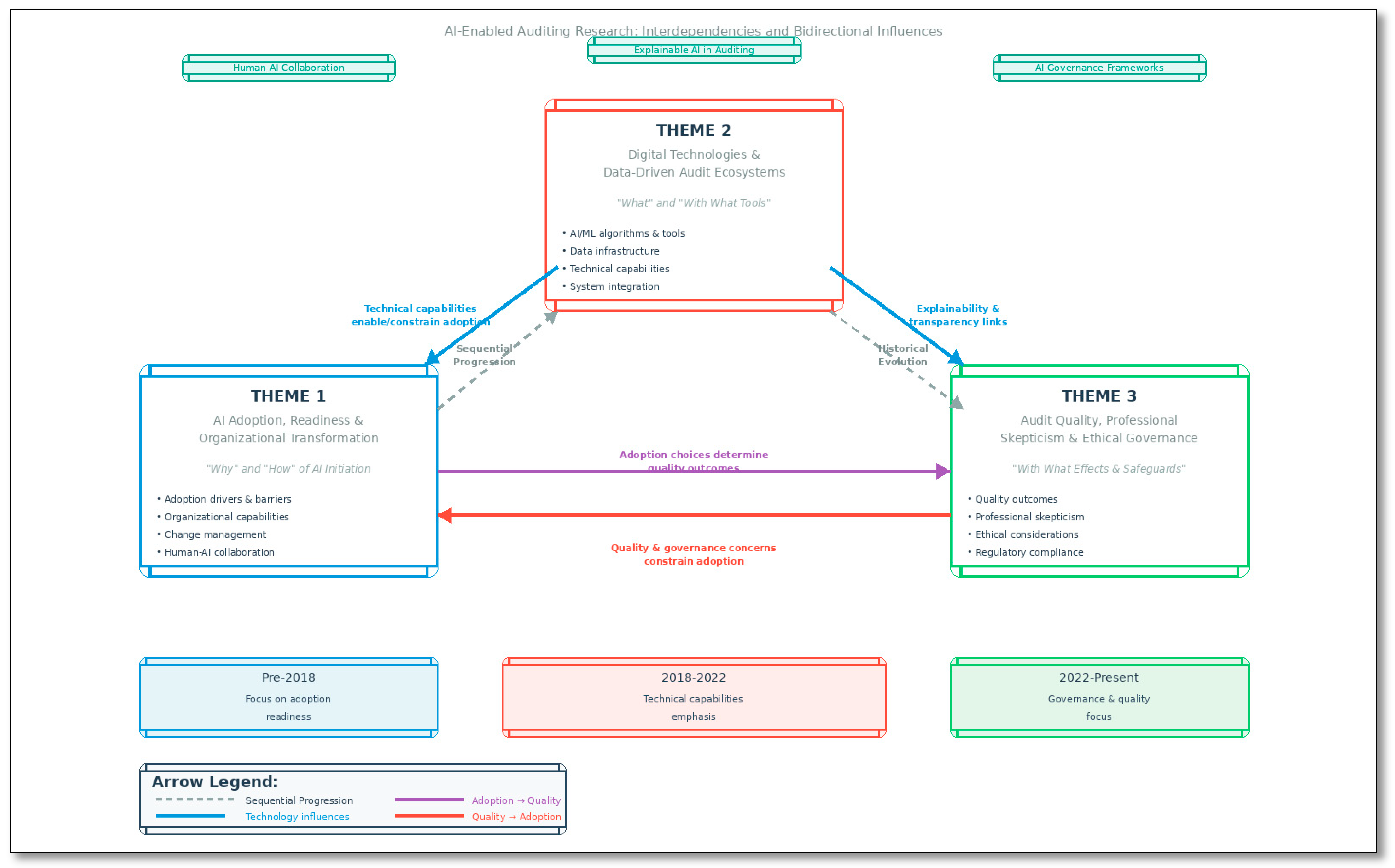
3.8. Thematic Integration and Interdependencies
- Sequential Progression: Adoption → Technology → Governance
- Bidirectional Influences Among Themes
- Cross-Theme Research Streams
- Synthesis: An Integrated Framework
- Theme 1 addresses the ‘why’ and ‘how’ of initiating AI adoption.
- Theme 2 addresses the ‘what’ and ‘with what tools’ of implementing AI.
- Theme 3 addresses the ‘with what effects’ and ‘with what safeguards’ of AI deployment.
- Synthesized Research Gaps and Future Research Directions
4. Conclusions
- Contribution and significance to stakeholders.
- Implications for Audit Firms and Practitioners
- Invest in Explainable AI Training: Develop auditor training programs focused on interpreting AI outputs, understanding algorithmic logic, and maintaining professional skepticism when using AI tools.
- Establish AI Governance Frameworks: Implement internal controls for AI tool selection, validation, monitoring, and documentation. Create dedicated AI governance committees with technical and audit expertise.
- Pilot Human-AI Collaboration Models: Test different configurations of auditor-AI interaction before full-scale deployment. Conduct controlled pilots in 3–5 audit engagements to identify optimal collaboration patterns.
- Develop Algorithmic Audit Trails: Ensure AI systems maintain comprehensive logs of decisions, data inputs, and processing steps for audit documentation and regulatory compliance.
- Address Algorithmic Bias: Implement bias testing protocols for AI tools used in risk assessment and sampling to ensure fair, unbiased audit procedures.
- Invest in Data Infrastructure: Build capabilities for handling large-scale, unstructured data required for advanced AI applications.
- Implications for Regulators and Standard-Setters
- Develop AI-Specific Audit Standards: Create guidance addressing: (a) acceptable AI tools and validation requirements, (b) documentation standards for AI-assisted procedures, (c) quality control requirements for AI outputs, and (d) auditor competency requirements for AI usage. Coordinate internationally (IAASB) to develop principles-based standards.
- Establish Auditability Requirements for AI Systems: Mandate that AI tools used in audits meet explainability, transparency, and reproducibility standards. Develop certification framework for ‘audit-grade AI systems.’
- Clarify Accountability Frameworks: Provide guidance on responsibility allocation when AI tools contribute to audit failures. Address legal and professional liability questions through formal pronouncements.
- Require AI Disclosure in Audit Reports: Consider mandatory disclosure of material AI usage in audit procedures to enhance transparency for financial statement users.
- Monitor AI Adoption Patterns: Establish ongoing surveillance of AI deployment in audits to identify emerging risks and best practices.
- Support SME Audit Firms: Provide resources and guidance to help smaller firms adopt AI responsibly without competitive disadvantage.
- Implications for Investors and Financial Statement Users
- Understand AI’s Impact on Audit Quality: Recognize that AI adoption may initially increase audit quality variability as firms learn to deploy tools effectively.
- Seek Transparency: Request information from audit committees about AI usage in audits and governance mechanisms.
- Monitor Regulatory Developments: Stay informed about evolving AI audit standards that may affect audit quality and reliability.
Study Limitations
Author Contributions
Funding
Informed Consent Statement
Data Availability Statement
Acknowledgments
Conflicts of Interest
References
- Abdullah, A. A. H., & Almaqtari, F. A. (2024). The impact of artificial intelligence and Industry 4.0 on transforming accounting and auditing practices. Journal of Open Innovation: Technology, Market, and Complexity, 10(1), 100218. [Google Scholar] [CrossRef]
- Abu Huson, Y., Sierra García, L., García Benau, M. A., & Mohammad Aljawarneh, N. (2025). Cloud-based artificial intelligence and audit report: The mediating role of the auditor. VINE Journal of Information and Knowledge Management Systems, 55(6), 1553–1574. [Google Scholar] [CrossRef]
- Albitar, K., Gerged, A. M., Kikhia, H., & Hussainey, K. (2021). Auditing in times of social distancing: The effect of COVID-19 on auditing quality. International Journal of Accounting & Information Management, 29(1), 169–178. [Google Scholar] [CrossRef]
- Alles, M., & Gray, G. L. (2024). The marketing on Big 4 websites of Big Data Analytics in the external audit: Evidence and consequences. International Journal of Accounting Information Systems, 54, 100697. [Google Scholar] [CrossRef]
- Almaqtari, F. A. (2024). The role of IT governance in the integration of AI in accounting and auditing operations. Economies, 12(8), 199. [Google Scholar] [CrossRef]
- Appelbaum, D., Kogan, A., & Vasarhelyi, M. A. (2017). Big data and analytics in the modern audit engagement: Research needs. Auditing: A Journal of Practice & Theory, 36(4), 1–27. [Google Scholar]
- Aria, M., & Cuccurullo, C. (2017). Bibliometrix: An R-tool for comprehensive science mapping analysis. Journal of Informetrics, 11(4), 959–975. [Google Scholar] [CrossRef]
- Baker, H. K., Kumar, S., & Pandey, N. (2020). A bibliometric analysis of managerial finance: A retrospective. Managerial Finance, 46(11), 1495–1517. [Google Scholar] [CrossRef]
- Bonsón, E., & Bednárová, M. (2019). Blockchain and its implications for accounting and auditing. Meditari Accountancy Research, 27(5), 725–740. [Google Scholar] [CrossRef]
- Curtis, M. B., & Payne, E. A. (2008). An examination of contextual factors and individual characteristics affecting technology implementation decisions in auditing. International Journal of Accounting Information Systems, 9(2), 104–121. [Google Scholar] [CrossRef]
- Dai, J., & Vasarhelyi, M. A. (2017). Toward blockchain-based accounting and assurance. Journal of Information Systems, 31(3), 5–21. [Google Scholar] [CrossRef]
- Damerji, H., & Salimi, A. (2021). Mediating effect of use perceptions on technology readiness and adoption of artificial intelligence in accounting. Accounting Education, 30(2), 107–130. [Google Scholar] [CrossRef]
- Deloitte. (2024). Navigating the artificial intelligence frontier: An introduction for internal audit. Deloitte Risk Advisory. Available online: https://www2.deloitte.com/content/dam/Deloitte/us/Documents/Advisory/us-navigating-the-artificial-intelligence-frontier.pdf (accessed on 10 January 2026).
- Dietvorst, B. J., Simmons, J. P., & Massey, C. (2015). Algorithm aversion: People erroneously avoid algorithms after seeing them err. Journal of Experimental Psychology: General, 144(1), 114. [Google Scholar] [CrossRef]
- Donthu, N., Kumar, S., Mukherjee, D., Pandey, N., & Lim, W. M. (2021). How to conduct a bibliometric analysis: An overview and guidelines. Journal of Business Research, 133, 285–296. [Google Scholar] [CrossRef]
- Earley, S. (2023). What executives need to know about knowledge management, large language models and generative AI. Applied Marketing Analytics, 9(3), 215–229. [Google Scholar] [CrossRef]
- Ellili, N. O. D. (2023). FinTech adoption during COVID-19 pandemic: Bibliometric analysis. What lessons for the future? What Lessons for the Future. [Google Scholar] [CrossRef]
- European Parliament and Council of the European Union. (2024). Regulation (EU) 2024/1689 of the European Parliament and of the Council of 13 June 2024 laying down harmonised rules on artificial intelligence (Artificial Intelligence Act). Official Journal of the European Union. Available online: https://eur-lex.europa.eu/eli/reg/2024/1689/oj (accessed on 10 January 2026).
- Fisher, I. E., Garnsey, M. R., & Hughes, M. E. (2016). Natural language processing in accounting, auditing and finance: A synthesis of the literature with a roadmap for future research. Intelligent Systems in Accounting, Finance and Management, 23(3), 157–214. [Google Scholar] [CrossRef]
- Francis, J. R. (2011). A framework for understanding and researching audit quality. Auditing: A Journal of Practice & Theory, 30(2), 125–152. [Google Scholar]
- Gu, H., Schreyer, M., Moffitt, K., & Vasarhelyi, M. (2024). Artificial intelligence co-piloted auditing. International Journal of Accounting Information Systems, 54, 100698. [Google Scholar] [CrossRef]
- Hajek, P., & Henriques, R. (2017). Mining corporate annual reports for intelligent detection of financial statement fraud—A comparative study of machine learning methods. Knowledge-Based Systems, 128, 139–152. [Google Scholar] [CrossRef]
- Han, H., Shiwakoti, R. K., Jarvis, R., Mordi, C., & Botchie, D. (2023). Accounting and auditing with blockchain technology and artificial Intelligence: A literature review. International Journal of Accounting Information Systems, 48, 100598. [Google Scholar] [CrossRef]
- Huang, F., & Vasarhelyi, M. A. (2019). Applying robotic process automation (RPA) in auditing: A framework. International Journal of Accounting Information Systems, 35, 100433. [Google Scholar] [CrossRef]
- Hurtt, R. K., Brown-Liburd, H., Earley, C. E., & Krishnamoorthy, G. (2013). Research on auditor professional skepticism: Literature synthesis and opportunities for future research. Auditing: A Journal of Practice & Theory, 32(Suppl. S1), 45–97. [Google Scholar]
- International Auditing and Assurance Standards Board (IAASB). (2024). Technology position statement. International Federation of Accountants. Available online: https://www.iaasb.org/publications/technology-position-statement (accessed on 10 January 2026).
- Jain, K., & Tripathi, P. S. (2023). Mapping the environmental, social and governance literature: A bibliometric and content analysis. Journal of Strategy and Management, 16(3), 397–428. [Google Scholar] [CrossRef]
- Kassar, M., & Jizi, M. (2026). Artificial intelligence and robotic process automation in auditing and accounting: A systematic literature review. Journal of Applied Accounting Research, 27(1), 217–241. [Google Scholar] [CrossRef]
- Khatib, S. F., Abdullah, D. F., Elamer, A., Yahaya, I. S., & Owusu, A. (2023). Global trends in board diversity research: A bibliometric view. Meditari Accountancy Research, 31(2), 441–469. [Google Scholar] [CrossRef]
- Knechel, W. R., Krishnan, G. V., Pevzner, M., Shefchik, L. B., & Velury, U. K. (2013). Audit quality: Insights from the academic literature. Auditing: A Journal of Practice & Theory, 32(Suppl. S1), 385–421. [Google Scholar]
- Kokina, J., Blanchette, S., Davenport, T. H., & Pachamanova, D. (2025). Challenges and opportunities for artificial intelligence in auditing: Evidence from the field. International Journal of Accounting Information Systems, 56, 100734. [Google Scholar] [CrossRef]
- Kokina, J., & Davenport, T. H. (2017). The emergence of artificial intelligence: How automation is changing auditing. Journal of Emerging Technologies in Accounting, 14(1), 115–122. [Google Scholar] [CrossRef]
- Kureljusic, M., & Karger, E. (2024). Forecasting in financial accounting with artificial intelligence–A systematic literature review and future research agenda. Journal of Applied Accounting Research, 25(1), 81–104. [Google Scholar] [CrossRef]
- Leocádio, D., Malheiro, L., & Reis, J. (2024). Artificial intelligence in auditing: A conceptual framework for auditing practices. Administrative Sciences, 14(10), 238. [Google Scholar] [CrossRef]
- Leocádio, D., Malheiro, L., & Reis, J. C. G. D. (2025). Auditors in the digital age: A systematic literature review. Digital Transformation and Society, 4(1), 5–20. [Google Scholar] [CrossRef]
- Li, Y., & Goel, S. (2025). Artificial intelligence auditability and auditor readiness for auditing artificial intelligence systems. International Journal of Accounting Information Systems, 56, 100739. [Google Scholar] [CrossRef]
- Lombardi, R., de Villiers, C., Moscariello, N., & Pizzo, M. (2022). The disruption of blockchain in auditing—A systematic literature review and an agenda for future research. Accounting, Auditing & Accountability Journal, 35(7), 1534–1565. [Google Scholar] [CrossRef]
- Manita, R., Elommal, N., Baudier, P., & Hikkerova, L. (2020). The digital transformation of external audit and its impact on corporate governance. Technological Forecasting and Social Change, 150, 119751. [Google Scholar] [CrossRef]
- Mansour, E. M., Al-Zyod, L., Ghassab, E. E., & Alaqrabawi, M. (2025). Auditor’s willingness to learn and its effect on the intention to use AI technologies in the audit process: Evidence from emerging economies. Journal of Financial Reporting and Accounting, 23(4), 1553–1586. [Google Scholar] [CrossRef]
- Mohammed Ismail, I. H., & Abdul Hamid, F. Z. (2024). A systematic literature review of the role of big data analysis in financial auditing. Management & Accounting Review (MAR), 23(2), 321–350. [Google Scholar] [CrossRef]
- Mugwira, T. (2022). Internet related technologies in the auditing profession: A WOS bibliometric review of the past three decades and conceptual structure mapping. Spanish Accounting Review, 25, 201–216. [Google Scholar] [CrossRef]
- Munoko, I., Brown-Liburd, H. L., & Vasarhelyi, M. (2020). The ethical implications of using artificial intelligence in auditing. Journal of Business Ethics, 167(2), 209–234. [Google Scholar] [CrossRef]
- Musunuru, K. (2025). Big data analytics for financial auditing practices: Identification of conceptual patterns, implications and challenges using text mining. Contaduría y Administración, 70(2), 1–36. [Google Scholar] [CrossRef]
- Nelson, M. W. (2009). A model and literature review of professional skepticism in auditing. Auditing: A Journal of Practice & Theory, 28(2), 1–34. [Google Scholar]
- Odonkor, B., Kaggwa, S., Uwaoma, P. U., Hassan, A. O., & Farayola, O. A. (2024). The impact of AI on accounting practices: A review: Exploring how artificial intelligence is transforming traditional accounting methods and financial reporting. World Journal of Advanced Research and Reviews, 21(1), 172–188. [Google Scholar] [CrossRef]
- O’Neil, C. (2016). Weapons of math destruction: How big data increases inequality and threatens democracy. Crown Publishers. [Google Scholar]
- Parasuraman, R., & Riley, V. (1997). Humans and automation: Use, misuse, disuse, abuse. Human Factors, 39(2), 230–253. [Google Scholar] [CrossRef]
- PCAOB. (2025). Accounting developments 2024. The Business Lawyer, 80. [Google Scholar]
- Power, M. (1997). The audit society: Rituals of verification. Oxford University Press. [Google Scholar]
- Pravdiuk, N., Miroshnichenko, M., Lukanovska, I., Tkal, Y., & Motorniuk, U. (2024). The impact of cryptocurrencies and blockchain technologies on the accounting and audit systems. Economic Affairs, 69, 107–115. [Google Scholar] [CrossRef]
- Ramzan, S., & Lokanan, M. (2025). The application of machine learning to study fraud in the accounting literature. Journal of Accounting Literature, 47(3), 570–596. [Google Scholar] [CrossRef]
- Raschke, R. L., Saiewitz, A., Kachroo, P., & Lennard, J. B. (2018). AI-enhanced audit inquiry: A research note. Journal of Emerging Technologies in Accounting, 15(2), 111–116. [Google Scholar] [CrossRef]
- Rose, A. M., Rose, J. M., Sanderson, K. A., & Thibodeau, J. C. (2017). When should audit firms introduce analyses of big data into the audit process? Journal of Information Systems, 31(3), 81–99. [Google Scholar] [CrossRef]
- Sayal, A., Johri, A., Chaithra, N., Alhumoudi, H., & Alatawi, Z. (2025). Optimizing audit processes through open innovation: Leveraging emerging technologies for enhanced accuracy and efficiency. Journal of Open Innovation: Technology, Market, and Complexity, 11(3), 100573. [Google Scholar] [CrossRef]
- Sun, T. (2019). Applying deep learning to audit procedures: An illustrative framework. Accounting Horizons, 33(3), 89–109. [Google Scholar] [CrossRef]
- Sundarasen, S., Kumar, R., Tanaraj, K., Ali Alsmady, A., & Rajagopalan, U. (2024a). From board diversity to disclosure: A comprehensive review on board dynamics and ESG reporting. Research in Globalization, 9, 100259. [Google Scholar] [CrossRef]
- Sundarasen, S., Rajagopalan, U., & Alsmady, A. A. (2024b). Environmental accounting and sustainability: A meta-synthesis. Sustainability, 16(21), 9341. [Google Scholar] [CrossRef]
- Sutton, S. G., Holt, M., & Arnold, V. (2016). The reports of my death are greatly exaggerated: Artificial intelligence research in accounting. International Journal of Accounting Information Systems, 22, 60–73. [Google Scholar] [CrossRef]
- Tranfield, D., Denyer, D., & Smart, P. (2003). Towards a methodology for developing evidence-informed management knowledge by means of systematic review. British Journal of Management, 14(3), 207–222. [Google Scholar] [CrossRef]
- Ülker, P., Ülker, M., & Karamustafa, K. (2023). Bibliometric analysis of bibliometric studies in the field of tourism and hospitality. Journal of Hospitality and Tourism Insights, 6(2), 797–818. [Google Scholar] [CrossRef]
- Van Eck, N. J., & Waltman, L. (2009). Software survey: VOSviewer, a computer program for bibliometric mapping. Scientometrics, 84(2), 523–538. [Google Scholar] [CrossRef]
- Yilmaz, A. A., & Tuzlukaya, S. E. (2024). The relation between intellectual capital and digital transformation: A bibliometric analysis. International Journal of Innovation Science, 16(2), 244–264. [Google Scholar] [CrossRef]
- Zhao, J., & Wang, X. (2024). Unleashing efficiency and insights: Exploring the potential applications and challenges of ChatGPT in accounting. Journal of Corporate Accounting & Finance, 35(1), 269–276. [Google Scholar]
- Zhong, C., & Goel, S. (2024). Transparent AI in auditing through explainable AI. Current Issues in Auditing, 18(2), A1–A14. [Google Scholar] [CrossRef]
- Zupic, I., & Čater, T. (2015). Bibliometric methods in management and organization. Organizational Research Methods, 18(3), 429–472. [Google Scholar] [CrossRef]



| Citation | Key Findings | Main Contribution | Relevant Theme(s) (Section 3.7) |
|---|---|---|---|
| Kokina and Davenport (2017) | AI shifts auditing from sampling to full-population, proactive analysis; enhances efficiency but risks erosion of professional judgment. | Provides early conceptual framing of AI’s transformative impact on auditing. | Theme 1: AI Adoption & Audit Transformation; Theme 3: Judgment & Audit Quality |
| Munoko et al. (2020) | AI introduces ethical risks related to bias, transparency, accountability, and may widen capability gaps between large and small firms. | Integrates ethics and governance concerns into the AI auditing discourse. | Theme 3: Professional Judgment, Ethics & Governance |
| Han et al. (2023) | AI–blockchain convergence improves transparency and fraud detection; empirical evidence remains limited. | Maps synergies and gaps at the intersection of AI and blockchain in auditing. | Theme 2: Digital Technologies & Data-Driven Audit Ecosystems |
| Manita et al. (2020) | AI enhances efficiency and fraud detection while reshaping auditors’ roles; adoption requires reskilling and regulatory adaptation. | Frames digital transformation as both a technical and organizational process. | Theme 1: AI Adoption & Audit Transformation; Theme 2 |
| Hajek and Henriques (2017) | NLP and machine learning outperform traditional models in detecting financial distress using unstructured disclosures. | Demonstrates predictive value of text mining for audit risk assessment. | Theme 2: Digital Technologies & Data Analytics |
| Damerji and Salimi (2021) | Perceived usefulness and ease of use mediate the relationship between readiness and AI adoption. | Provides empirical evidence on behavioral drivers of AI adoption in auditing. | Theme 1: AI Adoption & Capability Building |
| Fisher et al. (2016) | AI has strong potential to enhance audit quality, but academic research lags technological developments. | Establishes an early research agenda for AI in auditing. | Theme 1: AI Adoption & Audit Transformation |
| Sutton et al. (2016) | AI is more likely to augment rather than replace auditors; human–AI collaboration is essential. | Challenges automation-replacement narratives in auditing research. | Theme 1: AI Adoption & Audit Transformation; Theme 3 |
| Albitar et al. (2021) | Pandemic constraints accelerated AI adoption but introduced risks due to rapid implementation. | Links crisis-driven digital transformation with long-term AI adoption debates. | Theme 1: AI Adoption & Audit Transformation; Theme 3 |
| Author | No. of Publications | Main Research Interest Areas | Affiliation | Country |
|---|---|---|---|---|
| Miklós A. Vasarhelyi | 7 | Continuous auditing, audit analytics, artificial intelligence in auditing, continuous assurance systems, audit automation | Rutgers Business School | United States |
| Fahad A. Almaqtari | 3 | Corporate governance, audit quality, financial performance, emerging market accounting practices | King Khalid University | Saudi Arabia |
| Feng-Hsiang Chen | 3 | Artificial intelligence applications in accounting, audit risk assessment, big data analytics | National Taiwan University | Taiwan |
| Ming-Feng Hsu | 3 | Audit analytics, decision support systems, machine learning in auditing | National Chung Cheng University | Taiwan |
| Kuo-Hua Hu | 3 | Predictive analytics, fraud detection models, AI-based audit techniques | National Chengchi University | Taiwan |
| Jian Yang | 3 | Textual analysis, machine learning in accounting research, financial disclosure analytics | City University of Hong Kong | Hong Kong |
| Yahya Abu Huson | 2 | Audit quality, technology adoption in auditing, auditor judgment | Al-Zaytoonah University of Jordan | Jordan |
| Sami F. Al-Aroud | 2 | Accounting information systems, data analytics, digital transformation in auditing | Yarmouk University | Jordan |
| Abdulrahman Alassuli | 2 | Audit technology, professional judgment, audit analytics adoption | University Utara Malaysia | Malaysia |
| Journal Title | ABDC Ranking | Scimago Quartile |
|---|---|---|
| International Journal of Accounting Information Systems | A | Q1 |
| Journal of Emerging Technologies in Accounting | B | Q2 |
| Journal of Financial Reporting and Accounting | B | Q2 |
| Managerial Auditing Journal | A | Q1 |
| Journal of Open Innovation: Technology, Market, and Complexity | B | Q1 |
| Review of Accounting Studies | A | Q1 |
| Accounting Education | B | Q1 |
| International Review of Financial Analysis | A | Q1 |
| Study (Authors, Year) | Title | Main Findings | Contribution |
|---|---|---|---|
| Damerji and Salimi (2021) | Mediating effect of use perceptions on technology readiness and adoption of artificial intelligence in accounting | Technology readiness significantly relates to AI adoption, with perceived usefulness (PU) and perceived ease of use (PEOU) mediating the readiness–adoption relationship (sample: accounting students, survey-based). | Links technology readiness to AI adoption through PU/PEOU; highlights the role of education in preparing future professionals. |
| Alles and Gray (2024) | The marketing on Big 4 websites of Big Data Analytics in the external audit: Evidence and consequences | Big Four firms market audit analytics as providing operational and value-adding insights; “value add” is positioned as an essential selling point; raises concerns regarding auditor independence. | Shifts attention to how audit analytics are publicly represented and how audits are strategically positioned. |
| Leocádio et al. (2024) | Artificial Intelligence in Auditing: A Conceptual Framework for Auditing Practices | SLR develops a conceptual framework highlighting AI’s potential to shift auditing toward proactive and continuous monitoring; calls for research on efficiency, performance, regulation, and auditor adaptation. | Organizes fragmented audit–AI literature and proposes a structured agenda for future empirical work. |
| Curtis and Payne (2008) | An examination of contextual factors and individual characteristics affecting technology implementation decisions in auditing | Audit technologies can improve efficiency and effectiveness but are underutilized due to performance evaluation pressures, budget constraints, and contextual factors. | Explains why technological availability does not ensure implementation; emphasizes incentives and organizational context. |
| Kokina et al. (2025) | Challenges and opportunities for artificial intelligence in auditing: Evidence from the field | Simple AI applications are widely used, while complex AI remains limited; key challenges include explainability, bias, privacy, robustness, overreliance, and lack of guidance. | Provides field-based insight into actual AI use and consolidates governance and risk concerns. |
| Abdullah and Almaqtari (2024) | The impact of artificial intelligence and Industry 4.0 on auditing | AI and Industry 4.0 technologies are expected to reshape auditing, but adoption is constrained by institutional, infrastructural, and regulatory factors. | Situates AI adoption within broader digital transformation in auditing. |
| Abu Huson et al. (2025) | Cloud-based artificial intelligence and audit quality | AI use is associated with potential improvements in audit quality, suggesting benefits depend on effective implementation. | Links AI adoption to audit quality outcomes. |
| Study (Authors, Year) | Title | Main Findings | Contribution |
|---|---|---|---|
| Gu et al. (2024) | Artificial intelligence co-piloted auditing | Proposes “AI co-piloted auditing,” arguing auditors can be augmented by foundation models across audit tasks; discusses how human–AI collaboration could reshape audit work. | Introduces a clear conceptual framing for human-in-the-loop auditing with foundation models, helping shift the discussion from “automation replaces auditors” to “augmentation and workflow redesign.” |
| Raschke et al. (2018) | AI-Enhanced Audit Inquiry: A Research Note | Discusses the feasibility of using AI “bots” to generate audit inquiries and evaluate client responses, and outlines research opportunities for automated inquiry. | Sharp, audit-specific contribution: treats inquiry as a workflow that can be augmented/automated and highlights researchable design questions. |
| Manita et al. (2020) | The digital transformation of external audit and its impact on corporate governance | Interview-based evidence (Big audit firms in France) showing digital tech affects audit firms at multiple levels and reshapes audit’s role as a governance mechanism. | Strong empirical anchor: explains digital transformation through governance and organizational change rather than “tools only.” |
| Han et al. (2023) | Accounting and auditing with blockchain technology: A literature review | Surveys research on how blockchain will affect accounting/auditing (including audit processes and assurance implications). | Maps a major adjacent technology domain; useful for positioning how “data infrastructure” innovations interact with audit analytics/AI. |
| Sayal et al. (2025) | Optimizing audit processes through open innovation: Leveraging emerging technologies for enhanced accuracy and efficiency | Uses ML (supervised + unsupervised) on SEC financial statement datasets to improve audit-related risk classification (as described on the publisher page). | Offers a more “build/test” oriented approach (model framework + dataset), moving beyond conceptual claims. |
| Mohammed Ismail and Abdul Hamid (2024) | A systematic literature review of the role of big data analysis in financial auditing | SLR synthesizing how big data analytics is used/positioned in financial auditing and discusses opportunities and challenges (per the journal/repository record). | Consolidates “big data analysis in auditing” as a structured stream—useful bridge between audit analytics and AI-enabled decision support. |
| Huang and Vasarhelyi (2019) | Applying robotic process automation (RPA) in auditing: A framework | Develops a conceptual framework for integrating RPA into audit processes, focusing on automating routine, rule-based audit tasks such as data extraction, reconciliations, and control testing. | Demonstrates how RPA can enhance audit efficiency and consistency by automating repetitive procedures, allowing auditors to focus on judgment-intensive activities such as risk assessment and exception evaluation. |
| Dai and Vasarhelyi (2017) | Toward blockchain-based accounting and assurance | Develops a conceptual framework for applying blockchain technology to accounting and auditing, with a focus on continuous auditing, real-time verification, and immutable transaction records. | Highlights blockchain’s ability to enhance audit quality through continuous assurance models. |
| Study (Authors, Year) | Title | Main Findings | Contribution |
|---|---|---|---|
| Munoko et al. (2020) | The Ethical Implications of Using Artificial Intelligence in Auditing | Examines ethical challenges arising from the use of AI in auditing, including issues of fairness, accountability, transparency, and responsibility, and how these affect audit decision-making. | Positions AI in auditing as not merely a technical advancement but a professional ethics and governance issue, highlighting risks related to over-reliance, bias, and responsibility for AI-driven outcomes. |
| Li and Goel (2025) | Making It Possible for the Auditing of AI: A Systematic Review of AI Audits and AI Auditability | Systematically reviews academic and regulatory literature on auditing AI systems and identifies auditability measures required across the AI lifecycle. | Clearly distinguishes auditing AI from using AI to audit, offering a structured view of governance, data, models, monitoring, transparency, and accountability required for AI assurance. |
| Zhong and Goel (2024) | Transparent AI in Auditing through Explainable AI | Proposes the use of explainable AI (XAI) techniques to improve transparency and interpretability of AI systems used in auditing. | Demonstrates that AI systems remain “black boxes” without deliberate auditability design, supporting the need for explainability, documentation, and lifecycle controls to justify audit reliance. |
| Bonsón and Bednárová (2019) | Blockchain and its Implications for Accounting and Auditing | Explores how blockchain features such as immutability, decentralization, and transparency may reshape accounting records and audit processes. | Supports arguments around immutable audit trails while highlighting governance challenges, particularly the need to link on-chain records to real-world economic rights and obligations. |
| Lombardi et al. (2022) | The Disruption of Blockchain in Auditing: A Systematic Literature Review and Future Research Agenda | Provides a structured literature review identifying research streams, gaps, and implications of blockchain adoption in auditing. | Serves as a state-of-the-art reference on blockchain in auditing, emphasizing institutional change, evolving audit procedures, and the need for standards, training, and empirical validation. |
| Rose et al. (2017) | When Should Audit Firms Introduce Analyses of Big Data Into the Audit Process? | Examines when and how audit firms should adopt big data analytics and how such tools influence audit planning and risk assessment. | Establishes a foundational link between analytics adoption and auditor judgment, showing that advanced tools can shape perceptions of risk and decision-making. |
| Raschke et al. (2018) | AI-Enhanced Audit Inquiry: A Research Note | Investigates the feasibility of using AI tools to automate audit inquiries and evaluate management responses. | Demonstrates that while AI can support inquiry processes, professional judgment, follow-up questioning, and skepticism remain essential. |
| Hurtt et al. (2013) | Research on Auditor Professional Skepticism: Literature Synthesis and Opportunities for Future Research | Synthesizes prior research on professional skepticism and outlines how skepticism operates and can be developed and measured. | Provides a theoretical foundation for understanding skepticism, which is critical for examining how AI and automation affect auditor judgment. |
| Nelson (2009) | A Model and Literature Review of Professional Skepticism in Auditing | Develops a conceptual model linking incentives, evidence, judgment, and skeptical actions in auditing. | Offers a mechanistic explanation of how AI tools may either strengthen or weaken professional skepticism through their influence on evidence evaluation and judgment. |
| Parasuraman and Riley (1997) | Humans and Automation: Use, Misuse, Disuse, Abuse | Introduces a human-factors framework explaining how users interact with automated systems, including over-use and misuse. | Provides the behavioral foundation for understanding automation bias and “process blindness” in AI-enabled audit environments. |
| Dietvorst et al. (2015) | Algorithm Aversion: People Erroneously Avoid Algorithms after Seeing Them Err | Shows that individuals may reject algorithmic advice after observing small errors, even when algorithms outperform humans overall. | Complements automation bias research by explaining under-reliance on AI, highlighting the difficulty of calibrating appropriate trust in audit technologies. |
| Francis (2011) | A Framework for Understanding and Researching Audit Quality | Develops a multi-level framework explaining audit quality as a function of competence, independence, incentives, and institutional factors. | Serves as a foundational lens for evaluating how AI and automation reshape audit quality by challenging traditional notions of judgment, skepticism, and accountability. |
| Theme | Integrated Keywords | Representative Articles |
|---|---|---|
| Theme 1: AI in Auditing: Readiness, Representation, and Real-World Use | Technology adoption, audit risk, accounting education, expert systems, capability maturity, organizational readiness, workforce digital skills | Damerji and Salimi (2021); Alles and Gray (2024); Leocádio et al. (2025); Kokina et al. (2025); Abdullah and Almaqtari (2024); Abu Huson et al. (2025) |
| Theme 2: Digital Technologies & Data-Driven Audit Ecosystems | Machine learning, deep learning, RPA, big data, blockchain, IoT, text mining, predictive analytics, digital ecosystems, continuous auditing | Gu et al. (2024); Han et al. (2023); Sayal et al. (2025); Manita et al. (2020); Mohammed Ismail and Abdul Hamid (2024); Dai and Vasarhelyi (2017); Sun (2019); Huang and Vasarhelyi (2019); Han et al. (2023) |
| Theme 3: Audit Quality, Professional Skepticism & Ethical Governance | Audit quality, skepticism, ethics, accountability, transparency, explainability, AI governance, algorithmic bias, fairness | Parasuraman and Riley (1997); Nelson (2009); Hurtt et al. (2013); Dietvorst et al. (2015); Bonsón and Bednárová (2019); Francis (2011); Munoko et al. (2020); Raschke et al. (2018); Zhong and Goel (2024); Li and Goel (2025); Lombardi et al. (2022); Rose et al. (2017) |
| Theme | Synthesized Research Gaps | Potential Future Research | Recommended Methodologies | Level(s) of Analysis |
|---|---|---|---|---|
| Theme 1: Adoption, Audit Risk & Capability Building | Overemphasis on adoption intention rather than post-adoption use | Develop post-adoption behavioral models and longitudinal studies | Longitudinal field studies, panel data analysis, interrupted time series | Individual auditor, audit team, firm level |
| Limited evidence on AI impact on actual audit quality | Examine AI-readiness frameworks for different audit firm sizes | Archival analysis, quasi-experimental designs, difference-in-differences | Engagement level, firm level | |
| Lack of integration with institutional pressure, regulation, and governance theories | Study regulatory influence on AI adoption | Comparative institutional analysis, cross-country studies, policy analysis | Institutional level, regulatory framework | |
| Skills gaps between universities, firms, and technological needs | Explore skill transformation pathways and investigate organizational resistance and cultural barriers | Survey research, competency gap analysis, Delphi studies, case studies | Individual auditor, educational institutions, firm level | |
| Lack of organizational change models for AI-based auditing | Design capability maturity models for AI-enabled auditing | Action research, design science research, multiple case studies | Firm level, organizational processes | |
| Lack of field-based empirical validations of ML/DL in real audits | Develop open-source benchmark datasets and conduct firm-level pilots using ML/DL in real engagements | Field experiments, pilot studies, randomized controlled trials | Engagement level, algorithm performance | |
| Theme 2: Digital Technologies & Data-Driven Audit Ecosystems | Few benchmark datasets for replicable AI audit research | Build integrated digital ecosystem audit frameworks | Dataset development, collaborative research initiatives, open-source projects | Industry-academic collaboration level |
| Limited understanding of AI-human collaboration in judgment | Propose standards for AI-enabled digital evidence | Laboratory experiments, process tracing, think-aloud protocols, behavioral observation | Individual auditor, task level | |
| Regulatory uncertainty in blockchain-based evidence | Study model drift and continuous monitoring | Legal analysis, Delphi studies with regulators, comparative jurisdictional analysis | Institutional level, regulatory frameworks | |
| Fragmented literature on digital ecosystems | Develop AI model auditability frameworks | Systematic literature review, framework development, design science research | Technology level, ecosystem level | |
| Lack of AI lifecycle governance, model drift research, and assurance of AI models | Create AI adoption pathways for small audit firms | Longitudinal monitoring studies, algorithm audits, performance testing | Algorithm level, firm level | |
| Theme 3: Audit Quality, Professional Skepticism & Ethical Governance | No frameworks for AI responsibility, liability, and accountability | Develop AI accountability frameworks | Legal case analysis, scenario-based analysis, stakeholder interviews, action research | Institutional level, firm level, legal framework |
| Limited evidence on AI improving regulatory inspection outcomes | Study AI impact on PCAOB/IAASB inspection results | Archival analysis of inspection data, quasi-experimental designs, regulatory data analysis | Engagement level, firm level, regulatory level | |
| Underdeveloped models of digital skepticism | Create hybrid skepticism models | Behavioral experiments, cognitive psychology studies, survey research | Individual auditor, cognitive processes | |
| Insufficient exploration of AI-driven cognitive biases | Conduct behavioral experiments on AI-assisted fraud detection | Laboratory experiments, between-subjects designs, eye-tracking studies, neuroimaging | Individual auditor, judgment and decision-making | |
| Poor integration of AI ethics into auditing standards | Design explainable AI protocols for auditors | Design science research, A/B testing of explanation formats, user experience studies | Technology design, individual auditor, task level | |
| Lack of explainable AI tools designed for audit evidence | Explore governance of algorithmic fairness and bias | Algorithmic fairness audits, field experiments, archival analysis for bias detection | Algorithm level, client level, societal level | |
| N/A | Evaluate impact of AI governance on trust and litigation risk | Archival analysis of litigation cases, survey of stakeholder trust, event studies | Firm level, market level, stakeholder level |
Disclaimer/Publisher’s Note: The statements, opinions and data contained in all publications are solely those of the individual author(s) and contributor(s) and not of MDPI and/or the editor(s). MDPI and/or the editor(s) disclaim responsibility for any injury to people or property resulting from any ideas, methods, instructions or products referred to in the content. |
© 2026 by the authors. Licensee MDPI, Basel, Switzerland. This article is an open access article distributed under the terms and conditions of the Creative Commons Attribution (CC BY) license.
Share and Cite
Sundarasen, S.; Kamaludin, K.; Nakiran, D. From Adoption to Audit Quality: Mapping the Intellectual Structure of Artificial Intelligence-Enabled Auditing. J. Risk Financial Manag. 2026, 19, 209. https://doi.org/10.3390/jrfm19030209
Sundarasen S, Kamaludin K, Nakiran D. From Adoption to Audit Quality: Mapping the Intellectual Structure of Artificial Intelligence-Enabled Auditing. Journal of Risk and Financial Management. 2026; 19(3):209. https://doi.org/10.3390/jrfm19030209
Chicago/Turabian StyleSundarasen, Sheela, Kamilah Kamaludin, and Deepa Nakiran. 2026. "From Adoption to Audit Quality: Mapping the Intellectual Structure of Artificial Intelligence-Enabled Auditing" Journal of Risk and Financial Management 19, no. 3: 209. https://doi.org/10.3390/jrfm19030209
APA StyleSundarasen, S., Kamaludin, K., & Nakiran, D. (2026). From Adoption to Audit Quality: Mapping the Intellectual Structure of Artificial Intelligence-Enabled Auditing. Journal of Risk and Financial Management, 19(3), 209. https://doi.org/10.3390/jrfm19030209