Article

Stock Liquidity and Social Media Analyst Coverage: Evidence from Tick Size Pilot Program

1
College of Business and Public Management, Wenzhou-Kean University, Wenzhou 320506, China
2
Gary W. Rollins College of Business, The University of Tennessee Chattanooga, Chattanooga, TN 37403, USA
3
College of Business, University of Wyoming, Laramie, WY 82070, USA
*
Author to whom correspondence should be addressed.
J. Risk Financial Manag. 2026, 19(2), 98; https://doi.org/10.3390/jrfm19020098
Submission received: 29 December 2025 / Revised: 23 January 2026 / Accepted: 26 January 2026 / Published: 2 February 2026
(This article belongs to the Special Issue Corporate Finance and Governance in a Changing Global Environment)

Abstract

Social media analysts (SMAs) on venues such as Seeking Alpha have become an important information intermediary for retail investors, particularly for smaller firms that receive limited attention from traditional channels. This study examines the effects of the wider tick size on social media analyst coverage in the U.S. capital market. Using the SEC’s 2016–2018 Tick Size Pilot Program as a quasi-natural experiment and a difference-in-differences design on approximately 2400 small-cap stocks, we find that wider tick size leads to a significant decline in the number of articles and unique contributors for treated firms. This effect is particularly strong for stocks with initially narrow bid–ask spreads. Furthermore, we find no significant change in the sentiment and quality of SMAs’ reports, indicating that the decrease in coverage is primarily driven by liquidity considerations rather than fundamental changes in the firms. These results imply that market microstructure reforms can inadvertently weaken the retail investor information ecosystem by discouraging independent research production.
JEL Classification:
G2; G23; G24

1. Introduction

Social media analysts (“SMAs” hereafter) are a group of individual investors who post investment opinions online on the social media platform. Prior literature documents that research by SMAs can be informative, complement sell-side research, and influence retail trading and prices (H. Chen et al., 2014; Campbell et al., 2019; Drake et al., 2021; Farrell et al., 2022), highlighting their added value beyond that provided by sell-side analysts. Unlike sell-side analysts who operate within brokerage institutions and produce research primarily for institutional clients, SMAs are decentralized contributors whose payoffs are more closely tied to reputation and reader attention and their content reaches toward a broader retail audience, in line with a “wisdom of crowds” mechanism documented in prior work (e.g., H. Chen et al., 2014; Luo et al., 2013), and have become a distinct channel through which firm-specific information reaches retail investors, particularly for smaller firms that may attract limited professional analyst coverage.1 Although extensive literature documents the impact of social media analyst coverage, few studies explore the incentives behind their decision to post investment advice online. Claussen et al. (2021) suggest that monetary incentives influence social media analysts’ stock coverage decisions. Using Seeking Alpha, a widely used investment-related social media platform, as their sample, they find that increased pay correlates with increased coverage by social media analysts. In addition to direct compensation, there are other motivations for these analysts, such as engaging with readers through comments, realizing profits on investment positions if they have a stake, and building a reputation in the investment community for future business opportunities. These incentives are likely to be sensitive to investor participation and information demand, which depend on trading frictions and information environment (Merton, 1987; Drake et al., 2012).
Market microstructure theory predicts that trading frictions, such as bid–ask spreads and minimum price increments, affect transaction costs, liquidity, and ultimately market participation and required returns (Amihud & Mendelson, 1986; Amihud, 2002). Thus, liquidity can influence SMA coverage through an investor participation and attention channel. Insufficient liquidity is associated with higher effective transaction costs (Amihud & Mendelson, 1986). Higher costs discourage trading and increase the cost of participation for less informed investors (Easley & O’Hara, 2004), while attention constraints impact which securities investors consider in the first place (Barber & Odean, 2008), suggesting that illiquid stocks could reduce investor attention and participation. As a result, investors are less likely to search for, process, and act on firm-specific information, which weakens the expected payoff to producing and disseminating analyst content on social media. Conversely, stocks with higher liquidity tend to attract more attention from both investors and analysts, creating a more vibrant discussion environment and more opportunities for analysts to engage with their audience. Moreover, higher liquidity can enhance the potential for analysts to realize profits on their own investments, as it facilitates easier and more profitable trading. In our study, we propose stock liquidity as a significant determinant of social media analyst coverage decision. Previous research indicates that social media analyst coverage can reduce information asymmetry and increase stock liquidity (Ding et al., 2020; Gomez et al., 2022; Ding et al., 2022). However, it remains unclear whether stock characteristics, in turn, affect SMAs’ coverage decisions.
Our study aims to provide evidence that stock liquidity can indeed affect social media analyst coverage decisions. To explore this causal relationship, we employ a quasi-natural experiment using the Tick Size Pilot Program, which operates in the U.S. capital market. On 6 May 2015, the SEC issued an order to implement a Tick Size Pilot Program by the National Securities Exchanges and FINRA. The program targets a set of randomly selected small-cap stocks that are assigned to three treatment groups differing in minimum quoting and trading increments. This program lasted for two years and was embedded in an ongoing market-structure policy debate of whether discrete pricing rules could affect stock trading, liquidity, and market quality.2 Prior studies document a variety of influences of the pilot program on the stock market, such as reduced quoted, effective spreads and stock price (Albuquerque et al., 2020; Chung et al., 2020), less algorithm trading (Lee & Watts, 2021), improved financial reporting quality (Ahmed et al., 2020), and sell-side analyst coverage (Z. Chen et al., 2021).
To investigate our question, we implement a difference-in-differences approach. We find that the widening of the tick size for treated firms leads to a decrease in stock liquidity compared to the control firms, which is consistent with the prior literature. Our baseline results show that the increase in the tick size for the treated firms negatively affects the total number of SMAs articles and the number of SMAs who are willing to share advice on these firms compared to the control firms. As the program separates the treated stocks into three groups, we further want to examine in which group the effect is more pronounced. We show that the baseline results are held in groups 1 and 3, where quote and trading increments differ in group 1 and additional trading constraints are imposed in group 3. We also conduct a cross-sectional analysis and find that the above effect holds for tick-constrained stocks, with bid–ask spreads lower than $0.05. Lastly, we intend to investigate whether SMAs will convey different sentiments and sacrifice the quality of reports after the stocks become less liquid. However, we do not find any change in SMAs’ sentiment and quality, indirectly suggesting that SMAs’ decline in coverage resulted from liquidity, rather than the fundamental change of the firms.
This paper contributes to the literature in three aspects. First, we provide causal evidence that liquidity is a determinant of the SMA coverage, showing that exogenous increases in trading frictions reduce the intensity and breadth of SMA coverage. Second, we link the market design to the information environment by showing that a microstructure reform designed to affect execution quality also affects who produces public research and which firms receive attention, in line with existing research on how intermediaries impact information production. Lastly, our results add new evidence that market design interventions can widen the information gap for retail participants, who are the primary users of SMA research.
The remainder of this paper is as follows. Section 2 develops our hypotheses. Section 3 describes our empirical methodology. Section 4 discusses the empirical results, followed by conclusions in Section 5.

2. Institutional Background and Hypothesis Development

2.1. Tick Size Pilot Program

On 6 May 2015, the U.S. Securities and Exchange Commission (SEC) approved the National Market System (NMS) Plan to initiate the Tick Size Pilot Program as a regulatory trial to evaluate the effects of wider tick sizes on the market quality and liquidity of small-cap stocks, where thin liquidity and information frictions are typically most salient, as the primary goal. Mechanically, tick size is a discrete pricing rule that governs the granularity of price competition among liquidity suppliers. On the one hand, a larger tick size can increase the economic value of time priority at the best bid and offer, which may encourage displayed limit-order supply and widen posted depth. On the other hand, wider tick sizes can mechanically widen quoted spreads and increase trading costs. This ambiguity of welfare implications reflects a broader debate on market microstructure, where regulatory interventions improve execution quality and reallocate trading rents across participants (O’Hara & Ye, 2011).
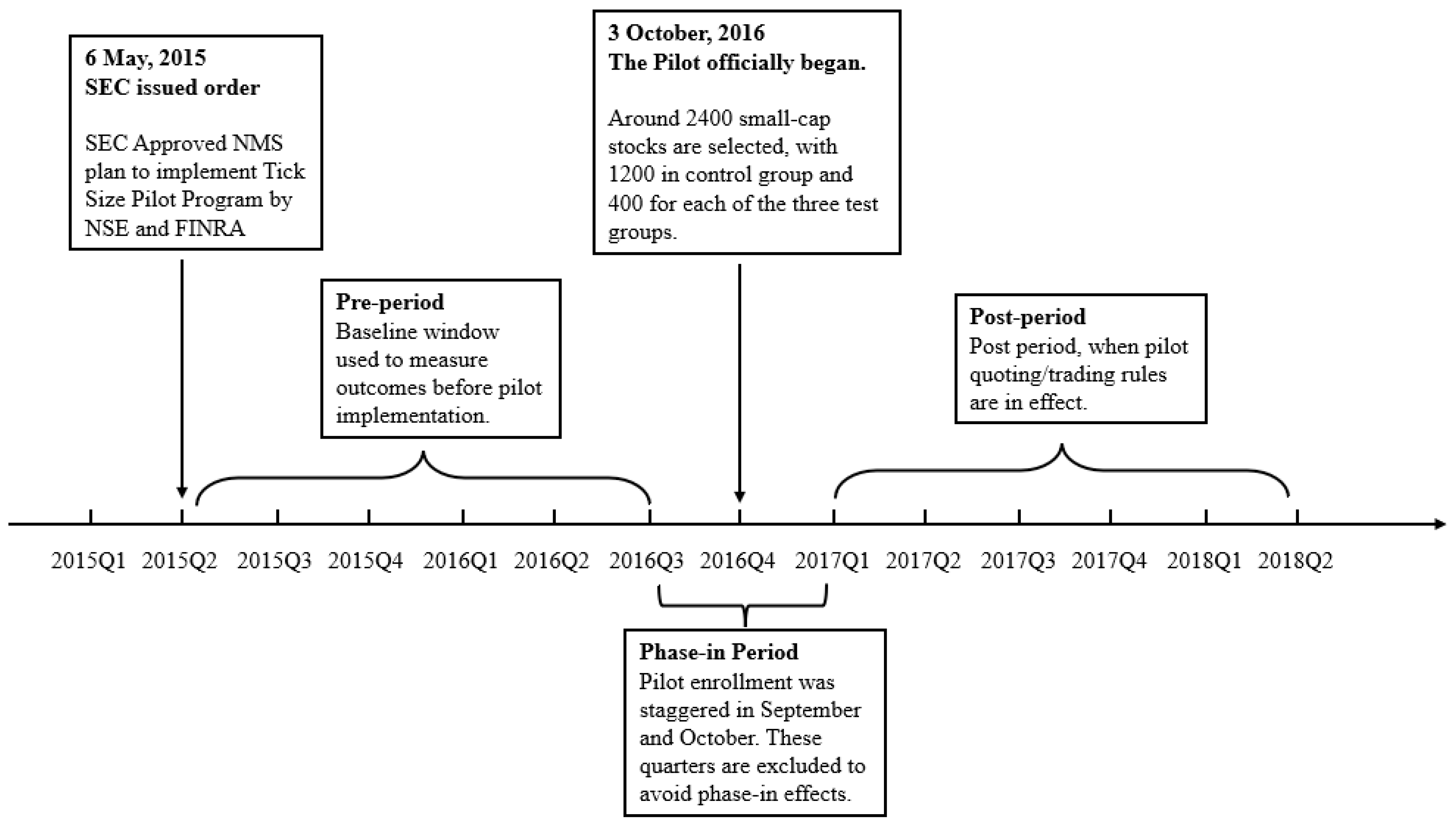
As mandated by the Jumpstart Our Business Startups (JOBS) Act, the initiative was implemented under the National Market System (NMS) Plan and lasted from October 2016 to October 2018. Approximately 1200 small-cap stocks were included in this program; these stocks were randomly assigned to one of three test groups, each subject to a distinct set of trading limitations and tick size increments. The typical $0.01 increments were still used for both trading and quotation for the control group. The first test group experienced an increase in tick size to $0.05. The second group experienced both a $0.05 increment for quoting and trading, with certain exceptions for specific trade types. The third test group also adopted a $0.05 tick size increment but included an additional “trade-at” requirement, which prioritized order execution at the best bid or offer within the exchanges. The detailed timeline of the pilot program is presented in Figure 1.
The implementation of the Tick Size Pilot Program attracts numeric studies from academia. Consistent with the ambiguity of the underlying economics, the empirical evidence on market-quality effects is mixed and often state-dependent. For example, Chung et al. (2020) show that the Pilot program affects small and large orders differently, consistent with changes in trading costs and how trades are executed. In addition, prior literature found that wider tick size can significantly influence stock liquidity (Griffith & Roseman, 2019; Albuquerque et al., 2020; Chung et al., 2020), algorithm trading (Lee & Watts, 2021), earnings management (Li & Xia, 2021), financial reporting quality (Ahmed et al., 2020), sell-side analyst coverage (Z. Chen et al., 2021). Therefore, the Tick Size Pilot Program offers a quasi-natural experiment to examine the effects of market structure changes on stock liquidity, trading costs, and the behavior of market participants.

2.2. Social Media Analyst

The proliferation of social media platforms has democratized access to financial information, giving rise to a new category of financial commentators known as social media analysts (SMAs), who are often individual investors who share their investment insights on platforms such as Seeking Alpha. Unlike traditional sell-side analysts who are typically employed by financial institutions and have structured access to management and institutional feedback, SMAs, by contrast, typically rely on public information and personal expertise. Also, the incentives of sell-side analysts are tied to institutional demand and career concerns within the sell-side markets, while the payoffs of SMAs depend closely on online readership and platform reputation. Furthermore, SMA research is produced for, and primarily consumed by, a broad retail audience, while sell-side research has historically been targeted to institutional clients. In an investor-recognition framework (Merton, 1987), SMA coverage can therefore expand visibility among marginal investors not reached by traditional sell-side research, making SMA coverage a distinct information-intermediation channel, especially for small-cap stocks, and thus constitutes a distinct information-supply channel rather than a simple extension of traditional analyst coverage. Consistent with this view, Luo et al. (2013) show that social media is value relevant and informative for capital markets.
SMAs have gained prominence, particularly among retail investors, due to their ability to provide timely and often insightful coverage of stocks that might otherwise be overlooked by the professional investment community (Farrell et al., 2022). Recent studies have highlighted the growing influence of SMAs on stock market behavior. Research suggests that SMAs can provide valuable information that complements or even rivals that of traditional analysts. For example, SMAs’ reports have been found to contain unique insights that are not always captured by sell-side analysts, making them a valuable resource for investors seeking to enhance their decision-making process (Drake et al., 2021). However, the motivations and credibility of SMAs remain subjects of debate, particularly given the anonymity that some of them maintain online (Dyer & Kim, 2021). Despite these concerns, the rise of SMAs represents a significant shift in the landscape of financial analysis (Gomez et al., 2022), one that reflects broader trends toward the decentralization of information in the digital age.
This paper examines the impact of stock liquidity on the behavior of SMAs, particularly in the context of the U.S. SEC’s Tick Size Pilot Program. By analyzing the effects of increased tick sizes on the coverage decisions of SMAs, this study seeks to contribute to the understanding of how market structure changes influence the distribution of financial information on social media platforms (Z. Chen et al., 2021). The findings are expected to provide insights into the role of liquidity as a determinant of SMA coverage and its broader implications for market efficiency and investor behavior.

2.3. Hypotheses Development

We propose that increase in tick size can affect social media analyst coverage decisions in two directions. On one hand, widening tick size for treated firms in the pilot program could reduce the social media analyst coverage on these firms. A wider tick increases effective transaction costs for the treated stocks (Amihud & Mendelson, 1986; Albuquerque et al., 2020; Rindi & Werner, 2019), and investors will bear higher costs when trading these treated firms with wider quotes, which might negatively impact on investors’ profitability and weaken market attention (Amihud, 2002). Furthermore, higher costs increase the cost of participation for less informed investors and decrease expected payoff from allocating attention to a security, which can discourage investors’ participation (Easley & O’Hara, 2004; Barber & Odean, 2008). Therefore, investors have weaker incentives to trade and to acquire costly information about the stock.
Social media analysts, who share investment ideas online, intend to help investors make better investment decisions and make better profits. Their benefits are tied to readership and reputational capital. A reduction in investor participation lowers the marginal return to producing coverage. Moreover, if the following investors trading on the covered stock incur a higher cost, it is likely that investors will be less satisfied with the experience following the recommendation because even correct recommendations can deliver worse realized investor returns, which might jeopardize the reputation of the social media analysts. Consequently, social media analysts could sheer off the stock with wider tick size to avoid the negative influence on them.
Therefore, hypothesis one is proposed as follows:
H1a. 
Wider tick size leads to lower SMA coverage.
On the other hand, an increase in tick size for treated firms could increase the incentive for social media analyst coverage. Lee and Watts (2021) document that wider tick size diminishes the speed advantage by algorithm trading due to the increased cost and reduced frequency of quote update. As a result, the decreased algorithm trading activities creates incentive for fundamental traders to acquire fundamental information. Ahmed et al. (2020) also provide evidence of the increase in financial reporting quality by the firms following the information demand from the investors. Social media analysts, whose articles are found to be value relevant (Luo et al., 2013; H. Chen et al., 2014; Bartov et al., 2018; Campbell et al., 2019; Dim, 2025; Farrell et al., 2022; Farrell et al., 2020; Drake et al., 2021) are expected to provide valuable information on a firm. If reduced algorithm trading activities give way to fundamental information acquisition, social media analysts could also find it a good opportunity to exploit more information on the treated firm with wider tick size to earn credit for the insightful idea.
Hence, we propose the competing hypothesis as follows:
H1b. 
Wider tick size leads to higher SMA coverage.

3. Sample Construction, Research Design, and Variable Definition

3.1. Sample Construction

During the Tick Size Pilot Program, the SEC selects around 2400 small-cap firms and randomly assigns the firms into two groups, which are treated groups and control groups. For 1200 stocks in the control groups, they are quoted in one cent ($0.01) increments across the entire sample period. Among the 1200 treated firms, they are further classified into three subgroups. For stocks in treated group 1, they are quoted in a wider tick size in $0.05 increments but continued to trade at their current price increment. For stocks in treated group 2, the stock is quoted and traded in $0.05 minimum increments, but would allow certain exemptions for midpoint executions, retail investor executions, and negotiated trades. Lastly, in the treated group 3, the group is adhered to the requirements of the second test group but was also subject to a “trade-at” requirement. There was also an exemption for block size orders.
Focusing on small-cap stocks is central to the pilot’s policy design and to our setting.3 Small-cap securities are more likely to have higher trading costs, and greater sensitivity to market design features such as minimum tick sizes. As a result, changes in quoting and trading increments are more likely to translate into economically meaningful variation in liquidity and participation for these firms than for large, highly liquid stocks. This focus is consistent with a large literature documenting that firm size is a first-order characteristic in asset pricing and liquidity research, with small firms exhibiting distinct return and trading patterns (Fama & French, 1992). At the same time, SMAs’ covered firms tend to be small firms because small-cap stocks face greater information frictions and thinner traditional analyst coverage, creating a larger role for alternative information intermediaries such as SMAs.
We first obtained the all the stocks enrolled in the Tick Size Pilot Program from the Financial Industry Regulatory Authority (FINRA). The stocks were not opted in all at once and some of them were enrolled during the months of September and October. To alleviate the compounding effect during the phase-in period, we removed 2016 Q3 and Q4 from our sample. We employed 2017 Q1 as the start quarter and 2018 Q1 as the end quarter in the post-pilot program period. To implement the test, we selected 5 quarters from 2015 Q2 to 2016 Q2 as pre-pilot period. Following Ahmed et al. (2020), we excluded the stocks which switch groups during the experiment period after 31 October. Then, we located these stocks in the Compustat quarterly file. Our analysis is based on firm-quarter level of observations.
Then, we obtained the social media analysts reports from Seeking Alpha website (Campbell et al., 2019; Drake et al., 2021; Farrell et al., 2022).4 We collected all research articles provided by contributors on Seeking Alpha between 2015 and 2018. We constructed firm-quarter level of SMA-related variables and merged them into the main sample.
In addition, we employed other data sources, such as stock returns from CRSP, institutional holdings from Thomson Reuters/Refinitiv 13F, and sell-side analyst related variables from Institutional Brokers’ Estimate System (I/B/E/S).5

3.2. Empirical Design

To explore the causal impact of Tick Size Pilot Program on social media analyst coverage, we used a difference-in-differences approach. The empirical design is as the following:
SMA i , t = α + β 1   ×   After   ×   Treat + β 2   ×   After + β 3   ×   Treat + γ   ×   X i   +   θ i   +   θ t   +   ϵ i .
i indexes a firm, t indexes the quarter. Treat is a dummy variable that equals one if the stock is selected in the treated group, and zero if it is the control group. After is a dummy variable which takes the value of one if the coverage is after the pilot program implementation from 2017 Q1 to 2018 Q1 and zero otherwise. Our variable of interest is β 1 , which indicates how increase in the tick size affects SMA coverage. We included a series of control variables X i . In addition, we followed Ahmed et al. (2020) by including θ t year-quarter fixed effects and θ i firm fixed effects. Following Bertrand et al. (2004), we also computed heteroskedasticity-robust standard errors clustered at the firm-quarter level to mitigate serial correlation in panel data.
We employed three proxies as our dependent variable to represent SMA coverage: SMA_Dummy, Num_Article and Num_Contributor. We estimated Equation (1) using OLS with two-way fixed effects. Detailed definitions will be discussed in the next section.

3.3. Variable Definitions

For dependent variables, we followed Z. Chen et al. (2021) to construct variables that reflect the information supply from the analysts. The first dependent variable, SMA_Dummy, is a dummy variable which equals one if there is at least one article covering the firm during a certain quarter, and zero otherwise. Our second dependent variable Num_Article, counts the number of articles covering the firm within a certain quarter. To ensure that our results do not bias towards the contributors who issue multiple reports, we used a third dependent variable Num_Contributor counting the number of unique contributors covering the firm during a certain quarter.6
We followed Z. Chen et al. (2021) to add a set of control variables that potentially affect the SMA coverage incentive, including market capitalization of the stock (MaktCap), Book-to-Market Ratio (Book-to-Market) and the growth of the assets (Growth_AT), return of the stock in the past 12 months (Past_Ret), return on assets (ROA), external financing of the firm (ExtFin), cash flow volatility (CFVol), institutional holdings (IO_Holdings), and sell-side analyst coverage (Analyst_Cover). Market capitalization and book-to-market capture size and value characteristics. Past returns and ROA proxy for recent performance and profitability. External financing, cash-flow volatility, and asset growth capture financing needs and fundamental uncertainty that may affect investor attention and the demand for research. Institutional ownership proxies for the investor base and information production capacity. Also, institutional investors can supply liquidity or reduce information asymmetry, controlling for institutional investors helps isolate the effect of the tick-size-induced liquidity shock on SMA coverage. Finally, sell-side analyst coverage captures the level of professional information supply that may substitute for or complement SMA output. The detailed definitions are shown in Appendix A, Table A1.

3.4. Summary Statistics

Panel A of Table 1 presents the summary statistics of all the variables. On average, around 38% of the firm-quarters are covered by at least one social media analyst. The average number of articles (unique contributors) for stocks is 0.637 (0.578) for the testing sample. Conditioning on the coverage by social media analyst, the average number of articles (unique contributors) is 2 (1.54). The mean market capitalization of the stocks (MaktCap) is 983 million and Book-to-Market is 0.606, which is consistent with the fact that the small-cap stocks are enrolled in the pilot program. The past 12 months return is 12%, and ROA is −0.006. Institutional holdings are around 68%, and the average number of analysts covering the stocks is around 5.
Table 1 panel B reports the pairwise correlations among control variables. The correlation coefficients range from −0.39 to 0.54, suggesting that the regression model does not show serious multicollinearity problem. In addition, we display variance inflation factors in Table 1, panel C. The maximum VIF is 2, well below conventional thresholds 10 (Freund et al., 2006), further suggesting that multicollinearity does not materially affect our regression estimates.

4. Empirical Results and Discussions

4.1. Baseline Results

We begin our analysis by investigating the effect of wider tick size on social media analyst coverage. We regress three dependent variables SMA_Dummy, Num_Article, Num_Contributor on Tick Size Pilot Program related variables based on Equation (1). Table 2 shows the baseline results. From column (1) to (3), we do not include any fixed effects and cluster the standard errors at firm-quarter level. From column (4) to (6), we include firm and year-quarter fixed effects and cluster at firm-quarter level. In columns (1) and (4), dependent variable is SMA_Dummy. The coefficients on interaction terms are positive, but statistically insignificant, suggesting that widening of the tick size on small-sized firm does not have a significant impact on overall SMA decision on covering the stock. It will not fully eliminate SMAs’ incentive of writing articles just because a stock is enrolled in the treated group.7 However, in column (2) and (4), when we change the dependent variable to the number of articles of the stock, we find that the coefficients are negative and statistically significant. This indicates that after the widening of the tick size for the treated firms, SMAs write fewer articles than before compared to the control firms. The magnitude is significant as well. Taking column (2) as an example, the estimated coefficient implies that SMAs publish 0.096 fewer articles per period after treatment for treated firms, which corresponds to approximately a 15% reduction relative to the sample mean.8 In addition, when we replace dependent variable to the number of different authors, the coefficients for interaction terms are also negative and statistically significant, suggesting that the increase in tick size will deter some SMAs to cover the stock as before compared to the stock without the change in tick size.9 Taken together, the baseline results suggest that the observed decline in SMA coverage reflects adjustments in analysts’ effort and participation rather than a complete exit from coverage. While producing at least one article may still be worthwhile for existing SMAs due to reputation or monitoring incentives, lower stock liquidity reduces expected readership and trading interest, lowering the returns to produce additional content. As a result, SMAs tend to write less frequently, and more occasional SMAs, who are more sensitive to reduced attention, are more likely to stop contributing, leading to a decline in the diversity of coverage. The overall results are consistent with H1a in the hypothesis. This result is also in line with Z. Chen et al. (2021) which shows that sell-side analyst coverage declines due to the widening of the tick size. This also adds evidence to the literature that sell-side analyst and social media analysts share some similarities in capital market (Farrell et al., 2022).

4.2. Additional Analysis

4.2.1. Stock Liquidity

Our baseline results support the view that increase in tick size for stocks will discourage social media analyst coverage on them. Based on the hypothesis, widening tick size is associated with lower liquidity, which is likely to drive up the potential transaction costs for investors, especially the retail investors. That will negatively affect the profitability of retail investors’ trading. Then, the following task that we want to investigate is whether treated firms in the pilot program experience decrease in liquidity. We employ two proxies for stock liquidity. The first measure is the natural logarithm of the average daily trading volume for stock i over a specified quarter (Log_DVol). The second measure is the average of daily relative spread for stock i over a quarter (Avg_RelSpread). Lower volume and higher relative spread represent the lower liquidity. We use the same model specification as in Equation (1) and replace the dependent variables with these two liquidity variables. The results are reported in Table 3.
Column (1) and (2) show the results using Log_DVol as the dependent variable with column (2) adding firm and year-quarter fixed effects. We find that both coefficients for the interaction terms are negative and statistically significant. This indicates that the treated group experience a decline in terms of trading volume after they are enrolled in the program. Furthermore, column (3) and (4) display the results using Avg_RelSpread as the dependent variable. The results deliver similar information that when a stock is enrolled in the treated group, relative spread becomes larger, suggesting lower liquidity compared to that in control group. The overall results also speak to Li and Xia (2021) and Z. Chen et al. (2021) that widening tick size indeed negatively affects stock liquidity.

4.2.2. Different Treated Groups

The Tick Size Pilot Program classifies the treated stocks into three different groups, which are “G1”, “G2”, and “G3”. The stocks in the first group, “G1”, are quoted in a wider tick size in $0.05 increments but continued to trade at their current price increment. Stocks in “G2” are not only quoted in $0.05 minimum increments, but also traded in $0.05 minimum increments. In the last group, “G3”, stocks are quoted and traded in $0.05 minimum increments as in group “G2”, but it is subject to a “trade-at” requirement. We intend to examine whether SMAs coverage decision will be different for different groups. Then, we separate the treated stocks based on their classification and then compare the effects with control groups. We employ the same model specification in Equation (1) but use the sample with treated stocks in “G1” and control stocks, “G2” and control stocks, “G3” and control stocks respectively. The results are shown in Table 4.
In columns (1), (4), and (7), where we use SMA_Dummy as the dependent variable, the coefficients for the interaction terms across all three groups are statistically insignificant. This result supports our baseline tests, indicating that SMAs incentive to discuss a stock is not affected by program participation. However, regarding the quantity of outputs, SMA coverage declines for stocks in groups 1 and 3 but remains unchanged in group 2. Similar results are observed when considering the number of SMAs as the output variable. These different effects may be due to the divergence in quote and trade increments and additional trading requirements. For stocks in group 1, the discrepancy between quote and execution prices could add complexities for retail investors, making these stocks less attractive for SMAs to cover. Additionally, though the quote and trade prices for stocks in group 3 are consistent, the extra restrictions may deter SMAs from sharing advice on them. Conversely, the consistency in group 2 appears to have minimal impact on trading complexity and liquidity, resulting in minimal effect on SMA coverage decisions.

4.2.3. Tick-Constrained Sample

As the Tick Size Pilot Program alternates both the quote and trading increment of prices for treated firms, stocks originally with different bid–ask spread will display different effects on SMA coverage incentive. Then, we further investigate two subsamples, one being the tick-constrained sample, the other one being non-tick-constrained sample. We define tick-constrained stocks as those having bid–ask spread below $0.05. Because the pilot program increases the quote by $0.05 for treated firms, we expect that for tick-constrained stocks, stock liquidity will be affected more when tick size increases, therefore SMAs’ decision on the tick size increase will be more pronounced. We separate the sample into these two subgroups and re-run the same regression as in Equation (1). The results are reported in Table 5.
Table 5 columns (1), (3), and (5) display the results for the non-tick-constrained sample, and columns (2), (4), and (6) display results for the tick-constrained sample. We can observe that for non-tick-constrained sample, none of the coefficients are statistically significant. Part of the reasons is that for originally illiquid stocks with large bid–ask spread, the increase in tick size is a very minimal change for them. Therefore, SMA coverage incentive is not affected significantly. However, for the tick-constrained sample, the average bid–ask spread before participation in the program is around $0.03. Therefore, the increase to $0.05 for quote and trading increment will have significant influence on liquidity, and consequently the SMA coverage decision. We can confirm the conjecture in columns (2) and (4). The coefficients for interaction terms are negative and statistically significant, indicating that wider tick size for treated stocks will reduce the attractiveness of covering the stocks, which is consistent with the baseline results in Table 2.

4.2.4. Sentiment from SMAs

The overall results so far infer that SMAs become more reluctant to cover the stocks when their liquidity gets lower, which will lower trading profit with higher transaction costs. However, with the lower coverage, will SMAs express negative opinion on these stocks? Following our narrative, we should not expect to see a change in the sentiment conveyed in their reports, as the decline in coverage results from trading costs rather than a fundamental change in the stocks. To test this conjecture, we examine the detailed content of the reports written by the SMAs and we conduct a textual analysis on the sentiment following Loughran and McDonald (2011). We calculate the percentage of positive and negative words for a firm in a specific quarter and use them as dependent variables. The results are shown in Table 6.
Table 6 column (1) reports the results for SMAs reports with positive sentiment and column (2) reports negative sentiment. Confirming our expectations, there is no significant change in terms of the sentiment for the treated stocks with wider tick size, compared to the control stocks. This result does not suggest that SMAs will ignore fundamental change when they initiate coverage. SMAs will consider a variety of factors for the coverage decision. Our analysis focuses on one particular aspect, which is stock liquidity, and our findings robustly confirm that it plays a critical role in influencing SMAs’ coverage decisions.

4.2.5. Content Depth from SMAs

While the sentiment analysis focuses on the tone of SMAs reports, it is also important to examine whether changes in stock liquidity affect the quality of SMAs reports. A decline in number of articles and contributors could reflect either reduced analytical effort among remaining contributors or the exit of more marginal participants. To distinguish between these possibilities, we examine whether the quality of the SMAs’ reports changes following the Tick Size Pilot Program.10
We proxy for the quality of the reports using article length, measured by the number of words in SMAs reports. Specifically, we construct two firm-quarter level measures: the average length of SMA articles and the total length of all SMA articles written for a given stock. We estimate difference-in-differences regressions analogous to our baseline specification, controlling for firm fixed effects, year-quarter fixed effects, and the same set of control variables. The results are reported in Table 7.
As shown in Table 7, we find no significant change in either average or total article length for treated stocks relative to control stocks following the wider tick size. These results suggest that although fewer articles are produced and fewer contributors participate when liquidity declines, SMAs who continue to write about a stock do not reduce the depth of their analysis. This pattern is consistent with the interpretation that lower liquidity primarily discourages marginal participation rather than diminishing the informational content of remaining SMA reports.

5. Conclusions

Our study investigates the impact of stock liquidity on social media analyst coverage decisions in the U.S. capital market. We find that the widening of tick sizes for small-cap firms leads to a decrease in stock liquidity, which in turn discourages SMAs from covering these stocks. This decline is more pronounced in stocks with originally lower bid–ask spreads. Our findings highlight that stock liquidity is a significant determinant of SMA coverage, with increased transaction costs and reduced liquidity diminishing their incentive to provide investment advice. Additionally, our analysis shows no significant change in the sentiment and quality of SMAs’ reports, suggesting that the reduced coverage is driven by liquidity concerns rather than changes in the fundamental value of the firms.
Our findings have implications for the broader information environment. SMAs act as an information intermediary that can supplement traditional analyst coverage. More broadly, our evidence connects market liquidity to the information supply of non-traditional intermediaries. A liquidity-driven contraction in SMA coverage has the potential to reduce information supply for already information-sensitive small-cap firms, which may increase information asymmetry. While we do not directly test effects on volatility or price efficiency, the documented decrease in coverage represents a measurable reduction in public information supply for small-cap firms. In turn, lower information supply can dampen investor attention and trading participation, with possible consequences for volatility and market quality (Barber & Odean, 2008). From a policy perspective, these results suggest that market design interventions that alter trading costs can have spillovers beyond trading metrics, affecting who produces information and which firms receive coverage. These spillovers are particularly relevant for retail investors. Relative to institutional investors who typically have broader access to sell-side research and private information channels, retail investors disproportionately rely on public, platform-based analysis such as Seeking Alpha. Thus, a liquidity-driven reduction in SMA coverage can widen an information gap by reducing the availability of interpretable firm-level research for retail participants.
Our setting also helps clarify the scope of the conclusions. First, the Tick Size Pilot Program focuses on small-cap stocks, which is where liquidity and information frictions tend to be most salient. An important next step is to examine whether the same liquidity–coverage mechanism operates for large-cap firms, where trading is deeper and frictions are smaller. Second, our SMA measures come from Seeking Alpha, a leading venue for investor-generated research, but different platforms vary in contributor incentives, readership, and visibility, so the magnitudes may differ across settings (Bushee & Miller, 2012). More generally, future work could examine regulatory settings or international markets, compare SMA behavior across platforms, and test whether liquidity-driven changes in information supply relate to shifts in investor attention and related market outcomes.

Author Contributions

Y.H.: Funding Acquisition, Conceptualization, Methodology, Data curation, Investigation, Writing—original draft, Writing—review and editing; D.L.: Methodology, Investigation, Writing—review and editing; Y.Z.: Conceptualization, Methodology, Data curation, Investigation, Writing—review and editing. All authors have read and agreed to the published version of the manuscript.

Funding

Our research is supported by Wenzhou-Kean University Student Partnering with Faculty (SpF) Research Program under WKUSPF202407 and Internal Funding under IRSPK2023001.

Institutional Review Board Statement

Not applicable.

Informed Consent Statement

Not applicable.

Data Availability Statement

The data that support the findings of this study are available from the corresponding author upon reasonable request.

Acknowledgments

We gratefully acknowledge the outstanding assistant work from Shuning Gao and Xuyang Zou.

Conflicts of Interest

The authors declare no conflicts of interest.

Appendix A

Table A1. Variable definitions.
Variable Definition
SMA_DummyA dummy variable which equals one if there is at least one article covering the stock i during a certain quarter t, and zero otherwise.
Num_ArticleThe total number of articles covering the stock i during a certain quarter t.
Num_ContributorThe unique number of contributors covering the stock i during a certain quarter t.
MaktCapMarket value of equity for stock i at the end of quarter t.
Book-to-MaktBook value over market value of equity for stock i at the end of quarter t.
Past_RetPast 12 months return for stock i before quarter t.
ROAReturn on total assets for stock i at the end of quarter t.
ExtFinNet cash received from equity issuance and debt issuance for stock i at the end of quarter t.
CFVolThe standard deviation of the operating cash flows over the prior five quarters, scaled by total assets in quarter t − 1.
Growth_ATGrowth rate for total assets from quarter t − 1 to t for stock i.
IO_HoldingsInstitutional holdings for stock i at the end of quarter t.
Analyst_CoverThe total number of analysts covering for stock i at the end of quarter t.
Log_DVolThe natural logarithm of the average daily trading volume for stock i over quarter t.
Avg_RelSpreadThe average of daily relative spread for stock i over quarter t. Daily average relative spread is (Ask-Bid)/Midpoint of price.
Positive_ToneThe percentage of the positive words in all articles written by SMAs for stock i over a specific quarter t. The positive word directory is from Loughran and McDonald (2011).
Negative_ToneThe percentage of the positive words in all articles written by SMAs for stock i over a specific quarter t. The negative word directory is from Loughran and McDonald (2011).
Average_LengthThe average number of words from all articles written by SMAs for stock i over a specific quarter t.
Total LengthThe total number of words from all articles written by SMAs for stock i over a specific quarter t.

Notes

1
Relative to news media coverage, which is often broad and event-driven, SMA articles are typically more firm-specific and written as explicit investment theses; compared with general social discussion, SMA content is usually longer-form and more structured.
2
3
Pilot’s design implies natural limits to external validity. Our estimates should be interpreted as the effects of exogenous liquidity shocks in a small-cap environment where liquidity constraints are binding. The magnitude and the mechanisms may differ for large-cap stocks, which generally exhibit higher liquidity and more extensive institutional information production.
4
Seeking Alpha, established in 2004, features user-generated investment research from over 18,000 contributors as of 2024, who provide articles on various topics including macroeconomics, capital market analysis, and fundamental analysis of stocks. By 2024, the platform attracted 20 million people usage on a monthly basis. (https://about.seekingalpha.com/, accessed on 5 June 2021).
5
These datasets have well-known limitations. In particular, 13F filings are reported with a lag and reflect quarter-end holdings rather than continuous trading, so we use 13F-based variables only as low-frequency controls. Seeking Alpha provides a widely used archive of investor-generated research but is subject to contributor selection and heterogeneous author quality. But our identification relies on within-firm changes induced by the Pilot’s quasi-random assignment and fixed-effects specifications, which mitigates concerns that time-invariant platform selection drives the results.
6
The three measures are also consistent with Tetlock (2007). In Tetlock (2007), media activity is viewed as a proxy for the flow and intensity of market-related information and investor attention rather than firm fundamentals per se. Within this framework, the SMA coverage dummy captures the extensive margin of information supply, the number of articles reflects the intensity of information dissemination, and the number of contributors captures the breadth of market participation and heterogeneity of information producers. Prior research shows that variation in media quantity and participation is closely linked to trading activity and liquidity, providing a theoretical foundation for our empirical measures.
7
We employ a logit model for the robustness test, and the results remain qualitatively the same.
8
The sample mean number of article is 0.637 as reported in Table 1, so the reduction is 0.096/0.637 = 15%.
9
In column (3), the estimated coefficient corresponds to approximately a 13% (0.073/0.578) reduction relative to the sample mean.
10
We thank an anonymous reviewer for suggesting this analysis.

References

  1. Ahmed, A. S., Li, Y., & Xu, N. (2020). Tick size and financial reporting quality in small-cap firms: Evidence from a natural experiment. Journal of Accounting Research, 58, 869–914. [Google Scholar] [CrossRef]
  2. Albuquerque, R., Song, S., & Yao, C. (2020). The price effects of liquidity shocks: A study of the SEC’s tick size experiment. Journal of Financial Economics, 138, 700–724. [Google Scholar] [CrossRef]
  3. Amihud, Y. (2002). Illiquidity and stock returns: Cross-section and time-series effects. Journal of Financial Markets, 5, 31–56. [Google Scholar] [CrossRef]
  4. Amihud, Y., & Mendelson, H. (1986). Liquidity and stock returns. Financial Analysts Journal, 42, 43–48. [Google Scholar] [CrossRef]
  5. Barber, B. M., & Odean, T. (2008). All that glitters: The effect of attention and news on the buying behavior of individual and institutional investors. The Review of Financial Studies, 21, 785–818. [Google Scholar] [CrossRef]
  6. Bartov, E., Faurel, L., & Mohanram, P. S. (2018). Can twitter help predict firm-level earnings and stock returns? The Accounting Review, 93, 25–57. [Google Scholar] [CrossRef]
  7. Bertrand, M., Duflo, E., & Mullainathan, S. (2004). How much should we trust differences-in-differences estimates? The Quarterly Journal of Economics, 119, 249–275. [Google Scholar] [CrossRef]
  8. Bushee, B. J., & Miller, G. S. (2012). Investor relations, firm visibility, and investor following. The Accounting Review, 87, 867–897. [Google Scholar] [CrossRef]
  9. Campbell, J. L., DeAngelis, M. D., & Moon, J. R. (2019). Skin in the game: Personal stock holdings and investors’ response to stock analysis on social media. Review of Accounting Studies, 24, 731–779. [Google Scholar] [CrossRef]
  10. Chen, H., De, P., Hu, Y. J., & Hwang, B. H. (2014). Wisdom of crowds: The value of stock opinions transmitted through social media. Review of Financial Studies, 27, 1367–1403. [Google Scholar] [CrossRef]
  11. Chen, Z., Huffman, A., Narayanamoorthy, G., & Zhang, R. (2021). Minimum tick size and analyst coverage: Evidence from the tick size pilot program. Journal of Business Finance & Accounting, 48, 666–691. [Google Scholar]
  12. Chung, K. H., Lee, A. J., & Rösch, D. (2020). Tick size, liquidity for small and large orders, and price informativeness: Evidence from the tick size pilot program. Journal of Financial Economics, 136, 879–899. [Google Scholar] [CrossRef]
  13. Claussen, J., Litterscheidt, R., & Streich, D. J. (2021). Seeking analyst coverage: Can non-professional analysts compensate for the decline in professional analyst coverage? [Working Paper]. Available online: https://www.researchgate.net/profile/David-Streich-2/publication/353357224_Seeking_Analyst_Coveragepdf/data/60f7d5582bf3553b290025fa/Seeking-Analyst-Coverage.pdf (accessed on 27 December 2025).
  14. Dim, C. (2025). Social media analysts’ skill: Evidence from text-implied beliefs. Journal of Financial and Quantitative Analysis, 60, 3081–3115. [Google Scholar] [CrossRef]
  15. Ding, R., Shi, Y., & Zhou, H. (2022). Social media coverage and post-earnings announcement drift: Evidence from seeking alpha. The European Journal of Finance, 29, 207–227. [Google Scholar] [CrossRef]
  16. Ding, R., Zhou, H., & Li, Y. (2020). Social media, financial reporting opacity, and return comovement: Evidence from Seeking Alpha. Journal of Financial Markets, 50, 100511. [Google Scholar] [CrossRef]
  17. Drake, M. S., Moon, J., Twedt, B. J., & Warren, J. (2021). Social media analysts and sell-side analyst research. Review of Accounting Studies, 28, 385–420. [Google Scholar] [CrossRef]
  18. Drake, M. S., Roulstone, D. T., & Thornock, J. R. (2012). Investor information demand: Evidence from Google searches around earnings announcements. Journal of Accounting Research, 50, 1001–1040. [Google Scholar] [CrossRef]
  19. Dyer, T., & Kim, E. (2021). Anonymous equity research. Journal of Accounting Research, 59, 575–611. [Google Scholar] [CrossRef]
  20. Easley, D., & O’Hara, M. (2004). Information and the cost of capital. The Journal of Finance, 59, 1553–1583. [Google Scholar] [CrossRef]
  21. Fama, E. F., & French, K. R. (1992). The cross-section of expected stock returns. Journal of Finance, 47, 427–465. [Google Scholar]
  22. Farrell, M., Green, T. C., Jame, R., & Markov, S. (2022). The democratization of investment research and the informativeness of retail investor trading. Journal of Financial Economics, 145, 616–641. [Google Scholar] [CrossRef]
  23. Farrell, M., Jame, R., & Qiu, T. (2020). The cross-section of non-professional analyst skill. Available online: https://ssrn.com/abstract=3682490 (accessed on 28 August 2020).
  24. Freund, R. J., Wilson, W. J., & Sa, P. (2006). Regression analysis. Elsevier. [Google Scholar]
  25. Gomez, E. A., Heflin, F., Moon, J. R., & Warren, J. D. (2022). Financial analysis on social media and disclosure processing costs: Evidence from Seeking Alpha. The Accounting Review, 99, 223–246. [Google Scholar] [CrossRef]
  26. Griffith, T. G., & Roseman, B. S. (2019). Making cents of tick sizes: The effect of the 2016 US SEC tick size pilot on limit order book liquidity. Journal of Banking & Finance, 101, 104–121. [Google Scholar] [CrossRef]
  27. Lee, C. M., & Watts, E. M. (2021). Tick size tolls: Can a trading slowdown improve earnings news discovery? The Accounting Review, 96, 373–401. [Google Scholar] [CrossRef]
  28. Li, D., & Xia, Y. (2021). Gauging the effects of stock liquidity on earnings management: Evidence from the SEC tick size pilot test. Journal of Corporate Finance, 67, 101904. [Google Scholar] [CrossRef]
  29. Loughran, T., & McDonald, B. (2011). When is a liability not a liability? Textual analysis, dictionaries, and 10-Ks. The Journal of Finance, 66, 35–65. [Google Scholar] [CrossRef]
  30. Luo, X., Zhang, J., & Duan, W. (2013). Social media and firm equity value. Information Systems Research, 24, 146–163. [Google Scholar] [CrossRef]
  31. Merton, R. C. (1987). A simple model of capital market equilibrium with incomplete information. The Journal of Finance, 42, 483–510. [Google Scholar] [CrossRef]
  32. O’Hara, M., & Ye, M. (2011). Is market fragmentation harming market quality? Journal of Financial Economics, 100, 459–474. [Google Scholar] [CrossRef]
  33. Rindi, B., & Werner, I. M. (2019). U.S. tick size pilot. Fisher college of business working paper no. 2017-03-018, Charles A Dice center working paper No. 2017-18. SSRN. Available online: https://ssrn.com/abstract=3041644 (accessed on 20 July 2021).
  34. Tetlock, P. C. (2007). Giving content to investor sentiment: The role of media in the stock market. The Journal of Finance, 62, 1139–1168. [Google Scholar] [CrossRef]
Figure 1. Timeline of Tick Size Pilot Program. This figure presents the timeline of Tick Size Pilot Program and the window for our testing sample.
Jrfm 19 00098 g001
Table 1. Summary statistics. Panel A reports summary statistics for the testing sample including 2015 Q2 to 2016 Q2 and 2017 Q1 to 2018 Q1, for a total of 10 quarters with 13,254 firm-quarter level of observations. Detailed variable definitions are in Appendix A, Table A1. Panel B presents the pairwise correlations among the control variables. Panel C reports the variance inflation factors.
Panel A: Descriptive Statistics
VariablesNMeanStd. Dev.P25MedianP75
Dependent Variable
SMA_Dummy13,2540.3750.4840.0000.0001.000
Num_Article13,2540.6371.1750.0000.0001.000
Num_Contributor13,2540.5780.9840.0000.0001.000
Independent Variable
Treat13,2540.4970.5000.0000.0001.000
Control Variables
MaktCap (in millions)13,254983.40947.33280.75675.081423.91
Book-to-Market13,2540.6060.4670.2900.5340.799
Past_Ret13,2540.1220.392−0.1170.0710.310
ROA13,254−0.0060.046−0.0050.0030.014
ExtFin13,2540.0310.126−0.0130.0000.024
CFVol13,2540.0440.0420.0170.0330.055
Growth_AT13,2540.0280.126−0.0170.0080.037
IO_Holdings13,2540.6850.2500.5180.7330.894
Analyst_Cover13,2545.1493.3513.0005.0007.000
Panel B: Correlation Matrix
MaktCapBook-to-MarketPast_RetROAExtFinCFVolGrowth_ATIO_HoldingsAnalyst_Cover
MaktCap1
Book-to-Market−0.245 ***1
Past_Ret0.212 ***−0.247 ***1
ROA0.251 ***0.0827 ***0.113 ***1
ExtFin−0.0412 ***−0.129 ***0.0808 ***−0.390 ***1
CFVol−0.111 ***−0.280 ***−0.0296 ***−0.344 ***0.272 ***1
Growth_AT0.0963 ***−0.0775 ***0.148 ***0.101 ***0.384 ***0.116 ***1
IO_Holdings0.539 ***−0.0862 ***0.01550.119 ***−0.0469 ***0.003170.01511
Analyst_Cover0.521 ***−0.165 ***−0.0249 **0.009170.0330 ***0.0201 *0.0475 ***0.422 ***1
Panel C: Variance Inflation Factors
VariableVIF1/VIF
MaktCap20.50
ExtFin1.530.65
ROA1.50.67
IO_Holdings1.50.67
Analyst_Cover1.490.67
Growth_AT1.310.76
CFVol1.290.77
Book-to-Market1.260.79
Past_Ret1.170.86
Mean VIF1.45
“*, **, and *** indicate statistical significance at the 10%, 5%, and 1% level, respectively.”
Table 2. The effect of widening tick size on SMA coverage. This table reports the OLS regression results for the effect of widening tick size on the SMA coverage during the Tick Size Pilot Program. There are three dependent variables. In column (1) and (4), dependent variable is SMA_Dummy, which is a dummy variable that equals one if there is at least one article covering the firm during a certain quarter, and zero otherwise. In column (2) and (5), the dependent variable is Num_Article, which counts the number of articles covering the firm during a certain quarter. In column (3) and (6), the dependent variable is Num_Contributor, counting the number of unique contributors covering the firm within a certain quarter. Treat is a dummy variable that equals one if the stock is selected in the treated group, and zero if it is the control group. After is a dummy variable which takes the value of one if the coverage is after the pilot program implementation from 2017 Q1 to 2018 Q1 and zero otherwise. We control a set of variables that affect the SMA coverage incentive. Definitions are described in Appendix A. From column (1) to (3), we do not include any fixed effects and cluster standard errors at firm-quarter level. From column (4) to (6), we include firm fixed effects and year-quarter fixed effects, and cluster standard errors at firm-quarter level. T-statistics are reported in parentheses. *, **, and *** indicate statistical significance at the 10%, 5%, and 1% level, respectively.
Dependent Variable SMA_DummyNum_ArticleNum _ContributorSMA_DummyNum_ArticleNum_Contributor
(1)(2)(3)(4)(5)(6)
Treat × After−0.002−0.096 ***−0.073 **−0.002−0.092 **−0.069 **
(−0.124)(−2.665)(−2.417)(−0.105)(−2.506)(−2.265)
After−0.080 ***−0.091 ***−0.093 ***
(−6.919)(−3.538)(−4.264)
Treat−0.0030.051 *0.035
(−0.242)(1.714)(1.365)
MaktCap0.020 ***0.083 ***0.063 ***0.096 ***0.333 ***0.260 ***
(3.397)(4.754)(4.500)(4.510)(5.704)(5.699)
Book-to-Market−0.0010.063 **0.040 *0.063 **0.287 ***0.241 ***
(−0.118)(2.414)(1.826)(2.169)(3.954)(4.248)
Past_Ret−0.032 **0.012−0.022−0.029 *0.001−0.017
(−2.561)(0.288)(−0.784)(−1.921)(0.021)(−0.567)
ROA0.432 ***0.3290.596 *−0.216−2.196 ***−1.616 ***
(3.576)(0.813)(1.919)(−1.241)(−4.100)(−3.940)
ExtFin0.166 ***0.265 **0.206 **0.0520.0500.058
(3.887)(2.044)(2.176)(1.059)(0.411)(0.614)
CFVol1.644 ***4.694 ***3.987 ***0.792 ***2.680 ***2.198 ***
(12.784)(12.295)(12.590)(3.543)(4.585)(4.593)
Growth_AT−0.0430.0550.0550.0190.219 **0.211 ***
(−1.115)(0.475)(0.587)(0.512)(2.179)(2.616)
IO_Holdings0.021−0.145 **−0.0630.000−0.146−0.048
(0.944)(−2.194)(−1.181)(0.006)(−0.902)(−0.365)
Analyst_Cover0.015 ***0.051 ***0.044 ***0.008 **0.033 ***0.030 ***
(8.784)(9.004)(8.853)(2.171)(3.310)(4.037)
Firm FENoNoNoYesYesYes
Year-Quarter FENoNoNoYesYesYes
Observations13,25413,25413,25413,21013,21013,210
Adj. R-sq0.0460.0600.0630.2220.3950.391
Table 3. The effect of widening tick size on stock liquidity. This table reports the OLS regression results for the effect of widening tick size on the stock liquidity during the Tick Size Pilot Program. There are two dependent variables. In column (1) and (2), dependent variable is Log_DVol, the natural logarithm of the average daily trading volume for stock i over a specific quarter. In column (3) and (4), the dependent variable is Avg_RelSpread, the average of daily relative spread for stock i over a quarter. Treat is a dummy variable that equals one if the stock is selected in the treated group, and zero if it is the control group. After is a dummy variable which takes the value of one if the coverage is after the pilot program implementation from 2017 Q1 to 2018 Q1 and zero otherwise. We include a set of variables that affect the SMA coverage incentive. Definitions are described in Appendix A. In column (1) and (3), we do not include any fixed effects and cluster standard errors at firm-quarter level. In column (2) to (4), we include firm fixed effects and year-quarter fixed effects, and cluster standard errors at firm-quarter level. T-statistics are reported in parentheses. *, **, and *** indicate statistical significance at the 10%, 5%, and 1% level, respectively.
Dependent Variable Log_DVolLog_DVolAvg_RelSpreadAvg_RelSpread
(1)(2)(3)(4)
Treat × After−0.054 **−0.060 ***0.002 ***0.002 ***
(−2.476)(−3.376)(15.091)(16.098)
After0.018 0.000
(1.040) (0.321)
Treat−0.042 * 0.000
(−1.846) (1.221)
MaktCap0.512 ***0.301 ***−0.003 ***−0.003 ***
(35.705)(11.107)(−31.473)(−15.294)
Book-to-Market0.203 ***0.240 ***0.000−0.001 ***
(7.618)(7.068)(0.150)(−2.713)
Past_Ret−0.060 **0.066 ***−0.000 ***−0.000 ***
(−2.403)(3.706)(−3.496)(−2.632)
ROA−3.758 ***−0.3280.0020.004 ***
(−15.077)(−1.582)(1.496)(2.867)
ExtFin0.291 ***0.164 ***0.0000.001 *
(3.830)(3.088)(0.544)(1.840)
CFVol4.625 ***1.267 ***−0.0000.004 *
(16.137)(5.036)(−0.131)(1.941)
Growth_AT0.0670.139 ***0.001 **0.000
(0.862)(3.167)(2.011)(1.607)
IO_Holdings1.130 ***0.869 ***−0.006 ***−0.004 ***
(20.706)(10.687)(−19.875)(−7.402)
Analyst_Cover0.080 ***0.025 ***0.000 ***−0.000 ***
(23.638)(7.278)(3.323)(−3.157)
Firm FENoYesNoYes
Year-Quarter FENoYesNoYes
Observations13,25413,21013,25413,210
Adj. R-sq0.5230.8970.3840.804
Table 4. The effect of widening tick size on SMA coverage for subgroups. This table reports the logistics regression and OLS regression results for the effect of widening tick size on the SMA coverage during the Tick Size Pilot Program for different groups. There are three dependent variables. In column (1), (4), and (7), we use logistic regression analysis. The dependent variable is SMA_Dummy, which is a dummy variable that equals one if there is at least one article covering the firm within a certain quarter, and zero otherwise. In column (2), (5), and (8), we use OLS regression analysis. The dependent variable is Num_Article, which counts the number of articles covering the firm during a certain quarter. In column (3), (6), and (9), we use OLS regression analysis. The dependent variable is Num_Contributor, counting the number of unique contributors covering the firm within a certain quarter. Treat is a dummy variable that equals one if the stock is selected in the treated group, and zero if it is the control group. After is a dummy variable which takes the value of one if the coverage is after the pilot program implementation from 2017 Q1 to 2018 Q1 and zero otherwise. We include a set of control variables that affect the SMA coverage incentive. Definitions are described in Appendix A. We include firm fixed effects and year-quarter fixed effects, and cluster standard errors at firm-quarter level. T-statistics are reported in parentheses. **, and *** indicate statistical significance at the 5% and 1% level, respectively.
Dependent
Variable
SMA
_Dummy
Num
_Article
Num_ContributorSMA
_Dummy
Num
_Article
Num_ContributorSMA
_Dummy
Num
_Article
Num_Contributor
(1)(2)(3)(4)(5)(6)(7)(8)(9)
Group 1Group 2Group 3
Treat × After−0.018−0.129 ***−0.108 ***0.036−0.0160.001−0.022−0.130 ***−0.099 **
(−0.785)(−2.680)(−2.673)(1.593)(−0.285)(0.018)(−0.898)(−2.620)(−2.290)
ControlsYesYesYesYesYesYesYesYesYes
Firm FEYesYesYesYesYesYesYesYesYes
Year-Quarter FEYesYesYesYesYesYesYesYesYes
Observations880888088808884188418841885188518851
Adj. R-sq0.2130.3740.3650.2300.4080.4080.2140.3740.370
Table 5. The effect of widening tick size on SMA coverage: tick-constrained vs non-tick constrained. This table reports the OLS regression results for the effect of widening tick size on the SMA coverage during the Tick Size Pilot Program for different subsamples. Tick-constrained sample includes stocks which have bid–ask spread below $0.05. Non-tick-constrained sample includes the rest. There are three dependent variables. In column (1) and (2), dependent variable is SMA_Dummy, which is a dummy variable that equals one if there is at least one article covering the firm within a certain quarter, and zero otherwise. In column (3) and (4), the dependent variable is Num_Article, which counts the number of articles covering the firm during a certain quarter. In column (5) and (6), the dependent variable is Num_Contributor, counting the number of unique contributors covering the firm within a certain quarter. Treat is a dummy variable that equals one if the stock is selected in the treated group, and zero if it is the control group. After is a dummy variable which takes the value of one if the coverage is after the pilot program implementation from 2017 Q1 to 2018 Q1 and zero otherwise. We include a set of control variables that affect the SMA coverage incentive. Definitions are described in Appendix A. We include firm fixed effects and year-quarter fixed effects, and cluster standard errors at firm-quarter level. T-statistics are reported in parentheses. ** indicate statistical significance at the 5% level.
Dependent VariableSMA_DummyNum_ArticleNum_Contributor
(1)(2)(3)(4)(5)(6)
Non-Tick
Constrained
Tick ConstrainedNon-Tick
Constrained
Tick
Constrained
Non-Tick
Constrained
Tick
Constrained
Treat × After0.019−0.005−0.021−0.104 **−0.002−0.079 **
(0.457)(−0.254)(−0.288)(−2.567)(−0.029)(−2.352)
ControlsYesYesYesYesYesYes
Firm FEYesYesYesYesYesYes
Year-Quarter FEYesYesYesYesYesYes
Observations195311,257195311,257195311,257
Adj. R-sq0.2380.2130.4140.3890.4070.386
Table 6. The effect of widening tick size on SMA sentiment. This table reports the OLS regression results for the effect of widening tick size on the SMA sentiment during the Tick Size Pilot Program. There are two dependent variables. In column (1), dependent variable is Positive_Tone, the percentage of the positive words conveyed by SMAs for all articles for stock i over a specific quarter. In column (2), the dependent variable is Negative_Tone, the percentage of the negative words conveyed by SMAs for all articles for stock i over a specific quarter. Treat is a dummy variable that equals one if the stock is selected in the treated group, and zero if it is the control group. After is a dummy variable which takes the value of one if the coverage is after the pilot program implementation from 2017 Q1 to 2018 Q1 and zero otherwise. We include a set of variables that affect the SMA coverage incentive. Definitions are described in Appendix A. We include firm fixed effects and year-quarter fixed effects, and cluster standard errors at firm-quarter level. T-statistics are reported in parentheses.
Dependent Variable Positive_ToneNegative_Tone
(1)(2)
Treat × After−0.014−0.012
(−0.499)(−0.416)
ControlsYesYes
Firm FEYesYes
Year-Quarter FEYesYes
Observations13,21013,210
Adj. R-sq0.1890.212
Table 7. The effect of widening tick size on SMAs’ reports quality. This table reports the OLS regression results for the effect of widening tick size on the SMA article length during the Tick Size Pilot Program. There are two dependent variables. In column (1), dependent variable is Average_Length, the average number of words from all articles written by SMAs for stock i over a specific quarter. In column (2), the dependent variable is Total Length, the total number of words from all articles written by SMAs for stock i over a specific quarter. Treat is a dummy variable that equals one if the stock is selected in the treated group, and zero if it is the control group. After is a dummy variable which takes the value of one if the coverage is after the pilot program implementation from 2017 Q1 to 2018 Q1 and zero otherwise. We include a set of variables that affect the SMA coverage incentive. Definitions are described in Appendix A. We include firm fixed effects and year-quarter fixed effects, and cluster standard errors at firm-quarter level. T-statistics are reported in parentheses.
Dependent Variable Average_LengthTotal Length
(1)(2)
Treat × After−0.021−0.050
(−0.182)(−0.406)
ControlsYesYes
Firm FEYesYes
Year-Quarter FEYesYes
Observations13,21013,210
Adj. R-sq0.2200.246
Disclaimer/Publisher’s Note: The statements, opinions and data contained in all publications are solely those of the individual author(s) and contributor(s) and not of MDPI and/or the editor(s). MDPI and/or the editor(s) disclaim responsibility for any injury to people or property resulting from any ideas, methods, instructions or products referred to in the content.