


Abstract
Inflation is an economic phenomenon that affects the growth of many countries around the world, especially African countries. Several studies have endeavored to determine the direction of its effect in developing countries, albeit with inconclusive results. Moreover, there is a paucity of studies on the moderating roles fiscal policy and monetary policy play in this relationship. This study examines the effect of inflation on Nigerian economic growth and the moderating roles of fiscal and monetary policies from 1986 to 2023. By employing the ARDL bound test, it was discovered that a long-run relationship exists, with a significant negative relationship in the short run. Also, the intervening role of government expenditure significantly worsens the effect, while the money supply insignificantly weakens the influence of inflation on economic growth in the short run. Notably, the moderating role of a coordinated fiscal and monetary policy has a favorable significant effect on the inflation–growth nexus. This study concludes that while inflation poses a serious threat to the Nigerian economy, the intervening roles of coordinated government expenditure and the money supply are significant to reduce the adverse effect. There is a pressing need for monetary authorities to utilize a coordinated fiscal and monetary policy to reduce the inflation rate to single-digit levels.
1. Introduction
Inflation is an economic phenomenon that plays a central role in shaping economic dynamics. It is the gradual rise in the average price of goods and services, which poses a dual challenge for emerging markets (Idris & Bakar, 2017). These challenges include interest rate dynamics, inadequate infrastructure, corruption, policy implementation gaps, and inflationary pressures, to mention but a few. Sunday and Miriam (2015) argue that high or persistent inflation reduces consumers’ purchasing power, which lowers real income, while reduced purchasing power can result in lower consumer spending, affecting businesses and overall economic growth. It can create a cycle of decreased demand and production. Additionally, inflation can skew price signals, making it difficult for companies to determine the relative worth of goods and services. Misallocations of resources may occur, leading to inefficiencies and hindering productivity gains, which are essential for sustained economic growth. On the other hand, moderated inflation may stimulate economic growth if it is within a certain range, as it can encourage spending and investment (Bangura & Omojolaibi, 2024; Umaru et al., 2013). Although high inflation may lead to higher interest rates, impacting the cost of borrowing and potentially deterring investment (Awogbemi & Taiwo, 2012) if not also anticipated, it can erode the real value of debt. While this can benefit debtors, it may also pose challenges for creditors, and the overall dynamics of debt in the economy can be affected (Adu & Ajigbotoso, 2024; Awogbemi & Oluwaseyi, 2011), hence the need for moderated inflation, particularly in growing economies.
In Nigeria, for instance, the nation’s transition from a primarily agrarian economy to an oil-dependent one and, subsequently, to a more diversified market has been marked by periods of robust economic growth and structural changes. The country’s economic trajectory, however, is marked by challenges, with inflation emerging as a critical factor influencing its growth dynamics (Ogu et al., 2021; Sulaiman & Azeez, 2012). Due to several issues, including a depreciating currency, insecurity, rising fuel prices, and budget deficits, the country’s inflation rate has frequently surpassed 15% (CBN, 2023). Numerous policy interventions, such as the fiscal and regular tightening of monetary tools, have been engaged by the Government and Central Bank of Nigeria, yet the inflation rate has proved to be resistant to policy control while the economy remains precarious (World Bank, 2023). Monetary policy focuses mostly on controlling inflation, interest rates, and the money supply, whereas fiscal policy includes governmental borrowing, taxing, and spending. But in Nigeria, these two policy branches have frequently not been coordinated well or are in conflict, which can result in policy misalignments that worsen macroeconomic instability. The impacts of tight monetary policy, for instance, can be countered by expansionary fiscal policy through deficit financing, which would impair economic outcomes and inflation control mechanisms (Atan & Effiong, 2021). To better align macroeconomic objectives, it is essential to comprehend how these policies moderate the inflation–growth relationship, hence the need for this study.
Considering the benefits of inflation and, at the same time, the challenges of inflation, the determination of the effect of its standing on the growth of emerging markets has become a puzzle to be unraveled empirically. Therefore, as emerging markets, like that of Nigeria, chart their courses toward sustainable growth, understanding the complex connection between economic development and inflation becomes paramount. In both industrialized and emerging nations, there is a substantial body of empirical research on the connection between inflation and economic growth (Adeyemi & Olowookere, 2021; Adu & Ajigbotoso, 2024; Bangura & Omojolaibi, 2024; Ben Abdallah et al., 2023; Maiga, 2024; Moodley & Pillay, 2024; Ogu et al., 2021) with conflicting results. Furthermore, in a bid to control the persistent increase in the prices of goods and services, fiscal and monetary instruments are introduced by the government and monetary authorities, yet the Nigerian inflation rate escalates. More so, supply-side and demand-side forces can both contribute to Nigerian inflation, necessitating distinct policy responses. Therefore, a more sophisticated study is required, one that assesses how policy variables influence the impact of inflation on economic growth in Nigerian contexts. While several studies have identified the direction of the effects of these policies on controlling inflation in Nigeria, few or no studies have considered the moderating roles of fiscal and monetary policies in inflation (Hamadouche et al., 2024).
This study, therefore, introduces novelty to the relationship between the inflation rate and Nigerian economic growth by investigating the moderating roles of government expenditure and the money supply, which have received little or no attention in the relationship between the inflation rate and economic growth in Nigeria. This is to identify the policy that significantly moderates inflationary pressure in the Nigerian economy. Based on this background, this study fills the knowledge gap by revisiting the nexus between Nigeria’s economic growth and inflation with the moderating roles of fiscal and monetary policies from 1986 to 2023. This will update the results of existing studies, since the economy has experienced various transitions and structural changes, such as the structural adjustment program (SAP) in 1986, the 2007–2008 global financial crises, the COVID-19 pandemic, and the Russia–Ukraine war.
The rest of the paper includes a Literature review, Materials and Methods, Results and Discussion, Conclusion, Practical implications, and Limitations of the study.
2. Literature Review
2.1. Policy Coordination and Inflation-Growth Nexus
The coordination of monetary policy and fiscal policy is germane in the inflation-growth nexus, especially in developing countries where price stability is almost impossible (Hakimah, 2025). Price instability occurs when there are fluctuations in the prices of goods and services. This occurs as a result of structural disturbances and weak policies that distort the smooth adjustment of prices over time. When prices become unstable over a certain period, inflation expectations rise among households and firms, higher wages are demanded by workers, and firms raise the prices of their goods. This upward price movement, when persistent, becomes inflation, resulting in distortion of price signals, low investment, and long-term growth (Judijanto & Kusnadi, 2024.)
In a bid to address the issue of inflation rate, prior studies show that monetary and fiscal policy can be pivotal for controlling inflation (Hakimah, 2025). Also, a well-coordinated monetary policy and fiscal policy can combat inflationary pressures and ensure sustainable economic growth. Hence, to reduce inflation, the central bank uses monetary policy instruments such as interest rates and money supply (EKŞİ et al., 2025). For instance, when interest is increased or the money supply is tightened, it reduces excess liquidity. This in turn reduces the purchasing power of consumers and stabilizes prices. Fiscal policy, on the other hand, is used by governments to stabilize the economy and combat inflation by reducing unnecessary government expenditures, increasing tax levy when necessary, promoting productive investment and controlling deficits (Nguyen et al., 2022).
2.2. Theoretical Review and Hypothesis Development
The statement “Together forever” in the nexus of inflation and economic growth suggests that inflation is a monetary phenomenon that subsists in every economy (Grauwe & Polan, 2005). This indicates that though inflation is detrimental, it cannot be eradicated as a result of its connection with monetary variables and benefits when well moderated. For instance, the Philip curve theory proposed by A. W Philips in 1958 revealed that the relationship between inflation and unemployment is negative, suggesting that when there is a slight increase in the inflation rate, the level of unemployment reduces (Okwuchukwu et al., 2023). This can be explained by the increase in demand for goods and services which may be experienced in the economy. Therefore, in a bid to meet the demands of consumers, companies would be prompted to employ more labor. Some of the prior studies on the inflation-growth nexus also established that inflation has a positive impact on economic growth; for example, it can lead to an increase in total national output (Ogu et al., 2021) and standard of living (Bangura & Omojolaibi, 2024), to mention but a few.
However, some theories, such as the classical and monetarist theory, are built on the premise that the inflation and economic growth of a nation are “better apart”. The classical school of thought, originating from the works of Adam Smith in 1776, assumes that economic systems are self-regulatory and can result in full employment. This implies that the excess supply or demand in a nation can be regulated without interventions. However, inflation can disrupt the self-regulatory nature of the market by distorting the price of goods and services through fluctuations in the market signals. This could result in misallocation of resources by producers, poor spending, and uncertainties in investment (Smith, 1776). The monetarist corroborates the assumptions of the classicalist by adding that inflation creates a volatile economic system which discourages savings and investment (Friedman, 1968). Some empirical findings also established that inflation is detrimental to the growth of any economy (Maiga, 2024; Minteh et al., 2025; Nadabo & Maigari, 2021).
To solve these conflicting results, the Keynesian theory, established by John Maynard Keynes in 1936, supports the assumption of the Philip curve theory by introducing intervening factors. The theory posits that inflation rate could be beneficial if moderated by using either monetary policy or fiscal policy as stabilizers of the relationship between inflation rate and economic growth. Though several studies have investigated the impact of fiscal and monetary policy on inflation and economic growth (Fasanya et al., 2021; Sriyana, 2022; Yuliati et al., 2025), few studies (if any) have investigated the moderating role of fiscal and monetary policy in controlling the influence of inflation on economic growth, especially in Nigeria, where the inflation rate has almost made its permanent abode.
Therefore, based on the theoretical reviews of this study, the following hypotheses are stated in alternative form and tested at a 5% significance level for this study:
H1.
There is a long-term relationship between inflation and Nigerian economic growth (“Together forever”).
H2.
The impact of inflation rate on Nigeria’s GDP is negative and significant (“Better apart”).
H3.
Government expenditure significantly moderate the influence of the inflation rate on the Nigerian economy.
H4.
Money supply significantly moderates the effect of the inflation rate on the Nigerian economy.
H5.
Coordinated government expenditure and money supply significantly moderate the effect of the inflation rate on the Nigerian economy.
2.3. Empirical Review
Many researchers and academics have conducted several in-depth studies on the connection between inflation and economic growth in different economies, with differing methodological techniques and conclusions. Most studies show that inflation and economic growth are negatively correlated, while some studies show contradictory or conflicting results. Omobolanle (2021) found that inflation does not significantly affect Nigerian economic growth, though it has a positive effect. Their study also established that long-run and short-run relationships exist between inflation and Nigerian economic growth. Ben Abdallah et al. (2023) analyzed the impact of inflation on economic growth in Mauritana by using a threshold regression model from 1970 to 2018. The result revealed that the impact of inflation is positive when the threshold is below 5.53%. This suggests that when the inflation rate is above the threshold, economic growth begins to decline. In a similar study, Bangura and Omojolaibi (2024), considered a threshold effect of inflation rate on GDP in Nigeria. Findings showed that for the Nigerian economy to be positively impacted by inflation, a threshold above 12.88% should be discouraged. This further suggest that an inflation rate of 12.88% and below would cause the Nigerian economy to experience a moderated inflation rate that would result in improvements in productivity, standard of living, and economic stability. Hence the need for a coordinated fiscal and monetary policy in the economy for a targeted inflation rate of 12.88% and below for improving economic productivity. Adeyemi and Olowookere (2021) used the ARDL model to establish the existence of a long-run relationship between inflation and the Nigerian economy with an insignificant positive effect; however, the inflation rate exerted a negative and significant effect on Nigerian GDP in the short run. This points to the assertion that in the immediate term, the inflation rate can erode consumer purchasing power, increase the cost of production, and discourage investors, which may result in a significant reduction in GDP growth rate in a short while. In Gambia, Minteh et al. (2025) investigated the relationship between some selected macroeconomic variables and economic growth between 1970 and 2023. The ARDL model employed revealed that inflation has an insignificant but positive effect on GDP, while exchange rate exerts a negative insignificant effect.
Continuing with the theme of the positive impact of the inflation rate, Ogu et al. (2021) opines that the effect of the inflation rate on Nigerian economic growth is favorable but insignificant, while interest rate exerts a negative and significant impact on growth. This suggest that, in Nigeria, the rate of demand for goods and services can expand the production rate, which may lead to an increase in total output during the period under study. In another study, Idoro and Ehiedu (2024) emphasized the need to use coordinated fiscal and monetary policy to moderate the effect of inflation rate on economic growth. Uddin and Ullah (2024) also discovered that, between 1970 and 2019, inflation, unemployment, and money supply improved economic growth in Pakistan, while interest rate and foreign investment exerted negative effects. This suggests the need to effectively employ the use of economic policies to boost growth and manage the influence of inflation rate and interest rate on economic growth.
Several studies have also provided evidence of a negative relationship between inflation and economic growth. For instance, Adu and Ajigbotoso (2024) noted that the inflation level in Nigeria has discouraged willingness to save by the surplus unit and the rate of investments as a result of the lack of structural flexibilities and the ineffectiveness of policies that have been established to control the inflation rate in the economy. Using an autoregressive distributed lag model, Bellepea et al. (2024) examined how the inflation rate affected the economic growth of selected oil-exporting countries, including Algeria, Congo, Egypt, Nigeria, and Gabon, between 1980 and 2020. The study found that both in the long run and the short run, inflation had a significant adverse impact on the economic growth of African countries. Nadabo and Maigari (2021) investigated the asymmetrical effect of inflation rate on Nigerian economic growth by employing the Nonlinear Autoregressive Distributed lag approach from 1990 to 2020. Inflation was seen to have an asymmetric and negative effect on economic growth in Nigeria. The authors suggest the need for a robust monetary policy plan to control the rate of inflation in order to ensure sustainable development in Nigerian economic growth process. In another study focused on the Nigerian economy, Okwuchukwu et al. (2023) observed that fluctuations in exchange rate and inflation rate are a major cause of redundancy in Nigerian economic growth. Using ARDL model, the effect of inflation was found to be insignificant, but both the real exchange rate and the inflation rate increased the economy’s employment rate. Maiga (2024) researched the relationship between inflation and economic growth in Tanzania from 1990 to 2021 and demonstrated that inflation has significantly hindered the country’s economic progress.
Additionally, Moodley and Pillay (2024) used the ARDL model to study the relationship between inflation and growth in South Africa from 1970 to 2021. According to the results, only the consumer price index (CPI) and money supply have substantial short-term negative and short-term positive influence on GDP, whereas the money supply, interest rate, and CPI all have a significant long-term negative impact. According to Hussain’s (2023) research, inflation has a negative and substantial effect on economic growth in Pakistan, both in the short and long term. This implies that the rate of inflation is harmful to Pakistan’s economic growth in the short and long term. Previous research on the correlation between inflation and economic growth has produced conflicting findings, ranging from positive to negative, significant to negligible, and long-term to short-term (or both), rendering the study inconclusive. Hence, the need for more thorough research on the connection between inflation and economic growth, especially in Nigeria, stems from several recent structural anomalies in the country’s economy.
Consequently, in a bid to determine the efficiency of the money market in bolstering Nigerian economic growth, several monetary and fiscal policies have been investigated to identify a more robust instrument to control inflation rate. This necessitated several prior studies and research on the relationship between monetary policy, fiscal policy, and inflation targeting, especially in developing countries. In Vietnam, Tung (2021) used the vector autoregressive method to investigate the correlation between fiscal policy, monetary policy, and volatility in price between 2004 and 2018. The study used tax revenue and government expenditure as a proxy for fiscal policy, while money supply (M2) and exchange rate were employed to capture the monetary policy instrument. The result shows that fiscal policy has a stronger effect on controlling inflation than monetary policy. In another study in Vietnam, Nguyen et al. (2022) asserted that sustainable development with a stabilized inflation rate can be achieved through the proper management and application of fiscal and monetary policies. Using the VAR model, the outcome showed that government expenditure, fiscal deficit, and money supply had positive and significant effects on inflation, while exchange rate exerts a negative but insignificant impact. Specifically, the effect of government expenditure on inflation in the Nigerian economy between 1981 and 2019 was investigated in the works of Akobi et al. (2021) by employing multivariate regression. The findings revealed that expenditures of government on health and telecommunication exert favorable and significant impacts on inflation, while expenditures on education and agriculture also had positive but insignificant effects on inflation. Atan and Effiong (2021) added that government activities, measured as the percentage of government expenditure to Nigerian gross domestic product, have long-term and short-term relationships with inflation and are observed to insignificantly reduce the inflation rate.
In Indonesia, the combined effect of monetary and fiscal policy was investigated by Yuliati et al. (2025) using the threshold vector autoregression approach between the first quarter of 2013 and the second quarter of 2023. The study discovered that the use of either low or high interest rates with deficit budgets cause instability in the inflation rate, while surplus budget reduces the rate of inflation in the Indonesian economy. This shows that the use of fiscal resources without a corresponding increase in revenue generated by the company may worsen the rate of inflation, as supported by Fasanya et al. (2021). This indicates that there is a need for a coordinated and robust policies to control inflation rate. In another Indonesian study, Sriyana (2022) analyzed the roles that fiscal and monetary policy play in reducing the inflation rate by using the vector error correction model. The results showed that money supply and government spending substantially escalated the rate of inflation in the country. This effect may be attributable to the availability of excessive money in circulation and the use of government funds on unproductive projects which could have led to price instability. Musa et al. (2022) established that the role of monetary policy on Nigerian economic growth is significant by employing structural vector autoregressive model to capture the relationship from 1986 to 2017.
The results emphasized that money supply is a more effective monetary policy instrument for controlling inflation and sustaining the economy than monetary policy rate. Also, in Pakistan, Nasir et al. (2021) investigated the effectiveness of money supply in controlling inflation between 1987 and 2019 and revealed that, in the long run, money supply and unemployment rate have insignificant negative impacts in terms of controlling inflation, while the current value of the interest rate exerts a positive and substantial effect on inflation both in the long run and in the short run. The study further established that money supply and unemployment are significant in controlling inflation in the short run, with positive and negative effects, respectively. Muhammed et al. (2021) studied the impact of monetary policy on economic growth in Nigeria between 1981 and 2016. Their study asserts that the persistent rise in price of goods and services is more of a structural problem than a monetary phenomenon due to its negative impact on economic growth.
However, despite the extant studies on the interplay among fiscal policy, monetary policy, inflation, and economic growth, few (if any) studies have investigated the intervening role of fiscal and monetary policy in the relationship between inflation rate and economics. This gap constitutes the novel contribution of this study.
3. Materials and Methods
A quantitative research design is used for this study, in which a time series econometric analysis is used to examine the impact of inflation rate on Nigerian economic growth, with a focus on the intervening role of Fiscal and monetary policy from 1986 to 2023. This time frame was selected because it aligns with Nigeria’s economic slump and significant economic reforms. The autoregressive distribution lag (ARDL) and ARDL bounds testing approach established by Pesaran et al. (2001) are used in this study in an effort to investigate the variables’ dynamic interaction in the model in both the short and long term. This technique allows the analysis of variables that are stationary at level I(0) and first difference I(1). It is appropriate for this study because of its capacity to simultaneously determine the short- and long-term relationships between variables in the model. The model for this study is specified below for hypotheses one to five:
The models above are specified to test the hypotheses of this study, where Equation (1) is for hypothesis 1 and 2 while Equation (2) is used for hypothesis 3, 4 and 5. The dependent variable is gross domestic product at time t (GDPt). The independent variable is inflation rate (INFRt) while the control variables are government expenditure (GEXPt), money supply (MSt), exchange rate (EXCHRt), and interest rate (INTt). The inflation rate is measured by the consumer price index, government expenditure is captured by the total percentage of government expenditure to GDP, money supply is measured by the total amount of money in circulation and bank deposits (M2), while the real interest rate is used as a proxy for the interest rate. The sources of the annual data used in the study were the World Database Indicator and the Central Bank of Nigeria Statistical Bulletin. Also, the scope of the study is 1986–2023, which implies that the variables employed were observed for 38 years. The explanatory variables used in this study (GEXP, MS, INT, EXCHR) were employed to explicitly account for monetary and fiscal policy channels and external sector dynamics in order to minimize omitted variables bias. To determine whether the relationship between the variables is a long-term one, Pesaran et al. (2001) developed the ARDL bound testing approach, a co-integration technique. If the lower limits value is greater than the F-statistic, the null hypothesis of no co-integration is accepted, while it is rejected if the test statistic value is more than the upper critical bounds value. Its advantages over the traditional co-integration tests are numerous. Applying the ARDL bound test method is the initial step, regardless of whether the series is I(0) or I(1). Secondly, a simple linear transformation can be used to translate ARDL bounds testing into the unrestricted error correction model (UECM). The ARDL models for both short- and long-term dynamics are described below.
The long-term ARDL model for this study is presented below:
The short-run specification is as follows:
4. Results
With a very low standard deviation of 2.18 and a mean value of 9.47 for economic growth, as measured by the log of GDP (LNGDP), Table 1 shows that Nigeria’s economic growth appears to have been quite consistent over the period, showing moderate variability. The inflation rate (INFR), on the other hand, has a high mean of 19.57% and a very wide range (standard deviation of 17.11), with a maximum value of 72.84%. This underscores the economy’s ongoing and severe inflationary pressures. The leptokurtic kurtosis (4.89) and substantial positive skewness (1.76) of inflation suggest that there are frequent and severe inflation spikes, which may have a detrimental impact on economic confidence, investment, and consumption. The mean value for government expenditure (2.91) with a positively skewed value of 1.17, indicates that governments increase their spending in response to economic shocks.
Table 1.
Descriptive analysis.
Also, with a mean of 7.67, standard deviation of 2.41, and a tiny negative skewness (−0.31), the money supply (LNMS) suggests relative stability but also raises the possibility of a few phases of recession or a less rapid monetary expansion. With a low mean of 2.43, minimum value of −31.45, and significant variability (standard deviation = 9.69), the interest rate (INT) exhibits peculiar behavior of excessive monetary manipulations. Interest rate skewness is negative (−1.20) and kurtosis is high (5.43), indicating some extremely low or negative values that may skew the effectiveness of monetary policy. With a mean of 144.81, a maximum of 645.19, and an extremely high standard deviation of 143.70, the exchange rate (EXCHR) is extremely erratic, indicating both exchange rate volatility and substantial currency depreciation over time. The results of the exchange rate reveal significant kurtosis (5.30) and substantial positive skewness (1.46), which contribute to imported inflation and macroeconomic uncertainty, further suggesting frequent rapid devaluations.
Table 2 reveals a moderate but negative correlation between inflation rate and government expenditure, indicating that a decline in economic growth linked to an increase in the inflation rate and a rise in government spending may not be growth-driven in the Nigerian economy. However, the positive and very strong connection between Nigerian GDP and money supply indicates that an expansionary monetary policy would increase the economic output in the country. Also, the interest rate has a weak relationship and a direct relationship with GDP, suggesting that a rise in the interest rate is likely to boost economic activities, while the exchange rate has a positive and strong correlation with Nigerian economic growth (0.814). Notably, money supply and inflation also have a moderately negative correlation (−0.4048), which may suggest that weak policy transmission mechanisms are the primary cause of inflation rather than monetary expansion. Inflation and interest rates have an unusually large negative correlation (−0.781), which could indicate lagged monetary adjustments or policy misalignment.
Table 2.
Correlation analysis.
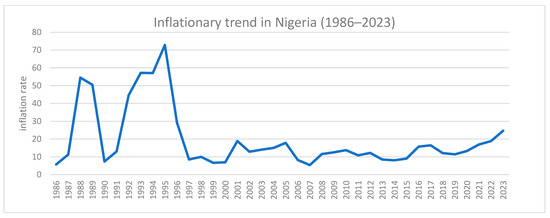
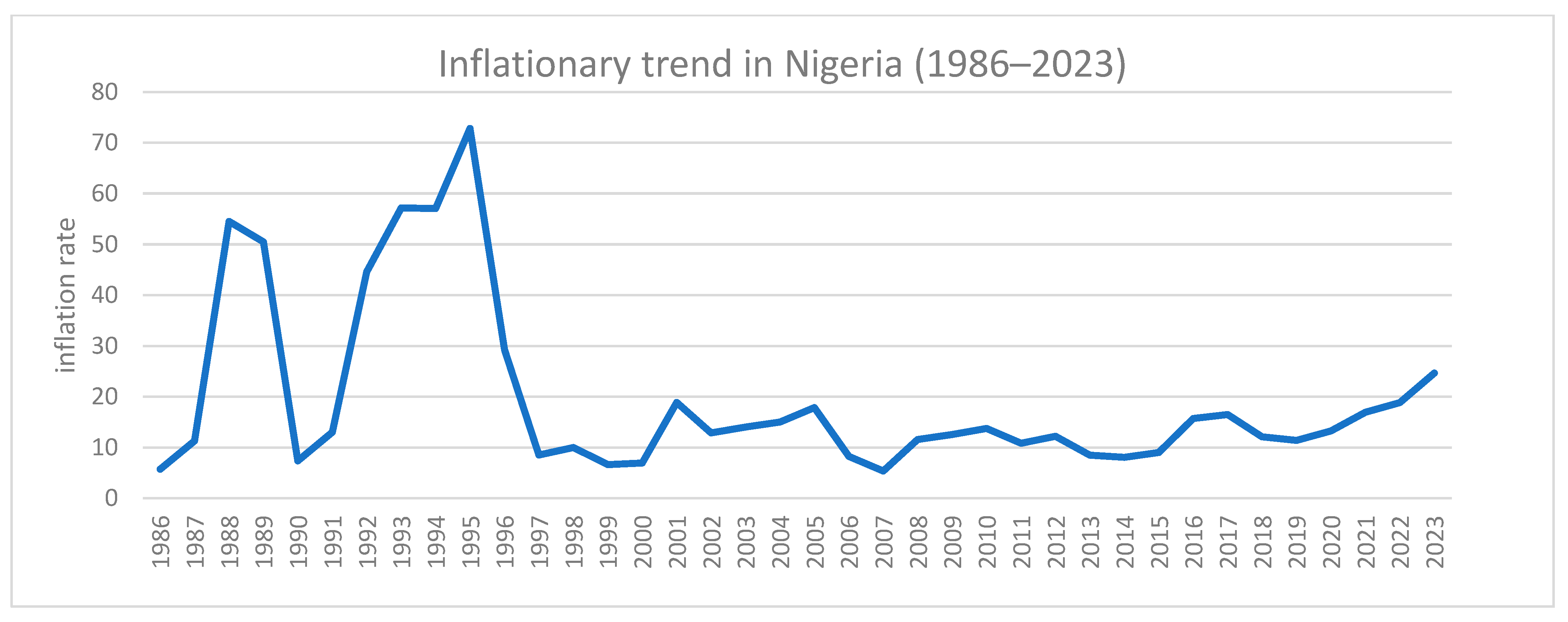
Figure 1 reveals that the rate of inflation in Nigeria has experienced fluctuations over time. Specifically, in 1995, the rate of inflation stood at 72.84%, which marks the highest rate of inflation in the Nigerian economy compared to other years. However, in 1996, there was a sharp drop in the Nigerian inflation rate, which has since shown a gradual rise from 1998 to date.
Figure 1.
Inflationary trend in Nigeria from 1986 to 2023. Source: CBN statistical bulletin (2023).
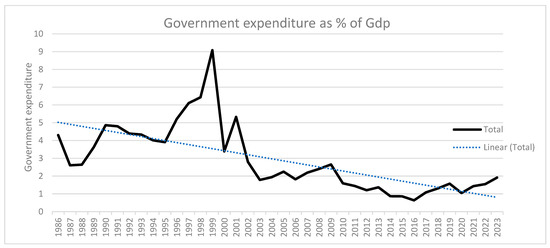
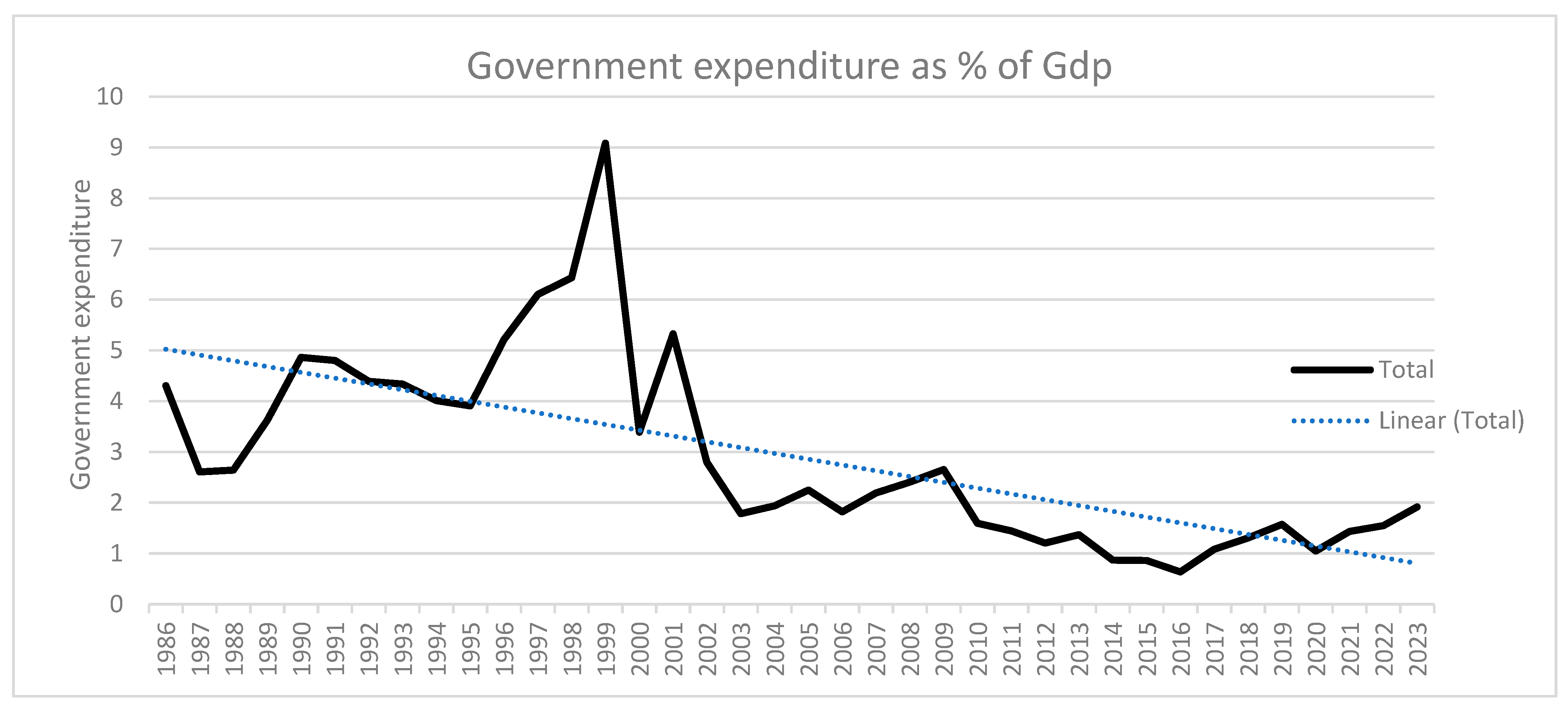
Figure 2 shows that the level of government spending fluctuations over the years studied dropped drastically, with a sluggish rise in 2023. This gives more insight into the cause of the fluctuations in Nigerian inflation rate.
Figure 2.
Trend analysis for government expenditure (1986–2023). Source: CBN statistical bulletin (2023).
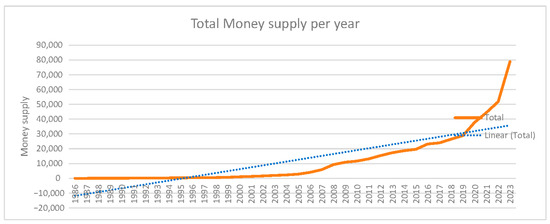
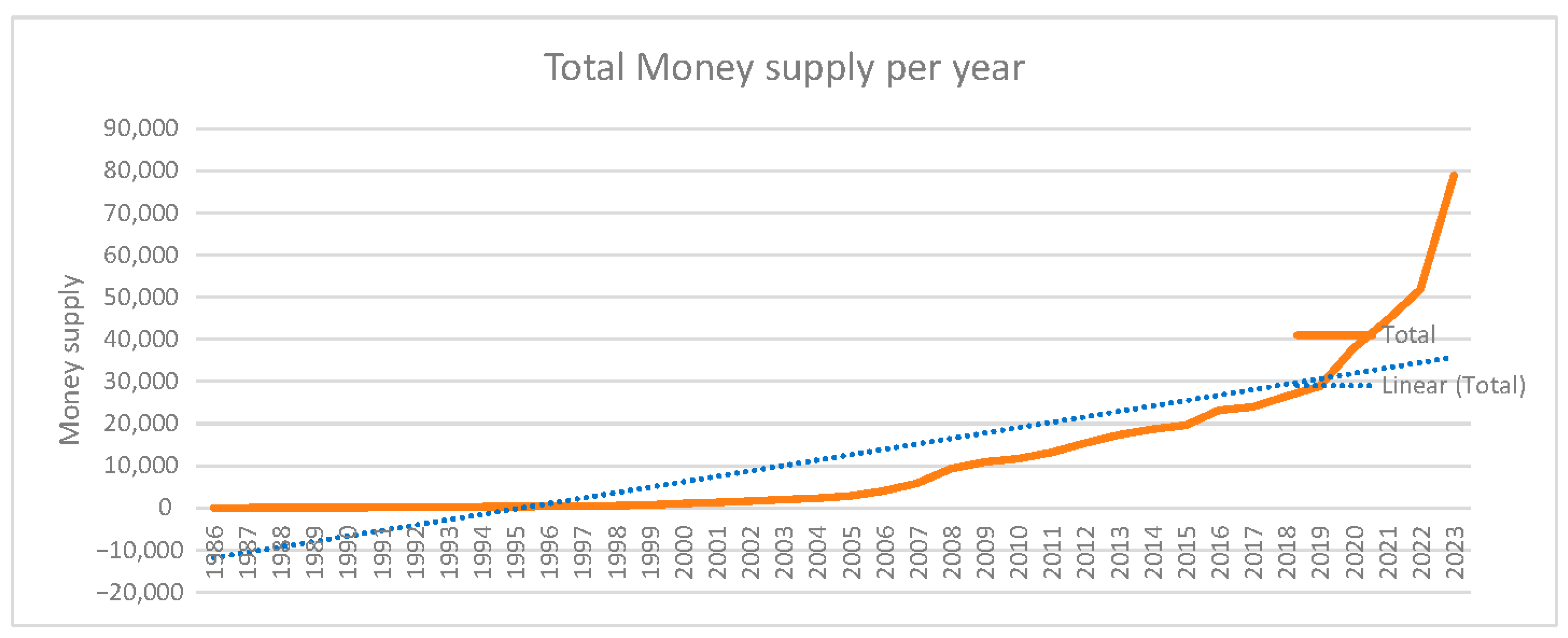
Figure 3 reveals the total amount of money that is available in the economy for business activities yearly. It is observed that there is an upward trend; that is, the amount of money in circulation increases yearly. Considering Figure 2 and Figure 3, it is observed that expansionary monetary policy and contractionary fiscal policy were employed to stabilize the economy over the years under investigation.
Figure 3.
Trend analysis for money supply (1986–2023). Source: CBN statistical bulletin (2023).
The ADF unit roots, as reported in Table 3, demonstrate that the economic growth and inflation rate are stationary at level, demonstrating that the variables are integrated to the order of zero. The criterion for the unit root test is that the null hypothesis of non-stationarity is accepted if the ADF test statistic exceeds the critical threshold. From the report in Table 3, the inflation rate and economic growth are found to be stationary at level, indicating the variables are integrated to the order of zero 1(0). However, GEXP, MS, INT, and EXCHR are non-stationary at level but stationary after first differencing. This affirms that government expenditure (GEXP), money supply (LNMS), interest rate (INT), and exchange rate (EXCHR) are integrated to the order of one I (1). This combination of stationarity at level and first differencing of the variables makes the ARDL model appropriate for this study, as it is able to determine the short- and long-term relationships between the variables. The optimal lag lengths of four and two are chosen for models 1 and 2, respectively, using the Akaike information criteria (AIC) (See Appendix A.1 and Appendix A.2).
Table 3.
ADF unit root results.
The results of the ARDL bound test in Table 4 show that the F-statics value (model 1 = 15.868, model 2 = 7.874) is higher than the lower and upper bound values at the 1%, 5%, and 10% significance level for both models. Given that the F-statistic exceeds the upper bound at all statistical significance levels (1%, 5%, and 10%), it can be concluded that the null hypothesis of no co-integration is rejected in both models. This further suggests that the variables in both models have a long-term relationship.
Table 4.
ARDL bound test.
The long-term relationships between the variables in models 1 and 2 are reported in the result shown in Table 5. The results for Model 1 illustrate how the money supply (MS), interest rate (INT), exchange rate (EXCH), government spending (GEXP), and inflation (INF) affect the GDP over the long term. The results reveal that inflation has a negative and marginally significant effect on GDP at a 10% significance level, indicating that an increase in the inflation rate would lead to a mild significant reduction in GDP in the long run. Also, GEXP, INT, and exchange rate exert negative impacts on GDP, while LNMS exerts a positive effect on economic growth. However, of all the variables, only money supply, interest rate, and exchange rate exert significant impacts on GDP in the long run.
Table 5.
ARDL long-run result (Model 1 and Model 2).
On the other hand, the result for Model 2 shows that with the intervening effect of government expenditure (GEXP) and money supply (LNMS), inflation rate and exchange rate exert positive (though insignificant) impacts on the GDP. However, the effect of changes in the interest rate remains negative with an insignificant impact. This result further reveals that the moderating role of government expenditure (INF × GEXP) and money supply (INF × LNMS) weakens the positive impact of inflation on GDP insignificantly. However, the coordinated use of both government expenditure and money supply (INF × GEXP × LNMS) exerts an insignificant but positive impact on the interplay between inflation rate and GDP in the long run.
The results in Table 6 show that the inflation rate in the current period (D(INF)) has a negative and significant impact on GDP in the short term, while the lag values of inflation have both significantly positive (lag 1 and 2) and negative (Lag 3) effects on GDP. In addition, government expenditure consistently exerts a negative and significant effect on GDP, except in lag 3 when it becomes insignificant. The effect of money supply in the current period is negative and significant, but it became positive in later lags (2 and 3) and remained significant. Interest rate exerted a negative and significant effect on economic growth in the current period, while later lags depicted a positive and significant effect on GDP, suggesting some possible adjustment over time. Moreover, exchange rate has a positive and significant effect in the current and lagged period except for lag one, which shows a negative but insignificant effect on GDP. The speed of adjustment of 0.205 with negative and significant error term shows that when there is disequilibrium in the system, the speed of adjustment to equilibrium in the long run is 20.5%. This implies that inflation shocks have long-lasting but transient effects on growth and points to a gradual but continuous adjustment process. The presence of a long-term equilibrium link between inflation and economic growth in Nigeria is further confirmed by the negative and significant ECM. Numerous structural and institutional factors account for the delayed rate of adjustment and the long-term effects of inflation on Nigerian economic growth. Nigerian cost-push pressures from declining currency rates, reliance on imports, unstable energy prices, and supply-side limitations are the main causes of the country’s ongoing inflation. Hence, due to the economy’s structural rigidities, low productive capacity, and restricted competitiveness, these shocks take a long time to reverse.
Table 6.
ECM (ARDL short-term result) Model 1.
Table 7 reveals the moderating role of monetary and fiscal policy on the inflation-growth nexus, which shows that with moderation, inflation rate has a favorable (though insignificant) impact on GDP, while its lagged effect on GDP remains significantly negative. The moderating role of GEXP and LNMS (when exerted separately) on inflation is negative and insignificant for the economic output in the current period; however, the effect becomes positive and significant in lagged periods (B = 0.009, p = 0.000, B = 0.003, p = 0.0006, respectively). Moreover, the interaction effect of GEXP and LNMS (when jointly used on inflation) has a positive and significant effect on GDP, suggesting the efficacy of coordinated fiscal and monetary policy in addressing inflation changes in the economy. However, despite the introduction of moderation in the model, the effect of the interest rate on GDP remains negative and significant, suggesting the effect of a very tight monetary policy in the system. The exchange rate in the current period exerts a negative and significant effect on GDP, but it exerted a significant and positive effect on GDP in the past period. The error correction term (−2%) is negative and significant, showing that the speed of adjustment of the variables toward long-term equilibrium is very slow. This incredibly slow rate of adjustment suggests that the Nigerian economy is affected by inflation shocks for a long time. The transition to long-term equilibrium is nevertheless slow, even when monetary and fiscal policy are included as intervening variables. The persistence of exchange rate-driven inflation in Nigeria, weak monetary transmission channels, structural rigidities, and fiscal implementation delays are all major contributing factors to this. The short-term negative impacts of inflation are mitigated by monetary and fiscal policies, but their impact is insufficient to swiftly bring the economy back into balance. As a result, Nigeria’s long-term inflation-growth dynamics are marked by delayed correction and slow convergence.
Table 7.
ECM (ARDL short-term result)—Model 2.
4.1. Diagnostic Test
Table 8 reveals that for Models 1 and 2, the serial correlation test shows an absence of autocorrelation in the model (p = 0.082, 0.835), though Model 2 seems more reliable. Also, both models have p-values greater than 5% significant value (p = 0.942, 0.458, respectively), indicating that the variance of the residuals is constant, hence the presence of homoscedasticity in the models. The Ramsey reset result with p-value 0.185 and 0.285 shows there are no errors of specification in both models. This further implies that the models are well specified to achieve the purpose of this study. In a test of the normality of the distribution, the p-values of Jarque–Bera (0.311 and 0.583), which are above a 5% significance level, reveal the result. This indicates that the models used in the study are normally distributed. Therefore, the null hypothesis that the residuals in the two models do not deviate from a normal distribution is accepted.
Table 8.
Serial correlation.
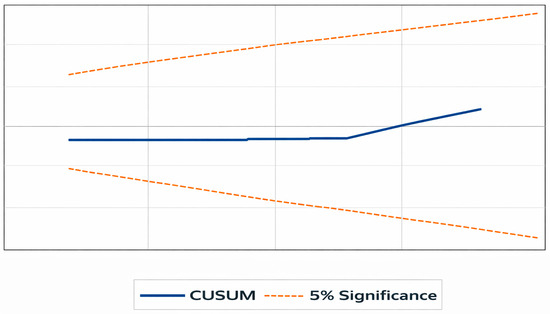
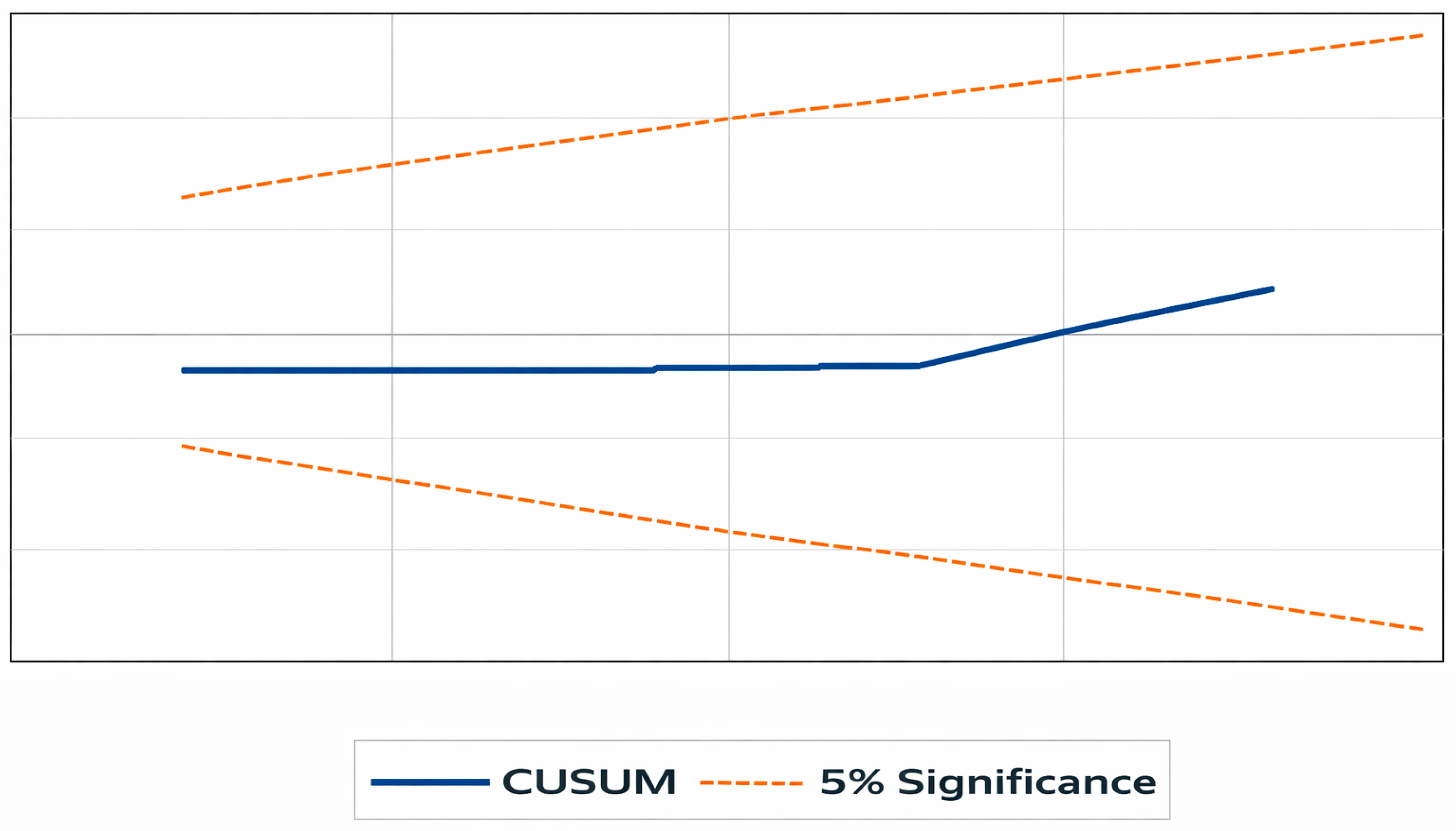
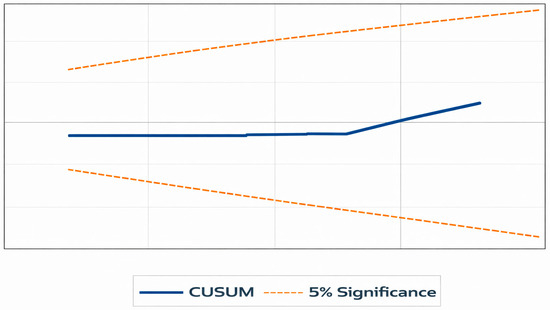
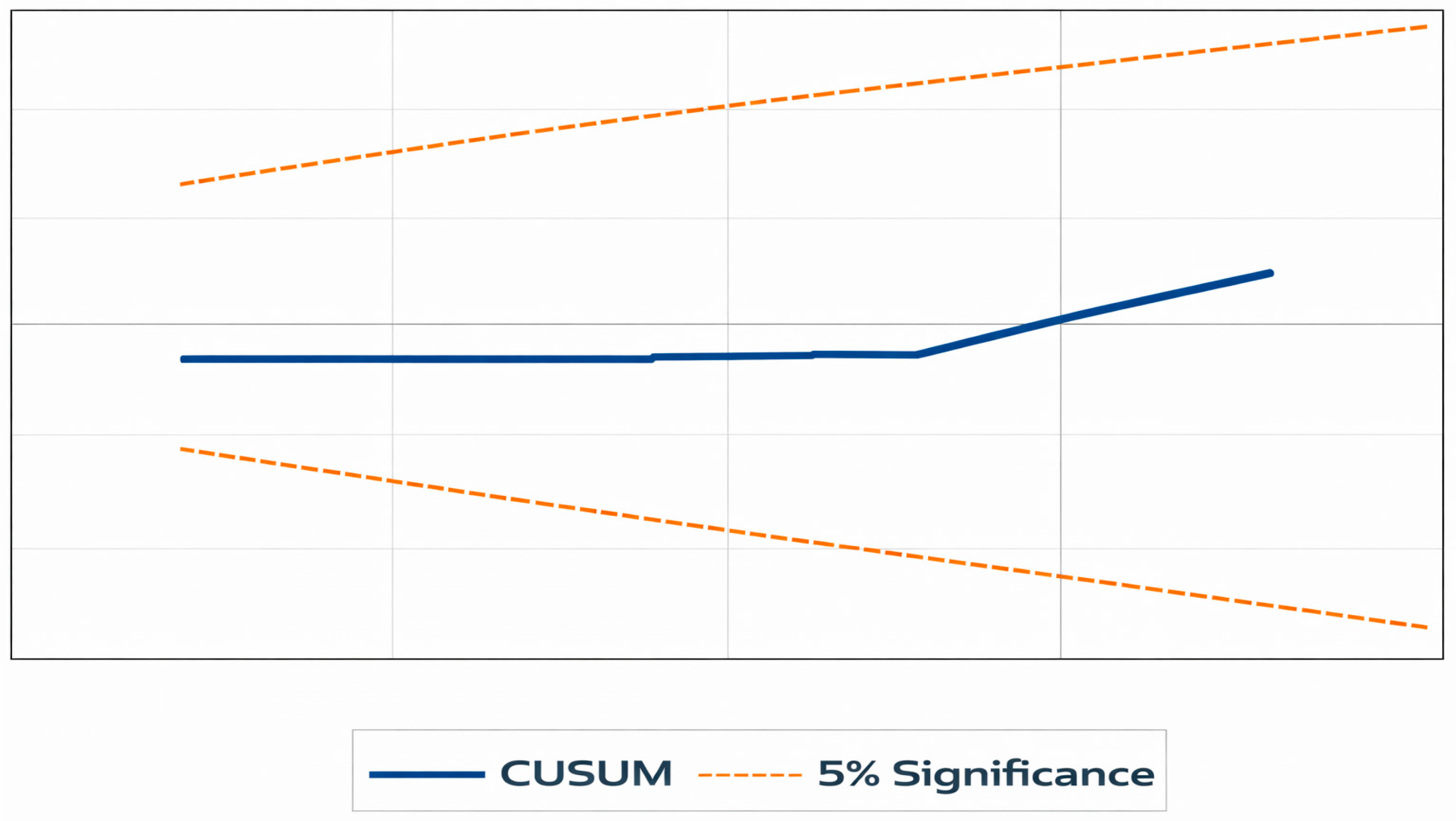
In Figure 4 and Figure 5, the cumulative sum test presents the stability of the coefficients in the models. The blue line shows the cumulative sum of recursive residuals, while the orange lines signify a 5% significance level. It can also be observed that the CUSUM line is within the 5% significance boundaries (orange dashed lines), suggesting that both models are stable over time. Hence, the models’ stability and reliability over time is observed.
Figure 4.
Cumulative sum (Cusum Test) for Model 1.
Figure 5.
Cumulative sum (Cusum Test) for Model 2.
4.2. Robustness Check
To ensure the robustness of the results obtained in this study, we extend the analysis by examining the causal relationship that exists between inflation, GDP, monetary policy, and fiscal policy by using the Toda–Yamamoto causality test. This test determines the direction of the cause-and-effect relationship among the variables regardless of their stationarity level. It can be applied to variables with different orders of integration. For this study, the maximum order of integration is 1(k), since the orders of integration of the variables are I(0) and I(1). Also, the maximum lag length (dmax) was determined using Akaike information criterion of 1 and 10 for Model 1 and Model 2, respectively. For decision criteria, there is Granger causality at any significance level (1%, 5%, or 10%).
Table 9 reveals that there is a bidirectional causal relationship between GDP and inflation rate. This suggests that changes in the inflation rate significantly impact GDP, while the variations in GDP also have feedback effects on the inflation rate. This further shows that there exists a dynamic interdependence between stability of price and economic performance. Also, the moderating role of government expenditure and money supply on the inflation-growth nexus is significant. Conversely, the absence of feedback from GDP to the interaction term shows a weaker response to policy framework. However, when considered jointly (fiscal and monetary policy) as a moderating variable, the causality is bidirectional, indicating a significant policy-growth feedback mechanism.
Table 9.
Toda–Yamamoto causality test result.
Summarily, these results corroborate the findings from the ARDL test by highlighting the efficacy of using a coordinated fiscal and monetary policy to control inflationary pressure in Nigeria.
4.3. Discussion
This study discovered that a long-term relationship subsists between inflation and economic growth in Nigeria, and the speed of adjustment when there is a perceived disequilibrium in the system is significant. This indicates that inflation rate and economic growth move together in an economy over a long period of time. The outcome is consistent with research by Adeyemi and Olowookere (2021), which established a long-term link between inflation and economic expansion. This leads to the acceptance of the alternative hypothesis that there is a long-term relationship between inflation and economic growth. This provides even more proof that economic growth and inflation are intertwined.
The findings on the impact of inflation on economic growth shows a negative and significant relationship in the short run, though it is insignificant in the long run, indicating that a rise in inflation would result in a decline in economic output, erode purchasing power, and hamper investment, as supported by the works of Adu and Ajigbotoso (2024). This is also in line with the findings of Adeyemi and Olowookere (2021), who assert that inflation has a negative and significant impact on economic growth in the short term. This study also revealed that government spending primarily hinders growth both in the long run and short run but that the effect is significant in the short run, which raises the possibility that Nigerian public spending is ineffective or misallocated. This is in line with the findings of Atan and Effiong (2021), who found that government initiatives had little impact on raising growth and lowering inflation. This was probably because they prioritized non-productive spending or mismanaged the budget. However, money supply has a positive impact on GDP only in the short term, though the effect is significant in both the short and long term. This indicates that monetary expansion might spur growth. The findings of Uddin and Ullah (2024), who found in their study in Pakistan that money supply may boosts economic activity, supports the findings of this study.
The results of the study on the moderating effect of fiscal and monetary policy also demonstrate that government spending and money supply reduce the adverse effects of inflation on growth both in the short and long term. This implies that when governments increase their spending on developmental projects, the level of inflation will be curbed by the increase in demand for labor, which will lead to a rise in economic total output. Additionally, an expansionary monetary policy (money supply) will encourage investment and lessen the negative impact of inflation on economic expansion. In conclusion, the hypothesis that government spending and money supply considerably moderates the relationship between inflation and growth is rejected.
Furthermore, the short-term effects of inflation in Nigeria are favorably and considerably influenced by the moderating action of a coordinated fiscal policy (government spending) and monetary policy (money supply), though the effect is only significant in the long run. In order to control inflation and maintain economic stability in Nigeria and other developing countries, these findings highlight the notion that strong and coordinated fiscal and monetary policies are not only desirable, but essential. The results are consistent with those of Nguyen et al. (2022) and Tung (2021), who found that the joint application of fiscal and monetary tools was effective for maintaining inflation stability and promoting economic growth. Therefore, the hypothesis that the moderated effect of coordinated fiscal and monetary policy is significant in controlling the inflation rate in Nigeria is accepted. These results also extend the Keynesian theory by showing that both fiscal and monetary policy can be combined to moderate the influence of inflation on economic growth in Nigeria.
5. Conclusions
This study looked at the moderating effects of monetary and fiscal policy, as well as the relationship between inflation and economic growth in Nigeria. The findings showed that, in the short term, inflation significantly hinders economic growth, albeit government spending and the money supply also have negative impacts. In particular, it was discovered that government spending had a largely negative impact, indicating inefficiency in spending, whereas the money supply had a delayed but favorable impact on growth. While exchange rate changes generally boosted growth, interest rates had a short-term negative impact on it. These results demonstrate the intricacy of Nigeria’s macroeconomic dynamics and the necessity of carefully formulating policies. The study also discovered that the negative effects of inflation on growth are considerably mitigated by coordinated monetary and fiscal policies. Positive interaction effects between the money supply, government spending, and inflation imply that these policies, when combined, can protect the economy from inflationary shocks.
5.1. Practical Implications of the Findings
The outcome of this study reveals that there is an urgent need to reduce the inflation rate in Nigeria, considering the adverse and significant effect it has on economic productivity. This entails establishing inflation-targeting frameworks and avoidance of expansionary monetary and fiscal policy, especially when a hike in the inflation rate is perceived. Government expenditure should be carefully directed into sectors that promote growth, such as infrastructure, healthcare, and education, since ineffective fiscal spending worsens the negative effects inflation has on the economy. According to this study, monetary policy should be steady, intentional, and forward-looking, because the money supply has a delayed but eventually positive effect on economic growth. The impact of central bank operations may not be immediately apparent; thus, they must be regular and predictable. The short-term negative impact of interest rate policy on growth, notwithstanding its effectiveness in lowering inflation, raises the possibility that an economy that is sluggish may be the consequence of overly high interest rates that deter investment and consumption. In order to maintain credit availability for consumers and businesses, it is necessary to strike a balance with the need to control inflation.
Also, exchange rate policies that would bolster economic growth should be implemented, considering the significant favorable impact of exchange rate on Nigerian economic growth. The result notably concludes that the adverse and substantial impact of inflation rate is controlled by a robust fiscal and monetary policy. This suggests that the monetary and fiscal policy should be combined to control the influence of inflation on Nigerian economic growth. To attain macroeconomic stability, economic institutions need to coordinate their policies rather than functioning independently. By establishing frequent policy alignment between the Ministry of Finance and the Central Bank of Nigeria through a combined macroeconomic coordination committee, Nigerian institutions can effectively coordinate fiscal and monetary policies. When the money supply is growing, government spending should be designed to support monetary policy by giving capital and productivity-boosting expenditures priority. To prevent contradictory policy signals, the CBN should coordinate liquidity management with government borrowing and debt issuance. Instead of focusing on wide-ranging expansion, both institutions might rely more on focused financial interventions and fiscal incentives to boost productive sectors. The moderating influence of monetary and fiscal policies on economic growth will be strengthened and inflation expectations will be better controlled with consistent and cohesive policy communication.
5.2. Limitations of the Study and Suggestions for Future Research
This study focused majorly on the Nigerian economy and the impact of inflation on aggregate national output without considering the impact on various sectors that constitute the economy. This constitutes the major limitations of this study. Hence, future studies could break down the economy into distinct sectors, such as manufacturing, services, and agriculture, to examine how inflation impacts each one differently. Furthermore, a cross-country comparison of Nigeria with other emerging or Sub-Saharan African nations may offer more comprehensive understandings of the ways in which policy frameworks, inflation dynamics, and institutional quality vary depending on the setting. Also, since Nigeria would have had different monetary regimes during the period under study, with inflation targeting beginning more recently, future studies could capture these changes in the regime by performing modeling with dummy variables.
Author Contributions
Conceptualization; A.O.A. and M.D.; methodology and software, A.O.A.; validation, A.O.A. and M.D.; formal analysis, A.O.A.; investigation, A.O.A. and M.D.; resources, M.D.; data curation, A.O.A.; writing—original draft preparation, A.O.A.; writing—review and editing, M.D.; visualization, M.D.; funding acquisition: M.D.; supervision, M.D.; project administration, M.D. All authors have read and agreed to the published version of the manuscript.
Funding
This research received no external funding.
Institutional Review Board Statement
Not applicable.
Informed Consent Statement
Not applicable.
Data Availability Statement
The data used in this study is available via the Central Bank of Nigeria Statistical bulletin.
Conflicts of Interest
The authors declare no conflicts of interest.
Appendix A
Appendix A.1
Table A1.
Optimal lag selection (Mode 1).
Appendix A.2
Table A2.
Optimal lag selection (Mode 2).
References
- Adeyemi, A. Z., & Olowookere, J. K. (2021). Inflation, unemployment and economic growth in Nigeria (1980–2019). Polac International Journal of Economics and Management Science (PIJEMS), 7(1), 60–71. [Google Scholar]
- Adu, C. A., & Ajigbotoso, M. A. (2024). Inflationary rate and investment in Nigeria. Indonesian Journal of Applied and Industrial Sciences (ESA), 3(2), 203–208. [Google Scholar] [CrossRef] [Scilit]
- Akobi, K. C., Umeora, C. E., & Atueyi, C. L. (2021). Government expenditure and inflation rate in Nigeria. International Journal of Business Systems and Economics, 13(4), 276–293. [Google Scholar]
- Atan, J. A., & Effiong, U. E. (2021). Fiscal policy and inflation in Nigeria: An insight into the critical limit hypothesis. Journal of Research in Business and Management, 9(5), 66–73. [Google Scholar]
- Awogbemi, C. A., & Oluwaseyi, A. (2011). Modeling volatility in financial time series: Evidence from Nigerian inflation rates. Ozean Journal of Applied Sciences, 4(3), 337–350. [Google Scholar]
- Awogbemi, C. A., & Taiwo, J. K. (2012). Empirical analysis of the causes and effects of inflation in Nigeria. Journal of Economics and Sustainable Development, 3(11), 35–40. [Google Scholar]
- Bangura, M., & Omojolaibi, J. A. (2024). Inflation-economic growth nexus in Nigeria: New evidence on threshold effects. International Journal of Economic Policy, 4(1), 44–62. [Google Scholar] [CrossRef] [Scilit]
- Bellepea, N. Y., Ozdeser, H., & Seraj, M. (2024). Impact of inflation on economic growth: Investigating some major oil exporting countries in Africa. SunText Review of Economics & Business, 5(1), 201. [Google Scholar] [CrossRef] [Scilit]
- Ben Abdallah, A., Guidara, S., Aloulou, R., Kalai, M., & Helali, K. (2023). Investigating the relationship between inflation and economic growth in Mauritania: An empirical analysis using the regime change model. SN Business & Economics, 4(1), 2. [Google Scholar] [CrossRef] [Scilit]
- Central Bank of Nigeria (CBN). (2023). Exchange rate and inflation report. Central Bank of Nigeria. [Google Scholar]
- EKŞİ, İ. H., Ahmet, Ş., & Salman, C. (2025). The effect of policy interest rate on countries’ inflation rates and economic growth: Research on G-8 countries. International Student Conference on Business, Education, Economics, Accounting, and Management (ISC-BEAM), 3(1), 1938–1944. [Google Scholar] [CrossRef] [Scilit]
- Fasanya, I., Fajobi, A., & Adetokunbo, A. (2021). Are fiscal deficits inflationary in Nigeria? New evidence from bounds testing to cointegration with structural breaks. Economic Annals, 66(228), 123–147. [Google Scholar] [CrossRef] [Scilit]
- Friedman, M. (1968). The role of monetary policy. The American Economic Review, 58(1), 1–17. [Google Scholar]
- Grauwe, P. D., & Polan, M. (2005). Is inflation always and everywhere a monetary phenomenon? Scandinavian Journal of Economics, 107(2), 239–259. [Google Scholar] [CrossRef] [Scilit]
- Hakimah, Y. (2025). Monetary and fiscal policy: Drivers of stability in developing economies. Jurnal Konseling Dan Pendidikan, 13(1), 1–10. [Google Scholar] [CrossRef] [Scilit]
- Hamadouche, F. Z., Hamadouche, B., Ghandour, M. M., Hamadouche, A., & Boutrig, B. (2024). Granger test and ARDL model for the socio-economic challenges investigation: Public expenditure components, economic growth, and inflation. SocioEconomic Challenges (SEC), 8(4), 70–87. [Google Scholar] [CrossRef] [Scilit]
- Hussain, W. A. (2023). Impact of inflation on economic growth: A time series analysis (A time series analysis of Pakistan). Harf-o-Sukhan, 7(3), 592–607. [Google Scholar]
- Idoro, D., & Ehiedu, V. C. (2024). Impact of inflation rate and exchange rate fluctuations on economic growth in a developing nation. Journal of Accounting and Financial Management, 10. [Google Scholar] [CrossRef]
- Idris, M., & Bakar, R. (2017). The relationship between inflation and economic growth in Nigeria: A conceptual approach. Asian Research Journal of Arts & Social Sciences, 3(1), 1–15. [Google Scholar] [CrossRef] [Scilit]
- Judijanto, L., & Kusnadi, I. (2024). The impact of inflation on economic growth: A comprehensive literature study. Journal of Community Dedication, 4(4), 786–796. [Google Scholar]
- Maiga, Y. (2024). Impact of inflation on economic growth: Evidence from Tanzania. Journal of Agricultural Studies, 12(2), 77. [Google Scholar] [CrossRef] [Scilit]
- Minteh, S., Gisseh, A., & Khan, E. (2025). The impact of inflation, exchange rate, trade and foreign direct investment on economic growth of the Gambia: Evidence from ARDL approach. Journal of Macroeconomics and Social Development, 2(3), 16. [Google Scholar] [CrossRef] [Scilit]
- Moodley, F., & Pillay, S. (2024). Evaluating the effects of inflation on economic growth in South Africa. Journal of Economics and Financial Analysis, 8(2), 69–87. [Google Scholar]
- Muhammed, M. N., Babawulle, D. H., & Tahir, H. M. (2021). Impact of monetary policy on economic growth in Nigeria: Vector error correction mechanism approach. Dutsin-Ma Journal of Management Sciences, Federal University, Katsina Nigeria, 4(3), 335–337. [Google Scholar]
- Musa, I., Magaji, S., & Salisu, A. (2022). Monetary policy shocks and economic growth: Evidence from SVAR modelling. International Journal of Indonesian Business Review, 1(1), 1–11. [Google Scholar] [CrossRef] [Scilit]
- Nadabo, Y. S., & Maigari, S. S. (2021). Asymmetrical effect of inflation on economic growth in Nigeria: Evidence by nonlinear ARDL approach. IOSR Journal of Economics and Finance (IOSR-JEF), 12, 21–28. [Google Scholar]
- Nasir, R., Waheed, R., & Nasir, W. (2021). The impact of money supply on inflation in Pakistan. Journal of Economics and Management Sciences, 2(1), 18–28. [Google Scholar] [CrossRef] [Scilit]
- Nguyen, T. T., Phan, T. D., & Tran, N. A. (2022). Impact of fiscal and monetary policy on inflation in Vietnam. Investment Management & Financial Innovations, 19(1), 201. [Google Scholar]
- Ogu, M. A., Adagiri, I. H., & Abdusalam, A. U. (2021). Impact of inflation on economic growth in Nigeria 1999–2017. UMYU Journal of Counselling and Educational Foundation, 1(1), 1–10. [Google Scholar]
- Okwuchukwu, C., Edith, D., & Onyeanu, O. (2023). Exchange rate fluctuations and inflation on economic development in Nigeria: The economic, HEART of a nation. Seybold Report Journal, 18(10), 46–64. [Google Scholar]
- Omobolanle, Y. R. (2021). The effects of inflation on economic growth in Nigeria. International Journal of Innovative Research and Development, 10(6), 111–123. [Google Scholar] [CrossRef] [Scilit]
- Pesaran, M. H., Shin, Y., & Smith, R. J. (2001). Bounds testing approaches to the analysis of level relationships. Journal of Applied Econometrics, 16(3), 289–326. [Google Scholar] [CrossRef] [Scilit]
- Smith, A. (1776). An inquiry into the nature and causes of the wealth of nations: Volume one. W. Strahan and T. Cadell. [Google Scholar]
- Sriyana, J. (2022). Fiscal and monetary policies to reduce inflation rate in Indonesia. Jurnal Kebijakan Ekonomi Dan Keuangan, 1, 82–91. [Google Scholar] [CrossRef] [Scilit]
- Sulaiman, L. A., & Azeez, B. A. (2012). Effect of external debt on economic growth of Nigeria. Journal of Economics and Sustainable Development, 3(8), 71–79. [Google Scholar]
- Sunday, R. J., & Miriam, K. (2015). Inflation targeting and economic growth in Nigeria: A vector auto regressive (var) approach. European Journal of Economics and Management (EJEM), 2, 42. [Google Scholar] [CrossRef] [Scilit]
- Tung, L. T. (2021). Fiscal policy, monetary policy and price volatility: Evidence from an emerging economy. Organizations and Markets in Emerging Economies, 12(1), 57–70. [Google Scholar] [CrossRef] [Scilit]
- Uddin, I., & Ullah, R. (2024). The nexus amongst the interest rate, inflation and economic growth in Pakistan: Evidence from simultaneous equation modeling. Economic Alternatives, 1, 45–58. [Google Scholar] [CrossRef] [Scilit]
- Umaru, A., Donga, M., & Musa, S. (2013). An empirical investigation into the effect of unemployment and inflation on economic growth in Nigeria. Interdisciplinary Journal of Research in Business ISSN, 2046, 7141. [Google Scholar]
- World Bank. (2023). The impact of inflation on economies. Sub-Saharan African. [Google Scholar]
- Yuliati, L., Dana, B. S., & Musaiyaroh, A. (2025). Monetary and fiscal policy on inflation in indonesia: Threshold vector autoregression approach. Media Ekonomi Dan Manajemen, 40(1), 1. [Google Scholar] [CrossRef] [Scilit]

Disclaimer/Publisher’s Note: The statements, opinions and data contained in all publications are solely those of the individual author(s) and contributor(s) and not of MDPI and/or the editor(s). MDPI and/or the editor(s) disclaim responsibility for any injury to people or property resulting from any ideas, methods, instructions or products referred to in the content. |
© 2026 by the authors. Licensee MDPI, Basel, Switzerland. This article is an open access article distributed under the terms and conditions of the Creative Commons Attribution (CC BY) license.