


Abstract
Artificial intelligence (AI) has played a pivotal role in enhancing the efficiency of financial technology (Fintech), ultimately contributing to the stability of the banking sector. The advancements in Fintech driven by AI tools are significantly improving risk management within the banking industry. This paper investigates the mediating role of AI in the relationship between Fintech and financial stability in the context of Islamic and conventional banks across selected countries in the Organization of Islamic Cooperation (OIC). It employs structural equation modeling (SEM) to explore the causal linkages across time domains. The results of this research identify that AI is a significant mediator, playing a critical role between Fintech and stability. It either mitigates or amplifies risks, depending on the regulatory framework and implementation practices in place. The analysis indicates that AI has a weak mediating effect in the short run, but a strong mediating effect in the long run between Fintech and stability. This research paper emphasizes the importance of developing robust, forward-thinking policies to leverage the benefits of AI. It also addresses the risks to financial stability in both Islamic and conventional banking systems.
1. Introduction
The integration of artificial intelligence (AI) and financial technology (Fintech) has transformed the finance industry in recent times (Ma et al., 2025; Cao et al., 2024). Current technological advancements have offered new opportunities for improving efficiency, customer experience, and risk management (Sun et al., 2025). Particularly, Fintech has a significant effect on innovation advancements in urban cities, which in turn impacts the financial markets (Xuan et al., 2025). Few studies have investigated the synergy between these two emerging technologies and their collective effect on financial stability, particularly in the context of Islamic and conventional banks. The impacts of Fintech and AI may differ in these banking sectors, as Islamic banking adheres to strong ethical and financial principles such as profit-sharing and risk avoidance. However, the interaction between AI and Fintech within each banking system and its impact on financial stability remain under-researched. We contribute to the growing theoretical and empirical literature on the role of AI and Fintech by using advanced tools to enhance the resilience of the banking sector (Ristanović et al., 2025). On the methodological side, this study uses the most up-to-date structural equation modeling (SEM) techniques to identify the causal paths of direct and indirect impacts among AI, Fintech, and financial stability.
The impacts of Fintech and AI on financial stability remain a pressing concern (Mabe & Simo-Kengne, 2025). The utilization of mobile money and Internet banking has expedited the entry of additional operators, offering financial services to the unbanked populace (Osabutey & Jackson, 2024). However, the impact of Fintech on financial stability has been vastly contested (Agrawal, 2021). These innovative factors enhance banking operations, productivity advancement, and risk management. Information Technology is a substantial activity feature and can consequently be utilized to augment competitiveness (Awotunde et al., 2021; Rambe & Khaola, 2022). Moreover, Fintech is a dynamic entity characterized by flexibility and evolution rather than a stable concept universally comprehensible to academia and the media (Passanisi, 2024). Recently, Fintech has gained significant appeal in financial markets (Chand et al., 2025) and portfolio management, since it may be categorized as a financial asset or commodity offering pure store-of-value benefits. As a result, the banking system has progressively transitioned to shadow the Islamic banking sector (Yoshida, 2019; Jefferson, 2021).
The integration of AI and Fintech into the banking sector presents both opportunities and challenges, with important implications for the Islamic and conventional banking systems (Moharrak & Mogaji, 2025; Ally, 2025). The Islamic banking system is strongly guided by Sharia-based principles, which may be treated with different considerations when adopting these technologies (Arsyad et al., 2025). While the literature shows that artificial intelligence (AI) and Fintech can enhance efficiency and risk management (Khalil et al., 2025; Dewasiri et al., 2024; Pattnaik et al., 2024), they must align with ethical and religious standards. The relationship between AI and Fintech in Islamic banking can be explored through three key elements. Firstly, AI and blockchain technologies may significantly enhance risk management in Islamic finance by offering both transparency and security (Zaman et al., 2025). This will reduce data manipulation risks and further enable predictive analysis for fraud detection (Hendarti et al., 2024). Secondly, AI applications, including machine learning and big data analysis, can enhance decision-making and operational efficiency. At the same time, they can be aligned with Islamic values to ensure compliance (Ishak & Mohamed, 2023). Thirdly, the adoption of Fintech in Islamic banking has shown potential for market growth, especially in areas like Sukuk issuance and digital transactions. This growth can align with Sharia principles, ensuring compliance while driving innovation (Rahman et al., 2024; Mohamad et al., 2024).
The banking sector faces some risks associated with using AI and Fintech. There are three important aspects that should be considered. Firstly, the integration of AI into Islamic finance must ensure strict compliance with Sharia-based principles, which can be further challenging, particularly given the rapid pace of technological advancement (Hendarti et al., 2024; Mohamad et al., 2024). Secondly, the implementation of AI can lead to technological unemployment and high costs, which are significant concerns for Islamic banks aiming to maintain ethical standards. Thirdly, ensuring data security and privacy is very crucial, as these are integral (important) to maintaining trust and compliance with Islamic ethical standards (Mohamad et al., 2024). The debate so far suggests that the conventional banking sector does not face unique challenges in integrating AI and Fintech like the Islamic banking sector. The Islamic banking system operates under Sharia-compliant principles, which strictly prohibit Riba, also known as interest, excessive volatility, also known as Gharar, and highly speculative financial activities, also known as Maysir. These ethical constraints are the main factors that directly define the shape the products, structure of risk management, and mechanism of governance of the Islamic banking system. As a result of these constraints, emerging technologies like artificial intelligence (AI) may influence the stability of this banking system differently. This banking system prioritizes transparency and asset-backed financial compliance, which may slow the adoption of technology but can also reduce exposure to a certain level of operational and credit risks.
Conventional banks prioritize efficiency and profitability, often without the same ethical constraints. This difference highlights the importance of a comparative analysis approach to Islamic finance, ensuring that technological advancements align with ethical and religious values. These technologies also offer significant opportunities for growth and innovation; there are some risks that may hit both banking systems differently.
Fintech can enhance economic stability and augment financial intermediation for consumers and the economy (Sant’Anna & Figueiredo, 2024; Sikalao-Lekobane, 2024). Simultaneously, several other nations frequently experience political instability, which may affect the correlation between Fintech and financial stability. Prior studies have examined the correlation between Fintech, economic success, and financial stability (Ozturk & Ullah, 2022; Banna & Alam, 2021). Our research aims to analyze Fintech’s impact on economic stability in OIC regions. This study focuses on the wide gap between Fintech and financial stability, a topic that still needs to be addressed in the existing literature (Hossain & Sultana, 2024).
AI is reforming the financial system by enhancing efficiency, resilience, and fairness (Bouchetara et al., 2024). AI introduces additional risks when recognized AI risk variables converge with existing factors of financial stability. AI postulates the most effective responses for authorities to address the difficulties it presents. The financial system influences several inherent vulnerabilities that consistently underpin financial crises. However, it includes data incompleteness, system responses, strategic complementarities, and uncertainty (Yaqoobi, 2022). These can potentially interact with the internal mechanisms of AI and its integration within the financial system (Durongkadej et al., 2024).
However, specific avenues of AI-induced financial destabilization are particularly concerning (Akhtar et al., 2024). The risk of malignant use emerges due to the presence of well-resourced, profit-maximizing economic agents who exhibit little regard for the social ramifications of their actions. They aim to circumvent regulations and alter the system to their advantage, making it challenging for other market participants and regulators to detect. Technology has consistently aided such agents, who currently use AI (Spring et al., 2022). Contrary to the predominantly malevolent application of AI, workers of financial institutions, while adhering to legal boundaries, may engage in conduct that is both socially objectionable and detrimental to the interests of their employing organization. Artificial intelligence will also enable illicit actions, including those conducted by rogue traders, criminals, terrorists, and nation-states seeking to instigate civil unrest. The disinformation channel arises from consumers of AI failing to comprehend its limitations while increasingly relying on it.
This pertains to sagacious policies designed to avert and manage financial crises (Belkhir et al., 2022). In many applications, data is limited and objectives are ambiguous, leading data-driven algorithms to confidently provide recommendations in response to inquiries for which they possess minimal or no relevant training data, manifesting the broader phenomena termed AI delusion.
The Islamic Mehdi system has adopted AI, but at a very slow pace. But examination of its interaction with financial stability and Fintech is still very important. As we know that their unique system of governance is based upon Sharia-compliant rules, the restrictions on the ethical dimension create a distinct environment where emerging technologies may influence risk differently compared with another banking system.
This study addresses this research gap by investigating the mediating role of AI in the relationship between Fintech and the financial stability of Islamic and conventional banking sectors in selected Organization of Islamic Cooperation (OIC) countries. Causal path analysis is employed through structural equation modeling (SEM). This paper examines how AI moderates the impact of Fintech on financial stability, considering the regulatory challenges and differences between Islamic and conventional banking.
The findings aim to fill the gap in the literature regarding the dual effects of AI and Fintech in banking and provide policymakers with insights into leveraging these technologies while managing risks to ensure financial stability across both banking systems. These research findings contribute to the growing discourse on how emerging technologies can be harmonized with traditional banking structures to enhance financial resilience.
2. Literature Review
Recent developments in digital technology are remodeling the financial environment, which has been marked by a global increase in goods and firms that utilize new technologies to enhance and replace conventional financial services. The cost of global start-up investments in Fintech has largely increased. The rapid increase in technological usage in finance is generating both new prospects and challenging situations.
The financial services zone also includes customers, financial establishments, and policymakers worldwide. It can enhance the efficiency and competency of financial systems while developing financial inclusion for underprivileged people. Fintech’s expected benefits are dependent on a suitable regulatory environment (Kabulova, 2023). Moreover, increased technological complexity and vulnerability to cybersecurity attacks render Fintech a significant possible systemic risk to financial stability and integrity. Consequently, authorities must proactively evaluate the sufficiency of supervisory frameworks for Fintech to capitalize on its advantages while minimizing threats to financial stability. Fintech remains relatively minor in comparison to conventional financial institutions. However, it is experiencing tremendous growth, particularly in the most hazardous parts of the financial sector (Choudhary & Thenmozhi, 2024). A limited yet expanding body of literature exists regarding Fintech and its ramifications for financial stability, yielding inconclusive findings that present either a threat or opportunity. Several studies assert that Fintech may alleviate financial imperils by promoting decomposition and diversity, augmenting finance-related markets and improving effectiveness and competitiveness in the banking sector. Conversely, some contend that Fintech may be susceptible to cybersecurity threats, exacerbate market unpredictability, intensify collective risky behavior, and foster contagion between customers and financial organizations, ultimately jeopardizing financial sustainability. The ambiguity in the connection between Fintech and financial stability aligns with verdicts from a comprehensive body of studies regarding the effect of financial innovation on financial stability (Sikalao-Lekobane, 2022; Duran & Griffin, 2021).
Svetlova (2022) examined the relationship between systematic risk in the financial system and AI ethics, explaining that AI ethics extend beyond the algorithms of any individual to include system-level impacts. They proposed the concept of ethics of complexity, also known as ethical institutions. Fundira and Mbohwa (2025) investigated the role of AI ethics in the banking sector by reviewing 25 studies from 2018 to 2024, identifying four main pillars of AI ethics: customer-centric AI, AI applications and innovations, ethical governance, and decision-making related to risk. They focused on the role of regulations in the banking sector, such as GDPR and EU AI acts, in maintaining the protection of consumers and financial stability of the financial system.
Arugula (2024) argued that the use of AI in the financial system has positive and negative impacts; therefore, AI ethics are very necessary for financial stability. Oyasiji et al. (2023) found that cooperation between policymakers, researchers, and financial organizations is significantly important to develop AI ethics, which can sustain the growth of the financial sector. Adeniyi and Okusi (2024) found that AI ethics are used for many purposes for both individuals and governance, promoting the use of AI for an efficient financial system.
This study enhances the previous research by investigating different countries to examine the evolution of Fintech and analytically assess its influence on financial stability across a substantial panel of nations. The methodology offers intriguing insights into the correlation between Fintech and financial stability (Nguyen et al., 2022). The extent of influence and importance of Fintech on financial stability is contingent upon the kind of tool utilized. Although the growth of Fintech is projected to positively influence financial stability in industrialized countries, its impact remains detrimental in poor countries. The findings indicate that lending activities conducted through Fintech may entail heightened risk due to attentiveness and excessive dependence on data-driven algorithms, where capital-raising opportunities offered by Fintech organizations contribute to the decentralization and diversification of risk within the financial system, particularly in advanced economies. It is essential to consider that novel Fintech with intricate network configurations, particularly in lending, have not yet been evaluated during economic recessions (Beaverstock et al., 2023; Katsiampa et al., 2022).
Mhlanga (2022) asserted that digitization has improved access to finance-related services for a substantial segment of the population formerly excluded from financial activity, as digital tools render these services affordable for many. Ediagbonya and Tioluwani (2023) emphasized that developing countries, like India, utilize digital technology to deliver services to people who lack access to this sector. Consequently, digital technology facilitates integrating this formerly unbanked demographic into the formal financial system. Anakpo et al. (2023) contended that digital technology enhances financial inclusion by enabling the unbanked population to access essential banking services and other financial resources vital for impoverished populations. Shaikh et al. (2023) posited that integrating financial instruments can facilitate access to financial services for the unbanked, hence helping to disrupt the poverty cycle.
Parvin and Panakaje (2022) argued that financial inclusion is often regarded as a less critical aspect of financial services, receiving insufficient attention from the decision makers despite its significance in empowering marginalized populations. Ezzahid and Elouaourti (2021) assessed that many disadvantaged individuals are excluded from the traditional financial system, leading to a pervasive reliance pattern among those unable to obtain financial services, complicating the struggle against poverty. Rosenstein (2022) posited that the advent of Fintech, the latest state of financial innovation, is progressively bridging the divide between underprivileged societies. Upadhyaya (2024) asserts that digital technology unlocks formerly unavailable prospects in the digital economy for numerous individuals, resulting in more equal growth and societal advancement. The combined impact of Fintech and AI on financial stability in the OIC region is very similar. These economies are transforming from the traditional financial sector to Fintech and AI-driven financial systems.
Fintech adoptions are currently in a progression phase. However, as the broader economy transitions from conventional to new paradigms, it may generate new opportunities for certain Fintech firms that have established a global presence through AI technology. Fintech and AI are crucial in significantly expanding digital financial services and trade. Artificial intelligence can potentially develop into autonomous intelligent systems (Arefin, 2023; Guo & Polak, 2021). Currently, a substantial amount of research in the domain of computing is focused on deep learning.
However, deep learning is constrained by its requirement for significant human interaction. Consequently, researchers are endeavoring to minimize the artificial interference of autonomous intelligent systems and enhance machine intelligence’s self-learning capacity. In the future, AI may enhance the operational efficiency of various businesses and facilitate the integration and advancement of computing technology. It enables the development of benchmark applications for an affordable, high-efficiency, and broadly inclusive intelligent society (Abakah et al., 2023; Kabulova, 2023).
The literature is based on studies that are particularly focused on the adoption of Fintech and AI, which increase the efficiency and reduce the efforts required for risk management. Their impacts are very different between the two banking systems because they operate under different regulatory and ethical designs. This motivates our proposed hypotheses, which examine the following: first, the impact of Fintech on financial stability; second, the impact of AI on financial stability; and third, the mediating role of AI between Fintech and financial stability.
3. Conceptual Framework and Hypothesis
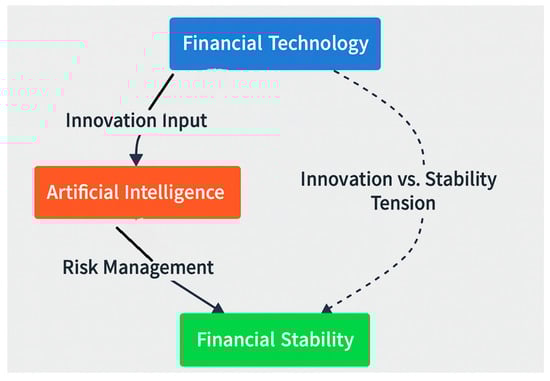
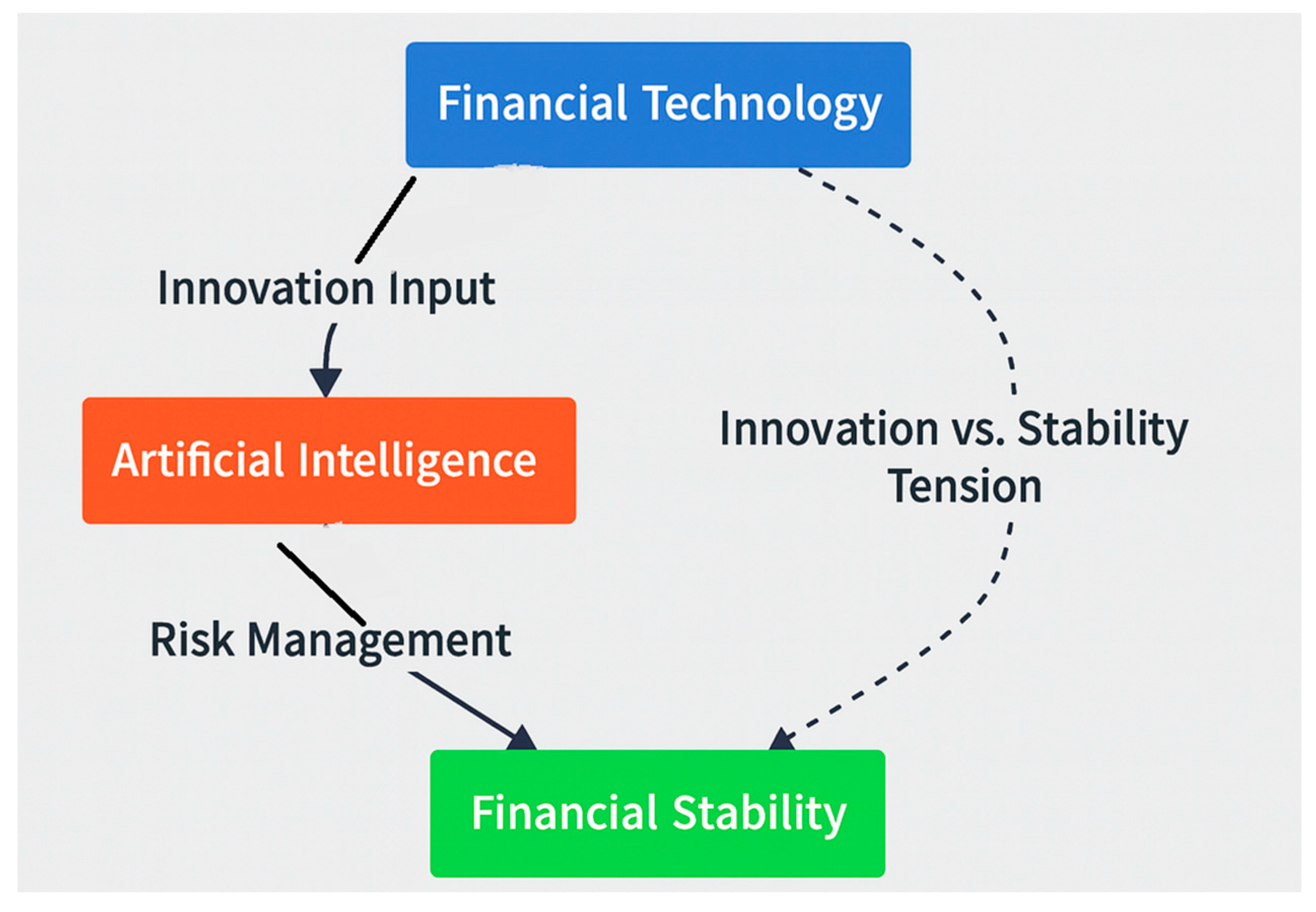
Fintech inclusion is becoming essential in discussions regarding facilitating financial actions among lower-level financial development (Ashoer et al., 2024). Banks and non-bank entities are collaborating to enhance financial inclusion using digital financial methods, targeting financially excluded and underprivileged communities (Anakpo et al., 2023). Similarly, these institutions are using established digital methods by directly applying artificial intelligence (AI) to enhance access for individuals previously served by traditional financial institutions (Mhlanga, 2020). The traditional banking system, created during the Industrial Revolution and dependent on paper and physical currency delivery, is transforming in the modern era (Rymarczyk, 2021). Fintech encompasses innovative business models with substantial potential to transform the financial services industry (Nichkasova & Shmarlouskaya, 2020). The Fintech business model offers a variety of financial products and services through automated processes utilizing substantial online resources (Amnas et al., 2024). Technologies driving industry, including AI and machine learning, can augment both emerging Fintech firms and established incumbents (Ali et al., 2024). Figure 1 shows the conceptual framework below:
Figure 1.
A conceptual framework between AI, Fintech, and financial stability.
Figure 1 presents the conceptual framework of this study. The original framework shows general interlinkages, while the revised framework adopts a one-sided mediation structure, where Fintech influences AI readiness, which ultimately affects financial stability. This structure aligns with the current empirical literature, which does not strongly support the bidirectionality in these contexts.
Hypothesis 1.
Fintech affects financial stability in OIC countries.
Various AI technologies are applicable to enhance financial inclusion, encompassing knowledge depiction, speech-to-text conversion, learning, expert systems, natural language processing, machine learning, robotics, and symbolic logic (Maple et al., 2023). The proliferation of AI technologies is thought to have surged in 2011 when corporations such as Google, Microsoft, IBM, and Facebook initiated substantial investments in AI and ML for business applications. The conventional banking sector comprises millions of clients with a historical legacy extending over centuries, some of whom may possess assets valued in the billions (Murinde et al., 2022). The difficulty is that these customers lack digital proficiency (Lucas et al., 2022). Conversely, AI is highly capable; however, gaining customer trust presents a similar challenge. Technological advancements have produced a new viewpoint on Fintech, making it a better option for banking activities. Banks have adopted AI tools, and shopping in numerous nations is being conducted online through various banking software for transaction execution. Moreover, the presence of numerous technology corporations, such as Google, Apple, Facebook, and Amazon in the United States, alongside Baidu, Alibaba, and Tencent in Asia, which boast millions of customers, generate billions in financial returns, possess decades of history, and maintain a distinctly digital vision, will serve as exemplars for banks to adopt digital technology and recognize the significance of artificial intelligence in finance.
Hypothesis 2.
AI impacts financial stability in OIC countries.
The World Bank stated that digital financial offerings, encompassing mobile smartphone usage, have been implemented in over 80 countries (Agur et al., 2020). Therefore, millions of previously marginalized and underserved impoverished persons are transitioning from primarily cash-based transactions to formal economic services, which include various offerings like bills, insurance, securities, and financial savings. Cellular telephones and diverse digital technologies, such as AI, are substantially applied, and the pace of financial inclusion is great (Anakpo et al., 2023). Financial inclusion facilitates the provision of financial services to customers at an affordable cost that is beneficial for them (Arner et al., 2020). Services offer extensive benefits to previously marginalized users; however, they also entail prominent risks stemming from the implementation of new technology (Chemtai, 2023).
Furthermore, there are risks linked with unforeseen and unstable costs affecting inexperienced and poor consumers, alongside risks associated with utilizing new data types that introduce concerns regarding personal data security (Alagood et al., 2023). Experts suggest that using AI, especially algorithms, can mitigate some dangers (Cheng et al., 2021). Driven by the prevalence of AI in Industry 4.0 and the growing emphasis on financial inclusion, the discourse is increasingly focusing on enabling financially marginalized groups to engage actively in the financial ecosystem. This study aims to investigate the influence of AI on digital finance.
Hypothesis 3.
Fintech and AI have a combined influence on financial stability in OIC countries.
AI plays a significant role in the development of Fintech, ensuring financial stability (Ma et al., 2025; Chikri & Kassou, 2024; Jakšič & Marinč, 2019). AI enhances efficiency, improves decision-making, and personalizes services in the finance industry. It provides algorithmic trading, fraud prevention, credit scoring, and customer services (Manikandan et al., 2024; Jashwanth, 2024; Zhao et al., 2023).
4. Methodology
Structural equation modeling (SEM) was used to define the causal linkages between AI, Fintech, and financial stability, along with the control variables. SEM has previously been used to identify complex causal paths (Ghouse et al., 2025; Chauhan et al., 2024; Rosa et al., 2011). SEM analysis was employed to test the mediating role of AI between Fintech and financial stability.
SEM is commonly used for the construction of latent variable models, but it has the ability to test mediation through direct and indirect paths. Our SEM model is based on panel regression, which allows it to capture both latent variable effects and mediation between variables. Using this model, we can determine the significant relationships that remains stable because it has all the abilities of different models, thereby supporting our SEM findings.
The data was taken from the WDI, and the AI readiness index data was extracted from the Oxford Insights AI Readiness Index.
The data used in this study was collected from the financial statements and annual reports of total 78 banks, including 40 conventional banks and 38 Islamic banks, across 25 selected OIC countries, including Afghanistan, Bahrain, Bangladesh, Brunei, Egypt, Gambia, Guyana, Indonesia, Jordan, Kazakhstan, Kuwait, Lebanon, Malaysia, Maldives, Nigeria, Oman, Pakistan, Palestine, Qatar, Saudi Arabia, Senegal, Turkey, UAE, Uganda, and Uzbekistan. The selection of banks and countries was based on the availability of relevant financial data, covering the time period from 2014 to 2023. For bank-specific metrics, like financial stability, total assets, management quality, non-performing loans (NPL), capital adequacy ratios (CAR), and liquidity ratios (LR), data was obtained from the annual reports and financial statements of banks in the selected OIC countries. Fintech data was collected from reports, journals, and publications issued by central banks. Macroeconomic data, including inflation, GDP growth, and unemployment rates, were sourced from the World Bank open database. This comprehensive dataset enabled a detailed analysis of the relationship between Fintech and banking stability in both conventional and Islamic banking systems.
To empirically assess the relationship between Fintech adoption and the financial stability of banks, we propose the following baseline econometric model:
where FS is financial stability, Fintech is the financial technology index, ROA is return on assets, SIZE is bank size, ROE is return on equity, MQ is management quality, NPL is non-performing loans, CAP is capitalization, CAR is the capital adequacy ratio, LR is the liquidity risk ratio, UN is the unemployment ratio, GDP is the GDP growth rate, INF is the inflation rate, and ε is the error term.
The Fintech index is calculated as the equally weighted average of the number of ATMs and credit cards issued by a bank, serving as a measure of the bank’s Fintech adoption. In this study, the Fintech variable was estimated by including indicators such as ATM machines and credit card issuance, which specifically represent digital delivery channels and customer access to innovation rather than the broader ecosystem of money transfers through mobile banking, new banks, or distributed ledger technologies. Also, we only focused on these two indicators because their data is available.
Financial stability (Z-score) acts as a proxy for banking stability by capturing insolvency risk and assessing a bank’s ability to use its capital and assets to cover return volatility, where a higher Z-score indicates greater stability. The Z-score is estimated as FS = (ROA + (EQUITY/ASSET))/σROA. The AI Readiness Index evaluates a country’s preparedness for AI adoption, based on three pillars: Government, Technology Sector, and Data & Infrastructure. These pillars encompass dimensions like Vision, Governance and Ethics, Digital Capacity, Adaptability, Maturity, Innovation Capacity, Human Capital, and Infrastructure.
5. Results
Table 1 and Table 2 below show the statistical results of conventional and Islamic banks from 25 OIC countries. The mean value represents the average values, while the standard deviation indicates the dispersion from the mean value. The minimum represents the minimum value in the series, and the maximum represents the maximum value in the series.
Table 1.
Descriptive statistics of conventional banks.
Table 2.
Descriptive statistics of Islamic banks.
Conventional banks show a higher average financial stability, around 56.7, compared to their Islamic counterparts, which have a value around 38.17. The most important banking system factor is financial stability. The variability in financial stability, as indicated by the standard error, is higher for conventional banks, while it is only 1.56 for Islamic banks. This provides very interesting insights. Conventional banks may have overall better financial stability; however, this involves greater variability across both types of banking systems. We used the SEM AI readiness index for both systems according to their countries because the countries were the same in both analyses. However, there were differences in the number of banks. The mean value and standard deviation of AI readiness are the same for Islamic and conventional banks. Fintech adoption is slightly higher in Islamic banks compared to conventional banks. There is a large standard deviation, which indicates differences between the institutions in adopting new financial technologies.
The profitability matrix, which is measured from the ROA and ROE, shows that the ROA is more likely to be the same across both banking systems. The figure shows very few or slightly fewer changes. The ROE, on the other hand, is higher in conventional banks compared to Islamic banks. The value for conventional banks is 0.173, while for Islamic banks, it is only 0.13. Differences in ROE, which measures profitability, suggest that conventional banks may be more efficient in terms of generating returns, particularly from stakeholders’ equity. Regarding the liquidity risk, it is substantially larger in conventional banks compared to Islamic banks. The figures show that for conventional banks, it is around USD 3.317 billion, while for Islamic banks, it is around USD 124 billion, which is less than half. Both systems show huge changes, with maximum values even reaching USD 4.18 trillion. In the macroeconomic context, we see that Islamic banks operate in environments with slightly lower averages. This means that Islamic banks may face moderately higher inflation compared to the conventional banking system.
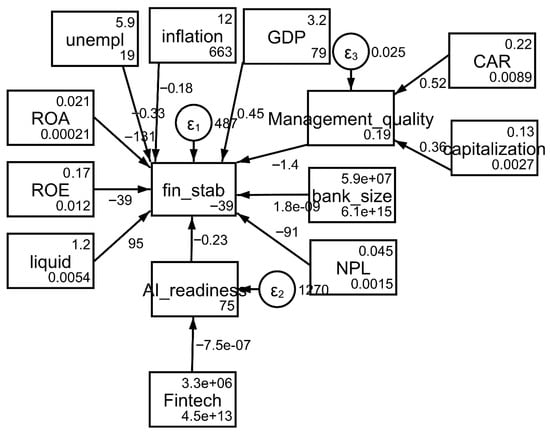
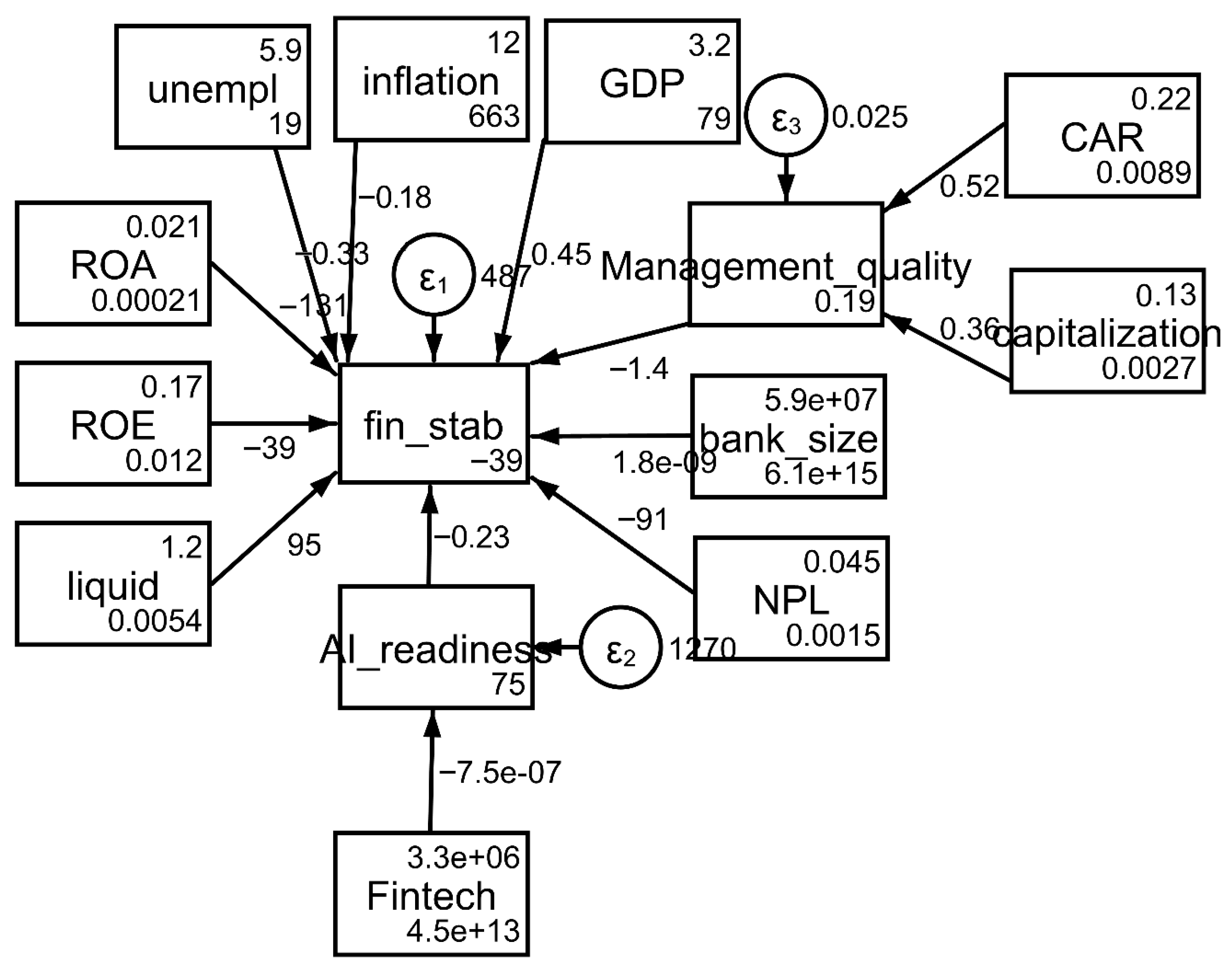
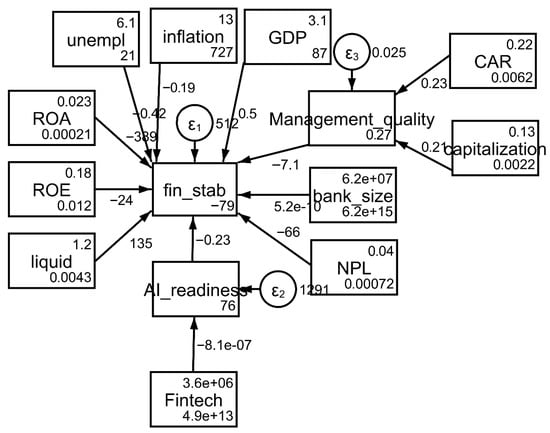
Figure 2, given below based on the results of Table 3, illustrates the structural equation model (SEM) for conventional banks. It shows the relationships between key variables: Fintech, management quality, AI, and financial stability. The diagram highlights the role of AI readiness as an intermediary between Fintech and financial stability. This suggests that as banks adopt more Fintech, their AI capabilities may affect how stable they remain. The figure emphasizes how Fintech’s influence is not direct but occurs through changes in AI readiness, showing a complex interplay between technology and bank stability.
Figure 2.
SEM results for conventional banks.
Table 3.
Results of SEM model for conventional banks.
Table 3 provides regression results for financial stability in conventional banks. AI readiness significantly reduces financial stability (−0.234, p < 0.01), implying that AI adoption might introduce short-term instability. Other key factors, like liquidity (95.16, p < 0.05) and inflation (−0.185, p < 0.05), also play a role. Fintech has a minor negative impact on stability (−7.51 × 10⁻⁷, p < 0.1). Interestingly, Fintech significantly affects AI readiness (p < 0.1), indicating that technology adoption shapes a bank’s readiness for AI. These results suggest that AI, while transformative, needs careful integration to maintain stability.
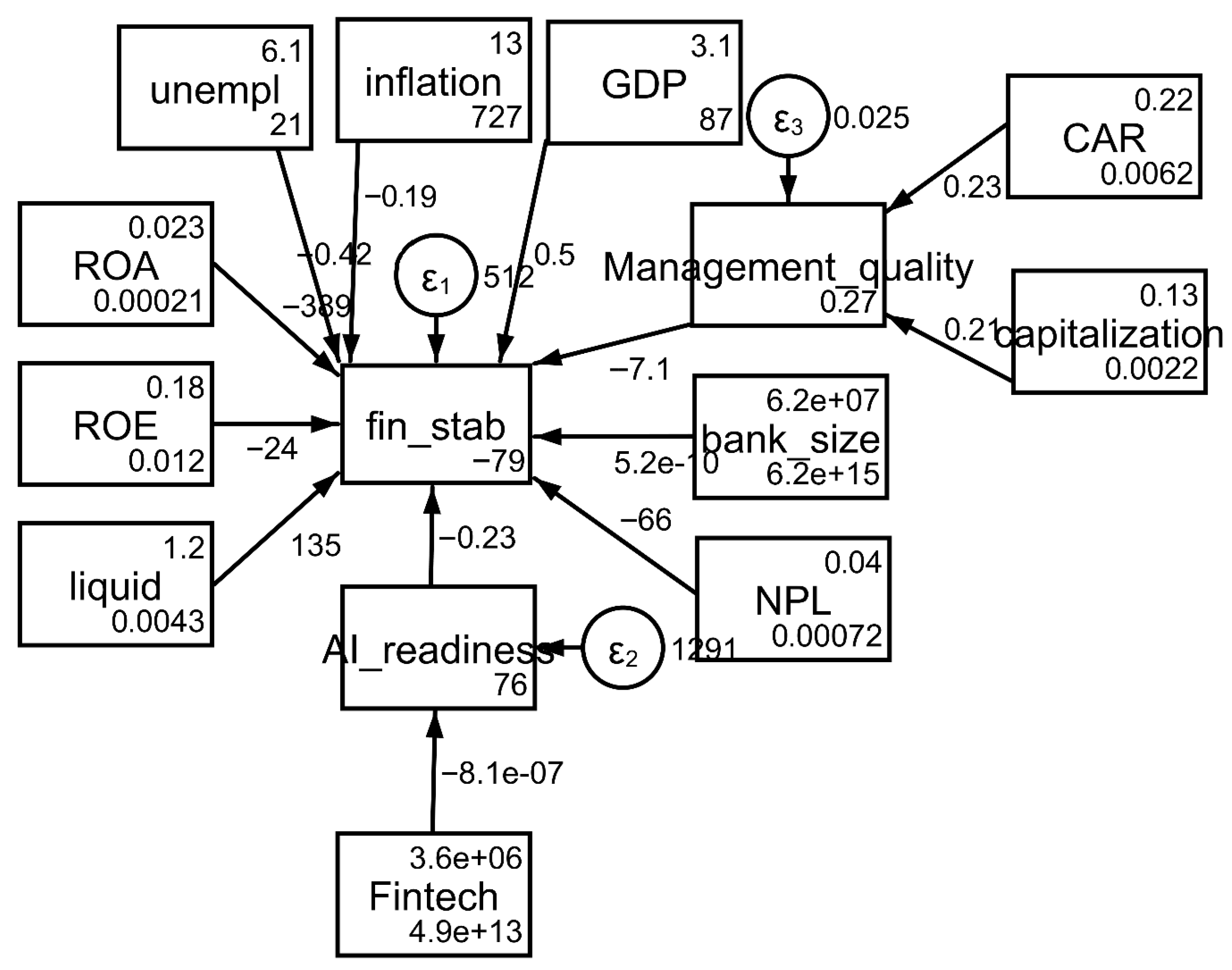
Figure 3 presents the SEM results for Islamic banks based on the results of Table 4, showing the relationships between Fintech, AI readiness, management quality, and financial stability. The model underscores the mediating role of AI readiness between Fintech adoption and financial stability, highlighting how technology shapes stability indirectly. Islamic banks, operating under distinct principles, show a different pathway of influence compared to conventional banks. This figure emphasizes the nuanced impact of AI readiness and technological integration on bank resilience in Islamic financial systems.
Figure 3.
SEM results for Islamic banks.
Table 4.
SEM results for Islamic banks.
Table 4 shows how various factors influence financial stability at Islamic banks. AI readiness has a significant negative impact on stability (−0.232, p < 0.01), suggesting that AI adoption introduces risks. Liquidity (134.6, p < 0.01) and GDP growth (0.504, p < 0.05) positively affect stability, while inflation exerts a negative influence (−0.189, p < 0.05). Fintech adoption also indirectly affects stability by lowering AI readiness (−8.13 × 10⁻⁷, p < 0.1). These results show that Islamic banks face similar challenges to conventional banks, particularly in managing AI integration and its consequences for financial health.
The post-estimation test results are given in Table 3 and Table 4. The McFadden R-square is basically a pseudo-R-square and pseudo-adjusted R-square. The values of adjusted and R-square are between 0.2 and 0.4. Value within this range are considered reasonable value, indicating that the model is a good fit. Therefore, the statistics showing that, according to the R-square value, the models are a good fit. The LM test (LM2 test) is used to detect heteroscedasticity in the model. The results show no significant value, indicating that there is no heteroscedasticity issue in the residuals of the models. The LR test assesses the specifications of the model. If the LR test results are significant, it means that the specifications of the models are good. The RMSEA model is the root mean square error of approximation test. If the value of this test is greater than 1 or close to 1, it means that the model is poorly fitted. But if the value is lower than 0.5, it means that it is a good-fit model. All the values of the RMSEA test were less than 0.05, which means that the models are a good fit. The CFI is the comparative fit index. If the values of the tests are greater than 0.95, it means that it is an excellent-fit model. The results indicate that the test values were greater than 0.95 for all the models, which means that the models are a good fit. The TLI test is the Tucker–Lewis Index, which measures the complexity of the model, indicating whether the model may be over-specified or under-specified because of the number of parameters. Higher values of TLI indicate that the model is a good fit. The test results indicate that most of the values were greater than 0.95, which means that the models do not have an issue of over-parameterization.
Table 5 compares how Islamic and conventional banks respond to AI readiness and other factors affecting financial stability. In both cases, AI readiness negatively impacts stability, though slightly more so in conventional banks. Liquidity significantly strengthens stability in Islamic banks (134.6, p < 0.01) compared to conventional ones (95.16, p < 0.05). Management quality, while not statistically significant in either model, shows a stronger negative coefficient in Islamic banks. This comparison highlights that while both banking systems face similar technological risks, their stability is influenced differently by liquidity and management factors.
Table 5.
Comparison of SEM results of Islamic and conventional banks.
6. Conclusions
This study highlights the significant mediating role that artificial intelligence (AI) plays between Fintech and financial stability in both conventional and Islamic banks across OIC countries. AI not only enhances the efficiency of Fintech but also introduces complexities that require careful integration. The results also indicate that both Islamic and conventional banking have significant effects in the long run. The results also indicate that other controlling financial variables and macroeconomic indicators are significant in the long run. In this case, there is a discrepancy between the overall results and the results over time. This is because Islamic banks do not easily adopt new AI-driven financial technology, which leads to more financial stability. This is mainly due to strict compliance rules and ethics that prevent them from adopting AI-driven financial technology. In contrast, conventional banks can use any type of technology without these restrictions, which is why there is a stronger relationship between AI fintech and financial stability. Additionally, Islamic banks are smaller in size, with fewer funds to invest in the adoption of new technology. In contrast, conventional banks are larger, with more funds, and they readily adopt AI-driven technologies for banking operations, such as credit scoring, customer servicing, algorithmic frameworks, and AI-driven decisions.
The findings suggest that while Fintech contributes to financial stability, its full potential is realized when coupled with AI, as it can mitigate or exacerbate risks depending on its application. Policymakers are encouraged to develop frameworks that leverage AI’s benefits while addressing its risks to ensure that both banking systems achieve sustainable financial stability over time.
The results of this study indicate that the conventional banking system has very strong sensitivity to financial technology based on AI, due to their environment based on a flexible regulatory framework and rapid digitalization. Meanwhile, Islamic banks, in contrast to conventional banks, are based on compliance-oriented governance, and they adopt artificial intelligence very cautiously, resulting in higher stability in conventional banks but slower technological integration in the Islamic banking system. These structural differences are explaining the divergent pathways observed in our structural equation modeling results.
There is a limitation in the case of data, but in the future, more data will be available. Then, this work can be extended by incorporating more indicators of financial technology (Fintech), which can be achieved using panel data analysis to include more countries in the dataset. This work was carried out using the available data from several countries, but in the future, we can extend the sample size to include more countries and more banks. Also, future research could increase the number of observations over the years, allowing for the co-integration of long-term results in the future.
Author Contributions
Conceptualization, G.G. and M.I.B.; methodology, G.G. and F.A.A.; formal analysis, M.I.B. and F.A.A.; writing—original draft preparation, G.G.; writing—review and editing, F.A.A. and M.I.B.; supervision, M.I.B. All authors have read and agreed to the published version of the manuscript.
Funding
This research received no external funding.
Institutional Review Board Statement
Not applicable.
Informed Consent Statement
Not applicable.
Data Availability Statement
The data presented in this study are available on request from the corresponding author due to (A major portion of the data was collected personally from the financial records of the banking system; therefore, it cannot be shared publicly).
Conflicts of Interest
The authors declare no conflicts of interest.
References
- Abakah, E. J. A., Tiwari, A. K., Ghosh, S., & Doğan, B. (2023). Dynamic effect of Bitcoin, Fintech and artificial intelligence stocks on eco-friendly assets, Islamic stocks and conventional financial markets: Another look using quantile-based approaches. Technological Forecasting and Social Change, 192, 122566. [Google Scholar] [CrossRef] [Scilit]
- Adeniyi, A. C., & Okusi, O. (2024). Ethical AI governance, financing, and human well-being in the 21st century. African Journal of Humanities and Contemporary Education Research, 17(1), 193–205. [Google Scholar] [CrossRef] [Scilit]
- Agrawal, S. (2021). Integrating digital wallets: Advancements in contactless payment technologies. International Journal of Intelligent Automation and Computing, 4(8), 1–14. [Google Scholar]
- Agur, I., Peria, S. M., & Rochon, C. (2020). Digital financial services and the pandemic: Opportunities and risks for emerging and developing economies (International Monetary Fund Special Series on COVID-19, Transactions). International Monetary Fund (IMF). [Google Scholar]
- Akhtar, M., Salman, A., Ghafoor, K. A., & Kamran, M. (2024). Artificial intelligence, financial services knowledge, government support, and user innovativeness: Exploring the moderated-mediated path to fintech adoption. Heliyon, 10(21), e39521. [Google Scholar] [CrossRef] [Scilit]
- Alagood, J., Prybutok, G., & Prybutok, V. R. (2023). Navigating privacy and data safety: The implications of increased online activity among older adults post-covid-19 induced isolation. Information, 14(6), 346. [Google Scholar] [CrossRef] [Scilit]
- Ali, G., Mijwil, M. M., Buruga, B. A., & Abotaleb, M. (2024). A Comprehensive review on cybersecurity issues and their mitigation measures in Fintech. Iraqi Journal for Computer Science and Mathematics, 5(3), 12. [Google Scholar] [CrossRef] [Scilit]
- Ally, A. M. (2025). Artificial intelligence (AI) and financial technology (FinTech) in Tanzania; legal and regulatory issues. International Journal of Law and Management. Ahead of print. [CrossRef] [Scilit]
- Amnas, M. B., Selvam, M., & Kathiravan, C. (2024). The potential of a fintech-driven model in enabling financial inclusion. In Data-driven modelling and predictive analytics in business and finance (pp. 172–185). Auerbach Publications. [Google Scholar]
- Anakpo, G., Xhate, Z., & Mishi, S. (2023). The policies, practices, and challenges of digital financial inclusion for sustainable development: The case of the developing economy. Fintech, 2(2), 327–343. [Google Scholar] [CrossRef] [Scilit]
- Arefin, S. (2023). Beginning of artificial intelligence: Does Fintech promote banks financial performance through e-transaction easiness? Annals of Artificial Intelligence and Data Sciences, 1(1), 1–11. [Google Scholar]
- Arner, D. W., Buckley, R. P., Zetzsche, D. A., & Veidt, R. (2020). Sustainability, Fintech and financial inclusion. European Business Organization Law Review, 21, 7–35. [Google Scholar] [CrossRef] [Scilit]
- Arsyad, I., Kharisma, D. B., & Wiwoho, J. (2025). Artificial intelligence and Islamic finance industry: Problems and oversight. International Journal of Law and Management. Ahead of print.
- Arugula, B. (2024). Ethical AI in financial services: Balancing innovation and compliance. International Journal of Artificial Intelligence, Data Science, and Machine Learning, 5(3), 46–54. [Google Scholar] [CrossRef] [Scilit]
- Ashoer, M., Jebarajakirthy, C., Lim, X. J., Mas’ud, M., & Sahabuddin, Z. A. (2024). Mobile Fintech, digital financial inclusion, and gender gap at the bottom of the pyramid: An extension of mobile technology acceptance model. Procedia Computer Science, 234, 1253–1260. [Google Scholar] [CrossRef] [Scilit]
- Awotunde, J. B., Adeniyi, E. A., Ogundokun, R. O., & Ayo, F. E. (2021). Application of big data with Fintech in financial services. In Fintech with artificial intelligence, big data, and blockchain (pp. 107–132). Springer. [Google Scholar]
- Banna, H., & Alam, M. R. (2021). Impact of digital financial inclusion on ASEAN banking stability: Implications for the post-COVID-19 era. Studies in Economics and Finance, 38(2), 504–523. [Google Scholar] [CrossRef] [Scilit]
- Beaverstock, J., Leaver, A., & Tischer, D. (2023). How financial products organize spatial networks: Analyzing collateralized debt obligations and collateralized loan obligations as “networked products”. Environment and Planning A: Economy and Space, 55(4), 969–996. [Google Scholar] [CrossRef] [Scilit]
- Belkhir, M., Naceur, S. B., Candelon, B., & Wijnandts, J. C. (2022). Macroprudential policies, economic growth and banking crises. Emerging Markets Review, 53, 100936. [Google Scholar] [CrossRef] [Scilit]
- Bouchetara, M., Zerouti, M., & Zouambi, A. R. (2024). Leveraging artificial intelligence (AI) in public sector financial risk management: Innovations, challenges, and future directions. EDPACS, 69(9), 124–144. [Google Scholar] [CrossRef] [Scilit]
- Cao, S. S., Jiang, W., & Lei, L. G. (2024). Applied AI for finance and accounting: Alternative data and opportunities. Pacific-Basin Finance Journal, 84, 102307. [Google Scholar] [CrossRef] [Scilit]
- Chand, S. A., Singh, B., Narayan, K., & Chand, A. (2025). The impact of financial technology (FinTech) on bank risk-taking and profitability in small developing island states: A study of Fiji. Journal of Risk and Financial Management, 18(7), 366. [Google Scholar] [CrossRef] [Scilit]
- Chauhan, R. S., Riis, C., Adhikari, S., Derrible, S., Zheleva, E., Choudhury, C. F., & Pereira, F. C. (2024). Determining causality in travel mode choice. Travel Behaviour and Society, 36, 100789. [Google Scholar] [CrossRef] [Scilit]
- Chemtai, F. (2023). Microfinance innovations, intrapreneurial process and financial inclusion of selected microfinance institutions’ customers in north rift region, Kenya [Doctoral dissertation, Kisii University]. [Google Scholar]
- Cheng, L., Varshney, K. R., & Liu, H. (2021). Socially responsible AI algorithms: Issues, purposes, and challenges. Journal of Artificial Intelligence Research, 71, 1137–1181. [Google Scholar] [CrossRef] [Scilit]
- Chikri, H., & Kassou, M. (2024). Financial revolution: Innovation powered by FinTech and artificial intelligence. Journal of Theoretical and Applied Information Technology, 102(9), 4145–4157. [Google Scholar]
- Choudhary, P., & Thenmozhi, M. (2024). Fintech and financial sector: ADO analysis and future research agenda. International Review of Financial Analysis, 93, 103201. [Google Scholar] [CrossRef] [Scilit]
- Dewasiri, N. J., Dharmarathna, D. G., & Choudhary, M. (2024). Leveraging artificial intelligence for enhanced risk management in banking: A systematic literature review. In Artificial intelligence enabled management: An emerging economy perspective (pp. 197–213). De Gruyter. [Google Scholar]
- Duran, R. E., & Griffin, P. (2021). Smart contracts: Will Fintech be the catalyst for the next global financial crisis? Journal of Financial Regulation and Compliance, 29(1), 104–122. [Google Scholar] [CrossRef] [Scilit]
- Durongkadej, I., Hu, W., & Wang, H. E. (2024). How artificial intelligence incidents affect banks and financial services firms? A study of five firms. Finance Research Letters, 70, 106279. [Google Scholar] [CrossRef] [Scilit]
- Ediagbonya, V., & Tioluwani, C. (2023). The role of Fintech in driving financial inclusion in developing and emerging markets: Issues, challenges and prospects. Technological Sustainability, 2(1), 100–119. [Google Scholar] [CrossRef] [Scilit]
- Ezzahid, E., & Elouaourti, Z. (2021). Financial inclusion, mobile banking, informal finance and financial exclusion: Micro-level evidence from Morocco. International Journal of Social Economics, 48(7), 1060–1086. [Google Scholar] [CrossRef] [Scilit]
- Fundira, M., & Mbohwa, C. (2025). AI ethics in banking services: A systematic and bibliometric review of regulatory and consumer perspectives. Discover Artificial Intelligence, 5(1), 319. [Google Scholar] [CrossRef] [Scilit]
- Ghouse, G., Bhatti, M. I., & Nasrullah, M. J. (2025). The impact of financial inclusion, Fintech, HDI, and green finance on environmental sustainability in E-7 countries. Finance Research Letters, 72, 106617. [Google Scholar] [CrossRef] [Scilit]
- Guo, H., & Polak, P. (2021). Artificial intelligence and financial technology Fintech: How AI is being used under the pandemic in 2020. In The fourth industrial revolution: Implementation of artificial intelligence for growing business success (pp. 169–186). Springer. [Google Scholar]
- Hendarti, Y., Winarno, B., & Aprilianto, M. P. (2024). Use of blockchain technology and AI in sharia financial risk management. Jurnal Ekuisci, 1(3), 155–163. [Google Scholar] [CrossRef] [Scilit]
- Hossain, M. S., & Sultana, M. (2024). Digitalization of corporate finance and firm performance: Global evidence and analysis. Journal of Financial Economic Policy, 16(4), 501–539. [Google Scholar] [CrossRef] [Scilit]
- Ishak, M. N., & Mohamed, A. (2023). Harmonization of Islamic economics with artificial intelligence: Towards an ethical and innovative economic paradigm. Al-Kharaj: Journal of Islamic Economic and Business, 5(4). [Google Scholar] [CrossRef] [Scilit]
- Jakšič, M., & Marinč, M. (2019). Relationship banking and information technology: The role of artificial intelligence and FinTech. Risk Management, 21(1), 1–18. [Google Scholar] [CrossRef] [Scilit]
- Jashwanth, G. M. (2024). Study on usage of artificial intelligence in FinTech industry. International Journal for Science Technology and Engineering, 12(8), 520–549. [Google Scholar] [CrossRef] [Scilit]
- Jefferson, P. T. (2021). Banks vs. shadow banks: Evidence from the 2015 FHA mortgage insurance premium cut [Doctoral dissertation, Olin Business School]. [Google Scholar]
- Kabulova, J. (2023). Impact of Fintech innovation on the financial sector’s stability. Available online: https://etalpykla.vilniustech.lt/handle/123456789/111133 (accessed on 22 December 2025).
- Katsiampa, P., McGuinness, P. B., Serbera, J. P., & Zhao, K. (2022). The financial and prudential performance of Chinese banks and Fintech lenders in the era of digitalization. Review of Quantitative Finance and Accounting, 58(4), 1451–1503. [Google Scholar] [CrossRef] [Scilit]
- Khalil, M. A., Hadid, M., Padmanabhan, R., Elomri, A., & Kerbache, L. (2025). An integrated artificial intelligence and optimization model for operational efficiency and risk reduction in letter of credit examination process. Decision Analytics Journal, 14, 100552. [Google Scholar] [CrossRef] [Scilit]
- Lucas, M., Bem-haja, P., Santos, S., Figueiredo, H., Ferreira Dias, M., & Amorim, M. (2022). Digital proficiency: Sorting real gaps from myths among higher education students. British Journal of Educational Technology, 53(6), 1885–1914. [Google Scholar] [CrossRef] [Scilit]
- Ma, C. Q., Liu, X., Klein, T., & Ren, Y. S. (2025). Decoding the nexus: How Fintech and AI stocks drive the future of sustainable finance. International Review of Economics & Finance, 98, 103877. [Google Scholar] [CrossRef] [Scilit]
- Mabe, Q. M., & Simo-Kengne, B. D. (2025). The impact of Fintech risk on bank performance in Africa: The PVAR approach. Journal of Risk and Financial Management, 18(8), 456. [Google Scholar] [CrossRef] [Scilit]
- Manikandan, M., Venkatesh, P., Chitra, D., Krishnamoorthi, M., Ramu, M., & Senthilnathan, C. R. (2024, October 8–9). An impact of artificial intelligence in Fintech. 2024 International Conference on Power, Energy, Control and Transmission Systems (ICPECTS) (pp. 1–3), Chennai, India. [Google Scholar] [CrossRef] [Scilit]
- Maple, C., Szpruch, L., Epiphaniou, G., Staykova, K., Singh, S., Penwarden, W., Wen, Y., Wang, Z., Hariharan, J., & Avramovic, P. (2023). The AI revolution: Opportunities and challenges for the finance sector. arXiv, arXiv:2308.16538. [Google Scholar] [CrossRef] [Scilit]
- Mhlanga, D. (2020). Industry 4.0 in finance: The impact of artificial intelligence (AI) on digital financial inclusion. International Journal of Financial Studies, 8(3), 45. [Google Scholar] [CrossRef] [Scilit]
- Mhlanga, D. (2022). Digital financial inclusion, and the way forward for emerging markets: Towards sustainable development. In Digital financial inclusion: Revisiting poverty theories in the context of the fourth industrial revolution (pp. 323–341). Springer International Publishing. [Google Scholar]
- Mohamad, S. N. A., Dali, N. R. S. M., & Basah, M. Y. A. (2024). Navigating the moral compass of Halal FinTech in Islamic finance: Harvesting benefits while curbing risks. In Emerging technology and crisis management in the Halal industry: Issues and recent developments (pp. 157–171). Springer Nature. [Google Scholar]
- Moharrak, M., & Mogaji, E. (2025). Generative AI in banking: Empirical insights on integration, challenges and opportunities in a regulated industry. International Journal of Bank Marketing, 43(4), 871–896. [Google Scholar] [CrossRef] [Scilit]
- Murinde, V., Rizopoulos, E., & Zachariadis, M. (2022). The impact of the Fintech revolution on the future of banking: Opportunities and risks. International Review of Financial Analysis, 81, 102103. [Google Scholar] [CrossRef] [Scilit]
- Nguyen, L., Tran, S., & Ho, T. (2022). Fintech credit, bank regulations and bank performance: A cross-country analysis. Asia-Pacific Journal of Business Administration, 14(4), 445–466. [Google Scholar] [CrossRef] [Scilit]
- Nichkasova, Y., & Shmarlouskaya, H. (2020). Financial technologies as a driving force for business model transformation in the banking sector. International Journal of Business and Globalisation, 25(4), 419–447. [Google Scholar] [CrossRef] [Scilit]
- Osabutey, E. L., & Jackson, T. (2024). Mobile money and financial inclusion in Africa: Emerging themes, challenges and policy implications. Technological Forecasting and Social Change, 202, 123339. [Google Scholar] [CrossRef] [Scilit]
- Oyasiji, O., Okesiji, A., Imediegwu, C. C., Elebe, O., & Filani, O. M. (2023). Ethical AI in financial decision-making: Transparency, bias, and regulation. International Journal of Scientific Research in Computer Science, Engineering and Information Technology, 9(5), 453–471. [Google Scholar]
- Ozturk, I., & Ullah, S. (2022). Does digital financial inclusion matter for economic growth and environmental sustainability in OBRI economies? An empirical analysis. Resources, Conservation and Recycling, 185, 106489. [Google Scholar] [CrossRef] [Scilit]
- Parvin, S. R., & Panakaje, N. (2022). A study on the prospects and challenges of digital financial Inclusion. International Journal of Case Studies in Business, IT and Education (IJCSBE), 6(2), 469–480. [Google Scholar] [CrossRef] [Scilit]
- Passanisi, F. (2024). Fintech as a transformative model for financial inclusion: A systematic review [Master’s dissertation, University of Malta]. [Google Scholar]
- Pattnaik, D., Ray, S., & Raman, R. (2024). Applications of artificial intelligence and machine learning in the financial services industry: A bibliometric review. Heliyon, 10(1), e23492. [Google Scholar] [CrossRef] [Scilit]
- Rahman, T., Joe, N. M., & Jalil, M. A. (2024). Governance apathy and systemic barriers in enforcing shariah compliance: A critical study of islamic banking practices in Bangladesh. International Journal of Social and Business Studies, 2(2), 52–71. [Google Scholar]
- Rambe, P., & Khaola, P. (2022). The impact of innovation on agribusiness competitiveness: The mediating role of technology transfer and productivity. European Journal of Innovation Management, 25(3), 741–773. [Google Scholar] [CrossRef] [Scilit]
- Ristanović, V., Primorac, D., & Mulović Trgovac, A. (2025). Banking in the age of blockchain and FinTech: A hybrid efficiency framework for emerging economies. Journal of Risk and Financial Management, 18(8), 458. [Google Scholar] [CrossRef] [Scilit]
- Rosa, G. J., Valente, B. D., de los Campos, G., Wu, X. L., Gianola, D., & Silva, M. A. (2011). Inferring causal phenotype networks using structural equation models. Genetics Selection Evolution, 43, 6. [Google Scholar] [CrossRef] [Scilit] [PubMed]
- Rosenstein, P. A. (2022). The future of finance: The potential for the United States to harness the promise of financial technology (Fintech) and pave the way for a new age of financial innovation and inclusion [Doctoral dissertation, Johns Hopkins University]. [Google Scholar]
- Rymarczyk, J. (2021). The impact of industrial revolution 4.0 on international trade. Entrepreneurial Business and Economics Review, 9(1), 105–117. [Google Scholar] [CrossRef] [Scilit]
- Sant’Anna, D. A., & Figueiredo, P. N. (2024). Fintech innovation: Is it beneficial or detrimental to financial inclusion and financial stability? A systematic literature review and research directions. Emerging Markets Review, 60, 101140. [Google Scholar] [CrossRef] [Scilit]
- Shaikh, A. A., Glavee-Geo, R., Karjaluoto, H., & Hinson, R. E. (2023). Mobile money as a driver of digital financial inclusion. Technological Forecasting and Social Change, 186, 122158. [Google Scholar] [CrossRef] [Scilit]
- Sikalao-Lekobane, O. L. (2022). The impact of Fintech credit on financial stability: An empirical study [Doctoral dissertation, Bournemouth University]. [Google Scholar]
- Sikalao-Lekobane, O. L. (2024). Does FinTech credit enhance or disrupt financial stability? International Review of Economics & Finance, 96, 103489. [Google Scholar] [CrossRef] [Scilit]
- Spring, M., Faulconbridge, J., & Sarwar, A. (2022). How information technology automates and augments processes: Insights from Artificial-Intelligence-based systems in professional service operations. Journal of Operations Management, 68(6–7), 592–618. [Google Scholar] [CrossRef] [Scilit]
- Sun, J., Zhang, C., Zhang, R., Ji, Y., & Ding, J. (2025). Spillover dynamics and determinants between Fintech institutions and commercial banks based on the complex network and random forest fusion. Pacific-Basin Finance Journal, 91, 102713. [Google Scholar] [CrossRef] [Scilit]
- Svetlova, E. (2022). AI ethics and systemic risks in finance. AI and Ethics, 2(4), 713–725. [Google Scholar] [CrossRef] [Scilit]
- Upadhyaya, H. (2024). Digital education and economic transformation: Bridging the gap. Meadow Publication. [Google Scholar]
- Xuan, S., Hu, J., Yin, J., Li, Y., & Peng, J. (2025). The role of FinTech in shaping urban innovation: A study of financial markets from the perspective of the patent renewal model. Pacific-Basin Finance Journal, 91, 102750. [Google Scholar] [CrossRef] [Scilit]
- Yaqoobi, A. A. (2022). The governance of public–private partnerships: Complexity, uncertainty and incompleteness [Doctoral dissertation, University of Leicester]. [Google Scholar]
- Yoshida, E. (2019). Fintech-enabled islamic financial system and financial stability. In Islamic monetary economics and institutions: Theory and practice (pp. 181–192). Springer. [Google Scholar]
- Zaman, A., Tlemsani, I., Matthews, R., & Mohamed Hashim, M. A. (2025). Assessing the potential of blockchain technology for Islamic crypto assets. Competitiveness Review: An International Business Journal, 35(2), 229–250. [Google Scholar] [CrossRef] [Scilit]
- Zhao, D., Jia, Y., & Djurišić, A. B. (2023). FinTech is impacting the financial industry (pp. 29–51). Springer Nature. [Google Scholar] [CrossRef] [Scilit]

Disclaimer/Publisher’s Note: The statements, opinions and data contained in all publications are solely those of the individual author(s) and contributor(s) and not of MDPI and/or the editor(s). MDPI and/or the editor(s) disclaim responsibility for any injury to people or property resulting from any ideas, methods, instructions or products referred to in the content. |
© 2026 by the authors. Licensee MDPI, Basel, Switzerland. This article is an open access article distributed under the terms and conditions of the Creative Commons Attribution (CC BY) license.