


Multiplicative Methodology for Assessing Investment Attractiveness and Risk for Industries



Abstract
1. Introduction
2. Materials and Methods
- (1)
- assessment of individual indicators of enterprises (WACC and EVA) when measuring the investment attractiveness of enterprises in the industrial complex;
- (2)
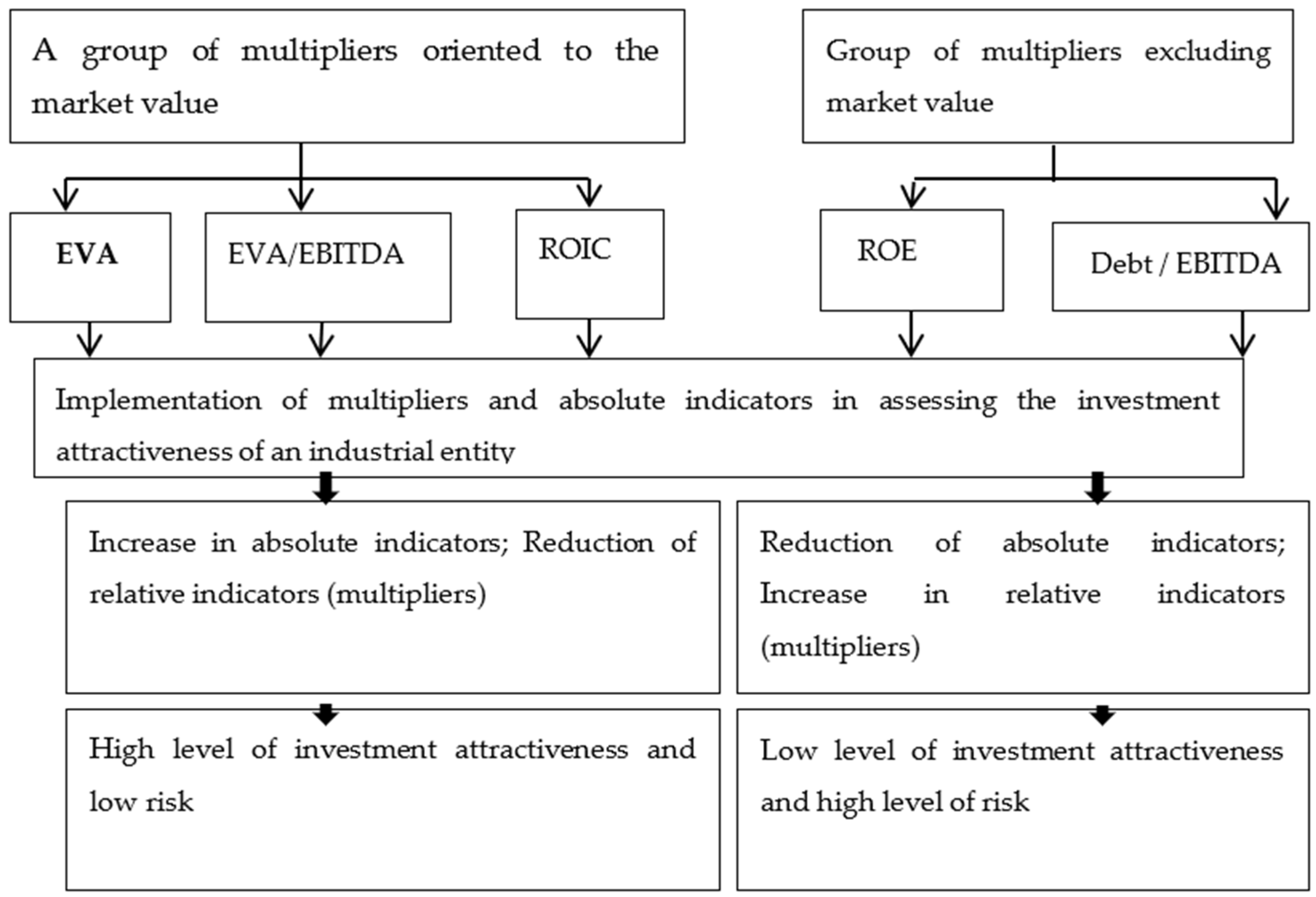
- measurement of multipliers oriented to market value and excluding market value (EVA/EBITDA, ROIC, ROE, etc.) to determine the level of investment attractiveness and risk level of industrial complex enterprises;
- (3)
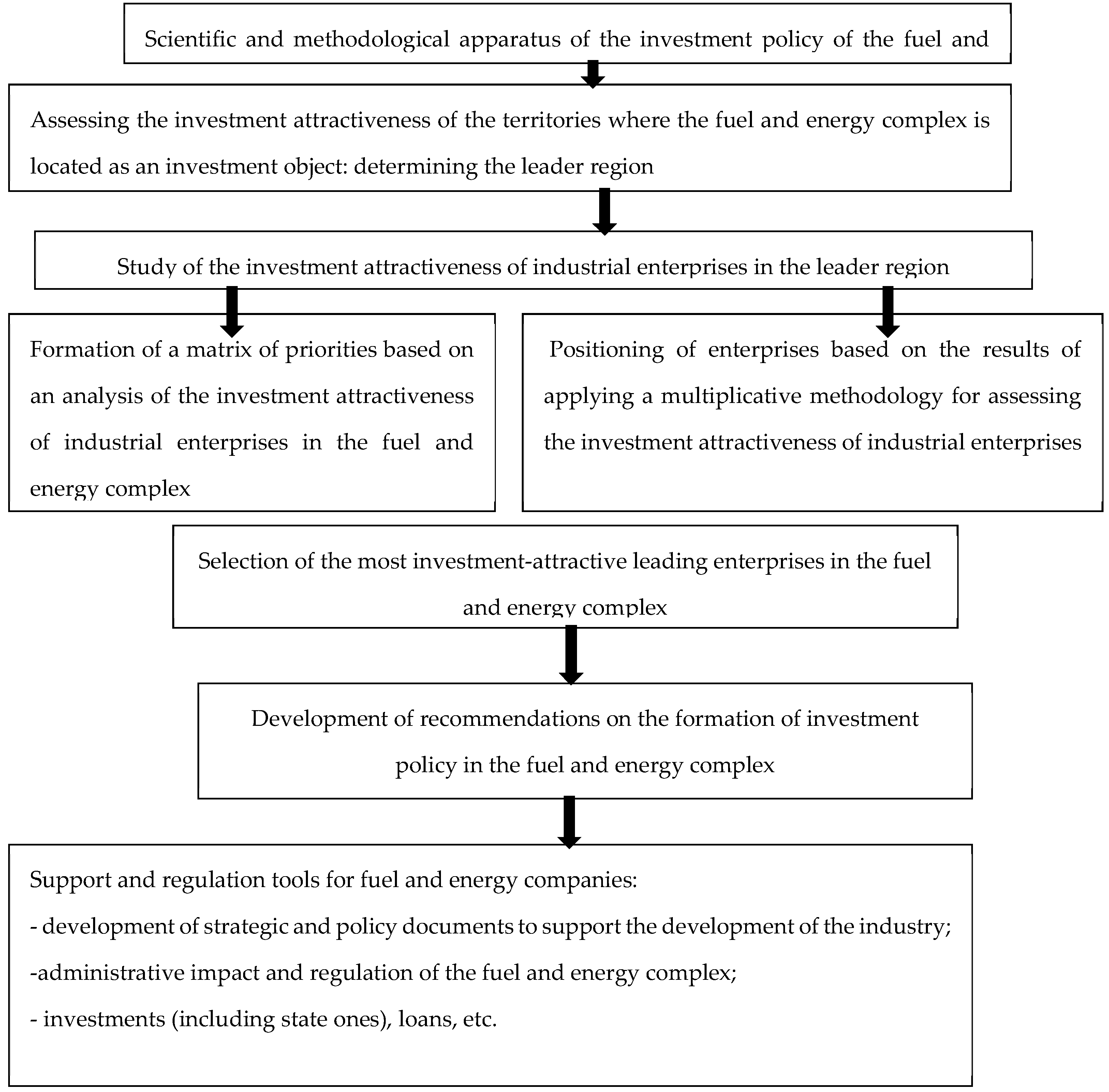
- rating methods and methods of comparative analysis in determining the zone of investment-attractive enterprises.
3. Results
4. Discussion
5. Conclusions
Author Contributions
Funding
Conflicts of Interest
References
- Al-Abdulla, Hadi Al. 1989. Qatar’s Investment Alternatives: An Evaluation and Comparison of the Returns and Risks on External Portfolio Investment, Internal Investment in Manufacturing Industries, and Investment in Keeping Oil Underground, for the State of Qatar. Ph.D. dissertation, Bradford University, Bradford, UK. [Google Scholar]
- Blank, David. 2019. Investment attractiveness of the US high-tech industry. Economy and Business: Theory and Practice 6: 47–52. [Google Scholar] [CrossRef]
- Chebotareva, Galina. 2018. Individualization of risks diagnostics in assessment of investment potential of sectoral companies in developing countries. International Journal of Sustainable Development and Planning 13: 851–59. [Google Scholar] [CrossRef]
- Dang, Alicia H., and Roberto Samaniego. 2022. R&D, Industrial Policy and Growth. Journal of Risk and Financial Management 15: 344. [Google Scholar] [CrossRef]
- Demirhan, Erdal, and Mahmut Masca. 2008. Determinants of foreign direct investment flows to developing countries: A cross-sectional analysis. Prague Economic Papers 4: 356–69. [Google Scholar] [CrossRef]
- Groh, Alexander Peter. 2007. How Attractive Is Central Eastern Europe for Risk Capital Investors? Minato: IESE Business School. [Google Scholar]
- Ilchenko, Svitlana, and Ganna Glushko. 2017. Investment attractiveness of the port industry in crisis conditions. Investment Management and Financial Innovations 14: 251–60. [Google Scholar] [CrossRef][Green Version]
- Ilyash, Olha, Osman Yildirim, Liubov Smoliar, Dariia Doroshkevych, Taras Vasylciv, and Ruslan Lupak. 2020. Evaluation of enterprise investment attractiveness under circumstances of economic development. Bulletin of Geography. Socio-Economic Series 47: 95–113. [Google Scholar] [CrossRef]
- Pershin, Andrey. 2020. Currency Volatility as One of the Aspects Affecting the Investment Attractiveness of the Country. Components of Scientific and Technological Progress 8: 14–20. [Google Scholar]
- Petryk, Olena, Andriy Samiilenko, Iryna Hnatenko, Andrii Samiilenko, Viktoriia Rubezhanska, and Oleksiy Patsarniuk. 2020. Conceptual model for assessing the investment attractiveness of innovative projects of industrial enterprises. Accounting 6: 1345–50. [Google Scholar] [CrossRef]
- Raszkowski, Andrzej. 2013. Selected aspects of investment attractiveness of regions. ACC Journal 2: 116–26. [Google Scholar]
- Reshetnikova, Irina, Olga Yanina, Larisa Semenova, Lesya Bozhko, and Oleg Veselitsky. 2019. Problem of assessing the investment attractiveness of risk projects for developing artificial intelligence. International Journal of Recent Technology and Engineering 8: 238–43. [Google Scholar] [CrossRef]
- Vertakova, Yulia, Klevtsova Maria, and Klevtsov Sergey. 2015. Technology of fixed assets assessment in investigating the stability of the industrial complex of the region. In Innovation Management and Sustainable Economic Competitive Advantage: From Regional Development to Global Growth, Paper Presented at IBIMA 2015: The 26th International Business Information Management Association Conference, Madrid, Spain, 11–12 November 2015. Madrid: International Business Information Management Association, pp. 3230–36. [Google Scholar]
- Vertakova, Yulia, and Vladimir Plotnikov. 2016. Innovative and industrial development: Specifics of interrelation. Екoнoмiчний часoпис-XXI 156: 37–40. [Google Scholar] [CrossRef]
- Zhao, Hang, and Reuven Levary. 2002. Evaluation of country attractiveness for foreign direct investment in the e-retail industry. Multinational Business Review 10: 1. [Google Scholar]

| Enterprises of the Fuel and Energy Complex of the Ural Federal District | WACC | EVA | ||||
|---|---|---|---|---|---|---|
| 2020 | 2019 | 2018 | 2020 | 2019 | 2018 | |
| “Varioganneft” PJSC | 9.31 | 9.93 | 11.49 | −488,328.8 | 534,547 | 978,781.6 |
| “OIL COMPANY “KONDANEFT”” JSC | 10.56 | 9.23 | 12.12 | 710,065.12 | 4,699,694 | 4,164,068 |
| “Gazpromneft-Khantos” LLC | 9.40 | 8.89 | 11.31 | −1,532,165 | 11,924,687 | 26,185,083 |
| “SURGUTNEFTEGAZ” PJSC | 8.89 | 8.72 | 11.13 | −3.89 × 10⁸ | −3.1 × 10⁸ | −3.8 × 10⁸ |
| Gazprom Pererabotka LLC (branch of Khanty-Mansi Autonomous Okrug, (SURGUT ZSK)) | 8.79 | 8.12 | 10.58 | −51,805,477 | −4.7 × 10⁷ | −6.2 × 10⁷ |
| “SIBUR Holding” PJSC | 9.48 | 8.12 | 10.98 | −29,499,848 | 60,827,498 | 48,599,446 |
| “Rn-Nyaganneftegaz” JSC | 9.29 | 10.7 | 11.29 | 334,294.32 | 17,858,609 | 5,617,511 |
| “NIZHNEVARTOVSKOE NEFTEPERERABATYVAYUSHCHEE OB”EDINENIE” LLC | 8.95 | 8.77 | 11.20 | 695,173.18 | 1,744,678 | 178,838.7 |
| “NIZHNEVARTOVSKOE NEFTEGAZODOBYVAYUSHCHEE PREDPRIYATIE” JSC | 9.52 | 9.13 | 11.69 | 1,926,875.6 | 5,130,220 | 3,587,565 |
| “SAMOTLORNEFTEGAZ” JSC | 9.10 | 8.81 | 11.29 | −19,201,793 | 21,960,410 | 22,495,952 |
| “UNIPRO” PJSC | 6.87 | 7.46 | 9.87 | 5,384,278.8 | 8,367,583 | 5,405,213 |
| “YUGORSKAYA TERRITORIAL’NAYA ENERGETICHESKAYA KOMPANIYA-REGIONAL’NYE SETI” JSC | 7.02 | 7.31 | 9.99 | 716,113.01 | 853,308 | 338,095 |
| “Nizhnevartovskaya GRES” JSC | 6.86 | 7.37 | 9.90 | 1,531,387.6 | 1,317,685 | 338,843.4 |
| Enterprises of the Fuel and Energy Complex of the Ural Federal District | The Zone of Investment Attractive Undervalued Enterprises | ||
|---|---|---|---|
| 2020 | 2019 | 2018 | |
| “Varioganneft” PJSC | |||
| “OIL COMPANY “KONDANEFT”” JSC | |||
| “Gazpromneft-Khantos” LLC | |||
| “SURGUTNEFTEGAZ” PJSC | |||
| Gazprom Pererabotka LLC (branch of Khanty-Mansi Autonomous Okrug, (SURGUT ZSK)) | |||
| “SIBUR Holding” PJSC | |||
| “Rn-Nyaganneftegaz” JSC | |||
| “NIZHNEVARTOVSKOE NEFTEPERERABATYVAYUSHCHEE OB’EDINENIE” LLC | |||
| “NIZHNEVARTOVSKOE NEFTEGAZODOBYVAYUSHCHEE PREDPRIYATIE” JSC | |||
| “SAMOTLORNEFTEGAZ” JSC | |||
| “UNIPRO” PJSC | |||
| “CHERNOGORENERGO” JSC | |||
| “YUGORSKAYA TERRITORIAL’NAYA ENERGETICHESKAYA KOMPANIYA-REGIONAL’NYE SETI” JSC | |||
| “Nizhnevartovskaya GRES” JSC | |||
| Enterprise | Indicators and Multipliers of Investment Attractiveness | ||||
|---|---|---|---|---|---|
| Including Market Value | Excluding Market Value | ||||
| EVA | EVA/EBITDA | ROIC | ROE | Debt/EBITDA | |
| >0—Investment Attractive | <3—Undervalued 3–5—Standard >5—Overvalued | ROIC > WACC | the ↑, the Better (Rating) | <2—Comfortable Level of Debt 2–4—Acceptable level >4—High Level | |
| “Varioganneft” PJSC | <0 | <0 | ROIC < WACC | 5 | 2–4 |
| “Oil Company “Kondaneft”” JSC | >0 | <3 | ROIC > WACC | 1 | >4 |
| “Gazpromneft-Khantos” LLC | <0 | <0 | ROIC < WACC | 4 | 2–4 |
| “SURGUTNEFTEGAZ” PJSC | <0 | 0 | ROIC < WACC | 3 | 2–4 |
| “NIZHNEVARTOVSKOE NEFTEGAZODOBYVAYUSHCHEE PREDPRIYATIE” JSC | >0 | <3 | ROIC > WACC | 3 | 2–4 |
| “SAMOTLORNEFTEGAZ” JSC | <0 | <0 | ROIC < WACC | 5 | 2–4 |
| Enterprise | EVA/EBITDA | Debt/EBITDA | WACC |
|---|---|---|---|
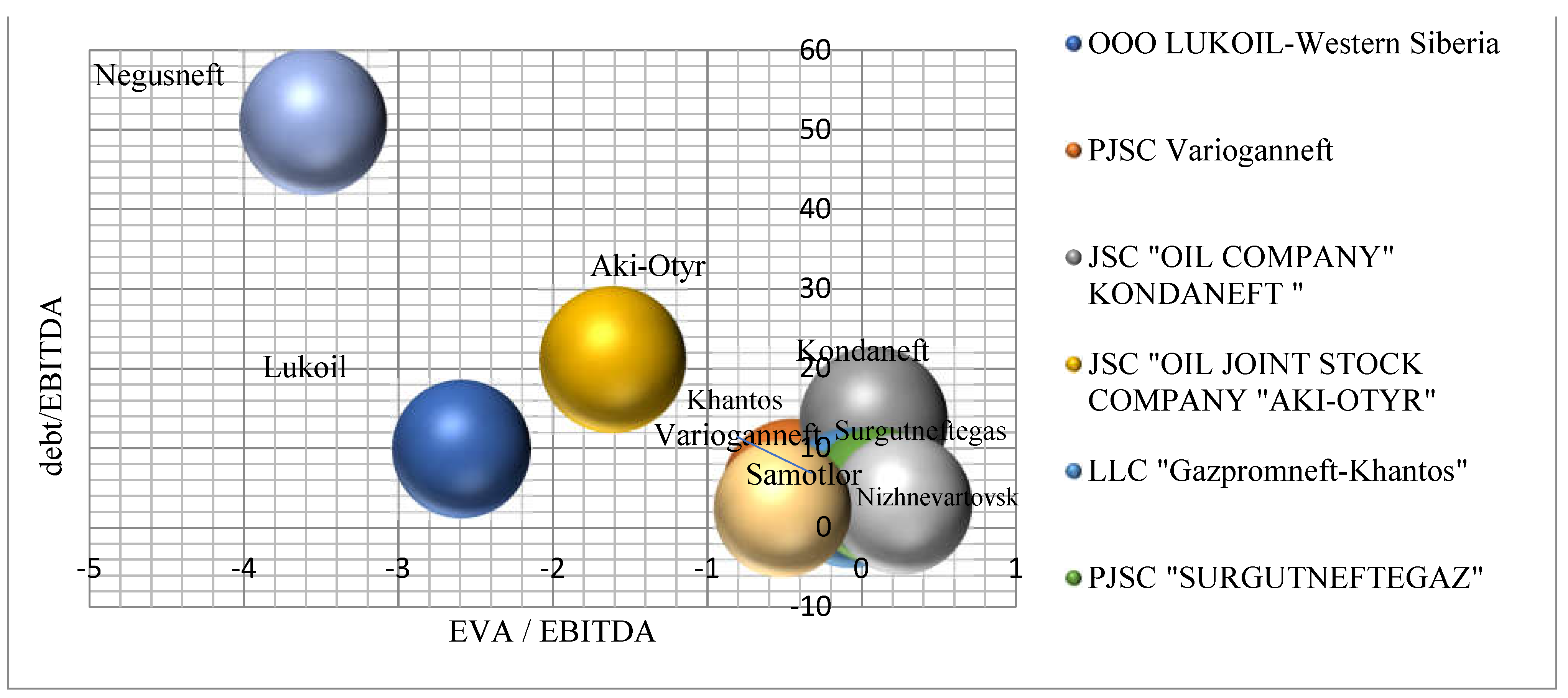
| “LUKOJL-Zapadnaya Sibir” LLC | −2.59 | 9.87 | 9.25 |
| “Varioganneft” PJSC | −0.45 | 4.89 | 9.31 |
| “OIL COMPANY “KONDANEFT”” JSC | 0.08 | 13.36 | 10.56 |
| “OIL JOINT STOCK COMPANY “AKI-OTYR” JSC | −1.61 | 21.10 | 10.36 |
| “Gazpromneft-Khantos” LLC | −0.07 | 3.71 | 9.40 |
| “SURGUTNEFTEGAZ” PJSC | 0.1 | 4.02 | 8.89 |
| “NEGUSNEFT JSC” | −3.55 | 50.99 | 9.97 |
| «Slavneft-Nizhnevartovsk» LLC | 35.35 | −547.28 | 10.49 |
| “Nizhnevartovskoe Neftegazodobyvayushchee Predpriyatie” JSC | 0.26 | 2.96 | 9.52 |
| “SAMOTLORNEFTEGAZ” JSC | −0.51 | 2.39 | 9.10 |
| Sub-Sectors of Fuel and Energy Complex | Investment Attractiveness Matrix | Multiplicative Methodology | Positioning | |
|---|---|---|---|---|
| Level 1 Priority | Level 2 Priority | |||
| Extractive industry | “Samotlorneftegaz” JSC | “Varioganneft” PJSC, “Gazpromneft-Khantos” LLC “Oil Company “Kondaneft” JSC, “Rn-Nyaganneftegaz” JSC, “Surgutneftegas” PJSC | “Nizhnevartovskoe Neftegazodobyvayushchee Predpriyatie” JSC “Oil Company “Kondaneft” JSC | “Samotlorneftegaz” JSC “Nizhnevartovskoe Neftegazodobyvayushchee Predpriyatie” JSC “Oil Company “Kondaneft” JSC |
| Manufacturing industry | “Gazprom Pererabotka” LLC | “Nizhnevartovskoe Neftepererabatyvayushchee Ob’edinenie” LLC, “SIBUR Holding” PJSC | “Nizhnevartovskoe Neftepererabatyvayushchee Ob’edinenie” LLC | “Nizhnevartovskoe Neftepererabatyvayushchee Ob’edinenie” LLC |
| Power industry | “Nizhnevartovskaya GRES” JSC | “UNIPRO” PJSC, “Yugorskaya Territorial’naya Energeticheskaya Kompaniya-Regional’nye Seti” JSC, Chernogorenergo JSC | “Yugorskaya Territorial’naya Energeticheskaya Kompaniya-Regional’nye Seti” JSC, “Nizhnevartovskaya GRES” JSC | “Nizhnevartovskaya GRES” JSC ПAO “Юнипрo” |
Publisher’s Note: MDPI stays neutral with regard to jurisdictional claims in published maps and institutional affiliations. |
© 2022 by the authors. Licensee MDPI, Basel, Switzerland. This article is an open access article distributed under the terms and conditions of the Creative Commons Attribution (CC BY) license (https://creativecommons.org/licenses/by/4.0/).
Share and Cite
Vertakova, Y.; Klevtsova, M.; Zadimidchenko, A. Multiplicative Methodology for Assessing Investment Attractiveness and Risk for Industries. J. Risk Financial Manag. 2022, 15, 419. https://doi.org/10.3390/jrfm15100419
Vertakova Y, Klevtsova M, Zadimidchenko A. Multiplicative Methodology for Assessing Investment Attractiveness and Risk for Industries. Journal of Risk and Financial Management. 2022; 15(10):419. https://doi.org/10.3390/jrfm15100419
Chicago/Turabian StyleVertakova, Yulia, Maria Klevtsova, and Anna Zadimidchenko. 2022. "Multiplicative Methodology for Assessing Investment Attractiveness and Risk for Industries" Journal of Risk and Financial Management 15, no. 10: 419. https://doi.org/10.3390/jrfm15100419
APA StyleVertakova, Y., Klevtsova, M., & Zadimidchenko, A. (2022). Multiplicative Methodology for Assessing Investment Attractiveness and Risk for Industries. Journal of Risk and Financial Management, 15(10), 419. https://doi.org/10.3390/jrfm15100419

