Article

Pharmacovigilance-Based Safety Profile of Bortezomib: A Disproportionality Analysis Using FAERS Data


1
Frankel Cardiovascular Center, University of Michigan, 2800 Plymouth Road, NCRC Building 20, Ann Arbor, MI 48109, USA
2
Caswell Diabetes Institute, University of Michigan, 2800 Plymouth Road, NCRC Building 20, Ann Arbor, MI 48109, USA
*
Authors to whom correspondence should be addressed.
Cardiovasc. Med. 2026, 29(1), 4; https://doi.org/10.3390/cardiovascmed29010004
Submission received: 5 November 2025 / Revised: 12 January 2026 / Accepted: 28 January 2026 / Published: 31 January 2026

Abstract

Bortezomib is a 26S proteasome inhibitor used to treat multiple myeloma and systemic amyloidosis. While effective in prolonging survival, bortezomib has been increasingly associated with cardiovascular adverse events (CVAEs), including cardiac failure and arrhythmias, yet a comprehensive post-marketing cardiac safety profile remains incompletely defined. We analyzed cardiovascular adverse events reported between May 2003 and May 2025 using the U.S. Food and Drug Administration Adverse Event Reporting System (FAERS) via the OpenVigil 2.1 platform. Disproportionality analysis was performed using reporting odds ratios (RORs) with 95% confidence intervals (CIs). Among over 9 million drug-related adverse events in FAERS, 552 cardiac events were linked to bortezomib. Several cardiac outcomes, including atrial flutter, left ventricular dysfunction, cardiac failure, cardiomyopathy, atrial fibrillation, right ventricular failure, myocarditis, and supraventricular tachycardia, demonstrated elevated disproportionality signals. Separately, cardiac amyloidosis exhibited the highest disproportionality signal (ROR: 35.58; 95% CI: 28.16–44.95), a finding that reflects underlying disease severity rather than treatment-emergent cardiotoxicity. Cardiac failure accounted for the greatest number of hospitalizations (301) and deaths (208), followed by atrial fibrillation and cardiac amyloidosis. Older adults (≥65 years) and patients with amyloidosis or multiple myeloma were the most vulnerable populations. Overall, bortezomib was associated with serious cardiac adverse events, particularly cardiac failure and atrial arrhythmias, underscoring the need for routine cardiovascular risk assessment and proactive monitoring in high-risk patients.

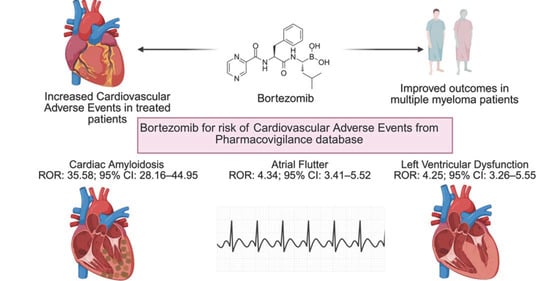
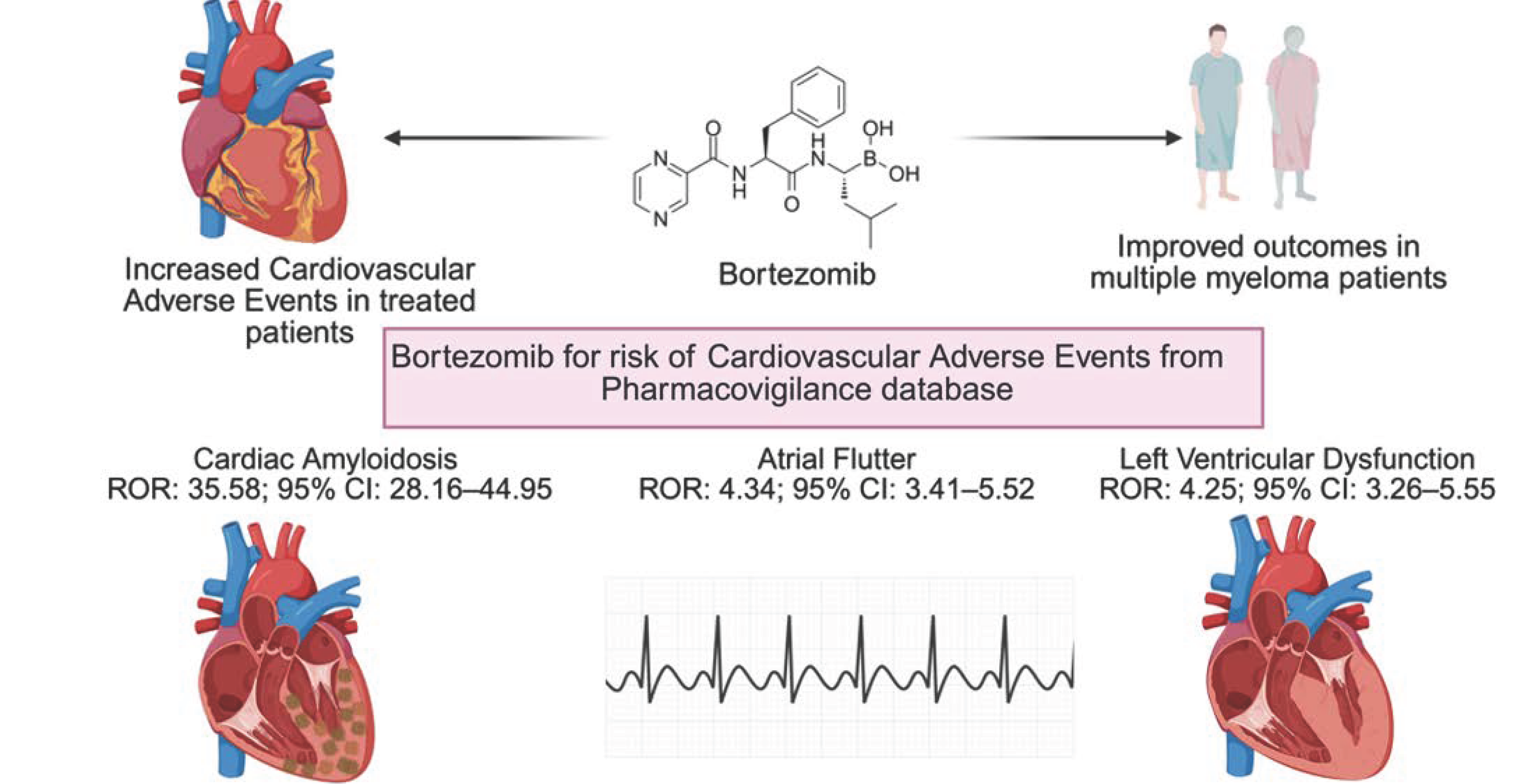
Graphical Abstract

1. Introduction

Bortezomib, a 26S proteasome inhibitor, is commonly used in the treatment of multiple myeloma (MM) and mantle cell lymphoma and has contributed to improved outcomes for many patients [1]. Although it has transformed patient outcomes, there is an emerging consensus of its potential negative effects on the heart. While early trials mainly reported low blood pressure and nerve damage, real-world data now point to a broader range of cardiovascular problems, including cardiomyopathy and heart failure [2].
Patients with MM and systemic amyloidosis are already predisposed to cardiovascular problems due to factors such as renal dysfunction, increased blood viscosity, and direct cardiac infiltration by misfolded proteins [3]. These overlapping risks make it challenging to distinguish disease-related cardiac manifestations from potential treatment-related toxicity. Moreover, proposed biological mechanisms such as endoplasmic reticulum stress, oxidative injury, mitochondrial dysfunction, and impaired autophagy led to a plausible basis for bortezomib-associated cardiac injury [4,5,6]. These effects may be especially relevant in older adults who often present with hypertension, coronary artery disease, or other baseline vulnerabilities.
Given these complexities, real-world data can offer vital context for understanding how cardiotoxicity presents outside controlled clinical trials. Spontaneous reporting systems like the FDA Adverse Event Reporting System (FAERS) are particularly useful for generating early safety signals in heterogeneous patient populations [7,8,9]. However, the full pattern of cardiac adverse events associated with bortezomib in FAERS has not been comprehensively studied [10]. Therefore, this study applied disproportionality analyses to describe patterns of reported cardiac adverse events associated with bortezomib and to generate hypotheses regarding its potential cardiotoxic effects in real-world practice.

2. Methods

2.1. Data Source and Preparation

2.1.1. Data Extraction

Data were obtained from the U.S. Food and Drug Administration (FDA) Adverse Event Reporting System (FAERS) through OpenVigil 2.1 (build: OpenVigil 2.1–MedDRA–v24, data coverage 2004Q1–2025Q2), a pharmacovigilance platform [11]. For this study, adverse event (AE) reports in which bortezomib was recorded as a suspect drug were extracted up to 19 May 2025. Adverse events were coded according to the Medical Dictionary for Regulatory Activities (MedDRA), version 28.0 (released March 2025).

2.1.2. Case Selection and Role Codes

For each Preferred Term (PT), all unique reports were initially counted irrespective of role designation. Cases in which bortezomib was identified as the primary suspect (PS) or secondary suspect (SS) were included in the main disproportionality analysis. The category labeled as “Other” is an umbrella term encompassing interacting (I) and concomitant (C) roles which were included only in sensitivity analyses to evaluate the robustness of the observed associations.

2.1.3. Deduplication and Unit of Analysis

To ensure accurate case counts, duplicate records were removed using OpenVigil’s default deduplication algorithm, which collapses reports by case ID, retains the highest case version, removes entries flagged as duplicates, and consolidates follow-up reports into a single unique case. The number of adverse events was calculated by counting unique cases, not Individual Safety Reports (ISRs). This approach, using the unique case as the unit of analysis for all disproportionality calculations reduced overcounting from cases reporting multiple AEs and provided a more accurate measure of the number of Adverse events.

2.1.4. Event Identification and Grouping

Cardiovascular events were identified using a two-stage process: 1. Screening: We screened for potential cardiac events using Preferred Terms (PTs) in their narrow scope. The Preferred Terms used were for example: ‘Cardiac failure’, ‘Cardiomyopathy’, ‘ischemic heart disease’, and ‘Myocarditis’ (MedDRA v28.0). 2. Reporting: For the final analysis and signal detection, we investigated closely the PTs and reported results based on the number of unique cases. Ultimately, generating clinically and statically significant signals.

2.2. Disproportionality Analysis

The reporting odds ratio (ROR) method was applied to detect statistically significant signals in the data, following standard pharmacovigilance practices [12]. This analysis was limited to cases in which bortezomib was listed as a suspect drug and was critical for identifying bortezomib’s unique cardiac risk profile. Signal Detection and Thresholds Disproportionality analyses were performed at the case level. The reporting odds ratio (ROR) with 95% confidence intervals (CIs) was used as the primary metric. A signal was considered positive when at least three unique cases (N ≥ 3) were reported for a given PT and the lower bound of the 95% CI exceeded 1, corresponding to χ2 ≥ 3.84 (α = 0.05). Exploratory signals that did not meet these thresholds were flagged as hypothesis-generating.
Calculation of ROR. Reporting odds ratio (ROR) with test drug versus all other drugs in the FAERS database was calculated as:
Test DrugAll Other Drugs in FAERS
Reports of AE of interestAB
All other eventsCD
ROR = (A × D)/(B × C), 95% CI = eln(ROR)±1.96√(1/A+1/B+1/C+1/D)

2.3. Information Component (IC) Analysis

In addition to the reporting odds ratio (ROR), disproportionality was also evaluated using the Information Component (IC), a Bayesian signal detection method commonly applied in spontaneous reporting systems. The IC compares the observed number of reports for a given drug–event pair with the number expected under the assumption of statistical independence. The IC was calculated as:
I C   =   l o g 2 N _ O b s + 0.5 N _ E x p + 0.5
where N_Obs denotes the observed number of reports for the drug–event pair and N_Exp represents the expected number of reports based on marginal totals. A shrinkage factor of 0.5 was applied to stabilize estimates for rare events. Statistical significance was assessed using the lower bound of the 95% Bayesian credibility interval (IC025), with IC025 > 0 considered indicative of a positive disproportionality signal. Because atrial fibrillation is highly prevalent in AL amyloidosis, AF reports were further reviewed for co-reported amyloidosis. AF cases with concurrent amyloidosis were classified as disease-related, whereas AF cases without amyloidosis were considered potentially treatment-related or of uncertain attribution.

2.4. Cardiac Adverse Event Classification

Acknowledging that many cardiac findings in patients with multiple myeloma (MM) and AL amyloidosis are not necessarily treatment-related, cardiac adverse events (AEs) were grouped into three categories based on clinical judgment and prior literature. Disease-related events were those commonly seen as part of the natural disease course, such as cardiac amyloidosis, right ventricular (RV) failure, and hypertrophic cardiomyopathy. Potential treatment-related events included AEs with reported or plausible links to proteasome inhibitor cardiotoxicity, such as cardiomyopathy, left ventricular (LV) dysfunction, myocarditis, supraventricular tachyarrhythmias, and heart failure without co-reported amyloidosis. A third category consisted of events with uncertain or overlapping etiology, where contributions from both underlying disease and treatment could not be clearly distinguished. Because atrial fibrillation (AF) is highly prevalent in AL amyloidosis, we reviewed AF cases to determine whether cardiac amyloidosis was co-reported. AF events with documented amyloidosis were classified as disease-related, whereas AF cases without amyloidosis were considered potentially treatment-related or uncertain.

3. Results

3.1. Disproportionality Signals for Cardiac Adverse Events

A search query was performed for all Adverse events associated with Bortezomib compared to the entire database since its FDA approval from May 2003 to May 2025. To reduce common symptoms, MedDRA has already been classified into Preferred Terms. A compiled list based on the number of unique cases is summarized in Table 1, with their respective ROR (95%Cl). In total, 12 Adverse Events were associated with a cardiac disease and exhibited statistically significant RORs for Bortezomib relative to the entire database.
In MedDRA, a Preferred Term (PT) is known as a single, standardized medical concept used for coding adverse events, such as “nausea” or “anaphylactic reaction.” A unique case, on the other hand, is a subset of a Preferred Term (PT) which describes an individual clinical scenario that may involve multiple symptoms, lab abnormalities, or diagnoses. The number of adverse events in the MedDRA database correlated more closely with the number of unique cases than with the number of Preferred Terms (PTs). Therefore, most of this paper’s data utilizes unique cases over the more commonly used unit of PT.
We extracted a comprehensive list of adverse events and unique case IDs in the entire database (from May 2003 to May 2025). Disproportionality analysis using the reporting odds ratio (ROR) revealed statistically significant pharmacovigilance signals for twelve cardiac AEs (Table 1). Among reported cardiac terms, cardiac amyloidosis showed a markedly elevated disproportionality signal (ROR 35.578; 95% CI 28.158–44.953), consistent with its prevalence as a disease manifestation in the treated population rather than a drug-induced adverse effect. Atrial flutter (ROR 4.339; 95% CI 3.414–5.515) and left ventricular dysfunction (ROR 4.254; 95% CI 3.259–5.554) also showed elevated RORs, revealing a higher vulnerability in treated patients. More commonly reported events, such as Cardiac failure (ROR 3.183; 95% CI 2.925–3.463) and Atrial fibrillation (ROR 2.649; 95% CI 2.430–2.887), remained significant but with lower magnitude signals. Bayesian disproportionality analysis using the Information Component (IC) demonstrated findings that were highly concordant with the ROR-based results. All twelve cardiac adverse events exhibited positive IC values, with lower bounds of the 95% Bayesian credibility intervals (IC025) exceeding zero, indicating statistically robust disproportionality signals. Cardiac amyloidosis showed the strongest Bayesian signal (IC 4.72; IC025 4.41), consistent with its markedly elevated reporting odds ratio (ROR 35.58; 95% CI 28.16–44.95). Strong and stable signals were also observed for atrial flutter (IC 2.07; IC025 1.72; ROR 4.34; 95% CI 3.41–5.52) and left ventricular dysfunction (IC 2.03; IC025 1.65; ROR 4.25; 95% CI 3.26–5.55). More frequently reported events, including cardiac failure (IC 1.65; IC025 1.52; ROR 3.18; 95% CI 2.93–3.46) and atrial fibrillation (IC 1.39; IC025 1.26; ROR 2.65; 95% CI 2.43–2.89), retained consistent Bayesian support despite more moderate effect sizes. Less frequent events, such as myocarditis (IC 1.14; IC025 0.77; ROR 2.25; 95% CI 1.73–2.91) and supraventricular tachycardia (IC 1.09; IC025 0.67; ROR 2.17; 95% CI 1.61–2.93), demonstrated weaker but statistically credible Bayesian signals.

3.2. Clinical Severity and Mortality Outcomes

Table 2 summarizes the clinical impact of twelve cardiac AEs reported in association with bortezomib, including hospitalization rates, life-threatening classifications, and mortality outcomes. According to Table 2, Cardiac failure emerged as both the most common and most lethal AE, with 197 hospitalizations and 208 deaths, reflecting a case fatality rate of approximately 37.7%. This finding aligns with earlier reports describing cardiac failure as a frequent complication of proteasome inhibitors, especially in patients with comorbidities such as hypertension, chronic kidney disease, or underlying structural heart abnormalities [13,14]. Clinical outcome variables, including hospitalization and fatal outcome, were examined to provide contextual information regarding the reported severity of cardiac adverse events. These outcomes were analyzed descriptively and were not used to infer drug-attributable mortality, given the absence of reliable exposure denominators and the high baseline mortality associated with multiple myeloma and systemic amyloidosis.
Atrial fibrillation also showed high prevalence, with 216 hospitalizations and 89 deaths, but a lower-case fatality rate (~8.7%), consistent with prior studies suggesting that atrial arrhythmias are common but often manageable with appropriate monitoring and supportive care [15]. These findings are significant given that atrial fibrillation has previously been under-recognized in this population and may reflect direct cardiac remodeling or autonomic imbalance induced by bortezomib [4,8].
Although cardiac amyloidosis was reported less frequently (n = 80), it was associated with a high observed mortality rate (36 deaths; 27.5%). This pattern most plausibly reflects the underlying severity of systemic AL amyloidosis, for which bortezomib is commonly prescribed, rather than true cardiotoxicity. Nonetheless, patients with established amyloid cardiomyopathy may remain clinically vulnerable during treatment due to limited cardiac reserve and increased sensitivity to therapeutic stressors [7,16,17]. To maintain clinical interpretability, amyloidosis-related Preferred Terms (PTs) should be excluded from the primary cardiotoxicity analysis or examined separately in a prespecified sensitivity analysis labeled as “indication signals.” Because cardiac amyloidosis represents an organ-specific manifestation of systemic AL amyloidosis, mortality signals in this category should be interpreted as indication-related rather than drug-attributable.
In addition, other rare but severe events like myocarditis (6 deaths from 57 reports) and Cardiac Failure acute (11 deaths from 48 reports) highlight the importance of monitoring for immune-related or inflammatory mechanisms during therapy [5,14,18]. As shown in Table 2, even low-frequency AEs such as hypertrophic cardiomyopathy, right ventricular failure, and supraventricular tachycardia were associated with at least one fatality each, supporting the idea that infrequent events may still carry significant clinical risk in vulnerable patients. Accordingly, mortality outcomes were not visualized as standalone figures and are instead reported in tabular form to avoid overinterpretation of causality in a spontaneous reporting system.
Overall, this mortality profile highlights the need to prioritize both frequent and rare cardiac complications during bortezomib therapy, especially when treating elderly or comorbid patients.

3.3. Suspected Attribution and Causality Patterns

To evaluate the likelihood of a causal link between bortezomib and each reported cardiac adverse event, Table 3 categorizes suspect attribution as primary, secondary, or other. Events such as cardiomyopathy (68.0 percent) and Cardiac Failure acute (60.4 percent) had the highest rates of primary suspect designation, suggesting a closer association between bortezomib exposure and the onset of these conditions. Mechanistically, this observation aligns with prior studies showing that proteasome inhibition can impair protein turnover, increase oxidative stress, and induce cardiomyocyte apoptosis, processes that are central to the development of structural heart disease [19,20,21,22].
In contrast, atrial fibrillation (41.4 percent) and cardiac failure (46.0 percent) displayed more distributed attribution patterns, often falling into the secondary suspect category. These patterns likely reflect a combination of drug effects and disease-related factors such as prior cardiovascular history, chemotherapy-induced cardiomyopathy, or progression of multiple myeloma [3,16]. Such mixed attributions are common in oncology settings, where polypharmacy and overlapping toxicities complicate causal inference. Less common events, including atrial flutter and hypertrophic cardiomyopathy, were frequently classified as secondary or “other,” which may reflect reporting biases, diagnostic uncertainty, or the influence of comorbidities rather than direct drug toxicity [23].
From an analytical standpoint, it is important to note that restricting attribution to primary suspect reports offers greater signal specificity, whereas including secondary or other roles may introduce concomitant or interacting drugs into the analysis and thereby dilute the association. Additionally, our primary analyses relied on primary suspect reports, with sensitivity analyses that combined primary and secondary suspects. The choice of comparator also influences interpretation. While “all other drugs” provides a broad reference set, this approach risks therapeutic area confounding. Additional sensitivity analyses using myeloma therapeutics (excluding proteasome inhibitors) as comparators, and separate analyses excluding other proteasome inhibitors to test for class-specific effects, provide greater robustness and help clarify whether the observed signals are unique to bortezomib or reflect broader therapeutic trends.

3.4. Demographic and Treatment Context

Demographic analysis showed that cardiac adverse events were more frequently reported in older adults and in males, a pattern that reflects established trends in cardiovascular vulnerability within oncology populations. Among the 552 reports of cardiac failure, 233 involved males, 188 involved females, and 131 lacked gender specification. Atrial fibrillation followed a similar distribution, with 265 reports in males compared to 164 in females (Table 3). These observations suggest a possible sex-based predisposition, which may be influenced by differences in baseline cardiovascular health, the prevalence of hypertension, or hormonal modulation [6,9]. In contrast, cardiac amyloidosis was nearly equally distributed, with 32 reports in males and 31 in females. This balanced pattern is consistent with the biology of amyloidosis, which affects both sexes relatively equally and may remain undetected until late stages of the disease [16]. Demographic variables were summarized descriptively to characterize the reported population; however, sex-specific analyses were not emphasized due to substantial missing data and the inability to establish sex-specific exposure denominators within FAERS.
The accuracy of sex-specific risk estimates is limited by the large proportion of missing demographic data, particularly in earlier FAERS submissions. This limitation emphasizes the importance of improving the quality of pharmacovigilance reporting, as more complete datasets are essential for clarifying whether these differences represent true biological effects or are shaped by reporting practices [10].
Age was also a defining factor in the distribution of cardiac events. Patients aged 65 years or older accounted for 41.7 percent of cardiac failure reports and nearly half of atrial fibrillation reports. These findings are consistent with registry-based studies that demonstrate higher rates of cardiotoxic events among older patients who begin bortezomib therapy [24,25]. The increased vulnerability in this group likely reflects the combined impact of baseline frailty, a higher burden of preexisting cardiovascular disease, and diminished physiologic reserve. Given that bortezomib is often prescribed in older adults with plasma cell disorders, these findings underscore the importance of structured cardiovascular risk assessment prior to treatment and vigilant monitoring throughout therapy.
Bortezomib is rarely given alone. In most cases it is administered alongside other agents such as dexamethasone, lenalidomide or thalidomide, daratumumab, cyclophosphamide, melphalan, prednisone, doxorubicin, carfilzomib, or rituximab. Many of these drugs have their own cardiovascular effects, which complicates the attribution of risk to bortezomib alone. To address this challenge, future pharmacovigilance studies could benefit from summarizing the most frequent co-medications and conducting sensitivity analyses. These might include excluding cases where anthracyclines such as doxorubicin were co-reported or focusing specifically on cases where bortezomib was used as monotherapy. Such approaches would help disentangle drug-specific associations from the combined effects of multidrug regimens and provide a clearer picture of the cardiovascular risks attributable to bortezomib.

3.5. Disease-Specific Patterns and Subgroup Risk

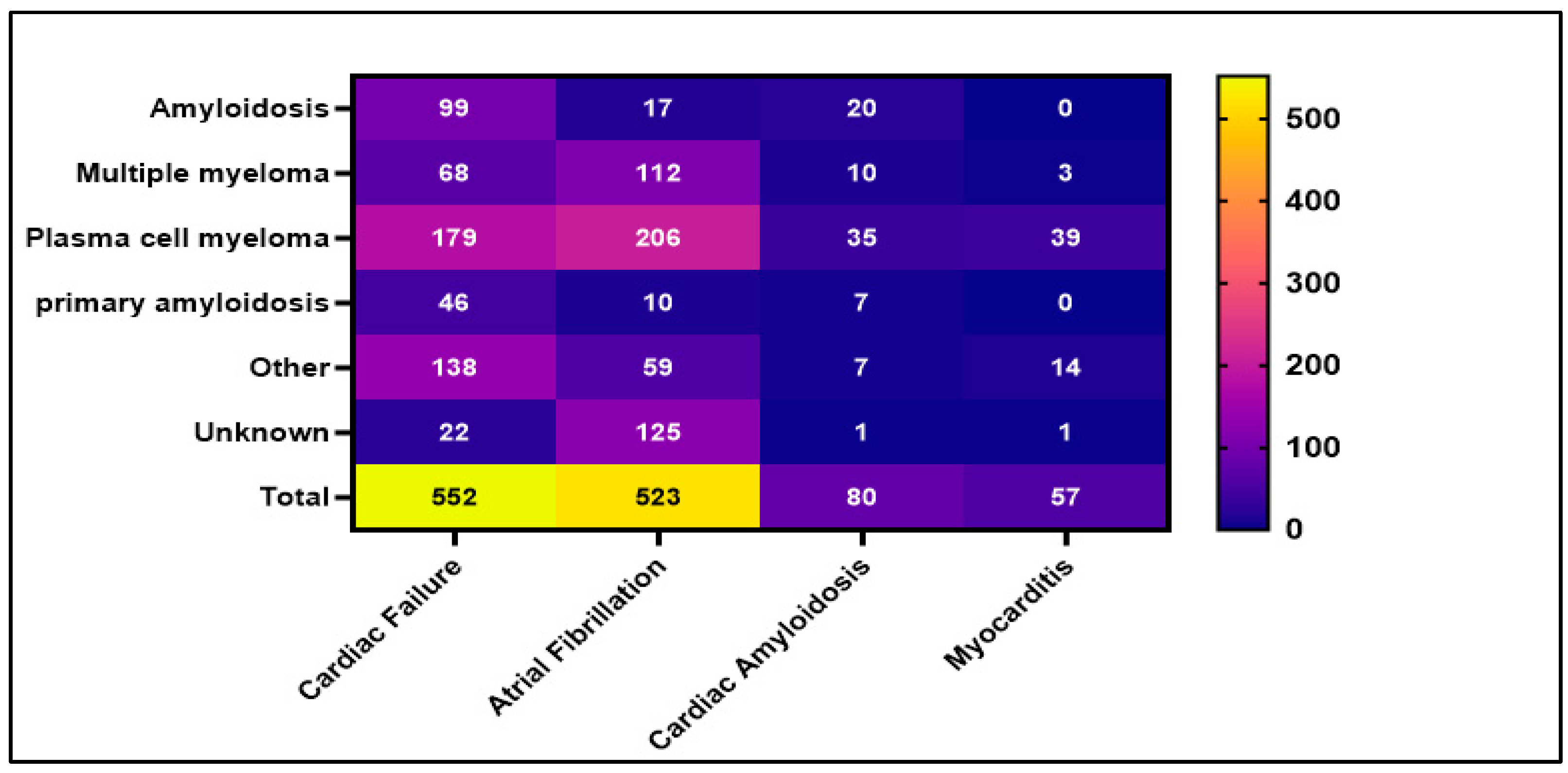
Figure 1 presents a heatmap of four major cardiac AEs across clinical subgroups based on diagnosis (e.g., plasma cell myeloma, systemic amyloidosis). Cardiac failure and atrial fibrillation were present in patients with plasma cell myeloma (179 and 206 reports, respectively), while cardiac amyloidosis clustered heavily in amyloidosis patients (27 of 80 reports), illustrating disease-specific cardiotoxic risks.
These distribution patterns are clinically important. For example, patients with amyloidosis often present with underlying transthyretin or light chain deposition, which may predispose the heart to dysfunction under proteasome inhibition [7,16,17]. In contrast, myocarditis, although rarer overall (57 reports), disproportionately affected plasma cell myeloma patients (39 reports), potentially reflecting immune dysregulation, infections, or off-target inflammatory responses in this population [5,18].
Furthermore, multiple myeloma, a condition known to involve high treatment burden and systemic inflammation, accounted for a substantial proportion of atrial fibrillation and cardiac failure cases. These results support the need for disease specific surveillance strategies and may influence decisions regarding drug selection, dose modification, and cardiac imaging [13,24].

4. Discussion

Our analysis identified a strong pharmacovigilance signal associating bortezomib with a spectrum of cardiac adverse events (AEs), including cardiac failure, cardiomyopathy, and arrhythmias. These observations contribute to the ongoing debate in cardio-oncology, where proteasome inhibitors remain essential in treating multiple myeloma (MM) and systemic amyloidosis but may also introduce cardiovascular concerns [13,16]. Given the spontaneous reporting nature of FAERS, these findings should be interpreted as hypothesis-generating rather than causal. To preserve interpretability and avoid overstatement, analyses focused on disproportionality signal detection rather than subgroup-specific severity or mortality modeling.
Importantly, Bayesian Information Component analysis corroborated the frequentist disproportionality results, with all evaluated cardiac adverse events demonstrating IC025 values greater than zero. Events with the strongest ROR signals, including cardiac amyloidosis (ROR 35.58), atrial flutter (ROR 4.34), and left ventricular dysfunction (ROR 4.25), also exhibited the highest IC values (IC 4.72, 2.07, and 2.03, respectively), indicating robust and internally consistent signal detection across analytical frameworks. In contrast, events with more moderate ROR estimates, including atrial fibrillation (ROR 2.65; IC 1.39) and cardiac failure (ROR 3.18; IC 1.65), maintained positive Bayesian support, suggesting that these associations were not driven solely by reporting volume or sparse data effects. Lower-frequency events, such as myocarditis (IC025 0.77) and supraventricular tachycardia (IC025 0.67), demonstrated attenuated but credible Bayesian signals, supporting their interpretation as hypothesis-generating findings rather than definitive safety associations.
Mechanistically, several pathways could explain bortezomib’s cardiotoxic profile. Proteasome inhibition disrupts protein homeostasis, which in turn may trigger mitochondrial dysfunction, endothelial injury, and impaired cellular repair capacity [4,19,20,23]. These mechanisms, described in cardiac literature, provide a biological explanation for the observed signals, but they remain speculative and require further experimental validation.
The signals were particularly common among older adults and patients with pre-existing cardiovascular disease. These findings do not establish these conditions as risk factors, but they highlight plausible clinical contexts where reduced physiologic reserve, endothelial dysfunction, and impaired mitochondrial resilience may increase susceptibility to cardiac injury [24,25]. This interpretation aligns with real-world data showing that elderly MM patients often experience higher cardiovascular event rates soon after initiating bortezomib therapy. These proposed mechanisms are most relevant to potentially treatment-associated events such as cardiac failure and atrial fibrillation or atrial flutter and are unlikely to explain amyloidosis-related findings, which reflect underlying disease pathology.
Patterns of attribution also varied across AEs. Cardiac Failure acute and cardiomyopathy were more frequently designated as primary suspect events, suggesting a closer link to drug exposure. In contrast, atrial fibrillation and congestive cardiomyopathy were more often reported as secondary suspects, likely reflecting the use of co-medications, underlying disease burden, and comorbidities common in oncology populations [3,9]. Rare events such as hypertrophic cardiomyopathy and supraventricular tachycardia, though rare, were associated with severe outcomes including death. These findings highlight prior pharmacovigilance literature, which shows that even low-prevalence signals can carry high clinical impact when they affect vulnerable cardiac substrates [13,14].
Sex-based patterns were also observed. Males were more frequently represented in cases of atrial fibrillation and cardiac failure, although these findings are limited by missing demographic information in older FAERS records. Nonetheless, this trend aligns with prior reports suggesting that hormonal and behavioral differences, such as hypertension prevalence and tobacco use, may shape cardiovascular outcomes in patients receiving bortezomib [6].
Disease-specific subgroup patterns further support the complexity of these observations. Among MM patients, atrial fibrillation and cardiac failure were particularly common, likely reflecting the combined burden of anemia, systemic inflammation, and treatment-related stress [3,24]. In systemic amyloidosis, cardiac amyloidosis reports carried disproportionately high mortality. These events should be regarded as confounding by indication rather than evidence of drug-induced toxicity, since amyloidosis is both the underlying disease substrate and a treatment indication. These reports reflect the underlying disease substrate and advanced cardiomyopathy present at baseline, rather than representing a treatment-related adverse effect attributable to bortezomib. In contrast, atrial fibrillation occurred predominantly in patients without documented amyloidosis, supporting a potential treatment-related association rather than confounding by amyloid cardiomyopathy. Several of the signals identified in this analysis, particularly cardiac amyloidosis, RV failure, and AF reported alongside amyloid involvement, likely reflect underlying disease rather than direct drug toxicity. MM and AL amyloidosis often produce complex cardiac phenotypes that can resemble or intensify treatment-related effects, which makes attribution difficult in spontaneous reporting systems. The classification approach used in this study helped distinguish events that are more reasonably disease-driven from those that may be associated with proteasome inhibition, although some overlap is unavoidable given the clinical complexity of this patient population. Nevertheless, the high fatality rate emphasizes the extreme vulnerability of this patient population and the importance of close monitoring [7,16,17].
In summary, our findings highlight a set of hypothesis-generating signals that support further investigation. Bortezomib’s potential cardiovascular effects may involve mitochondrial dysfunction and endothelial injury, though confirmatory studies are needed. While causality cannot be inferred from FAERS data, the results suggest that older adults and patients with pre-existing cardiovascular disease represent plausible contexts of heightened vulnerability. Future prospective studies and mechanistic investigations are essential to clarify these patterns and to guide evidence-based risk mitigation strategies.

5. Conclusions

This pharmacovigilance analysis provides real-world evidence that bortezomib is associated with a spectrum of serious cardiac adverse events, including cardiac failure, atrial fibrillation, and other arrhythmias. Reports of cardiac amyloidosis exhibited high disproportionality but reflect underlying disease indication rather than treatment-induced cardiotoxicity. The elevated reporting odds ratios, particularly in older adults and those with underlying plasma cell disorders, highlight the need for personalized cardiovascular surveillance. Mechanistically, these AEs align with known pathways of proteasome inhibitor-induced toxicity, including mitochondrial dysfunction, oxidative stress, and impaired protein clearance. Clinicians should consider early cardiac risk stratification, baseline imaging, and routine monitoring when prescribing bortezomib, especially for high-risk populations such as patients with AL amyloidosis or advanced age.

6. Study Limitations

This study has several inherent limitations stemming from the nature of spontaneous reporting data in the FAERS database. First, under- and over-reporting bias may affect signal reliability, as reports are submitted voluntarily and influenced by factors such as media attention, litigation, and the time elapsed since drug approval. Second, Outcome severity indicators such as death and hospitalization were interpreted cautiously and were not modeled as primary endpoints, as FAERS does not permit attribution of mortality or severity directly to drug exposure in populations with high baseline risk. Similarly, sex-specific risk assessment was not pursued due to incomplete demographic reporting and the absence of treatment denominators. Third, the absence of reliable exposure denominators prevents the estimation of true incidence or comparative risk. Fourth, co-medication and indication confounding are likely, particularly in oncology patients who often receive complex treatment regimens. Fifth, duplicate, incomplete, or misclassified reports may persist despite rigorous deduplication and data-cleaning efforts. Sixth, variability in data entry practices, MedDRA coding, and reporter expertise can introduce inconsistencies that affect signal interpretation. Seventh, because FAERS is a dynamic system that undergoes continuous updates, the dataset analyzed from 13 May 2003 to 19 May 2025, may change as new reports are submitted or revised, meaning results could shift even after a single day. Finally, disproportionality analyses are inherently non-causal and should be regarded as hypothesis-generating rather than confirmatory. These limitations should be carefully considered when analyzing the results, as they emphasize the need for complementary epidemiological and mechanistic studies to verify potential safety signals identified through FAERS.

Author Contributions

Conceptualization, A.P.S.; Methodology, A.P.S.; Software, M.N.; Validation, M.N.; Formal analysis, M.N. and A.M.; Investigation, M.N. and A.P.S.; Resources, A.A.-L.; Data curation, M.N. and A.M.; Writing—review and editing, A.M. and A.A.-L.; Supervision, A.A.-L. and A.P.S.; Project administration, A.A.-L. and A.P.S. All authors have read and agreed to the published version of the manuscript.

Funding

This research received no external funding.

Data Availability Statement

The original contributions presented in this study are included in the article. Further inquiries can be directed to the corresponding author.

Conflicts of Interest

The authors declare no conflicts of interest.

References

  1. Richardson, P.G.; Barlogie, B.; Berenson, J.; Singhal, S.; Jagannath, S.; Irwin, D.; Rajkumar, S.V.; Srkalovic, G.; Alsina, M.; Alexanian, R.; et al. A phase 2 study of bortezomib in relapsed, refractory myeloma. N. Engl. J. Med. 2003, 348, 2609–2617. [Google Scholar] [CrossRef]
  2. Moreau, P.; Pylypenko, H.; Grosicki, S.; Karamanesht, I.; Leleu, X.; Grishunina, M.; Rekhtman, G.; Masliak, Z.; Robak, T.; Shubina, A.; et al. Subcutaneous versus intravenous administration of bortezomib in patients with relapsed multiple myeloma: A randomised, phase 3, non-inferiority study. Lancet Oncol. 2011, 12, 431–440. [Google Scholar] [CrossRef]
  3. Kistler, K.D.; Kalman, J.; Sahni, G.; Murphy, B.; Werther, W.; Rajangam, K.; Chari, A. Incidence and Risk of Cardiac Events in Patients with Previously Treated Multiple Myeloma Versus Matched Patients Without Multiple Myeloma: An Observational, Retrospective, Cohort Study. Clin. Lymphoma Myeloma Leuk. 2017, 17, 89–96.e3. [Google Scholar] [CrossRef] [PubMed]
  4. Ling, Y.H.; Liebes, L.; Zou, Y.; Perez-Soler, R. Reactive oxygen species generation and mitochondrial dysfunction in the apoptotic response to Bortezomib, a novel proteasome inhibitor, in human H460 non-small cell lung cancer cells. J. Biol. Chem. 2003, 278, 33714–33723. [Google Scholar] [CrossRef]
  5. Kuroda, K.; Liu, H. The proteasome inhibitor, bortezomib, induces prostate cancer cell death by suppressing the expression of prostate-specific membrane antigen, as well as androgen receptor. Int. J. Oncol. 2019, 54, 1357–1366. [Google Scholar] [CrossRef]
  6. Garcia, M.; Mulvagh, S.L.; Bairey Merz, C.N.; Buring, J.E.; Manson, J.E. Cardiovascular Disease in Women: Clinical Perspectives. Circ. Res. 2016, 118, 1273–1293. [Google Scholar] [CrossRef] [PubMed]
  7. Christoffersen, M.; Greve, A.M.; Hornstrup, L.S.; Frikke-Schmidt, R.; Nordestgaard, B.G.; Tybjærg-Hansen, A. Transthyretin Tetramer Destabilization and Increased Mortality in the General Population. JAMA Cardiol. 2025, 10, 155–163. [Google Scholar] [CrossRef] [PubMed]
  8. Herrmann, J.; Yang, E.H.; Iliescu, C.A.; Cilingiroglu, M.; Charitakis, K.; Hakeem, A.; Toutouzas, K.; Leesar, M.A.; Grines, C.L.; Marmagkiolis, K. Vascular Toxicities of Cancer Therapies: The Old and the New—An Evolving Avenue. Circulation 2016, 133, 1272–1289. [Google Scholar] [CrossRef]
  9. Gandolfi, S.; Laubach, J.P.; Hideshima, T.; Chauhan, D.; Anderson, K.C.; Richardson, P.G. The proteasome and proteasome inhibitors in multiple myeloma. Cancer Metastasis Rev. 2017, 36, 561–584. [Google Scholar] [CrossRef]
  10. Munoz, M.A.; Pan, G.J.D.; Wei, Y.-J.J.; Xiao, H.; Delcher, C.; Giffin, A.; Sadiq, N.; Winterstein, A.G. Sociodemographic Characteristics of Adverse Event Reporting in the USA: An Ecologic Study. Drug Saf. 2024, 47, 377–387. [Google Scholar] [CrossRef]
  11. Sakaeda, T.; Tamon, A.; Kadoyama, K.; Okuno, Y. Data mining of the public version of the FDA Adverse Event Reporting System. Int. J. Med. Sci. 2013, 10, 796–803. [Google Scholar] [CrossRef] [PubMed]
  12. Bate, A.; Evans, S.J. Quantitative signal detection using spontaneous ADR reporting. Pharmacoepidemiol. Drug Saf. 2009, 18, 427–436. [Google Scholar] [CrossRef]
  13. Chari, A.; Stewart, A.K.; Russell, S.D.; Moreau, P.; Herrmann, J.; Banchs, J.; Hajek, R.; Groarke, J.; Lyon, A.R.; Batty, G.N.; et al. Analysis of carfilzomib cardiovascular safety profile across relapsed and/or refractory multiple myeloma clinical trials. Blood Adv. 2018, 2, 1633–1644. [Google Scholar] [CrossRef] [PubMed]
  14. Xiang, C.; Guo, R.; Ti, J.; Zhang, S.; Wang, T. Infection-related adverse events comparison of bortezomib, carfilzomib and ixazomib: A pharmacovigilance study based on FAERS. Expert Opin. Drug Saf. 2025, 1–10. [Google Scholar] [CrossRef]
  15. Chen, Q.; van Rein, N.; van der Hulle, T.; Heemelaar, J.C.; A Trines, S.; Versteeg, H.H.; A Klok, F.; Cannegieter, S.C. Coexisting atrial fibrillation and cancer: Time trends and associations with mortality in a nationwide Dutch study. Eur. Heart J. 2024, 45, 2201–2213. [Google Scholar] [CrossRef]
  16. Movila, D.E.; Motofelea, A.C.; Cozma, D.; Albai, O.; Sima, A.C.; Andor, M.; Ciocarlie, T.; Dragan, S.R. Cardiac Amyloidosis: A Narrative Review of Diagnostic Advances and Emerging Therapies. Biomedicines 2025, 13, 1230. [Google Scholar] [CrossRef]
  17. Caponetti, A.G.; Accietto, A.; Saturi, G.; Ponziani, A.; Sguazzotti, M.; Massa, P.; Giovannetti, A.; Ditaranto, R.; Parisi, V.; Leone, O.; et al. Screening approaches to cardiac amyloidosis in different clinical settings: Current practice and future perspectives. Front. Cardiovasc. Med. 2023, 10, 1146725. [Google Scholar] [CrossRef]
  18. Zheng, Y.; Huang, S.; Xie, B.; Zhang, N.; Liu, Z.; Tse, G.; Liu, T. Cardiovascular Toxicity of Proteasome Inhibitors in Multiple Myeloma Therapy. Curr. Probl. Cardiol. 2023, 48, 101536. [Google Scholar] [CrossRef]
  19. Mitra, A.K.; Harding, T.; Mukherjee, U.K.; Jang, J.S.; Li, Y.; HongZheng, R.; Jen, J.; Sonneveld, P.; Kumar, S.; Kuehl, W.M.; et al. A gene expression signature distinguishes innate response and resistance to proteasome inhibitors in multiple myeloma. Blood Cancer J. 2017, 7, e581. [Google Scholar] [CrossRef] [PubMed]
  20. Rückrich, T.; Kraus, M.; Gogel, J.; Beck, A.; Ovaa, H.; Verdoes, M.; Overkleeft, H.S.; Kalbacher, H.; Driessen, C. Characterization of the ubiquitin-proteasome system in bortezomib-adapted cells. Leukemia 2009, 23, 1098–1105. [Google Scholar] [CrossRef]
  21. Sundaravel, S.H.; I Marar, R.; A Abbasi, M.; Baljevic, M.; Stone, J.R. Bortezomib-Induced Reversible Cardiomyopathy: Recovered with Guideline-Directed Medical Therapy. Cureus 2021, 13, e20295. [Google Scholar] [CrossRef]
  22. Georgiopoulos, G.; Makris, N.; Laina, A.; Theodorakakou, F.; Briasoulis, A.; Trougakos, I.P.; Dimopoulos, M.A.; Kastritis, E.; Stamatelopoulos, K. Cardiovascular Toxicity of Proteasome Inhibitors: Underlying Mechanisms and Management Strategies: JACC: CardioOncology State-of-the-Art Review. JACC Cardio Oncol. 2023, 5, 1–21. [Google Scholar] [CrossRef]
  23. Hedhli, N.; Depre, C. Proteasome inhibitors and cardiac cell growth. Cardiovasc. Res. 2010, 85, 321–329. [Google Scholar] [CrossRef] [PubMed]
  24. Armenian, S.H.; Lacchetti, C.; Lenihan, D. Prevention and Monitoring of Cardiac Dysfunction in Survivors of Adult Cancers: American Society of Clinical Oncology Clinical Practice Guideline Summary. J. Oncol. Pract. 2017, 13, 270–275. [Google Scholar] [CrossRef] [PubMed]
  25. Jang, B.; Jeong, J.; Heo, K.-N.; Koh, Y.; Lee, J. Real-world incidence and risk factors of bortezomib-related cardiovascular adverse events in patients with multiple myeloma. Blood Res. 2024, 59, 3. [Google Scholar] [CrossRef] [PubMed]
Figure 1. Heatmap showing the distribution of cardiac AEs across high-risk diagnoses (e.g., multiple myeloma, amyloidosis), revealing disease-specific vulnerability.
Cardiovascmed 29 00004 g001
Table 1. Disproportionality analysis of cardiac adverse events associated with bortezomib using both frequentist (ROR with 95% CI) and Bayesian (Information Component, IC and IC025) signal detection methods.
Adverse Event Preferred Term (PT)ADRNumber of
Drug
Events
Number of Reports for AE in
Full Database (All Drugs)
ROR (95% Cl)ICIC025
1Cardiac failureYes55245,6333.183 (2.92 5–3.463)1.6451.524
2Atrial fibrillationYes52952,3832.649 (2.43–2.887)1.3851.262
3CardiomyopathyYes9790142.81 (2.3–3.433)1.4661.179
4Cardiac amyloidosisYes8066135.578 (28.158–44.953)4.724.41
5Atrial flutterYes6841154.339 (3.414–5.515)2.0661.724
6MyocarditisYes5766112.245 (1.73–2.914)1.1440.771
7Left Ventricular dysfunctionYes5533934.254 (3.259–5.554)2.0281.649
8Cardiac Failure acuteYes4834373.657 (2.75–4.862)1.8161.41
9Supraventricular tach-
ycardia
Yes4351502.173 (1.61–2.934)1.0940.665
10Right ventricular fail-
ure
Yes3337402.297 (1.631–3.237)1.1650.676
11Congestive cardiomy-
opathy
Yes3629103.233 (2.327–4.492)1.6370.688
12Hypertrophic cardiomyopathyYes129123.44 (1.946–6.081)1.6360.836
Cardiac amyloidosis reflects an indication-related signal arising from underlying disease biology and confounding by indication rather than a treatment-emergent adverse event.
Table 2. Clinical outcomes (hospitalizations, life-threatening events, deaths) for each cardiac AE linked to bortezomib.
Adverse EventHospitalizationLife-ThreateningDeathOther Outcomes
Atrial fibrillation2163289192
Atrial flutter399713
Cardiac amyloidosis763631
Cardiac failure19745208104
Cardiac failure acute245116
Cardiomyopathy2461453
Congestive cardiomyopathy182412
Hypertrophic cardiomyopathy10011
Left ventricular dysfunction226918
Myocarditis206625
Right ventricular failure47211
Supraventricular tachycardia211048
Table 3. Demographic and clinical distribution of bortezomib-associated cardiac AEs by age, diagnosis, reporter country, and attribution type.
Cardiac FailureAtrial FibrillationAtrial FlutterCardiac Failure AcuteCardiomyopathyCongestive CardiomyopathyHypertrophic CardiomyopathyLeft Ventricular DysfunctionMyocarditisRight Ventricular FailureSupraventricular TachycardiaCardiac Amyloidosis
Suspect Attribution# of Unique cases55252968489736125557334380
(Male: 188(Male: 164(Male: 17Male: 21(Male: 37(Male: 11(Male: 2(Male: 20(Male: 22(Male: 16(Male: 12(Male: 31
Female: 233Female: 265Female: 37Female: 20Female: 33Female: 18Female: 9Female: 27Female: 28Female: 13Female: 20Female: 32
Not specified: 0Not specified: 15Not specified: 1Not specified: 0Not specified: 1Not specified: 2Not specified: 0Not specified: 1Not specified: 1Not specified: 0Not specified: 0Not specified: 2
Unknown: 131)Unknown: 85)Unknown: 13)Unknown: 7)Unknown: 26)Unknown: 5)Unknown: 1)Unknown: 7)Unknown: 6)Unknown: 4)Unknown: 11)Unknown: 15)
Other61 (11.1%)89 (16.8%)12 (17.6%)2 (4.2%)6 (6.2%)1 (2.8%)1 (8.3%)6 (10.9%)1 (1.8%)4 (12.1%)2 (4.7%)5 (6.2%)
Primary Suspect237 (42.9%)219 (41.4%)22 (32.4%)29 (60.4%)66 (68.0%)18 (50.0%)5 (41.7%)28 (50.9%)37 (64.9%)16 (48.5%)23 (53.5%)39 (48.8%)
Secondary Suspect254 (46.0%)221 (41.4%)34 (50.0%)17 (35.4%)25 (25.8%)17 (47.2%)6 (50.0%)21 (38.18%)17 (29.8%13 (39.4%)18 (41.9%)36 (45.0%)
Amyloidosis99 (17.9%)17 (3.2%)4 (5.9%)3 (6.25%)2 (2.1%)1 (2.8%)0 (0.0%)0 (0.00%)0 (0.0%)0 (0.0%)0 (0.0%)20 (25%)
Indication SubtypeMultiple myeloma68 (12.3%)112 (21.2%)17 (25.0%)6 (12.5%)31 (32.0%)4 (11.1%)2 (16.7%)7 (12.73%)3 (5.2%)2 (6.1%)17 (39.5%)10 (12.5%)
Plasma cell myeloma179 (32.4%)206 (38.9%)34 (50.0%)28 (58.33%)35 (36.1%)19 (52.8%)8 (66.7%)19 (34.55%)39 (67.2%)8 (24.2%)14 (32.6%)35 (43.8%)
Primary amyloidosis46 (8.33%)10 (1.9%)0 (0.0%)3 (6.25%)3 (3.1%)0 (0.0%)0 (0.0%)0 (0.00%)0 (0.0%)4 (12.1%)0 (0.0%)7 (8.8%)
Other138 (25.0%)59 (11.2%)11 (16.2%)4 (8.33%)20 (20.6%)12 (33.3%)1 (8.3%)21 (38.18%)15 (24.6%)17 (51.5%)8 (18.6%)7 (8.8%)
Unknown22 (3.9%)125 (23.6%)2 (2.9%)4 (8.33%)6 (6.2%)0 (0.0%)1 (8.3%)8 (14.55%)1 (1.7%)2 (6.1%)4 (9.3%)1 (1.2%)
<1819 (3.4%)0 (0.0%)0 (0.0%)0 (0.0%)1 (1.0%)0 (0.0%)0 (0.0%)6 (10.91%)2 (3.5%)2 (6.1%)0 (0.0%)0 (0.0%)
Age Subtype18–4418 (3.3%)1 (0.2%)0 (0.0%)1 (2.1%)6 (6.2%)0 (0.0%)0 (0.0%)4 (7.27%)7 (12.3%)10 (30.3%)0 (0.0%)1 (1.2%)
45–64113 (20.5%)102 (19.3%)15 (22.1%)13 (27.1%)31 (32.0%)18 (50.0%)1 (8.3%)20 (36.36%)19 (33.3%)12 (36.4%)15 (34.9%)31 (38.8%)
65+230 (41.7%)262 (49.5%)33 (48.5%)23 (47.9%)26 (26.8%)12 (33.3%)11 (91.7%)13 (23.64%)21 (36.8%)4 (12.1%)13 (30.2%)26 (32.5%)
Unknown172 (31.2%)164 (31.0%)20 (29.4%)11 (22.9%)33 (34.0%)6 (16.7%)0 (0.0%)12 (21.82%)8 (14.0%)5 (15.2%)15 (34.9%)22 (28.7%)
United States100 (18.1%)218 (41.2%)29 (42.6%)2 (4.17%)39 (40.2%)2 (5.6%)5 (41.7%)18 (32.73%)27 (47.4%)13 (39.4%)12 (27.9%)5 (6.25%)
Reporter CountryFrance (FR)80 (14.5%)45 (8.5%)1 (1.5%)4 (8.33%)2 (2.1%)17 (47.2%)5 (41.7%)1 (1.82%)5 (8.8%)0 (0.0%)1 (2.3%)12 (15.0%)
Japan (JP)66 (12.0%)18 (3.4%)5 (5.9%)10 (20.83%)4 (4.1%)1 (2.8%)0 (0.0%)0 (0.00%)0 (0.0%)2 (6.1%)7 (16.3%)12 (15.0%)
Germany(DE)76 (13.8%)30 (5.7%)8 (11.8%)0 (0.00%)2 (2.1%)0 (0.0%)0 (0.0%)2 (3.64%)2 (3.5%)1 (3.05%)2 (4.7%)0 (0.0%)
United Kingdom (GB)11 (2.0%)45 (8.5%)6 (8.8%)3 (6.25%)1 (1.0%)0 (0.0%)0 (0.0%)0 (0.00%)2 (3.5%)0 (0.0%)1 (2.3%)9 (11.25%)
Other Countries215 (38.9%)164 (31.0%)20 (29.4%)29 (60.42%)3 (3.1%)1 (2.8%)1 (8.3%)34 (61.82%)21 (36.8%)17 (51.5%)16 (37.2%)39 (48.75%)
Unknown4 (0.7%)9 (1.7%)0 (0.0%)0 (0.00%)46 (47.4%)15 (41.7%)1 (8.3%)0 (0.00%)0 (0.0%)0 (0.0%)4 (0.09%)3 (3.75%)
Disclaimer/Publisher’s Note: The statements, opinions and data contained in all publications are solely those of the individual author(s) and contributor(s) and not of MDPI and/or the editor(s). MDPI and/or the editor(s) disclaim responsibility for any injury to people or property resulting from any ideas, methods, instructions or products referred to in the content.