


A 51-year-old patient suffered from recurrent atypical thoracic pain. Clinical examination, cardiac biomarkers and electrocardiography were unremarkable.
Transthoracic echocardiography revealed a normal ejection fraction, trivial mitral regurgitation and a mobile, echo-dense mass, 10 mm long and 6 mm in diameter, attached to the chordae tendinae of the P1/A1 segment of the mitral valve leaflet (Figure 1A, arrow).
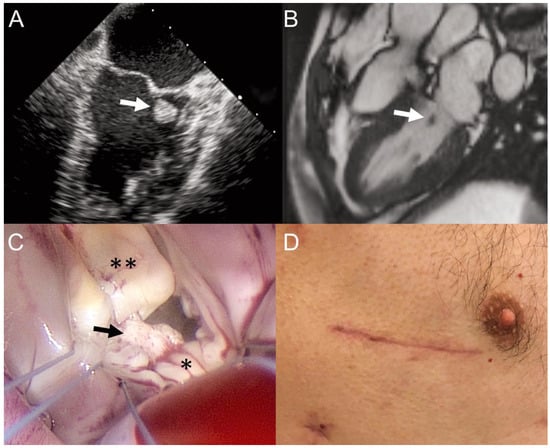
Figure 1.
Cardiac magnetic resonance imaging confirmed the presence of the mass, showing a mobile structure on the cine images, an isointense signal on T1 and T2 weighted images, as well as a hyperenhancement after late gadolinium administration (Figure 1B, cine image, arrow).
Given the appearance of the tumour, a papillary fibroelastoma of the mitral valve was suspected. Papillary fibroelastomas are rare primary cardiac tumours with a reported incidence of 0.002% [1]. Most patients are asymptomatic, but some are at increased risk of thromboembolic complications—in particular if the tumour is mobile and attached to the mitral valve apparatus [2]. We discussed the thrombotic risk with the patient and weighed it against the risk of minimally invasive surgery [3].
Because of the recurrent atypical thoracic pain experienced by the patient and the large diameter of the mobile mass, we chose surgery. Cardiopulmonary bypass was installed through a 2-cm right-sided groin incision. The heart was approached via a right-sided anterolateral minimally invasive incision.
After cardiac arrest and opening of the left atrium, we found a tumour attached to a secondary chord at the P1 segment of the posterior leaflet (Figure 1C, arrow point on the tumour, posterior* and anterior** mitral leaflet). The tumour was completely excised without damaging the leaflets. The intraoperative course was uneventful, and echocardiography confirmed competent valve function. The postoperative course was uneventful and the patient discharged at day 7. Pathological diagnosis confirmed a papillary fibroelastoma.
Clincal follow-up at 3 months after surgery showed unremarkable wound healing (Figure 1D) and a full recovery.
Conflicts of Interest
No financial support and no other potential conflict of interest relevant to this article was reported.
References
- Klarich, K.W.; Enriquez-Sarano, M.; Gura, G.M.; Edwards, W.D.; Tajik, A.J.; Seward, J.B. Papillary fibroelastoma: Echocardiographic characteristics for diagnosis and pathologic correlation. J Am Coll Cardiol. 1997, 30, 784–790. [Google Scholar] [CrossRef]
- Sun, J.P.; Asher, C.R.; Yang, X.S.; Cheng, G.G.; Scalia, G.M.; Massed, A.G.; et al. Clinical and echocardiographic characteristics of papillary fibroelastomas: A retrospective and prospective study in 162 patients. Circulation 2001, 103, 2687–2693. [Google Scholar] [CrossRef] [PubMed]
- Arsalan, M.; Smith, R.L.; Squiers, J.J.; Wang, A.; DiMaio, J.M.; Mack, M.J. Robotic Excision of a Papillary Fibroelastoma of the Mitral Chordae. Ann Thorac Surg. 2016, 101, e187–e188. [Google Scholar] [CrossRef] [PubMed][Green Version]
© 2017 by the author. Attribution - Non-Commercial - NoDerivatives 4.0.