
Brief Report

Daidzein Reduces Food Intake Through Light-Phase-Specific Upregulation of Hypothalamic Urocortin in Female Rats

1
Department of Biological Resources, Graduate School of Agriculture, Ehime University, Matsuyama 790-8566, Japan
2
Applied Bioresource Science Department, United Graduate School of Agricultural Sciences, Ehime University, Matsuyama 790-8566, Japan
*
Author to whom correspondence should be addressed.
Nutraceuticals 2026, 6(1), 14; https://doi.org/10.3390/nutraceuticals6010014
Submission received: 19 December 2025 / Revised: 15 February 2026 / Accepted: 23 February 2026 / Published: 27 February 2026

Abstract

Estrogen suppress food intake, and soy isoflavones exhibit estrogen-like activities. However, the specific isoflavone components responsible for appetite regulation and their underlying neuroendocrine mechanisms remain unclear. We investigated whether the major soy isoflavones daidzein and genistein differentially influence feeding behavior and hypothalamic appetite-regulating neuropeptides in female rats. Ovariectomized (OVX) and sham-operated female rats were fed a control diet or diets supplemented with daidzein or genistein (150 mg/kg diet) for one or two weeks under ad libitum conditions. A separate OVX group received subcutaneous estradiol. Hypothalamic expression of orexigenic and anorexigenic neuropeptides was quantified during the dark (active) and light (inactive) phases. Daidzein, but not genistein, significantly reduced food intake, body weight gain, and body fat in both OVX and intact females, whereas estradiol decreased these parameters only in OVX rats. Among all hypothalamic neuropeptides examined, urocortin was the only gene that responded to dietary daidzein, showing a significant increase exclusively during the light phase of week 1. Neither NPY nor CRH expression was altered by daidzein. The temporal pattern of urocortin induction closely paralleled the reduction in food intake, suggesting a potential mechanistic link. Daidzein exerts a female-specific anorectic effect that cannot be explained solely by estrogenic activity. The selective upregulation of hypothalamic urocortin during the light phase represents a novel neuroendocrine response to dietary daidzein and may contribute to its suppression of food intake. These findings provide new insight into the sex-specific metabolic actions of dietary isoflavones.

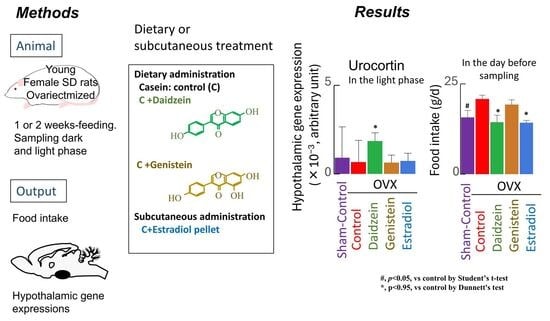
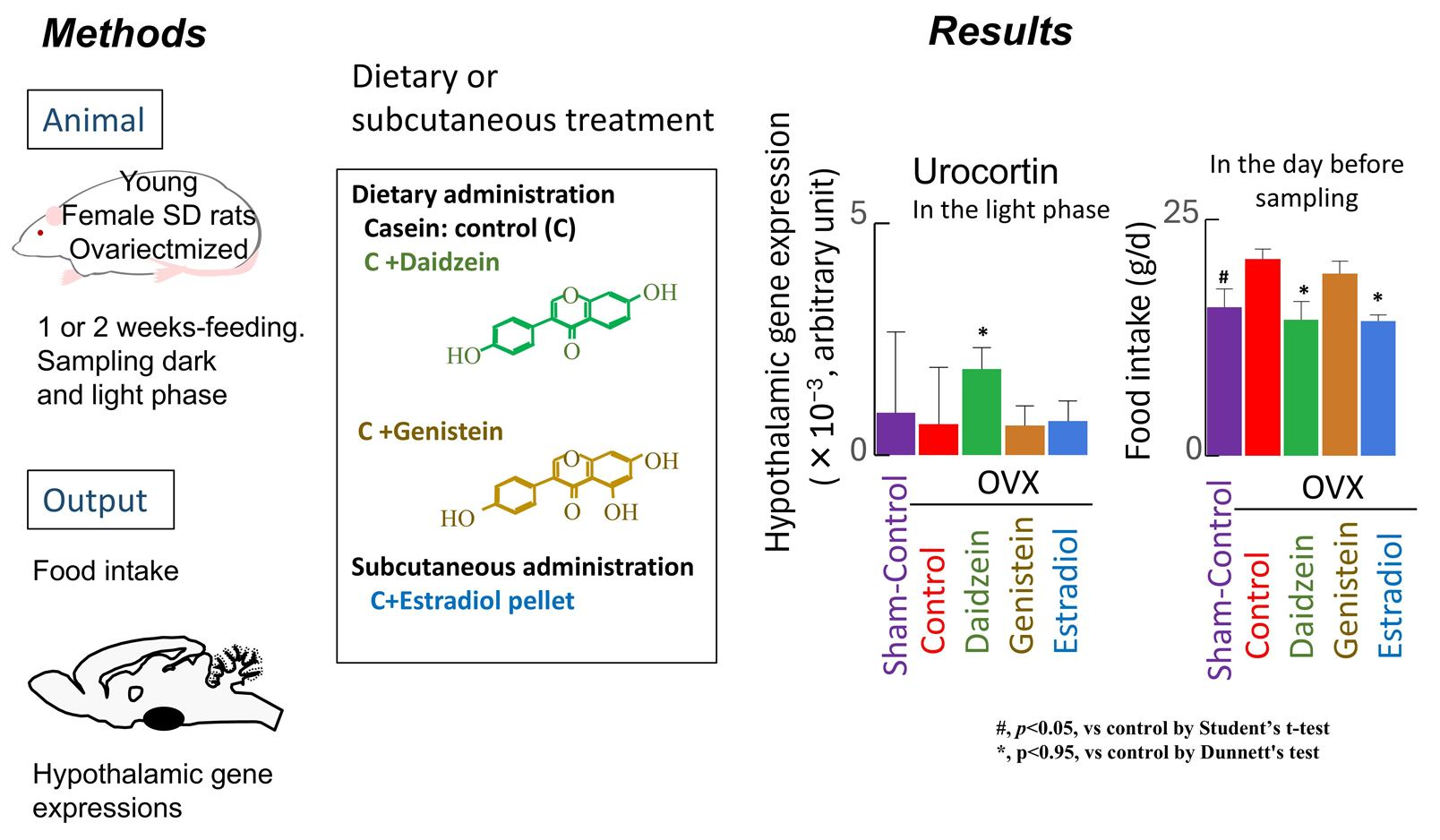
Graphical Abstract

1. Introduction

Soy isoflavones are widely recognized for their beneficial effects on metabolic health, including improvements in obesity-related parameters [1,2,3]. These physiological actions are often attributed to their structural similarity to 17β-estradiol and their ability to bind estrogen receptors. Among the major dietary isoflavones, daidzein and genistein exhibit both estrogenic and anti-estrogenic properties, yet accumulating evidence suggests that their biological activities are not identical and may involve distinct regulatory pathways.
Circadian rhythms play a fundamental role in coordinating feeding behavior, metabolism, and reproductive endocrine function [4]. Hormones of the hypothalamic–pituitary–gonadal (HPG) axis, particularly estrogen, display clear circadian patterns and influence hypothalamic neurons involved in appetite regulation [4,5]. Feeding timing itself also acts as a strong zeitgeber capable of shifting metabolic and hypothalamic gene expression [6]. Thus, disruptions in ovarian hormone signaling—such as those induced by ovariectomy—may alter both feeding rhythms and the expression of appetite-related neuropeptides [4,6].
Estrogens play a central role in the regulation of energy balance. Estradiol suppresses food intake and reduces body weight gain in both humans and rodents [7,8,9,10,11]. Ovariectomy increases feeding and body weight, whereas estradiol replacement reverses these effects, primarily through estrogen receptor-α–mediated mechanisms [8,9,10,11]. These findings highlight the importance of estrogenic signaling in the central regulation of feeding behavior.
We previously reported that dietary soy isoflavones reduce food intake in female rats but not in males, and that this anorectic effect occurs irrespective of ovarian status [12]. Furthermore, daidzein was identified as the principal isoflavone responsible for this female-specific suppression of feeding, whereas genistein did not exert comparable effects [12].
The hypothalamus integrates peripheral metabolic cues and orchestrates feeding behavior [13]. Estradiol modulates several appetite-regulating neuropeptides, including Neuropeptide Y (NPY) [14,15] and corticotropin-releasing hormone (CRH) [16]. However, the extent to which dietary isoflavones influence these neuropeptides under ad libitum feeding conditions remains unclear. Our previous study using a controlled three-meal feeding regimen demonstrated that daidzein suppressed postprandial NPY and increased CRH expression [17], but this approach may not fully reflect natural feeding patterns.
To clarify the mechanisms underlying the female-specific anorectic effect of daidzein, the present study examined how dietary daidzein and genistein influence hypothalamic appetite-regulating neuropeptides in ovariectomized (OVX) rats under ad libitum feeding conditions. Sampling was performed during both the dark and light phases to capture potential circadian differences [18,19], reflecting the possibility that daidzein’s effects may interact with circadian regulation of hypothalamic signaling. We also compared these responses with those induced by estradiol to determine whether daidzein acts through estrogen-dependent or distinct pathways.

2. Materials and Methods

2.1. Animals and Housing

Five-week-old female Sprague–Dawley rats (Japan SLC, Inc., Hamamatsu, Shizuoka, Japan) were housed individually in a temperature-controlled room (23 ± 1 °C) under a 12 h light–dark cycle with free access to food and water. All procedures were conducted in accordance with the guidelines of the Laboratory Animal Care Committee of Ehime University and were approved by the Institutional Animal Care and Use Committee of Ehime University (08A92).

2.2. Experimental Design

After a week of acclimation, rats were assigned to ovariectomy (OVX) or sham surgery. After a week of recovery, OVX rats were further divided into four groups (control diet, estradiol, daidzein, and genistein), and sham-operated rats received the control diet, when the pubertal growth spurt is largely completed in this strain [20]. This protocol, including ovariectomy at six weeks of age, follows established methods for inducing estrogen deficiency in young female rats [21] and is consistent with our previous studies using the same experimental system [12]. A placebo group was not established because the absence of an effect of the bitterness of soy isoflavones on feed intake has been confirmed by the finding that oral gavage of soy isoflavones in female rats resulted in a reduction in food intake comparable to that observed with dietary administration in our previous study [12]. Each group consisted of six animals. Prior to group allocation, all rats were weighed and ranked by body weight. Block randomization was performed by forming blocks of animals with similar body weights and randomly assigning animals within each block to ensure balanced baseline body weight across groups. Feeding duration (1 or 2 weeks) and sampling phase (dark or light) were varied across four independent experimental sets, and different animals were used for each condition. Throughout the duration of the experiment, the body weight and the weight of the food consumed were recorded every morning for each of the animals, and then the diet was replenished.

2.3. Diets and Treatments

The control diet was based on AIN-76. Daidzein or genistein (≥98% purity; FUJIFILM Wako, Osaka, Japan) was added to the diet at 150 mg/kg diet at the expense of cornstarch. Estradiol-treated rats received a slow-release estradiol-benzoate pellet (0.5 mg, 60-day release; Innovative Research of America, Sarasota, FL, USA) implanted subcutaneously.

2.4. Surgical Procedures

OVX was performed under isoflurane anesthesia. Sham rats underwent identical procedures without ovary removal.

2.5. Sample Collection

Whole hypothalamous were rapidly dissected, preserved in RNAlater® (Thermo Fisher Scientific, Waltham, MA, USA), and stored at −80 °C until analysis.

2.6. RNA Isolation and qPCR

Total RNA was extracted using the RNeasy Mini Kit (Qiagen, Hilden, Germany). cDNA was synthesized using the High-Capacity cDNA Reverse Transcription Kit (Applied Biosystems, Foster City, CA, USA). Quantitative PCR was performed using THUMDERBIRD™, SYBRqPCRmix mastermix (TOYOBO Co., Ltd., Osaka, Japan) on a StepOnePlus Real-Time PCR System (Applied Biosystems). Primer sequences are listed in Supplementary Table S1. Both GAPDH and β-actin were initially evaluated as potential reference genes; the stability under the experimental conditions was validated using BestKeeper [22], and β-actin was used as the internal control for normalization. PCR amplification consisted of 50 cycles of denaturation at 95 °C for 15 s and annealing/extension at 60 °C for 1 min, with fluorescence measured at 530 nm during the extension step. The amplification efficiency (90–110%) was determined using a ten-point serial dilution of pooled cDNA (R2 > 0.99). No-template controls were included in all runs. Relative mRNA expression was calculated using the crossing-point method normalized to β-actin and corrected for primer-specific amplification efficiency by the method previously reported [23].

2.7. Statistical Analysis

Statistical analysis is performed using two-way or three-way analysis of variance (ANOVA) with treatment, week, and phase (dark or light) as between-subject factors, as appropriate for each dataset without Sham groups. When significant main effects or interactions are detected, simple main effects are examined, and pairwise comparisons with the OVX-Control group are performed using Dunnett’s test. Comparisons between OVX-Control and Sham groups are conducted using Student’s t-test. Values are expressed as mean ± SD. Statistical analyses were performed using SPSS Statistics version 31.0.1.0 (IBM Corp., Armonk, NY, USA).

3. Results

3.1. Body Weight and Food Intake

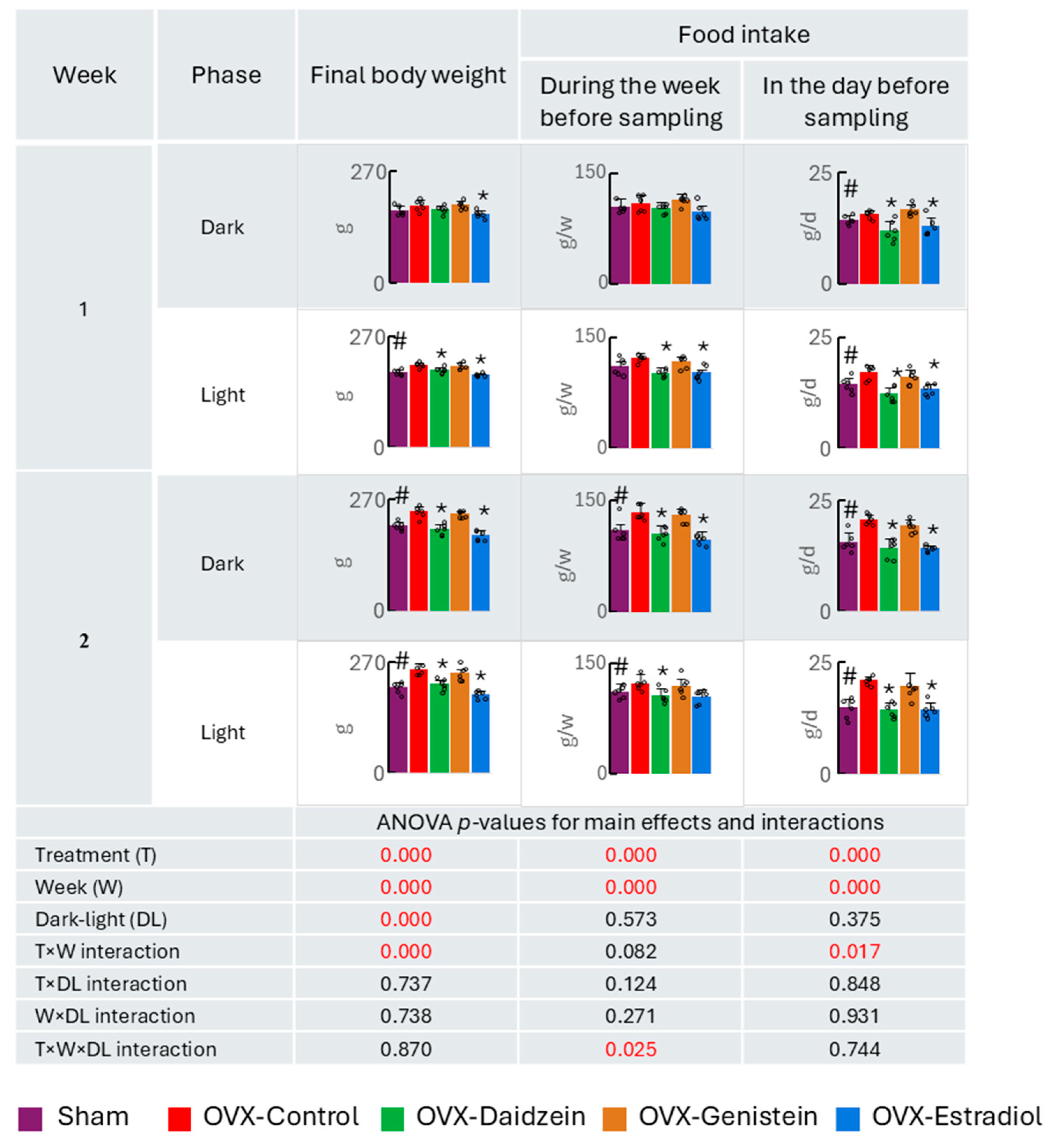
Figure 1 shows effects of daidzein, genistein, and estradiol on body weight and food intake. Two-way ANOVA revealed significant main effects of treatment and week for all these parameters, as well as significant interactions involving treatment for final body weight and food intake in the day before sampling. The dark–light effects of these parameters were examined to confirm that animals exhibited comparable feeding responses across treatments in both the dark and light phases at the time of hypothalamus sampling. Although no significant dark–light effects or interactions with other factors were expected, a significant dark–light effect was detected for final body weight. In addition, food intake during the week before sampling showed a significant three-way interaction among treatment, week, and dark–light phase. In contrast, food intake on the day before sampling showed no significant dark–light effect and no interactions with any other factors. During week 1 in the dark phase, neither the daidzein nor genistein group differed from the OVX control group in final body weight and food intake during the week before sampling, whereas the estradiol group showed significantly lower final body weight by Dunnett’s multiple comparison test. During week 1 in the light phase and during week 2 in the dark and light phases, the final body weight and food intake during the week before sampling and the day before sampling was significantly reduced in the daidzein and estradiol groups by Dunnett’s multiple comparison test, while the genistein group did not differ from the OVX control group. The OVX control group showed significantly higher final body weight than the sham-operated group under all conditions except week 1 in the dark phase by Student’s t-test. Food intake during the week before sampling was significantly higher in the OVX control group only in week 2, whereas food intake on the day before sampling was consistently higher in the OVX control group across all conditions by Student’s t-test.

3.2. Hypothalamic Neuropeptide Gene Expression

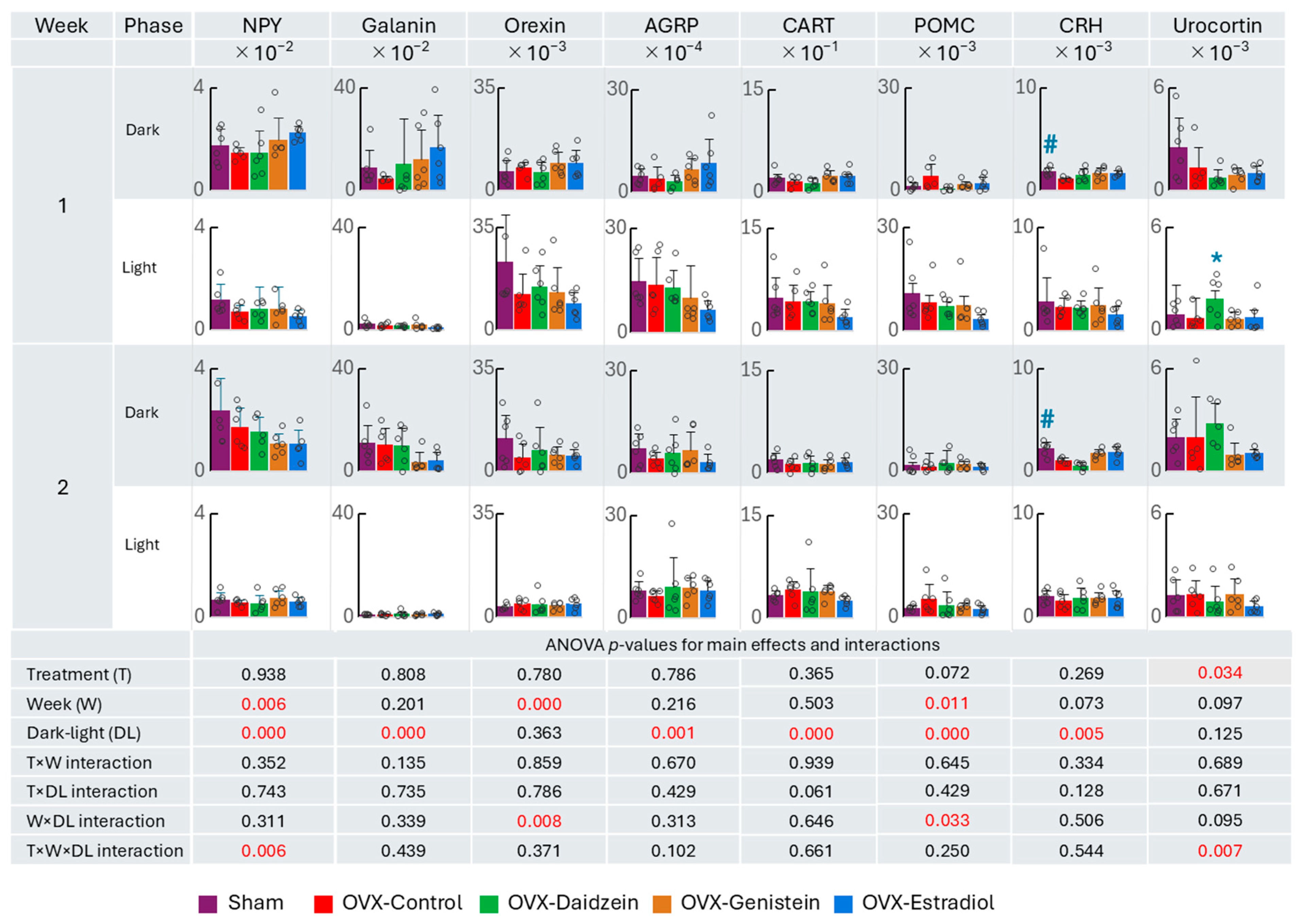
Figure 2 shows effects of daidzein, genistein, and estradiol on hypothalamic gene expression of appetite-related neuropeptide. ANOVA confirmed a significant dark–light effect, with NPY (×10−2, arbitrary unit) at 1.6 ± 0.5 in the dark phase versus 0.7 ± 0.5, p < 0.0005 in the light phase, and galanin (×10−2, arbitrary units) at 9.5 ± 0.5 versus 1.3 ± 0.5, p < 0.0005, respectively. In contrast, orexin expression did not differ between phases. Agouti-related protein (AGRP) showed the opposite pattern of NPY and galanin, with higher expression in the light phase (AGRP × 10−4, arbitrary unit: 5.5 ± 0.5 in the dark phase vs. 9.5 ± 0.5 in the light phase, p = 0.001).The anorectic peptides cocaine- and amphetamine-regulated transcript (CART), proopiomelanocortin (POMC), and CRH exhibited significantly higher expression during the light phase. CART (×10−1, arbitrary unit) was 1.7 ± 1.3 in the dark phase versus 3.7 ± 1.0 in the light phase, p < 0.0005; POMC (×10−3, arbitrary unit) was 2.1 ± 2.5 versus 5.1 ± 2.5, p < 0.0005; and CRH (×10−3, arbitrary unit) was 1.5 ± 0.5 versus 2.0 ± 0.5, p = 0.005. The sham-operated group also showed significantly higher CRH expression than the OVX control group in the dark phase of both Weeks 1 and 2 by Student’s t-test. Although the ANOVA did not show significant treatment effects, Dunnett’s test suggested modest estradiol responsiveness (week 1: p = 0.116; week 2: p = 0.013) and a weaker but similar trend for genistein (week 1: p = 0.104; week 2: p = 0.028).

3.3. Hypothalamic Urocortin Gene Expression

Among the hypothalamic neuropeptide genes examined, a significant treatment × week × phase interaction was detected by Two-way ANOVA. Urocortin was significantly increased only in the OVX-Daidzein group during the light phase of week 1 by Dunnett’s multiple comparison test (Figure 2).

4. Discussion

4.1. Effects of Ovariectomy and Daidzein on Feeding Behavior

In line with our previous findings [12], ovariectomy in the present study led to increases in both food intake and body weight, whereas dietary daidzein and estradiol administration attenuated these effects, and genistein had no influence on feeding behavior. Ovariectomy increased food intake and body weight, confirming the role of ovarian hormones in energy balance [7,8,9,10,11]. As anticipated, these responses were more pronounced during the second week than during the first week of the experimental period. Although rats exhibit crepuscular tendencies, Sprague–Dawley rats, in the present study, maintained under a standard 12:12 light–dark cycle showed clear diurnal patterns in locomotor activity, feeding behavior, and hypothalamic neuropeptide expression [24,25,26], indicating that the distinction between light- and dark-phase sampling is appropriate for evaluating diurnal regulation in this strain. Importantly, food intake on the day immediately preceding sampling showed consistent responses to ovariectomy and the respective treatments across both phases and weeks, indicating that short-term feeding status is a reliable indicator of the animals’ metabolic condition at the time of tissue collection. This consistency allowed us to examine how pre-sampling food intake may interact with hypothalamic gene expression.

4.2. Diurnal Regulation of Hypothalamic Neuropeptides

The diurnal patterns observed in neuropeptide expression—elevated NPY and galanin during the dark phase and higher CART, POMC, and CRH during the light phase—were consistent with established circadian regulation of orexigenic and anorexigenic signaling [18,19]. These rhythms likely represent a dominant regulatory influence that can override more subtle modulatory effects of dietary phytoestrogens. AGRP expression showed an inverse pattern to NPY, and orexin expression remained unchanged, further supporting the idea that intrinsic circadian cues strongly shape hypothalamic neuropeptide dynamics [24].
The absence of daidzein- or genistein-induced changes in neuropeptide expression under ad libitum feeding conditions suggests that phytoestrogen effects on hypothalamic signaling may require specific metabolic contexts. In our previous meal-feeding study, daidzein suppressed postprandial NPY and increased CRH expression [17], indicating that phytoestrogens can modulate hypothalamic pathways when animals experience a clear fasting–refeeding transition. Under ad libitum conditions, however, such transitions are blunted, resulting in attenuated fluctuations in peripheral metabolic hormones such as insulin, leptin, and ghrelin [27,28]. These attenuated hormonal cues may limit the ability of phytoestrogens to influence downstream hypothalamic circuits, making circadian phase-dependent changes more prominent than treatment effects [29,30].
Taken together, these findings suggest that the mechanisms by which daidzein and genistein affect feeding behavior and hypothalamic gene expression are highly dependent on metabolic state and circadian phase. Phytoestrogen actions may emerge most clearly when hypothalamic circuits are in a dynamic, hormonally responsive state—such as during the postprandial period [31]—whereas under stable ad libitum feeding, circadian regulation becomes the predominant driver of neuropeptide expression. Under these conditions, the factors discussed in the following paragraph are likely to function as secondary modulators that shape the observed expression patterns, rather than as primary determinants of the phytoestrogenic mechanism itself [32].

4.3. Estradiol-Related Neuropeptide Responses

Estradiol tended to increase CRH expression and decrease NPY expression, a pattern consistent with its well-established anorexigenic actions [14,15,16] and with previous reports showing that estrogen enhances catabolic CRH signaling while suppressing orexigenic pathways [33]. These findings support the view that estradiol enhances hypothalamic catabolic signaling while suppressing orexigenic drive. In the present study, although CRH expression was reduced in OVX rats only in samples collected during the dark phase, the modest estradiol-responsive trend observed in both weeks suggests that CRH remains sensitive to estrogenic status even when whole-hypothalamus measurements dilute nucleus-specific effects, consistent with evidence that estrogen directly regulates CRH gene transcription [34]. The similarly low p-values observed for genistein, despite its lack of behavioral effects, further indicate that CRH responsiveness reflects estrogenic signaling per se rather than a direct driver of feeding behavior. In contrast, daidzein did not alter CRH expression, implying that its anorectic-like effects observed in other contexts are unlikely to be mediated through CRH-dependent pathways.
Regarding NPY, the absence of treatment effects in the present study likely reflects the anatomical heterogeneity of hypothalamic NPY expression. NPY is predominantly expressed in the arcuate nucleus (ARC) but is also present in the paraventricular nucleus (PVN) and ventromedial nucleus (VMN), and ovariectomy has been shown to differentially regulate NPY across these nuclei, with PVN-specific increases reported despite unchanged whole-hypothalamus levels [35], a pattern consistent with nucleus-specific estrogenic regulation [36]. Thus, nucleus-specific regulation may have been masked in our sampling approach. Importantly, our previous meal-feeding study demonstrated that daidzein suppressed whole-hypothalamus NPY expression, suggesting that daidzein may modulate NPY through metabolic-state-dependent mechanisms distinct from classical estrogenic signaling. This interpretation aligns with evidence that phytoestrogenic actions on neuroendocrine and metabolic pathways are strongly influenced by metabolic and hormonal context [37]. Under the ad libitum conditions of the present study, such mechanisms may not have been engaged, explaining the absence of daidzein-induced changes in NPY expression.

4.4. Selective Induction of Urocortin by Daidzein

A novel and central finding of this study is that urocortin was the only neuropeptide selectively upregulated by daidzein. This increase occurred specifically during the light phase of week 1, coinciding with the period in which daidzein produced the strongest reduction in food intake. Urocortin is a potent anorectic peptide acting through CRH2 receptors and is regulated differently from CRH [38], suggesting that daidzein engages a distinct neuroendocrine pathway. The phase-specific responsiveness is consistent with evidence that OVX rats exhibit heightened metabolic sensitivity during the light phase [39]. The selective activation of urocortin by daidzein—but not by estradiol or genistein—highlights a unique mechanism underlying daidzein’s anorectic effect. The absence of similar effects with genistein further underscores the structural and functional specificity of daidzein among dietary isoflavones [40]. Together, these findings indicate that daidzein reduces food intake through a mechanism distinct from classical estrogenic signaling, potentially involving selective activation of hypothalamic urocortin during the light phase. Our previous findings showed that the anorectic effects of dietary daidzein and equol depend on delayed gastric emptying, as food intake was reduced only when gastric contents were retained [41]. This physiological profile aligns with the established actions of centrally administered urocortin peptides, particularly urocortin 2, which delay gastric emptying via CRH2-dependent pathways [42]. Given this, the daidzein-induced increase in hypothalamic urocortin observed in the present study may contribute to reduced food intake by promoting gastric retention. Thus, daidzein may suppress feeding through a urocortin-mediated delay in gastric emptying, linking its central and peripheral actions within a unified mechanism. Further studies using nucleus-specific analyses or controlled feeding paradigms are warranted to elucidate the neural circuits involved.

5. Conclusions

Daidzein reduces food intake and body weight gain in female OVX rats through a mechanism independent of classical estrogenic pathways. The selective induction of hypothalamic urocortin during the light phase represents a novel neuroendocrine mechanism underlying daidzein’s anorectic action.

Supplementary Materials

The following supporting information can be downloaded at https://www.mdpi.com/article/10.3390/nutraceuticals6010014/s1: Table S1: The primers used for reverse transcription-polymerase chain reaction (RT-PCR) analysis; Table S2: Effects of daidzein, genistein and estradiol on initial and final body weight and food intake.

Author Contributions

Conceptualization, T.K. and T.M.; Methodology, T.M., M.N. and T.K.; Formal analysis, T.M. and M.N.; Investigation, T.M., M.N. and J.B.; Resources, T.K.; Data curation, T.K.; Writing—original draft preparation, T.K.; Writing—review and editing, T.K., T.M. and J.B.; Visualization, T.M.; Supervision, T.K.; Project administration, T.K.; Funding acquisition, T.K. All authors have read and agreed to the published version of the manuscript.

Funding

Supported by the Fuji Foundation for Protein Research, and a Grant-in-Aid for Scientific Research from MEXT Japan (16780093).

Institutional Review Board Statement

Approved by the Institutional Animal Care and Use Committee of Ehime University (08A92), 31 May 2023.

Informed Consent Statement

Not applicable.

Data Availability Statement

Available from the corresponding author upon reasonable request.

Acknowledgments

mRNA expression measurements were performed at the Integrated Center for Science, Tarumi, Ehime University. During the preparation of this manuscript, the author used Microsoft Copilot (ver. 1.25121.84.0; Microsoft Corporation) for the purposes of language editing and text refinement. The authors have reviewed and edited the output and take full responsibility for the content of this publication.

Conflicts of Interest

The authors declare no conflicts of interest.

Abbreviations

The following abbreviations are used in this manuscript:
AGRPAgouti-related peptide
ARCArcuate nucleus
CARTCocaine- and amphetamine-regulated transcript
CRHCorticotropin-releasing hormone
ERαEstrogen receptor alpha
NPYNeuropeptide Y
OVXOvariectomized
POMCProopiomelanocortin
PVNParaventricular nucleus
VMNVentromedial nucleus

References

  1. Setchell, K.D.R. Phytoestrogens: The biochemistry, physiology, and implications for human health of soy phytoestrogens. Am. J. Clin. Nutr. 1998, 68, 1333S–1348S. [Google Scholar]
  2. Bhathena, S.J.; Velasquez, M.T. Beneficial role of dietary phytoestrogens in obesity and diabetes. Am. J. Clin. Nutr. 2002, 76, 1191–1201. [Google Scholar] [CrossRef] [PubMed]
  3. Sato, Y.; Higuchi, A.; Pan, W. Effects of a daidzein-rich isoflavone aglycone extract on body composition in overweight premenopausal Japanese women. Clin. Exp. Pharmacol. Physiol. 2007, 34, S76–S78. [Google Scholar] [CrossRef]
  4. Shao, S.; Zhao, H.; Lu, Z.; Lei, X.; Zhang, Y. Circadian Rhythms Within the Female HPG Axis: From Physiology to Etiology. Endocrinology 2021, 162, bqab117. [Google Scholar] [CrossRef] [PubMed]
  5. Shanmugam, D.A.S.; Balaraman, A.D.; Kar, A.; Franco, A.; Balaji, B.A.C.; Meenakumari, S.; Praveenkumar, P.K.; Gayathri, R.; Ganesan, V.K.; Kumar, M.V.; et al. Mini review: Bidirectional Regulation of Circadian Rhythm by Suprachiasmatic Nucleus and Nuclear Receptors in Female Mammals. J. Circadian Rhythms 2025, 23, 4. [Google Scholar] [CrossRef]
  6. Smith, H.A.; Betts, J.A. Circadian rhythms, feeding patterns and metabolic regulation: Implications for critical care. Proc. Nutr. Soc. 2024, 1–5. [Google Scholar] [CrossRef]
  7. Geary, N. Estradiol, CCK and satiation. Peptides 2001, 22, 1251–1263. [Google Scholar] [CrossRef]
  8. Lyons, P.M.; Truswell, A.S.; Mira, M.; Vizzard, J.; Abraham, S.F. Reduction of food intake in the ovulatory phase of the menstrual cycle. Am. J. Clin. Nutr. 1989, 49, 1164–1168. [Google Scholar] [CrossRef]
  9. Gong, E.J.; Garrel, D.; Calloway, D.H. Menstrual cycle and voluntary food intake. Am. J. Clin. Nutr. 1989, 49, 252–258. [Google Scholar] [CrossRef]
  10. Wade, G.N. Some effects of ovarian hormones on food intake and body weight in female rats. J. Comp. Physiol. Psychol. 1975, 88, 183–193. [Google Scholar] [CrossRef]
  11. Geary, N.; Asarian, L. Cyclic estradiol treatment normalizes body weight and test meal size in ovariectomized rats. Physiol. Behav. 1999, 67, 141–147. [Google Scholar] [CrossRef] [PubMed]
  12. Fujitani, M.; Mizushige, T.; Adhikari, S.; Bhattarai, K.; Kishida, T. Mechanism of Soy Isoflavone Daidzein-Induced Female-Specific Anorectic Effect. Metabolites 2022, 12, 252. [Google Scholar] [CrossRef]
  13. Schwartz, M.W.; Woods, S.C.; Porte, D., Jr.; Seeley, R.J.; Baskin, D.G. Central nervous system control of food intake. Nature 2000, 404, 661–671. [Google Scholar] [CrossRef]
  14. Bonavera, J.J.; Dube, M.G.; Kalra, S.P.; Kalra, P.S. Anorectic effects of estrogen may be mediated by decreased neuropeptide-Y release in the hypothalamic paraventricular nucleus. Endocrinology 1994, 134, 2367–2370. [Google Scholar] [CrossRef]
  15. Shimizu, H.; Ohtani, K.; Mori, M.; Kato, Y.; Tanaka, Y. Withdrawal of estrogen increases hypothalamic neuropeptide Y mRNA expression in ovariectomized obese rats. Neurosci. Lett. 1996, 204, 81–84. [Google Scholar] [CrossRef] [PubMed]
  16. McEwen, B.S.; Alves, S.E. Estrogen actions in the central nervous system. Endocr. Rev. 1999, 20, 279–307. [Google Scholar] [CrossRef]
  17. Fujitani, M.; Mizushige, T.; Bhattarai, K.; Iwahara, A.; Aida, R.; Segawa, T.; Kishida, T. Dynamics of appetite-mediated gene expression in daidzein-fed female rats in the meal-feeding method. Biosci. Biotechnol. Biochem. 2015, 79, 1342–1349. [Google Scholar] [CrossRef]
  18. Cedernaes, J.; Waldeck, N.; Bass, J. Neurogenetic basis for circadian regulation of metabolism by the hypothalamus. Genes Dev. 2019, 33, 1136–1158. [Google Scholar] [CrossRef]
  19. Douglass, A.M.; Kucukdereli, H.; Madara, J.C.; Wang, D.; Wu, C.; Lowenstein, E.D.; Tao, J.; Lowell, B.B. Acute and circadian feedforward regulation of agouti-related peptide hunger neurons. Cell Metab. 2025, 37, 708–722. [Google Scholar] [CrossRef]
  20. Ojeda, S.R.; Urbanski, H.F. Puberty in the rat. In Knobil and Neill’s Physiology of Reproduction; Knobil, E., Neill, J.D., Eds.; Academic Press: Cambridge, MA, USA, 1994; pp. 363–409. [Google Scholar]
  21. Kalu, D.N. The ovariectomized rat model of postmenopausal bone loss. Bone Miner. 1991, 15, 175–191. [Google Scholar] [CrossRef] [PubMed]
  22. Pfaffl, M.W.; Tichopad, A.; Prgomet, C.; Neuvians, T.P. Determination of stable housekeeping genes, differentially regulated target genes and sample integrity: BestKeeper-Excel-based tool using pair-wise correlations. Biotechnol. Lett. 2004, 26, 509–515. [Google Scholar] [CrossRef]
  23. Pfaffl, M.W. A new mathematical model for relative quantification in real-time RT-PCR. Nucleic Acids Res. 2001, 29, e45. [Google Scholar] [CrossRef]
  24. Kalsbeek, A.; la Fleur, S.; Fliers, E. Circadian control of glucose metabolism. Mol. Metab. 2014, 3, 372–383. [Google Scholar] [CrossRef]
  25. Sato, T.; Sato, S. Circadian Regulation of Metabolism: Commitment to Health and Diseases. Endocrinology 2023, 164, bqad086. [Google Scholar] [CrossRef]
  26. Van Drunen, R.; Eckel-Mahan, K. Circadian Rhythms of the Hypothalamus: From Function to Physiology. Clocks Sleep 2021, 3, 189–226. [Google Scholar] [CrossRef] [PubMed]
  27. Cummings, D.E.; Frayo, R.S.; Marmonier, C.; Aubert, R.; Chapelot, D. Plasma ghrelin levels and hunger scores in humans initiating meals voluntarily without time- and food-related cues. Am. J. Physiol. Endocrinol. Metab. 2004, 287, E297–E304. [Google Scholar] [CrossRef] [PubMed]
  28. Morton, G.J.; Meek, T.H.; Schwartz, M.W. Neurobiology of food intake in health and disease. Nat. Rev. Neurosci. 2014, 15, 367–378. [Google Scholar] [CrossRef]
  29. Zhang, L.; Hernandez-Sanchez, D.; Herzog, H. Regulation of Feeding-Related Behaviors by Arcuate Neuropeptide Y Neurons. Endocrinology 2019, 160, 1411–1420. [Google Scholar] [PubMed]
  30. Jang, M.; Romsos, D.R. Neuropeptide Y and corticotropin-releasing hormone concentrations within specific hypothalamic regions of lean but not Ob/ob mice respond to food deprivation and refeeding. J. Nutr. 1998, 128, 2520–2525. [Google Scholar] [CrossRef]
  31. Vasudevan, N.; Pfaff, D.W. Non-genomic actions of estrogens and their interaction with genomic actions in the brain. Front. Neuroendocrinol. 2008, 29, 238–257. [Google Scholar] [CrossRef]
  32. Hastings, M.H.; Maywood, E.S.; Brancaccio, M. The Mammalian Circadian Timing System and the Suprachiasmatic Nucleus as Its Pacemaker. Biology 2019, 8, 13. [Google Scholar] [CrossRef]
  33. Asarian, L.; Geary, N. Modulation of appetite by gonadal steroid hormones. Philos. Trans. R. Soc. Lond. B Biol. Sci. 2006, 361, 1251–1263. [Google Scholar] [CrossRef]
  34. Vamvakopoulos, N.C.; Chrousos, G.P. Evidence of direct estrogenic regulation of human corticotropin-releasing hormone gene expression. Potential implications for the sexual dimophism of the stress response and immune/inflammatory reaction. J. Clin. Investig. 1993, 92, 1896–1902. [Google Scholar] [CrossRef]
  35. Ainslie, D.A.; Morris, M.J.; Thorburn, A.W.; Wittert, G.; Turnbull, H.; Proietto, J. Estrogen deficiency causes central leptin insensitivity and increased hypothalamic neuropeptide Y. Int. J. Obes. 2001, 25, 1680–1688. [Google Scholar] [CrossRef]
  36. Xu, M.; Urban, J.H.; Hill, J.W.; Levine, J.E. Regulation of hypothalamic neuropeptide Y Y1 receptor gene expression during the estrous cycle: Role of progesterone receptors. Endocrinology 2000, 141, 3319–3327. [Google Scholar] [CrossRef]
  37. Cederroth, C.R.; Nef, S. Soy, phytoestrogens and metabolism: A review. Mol. Cell. Endocrinol. 2009, 304, 30–42. [Google Scholar] [CrossRef] [PubMed]
  38. McCosh, R.B.; O’Bryne, K.T.; Karsch, F.J.; Breen, K.M. Regulation of the gonadotropin-releasing hormone neuron during stress. J. Neuroendocrinol. 2022, 34, e13098. [Google Scholar] [CrossRef] [PubMed]
  39. Cardoso, T.S.R.; Horta, N.A.C.; Fernandes, P.; Araújo, F.M.; Luciano, P.L.C.; Cardoso, T.M.; Drummond, L.R.; Coimbra, C.C.; Poletini, M.O. Light phase feeding and estradiol reverse ovariectomy-induced alterations in metabolism and liver clock gene expression in rats. Biogerontology 2025, 26, 163. [Google Scholar] [CrossRef] [PubMed]
  40. Chang, H.C.; Churchwell, M.I.; Doerge, D.R.; Delclos, K.B.; Newbold, R.R. Mass spectrometric determination of genistein tissue distribution in diet-exposed Sprague-Dawley rats. J. Nutr. 2000, 130, 1963–1970. [Google Scholar]
  41. Adhikari, S.; Bhattarai, K.; Abe, Y.; Kira, M.; Fujitani, M.; Miyada, T.; Kishida, T. Dietary daidzein decreases food intake accompanied with delayed gastric emptying in ovariectomized rats. Biosci. Biotechnol. Biochem. 2020, 84, 1232–1238. [Google Scholar] [CrossRef]
  42. Czimmer, J.; Million, M.; Taché, Y. Urocortin 2 acts centrally to delay gastric emptying through sympathetic pathways while CRF and urocortin 1 inhibitory actions are vagal dependent in rats. Am. J. Physiol. Gastrointest. Liver Physiol. 2006, 290, G511–G518. [Google Scholar] [CrossRef] [PubMed]
Figure 1. Effects of daidzein, genistein, and estradiol on body weight and food intake in ovariectomized female rats. Final body weight, food intake during the week before sampling, and food intake on the day before sampling in ovariectomized rats fed the control diet (OVX-Control), daidzein diet (OVX-Daidzein), genistein diet (OVX-Genistein), or control diet with estradiol administration (OVX-Estradiol), and in sham-operated rats (Sham) for 1 or 2 weeks. The y-axis represents the relative gene expression normalized to the housekeeping gene β-actin (arbitrary units). Values are means ± SD (bars and capped lines, n = 6) and individual values (open circles). Statistical significance was assessed by mixed-design ANOVA followed by Dunnett’s test. Mixed-design ANOVA p-values < 0.05 are shown in red. The asterisk (*) indicates p ≤ 0.05 vs. OVX-Control (Dunnett’s test). The hash mark (#) indicates p ≤ 0.05 vs. OVX-Control (Student’s t-test).
Nutraceuticals 06 00014 g001
Figure 2. Hypothalamic expression of appetite-related neuropeptides during the dark and light phases. Expression levels of orexigenic (NPY, galanin, orexin, AGRP) and anorexigenic (CART, POMC, CRH, urocortin) neuropeptides in ovariectomized rats fed the control diet (OVX-Control), daidzein diet (OVX-Daidzein), genistein diet (OVX-Genistein), or control diet with estradiol administration (OVX-Estradiol), and in sham-operated rats (Sham) for 1 or 2 weeks. The y-axis represents the relative gene expression normalized to the housekeeping gene β-actin (arbitrary units). Values are means ± SD (bars and capped lines, n = 6) and individual values (open circles). Statistical significance was assessed by mixed-design ANOVA followed by Dunnett’s test. Mixed-design ANOVA p-values < 0.05 are shown in red. The asterisk (*) indicates p ≤ 0.05 vs. OVX-Control (Dunnett’s test). The hash mark (#) indicates p ≤ 0.05 vs. OVX-Control (Student’s t-test).
Nutraceuticals 06 00014 g002
Disclaimer/Publisher’s Note: The statements, opinions and data contained in all publications are solely those of the individual author(s) and contributor(s) and not of MDPI and/or the editor(s). MDPI and/or the editor(s) disclaim responsibility for any injury to people or property resulting from any ideas, methods, instructions or products referred to in the content.