Over Two Million Life-Years at Risk: Why Gaza’s Health Reconstruction Is a Moral Imperative

 ,
,  ,
,  ,
,  and
and
Highlights
- The concept of Healthocide frames the systematic destruction of healthcare infrastructure, workforce, and services in Gaza as a deliberate determinant of population health collapse.
- The resulting disruption to care, disease prevention, and survival conditions has already led to an estimated loss of over three million life-years since October 2023.
- Quantifying life-years lost reframes the destruction of healthcare systems as a measurable population health crisis, allowing the scale of harm to be evaluated using public health metrics.
- Introducing Healthogenesis provides a structured framework for rebuilding health systems in post-conflict settings through equity-driven, locally defined strategies.
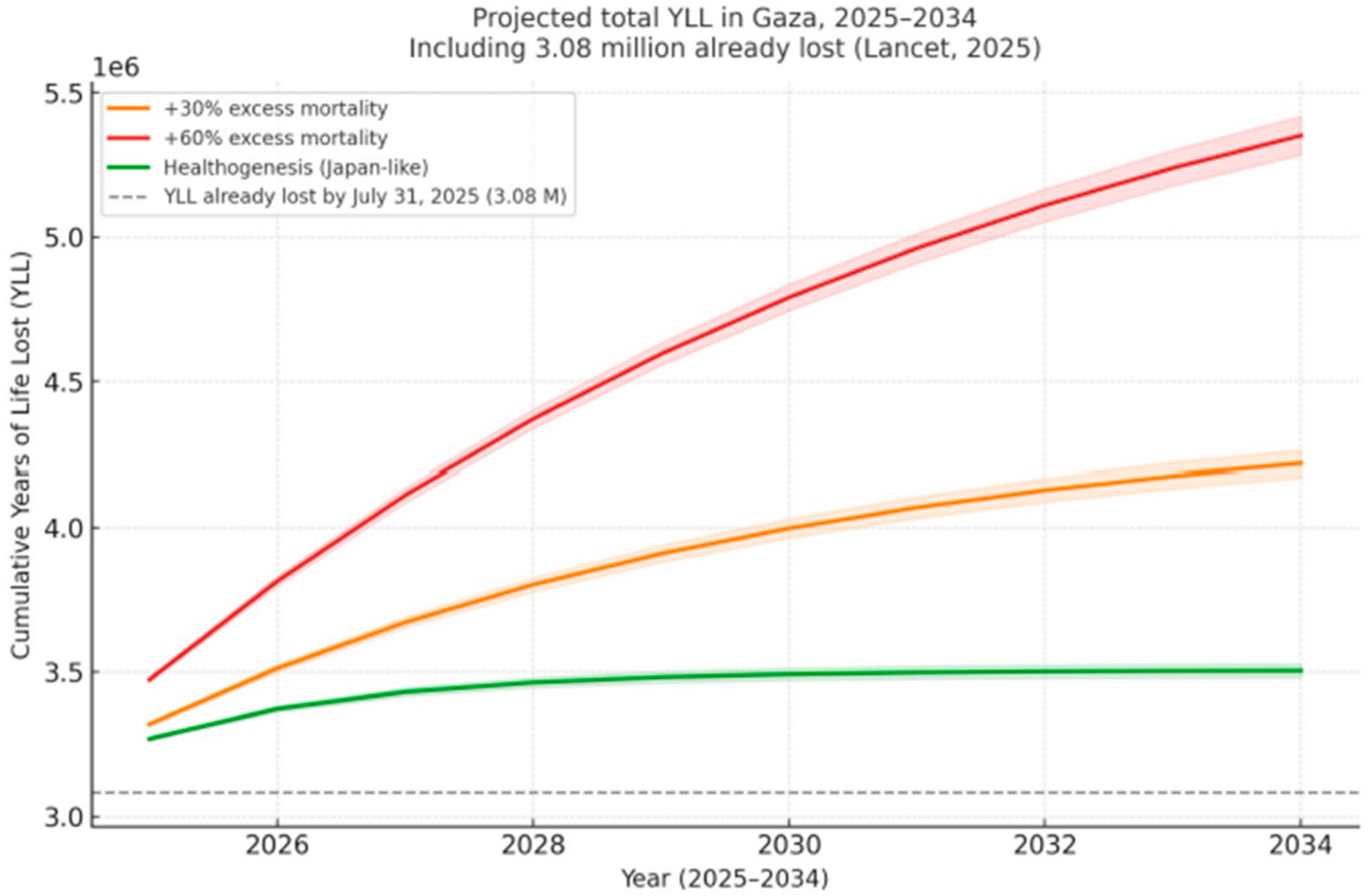
- Without immediate, coordinated reconstruction of Gaza’s health system, projections suggest an additional 1.1–2.2 million life-years could be lost over the next decade.
- International health actors should shift from agenda-setting roles to enabling Palestinian-led Healthogenesis, supporting sustainable, locally governed health system recovery.
Abstract
1. Introduction: Naming the Destruction to Guide the Response
2. Healthocide and Medical Neutrality
3. From Condemnation to Reconstruction: The Case for Healthogenesis
3.1. Principles to Guide Reconstruction
- Local leadership comes first. Palestinian institutions set priorities, timelines, and standards; donors and societies follow these, not the other way around.
- Universality and equity. Inclusive access—especially for children, persons with disabilities, and impoverished households—ensures the rebuilt system does not entrench new inequalities.
- Genuine Healthogenesis, as understood within a public health framework, extends far beyond simple restoration of clinical services. The social determinants of health, such as housing, food security, access to clean drinking water, education, community cohesion, a stable economy, and other conditions for a sustainable peace, account for the greatest impact on population health and cannot realistically be extracted from any credible reconstruction agenda. A truly “healthogenic” response in Gaza must, therefore, simultaneously include all of these domains, recognizing that rebuilding hospitals can in no way compensate for the horrors of families living amongst the rubble of their previous homes, children having no access to schools, or populations having no access to safe drinking water. While the recreation of a health system is a critical starting point of reconstruction, it is not, by itself, sufficient to address all recovery needs. Rather than treating health in isolation, international donors should support a comprehensive recovery where Palestinian-led institutions determine the priorities for long-term community resilience and socio-economic stability.
- We acknowledge that framing this work around the term Healthogenesis, when its scope is mainly focused on health system infrastructure, invites the legitimate question of whether the terminology exaggerates the breadth of the intervention described. We deliberately chose to keep the term for two reasons. For consistency of the emerging term Healthocide, but also because naming the response at the level of health, instead of medicine alone, maintains the moral and political ambition that true reconstruction actually demands. Narrowing the language to Medicide and Medogenesis would risk reducing what is fundamentally a population health crisis to a technical exercise in facility repair and workforce re-establishment. It is the obligation of health professionals, medical societies, and donors to not simply rebuild what was destroyed, but to create the conditions in which health, as defined by the WHO Constitution [16], again becomes possible.
- Transparency and accountability. Open metrics and public reporting turn compassion into measurable recovery and maintain public trust.
3.2. A Minimum Reconstruction Package: From Principle to Practice
- Building on our original framework and stakeholder feedback, we outline a minimum package that any donor or society can support under Palestinian leadership [7].
- Workforce rebuilding and protected training pathways—Multi-year training partnerships and credentialing (blended/Arabic curricula), train-the-trainer programmes embedded in local departments, funded return guarantees, and rapid re-licencing. Metrics: Trainees returning to posts; trainers certified; and annual retention.
- Restoration of essential services with equity guardrails—Priority corridors for emergency care, maternal–child health, oncology, dialysis, trauma, and rehabilitation with coverage targets by governorate (e.g., time to first oncology intake; 30-/90-day continuity). Metrics: Median wait time; continuity percentages; and backlog clearance.
- Rehabilitation and long-term disability care—Expand inpatient and community rehabilitation, prosthetics, pain management, and tele-rehabilitation pilots; secure supplies, and maintenance. Metrics: Functional outcomes; device uptime; and rehabilitation bed availability.
- Health information, registries, and audit culture—Essential trauma, rehabilitation, oncology, and NCD registries with monthly facility readiness reports and open-access dashboards. Metrics: Registry completeness; readiness scores; and stockout days.
- WHO-compliant procurement and maintenance—Standardized donation kits; biomedical engineering training for local technicians; and maintenance budgets as a fixed proportion of donations. Metrics: Maintenance adherence; mean time to repair; and % donations meeting WHO guidance.
- Mental health and psychosocial recovery—Integrated MHPSS for Gaza civilians and Israeli communities traumatized by the war. Metrics: Coverage and follow-up, as well as integration into primary care.
- Regional collaboration and twinning—Structured twinning programmes with hospitals in Egypt, Jordan, and Lebanon; short-cycle specialist rotations; and regional examination centres when it is safe. Metrics: Rotation weeks; credentials awarded; and twinning outputs.
4. Governance: A Co-Chaired Global Working Table
5. Measuring Progress: An Open-Accountability Dashboard
6. Limitations
7. A Profession’s Responsibility Beyond Gaza
8. Conclusions: From Betrayal to Renewal
Author Contributions
Funding
Institutional Review Board Statement
Informed Consent Statement
Data Availability Statement
Conflicts of Interest
References
- Abi-Rached, J.M.; Sharara, A.I.; Nasrallah, M.P.; Abiad, F. Healthocide and medical neutrality: A call for action and reflection. BMJ Glob. Health 2025, 10, e018656. [Google Scholar] [CrossRef] [PubMed]
- Abbasi, K. Where genocide, healthocide, and atrocities start, medical neutrality ends. BMJ 2025, 391, r2120. [Google Scholar] [CrossRef]
- World Health Organization (WHO). Public Health Situation Analysis (PHSA) [Internet]. 2025. Available online: https://cdn.who.int/media/docs/default-source/documents/emergencies/who-phsa-opt-100925.pdf?sfvrsn=367c45e4_1 (accessed on 1 February 2026).
- World Health Organization (WHO). Gaza’s Many Injured Will Need Rehabilitation Care and Support for Years to Come, WHO Report [Internet]. 2025. Available online: https://www.emro.who.int/opt/news/gazas-many-injured-will-need-rehabilitation-care-and-support-for-years-to-come-who-report.html (accessed on 1 February 2026).
- Zahran, R.; Abu-Sittah, G. Over three million life-years lost in Gaza. Lancet 2025, 406, e1234–e1235. [Google Scholar] [CrossRef] [PubMed]
- UNOCHA Reported Impact Snapshot—Gaza Strip (29 Oct 2025). Available online: https://www.ochaopt.org/content/reported-impact-snapshot-gaza-strip-29-october-2025 (accessed on 1 February 2026).
- Vitale, A.; Abu Hilal, M.; Gumbs, A.A.; Cillo, U.; Frigerio, I. Gaza’s healthocide: Medical societies must not stay silent. Lancet 2025, 406, 1467–1468. [Google Scholar] [CrossRef] [PubMed]
- Minhas, R.; Shellah, D.; Maynard, N.; Goodwin-Gill, G.; Chalmers, I.; Feder, G. Medicine’s reckoning with genocide and crimes against humanity. BMJ 2025, 391, r2277. [Google Scholar] [CrossRef] [PubMed]
- Guillot, M.; Draidi, M.; Cetorelli, V.; Monteiro Da Silva, J.H.C.; Lubbad, I. Life expectancy losses in the Gaza Strip, Oct 2023–Sept 2024. Lancet 2025, 405, 478–485. [Google Scholar] [CrossRef] [PubMed]
- WHOEMRO. Gaza’s Many Injured Will Need Rehabilitation Care and Support for Years to Come; WHOEMRO: Cairo, Egypt, 2025. [Google Scholar]
- Horiuchi, S. Major causes of the rapid longevity extension in post-war Japan. Jpn. J. Popul. 2011, 9, 162–171. [Google Scholar] [PubMed]
- Pris, B.; Karakaya, S. The Phoenix Factor Applied to Civil Wars: The Long-Term Public Health Effects of Civil War (2011). APSA 2011 Annual Meeting. SSRN [Internet]. 2011. Available online: https://papers.ssrn.com/sol3/papers.cfm?abstract_id=1900653 (accessed on 1 February 2026).
- Dewachi, O.; Skelton, M.; Nguyen, V.K.; Fouad, M.F.; Ghassan, A.S.; Zeina, M. Changing therapeutic geographies of the Iraqi and Syrian wars. Lancet 2014, 383, 449–457. [Google Scholar] [CrossRef] [PubMed]
- AlKarim, T.; Abbara, A.; Attal, B. Armed conflict alone does not explain the devastation of Yemen’s health system. BMJ Glob. Health 2021, 6, e004740. [Google Scholar] [CrossRef] [PubMed]
- Coghlan, B.; Brennan, R.J.; Ngoy, P.; Dofara, D.; Otto, B.; Clements, M.; Stewart, T. Mortality in the Democratic Republic of Congo: A nationwide survey. Lancet 2006, 367, 44–51. [Google Scholar] [CrossRef] [PubMed]
- World Health Organization. Constitution of the World Health Organization; WHO: Geneva, Switzerland, 1948. [Google Scholar]
- Niu, H.; Bedggood, M.; Jenkins, M.; Pathan, S.; Saeed, D.; Jureidini, J. Genocide in Gaza: Moral and ethical failures of medical institutions. Lancet 2025, 405, 2271–2272. [Google Scholar] [CrossRef] [PubMed]

Disclaimer/Publisher’s Note: The statements, opinions and data contained in all publications are solely those of the individual author(s) and contributor(s) and not of MDPI and/or the editor(s). MDPI and/or the editor(s) disclaim responsibility for any injury to people or property resulting from any ideas, methods, instructions or products referred to in the content. |
© 2026 by the authors. Licensee MDPI, Basel, Switzerland. This article is an open access article distributed under the terms and conditions of the Creative Commons Attribution (CC BY) license.
Share and Cite
Vitale, A.; Abu Hilal, M.; Cillo, U.; Frigerio, I.; Gumbs, A.A. Over Two Million Life-Years at Risk: Why Gaza’s Health Reconstruction Is a Moral Imperative. Int. J. Environ. Res. Public Health 2026, 23, 484. https://doi.org/10.3390/ijerph23040484
Vitale A, Abu Hilal M, Cillo U, Frigerio I, Gumbs AA. Over Two Million Life-Years at Risk: Why Gaza’s Health Reconstruction Is a Moral Imperative. International Journal of Environmental Research and Public Health. 2026; 23(4):484. https://doi.org/10.3390/ijerph23040484
Chicago/Turabian StyleVitale, Alessandro, Mohammad Abu Hilal, Umberto Cillo, Isabella Frigerio, and Andrew A. Gumbs. 2026. "Over Two Million Life-Years at Risk: Why Gaza’s Health Reconstruction Is a Moral Imperative" International Journal of Environmental Research and Public Health 23, no. 4: 484. https://doi.org/10.3390/ijerph23040484
APA StyleVitale, A., Abu Hilal, M., Cillo, U., Frigerio, I., & Gumbs, A. A. (2026). Over Two Million Life-Years at Risk: Why Gaza’s Health Reconstruction Is a Moral Imperative. International Journal of Environmental Research and Public Health, 23(4), 484. https://doi.org/10.3390/ijerph23040484