Public Health Communication Challenges in Eastern Europe and Central Asia: A Scoping Review

 , ,
, ,
Abstract
1. Introduction
1.1. Theoretical and Contextual Framework
1.2. Aims and Scope of the Review
- RQ1: What were the main public health communication challenges encountered by post-Soviet countries during the COVID-19 pandemic?
- RQ2: In what ways did the historical background of public health communication in post-Soviet nations shape the way they responded to COVID-19?
- RQ3: What lessons can be learned from the public health communication experiences of post-Soviet countries during COVID-19 to improve future health crisis communication?
2. Materials and Methods
2.1. Protocol and Eligibility Criteria
- Inclusion criteria:
- -
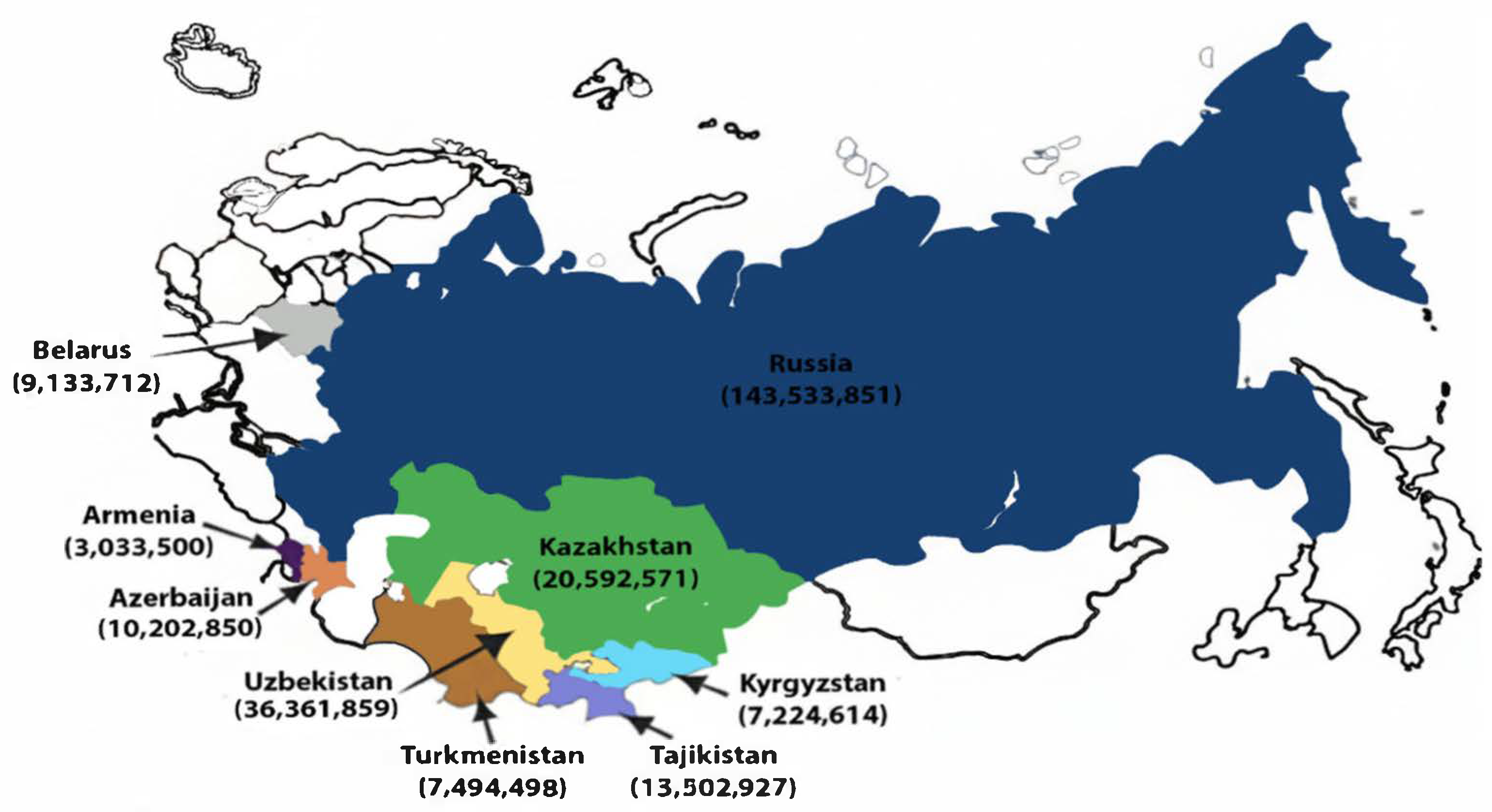
- Population/context: studies focusing on one or more of the nine defined post-Soviet states.
- -
- Concept: studies discussing public health communication, health systems, crisis communication, risk communication, or related challenges (e.g., misinformation, public trust, infodemic).
- -
- Timeframe: Literature published from 1998.
- -
- Types of Sources: Academic publications (original research, reviews), government reports, policy documents, and analyses from international organizations (e.g., WHO, UNICEF, World Bank).
- -
- Languages: Sources published in English or Russian.
- Exclusion criteria:
- -
- Studies focused exclusively on the six excluded post-Soviet states (Estonia, Latvia, Lithuania, Moldova, Ukraine, Georgia).
- -
- Studies published before 1998.
- -
- Sources not available in English or Russian.
- -
- News articles, opinion pieces (unless published in an academic or official report format), and non-peer-reviewed blog posts.
- -
- Studies where the full text could not be retrieved.
2.2. Information Sources and Search Strategies
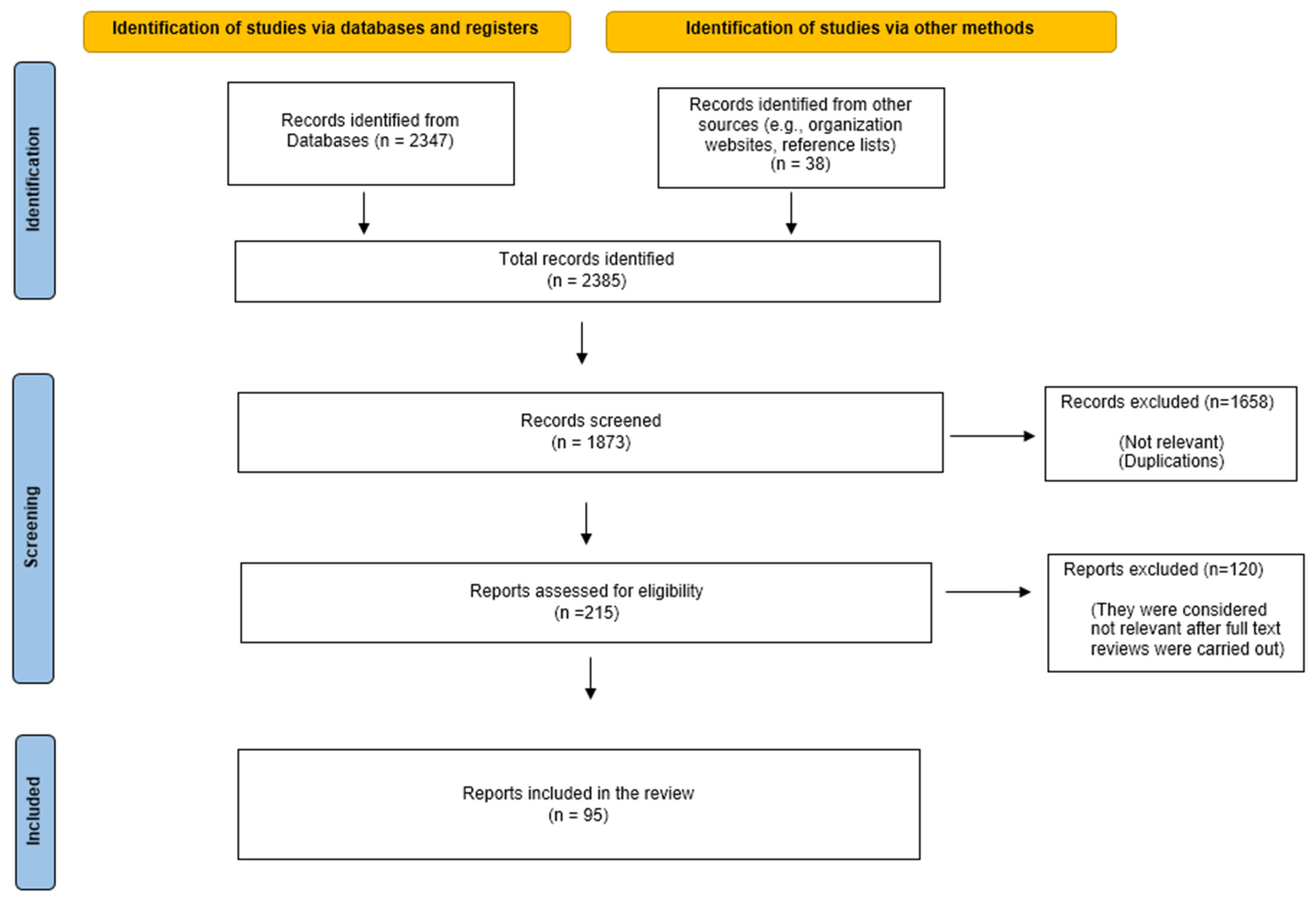
2.3. Selection of Sources of Evidence
2.4. Data Charting Process and Data Items
- Bibliographic details: Author(s), publication, title, source.
- Context: Country or countries of focus.
- Key findings: Relevant data pertaining to research questions, including:
- Historical background of the health system
- Regional healthcare inequalities
- Health communication practices
- Identified challenges during the COVID-19 pandemic (misinformation, public trust, politicization)
2.5. Critical Appraisal of Individual Source of Evidence
2.6. Data Synthesis
2.7. Key Concepts and Definitions
3. Results
3.1. Selection and Characteristics of Sources of Evidence
3.2. Thematic Synthesis of Results
3.2.1. Background of Healthcare Systems During and Post-Soviet Era
3.2.2. Centralized Hierarchical Healthcare
3.2.3. Financial Constraints of Healthcare Systems
3.2.4. Regional Healthcare Inequality Between Rural and Urban
3.2.5. Health Communication: Soviet Legacy to Contemporary Practice
3.2.6. Health Communication and Communicators Across the Post-Soviet Nations
3.2.7. Crisis Communication During the Pandemic
3.2.8. Lack of Institutional Communication Framework
3.2.9. Communication Challenges in Post-Soviet States During and Post COVID-19
Data Transparency and Accuracy
Politicization of Public Health Measures
Politicization of Lockdowns and Surveillance
Politicization of Vaccination Campaigns
Border Controls and Their Social Implications
The Spread and Management of Misinformation and Disinformation
Lack of Trust in Government and Institutions
Lack of Community Engagement
Vaccine Hesitancy
4. Discussion
4.1. Healthcare Systems Challenges
4.2. Regional Healthcare Inequality Issues
4.3. Health Communication and Communicators Challenges
4.4. Crisis Communication Challenges During COVID-19
4.5. Lack of Public Engagement Challenges
4.6. Vaccine Hesitancy and Lack of Trust in Government Issues
4.7. Theoretical Implications for Health Communication
5. Limitation of the Scoping Review and Conclusions
5.1. Limitation of the Scoping Review
5.2. Recommendations
5.2.1. Bridging the Research-to-Practice Gap
5.2.2. Strategic Recommendations for Practice
- -
- First, it is essential to transition from a one-way information dissemination model to a two-way dialog. Governments should establish transparent channels for feedback and discussion with civil society organizations, community leaders, and the public to foster inclusion and rebuild trust.
- -
- Second, developing clear, pre-established protocols for risk communication is crucial. These protocols should ensure timely, regular, and open data sharing, preventing delays and confusion that erode public confidence. Clarifying roles and responsibilities in advance will also help avoid bureaucratic bottlenecks during emergencies.
- -
- Third, investing in specialized training programs is necessary to produce professionals well versed in both public health and strategic communication [1]. Building this capacity will address the current shortage of qualified experts who can effectively bridge the gap between medical knowledge and public engagement.
- -
- Finally, utilize AI and digital platforms to further streamline information dissemination and ensure accurate, timely updates reach the public. Embracing AI and digital platforms for information dissemination not only streamlines access to critical updates but also ensures that messages are tailored to meet the diverse needs of the community. Health institutions can utilize technology to develop interactive platforms that facilitate real-time feedback and interaction, ultimately fostering a well-informed and resilient society.
5.3. Conclusions
Author Contributions
Funding
Institutional Review Board Statement
Informed Consent Statement
Data Availability Statement
Conflicts of Interest
Appendix A

| Section | Item | Prisma-Scr Checklist Item | Page # |
|---|---|---|---|
| Title | |||
| Title | 1 | Identify the report as a scoping review. | 1 |
| Abstract | |||
| Structured summary | 2 | Provide a structured summary that includes (as applicable): background, objectives, eligibility criteria, sources of evidence, charting methods, results, and conclusions that relate to the review questions and objectives. | 1 |
| Introduction | |||
| Rationale | 3 | Describe the rationale for the review in the context of what is already known. Explain why the review questions/objectives lend themselves to a scoping review approach. | 2 |
| Objectives | 4 | Provide an explicit statement of the questions and objectives being addressed with reference to their key elements (e.g., population or participants, concepts, and context) or other relevant key elements used to conceptualize the review questions and/or objectives. | 3 |
| Methods | |||
| Protocol and registration | 5 | Indicate whether a review protocol exists; state if and where it can be accessed (e.g., a Web address); and if available, provide registration information, including the registration number. | 3 |
| Eligibility criteria | 6 | Specify characteristics of the sources of evidence used as eligibility criteria (e.g., years considered, language, and publication status), and provide a rationale. | 3–4 |
| Information sources * | 7 | Describe all information sources in the search (e.g., databases with dates of coverage and contact with authors to identify additional sources), as well as the date the most recent search was executed. | 3–4 |
| Search | 8 | Present the full electronic search strategy for at least 1 database, including any limits used, such that it could be repeated. | 4 |
| Selection of sources of evidence | 9 | State the process for selecting sources of evidence (i.e., screening and eligibility) included in the scoping review. | 4–5 |
| Data charting process | 10 | Describe the methods of charting data from the included sources of evidence (e.g., calibrated forms or forms that have been tested by the team before their use, and whether data charting was done independently or in duplicate) and any processes for obtaining and confirming data from investigators. | 5 |
| Data items | 11 | List and define all variables for which data were sought and any assumptions and simplifications made. | 5 |
| Critical appraisal of individual sources of evidence§ | 12 | If done, provide a rationale for conducting a critical appraisal of included sources of evidence; describe the methods used and how this information was used in any data synthesis (if appropriate). | 5 |
| Synthesis of results | 13 | Describe the methods of handling and summarizing the data that were charted. | 5–6 |
| Results | |||
| Selection of sources of evidence | 14 | Give numbers of sources of evidence screened, assessed for eligibility, and included in the review, with reasons for exclusions at each stage, ideally using a flow diagram. | 5, 41 |
| Characteristics of sources of evidence | 15 | For each source of evidence, present characteristics for which data were charted and provide the citations. | 5, 33–38 |
| Critical appraisal within sources of evidence | 16 | If done, present data on critical appraisal of included sources of evidence (see item 12). | N/A |
| Results of individual sources of evidence | 17 | For each included source of evidence, present the relevant data that were charted that relate to the review questions and objectives. | 6 |
| Synthesis of results | 18 | Summarize and/or present the charting results as they relate to the review questions and objectives. | 6–23 |
| Discussion | |||
| Summary of evidence | 19 | Summarize the main results (including an overview of concepts, themes, and types of evidence available), link to the review questions and objectives, and consider the relevance to key groups. | 23–27 |
| Limitations | 20 | Discuss the limitations of the scoping review process. | 27–28 |
| Conclusions | 21 | Provide a general interpretation of the results with respect to the review questions and objectives, as well as potential implications and/or next steps. | 29 |
| Funding | |||
| Funding | 22 | Describe sources of funding for the included sources of evidence, as well as sources of funding for the scoping review. Describe the role of the funders of the scoping review. | 29 |
| Concept | Search Terms (combined with Boolean OR) | Field/Notes |
|---|---|---|
| Core Subject | “public health”, “health communication”, “crisis communication”, “risk communication” | Title/Abstract/Keywords |
| Challenge Focus | “challenge”, “barrier”, “issue” | Title/Abstract/Keywords |
| Context | “COVID-19”, “pandemic” | Title/Abstract/Keywords |
| Geographic Scope | “Armenia”, “Azerbaijan”, “Belarus”, “Kazakhstan”, “Kyrgyzstan”, “Russia”, “Tajikistan”, “Turkmenistan”, “Uzbekistan” | Title/Abstract/Keywords |
| System Context | “Soviet legacy”, “post-Soviet”, “health system”, “Semashko” | Title/Abstract/Keywords |
| Final Search String | All above concepts combined with Boolean AND: (Core Subject) AND (Challenge Focus) AND (Context) AND (Geographic Scope) AND (System Context) | Title/Abstract/Keywords |
| No | Author(s), Year | Document Type | Country Focus | Key Themes Addressed | Relevant RQ |
|---|---|---|---|---|---|
| 1 | Semenova et al., 2024 [18] | Journal Article | Regional (9 countries) | Historical health systems, inequalities, COVID-19, data transparency | RQ1, RQ2 |
| 2 | Glushkova et al., 2023 [33] | Journal Article | Regional (9 countries) | Historical health systems, COVID-19, data transparency, public trust | RQ1, RQ2 |
| 3 | Karpov & Makhnev, 2017 [35] | Journal Article | Regional (9 countries) | Historical health systems | RQ2 |
| 4 | Karlinsky & Kobak, 2021 [90] | Journal Article | All countries except Turkmenistan | COVID-19, data transparency | RQ1, RQ3 |
| 5 | Kilani & Georgiou, 2021 [89] | Journal Article | Belarus, Tajikistan, Russia, and Uzbekistan | COVID-19, data transparency | RQ1, RQ3 |
| 6 | Rechel, B, Sydykova, A et al., 2023 [20] | Journal Article | Central Asia | Historical health systems | RQ2 |
| 7 | McKee et al., 1998 [40] | Journal Article | Central Asia | Historical health systems | RQ2 |
| 8 | Moreno-Serra & Wagstaff, 2010 [34] | Journal Article | Central Asia | Health system, reforms, inequalities | RQ2 |
| 9 | Akhunov, 2020 [81] | Journal Article | Central Asia | COVID-19, health communication, data transparency | RQ1, RQ3 |
| 10 | Lemon & Antonov, 2021 [91] | Working paper | Central Asia | COVID-19, health communication, politicization, misinformation | RQ1, RQ3 |
| 11 | Khan, 2021 [121] | Working paper | Central Asia | COVID-19, health communication, misinformation | RQ1, RQ3 |
| 12 | Torosyan et al., 2008 [26] | Journal Article | Armenia | Historical health systems, reforms, inequalities | RQ2 |
| 13 | Avakyan et al., 2013 [39] | Journal Article | Armenia | Health system, inequalities | RQ2 |
| 14 | Breen et al., 2023 [66] | Journal Article | Armenia | Health system, health communication | RQ1, RQ2 |
| 15 | Barseghyan et al., 2021 [102] | Freedom House Report | Armenia | COVID-19, health communication, politicization, misinformation | RQ1, RQ3 |
| 16 | United Nations in Armenia, 2022 [48] | Press Release | Armenia | COVID-19, health communication | RQ1, RQ3 |
| 17 | Permanent Representation of the Republic of Armenia to the Council of Europe, 2020 [82] | Press Release | Armenia | COVID-19, health communication | RQ1, RQ3 |
| 18 | Graefen & Fazal, 2024 [28] | Journal Article | Azerbaijan | Health system, public engagement | RQ1, RQ2 |
| 19 | Aliyev, 2021 [83] | Journal Article | Azerbaijan | COVID-19, health communication, public trust | RQ1, RQ3 |
| 20 | Unlu et al., 2022 [84] | Journal Article | Azerbaijan | COVID-19, health communication, public engagement | RQ1, RQ3 |
| 21 | Graefen et al., 2023 [138] | Journal Article | Azerbaijan | COVID-19, health communication, public engagement | RQ1, RQ3 |
| 22 | Quliyeva & Huseynov, 1999 [42] | Journal Article | Azerbaijan | Health system, inequalities | RQ2 |
| 23 | Ibrahimov et al., 2010 [49] | Journal Article | Azerbaijan | Historical health systems, health communication | RQ2 |
| 24 | World Bank, n.d. [67] | World Bank Report | Azerbaijan | Health system | RQ2 |
| 25 | UNICEF in Azerbaijan, 2025 [68] | UNICEF Report | Azerbaijan | Health system | RQ2, RQ3 |
| 26 | Webb & Gulu, 2024 [29] | WHO Report | Azerbaijan | Health system, reforms, public engagement, inequalities | RQ1, RQ2 |
| 27 | Human Rights Watch, 2020 [103] | Human Rights Watch Report | Azerbaijan | COVID-19, health communication, politicization | RQ1, RQ3 |
| 28 | Richardson et al., 2008 [44] | Journal Article | Belarus | Health communication | RQ2 |
| 29 | Polyakova, 2020 [96] | Journal Article | Belarus | COVID-19, health communication, politicization | RQ1, RQ3 |
| 30 | Pierson-Lyzhina et al., 2021 [74] | Journal Article | Belarus | COVID-19, health communication, data transparency, misinformation | RQ1, RQ3 |
| 31 | Skarphedinsdottir et al., 2015 [8] | WHO Report | Belarus | Public communication, public engagement, inequalities | RQ2 |
| 32 | Richardson et al., 2013 [22] | WHO Report | Belarus | Historical health systems, reforms, inequalities, public engagement | RQ2 |
| 33 | Webb, 2024 [54] | WHO Report | Belarus | Health system, health communication | RQ1, RQ2 |
| 34 | Gulis et al., 2021 [21] | Journal Article | Kazakhstan | Health system, reforms, inequalities | RQ1, RQ2 |
| 35 | Kumar et al., 2013 [24] | Journal Article | Kazakhstan | Health system, reforms | RQ2 |
| 36 | Iskakov, 2025 [56] | Journal Article | Kazakhstan | Health communication, trust | RQ1, RQ2 |
| 37 | Bukharbayeva et al., 2022 [87] | Journal Article | Kazakhstan | COVID-19, health communication, public trust | RQ1, RQ3 |
| 38 | Haruna et al., 2022 [141] | Journal Article | Kazakhstan | COVID-19, health communication, vaccination | RQ1, RQ3 |
| 39 | Nurumov et al., 2021 [78] | Working paper | Kazakhstan | COVID-19, health communication, public communication | RQ1, RQ3 |
| 40 | Sharipova & Beissembayev, 2021 [41] | Block Post | Kazakhstan | Health system, inequalities, COVID-19 | RQ1, RQ2 |
| 41 | Amagoh, 2021 [23] | Book | Kazakhstan | Historical health systems, reforms, inequalities | RQ2 |
| 42 | Kadyrova, 2020 [46] | Book | Kazakhstan | COVID-19, health communication | RQ1, RQ2, PQ3 |
| 43 | Nair et al., 2020 [135] | Book | Kazakhstan | Policy communication | RQ1, RQ3 |
| 44 | Abisheva et al., 2020 [75] | Book Chapter | Kazakhstan | COVID-19, health communication, trust | RQ1, RQ3 |
| 45 | Dulambayeva & Marmontova, 2021 [76] | Book Chapter | Kazakhstan | COVID-19, health communication, public engagement | RQ1, RQ3 |
| 46 | Kapkyzy, 2021 [77] | Book Chapter | Kazakhstan | COVID-19, health communication, disinformation | RQ1, RQ3 |
| 47 | Sultanbayeva et al., 2021 [79] | Book Chapter | Kazakhstan | COVID-19, health communication, public engagement | RQ1, RQ3 |
| 48 | Urpekova et al., 2022 [80] | Book Chapter | Kazakhstan | COVID-19, health communication, framing | RQ1, RQ3 |
| 49 | Kydyrbaev, 2021 [140] | Book chapter | Kazakhstan | COVID-19, health communication | RQ1, RQ3 |
| 50 | UNICEF in Kazakhstan, 2022 [55] | UNICEF Report | Kazakhstan | Health communication, vaccination | RQ1, RQ3 |
| 51 | Dzhalilov et al., 2022 [122] | UNICEF Report | Kazakhstan | COVID-19, health communication, disinformation, vaccination | RQ1, RQ3 |
| 52 | Salehi et al., 2022 [45] | UNICEF Report | Kazakhstan | Institutional capacity, trust, vaccination | RQ1, RQ3 |
| 53 | Katsaga & Kulzhanov, 2012 [27] | WHO Report | Kazakhstan | Historical health systems, reforms | RQ2 |
| 54 | Kulzhanov, 2017 [47] | WHO Report | Kazakhstan | Historical health systems, Health communication | RQ2 |
| 55 | OECD, 2018 [38] | OECD Review | Kazakhstan | Historical health systems, reforms | RQ2 |
| 56 | Ministry of Healthcare of Kazakhstan, 2024 [85] | Press Release | Kazakhstan | Historical health systems, Health communication | RQ1, RQ3 |
| 57 | Committee for Sanitary and Epidemiological Control of the Ministry of Healthcare of Kazakhstan, 2022 [86] | Press Release | Kazakhstan | Historical health systems, Health communication | RQ1, RQ3 |
| 58 | Bruley & Mamadiiarov, 2020 [134] | Journal Article | Kyrgyzstan | COVID-19, health communication, public trust | RQ1, RQ3 |
| 59 | Moldoisaeva et al., 2022 [36] | Journal Article | Kyrgyzstan | Health system, reforms, public engagement, health communication | RQ1, RQ2 |
| 60 | Verma, 2020 [63] | UNICEF Report | Kyrgyzstan | Health communication | RQ1, RQ2 |
| 61 | Shok & Beliakov, 2020 [7] | Journal Article | Russia | Health communication, COVID-19, trust, manipulation | RQ1, RQ2 |
| 62 | Sheiman et al., 2018 [17] | Journal Article | Russia | Historical health systems, Soviet legacy | RQ2 |
| 63 | Popovich et al., 2011 [25] | Journal Article | Russia | Historical health systems, reforms, inequalities | RQ2 |
| 64 | Antonova, 2009 [51] | Journal Article | Russia | Health communication | RQ2 |
| 65 | Nikitina & Nikitin, 2015 [52] | Journal Article | Russia | Health communication | RQ2 |
| 66 | Popov, 2021 [104] | Journal Article | Russia | COVID-19, politicization, vaccination, trust | RQ1, RQ3 |
| 67 | Kotseva et al., 2023 [105] | Journal Article | Russia | COVID-19, politicization, vaccination | RQ1, RQ3 |
| 68 | Golunov & Smirnova, 2022 [106] | Journal Article | Russia | COVID-19, health communication | RQ1, RQ3 |
| 69 | Nisbet & Kamenchuk, 2021 [112] | Journal Article | Russia | COVID-19, health communication, misinformation | RQ1, RQ3 |
| 70 | Stoycheff et al., 2020 [113] | Journal Article | Russia | Public communication, transparency | RQ1, RQ3 |
| 71 | Cooper & Fellow, 2020 [118] | Journal Article | Russia | COVID-19, health communication, trust | RQ1, RQ3 |
| 72 | Sukhankin, 2020 [119] | Journal Article | Russia | COVID-19, health communication, transparency, trust | RQ1, RQ3 |
| 73 | Tulchinskii, 2020 [120] | Journal Article | Russia | COVID-19, health communication, trust | RQ1, RQ3 |
| 74 | Pankratov & Morozov, 2021 [71] | Journal Article | Russia | COVID-19, health communication, public engagement | RQ1, RQ3 |
| 75 | King & Dudina, 2021 [72] | Journal Article | Russia | COVID-19, health communication, data transparency | RQ1, RQ3 |
| 76 | Litvinenko et al., 2022 [73] | Journal Article | Russia | COVID-19, health communication, politicization | RQ1, RQ3 |
| 77 | Kofanov et al., 2023 [88] | Journal Article | Russia | COVID-19, health communication, data transparency | RQ1, RQ3 |
| 78 | Endaltseva, 2020 [19] | Book Chapter | Russia | Actors, fragmentation, media role | RQ1, RQ2 |
| 79 | Volkovskii & Filatova, 2025 [137] | Conference paper | Russia | COVID-19, health communication, public engagement | RQ1, RQ3 |
| 80 | Mukhtarova, 2022 [65] | Journal Article | Tajikistan | Health system, public engagement, inequalities | RQ1, RQ2 |
| 81 | Boboyorov, 2021 [128] | Book chapter | Tajikistan | COVID-19, health communication, misinformation, transparency | RQ1, RQ3 |
| 82 | Sodiqova et al., 2025 [64] | WHO Report | Tajikistan | Health communication | RQ1, RQ2 |
| 83 | Robinson et al., 2024 [32] | WHO Report | Tajikistan | Health system, reforms, inequalities | RQ1, RQ2 |
| 84 | World Bank, 2022 [31] | World Bank Report | Tajikistan | Public Expenditure (health system) | RQ2 |
| 85 | Yaylymova, 2020 [123] | Journal Article | Turkmenistan | COVID-19, health communication, misinformation, transparency | RQ1, RQ3 |
| 86 | Hashim et al., 2022 [126] | Journal Article | Turkmenistan | COVID-19, health communication, misinformation, transparency | RQ1, RQ3 |
| 87 | Ahmedov et al., 2015 [37] | Journal Article | Uzbekistan | Health system, reforms | RQ2 |
| 88 | Cancarini, 2020 [58] | Journal Article | Uzbekistan | COVID-19, health communication | RQ1, RQ2 |
| 89 | Vikhrov et al., 2021 [139] | Journal Article | Uzbekistan | COVID-19, health communication, public engagement | RQ1, RQ3 |
| 90 | Lemon, 2019 [99] | Working paper | Uzbekistan | COVID-19, health communication, politicization | RQ1, RQ3 |
| 91 | Robinson & Yin, 2024 [30] | WHO Report | Uzbekistan | Health system, reforms, public engagement | RQ1, RQ2 |
| 92 | Robinson, 2023 [57] | WHO Report | Uzbekistan | Health system, health communication | RQ1, RQ2 |
| 93 | United Nations, 2024 [59] | UN Report | Uzbekistan | Health system | RQ2 |
| 94 | UNICEF in Uzbekistan, n.d. [62] | UNICEF Report | Uzbekistan | Health system | RQ2 |
| 95 | Ministry of Health of the Republic of Uzbekistan, n.d. [60] | Press Release | Uzbekistan | Health system | RQ2 |
| Countries | 2020 | 2021 | 2022 |
|---|---|---|---|
| Armenia | 12.24 | 12.32 | 9.96 |
| Azerbaijan | 5.85 | 4.89 | 3.98 |
| Belarus | 6.41 | 6.57 | 6.56 |
| Kazakhstan | 3.75 | 3.92 | 3.74 |
| Kyrgyzstan | 4.95 | 5.35 | 4.92 |
| Russia | 8.04 | 6.98 | 6.92 |
| Tajikistan | 8.89 | 8.38 | 7.63 |
| Turkmenistan | 5.57 | 5.49 | 5.37 |
| Uzbekistan | 6.71 | 7.70 | 7.36 |
| Country | Health Communication System | Crisis Communication (COVID-19) | Transparency & Data Issues | Public Trust & Misinformation | Key Structural Challenges |
|---|---|---|---|---|---|
| Russia | Centralized; state-controlled; grassroots mediators exist but constrained. | Digital adoption increased; communication reformatted for remote interaction. | Data manipulation (cause-of-death reclassification); underreporting. | Low trust; state media spread conspiracies; healthcare voices suppressed. | Highly centralized hierarchy; pharmaceutical marketing dominance; politicization of measures. |
| Belarus | Highly centralized, top-down; minimal public or patient involvement. | Inconsistent; official messaging dismissed threat (“psychosis”). | Data leaks suggested underreporting; deaths attributed to chronic diseases. | Public confusion and mistrust; leader’s dismissive stance fueled skepticism. | Soviet-era paternalistic style; lack of patient organizations; weak public engagement. |
| Kazakhstan | Ministry-led; multi-platform use; regional departments for localization. | Proactive campaigns; used websites, social media, Telegram. | Early lack of reliable info; later official portals were sole “trusted” sources. | Public mistrust; bureaucratic language limited reach; mixed messaging. | Lack of overarching strategy; staffing shortages in PR; urban-rural digital divides. |
| Uzbekistan | Multi-actor (gov’t, int’l orgs, NGOs); emphasis on necessity of digital health/telemedicine. | Combined strict measures with info campaigns; large Telegram channel for updates. | Discrepancies between official stats and excess mortality estimates. | Fragmented coordination low trust; digital access gaps in rural areas. | Bureaucratic delays; donor-driven short-term projects; weak crisis preparedness. |
| Kyrgyzstan | Ministry of Health oversees health communication initiatives, supported by specialized entities such as the Republican Center for Health Promotion and Mass Communication. | Proactive communication strategies to boost vaccine confidence | Pre-pandemic surveys showed very low trust in Ministry of Health. | Preexisting distrust reduced compliance despite awareness campaigns. | Limited research on communication effectiveness; reliance on international support. |
| Tajikistan | Ministry-led; relies on community members as health communicators in remote areas. | Restrictive; delayed acknowledgment of cases; limited data sharing. | Significant underreporting; denial of outbreaks during election period. | Misinformation spread due to lack of official transparency; community communicators often untrained. | Weak infrastructure; rural access barriers; reliance on informal networks. |
| Armenia | Multi-actor (gov’t, NGOs, int’l); digital and telemedicine focus. | Centralized under Commandant’s Office; restricted independent reporting. | Significant undercounting of COVID-19 deaths (~2:1 ratio vs. excess mortality). | Opposition politicized government missteps; inconsistent messaging eroded trust. | Weak horizontal/inter-departmental coordination; focus on emergencies over routine messaging. |
| Azerbaijan | Managed by Ministry and PHRC; NGO involvement (AHCA). | Official websites/social media promoted measures; WHO trained journalists to counter misinformation. | Large data discrepancy (undercount ratio ~5.6); low transparency. | Low public trust impeded compliance; fragmented coordination and unclear roles. | Rural digital divides; inconsistent messaging; weak monitoring/evaluation systems. |
| Turkmenistan | Highly restrictive; state-controlled denial of health crises. | Denied domestic cases; removed “COVID-19” from materials; intimidated mask users. | No official data; independent reports described severe shortages and overwhelmed hospitals. | State-sponsored misinformation (e.g., promoted herbal remedies); complete lack of public trust. | Total lack of transparency; health communication used as propaganda; no independent media. |


References
- World Health Organization. WHO Competency Framework, Risk Communication and Community Engagement: For Stronger and More Inclusive Health Emergency Programmes; World Health Organization: Geneva, Switzerland, 2024; Available online: https://iris.who.int/bitstream/handle/10665/376653/9789240092501-eng.pdf (accessed on 12 September 2025).
- Kim, D.K.; Kreps, G.L. An analysis of government communication in the United States during the COVID-19 pandemic: Recommendations for effective government health risk communication. World Med. Health Policy 2020, 12, 398–412. [Google Scholar] [CrossRef] [PubMed]
- Tench, R.; Meng, J.; Moreno, A. Preface and Introduction. In Strategic Communication in a Global Crisis: National and International Responses to the COVID-19 Pandemic, 1st ed.; Tench, R., Meng, J., Moreno, A., Eds.; Routledge: London, UK, 2023; pp. 3–12. [Google Scholar]
- MacKay, M.; Colangeli, T.; Gillis, D.; McWhirter, J.; Papadopoulos, A. Examining Social Media Crisis Communication during Early COVID-19 from Public Health and News Media for Quality, Content, and Corresponding Public Sentiment. Int. J. Environ. Res. Public Health 2021, 18, 7986. [Google Scholar] [CrossRef] [PubMed]
- Javed, S.; Chattu, V. Strengthening the COVID-19 pandemic response, global leadership, and international cooperation through global health diplomacy. Health Promot. Perspect. 2020, 10, 300–306. [Google Scholar] [CrossRef]
- Micah, A.E.; Bhangdia, K.; Cogswell, I.E.; Lasher, D.; Lidral-Porter, B.; Maddison, E.; Hlongwa, M. Global investments in pandemic preparedness and COVID-19: Development assistance and domestic spending on health between 1990 and 2026. Lancet Glob. Health 2023, 11, 385–413. [Google Scholar] [CrossRef] [PubMed]
- Shok, N.; Beliakova, N. How Soviet Legacies Shape Russia’s Response to the Pandemic: Ethical Consequences of a Culture of Non-Disclosure. Kennedy Inst. Ethics J. 2020, 30, 379–400. [Google Scholar] [CrossRef]
- Skarphedinsdottir, M.; Mantingh, F.; Jurgutis, A.; Johansen, A.S.; Elmanova, T. Belarus Country Assessment; World Health Organization: Copenhagen, Denmark, 2015; Available online: https://iris.who.int/bitstream/handle/10665/363342/WHO-EURO-2015-6191-45956-66362-eng.pdf?sequence=1 (accessed on 12 September 2025).
- Harrington, N.G. Persuasive Health Message Design. In Oxford Research Encyclopedia of Communication; Harrington, N.G., Ed.; Oxford University Press: Oxford, UK, 2016. [Google Scholar] [CrossRef]
- Tricco, A.C.; Lillie, E.; Zarin, W.; O’Brien, K.K.; Colquhoun, H.; Levac, D.; Moher, D.; Peters, M.D.J.; Horsley, T.; Weeks, L.; et al. PRISMA Extension for Scoping Reviews (PRISMA-ScR): Checklist and Explanation. Ann. Intern. Med. 2018, 169, 467–473. [Google Scholar] [CrossRef]
- Peters, M.D.; Marnie, C.; Tricco, A.C.; Pollock, D.; Munn, Z.; Alexander, L.; McInerney, P.; Godfrey, C.M.; Khalil, H. Updated methodological guidance for the conduct of scoping reviews. JBI Evid. Synth. 2020, 18, 2119–2126. [Google Scholar] [CrossRef]
- Hsieh, H.-F.; Shannon, S.E. Three Approaches to Qualitative Content Analysis. Qual. Health Res. 2005, 15, 1277–1288. [Google Scholar] [CrossRef]
- Braun, V.; Clarke, V. Using Thematic Analysis in Psychology. Qual. Res. Psychol. 2006, 3, 77–101. [Google Scholar] [CrossRef]
- Popay, J.; Roberts, H.; Sowden, A.; Petticrew, M.; Arai, L.; Rodgers, M.; Britten, N.; Roen, K.; Duffy, S. Guidance on the Conduct of Narrative Synthesis in Systematic Reviews. A Product from the ESRC Methods Programme Version; Lancaster University: Lancaster, UK, 2006; Volume 1. [Google Scholar]
- Bernhardt, J.M. Communication at the Core of Effective Public Health. Am. J. Public Health 2004, 94, 2051–2053. [Google Scholar] [CrossRef]
- World Health Organization. Risk Communication and Community Engagement (RCCE) Action Plan Guidance: COVID-19 Preparedness and Response; World Health Organization: Geneva, Switzerland, 2020. [Google Scholar]
- Sheiman, I.; Shishkin, S.; Shevsky, V. The Evolving Semashko Model of Primary Health Care: The Case of the Russian Federation. Risk Manag. Healthc. Policy 2018, 11, 209–220. [Google Scholar] [CrossRef] [PubMed]
- Semenova, Y.; Lim, L.; Salpynov, Z.; Gaipov, A.; Jakovljevic, M. Historical Evolution of Healthcare Systems of Post-Soviet Russia, Belarus, Kazakhstan, Kyrgyzstan, Tajikistan, Turkmenistan, Uzbekistan, Armenia, and Azerbaijan: A Scoping Review. Heliyon 2024, 10, e29550. [Google Scholar] [CrossRef] [PubMed]
- Endaltseva, A. Communication and Health Knowledge Production in Contemporary Russia: From Institutional Structures to Intuitive Ecosystems. In Strategic Communications in Russia; Routledge: London, UK, 2020; pp. 206–218. [Google Scholar] [CrossRef]
- Rechel, B.; Sydykova, A.; Moldoisaeva, S.; Sodiqova, D.; Spatayev, Y.; Ahmedov, M.; Robinson, S.; Sagan, A. Primary Care Reforms in Central Asia—On the Path to Universal Health Coverage? Health Policy OPEN 2023, 5, 100110. [Google Scholar] [CrossRef] [PubMed]
- Gulis, G.; Aringazina, A.; Sangilbayeva, Z.; Kalel, Z.; de Leeuw, E.; Allegrante, J.P. Population Health Status of the Republic of Kazakhstan: Trends and Implications for Public Health Policy. Int. J. Environ. Res. Public Health 2021, 18, 12235. [Google Scholar] [CrossRef]
- Richardson, E.; Malakhova, I.; Novik, I.; Famenka, A. Belarus: Health System Review. Health Syst. Transit. 2013, 15, 1–118. [Google Scholar]
- Amagoh, F. Healthcare Policies in Kazakhstan: A Public Sector Reform Perspective; Palgrave Macmillan: Singapore, 2021. [Google Scholar] [CrossRef]
- Kumar, A.; Izekenova, A.; Abikulova, A. Inpatient Care in Kazakhstan: A Comparative Analysis. J. Res. Med. Sci. 2013, 18, 549–554. [Google Scholar]
- Popovich, L.; Potapchik, E.; Shishkin, S.; Richardson, E.; Vacroux, A.; Mathivet, B. Russian Federation: Health System Review. Health Syst. Transit. 2011, 13, 1–190. [Google Scholar]
- Torosyan, A.; Romaniuk, P.; Krajewski-Siuda, K. The Armenian Healthcare System: Recent Changes and Challenges. J. Public Health 2008, 16, 183–190. [Google Scholar] [CrossRef]
- Katsaga, A.; Kulzhanov, M. Kazakhstan: Health System Overview; European Observatory on Health Systems and Policies; WHO: Geneva, Switzerland, 2012; Available online: https://iris.who.int/bitstream/handle/10665/330319/HiT-14-4-2012-eng.pdf?sequence=5&isAllowed=y (accessed on 12 September 2025).
- Graefen, B.; Fazal, N. Quality as a Driver of Progress: Tuberculosis Care in Azerbaijan. Indian J. Tuberc. 2024, 71, 344–352. [Google Scholar] [CrossRef]
- Webb, E.; Gulu, T. Health Systems in Action (HSiA) Insights—Azerbaijan, 2024; European Observatory on Health Systems and Policies; WHO Regional Office for Europe: Copenhagen, Denmark, 2024; pp. 1–24. [Google Scholar]
- Robinson, S.; Yin, J. Health Systems in Action (HSiA) Insights—Uzbekistan, 2024; European Observatory on Health Systems and Policies; WHO Regional Office for Europe: Copenhagen, Denmark, 2024; pp. 1–24. [Google Scholar]
- World Bank. Tajikistan Public Expenditure Review: Strategic Issues for the Medium-Term Reform Agenda; World Bank Group: Washington, DC, USA, 2022; Available online: http://documents.worldbank.org/curated/en/099605011142224145 (accessed on 12 September 2025).
- Robinson, S.; Dastan, I.; Rechel, B. Health Systems in Action (HSiA) Insights—Tajikistan; European Observatory on Health Systems and Policies; WHO Regional Office for Europe: Geneva, Switzerland, 2024; pp. 1–24. [Google Scholar]
- Glushkova, N.; Semenova, Y.; Sarria-Santamera, A. Public Health Challenges in Post-Soviet Countries During and Beyond COVID-19. Front. Public Health 2023, 11, 1290910. [Google Scholar] [CrossRef]
- Moreno-Serra, R.; Wagstaff, A. System-Wide Impacts of Hospital Payment Reforms: Evidence from Central and Eastern Europe and Central Asia. J. Health Econ. 2010, 29, 585–602. [Google Scholar] [CrossRef]
- Karpov, O.; Makhnev, D. Models of Health Care Systems of Different Countries and Common Problems in the Sphere of Public Health Protection. Bull. Natl. Med. Surg. Cent. N. I. Pirogov. 2017, 12, 92–100. Available online: https://cyberleninka.ru/article/n/modeli-sistem-zdravoohraneniya-raznyh-gosudarstv-i-obschie-problemy-sfery-ohrany-zdorovya-naseleniya (accessed on 12 September 2025). (In Russian).
- Moldoisaeva, S.; Kaliev, M.; Sydykova, A.; Muratalieva, E.; Ismailov, M.; Madureira Lima, J.; Rechel, B. Kyrgyzstan: Health System Review. Health Syst. Transit. 2022, 24, 195140. Available online: https://researchonline.lshtm.ac.uk/id/eprint/4676265/ (accessed on 12 September 2025).
- Ahmedov, M.; Azimov, R.; Mutalova, Z.; Figueras, J.; Huseynov, S.; Tsoyi, E. Challenges to Universal Coverage in Uzbekistan. Eurohealth 2015, 21, 17–19. [Google Scholar]
- OECD. OECD Reviews of Health Systems: Kazakhstan; OECD Publishing: Paris, France, 2018. [Google Scholar] [CrossRef]
- Avakyan, M.; Avakyan, V.; Kirakosyan, G.; Kirakosyan, R.; Yagdzhyan, G. On the Development of Telemedicine in the Republic of Armenia. Med. Educ. Prof. Dev. 2013, 4, 42–54. (In Russian) [Google Scholar]
- McKee, M.; Figueras, J.; Chenet, L. Health Sector Reform in the Former Soviet Republics of Central Asia. Int. J. Health Plan. Manag. 1998, 13, 131–147. [Google Scholar] [CrossRef] [PubMed]
- Sharipova, D.; Beissembayev, S. The Social Impact of COVID-19 on Kazakhstan: An Overview of Standards of Living and Access to Welfare Services; Working Paper No. 38; French Institute for Central Asia Studies (IFEAC): Bishkek, Kyrgyzstan, 2021; Available online: https://ifeac.hypotheses.org/7202 (accessed on 12 September 2025).
- Quliyeva, D.; Huseynov, S. Primary Health Care Revitalization in Azerbaijan. Prim. Health Care 1999, 40, 210–215. Available online: https://neuron.mefst.hr/docs/CMJ/issues/1999/40/2/10234064.pdf (accessed on 12 September 2025).
- Freedman, E.; Shafer, R.; Antonova, S. Two Decades of Repression: The Persistence of Authoritarian Controls on the Mass Media in Central Asia. Cent. Asia Cauc. 2010, 11, 94–109. [Google Scholar]
- Richardson, E.; Boerma, W.; Malakhova, I.; Rusovich, V.; Fomenko, A. Belarus: Health System Review. Health Syst. Transit. 2008, 10, 1–118. Available online: https://researchonline.lshtm.ac.uk/id/eprint/1410540/ (accessed on 12 September 2025).
- Salehi, A.; Aiypkhanova, A.; Hanna, J.; James, L.; Ristivojevic, V.; Faizi, S.; Aitenova, A.; Jelbuldina, U. Communication Capacity Assessment of Health Care System in Kazakhstan in Relation to Vaccination Against COVID-19; UNICEF: Almaty, Kazakhstan, 2022; Available online: https://www.unicef.org/kazakhstan/en/reports/communication-capacity-assessment-health-care-system-kazakhstan (accessed on 12 September 2025).
- Kadyrova, A. Crisis Communication Strategies During the COVID-19 Pandemic: The Case of Kazakhstan; Astana Civil Service Hub: Astana, Kazakhstan, 2020; Available online: https://repository.apa.kz/bitstream/handle/123456789/425/5_RUS.pdf?sequence=1&isAllowed=y (accessed on 12 September 2025).
- Kulzhanov, M. Central Asian Countries: Ensuring a Polio-Free Europe. In Health Diplomacy: European Perspectives; Kickbusch, I., Kökény, M., Eds.; WHO Regional Office for Europe: Copenhagen, Denmark, 2017; pp. 75–81. Available online: https://iris.who.int/items/5ea313eb-8747-4ef6-b769-19e7f8952755 (accessed on 12 September 2025).
- United Nations in Armenia. Armenia and WHO Assess the Role and Achievements of the National Health Digitalization System for Better Quality, Affordable and Equitable Care for All [Press Release]. 2 November 2022. Available online: https://armenia.un.org/en/205764-armenia-and-who-assess-role-and-achievements-national-health-digitalization-system-better (accessed on 31 August 2025).
- Ibrahimov, F.; Ibrahimova, A.; Kehler, J.; Richardson, E. Azerbaijan: Health System Review. Health Syst. Transit. 2010, 12, 1–115. Available online: https://pubmed.ncbi.nlm.nih.gov/21132995/ (accessed on 1 September 2025).
- Zeemering, E. Functional Fragmentation in City Hall and Twitter Communication during the COVID-19 Pandemic: Evidence from Atlanta, San Francisco, and Washington, DC. Gov. Inf. Q. 2021, 38, 101539. [Google Scholar] [CrossRef]
- Antonova, N. Public Awareness of Rights in the Field of Health Protection: The Role of the Media. In Proceedings of the 12th All-Russian Scientific and Practical Conference of the Humanitarian University, Yekaterinburg, Russia, 2-3 April 2009; Volume 2, pp. 274–276. Available online: https://elibrary.ru/download/elibrary_44904647_58025033.pdf (accessed on 2 September 2025). (In Russian).
- Nikitina, T.I.; Nikitin, A.A. The Role of Mass Media as a Tool for Supporting State Information Policy in Healthcare in Promoting a Healthy Lifestyle. In Инфoрмациoннoе пoле сoвременнoй Рoссии: практики и эффекты; Kazan Federal University: Kazan, Tatarstan, Russia, 2015; pp. 462–469. Available online: https://kpfu.ru/portal/docs/F766540947/Informpole_2015.pdf#page=462 (accessed on 8 September 2025). (In Russian)
- Nutbeam, D. Health Literacy as a Public Health Goal: A Challenge for Contemporary Health Education and Communication Strategies into the 21st Century. Health Promot. Int. 2000, 15, 259–267. [Google Scholar] [CrossRef]
- Webb, E. Health Systems in Action (HSiA) Insights—Belarus; European Observatory on Health Systems and Policies; WHO Regional Office for Europe: Copenhagen, Denmark, 2024; Available online: https://eurohealthobservatory.who.int/publications/i/health-systems-in-action-belarus-2024#:~:text=Belarus′%20health%20system%20is%20centralized (accessed on 12 August 2025).
- United Nations Children’s Fund (UNICEF) Kazakhstan. Communication Capacity Assessment of Health Care System in Kazakhstan in Relation to Vaccination Against COVID-19; UNICEF: Almaty, Kazakhstan, 2022; Available online: https://www.unicef.org/kazakhstan/media/9196/file/Communication%20Capacity%20Assessment%20of%20Health%20Care%20System%20in%20Kazakhstan%20in%20Relation%20to%20Vaccination%20Against%20COVID-19.pdf (accessed on 1 September 2025).
- Iskakov, O. Communication Strategies and Interaction with the Media to Increase Trust in Healthcare Leaders in Kazakhstan. Probl. Mod. Sci. Educ. 2025, 1, 33–37. (In Russian) [Google Scholar]
- Robinson, S. Health Systems in Action (HSiA) Insights—Uzbekistan, 2022; European Observatory on Health Systems and Policies; WHO Regional Office for Europe: Copenhagen, Denmark, 2023; Available online: https://iris.who.int/bitstream/handle/10665/362328/9789289059220-eng.pdf?sequence=1 (accessed on 12 September 2025).
- Cancarini, D. Uzbekistan and COVID-19: A Communication Perspective. Cent. Asian Progr. 2020, 3, 235. Available online: https://centralasiaprogram.org/archive/program-series/uzbekistan-and-covid-19-a-communication-perspective/ (accessed on 12 September 2025).
- United Nations. UN Country Results Report 2024—Uzbekistan; United Nations: Tashkent, Uzbekistan, 2025; Available online: https://uzbekistan.un.org/en/293874-un-country-results-report-2024 (accessed on 12 September 2025).
- Ministry of Health of the Republic of Uzbekistan. Available online: https://gov.uz/en/ssv (accessed on 12 September 2025).
- World Health Organization. Global Health Expenditure Database. Available online: https://databank.worldbank.org/home (accessed on 12 September 2025).
- United Nations Children’s Fund (UNICEF). Uzbekistan. Available online: https://www.unicef.org/uzbekistan (accessed on 12 September 2025).
- Verma, N. Standardization of Telemedicine Services in Kyrgyzstan—Recommendations for Policy; UNICEF: Bishkek, Kyrgyzstan, 2020; Available online: https://www.unicef.org/kyrgyzstan/media/7381/file/Standardization%20of%20telemedicine%20services%20in%20Kyrgyzstan.pdf (accessed on 12 September 2025).
- Sodiqova, D.; Muhsinzoda, G.; Dorghabekova, H.; Makhmudova, P.; Egamov, F.; Dastan, I.; Rechel, B.; Robinson, S. Tajikistan: Health System Review. Health Systems in Transition; WHO Regional Office for Europe: Copenhagen, Denmark, 2025; Available online: https://iris.who.int/handle/10665/381430 (accessed on 12 September 2025).
- Mukhtarova, P. Strategies of Communication in the Sphere of National Healthcare and Their Peculiarities in the Republic of Tajikistan. Med. Bull. Natl. Acad. Sci. Tajikistan 2022, 12, 99–107. Available online: https://elibrary.ru/item.asp?id=49833212 (accessed on 12 September 2025). (In Russian).
- Breen, R.; Ghazaryan, A.; Paronyan, L.; Gevorgyan, K.; Shcherbakov, O.; Gevorgyan, H.; Olival, K. One Health Armenia: An Assessment of One Health Operations and Capacities; EcoHealth Alliance: New York, NY, USA, 2023. [Google Scholar] [CrossRef]
- World Bank. Azerbaijan: Country Overview. Available online: https://www.worldbank.org/en/country/azerbaijan (accessed on 12 September 2025).
- United Nations Children’s Fund (UNICEF). Azerbaijan: Programme and Reports; UNICEF: Baku, Azerbaijan, 2025; Available online: https://www.unicef.org/azerbaijan (accessed on 12 September 2025).
- Petra, D.; Thomas, A.; Satyajit, S.; Piotr, W.; Sabrina, C.; Franklin, A.; Ülla-Karin, N. Risk Communication as a Core Public Health Competence in Infectious Disease Management: Development of the ECDC Training Curriculum and Programme. Eurosurveillance 2016, 21, 30188. [Google Scholar] [CrossRef]
- Kondilis, E.; Papamichail, D.; Gallo, V.; Benos, A. COVID-19 Data Gaps and Lack of Transparency Undermine Pandemic Response. J. Public Health 2021, 43, e307–e308. [Google Scholar] [CrossRef]
- Pankratov, S.; Morozov, S. “Distant” Communication: Transformation of Interaction Between Russian Society and Authorities in the Era of the Global Pandemic. Sci. J. Volgogr. State Univ. Ser. 4 Hist. Area Stud. Int. Relat. 2021, 26, 172–181. [Google Scholar] [CrossRef]
- King, E.; Dudina, V. COVID-19 in Russia: Should We Expect a Novel Response to the Novel Coronavirus? Glob. Public Health 2021, 16, 1237–1250. [Google Scholar] [CrossRef]
- Litvinenko, A.; Borissova, A.; Smoliarova, A. Politicization of Science Journalism: How Russian Journalists Covered the COVID-19 Pandemic. J. Stud. 2022, 23, 687–702. [Google Scholar] [CrossRef]
- Pierson-Lyzhina, E.; Kovalenko, O.; Saralidze, L. Government Communication and Public Resilience to Propaganda during COVID-19. ResearchGate. 2021. Available online: https://www.researchgate.net/publication/364330603_Government_communication_Government_communication_and_public_resilience_and_public_resilience_to_propaganda_during_to_propaganda_during_COVID-19_COVID-19 (accessed on 12 September 2025).
- Abisheva, M.; Dulambayeva, R.; Dzhumabaev, S.; Marmontova, T.; Baglay, B. Public Administration During A Pandemic; Abisheva, M., Dulambayeva, R., Eds.; Academy of Public Administration: Nur-Sultan, Kazakhstan, 2020; p. 139. [Google Scholar]
- Dulambayeva, R.; Marmontova, T. How to Better Establish Communication between Government and Society: COVID-19 Challenges for Public Administration. In Kazakhstan and COVID-19: Media, Culture, Politics; Friedrich Ebert Foundation: Almaty, Kazakhstan, 2021; pp. 14–30. (In Russian) [Google Scholar]
- Kapkyzy, Y. Conspiracy Theories and Disinformation in Kazakh-Language Media. In Kazakhstan and COVID-19: Media, Culture, Politics; Friedrich Ebert Foundation: Almaty, Kazakhstan, 2021; pp. 202–213. (In Russian) [Google Scholar]
- Nurumov, B.; Berkenova, G.; Freedman, E.; Ibrayeva, G. Informing the Public about the Dangers of a Pandemic. Early COVID-19 Coverage by News Organizations in Kazakhstan. In COVID-19 Pandemic and Central Asia: Crisis Management, Economic Impact, and Social Transformations; Central Asia Program: Washington, DC, USA, 2021; pp. 99–113. Available online: https://www.centralasiaprogram.org/wp-content/uploads/2020/12/CAP-Paper-248-by-Bakhtiyar-Nurumov-et-al.-Final.pdf (accessed on 12 September 2025).
- Sultanbayeva, G.; Gorbunova, A.; Lozhnikova, O. Research, Analysis and Assessment of Public Demand for Reliable Information during the COVID-19 Pandemic. Ser. Zhurnalistiki 2022, 63, 4–15. [Google Scholar] [CrossRef]
- Urpekova, A. Regional Media Frames about Anti-COVID Measures during the COVID-19 Pandemic (on the Example of Atyrau and Pavlodar Regions). In Kazakhstan and COVID-19: Media, Culture, Politics; Friedrich Ebert Foundation: Almaty, Kazakhstan, 2021; pp. 70–83. (In Russian) [Google Scholar]
- Akhunov, A. The COVID-19 Pandemic as a Challenge for the Post-Soviet Countries of Central Asia. Int. Analit. 2020, 11, 114–128. Available online: https://www.interanalytics.org/jour/article/view/270 (accessed on 12 September 2025). (In Russian) [CrossRef]
- Permanent Representation of the Republic of Armenia to the Council of Europe. Note Verbale to the Secretary General of the Council of Europe. Council of Europe, Strasbourg, France, 2020; Ref. No. JJ9015C, Tr./005-227. Available online: https://rm.coe.int/16809cf885 (accessed on 12 September 2025).
- Aliyev, K. An Explorative Analysis of Azerbaijan’s COVID-19 Policy Response and Public Opinion. Cauc. Surv. 2021, 9, 257–274. [Google Scholar] [CrossRef]
- Unlu, S.; Yaşar, L.; Bilici, E. The COVID-19 Normalization Process for Turkish Nations in Terms of Health Communications: The Case of Türkiye, Azerbaijan, and the Turkish Republic of Northern Cyprus. İnsan Toplum 2022, 12, 137–154. [Google Scholar]
- Ministry of Healthcare of Kazakhstan. Regulation of the Public Relations Department of the Ministry of Healthcare of Kazakhstan. 2024. Available online: https://www.gov.kz/memleket/entities/dsm/documents/details/838890?lang=ru (accessed on 12 September 2025).
- Committee for Sanitary and Epidemiological Control of the Ministry of Healthcare of Kazakhstan. Regulation of the Public Relations Department. 2022. Available online: https://www.gov.kz/memleket/entities/ksek/about/structure/departments/position/5537/1?lang=ru (accessed on 12 September 2025).
- Bukharbayeva, A.; Zhussupov, B.; Alekesheva, L.; Erdenova, M.; Iskakova, B.; Myrkassymova, A.; Mergenova, G. Assessing the Trust of the Population of Kazakhstan in Sources of Information during the COVID-19 Pandemic. Nauka Zdravookhran. 2022, 24, 15–23. [Google Scholar]
- Kofanov, D.; Kozlov, V.; Libman, A.; Zakharov, N. Encouraged to Cheat? Federal Incentives and Career Concerns at the Sub-National Level as Determinants of Under-Reporting of COVID-19 Mortality in Russia. Br. J. Polit. Sci. 2023, 53, 835–860. [Google Scholar] [CrossRef]
- Kilani, A.; Georgiou, G. Countries with Potential Data Misreport Based on Benford’s Law. J. Public Health 2021, 43, e295–e296. [Google Scholar] [CrossRef]
- Karlinsky, A.; Kobak, D. Tracking Excess Mortality across Countries during the COVID-19 Pandemic with the World Mortality Dataset. eLife 2021, 10, e69336. [Google Scholar] [CrossRef]
- Lemon, E.; Antonov, O. Responses to COVID-19 and the Strengthening of Authoritarian Governance in Central Asia. The COVID-19 Pandemic and Central Asia, Central Asia Program, CAP Paper No. 236. 2021. Available online: https://centralasiaprogram.org/wp-content/uploads/2020/08/CAP-Paper-236-Edward-Lemon-1.pdf (accessed on 12 September 2025).
- Ivanova, P.; Osborn, A. Coronavirus Forces Putin Critics to Scale Back Protests before Big Vote. Reuters. 2 June 2020. Available online: https://jp.reuters.com/article/instant-article/idUSKBN217256/ (accessed on 12 September 2025).
- Reuters. Hundreds Protest in Moscow against Reforms That May Keep Putin in Power. Reuters. 19 July 2020. Available online: https://www.reuters.com/article/world/hundreds-protest-in-moscow-against-reforms-that-may-keep-putin-in-power-idUSKCN24G2SE/ (accessed on 12 September 2025).
- Mediazona. In St. Petersburg, a Picketer with a Poster Reading “Let’s Live in Peace” Was Charged with Violating COVID Restrictions. 19 March 2023. Available online: https://zona.media/news/2023/03/19/leopold (accessed on 12 September 2025). (In Russian).
- Davies, K.; Litvinova, D. Putin Foe Alexei Navalny Is Buried in Moscow as Thousands Attend under a Heavy Police Presence. Associated Press News. 2 March 2024. Available online: https://apnews.com/article/russia-alexei-navalny-funeral-9263c4d0688b883fa9f853f5d0310e45 (accessed on 12 September 2025).
- Polyakova, N.V. On the Role of the “COVID” Factor in the 2020 Presidential Campaign in Belarus. In Political Representation and Public Authority: Transformational Challenges and Prospects; Moscow State Pedagogical University: Moscow, Russia, 2020; pp. 419–420. Available online: https://elibrary.ru/item.asp?id=44723176 (accessed on 12 September 2025). (In Russian)
- Schatz, E. The Soft Authoritarian Tool Kit: Agenda-Setting Power in Kazakhstan and Kyrgyzstan. Comp. Politics 2009, 41, 203–222. [Google Scholar] [CrossRef]
- Foa, R.S. Modernization and Authoritarianism. J. Democr. 2018, 29, 129–140. [Google Scholar] [CrossRef]
- Lemon, E. Mirziyoyev’s Uzbekistan: Democratization or Authoritarian Upgrading? Foreign Policy Research Institute—Central Asia Papers. 2019. Available online: https://www.fpri.org/article/2019/06/mirziyoyevs-uzbekistan-democratization-or-authoritarian-upgrading/ (accessed on 12 September 2025).
- Rechel, C.; Janenova, S.; Ha, H. Social Injustice in Consolidated Authoritarian Regimes: Responding to the COVID-19 Pandemic. In Social Justice in a Turbulent Era; Edward Elgar Publishing: Cheltenham, UK, 2023; pp. 24–46. [Google Scholar]
- Radio Free Europe/Radio Liberty. Kazakh Civil Rights Activists Under Pressure Amid Coronavirus Spread. RFE/RL. 8 April 2020. Available online: https://www.rferl.org/a/kazakhstan-kazakh-activists-coronavirus-human-rights-economy/30542645.html (accessed on 12 September 2025).
- Barseghyan, A.; Grigoryan, L.; Pambukchyan, A.; Papyan, A.; Aghekyan, E. Disinformation and Misinformation in Armenia: Confronting the Power of False Narratives. Freedom House. June 2021. Available online: https://freedomhouse.org/sites/default/files/2021-06/Disinformation-in-Armenia_En-v3.pdf (accessed on 12 September 2025).
- Human Rights Watch. Azerbaijan: Crackdown on Critics amid Pandemic. Stop Abusing Restrictions to Retaliate against Opposition. Human Rights Watch News Release. 16 April 2020. Available online: https://www.hrw.org/news/2020/04/16/azerbaijan-crackdown-critics-amid-pandemic (accessed on 12 September 2025).
- Popov, D. COVID-19: The Split of Public Opinion and State Policy in Russia. Russ. J. Soc. Res. 2021, 2, 6–19. Available online: https://scholar.archive.org/work/g2qb3kazgvgrxnql7jwmbhxjiq/access/wayback/https://rusus.jes.su/index.php?dispatch=products.print_publication&product_id=92596&format=pdf&version_id=90907 (accessed on 12 September 2025).
- Kotseva, B.; Vianini, I.; Nikolaidis, N.; Faggiani, N.; Potapova, K.; Gasparro, C.; Linge, J.P. Trend analysis of COVID-19 mis/disinformation narratives—A 3-year study. PLoS ONE 2023, 18, e0291423. [Google Scholar] [CrossRef] [PubMed]
- Golunov, S.; Smirnova, V. Russian border controls in times of the COVID-19 pandemic: Social, political, and economic implications. Probl. Post-Communism 2022, 69, 71–82. (In Russian) [Google Scholar] [CrossRef]
- Nossem, E. The pandemic of nationalism and the nationalism of pandemics. UniGR-CBS Work. Pap. 2020, 8. [Google Scholar] [CrossRef]
- Bursztyn, L.; Rao, A.; Roth, C.; Yanagizawa-Drott, D. Misinformation During A Pandemic; National Bureau of Economic Research: Cambridge, MA, USA, 2020; NBER Working Paper No. 27417. [Google Scholar] [CrossRef]
- Jamieson, K.; Albarracín, D. The relation between media consumption and misinformation at the outset of the SARS-CoV-2 pandemic in the US. HKS Misinf. Rev. 2020, 1, 1–22. [Google Scholar] [CrossRef]
- Freelon, D.; Wells, C. Disinformation as political communication. Political Commun. 2020, 37, 145–156. [Google Scholar] [CrossRef]
- Wardle, C.; Derakhshan, H. Information Disorder: Toward an Interdisciplinary Framework for Research and Policy-Making; Council of Europe: Strasbourg, France, 2017. [Google Scholar]
- Nisbet, E.; Kamenchuk, O. Russian news media, digital media, informational learned helplessness, and belief in COVID-19 misinformation. Int. J. Public Opin. Res. 2021, 33, 571–590. [Google Scholar] [CrossRef]
- Stoycheff, E.; Nisbet, E.C.; Epstein, D. Differential effects of capital-enhancing and recreational Internet use on citizens’ demand for democracy. Commun. Res. 2020, 47, 1034–1055. [Google Scholar] [CrossRef]
- Stoycheff, E.; Nisbet, E. What’s the bandwidth for democracy? Deconstructing Internet penetration and citizen attitudes about governance. Political Commun. 2014, 31, 628–646. [Google Scholar] [CrossRef]
- Moscadelli, A.; Albora, G.; Biamonte, M.A.; Giorgetti, D.; Innocenzio, M.; Paoli, S.; Bonaccorsi, G. Fake news and COVID-19 in Italy: Results of a quantitative observational study. Int. J. Environ. Res. Public Health 2020, 17, 5850. [Google Scholar] [CrossRef]
- Loomba, S.; de Figueiredo, A.; Piatek, S.; de Graaf, K.; Larson, H. Measuring the impact of COVID-19 vaccine misinformation on vaccination intent in the UK and USA. Nat. Hum. Behav. 2021, 5, 337–348. [Google Scholar] [CrossRef]
- Kisa, S.; Kisa, A. A comprehensive analysis of COVID-19 misinformation, public health impacts, and communication strategies: Scoping review. J. Med. Internet Res. 2024, 26, e56931. [Google Scholar] [CrossRef] [PubMed]
- Cooper, A.; Fellow, J. Conveying truth: Independent media in Putin’s Russia. Shorenstein Center on Media, Politics and Public Policy. 2020. Available online: https://shorensteincenter.org/independent-media-in-putins-russia (accessed on 7 February 2023).
- Sukhankin, S. COVID-19 as a tool of information confrontation: Russia’s approach. Sch. Public Policy Publ. 2020, 13. [Google Scholar] [CrossRef]
- Tulchinskii, G. The dynamics of public discourse during the coronavirus pandemic: A request for responsibility. Russ. J. Commun. 2020, 12, 193–214. [Google Scholar] [CrossRef]
- Khan, F. Post-COVID-19 Central Asia and the Sino-American geopolitical competition. Cent. Asia Program Pap. 2021, 241, 31–37. Available online: https://centralasiaprogram.org/archive/central-asia-research-paper/post-covid-19-central-asia-and-the-sino-american-geopolitical-competition (accessed on 1 September 2025).
- Dzhalilov, A.; Bannikov, P.; Smakov, D.; Bocharova, M.; Abdilda, Z.; Yesimkhanov, M.; Tleukhan, Z. Dissemination of Disinformation About Vaccination in Kazakhstan in 2020–2021; UNICEF: Almaty, Kazakhstan, 2022; Available online: https://www.unicef.org/kazakhstan/en/reports/dissemination-disinformation-about-vaccination-kazakhstan-2020-2021 (accessed on 1 September 2025).
- Yaylymova, A. COVID-19 in Turkmenistan: No data, no health rights. Health Hum. Rights 2020, 22, 325. [Google Scholar]
- Lewis, S. This Central Asian Country Will Reportedly Arrest You for Saying the Word “Coronavirus”. CBS News. 2020. Available online: https://www.cbsnews.com/news/coronavirus-turkmenistan-bans-word-coronavirus-arrest (accessed on 1 September 2025).
- The Statesman. Turkmenistan Bans the Word “Coronavirus”, Wearing of Masks, in a Major Censorship Move. The Statesman. 1 April 2020. Available online: https://www.thestatesman.com/world/turkmenistan-bans-the-word-coronavirus-wearing-of-masks-in-a-major-censorship-move-1502872551.html (accessed on 1 September 2025).
- Hashim, H.T.; El Rassoul, A.E.A.; Bchara, J.; Ahmadi, A.; Lucero-Prisno, D.E., III. COVID-19 denial in Turkmenistan veiling the real situation. Arch. Public Health 2022, 80, 8. [Google Scholar] [CrossRef]
- Eurasianet. Tajikistan Strains Credibility with Apparent COVID-19 Turnaround. Eurasianet. 22 May 2020. Available online: https://eurasianet.org/tajikistan-strains-credibility-with-apparent-covid-19-turnaround (accessed on 1 September 2025).
- Boboyorov, H. The Authoritarian Treatment of the COVID-19: The Case of Tajikistan. In COVID-19 Pandemic and Central Asia. Crisis Management, Economic Impact, and Social Transformations; Laruelle, M., Ed.; Central Asia Program, The George Washington University: Washington, DC, USA, 2021; pp. 91–99. Available online: https://www.centralasiaprogram.org/wp-content/uploads/2021/01/Laruelle-ed-Covid-and-Central-Asia-2021-Final-1.pdf (accessed on 1 September 2025).
- Ghaddar, A.; Khandaqji, S.; Awad, Z.; Kansoun, R. Conspiracy beliefs and vaccination intent for COVID-19 in an infodemic. PLoS ONE 2022, 17, e0261559. [Google Scholar] [CrossRef]
- Agley, J.; Xiao, Y.; Thompson, E.E.; Chen, X.; Golzarri-Arroyo, L. Intervening on trust in science to reduce belief in COVID-19 misinformation and increase COVID-19 preventive behavioral intentions: Randomized controlled trial. J. Med. Internet Res. 2021, 23, e32425. [Google Scholar] [CrossRef]
- Agley, J. Assessing changes in US public trust in science amid the COVID-19 pandemic. Public Health 2020, 183, 122–125. [Google Scholar] [CrossRef]
- Devine, D.; Gaskell, J.; Jennings, W.; Stoker, G. Trust and the coronavirus pandemic: What are the consequences of and for trust? An early review of the literature. Political Stud. Rev. 2021, 19, 274–285. [Google Scholar] [CrossRef]
- Hyland-Wood, B.; Gardner, J.; Leask, J.; Ecker, U. Toward effective government communication strategies in the era of COVID-19. Humanit. Soc. Sci. Commun. 2021, 8, 30. [Google Scholar] [CrossRef]
- Bruley, J.; Mamadiiarov, I. Kyrgyzstan: The socioeconomic consequences of the COVID-19 crisis. In Cent. Asia Program (CAP); The George Washington University: Washington, DC, USA, 2020; Available online: https://centralasiaprogram.org/publications-all/kyrgyzstan-the-socioeconomic-consequences-of-the-covid-19-crisis/ (accessed on 1 September 2025).
- Nair, B.; Janenova, S.; Serikbayeva, B. A Primer on Policy Communication in Kazakhstan, 1st ed.; Palgrave MacMillan: Singapore, 2020; Available online: https://www.palgrave.com/gp/book/9789811506093.
- Flores, R.; Asuncion, X. Toward an improved risk/crisis communication in this time of COVID-19 pandemic: A baseline study for Philippine local government units. J. Sci. Commun. 2020, 19, A09. [Google Scholar] [CrossRef]
- Volkovskii, D.; Filatova, O. Social media and deliberation in the period of COVID-19 crisis: Transforming political interaction between citizens and Russian authorities in the digital sphere. In Proceedings of the Conference on Digital Government Research (DGO 2025), Porto Alegre, Brazil, 9–12 June 2025; Volume 1. Available online: https://proceedings.open.tudelft.nl/DGO2025/article/view/988 (accessed on 1 September 2025).
- Graefen, B.; Hasanli, S.; Jabrayilov, A.; Alakbarova, G.; Tahmazi, K.; Gurbanova, J.; Fazal, N. Instagram as a health education tool: Evaluating the efficacy and quality of medical content on Instagram in Azerbaijan. medRxiv 2023. [Google Scholar] [CrossRef]
- Vikhrov, I.; Azimova, N.; Ashirbaev, S.; Chakraborty, S.; Koustuv, D. The role of social messaging in the health promotion against COVID-19 in Uzbekistan. Interdiscip. Approaches Med. 2021, 2, 3–9. [Google Scholar] [CrossRef]
- Kydyrbaev, O. The image of a strong social state in the media. In Kazakhstan and COVID-19: Media, Culture, Politics; Friedrich Ebert Foundation Representative Office in Kazakhstan: Almaty, Kazakhstan, 2021; pp. 31–46. (In Russian) [Google Scholar]
- Haruna, U.; Amos, O.; Gyeltshen, D.; Colet, P.; Almazan, J.; Ahmadi, A.; Sarria-Santamera, A. Towards a post-COVID world: Challenges and progress of recovery in Kazakhstan. Public Health Chall. 2022, 1, e17. [Google Scholar] [CrossRef] [PubMed]
- Peters, R.; Covello, V.; McCallum, D. The determinants of trust and credibility in environmental risk communication: An empirical study. Risk Anal. 1997, 17, 43–54. [Google Scholar] [CrossRef]
- Lewandowsky, S.; Gignac, G.E.; Vaughan, S. The pivotal role of perceived scientific consensus in acceptance of science. Nat. Clim. Chang. 2013, 3, 399–404. [Google Scholar] [CrossRef]
- World Bank. World Development Indicators; Current Health Expenditure; World Bank: Washington, DC, USA, 2025; Available online: https://databank.worldbank.org/source/world-development-indicators (accessed on 7 August 2025).
- World Bank. Open Data. Population. Available online: https://data.worldbank.org/country (accessed on 16 September 2025).
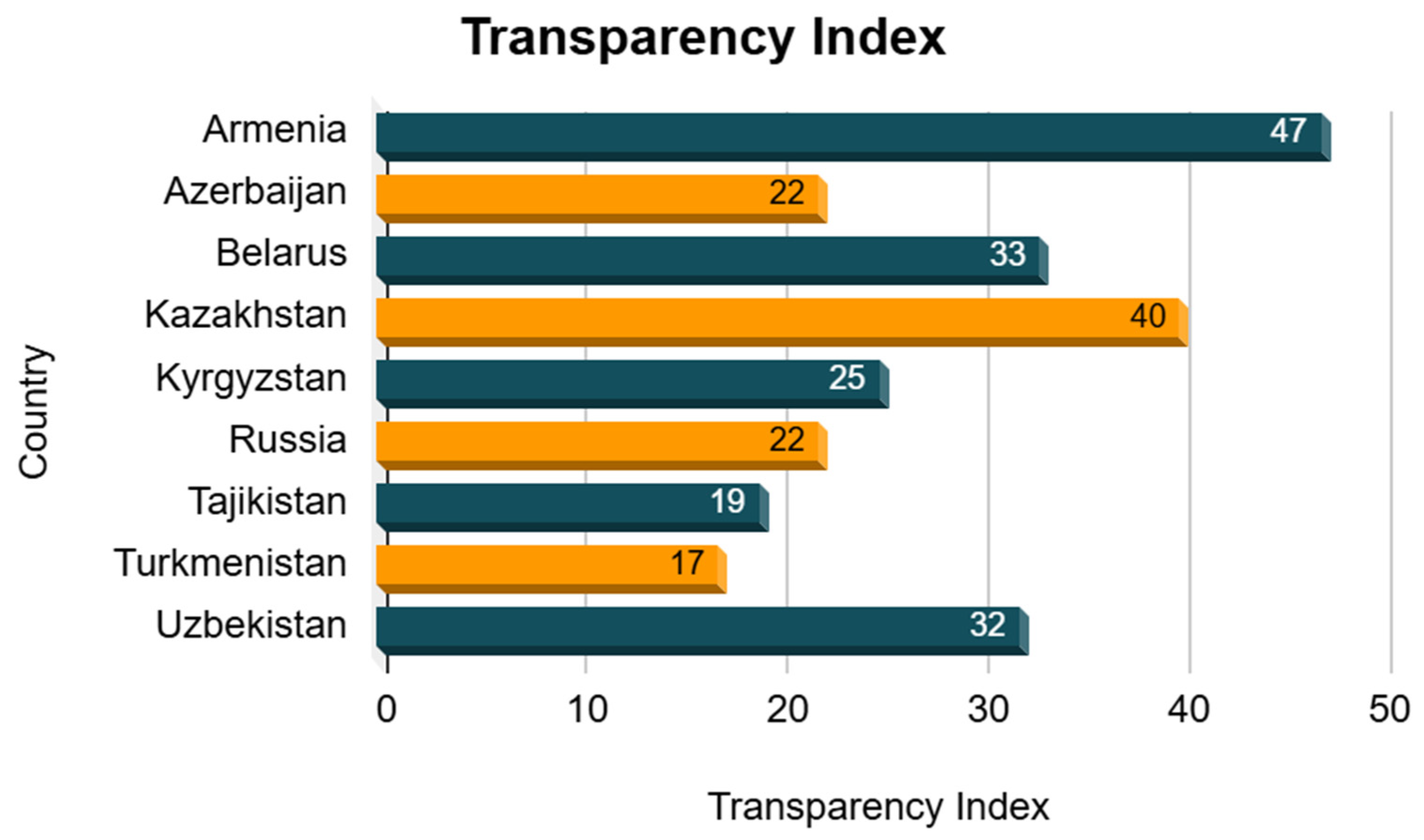
- Transparency International. Corruption Perception Index; Transparency International: Berlin, Germany, 2024; Available online: https://www.transparency.org/en/countries (accessed on 21 September 2025).
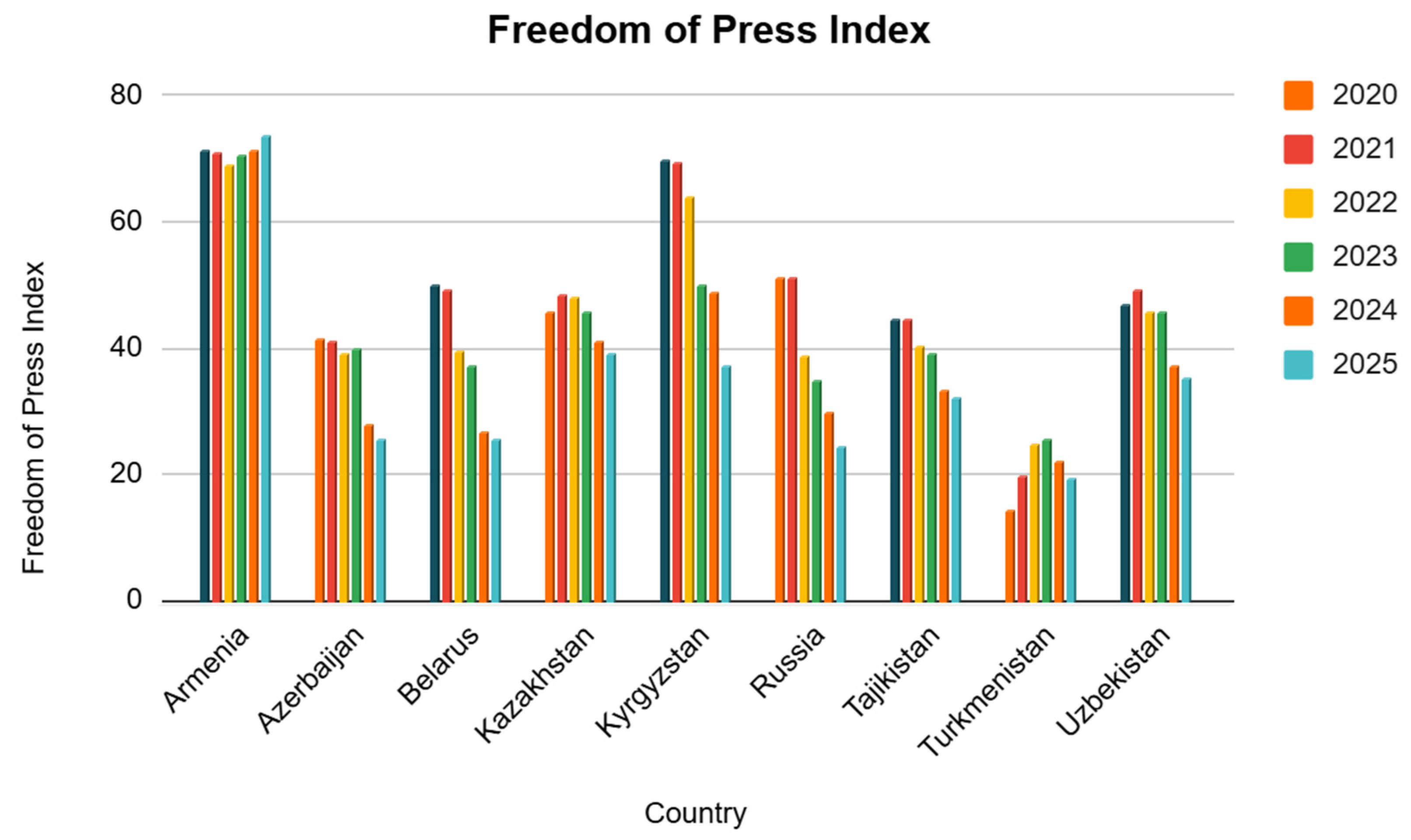
- Reporters without Borders. Freedom of Press Index; Reporters Without Borders: Paris, France, 2025; Available online: https://rsf.org/en/index?year= (accessed on 27 September 2025).
Disclaimer/Publisher’s Note: The statements, opinions and data contained in all publications are solely those of the individual author(s) and contributor(s) and not of MDPI and/or the editor(s). MDPI and/or the editor(s) disclaim responsibility for any injury to people or property resulting from any ideas, methods, instructions or products referred to in the content. |
© 2025 by the authors. Licensee MDPI, Basel, Switzerland. This article is an open access article distributed under the terms and conditions of the Creative Commons Attribution (CC BY) license.
Share and Cite
Lim, L.; Mukasheva, A.; Alegbe, A.O.; Emehel, A.N.; Aubakirova, B.; Semenova, Y. Public Health Communication Challenges in Eastern Europe and Central Asia: A Scoping Review. Int. J. Environ. Res. Public Health 2026, 23, 19. https://doi.org/10.3390/ijerph23010019
Lim L, Mukasheva A, Alegbe AO, Emehel AN, Aubakirova B, Semenova Y. Public Health Communication Challenges in Eastern Europe and Central Asia: A Scoping Review. International Journal of Environmental Research and Public Health. 2026; 23(1):19. https://doi.org/10.3390/ijerph23010019
Chicago/Turabian StyleLim, Lisa, Aisha Mukasheva, Augustina Osaromiyeke Alegbe, Adaora Nancy Emehel, Bibigul Aubakirova, and Yuliya Semenova. 2026. "Public Health Communication Challenges in Eastern Europe and Central Asia: A Scoping Review" International Journal of Environmental Research and Public Health 23, no. 1: 19. https://doi.org/10.3390/ijerph23010019
APA StyleLim, L., Mukasheva, A., Alegbe, A. O., Emehel, A. N., Aubakirova, B., & Semenova, Y. (2026). Public Health Communication Challenges in Eastern Europe and Central Asia: A Scoping Review. International Journal of Environmental Research and Public Health, 23(1), 19. https://doi.org/10.3390/ijerph23010019