Barriers to Chronic Disease Healthcare Access in Rural Eastern Cape Province, South Africa

Abstract
1. Introduction
2. Materials and Methods
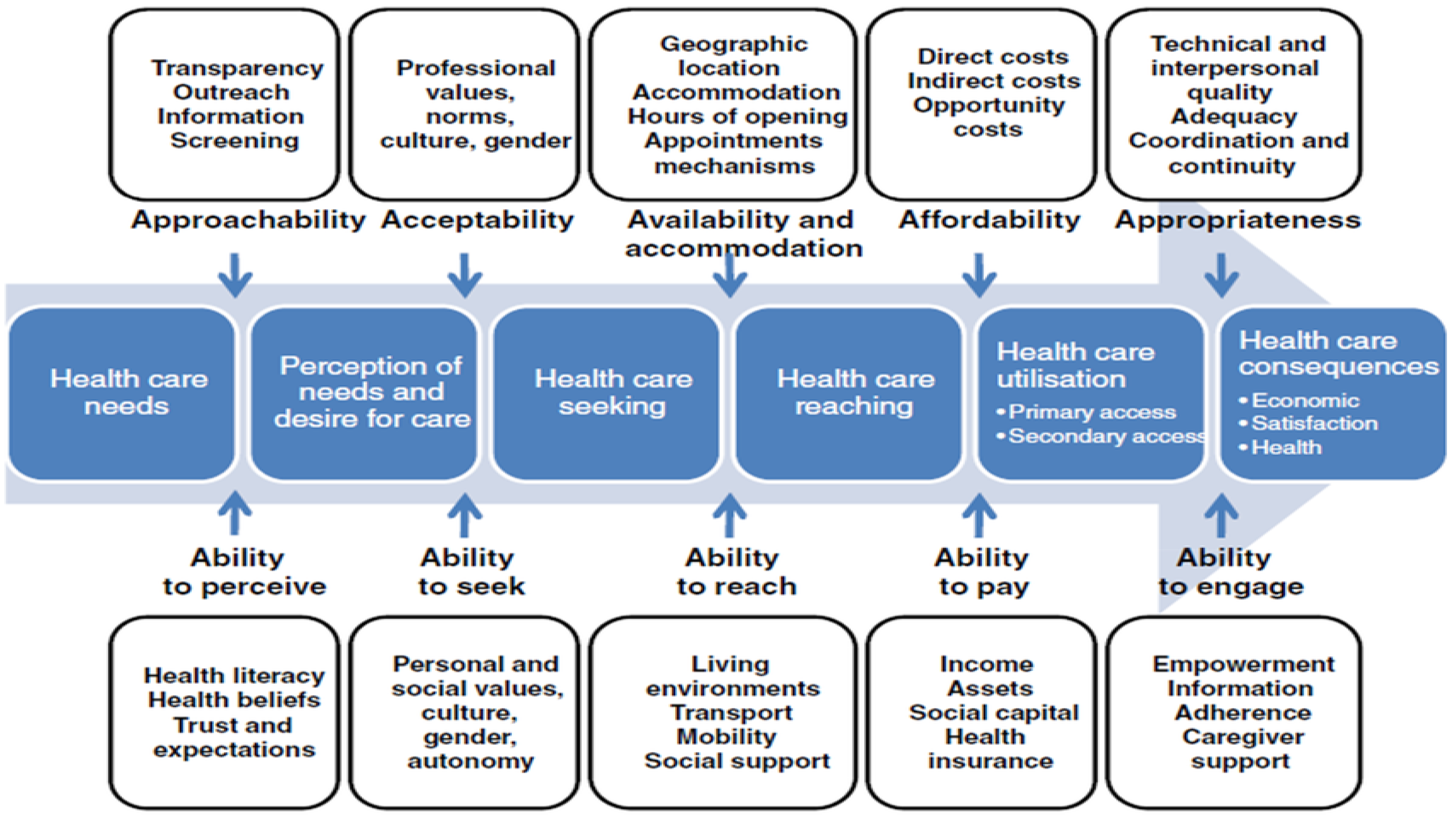
2.1. Context and Conceptual Framework
2.1.1. Barriers to Perceiving Need (Accessibility)
2.1.2. Barriers to Seeking Care (Acceptability)
2.1.3. Barriers to Reaching Healthcare (Availability)
2.1.4. Barriers to Utilizing Healthcare and Barriers to the Ability to Pay (Affordability)
2.1.5. Barriers to Ability to Engage (Appropriateness)
2.2. Population and Sampling
2.3. Data Collection
2.4. Data Processing and Analysis
2.5. Ethics Approval
3. Results
3.1. Participants’ Information
3.1.1. Theme 1: Barriers to Accessing Healthcare Services
“Going to the clinic or hospital is difficult because roads are terrible, especially when it rains. Sometimes it takes hours to get to the clinic because taxi drivers refuse to come to our area.”[Participant 6, male, 68 years]
“The clinic is far from where I stay, and the long distance often delays my treatment because I can’t go regularly if it’s raining, or I do not have transport money.”[Participant 1, male, 70 years]
“The hospital is far, and I can’t even walk; I would arrive very late.”[Participant 9, female, 67 years]
“The roads in our area are very bad, especially when it is raining. This makes it difficult even for transport to reach us.”[Participant 20, female, 39 years]
“The roads in my area are very bad, and when it rains, they become muddy and almost impossible to use. This makes it difficult for taxis to operate and for me to reach the clinic.”[Participant 26, female, 67 years]
“Accessing healthcare services has been a struggle for me because of the long distances to the clinic and the lack of transport.”[Participant 26, female, 67 years]
“Transport is expensive, so many patients walk long distances.”[Participant 21, male 28 years]
“Patients usually miss their appointments, leading to health issues.”[Participant 21, male, 28 years]
“There is lack of transportation, and our road is a gravel road, making it difficult to travel.”[Participant 12, male, 68 years]
“Transportation is the major issue because I use public transport, and it is not always reliable because when it is raining taxis refuse to reach certain areas.”[Participant 20, female, 39 years]
“This grant is not enough to cater for all my needs, and sometimes it is finished, and I struggle going to the clinic because I also use it for transport.”[Participant 2, female, 58 years]
“The government grant is not enough to cover all my healthcare expenses, including transport and emergencies.”[Participant 28, female, 68 years]
“Yes, it does affect me because I use the same money to buy groceries and pay stokvels, and it usually runs out.”[Participant 7, female, 60 years]
“The money I have is not enough to cover healthcare costs, especially transport.”[Participant 27, female, 39 years]
“Patients experience poor health outcomes due to interrupted care.”[Participant 25, male, 25 years]
“Financial problems patient face usually compromises their treatment adherence.”[Participant 30, female, 39 years]
“It can be difficult sometimes for me to come to the clinic because if I do not have money, I will not be able to come unless I have someone to borrow the money from and come here. Even if it is not my date to collect my treatment then it happens, I get sick, it will be difficult for me because most of the time I don’t have any money left for emergencies.”[Participant 5, male, 70 years]
3.1.2. Theme 2: Experiences and Perspectives
“Most of the time, I wait for three to four hours, sometimes from 8 a.m. to 1 p.m. This impacts my blood pressure management as I stay here until I am hungry due to time constraints.”[Participant 2, female, 58 years]
“I wait for about three or four hours; it does affect me because I wait here till it is late, and I don’t even have money to buy food.”[Participant 7, female, 60 years]
“It usually depends on how many people are at the hospital. Sometimes I wait for about five or six hours. My diabetes makes me hungry and thirsty all the time.”[Participant 15, female, 69 years]
“Patients become frustrated and sometimes leave without receiving care.”[Participant 21, male, 28 years]
“It delays diagnosis and early treatment, leading to the chronic disease being worse.”[Participant 22, female, 37 years]
“Yes, sometimes they say some medication is not available, but I always get my hypertension treatment.”[Participant 10, female, 51 years]
“I usually receive my medication, but this month, they did not give me my diabetes medication, and they did not explain why.”[Participant 14, female, 55 years]
“Yes, I was sent to another clinic and used my own money to get there.”[Participant 28, female, 63 years]
“Insufficient resources at the hospital makes it hard for us to provide comprehensive care to patients.”[Participant 24, female, 29 years]
“I usually receive my medication and sometimes they even give me treatment for three months.”[Participant 14, female, 55 years]
“Yes”[Participant 21–25 and 29–32]
“I was sent to another clinic and used my own money to get there.”[Participant 28, female, 63 years]
“The stock-outs of insulin usually result to mossed doses and lead to poor management of diabetes”[Participant 31, female, 29 years]
“I’m scared of traditional medicine, including drinking and steaming with them, as I am too old for all those things.”[Participant 18, female, 58 years]
“I used an herb called ‘uzifo zonke’ as I heard it does help with lowering blood pressure levels.”[Participant 3, female, 66 years]
“I used traditional medicine because I heard it also helps in treating diabetes, but I would go to the clinic and still find that my blood sugar is still high.”[Participant 28, female, 63 years]
“I’m a traditional man. Of course, I am going to use traditional herbs because I believe in them, even my ancestors were using them”[Participant 12, male, 68 years]
“I have used traditional medicines, but they have not been effective in managing both my disease.”[Participant 28, female, 63 years]
“I have never come across a nurse that was rude to me. I’ve always had the best experience with them, but I think they should try to work fast because we wait for too long here.”[Participant 3, female, 66 years]
“The nurses take care of us here, and they are respectful and kind.”[Participant 8, female 64 years]
“At the hospital, some healthcare workers are respectful and helpful, but I have also encountered others who seem impatient.”[Participant 20, female, 39 years]
“There is limited healthcare staff while there is a large number of patients we have to serve.”[Participant 30, female, 29 years]
“It affects because when it is raining, I must hire a ‘special’ to help me cross the river, the place is also not safe for us as women.”[Participant 8, female, 64 years]
“It is very far because I cannot even walk to the hospital or clinic, and it is not safe for women to walk alone in the street.”[Participant 18, female, 58 years]
“Heavy workload and still have to provide quality care for patients.”[Participant 21, male, 28 years]
“Emotional strain that comes from seeing a patient suffer and sometimes we cannot even help them due to insufficient medical supplies.”[Participant 25, male, 37 years]
“Patients usually arrive late at hospital when their condition has progressed because ambulances do not arrive on time making it harder for us.”[Participant 21, male, 28 years]
“Overwork and burnout are the most challenges here at the hospital because it is always overcrowded and sometimes, we do not even get our lunch breaks”[Participant 22, female, 37 years]
“Heavy workload due to shortage of staff here at the clinic.”[Participant 29, female, 30 years]
3.1.3. Theme 3: Existing Strategies or Interventions
“The only thing I have seen are mobile clinics even though they do not come here regularly.”[Participant 1, male, 70 years]
“I have seen mobile clinics occasionally and NGOs in the community, but the NGOs focuses on children only.”[Participant 5, male 70 years]
“Mobile clinics do come occasionally, because it is also difficult for them to come more often because our roads are in a poor condition.”[Participant 6, male, 68 years]
“We do have mobile clinics even though they often reach areas far from where I stay, so I wouldn’t know what they offer because I have never gone to them.”[Participant 7, female, 68 years]
“Mobile clinics sometimes come to the school, but they don’t come regularly. When they do come, they give people medication for their illnesses and check blood pressure and diabetes.”[Participant 9, female, 67 years]
“The CHW’s we had used to visit children and even give them deworming medicine.”[Participant 9, female, 67 years]
“I have only seen mobile clinics, but they take a month or two to come back again.”[Participant 10, female, 51 years]
“They only visit those who cannot go to the clinic on their own, they bring them treatment.”[Participant 16, female, 68 years]
“Once in three months. Their visits are helpful, but not consistent enough to manage my condition.”[Participant 27, female, 39 years]
“Mobile clinics have been effective in reaching many patients in rural areas, but the lack of resources, such as staff and equipment has made it difficult to reach even more people.”[Participant 21, male, 28 years]
“Outreach programs help in raising awareness and detection of chronic disease at an early stage, the only challenge is that there is not enough staff to be part of the team.”[Participant 22, female, 37 years]
“Outreach programs and mobile clinics. It is often difficult to reach some communities due to poor infrastructure and lack of staff.”[Participant 25, female, 37 years]
4. Discussion
5. Conclusions
Author Contributions
Funding
Institutional Review Board Statement
Informed Consent Statement
Data Availability Statement
Acknowledgments
Conflicts of Interest
References
- Chowdhury, J.; Ravi, R.P. Healthcare accessibility in developing countries: A global healthcare challenge. J. Clin. Biomed. Res. 2022, 4, 1–5. [Google Scholar] [CrossRef]
- Tzenios, N. The Determinants of Access to Healthcare: A Review of Individual, Structural, and Systemic Factors. J. Humanit. Appl. Sci. Res. 2025, 12, 45–60. [Google Scholar]
- Gordon, T.; Booysen, F.; Mbonigaba, J. Socio-economic inequalities in the multiple dimensions of access to healthcare: The case of South Africa. BMC Public Health 2020, 20, 289. [Google Scholar] [CrossRef] [PubMed] [PubMed Central]
- Barakat, C.; Konstantinidis, T. A Review of the Relationship between Socioeconomic Status Change and Health. Int. J. Environ. Res. Public Health 2023, 20, 6249. [Google Scholar] [CrossRef] [PubMed]
- Brundisini, F.; Giacomini, M.; DeJean, D.; Vanstone, M.; Winsor, S.; Smith, A. Chronic disease patients’ experiences with accessing health care in rural and remote areas: A systematic review and qualitative meta-synthesis. Ont. Health Technol. Assess. Ser. 2013, 13, 1–33. [Google Scholar] [PubMed] [PubMed Central]
- Scheffler, E.; Visagie, S.; Schneider, M. The impact of health service variables on healthcare access in a low resourced urban setting in the Western Cape, South Africa. Afr. J. Prim. Health Care Fam. Med. 2015, 7, 820. [Google Scholar] [CrossRef]
- Schwarz, T.; Schmtidt, A.E.; Bobe, J.; Ladurner, J. Barriers to accessing healthcare for people with chronic disease: A qualitative interview study. BMC Health Serv. Res. 2022, 22, 1037. [Google Scholar] [CrossRef] [PubMed]
- Chinyakata, R.; Roman, N.V.; Msiza, F.B. Stakeholders’ Perspectives on the Barriers to Accessing Health Care Services in Rural Settings: A Human Capabilities Approach. Open Public Health J. 2021, 14, 336–344. [Google Scholar] [CrossRef]
- McIntyre, D.; Obse, A.; Barasa, E.; Ataguba, J. Challenges in Financing Universal Health Coverage in Sub-Saharan Africa. Oxford Res. Encycl. Econ. Financ. 2018. [Google Scholar] [CrossRef]
- Godongwana, M.; De Wet-Billings, N.; Milovanovic, M. The comorbidity of HIV, hypertension and diabetes: A qualitative study exploring the challenges faced by healthcare providers and patients in selected urban and rural health facilities where the ICDM model is implemented in South Africa. BMC Health Serv. Res. 2021, 21, 647. [Google Scholar] [CrossRef]
- Coughlin, S.S.; Clary, C.; Johnson, J.A.; Berman, A.; Heboyan, V.; Benevides, T.; Moore, J.; George, V. Continuing Challenges in Rural Health in the United States. J. Environ. Health Sci. 2019, 5, 90–92. [Google Scholar]
- South African Medical Research Council (SAMRC). The State of Health in South Africa: Reflections and Future Directions. 2023. Available online: https://www.samrc.ac.za/news/state-health-south-africa-reflections-and-future-directions (accessed on 5 August 2025).
- Nojilana, B.; Bradshaw, D.; Pillay-van Wyk, V.; Msemburi, W.; Somdyala, N.; Joubert, J.D.; Groenewald, P.; Laubscher, R.; Dorrington, R.E. Persistent burden from non-communicable disease in South Africa needs strong action. S. Afr. Med. J. 2016, 106, 436–437. [Google Scholar] [CrossRef]
- Eastern Cape Socioeconomic Consultative Council (ECSECC). Eastern Cape Socioeconomic Review and Outlook 2024; ECSECC: East London, South Africa, 2024; Available online: https://ecsecc.org/datarepository/documents/ec-2024-sero_bNQ2D.pdf (accessed on 5 August 2025).
- Willie, M.M.; Maqbool, M. Access to Public Health Services in South Africa’s Rural Eastern Cape Province. J. Med. Public Health 2023, 4, 1076. [Google Scholar] [CrossRef]
- Chelak, K.; Chakole, S. The Role of Social Determinants of Health in Promoting Health Equality: A Narrative Review. Cureus 2023, 15, e33425. [Google Scholar] [CrossRef]
- OR Tambo District Municipality EC. Profile and Analysis District Development Model. South Africa. 2020. Available online: https://www.cogta.gov.za/ddm/wp-content/uploads/2020/11/ORTamnco-September-2020.pdf (accessed on 5 August 2025).
- Ataguba, J.E.; Ojo, K.; Ichoku, H.E. Socioeconomic-Related Inequalities in Health in South Africa: Evidence from General Household Surveys. Int. J. Equity Health 2011, 10, 48. [Google Scholar] [CrossRef]
- Cu, A.; Meister, S.; Lefebvre, B.; Ridde, V. Assessing Healthcare Access Using the Levesque’s Conceptual Framework—A Scoping Review. Int. J. Equity Health 2021, 20, 116. [Google Scholar] [CrossRef]
- Levesque, J.F.; Harris, M.F.; Russell, G. Patient-Centred Access to Health Care: Conceptualising Access at the Interface of Health Systems and Populations. Int. J. Equity Health 2013, 12, 18. [Google Scholar] [CrossRef] [PubMed]
- Francis, P. Managing Chronic Disease: A Comprehensive Approach to Better Health. J. Public Health Nutr. 2023, 6, 153. [Google Scholar]
- Hopman, P.; Heins, M.J.; Rijken, M.; Schellevis, F.G. Health Care Utilization of Patients with Multiple Chronic Disease in the Netherlands: Differences and Underlying Factors. Eur. J. Intern. Med. 2015, 26, 190–196. [Google Scholar] [CrossRef] [PubMed]
- Tangcharoensathien, V.; Lekagul, A.; Teo, Y.Y. Global Health Inequities: More Challenges, Some Solutions. Bull. World Health Organ. 2024, 102, 86–86A. [Google Scholar] [CrossRef]
- Thompson, A.E.; Anisimowicz, Y.; Miedema, B.; Hogg, W.; Wodchis, W.P.; Aubrey-Bassler, K. The Influence of Gender and Other Patient Characteristics on Health Care-Seeking Behaviour: A QUALICOPC Study. BMC Fam. Pract. 2016, 17, 38. [Google Scholar] [CrossRef] [PubMed]
- World Health Organization (WHO). Global Report on Ageism; World Health Organization: Geneva, Switzerland, 2021. [Google Scholar]
- Hu, Y.; Yang, Y.; Gao, Y.; Zhao, X.; Chen, L.; Sui, W.; Hu, J. The Impact of Chronic Disease on the Health-Related Quality of Life of Middle-Aged and Older Adults: The Role of Physical Activity and Degree of Digitization. BMC Public Health 2024, 24, 2335. [Google Scholar] [CrossRef]
- Cabañero-Garcia, E.; Martinez-Lacoba, R.; Pardo-Garcia, I.; Amo-Saus, E. Barriers to health, social and long-term care access among older adults: A systematic review of reviews. Int. J. Equity Health Vol. 2025, 24, 72. [Google Scholar] [CrossRef]
- Ngene, N.C.; Khaliq, O.P.; Moodley, J. Inequality in Health Care Services in Urban and Rural Settings in South Africa. Afr. J. Reprod. Health 2023, 27, 87. [Google Scholar] [CrossRef]
- Berhe, K.T.; Gesesew, H.A.; Ward, P.R. Traditional Healing Practices, Factors Influencing Access to the Practices, and Their Complementary Effect on Mental Health in Sub-Saharan Africa: A Systematic Review. BMJ Open 2024, 14, e083004. [Google Scholar] [CrossRef]
- Henke, O.; Bruchhausen, W.; Massawe, A. Use of Herbal Medicine Is Associated with Late-Stage Presentation in Tanzanian Patients with Cancer: A Survey to Assess the Utilization of Herbal Medicine. JCO Glob. Oncol. 2022, 8, e2200069. [Google Scholar] [CrossRef]
- Mseke, E.P.; Jessup, B.; Barnett, T. Impact of Distance and/or Travel Time on Healthcare Service Access in Rural and Remote Areas: A Scoping Review. J. Transp. Health 2024, 37, 101819. [Google Scholar] [CrossRef]
- Golembiewski, E.H.; Gravholt, D.L.; Roldan, V.D.T.; Naranjo, E.P.L.; Vallejo, S.; Bautista, A.G.; LaVecchia, C.M.; Patten, C.A.; Allen, S.V.; Jaladi, S.; et al. Rural Patient Experiences of Accessing Care for Chronic Conditions: A Systematic Review and Thematic Synthesis of Qualitative Studies. Ann. Fam. Med. 2022, 20, 266–272. [Google Scholar] [CrossRef] [PubMed]
- Weinhold, I.; Gurtner, S. Understanding Shortages of Sufficient Health Care in Rural Areas. Health Policy 2014, 118, 201–214. [Google Scholar] [CrossRef]
- Goudge, J.; Gilson, L.; Russell, S.; Gumede, T.; Mills, A. Affordability, Availability, and Acceptability Barriers to Healthcare for the Chronically Ill: Longitudinal Case Studies from South Africa. BMC Health Serv. Res. 2009, 9, 75. [Google Scholar] [CrossRef] [PubMed]
- Regassa-Senbato, F.; Wolde, D.; Bifa, K.T.; Bikila, T.G. Perspective Chapter: Strategies for Enhancing Healthcare Access. In Public Health [Online]; IntechOpen: London, UK, 2025. [Google Scholar] [CrossRef]


| Codes | Gender | Age | Diagnosis | Year of Diagnosis | Facility Name |
|---|---|---|---|---|---|
| Participants 1 | Male | 70 | Hypertension | >10 years | Mqanduli CHC |
| Participants 2 | Female | 58 | Hypertension | 2012 | Mqanduli CHC |
| Participants 3 | Female | 66 | Hypertension | >10 years | Mqanduli CHC |
| Participants 4 | Female | 50 | Diabetes & Hypertension | 2020 & 2022 | Mqanduli CHC |
| Participants 5 | Male | 70 | Hypertension | Unknown (>10 years) | Mqanduli CHC |
| Participants 6 | Male | 68 | Hypertension | Unknown (>10 years) | St Barnabas Hospital |
| Participants 7 | Female | 60 | Diabetes & Hypertension | Unknown (>10 years) | St Barnabas Hospital |
| Participants 8 | Female | 64 | Hypertension | Unknown (>10 years) | St Barnabas Hospital |
| Participants 9 | Female | 67 | Hypertension | 2001 | St Barnabas Hospital |
| Participants 10 | Female | 51 | Diabetes & Hypertension | 2024 | St Barnabas Hospital |
| Participants 11 | Female | 64 | Hypertension | 2002 | St Barnabas Hospital |
| Participants 12 | Male | 68 | Hypertension | 2020 | St Barnabas Hospital |
| Participants 13 | Female | 50 | Hypertension | Unknown | St Barnabas Hospital |
| Participants 14 | Female | 55 | Diabetes & Hypertension | Unknown | St Barnabas Hospital |
| Participants 15 | Female | 69 | Diabetes | 2020 | St Barnabas Hospital |
| Participants 16 | Female | 68 | Hypertension | Unknown | St Barnabas Hospital |
| Participants 17 | Female | 67 | Hypertension | Unknown | St Barnabas Hospital |
| Participants 18 | Female | 58 | Hypertension | 2020 | St Barnabas Hospital |
| Participants 19 | Female | 65 | Hypertension | 2016 | St Barnabas Hospital |
| Participants 20 | Female | 39 | Breast Cancer | 2024 | St Barnabas Hospital |
| Participants 26 | Female | 67 | Hypertension | 2018 | Libode Clinic |
| Participants 27 | Female | 39 | Diabetes | 2022 | Libode Clinic |
| Participants 28 | Female | 63 | Diabetes | 2022 | Libode Clinic |
| Code | Gender | Age | Professional Level | Facility Name |
|---|---|---|---|---|
| Participants 21 | Male | 28 | Registered Nurse | St Barnabas Hospital |
| Participants 22 | Female | 37 | Registered Nurse | St Barnabas Hospital |
| Participants 23 | Female | 40 | Registered Nurse | St Barnabas Hospital |
| Participants 24 | Female | 29 | Registered Nurse | St Barnabas Hospital |
| Participants 25 | Male | 37 | Registered Nurse | St Barnabas Hospital |
| Participants 29 | Female | 30 | Registered Nurse | Libode Clinic |
| Participants 30 | Female | 39 | Registered Nurse | Libode Clinic |
| Participants 31 | Female | 42 | Registered Nurse | Libode Clinic |
| Participants 32 | Female | 28 | Registered Nurse | Libode Clinic |
Disclaimer/Publisher’s Note: The statements, opinions and data contained in all publications are solely those of the individual author(s) and contributor(s) and not of MDPI and/or the editor(s). MDPI and/or the editor(s) disclaim responsibility for any injury to people or property resulting from any ideas, methods, instructions or products referred to in the content. |
© 2025 by the authors. Licensee MDPI, Basel, Switzerland. This article is an open access article distributed under the terms and conditions of the Creative Commons Attribution (CC BY) license (https://creativecommons.org/licenses/by/4.0/).
Share and Cite
Mntungwana, S.; Khosa, N.V.; Buso, A.E.; Sithole, N. Barriers to Chronic Disease Healthcare Access in Rural Eastern Cape Province, South Africa. Int. J. Environ. Res. Public Health 2025, 22, 1881. https://doi.org/10.3390/ijerph22121881
Mntungwana S, Khosa NV, Buso AE, Sithole N. Barriers to Chronic Disease Healthcare Access in Rural Eastern Cape Province, South Africa. International Journal of Environmental Research and Public Health. 2025; 22(12):1881. https://doi.org/10.3390/ijerph22121881
Chicago/Turabian StyleMntungwana, Siphelele, Ntiyiso Vinny Khosa, Andiswa Esethu Buso, and Nomfuneko Sithole. 2025. "Barriers to Chronic Disease Healthcare Access in Rural Eastern Cape Province, South Africa" International Journal of Environmental Research and Public Health 22, no. 12: 1881. https://doi.org/10.3390/ijerph22121881
APA StyleMntungwana, S., Khosa, N. V., Buso, A. E., & Sithole, N. (2025). Barriers to Chronic Disease Healthcare Access in Rural Eastern Cape Province, South Africa. International Journal of Environmental Research and Public Health, 22(12), 1881. https://doi.org/10.3390/ijerph22121881