
“I Somehow Survived… but I Will Never Do It Again”: Teachers’ Perspectives on Past and Future Educational Disruptions in Slovenia


Abstract
1. Introduction
1.1. Aim and Research Question
1.2. Structure
1.3. Theoretical Insights
2. Materials and Methods
2.1. Procedure
2.2. Participants
2.3. Instruments
2.4. Analysis
3. Results
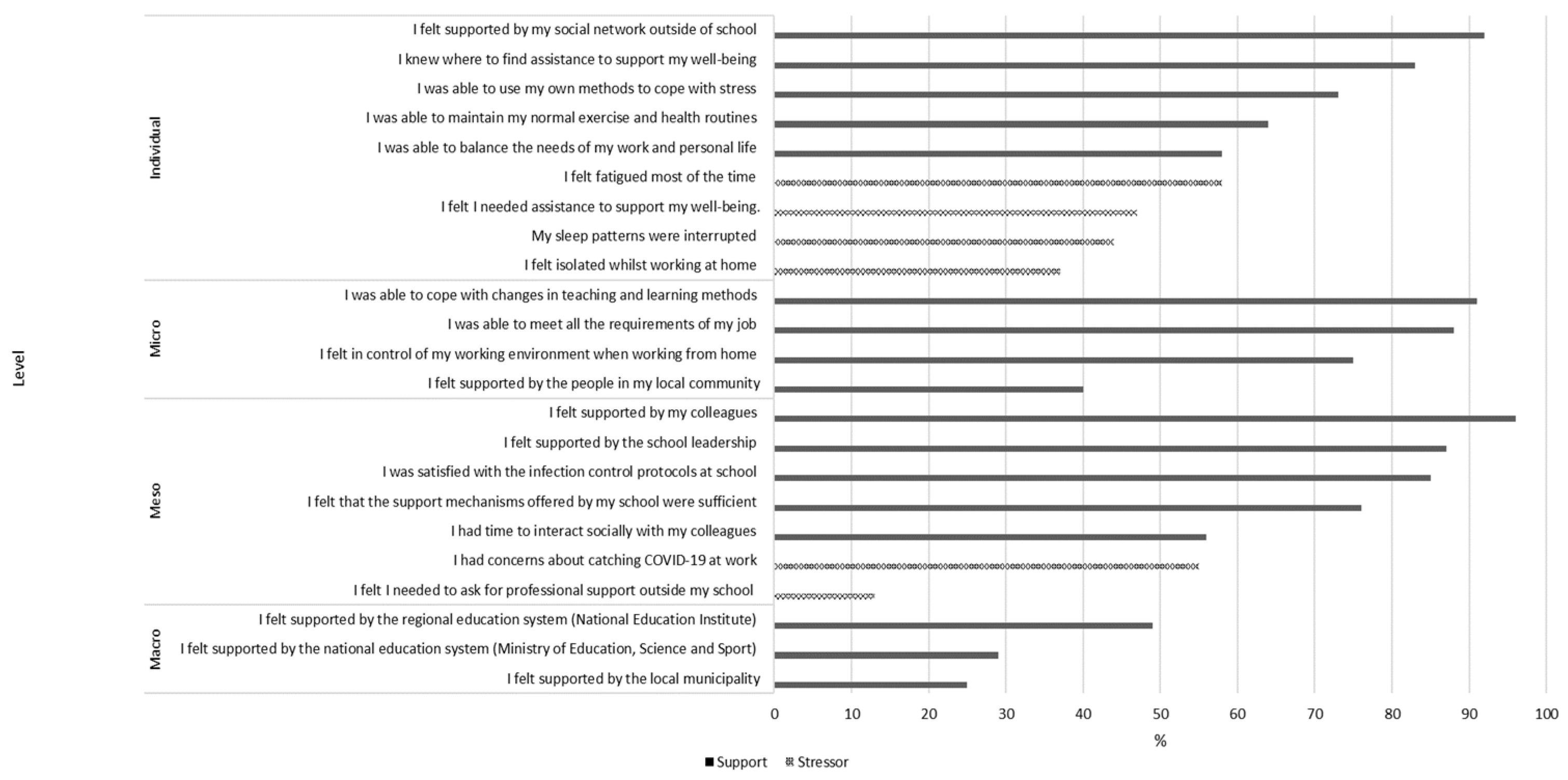
3.1. Teachers’ Stress Sources and Well-Being Sources as Reported in the REDS
3.2. Teachers’ Stress Sources and Well-Being Support as Reported in the Focus Groups
3.2.1. Individual Level
3.2.2. Micro Level
3.2.3. Meso Level
3.2.4. Macro Level
3.2.5. Chrono Level
4. Discussion
4.1. Sources of Stress on Different Levels
4.2. Sources of Support on Different Levels
4.3. Limitations and Future Research Directions
4.4. (Non)Preparedness and Required Support for Future Educational Disruptions Across Levels
5. Conclusions
Author Contributions
Funding
Institutional Review Board Statement
Informed Consent Statement
Data Availability Statement
Acknowledgments
Conflicts of Interest
Abbreviations
| COVID-19 | Coronavirus disease 2019 |
| IEA | International Association for the Evaluation of Educational Achievement |
| JD-R | Job Demands–Resources Model |
| REDS | Responses to Educational Disruption Survey |
| UNESCO | United Nations Educational, Scientific and Cultural Organization |
References
- Bertoletti, A.; Karpiński, Z. Investigating the Effect of COVID-19 Disruption in Education Using REDS Data. Large-Scale Assess. Educ. 2024, 12, 5. [Google Scholar] [CrossRef]
- Spond, M.; Ussery, V.; Warr, A.; Dickinson, K.J. Adapting to Major Disruptions to the Learning Environment: Strategies and Lessons Learnt During a Global Pandemic. Med. Sci. Educ. 2022, 32, 1173–1182. [Google Scholar] [CrossRef] [PubMed]
- Pressley, T.; Rangel, R. Elementary Teacher Self-Efficacy after a Year of Teaching During COVID-19. Psychol. Sch. 2023, 60, 3284–3297. [Google Scholar] [CrossRef]
- Sigursteinsdottir, H.; Rafnsdottir, G.L. The Well-Being of Primary School Teachers During COVID-19. Int. J. Environ. Res. Public Health 2022, 19, 11177. [Google Scholar] [CrossRef]
- Falecki, D.; Mann, E. Practical Applications for Building Teacher Wellbeing in Education. In Cultivating Teacher Resilience: International Approaches, Applications and Impact; Mansfield, C.F., Ed.; Springer: Cham, Switzerland, 2020; pp. 175–191. [Google Scholar] [CrossRef]
- Harmsen, R.; Helms-Lorenz, M.; Maulana, R.; van Veen, K. The Relationship between Beginning Teachers’ Stress Causes, Stress Responses, Teaching Behaviour and Attrition. Teach. Teach. Theory Pract. 2018, 24, 626–643. [Google Scholar] [CrossRef]
- Kupers, E.; Mouw, J.M.; Fokkens-Bruinsma, M. Teaching in Times of COVID-19: A Mixed-Method Study into Teachers’ Teaching Practices, Psychological Needs, Stress, and Well-Being. Teach. Teach. Educ. 2022, 115, 103724. [Google Scholar] [CrossRef]
- Wong, R. Job-related stress and well-being among teachers: A cross-sectional study. Asian Soc. Sci. 2020, 16, 19–28. [Google Scholar] [CrossRef]
- Bell, S.; Williams, J.; Horwood, J.; Redwood, S. When Corona Infested Everything—A Qualitative Interview Study Exploring the Impact of COVID-19 Mitigation Measures on School Life from the Perspectives of English Secondary School Staff and Students. Int. J. Environ. Res. Public Health 2025, 22, 915. [Google Scholar] [CrossRef] [PubMed]
- Davis, T.; Park, E. A Systematic Review of Early-Career Teacher Wellbeing, Stress, Burnout and Support Mechanisms During and Post COVID-19 Pandemic. Educ. Sci. 2025, 15, 996. [Google Scholar] [CrossRef]
- Hascher, T.; Waber, J. Teacher Well-Being: A Systematic Review of the Research Literature from the Year 2000–2019. Educ. Res. Rev. 2021, 34, 100411. [Google Scholar] [CrossRef]
- Aziku, M.; Zhang, B. A Systematic Review of Teacher Well-Being Research During the COVID-19 Pandemic. Front. Psychol. 2024, 15, 1427979. [Google Scholar] [CrossRef]
- Robinson, L.E.; Valido, A.; Drescher, A.; Woolweaver, A.B.; Espelage, D.L.; LoMurray, S.; Long, A.C.; Wright, A.A.; Dailey, M.M. Teachers, Stress, and the COVID-19 Pandemic: A Qualitative Analysis. Sch. Ment. Health 2023, 15, 78–89. [Google Scholar] [CrossRef] [PubMed]
- Gadermann, A.M.; Gagné Petteni, M.; Molyneux, T.M.; Warren, M.T.; Thomson, K.C.; Schonert-Reichl, K.A.; Guhn, M.; Oberle, E. Teacher Mental Health and Workplace Well-Being in a Global Crisis: Learning from the Challenges and Supports Identified by Teachers One Year into the COVID-19 Pandemic in British Columbia, Canada. PLoS ONE 2023, 18, e0290230. [Google Scholar] [CrossRef] [PubMed]
- Ní Chinseallaigh, E.; Shipsey, M.; Minihan, E.; Gavin, B.; McNicholas, F. Burnout Persists in Teachers in Ireland Post-COVID-19: A Qualitative Follow Up Comparative Study. Int. J. Environ. Res. Public Health 2025, 22, 641. [Google Scholar] [CrossRef]
- Pereira, D.; Aguiar Vieira, D.; Flores, M.A.; Machado, E.A.; Fernandes, E. Teachers’ Concerns and Teaching Experience During the Pandemic and beyond: Implications for Research, Policy and Practice. Cogent Educ. 2025, 12, 2461395. [Google Scholar] [CrossRef]
- Reinke, W.M.; Herman, K.C.; Stormont, M.; Ghasemi, F. Teacher Stress, Coping, Burnout, and Plans to Leave the Field: A Post-Pandemic Survey. Sch. Ment. Health 2025, 17, 328–344. [Google Scholar] [CrossRef]
- Luhmann, M.; Hofmann, W.; Eid, M.; Lucas, R.E. Subjective Well-Being and Adaptation to Life Events: A Meta-Analysis. J. Pers. Soc. Psychol. 2012, 102, 592–615. [Google Scholar] [CrossRef] [PubMed]
- Sacré, M.; Ries, N.; Wolf, K.; Kunter, M. Teachers’ Well-Being and Their Teaching Quality During the COVID-19 Pandemic: A Retrospective Study. Front. Educ. 2023, 8, 1136940. [Google Scholar] [CrossRef]
- Braun, S.S.; Roeser, R.W.; Mashburn, A.J.; Skinner, E. Middle School Teachers’ Mindfulness, Occupational Health and Well-Being, and the Quality of Teacher-Student Interactions. Mindfulness 2019, 10, 245–255. [Google Scholar] [CrossRef]
- Baker, C.N.; Peele, H.; Daniels, M.; Saybe, M.; Whalen, K.; Overstreet, S. The Experience of COVID-19 and Its Impact on Teachers’ Mental Health, Coping, and Teaching. Sch. Psychol. Rev. 2021, 50, 491–504. [Google Scholar] [CrossRef]
- Perrone, F.; Player, D.; Youngs, P. Administrative Climate, Early Career Teacher Burnout, and Turnover. J. Sch. Leadersh. 2019, 29, 191–209. [Google Scholar] [CrossRef]
- Herman, K.C.; Hickmon-Rosa, J.E.; Reinke, W.M. Empirically Derived Profiles of Teacher Stress, Burnout, Self-Efficacy, and Coping and Associated Student Outcomes. J. Posit. Behav. Interv. 2018, 20, 90–100. [Google Scholar] [CrossRef]
- Hoglund, W.L.; Klingle, K.E.; Hosan, N.E. Classroom Risks and Resources: Teacher Burnout, Classroom Quality and Children’s Adjustment in High Needs Elementary Schools. J. Sch. Psychol. 2015, 53, 337–357. [Google Scholar] [CrossRef]
- Oberle, E.; Schonert-Reichl, K. Stress Contagion in the Classroom? The Link between Classroom Teacher Burnout and Morning Cortisol in Elementary School Students. Soc. Sci. Med. 2016, 159, 30–37. [Google Scholar] [CrossRef] [PubMed]
- Statistical Office of the Republic of Slovenia. Persons in Employment, August 2024; Statistical Office of the Republic of Slovenia: Ljubljana, Slovenia, 2025; Available online: https://www.stat.si/StatWeb/en/news/Index/13164 (accessed on 10 October 2025).
- Statistical Office of the Republic of Slovenia. Persons Employed in Formal Education, School Year 2024/2025; Statistical Office of the Republic of Slovenia: Ljubljana, Slovenia, 2025; Available online: https://www.stat.si/StatWeb/en/News/Index/13702 (accessed on 10 October 2025).
- Agyapong, B.; Obuobi-Donkor, G.; Burback, L.; Wei, Y. Stress, Burnout, Anxiety and Depression among Teachers: A Scoping Review. Int. J. Environ. Res. Public Health 2022, 19, 10706. [Google Scholar] [CrossRef]
- Greenberg, M.T.; Brown, J.L.; Abenavoli, R.M. Teacher Stress and Health Effects on Teachers, Students, and Schools; Edna Bennett Pierce Prevention Research Center, Pennsylvania State University: State College, PA, USA, 2016. [Google Scholar]
- Gouëdard, P.; Pont, B.; Viennet, R. Education Responses to COVID-19: Implementing a Way Forward; OECD Working Paper No. 224; OECD: Paris, France, 2020. [Google Scholar] [CrossRef]
- Ermenc, K.S.; Kalin, J.; Mažgon, J. How to Run an Empty School: The Experience of Slovenian School Heads During the COVID-19 Pandemic. SAGE Open 2021, 11, 215824402110321. [Google Scholar] [CrossRef]
- Department of Education and Skills. Teacher Wellbeing & Self-Care During the COVID-19 (Coronavirus) School Closures; Department of Education and Skills: Dublin, Ireland, 2020; Available online: https://www.education.ie/en/The-Department/Announcements/teacher-wellbeing-self-care-during-the-covid-19-coronavirus-school-closures.pdf (accessed on 20 February 2025).
- Meinck, S.; Fraillon, J.; Strietholt, R. The Impact of the COVID-19 Pandemic on Education: International Evidence from the Responses to Educational Disruption Survey (REDS); UNESCO: Paris, France; IEA: Amsterdam, The Netherlands, 2022. [Google Scholar]
- Bakker, A.B.; Demerouti, E. Job Demands—Resources Theory: Taking Stock and Looking Forward. J. Occup. Health Psychol. 2017, 22, 273–285. [Google Scholar] [CrossRef]
- Bronfenbrenner, U. The Ecology of Human Development: Experiments by Nature and Design; Harvard University Press: Cambridge, MA, USA, 1979. [Google Scholar]
- Bakker, A.B.; Demerouti, E. The Job Demands-Resources Model: State of the Art. J. Manag. Psychol. 2007, 22, 309–328. [Google Scholar] [CrossRef]
- McCarthy, C.J. Teacher Stress: Balancing Demands and Resources. Phi Delta Kappan 2019, 101, 8–14. [Google Scholar] [CrossRef]
- Taris, T.W.; Leisink, P.L.M.; Schaufeli, W.B. Applying Occupational Health Theories to Educator Stress: Contribution of the Job Demands-Resources Model. In Educator Stress. Aligning Perspectives on Health, Safety and Well-Being; McIntyre, T., McIntyre, S., Francis, D., Eds.; Springer: Cham, Switzerland, 2017; pp. 237–259. [Google Scholar] [CrossRef]
- Lambert, R.; McCarthy, C.; Weppner, C.; Malerba, C.; Osman, D.; Holcomb, T.S.; Bottoms, B.L. Associations between Teacher Stress and School Leadership: A Mixed Methods Study with Implications for School Psychologists. Sch. Psychol. 2023, 38, 370–384. [Google Scholar] [CrossRef]
- Aulén, A.-M.; Pakarinen, E.; Lerkkanen, M.-K. Teachers’ Job Crafting to Support Their Work-Related Well-Being During the COVID-19 Pandemic—A Qualitative Approach. Teach. Teach. Educ. 2024, 141, 104492. [Google Scholar] [CrossRef]
- Granziera, H.; Collie, R.; Martin, A. Understanding Teacher Wellbeing through Job Demands-Resources Theory. In Cultivating Teacher Resilience: International Approaches, Applications and Impact; Mansfield, C.F., Ed.; Springer: Cham, Switzerland, 2021; pp. 229–244. [Google Scholar]
- Skaalvik, E.M.; Skaalvik, S. Job Demands and Job Resources as Predictors of Teacher Motivation and Well-Being. Soc. Psychol. Educ. 2018, 21, 1251–1275. [Google Scholar] [CrossRef]
- Chan, M.-K.; Sharkey, J.D.; Lawrie, S.I.; Arch, D.A.N.; Nylund-Gibson, K. Elementary School Teacher Well-Being and Supportive Measures amid COVID-19: An Exploratory Study. Sch. Psychol. 2021, 36, 533–545. [Google Scholar] [CrossRef] [PubMed]
- Lep, Ž.; Klemenčič Mirazchiyski, E.; Mirazchiyski, P.V. The Relative Effect of Job Demands, Resources, and Personal Resources on Teaching Quality and Students’ Engagement During the COVID-19 Pandemic. Front. Psychol. 2023, 14, 1282775. [Google Scholar] [CrossRef]
- Manuti, A.; Giancaspro, M.L.; Gemmano, C.G.; Morrelli, F. Coping with the Unexpected: A Job Demands/Resources Study Exploring Italian Teachers’ Remote Working Experience During the COVID-19 Lockdown. Teach. Teach. Educ. Leadersh. Prof. Dev. 2022, 1, 100010. [Google Scholar] [CrossRef]
- Martí-González, M.; Alcalá-Ibañez, M.L.; Castán-Esteban, J.L.; Martín-Bielsa, L.; Gallardo, L.O. COVID-19 in School Teachers: Job Satisfaction and Burnout through the Job Demands Control Model. Behav. Sci. 2023, 13, 76. [Google Scholar] [CrossRef] [PubMed]
- Sokal, L.; Eblie Trudel, L.; Babb, J. Supporting Teachers in Times of Change: The Job Demands-Resources Model and Teacher Burnout During the COVID-19 Pandemic. Int. J. Contemp. Educ. 2020, 3, 67–74. [Google Scholar] [CrossRef]
- Stang-Rabrig, J.; Brüggemann, T.; Lorenz, R.; McElvany, N. Teachers’ Occupational Well-Being During the COVID-19 Pandemic: The Role of Resources and Demands. Teach. Teach. Educ. 2022, 117, 103803. [Google Scholar] [CrossRef]
- Alves, R.; Lopes, T.; Precioso, J. Teachers’ Well-Being in Times of COVID-19 Pandemic: Factors That Explain Professional Well-Being. Int. J. Educ. Res. Innov. 2020, 15, 203–217. [Google Scholar] [CrossRef]
- Padmanabhanunni, A.; Pretorius, T.B. Teacher Burnout in the Time of COVID-19: Antecedents and Psychological Consequences. Int. J. Environ. Res. Public Health 2023, 20, 4204. [Google Scholar] [CrossRef]
- Westphal, A.; Kalinowski, E.; Hoferichter, C.J.; Vock, M. K-12 Teachers’ Stress and Burnout During the COVID-19 Pandemic: A Systematic Review. Front. Psychol. 2022, 13, 920326. [Google Scholar] [CrossRef]
- Cross, D.I.; Hong, J.Y. An Ecological Examination of Teachers’ Emotions in the School Context. Teach. Teach. Educ. 2012, 28, 957–967. [Google Scholar] [CrossRef]
- Price, D.; McCallum, F. Ecological Influences on Teachers’ Well-Being and “Fitness”. Asia-Pac. J. Teach. Educ. 2015, 43, 195–209. [Google Scholar] [CrossRef]
- Roffey, S. Pupil Wellbeing—Teacher Wellbeing: Two Sides of the Same Coin? Educ. Child Psychol. 2012, 29, 8–17. [Google Scholar] [CrossRef]
- McDonough, S.; Lemon, N. “Stretched Very Thin”: The Impact of COVID-19 on Teachers’ Work Lives and Well-Being. Teach. Teach. 2022, 30, 1070–1082. [Google Scholar] [CrossRef]
- Lizana, P.A.; Lera, L. Depression, Anxiety, and Stress among Teachers During the Second COVID-19 Wave. Int. J. Environ. Res. Public Health 2022, 19, 5968. [Google Scholar] [CrossRef]
- Santiago, I.S.D.; dos Santos, E.P.; da Silva, J.A.; de Sousa Cavalcante, Y.; Gonçalves Júnior, J.; de Souza Costa, A.R.; Cândido, E.L. The Impact of the COVID-19 Pandemic on the Mental Health of Teachers and Its Possible Risk Factors: A Systematic Review. Int. J. Environ. Res. Public Health 2023, 20, 1747. [Google Scholar] [CrossRef] [PubMed]
- Kim, E.L.; Oxley, L.; Asbury, K. “My Brain Feels like a Browser with 100 Tabs Open”: A Longitudinal Study of Teachers’ Mental Health and Well-Being During the COVID-19 Pandemic. Br. J. Educ. Psychol. 2021, 92, 299–318. [Google Scholar] [CrossRef]
- Hilger, K.J.E.; Scheibe, S.; Frenzel, A.C.; Keller, M.M. Exceptional Circumstances: Changes in Teachers’ Work Characteristics and Well-Being During COVID-19 Lockdown. Sch. Psychol. 2021, 36, 516–532. [Google Scholar] [CrossRef]
- Restubog, S.L.D.; Ocampo, A.C.G.; Wang, L. Taking Control amidst the Chaos: Emotion Regulation During the COVID-19 Pandemic. J. Vocat. Behav. 2020, 119, 103440. [Google Scholar] [CrossRef] [PubMed]
- Truzoli, R.; Pirola, V.; Conte, S. The Impact of Risk and Protective Factors on Online Teaching Experience in High School Italian Teachers During the COVID-19 Pandemic. J. Comput. Assist. Learn. 2021, 37, 940–952. [Google Scholar] [CrossRef] [PubMed]
- Diaz Lema, M.L.; Rossi, L.; Soncin, M. Teaching Away from School: Do School Digital Support Influence Teachers’ Well-Being During COVID-19 Emergency? Large-Scale Assess. Educ. 2023, 11, 10. [Google Scholar] [CrossRef]
- Pozo, J.; Echeverría, M.P.; Cabellos, B. Teaching and Learning in Times of COVID-19: Uses of Digital Technologies During School Lockdowns. Front. Psychol. 2021, 12, 656776. [Google Scholar] [CrossRef]
- van der Spoel, I.; Noroozi, O.; Schuurink, E.; Van Ginkel, S. Teachers’ Online Teaching Expectations and Experiences During the COVID-19 Pandemic in the Netherlands. Eur. J. Teach. Educ. 2020, 43, 623–638. [Google Scholar] [CrossRef]
- Orines, R.; Sunga-Vargas, M.A. Stress and Emotion-Focused Coping as Predictors of Psychological Well-Being among Public School Teachers During COVID-19 Pandemic. N. Am. J. Psychol. 2023, 25, 405–416. [Google Scholar]
- Khan, N.; Aslam, R.; Asad, M.M.; Oad, L.; Almusharraf, N.M. Effects of WFH on Educators’ Wellbeing: Mediating Role of Institutional Head’s Support and Moderating Role of Employees’ Self-Efficacy at University Level. J. Prof. Cap. Community 2022, 7, 305–326. [Google Scholar] [CrossRef]
- Sudibjo, N.; Manihuruk, A.M. How Do Happiness at Work and Perceived Organizational Support Affect Teachers’ Mental Health through Job Satisfaction During the COVID-19 Pandemic? Psychol. Res. Behav. Manag. 2022, 15, 939–951. [Google Scholar] [CrossRef]
- Kim, E.L.; Asbury, K. “Like a Rug Had Been Pulled from Under You”: The Impact of COVID-19 on Teachers in England During the First Six Weeks of the UK Lockdown. Br. J. Educ. Psychol. 2020, 90, 1062–1083. [Google Scholar] [CrossRef] [PubMed]
- Trust, T.; Whalen, J. Should Teachers Be Trained in Emergency Remote Teaching? Lessons Learned from the COVID-19 Pandemic. J. Technol. Teach. Educ. 2020, 28, 198–199. [Google Scholar] [CrossRef]
- Billaudeau, N.; Alexander, S.; Magnard, L.; Temam, S.; Vercambre, M.-N. What Levers to Promote Teachers’ Wellbeing During the COVID-19 Pandemic and Beyond: Lessons Learned from a 2021 Online Study in Six Countries. Int. J. Environ. Res. Public Health 2022, 19, 9151. [Google Scholar] [CrossRef] [PubMed]
- Klusmann, U.; Aldrup, K.; Roloff-Bruchmann, J.; Carstensen, B.; Wartenberg, G.; Hansen, J.; Hanewinkel, R. Teachers’ Emotional Exhaustion During the COVID-19 Pandemic: Levels, Changes, and Relations to Pandemic-Specific Demands. Teach. Teach. Educ. 2023, 121, 103908. [Google Scholar] [CrossRef]
- Creswell, J.W.; Creswell, J.D. Research Design: Qualitative, Quantitative, and Mixed Methods Approaches, 5th ed.; SAGE Publications, Inc.: Los Angeles, CA, USA, 2018; pp. 213–246. [Google Scholar]
- UNESCO; IEA. Responses to Educational Disruption Survey: User Guide for the International Database (Revised ed.); UNESCO: Paris, France; IEA: Amsterdam, The Netherlands, 2022; p. 977. Available online: https://unesdoc.unesco.org/ark:/48223/pf0000382024. (accessed on 20 February 2025).
- Klemenčič Mirazchiyski, E.; Pertoci, N.; Plamen, M. Mednarodna Raziskava Motenj Izobraževanja v Času Epidemije Covida-19 (IEA REDS) Nacionalno Poročilo—Prvi Rezultati; Pedagoški inštitut: Ljubljana, Slovenia, 2021. [Google Scholar]
- Hsieh, H.; Shannon, S.E. Three Approaches to Qualitative Content Analysis. Qual. Health Res. 2005, 15, 1277–1288. [Google Scholar] [CrossRef]
- Harding, A.B.; Ramirez, M.R.; Ryan, A.D.; Xiong, B.N.; Rosebush, C.E.; Woods-Jaeger, B. Impacts of COVID-19 on Stress in Middle School Teachers and Staff in Minnesota: An Exploratory Study Using Random Forest Analysis. Int. J. Environ. Res. Public Health 2023, 20, 6698. [Google Scholar] [CrossRef]
- McCarthy, C.J.; Lambert, R.G.; Lineback, S.; Fitchett, P.G.; Baddouh, P.G. Assessing Teacher Appraisals and Stress in the Classroom: Review of the Classroom Appraisal of Resources and Demands. Educ. Psychol. Rev. 2016, 28, 577–603. [Google Scholar] [CrossRef]
- Kotowski, S.E.; Davis, K.G.; Barratt, C.L. Teachers Feeling the Burden of COVID-19: Impact on Well-Being, Stress, and Burnout. Work 2022, 71, 407–415. [Google Scholar] [CrossRef]
- Heikkilä, M.; Mankki, V. Teachers’ Agency During the COVID-19 Lockdown: A New Materialist Perspective. Pedagog. Cult. Soc. 2021, 31, 989–1004. [Google Scholar] [CrossRef]
- Anderson, R.; Bousselot, T.; Katz-Buoincontro, J.; Todd, J. Generating Buoyancy in a Sea of Uncertainty: Teachers Creativity and Well-Being During the COVID-19 Pandemic. Front. Psychol. 2020, 11, 614774. [Google Scholar] [CrossRef] [PubMed]
- Ávalos, B.; Flores, M.A.; Araneda, S. Battling to Keep Education Going: Chilean and Portuguese Teacher Experiences in COVID-19 Times. Teach. Teach. 2022, 28, 131–148. [Google Scholar] [CrossRef]
- Phillips, L.; Cain, M.; Ritchie, J.; Campbell, C.; Davis, S.; Brock, C.; Burke, G.; Coleman, K.; Joosa, E. Surveying and Resonating with Teacher Concerns During COVID-19 Pandemic. Teach. Teach. 2024, 30, 900–917. [Google Scholar] [CrossRef]
- Kim, E.L.; Fields, D.; Asbury, K. ‘It Feels like I’m Back to Being a Teacher’: A Longitudinal Trajectory Analysis of Teachers’ Experiences During the First 8 Months of COVID-19 in England. Br. J. Educ. Psychol. 2023, 93, 1105–1122. [Google Scholar] [CrossRef]
- Unruh, E. Too Much of a Good Thing? Teacher Performance During the COVID-19 Pandemic and the Ambiguous Role of High Teacher Autonomy. Int. J. Educ. Res. Open 2024, 7, 100353. [Google Scholar] [CrossRef]
- Marshall, T.D.; Pressley, T.; Love, M.S.; Geney, K.; Wiedmaier, M. Professional Time and Teacher Autonomy: Lessons from the COVID-19 Pandemic. In Teaching and Time Poverty. Understanding Workload and Work Intensification in Schools; Thompson, G., Hogan, A., Eds.; Routledge: London, UK, 2024. [Google Scholar]
- Chang, M.-L.; Gaines, R.E.; Mosley, K.C. Effects of Autonomy Support and Emotion Regulation on Teacher Burnout in the Era of the COVID-19 Pandemic. Front. Psychol. 2022, 13, 846290. [Google Scholar] [CrossRef]
- Kodelja, Z. Šolstvo v Času Pandemije: Izobraževanje na Daljavo [Education during a Pandemic: Distance Education]. J. Contemp. Educ. Stud. 2020, 71, 42–56. [Google Scholar]
- Woltran, F.; Lindner, K.-T.; Schwab, S. Pandemic Education—Insights into Teachers’ Perceptions of Hygiene Measures in Schools Due to COVID-19. Int. J. Environ. Res. Public Health 2023, 20, 5207. [Google Scholar] [CrossRef] [PubMed]
- Mirazchiyski, P.V.; Klemenčič Mirazchiyski, E. Students’ and Teachers’ Perceptions of Students’ Academic Outcomes in Slovenia: Evidence from REDS Data. Large-Scale Assess. Educ. 2023, 11, 23. [Google Scholar] [CrossRef]
- Klusmann, B.; Trippenzee, M.; Fokkens-Bruinsma, M.; Sanderman, R.; Schroevers, M.J. Providing Emergency Remote Teaching: What Are Teachers’ Needs and What Could Have Helped Them to Deal with the Impact of the COVID-19 Pandemic? Teach. Teach. Educ. 2022, 118, 103815. [Google Scholar] [CrossRef]
- Ozamiz-Etxebarria, N.; Legorburu Fernnadez, I.; Lipnicki, D.M.; Idoiaga Mondragon, N.; Santabárbara, J. Prevalence of Burnout among Teachers During the COVID-19 Pandemic: A Meta-Analysis. Int. J. Environ. Res. Public Health 2023, 20, 4866. [Google Scholar] [CrossRef] [PubMed]
- Brooks, M.; Creely, E.; Laletas, S. Coping through the Unknown: School Staff Wellbeing During the COVID-19 Pandemic. Int. J. Educ. Res. Open 2022, 3, 100146. [Google Scholar] [CrossRef]
- Rolf, L.R.; Vestal, L.; Moore, A.C.; Lobb Dougherty, N.; Mueller, N.; Newland, J.G. Psychosocial Work Environment Stressors for School Staff During the COVID-19 Pandemic: Barriers and Facilitators for Supporting Wellbeing. Front. Public Health 2023, 11, 1096240. [Google Scholar] [CrossRef]
- Walter, H.L.; Fox, H.B. Understanding Teacher Well-Being During the Covid-19 Pandemic Over Time: A Qualitative Longitudinal Study. J. Organ. Psychol. 2021, 21, 5. [Google Scholar] [CrossRef]
- Bronfenbrenner, U. Ecological Systems Theory. In Six Theories of Child Development: Revised Formulations and Current Issues; Vasta, R., Ed.; Jessica Kingsley Publishers: London, UK, 1992; pp. 187–249. [Google Scholar]
- Ragnarsdóttir, G.; Gestsdóttir, S.M.; Björnsdóttir, A.; Eiríksdóttir, E. Starfsumhverfi framhaldsskólakennara á fyrsta ári COVID-19 heimsfaraldurs [The Working Environment of Upper Secondary School Teachers during the First Year of the COVID-19 Pandemic]. Netla 2022, 1–20. [Google Scholar] [CrossRef]
- Collie, R.J. COVID-19 and Teachers’ Somatic Burden, Stress, and Emotional Exhaustion: Examining the Role of Principal Leadership and Workplace Buoyancy. AERA Open 2021, 7, 2332858420986187. [Google Scholar] [CrossRef]
- Marani, M.; Katul, G.G.; Pan, K.W.; Parolari, J.A. Intensity and Frequency of Extreme Novel Epidemics. Proc. Natl. Acad. Sci. USA 2021, 118, e2105482118. [Google Scholar] [CrossRef]
- Sürmeli, Þ.Á.; Ragnarsdottir, G.; Gestsdottir, S.M. Leading the Dance: The Role of Teacher Collaboration and Collegiality During Sudden Disruptions. Teach. Teach. Educ. 2024, 139, 104453. [Google Scholar] [CrossRef]
- Skaalvik, E.M.; Skaalvik, S. Teacher Self-Efficacy and Teacher Burnout: A Study of Relations. Teach. Teach. Educ. 2010, 26, 1059–1069. [Google Scholar] [CrossRef]
- Jennings, P.A.; Greenberg, M.T. The Prosocial Classroom: Teacher Social and Emotional Competence in Relation to Student and Classroom Outcomes. Rev. Educ. Res. 2009, 79, 491–525. [Google Scholar] [CrossRef]
- Brown, B.; Wang, T.; Lee, M.; Childs, A. Surviving, Navigating and Innovating through a Pandemic: A Review of Research on School Leadership During COVID-19, 2020–2021. Int. J. Educ. Dev. 2023, 100, 102804. [Google Scholar] [CrossRef] [PubMed]
- UNESCO. Building Back Resilient: How Can Education Systems Prevent, Prepare for and Respond to Health Emergencies and Pandemics? UNESCO Publications: Paris, France, 2021; Available online: https://unesdoc.unesco.org/ark:/48223/pf0000375278 (accessed on 20 February 2025).
- Kozina, A. (Ed.) Empowering Teachers Across Europe to Deal with Social, Emotional and Diversity-Related Challenges, Volume 1: Experimentation Perspectives; Waxmann: Münster, Germany, 2024. [Google Scholar]
- Štremfel, U. (Ed.) Empowering Teachers Across Europe to Deal with Social, Emotional and Diversity-Related Challenges, Volume 2: Policy perspectives; Waxmann: Münster, Germany, 2024. [Google Scholar]


| Level in Bronfenbrenner’s Ecological System | Job Demands/Stressors | Job Resources/Supports |
|---|---|---|
| Individual | Psychological and physical health challenges: Anxiety [13,56,57]; health struggles and personal issues [16,58]; work and personal life balance [14,16,55,59]; feeling unsafe in the workplace [14] Professional demands: Adapting teaching to distance learning [55]; lack of ICT skills; increased and additional workload [13,55] | Psychological characteristics: Resilience, positive self-perceptions (e.g., competence), emotional regulation [45,60]; high locus of control and self-efficacy [61]; coping strategies [58] Skills and experience: Pre-existing ICT skills [51,62]; self-efficacy in distance teaching [51]; previous distance learning experience [63,64] |
| Micro (students, classroom) | Concerns about students and families: Concern for others [58], especially students’ academic achievement, well-being, home life, and behaviour [13,16,65]; increased needs for various types of support to families [14]; missing connection with students, unable to meet their needs and reduced learning time [14] | Meaning: Students as a source of meaning and reward [11] |
| Meso (school leadership) | Organisational demands and conditions: Lack of institutional support; professional demands, work responsibilities, and instructional expectations from leadership [13,43]; poor working conditions [16]; dissatisfaction with school safety measures [14] Health risks at school: Exposure to unvaccinated children [14]; being at risk of infection at school | Support from school leadership and peers: Support received by the colleagues and school management (either material, organisational, or emotional [14,48,66,67]; acknowledging and supporting well-being and encouraging work–life balance (School wellness initiatives and school safety protocols (feeling safe)) [14], School computer technology [62] |
| Macro (system/society) | Policy and systemic challenges: Inconsistency in public health orders and implementation, feeling unsupported by the government [14]; unrealistic COVID safety expectations [13,14]; delayed vaccine access—no protections as afforded to other essential workers [14], standardised testing pressure; rapid changes in teaching conditions [14] Communication and public perception: Lack of clarity from government and school leadership leading to variability in educational action plans [13] and exacerbating the challenge of the shift and feelings of uncertainty [68,69]; negative media portrayal [55,58] | Work autonomy and social support [58,70] |
| Chrono (temporal changes) | Accumulated demands: Learning new technologies [14]; uncertainty, increased workload, and managing multiple roles simultaneously [58] |
| Characteristics | Quantitative Sample | Qualitative Sample |
|---|---|---|
| Sample size (N) | 1422 | 8 |
| Gender (% female) | 78.30% | 100% |
| Subjects taught | Various subjects | Slovene, Mathematics, English, Art, Science |
| Years of teaching experience | 19.9% ≤ 10 years 34.4% = 11–20 years 45.8% ≥ 21 years | Representing various career stages |
| Level in Bronfenbrenner’s Ecological System | Sources of Stress | Sources of Support for Well-Being | Future Support Needs |
|---|---|---|---|
| Individual | - Personal circumstances (e.g., parenting, living alone) | - Internal coping (e.g., self-regulation, optimism) | - Boundary-setting and professional role clarity |
| - Workload and work–life balance | - Time spent in nature and with the family | ||
| - Limited home resources (sharing space, computer, and Internet with the family) | - Use of self-help strategies | ||
| Micro (students, classroom) | Emotional burden of student care (concern for (vulnerable) students, their well-being, and mental health) - Unequal access (devices, Internet, food, study space) - Low student/parent engagement - Ambiguity in responsibilities (attendance, motivation) - Burden of being a class teacher - Challenging communication with parents | - Supportive parents | - Clearer role definitions (guidelines on roles/responsibilities) |
| Meso (school leadership) | - Isolation among teachers in less-represented subjects - Lowering educational standards - Unequal workload distribution (due to the lack of national regulation and school-level coordination) data | - Collegial support - Subject-specific collaboration - Supportive school leadership (e.g., regular meetings, accessibility of technology, school space) - School-based initiatives (e.g., yoga, outdoor meetings) - School psychologists (mostly focused on students’ and not teachers’ well-being) - Subject-related resources developed during the pandemic | - Peer support and supervision systems - Accessible psychosocial services for staff (mental health support for teachers, as well as students) - Training in stress management and self-care - Training in communication and relational skills - Technical (information technology) support - External (national) motivators for student engagement in distance learning - Tools and guidelines for online well-being monitoring - Valid remote assessment practices - Digital skills training for students - Support for migrant students and families |
| Macro (system, society) | - Lack of timely guidance from authorities - Size of school (bigger—more work; smaller—less collegial help) - Uneven availability of teaching materials between different subjects - Limited support from authorities (e.g., the Ministry of Education, the National Education Institute) - Public devaluation of the teaching profession - Poor coordination of protocols for COVID-19 testing | - Size of school (bigger, more collegial help) - Publicly available self-help resources | - Clear, feasible and flexible national guidelines (e.g., testing for coronavirus, tailored back-to-school rules) - Humanised and motivational support from policymakers - Direct dialogue opportunities with policymakers |
| Chrono (temporal changes) | - Long-term overwork and fatigue - Unpredictable and changing rules - High level of uncertainty - Declining student knowledge and mental health | - Acquired digital skills - Lessons learned from past experiences | - System-level preparedness for future disruptions - Flexible assessment procedures - Support for student mental health and digital literacy - Special focus on marginalised students (e.g., migrants, low socioeconomic status) |
Disclaimer/Publisher’s Note: The statements, opinions and data contained in all publications are solely those of the individual author(s) and contributor(s) and not of MDPI and/or the editor(s). MDPI and/or the editor(s) disclaim responsibility for any injury to people or property resulting from any ideas, methods, instructions or products referred to in the content. |
© 2025 by the authors. Licensee MDPI, Basel, Switzerland. This article is an open access article distributed under the terms and conditions of the Creative Commons Attribution (CC BY) license (https://creativecommons.org/licenses/by/4.0/).
Share and Cite
Štremfel, U.; Veldin, M. “I Somehow Survived… but I Will Never Do It Again”: Teachers’ Perspectives on Past and Future Educational Disruptions in Slovenia. Int. J. Environ. Res. Public Health 2025, 22, 1740. https://doi.org/10.3390/ijerph22111740
Štremfel U, Veldin M. “I Somehow Survived… but I Will Never Do It Again”: Teachers’ Perspectives on Past and Future Educational Disruptions in Slovenia. International Journal of Environmental Research and Public Health. 2025; 22(11):1740. https://doi.org/10.3390/ijerph22111740
Chicago/Turabian StyleŠtremfel, Urška, and Manja Veldin. 2025. "“I Somehow Survived… but I Will Never Do It Again”: Teachers’ Perspectives on Past and Future Educational Disruptions in Slovenia" International Journal of Environmental Research and Public Health 22, no. 11: 1740. https://doi.org/10.3390/ijerph22111740
APA StyleŠtremfel, U., & Veldin, M. (2025). “I Somehow Survived… but I Will Never Do It Again”: Teachers’ Perspectives on Past and Future Educational Disruptions in Slovenia. International Journal of Environmental Research and Public Health, 22(11), 1740. https://doi.org/10.3390/ijerph22111740