


Outdoor Natural Versus Built Experiments: A Scoping Review and Methodological Recommendations for Psychological Science


Abstract
1. Introduction
Objectives
- Review the literature utilizing a scoping review approach, to identify outdoor experiments (and secondary analyses of outdoor experiments) investigating the effect of short exposure to natural environments compared to built environments on psychological variables assessed by self-reported measures or psychological tasks.
- Synthesize the designs, samples, procedures, outcome measures, controlled variables, analyses, potential mechanisms, and general findings.
- Compare methodologies of studies focused on affective versus cognitive outcomes.
- Identify limitations, gaps, and innovative approaches.
- Form methodological recommendations for future research.
2. Materials and Methods
2.1. Protocol and Registration
2.2. Eligibility Criteria, Information Sources, and Search Strategy
2.3. Selection of Sources of Evidence
2.4. Data Charting Process and Data Items
2.5. Synthesis of Results
3. Results
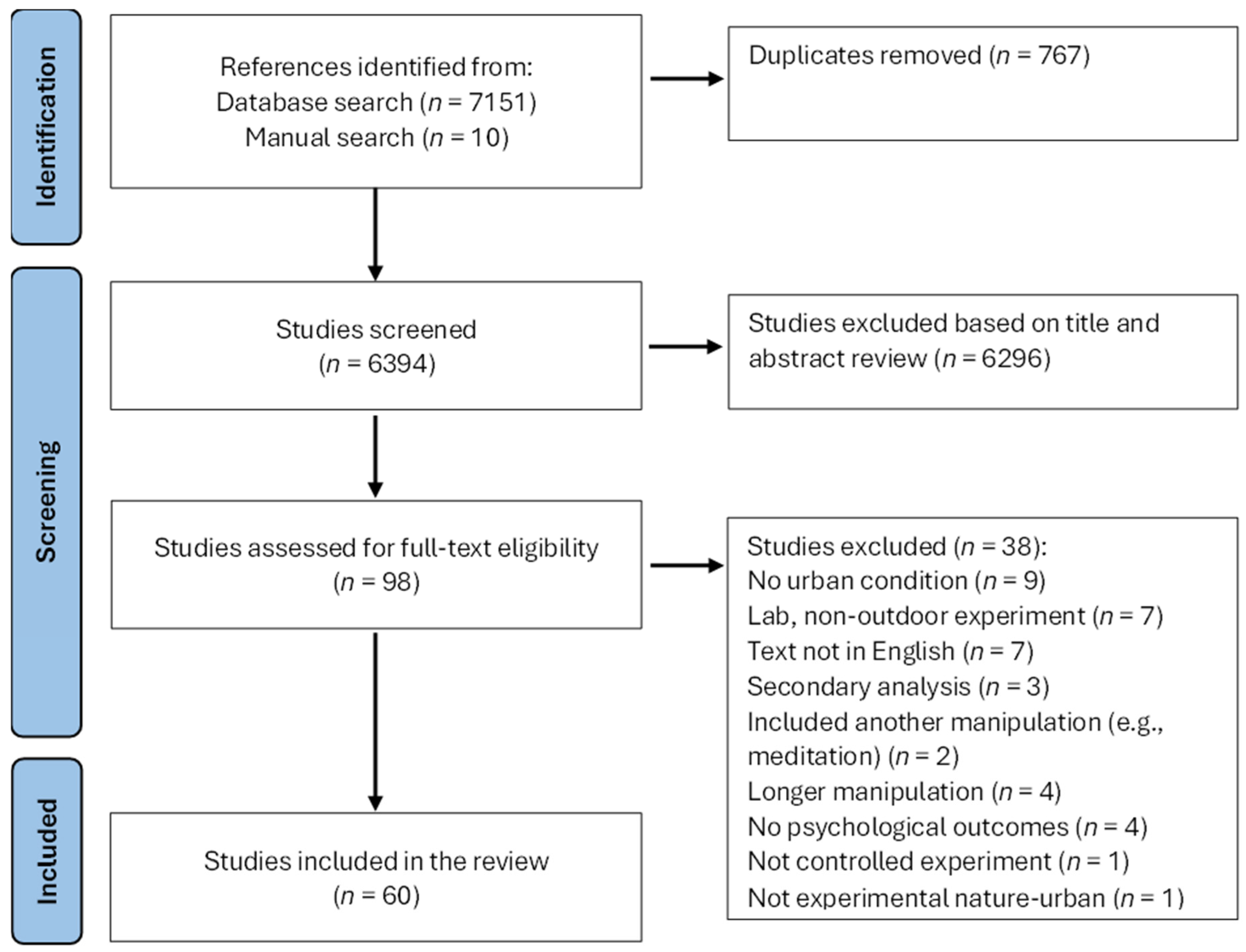
3.1. Selection of Sources
3.2. Characteristics of Included Studies
3.3. Synthesis of Findings
3.3.1. Samples Characteristics
3.3.2. Experimental Procedures
Experimental Design
Interaction with the Environment
Environmental Sites and Conditions
3.3.3. Studies Measures
Affective and Restorativeness Measures
Cognitive Measures
Other Measures
3.3.4. Studies Analyses
3.3.5. Studies’ Findings
Affective and Cognitive Outcomes
Other Outcomes
Underlying Mechanisms
- Individual Characteristics
- Situational Experience
- Associations Between Outcomes/Other Factors
4. Discussion
4.1. Summary of Evidence
4.1.1. Studies’ Samples
4.1.2. Experimental Sites and Environmental Conditions
4.1.3. Experimental Considerations
Baseline Measurements
Masking
Sense of Safety
4.1.4. Studied Outcomes
4.1.5. Individual Differences as Moderators
4.1.6. Order Effect and Repeated Exposures
4.2. Limitations
5. Conclusions
- Recruit larger and more diverse samples to enable generalization, investigation of unique subgroups of participants and proportions of positive responders, and order effects in within-subject studies.
- Mask participants when possible. Describe the study with general terms like “environments” or “outdoors” rather than using the word “nature.”
- Include pre- and post-exposure measurements when possible. A baseline measurement (either indoors or at the experimental site) can help determine the effect of each environment independently and in comparison to one another.
- Include environmental measures (e.g., temperature, humidity, noise) to control for in the analysis, compare the conditions between the environments, or examine associations with outcomes. Assess and report visual, sound, and smell characteristics and evaluate congruence between environments (e.g., an urban plaza might be very green but noise-polluted with heavy traffic). Related to the sense of touch, beyond the environmental conditions (e.g., wind, temperature, humidity), report elements related to the sensation of walking (e.g., asphalt, concrete pavement, forest trails) or sitting (e.g., ground, chair).
- For improvements in affective outcomes, shorter durations of viewing or walking in the environment may be sufficient (e.g., 15 min), as well as shorter washout periods between sessions in within-subject designs. For cognitive performance, it appears that longer durations are required (40–60 min) with longer washout periods between sessions (e.g., one week apart). For behavioral tasks and other measures, the duration of exposure and washout periods are unknown as more research is needed.
- To understand individual differences, include baseline nature-related measures (e.g., nature connectedness, typical time spent in nature, residential greenness), as well as measures of the situational perceived experience (e.g., restorative experience, perceived beauty, immersion), or other potential mediators, and test for associations with outcomes.
- For the experimental environments, ensure the natural environment is open, safe, and rich with green or blue elements. Ensure the urban environment is low on green elements yet offers a safe and potentially restorative urban experience (e.g., beautiful architecture, open space). Moving away from the dichotomous green–gray environments and examining urban areas with different levels of vegetation will offer a better understanding of the therapeutic potential of urban environments.
- Future research should investigate understudied clinical populations (e.g., people with chronic pain conditions, substance use disorders) and explore other outcomes utilizing behavioral tasks and other measures, for example, social outcomes, pain, and addictive behaviors.
Author Contributions
Funding
Institutional Review Board Statement
Informed Consent Statement
Data Availability Statement
Conflicts of Interest
Appendix A
References
- McMahan, E.A.; Estes, D. The effect of contact with natural environments on positive and negative affect: A meta-analysis. J. Posit. Psychol. 2015, 10, 507–519. [Google Scholar] [CrossRef]
- Norwood, M.; Lakhani, A.; Maujean, A.; Zeeman, H.; Creux, O.; Kendall, E. Brain activity, underlying mood and the environment: A systematic review. J. Environ. Psychol. 2019, 65, 101321. [Google Scholar] [CrossRef]
- Antonelli, M.; Barbieri, G.; Donelli, D. Effects of forest bathing (shinrin-yoku) on levels of cortisol as a stress biomarker: A systematic review and meta-analysis. Int. J. Biometeorol. 2019, 63, 1117–1134. [Google Scholar] [CrossRef]
- Ideno, Y.; Hayashi, K.; Abe, Y.; Ueda, K.; Iso, H.; Noda, M.; Lee, J.-S.; Suzuki, S. Blood pressure-lowering effect of shinrin-yoku (forest bathing): A systematic review and meta-analysis. BMC Complement. Altern. Med. 2017, 17, 409. [Google Scholar] [CrossRef] [PubMed]
- Meredith, G.R.; Rakow, D.A.; Eldermire, E.R.; Madsen, C.G.; Shelley, S.P.; Sachs, N.A. Minimum time dose in nature to positively impact the mental health of college-aged students, and how to measure it: A scoping review. Frontiers 2020, 10, 2942. [Google Scholar] [CrossRef] [PubMed]
- Oh, B.; Lee, K.; Zaslawski, C.; Yeung, A.; Rosenthal, D.; Larkey, L.; Back, M. Health and well-being benefits of spending time in forests: Systematic review. Environ. Health Prev. Med. 2017, 22, 71. [Google Scholar] [CrossRef] [PubMed]
- Ohly, H.; White, M.P.; Wheeler, B.W.; Bethel, A.; Ukoumunne, O.C.; Nikolaou, V.; Garside, R. Attention Restoration Theory: A Systematic review of the attention restoration potential of exposure to natural environments. J. Toxicol. Environ. Health Part B 2016, 19, 305–343. [Google Scholar] [CrossRef]
- Berry, M.S.; Rung, J.M.; Crawford, M.C.; Yurasek, A.M.; Ferreiro, A.V.; Almog, S. Using greenspace and nature exposure as an adjunctive treatment for opioid and substance use disorders: Preliminary evidence and potential mechanisms. Behav. Process. 2021, 186, 104344. [Google Scholar] [CrossRef]
- Kotera, Y.; Rhodes, C. Commentary: Suggesting shinrin-yoku (forest bathing) for treating addiction. Addict. Behav. 2020, 111, 106556. [Google Scholar] [CrossRef]
- Wiley, E.R.; Seabrook, J.A.; Gilliland, J.A.; Anderson, K.K.; Stranges, S. Green space and substance use and addiction: A new frontier. Addict. Behav. 2020, 100, 106155. [Google Scholar] [CrossRef]
- Berry, M.S.; Sweeney, M.M.; Morath, J.; Odum, A.L.; Jordan, K.E. The nature of impulsivity: Visual exposure to natural environments decreases impulsive decision-making in a delay discounting task. PLoS ONE 2014, 9, e97915. [Google Scholar] [CrossRef]
- Berry, M.S.; Repke, M.A.; Nickerson, N.P.; Iii, L.G.C.; Odum, A.L.; Jordan, K.E. Making time for nature: Visual exposure to natural environments lengthens subjective time perception and reduces impulsivity. PLoS ONE 2015, 10, e0141030. [Google Scholar] [CrossRef]
- Yang, Y.; Wang, L.; Passmore, H.-A.; Zhang, J.; Zhu, L.; Cai, H. Viewing nature scenes reduces the pain of social ostracism. J. Social Psychol. 2020, 161, 197–215. [Google Scholar] [CrossRef] [PubMed]
- Kondo, M.C.; Oyekanmi, K.O.; Gibson, A.; South, E.C.; Bocarro, J.; Hipp, J.A. Nature prescriptions for health: A review of evidence and research opportunities. Int. J. Environ. Res. Public Health 2020, 17, 4213. [Google Scholar] [CrossRef]
- Browning, M.H.E.M.; Saeidi-Rizi, F.; McAnirlin, O.; Yoon, H.; Pei, Y. The role of methodological choices in the effects of experimental exposure to simulated natural landscapes on human health and cognitive performance: A systematic review. Environ. Behav. 2021, 53, 687–731. [Google Scholar] [CrossRef]
- White, M.P.; Yeo, N.L.; Vassiljev, P.; Lundstedt, R.; Wallergård, M.; Albin, M.; Lõhmus, M. A Prescription for “Nature”—The potential of using virtual nature in therapeutics. Neuropsychiatr. Dis. Treat. 2018, 14, 3001–3013. [Google Scholar] [CrossRef]
- Browning, M.H.E.M.; Shipley, N.; McAnirlin, O.; Becker, D.; Yu, C.-P.; Hartig, T.; Dzhambov, A.M. An actual natural setting improves mood better than its virtual counterpart: A meta-analysis of experimental data. Front. Psychol. 2020, 11, 2200. [Google Scholar] [CrossRef]
- Markevych, I.; Schoierer, J.; Hartig, T.; Chudnovsky, A.; Hystad, P.; Dzhambov, A.; de Vries, S.; Triguero-Mas, M.; Brauer, M.; Nieuwenhuijsen, M.; et al. Exploring pathways linking greenspace to health: Theoretical and methodological guidance. Environ. Res. 2017, 158, 301–317. [Google Scholar] [CrossRef]
- Tricco, A.C.; Lillie, E.; Zarin, W.; O’Brien, K.K.; Colquhoun, H.; Levac, D.; Moher, D.; Peters, M.D.J.; Horsley, T.; Weeks, L.; et al. Prisma extension for scoping reviews (PRISMA-SCR): Checklist and explanation. Ann. Intern. Med. 2018, 169, 467–473. [Google Scholar] [CrossRef]
- Menardo, E.; Brondino, M.; Hall, R.; Pasini, M. Restorativeness in natural and urban environments: A meta-analysis. Psychol. Rep. 2021, 124, 417–437. [Google Scholar] [CrossRef]
- Stenfors, C.U.D.; Van Hedger, S.C.; Schertz, K.E.; Meyer, F.A.C.; Smith, K.E.L.; Norman, G.J.; Bourrier, S.C.; Enns, J.T.; Kardan, O.; Jonides, J.; et al. Positive effects of nature on cognitive performance across multiple experiments: Test order but not affect modulates the cognitive effects. Front. Psychol. 2019, 10, 438004. [Google Scholar] [CrossRef] [PubMed]
- Yi, Y.; Seo, E.; An, J. Does forest therapy have physio-psychological benefits? A systematic review and meta-analysis of randomized controlled trials. Int. J. Environ. Res. Public Health 2022, 19, 10512. [Google Scholar] [CrossRef] [PubMed]
- Zhang, X.; Zhang, Y.; Yun, J.; Yao, W. A systematic review of the anxiety-alleviation benefits of exposure to the natural environment. Rev. Environ. Health 2023, 38, 281–293. [Google Scholar] [CrossRef] [PubMed]
- Kassambara, A. rstatix: Pipe-Friendly Framework for Basic Statistical Tests, version 0.7.3. The Comprehensive R Archive Network. The R Core team: Vienna, Austria, 2021. [CrossRef]
- Rider, N.D.; Bodner, G.E. Does taking a walk in nature enhance long-term memory? Ecopsychology 2016, 8, 27–34. [Google Scholar] [CrossRef]
- Abdul Aziz, N.A.; Shian, L.Y.; Mokhtar, M.D.M.; Raman, T.L.; Saikim, F.H.; Chen, W.; Nordin, N.M. Effectiveness of urban green space on undergraduates’ stress relief in tropical city: A field experiment in Kuala Lumpur. Urban For. Urban Green. 2021, 63, 127236. [Google Scholar] [CrossRef]
- Ameli, R.; Skeath, P.; Abraham, P.A.; Panahi, S.; Kazman, J.B.; Foote, F.; Deuster, P.A.; Ahmad, N.; Berger, A. A nature-based health intervention at a military healthcare center: A randomized, controlled, cross-over study. PeerJ 2021, 9, e10519. [Google Scholar] [CrossRef]
- Ballew, M.T.; Omoto, A.M. Absorption: How nature experiences promote awe and other positive emotions. Ecopsychology 2018, 10, 26–35. [Google Scholar] [CrossRef]
- Beil, K.; Hanes, D. The influence of urban natural and built environments on physiological and psychological measures of stress—A pilot study. Int. J. Environ. Res. Public Health 2013, 10, 1250–1267. [Google Scholar] [CrossRef]
- Berman, M.G.; Jonides, J.; Kaplan, S. The cognitive benefits of interacting with nature. Psychol. Sci. 2008, 19, 1207–1212. [Google Scholar] [CrossRef]
- Berman, M.G.; Kross, E.; Krpan, K.M.; Askren, M.K.; Burson, A.; Deldin, P.J.; Kaplan, S.; Sherdell, L.; Gotlib, I.H.; Jonides, J. Interacting with nature improves cognition and affect for individuals with depression. J. Affect. Disord. 2012, 140, 300–305. [Google Scholar] [CrossRef]
- Bielinis, E.; Takayama, N.; Boiko, S.; Omelan, A.; Bielinis, L. The effect of winter forest bathing on psychological relaxation of young polish adults. Urban For. Urban Green. 2018, 29, 276–283. [Google Scholar] [CrossRef]
- Bielinis, E.; Omelan, A.; Boiko, S.; Bielinis, L. The restorative effect of staying in a broad- leaved forest on healthy young adults in winter and spring. Balt. For. 2018, 24, 218–227. [Google Scholar]
- Bielinis, E.; Łukowski, A.; Omelan, A.; Boiko, S.; Takayama, N.; Grebner, D.L. The effect of recreation in a snow-covered forest environment on the psychological wellbeing of young adults: Randomized controlled study. Forests 2019, 10, 827. [Google Scholar] [CrossRef]
- Bielinis, E.; Janeczko, E.; Takayama, N.; Zawadzka, A.; Słupska, A.; Piętka, S.; Lipponen, M.; Bielinis, L. The effects of viewing a winter forest landscape with the ground and trees covered in snow on the psychological relaxation of young Finnish adults: A pilot study. PLoS ONE 2021, 16, e0244799. [Google Scholar] [CrossRef]
- Bratman, G.N.; Daily, G.C.; Levy, B.J.; Gross, J.J. The benefits of nature experience: Improved affect and cognition. Landsc. Urban Plan. 2015, 138, 41–50. [Google Scholar] [CrossRef]
- Chen, Z.; He, Y.; Yu, Y. Enhanced functional connectivity properties of human brains during in-situ nature experience. PeerJ 2016, 4, e2210. [Google Scholar] [CrossRef]
- Ehret, S.; Roth, S.; Zimmermann, S.U.; Selter, A.; Thomaschke, R. Feeling Time in Nature: The influence of directed and undirected attention on time awareness. Appl. Cogn. Psychol. 2020, 34, 737–746. [Google Scholar] [CrossRef]
- Elsadek, M.; Liu, B.; Lian, Z.; Xie, J. The influence of urban roadside trees and their physical environment on stress relief measures: A field experiment in Shanghai. Urban For. Urban Green. 2019, 42, 51–60. [Google Scholar] [CrossRef]
- Geniole, S.N.; David, J.P.F.; Euzébio, R.F.R.; Toledo, B.Z.S.; Neves, A.I.M.; McCormick, C.M. Restoring land and mind: The benefits of an outdoor walk on mood are enhanced in a naturalized landfill area relative to its neighboring urban area. Ecopsychology 2016, 8, 107–120. [Google Scholar] [CrossRef]
- Gidlow, C.J.; Jones, M.V.; Hurst, G.; Masterson, D.; Clark-Carter, D.; Tarvainen, M.P.; Smith, G.; Nieuwenhuijsen, M. Where to put your best foot forward: Psycho-physiological responses to walking in natural and urban environments. J. Environ. Psychol. 2016, 45, 22–29. [Google Scholar] [CrossRef]
- Hartig, T.; Mang, M.; Evans, G.W. Restorative effects of natural environment experiences. Environ. Behav. 1991, 23, 3–26. [Google Scholar] [CrossRef]
- Hartig, T.; Nyberg, L.; Nilsson, L.-G.; Gärling, T. Testing for mood congruent recall with environmentally induced mood. J. Environ. Psychol. 1999, 19, 353–367. [Google Scholar] [CrossRef]
- Hassan, A.; Tao, J.; Li, G.; Jiang, M.; Aii, L.; Zhihui, J.; Zongfang, L.; Qibing, C. Effects of walking in bamboo forest and city environments on brainwave activity in young adults. Evid. Based Complement. Altern. Med. 2018, 2018, e9653857. [Google Scholar] [CrossRef]
- Igarashi, M.; Miwa, M.; Ikei, H.; Song, C.; Takagaki, M.; Miyazaki, Y. Physiological and psychological effects of viewing a kiwifruit (Actinidia Deliciosa ‘Hayward’) orchard landscape in summer in Japan. Int. J. Environ. Res. Public Health 2015, 12, 6657–6668. [Google Scholar] [CrossRef] [PubMed]
- Joung, D.; Kim, G.; Choi, Y.; Lim, H.; Park, S.; Woo, J.-M.; Park, B.-J. The prefrontal cortex activity and psychological effects of viewing forest landscapes in autumn season. Int. J. Environ. Res. Public Health 2015, 12, 7235–7243. [Google Scholar] [CrossRef] [PubMed]
- Joung, D.; Lee, B.; Lee, J.; Lee, C.; Koo, S.; Park, C.; Kim, S.; Kagawa, T.; Park, B.-J. Measures to promote rural healthcare tourism with a scientific evidence-based approach. Int. J. Environ. Res. Public Health 2020, 17, 3266. [Google Scholar] [CrossRef] [PubMed]
- Kabisch, N.; Püffel, C.; Masztalerz, O.; Hemmerling, J.; Kraemer, R. Physiological and psychological effects of visits to different urban green and street environments in older people: A field experiment in a dense inner-city area. Landsc. Urban Plan. 2021, 207, 103998. [Google Scholar] [CrossRef]
- Lee, J.; Park, B.-J.; Tsunetsugu, Y.; Kagawa, T.; Miyazaki, Y. Restorative effects of viewing real forest landscapes, based on a comparison with urban landscapes. Scand. J. For. Res. 2009, 24, 227–234. [Google Scholar] [CrossRef]
- Lee, J.-Y.; Park, K.-T.; Lee, M.-S.; Park, B.-J.; Ku, J.-H.; Lee, J.-W.; Oh, K.-O.; An, K.-W.; Miyazaki, Y. Evidence-based field research on health benefits of urban green area. J. Korean Inst. Landsc. Archit. 2011, 39, 111–118. [Google Scholar] [CrossRef]
- Lee, J.; Park, B.-J.; Tsunetsugu, Y.; Ohira, T.; Kagawa, T.; Miyazaki, Y. Effect of forest bathing on physiological and psychological responses in young Japanese male subjects. Public Health 2011, 125, 93–100. [Google Scholar] [CrossRef]
- Lee, J.; Tsunetsugu, Y.; Takayama, N.; Park, B.-J.; Li, Q.; Song, C.; Komatsu, M.; Ikei, H.; Tyrväinen, L.; Kagawa, T.; et al. Influence of forest therapy on cardiovascular relaxation in young adults. Evid. Based Complement. Altern. Med. 2014, 2014, 834360. [Google Scholar] [CrossRef]
- Lee, J.; Park, B.-J.; Ohira, T.; Kagawa, T.; Miyazaki, Y. Acute effects of exposure to a traditional rural environment on urban dwellers: A crossover field study in terraced farmland. Int. J. Environ. Res. Public Health 2015, 12, 1874–1893. [Google Scholar] [CrossRef]
- Mayer, F.S.; Frantz, C.M.; Bruehlman-Senecal, E.; Dolliver, K. Why is nature beneficial?: The role of connectedness to nature. Environ. Behav. 2009, 41, 607–643. [Google Scholar] [CrossRef]
- Nicolosi, V.; Wilson, J.; Yoshino, A.; Viren, P. The restorative potential of coastal walks and implications of sound. J. Leis. Res. 2021, 52, 41–61. [Google Scholar] [CrossRef]
- Ojala, A.; Korpela, K.; Tyrväinen, L.; Tiittanen, P.; Lanki, T. Restorative effects of urban green environments and the role of urban-nature orientedness and noise sensitivity: A field experiment. Health Place 2019, 55, 59–70. [Google Scholar] [CrossRef] [PubMed]
- Olszewska-Guizzo, A.; Sia, A.; Fogel, A.; Ho, R. Can exposure to certain urban green spaces trigger frontal alpha asymmetry in the brain?—Preliminary findings from a passive task EEG study. Int. J. Environ. Res. Public Health 2020, 17, 394. [Google Scholar] [CrossRef] [PubMed]
- Olszewska-Guizzo, A.; Fogel, A.; Escoffier, N.; Sia, A.; Nakazawa, K.; Kumagai, A.; Dan, I.; Ho, R. Therapeutic garden with contemplative features induces desirable changes in mood and brain activity in depressed adults. Front. Psychiatry 2022, 13, 757056. [Google Scholar] [CrossRef] [PubMed]
- Park, B.-J.; Tsunetsugu, Y.; Kasetani, T.; Hirano, H.; Kagawa, T.; Sato, M.; Miyazaki, Y. Physiological effects of shinrin-yoku (taking in the atmosphere of the forest)—Using salivary cortisol and cerebral activity as indicators. J. Physiol. Anthropol. 2007, 26, 123–128. [Google Scholar] [CrossRef]
- Park, B.-J.; Tsunetsugu, Y.; Ishii, H.; Furuhashi, S.; Hirano, H.; Kagawa, T.; Miyazaki, Y. Physiological effects of shinrin-yoku (taking in the atmosphere of the forest) in a mixed forest in Shinano Town, Japan. Scand. J. For. Res. 2008, 23, 278–283. [Google Scholar] [CrossRef]
- Park, B.-J.; Tsunetsugu, Y.; Kasetani, T.; Morikawa, T.; Kagawa, T.; Miyazaki, Y. Physiological effects of forest recreation in a young conifer forest in Hinokage Town, Japan. Silva Fenn 2009, 43, 291–301. [Google Scholar] [CrossRef]
- Park, B.J.; Tsunetsugu, Y.; Kasetani, T.; Kagawa, T.; Miyazaki, Y. The physiological effects of shinrin-yoku (taking in the forest atmosphere or forest bathing): Evidence from field experiments in 24 forests across Japan. Environ. Health Prev. Med. 2010, 15, 18–26. [Google Scholar] [CrossRef]
- Park, B.-J.; Furuya, K.; Kasetani, T.; Takayama, N.; Kagawa, T.; Miyazaki, Y. Relationship between psychological responses and physical environments in forest settings. Landsc. Urban Plan. 2011, 102, 24–32. [Google Scholar] [CrossRef]
- Perkins, S.; Searight, H.R.; Ratwik, S. Walking in a natural winter setting to relieve attention fatigue: A pilot study. Psychology 2011, 2, 777–780. [Google Scholar] [CrossRef]
- Pratiwi, P.I.; Xiang, Q.; Furuya, K. Physiological and psychological effects of viewing urban parks in different seasons in adults. Int. J. Environ. Res. Public Health 2019, 16, 4279. [Google Scholar] [CrossRef] [PubMed]
- Pratiwi, P.I.; Xiang, Q.; Furuya, K. Physiological and psychological effects of walking in urban parks and its imagery in different seasons in middle-aged and older adults: Evidence from Matsudo City, Japan. Sustainability 2020, 12, 4003. [Google Scholar] [CrossRef]
- Roe, J.; Mondschein, A.; Neale, C.; Barnes, L.; Boukhechba, M.; Lopez, S. The urban built environment, walking and mental health outcomes among older adults: A pilot study. Front. Public Health 2020, 8, 575946. [Google Scholar] [CrossRef]
- Shin, W.S.; Shin, C.S.; Yeoun, P.S.; Kim, J.J. The influence of interaction with forest on cognitive function. Scand. J. For. Res. 2011, 26, 595–598. [Google Scholar] [CrossRef]
- Shrestha, T.; Di Blasi, Z.; Cassarino, M. Natural or urban campus walks and vitality in university students: Exploratory qualitative findings from a pilot randomised controlled study. Int. J. Environ. Res. Public Health 2021, 18, 2003. [Google Scholar] [CrossRef]
- Song, C.; Joung, D.; Ikei, H.; Igarashi, M.; Aga, M.; Park, B.-J.; Miwa, M.; Takagaki, M.; Miyazaki, Y. Physiological and psychological effects of walking on young males in urban parks in winter. J. Physiol. Anthropol. 2013, 32, 18. [Google Scholar] [CrossRef]
- Song, C.; Ikei, H.; Igarashi, M.; Miwa, M.; Takagaki, M.; Miyazaki, Y. Physiological and psychological responses of young males during spring-time walks in urban parks. J. Physiol. Anthropol. 2014, 33, 8. [Google Scholar] [CrossRef]
- Song, C.; Ikei, H.; Kobayashi, M.; Miura, T.; Taue, M.; Kagawa, T.; Li, Q.; Kumeda, S.; Imai, M.; Miyazaki, Y. Effect of forest walking on autonomic nervous system activity in middle-aged hypertensive individuals: A pilot study. Int. J. Environ. Res. Public Health 2015, 12, 2687–2699. [Google Scholar] [CrossRef]
- Song, C.; Ikei, H.; Igarashi, M.; Takagaki, M.; Miyazaki, Y. Physiological and psychological effects of a walk in urban parks in fall. Int. J. Environ. Res. Public Health 2015, 12, 14216–14228. [Google Scholar] [CrossRef]
- Song, C.; Ikei, H.; Kobayashi, M.; Miura, T.; Li, Q.; Kagawa, T.; Kumeda, S.; Imai, M.; Miyazaki, Y. Effects of viewing forest landscape on middle-aged hypertensive men. Urban For. Urban Green. 2017, 21, 247–252. [Google Scholar] [CrossRef]
- Song, C.; Ikei, H.; Park, B.-J.; Lee, J.; Kagawa, T.; Miyazaki, Y. Psychological benefits of walking through forest areas. Int. J. Environ. Res. Public Health 2018, 15, 2804. [Google Scholar] [CrossRef] [PubMed]
- Song, C.; Ikei, H.; Kagawa, T.; Miyazaki, Y. Effects of walking in a forest on young women. Int. J. Environ. Res. Public Health 2019, 16, 229. [Google Scholar] [CrossRef] [PubMed]
- Song, C.; Ikei, H.; Kagawa, T.; Miyazaki, Y. Physiological and psychological effects of viewing forests on young women. Forests 2019, 10, 635. [Google Scholar] [CrossRef]
- Stigsdotter, U.K.; Corazon, S.S.; Sidenius, U.; Kristiansen, J.; Grahn, P. It is not all bad for the grey city—A crossover study on physiological and psychological restoration in a forest and an urban environment. Health Place 2017, 46, 145–154. [Google Scholar] [CrossRef]
- Takayama, N.; Korpela, K.; Lee, J.; Morikawa, T.; Tsunetsugu, Y.; Park, B.-J.; Li, Q.; Tyrväinen, L.; Miyazaki, Y.; Kagawa, T. Emotional, restorative and vitalizing effects of forest and urban environments at four sites in Japan. Int. J. Environ. Res. Public Health 2014, 11, 7207–7230. [Google Scholar] [CrossRef]
- Tsunetsugu, Y.; Park, B.-J.; Ishii, H.; Hirano, H.; Kagawa, T.; Miyazaki, Y. Physiological effects of shinrin-yoku (taking in the atmosphere of the forest) in an old-growth broadleaf forest in Yamagata Prefecture, Japan. J. Physiol. Anthropol. 2007, 26, 135–142. [Google Scholar] [CrossRef]
- Tyrväinen, L.; Ojala, A.; Korpela, K.; Lanki, T.; Tsunetsugu, Y.; Kagawa, T. The influence of urban green environments on stress relief measures: A field experiment. J. Environ. Psychol. 2014, 38, 1–9. [Google Scholar] [CrossRef]
- van der Wal, A.J.; Schade, H.M.; Krabbendam, L.; van Vugt, M. Do natural landscapes reduce future discounting in humans? Proc. Biol. Sci. 2013, 280, 20132295. [Google Scholar] [CrossRef]
- Watkins-Martin, K.; Bolanis, D.; Richard-Devantoy, S.; Pennestri, M.-H.; Malboeuf-Hurtubise, C.; Philippe, F.; Guindon, J.; Gouin, J.-P.; Ouellet-Morin, I.; Geoffroy, M.-C. The effects of walking in nature on negative and positive affect in adult psychiatric outpatients with major depressive disorder: A randomized-controlled study. J. Affect. Disord. 2022, 318, 291–298. [Google Scholar] [CrossRef] [PubMed]
- Russell, J.A.; Weiss, A.; Mendelsohn, G.A. Affect grid: A single-item scale of pleasure and arousal. J. Personal. Social Psychol. 1989, 57, 493–502. [Google Scholar] [CrossRef]
- Terry, P.C.; Lane, A.M.; Fogarty, G.J. Construct validity of the Profile of Mood States—Adolescents for use with adults. Psychol. Sport. Exerc. 2003, 4, 125–139. [Google Scholar] [CrossRef]
- Mayer, F.S.; Frantz, C.M. The connectedness to nature scale: A measure of individuals’ feeling in community with nature. J. Environ. Psychol. 2004, 24, 503–515. [Google Scholar] [CrossRef]
- Brown, K.W.; Ryan, R.M. The benefits of being present: Mindfulness and its role in psychological well-being. J. Personal. Social Psychol. 2003, 84, 822–848. [Google Scholar] [CrossRef]
- Matthews, G.; Jones, D.M.; Chamberlain, A.G. Refining the measurement of mood: The UWIST Mood Adjective Checklist. Br. J. Psychol. 1990, 81, 17–42. [Google Scholar] [CrossRef]
- Steyer, R.; Schwenkmezger, P.; Notz, P.; Eid, M. Der Mehrdimensionaler Befindlichkeitsfragebogen (MDBF) [The Multidimensional Affect Rating Scale (MDBF)]; Hogrefe: Göttingen, Germany, 1997. [Google Scholar]
- Campbell, A.; Converse, P.E.; Rodgers, W.L. The Quality of American Life: Perceptions, Evaluations, and Satisfactions; Russell Sage Foundation: New York, NY, USA, 1976. [Google Scholar]
- Watson, D.; Clark, L.A.; Tellegen, A. Development and validation of brief measures of positive and negative affect: The PANAS scales. J. Personal. Social Psychol. 1988, 54, 1063–1070. [Google Scholar] [CrossRef]
- McNair, D.M.; Lorr, M.; Droppleman, L.F. Manual Profile of Mood States; Educational and Industrial Testing Services: San Diego, CA, USA, 1971. [Google Scholar]
- Hartig, T.; Korpela, K.; Evans, G.W.; Gärling, T. A measure of restorative quality in environments. Scand. Hous. Plan. Res. 1997, 14, 175–194. [Google Scholar] [CrossRef]
- Korpela, K.M.; Ylén, M.; Tyrväinen, L.; Silvennoinen, H. Determinants of restorative experiences in everyday favorite places. Health Place 2008, 14, 636–652. [Google Scholar] [CrossRef]
- Trapnell, P.D.; Campbell, J.D. Private self-consciousness and the five-factor model of personality: Distinguishing rumination from reflection. J. Personal. Social Psychol. 1999, 76, 284–304. [Google Scholar] [CrossRef]
- Bradley, M.M.; Lang, P.J. Measuring emotion: The self-assessment manikin and the semantic differential. J. Behav. Ther. Exp. Psychiatry 1994, 25, 49–59. [Google Scholar] [CrossRef] [PubMed]
- Derogatis, L.R.; Cleary, P.A. Confirmation of the dimensional structure of the SCL-90: A study in construct validation. J. Clin. Psychol. 1977, 33, 981–989. [Google Scholar] [CrossRef]
- Osgood, C.E.; Suci, G.J.; Tannenbaum, P.H. The Measurement of Meaning; University of Illinois Press: Urbana, IL, USA, 1957. [Google Scholar]
- Han, K.-T. A reliable and valid self-rating measure of the restorative quality of natural environments. Landsc. Urban Plan. 2003, 64, 209–232. [Google Scholar] [CrossRef]
- Govern, J.M.; Marsch, L.A. Development and validation of the situational self-awareness scale. Conscious. Cogn. 2001, 10, 366–378. [Google Scholar] [CrossRef]
- Spielberger, C.D.; Gorsuch, R.L.; Lushene, R.; Vagg, P.R.; Jacobs, G.A. Manual for the State-Trait Anxiety Inventory. In Manual for the State-Trait Anxiety Inventory; Consulting Psychologists Press: Palo Alto, CA, USA, 1983. [Google Scholar]
- Mackay, C.; Cox, T.; Burrows, G.; Lazzerini, T. An inventory for the measurement of self-reported stress and arousal. Br. J. Social Clin. Psychol. 1978, 17, 283–284. [Google Scholar] [CrossRef]
- Ryan, R.M.; Frederick, C. On energy, personality, and health: Subjective vitality as a dynamic reflection of well-being. J. Personal. 1997, 65, 529–565. [Google Scholar] [CrossRef]
- Zuckerman, M. Development of a situation-specific trait-state test for the prediction and measurement of affective responses. J. Consult. Clin. Psychol. 1977, 45, 513–523. [Google Scholar] [CrossRef]
- Clayton, S. Environmental identity: A conceptual and an operational definition. In Identity and the Natural Environment: The Psychological Significance of Nature; MIT Press: Cambridge, MA, USA, 2003; pp. 45–65. [Google Scholar]
- Schultz, P.W. The structure of environmental concern: Concern for self, other people, and the biosphere. J. Environ. Psychol. 2001, 21, 327–339. [Google Scholar] [CrossRef]
- Gatersleben, B.; Andrews, M. When walking in nature is not restorative-the role of prospect and refuge. Health Place 2013, 20, 91–101. [Google Scholar] [CrossRef]
- Martens, D.; Gutscher, H.; Bauer, N. Walking in “wild” and “tended” urban forests: The impact on psychological well-being. J. Environ. Psychol. 2011, 31, 36–44. [Google Scholar] [CrossRef]

| Study First Author, Year Location | Sample N (n Female), Mean Age, Description | Design Between/Within (Washout Period), Measurements | Activity Type, Duration of Interaction with Environment | Environmental Conditions | Outcome Measures | Results | |||
|---|---|---|---|---|---|---|---|---|---|
| Measures/Analysis | Self-Reported Scales | Tasks | Did Nature (vs. Built) Improve Outcomes? | Did Built Worsen Outcomes (Pre vs. Post)? | |||||
| #1 | Abdul Aziz et al., 2021 [26] Malaysia | 90 (45), 22.9 y, healthy university students | Between, pre-post | Walk, 20 min | Weather, temperature, humidity, wind/ descriptive | POMS, PANAS, ROS | - | Affective: Yes Restorative: Yes | Yes (n.s.) |
| #2 | Ameli et al., 2021 [27] U.S. | 12 (9), 35 y, military personnel | Within (within 1 week), pre-post | Walk, 20 min | None | Qualitative, Distress VAS, MAAS | - | Affective: Yes | No |
| #3 | Ballew & Omoto, 2018 [28] U.S. | 100 (55), 19.3 y, healthy university students | Between, post | View, 15 min | None | Absorption, Awe, Positive Emotions | - | Affective: Yes Restorative: Yes | N/A |
| #4 | Beil & Hanes, 2013 [29] U.S. | 15 (7), 42.3 y, community members | Within (non-consecutive days), pre-post | View, 20 min | None | Subjective Stress VAS, PRS | - | Affective: Yes | No |
| #5 | Berman et al., 2008 (Exp. 1) [30] U.S. | 38 (23), 22.6 y, healthy university students | Within (2 weeks), pre-post | Walk, 50–55 min | Season/ covariate | PANAS | BDS | Affective: Yes Cognitive: Yes | No |
| #6 | Berman et al., 2012 [31] U.S. | 20 (12), 26.0 y, adults with depression | Within (1 week), pre-post | Walk, 50–55 min | None | PANAS | BDS | Affective: Yes Cognitive: Yes | No (affect improved in both) (cog. Yes n.s.) |
| #7 | Bielinis et al., 2018 [32] Poland | 62 (26), 21.5 y, healthy university students | Between, pre-post | View, 15 min | Weather, temperature, humidity, wind, noise/ descriptive | POMS, SVS, PANAS, ROS | - | Affective: Yes Restorative: Yes | Yes |
| #8 | Bielinis et al., 2018 [33] Poland | 54 (24), 21.4 y, healthy university students | Between–environment Within–seasons pre-post | View, 15 min | Weather, temperature, humidity, wind, noise/ descriptive | POMS, SVS, PANAS, ROS | - | Affective: Yes Restorative: Yes (more in winter) | Yes (more in spring) |
| #9 | Bielinis et al., 2019 [34] Poland | 32 (32), 21.0 y, healthy university students | Between, pre-post | View, 15 min | Weather, temperature, humidity, wind, noise/ descriptive | POMS, SVS, PANAS, ROS | - | Affective: Yes Restorative: Yes | Yes |
| #10 | Bielinis et al., 2021 [35] Finland | 22 (11), 22.5 y, healthy university students | Within (same day), pre-post | View, 15 min | Weather, temperature, humidity, wind, noise/ descriptive | POMS, SVS, PANAS, ROS | - | Affective: Yes | Yes |
| #11 | Bratman et al., 2015 [36] U.S. | 60 (33), 22.9 y, community members and students | Between, pre-post | Walk, 50 min | None | PANAS, STAI, RRQ | BDS, OSPAN, ANT, Change detection task | Affective: Yes Cognitive: Yes (mixed) | Yes (affect) |
| #12 | Chen et al., 2016 [37] China | 32 (16), 20.6 y, healthy university students | Between, pre-post | View, 20 min | Weather, temperature, humidity, wind, noise/ descriptive | POMS, PRS | Necker Cube Pattern Control Test | Affective: Yes Cognitive: No | Not reported |
| #13 | Ehret et al., 2020 [38] Germany | 48 (35), 26.4 y, healthy university students and community members | Between–environment. Within–tasks, (3 separate days), pre-post (mood), post (tasks) | Passive (sit), 25–35 min | Weather, temperature/ descriptive | SAMS, MDBF, Qualitative | Time awareness VAS, PoTJ VAS, Time Estimation | Time awareness: Yes Affective: Yes | Yes |
| #14 | Elsadek et al., 2019 [39] China | 364 (164), 23.0 y, healthy university students and visitors | Within (5 min), pre-post | Walk, 15 min | Weather, temperature, humidity, wind, solar radiation, noise/ descriptive | POMS, STAI, ROS, SVS | - | Affective: Yes Restorative: Yes | Yes |
| #15 | Geniole et al., 2016 [40] Canada | 31 (0), 24.6 y, healthy university students | Within (within 1 week), pre-post | Walk, 25 min | Weather, temperature/ comparison | Affect Grid | Stroop | Affective: Yes Cognitive: No | No |
| #16 | Gidlow et al., 2016 [41] UK | 38 (15), 40.9 y, community members | Within (separate days within two weeks), pre-post, follow up 60 min | Walk, 30 min | Noise/ Descriptive, comparable | BRUMS, ROS | BDS | Affective: No (all improved), Restorative: Yes Cognitive: Yes (in follow up) | No |
| #17 | Hartig et al., 1991 (Exp. 2) [42] U.S. | 34 (17), 20.0 y, healthy university students | Between, pre-post | Walk, 40 min | None | ZIPERS, OHS, PRS | Proofreading task | Affective: Yes Restorative: Yes Cognitive: Yes | Not performed |
| #18 | Hartig et al., 1999 (Exp. 3) [43] U.S. | 101 (62), 20.6 y, healthy university students | Between, post | View, 15 min | Weather/ comparison | PANAS, ZIPERS | Mood-congruence memory tests | Affective: Yes (partly) Cognitive: No | N/A |
| #19 | Hassan et al., 2018 [44] China | 60 (30), 19.6 y, healthy university students | Within (2 consecutive days), pre-post | Walk, 15 min | Weather, temperature, humidity/ descriptive | SDM, STAI | - | Affective: Yes | Not performed |
| #20 | Igarashi et al., 2015 [45] Japan | 17 (17), 46.1 y, urban community members | Within (no washout), post | View, 10 min | Weather, temperature, humidity, illumination/ descriptive | SDM, POMS | - | Affective: Yes | N/A |
| #21 | Joung et al., 2015 [46] Korea | 7 (not reported), 22.0 y, healthy university students | Within (not reported, fixed order nature → urban), post | View, 15 min | None | SDM, POMS | - | Affective: Yes | N/A |
| #22 | Joung et al., 2020 [47] Korea | 24 (9), 20.8 y, healthy university urban students | Within (4 days, fixed order nature → urban), post | Walk, 15 min | Weather/ descriptive | SDM, POMS, STAI | - | Affective: Yes | N/A |
| #23 | Kabisch et al., 2021 [48] Germany | 33 (21), 63.5 y, older adults | Within (separate days over 9 days, fixed order: old park → street → new park), pre-post | View and Walk, 15 + 30 min | Weather/ descriptive | POMS, ROS | - | Affective: Yes (n.s.) Restorative: Yes | Yes |
| #24 | Lee et al., 2009 [49] Japan | 12 (0), 21.3 y, healthy university students | Within (2 consecutive days), pre-post | View, 15 min | Temperature, humidity/ descriptive | SDM, Stress and Arousal Scale | - | Affective: Yes | Not performed |
| #25 | Lee et al., 2011 [50] Korea | 20 (0), 24.0 y, healthy university students | Within (2 consecutive days), post | View, 15 min | None | SDM, POMS, STAI, SCL-90-R | - | Affective: Yes | N/A |
| #26 | Lee et al., 2011 [51] Japan | 12 (0), 21.2 y, healthy university students | Within (2 consecutive days), pre-post | View, 15 min | Weather/ descriptive | SDM, POMS | - | Affective: Yes | Yes |
| #27 | Lee et al., 2014 [52] Japan | 48 (0), 21.1 y, healthy university students | Within (2 consecutive days), pre-post | Walk, 12–15 min | Weather/ descriptive | SDM, POMS, STAI, Stress and Arousal Scale | - | Affective: Yes | Not performed |
| #28 | Lee et al., 2015 [53] Japan | 12 (0), 22.3 y, healthy university students | Within (2 consecutive days), pre-post | View, 15 min | Weather/ descriptive | SDM, POMS, Stress and Arousal Scale | - | Affective: Yes | Not performed |
| #29 | Mayer et al., 2009 (Study 1) [54] U.S. | 76 (51), not reported, healthy university students | Between, post | Walk and View, 10 + 5 min | Weather/ descriptive, comparable | PANAS, SSAS, CNS, Ability to reflect single-item | Search Task | Affective: Yes Cognitive: Yes Connectedness to nature: Yes Ability to reflect: Yes Self awareness: No | N/A |
| #30 | Nicolosi et al., 2021 [55] U.S. | 63 (31), 20.4 y, healthy university students | Within, (same day), post | Walk, 10–15 min | Weather, temperature, wind, noise/ descriptive | SRRS | Quiz on reading | Affective: Yes Restorative: Yes Cognitive: No | N/A |
| #31 | Ojala et al., 2019 [56] Finland | 83 (83), 48.3 y, community members | Within (at least one week), pre-post | View and Walk, 15 + 30 min | Weather, temperature/ descriptive Noise/ comparison | ROS, SVS, Nature-urban oriented, Noise sensitivity | - | Affective: Yes | Yes |
| #32 | Olszewska-Guizzo et al., 2020 [57] Singapore | 22 (13), 32.9 y, community members | Within (average 11 days), pre-post | View, 30–45 min (6 min. physiological) | Temperature, humidity, brightness, noise/ covariate | POMS | - | Affective: No | Yes (trend) |
| #33 | Olszewska-Guizzo et al., 2022 [58] Singapore | 92 (52), 36.6 y, depressed and healthy adults | Within (average 9 days), pre-post | View, 30–45 min (6 min. physiological) | Temperature, humidity, brightness, noise/ covariate | POMS | - | Affective: Yes | Yes |
| #34 | Park et al., 2007 [59] Japan | 12 (0), 22.8 y, healthy university students | Within (2 consecutive days), pre-post | Walk (morning) and View (afternoon), 20 + 20 min | None | SDM | - | Affective: Yes | Not performed |
| #35 | Park et al., 2008 [60] Japan | 12 (0), 21.3 y, healthy university students | Within (2 consecutive days), pre-post | View, 15 min | None | SDM | - | Affective: Yes | Not performed |
| #36 | Park et al., 2009 [61] Japan | 12 (0), 21.8 y, healthy university students | Within (2 consecutive days), pre-post | Walk (morning) and View (afternoon), 15 + 15 min | None | SDM | - | Affective: Yes | Not performed |
| #37 | Park et al., 2010 [62] Japan | 280 (0), 21.7 y, healthy university students | Within (2 consecutive days), pre-post | Walk (morning) and View (afternoon), 15 + 15 min | Temperature, humidity, radiant heat, wind, atmospheric pressure, illumination/ Association with outcomes | POMS | - | Affective: Yes | Not performed |
| #38 | Park et al., 2011 [63] Japan | 168 (0), 20.4 y, healthy university students | Within (2 consecutive days), pre-post | View (morning) and Walk (afternoon), 15 + 15 min | Temperature, humidity, radiant heat, wind, atmospheric pressure/ Comparison, association with outcomes | SDM, POMS | - | Affective: Yes | Yes |
| #39 | Perkins et al., 2011 [64] U.S. | 26 (19), range 19–24 y, healthy university students | Between, pre-post | Walk, 20 min | None | POMS | BDS, Digit span forward, logical memory | Affective: No (all conditions improved) Cognitive: No | No |
| #40 | Pratiwi et al., 2019 [65] Japan | 24 (13), Spring: 66.4 y, Summer: 65.8 y, older adults | Within (same day morning, afternoon), pre-post | View, 11–15 min | Temperature, humidity/ descriptive | POMS, STAI | - | Affective: Yes | Not performed |
| #41 | Pratiwi et al., 2020 [66] Japan | 36 (21), winter: 70.2 y, spring: 66.4 y, summer: 66.8 y, middle aged and older adults | Within, (same day morning, afternoon), pre-post | Walk, 11–15 min | Temperature, humidity/ descriptive | POMS, STAI | - | Affective: Yes | Not performed |
| #42 | Rider & Bodner 2016 (Exp. 1) [25] Canada | 24 (20), 22.0 y, healthy university students | Within, (same day), post | Walk, 10 min | None | Mood (single item) | Memory: free recall/recognition | Affective: No Cognitive: No | N/A |
| Rider & Bodner 2016 (Exp. 2) [25] Canada | 24 (19), 22.0 y, healthy university students | Within (same day), post | Walk, 11 min | None | Mood (single item) | Memory: free recall/recognition | Affective: No Cognitive: No | N/A | |
| #43 | Roe et al., 2020 [67] U.S. | 11 (5), 64.8 y, older adults | Within, (1 day between), pre-post | Walk, 15–20 min | Weather, noise, air pollution/ Comparison, association with outcomes | MACL | Deary-Liewald Cognitive reaction time, Memory recall of route | Affective: Yes Cognitive: Yes (n.s.) | Yes (n.s.) |
| #44 | Shin et al., 2011 [68] Korea | 60 (25), 23.3 y, healthy university students | Within (1 week), pre-post | Walk, 50–55 min | None | POMS | Trail Making Test Part B | Affective: Yes Cognitive: Yes | Yes (affect) |
| #45 | Shrestha et al., 2021 [69] Ireland | 13 (10), 24.9 y, healthy university students | Between, post | Walk, 20–25 min | Weather, noise type/ descriptive | Qualitative, PRS-11 | - | Affective: Yes Restorative: Yes | Yes (qualitative) |
| #46 | Song et al., 2013 [70] Japan | 13 (0), 22.5 y, healthy university students | Within (20 min), post | Walk, 15 min | Weather, temperature, humidity, illumination/ descriptive | POMS, STAI, SDM | - | Affective: Yes | N/A |
| #47 | Song et al., 2014 [71] Japan | 17 (0), 21.2 y, healthy university students | Within (20 min), post | Walk, 15 min | Weather, temperature, humidity/ descriptive | POMS, STAI, SDM | - | Affective: Yes | N/A |
| #48 | Song et al., 2015 [72] Japan | 20 (0), 58.0 y, middle aged hypertensive | Within (2 consecutive days), post | Walk, 17 min (morning) | Weather, temperature, humidity/ descriptive | POMS, SDM | - | Affective: Yes | N/A |
| #49 | Song et al., 2015 [73] Japan | 23 (0), 22.3 y, healthy university students | Within (20 min), post | Walk, 15 min | Weather, temperature, humidity, illumination/ descriptive | POMS, STAI, SDM | - | Affective: Yes | N/A |
| #50 | Song et al., 2017 [74] Japan | 20 (0), 58.0 y, middle aged hypertensive | Within (2 consecutive days), post | View, 10 min (afternoon) | Weather, temperature, humidity/ descriptive | SDM | - | Affective: Yes | N/A |
| #51 | Song et al., 2018 [75] Japan | 585 (0), 21.7 y, healthy university students | Within (2 consecutive days), post | Walk, 15 min | None | POMS, STAI | - | Affective: Yes | N/A |
| #52 | Song et al., 2019 [76] Japan | 60 (60), 21.0 y, healthy university students | Within (2 consecutive days), post | Walk, 15 min | Weather, temperature, humidity, illumination/ descriptive | POMS, STAI, SDM | - | Affective: Yes | N/A |
| #53 | Song et al., 2019 [77] Japan | 65 (65), 21.0 y, healthy university students | Within (2 consecutive days), post | View, 15 min | Weather, temperature, humidity, illumination/ descriptive | POMS, STAI, SDM | - | Affective: Yes | N/A |
| #54 | Stenfors et al., 2019 (unpublished data 2016) [21] U.S. | 49 (31), 19.6 y, healthy university students | Within (1 week), pre-post | Walk, 20 min | None | PANAS | BDS | Affective: not reported Cognitive: No | Not reported |
| Stenfors et al., 2019 (unpublished data 2011) [21] U.S. | 21 (11), 23.6 y, healthy university students | Within (1 week), pre-post | Walk, 50–55 min | None | PANAS | BDS | Affective: not reported Cognitive: Yes (nature first) | Not reported | |
| #55 | Stigsdotter et al., 2017 [78] Denmark | 51 (51), range 20–36 y, healthy university students | Within (separate days within two weeks), pre-post | Walk and Rest, 15 + 5 min | None | POMS, PRS | - | Affective: Yes Restorative: Yes | No |
| #56 | Takayama et al., 2014 [79] Japan | 45 (0), 20.8-21.4 y, healthy university students | Within (2 consecutive days), pre-post | Walk (morning) and View (afternoon), 15 + 15 min | Weather, temperature, humidity/ descriptive | POMS, SVS, PANAS, ROS | - | Affective: Yes Restorative: Yes | Yes |
| #57 | Tsunetsugu et al., 2007 [80] Japan | 12 (0), 22.0 y, healthy university students | Within (2 consecutive days), pre-post | Walk (morning) and View (afternoon), 15 + 15 min | Weather, temperature, humidity/ descriptive | SDM | - | Affective: Yes | Yes |
| #58 | Tyrväinen et al., 2014 [81] Finland | 77 (71), 47.6 y, community members | Within (at least one week), pre-post | View and Walk, 15 + 30 min | Weather, temperature/ descriptive | SVS, PANAS, ROS, PRS, Creativity | - | Affective: Yes Restorative: Yes Creativity: No | Yes |
| #59 | van der Wal et al., 2013 [82] (Exp. 3) Netherlands | 43 (26), 31.8 y, community members | Between, post | Walk, 5 min | None | Future Valuation, Self-Control, Mood | Delay Discounting | Affective: Yes Delay Discounting: Yes | N/A |
| #60 | Watkins-Martin et al., 2022 [83] Canada | 37 (25), 49.3 y, adults with depression | Between, pre-post | Walk, 60 min | Weather/ Descriptive, comparable | PANAS | - | Affective: Yes | Yes |
Disclaimer/Publisher’s Note: The statements, opinions and data contained in all publications are solely those of the individual author(s) and contributor(s) and not of MDPI and/or the editor(s). MDPI and/or the editor(s) disclaim responsibility for any injury to people or property resulting from any ideas, methods, instructions or products referred to in the content. |
© 2025 by the authors. Licensee MDPI, Basel, Switzerland. This article is an open access article distributed under the terms and conditions of the Creative Commons Attribution (CC BY) license (https://creativecommons.org/licenses/by/4.0/).
Share and Cite
Almog, S.; Rodriguez Perez, M.; Berry, M.S. Outdoor Natural Versus Built Experiments: A Scoping Review and Methodological Recommendations for Psychological Science. Int. J. Environ. Res. Public Health 2025, 22, 1708. https://doi.org/10.3390/ijerph22111708
Almog S, Rodriguez Perez M, Berry MS. Outdoor Natural Versus Built Experiments: A Scoping Review and Methodological Recommendations for Psychological Science. International Journal of Environmental Research and Public Health. 2025; 22(11):1708. https://doi.org/10.3390/ijerph22111708
Chicago/Turabian StyleAlmog, Shahar, Maribel Rodriguez Perez, and Meredith S. Berry. 2025. "Outdoor Natural Versus Built Experiments: A Scoping Review and Methodological Recommendations for Psychological Science" International Journal of Environmental Research and Public Health 22, no. 11: 1708. https://doi.org/10.3390/ijerph22111708
APA StyleAlmog, S., Rodriguez Perez, M., & Berry, M. S. (2025). Outdoor Natural Versus Built Experiments: A Scoping Review and Methodological Recommendations for Psychological Science. International Journal of Environmental Research and Public Health, 22(11), 1708. https://doi.org/10.3390/ijerph22111708

