


Abstract
(1) Background: Cancer constitutes one of the principal causes of morbi-mortality in the world and generates an important loss of patients’ self-sufficiency. People who are their caregivers usually become the main care providers, which impacts their quality of life; (2) Aim: Analyze the different problems (physical, emotional, social, and financial) faced by people who are caregivers of adults with cancer and describe the strategies required to improve their quality of life; (3) Method: A literature review was conducted on the following database: PubMed, Cinahl, PsycINFO, and Scopus. The following eligibility criteria were specified: (a) research studies of quantitative, qualitative, or mixed methods, (b) consistent with objective, and (c) published in the English language or Spanish during the last five years; (4) Results: 36 studies were selected from those found in the literature. Regarding the problems mentioned: eight studies described physical issues, 26 emotional effects, 10 social implications, and seven financial strains. Twenty-eight studies described strategies to improve the quality of life of caregivers; (5) Conclusions: Caregivers are usually women around the age of 50. Problems faced are mostly emotional in nature, followed by social, physical, and financial ones. In order to cope with this burden, there are some strategies that can be developed to help to build skills to manage both the disease and the impact derived from it, therefore improving their quality of life.
1. Introduction
Cancer is considered the disease of the 21st century, as it is a leading cause of mortality and morbidity in the world [1]. According to the WHO, cancer is one of the leading causes of death through disease and its cure is still unsolved despite the advances in diagnosis and treatment [2]. The International Agency for Research on Cancer estimated that in the year 2020, 18.1 million cases of cancer were diagnosed worldwide, and this number will increase in the following two decades, reaching 27 million [3].
Cancer, as other chronic diseases, has numerous sequelae and an important limitation of self-sufficiency, thus requiring support from other people, usually from their immediate circle. Those people are known as informal or non-professional carers. The role of these caregivers is key in aiding and supporting cancer patients, however, they may experience a significant burden at numerous levels, causing an impact in their quality of life [4,5].
According to different authors, there is an inverse correlation between burden and quality of life in the caregivers of patients with cancer [6]. At the same time, being the caregiver of a care-dependent person implies 86% risk of suffering anxiety, and 65% of suffering depression [7].
Diverse studies have profiled non-professional caregivers, concluding that they are mostly women, aged 45 to 65, homemakers, and the daughter or spouse of the patient [8,9]. Besides, 39% of caregivers have no education and the average time devoted to provide care is 10.9 h per day [5].
Cancer causes devastation at physical, emotional, and social levels to people who suffer it and their families [10]. Epidemiologic data show that 40–50% of people diagnosed with cancer suffer from a high degree of physical and psychosocial pain along the whole oncological process, where 30% of patients asked for professional support. Family caregivers undergo an adaptation and acceptance process with regard to the disease, facing numerous tasks with high level of stress, which result in physical, emotional, social, and financial draining, therefore affecting their quality of life [11,12].
Given the significant exhaustion of informal caregivers, studies regarding their quality of life have gained importance in the last few years within the health sphere [13]. The concept quality of life is greatly influenced by the social context experienced by the individual and the relationship this person establishes with everything that surrounds her or him [14]. In this sense, the WHO has defined the term quality of life as the perception that each individual has of her/his own position in the cultural context and system of values she/he is experiencing, and this is closely related to this person’s goals, expectations, life standards, and concerns [15].
Different authors have described both dimensions and indicators embodied by the quality of life, as follows: 1. Physical well-being dimension, being its indicators health, nutrition, leisure, mobility, and the capacity to develop daily life basic activities. 2. Emotional dimension, comprising indicators, such as happiness, sense of security, spirituality, self-concept, and absence of stress or fear. 3. Social dimension, with indicators based on interpersonal relationships, such as family, friends, received support, social status, work environment, role in the community, etcetera. 4. Dimension of material well-being, including indicators related to the individual’s rights, socioeconomic status, safety, and employment [16,17,18,19].
In this respect, the objective of this review is focused on analyzing both problems and improvement strategies which are associated with the quality of life of people who are caregivers of adults with cancer.
2. Materials and Methods
2.1. Study Design and Search Strategy
A literature review was conducted on PudMed, Cinahl, PsycINFO, and Scopus during the months of February and May 2022. The studies’ search strategy was defined by consensus between the authors in order to avoid bias for not including relevant studies [20], namely: [(“Quality of Life” OR “Social Problem”) AND Neoplasm AND (Caregivers OR “Nursing Care”)].
2.2. Eligibility Criteria
Eligibility criteria for studies were presented with the greatest transparency and clarity in order to control selection bias [21]. Those eligibility criteria were: (1) Research studies following a quantitative, qualitative, or mixed method. (2) Regarding the issues associated to people who provide care to adults with cancer. (3) People aged 18 or older. (4) Published in the English or Spanish language during the past five years (2017–2022).
2.3. Selection of Articles
Studies were selected in four stages. The first of them consisted in the search and localization of studies on the database through the selected search strategy. The second stage comprised the elimination of duplicates. The third stage was devoted to titles, keywords, and abstracts reading of the selected studies, choosing those consistent with the review subject and according to the eligibility criteria. A fourth stage consisted of a critical reading of the full texts of the selected articles.
2.4. Data Analysis
Evidence drawn from selected studies included: 1. Author/s and year. 2. Objective. 3. Country/Period of the study. 4. Type of study/Instrument/Sample. 5. Main findings. Data were collected in a table following the recommendations of author Del Pino et al. [20].
3. Results
3.1. Description of the Studies
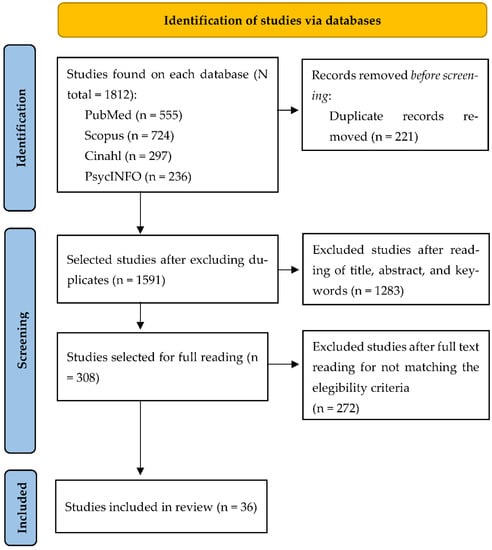
Of the 1812 studies initially identified, 36 were selected as being consistent with the review objective and eligibility criteria (Figure 1).
Figure 1.
Selection of studies flowchart.
With regard to their typology, 28 studies followed a quantitative research method. Twenty-two of them were descriptive, exploratory, or based on observation; four were randomized controlled trials; one was an experimental controlled trial; and one was a case–control study. In the remaining studies, seven followed a qualitative research method and one, a mixed method. Specific characteristics of these studies are detailed in Table 1.
3.2. Study Outcome
3.2.1. Characteristics of the Sample of Caregivers of Adults with Cancer
The total sample comprised 7663 people caregivers with an average age of 54.42 years. However, it must be highlighted that 10 studies did not describe average age [22,23,24,25,26,27,28,29,30,31]. With regard to sex, 66.72% of caregivers were women. As for family bonds, 15 studies described these caregivers as being mostly spouses or daughters/sons of the patients with cancer, usually sharing the same home [22,23,25,26,27,28,30,32,33,34,35,36,37,38,39].
3.2.2. Problems (Physical, Emotional, Social, and Financial) of People Who Are Caregivers of Adults with Cancer
In relation to physical problems, eight studies [25,34,37,40,41,42,43,44] described that care work implies a greater risk for caregivers of suffering physical morbidity with considerable wear, which in fact increases as the care burden continues over time. It is also observable that physical and health problems are more frequent in female caregivers, and physical damage results in a worse quality of life perceived by caregivers.
At an emotional level, 26 studies [22,23,25,26,27,28,29,30,33,34,35,36,38,40,41,42,43,44,45,46,47,48,49,50,51,52] alluded to the emotional and psychological problems suffered by caregivers, highlighting anxiety, depression, feelings of grief and distress, and high levels of stress. Therefore, showing that, the longer the care was needed over time, the greater the tension and emotional burden, resulting in worse quality of life.
With regard to social aspects, 10 studies [24,25,27,31,32,41,49,53,54,55] described how the patients’ disease process has affected the social interaction of caregivers, who manifest a great difficulty in reconciling their role as caregivers and the development of other daily activities, highlighting the deterioration of working conditions. The studies conclude that less social support is related to worse quality of life.
In the economic sphere, 10 studies [25,27,39,44,53,56,57] described the financial problems of people caregivers, resulting from the costs associated with the disease, the lack of financial support of other family members, or the difficulty of reconciling their role as caregivers with their work activity. The studies show that caregivers with higher income levels perceive a better quality of life.
3.2.3. Strategies to Improve the Quality of Life of Caregivers of Adults with Cancer
Among the strategies described, 10 studies [28,29,31,32,36,39,41,50,54,57] emphasized the need of enhancing social support by means of reinforcing the support networks and facilitating access to support groups and associations. Thirteen studies [23,24,27,30,32,35,37,38,45,46,47,49,54] indicated the need of developing coping strategies to improve the management and control of both the situation and the emotional strain, and also to help increase training in caregivers, thus improving their self-efficacy while reducing the emotional impact. One study [53] included the completion of breathing exercises and counseling sessions to reduce emotional strain. One study [34] suggested exercising practice to improve the perceived health levels on the part of caregivers. One study [39] pointed out the need of providing financial support to caregivers in order to improve their well-being. Four studies [22,24,44,48] highlighted the need of training properly health professionals on existential and spiritual distress management, as well as the need to identify groups at risk and reassigning tasks among all family members. One study [26] described that health professionals require cultural awareness in order to properly meet the needs of caregivers.
Table 1.
Characteristics of the selected studies.
4. Discussion
4.1. Characteristics of the Sample of Caregivers of Adults with Cancer
The total sample was made up of 7663 caregivers, 66.72% were women. In this sense, most studies coincide in stating that there are more women caregivers of patients with cancer than men [22,23,24,25,26,27,29,30,32,33,34,35,36,37,38,39,40,41,42,43,44,45,46,47,48,49,50,51,52,53,54,55,56,57]. This data met the results obtained by other authors outside this review, such as Martínez et al. [58] who conducted research to define the burden of caregivers of patients with head and neck cancer, concluded that the profile consisted of 81% women. On the other hand, the study accomplished by Guijarro-Requena et al. [13], with the aim of improving the quality of life of caregivers through training initiatives, indicated as well a larger representation of women, reaching 91.9% of the sample. However, there were two studies that described a larger number of male caregivers with respect to women [28,31].
Regarding average age of caregivers of patients with cancer, most of the studies set the interval between ages 45–65 [32,33,34,35,36,37,38,40,41,43,44,45,46,47,48,49,50,51,52,54,55,56]. These results coincide with those described by other authors [59,60]. Notwithstanding, in the study by Peredo et al. [61] analyzing burnout syndrome, anxiety, and depression in caregivers of patients with cancer, 48.7% were among the age interval 20–40 years. In the study by Amador et al. [62] analyzing psycho-affective features and overburden levels in caregivers of oncologic patients, 48% were women aged 24–29 years.
With respect to the familiar bond, the role of caregiver is undertaken by spouses or daughters/sons of people with cancer and usually share the same home [22,23,25,26,27,28,30,32,33,34,35,36,37,38,39]. These results are aligned with the conclusions described by other authors [5,8,58,63].
4.2. Physical, Emotional, Social, and Financial Strain Suffered by Caregivers of Adults with Cancer
Different review studies have revealed that care provision on the part of caregivers causes physical problems, increasing the risk of suffering physical morbidity the longer the care activity continues [25,34,37,40,41,42,43,44]. Authors outside this review described how the stressful factors related to care provision considerably affect the physical condition of caregivers, with this impact higher on male caregivers who are older and bearing a high demand of care [64]. Barrón and Alvarado [65] indicated that care provision, particularly if prolonged over time, may result in various physical conditions such as: fatigue, headaches, joint pain, dizziness, and worsening of sleep quality to trouble sleeping.
Most of the studies [22,23,25,26,27,28,29,30,33,34,35,36,38,40,41,42,43,44,45,46,47,48,49,50,51,52] have referenced the emotional and psychological problems suffered by caregivers, describing feelings of distress, stress, high levels of anxiety, and even depression. Emotional strain was significantly higher when care provision extended over time. Results obtained are in line with those mentioned by other authors [64,66]. Besides, the study conducted by Rosado et al. [67], aimed to evaluate the support needs and quality of life of caregivers of pediatric patients with cancer, described that emotional performance was the most damaged in the total score of quality of life index.
Regarding social problems, review studies [24,25,27,31,32,41,49,53,54,55] described how social interactions of caregivers were affected to the point of finding it very difficult to reconcile their role of caregivers with the rest of activities, where deterioration of working conditions and lesser social event engagement were highlighted. Caregivers who declared having worse social support showed poorer quality of life indicators. These findings are aligned with other authors’ results, which also indicated deterioration of working conditions, and a decrease of free time to develop daily activities or taking time for themselves. Moreover, the lesser the social support is perceived on the part of the caregiver, the worse the consequences on her/his health, both physical and psychological [66,68].
Several review studies [25,27,39,44,53,56,57] mentioned the financial problems of caregivers, highlighting among the possible causes, the lack of financial support, the costs derived from the disease process itself, or the difficulty of developing their work activity. Caregivers who reported lower incomes showed worse quality of life indicators. Several authors outside the review reported that difficulties to reconcile the role of caregiver with work activities add multiple financial burdens to caregivers [66]. The study conducted by Cortijo-Palacios et al. [69] carried out the Zarit Burden Interview in assessing caregiving burden, revealing high scores in low spending capacity and feelings of financial distress.
4.3. Strategies to Improve the Quality of Life of Caregivers of Adults with Cancer
With respect to the strategies to improve the quality of life of caregivers, different studies have pointed out the need of promoting social support, facilitating the access to support networks [28,29,31,32,36,39,41,50,54,57]. Authors such as Martínez, Lorenzo, and Llantá [58] have indicated that in order to improve the quality of life of caregivers, both social and family support are key, as they not only allow to hand over some tasks and responsibilities, but they also provide emotional, spiritual, and material support.
Review studies have described the need of implementing coping strategies to allow patients to improve the management of their own disease, while developing skills to reduce the emotional and physical impact [23,24,27,30,32,34,35,37,38,45,46,47,49,53,54]. These findings coincide with those published by other authors such as Pino et al. [70] who described the need of implementing coping strategies to protect the quality of life of caregivers and thus overcome cognitive, emotional, and behavioral demands faced by both caregiver and family environment. Besides, Pérez et al. [71] indicated that caregivers of patients with cancer who were able to develop coping strategies, managed to decrease the emotional impact and fatigue feeling.
Review studies revealed the need of appraising the economic situation of caregivers [25,27,39,44,53,56,57]. Authors such as Carreño et al. [72] have also pointed out this need when facing the high economic burden imposed on caregivers, and that this is not only associated to medical services, but to the lack of labor productivity or even job loss. This financial burden is connected to higher levels of anxiety and distress suffered by caregivers.
Authors of the review pointed out that in order to develop the strategies to aid caregivers, it is necessary to properly train health professionals, both in the management of emotional and physical strain, as in covering the spiritual needs and facilitate access to support networks. This requires health professionals to able to identify the most vulnerable groups while considering providing specific health care to all the family [22,24,44,48]. Moreover, in order to comply with all these needs, health professionals require cultural awareness to understand better the complex requirements of caregivers [26]. These results are aligned with the findings described by other authors [73].
4.4. Limitations
This review shows some limitations. Shortening the search strategy to the last five years made it impossible to recover all the information available on this subject, though a rigorous process was followed in order to obtain the latest scientific findings. Furthermore, the number of subjects in the sample vary from one study to another. On the other hand, the diversity of the research designs that were employed also limits interpretations. Another limitation is that no tool was used for study quality assessment.
5. Conclusions
The vast majority of caregivers of adults with cancer are women around 50 years old, being most commonly spouses or daughters of the patient with whom they usually live. Caregiving generates physical, emotional, social, and financial problems, which cause a burden in caregivers that results in a decrease of their quality of life. To improve their quality of life, different strategies can be implemented: In relation to physical problems, it is recommended exercising practice to improve the perceived health levels on the part of caregivers. At the emotional level, it is recommended, on one hand, enhancing social support by means of reinforcing the support networks and facilitating access to support groups and associations; and, on the other hand, developing coping strategies which improve the management and control of both the situation and the emotional strain. Breathing exercises and counseling sessions to reduce emotional strain have also been described is this regard. In the economic sphere, it stands out the need to provide financial support to caregivers in order to improve their well-being. In order to implement these strategies, it is necessary to train health professionals.
Author Contributions
Conceptualization, M.D.G.-M.; methodology, M.D.G.-M. and Á.B.-R.; formal analysis, M.D.R.C.-E., Y.G.-L., C.H.-C. and I.L.-L.; investigation, M.D.R.C.-E., Y.G.-L., C.H.-C. and I.L.-L.; data curation, M.D.R.C.-E., Y.G.-L., C.H.-C. and I.L.-L.; writing—original draft preparation, M.D.G.-M. and Á.B-R.; writing—review and editing, M.D.G.-M. and Á.B-R.; supervision, M.D.G.-M. All authors have read and agreed to the published version of the manuscript.
Funding
This research received no external funding.
Institutional Review Board Statement
Not applicable.
Informed Consent Statement
Not applicable.
Data Availability Statement
Not applicable.
Conflicts of Interest
The authors declare no conflict of interest.
References
- National Cancer Institute. What Is Cancer? Available online: https://www.cancer.gov/about-cancer/understanding/what-is-cancer (accessed on 3 March 2022).
- World Health Organization. Cancer. Available online: https://www.who.int/news-room/fact-sheets/detail/cancer (accessed on 3 March 2022).
- Sociedad Espyearla de Oncología Médica. Las Cifras del Cáncer en Espala. Available online: https://seom.org/images/LAS_CIFRAS_DEL_CANCER_EN_ESPANA_2022.pdf (accessed on 14 March 2022).
- González, A.; Fonseca, M.; Valladares, A.M.; López, L.M. Factores moduladores de resiliencia y sobrecarga en cuidadores principales de pacientes oncológicos avanzados. Rev. Finlay 2017, 7, 26–32. [Google Scholar]
- Zambrano-Domínguez, E.M.; Guerra-Martín, M.D. Formación del cuidador informal: Relación con el tiempo de cuidado a personas dependientes mayores de 65 years. Aquichan 2012, 12, 241–251. [Google Scholar] [CrossRef] [Scilit]
- Arias-Rojas, M.; Carreño, S.; Sepúlveda, A.; Romero, I. Sobrecarga y calidad de vida de cuidadores de personas con cáncer en cuidados paliativos. Rev. Cuid. 2021, 12, e1248. [Google Scholar] [CrossRef] [Scilit]
- Domínguez, J.A. Ansiedad y depresión en cuidadores de pacientes dependientes. Med. Fam.-SEMERGEN 2012, 38, 16–23. [Google Scholar] [CrossRef] [Scilit]
- Instituto de Mayores y Servicios Sociales. Cuidados a las Personas Mayores en los Hogares Espyearles: El Entorno Familiar. Available online: http://envejecimiento.csic.es/documentos/documentos/imserso-cuidados-01.pdf (accessed on 27 February 2022).
- Navarro, V. Perfil de los cuidadores informales y ámbito de actuación del trabajo social. Trab. Soc. Hoy 2016, 77, 63–83. [Google Scholar] [CrossRef] [Scilit]
- Cabrera, Y.; López, E.J.; López, E.; Arredondo, B. La psicología y la oncología: En una unidad imprescindible. Rev. Finlay 2017, 7, 115–127. [Google Scholar]
- Amador-Marín, B.; Guerra-Martín, M.D. Eficacia de las intervenciones no farmacológicas en la calidad de vida de las personas cuidadoras de pacientes con enfermedad de Alzheimer. Gac. Sanit. 2017, 31, 154–160. [Google Scholar] [CrossRef] [Scilit]
- Mesa, P.; Ramos, M.; Redolat, R. Cuidado de pacientes oncológicos: Una revisión sobre el impacto de la situación de estrés crónico y su relación con la personalidad del cuidador y otras variables moduladoras. Psicooncología 2017, 14, 93–106. [Google Scholar] [CrossRef] [Scilit]
- Guijarro-Requena, M.D.; Marín-Campaña, M.N.; Pulido-Lozano, M.I.; Romero-Carmona, R.M.; Luque-Romero, L.G. Mejora de la calidad de vida en cuidadores informales de personas dependientes mediante talleres educacionales. Enferm. Glob. 2022, 21, 59–73. [Google Scholar] [CrossRef] [Scilit]
- Vinaccia, S.; Quiceno, J.M.; Fernández, H.; Contreras, F.; Bedoya, M.; Tobón, S.; Zapata, M. Calidad de vida, personalidad resistente y apoyo social percibido en pacientes con diagnóstico de cáncer pulmonar. Psicol. Salud 2005, 15, 207–221. [Google Scholar]
- The WHOQOL Group. The World Health Organization Quality of Life assessment (WHOQOL): Position paper from the World Health Organization. Soc. Sci. Med. 1995, 41, 1403–1409. [Google Scholar] [CrossRef] [Scilit] [PubMed]
- Schalock, R.L.; Verdugo, M.A. Calidad de vida. In Discapacidad e Inclusión, 1st ed.; Alianza Editorial: Madrid, Spain, 2003. [Google Scholar]
- Rogero-García, J. Distribución en España del cuidado formal e informal a las personas mayores de 65 y más years en situación de dependencia. Rev. Espyearla Salud Pública 2009, 83, 393–405. [Google Scholar] [CrossRef] [Scilit]
- Sala, E. La Calidad de vida de las Cuidadoras Informales: Bases para un Sistema de Valoración. Available online: https://www.seg-social.es/wps/wcm/connect/wss/c3f111db-d9a6-4ee8-adfd-cbd7f9a8e99c/F74_07.pdf?MOD=AJPERES (accessed on 8 March 2022).
- Villatoro, K.; Sánchez, V. Calidad de vida y calidad de vida relacionada con la salud. In Atención al Tratamiento de las Enfermedades Crónicas Desde el Centro de Salud; Villatoro, K., Sánchez, V., Eds.; Universidad de Valencia: Valencia, Spain, 2012; pp. 29–46. [Google Scholar]
- Del Pino, R.; Frías, A.; Palomino, P.A. La revisión sistemática cuantitativa en enfermería. Rev. Iberoam. Enferm. Comunitaria 2014, 7, 24–39. [Google Scholar]
- Perestelo-Pérez, L. Standars on how to develop and report systematics reviews in Psychology and Health. Int. J. Clin. Health Psychol. 2013, 13, 49–57. [Google Scholar] [CrossRef] [Scilit]
- Benites, A.C.; Rodin, G.; De Oliveira-Cardoso, E.A.; Dos Santos, M.A. “You begin to give more value in life, in minutes, in seconds”: Spiritual and existential experiences of family caregivers of patients with advanced cancer receiving end-of-life care in Brazil. Support. Care Cancer 2022, 30, 2631–2638. [Google Scholar] [CrossRef] [Scilit]
- De Camargos, M.G.; Paiva, B.; De Almeida, C.; Paiva, C.E. What Is Missing for You to Be Happy? Comparison of the Pursuit of Happiness among Cancer Patients, Informal Caregivers, and Healthy Individuals. J. Pain Symptom Manag. 2019, 58, 417–426.e4. [Google Scholar] [CrossRef] [Scilit]
- Kilic, S.T.; Oz, F. Family Caregivers’ Involvement in Caring with Cancer and their Quality of Life. Asian Pac. J. Cancer Prev. 2019, 20, 1735–1741. [Google Scholar] [CrossRef] [Scilit]
- Kristanti, M.S.; Effendy, C.; Utarini, A.; Vernooij-Dassen, M.; Engels, Y. The experience of family caregivers of patients with cancer in an Asian country: A grounded theory approach. Palliat. Med. 2019, 33, 676–684. [Google Scholar] [CrossRef] [Scilit]
- Wittenberg, E.; Goldsmith, J.V.; Kerr, A.M. Variation in health literacy among family caregiver communication types. Psychooncology 2019, 28, 2181–2187. [Google Scholar] [CrossRef] [Scilit] [PubMed]
- Bilgin, S.; Gozum, S. Effect of nursing care given at home on the quality of life of patients with stomach cancer and their family caregivers’ nursing care. Eur. J. Cancer Care 2018, 27, e12567. [Google Scholar] [CrossRef] [Scilit] [PubMed]
- Cho, Y.; Jeon, Y.; Jang, S.I.; Park, E.C. Family Members of Cancer Patients in Korea Are at an Increased Risk of Medically Diagnosed Depression. J. Prev. Med. Public Health 2018, 51, 100–108. [Google Scholar] [CrossRef] [Scilit] [PubMed]
- McDonald, J.; Swami, N.; Pope, A.; Hales, S.; Nissim, R.; Rodin, G.; Hannon, B.; Zimmermann, C. Caregiver quality of life in advanced cancer: Qualitative results from a trial of early palliative care. Palliat. Med. 2018, 32, 69–78. [Google Scholar] [CrossRef] [Scilit] [PubMed]
- Mollica, M.A.; Litzelman, K.; Rowland, J.H.; Kent, E.E. The role of medical/nursing skills training in caregiver confidence and burden: A CanCORS study. Cancer 2017, 123, 4481–4487. [Google Scholar] [CrossRef] [Scilit] [PubMed]
- Senneseth, M.; Dyregrov, A.; Laberg, J.; Matthiesen, S.B.; Pereira, M.; Hauken, M.A. Facing spousal cancer during child-rearing years: The short-term effects of the Cancer-PEPSONE programme-a single-center randomized controlled trial. Psychooncology 2017, 26, 1541–1547. [Google Scholar] [CrossRef] [Scilit]
- Arias-Rojas, M.; Arredondo, E.; Carreño, S.; Posada, C.; Tellez, B. Validation of the Latin American-Spanish version of the scale ‘Quality of Life in Life-Threatening Illness-Family Caregiver Version’ (QOLLTI-F). Health Soc. Care Community 2022, 30, e832–e841. [Google Scholar] [CrossRef] [Scilit]
- Baudry, A.S.; Vanlemmens, L.; Anota, A.; Cortot, A.; Piessen, G.; Christophe, V. Profiles of caregivers most at risk of having unmet supportive care needs: Recommendations for healthcare professionals in oncology. Eur. J. Oncol. Nurs. Off. J. Eur. Oncol. Nurs. Soc. 2019, 43, 101669. [Google Scholar] [CrossRef] [Scilit] [PubMed]
- Cuthbert, C.A.; King-Shier, K.M.; Ruether, J.D.; Tapp, D.M.; Wytsma-Fisher, K.; Fung, T.S.; Culos-Reed, S.N. The Effects of Exercise on Physical and Psychological Outcomes in Cancer Caregivers: Results from the RECHARGE Randomized Controlled Trial. Ann. Behav. Med. 2018, 52, 645–661. [Google Scholar] [CrossRef] [Scilit] [PubMed]
- Halkett, G.K.; Golding, R.M.; Langbecker, D.; White, R.; Jackson, M.; Kernutt, E.; O’Connor, M. From the carer’s mouth: A phenomenological exploration of carer experiences with head and neck cancer patients. Psychooncology 2020, 29, 1695–1703. [Google Scholar] [CrossRef] [Scilit]
- Kassir, Z.M.; Li, J.; Harrison, C.; Johnson, J.T.; Nilsen, M.L. Disparity of perception of quality of life between head and neck cancer patients and caregivers. BMC Cancer 2021, 21, 1127. [Google Scholar] [CrossRef] [Scilit]
- Steel, J.L.; Cheng, H.; Pathak, R.; Wang, Y.; Miceli, J.; Hecht, C.L.; Haggerty, D.; Peddada, S.; Geller, D.A.; Marsh, W.; et al. Psychosocial and behavioral pathways of metabolic syndrome in cancer caregivers. Psychooncology 2019, 28, 1735–1742. [Google Scholar] [CrossRef] [Scilit] [PubMed]
- Washington, K.T.; Demiris, G.; Parker, D.; Albright, D.L.; Craig, K.W.; Tatum, P. Delivering problem-solving therapy to family caregivers of people with cancer: A feasibility study in outpatient palliative care. Psychooncology 2018, 27, 2494–2499. [Google Scholar] [CrossRef] [Scilit]
- Yu, H.; Zhang, H.; Yang, J.; Liu, C.; Lu, C.; Yang, H.; Huang, W.; Zhou, J.; Fu, W.; Shi, L.; et al. Health utility scores of family caregivers for leukemia patients measured by EQ-5D-3L: A cross-sectional survey in China. BMC Cancer 2018, 18, 950. [Google Scholar] [CrossRef] [Scilit]
- Lim, J.; Cho, H.; Bunds, K.S.; Lee, C.W. Cancer family caregivers’ quality of life and the meaning of leisure. Health Care Women Int. 2021, 42, 1144–1164. [Google Scholar] [CrossRef] [Scilit]
- Reblin, M.; Otto, A.K.; Ketcher, D.; Vadaparampil, S.T.; Ellington, L.; Heyman, R.E. In-home conversations of couples with advanced cancer: Support has its costs. Psychooncology 2020, 29, 1280–1287. [Google Scholar] [CrossRef] [Scilit]
- Kehoe, L.A.; Xu, H.; Duberstein, P.; Loh, K.P.; Culakova, E.; Canin, B.; Hurria, A.; Dale, W.; Wells, M.; Gilmore, N.; et al. Quality of Life of Caregivers of Older Patients with Advanced Cancer. J. Am. Geriatr. Soc. 2019, 67, 969–977. [Google Scholar] [CrossRef] [Scilit] [PubMed]
- Shin, J.; Ko, H.; Lee, J.W.; Kim, K.; Song, Y.M. Influence of time lapse after cancer diagnosis on the association between unmet needs and quality of life in family caregivers of Korean cancer patients. Eur. J. Cancer Care 2019, 28, e13089. [Google Scholar] [CrossRef] [Scilit] [PubMed]
- Cubukcu, M. Evaluation of quality of life in caregivers who are providing home care to cancer patients. Support. Care Cancer 2018, 26, 1457–1463. [Google Scholar] [CrossRef] [Scilit]
- El-Jawahri, A.; Jacobs, J.M.; Nelson, A.M.; Traeger, L.; Greer, J.A.; Nicholson, S.; Waldman, L.P.; Fenech, A.L.; Jagielo, A.D.; D’Alotto, J.; et al. Multimodal psychosocial intervention for family caregivers of patients undergoing hematopoietic stem cell transplantation: A randomized clinical trial. Cancer 2020, 126, 1758–1765. [Google Scholar] [CrossRef] [Scilit] [PubMed]
- Pereira, M.G.; Vilaça, M.; Pinheiro, M.; Ferreira, G.; Pereira, M.; Faria, S.; Monteiro, S.; Bacalhau, R. Quality of life in caregivers of patients with multiple myeloma. Aging Ment. Health 2020, 24, 1402–1410. [Google Scholar] [CrossRef] [Scilit]
- Titler, M.G.; Shuman, C.; Dockham, B.; Harris, M.; Northouse, L. Acceptability of a Dyadic Psychoeducational Intervention for Patients and Caregivers. Oncol. Nurs. Forum 2020, 47, 342–351. [Google Scholar] [CrossRef] [Scilit] [PubMed]
- Abdullah, N.N.; Idris, I.B.; Shamsuddin, K.; Abdullah, N. Health-Related Quality of Life (HRQOL) of Gastrointestinal Cancer Caregivers: The Impact of Caregiving. Asian Pac. J. Cancer Prev. 2019, 20, 1191–1197. [Google Scholar] [CrossRef] [Scilit] [PubMed]
- Hsu, T.; Nathwani, N.; Loscalzo, M.; Chung, V.; Chao, J.; Karanes, C.; Koczywas, M.; Forman, S.; Lim, D.; Siddiqi, T. Understanding Caregiver Quality of Life in Caregivers of Hospitalized Older Adults with Cancer. J. Am. Geriatr. Soc. 2019, 67, 978–986. [Google Scholar] [CrossRef] [Scilit]
- Hyde, M.K.; Legg, M.; Occhipinti, S.; Lepore, S.J.; Ugalde, A.; Zajdlewicz, L.; Laurie, K.; Dunn, J.; Chambers, S.K. Predictors of long-term distress in female partners of men diagnosed with prostate cancer. Psychooncology 2018, 27, 946–954. [Google Scholar] [CrossRef] [Scilit] [PubMed]
- Tan, J.Y.; Molassiotis, A.; Lloyd-Williams, M.; Yorke, J. Burden, emotional distress and quality of life among informal caregivers of lung cancer patients: An exploratory study. Eur. J. Cancer Care 2018, 27, e12691. [Google Scholar] [CrossRef] [Scilit] [PubMed]
- Lee, C.Y.; Lee, Y.; Wang, L.J.; Chien, C.Y.; Fang, F.M.; Lin, P.Y. Depression, anxiety, quality of life, and predictors of depressive disorders in caregivers of patients with head and neck cancer: A six-month follow-up study. J. Psychosom. Res. 2017, 100, 29–34. [Google Scholar] [CrossRef] [Scilit]
- Nayak, M.G.; George, A. Effectiveness of Multicomponent Intervention on Quality of Life of Family Caregivers of Cancer Patients. Asian Pac. J. Cancer Prev. 2021, 22, 2789–2795. [Google Scholar] [CrossRef] [Scilit]
- Van Roij, J.; Brom, L.; Youssef-El Soud, M.; Van de Poll-Franse, L.; Raijmakers, N. Social consequences of advanced cancer in patients and their informal caregivers: A qualitative study. Support. Care Cancer 2019, 27, 1187–1195. [Google Scholar] [CrossRef] [Scilit]
- Wood, R.; Taylor-Stokes, G.; Lees, M. The humanistic burden associated with caring for patients with advanced non-small cell lung cancer (NSCLC) in three European countries-a real-world survey of caregivers. Support. Care Cancer 2019, 27, 1709–1719. [Google Scholar] [CrossRef] [Scilit]
- Sadigh, G.; Switchenko, J.; Weaver, K.E.; Elchoufi, D.; Meisel, J.; Bilen, M.A.; Lawson, D.; Cella, D.; El-Rayes, B.; Carlos, R. Correlates of financial toxicity in adult cancer patients and their informal caregivers. Support. Care Cancer 2022, 30, 217–225. [Google Scholar] [CrossRef] [Scilit]
- Abbasi, A.; Mirhosseini, S.; Basirinezhad, M.H.; Ebrahimi, H. Relationship between caring burden and quality of life in caregivers of cancer patients in Iran. Support. Care Cancer 2020, 28, 4123–4129. [Google Scholar] [CrossRef] [Scilit] [PubMed]
- Martínez, L.; Lorenzo, A.; Llantá, M.C. Carga del cuidador en cuidadores informales primarios de pacientes con cáncer de cabeza y cuello. Rev. Habanera Cienc. Méd. 2019, 18, 126–137. [Google Scholar]
- Sotés, J.R.; Artime, M.; Pérez, A.; Olivera, B.; Martínez, L. Enfrentamiento a la muerte por cuidadores informales de pacientes con cáncer en estado terminal. Acta Méd. Cent. 2021, 15, 591–604. [Google Scholar]
- Vélez, J.A.; Mora, M.L.; Piedra, M.J. Bienestar y apoyo social en cuidadores informales de pacientes oncológicos. Eureka 2022, 19, 54–72. [Google Scholar]
- Peredo, E.; Gutiérrez, A.G.; Ortega, M.E.; Gutiérrez, C.; Contreras, C.M. Síndrome de burnout, ansiedad, depresión y ciclo reproductivo en cuidadoras informales de pacientes con cáncer. Psicol. Salud 2022, 32, 325–340. [Google Scholar] [CrossRef] [Scilit]
- Amador, C.; Puello, E.C.; Valencia, N.N. Características psicoafectivas y sobrecarga de los cuidadores informales de pacientes oncológicos terminales en Montería, Colombia. Rev. Cuba. Salud Pública 2020, 46, e1463. [Google Scholar]
- Rizo, A.C.; Molina, M.; Milián, N.C.; Pagán, P.E.; Machado, J. Caracterización del cuidador primario de enfermero oncológico en estado avanzado. Rev. Cuba. Med. Gen. Integral 2016, 32, 1–13. [Google Scholar]
- Pinquart, M.; Sorensen, S. Correlates of Physical Health of Informal Caregivers: A Meta-Analysis. J. Gerontol. 2007, 62, 126–137. [Google Scholar] [CrossRef] [Scilit]
- Barrón, B.S.; Alvarado, S. Desgaste físico y Emocional del Cuidador Primario en Cáncer. Cancerología 2009, 4, 39–46. [Google Scholar]
- García, M.M.; Del Río, M. El papel del cuidado informal en la atención a la dependencia: ¿cuidamos a quiénes cuidan? Actas Depend. 2012, 6, 99–117. [Google Scholar]
- Rosado, E.A.; Arroyo, C.; Sahagún, A.; Lara, A.; Campos, S.; Ochoa, R.; Sánchez, J.J. Necesidad de apoyo psicológico y calidad de vida en el cuidador primario de pacientes pediátricos con cáncer. Psicooncologia 2021, 18, 137–156. [Google Scholar] [CrossRef] [Scilit]
- Shultz, R. Sherwood PR. Physical and Mental Health Effects of Family Caregiving. Am. J. Nurs. 2008, 108, 23–27. [Google Scholar]
- Cortijo-Palacios, X.; Bernal-Morales, B.; Gutiérrez-García, A.G.; Díaz-Domínguez, E.; Hernández-Baltazar, D.; Cibrián-Llanderal, T. Evaluación psicoafectiva en pacientes con cáncer avanzado y cuidadores principales. Gac. Mex. Oncol. 2018, 17, 245–252. [Google Scholar] [CrossRef] [Scilit]
- Pino, K.; Murillo, M.; Suárez, L.F. Acompañamiento al enfermero crónico o terminal y calidad de vida en familia. Poiésis 2019, 36, 126–146. [Google Scholar] [CrossRef] [Scilit]
- Pérez-ordoñez, F.; Frías-Osuna, A.; Romero-Rodríguez, Y.; Del-Pino-Casado, R. Coping strategies and anxiety in caregivers of palliative cancer patients. Eur. J. Cancer Care 2016, 25, 600–607. [Google Scholar] [CrossRef] [Scilit] [PubMed]
- Carreño, S.P.; Sánchez, B.; Carrillo, G.M.; Chaparro-Díaz, L.; Gómez, O.J. Carga de la enfermedad crónica para los sujetos implicados en el cuidado. Rev. Fac. Nac. Salud Pública 2016, 34, 342–349. [Google Scholar] [CrossRef] [Scilit]
- Vivar, C.G.; Orecilla-Velilla, E.; Gómara-Arraiza, L. “Es más difícil”: Experiencias de las enfermeras sobre el cuidado del paciente con recidiva de cáncer. Enferm. Clín. 2009, 19, 314–321. [Google Scholar] [CrossRef] [Scilit] [PubMed]

Disclaimer/Publisher’s Note: The statements, opinions and data contained in all publications are solely those of the individual author(s) and contributor(s) and not of MDPI and/or the editor(s). MDPI and/or the editor(s) disclaim responsibility for any injury to people or property resulting from any ideas, methods, instructions or products referred to in the content. |
© 2023 by the authors. Licensee MDPI, Basel, Switzerland. This article is an open access article distributed under the terms and conditions of the Creative Commons Attribution (CC BY) license (https://creativecommons.org/licenses/by/4.0/).