Efficacy of Dry Needling and Acupuncture in Patients with Fibromyalgia: A Systematic Review and Meta-Analysis
 ,
,  , and
, and
Abstract
1. Introduction
2. Materials and Methods
2.1. Study Design
2.2. Data Sources
Filters: [Title/Abstract] |
#1 Fibromyalgia [MeSH]; #2 Fatigue Syndrome, Chronic [MeSH]; #3 Tender Points |
#4 #1 OR #2 OR #3 |
#5 Needling, Dry [MeSH]; #6 Acupuncture [MeSH]; #7 Acupuncture Therapy [MeSH]; #8 Acupuncture Analgesia [MeSH] |
#9 #5 OR #6 OR #7 OR #8 |
#10 Pain [MeSH]; #11 Chronic Pain [MesH]; #12 Pain Perception [MeSH]; #13 Pain Threshold [MeSH]; #14 Anxiety [MeSH]; #15 Depressive Disorder [MeSH]; #16 Fatigue [MeSH]; #17 Quality of Life [MeSH]; #18 Sleep [MeSH]; #19 Sleep Disorders |
#20 #10 OR #11 OR #12 OR #13 OR #14 OR #15 OR #16 OR #17 OR #18 OR #19 |
2.3. Study Eligibility Criteria
2.4. Study Appraisal and Synthesis Methods
2.5. Level of Evidence
2.6. Data Analysis
3. Results
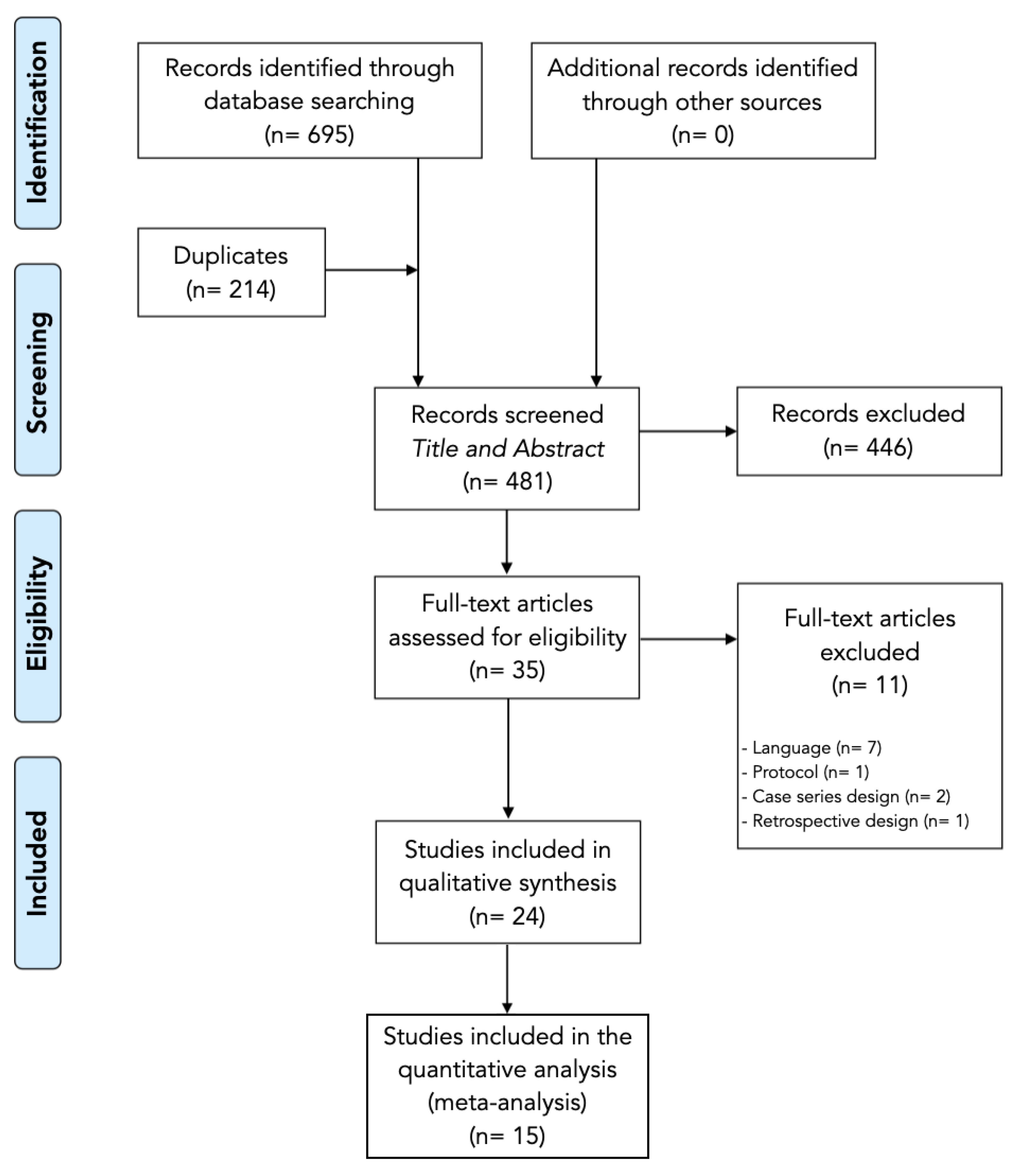
3.1. Study Selection
3.2. Methodological Quality Assessment
3.3. Dry Needling
3.4. Acupuncture
3.5. Meta-Analysis Results
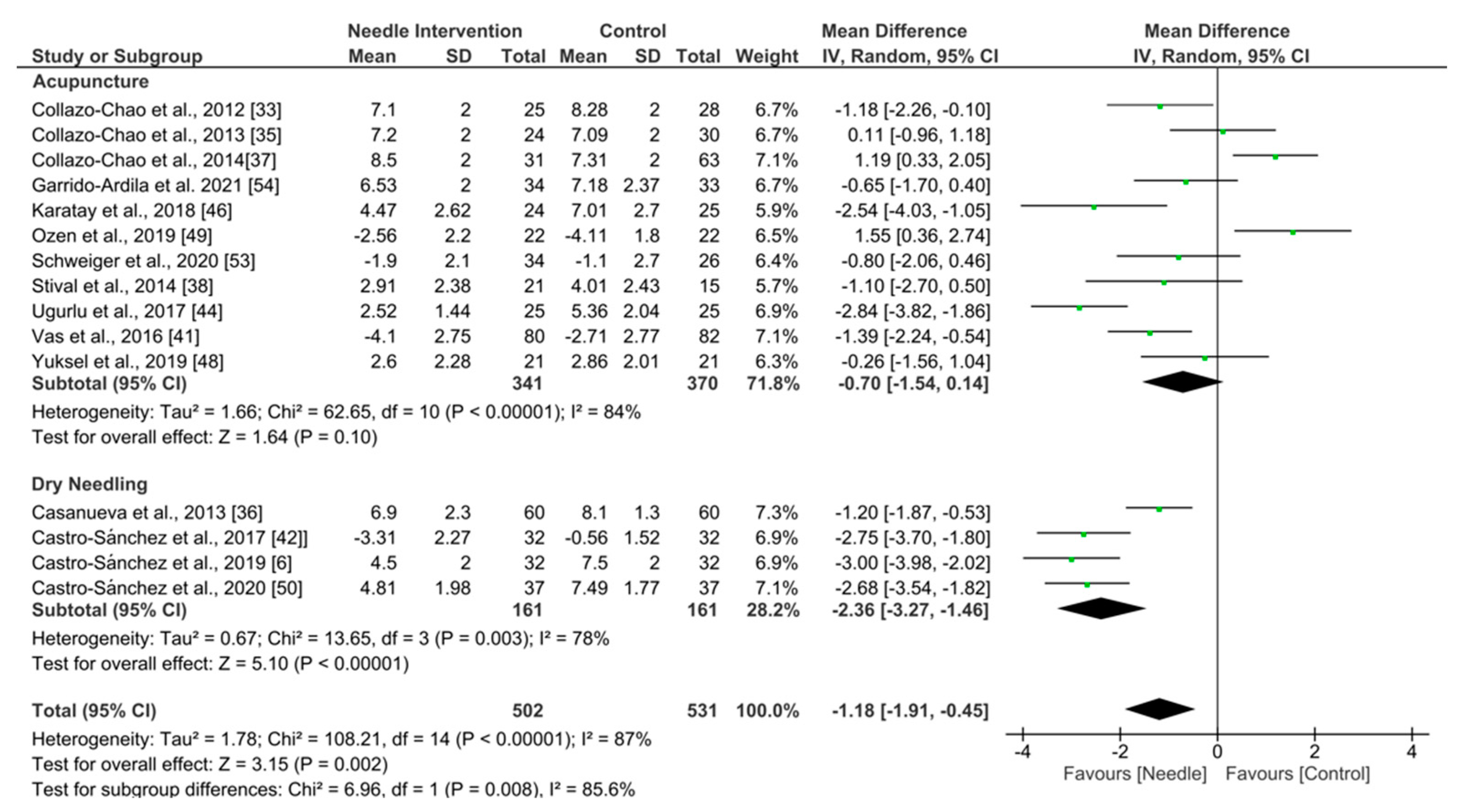
3.5.1. Pain Intensity
3.5.2. Fibromyalgia Impact Questionnaire
3.5.3. Sleeping/Resting Quality
3.5.4. Depression
3.5.5. Pressure Pain Threshold
3.6. Level of Evidence
4. Discussion
Limitations
5. Conclusions
Author Contributions
Funding
Institutional Review Board Statement
Informed Consent Statement
Data Availability Statement
Conflicts of Interest
References
- Wolfe, F.; Clauw, D.J.; Fitzcharles, M.A.; Goldenberg, D.L.; Häuser, W.; Katz, R.L.; Mease, P.J.; Russell, A.S.; Russell, I.J.; Walitt, B. 2016 Revisions to the 2010/2011 fibromyalgia diagnostic criteria. Semin. Arthritis Rheum. 2016, 46, 319–329. [Google Scholar] [CrossRef] [Scilit]
- Clauw, D.J. Fibromyalgia: A clinical review. JAMA 2014, 311, 1547–1555. [Google Scholar] [CrossRef] [Scilit] [PubMed]
- Langhorst, J.; Klose, P.; Musial, F.; Irnich, D.; Häuser, W. Efficacy of acupuncture in fibromyalgia syndrome–A systematic review with a meta-analysis of controlled clinical trials. Rheumatology 2010, 49, 778–788. [Google Scholar] [CrossRef] [Scilit] [PubMed]
- Fitzcharles, M.A.; Ste-Marie, P.A.; Goldenberg, D.L.; Pereira, J.X.; Abbey, S.; Choinière, M.; Ko, G.; Moulin, D.E.; Panopalis, P.; Proulx, J.; et al. 2012 Canadian Guidelines for the diagnosis and management of fibromyalgia syndrome: Executive summary. Pain Res. Manag. 2013, 18, 119–126. [Google Scholar] [CrossRef] [Scilit] [PubMed]
- Neumann, L.; Buskila, D. Epidemiology of fibromyalgia. Curr. Pain Headache Rep. 2003, 7, 362–368. [Google Scholar] [CrossRef] [Scilit]
- Castro Sánchez, A.M.; García López, H.; Fernández Sánchez, M.; Pérez Mármol, J.M.; Aguilar-Ferrándiz, M.E.; Luque Suárez, A.; Matarán Peñarrocha, G.A. Improvement in clinical outcomes after dry needling versus myofascial release on pain pressure thresholds, quality of life, fatigue, pain intensity, quality of sleep, anxiety, and depression in patients with fibromyalgia syndrome. Disabil. Rehabil. 2019, 41, 2235–2246. [Google Scholar] [CrossRef] [Scilit] [PubMed]
- Montoya, P.; Pauli, P.; Batra, A.; Wiedemann, G. Altered processing of pain-related information in patients with fibromyalgia. Eur. J. Pain 2005, 9, 293–303. [Google Scholar] [CrossRef] [Scilit] [PubMed]
- Desmeules, J.A.; Cedraschi, C.; Rapiti, E.; Baumgartner, E.; Finckh, A.; Cohen, P.; Dayer, P.; Vischer, T.L. Neurophysiologic evidence for a central sensitization in patients with fibromyalgia. Arthritis Rheum. 2003, 48, 1420–1429. [Google Scholar] [CrossRef] [Scilit] [PubMed]
- Maurer, A.J.; Lissounov, A.; Knezevic, I.; Candido, K.D.; Knezevic, N.N. Pain and sex hormones: A review of current understanding. Pain Manag. 2016, 6, 285–296. [Google Scholar] [CrossRef] [Scilit] [PubMed]
- Theoharides, T.C.; Tsilioni, I.; Arbetman, L.; Panagiotidou, S.; Stewart, J.M.; Gleason, R.M.; Russell, I.J. Fibromyalgia syndrome in need of effective treatments. J. Pharmacol. Exp. Ther. 2015, 355, 255–263. [Google Scholar] [CrossRef] [Scilit]
- Ablin, J.; Fitzcharles, M.A.; Buskila, D.; Shir, Y.; Sommer, C.; Häuser, W. Treatment of fibromyalgia syndrome: Recommendations of recent evidence-based interdisciplinary guidelines with special emphasis on complementary and alternative therapies. Evid. Based Complement. Altern. Med. 2013, 2013, 485272. [Google Scholar] [CrossRef] [Scilit]
- Macfarlane, G.J.; Kronisch, C.; Dean, L.E.; Atzeni, F.; Häuser, W.; Fluß, E.; Choy, E.; Kosek, E.; Amris, K.; Branco, J.; et al. EULAR revised recommendations for the management of fibromyalgia. Ann. Rheum. Dis. 2017, 76, 318–328. [Google Scholar] [CrossRef] [Scilit] [PubMed]
- Yang, B.; Yi, G.; Hong, W.; Bo, C.; Wang, Z.; Liu, Y.; Xue, Z.; Li, Y. Efficacy of acupuncture on fibromyalgia syndrome: A meta-analysis. J. Tradit. Chin. Med. 2014, 34, 381–391. [Google Scholar] [CrossRef] [PubMed]
- Dunning, J.; Butts, R.; Mourad, F.; Young, I.; Flannagan, S.; Perreault, T. Dry needling: A literature review with implications for clinical practice guidelines. Phys. Ther. Rev. 2014, 19, 252–265. [Google Scholar] [CrossRef] [Scilit]
- Gattie, E.; Cleland, J.A.; Snodgrass, S. The Effectiveness of Trigger Point Dry Needling for Musculoskeletal Conditions by Physical Therapists: A Systematic Review and Meta-analysis. J. Orthop. Sports Phys. Ther. 2017, 47, 133–149. [Google Scholar] [CrossRef] [Scilit]
- Espejo-Antúnez, L.; Tejeda, J.F.; Albornoz-Cabello, M.; Rodríguez-Mansilla, J.; de la Cruz-Torres, B.; Ribeiro, F.; Silva, A.G. Dry needling in the management of myofascial trigger points: A systematic review of randomized controlled trials. Complement Ther. Med. 2017, 33, 46–57. [Google Scholar] [CrossRef] [Scilit] [PubMed]
- Zhuang, Y.; Xing, J.J.; Li, J.; Zeng, B.Y.; Liang, F.R. History of acupuncture research. Int. Rev. Neurobiol. 2013, 111, 1–23. [Google Scholar] [CrossRef] [Scilit] [PubMed]
- Deare, J.C.; Zheng, Z.; Xue, C.C.; Liu, J.P.; Shang, J.; Scott, S.W.; Littlejohn, G. Acupuncture for treating fibromyalgia. Cochrane Database Syst. Rev. 2013, 2013, CD007070. [Google Scholar] [CrossRef] [Scilit]
- Zhou, K.; Ma, Y.; Brogan, M.S. Dry needling versus acupuncture: The ongoing debate. Acupunct. Med. 2015, 33, 485–490. [Google Scholar] [CrossRef] [Scilit]
- Kim, J.; Kim, S.R.; Lee, H.; Nam, D.H. Comparing Verum and Sham Acupuncture in Fibromyalgia Syndrome: A Systematic Review and Meta-Analysis. Evid. Based Complement. Altern. Med. 2019, 2019, 8757685. [Google Scholar] [CrossRef] [Scilit] [PubMed]
- Zhang, X.C.; Chen, H.; Xu, W.T.; Song, Y.Y.; Gu, Y.H.; Ni, G.X. Acupuncture therapy for fibromyalgia: A systematic review and meta-analysis of randomized controlled trials. J. Pain Res. 2019, 12, 527–542. [Google Scholar] [CrossRef] [Scilit]
- Moher, D.; Liberati, A.; Tetzlaff, J.; Altman, D.G.; PRISMA Group. Preferred reporting items for systematic reviews and meta-analyses: The PRISMA statement. PLoS Med. 2009, 6, e1000097. [Google Scholar] [CrossRef] [Scilit] [PubMed]
- Greenhalgh, T. Papers that summarise other papers (systematic reviews and meta-analyses). BMJ 1997, 315, 672–675. [Google Scholar] [CrossRef] [Scilit] [PubMed]
- Shokraneh, F.; Adams, C.E. Study-based registers of randomized controlled trials: Starting a systematic review with data extraction or meta-analysis. Bioimpacts 2017, 7, 209–217. [Google Scholar] [CrossRef] [Scilit] [PubMed]
- de Morton, N.A. The PEDro scale is a valid measure of the methodological quality of clinical trials: A demographic study. Aust. J. Physiother. 2009, 55, 129–133. [Google Scholar] [CrossRef] [Scilit]
- Schünemann, H.J.; Oxman, A.D.; Brozek, J.; Glasziou, P.; Bossuyt, P.; Chang, S.; Muti, P.; Jaeschke, R.; Guyatt, G.H. GRADE: Assessing the quality of evidence for diagnostic recommendations. BMJ Evid. Based Med. 2008, 13, 162–163. [Google Scholar] [CrossRef] [Scilit] [PubMed]
- Austin, T.M.; Richter, R.R.; Sebelski, C.A. Introduction to the GRADE approach for guideline development: Considerations for physical therapist practice. Phys. Ther. 2014, 94, 1652–1659. [Google Scholar] [CrossRef] [Scilit]
- Luo, D.; Wan, X.; Liu, J.; Tong, T. Optimally estimating the sample mean from the sample size, median, mid-range, and/or mid-quartile range. Stat. Methods Med. Res. 2018, 27, 1785–1805. [Google Scholar] [CrossRef] [Scilit] [PubMed]
- Sullivan, G.M.; Feinn, R. Using Effect Size—Or Why the P Value Is Not Enough. J. Grad. Med. Educ. 2012, 4, 279–282. [Google Scholar] [CrossRef] [Scilit] [PubMed]
- Deeks, J.J.; Higgins, J.P.T.; Douglas, G.; Altman, D.G. Analyzing data and undertaking metanalyses. In Cochrane Handbook for Systematic Reviews of Interventions Version 5.2.0 (Updated June 2017); Higgins, J.P.T., Churchill, R., Chandler, J., Cumpston, M.S., Eds.; Cochrane: London, UK, 2017. [Google Scholar]
- Huedo-Medina, T.B.; Sánchez-Meca, J.; Marín-Martínez, F.; Botella, J. Assessing heterogeneity in meta-analysis: Q statistic or I2 index? Psychol. Methods 2006, 11, 193–206. [Google Scholar] [CrossRef] [Scilit] [PubMed]
- Collazo-Chao, E. Effectiveness of acupuncture therapy for pain relief in patients with fibromyalgia. Rev. Int. Acupunt. 2010, 4, 52–58. [Google Scholar] [CrossRef]
- Collazo-Chao, E.; Aragonés, M.A. Acupuncture and traditional Chinese dietary therapy in the treatment of patients with fibromyalgia. A randomized prospective study. Rev. Int. Acupunt. 2012, 6, 94–101. [Google Scholar]
- Iannuccelli, C.; Mannocci, F.; Guzzo, M.P.; Olivieri, M.; Gerardi, M.C.; Atzeni, F.; Sarzi-Puttini, P.; Valesini, G.; Di Franco, M. Complementary treatment in fibromyalgia: Combination of somatic and abdominal acupuncture. Clin. Exp. Rheumatol. 2012, 30, 112–116. [Google Scholar]
- Collazo-Chao, E.; Muñoz-Reina, M.D. Scalp acupuncture and acupuncture for treatment of patients with fibromyalgia. Prospective randomized study. Rev. Int. Acupunt. 2013, 7, 6–11. [Google Scholar]
- Casanueva, B.; Rivas, P.; Rodero, B.; Quintial, C.; Llorca, J.; González-Gay, M.A. Short-term improvement following dry needle stimulation of tender points in fibromyalgia. Rheumatol. Int. 2014, 34, 861–866. [Google Scholar] [CrossRef] [Scilit] [PubMed]
- Collazo-Chao, E.; Muñoz-Reina, M.D.; Aragonés, M.A.; Gómez, F. Randomized prospective study to assess the effectiveness of several therapeutic procedures of traditional Chinese medicine in alleviation of pain and improvement in the standard of living in patients with fibromyalgia. Rev. Int. Acupunt. 2014, 8, 121–128. [Google Scholar] [CrossRef]
- Stival, R.S.; Cavalheiro, P.R.; Stasiak, C.E.; Galdino, D.T.; Hoekstra, B.E.; Schafranski, M.D. Acupuntura na fibromialgia: Um estudo randomizado-controlado abordando a resposta imediata da dor [Acupuncture in fibromyalgia: A randomized, controlled study addressing the immediate pain response]. Rev. Bras. Reumatol. 2014, 54, 431–436. [Google Scholar] [CrossRef] [Scilit] [PubMed]
- Weber, A.; Werneck, L.; Paiva, E.; Gans, P. Effects of music in combination with vibration in acupuncture points on the treatment of fibromyalgia. J. Altern. Complement. Med. 2015, 21, 77–82. [Google Scholar] [CrossRef] [Scilit]
- Días, P.A.; Guimarães, A.B.; Albuquerque Ade, O.; de Oliveira, K.L.; Cavalcante, M.L.; Guimarães, S.B. Short-term complementary and alternative medicine on quality of life in women with fibromyalgia. J. Integr. Med. 2016, 14, 29–35. [Google Scholar] [CrossRef] [Scilit]
- Li, D.; Yang, L.; Li, J. Fibromyalgia syndrome treated with acupuncture at the acupoints of the affected meridians and heavy moxibustion at painful points: A randomized controlled trial. Zhongguo Zhen Jiu 2016, 36, 147–151. [Google Scholar]
- Vas, J.; Santos-Rey, K.; Navarro-Pablo, R.; Modesto, M.; Aguilar, I.; Campos, M.Á.; Aguilar-Velasco, J.F.; Romero, M.; Párraga, P.; Hervás, V.; et al. Acupuncture for fibromyalgia in primary care: A randomised controlled trial. Acupunct. Med. 2016, 34, 257–266. [Google Scholar] [CrossRef] [Scilit]
- Castro-Sanchez, A.M.; Garcia-Lopez, H.; Mataran-Penarrocha, G.A.; Fernandez-Sanchez, M.; Fernandez-Sola, C.; Granero-Molina, J.; Aguilar-Ferrandiz, M.E. Effects of Dry Needling on Spinal Mobility and Trigger Points in Patients with Fibromyalgia Syndrome. Pain Physician 2017, 20, 37–52. [Google Scholar] [CrossRef] [Scilit]
- Iannuccelli, C.; Guzzo, M.P.; Atzeni, F.; Mannocci, F.; Alessandri, C.; Gerardi, M.C.; Valesini, G.; Di Franco, M. Pain modulation in patients with fibromyalgia undergoing acupuncture treatment is associated with fluctuations in serum neuropeptide Y levels. Clin. Exp. Rheumatol. 2017, 35, 81–85. [Google Scholar] [PubMed]
- Uğurlu, F.G.; Sezer, N.; Aktekin, L.; Fidan, F.; Tok, F.; Akkuş, S. The effects of acupuncture versus sham acupuncture in the treatment of fibromyalgia: A randomized controlled clinical trial. Acta Reumatol. Port. 2017, 42, 32–37. [Google Scholar] [PubMed]
- Zucker, N.A.; Tsodikov, A.; Mist, S.D.; Cina, S.; Napadow, V.; Harris, R.E. Evoked Pressure Pain Sensitivity Is Associated with Differential Analgesic Response to Verum and Sham Acupuncture in Fibromyalgia. Pain Med. 2017, 18, 582–1592. [Google Scholar] [CrossRef] [Scilit]
- Karatay, S.; Okur, S.C.; Uzkeser, H.; Yildirim, K.; Akcay, F. Effects of Acupuncture Treatment on Fibromyalgia Symptoms, Serotonin, and Substance P Levels: A Randomized Sham and Placebo-Controlled Clinical Trial. Pain Med. 2018, 19, 615–628. [Google Scholar] [CrossRef] [Scilit] [PubMed]
- Mist, S.D.; Jones, K.D. Randomized Controlled Trial of Acupuncture for Women with Fibromyalgia: Group Acupuncture with Traditional Chinese Medicine Diagnosis-Based Point Selection. Pain Med. 2018, 19, 1862–1871. [Google Scholar] [CrossRef] [Scilit]
- Yüksel, M.; Ayaş, Ş.; Cabıoğlu, M.T.; Yılmaz, D.; Cabıoğlu, C. Quantitative Data for Transcutaneous Electrical Nerve Stimulation and Acupuncture Effectiveness in Treatment of Fibromyalgia Syndrome. Evid. Based Complement. Altern. Med. 2019, 2019, 9684649. [Google Scholar] [CrossRef] [Scilit]
- Ozen, S.; Saracgil Cosar, S.N.; Cabioglu, M.T.; Cetin, N. A Comparison of Physical Therapy Modalities Versus Acupuncture in the Treatment of Fibromyalgia Syndrome: A Pilot Study. J. Altern. Complement. Med. 2019, 25, 296–304. [Google Scholar] [CrossRef] [Scilit] [PubMed]
- Castro-Sánchez, A.M.; Garcia-López, H.; Fernández-Sánchez, M.; Perez-Marmol, J.M.; Leonard, G.; Gaudreault, N.; Aguilar-Ferrándiz, M.E.; Matarán-Peñarrocha, G.A. Benefits of dry needling of myofascial trigger points on autonomic function and photoelectric plethysmography in patients with fibromyalgia syndrome. Acupunct. Med. 2020, 38, 140–149. [Google Scholar] [CrossRef] [Scilit] [PubMed]
- Di Carlo, M.; Beci, G.; Salaffi, F. Acupuncture for Fibromyalgia: An Open-Label Pragmatic Study on Effects on Disease Severity, Neuropathic Pain Features, and Pain Catastrophizing. Evid Based Complement Alternat. Med. 2020, 2020, 9869250. [Google Scholar] [CrossRef] [Scilit] [PubMed]
- Garrido-Ardila, E.M.; González-López-Arza, M.V.; Jiménez-Palomares, M.; García-Nogales, A.; Rodríguez-Mansilla, J. Effectiveness of acupuncture vs. core stability training in balance and functional capacity of women with fibromyalgia: A randomized controlled trial. Clin. Rehabil. 2020, 34, 630–645. [Google Scholar] [CrossRef] [Scilit] [PubMed]
- Schweiger, V.; Secchettin, E.; Castellani, C.; Martini, A.; Mazzocchi, E.; Picelli, A.; Polati, E.; Donadello, K.; Valenti, M.T.; Dalle Carbonare, L. Comparison between Acupuncture and Nutraceutical Treatment with Migratens® in Patients with Fibromyalgia Syndrome: A Prospective Randomized Clinical Trial. Nutrients 2020, 12, 821. [Google Scholar] [CrossRef] [Scilit] [PubMed]
- Garrido-Ardila, E.M.; González-López-Arza, M.V.; Jiménez-Palomares, M.; García-Nogales, A.; Rodríguez-Mansilla, J. Effects of Physiotherapy vs. Acupuncture in Quality of Life, Pain, Stiffness, Difficulty to Work and Depression of Women with Fibromyalgia: A Randomized Controlled Trial. J. Clin. Med. 2021, 10, 3765. [Google Scholar] [CrossRef] [Scilit]
- Úbeda-D’Ocasar, E.; Jiménez Díaz-Benito, V.; Gallego-Sendarrubias, G.M.; Valera-Calero, J.A.; Vicario-Merino, Á.; Hervás-Pérez, J.P. Pain and Cortisol in Patients with Fibromyalgia: Systematic Review and Meta-Analysis. Diagnostics 2020, 10, 922. [Google Scholar] [CrossRef] [Scilit] [PubMed]
- Úbeda-D’Ocasar, E.; Valera-Calero, J.A.; Hervás-Pérez, J.P.; Caballero-Corella, M.; Ojedo-Martín, C.; Gallego-Sendarrubias, G.M. Pain Intensity and Sensory Perception of Tender Points in Female Patients with Fibromyalgia: A Pilot Study. Int. J. Environ. Res. Public Health 2021, 18, 1461. [Google Scholar] [CrossRef] [Scilit] [PubMed]
- Cigarán-Méndez, M.I.; Pellicer-Valero, O.J.; Martín-Guerrero, J.D.; Varol, U.; Fernández-de-las-Peñas, C.; Navarro-Pardo, E.; Valera-Calero, J.A. Bayesian Linear Regressions Applied to Fibromyalgia Syndrome for Understanding the Complexity of This Disorder. Int. J. Environ. Res. Public Health 2022, 19, 4682. [Google Scholar] [CrossRef] [Scilit]
- Liew, B.X.W.; Valera-Calero, J.A.; Varol, U.; Nijs, J.; Arendt-Nielsen, L.; Plaza-Manzano, G.; Fernández-de-Las-Peñas, C. Distress and Sensitization as Main Mediators of Severity in Women with Fibromyalgia: A Structural Equation Model. Biomedicines 2022, 10, 1188. [Google Scholar] [CrossRef] [Scilit]
- Cigarán-Méndez, M.; Úbeda-D’Ocasar, E.; Arias-Buría, J.L.; Fernández-de-Las-Peñas, C.; Gallego-Sendarrubias, G.M.; Valera-Calero, J.A. The hand grip force test as a measure of physical function in women with fibromyalgia. Sci. Rep. 2022, 12, 3414. [Google Scholar] [CrossRef] [Scilit]
- Úbeda-D’Ocasar, E.; Valera-Calero, J.A.; Gallego-Sendarrubias, G.M.; Fernández-de-las-Peñas, C.; José Luis Arias-Buría, J.L.; Matilde Morales-Cabezas, M.; Lars Arendt-Nielsen, L.; Margarita Cigarán-Méndez, M. Association of Neuropathic Pain Symptoms with Sensitization Related Symptomatology in Women with Fibromyalgia. Biomedicines 2022, 10, 612. [Google Scholar] [CrossRef] [Scilit] [PubMed]
- Valera-Calero, J.A.; Úbeda-D’Ocasar, E.; Caballero-Corella, M.; Fernández-de-Las-Peñas, C.; Sendarrubias, G.M.G.; Arias-Buría, J.L. Cervical Multifidus Morphology and Quality Are Not Associated with Clinical Variables in Women with Fibromyalgia: An Observational Study. Pain Med. 2022, 23, 1138–1143. [Google Scholar] [CrossRef] [Scilit] [PubMed]
- Cigarán-Méndez, M.; Úbeda-D’Ocasar, E.; Arias-Buría, J.L.; Fernández-de-Las-Peñas, C.; Barbero, M.; Gallego-Sendarrubias, G.M.; Valera-Calero, J.A. Pain extent is associated with Central Sensitization Inventory but not widespread pressure pain sensitivity or psychological variables in women with fibromyalgia. Scand. J. Rheumatol. 2022, 1–8. [Google Scholar] [CrossRef] [Scilit] [PubMed]
- Sarmiento-Hernández, I.; Pérez-Marín, M.L.Á.; Nunez-Nagy, S.; Pecos-Martín, D.; Gallego-Izquierdo, T.; Sosa-Reina, M.D. Effectiveness of Invasive Techniques in Patients with Fibromyalgia: Systematic Review and Meta-Analysis. Pain Med. 2020, 21, 3499–3511. [Google Scholar] [CrossRef] [Scilit] [PubMed]
- Fernández-de-las-Peñas, C.; Dommerholt, J. International Consensus on Diagnostic Criteria and Clinical Considerations of Myofascial Trigger Points: A Delphi Study. Pain Med. 2018, 19, 142–150. [Google Scholar] [CrossRef] [Scilit] [PubMed]
- Valera-Calero, J.A. Percutaneous Electrolysis: A Potential Tool for Myofascial Pain Syndrome Treatment? Biomed. J. Sci. Tech. Res. 2020, 27, 21004–21005. [Google Scholar] [CrossRef] [Scilit]
- Wolfe, F.; Clauw, D.J.; Fitzcharles, M.A.; Goldenberg, D.L.; Katz, R.S.; Mease, P.; Russell, A.S.; Russell, I.J.; Winfield, J.B.; Yunus, M.B. The American College of Rheumatology preliminary diagnostic criteria for fibromyalgia and measurement of symptom severity. Arthritis Care Res. 2010, 62, 600–610. [Google Scholar] [CrossRef] [Scilit] [PubMed]



| Study | Item No. | Total | ||||||||||
|---|---|---|---|---|---|---|---|---|---|---|---|---|
| 1 | 2 | 3 | 4 | 5 | 6 | 7 | 8 | 9 | 10 | 11 | 0–10 | |
| Collazo-Chao et al., 2010 [32] | + | − | − | + | − | − | − | + | + | + | + | 5 |
| Collazo-Chao et al., 2012 [33] | + | + | + | − | − | − | + | + | − | + | + | 6 |
| Iannuccelli et al., 2012 [34] | + | + | − | + | + | − | − | + | + | + | + | 7 |
| Collazo-Chao et al., 2013 [35] | + | + | − | − | − | − | + | + | + | + | + | 6 |
| Casanueva et al., 2014 [36] | + | + | + | + | − | − | − | − | − | + | + | 5 |
| Collazo-Chao et al., 2014 [37] | + | + | − | − | − | − | + | + | + | + | + | 6 |
| Stival et al., 2014 [38] | + | + | − | + | + | − | + | − | − | + | + | 6 |
| Weber et al., 2015 [39] | + | + | + | + | − | − | − | + | − | + | + | 6 |
| Dias et al., 2016 [40] | + | + | − | + | − | − | − | − | + | + | + | 5 |
| Vas et al., 2016 [41] | + | + | + | + | − | − | + | + | + | + | + | 8 |
| Castro-Sánchez et al., 2017 [42] | + | + | + | + | − | − | + | + | − | + | + | 7 |
| Iannuccelli et al., 2017 [43] | + | + | − | + | − | − | − | + | + | + | + | 6 |
| Ugurlu et al., 2017 [44] | + | + | − | + | + | − | − | − | − | + | + | 5 |
| Zucker et al., 2017 [45] | + | + | + | + | + | − | − | − | + | + | + | 7 |
| Karatay et al., 2018 [46] | + | + | + | + | + | − | + | + | − | + | − | 7 |
| Mist et al., 2018 [47] | + | + | − | + | − | − | + | + | + | + | + | 7 |
| Castro-Sánchez et al., 2019 [6] | + | + | + | + | − | − | + | + | + | + | + | 8 |
| Yuksel et al., 2019 [48] | + | + | + | + | − | − | − | + | + | + | + | 7 |
| Ozen et al., 2019 [49] | + | + | + | + | − | + | − | + | + | + | + | 8 |
| Castro-Sánchez et al., 2020 [50] | + | + | + | + | + | − | + | + | + | + | + | 9 |
| Di Carlo et al., 2020 [51] | + | − | − | + | − | + | + | + | + | + | + | 7 |
| Garrido et al., 2020 [52] | + | + | + | − | − | + | + | + | + | + | + | 8 |
| Schweiger et al., 2020 [53] | + | + | + | + | − | − | + | + | + | + | + | 8 |
| Garrido-Ardila et al., 2021 [54] | + | + | + | + | − | − | + | + | + | + | + | 8 |
| Study | Study Design | Sample Characteristics | Objectives | Interventions | Outcomes Assessed | Results | Conclusions |
|---|---|---|---|---|---|---|---|
| Casanueva et al., 2014 [36] | Randomized controlled trial | n = 110 patients with FM 110 women/10 men | To evaluate the short-term efficacy of dry needling therapy in patients severely affected by fibromyalgia | EG: Tender points dry needling once a week for 6 weeks + their medical treatment: (n = 60) 54 women and 6 men CG: Medical treatment: (n = 60) 56 women and 4 men | McGill Pain Questionnaire VAS of Pain PPT Myalgic score VAS of fatigue Global Subjective Improvement SF-36 Questionnaire | At the end of treatment, the EG showed significant differences in VAS of pain (p = 0.002), VAS of fatigue (p = 0.02), SF-36 (p = 0.0007), myalgic score (p = 0.0005), PPT (p = 0.002) and global subjective improvement (p = 0.00001). Six weeks after the end of the treatment, the dry needling group still showed significant differences in VAS of pain (p = 0.01), VAS of fatigue (p = 0.02), SF-36 (p = 0.01), myalgic score (p = 0.00001), PPT (p = 0.0004) and global subjective improvement (p = 0.00001). | Patients severely affected by fibromyalgia can obtain short-term improvements following weekly dry needling for 6 weeks. |
| Castro-Sánchez et al., 2017 [42] | Single-blind randomized controlled trial | n = 64 patients aged 27–58 years old with FM 59 women/5 men | To compare the effectiveness of dry needling versus cross tape on spinal mobility and MTrP in spinal muscles in patients with FM. | EG: Spinal muscles MTrPs Dry needling (n = 32) CG: Cross Tape application (n = 32) 4 interventions a week for 5 weeks | Spinal mobility MTrPs PPT | Significant differences between groups were achieved for the MTrPs in latissimus dorsi muscle (right axillary portion: F = 9.80, p = 0.003); multifidus muscle (right L2 level: F = 11.80, p = 0.001); quadratus lumborum (right lateral superficial upper: F = 6.67, p = 0.012; and right lateral superficial lower: F = 5.38, p = 0.024). In addition, significant differences between groups for the segmental amplitude thoracic spine in the standing erect position (F = 7.33, p = 0.009), and segmental amplitude of lumbar spine (F = 11.60, p = 0.001) in the sitting erect position. | Dry needling therapy reduces MTrP algometry on thoracic and lumbar muscles. Dry needling and cross tape approaches reported a similar effect size for spinal mobility measures in patients with FM |
| Castro-Sánchez et al., 2019 [6] | Single-blind randomized controlled trial | n = 64 patients aged 27–58 years old with FM 58 women/6 men | To compare the effectiveness of dry needling versus myofascial release on myofascial trigger points pain in cervical muscles, quality of life, impact of symptoms pain, quality of sleep, anxiety, depression and fatigue in patients with FM | EG: Cervical muscles MTrPs Dry needling (n = 32) CG: Myofascial release (n = 32) Baseline and post treatment after four weeks of interventions | PPT of MTrP in cervical muscles Quality of life Impact of fibromyalgia Quality of sleep Intensity of pain Anxiety Depression Fatigue | Significant improvement was found in most pain pressure thresholds of the myofascial trigger points in cervical muscles in the dry needling group compared to myofascial release (p < 0.05). Similarly, these differences between groups were found for the components of quality of life of physical function (F = 12.74, p = 0.001), physical role (F = 11.24, p = 0.001), body pain (F = 30.26, p < 0.001), general health (F = 15.83, p < 0.001), vitality (F = 13.51, p = 0.001), social function (F = 4.73, p = 0.034), emotional role (F = 8.01, p = 0.006) and mental health (F = 4.95, p = 0.030). Similar results were achieved for total impact of FM symptoms (F = 42.91, p < 0.001), quality of sleep (F = 11.96, p = 0.001), state anxiety (F = 7.40, p = 0.009), and trait anxiety (F = -14.63, p < 0.001), hospital anxiety and depression (F = 20.60, p < 0.001), general pain intensity (F = 29.59, p < 0.001) and fatigue (F = -25.73, p < 0.001). | Dry needling therapy showed higher improvements in comparison with myofascial release therapy for pain pressure thresholds, the components of quality of life of physical role, body pain, vitality and social function, as well as the total impact of FM symptoms, quality of sleep, state and trait anxiety, hospital anxiety-depression, general pain intensity and fatigue. Implications for rehabilitation: Dry needling therapy reduces myofascial trigger point pain in the short term in patients with fibromyalgia syndrome. This therapeutic approach improves anxiety, depression, fatigue symptoms, quality of life and sleep after treatment. Dry needling and myofascial release therapies decrease intensity of pain, and the impact of fibromyalgia symptoms in this population. |
| Castro-Sánchez et al., 2020 [50] | Randomized controlled trial | n = 74 patients with FM 60 women/14 men | To compare the effects of dry needling and transcutaneous electrical nerve stimulation (TENS) on pain intensity, heart rate variability, galvanic response and oxygen saturation (SpO2) | EG: Dry needling (n = 37) CG: TENS (n = 37) Patients evaluated at baseline and after 6 weeks of treatment. | Pain intensity Heart rate variability Galvanic skin response Oxygen saturation Photoplethysmography | Significant differences between groups were found for the sensory dimension of pain, affective dimension of pain, total dimension of pain, visual analogue scale (VAS) and present pain intensity (PPI) (p = 0.001). In addition, significant differences between groups were achieved for very low frequency power of heart rate variability (p = 0.008) and low frequency power (p = 0.033). There were no significant differences in dry needling versus TENS groups on the spectral analysis of the photoplethysmography and oxygen saturation. | Dry needling therapy and TENS reduced pain attributable to MTrPs in patients with fibromyalgia, with greater improvements reported in the dry needling group across all dimensions of pain. Additionally, there were between-intervention differences for several parameters of heart rate variability and galvanic skin responses |
| Study | Study Design | Sample Characteristics | Objectives | Interventions | Outcomes Assessed | Results | Conclusions |
|---|---|---|---|---|---|---|---|
| Collazo-Chao et al., 2010 [32] | Quasi-experimental study | n = 42 female patients with fibromyalgia | To evaluate the effectiveness of acupuncture as a combined modality therapy in reducing pain in paired groups (before-after) of patients with fibromyalgia in conditions of clinical practice and to determine the extent to which analgesic consumption is reduced in these patients after a cycle of acupuncture and to identify the adverse reactions due to acupuncture | EG: Acupuncture application (n = 42) 10 sessions | Pain intensity Pain frequency Analgesic intake Disability Sleep quality | After application of an acupuncture cycle, the total pain scale score decreased by 51.5%, intensity by 46.9%, frequency by 41.3%, analgesic intake by 54.3% and disability by 46.2%; sleep improved by 64.4%. Drug intolerance was found in 26.2% of the patients. | Acupuncture is highly effective in the combined treatment of fibromyalgia and consumes scant resources. The reduction in drug intake in patients with fibromyalgia decreases adverse effects and healthcare costs and improves quality of life and user satisfaction. |
| Collazo-Chao et al., 2012 [33] | Randomized controlled trial | n = 120 female patients with fibromyalgia | To evaluate the effectiveness of acupuncture and traditional Chinese dietary therapy as single therapies in reducing pain and improving quality of life in patients with fibromyalgia versus combined treatment with acupuncture and traditional Chinese dietary therapy | EG1: Acupuncture and dietary therapy (n = 30) EG2: Acupuncture (n = 30) EG3: Dietary therapy (n = 30) CG (n = 30) 10 sessions for 6 months follow-up | VAS of pain FIQ | Treatment with traditional Chinese dietary therapy alone did not improve fibromyalgia symptoms. The combination of traditional Chinese dietary therapy with acupuncture produced significant improvements (p < 0.05). At 6 months, the best results were achieved in the acupuncture group. | The application of TCDT together with acupuncture is an effective measure to improve the therapeutic approach, although acupuncture produced the greatest improvements. |
| Iannuccelli et al., 2012 [34] | Quasi-experimental study | n = 30 female patients with fibromyalgia | To combine two different acupunctural methods (the somatic and abdominal one) in the treatment of 30 consecutive female patients with fibromyalgia and to evaluate the reduction in pain and the improvement in well-being state | EG1: Somatic acupuncture (n = 15) EG2: Abdominal acupuncture (n = 15) Weekly sessions for 10 weeks | Pain, disability, psychologic health and quality of life by using: VAS of pain FIQ FAS HAQ ZSAS ZSDS | The results showed a statistically significant reduction in the number of tender points and in pain. Moreover, we observed a statistically significant reduction in FIQ, FAS, HAQ, disease activity VAS, ZSAS, ZSDS at the end of the treatment. | The combination of two types of acupuncture could be a useful complementary treatment in FM patients, not only to control pain but also to improve associated symptoms and quality of life. As a result, acupuncture could be very useful to relieve pain in a multidisciplinary setting. |
| Collazo-Chao et al., 2013 [35] | Randomized controlled trial | n = 62 female patients with fibromyalgia | To assess and compare the effectiveness of acupuncture and scalp acupuncture as exclusive therapies for alleviating pain and improving the quality of life in patients with fibromyalgia | EG1: Acupuncture (n = 31) EG2: Scalp acupuncture (n = 31) 10 sessions for 6 months follow-up | VAS of pain FIQ | The scalp acupuncture group showed significant differences on all variables compared to the acupuncture one, except for sleeping problems. | The scalp acupuncture protocol showed a remarkably higher effectiveness than the acupuncture protocol for treating fibromyalgia. |
| Collazo-Chao et al., 2014 [37] | Randomized controlled trial | n = 99 female patients with fibromyalgia | To assess the effectiveness of a moxibustion protocol and compare it to that of acupuncture and scalp acupuncture regarding alleviation of pain and improvement in the standard of living in patients with fibromyalgia | EG1: Acupuncture (n = 33) EG2: Moxibustion (n = 33) EG3: Scalp acupuncture (n = 33) 10 sessions for 6 months follow-up | VAS of pain FIQ | The scalp acupuncture group showed significant differences in all variables compared to the other two groups after 6 months; particularly, the pain scale values decreased by 28.23% and those of the VAS by 20%. No differences were found on the FIQ in any of the groups. There were significant differences (p < 0.01) after 6 months in analgesic use, favoring moxibustion over acupuncture. | The scalp acupuncture protocol used showed notably more effectiveness than the moxibustion protocol and acupuncture treatment after syndromic diagnosis in the management of fibromyalgia. |
| Stival et al., 2014 [38] | Double-blinded randomized controlled trial | n = 36 patients with fibromyalgia 31 women/5 men | To evaluate the efficacy of acupuncture in the treatment of fibromyalgia, considering the immediate response of the VAS of pain as its primary outcome | EG: Acupuncture (n = 21) PG: Sham acupuncture (n = 15) | VAS of pain | The variation between the final and initial VAS values was −4.36 ± 3.23 (p = 0.0001) in the treatment group and −1.70 ± 1.55 in the control group (p = 0.06). The difference in terms of amplitude of variation of VAS (initial—final VAS) among groups favored the actual procedure (p = 0.005). The effect size for the treatment group was d = 1.7, which is considered a large effect. Although small, the statistical power of the sample for these results was very relevant (94.8%). | Acupuncture has proven effective in the immediate pain reduction in patients with fibromyalgia, with a quite significant effect size. |
| Weber et al., 2015 [39] | Randomized controlled trial | n = 120 female patients with fibromyalgia | To investigate the effect of music combined with vibration on acupuncture points for the treatment of fibromyalgia | EG1: Bach’s music sequence EG2: Vibratory stimuli on a combination of acupuncture points on the skin EG3: Simultaneous and synchronized vibratory stimuli and Bach’s sequence CG: No stimulation 5 sessions on alternate days | FIQ HAQ | All groups showed a significant improvement in FIQ and HAQ scores at the evaluation after the intervention. The complete group exhibited the best result on both the FIQ and HAQ (p < 0.001), and the improvement in HAQ score was significant (p < 0.004). | The placebo effect in FM may be substantial. However, comparison between groups revealed that the complete group had the greatest reduction in both FIQ and HAQ, with a significant improvement in HAQ, suggesting that the combined use of music and vibration exerts a greater effect on FM symptoms. |
| Dias et al., 2016 [40] | Non-randomized controlled trial | n = 30 female patients with fibromyalgia | To compare three classical traditional Chinese medicine therapies: acupuncture, electroacupuncture and moxibustion in the management of pain and promotion of quality of life in patients with fibromyalgia | EG1: Acupuncture (n = 10) EG2: Electroacupuncture (n = 10) EG3: Moxibustion (n = 10) One session a week for 8 weeks | Pain: PPT WBFPS Quality of life: SF-36 | There was no significant improvement in pain or reduction in tender points in any of the groups studied, at the end of the eighth session. Significant improvement in quality of life was perceived in vitality (after acupuncture treatment) and in mental health (after electroacupuncture and moxibustion treatments). | Traditional Chinese medicine therapies promoted an improvement in the quality of life in two areas (vitality and mental health) in women with fibromyalgia. |
| Vas et al., 2016 [41] | Double-blinded randomized controlled trial | n = 153 female patients with fibromyalgia | To evaluate the efficacy of an individualized acupuncture protocol for patients with fibromyalgia | EG: Acupuncture (n = 73) SG: Sham acupuncture (n = 80) Interventions once a week for 10 weeks | VAS of pain FIQ SF-12 questionnaire HDRS | Intention-to-treat analysis revealed that the decrease in pain intensity at 10 weeks was greater (p = 0.001) in the EG group (−41.0%, 95% CI −47.2% to −34.8%) than in the SG group (−27.1%, 95% CI −33.2% to −20.9%). During the follow-up period (6 and 12 months), significant differences (p < 0.01) in favor of the EG group persisted at 12 months (EG: −19.9%, 95% CI −24.6% to −15.1%; vs. SG: −6.2%, 95% CI −11.2% to −1.2%). | Individualized acupuncture treatment in primary care in patients with fibromyalgia proved efficacious in terms of pain relief, compared with placebo treatment. The effect persisted at 1 year, and its side effects were mild and infrequent. Therefore, the use of individualized acupuncture in patients with fibromyalgia is recommended. |
| Iannuccelli et al., 2017 [43] | Quasi-experimental study | n = 30 patients with fibromyalgia and 20 healthy subjects to compare baseline scores | To assess the effects of an acupuncture cycle on serum NPY levels in patients with FM and identify possible correlations between its serum levels and clinical and clinimetric parameters | Acupuncture (n = 30) | Serum NPY levels NTP VAS of pain | The baseline serum NPY levels of the patients were higher than those of the controls. They had significantly increased by the end of the treatment, when there was also a statistically significant reduction in pain, the number of tender points numbers and the clinimetric scores. | These findings confirm the analgesic properties of acupuncture as a complementary treatment in FM and indicate that NPY could play a role in pain modulation. |
| Ugurlu et al., 2017 [44] | Randomized controlled trial | n = 50 female patients with fibromyalgia | To determine and to compare the efficacy of real acupuncture with sham acupuncture on fibromyalgia treatment | EG: Acupuncture (n = 25) SG: Sham acupuncture (n = 25) Interventions were 3 sessions in the first week, twice a week for 2 weeks and once a week in the following 5 weeks (total: 12 sessions) | VAS of pain SF-36 questionnaire FIQ BDI FSS | Both groups improved significantly in all parameters 1 month after the first session and this improvement persisted 2 months after the first session (p < 0.05). However, real acupuncture group had better scores than sham acupuncture score in terms of all VAS scores, BDI and FIQ scores either 1 or 2 months after the first session (all p < 0.05). | Acupuncture significantly improved pain and symptoms of fibromyalgia. Although sham effect was important, real acupuncture treatment seems to be effective in treatment of fibromyalgia. |
| Zucker et al., 2017 [45] | Randomized controlled trial | n = 114 patients with fibromyalgia | To assess the treatment response to verum and sham acupuncture on pressure pain tenderness in fibromyalgia patients | EG: Acupuncture (n = 59) SG: Sham acupuncture (n = 55) Interventions were from once a week to three times a week, increasing in three-week blocks for a total of 18 treatments | VAS of pain Needle sensation | Participants who had higher pain pressure thresholds had greater reduction in clinical pain following verum acupuncture, while participants who had lower pain pressure thresholds showed better analgesic response to sham acupuncture. Moreover, patients with lower pressure pain thresholds had exacerbated clinical pain following verum acupuncture. Similar relationships were observed for sensitivity to acupuncture needling. | Acupuncture efficacy in fibromyalgia may be underestimated, and a more personalized treatment for fibromyalgia may also be possible. |
| Karatay et al., 2018 [46] | Randomized controlled trial | n = 75 female patients with fibromyalgia | To evaluate the effects of acupuncture treatment on serum levels of serotonin and substance p as well as on clinical parameters in patients with fibromyalgia | EG: Acupuncture (n = 25) SG1: Sham acupuncture (n = 25) SG2: Simulated acupuncture (n = 25) Interventions were semiweekly for 4 weeks | NTP VAS FIQ BDI NHP | Serum serotonin values increased significantly after treatment in EG and SG1 (p < 0.001 and p < 0.01, respectively). The increase in the EG was also different from both of the other groups (p < 0.01). While substance p levels decreased in the EG, they increased in the SG2 (p = 0.001). In the EG, significant improvements were found in almost all clinical outcomes after treatment. These usually continued for three months. In the SG1, there were also significant changes in the NTP, VAS, FIQ and BDI scores after treatment. Improvements in the NTP and FIQ scores lasted for three months. In the SG, significant improvements were found only in the NTP, VAS and BDI scores after treatment. | Acupuncture, rather than sham or placebo acupuncture, may lead to long-term improvements in clinical outcomes and pain neuromediator values. Changes in serum serotonin and substance P levels may be a valuable explanation for acupuncture mechanisms in fibromyalgia treatment. |
| Mist et al., 2018 [47] | Randomized controlled trial | n = 30 female patients with fibromyalgia | To test the treatment effect of group acupuncture vs. group education in persons with fibromyalgia | EG1: Acupuncture (n = 16) EG2: Group education (n = 14) Twice a week for 10 weeks | Revised FIQ GFI | FIQR total, FIQR pain and Global Fatigue Index all had clinically and statistically significant improvement in the group receiving acupuncture at end of treatment and four weeks post-treatment but not in participants receiving group education between groups. | Compared with education, group acupuncture improved global symptom impact, pain and fatigue. Furthermore, it was a safe and well-tolerated treatment option, improving a broader proportion of patients than current pharmaceutical options. |
| Yuksel et al., 2019 [48] | Randomized controlled trial | n = 42 patients with fibromyalgia | To evaluate the effects of acupuncture and TENS applications on the quantitative EEG changes and to evaluate their therapeutic effects in patients with fibromyalgia | EG1: Acupuncture (n = 21) EG2: TENS (n = 21) | VAS of pain BDI FIQ Tender points PPT EEG | In the TENS group, after the treatment, an increase was observed in the alpha power of the left anterior region as well as a decrease in pain scores. In the acupuncture group, an increase was determined in the alpha power of the right and left posterior regions as well as a decrease in pain score after the treatment. The power of low- and moderate-frequency waves on resting EEG was decreased in the patients with fibromyalgia. Decreased pain and increased inhibitor activity were found on EEG after TENS and acupuncture applications. | TENS and acupuncture applications seem to be beneficial in fibromyalgia patients. |
| Ozen et al., 2019 [49] | An experimental effectiveness comparative study | n = 44 female patients with fibromyalgia | To compare the effects of physiotherapy modalities with those of acupuncture on pain, daily function and quality of life in fibromyalgia patients. | EG1: TENS (n = 22) 15 sessions Five consecutive sessions per week EG2: Acupuncture (n = 22) 10 sessions Once every 2 days for 3 weeks | SF-MPQ VAS of pain FIQ | There was a reduction in all SF-MPQ domains and FIQ scores after treatment in both the physical therapy and acupuncture groups. There was no difference in pre- and post-treatment scores between the two groups. | Physical therapy modalities and acupuncture can be effectively used in the treatment of fibromyalgia. Even though one treatment option was not found to be more beneficial than the other, longer post-treatment follow-up may help determine the superior treatment option. |
| Di Carlo et al., 2020 [51] | Quasi-experimental study | n = 96 patients with fibromyalgia 85 women/11 men | To explore the role of acupuncture, in terms of efficacy on main disease severity measures and pain features, in patients with nonresponsive disease despite optimal drug therapy | EG: Acupuncture (n = 96) Once a week during 8 weeks | FIQ PCS PDQ PHQ | At the end of the eight-week treatment, patients experienced a significant improvement in all evaluated parameters (for FIQ, PDQ and PHQ p < 0.0001; for PCS p = 0.001). | It can be stated that acupuncture can be proposed also in phases of high severity of disease. Intervention with multimodal strategies, including acupuncture, could be of great benefit to patients. |
| Garrido et al., 2020 [52] | Randomized controlled trial | n = 135 female patients with fibromyalgia | To investigate the effectiveness of a core stability training physiotherapy program vs. acupuncture for the management of balance and functional capacity impairments of women with Fibromyalgia | EG1: Core stability physiotherapy program (n = 45) EG2: Acupuncture (n = 45) CG (n = 45) 13 weeks duration | Static Balance Berg Balance Scale Timed up and go test 10 min walk test FHAQ FIQ | The results showed statistically significant improvements in the acupuncture and physiotherapy groups vs. the control group at week 6 regarding Berg Balance Scale (p = 0.00, both groups), timed up and go test (p = 0.00 and p = 0.01, respectively) and 10 m walk test at comfortable speed (p = 0.02 and p = 0.03, respectively). The 10 m walk test at maximum speed showed significance when comparing the physiotherapy and control group (p = 0.03). However, no significant differences were found between the physiotherapy and the acupuncture groups. In relation to functional capacity, the improvements achieved after the treatments were not statistically significant. | Core stability-based physiotherapy and acupuncture improve dynamic balance and postural control in women with fibromyalgia. |
| Schweiger et al., 2020 [53] | Randomized controlled trial | n = 54 female patients with fibromyalgia | To compare two alternative treatments (nutraceutical and acupuncture) in fibromyalgia patients through a randomized clinical trial. | EG1: Nutritional combination containing coenzyme Q10, vitamin D, Alpha-lipoic acid, magnesium, and tryptophan (n = 21) EG2: Acupuncture (n = 34) 3 months duration | FIQ FSS | EG1 showed a statistically significant reduction in pain 1 month after the start of therapy (T1, p = 0.025), strengthened after 3 months with maintenance of treatment (p = 0.012). The efficacy in reducing pain was apparent in the Acupuncture Group at all post-treatment determinations and at follow-up (T1 and T2 p ≤ 0.001). Regarding quality of life, improvement in FIQ-R and FSS values was revealed in both groups. | The nutritional combination assessed seems to be an effective option to for patients with fibromyalgia. Our experience confirmed also the validity of acupuncture in these patients. Considering the complexity of the management of fibromyalgia patients, our results suggest a cyclical and sequential, or even concurrent, treatment with different approaches to improve the efficacy and the compliance of patients to long-term treatment. |
| Garrido-Ardila et al., 2021 [54] | Randomized controlled trial | n = 135 female patients with fibromyalgia | To assess the effectiveness of a core stability training physiotherapy program compared to an acupuncture treatment on quality of life, pain, joint stiffness, difficulty to work and depression of women with fibromyalgia | EG1: Core stability physiotherapy program (n = 45) EG2: Acupuncture treatment group CG: No treatment 13 weeks of duration | FIQ Pain intensity Joint Stiffness Difficulty to work Depression | Only the difficulty to work measure in the acupuncture group showed a slight decrease at week 13. In particular, mean (±SD) Spanish Fibromyalgia Impact Questionnaire score at 6 weeks was 62.89 ± 16.91 for the physiotherapy group, 62.5 ± 18.09 for the acupuncture group and 67.45 ± 17.07 for the control group. However, these improvements were not statistically significant. | Core-stability-based physiotherapy and acupuncture showed non-significant improvements in quality of life, pain, joint stiffness, difficulty to work and depression in women with fibromyalgia. |
| Number of Studies | Risk of Bias | Inconsistency | Indirectness of Evidence | Imprecision | Publication Bias | Quality of Evidence | MD [95% CI] or SMD [95% CI] |
|---|---|---|---|---|---|---|---|
| Pain intensity (Short-term follow-up) | |||||||
| Overall effect (n = 15, N = 1033) | No | Very Serious (I2 = 87%) | No | No | No | Low | MD: −1.18 [−1.91, −0.45] * SMD: −0.55 [−0.89, −0.21] * |
| Acupuncture (n = 11, N = 711) | No | Very Serious (I2 = 84%) | No | No | No | Low | MD: −0.70 [−1.54, 0.14] SMD: −0.30 [−0.65, 0.06] |
| Dry Needling (n = 4, N = 322) | No | Serious (I2 = 78%) | No | No | No | Moderate | MD: −2.36 [−3.27, −1.46] * SMD: −1.20 [−1.66, −0.75] * |
| Pain intensity (Mid-term follow-up) | |||||||
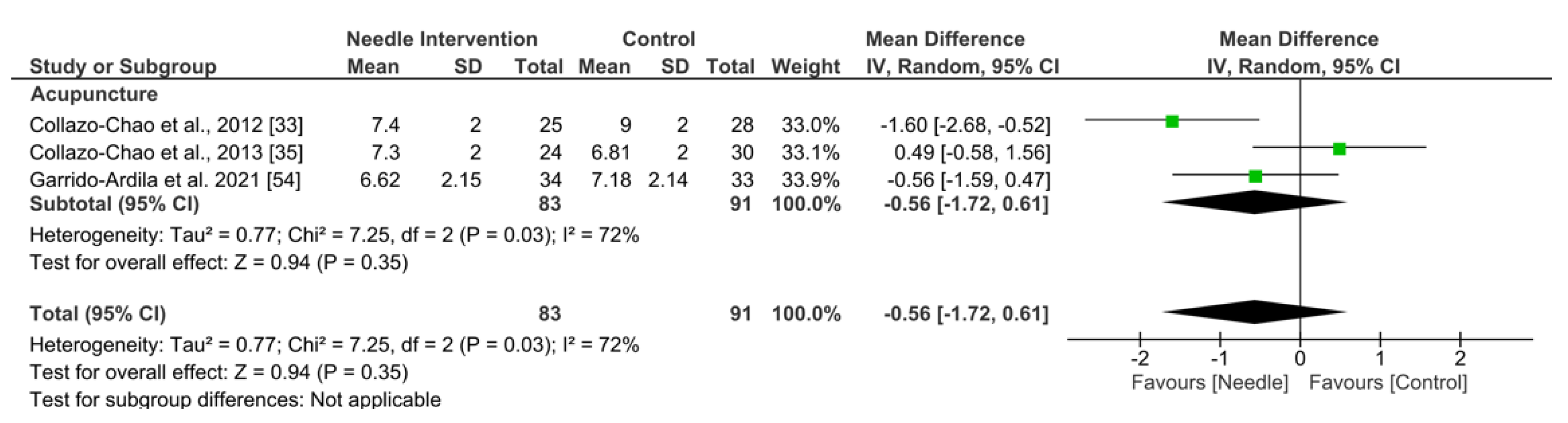
| Acupuncture (n = 3, N = 174) | No | Serious (I2 = 72%) | No | Serious | No | Moderate | MD: −0.56 [−1.72, 0.61] SMD: −0.26 [−0.82, 0.29] |
| Pain intensity (Long-term follow-up) | |||||||
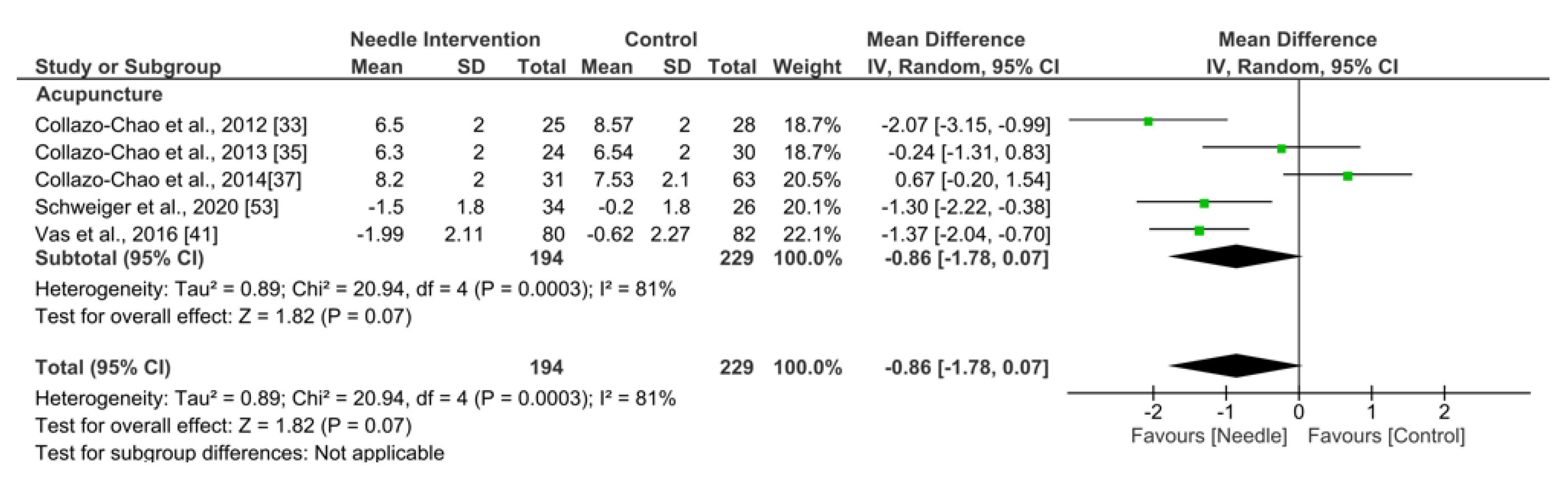
| Acupuncture (n = 5, N = 423) | No | Very Serious (I2 = 81%) | No | No | No | Low | MD: −0.86 [−1.78, 0.07] SMD: −0.42 [−0.88, 0.04] |
| Fibromyalgia Impact Questionnaire (Short-term follow-up) | |||||||
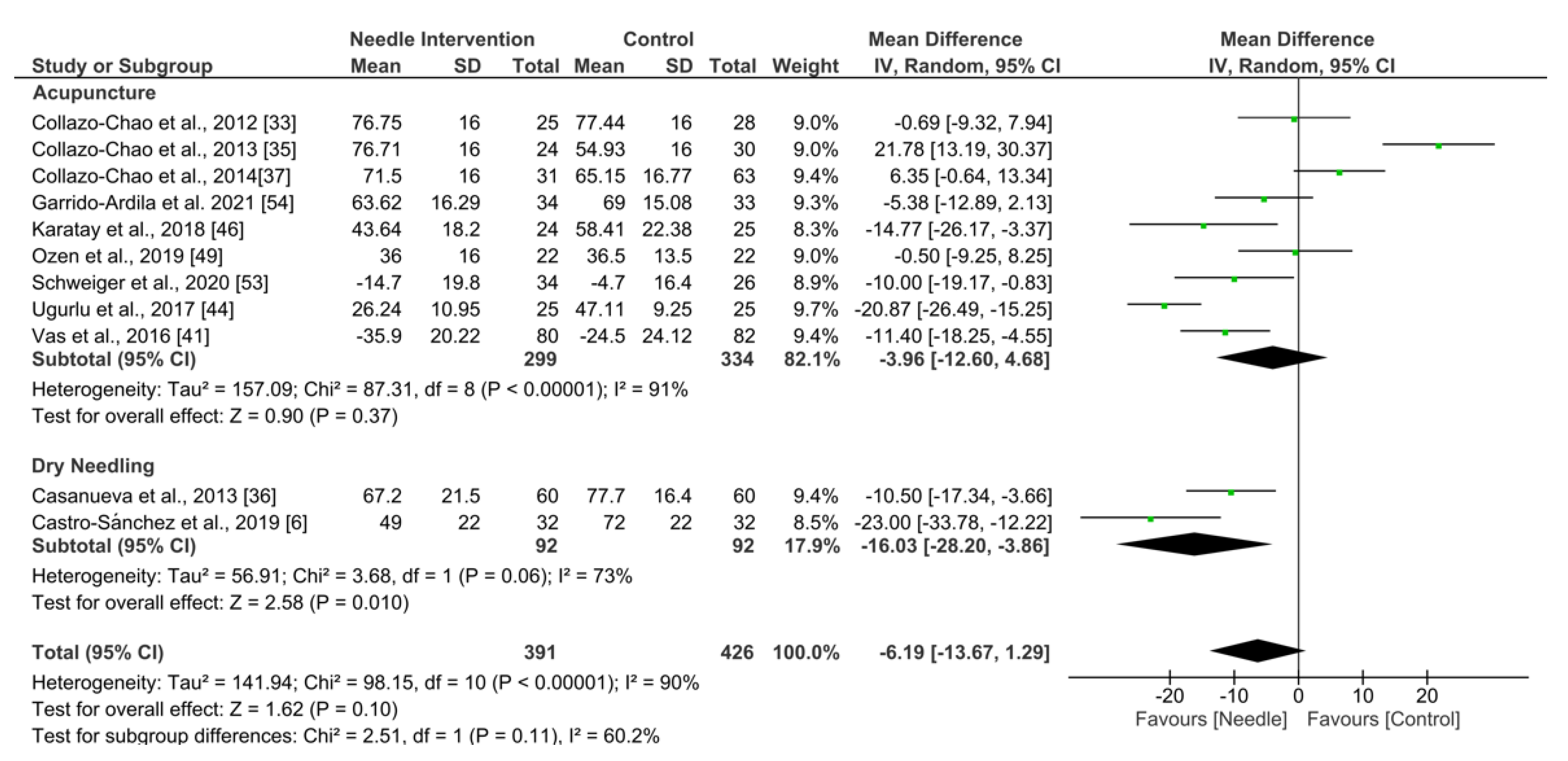
| Overall effect (n = 11, N = 817) | No | Very Serious (I2 = 90%) | No | No | No | Low | MD: −6.19 [−13.67, 1.29] SMD: −0.36 [−0.77, 0.05] |
| Acupuncture (n = 9, N = 633) | No | Very Serious (I2 = 91%) | No | No | No | Low | MD: −3.96 [−12.60, 4.68] SMD: −0.26 [−0.75, 0.22] |
| Dry Needling (n = 2, N = 184) | No | Serious (I2 = 73%) | No | Serious | No | Low | MD: −16.03 [−28.20, −3.86] * SMD: −0.75 [−1.22, −0.28] * |
| Fibromyalgia Impact Questionnaire (Mid-term follow-up) | |||||||
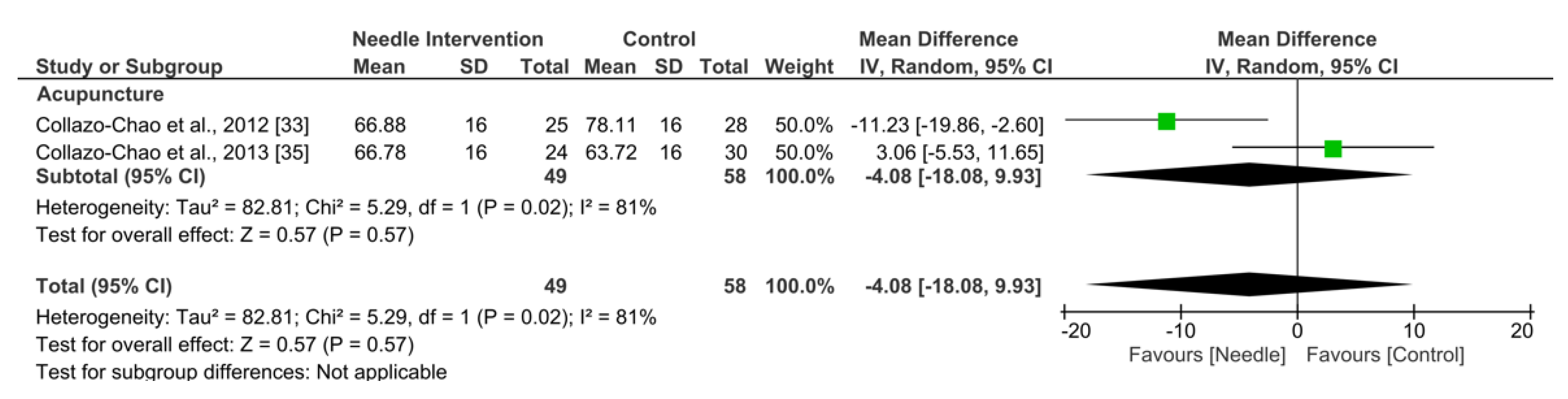
| Acupuncture (n = 2, N = 107) | No | Serious (I2 = 81%) | No | Serious | No | Low | MD: −4.08 [−18.08, 9.93] SMD: −0.25 [−1.11, 0.61] |
| Fibromyalgia Impact Questionnaire (Long-term follow-up) | |||||||
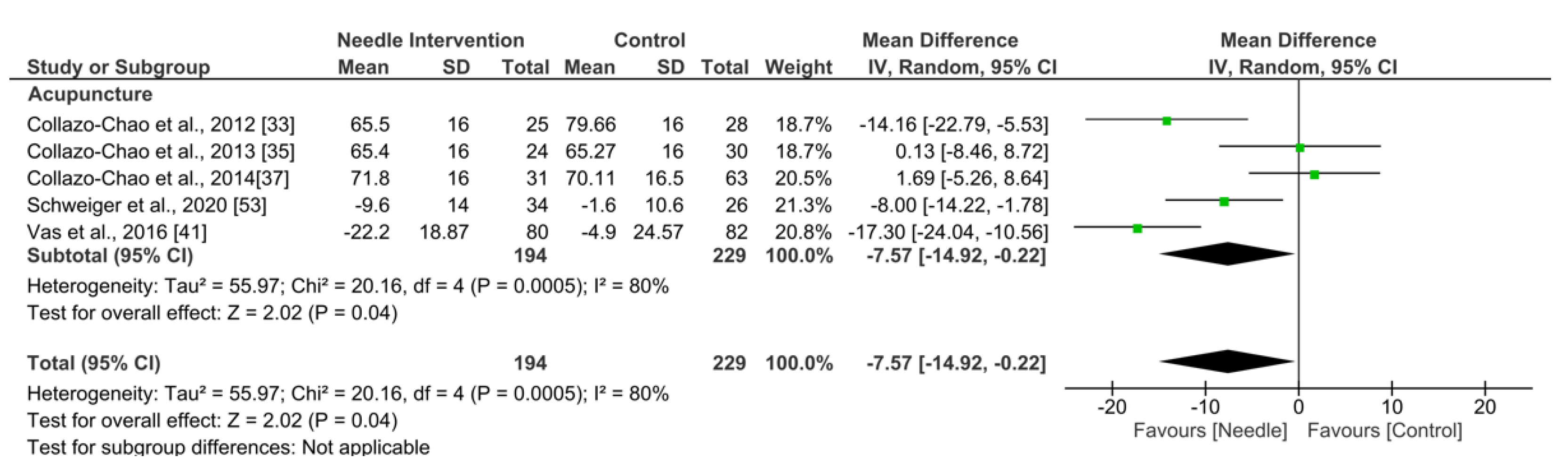
| Acupuncture (n = 5, N = 423) | No | Very Serious (I2 = 80%) | No | No | No | Low | MD: −7.57 [−14.92, −0.22] * SMD: −0.44 [−0.85, −0.02] * |
| Sleep (Short-term follow-up) | |||||||
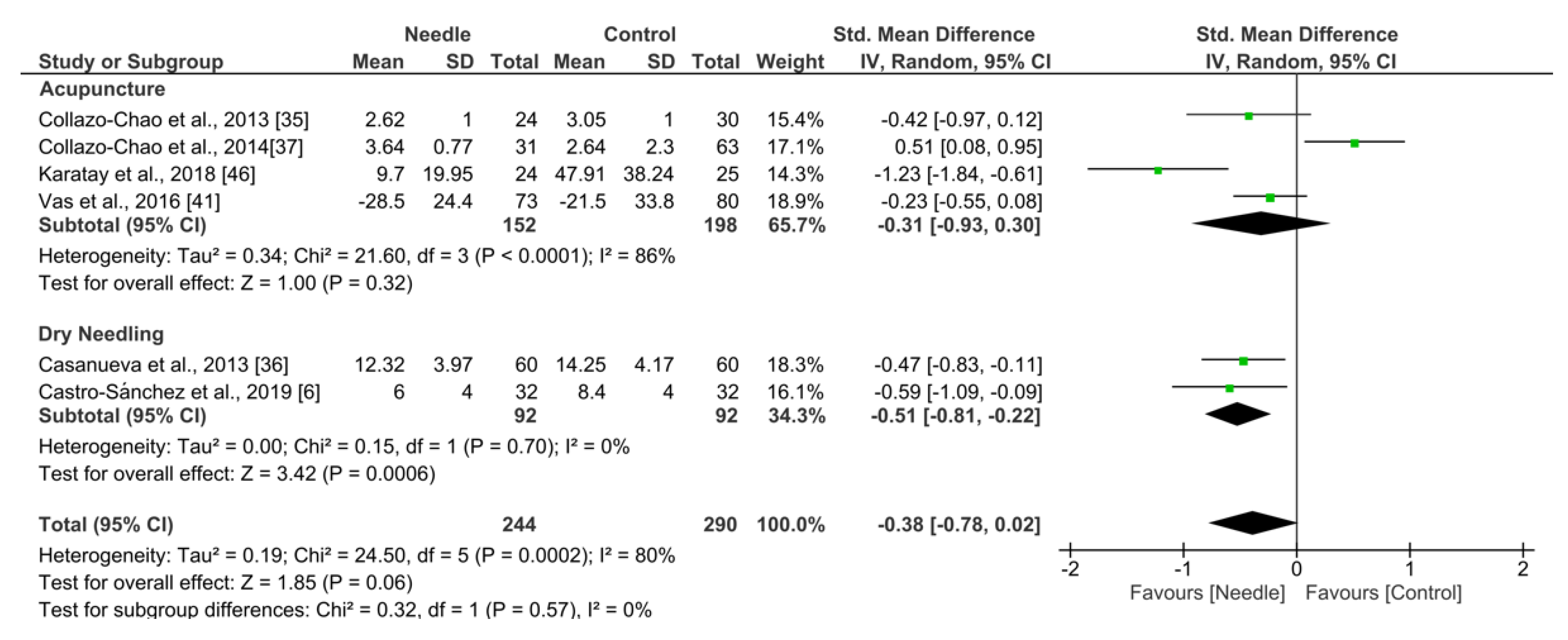
| Overall effect (n = 6, N = 534) | No | Very Serious (I2 = 80%) | No | No | No | Low | SMD: −0.38 [−0.78, 0.02] |
| Acupuncture (n = 4, N = 350) | No | Very Serious (I2 = 86%) | No | No | No | Low | SMD: −0.31 [−0.93, 0.30] |
| Dry Needling (n = 2, N = 184) | No | No (I2 = 0%) | No | Serious | No | Moderate | SMD: −0.51 [−0.81, −0.22] * |
| Sleep (Mid-term follow-up) | |||||||
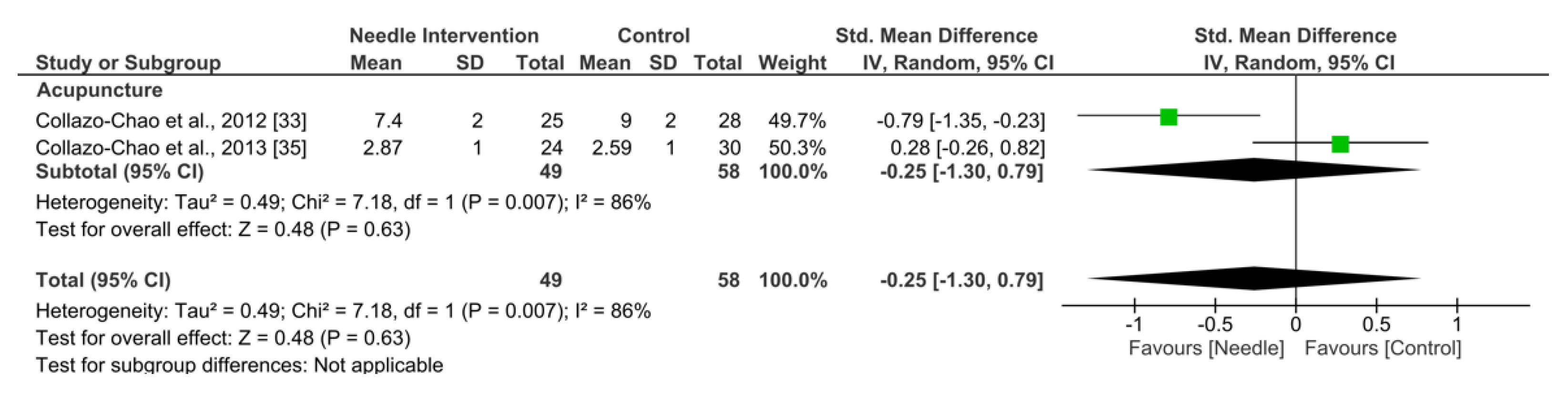
| Acupuncture (n = 2, N = 107) | No | Very Serious (I2 = 86%) | No | Very serious | No | Very Low | SMD: −0.25 [−1.30, 0.79] |
| Sleep (Long-term follow-up) | |||||||
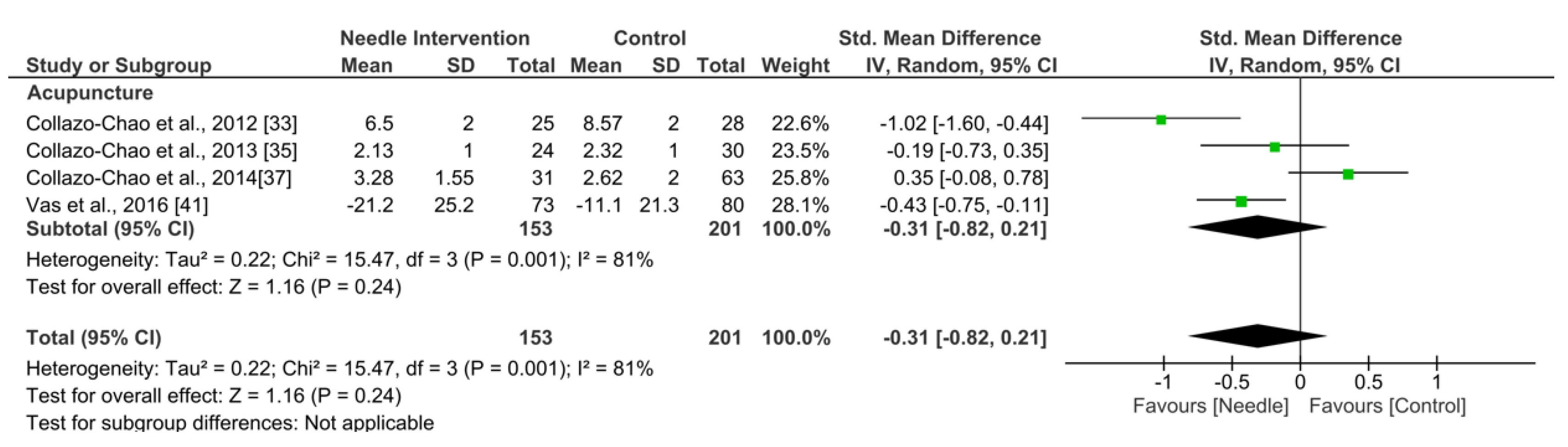
| Acupuncture (n = 2, N = 354) | No | Very Serious (I2 = 81%) | No | No | No | Low | SMD: −0.31 [−0.82, 0.21] |
| Depression (Short-term follow-up) | |||||||
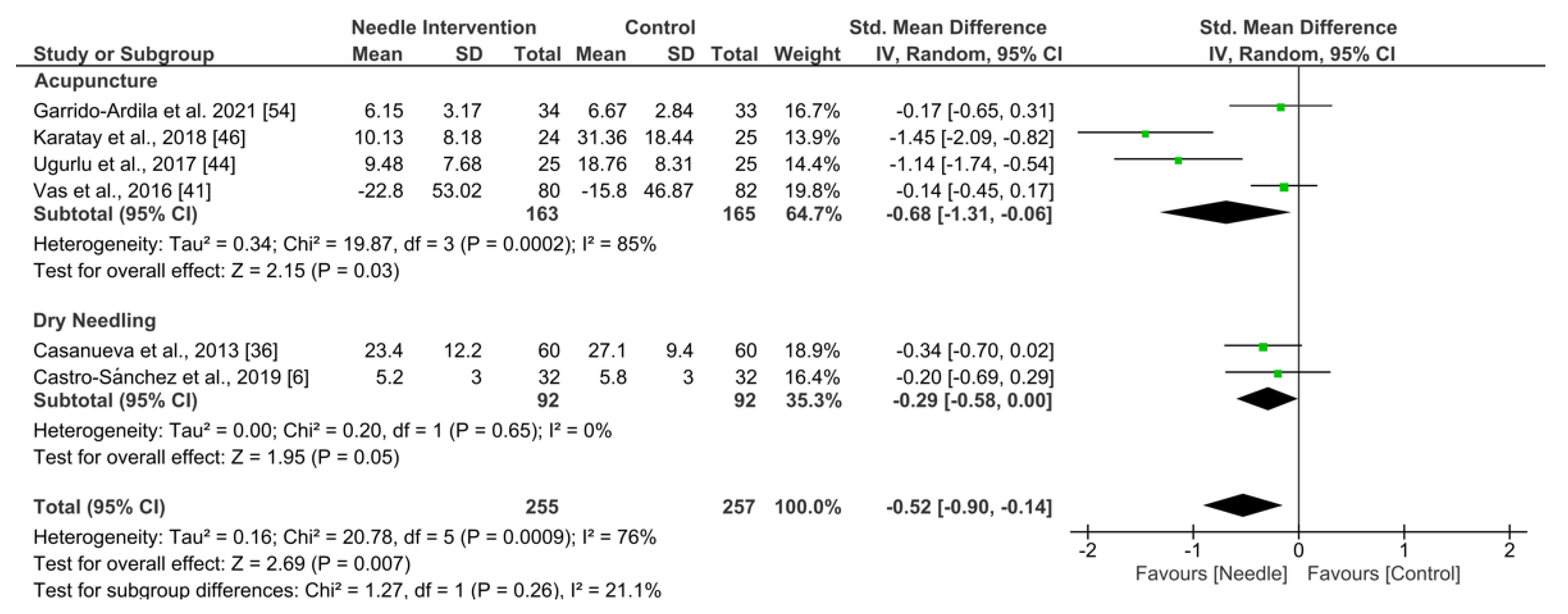
| Overall effect (n = 6, N = 512) | No | Serious (I2 = 76%) | No | No | No | Moderate | SMD: −0.52 [−0.90, 0.14] * |
| Acupuncture (n = 4, N = 328) | No | Very Serious (I2 = 85%) | No | No | No | Low | SMD: −0.68 [−1.31, −0.06] * |
| Dry Needling (n = 2, N = 184) | No | No (I2 = 0%) | No | Serious | No | Moderate | SMD: −0.29 [−0.58, 0.00] |
| Pressure pain threshold (Short-term follow-up) | |||||||
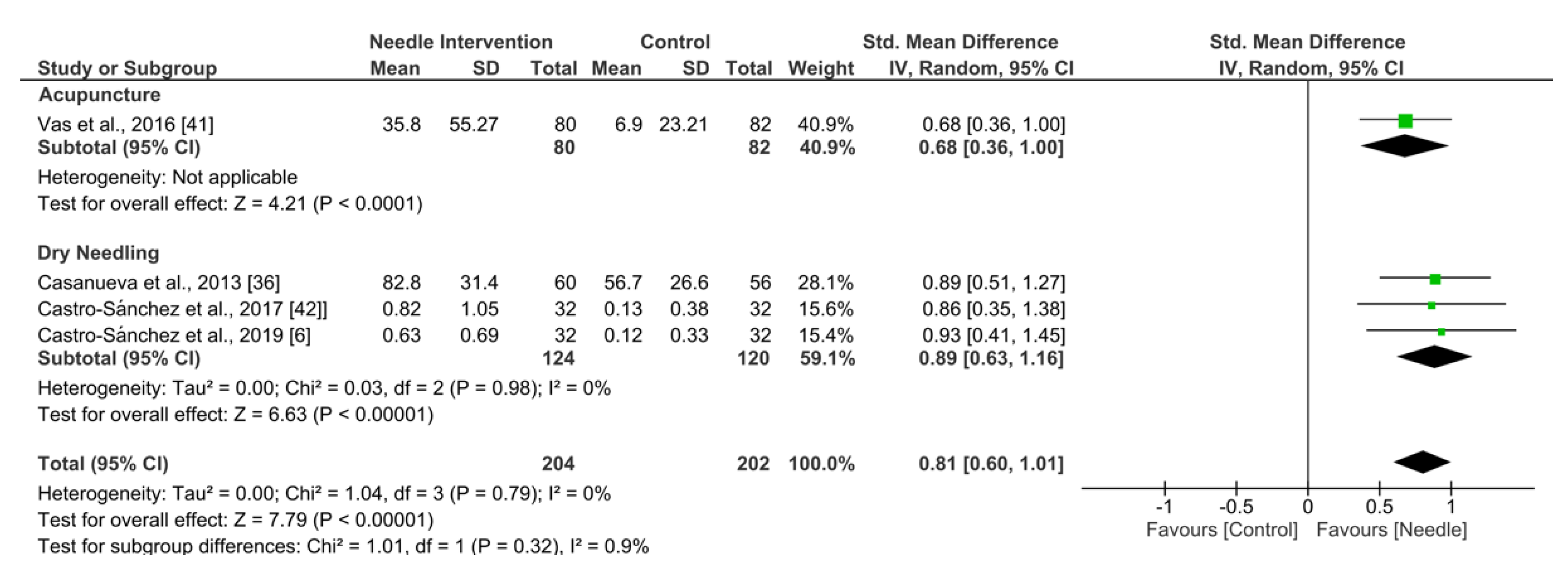
| Overall effect (n = 4, N = 406) | No | No (I2 = 0%) | No | No | No | High | SMD: 0.81 [0.60, 1.01] * |
| Acupuncture (n = 1, N = 162) | No | No | No | No | No | Very Low | SMD: 0.68 [0.36, 1.00] * |
| Dry Needling (n = 3, N = 244) | No | No (I2 = 0%) | No | Serious | No | Moderate | SMD: 0.89 [0.63, 1.16] * |
Publisher’s Note: MDPI stays neutral with regard to jurisdictional claims in published maps and institutional affiliations. |
© 2022 by the authors. Licensee MDPI, Basel, Switzerland. This article is an open access article distributed under the terms and conditions of the Creative Commons Attribution (CC BY) license (https://creativecommons.org/licenses/by/4.0/).
Share and Cite
Valera-Calero, J.A.; Fernández-de-las-Peñas, C.; Navarro-Santana, M.J.; Plaza-Manzano, G. Efficacy of Dry Needling and Acupuncture in Patients with Fibromyalgia: A Systematic Review and Meta-Analysis. Int. J. Environ. Res. Public Health 2022, 19, 9904. https://doi.org/10.3390/ijerph19169904
Valera-Calero JA, Fernández-de-las-Peñas C, Navarro-Santana MJ, Plaza-Manzano G. Efficacy of Dry Needling and Acupuncture in Patients with Fibromyalgia: A Systematic Review and Meta-Analysis. International Journal of Environmental Research and Public Health. 2022; 19(16):9904. https://doi.org/10.3390/ijerph19169904
Chicago/Turabian StyleValera-Calero, Juan Antonio, César Fernández-de-las-Peñas, Marcos José Navarro-Santana, and Gustavo Plaza-Manzano. 2022. "Efficacy of Dry Needling and Acupuncture in Patients with Fibromyalgia: A Systematic Review and Meta-Analysis" International Journal of Environmental Research and Public Health 19, no. 16: 9904. https://doi.org/10.3390/ijerph19169904
APA StyleValera-Calero, J. A., Fernández-de-las-Peñas, C., Navarro-Santana, M. J., & Plaza-Manzano, G. (2022). Efficacy of Dry Needling and Acupuncture in Patients with Fibromyalgia: A Systematic Review and Meta-Analysis. International Journal of Environmental Research and Public Health, 19(16), 9904. https://doi.org/10.3390/ijerph19169904