Elite Adolescent Ice Hockey Players: Analyzing Associations between Anthropometry, Fitness, and On-Ice Performance

Abstract
1. Introduction
Objectives of the Study
2. Materials and Methods
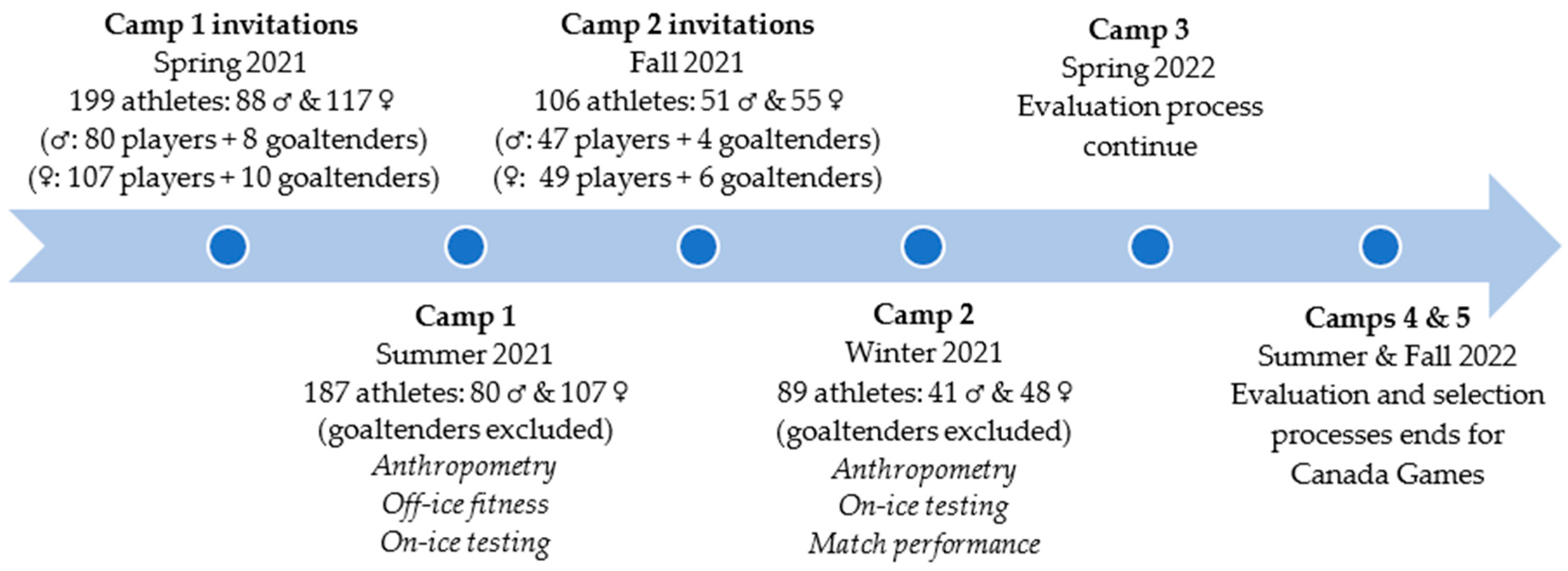
2.1. Participants—Procedures
2.1.1. Participants
2.1.2. Variables and Instruments—Camp 1
2.2. Measures—Camp 1
2.2.1. Anthropometric Measures and Off-Ice Fitness Protocols
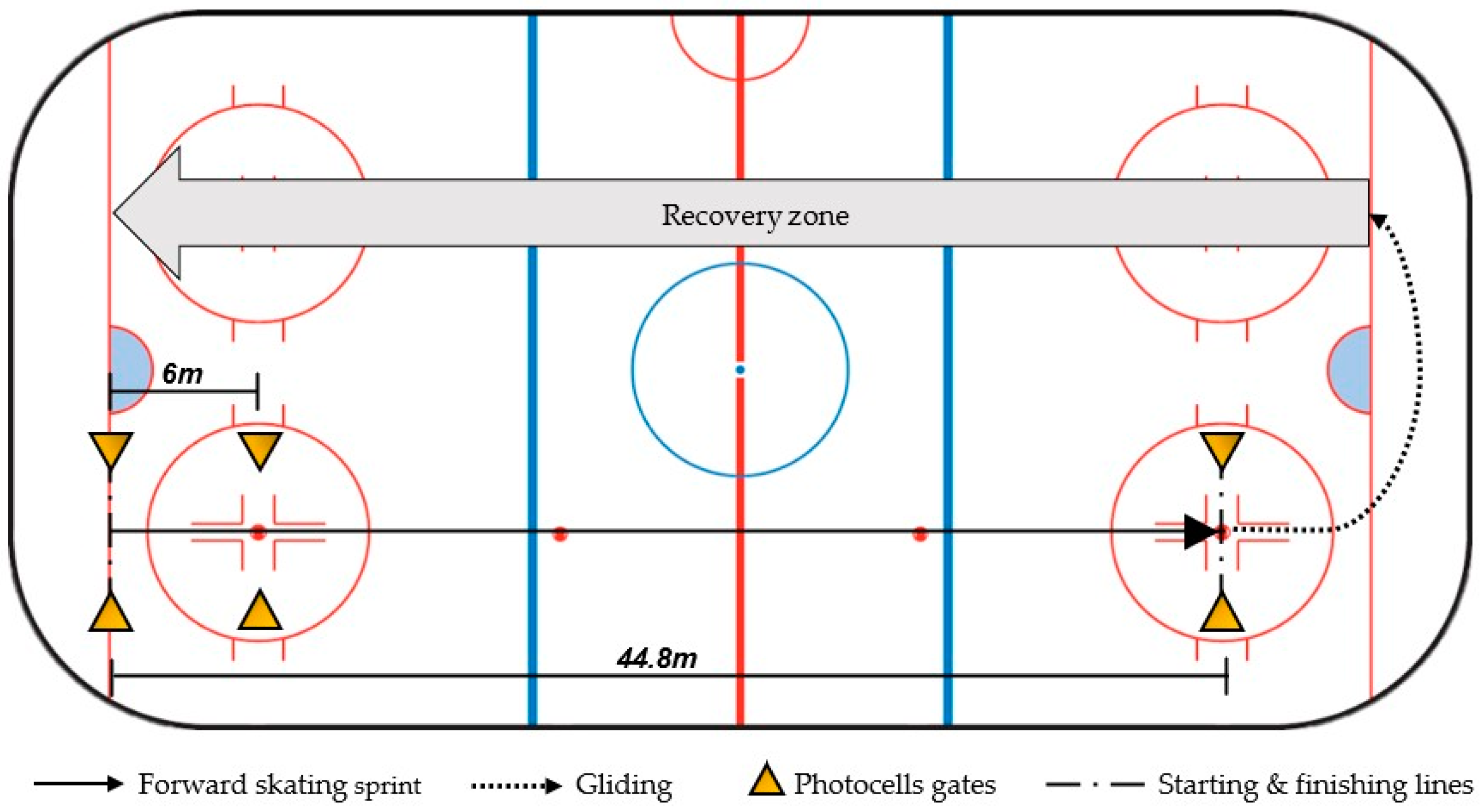
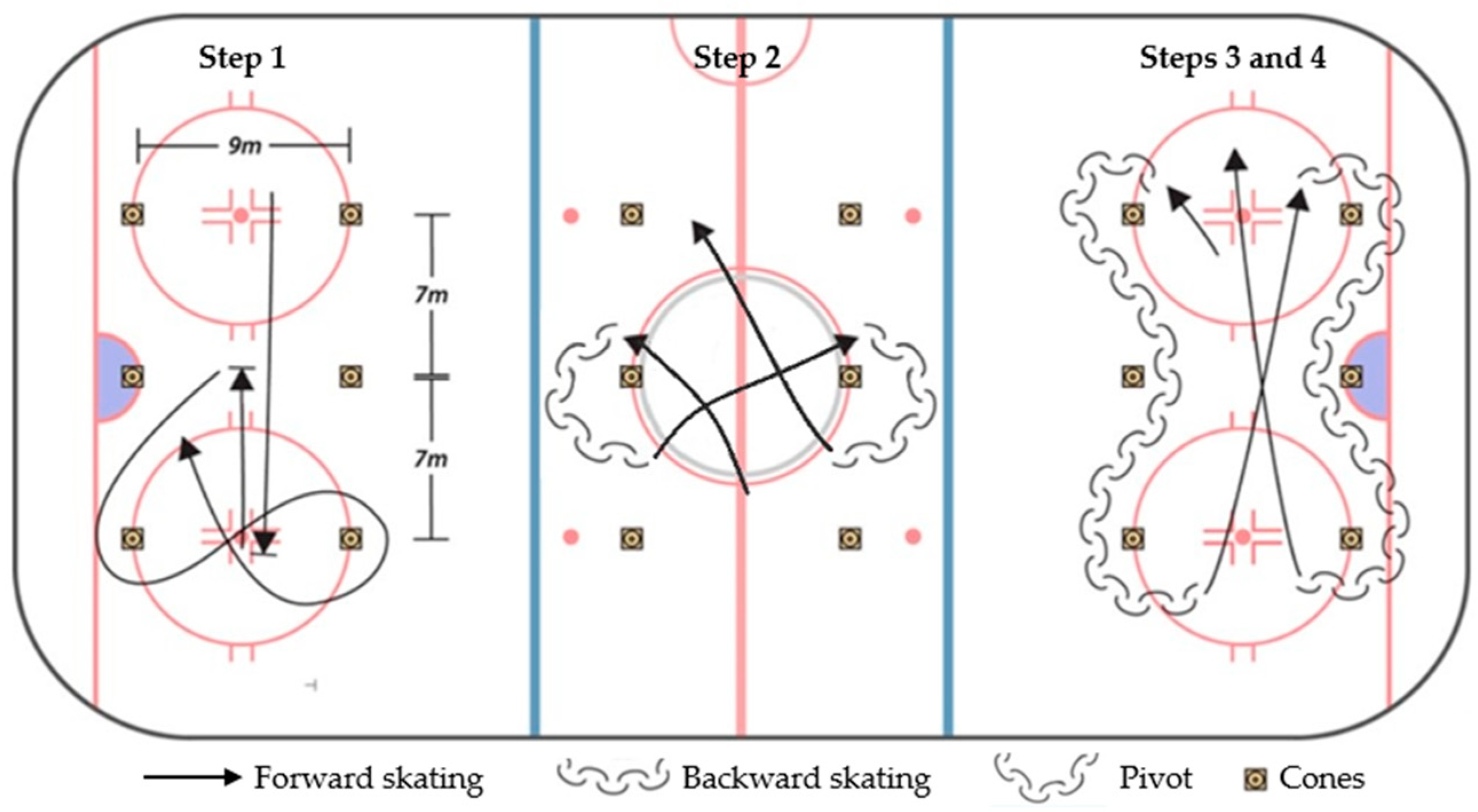
2.2.2. On-Ice Skating Abilities
2.3. Measures—Camp 2
2.3.1. Male Cohort: Anthropometry and Match Performance
2.3.2. Female On-Ice Skating Abilities and Match Performance
2.4. Statistical Analyses
3. Results
3.1. Descriptive Statistics
3.2. Camp 1
3.2.1. Anthropometry and Off-Ice Fitness
3.2.2. Anthropometry and On-Ice Fitness at Camp 1
3.3. Camp 2
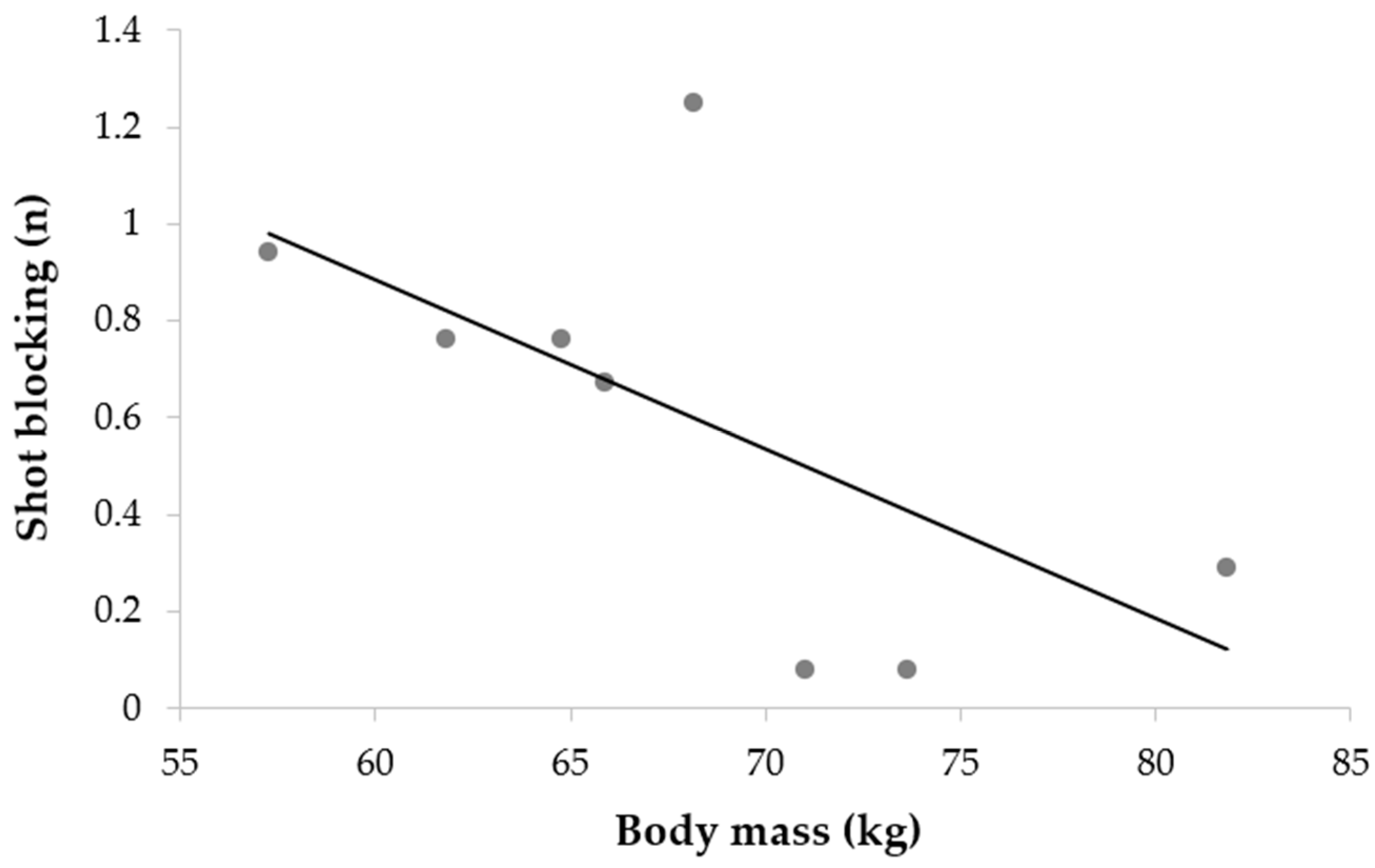
Male Cohort In-Depth Analysis: Anthropometry and Match Performance
3.4. Camp 2: Female Cohort
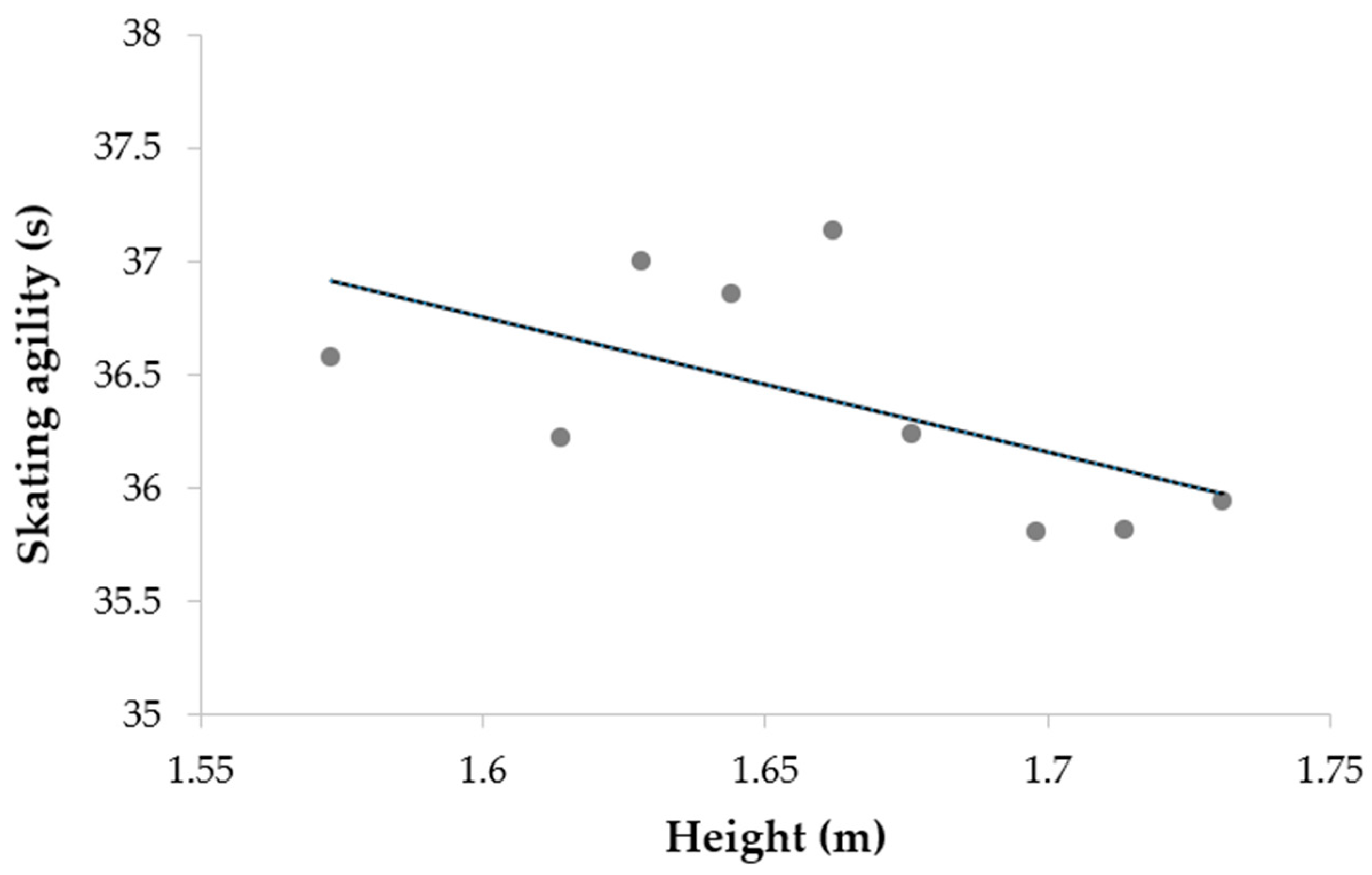
Female Cohort In-Depth Analysis: Anthropometry and Performance (Skating and Match Performance)
4. Discussion
Limitations and Future Perspectives
5. Conclusions
Author Contributions
Funding
Institutional Review Board Statement
Informed Consent Statement
Data Availability Statement
Acknowledgments
Conflicts of Interest
Appendix A

| Test | Measures (Units) (Instrumentation) | Protocol |
|---|---|---|
| Anthropometry Height | Body height (m) | Stand on the stadiometer platform with shoes off, with feet together, arms alongside the body. Then gaze outward; the measurement was taken following a maximum respiration rate to the nearest 0.5 cm. |
| Anthropometry Body Mass | Body mass (kg) | Instruction to step on the scale, with shorts, tee-shirt, and shoes off. Results are collected in kilograms, to the nearest 0.1 kg. |
| Standing broad jump | Length of jump (m) (Tape on floor) | Stand behind a marked line on the floor, with feet hip-width apart. Instruction to jump as far as possible, by quickly bending/extending legs and swinging arms back and forth, landing on both feet without falling. Foot that travelled the shortest distance is measured. The best of three attempts is selected. |
| Vertical jump | Height of jump (m) [Vertec] (Power Systems, Knoxville, TN, USA) | Stand under the testing device to measure maximum height with arms fully extended. Then, position self at an upper arm’s distance from the testing device and perform one pre-trial jump. Bend legs and pause for a second before jumping while reaching out as high as possible, by using arms. The best of three attempts is retained. |
| Counter movement jump | Flight time (s) Peak power (W) Relative peak power (W/kg) Concentric mean power (W) Eccentric impulse (ms) Concentric impulse (ms) (Dual Pasco 2-Axis Force Platform S-2142, 1000 Hz) (Roseville, CA, USA) | Stand immobile, feet on the device. Once body mass is recorded, athlete is advised to follow supervisor instructions before starting jumping. Athlete is instructed to start in standing position and must keep hands on hips during the whole assessment. They lower their center of mass by quickly bending their legs and hips, then braking suddenly (approximately at 90° knee flexion), produce force as quickly as possible to extend legs and jump vertically. No snap down (feet takeoff during lowering the position) is allowed. The best of two attempts is retained. |
| Grip strength | Sum of grip test (kg) (Jamar® hydraulic hand dynamometer) (Performance Health, Chicago, IL, USA) | Dynamometer is set to zero before each test and adjusted to athlete hand. Grab dynamometer in a neutral grip and keep it close to hips. Exhale heavily and compress it as hard as possible during three to five seconds. Then give back the device to the evaluator who records the result and resets it at 0 for the next test. Two attempts per hand are allowed, best result per side is retained. |
| Seated medicine ball-throw | Power (W) Relative power (W/kg) (Move Factor Ballistic Ball™) (Assess2Perform, Petoskey, MI, USA) | Sit on the floor with the back against the wall and feet hip-width apart. Ball is placed against the chest, and held at the sides and behind the center, with the forearms parallel to the floor. Throw the ball as hard as possible while keeping the back against the wall. The ball’s accelerometer records the throwing parameters. The best of the three attempts is selected. |
| Chin-ups | Maximum reps (n) (Bar for hanging) | Hang from the bar with hands shoulder-width apart with a supinated grip, arms fully extended. Pull-up by bending arms until the chin passes over the bar, then lower to the starting position. Leg swings are not allowed. Only reps performed with the correct technique are counted. |
| 30-m sprint | Time (s) (Swift Speedlight photocells) (Swift Performance, Northbrook, IL, USA) | Stand with feet behind the starting line. Initiate the sprint at any time after evaluator signal. Sprint as quickly as possible to the finish line. Should decelerate only after crossing the sprint distance to obtain the best possible time. Two attempts separated by a 3 min break; best time is retained. |
| 5-10-5 Pro agility | Time (s) (Swift Speedlight photocells) (Swift Performance, Northbrook, IL, USA) | Place feet on middle starting line. Begin by moving as quickly as possible to a line from the end past the photocells and touch the line with one hand, then move as quickly as possible to the line at the other end, touch the line with one hand before returning to the center. Best of two attempts is retained. |
| Léger 20 m Shuttle run | Maximum oxygen consumption (mL·kg−1·min−1) (Tool kit) | Repetition of 20 m shuttle runs to maximal fatigue. Must stand 1 m behind the line before the next beep before changing direction and continue to run, then must wait for the signal before starting. The speed increases with each level. Follow the rhythm of the soundtrack. One trial is recorded. |
References
- Upjohn, T.; Turcotte, R.; Pearsall, D.J.; Loh, J. Three-dimensional kinematics of the lower limbs during forward ice hockey skating. Sports Biomech. 2008, 7, 206–221. [Google Scholar] [CrossRef] [PubMed]
- Vigh-Larsen, J.F.; Ermidis, G.; Rago, V.; Randers, M.B.; Fransson, D.; Nielsen, J.L.; Gliemann, L.; Piil, J.F.; Morris, N.B.; de Paoli, F.V.; et al. Muscle Metabolism and Fatigue during Simulated Ice Hockey Match-Play in Elite Players. Med. Sci. Sports Exerc. 2020, 52, 2162–2171. [Google Scholar] [CrossRef] [PubMed]
- International Ice Hockey Federation. Survey of Players. Available online: https://www.iihf.com/en/static/5324/survey-of-players (accessed on 14 May 2022).
- PubMed. Ice Hockey Research Publications. Available online: https://pubmed.ncbi.nlm.nih.gov/?term=ice+hockey (accessed on 14 May 2022).
- Brocherie, F.; Girard, O.; Millet, G.P. Updated analysis of changes in locomotor activities across periods in an international ice hockey game. Biol. Sport 2018, 35, 261–267. [Google Scholar] [CrossRef]
- Montgomery, D.L. Physiological profile of professional hockey players—A longitudinal comparison. Appl. Physiol. Nutr. Metab. 2006, 31, 181–185. [Google Scholar] [CrossRef]
- Delisle-Houde, P.; Chiarlitti, N.A.; Reid, R.E.; Andersen, R.E. Relationship Between Physiologic Tests, Body Composition Changes, and On-Ice Playing Time in Canadian Collegiate Hockey Players. J. Strength Cond. Res. 2018, 32, 1297–1302. [Google Scholar] [CrossRef]
- Stanula, A.; Roczniok, R. Game intensity analysis of elite adolescent ice hockey players. J. Hum. Kinet. 2014, 44, 211–221. [Google Scholar] [CrossRef]
- Leiter, J.R.; Cordingley, D.M.; Zeglen, A.J.; Carnegie, G.D.; MacDonald, P.B. The Size and Strength Development in Elite Youth Ice Hockey Players. Int. J. Kinesiol. Sports Sci. 2016, 4, 54–62. [Google Scholar] [CrossRef]
- Neeld, K. Preparing for the Demands of Professional Hockey. Strength Cond. J. 2018, 40, 1–16. [Google Scholar] [CrossRef]
- Balyi, I. Long-Term Planning of Athlete Development, Multiple Periodisation, Modeling and Normative Data; The UK’s Quarterly Coaching Magazine: Leeds, UK, 1999; Volume 4, pp. 7–9. [Google Scholar]
- Roczniok, R.; Maszczyk, A.; Stanula, A.; Czuba, M.; Pietraszewski, P.; Kantyka, J.; Starzyński, M. Physiological and physical profiles and on-ice performance approach to predict talent in male youth ice hockey players during draft to hockey team. Isokinet. Exerc. Sci. 2013, 21, 121–127. [Google Scholar] [CrossRef]
- Huard Pelletier, V.; Glaude-Roy, J.; Daigle, A.-P.; Brunelle, J.-F.; Bissonnette, A.; Lemoyne, J. Associations between Testing and Game Performance in Ice Hockey: A Scoping Review. Sports 2021, 9, 117. [Google Scholar] [CrossRef]
- Lemoyne, J.; Brunelle, J.-F.; Pelletier, V.H.; Glaude-Roy, J.; Martini, G. Talent Identification in Elite Adolescent Ice Hockey Players: The Discriminant Capacity of Fitness Tests, Skating Performance and Psychological Characteristics. Sports 2022, 10, 58. [Google Scholar] [CrossRef] [PubMed]
- Dahlstrom, V.A. Comparison of Four Methods of Body Composition Analysis of Female Hockey Players Ages 13–19; University of Minnesota: Ann Arbor, MI, USA, 2003; p. 125. [Google Scholar]
- Chiarlitti, N.A.; Delisle-Houde, P.; Reid, R.E.; Kennedy, C.; Andersen, R.E. Importance of Body Composition in the National Hockey League Combine Physiological Assessments. J. Strength Cond. Res. 2018, 32, 3135–3142. [Google Scholar] [CrossRef] [PubMed]
- Perez, J.; Guilhem, G.; Brocherie, F. Reliability of the force-velocity-power variables during ice hockey sprint acceleration. Sports Biomech. 2022, 21, 56–70. [Google Scholar] [CrossRef] [PubMed]
- Donskov, A.S.; Brooks, J.S.; Dickey, J.P. Reliability of the Single-Leg, Medial Countermovement Jump in Youth Ice Hockey Players. Sports 2021, 9, 64. [Google Scholar] [CrossRef]
- Perez, J.; Guilhem, G.; Brocherie, F. Ice Hockey Forward Skating Force-Velocity Profiling Using Single Unloaded vs. Multiple Loaded Methods. J. Strength Cond. Res. 2021; Epub ahead of print. [Google Scholar] [CrossRef]
- Lagrange, S.; Ferland, P.-M.; Leone, M.; Comtois, A.S. Contrast Training Generates Post-Activation Potentiation and Improves Repeated Sprint Ability in Elite Ice Hockey Players. Int. J. Exerc. Sci. 2020, 13, 183–196. [Google Scholar]
- Woods, C.T.E.; Raynor, A.J.; Bruce, L.; McDonald, Z.; Collier, N. Predicting playing status in junior Australian Football using physical and anthropometric parameters. J. Sci. Med. Sport 2015, 18, 225–229. [Google Scholar] [CrossRef]
- Watts, A.S.; Coleman, I.; Nevill, A. The changing shape characteristics associated with success in world-class sprinters. J. Sports Sci. 2012, 30, 1085–1095. [Google Scholar] [CrossRef]
- Bernal-Orozco, M.F.; Posada-Falomir, M.; Quiñónez-Gastélum, C.M.; Plascencia-Aguilera, L.P.; Arana-Nuño, J.R.; Badillo-Camacho, N.; Márquez-Sandoval, F.; Holway, F.E.; Vizmanos-Lamotte, B. Anthropometric and Body Composition Profile of Young Professional Soccer Players. J. Strength Cond. Res. 2020, 34, 1911–1923. [Google Scholar] [CrossRef]
- Sánchez Muñoz, C.; Muros, J.J.; Lopez Belmonte, Ó.; Zabala, M. Anthropometric Characteristics, Body Composition and Somatotype of Elite Male Young Runners. Int. J. Environ. Res. Public Health 2020, 17, 674. [Google Scholar] [CrossRef]
- Leuciuc, F.V.; Muros, J.J.; Lopez Belmonte, Ó.; Zabala, M. Toward an Anthropometric Pattern in Elite Male Handball. Int. J. Environ. Res. Public Health 2022, 19, 2839. [Google Scholar] [CrossRef] [PubMed]
- Pearce, L.A.; Sinclair, W.H.; Leicht, A.S.; Woods, C.T. Physical, Anthropometric, and Athletic Movement Qualities Discriminate Development Level in a Rugby League Talent Pathway. J. Strength Cond. Res. 2018, 32, 3169–3176. [Google Scholar] [CrossRef] [PubMed]
- Arede, J.; Freitas, T.T.; Johnson, D.; Fernandes, J.F.T.; Williams, S.; Moran, J.; Leite, N. Training Load, Maturity Timing and Future National Team Selection in National Youth Basketball Players. J. Funct. Morphol. Kinesiol. 2022, 7, 21. [Google Scholar] [CrossRef] [PubMed]
- Ransdell, L.B.; Murray, T. A physical profile of elite female ice hockey players from the USA. J. Strength Cond. Res. 2011, 25, 2358–2363. [Google Scholar] [CrossRef] [PubMed]
- Boland, M.; Delude, K.; Miele, E.M. Relationship Between Physiological Off-Ice Testing, On-Ice Skating, and Game Performance in Division I Female Ice Hockey Players. J. Strength Cond. Res. 2019, 33, 1619–1628. [Google Scholar] [CrossRef]
- Allisse, M.; Sercia, P.; Comtois, A.-S.; Leone, M. Morphological, Physiological and Skating Performance Profiles of Male Age-Group Elite Ice Hockey Players. J. Hum. Kinet. 2017, 58, 87–97. [Google Scholar] [CrossRef]
- Vescovi, J.D.; Murray, T.M.; Fiala, K.A.; VanHeest, J.L. Off-ice performance and draft status of elite ice hockey players. Int. J. Sports Physiol. Perform. 2006, 1, 207–221. [Google Scholar] [CrossRef]
- Prokop, N.W.; Reid, R.E.; Andersen, R.E. Seasonal Changes in Whole Body and Regional Body Composition Profiles of Elite Collegiate Ice-Hockey Players. J. Strength Cond. Res. 2016, 30, 684–692. [Google Scholar] [CrossRef]
- Stanzione, J.R.; Dardarian, N.; Volpe, S.L. Body Composition Changes after One Year in Professional Male Ice Hockey Players. Int. J. Sports Med. 2020, 41, 1056–1060. [Google Scholar] [CrossRef]
- Czeck, M.A.; Roelofs, E.J.; Dietz, C.; Bosch, T.A.; Dengel, D.R. Body Composition and On-Ice Skate Times for National Collegiate Athletic Association Division I Collegiate Male and Female Ice Hockey Athletes. J. Strength Cond. Res. 2022, 36, 187–192. [Google Scholar] [CrossRef]
- Burr, J.F.; Jamnik, R.K.; Baker, J.; Macpherson, A.; Gledhill, N.; McGuire, E.J. Relationship of physical fitness test results and hockey playing potential in elite-level ice hockey players. J. Strength Cond. Res. 2008, 22, 1535–1543. [Google Scholar] [CrossRef] [PubMed]
- Quinney, H.A.; Dewart, R.; Game, A.; Snydmiller, G.; Warburton, D.; Bell, G. A 26 year physiological description of a National Hockey League team. Appl Physiol. Nutr. Metab. 2008, 33, 753–760. [Google Scholar] [CrossRef] [PubMed]
- Triplett, A.N.; Ebbing, A.C.; Green, M.R.; Connolly, C.P.; Carrier, D.P.; Pivarnik, J.M. Changes in collegiate ice hockey player anthropometrics and aerobic fitness over 3 decades. Appl. Physiol. Nutr. Metab. 2018, 43, 950–955. [Google Scholar] [CrossRef] [PubMed]
- Ransdell, L.B.; Murray, T.M.; Gao, Y. Off-ice fitness of elite female ice hockey players by team success, age, and player position. J. Strength Cond. Res. 2013, 27, 875–884. [Google Scholar] [CrossRef] [PubMed]
- Cordingley, D.M.; Sirant, L.; MacDonald, P.B.; Leiter, J.R. Three-Year Longitudinal Fitness Tracking in Top-Level Competitive Youth Ice Hockey Players. J. Strength Cond. Res. 2019, 33, 2909–2912. [Google Scholar] [CrossRef]
- Vigh-Larsen, J.F.; Beck, J.H.; Daasbjerg, A.; Knudsen, C.B.; Kvorning, T.; Overgaard, K.; Andersen, T.B.; Mohr, M. Fitness Characteristics of Elite and Subelite Male Ice Hockey Players: A Cross-Sectional Study. J. Strength Cond. Res. 2019, 33, 2352–2360. [Google Scholar] [CrossRef]
- Martini, G.; Brunelle, J.F.; Trudeau, F.; Lemoyne, J. Measuring ice hockey skills in a repeated measures testing context: The effects of fatigue on skating efficiency, passing, agility, and shooting. Sport J. 2018, 21, 1–16. [Google Scholar]
- Douglas, A.S.; Kennedy, C.R. Tracking In-Match Movement Demands Using Local Positioning System in World-Class Men’s Ice Hockey. J. Strength Cond. Res. 2020, 34, 639–646. [Google Scholar] [CrossRef]
- Delisle-Houde, P.; Reid, R.E.; Insogna, J.A.; Chiarlitti, N.A.; Andersen, R.E. Seasonal Changes in Physiological Responses and Body Composition During a Competitive Season in Male and Female Elite Collegiate Ice Hockey Players. J. Strength Cond. Res. 2019, 33, 2162–2169. [Google Scholar] [CrossRef]
- Gledhill, N.; Jamnik, V. Detailed Fitness and Medical Assessment Protocols for NHL Entry Draft Players; York University: Toronto, ON, Canada, 2007. [Google Scholar]
- Nightingale, S.C.; Miller, S.; Turner, A. The usefulness and reliability of fitness testing protocols for ice hockey players: A literature review. J. Strength Cond. Res. 2013, 27, 1742–1748. [Google Scholar] [CrossRef]
- Joseph, J.; McIntyre, F.; Joyce, C.; Scanlan, A.; Cripps, A. A comparison of multidimensional qualities discriminant of selection in elite adolescent Australian basketball athletes. PLoS ONE 2021, 16, e0256032. [Google Scholar] [CrossRef] [PubMed]
- Robertson, S.; Woods, C.; Gastin, P. Predicting higher selection in elite junior Australian Rules football: The influence of physical performance and anthropometric attributes. J. Sci. Med. Sport 2014, 18, 601–606. [Google Scholar] [CrossRef] [PubMed]
- Wiseman, A.C.; Bracken, N.; Horton, S.; Weir, P.L. The Difficulty of Talent Identification: Inconsistency among Coaches through Skill-Based Assessment of Youth Hockey Players. Int. J. Sports Sci. Coach. 2014, 9, 447–455. [Google Scholar] [CrossRef]
- Vigh-Larsen, J.F.; Haverinen, M.T.; Panduro, J.; Ermidis, G.; Andersen, T.B.; Overgaard, K.; Krustrup, P.; Parkkari, J.; Avela, J.; Kyröläinen, H.; et al. On-Ice and Off-Ice Fitness Profiles of Elite and U20 Male Ice Hockey Players of Two Different National Standards. J. Strength Cond. Res. 2020, 34, 3369–3376. [Google Scholar] [CrossRef]
- Gilenstam, K.M.; Thorsen, K.; Henriksson-Larsen, K.B. Physiological correlates of skating performance in women’s and men’s ice hockey. J. Strength Cond. Res. 2011, 25, 2133–2142. [Google Scholar] [CrossRef]
- Bezák, J. Upper body strength and power are associated with shot speed in men’s ice hockey. Acta Gymnica 2017, 47, 78–83. [Google Scholar] [CrossRef]
- Beckham, G.; Lish, S.; Disney, C.; Keebler, L.; DeBeliso, M.; Adams, K.J. The Reliability of the Seated Medicine Ball Throw as Assessed with Accelerometer Instrumentation. J. Phys. Act. Res. 2019, 4, 108–113. [Google Scholar] [CrossRef]
- Leger, L.A.; Mercier, D.; Gadoury, C.; Lambert, J. The multistage 20 metre shuttle run test for aerobic fitness. J. Sports Sci. 1988, 6, 93–101. [Google Scholar] [CrossRef]
- Stewart, P.F.; Turner, A.N.; Miller, S.C. Reliability, factorial validity, and interrelationships of five commonly used change of direction speed tests. Scand. J. Med. Sci. Sports 2014, 24, 500–506. [Google Scholar] [CrossRef]
- International Ice Hockey Centre of Excellence. Skating Agility Test (From Finnish Ice Hockey Federation). Available online: https://iihce.fi/suomeksi/Testaaminen/Pohjola-leiritestit/tabid/1150/Default.aspx#/material/872/2401 (accessed on 25 May 2022).
- InstatScoutHockey. Available online: https://instatsport.com/hockey/instat_scout (accessed on 25 May 2022).
- Tabachnick, B.G.; Fidell, L.S. Using Multivariate Statistics: International Edition; Pearson, U., Ed.; Pearson: London, UK, 2013. [Google Scholar]
- Stanula, A.J.; Roczniok, R.K.; Gabrys, T.; Szmatlan-Gabrys, U.B.; Ozimek, M.J. Relationships of Physical Fitness Test Results and Player Performance Indicators in National-Level Ice Hockey Players. In Society. Integration. Education, Proceedings of the International Scientific Conference, Rezekne, Latvia, 25–26 May 2018; Rezekne Academy of Technologies: Rēzekne, Latvia, 2016; Volume 4, pp. 264–273. [Google Scholar] [CrossRef]
- Lemoyne, J.; Pelletier, V.H.; Trudeau, F.; Grondin, S. Relative Age Effect in Canadian Hockey: Prevalence, Perceived Competence and Performance. Front. Sports Act. Living 2021, 3, 622590. [Google Scholar] [CrossRef]

| Performance Marker | Definition |
|---|---|
| Hits against | Situations in which a player is hit by an opponent. |
| Hits | Situations in which a player hits an opponent (shoulder check). |
| Expected goals with player on (xG-on) | Probability of scoring goals when the player is on the ice. Reflects the potential offensive contribution of a player. |
| Corsi % | Amount of shot attempts related to opponents’ shot attempts (player’s shot attempts + opponent’s shot attempts). Higher % means that player contributes to their team’s puck possession. |
| Opponent expected goals (D-xG) | Probability of seeing an opponent score when the player is playing in the defensive zone. Higher scores mean that a player is not contributing to their team’s success. |
| Shot blocking | Sum of situations in which a player blocks the opponent’s shot to the net. |
| Variables | Male Cohort | Female Cohort | ||
|---|---|---|---|---|
| Camp 1 (n = 80) | Camp 2 (n = 41) | Camp 1 (n = 107) | Camp 2 (n = 48) | |
| Age | 13.81 ± 0.40 | 14.21 ± 0.41 | 14.96 ± 0.92 | 15.69 ± 0.87 |
| Anthropometry | ||||
| Body Height (m) | 1.72 ± 0.076 | 1.76 ± 0.068 ** | 1.65 ± 0.058 | 1.66 ± 0.049 ** |
| Body Mass (kg) | 64.62 ± 9.30 | 68.24 ± 8.82 ** | 62.75 ± 8.79 | 63.77 ± 7.38 |
| Off-ice fitness | ||||
| Broad jump (m) | 2.26 ± 0.014 | n/a | 1.95 ± 0.015 | n/a |
| Vertical jump (m) | 0.48 ± 0.066 | n/a | 0.44 ± 0.061 | n/a |
| Flight time (s) | 0.31 ± 0.04 | n/a | 0.24 ± 0.04 | n/a |
| Absolute maximal power (W) | 3059.19 ± 546.73 | n/a | 2483.95 ± 353.05 | n/a |
| Relative maximal power (W/kg) | 47.13 ± 4.75 | n/a | 39.80 ± 4.58 | n/a |
| Concentric mean power (W) | 1587.51 ± 323.34 | n/a | 1287.16 ± 193.70 | n/a |
| Eccentric impulse (ms) | 75.48 ± 16.82 | n/a | 68.50 ± 12.73 | n/a |
| Concentric impulse (ms) | 164.51 ± 26.57 | n/a | 141.75 ± 20.66 | n/a |
| Grip strength (kg) | 95.83 ± 16.79 | n/a | 72.56 ± 13.40 | n/a |
| Chin-ups (n) | 8.93 ± 3.71 | n/a | 3.07 ± 2.95 | n/a |
| Medicine ball throw (W) | 169.64 ± 26.08 | n/a | 134.80 ± 18.39 | n/a |
| MB throw relative power (W/kg) | 8.01 ± 1.86 | n/a | 6.10 ± 1.11 | n/a |
| 30 m sprint (s) | 4.78 ± 0.20 | n/a | 5.05 ± 0.23 | n/a |
| 5-10-5 Pro agility (s) | 5.31 ± 0.19 | n/a | 5.65 ± 0.26 | n/a |
| VO2max (mL/min/kg) | 49.72 ± 4.86 | n/a | 44.28 ± 5.49 | n/a |
| On-ice skating | ||||
| 0–6 m acceleration (s) | 1.31 ± 0.07 | n/a | 1.44 ± 0.08 | 1.36 ± 0.06 |
| 44.8 m forward skating sprint (s) | 6.27 ± 0.23 | n/a | 6.85 ± 0.23 | 6.44 ± 0.20 |
| Skating agility (s) | 35.42 ± 1.29 | n/a | 38.63 ± 1.91 | 36.40 ± 0.94 |
| 0–6 m backward acceleration (s) | n/a | n/a | n/a | 1.62 ± 0.09 |
| 44.8 m backward skating sprint (s) | n/a | n/a | n/a | 7.81 ± 0.36 |
| Match performance indicators (per game) | ||||
| Hits (nb) | n/a | 0.24 ± 0.31 | n/a | n/a |
| Hits against (nb) | n/a | 0.47 ± 046 | n/a | n/a |
| xG with player | n/a | 0.49 ± 0.44 | n/a | n/a |
| Corsi for % | n/a | 0.51 ± 0.08 | n/a | n/a |
| Opponent xG | n/a | 0.28 ± 0.24 | n/a | n/a |
| Shot blocking | n/a | 0.56 ± 0.67 | n/a | n/a |
| Physical implication | n/a | n/a | n/a | 0.76 ± 0.88 |
| Puck recoveries | n/a | n/a | n/a | 1.35 ± 1.17 |
| Offensive actions | n/a | n/a | n/a | 5.89 ± 2.99 |
| Shot attempts | n/a | n/a | n/a | 4.62 ± 2.48 |
| Males (n = 80) | Females (n = 107) | |||
|---|---|---|---|---|
| Test | Height | Body Mass | Height | Body Mass |
| Broad jump | 0.268 * | 0.230 * | 0.069 | −0.290 *** |
| Vertical jump | 0.099 | 0.009 | −0.147 | −0.267 *** |
| Flight time | −0.002 | 0.026 | −0.214 * | −0.316 *** |
| Absolute maximal force | 0.540 ** | 0.679 *** | 0.131 | 0.481 *** |
| Absolute maximal power | 0.637 *** | 0.813 *** | 0.151 | 0.569 *** |
| Relative maximal power | 0.096 | 0.0106 | −0.268 ** | −0.389 *** |
| Concentric mean power | 0.487 *** | 0.690 *** | 0.151 | 0.562 *** |
| Eccentric impulse | 0.493 ** | 0.617 *** | 0.189 * | 0.468 *** |
| Concentric impulse | 0.653 ** | 0.856 *** | 0.275 ** | 0.693 *** |
| Grip strength | 0.501 ** | 0.595 *** | 0.219 * | 0.227 * |
| Medicine ball throw | 0.048 | 0.179 | −0.043 | 0.376 *** |
| MB throw relative power | −0.071 | −0.079 | −0.060 | −0.089 |
| 30-m sprint | −0.313 ** | −0.246 * | 0.015 | 0.314 *** |
| 5-10-5 Pro agility | −0.095 | 0.068 | 0.067 | 0.263 * |
| VO2max | −0.168 | −0.053 | −0.048 | −0.322 *** |
| Males (n = 80) | Females (n = 107) | |||
|---|---|---|---|---|
| Test | Height | Body Mass | Height | Body Mass |
| 0–6 m acceleration | −0.095 | −0.094 | 0.031 | 0.206 † |
| 44.8 m forward skating sprint | −0.179 | −0.137 | 0.210 | 0.257 * |
| Skating agility | 0.266 * | 0.316 ** | 0.075 | 0.137 |
| Test | Height | Body Mass |
|---|---|---|
| Hits | 0.125 | 0.231 |
| Hits against | 0.036 | 0.010 |
| xG | 0.142 | −0.084 |
| Corsi % | −0.081 | −0.087 |
| Defensive xG | 0.088 | −0.144 |
| Shot blocking | −0.255 | −0.399 * |
| Test | Height | Body Mass |
|---|---|---|
| 0–6 m acceleration | −0.018 | 0.120 |
| 44.8 m forward sprint | 0.031 | 0.065 |
| 0–6 m backward acceleration | 0.180 | 0.161 |
| 44.8 m backward sprint | −0.008 | 0.051 |
| Skating agility | −0.248 † | −0.107 |
| Physical implication | 0.061 | 0.014 |
| Puck recoveries | 0.171 | 0.087 |
| Offensive actions | 0.213 | 0.151 |
| Shot attempts | 0.115 | 0.088 |
Publisher’s Note: MDPI stays neutral with regard to jurisdictional claims in published maps and institutional affiliations. |
© 2022 by the authors. Licensee MDPI, Basel, Switzerland. This article is an open access article distributed under the terms and conditions of the Creative Commons Attribution (CC BY) license (https://creativecommons.org/licenses/by/4.0/).
Share and Cite
Martini, G.; Brunelle, J.-F.; Lalande, V.; Lemoyne, J. Elite Adolescent Ice Hockey Players: Analyzing Associations between Anthropometry, Fitness, and On-Ice Performance. Int. J. Environ. Res. Public Health 2022, 19, 8952. https://doi.org/10.3390/ijerph19158952
Martini G, Brunelle J-F, Lalande V, Lemoyne J. Elite Adolescent Ice Hockey Players: Analyzing Associations between Anthropometry, Fitness, and On-Ice Performance. International Journal of Environmental Research and Public Health. 2022; 19(15):8952. https://doi.org/10.3390/ijerph19158952
Chicago/Turabian StyleMartini, Gaëtan, Jean-François Brunelle, Vincent Lalande, and Jean Lemoyne. 2022. "Elite Adolescent Ice Hockey Players: Analyzing Associations between Anthropometry, Fitness, and On-Ice Performance" International Journal of Environmental Research and Public Health 19, no. 15: 8952. https://doi.org/10.3390/ijerph19158952
APA StyleMartini, G., Brunelle, J.-F., Lalande, V., & Lemoyne, J. (2022). Elite Adolescent Ice Hockey Players: Analyzing Associations between Anthropometry, Fitness, and On-Ice Performance. International Journal of Environmental Research and Public Health, 19(15), 8952. https://doi.org/10.3390/ijerph19158952